
Biosecurity Premises Biosecurity for Bioexclusion


Description: Biosecurity Premises Biosecurity for Bioexclusion Adapted from the FAD PRePNAHEMS Guidelines: Biosecurity (2016) Operational recommendations Minimum measures for a production facility Focus on bioexclusion Normal day-to-day management
Related Topics
Download Presentation
"Biosecurity Premises Biosecurity for Bioexclusion" is the property of its rightful owner. Permission is granted to download and print the materials on this website for personal, non-commercial use only, and to display it on your personal computer provided you do not modify the materials and that you retain all copyright notices contained in the materials. By downloading content from our website, you accept the terms of this agreement.
Presentation Transcript
slide1. Biosecurity Premises Biosecurity for
Bioexclusion Adapted from the FAD PReP/NAHEMS
Guidelines: Biosecurity (2016)<br>
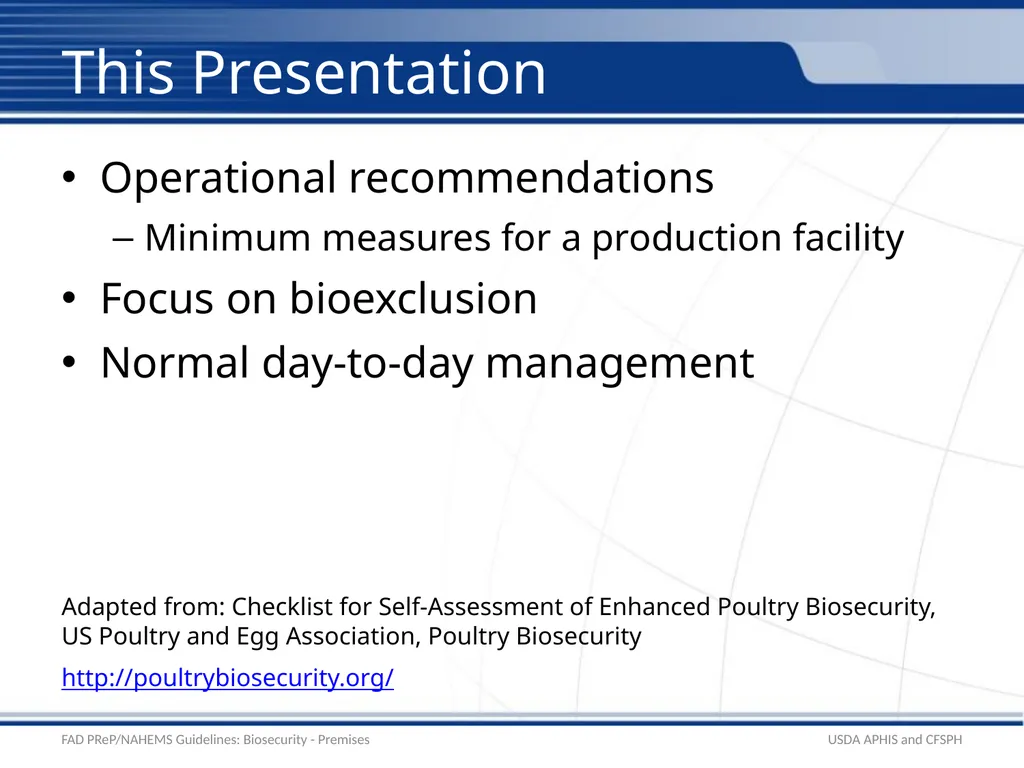
slide2. Operational recommendations
Minimum measures for a production facility
Focus on bioexclusion
Normal day-to-day management
Adapted from: Checklist for Self-Assessment of Enhanced Poultry Biosecurity, US Poultry and Egg Association, Poultry Biosecurity
http://poultrybiosecurity.org/ USDA APHIS and CFSPH FAD PReP/NAHEMS Guidelines: Biosecurity - Premises This Presentation<br>
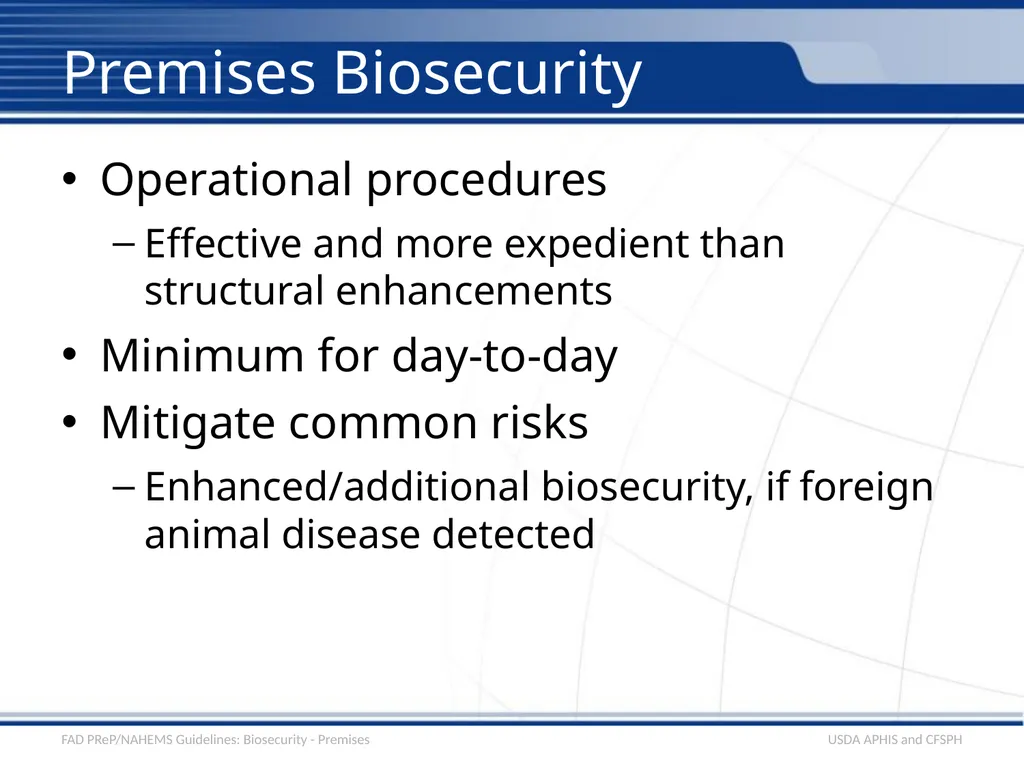
slide3. Operational procedures
Effective and more expedient than structural enhancements
Minimum for day-to-day
Mitigate common risks
Enhanced/additional biosecurity, if foreign animal disease detected USDA APHIS and CFSPH FAD PReP/NAHEMS Guidelines: Biosecurity - Premises Premises Biosecurity<br>
slide4. Assign Responsibility Grant Authority USDA APHIS and CFSPH FAD PReP/NAHEMS Guidelines: Biosecurity - Premises<br>
slide5. Assigned individual, title may vary
Develop site-specific biosecurity plan
Implement effective procedures
Institutionalize the plan
Clearly written
Trains all personnel with appropriate materials
Address changing needs
Monitor compliance by everyone USDA APHIS and CFSPH FAD PReP/NAHEMS Guidelines: Biosecurity - Premises Biosecurity Officer/Manager<br>
slide6. Authority to:
Stop violations
Take corrective actions
Certify the biosecurity plan has consistently been followed by all USDA APHIS and CFSPH FAD PReP/NAHEMS Guidelines: Biosecurity - Premises Biosecurity Officer/Manager cont’d<br>
slide7. Ensure compliance
Biosecurity plan communicated and distributed
To everyone who accesses the facility
Training on site-specific biosecurity procedures
Training materials
Documented, with ongoing audits and refreshers USDA APHIS and CFSPH FAD PReP/NAHEMS Guidelines: Biosecurity - Premises Training of Personnel<br>
slide8. Separation of Clean and Dirty USDA APHIS and CFSPH FAD PReP/NAHEMS Guidelines: Biosecurity - Premises<br>
slide9. Line or barrier
Imagined (i.e., painted line on the ground)
Physical obstruction
Separating clean from dirty
Clean = non-infected
Dirty = potential source of infection
Clean/Dirty Line, C&D Line
Site-specific
Farm level, barn level, or between USDA APHIS and CFSPH FAD PReP/NAHEMS Guidelines: Biosecurity - Premises Line of Separation<br>
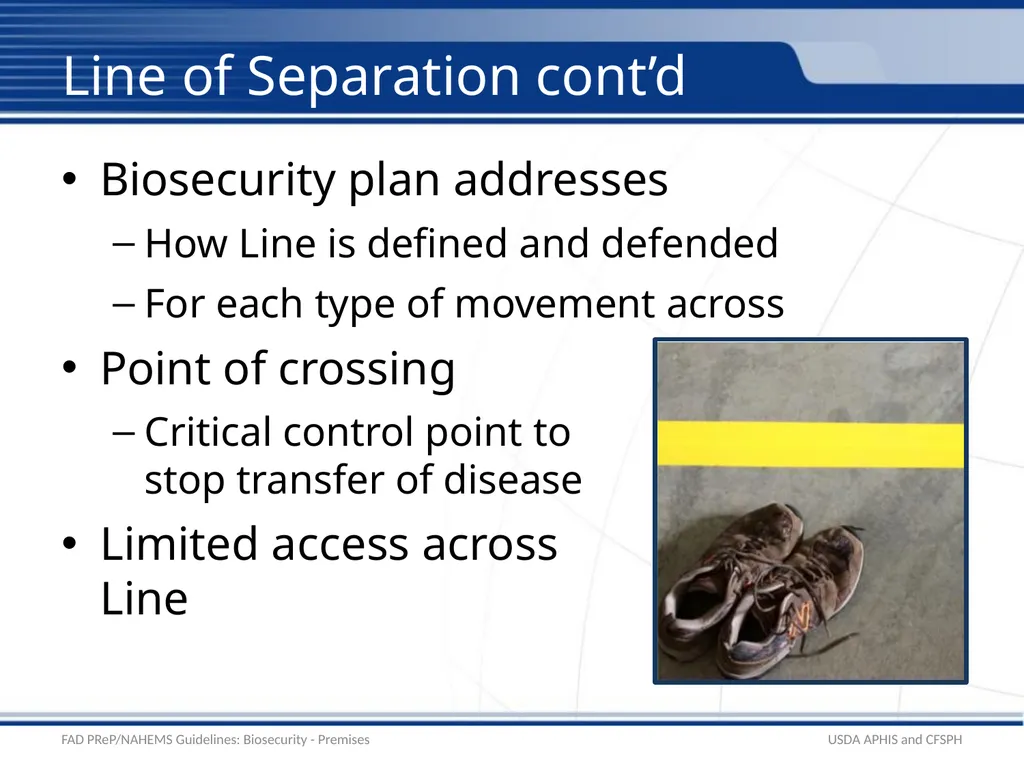
slide10. Biosecurity plan addresses
How Line is defined and defended
For each type of movement across
Point of crossing
Critical control point to stop transfer of disease
Limited access across Line USDA APHIS and CFSPH FAD PReP/NAHEMS Guidelines: Biosecurity - Premises Line of Separation cont’d<br>
slide11. Incorporated into plans for animals raised indoors
Sanitation standard reduces pathogen load in the environment
Additional separation between contaminated and non-contaminated
Further protects susceptible animals
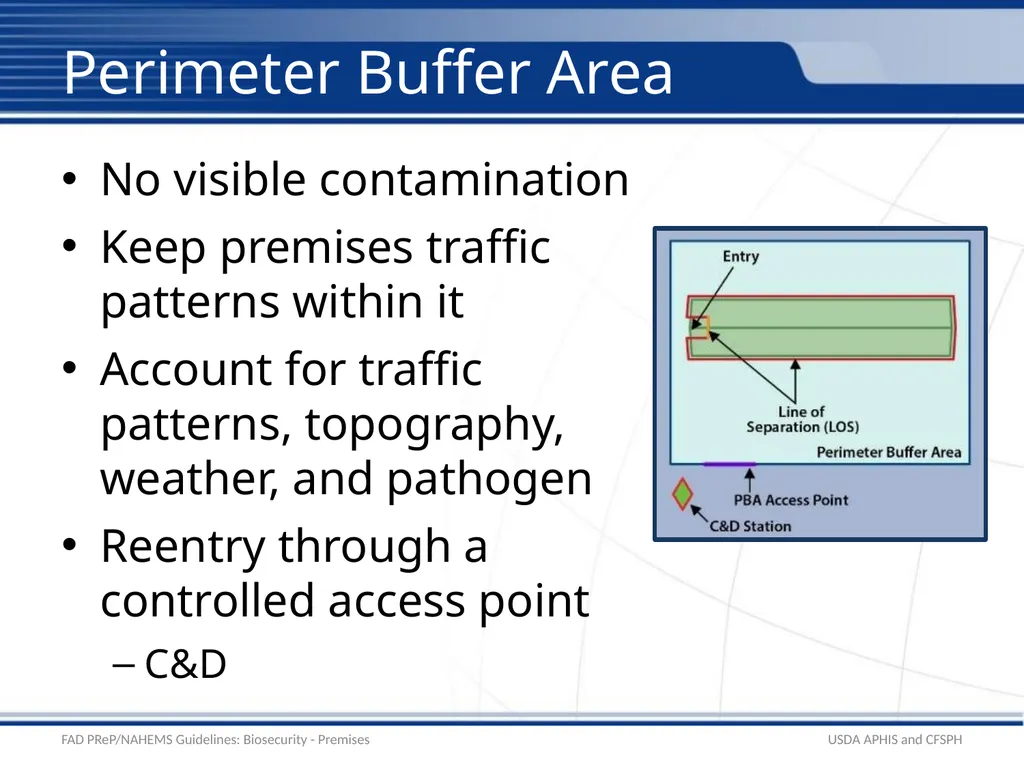
Clearly delineated USDA APHIS and CFSPH FAD PReP/NAHEMS Guidelines: Biosecurity - Premises Perimeter Buffer Area<br>
slide12. No visible contamination
Keep premises traffic patterns within it
Account for traffic patterns, topography, weather, and pathogen
Reentry through a controlled access point
C&D USDA APHIS and CFSPH FAD PReP/NAHEMS Guidelines: Biosecurity - Premises Perimeter Buffer Area<br>
slide13. Biosecurity Protocols USDA APHIS and CFSPH FAD PReP/NAHEMS Guidelines: Biosecurity - Premises<br>
slide14. Personnel and clothing/footwear
Site-specific procedures
Actions required before arrival
Actions at critical control points
Limits/controls access of pathogen to “clean” area via personnel
Shower/don clean outerwear
Mandatory to cross Line of Separation and/or enter Perimeter Buffer Area USDA APHIS and CFSPH FAD PReP/NAHEMS Guidelines: Biosecurity - Premises Personnel<br>
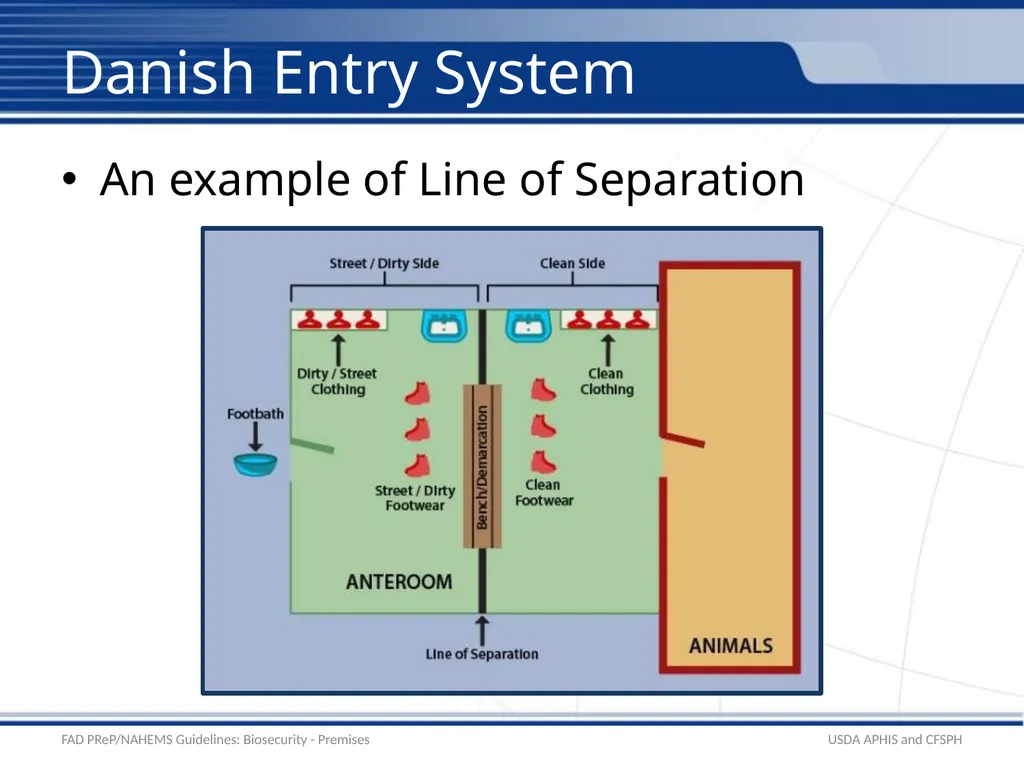
slide15. An example of Line of Separation USDA APHIS and CFSPH FAD PReP/NAHEMS Guidelines: Biosecurity - Premises Danish Entry System<br>
slide16. Prevent transfer of disease by vectors (biological and mechanical)
Address the exclusion or elimination of vectors
Avoid environmental contamination
Prevent the movement of contaminated material
Mitigate situations and habitat that attract wildlife and scavengers USDA APHIS and CFSPH FAD PReP/NAHEMS Guidelines: Biosecurity - Premises Vectors – Pets, Wildlife, and Insects<br>
slide17. Clean and sanitize before crossing the Line of Separation
Have sufficient equipment available
Avoid sharing USDA APHIS and CFSPH FAD PReP/NAHEMS Guidelines: Biosecurity - Premises Equipment<br>
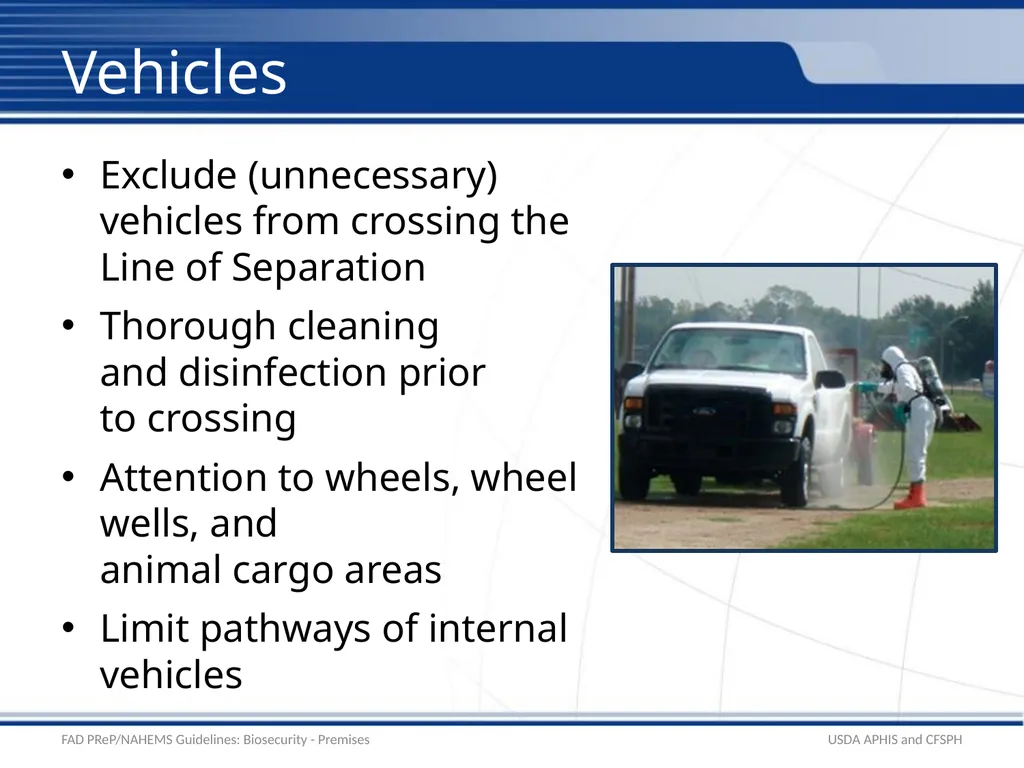
slide18. Exclude (unnecessary) vehicles from crossing the Line of Separation
Thorough cleaning and disinfection prior to crossing
Attention to wheels, wheel wells, and animal cargo areas
Limit pathways of internal vehicles USDA APHIS and CFSPH FAD PReP/NAHEMS Guidelines: Biosecurity - Premises Vehicles<br>
slide19. Protect susceptible animals from exposure
Avoid cross-contamination of pathways
Keep disposal service vehicles outside the Line of Separation
Prevent attracting wild animals or scavengers USDA APHIS and CFSPH FAD PReP/NAHEMS Guidelines: Biosecurity - Premises Carcass/Manure Disposal<br>
slide20. Closed herd or additions with documented health status
Isolate new animals for 30 days
All-in/all-out management
Housing cleaned between groups
Animals transported in cleaned and disinfected vehicles USDA APHIS and CFSPH FAD PReP/NAHEMS Guidelines: Biosecurity - Premises Animals<br>
slide21. Can be contaminated if exposed to pathogens
Store and handle properly
Immediately clean grain spills
Deliveries at remote locations
Use water from deep wells or treated sources USDA APHIS and CFSPH FAD PReP/NAHEMS Guidelines: Biosecurity - Premises Feed, Bedding/Litter, Water Supply<br>
slide22. Secure Food Supply Plans
Guidelines to minimize disease spread and ensure safe wholesome supply
Specific biosecurity standards
Available plans:
Secure Poultry Supply
Secure Milk Supply
Secure Pork Supply USDA APHIS and CFSPH FAD PReP/NAHEMS Guidelines: Biosecurity - Premises Continuity of Business<br>
slide23. Biosecurity
Maintains food safety and security
Protects the environment
Facilitates continuity of business
Excludes/contains disease
Site- and circumstance-specific
Consistent compliance USDA APHIS and CFSPH FAD PReP/NAHEMS Guidelines: Biosecurity - Premises Conclusion<br>
slide24. USDA APHIS and CFSPH FAD PReP/NAHEMS Guidelines: Biosecurity - Premises For More Information FAD PReP/NAHEMS Guidelines & SOP: Biosecurity (2016)
http://www.aphis.usda.gov/fadprep
Biosecurity web-based training module:
http://naherc.sws.iastate.edu/<br>
slide25. Authors (CFSPH)
Janice P. Mogan, DVM
Heather Allen, PhD, MPA
Kristen Bretz, MS
Reviewers (USDA)
Jonathan T. Zack, DVM
James A. Roth, DVM, PhD, DACVM USDA APHIS and CFSPH FAD PReP/NAHEMS Guidelines: Biosecurity - Premises Guidelines Content<br>
slide26. Acknowledgments Development of this presentation was by the Center for Food Security and Public Health at Iowa State University through funding from the USDA APHIS Veterinary Services PPT Authors: Janice P. Mogan, DVM; Logan Kilburn Reviewer: Kristen Bretz, MS<br>
slide2. Operational recommendations
Minimum measures for a production facility
Focus on bioexclusion
Normal day-to-day management
Adapted from: Checklist for Self-Assessment of Enhanced Poultry Biosecurity, US Poultry and Egg Association, Poultry Biosecurity
http://poultrybiosecurity.org/ USDA APHIS and CFSPH FAD PReP/NAHEMS Guidelines: Biosecurity - Premises This Presentation<br>
slide3. Operational procedures
Effective and more expedient than structural enhancements
Minimum for day-to-day
Mitigate common risks
Enhanced/additional biosecurity, if foreign animal disease detected USDA APHIS and CFSPH FAD PReP/NAHEMS Guidelines: Biosecurity - Premises Premises Biosecurity<br>
slide4. Assign Responsibility Grant Authority USDA APHIS and CFSPH FAD PReP/NAHEMS Guidelines: Biosecurity - Premises<br>
slide5. Assigned individual, title may vary
Develop site-specific biosecurity plan
Implement effective procedures
Institutionalize the plan
Clearly written
Trains all personnel with appropriate materials
Address changing needs
Monitor compliance by everyone USDA APHIS and CFSPH FAD PReP/NAHEMS Guidelines: Biosecurity - Premises Biosecurity Officer/Manager<br>
slide6. Authority to:
Stop violations
Take corrective actions
Certify the biosecurity plan has consistently been followed by all USDA APHIS and CFSPH FAD PReP/NAHEMS Guidelines: Biosecurity - Premises Biosecurity Officer/Manager cont’d<br>
slide7. Ensure compliance
Biosecurity plan communicated and distributed
To everyone who accesses the facility
Training on site-specific biosecurity procedures
Training materials
Documented, with ongoing audits and refreshers USDA APHIS and CFSPH FAD PReP/NAHEMS Guidelines: Biosecurity - Premises Training of Personnel<br>
slide8. Separation of Clean and Dirty USDA APHIS and CFSPH FAD PReP/NAHEMS Guidelines: Biosecurity - Premises<br>
slide9. Line or barrier
Imagined (i.e., painted line on the ground)
Physical obstruction
Separating clean from dirty
Clean = non-infected
Dirty = potential source of infection
Clean/Dirty Line, C&D Line
Site-specific
Farm level, barn level, or between USDA APHIS and CFSPH FAD PReP/NAHEMS Guidelines: Biosecurity - Premises Line of Separation<br>
slide10. Biosecurity plan addresses
How Line is defined and defended
For each type of movement across
Point of crossing
Critical control point to stop transfer of disease
Limited access across Line USDA APHIS and CFSPH FAD PReP/NAHEMS Guidelines: Biosecurity - Premises Line of Separation cont’d<br>
slide11. Incorporated into plans for animals raised indoors
Sanitation standard reduces pathogen load in the environment
Additional separation between contaminated and non-contaminated
Further protects susceptible animals
Clearly delineated USDA APHIS and CFSPH FAD PReP/NAHEMS Guidelines: Biosecurity - Premises Perimeter Buffer Area<br>
slide12. No visible contamination
Keep premises traffic patterns within it
Account for traffic patterns, topography, weather, and pathogen
Reentry through a controlled access point
C&D USDA APHIS and CFSPH FAD PReP/NAHEMS Guidelines: Biosecurity - Premises Perimeter Buffer Area<br>
slide13. Biosecurity Protocols USDA APHIS and CFSPH FAD PReP/NAHEMS Guidelines: Biosecurity - Premises<br>
slide14. Personnel and clothing/footwear
Site-specific procedures
Actions required before arrival
Actions at critical control points
Limits/controls access of pathogen to “clean” area via personnel
Shower/don clean outerwear
Mandatory to cross Line of Separation and/or enter Perimeter Buffer Area USDA APHIS and CFSPH FAD PReP/NAHEMS Guidelines: Biosecurity - Premises Personnel<br>
slide15. An example of Line of Separation USDA APHIS and CFSPH FAD PReP/NAHEMS Guidelines: Biosecurity - Premises Danish Entry System<br>
slide16. Prevent transfer of disease by vectors (biological and mechanical)
Address the exclusion or elimination of vectors
Avoid environmental contamination
Prevent the movement of contaminated material
Mitigate situations and habitat that attract wildlife and scavengers USDA APHIS and CFSPH FAD PReP/NAHEMS Guidelines: Biosecurity - Premises Vectors – Pets, Wildlife, and Insects<br>
slide17. Clean and sanitize before crossing the Line of Separation
Have sufficient equipment available
Avoid sharing USDA APHIS and CFSPH FAD PReP/NAHEMS Guidelines: Biosecurity - Premises Equipment<br>
slide18. Exclude (unnecessary) vehicles from crossing the Line of Separation
Thorough cleaning and disinfection prior to crossing
Attention to wheels, wheel wells, and animal cargo areas
Limit pathways of internal vehicles USDA APHIS and CFSPH FAD PReP/NAHEMS Guidelines: Biosecurity - Premises Vehicles<br>
slide19. Protect susceptible animals from exposure
Avoid cross-contamination of pathways
Keep disposal service vehicles outside the Line of Separation
Prevent attracting wild animals or scavengers USDA APHIS and CFSPH FAD PReP/NAHEMS Guidelines: Biosecurity - Premises Carcass/Manure Disposal<br>
slide20. Closed herd or additions with documented health status
Isolate new animals for 30 days
All-in/all-out management
Housing cleaned between groups
Animals transported in cleaned and disinfected vehicles USDA APHIS and CFSPH FAD PReP/NAHEMS Guidelines: Biosecurity - Premises Animals<br>
slide21. Can be contaminated if exposed to pathogens
Store and handle properly
Immediately clean grain spills
Deliveries at remote locations
Use water from deep wells or treated sources USDA APHIS and CFSPH FAD PReP/NAHEMS Guidelines: Biosecurity - Premises Feed, Bedding/Litter, Water Supply<br>
slide22. Secure Food Supply Plans
Guidelines to minimize disease spread and ensure safe wholesome supply
Specific biosecurity standards
Available plans:
Secure Poultry Supply
Secure Milk Supply
Secure Pork Supply USDA APHIS and CFSPH FAD PReP/NAHEMS Guidelines: Biosecurity - Premises Continuity of Business<br>
slide23. Biosecurity
Maintains food safety and security
Protects the environment
Facilitates continuity of business
Excludes/contains disease
Site- and circumstance-specific
Consistent compliance USDA APHIS and CFSPH FAD PReP/NAHEMS Guidelines: Biosecurity - Premises Conclusion<br>
slide24. USDA APHIS and CFSPH FAD PReP/NAHEMS Guidelines: Biosecurity - Premises For More Information FAD PReP/NAHEMS Guidelines & SOP: Biosecurity (2016)
http://www.aphis.usda.gov/fadprep
Biosecurity web-based training module:
http://naherc.sws.iastate.edu/<br>
slide25. Authors (CFSPH)
Janice P. Mogan, DVM
Heather Allen, PhD, MPA
Kristen Bretz, MS
Reviewers (USDA)
Jonathan T. Zack, DVM
James A. Roth, DVM, PhD, DACVM USDA APHIS and CFSPH FAD PReP/NAHEMS Guidelines: Biosecurity - Premises Guidelines Content<br>
slide26. Acknowledgments Development of this presentation was by the Center for Food Security and Public Health at Iowa State University through funding from the USDA APHIS Veterinary Services PPT Authors: Janice P. Mogan, DVM; Logan Kilburn Reviewer: Kristen Bretz, MS<br>