
Bitcoin and Blockchain Technology: A Quick
Description: Bitcoin and Blockchain Technology: A Quick Introduction for the Shipping Industry Ferdinando M. Ametrano https:www.ametrano.netabout Bitcoin (and Blockchain): Hard to Understand At the crossroads of: Cryptography Computer networking and
Related Topics
Download Presentation
"Bitcoin and Blockchain Technology: A Quick" is the property of its rightful owner. Permission is granted to download and print the materials on this website for personal, non-commercial use only, and to display it on your personal computer provided you do not modify the materials and that you retain all copyright notices contained in the materials. By downloading content from our website, you accept the terms of this agreement.
Presentation Transcript
slide1. Bitcoin and Blockchain Technology:
A Quick Introduction for the Shipping Industry Ferdinando M. Ametrano
https://www.ametrano.net/about/<br>
slide2. Bitcoin (and Blockchain): Hard to Understand At the crossroads of:
Cryptography
Computer networking and distributed systems
Game theory
Monetary theory
Mainly not a technology,
a cultural paradigm shift instead<br>
slide3. Table of Contents Internet Money
The Double Spending Problem
Bitcoin as Digital Gold
Blockchain Without Bitcoin
Blockchain Beyond Bitcoin: Notarization
Blockchain and Shipping Industry<br>
slide4. Decentralized digital currency
Not backed by any government or organization
No need for trusted third party
Instantaneous peer-to-peer transactions
Cryptographic security
Synergic economic incentives
Efficient low-cost banking for everybody everywhere
https://bitcoin.org/en/faq
http://www.coindesk.com/information/<br>
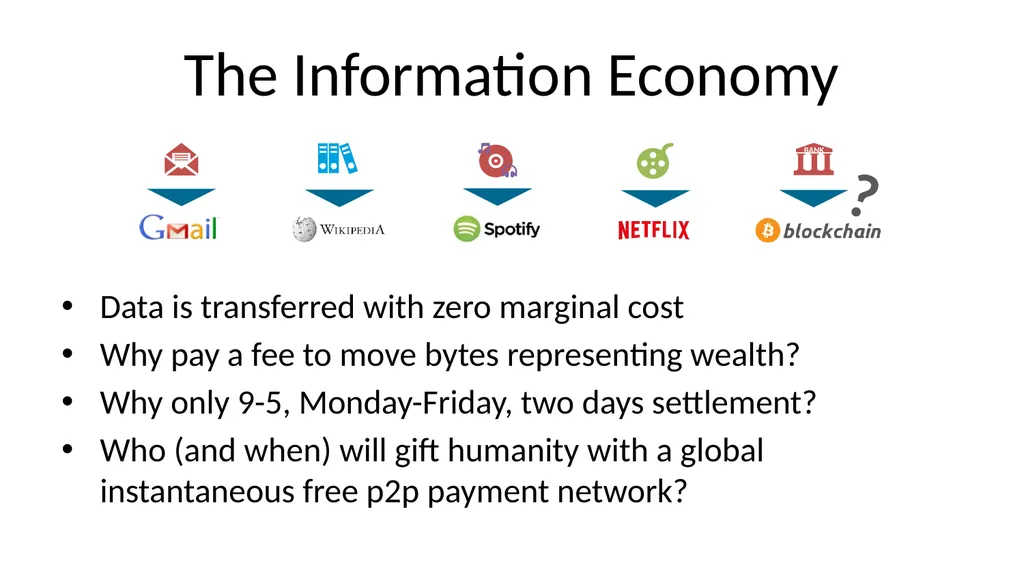
slide5. The Information Economy Data is transferred with zero marginal cost
Why pay a fee to move bytes representing wealth?
Why only 9-5, Monday-Friday, two days settlement?
Who (and when) will gift humanity with a global instantaneous free p2p payment network?<br>
slide6. Permissionless Innovation: Gentle, Fast, and Effective No centralized security mechanism, no barrier to enter, no editorial control
Email has not been designed by a consortium of postal agencies
Internet has not been developed by a consortium of telcos
Will a new money and its decentralized transactional network be designed by a consortium of banks?<br>
slide7. Money As A Social Relation Instrument Human beings are born into a gift economy
Enlarged relationship circle requires exchange economy
Barter economy: coincidence of wants
Trade economy: money as medium of exchange
Global information economy: supranational digital money<br>
slide8. Friedrich August von Hayek Denationalisation of Money history of coinage is an almost uninterrupted story of debasements; history is largely a history of inflation engineered by governments for their gain
why government monopoly of the provision of money is regarded as indispensable? It deprived public of the opportunity to discover and use a better reliable money
Blessed will be the day when it will no longer be from the benevolence of the government that we expect good money but from the regard of the banks for their own interest
A Free-Market Monetary System, Gold and Monetary Conference, New Orleans, Nov. 1977, https://mises.org/daily/3204
Hayek, F. A., Denationalisation of Money, The Institute of Economic Affairs, http://www.mises.org/books/denationalisation.pdf<br>
slide9. Table of Contents Internet Money
The Double Spending Problem
Bitcoin as Digital Gold
Blockchain Without Bitcoin
Beyond Bitcoin: Notarization
Bitcoin as Investment Asset<br>
slide10. The Double Spending Problem To securely transfer value using digital means has been possible for decades
In digital cash schemes, a single digital token, being just a file that can be duplicated, can be spent twice
A centralized trusted party has always been required to prevent double spending<br>
slide11. Bitcoin Network: A Distributed Back-office All network nodes validate and clear all transactions
Mining nodes provides also the additional computational power required for settlement
Without a central trusted party, how do they reach consensus on the transaction history?
Consensus in a distributed network with faulty (or malicious) nodes is a very hard problem<br>
slide12. Mining Miners compete to validate a new block of transactions
The winner providing proof-of-work for the finalization of a new block is rewarded with the issuance of new bitcoins in a special coinbase transaction included in that same block
Miners solve the double spending problem:
transactions spending the same coins would invalidate the block
an invalid block would be rejected from the network
the bitcoin reward would be removed from transaction history
The winning miner would have wasted his work<br>
slide13. Nakamoto Distributed Consensus Practical Byzantine Fault Tolerant (PBFT) distributed consensus is achieved using (game theory) economic incentive for the mining nodes to be honest
Double spending is solved without a central trusted party
Bitcoin can resist attacks of malicious agents, as long as they do not control network majority
Miners are compensated for their proof-of-work using seigniorage revenues, i.e. with issuance of new bitcoins
Seigniorage revenues subsidize the network<br>
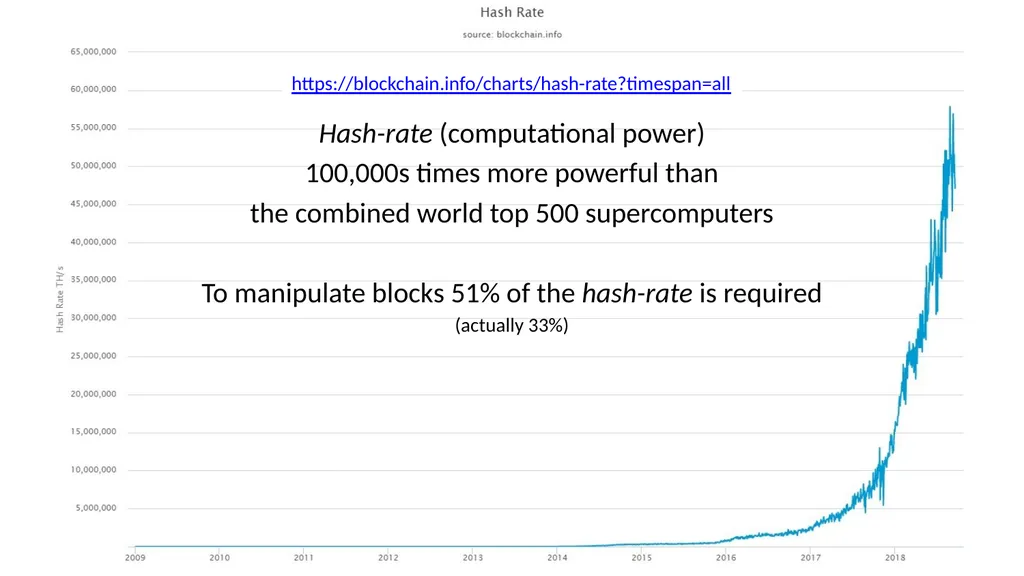
slide14. Hash-rate (computational power)
100,000s times more powerful than
the combined world top 500 supercomputers
To manipulate blocks 51% of the hash-rate is required
(actually 33%) https://blockchain.info/charts/hash-rate?timespan=all<br>
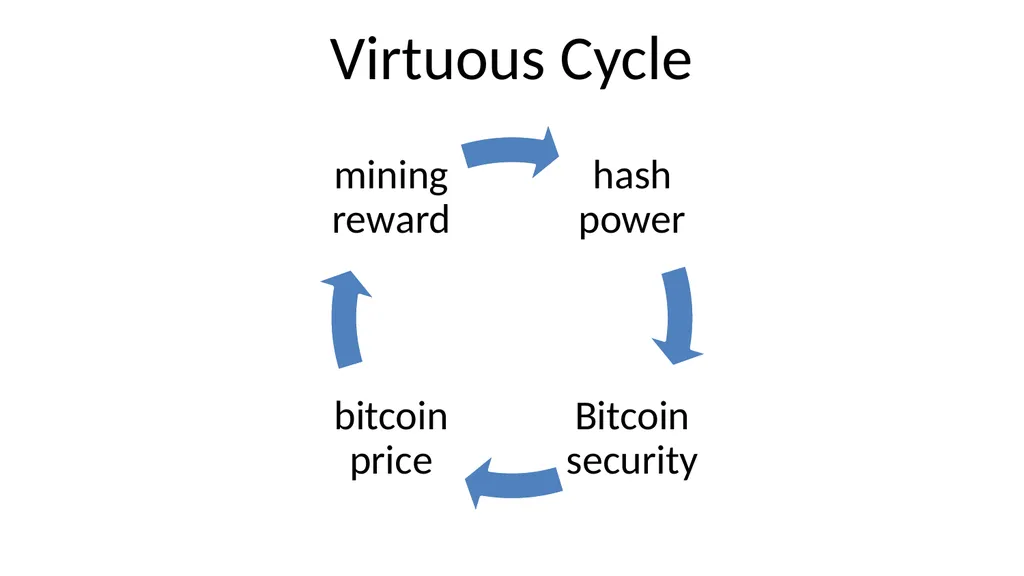
slide15. Virtuous Cycle<br>
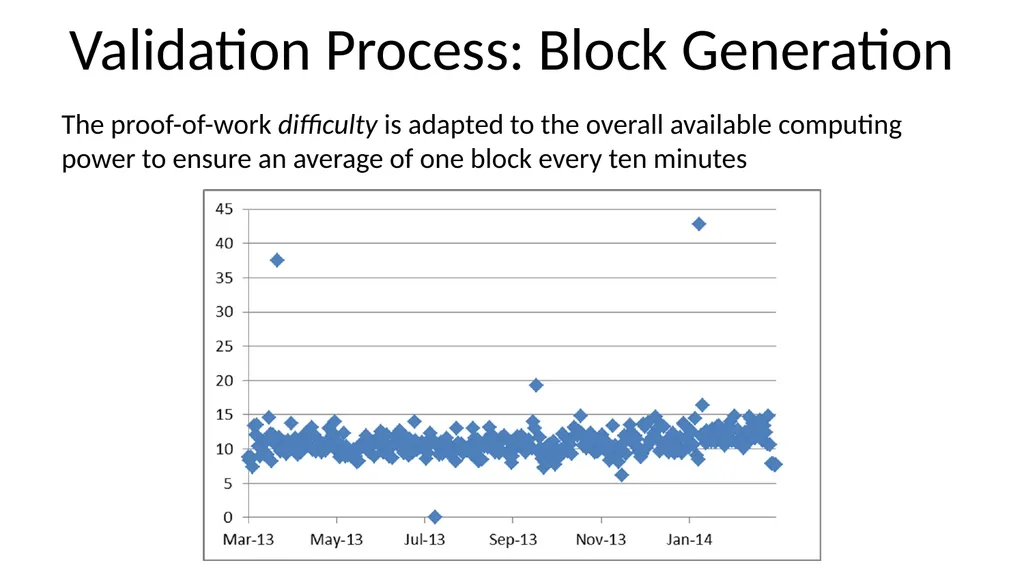
slide16. Validation Process: Block Generation The proof-of-work difficulty is adapted to the overall available computing power to ensure an average of one block every ten minutes<br>
slide17. Table of Contents Internet Money
The Double Spending Problem
Bitcoin as Digital Gold
Blockchain Without Bitcoin
Beyond Bitcoin: Notarization
Bitcoin as Investment Asset<br>
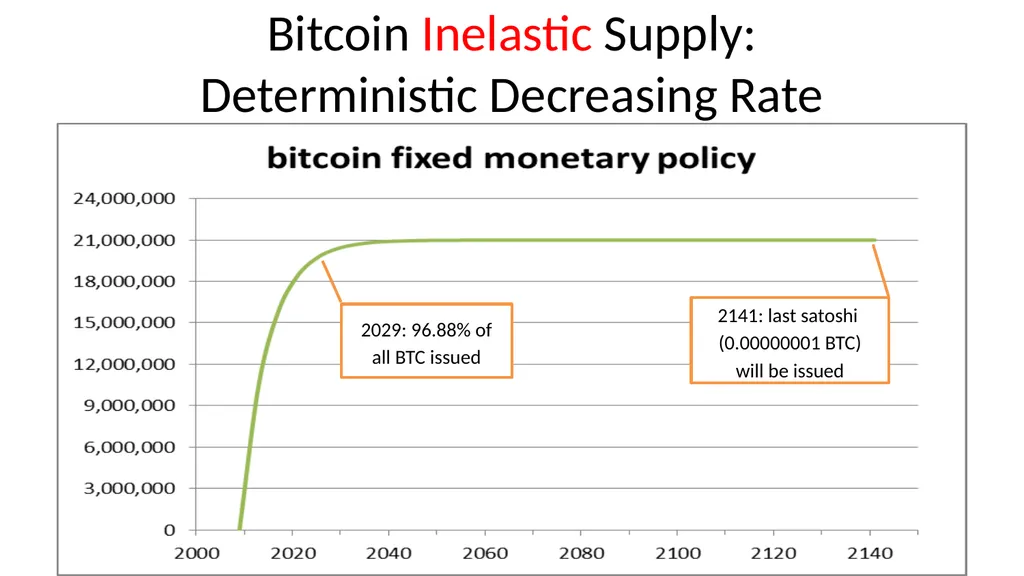
slide18. Bitcoin Monetary Rule 2009: 50BTC per block, every 10 minutes
halving every 4Y
This is the only way new bitcoins are released
It is called mining because of its similarity with the progressive scarcity of gold extraction
Supply free of discretionary intervention<br>
slide19. Bitcoin Inelastic Supply: Deterministic Decreasing Rate chart<br>
slide20. What Makes Bitcoin Special? Digital and scriptural: it only exists as validated transaction
Asset, not liability
Bearer instrument
It can be transferred but not duplicated (i.e. it can be spent, but not double-spent)
Scarce in digital realm, as nothing else before
It mimics gold monetary policy<br>
slide21. What Makes Bitcoin Special? Bitcoin is digital gold
with a secure uncensorable embedded
settlement network
More a crypto-commodity then a crypto-currency
This is the groundbreaking achievement by Satoshi Nakamoto, not blockchain “technology”<br>
slide22. Bitcoin Relevance If one thinks about the role of physical gold in the history of civilization, money, and finance
the digital equivalent of gold could be disruptive
in the current digital civilization and the future of money and finance
Bitcoin can be the new global reserve asset<br>
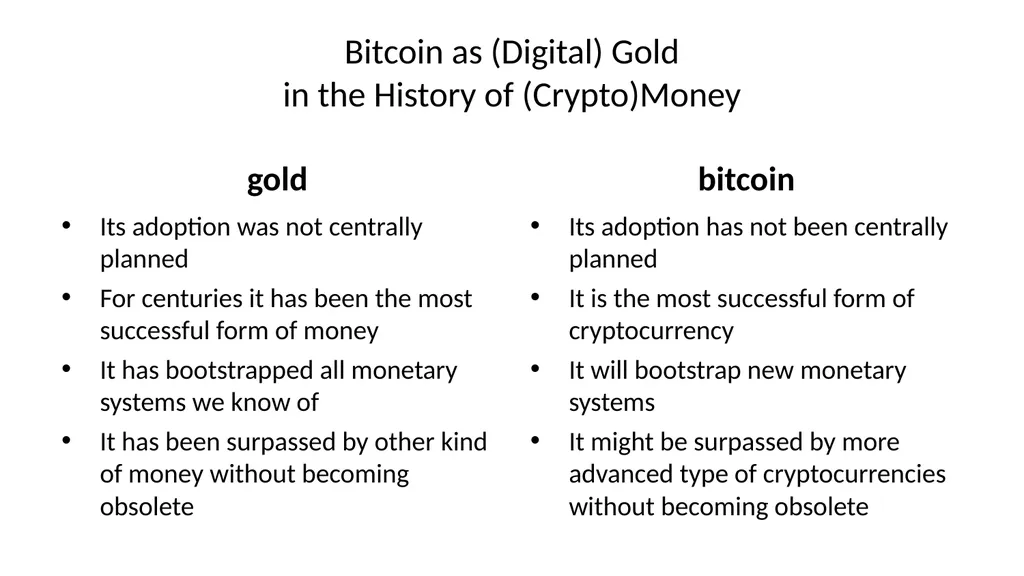
slide23. Bitcoin as (Digital) Gold in the History of (Crypto)Money gold Its adoption was not centrally planned
For centuries it has been the most successful form of money
It has bootstrapped all monetary systems we know of
It has been surpassed by other kind of money without becoming obsolete bitcoin Its adoption has not been centrally planned
It is the most successful form of cryptocurrency
It will bootstrap new monetary systems
It might be surpassed by more advanced type of cryptocurrencies without becoming obsolete<br>
slide24. Table of Contents Internet Money
The Double Spending Problem
Bitcoin as Digital Gold
Blockchain Without Bitcoin
Beyond Bitcoin: Notarization
Bitcoin as Investment Asset<br>
slide25. What is The Blockchain? [A hash pointer linked list of blocks]
An append-only sequential data structure
New blocks can only be appended at the end of the chain
To change a block in the middle of the chain, all subsequent blocks need to be changed
Very inefficient compared to a relational database<br>
slide26. Blockchain Without Bitcoin Does it make sense?
No bitcoin
No asset available to reward miners
Appointed validator officials required
Central governance is required!
Why should validators use a blockchain,
i.e. a subpar data structure, instead of a database?<br>
slide27. A Dramatic Misunderstanding “When a wise man points at the moon the fool examines the finger.” (Confucius)
“When a wise man points at the bitcoin the fool examines the blockchain.” (Ametrano)<br>
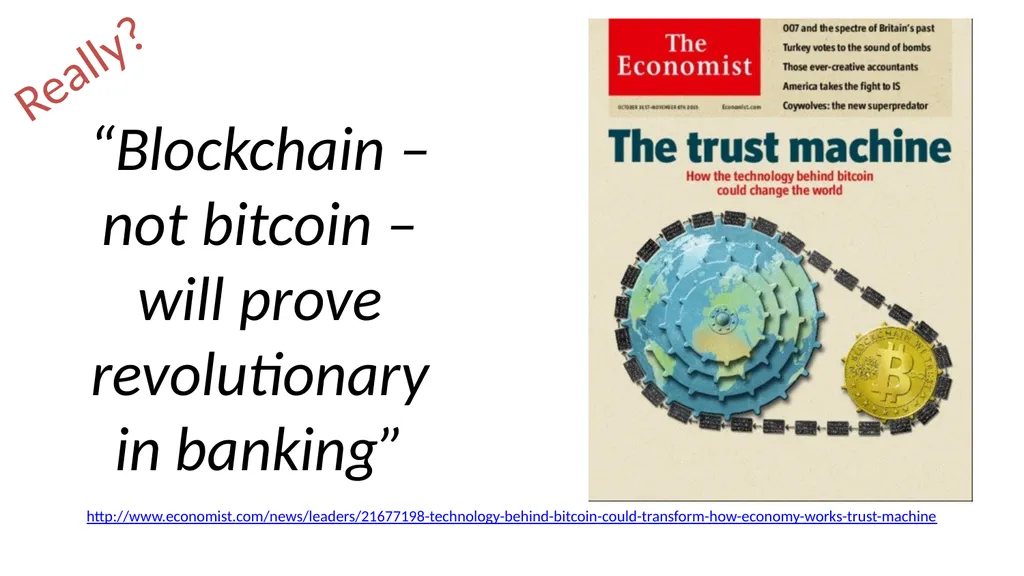
slide28. “Blockchain – not bitcoin – will prove revolutionary in banking” http://www.economist.com/news/leaders/21677198-technology-behind-bitcoin-could-transform-how-economy-works-trust-machine Really?<br>
slide29. Why is finance fascinated with blockchain? Blockchain transactions are immediately validated and cleared, then settled shortly thereafter,
automatically without a central authority
In the financial world, cash transactions only are cleared and settled automatically without a central authority © Ferdinando Ametrano 2018 29/114<br>
slide30. Consensus by reconciliation Financial transactions that take milliseconds to execute, clear and settle in days
Not a technological problem
Consensus by reconciliation of multiple independent ledgers: a checks and balances system that allows for prescriptions, corrections, and restrictions © Ferdinando Ametrano 2018 30/114<br>
slide31. The Mirage of Low Operational Costs If one takes into account the seigniorage revenues invested, each transaction on the bitcoin blockchain has a cost of about 10USD
Cheaper forms of consensus have not been proven yet
Even in the case of basic bilateral consensus through digital signatures (something hardly innovative or disruptive...) the integration cost in the existing infrastructure is not going to be irrelevant © Ferdinando Ametrano 2018 31/114<br>
slide32. Single Shared Data Set Single data source, avoiding reconciliation
Without a central governing node how to manage priorities between conflicting updates? Which consensus model?
Bilateral consensus? Really?!?!?
Central governance: back to DB admin
What if the single authoritative data source is hacked? Which reference can be used to fix it? © Ferdinando Ametrano 2018 32/114<br>
slide33. Blockchain as Distributed Database Incremental evolution from standard databases, also available using traditional distributed databases techniques
Blockchains have not been designed to be used as databases: poor writing performances and abysmal querying abilities<br>
slide34. Real Use Cases Are Still Missing Questions to be answered:
Can be achieved with a database?
What consensus is required? (distributed, bilateral, centralized)
What kind of security is required: preventive, detective, or corrective? (ok / yes today, probably not in the future/ no) © Ferdinando Ametrano 2018 34/114<br>
slide35. Cryptography, Not Blockchain In the nuclear explosion of bitcoin, applied cryptography is the radioactive fallout
It can be used to harden existing business processes
Databases on cryptographic steroids
Evolutionary, non-disruptive, technology<br>
slide36. Table of Contents Internet Money
The Double Spending Problem
Bitcoin as Digital Gold
Blockchain Without Bitcoin
Beyond Bitcoin: Notarization
Bitcoin as Investment Asset<br>
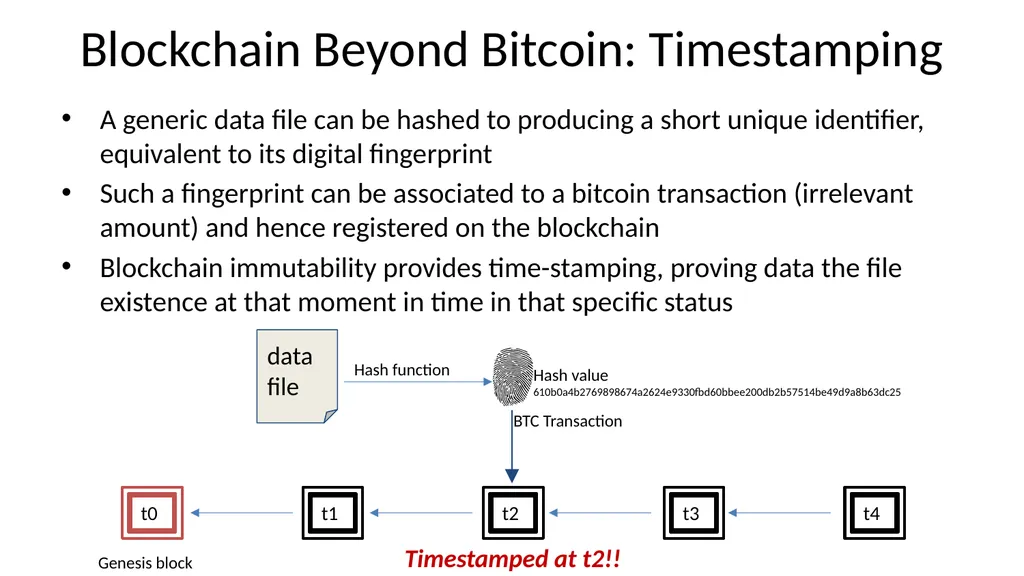
slide37. Blockchain Beyond Bitcoin: Timestamping A generic data file can be hashed to producing a short unique identifier, equivalent to its digital fingerprint
Such a fingerprint can be associated to a bitcoin transaction (irrelevant amount) and hence registered on the blockchain
Blockchain immutability provides time-stamping, proving data the file existence at that moment in time in that specific status data file Timestamped at t2!!<br>
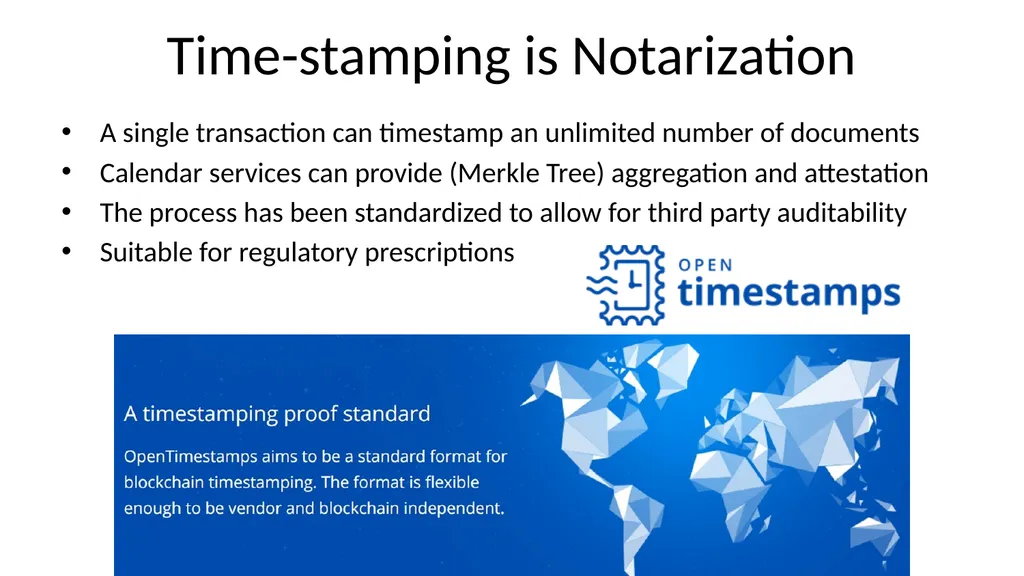
slide38. Time-stamping is Notarization A single transaction can timestamp an unlimited number of documents
Calendar services can provide (Merkle Tree) aggregation and attestation
The process has been standardized to allow for third party auditability
Suitable for regulatory prescriptions<br>
slide39. Digital Gold Jewelry What jewelry is for gold,
notarization could be for bitcoin:
not essential
but effective at leveraging its beauty<br>
slide40. Table of Contents Internet Money
The Double Spending Problem
Bitcoin as Digital Gold
Blockchain Without Bitcoin
Beyond Bitcoin: Notarization
Bitcoin as Investment Asset<br>
slide41. Transformative Blockchain Potential Reshape the flow of trade finance, making logistics in global trade faster and leaner
Eliminate middlemen
Reduce paperwork associated with data entry
Link parties needing to share data on a common platform, increasing the trust associated with geographically dispersed trading partners
Improve transparency and traceability in supply chains, establishing the provenance of a good or raw material from its origin
Tether regulatory processes to physical logistics processes
Automate commercial processes in logistics with smart contracts, triggering supply chain processes (including payment) in real time<br>
slide42. Separate Hype From Reality It is often unclear how blockchain works and what it can do for real
Touted as the solution to all inefficiency, blockchain is moving forward at a very slow pace
Pilots have been conducted in private and with a limited scope: hard to know exactly how successful they have been
RFID, heralded as an industry game-changer in the mid-2000s, never realized its initial promise<br>
slide43. Simplify Trade By Removing Paper and Centralizing Information Digitize logistics documents (booking confirmations, bills of lading, invoices, certificates of origin, customs declarations, etc.)
Digitally sign them and time-stamp (into bitcoin’s blockchain!)
This would make them non-repudiable, making clearer where inaccuracies have occurred, who was responsible for them, and when
Eliminate errors from multiple parties entering the same data into different databases
Blockchain is not needed:
any authoritative central repository would be good enough<br>
slide44. There is No Blockchain Magic Blockchain:
cannot confirm veracity of data
does not make data accurate or people trustworthy
is not needed to audit if data has been tampered with (cryptography is enough)
can only harden digital signature and time-stamping using notarization
“Tech gets adopted when it becomes simple, when it’s demystified” (Eric Rempel, Chief Information Officer, Redwood Logistics)<br>
slide45. Single Version of The Truth Trust does not exist in a vacuum, cannot be generated by a system
Single, permissioned, cloud-based repository of documents
Smart contract automation of ownership transfer once a set of conditions has been met
Smart contract triggering of payments between parties upon change of ownership
This is just shipment management software
and central clearing authority<br>
slide46. There Is No Free Lunch Costs and time are:
required to mature a new technology into a set of private, independent, interoperable solutions
required to set up a new organization: resistance to change and fear of unknown are natural hurdles
required to build a network of distributed parties<br>
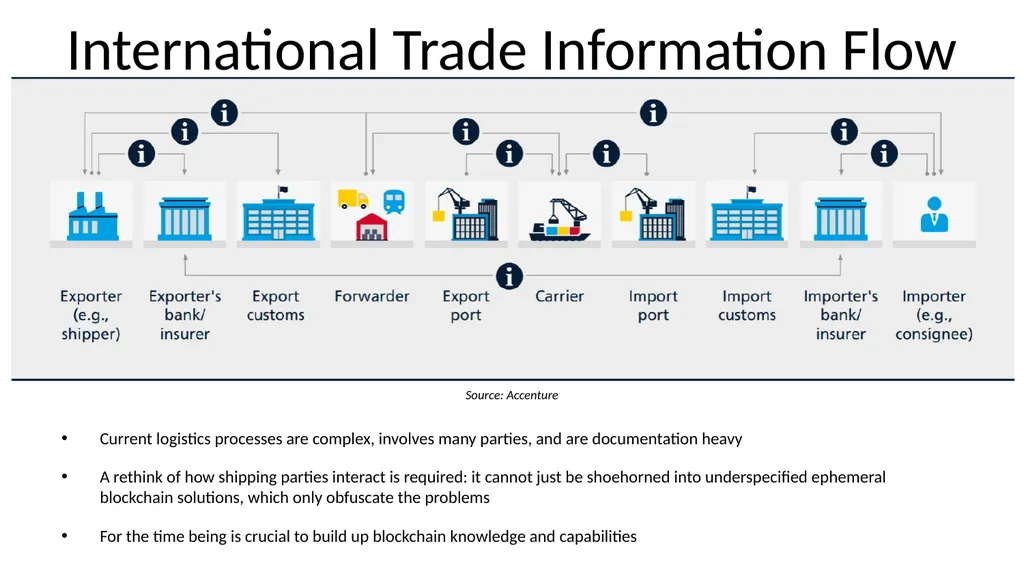
slide47. International Trade Information Flow Source: Accenture
Current logistics processes are complex, involves many parties, and are documentation heavy
A rethink of how shipping parties interact is required: it cannot just be shoehorned into underspecified ephemeral blockchain solutions, which only obfuscate the problems
For the time being is crucial to build up blockchain knowledge and capabilities<br>
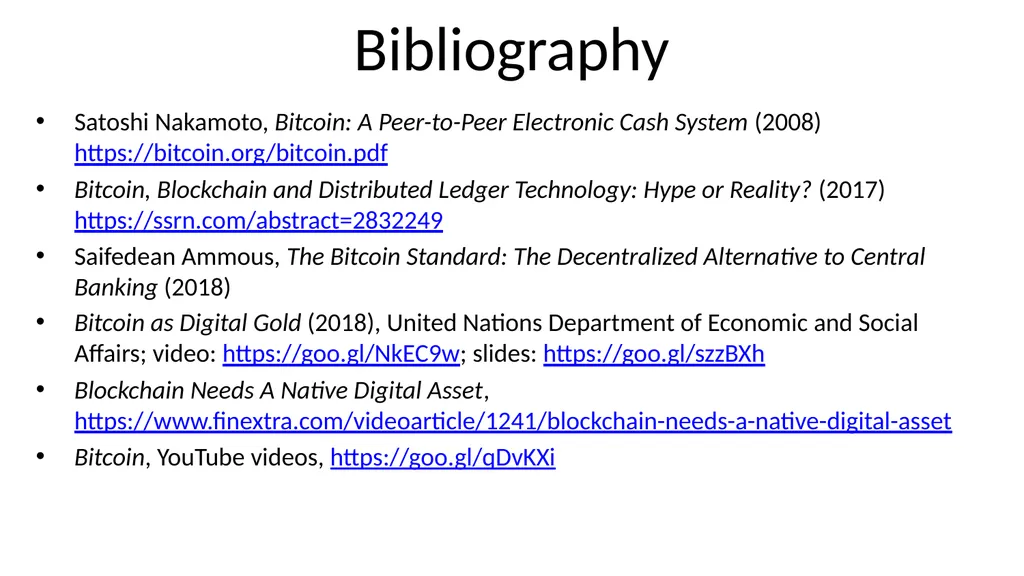
slide48. Bibliography Satoshi Nakamoto, Bitcoin: A Peer-to-Peer Electronic Cash System (2008) https://bitcoin.org/bitcoin.pdf
Bitcoin, Blockchain and Distributed Ledger Technology: Hype or Reality? (2017) https://ssrn.com/abstract=2832249
Saifedean Ammous, The Bitcoin Standard: The Decentralized Alternative to Central Banking (2018)
Bitcoin as Digital Gold (2018), United Nations Department of Economic and Social Affairs; video: https://goo.gl/NkEC9w; slides: https://goo.gl/szzBXh
Blockchain Needs A Native Digital Asset, https://www.finextra.com/videoarticle/1241/blockchain-needs-a-native-digital-asset
Bitcoin, YouTube videos, https://goo.gl/qDvKXi<br>
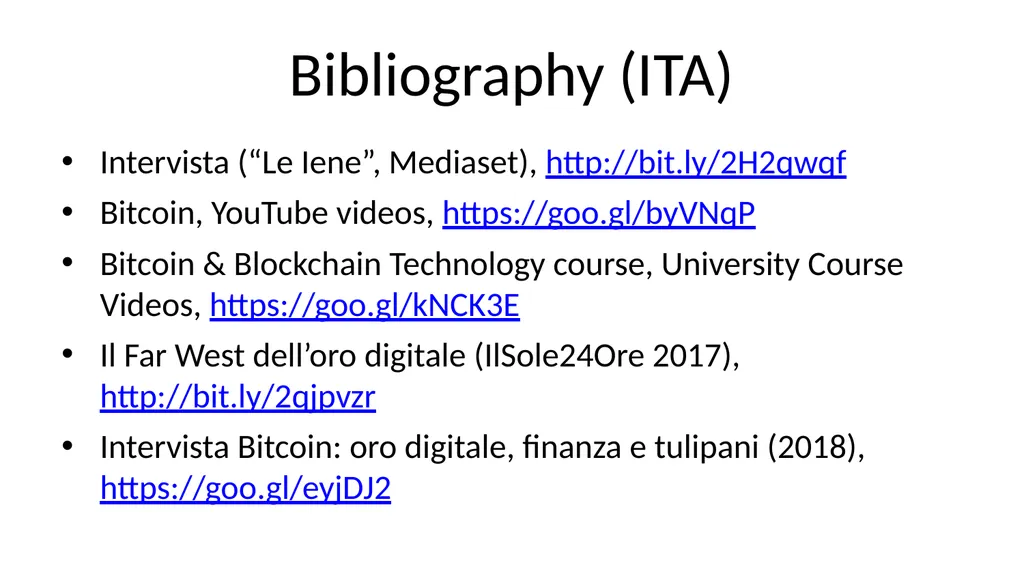
slide49. Bibliography (ITA) Intervista (“Le Iene”, Mediaset), http://bit.ly/2H2qwqf
Bitcoin, YouTube videos, https://goo.gl/byVNqP
Bitcoin & Blockchain Technology course, University Course Videos, https://goo.gl/kNCK3E
Il Far West dell’oro digitale (IlSole24Ore 2017), http://bit.ly/2qjpvzr
Intervista Bitcoin: oro digitale, finanza e tulipani (2018), https://goo.gl/eyjDJ2<br>
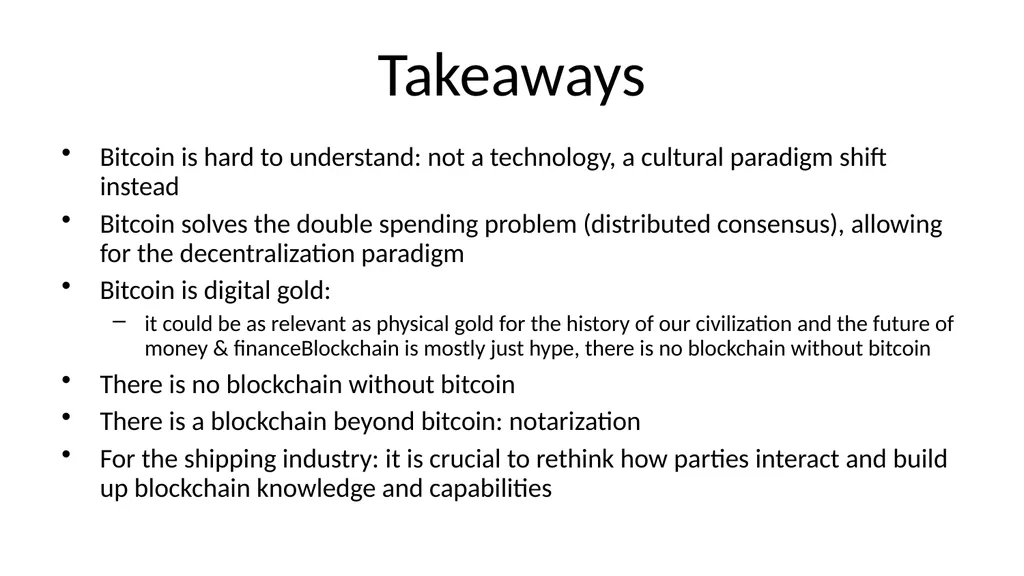
slide50. Takeaways Bitcoin is hard to understand: not a technology, a cultural paradigm shift instead
Bitcoin solves the double spending problem (distributed consensus), allowing for the decentralization paradigm
Bitcoin is digital gold:
it could be as relevant as physical gold for the history of our civilization and the future of money & financeBlockchain is mostly just hype, there is no blockchain without bitcoin
There is no blockchain without bitcoin
There is a blockchain beyond bitcoin: notarization
For the shipping industry: it is crucial to rethink how parties interact and build up blockchain knowledge and capabilities<br>
https://www.ametrano.net/about/<br>
slide2. Bitcoin (and Blockchain): Hard to Understand At the crossroads of:
Cryptography
Computer networking and distributed systems
Game theory
Monetary theory
Mainly not a technology,
a cultural paradigm shift instead<br>
slide3. Table of Contents Internet Money
The Double Spending Problem
Bitcoin as Digital Gold
Blockchain Without Bitcoin
Blockchain Beyond Bitcoin: Notarization
Blockchain and Shipping Industry<br>
slide4. Decentralized digital currency
Not backed by any government or organization
No need for trusted third party
Instantaneous peer-to-peer transactions
Cryptographic security
Synergic economic incentives
Efficient low-cost banking for everybody everywhere
https://bitcoin.org/en/faq
http://www.coindesk.com/information/<br>
slide5. The Information Economy Data is transferred with zero marginal cost
Why pay a fee to move bytes representing wealth?
Why only 9-5, Monday-Friday, two days settlement?
Who (and when) will gift humanity with a global instantaneous free p2p payment network?<br>
slide6. Permissionless Innovation: Gentle, Fast, and Effective No centralized security mechanism, no barrier to enter, no editorial control
Email has not been designed by a consortium of postal agencies
Internet has not been developed by a consortium of telcos
Will a new money and its decentralized transactional network be designed by a consortium of banks?<br>
slide7. Money As A Social Relation Instrument Human beings are born into a gift economy
Enlarged relationship circle requires exchange economy
Barter economy: coincidence of wants
Trade economy: money as medium of exchange
Global information economy: supranational digital money<br>
slide8. Friedrich August von Hayek Denationalisation of Money history of coinage is an almost uninterrupted story of debasements; history is largely a history of inflation engineered by governments for their gain
why government monopoly of the provision of money is regarded as indispensable? It deprived public of the opportunity to discover and use a better reliable money
Blessed will be the day when it will no longer be from the benevolence of the government that we expect good money but from the regard of the banks for their own interest
A Free-Market Monetary System, Gold and Monetary Conference, New Orleans, Nov. 1977, https://mises.org/daily/3204
Hayek, F. A., Denationalisation of Money, The Institute of Economic Affairs, http://www.mises.org/books/denationalisation.pdf<br>
slide9. Table of Contents Internet Money
The Double Spending Problem
Bitcoin as Digital Gold
Blockchain Without Bitcoin
Beyond Bitcoin: Notarization
Bitcoin as Investment Asset<br>
slide10. The Double Spending Problem To securely transfer value using digital means has been possible for decades
In digital cash schemes, a single digital token, being just a file that can be duplicated, can be spent twice
A centralized trusted party has always been required to prevent double spending<br>
slide11. Bitcoin Network: A Distributed Back-office All network nodes validate and clear all transactions
Mining nodes provides also the additional computational power required for settlement
Without a central trusted party, how do they reach consensus on the transaction history?
Consensus in a distributed network with faulty (or malicious) nodes is a very hard problem<br>
slide12. Mining Miners compete to validate a new block of transactions
The winner providing proof-of-work for the finalization of a new block is rewarded with the issuance of new bitcoins in a special coinbase transaction included in that same block
Miners solve the double spending problem:
transactions spending the same coins would invalidate the block
an invalid block would be rejected from the network
the bitcoin reward would be removed from transaction history
The winning miner would have wasted his work<br>
slide13. Nakamoto Distributed Consensus Practical Byzantine Fault Tolerant (PBFT) distributed consensus is achieved using (game theory) economic incentive for the mining nodes to be honest
Double spending is solved without a central trusted party
Bitcoin can resist attacks of malicious agents, as long as they do not control network majority
Miners are compensated for their proof-of-work using seigniorage revenues, i.e. with issuance of new bitcoins
Seigniorage revenues subsidize the network<br>
slide14. Hash-rate (computational power)
100,000s times more powerful than
the combined world top 500 supercomputers
To manipulate blocks 51% of the hash-rate is required
(actually 33%) https://blockchain.info/charts/hash-rate?timespan=all<br>
slide15. Virtuous Cycle<br>
slide16. Validation Process: Block Generation The proof-of-work difficulty is adapted to the overall available computing power to ensure an average of one block every ten minutes<br>
slide17. Table of Contents Internet Money
The Double Spending Problem
Bitcoin as Digital Gold
Blockchain Without Bitcoin
Beyond Bitcoin: Notarization
Bitcoin as Investment Asset<br>
slide18. Bitcoin Monetary Rule 2009: 50BTC per block, every 10 minutes
halving every 4Y
This is the only way new bitcoins are released
It is called mining because of its similarity with the progressive scarcity of gold extraction
Supply free of discretionary intervention<br>
slide19. Bitcoin Inelastic Supply: Deterministic Decreasing Rate chart<br>
slide20. What Makes Bitcoin Special? Digital and scriptural: it only exists as validated transaction
Asset, not liability
Bearer instrument
It can be transferred but not duplicated (i.e. it can be spent, but not double-spent)
Scarce in digital realm, as nothing else before
It mimics gold monetary policy<br>
slide21. What Makes Bitcoin Special? Bitcoin is digital gold
with a secure uncensorable embedded
settlement network
More a crypto-commodity then a crypto-currency
This is the groundbreaking achievement by Satoshi Nakamoto, not blockchain “technology”<br>
slide22. Bitcoin Relevance If one thinks about the role of physical gold in the history of civilization, money, and finance
the digital equivalent of gold could be disruptive
in the current digital civilization and the future of money and finance
Bitcoin can be the new global reserve asset<br>
slide23. Bitcoin as (Digital) Gold in the History of (Crypto)Money gold Its adoption was not centrally planned
For centuries it has been the most successful form of money
It has bootstrapped all monetary systems we know of
It has been surpassed by other kind of money without becoming obsolete bitcoin Its adoption has not been centrally planned
It is the most successful form of cryptocurrency
It will bootstrap new monetary systems
It might be surpassed by more advanced type of cryptocurrencies without becoming obsolete<br>
slide24. Table of Contents Internet Money
The Double Spending Problem
Bitcoin as Digital Gold
Blockchain Without Bitcoin
Beyond Bitcoin: Notarization
Bitcoin as Investment Asset<br>
slide25. What is The Blockchain? [A hash pointer linked list of blocks]
An append-only sequential data structure
New blocks can only be appended at the end of the chain
To change a block in the middle of the chain, all subsequent blocks need to be changed
Very inefficient compared to a relational database<br>
slide26. Blockchain Without Bitcoin Does it make sense?
No bitcoin
No asset available to reward miners
Appointed validator officials required
Central governance is required!
Why should validators use a blockchain,
i.e. a subpar data structure, instead of a database?<br>
slide27. A Dramatic Misunderstanding “When a wise man points at the moon the fool examines the finger.” (Confucius)
“When a wise man points at the bitcoin the fool examines the blockchain.” (Ametrano)<br>
slide28. “Blockchain – not bitcoin – will prove revolutionary in banking” http://www.economist.com/news/leaders/21677198-technology-behind-bitcoin-could-transform-how-economy-works-trust-machine Really?<br>
slide29. Why is finance fascinated with blockchain? Blockchain transactions are immediately validated and cleared, then settled shortly thereafter,
automatically without a central authority
In the financial world, cash transactions only are cleared and settled automatically without a central authority © Ferdinando Ametrano 2018 29/114<br>
slide30. Consensus by reconciliation Financial transactions that take milliseconds to execute, clear and settle in days
Not a technological problem
Consensus by reconciliation of multiple independent ledgers: a checks and balances system that allows for prescriptions, corrections, and restrictions © Ferdinando Ametrano 2018 30/114<br>
slide31. The Mirage of Low Operational Costs If one takes into account the seigniorage revenues invested, each transaction on the bitcoin blockchain has a cost of about 10USD
Cheaper forms of consensus have not been proven yet
Even in the case of basic bilateral consensus through digital signatures (something hardly innovative or disruptive...) the integration cost in the existing infrastructure is not going to be irrelevant © Ferdinando Ametrano 2018 31/114<br>
slide32. Single Shared Data Set Single data source, avoiding reconciliation
Without a central governing node how to manage priorities between conflicting updates? Which consensus model?
Bilateral consensus? Really?!?!?
Central governance: back to DB admin
What if the single authoritative data source is hacked? Which reference can be used to fix it? © Ferdinando Ametrano 2018 32/114<br>
slide33. Blockchain as Distributed Database Incremental evolution from standard databases, also available using traditional distributed databases techniques
Blockchains have not been designed to be used as databases: poor writing performances and abysmal querying abilities<br>
slide34. Real Use Cases Are Still Missing Questions to be answered:
Can be achieved with a database?
What consensus is required? (distributed, bilateral, centralized)
What kind of security is required: preventive, detective, or corrective? (ok / yes today, probably not in the future/ no) © Ferdinando Ametrano 2018 34/114<br>
slide35. Cryptography, Not Blockchain In the nuclear explosion of bitcoin, applied cryptography is the radioactive fallout
It can be used to harden existing business processes
Databases on cryptographic steroids
Evolutionary, non-disruptive, technology<br>
slide36. Table of Contents Internet Money
The Double Spending Problem
Bitcoin as Digital Gold
Blockchain Without Bitcoin
Beyond Bitcoin: Notarization
Bitcoin as Investment Asset<br>
slide37. Blockchain Beyond Bitcoin: Timestamping A generic data file can be hashed to producing a short unique identifier, equivalent to its digital fingerprint
Such a fingerprint can be associated to a bitcoin transaction (irrelevant amount) and hence registered on the blockchain
Blockchain immutability provides time-stamping, proving data the file existence at that moment in time in that specific status data file Timestamped at t2!!<br>
slide38. Time-stamping is Notarization A single transaction can timestamp an unlimited number of documents
Calendar services can provide (Merkle Tree) aggregation and attestation
The process has been standardized to allow for third party auditability
Suitable for regulatory prescriptions<br>
slide39. Digital Gold Jewelry What jewelry is for gold,
notarization could be for bitcoin:
not essential
but effective at leveraging its beauty<br>
slide40. Table of Contents Internet Money
The Double Spending Problem
Bitcoin as Digital Gold
Blockchain Without Bitcoin
Beyond Bitcoin: Notarization
Bitcoin as Investment Asset<br>
slide41. Transformative Blockchain Potential Reshape the flow of trade finance, making logistics in global trade faster and leaner
Eliminate middlemen
Reduce paperwork associated with data entry
Link parties needing to share data on a common platform, increasing the trust associated with geographically dispersed trading partners
Improve transparency and traceability in supply chains, establishing the provenance of a good or raw material from its origin
Tether regulatory processes to physical logistics processes
Automate commercial processes in logistics with smart contracts, triggering supply chain processes (including payment) in real time<br>
slide42. Separate Hype From Reality It is often unclear how blockchain works and what it can do for real
Touted as the solution to all inefficiency, blockchain is moving forward at a very slow pace
Pilots have been conducted in private and with a limited scope: hard to know exactly how successful they have been
RFID, heralded as an industry game-changer in the mid-2000s, never realized its initial promise<br>
slide43. Simplify Trade By Removing Paper and Centralizing Information Digitize logistics documents (booking confirmations, bills of lading, invoices, certificates of origin, customs declarations, etc.)
Digitally sign them and time-stamp (into bitcoin’s blockchain!)
This would make them non-repudiable, making clearer where inaccuracies have occurred, who was responsible for them, and when
Eliminate errors from multiple parties entering the same data into different databases
Blockchain is not needed:
any authoritative central repository would be good enough<br>
slide44. There is No Blockchain Magic Blockchain:
cannot confirm veracity of data
does not make data accurate or people trustworthy
is not needed to audit if data has been tampered with (cryptography is enough)
can only harden digital signature and time-stamping using notarization
“Tech gets adopted when it becomes simple, when it’s demystified” (Eric Rempel, Chief Information Officer, Redwood Logistics)<br>
slide45. Single Version of The Truth Trust does not exist in a vacuum, cannot be generated by a system
Single, permissioned, cloud-based repository of documents
Smart contract automation of ownership transfer once a set of conditions has been met
Smart contract triggering of payments between parties upon change of ownership
This is just shipment management software
and central clearing authority<br>
slide46. There Is No Free Lunch Costs and time are:
required to mature a new technology into a set of private, independent, interoperable solutions
required to set up a new organization: resistance to change and fear of unknown are natural hurdles
required to build a network of distributed parties<br>
slide47. International Trade Information Flow Source: Accenture
Current logistics processes are complex, involves many parties, and are documentation heavy
A rethink of how shipping parties interact is required: it cannot just be shoehorned into underspecified ephemeral blockchain solutions, which only obfuscate the problems
For the time being is crucial to build up blockchain knowledge and capabilities<br>
slide48. Bibliography Satoshi Nakamoto, Bitcoin: A Peer-to-Peer Electronic Cash System (2008) https://bitcoin.org/bitcoin.pdf
Bitcoin, Blockchain and Distributed Ledger Technology: Hype or Reality? (2017) https://ssrn.com/abstract=2832249
Saifedean Ammous, The Bitcoin Standard: The Decentralized Alternative to Central Banking (2018)
Bitcoin as Digital Gold (2018), United Nations Department of Economic and Social Affairs; video: https://goo.gl/NkEC9w; slides: https://goo.gl/szzBXh
Blockchain Needs A Native Digital Asset, https://www.finextra.com/videoarticle/1241/blockchain-needs-a-native-digital-asset
Bitcoin, YouTube videos, https://goo.gl/qDvKXi<br>
slide49. Bibliography (ITA) Intervista (“Le Iene”, Mediaset), http://bit.ly/2H2qwqf
Bitcoin, YouTube videos, https://goo.gl/byVNqP
Bitcoin & Blockchain Technology course, University Course Videos, https://goo.gl/kNCK3E
Il Far West dell’oro digitale (IlSole24Ore 2017), http://bit.ly/2qjpvzr
Intervista Bitcoin: oro digitale, finanza e tulipani (2018), https://goo.gl/eyjDJ2<br>
slide50. Takeaways Bitcoin is hard to understand: not a technology, a cultural paradigm shift instead
Bitcoin solves the double spending problem (distributed consensus), allowing for the decentralization paradigm
Bitcoin is digital gold:
it could be as relevant as physical gold for the history of our civilization and the future of money & financeBlockchain is mostly just hype, there is no blockchain without bitcoin
There is no blockchain without bitcoin
There is a blockchain beyond bitcoin: notarization
For the shipping industry: it is crucial to rethink how parties interact and build up blockchain knowledge and capabilities<br>