BLOAT Dr. Anil Kumar 4th Professional (VCP-II) Asst. Professor Dept. of VCC BLOAT Overdistension of the rumenoreticulum with the gases of fermentation Either in the form of a persistent foam mixed with the ruminal contents primary or frothy
"BLOAT Dr. Anil Kumar 4th Professional (VCP-II)" is the property of its rightful owner. Permission is granted to
download and print the materials on this website for personal, non-commercial use only, and to display it
on your personal computer provided you do not modify the materials and that you retain all copyright
notices contained in the materials. By downloading content from our website, you accept the terms of this
agreement.
Share
Embed code
Presentation Transcript
01
BLOAT
Dr. Anil Kumar
4th Professional (VCP-II) Asst. Professor Dept. of VCC<br>
02
BLOAT Overdistension of the rumenoreticulum with the gases of fermentation
Either in the form of a persistent foam mixed with the ruminal contents primary or frothy bloat
In the form of free-gas separated from the ingesta secondary or free-gas bloat.
Etiology:
Common in Cattle than other ruminants
Frothy bloat is associated with legume consumption(e.g., alfalfa, clover).
Thin leaf structure of certain varieties of legumes coupled with tender growth (early or late season) allows for more rapid bacterial degradation and intraruminal particle suspension.
Chloroplast released from the legume leaf forms monomolecular foams that trap gas bubbles.
These foams have great surface tension and are highly stable.<br>
03
Small gas bubbles do not coalesce, the cardia or the forestomach cannot be cleared of this foam, and the animal is unable to eructate
Feedlot Bloat: cattle can also develop frothy bloat when more than 50% of their ration is being consumed as concentrate.
A mucoprotein slime stabilizes the foam. This foam is stable at a low pH created by lactate and VFA production.
Salivation is decreased because of the fine grind of the diet, which also lessens intraruminal buffering.
Free gas bloat: is associated with a history of feeding whole or only partially chopped solid feeds (e.g., potatoes, apples, turnips).
Esophageal obstruction caused by a foreign body, stenosis, or pressure from enlargement outside the esophagus, acute onset of ruminal atony due to anaphylaxis, grain overload and hypocalcemia<br>
04
Hypoderma lineaturn reactions
Cervical neoplasia
Certain postures or diseases( Examples include milk fever and tetanus).
Vagal indigestion--Moderate free gas bloat
Clinical Signs:
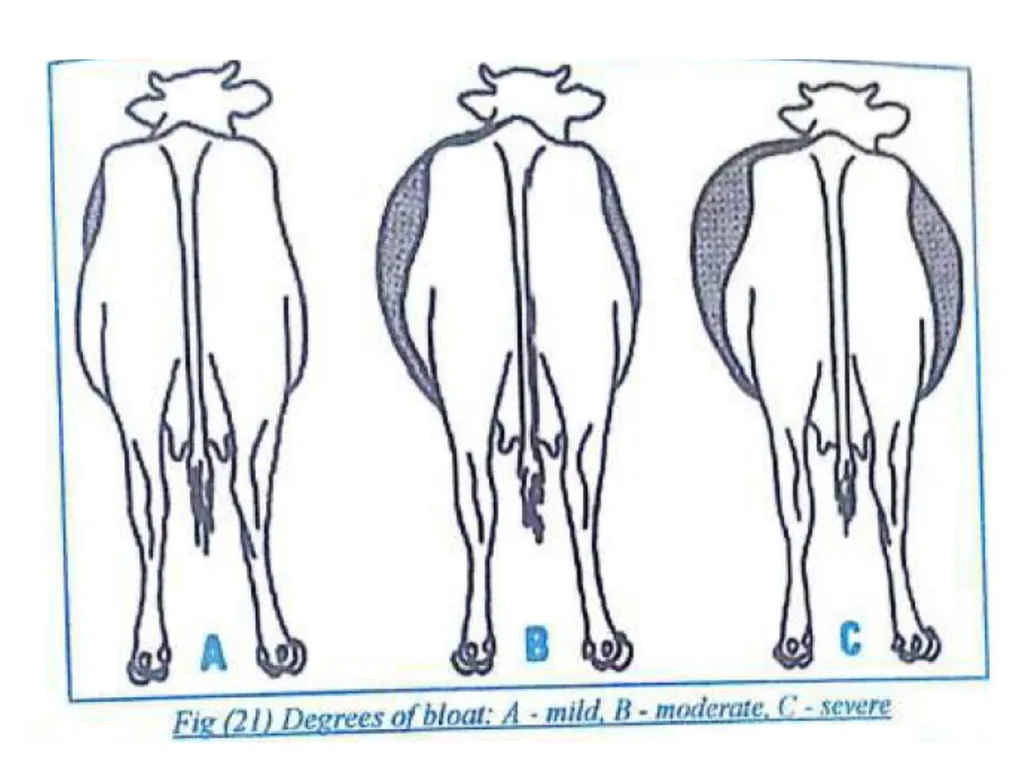
Distension of the left flank
Protrusion of the paralumbar fossa above the ventral column and enlarged abdomen
Dyspnea and grunting
Mouth breathing, protrusion of the tongue, and extension of the head, and occasionally vomition.<br>
05
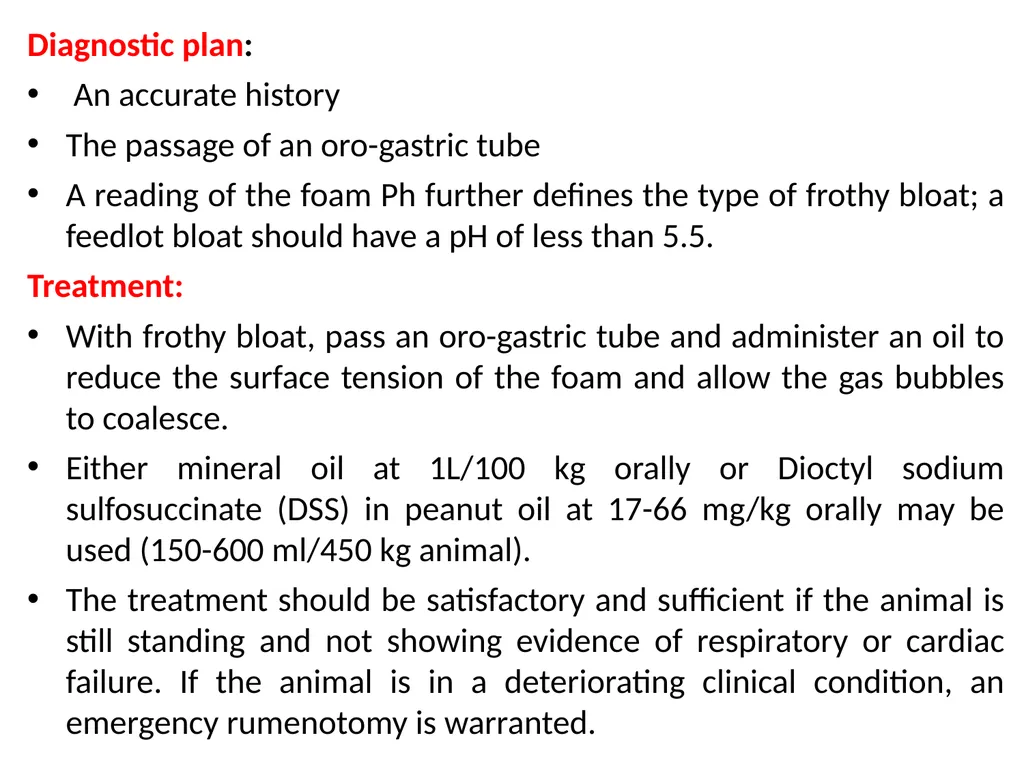
Diagnostic plan:
An accurate history
The passage of an oro-gastric tube
A reading of the foam Ph further defines the type of frothy bloat; a feedlot bloat should have a pH of less than 5.5.
Treatment:
With frothy bloat, pass an oro-gastric tube and administer an oil to reduce the surface tension of the foam and allow the gas bubbles to coalesce.
Either mineral oil at 1L/100 kg orally or Dioctyl sodium sulfosuccinate (DSS) in peanut oil at 17-66 mg/kg orally may be used (150-600 ml/450 kg animal).
The treatment should be satisfactory and sufficient if the animal is still standing and not showing evidence of respiratory or cardiac failure. If the animal is in a deteriorating clinical condition, an emergency rumenotomy is warranted.<br>