
Blockchain Blockchain Digital Cash is not New
NS
Published · 43 slides · 0 views

1 / 1
Description
Blockchain Blockchain Digital Cash is not New DigiCash Inc., founded in 1989 Based on Chaums blind signatures Strong crypto that ensures anonymity Back then, the killer app was thought to be micropayments Users on the Internet pay only
Related Topics
Share
Embed code
Download this presentation From Below
"Blockchain Blockchain Digital Cash is not New" is the property of its rightful owner. Permission is granted to download and print the materials on this website for personal, non-commercial use only, and to display it on your personal computer provided you do not modify the materials and that you retain all copyright notices contained in the materials. By downloading content from our website, you accept the terms of this agreement.
Presentation Transcript
01
Blockchain Blockchain<br>
02
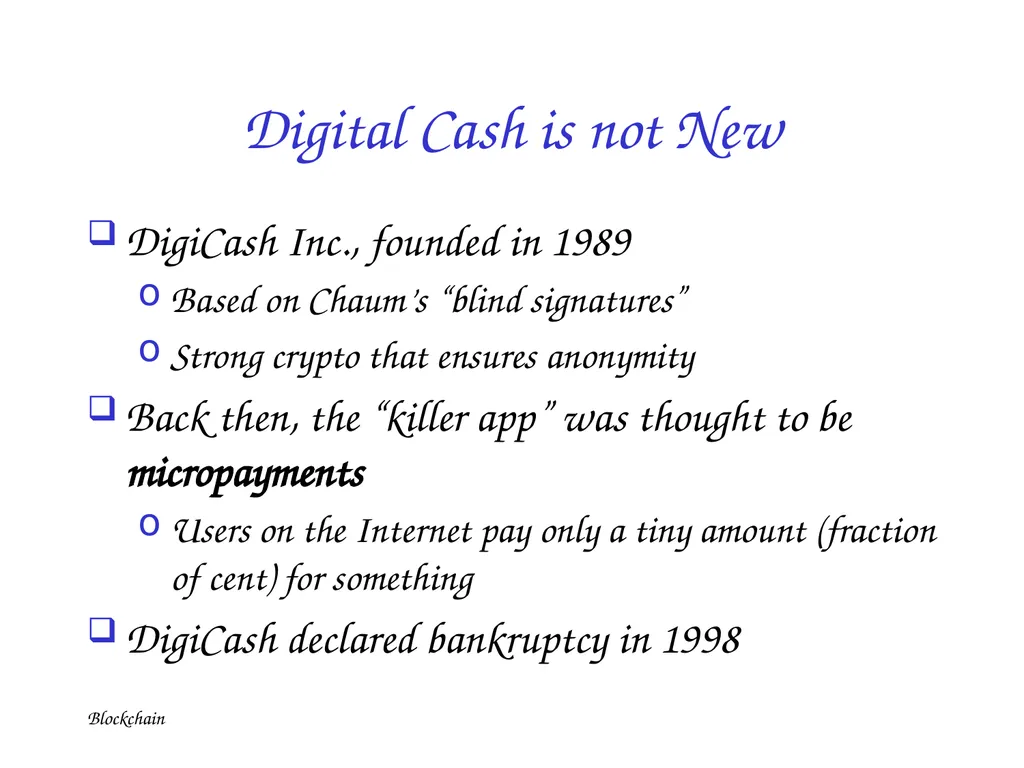
Digital Cash is not New DigiCash Inc., founded in 1989
Based on Chaum’s “blind signatures”
Strong crypto that ensures anonymity
Back then, the “killer app” was thought to be micropayments
Users on the Internet pay only a tiny amount (fraction of cent) for something
DigiCash declared bankruptcy in 1998 Blockchain<br>
Based on Chaum’s “blind signatures”
Strong crypto that ensures anonymity
Back then, the “killer app” was thought to be micropayments
Users on the Internet pay only a tiny amount (fraction of cent) for something
DigiCash declared bankruptcy in 1998 Blockchain<br>
03
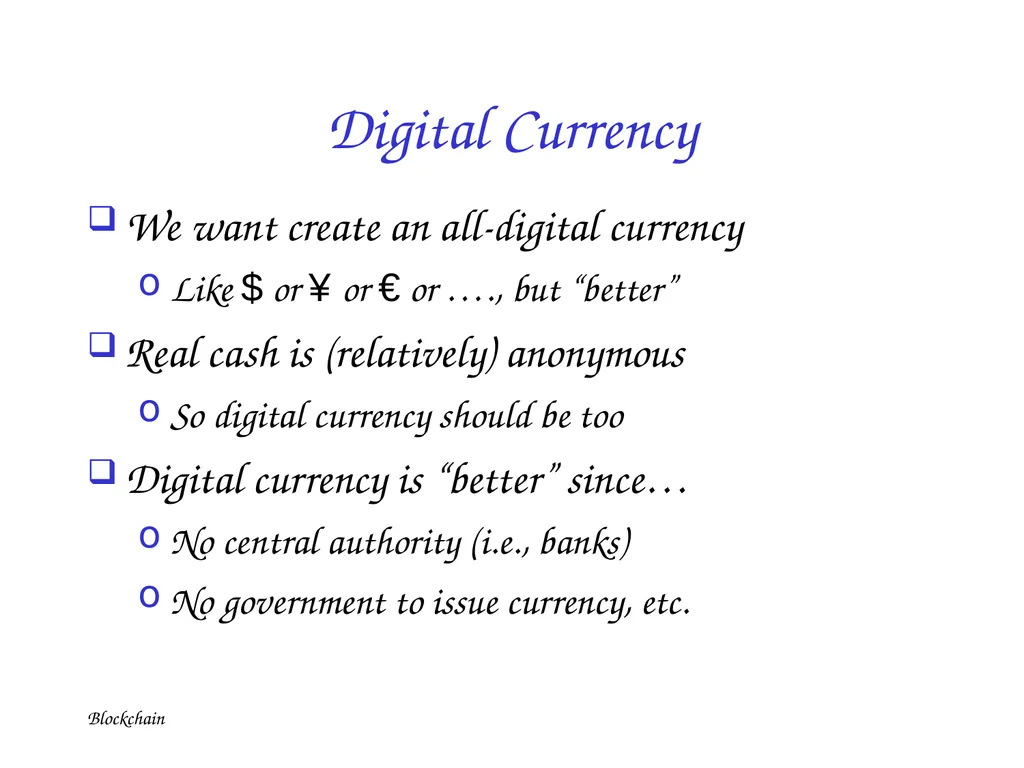
Blockchain Digital Currency We want create an all-digital currency
Like $ or ¥ or € or …., but “better”
Real cash is (relatively) anonymous
So digital currency should be too
Digital currency is “better” since…
No central authority (i.e., banks)
No government to issue currency, etc.<br>
Like $ or ¥ or € or …., but “better”
Real cash is (relatively) anonymous
So digital currency should be too
Digital currency is “better” since…
No central authority (i.e., banks)
No government to issue currency, etc.<br>
04
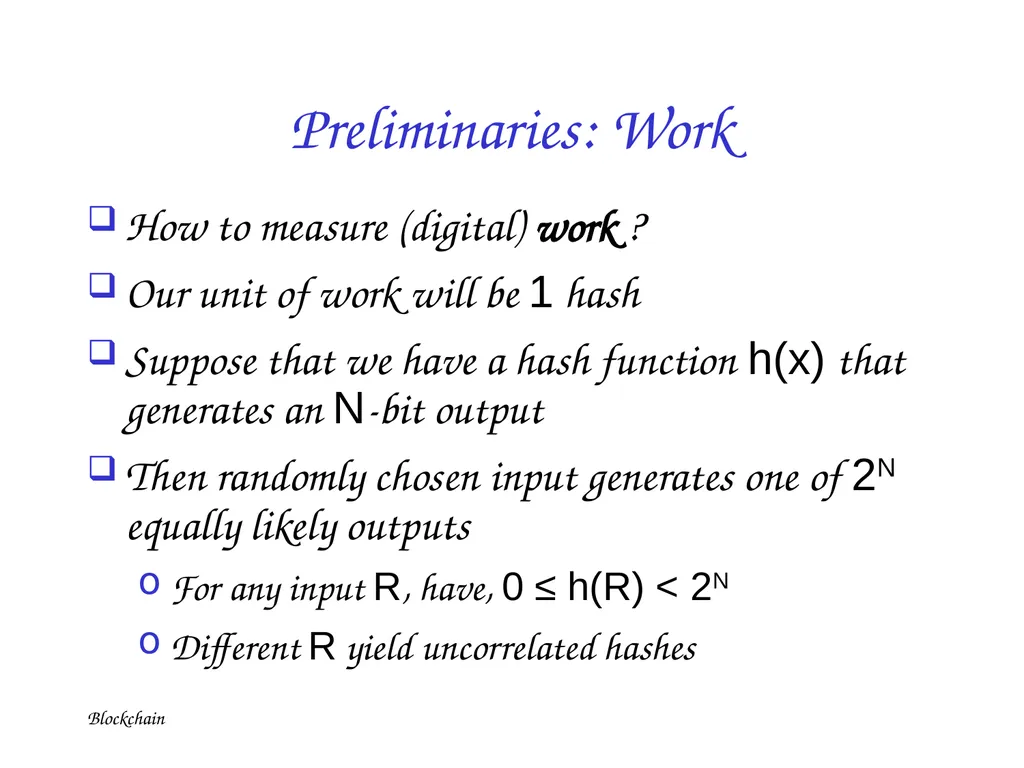
Blockchain Preliminaries: Work How to measure (digital) work ?
Our unit of work will be 1 hash
Suppose that we have a hash function h(x) that generates an N-bit output
Then randomly chosen input generates one of 2N equally likely outputs
For any input R, have, 0 ≤ h(R) < 2N
Different R yield uncorrelated hashes<br>
Our unit of work will be 1 hash
Suppose that we have a hash function h(x) that generates an N-bit output
Then randomly chosen input generates one of 2N equally likely outputs
For any input R, have, 0 ≤ h(R) < 2N
Different R yield uncorrelated hashes<br>
05
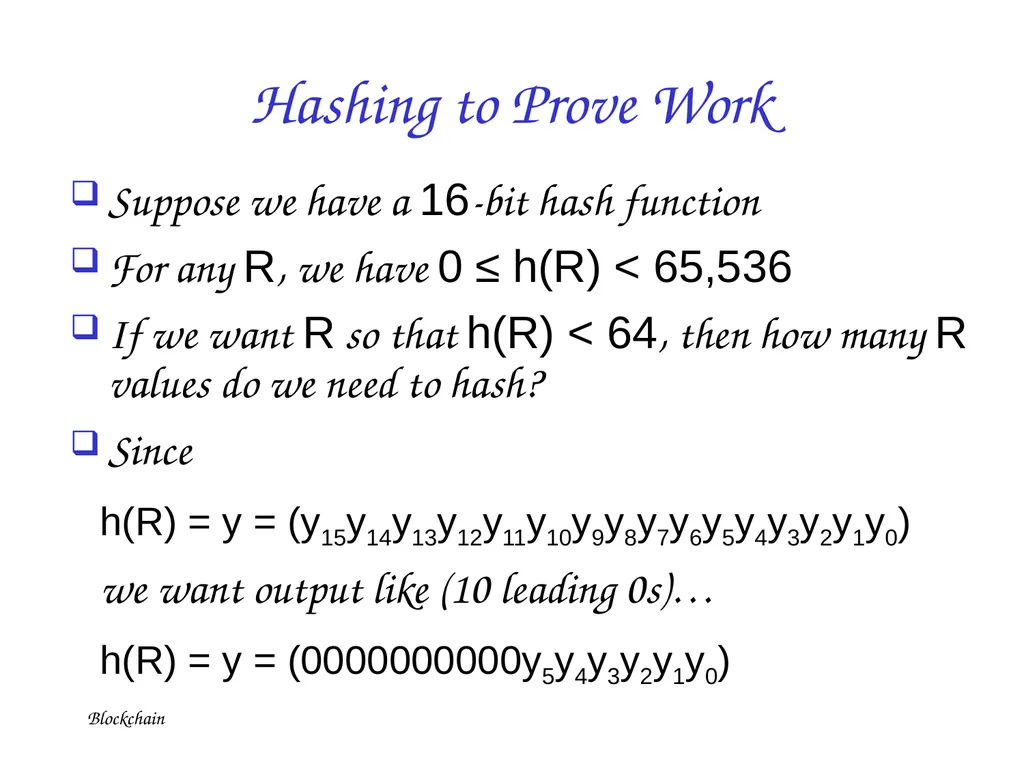
Blockchain Hashing to Prove Work Suppose we have a 16-bit hash function
For any R, we have 0 ≤ h(R) < 65,536
If we want R so that h(R) < 64, then how many R values do we need to hash?
Since
h(R) = y = (y15y14y13y12y11y10y9y8y7y6y5y4y3y2y1y0)
we want output like (10 leading 0s)…
h(R) = y = (0000000000y5y4y3y2y1y0)<br>
For any R, we have 0 ≤ h(R) < 65,536
If we want R so that h(R) < 64, then how many R values do we need to hash?
Since
h(R) = y = (y15y14y13y12y11y10y9y8y7y6y5y4y3y2y1y0)
we want output like (10 leading 0s)…
h(R) = y = (0000000000y5y4y3y2y1y0)<br>
06
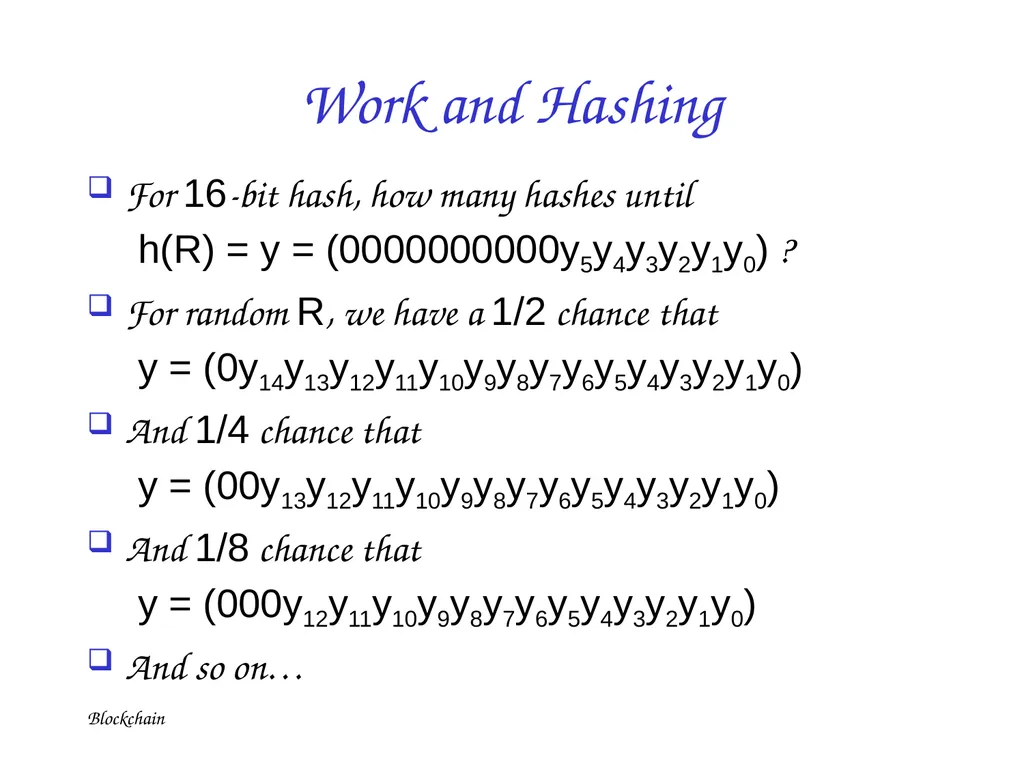
Work and Hashing For 16-bit hash, how many hashes until
h(R) = y = (0000000000y5y4y3y2y1y0) ?
For random R, we have a 1/2 chance that
y = (0y14y13y12y11y10y9y8y7y6y5y4y3y2y1y0)
And 1/4 chance that
y = (00y13y12y11y10y9y8y7y6y5y4y3y2y1y0)
And 1/8 chance that
y = (000y12y11y10y9y8y7y6y5y4y3y2y1y0)
And so on… Blockchain<br>
h(R) = y = (0000000000y5y4y3y2y1y0) ?
For random R, we have a 1/2 chance that
y = (0y14y13y12y11y10y9y8y7y6y5y4y3y2y1y0)
And 1/4 chance that
y = (00y13y12y11y10y9y8y7y6y5y4y3y2y1y0)
And 1/8 chance that
y = (000y12y11y10y9y8y7y6y5y4y3y2y1y0)
And so on… Blockchain<br>
07
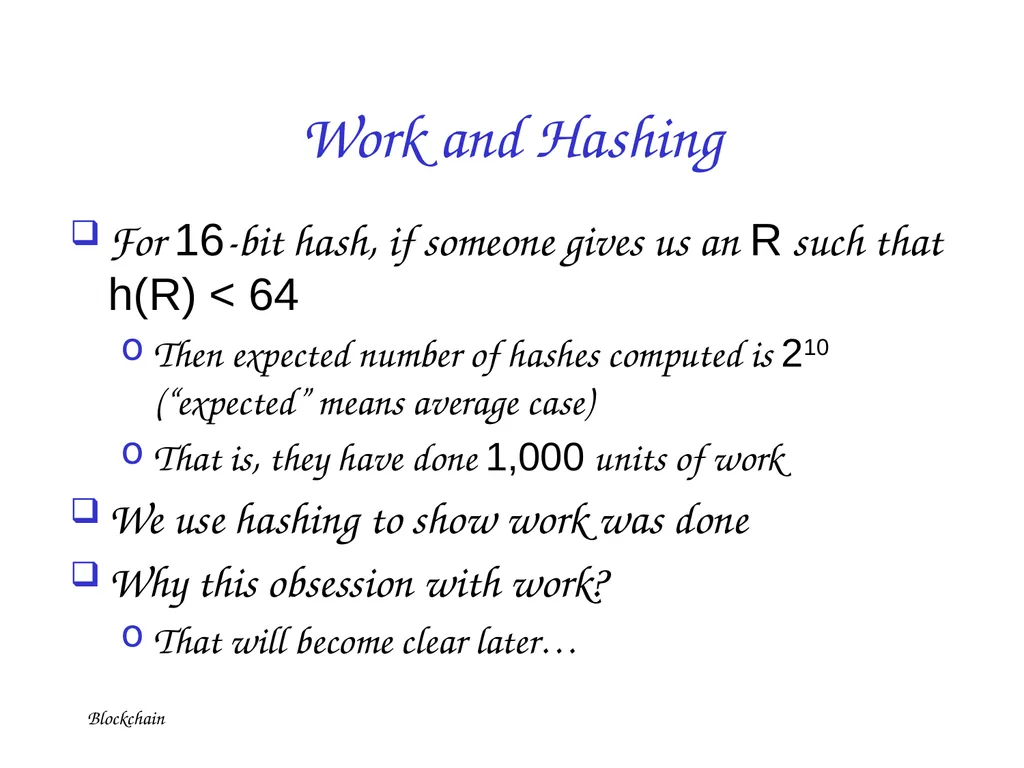
Work and Hashing For 16-bit hash, if someone gives us an R such that h(R) < 64
Then expected number of hashes computed is 210 (“expected” means average case)
That is, they have done 1,000 units of work
We use hashing to show work was done
Why this obsession with work?
That will become clear later… Blockchain<br>
Then expected number of hashes computed is 210 (“expected” means average case)
That is, they have done 1,000 units of work
We use hashing to show work was done
Why this obsession with work?
That will become clear later… Blockchain<br>
08
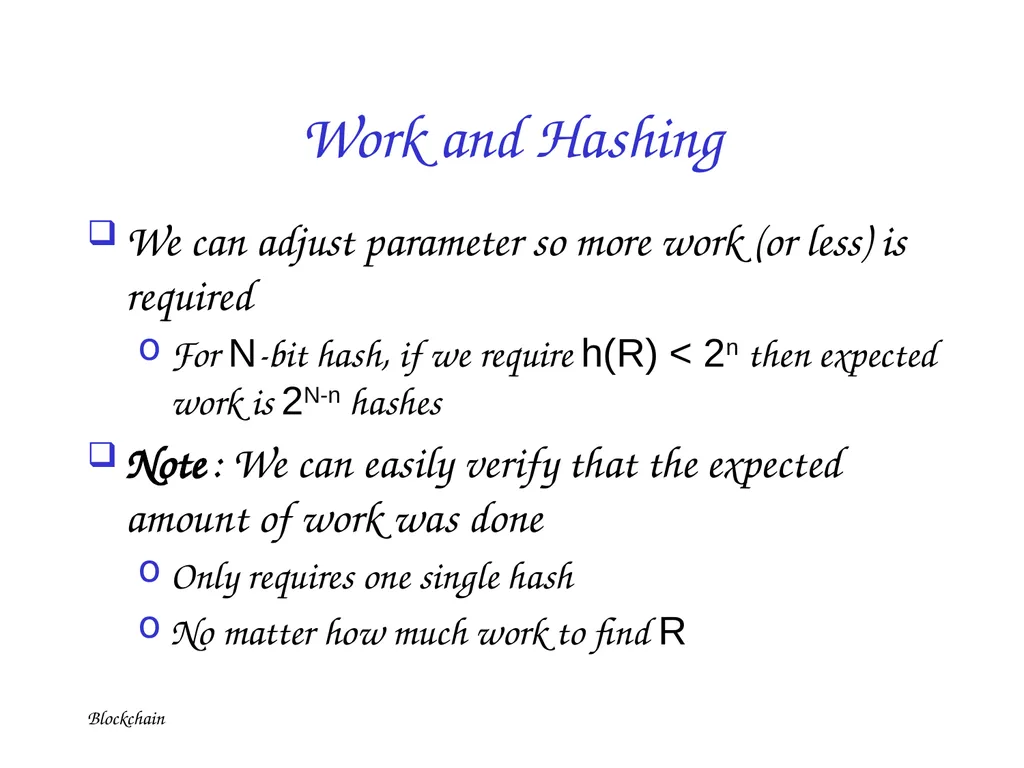
Work and Hashing We can adjust parameter so more work (or less) is required
For N-bit hash, if we require h(R) < 2n then expected work is 2N-n hashes
Note : We can easily verify that the expected amount of work was done
Only requires one single hash
No matter how much work to find R Blockchain<br>
For N-bit hash, if we require h(R) < 2n then expected work is 2N-n hashes
Note : We can easily verify that the expected amount of work was done
Only requires one single hash
No matter how much work to find R Blockchain<br>
09
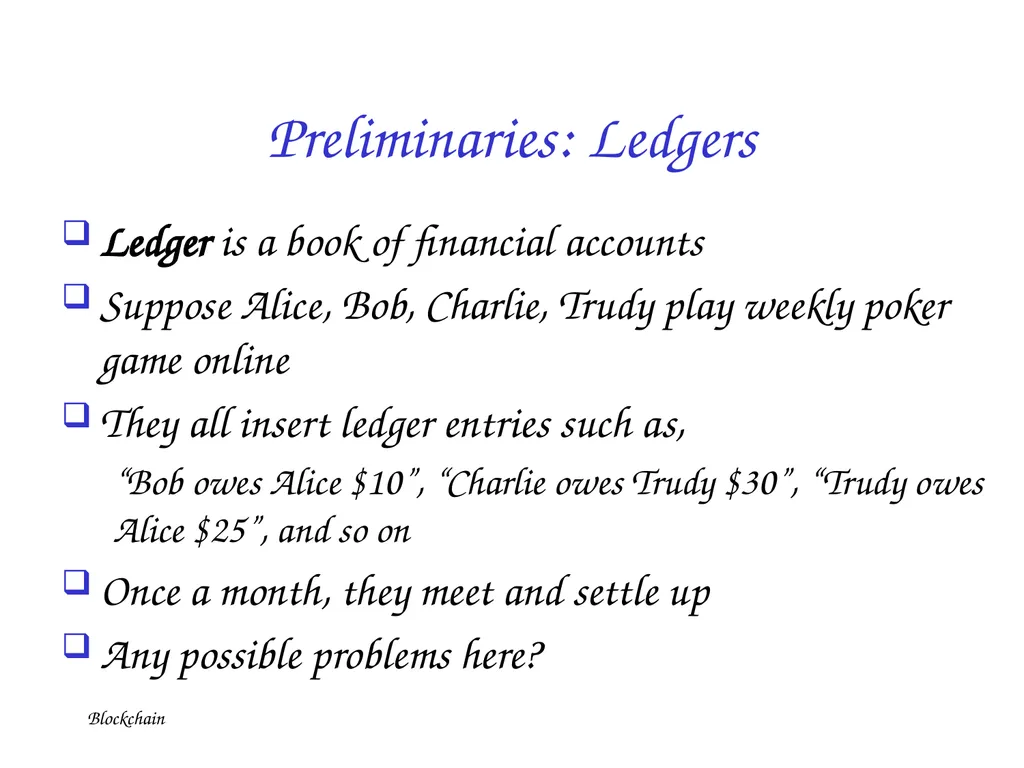
Preliminaries: Ledgers Ledger is a book of financial accounts
Suppose Alice, Bob, Charlie, Trudy play weekly poker game online
They all insert ledger entries such as,
“Bob owes Alice $10”, “Charlie owes Trudy $30”, “Trudy owes Alice $25”, and so on
Once a month, they meet and settle up
Any possible problems here? Blockchain<br>
Suppose Alice, Bob, Charlie, Trudy play weekly poker game online
They all insert ledger entries such as,
“Bob owes Alice $10”, “Charlie owes Trudy $30”, “Trudy owes Alice $25”, and so on
Once a month, they meet and settle up
Any possible problems here? Blockchain<br>
10
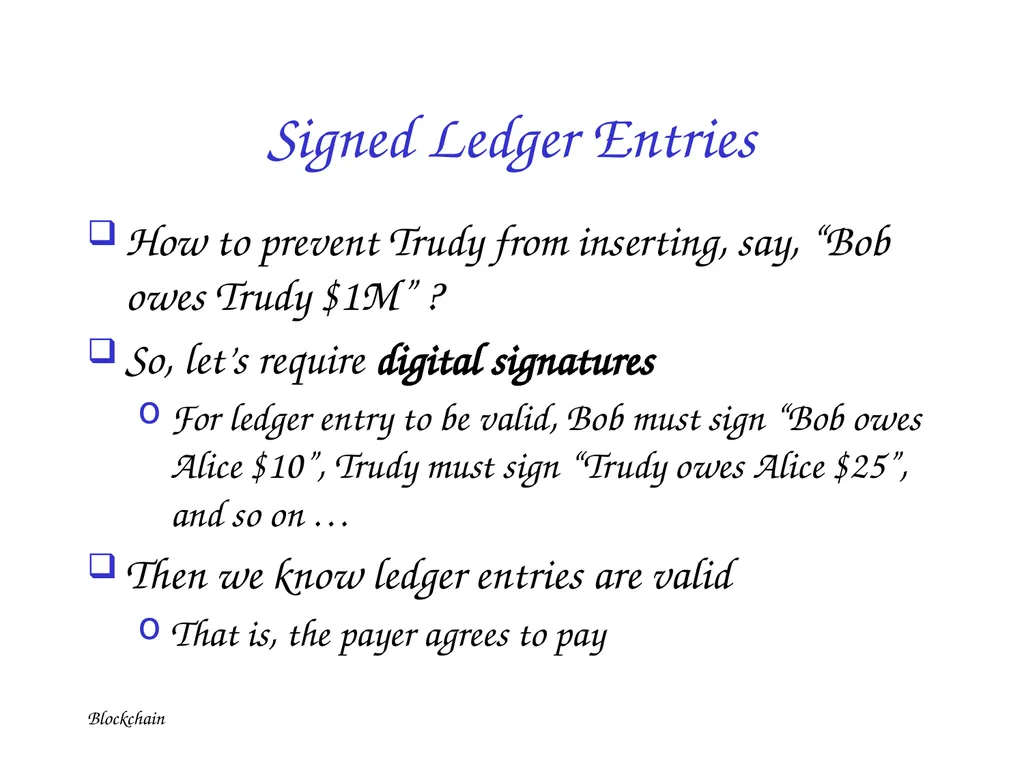
Signed Ledger Entries How to prevent Trudy from inserting, say, “Bob owes Trudy $1M” ?
So, let’s require digital signatures
For ledger entry to be valid, Bob must sign “Bob owes Alice $10”, Trudy must sign “Trudy owes Alice $25”, and so on …
Then we know ledger entries are valid
That is, the payer agrees to pay Blockchain<br>
So, let’s require digital signatures
For ledger entry to be valid, Bob must sign “Bob owes Alice $10”, Trudy must sign “Trudy owes Alice $25”, and so on …
Then we know ledger entries are valid
That is, the payer agrees to pay Blockchain<br>
11
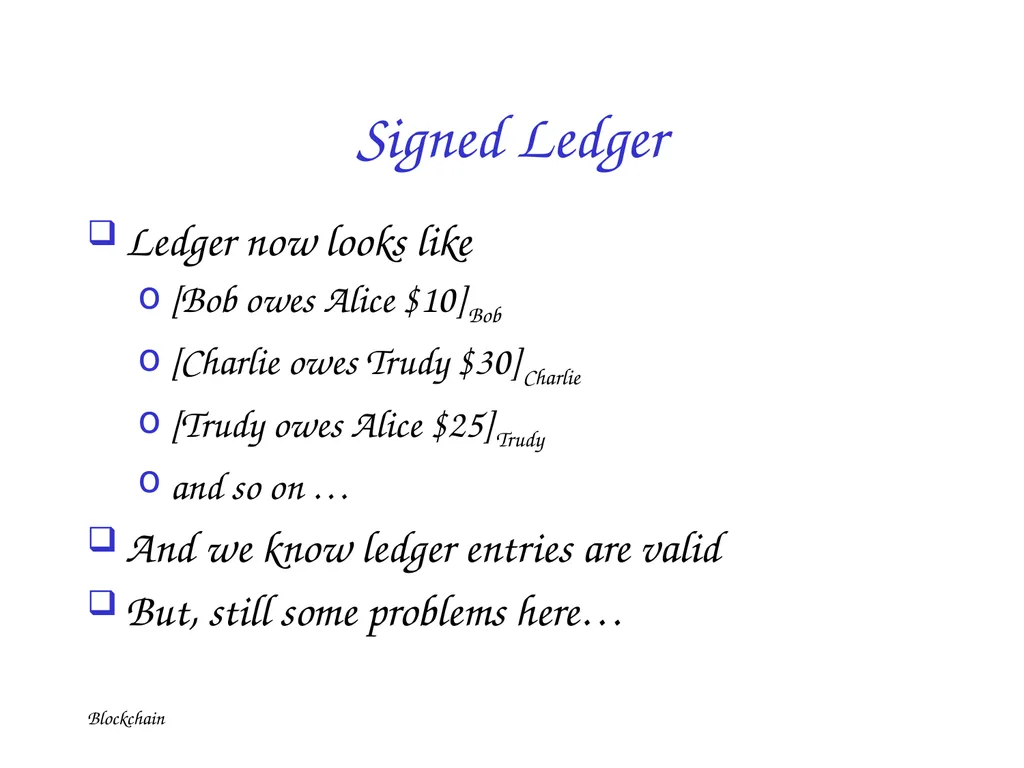
Signed Ledger Ledger now looks like
[Bob owes Alice $10]Bob
[Charlie owes Trudy $30]Charlie
[Trudy owes Alice $25]Trudy
and so on …
And we know ledger entries are valid
But, still some problems here… Blockchain<br>
[Bob owes Alice $10]Bob
[Charlie owes Trudy $30]Charlie
[Trudy owes Alice $25]Trudy
and so on …
And we know ledger entries are valid
But, still some problems here… Blockchain<br>
12
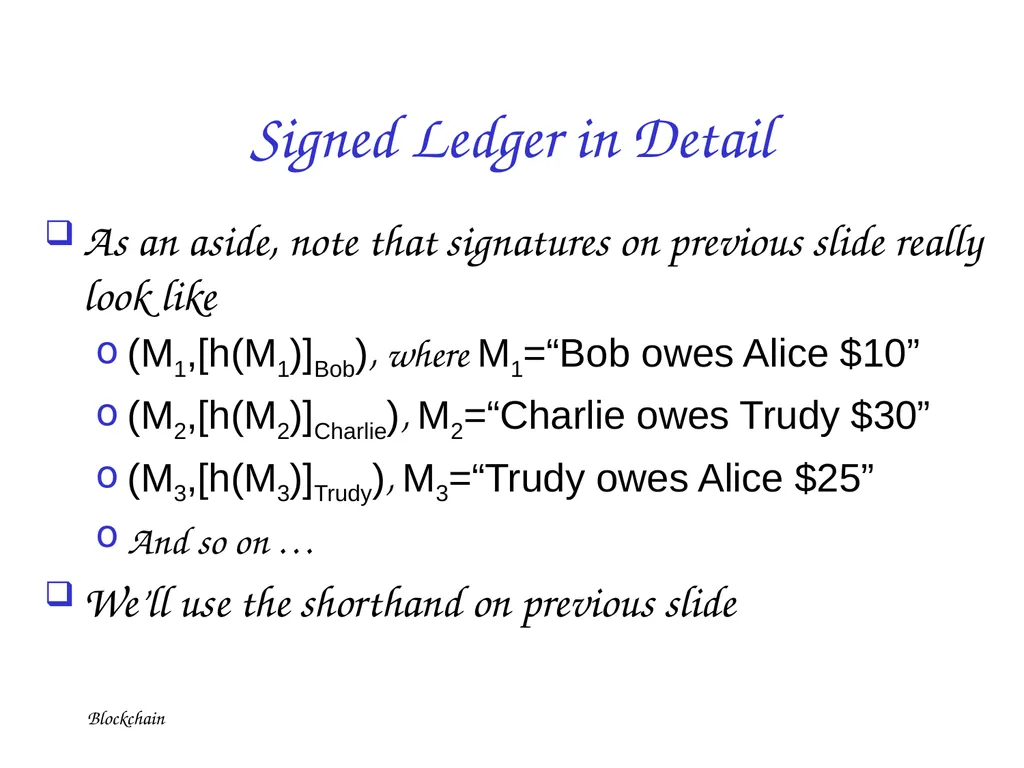
Signed Ledger in Detail As an aside, note that signatures on previous slide really look like
(M1,[h(M1)]Bob), where M1=“Bob owes Alice $10”
(M2,[h(M2)]Charlie), M2=“Charlie owes Trudy $30”
(M3,[h(M3)]Trudy), M3=“Trudy owes Alice $25”
And so on …
We’ll use the shorthand on previous slide Blockchain<br>
(M1,[h(M1)]Bob), where M1=“Bob owes Alice $10”
(M2,[h(M2)]Charlie), M2=“Charlie owes Trudy $30”
(M3,[h(M3)]Trudy), M3=“Trudy owes Alice $25”
And so on …
We’ll use the shorthand on previous slide Blockchain<br>
13
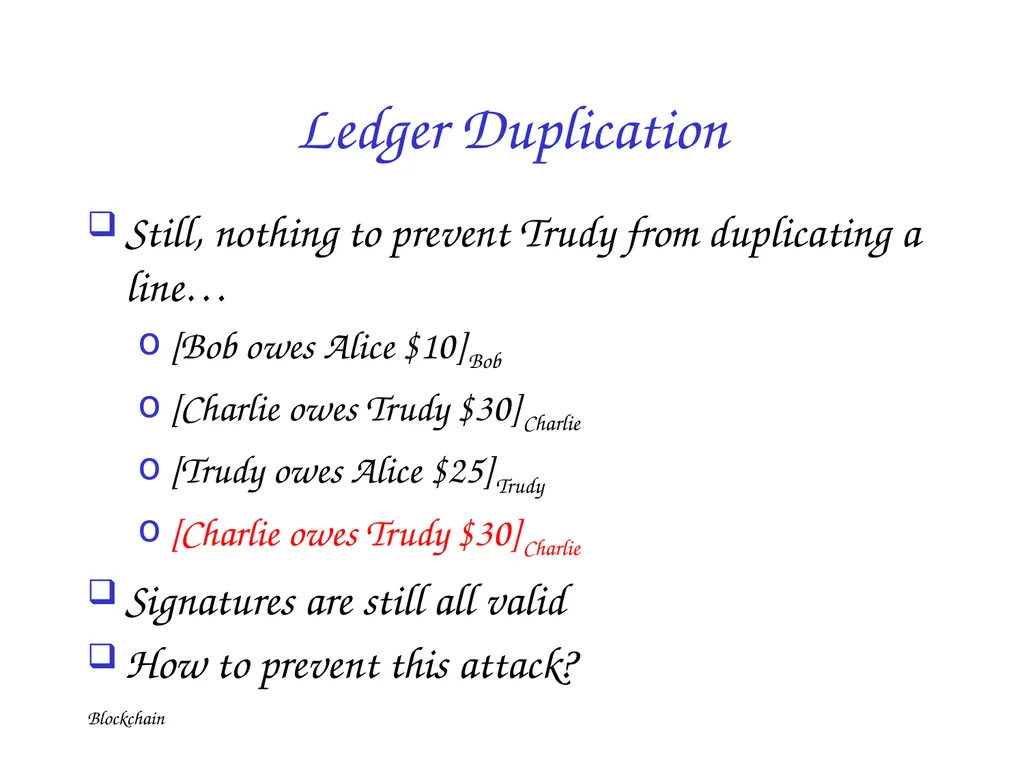
Ledger Duplication Still, nothing to prevent Trudy from duplicating a line…
[Bob owes Alice $10]Bob
[Charlie owes Trudy $30]Charlie
[Trudy owes Alice $25]Trudy
[Charlie owes Trudy $30]Charlie
Signatures are still all valid
How to prevent this attack? Blockchain<br>
[Bob owes Alice $10]Bob
[Charlie owes Trudy $30]Charlie
[Trudy owes Alice $25]Trudy
[Charlie owes Trudy $30]Charlie
Signatures are still all valid
How to prevent this attack? Blockchain<br>
14
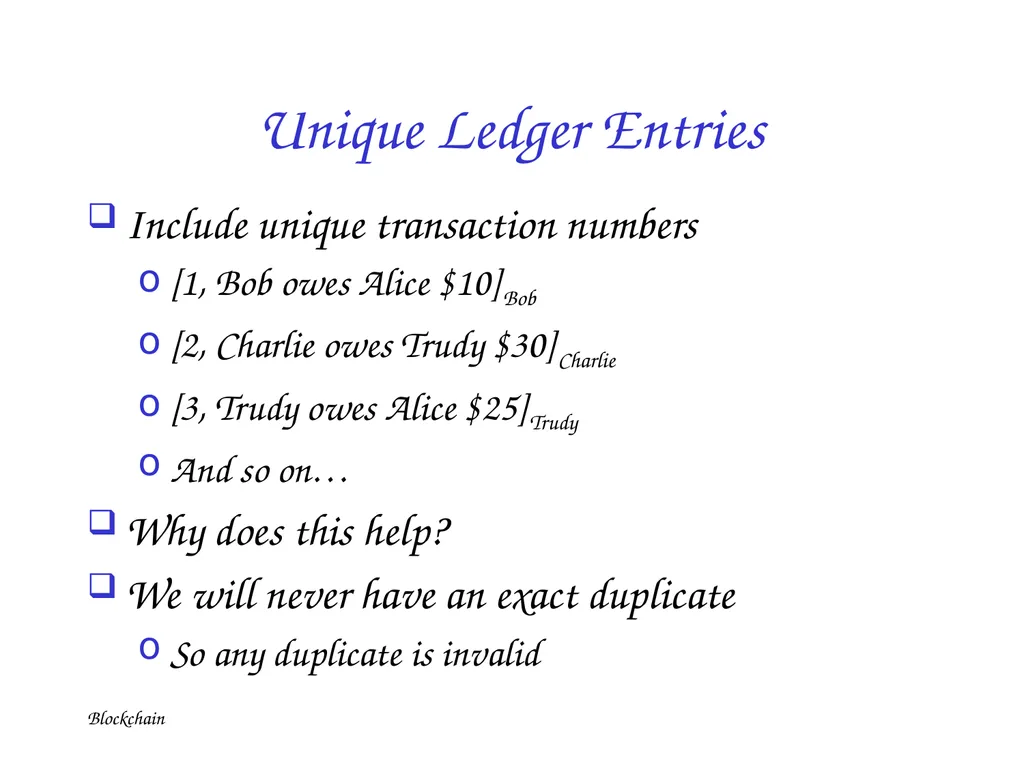
Unique Ledger Entries Include unique transaction numbers
[1, Bob owes Alice $10]Bob
[2, Charlie owes Trudy $30]Charlie
[3, Trudy owes Alice $25]Trudy
And so on…
Why does this help?
We will never have an exact duplicate
So any duplicate is invalid Blockchain<br>
[1, Bob owes Alice $10]Bob
[2, Charlie owes Trudy $30]Charlie
[3, Trudy owes Alice $25]Trudy
And so on…
Why does this help?
We will never have an exact duplicate
So any duplicate is invalid Blockchain<br>
15
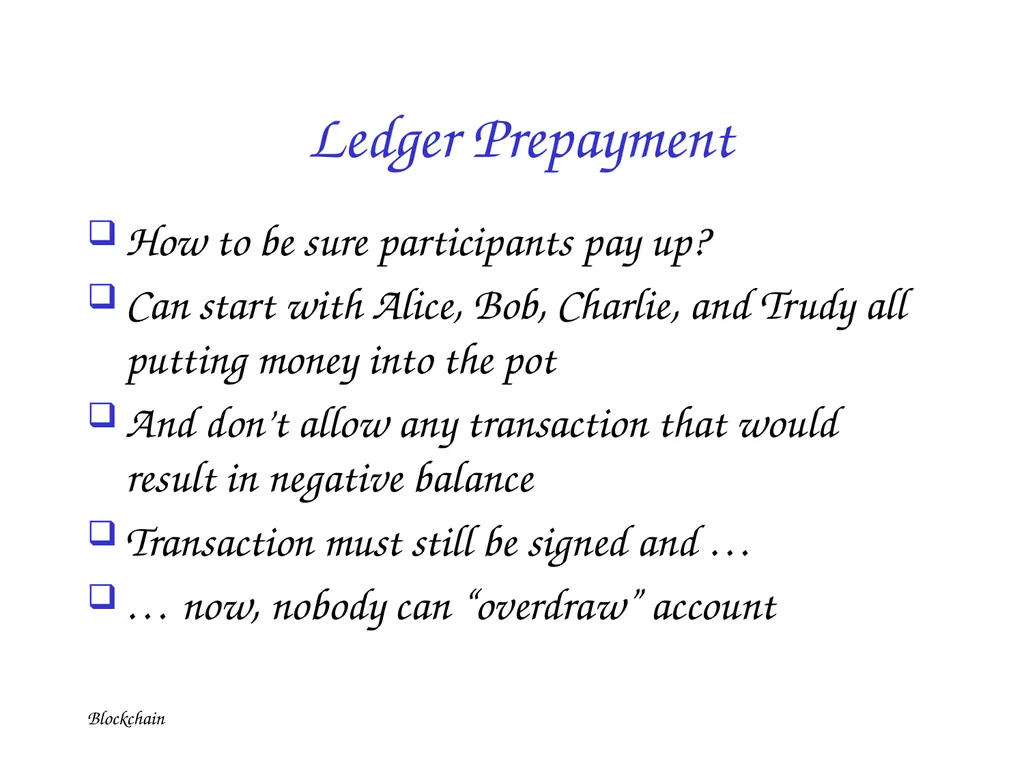
Ledger Prepayment How to be sure participants pay up?
Can start with Alice, Bob, Charlie, and Trudy all putting money into the pot
And don’t allow any transaction that would result in negative balance
Transaction must still be signed and …
… now, nobody can “overdraw” account Blockchain<br>
Can start with Alice, Bob, Charlie, and Trudy all putting money into the pot
And don’t allow any transaction that would result in negative balance
Transaction must still be signed and …
… now, nobody can “overdraw” account Blockchain<br>
16
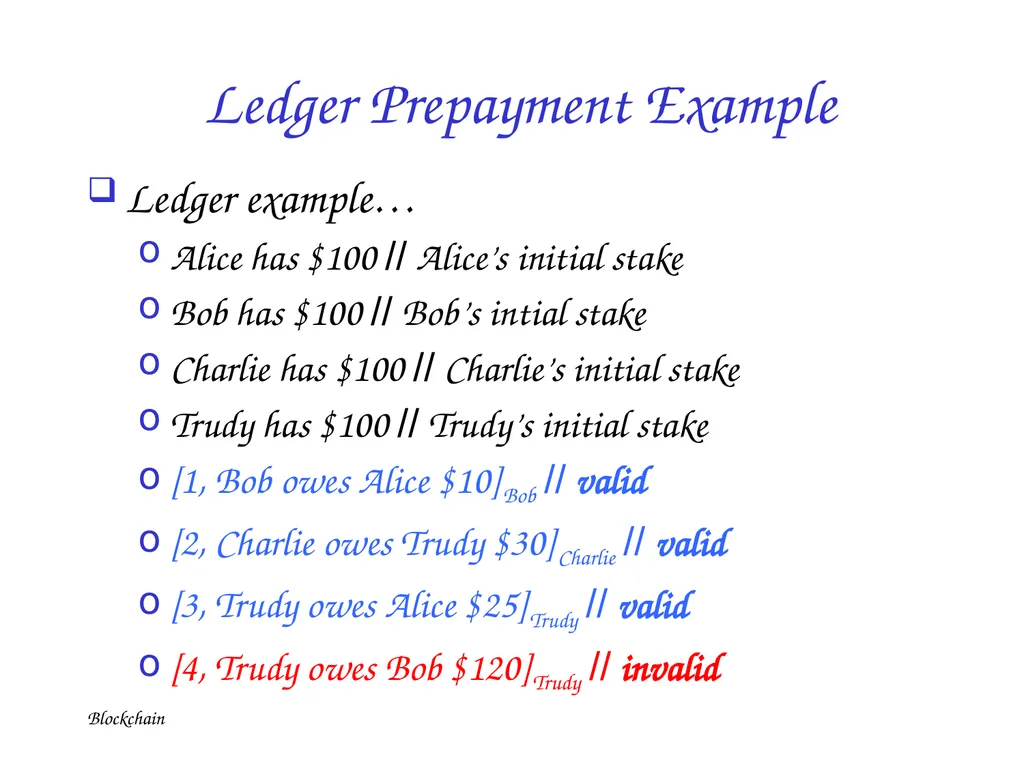
Ledger Prepayment Example Ledger example…
Alice has $100 // Alice’s initial stake
Bob has $100 // Bob’s intial stake
Charlie has $100 // Charlie’s initial stake
Trudy has $100 // Trudy’s initial stake
[1, Bob owes Alice $10]Bob // valid
[2, Charlie owes Trudy $30]Charlie // valid
[3, Trudy owes Alice $25]Trudy // valid
[4, Trudy owes Bob $120]Trudy // invalid Blockchain<br>
Alice has $100 // Alice’s initial stake
Bob has $100 // Bob’s intial stake
Charlie has $100 // Charlie’s initial stake
Trudy has $100 // Trudy’s initial stake
[1, Bob owes Alice $10]Bob // valid
[2, Charlie owes Trudy $30]Charlie // valid
[3, Trudy owes Alice $25]Trudy // valid
[4, Trudy owes Bob $120]Trudy // invalid Blockchain<br>
17
Ledger Prepayment Note that we must know the entire transaction history
So that we can know current balances
Then we can be sure a given transaction does not cause user to be overdrawn
This seems like kind of a hassle, but some big benefits come from it
As we will soon see... Blockchain<br>
So that we can know current balances
Then we can be sure a given transaction does not cause user to be overdrawn
This seems like kind of a hassle, but some big benefits come from it
As we will soon see... Blockchain<br>
18
Eternal Ledger? Alice, Bob, Charlie, and Trudy could continue to settle accounts each month
But, as the ledger currently stands, settling accounts is not necessary!
We know the current balances, and no risk of anyone being “overdrawn”
So, could play poker for months, years, or forever, without settling accounts Blockchain<br>
But, as the ledger currently stands, settling accounts is not necessary!
We know the current balances, and no risk of anyone being “overdrawn”
So, could play poker for months, years, or forever, without settling accounts Blockchain<br>
19
Ledger as Currency This ledger can act as its own currency!
Need a cool symbol, let’s use “§”
Transactions within ledger are all in terms of the § “currency”
Anyone can exchange ledger currency (i.e., §) for $ or ¥ or € or …
But, such exchanges occur outside the ledger currency protocol Blockchain<br>
Need a cool symbol, let’s use “§”
Transactions within ledger are all in terms of the § “currency”
Anyone can exchange ledger currency (i.e., §) for $ or ¥ or € or …
But, such exchanges occur outside the ledger currency protocol Blockchain<br>
20
Ledger Currency For example, Alice could pay Bob $10 in real world dollars for, say, §5 of currency in the ledger system
Comparable to exchanging, say, $ for ¥
The ledger is a history of transactions within the ledger currency system
In fact, the ledger is the currency
This is the key insight for cryptocurrency Blockchain<br>
Comparable to exchanging, say, $ for ¥
The ledger is a history of transactions within the ledger currency system
In fact, the ledger is the currency
This is the key insight for cryptocurrency Blockchain<br>
21
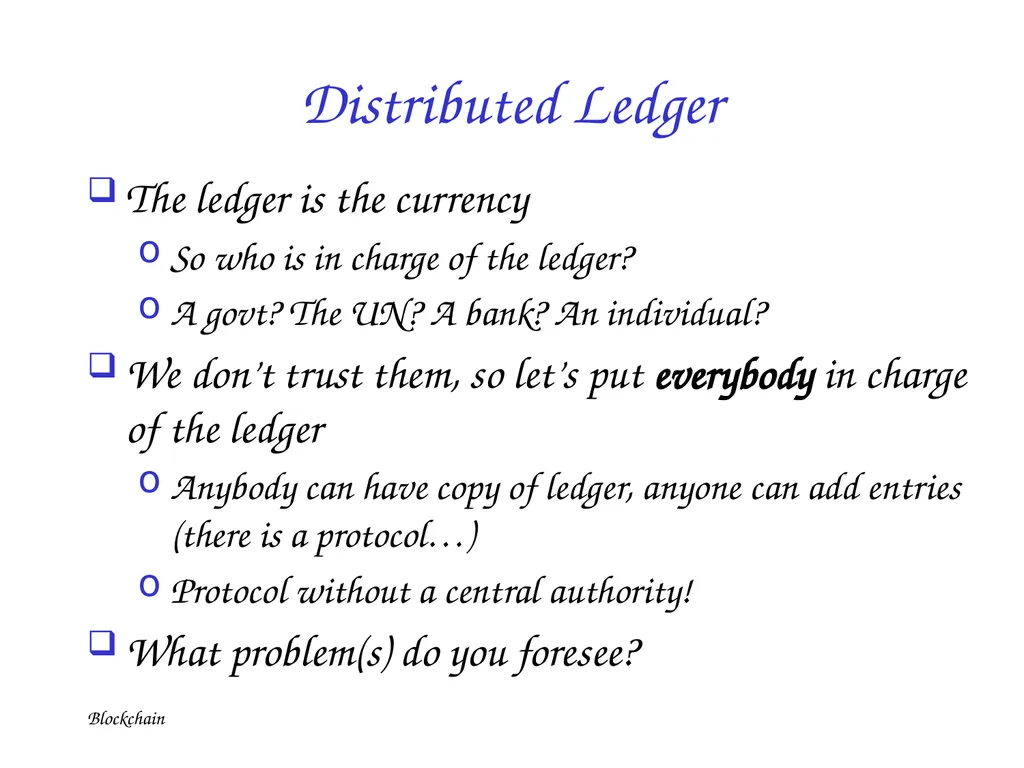
Distributed Ledger The ledger is the currency
So who is in charge of the ledger?
A govt? The UN? A bank? An individual?
We don’t trust them, so let’s put everybody in charge of the ledger
Anybody can have copy of ledger, anyone can add entries (there is a protocol…)
Protocol without a central authority!
What problem(s) do you foresee? Blockchain<br>
So who is in charge of the ledger?
A govt? The UN? A bank? An individual?
We don’t trust them, so let’s put everybody in charge of the ledger
Anybody can have copy of ledger, anyone can add entries (there is a protocol…)
Protocol without a central authority!
What problem(s) do you foresee? Blockchain<br>
22
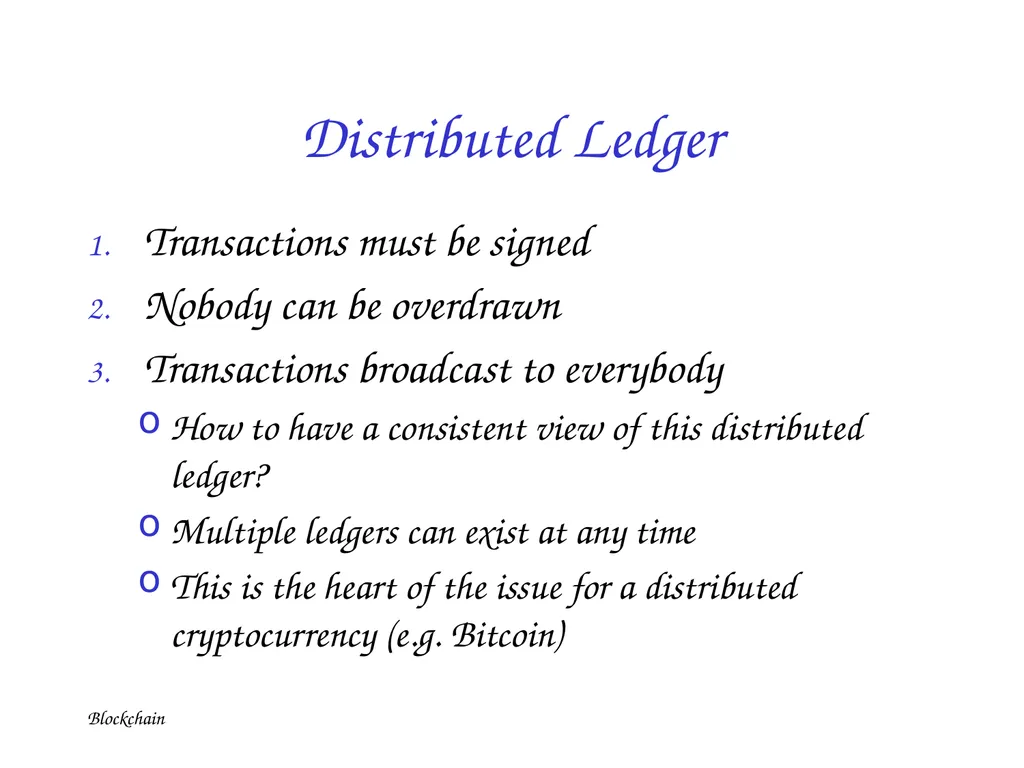
Distributed Ledger Transactions must be signed
Nobody can be overdrawn
Transactions broadcast to everybody
How to have a consistent view of this distributed ledger?
Multiple ledgers can exist at any time
This is the heart of the issue for a distributed cryptocurrency (e.g. Bitcoin) Blockchain<br>
Nobody can be overdrawn
Transactions broadcast to everybody
How to have a consistent view of this distributed ledger?
Multiple ledgers can exist at any time
This is the heart of the issue for a distributed cryptocurrency (e.g. Bitcoin) Blockchain<br>
23
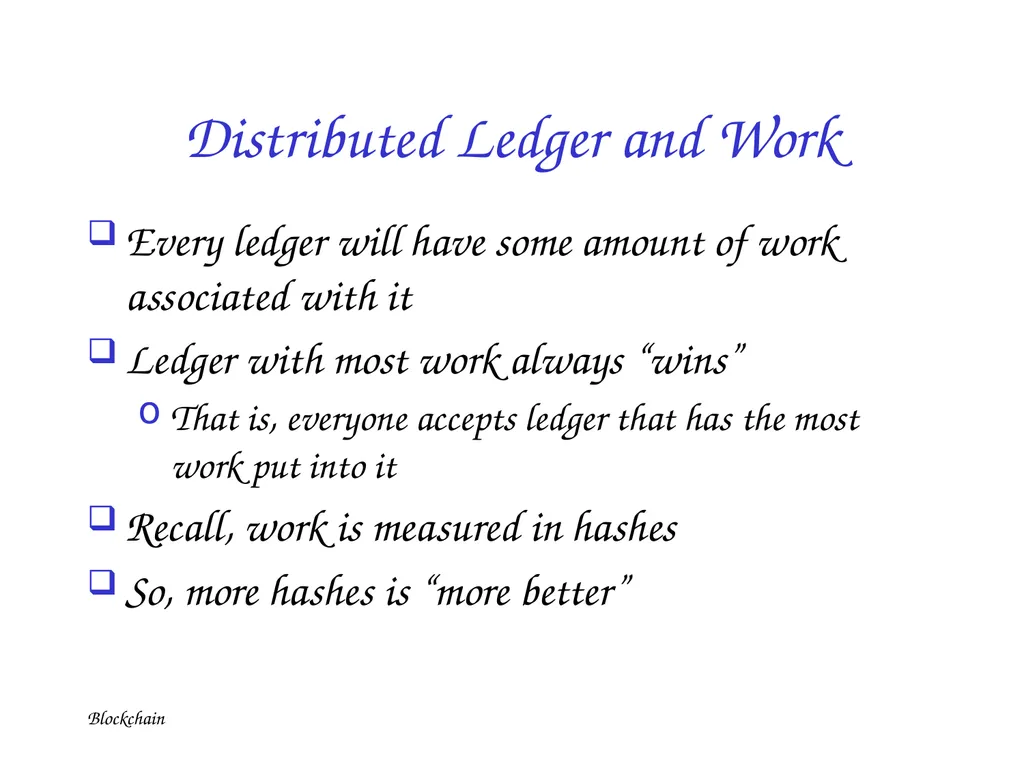
Distributed Ledger and Work Every ledger will have some amount of work associated with it
Ledger with most work always “wins”
That is, everyone accepts ledger that has the most work put into it
Recall, work is measured in hashes
So, more hashes is “more better” Blockchain<br>
Ledger with most work always “wins”
That is, everyone accepts ledger that has the most work put into it
Recall, work is measured in hashes
So, more hashes is “more better” Blockchain<br>
24
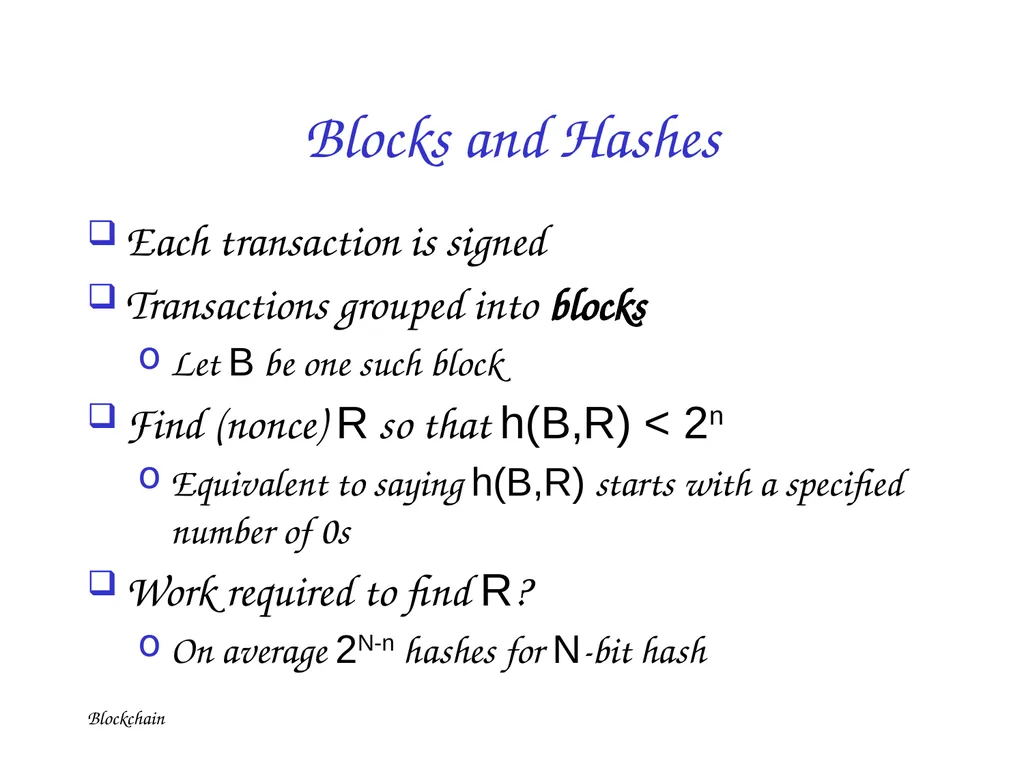
Blocks and Hashes Each transaction is signed
Transactions grouped into blocks
Let B be one such block
Find (nonce) R so that h(B,R) < 2n
Equivalent to saying h(B,R) starts with a specified number of 0s
Work required to find R?
On average 2N-n hashes for N-bit hash Blockchain<br>
Transactions grouped into blocks
Let B be one such block
Find (nonce) R so that h(B,R) < 2n
Equivalent to saying h(B,R) starts with a specified number of 0s
Work required to find R?
On average 2N-n hashes for N-bit hash Blockchain<br>
25
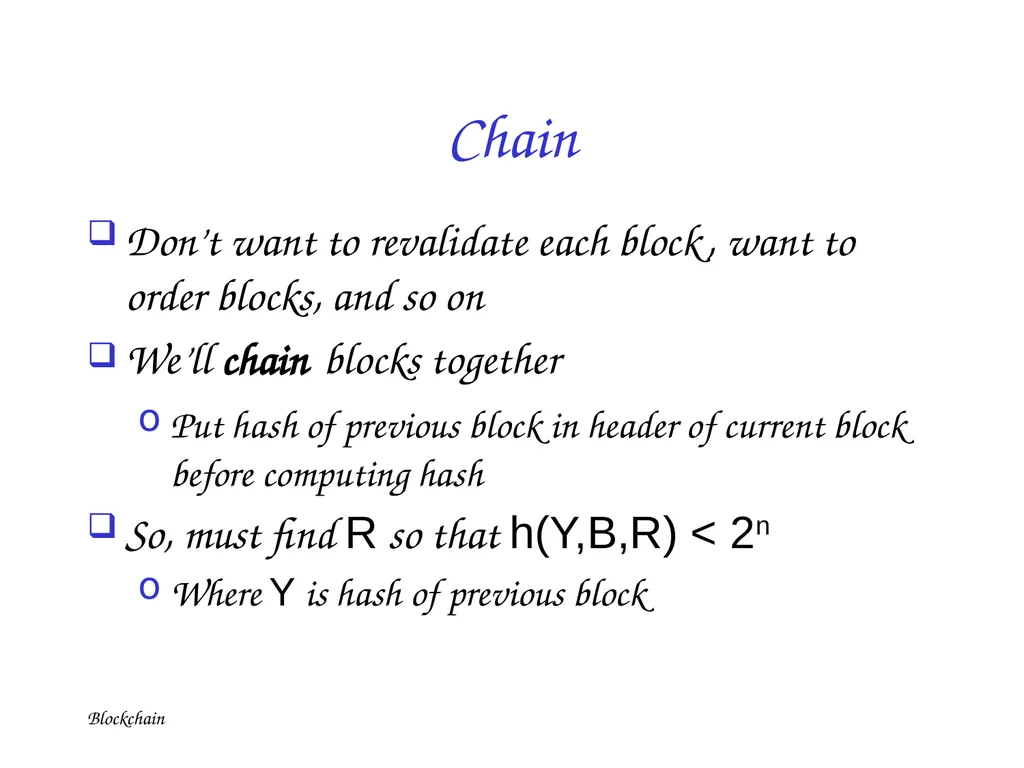
Chain Don’t want to revalidate each block, want to order blocks, and so on
We’ll chain blocks together
Put hash of previous block in header of current block before computing hash
So, must find R so that h(Y,B,R) < 2n
Where Y is hash of previous block Blockchain<br>
We’ll chain blocks together
Put hash of previous block in header of current block before computing hash
So, must find R so that h(Y,B,R) < 2n
Where Y is hash of previous block Blockchain<br>
26
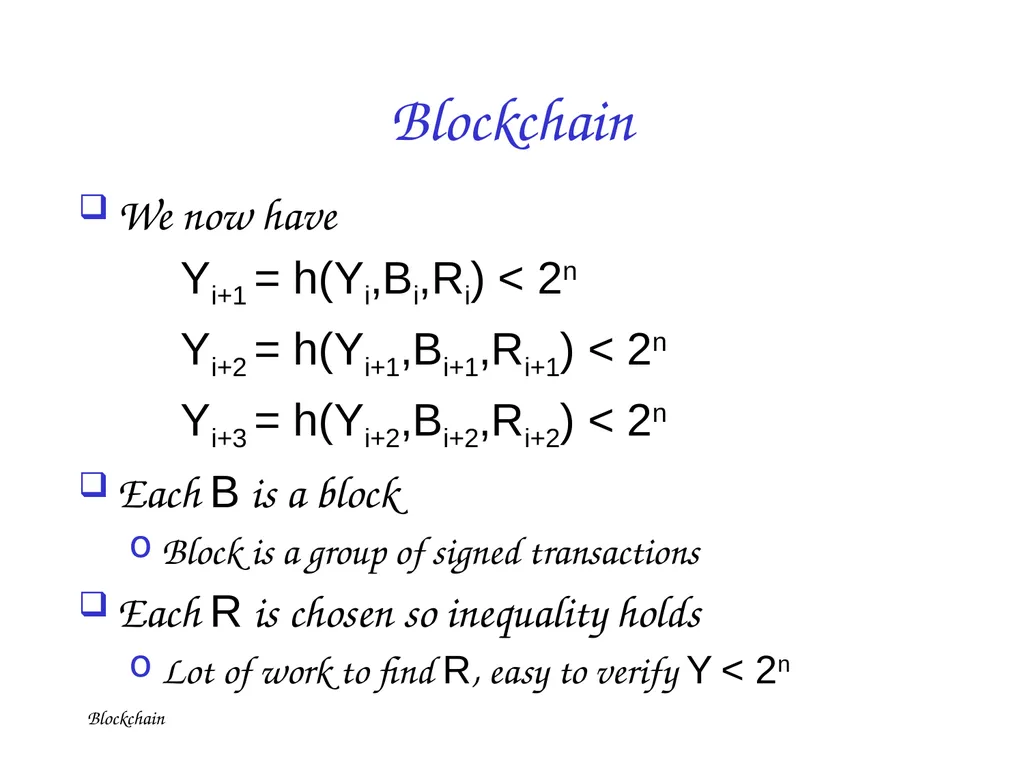
Blockchain We now have
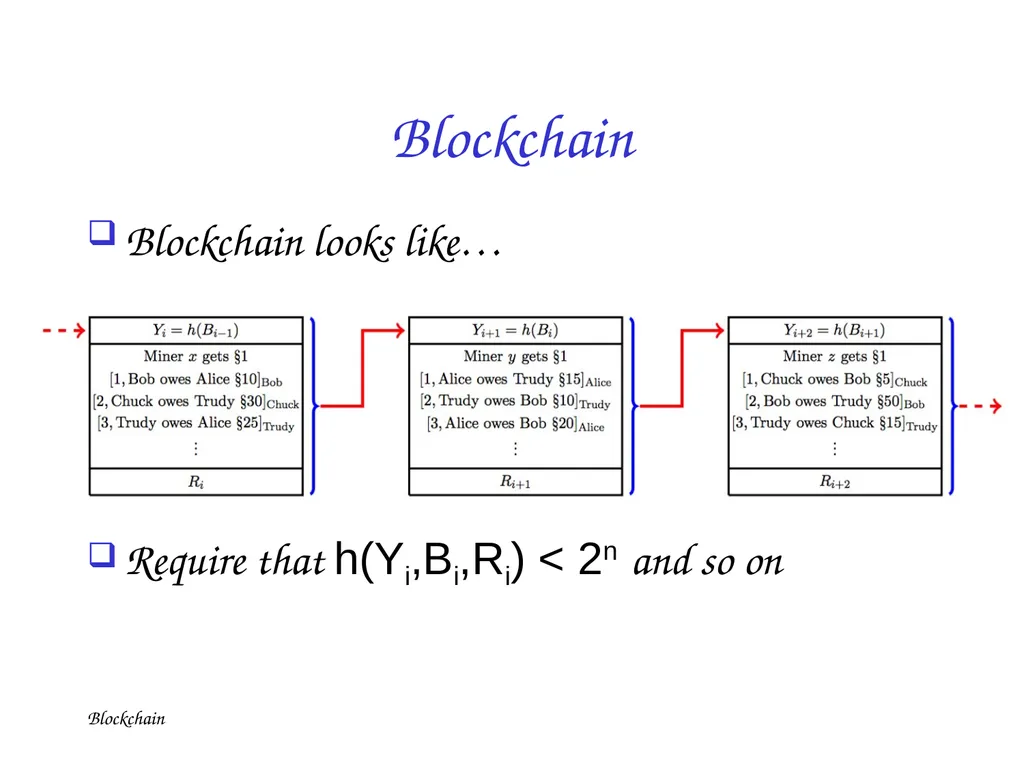
Yi+1 = h(Yi,Bi,Ri) < 2n
Yi+2 = h(Yi+1,Bi+1,Ri+1) < 2n
Yi+3 = h(Yi+2,Bi+2,Ri+2) < 2n
Each B is a block
Block is a group of signed transactions
Each R is chosen so inequality holds
Lot of work to find R, easy to verify Y < 2n Blockchain<br>
Yi+1 = h(Yi,Bi,Ri) < 2n
Yi+2 = h(Yi+1,Bi+1,Ri+1) < 2n
Yi+3 = h(Yi+2,Bi+2,Ri+2) < 2n
Each B is a block
Block is a group of signed transactions
Each R is chosen so inequality holds
Lot of work to find R, easy to verify Y < 2n Blockchain<br>
27
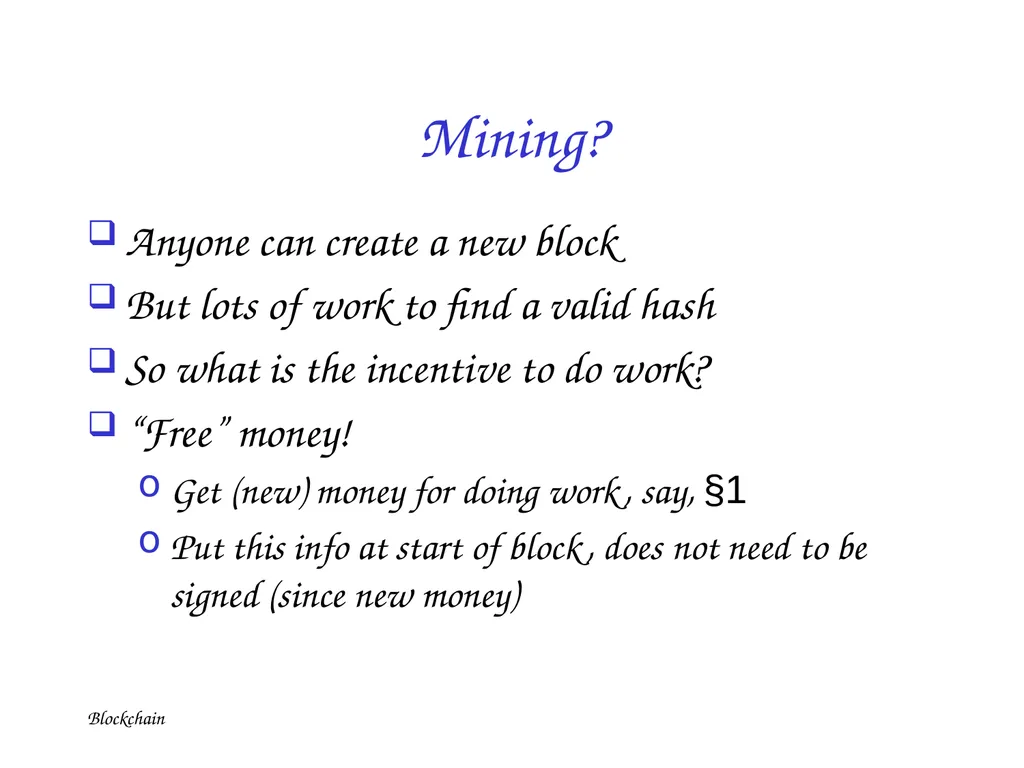
Mining? Anyone can create a new block
But lots of work to find a valid hash
So what is the incentive to do work?
“Free” money!
Get (new) money for doing work, say, §1
Put this info at start of block, does not need to be signed (since new money) Blockchain<br>
But lots of work to find a valid hash
So what is the incentive to do work?
“Free” money!
Get (new) money for doing work, say, §1
Put this info at start of block, does not need to be signed (since new money) Blockchain<br>
28
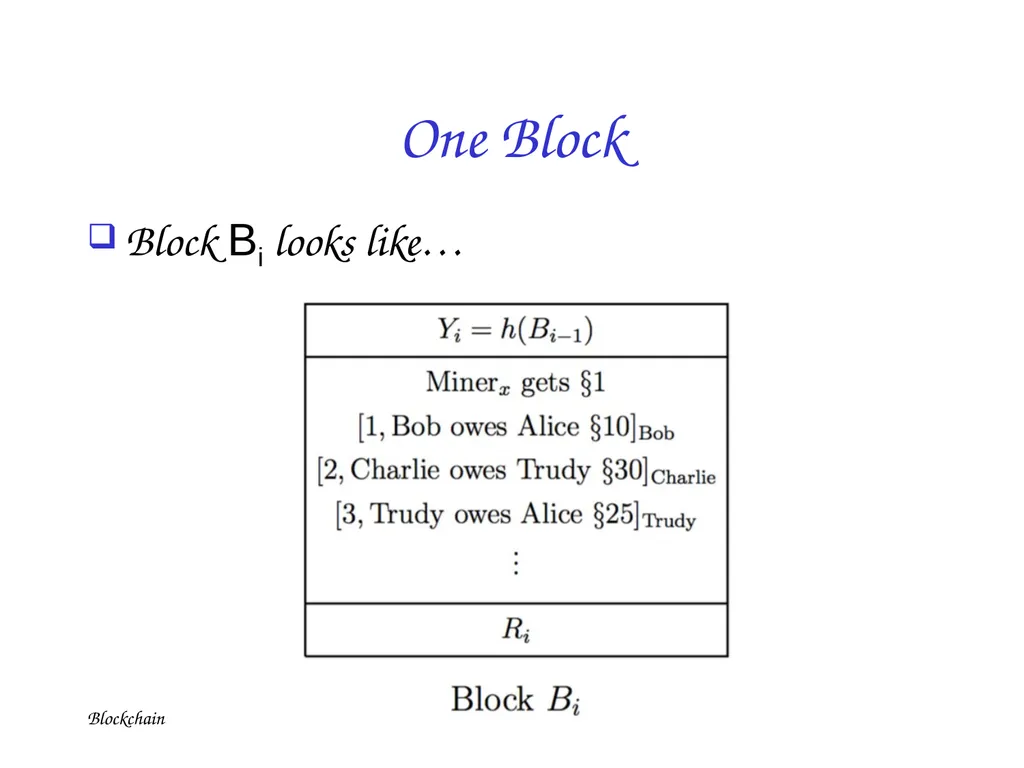
One Block Block Bi looks like… Blockchain<br>
29
Mining Free money, so miners are in a race to find hashes that yield valid blocks
The more computing power a miner has, the better chance to win race
Once a valid hash is found, miner sends the block out to everybody
Again, easy to verify hash is correct Blockchain<br>
The more computing power a miner has, the better chance to win race
Once a valid hash is found, miner sends the block out to everybody
Again, easy to verify hash is correct Blockchain<br>
30
Blockchain Blockchain looks like…
Require that h(Yi,Bi,Ri) < 2n and so on Blockchain<br>
Require that h(Yi,Bi,Ri) < 2n and so on Blockchain<br>
31
Mining Why is “mining” called mining ?
Really, just finding a valid block hash
Miner is doing work, and creating new money that did not previously exist
In a sense, this is comparable to mining gold or silver (for example)
This may be the most misunderstood part of cryptocurrency protocols Blockchain<br>
Really, just finding a valid block hash
Miner is doing work, and creating new money that did not previously exist
In a sense, this is comparable to mining gold or silver (for example)
This may be the most misunderstood part of cryptocurrency protocols Blockchain<br>
32
Non-Miners Users do not have to be miners
Non-miner just wants blockchain
Needed to know how much § others have
Also, non-miner sends out transactions for others to make blocks (and mine)
User might see conflicting blockchains
What to do in such cases???
More work is “more better”! Blockchain<br>
Non-miner just wants blockchain
Needed to know how much § others have
Also, non-miner sends out transactions for others to make blocks (and mine)
User might see conflicting blockchains
What to do in such cases???
More work is “more better”! Blockchain<br>
33
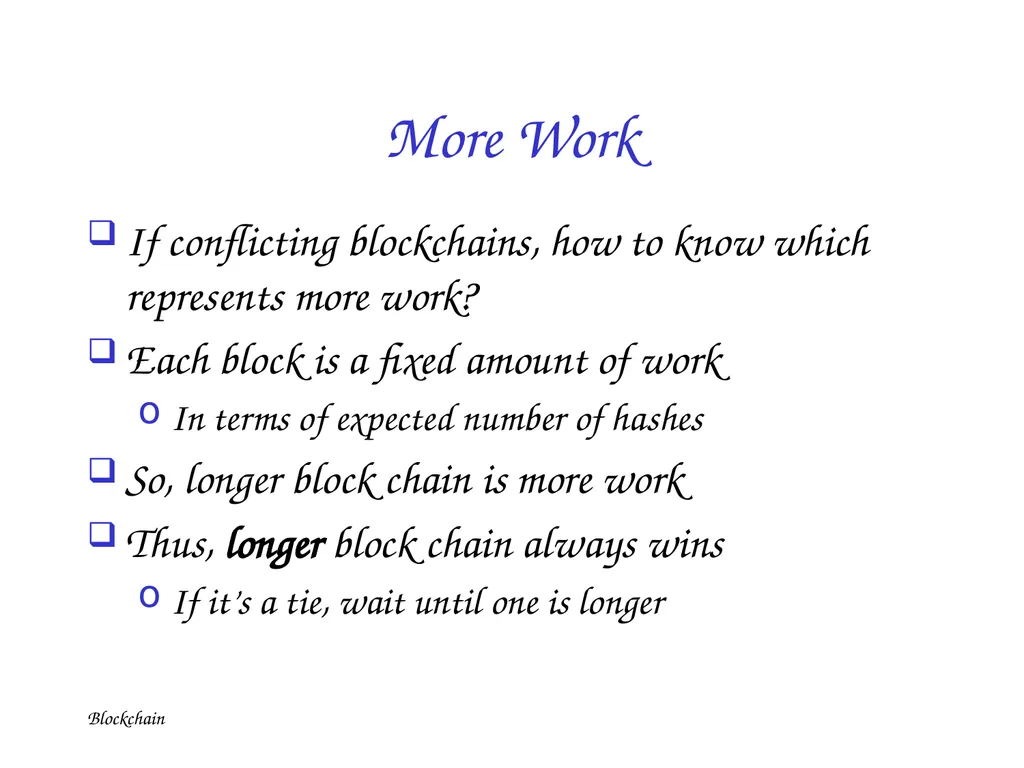
More Work If conflicting blockchains, how to know which represents more work?
Each block is a fixed amount of work
In terms of expected number of hashes
So, longer block chain is more work
Thus, longer block chain always wins
If it’s a tie, wait until one is longer Blockchain<br>
Each block is a fixed amount of work
In terms of expected number of hashes
So, longer block chain is more work
Thus, longer block chain always wins
If it’s a tie, wait until one is longer Blockchain<br>
34
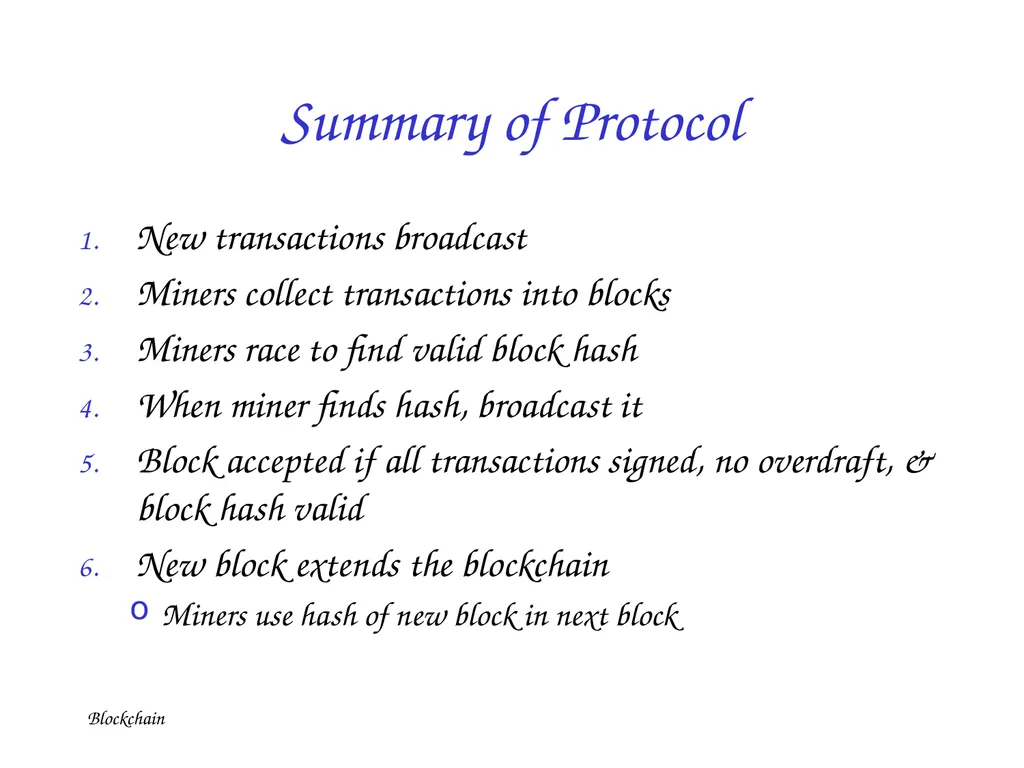
Summary of Protocol New transactions broadcast
Miners collect transactions into blocks
Miners race to find valid block hash
When miner finds hash, broadcast it
Block accepted if all transactions signed, no overdraft, & block hash valid
New block extends the blockchain
Miners use hash of new block in next block Blockchain<br>
Miners collect transactions into blocks
Miners race to find valid block hash
When miner finds hash, broadcast it
Block accepted if all transactions signed, no overdraft, & block hash valid
New block extends the blockchain
Miners use hash of new block in next block Blockchain<br>
35
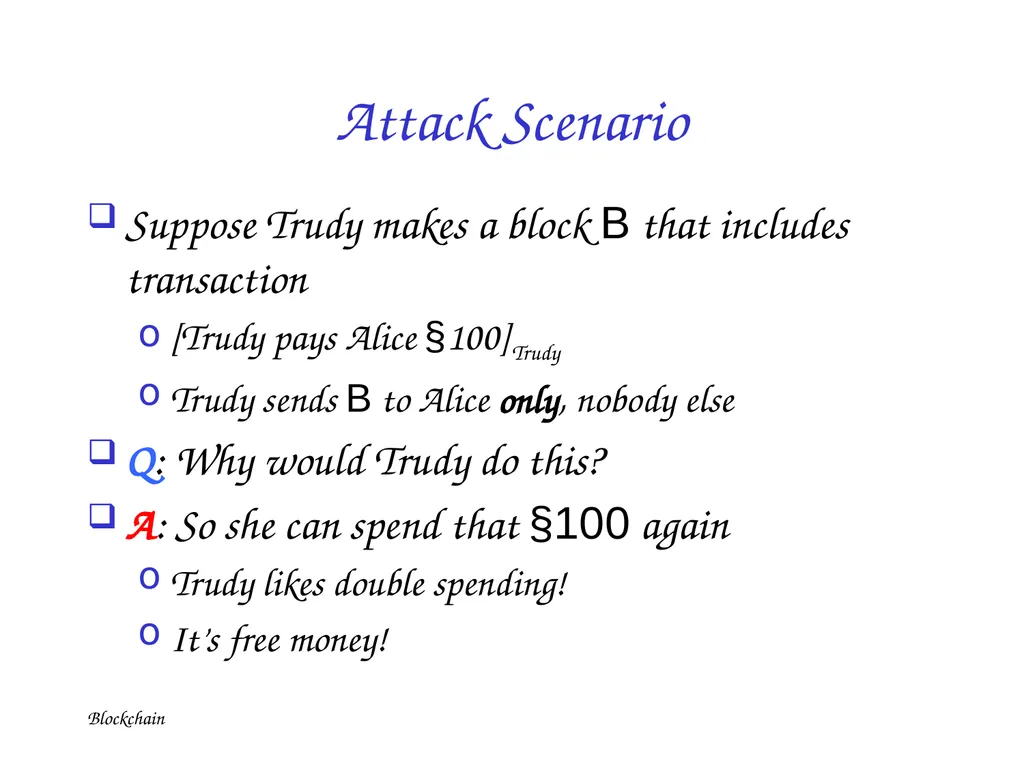
Attack Scenario Suppose Trudy makes a block B that includes transaction
[Trudy pays Alice §100]Trudy
Trudy sends B to Alice only, nobody else
Q: Why would Trudy do this?
A: So she can spend that §100 again
Trudy likes double spending!
It’s free money! Blockchain<br>
[Trudy pays Alice §100]Trudy
Trudy sends B to Alice only, nobody else
Q: Why would Trudy do this?
A: So she can spend that §100 again
Trudy likes double spending!
It’s free money! Blockchain<br>
36
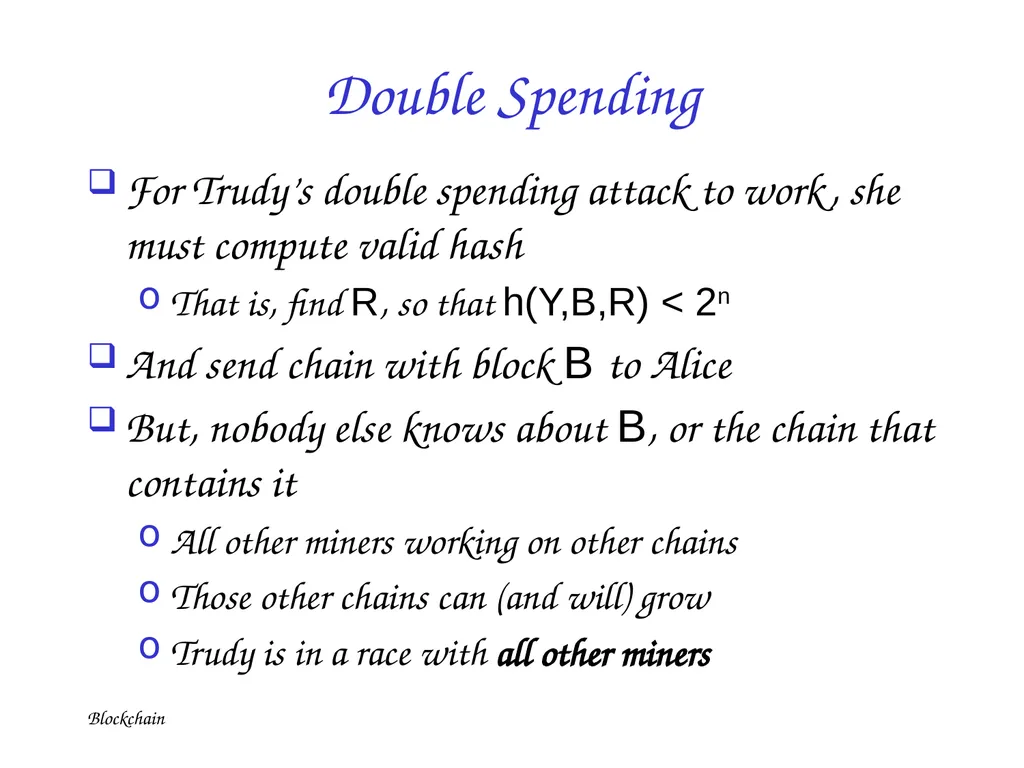
Double Spending For Trudy’s double spending attack to work, she must compute valid hash
That is, find R, so that h(Y,B,R) < 2n
And send chain with block B to Alice
But, nobody else knows about B, or the chain that contains it
All other miners working on other chains
Those other chains can (and will) grow
Trudy is in a race with all other miners Blockchain<br>
That is, find R, so that h(Y,B,R) < 2n
And send chain with block B to Alice
But, nobody else knows about B, or the chain that contains it
All other miners working on other chains
Those other chains can (and will) grow
Trudy is in a race with all other miners Blockchain<br>
37
Double Spending Attack Assuming she waits, Alice will reject Trudy’s chain if longer chain appears
Trudy would need majority of compute power in network to win consistently
Trudy needs to win a lot!
Or, miners must collude with Trudy
But is it in their interest to do so? Blockchain<br>
Trudy would need majority of compute power in network to win consistently
Trudy needs to win a lot!
Or, miners must collude with Trudy
But is it in their interest to do so? Blockchain<br>
38
Blockchain From users perspective…
Transaction in last block might not be entirely trustworthy
Possibility of double spending attack
But, the more blocks that follow, the more certain that a transaction is valid
Just wait until a few more blocks are added before accepting a transaction Blockchain<br>
Transaction in last block might not be entirely trustworthy
Possibility of double spending attack
But, the more blocks that follow, the more certain that a transaction is valid
Just wait until a few more blocks are added before accepting a transaction Blockchain<br>
39
Refinements Number of hashes can change so that winning hash takes constant time
Computing power in network can increase
In Bitcoin, new block every 10 minutes
Can decrease mining reward so money supply does not grow forever
E.g., maximum of 21,000,000 bitcoins
Then what will be incentive for miners? Blockchain<br>
Computing power in network can increase
In Bitcoin, new block every 10 minutes
Can decrease mining reward so money supply does not grow forever
E.g., maximum of 21,000,000 bitcoins
Then what will be incentive for miners? Blockchain<br>
40
Refinements Merkle tree can be used to reduce storage requirements
Transactions in a block hashed in a tree, only the root is needed in block hash
Simplified payment verification
In effect, rely on others to verify for you
Combining and splitting value
Transaction can have multiple input/output Blockchain<br>
Transactions in a block hashed in a tree, only the root is needed in block hash
Simplified payment verification
In effect, rely on others to verify for you
Combining and splitting value
Transaction can have multiple input/output Blockchain<br>
41
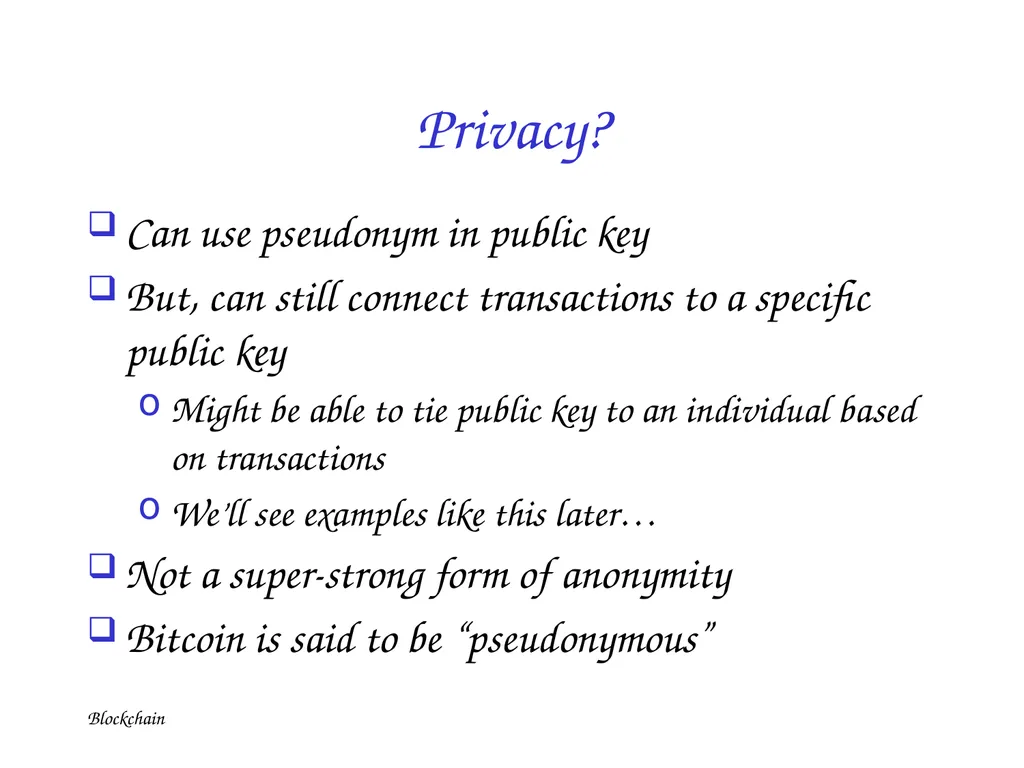
Privacy? Can use pseudonym in public key
But, can still connect transactions to a specific public key
Might be able to tie public key to an individual based on transactions
We’ll see examples like this later…
Not a super-strong form of anonymity
Bitcoin is said to be “pseudonymous” Blockchain<br>
But, can still connect transactions to a specific public key
Might be able to tie public key to an individual based on transactions
We’ll see examples like this later…
Not a super-strong form of anonymity
Bitcoin is said to be “pseudonymous” Blockchain<br>
42
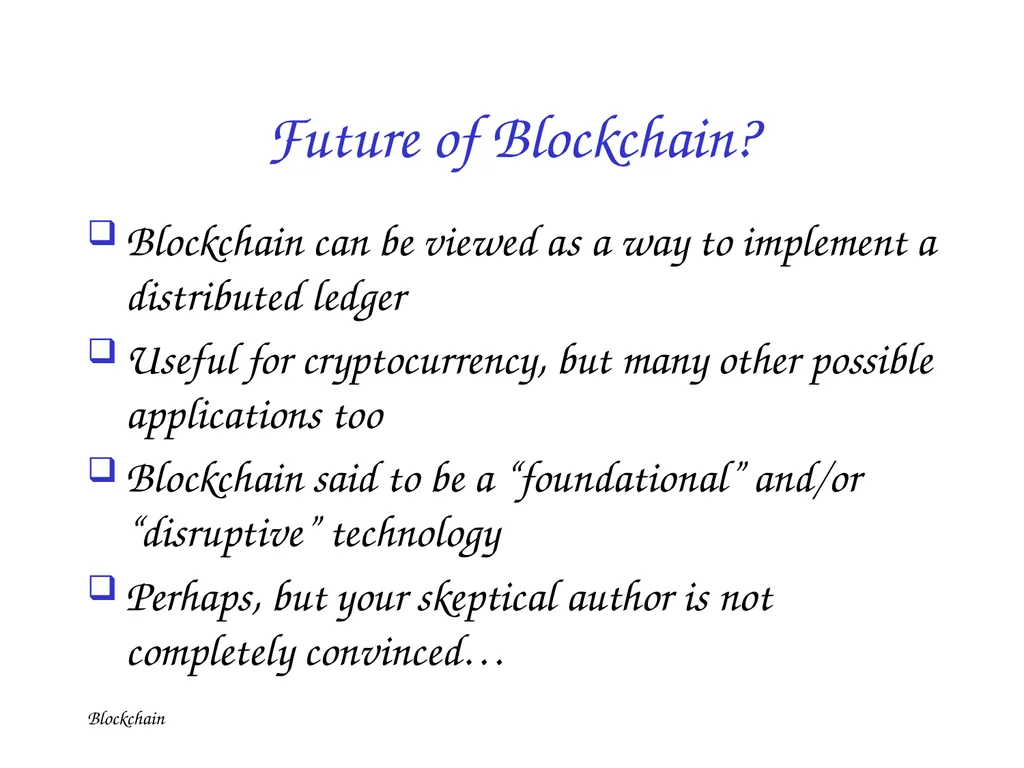
Future of Blockchain? Blockchain can be viewed as a way to implement a distributed ledger
Useful for cryptocurrency, but many other possible applications too
Blockchain said to be a “foundational” and/or “disruptive” technology
Perhaps, but your skeptical author is not completely convinced… Blockchain<br>
Useful for cryptocurrency, but many other possible applications too
Blockchain said to be a “foundational” and/or “disruptive” technology
Perhaps, but your skeptical author is not completely convinced… Blockchain<br>
43
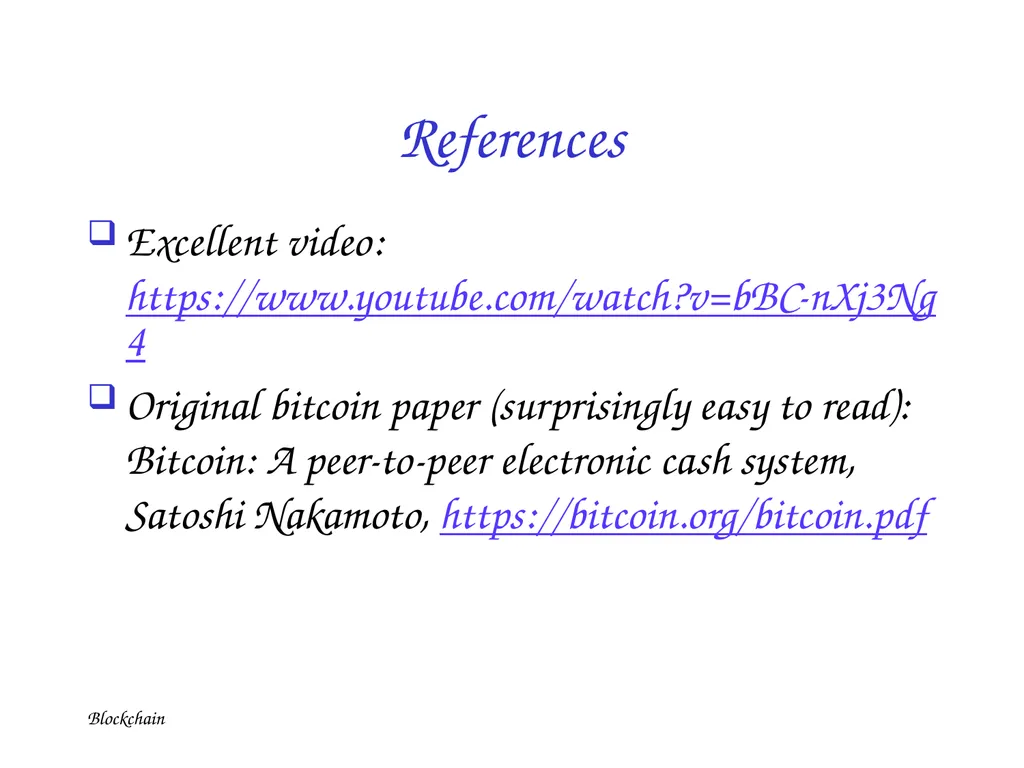
References Excellent video: https://www.youtube.com/watch?v=bBC-nXj3Ng4
Original bitcoin paper (surprisingly easy to read): Bitcoin: A peer-to-peer electronic cash system, Satoshi Nakamoto, https://bitcoin.org/bitcoin.pdf Blockchain<br>
Original bitcoin paper (surprisingly easy to read): Bitcoin: A peer-to-peer electronic cash system, Satoshi Nakamoto, https://bitcoin.org/bitcoin.pdf Blockchain<br>