Blood Glucose Monitoring Sara Alosaimy, Bsc Type 1
Description: Blood Glucose Monitoring Sara Alosaimy, Bsc Type 1 diabetes (b-cell destruction, usually leading to absolute insulin deficiency) Type 2 diabetes (a progressive insulin secretory defect on the background of insulin resistance) Other specific
Related Topics
Download Presentation
"Blood Glucose Monitoring Sara Alosaimy, Bsc Type 1" is the property of its rightful owner. Permission is granted to download and print the materials on this website for personal, non-commercial use only, and to display it on your personal computer provided you do not modify the materials and that you retain all copyright notices contained in the materials. By downloading content from our website, you accept the terms of this agreement.
Presentation Transcript
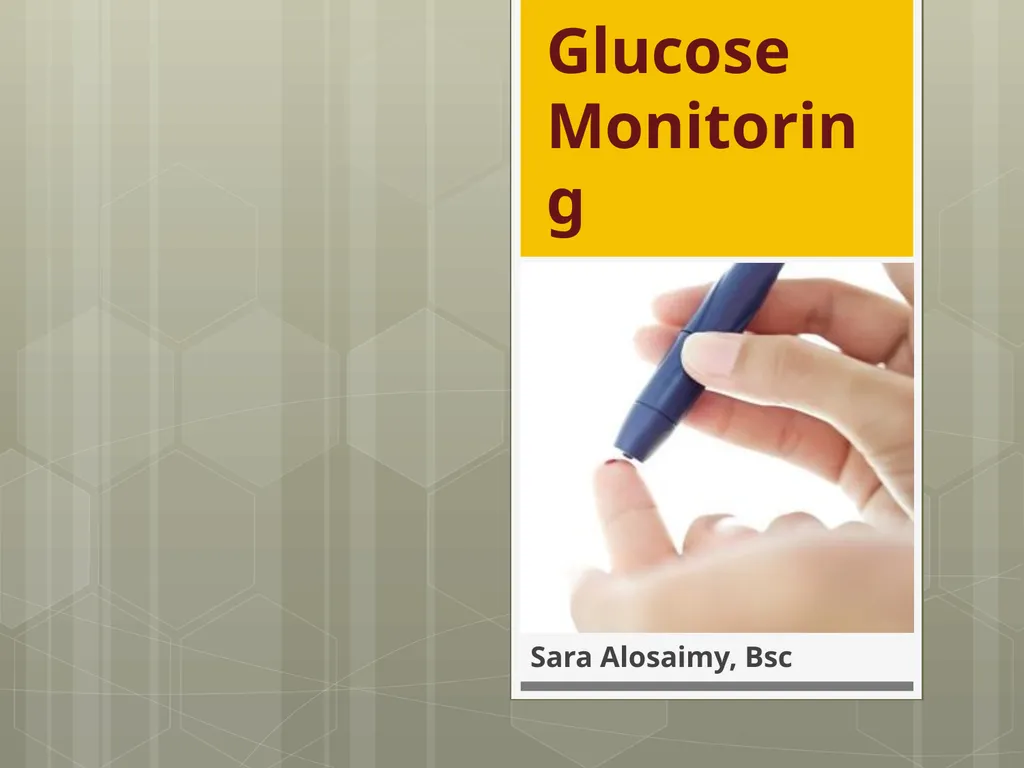
slide1. Blood Glucose Monitoring Sara Alosaimy, Bsc<br>
slide2. Type 1 diabetes
(b-cell destruction, usually leading to absolute insulin deficiency)
Type 2 diabetes
(a progressive insulin secretory defect on the background of insulin resistance)
Other specific types of diabetes due to other causes
e.g., genetic defects in b-cell function, genetic defects in insulin action, diseases of the exocrinepancreas (such as cystic fibrosis), and drug- or chemical-induced (such as in the treatment of HIV/AIDS or after organ transplantation)
Gestational diabetes mellitus (GDM)
(diabetes diagnosed during pregnancy that is not clearly overt diabetes) Diabetes Classification<br>
slide3. Hypoglycemia<br>
slide4. Hyperglycemia<br>
slide5. ■ An individualized blood glucose profile can help the healthcare team tailor an individualized diabetes treatment regimen
■ It improves recognition of hypoglycaemia or severe hyperglycaemia
■ It enhances patient education and empowerment. Why do we do it ?<br>
slide6. -It gives people with diabetes and their families the ability to make appropriate day-to-day treatment choices in activity and food choices, as well as over insulin or other agents
-Assists in achieving and maintaining glycemic goals
Evaluates pre-meal and post-meal BG Patterns.
Then, coordinates amount and timing of food, activity and meds to reach target BGs. Why do we do it ?<br>
slide7. When treatment is being changed or intensified
During attempts to optimize diabetes control
Suspected or confirmed hypoglycemic unawareness
Regular or disabling hypoglycemia
When driving
The Driver and Vehicle Licensing Agency (DVLA) advises that a person with
diabetes on medication that may cause hypoglycaemia (such as insulin, sulphonylureas and
meglitinides) MUST check their blood glucose level before driving and every 2 hours while
driving (DVLA Drivers Medical Group, 2011) When should self-monitoring of BGbe done MORE often?<br>
slide8. During periods of illness
During regular and/or intensive physical activity
When optimising control before conception and during pregnancy
In people living alone who may be at increased risk of falls
During shift work
In occupations where intensive self-management is needed to avoid hypoglycaemia
In people using insulin pumps or who have intensive multiple daily insulin therapy When should self-monitoring of BGbe done MORE often?<br>
slide9. How to monitor BG level?
(Self monitoring) 1-Finger prick
(Glucose meter). 2-Medtronic MiniMed 3-Glucowatch 4-Hb A1c testing<br>
slide10. Medtronic MiniMed Released in at 2005
Measure glucose every 5 sec. average every 5 min. for 3 days.
Advantage of decrease blood sample, and continuous BGM
Effective for children less than 7 years old
Potential for monitoring moment-to-moment changes in blood glucose concentration,
Which cannot be detected by intermittent (BGSM), so that changes in management as the result of sensing may lead to improved glycemic control<br>
slide11. Glucowatch Initially FDA approved for adult only but at August 2002 approved for child 7-17
Reading every 20min. for up to 12 hrs.
Adjunct device to supplement rather than to replace conventional glucose monitoring devices.
New G2 biographer gives reading every 10 min.
Adv: decrease number of blood sample daily
Disadv: sensor changed every 12 hrs (cost)
Also, its affected by weather.<br>
slide12. Sensor Meters
- Measures electronic charge resulting from reaction of strip enzyme and glucose in the drop of blood.
Newer meters are plasma calibrated readings are 12% higher than whole blood calibrated meters (older ones)
Timing
Fasting/before meals.
After meals.
Bedtime.
Middle of the night.
When suspect low glucose
Before or after activity.
Before driving. BG Meters 6 – 8 times daily for DM I<br>
slide13. Components of B.G meter kit<br>
slide14. How to use it ?<br>
slide15. Alternate Site Testing
(palm, forearm, thigh, upper arm)
are affected by food, activity, stress, illness, meds.
When to use:
Fasting or more than 2 hours since last meal/snack
2 hours or more since last insulin dose
2 hours or more since any activity
When NOT to use:
If has hypoglycemia unawareness
If suspect a low reading
Within 2 hours of eating
After exercise
During illness
Before driving<br>
slide16. Glucose Meter Potential Interferences<br>
slide17. Factors that Affect Accuracy<br>
slide18. % glycated hemoglobin, or HbA1c, in the blood.
The A1C test measures your average blood glucose control for the past 2 to 3 months.
It does not replace daily self-testing of blood glucose.<br>
slide19. When to perform?
Perform the A1C test at least two times a year in patients who are meeting treatment goals (and who have stable glycemic control)
Perform the A1C test quarterly in patients whose therapy has changed or who are not meeting glycemic goals.
Advantages and Disadvantages ?<br>
slide20. Diagnosis of Diabetes<br>
slide21. Target Blood Glucose Ranges
1. American Diabetes Association (213) Clinical Practice Recommendations<br>
slide22. Selecting An Appropriate Meter 1-Consider patient age:
The Elderly
-Less strip handling
-Small blood sample
-Larger display screen
-Memory
Children
- Small blood sample
- Comfortable lancet
- Quick results
- Memory Automatic strip handling and coding from Roche BG meter attached to a
Nintendo GAMEBOY®<br>
slide23. 2-Functional visual ability
-Tactile markings on strips.
-Strips that are not damaged by touching.
-Talking meters.
3-Cost
(insurance coverage or not)
4-Dislike of record keeping
5-Memory impairment
(cognition)
6-Motor ability
(e.g Tremors)
7-Psychosocial concerns
(e.g Readiness to learn) Accu-Chek Voicemate (Roche)
-Talking monitor<br>
slide24. Bob D., age 49, has type 2 diabetes. For the past seven years, he and his doctor have worked to control his blood sugar levels with diet and diabetes pills. Recently, Bob's control has been getting worse, so his doctor said that Bob might have to start insulin shots. But first, they agreed that Bob would try an exercise program to improve control.
After 3 months of sticking to his exercise plan, Bob returned to the doctor to check his blood sugar. It was near the normal range, but the doctor knew a single blood test only showed Bob's control at that time. It didn't say much about Bob's overall blood sugar control.
The doctor sent a sample of Bob's blood to the lab for an A1C test to learn how well Bob's blood sugar had been controlled, on average, for the past few months. The A1C test showed that Bob's control had improved. With the A1C results, Bob and his doctor had proof that the exercise program was working. The test results also helped Bob know that he could make a difference in his blood sugar control. CASE 1: A1C Scenario<br>
slide25. Mr Giles is a 53-year-old man diagnosed with diabetes 2 years ago, he had an HbA1c level of 7.5%
After 6 months of lifestyle changes, including nutritional therapy, his HbA1c level remained higher than 7% and he was prescribed metformin.
Although his HbA1c initially declined to 6.7%, it gradually returned to the original level of 7.5% during the course of a year.
Self-monitoring of blood glucose was discussed between Mr Giles and the pharmacist, and was subsequently used to create a glucose profile that showed frequent post-prandial glucose excursions higher than 11.1 mmol/litre.
On the basis of this SMBG pattern, pre-prandial repaglinide was prescribed, and Mr Giles was encouraged to continue SMBG regularly during the next few weeks to detect impending hypoglycaemia, and to monitor his response to the change in therapy.
At his last visit, Mr Giles’s HbA1c had improved to 6.9% (52 mmol/mol). CASE 2: SMBG Scenario<br>
slide2. Type 1 diabetes
(b-cell destruction, usually leading to absolute insulin deficiency)
Type 2 diabetes
(a progressive insulin secretory defect on the background of insulin resistance)
Other specific types of diabetes due to other causes
e.g., genetic defects in b-cell function, genetic defects in insulin action, diseases of the exocrinepancreas (such as cystic fibrosis), and drug- or chemical-induced (such as in the treatment of HIV/AIDS or after organ transplantation)
Gestational diabetes mellitus (GDM)
(diabetes diagnosed during pregnancy that is not clearly overt diabetes) Diabetes Classification<br>
slide3. Hypoglycemia<br>
slide4. Hyperglycemia<br>
slide5. ■ An individualized blood glucose profile can help the healthcare team tailor an individualized diabetes treatment regimen
■ It improves recognition of hypoglycaemia or severe hyperglycaemia
■ It enhances patient education and empowerment. Why do we do it ?<br>
slide6. -It gives people with diabetes and their families the ability to make appropriate day-to-day treatment choices in activity and food choices, as well as over insulin or other agents
-Assists in achieving and maintaining glycemic goals
Evaluates pre-meal and post-meal BG Patterns.
Then, coordinates amount and timing of food, activity and meds to reach target BGs. Why do we do it ?<br>
slide7. When treatment is being changed or intensified
During attempts to optimize diabetes control
Suspected or confirmed hypoglycemic unawareness
Regular or disabling hypoglycemia
When driving
The Driver and Vehicle Licensing Agency (DVLA) advises that a person with
diabetes on medication that may cause hypoglycaemia (such as insulin, sulphonylureas and
meglitinides) MUST check their blood glucose level before driving and every 2 hours while
driving (DVLA Drivers Medical Group, 2011) When should self-monitoring of BGbe done MORE often?<br>
slide8. During periods of illness
During regular and/or intensive physical activity
When optimising control before conception and during pregnancy
In people living alone who may be at increased risk of falls
During shift work
In occupations where intensive self-management is needed to avoid hypoglycaemia
In people using insulin pumps or who have intensive multiple daily insulin therapy When should self-monitoring of BGbe done MORE often?<br>
slide9. How to monitor BG level?
(Self monitoring) 1-Finger prick
(Glucose meter). 2-Medtronic MiniMed 3-Glucowatch 4-Hb A1c testing<br>
slide10. Medtronic MiniMed Released in at 2005
Measure glucose every 5 sec. average every 5 min. for 3 days.
Advantage of decrease blood sample, and continuous BGM
Effective for children less than 7 years old
Potential for monitoring moment-to-moment changes in blood glucose concentration,
Which cannot be detected by intermittent (BGSM), so that changes in management as the result of sensing may lead to improved glycemic control<br>
slide11. Glucowatch Initially FDA approved for adult only but at August 2002 approved for child 7-17
Reading every 20min. for up to 12 hrs.
Adjunct device to supplement rather than to replace conventional glucose monitoring devices.
New G2 biographer gives reading every 10 min.
Adv: decrease number of blood sample daily
Disadv: sensor changed every 12 hrs (cost)
Also, its affected by weather.<br>
slide12. Sensor Meters
- Measures electronic charge resulting from reaction of strip enzyme and glucose in the drop of blood.
Newer meters are plasma calibrated readings are 12% higher than whole blood calibrated meters (older ones)
Timing
Fasting/before meals.
After meals.
Bedtime.
Middle of the night.
When suspect low glucose
Before or after activity.
Before driving. BG Meters 6 – 8 times daily for DM I<br>
slide13. Components of B.G meter kit<br>
slide14. How to use it ?<br>
slide15. Alternate Site Testing
(palm, forearm, thigh, upper arm)
are affected by food, activity, stress, illness, meds.
When to use:
Fasting or more than 2 hours since last meal/snack
2 hours or more since last insulin dose
2 hours or more since any activity
When NOT to use:
If has hypoglycemia unawareness
If suspect a low reading
Within 2 hours of eating
After exercise
During illness
Before driving<br>
slide16. Glucose Meter Potential Interferences<br>
slide17. Factors that Affect Accuracy<br>
slide18. % glycated hemoglobin, or HbA1c, in the blood.
The A1C test measures your average blood glucose control for the past 2 to 3 months.
It does not replace daily self-testing of blood glucose.<br>
slide19. When to perform?
Perform the A1C test at least two times a year in patients who are meeting treatment goals (and who have stable glycemic control)
Perform the A1C test quarterly in patients whose therapy has changed or who are not meeting glycemic goals.
Advantages and Disadvantages ?<br>
slide20. Diagnosis of Diabetes<br>
slide21. Target Blood Glucose Ranges
1. American Diabetes Association (213) Clinical Practice Recommendations<br>
slide22. Selecting An Appropriate Meter 1-Consider patient age:
The Elderly
-Less strip handling
-Small blood sample
-Larger display screen
-Memory
Children
- Small blood sample
- Comfortable lancet
- Quick results
- Memory Automatic strip handling and coding from Roche BG meter attached to a
Nintendo GAMEBOY®<br>
slide23. 2-Functional visual ability
-Tactile markings on strips.
-Strips that are not damaged by touching.
-Talking meters.
3-Cost
(insurance coverage or not)
4-Dislike of record keeping
5-Memory impairment
(cognition)
6-Motor ability
(e.g Tremors)
7-Psychosocial concerns
(e.g Readiness to learn) Accu-Chek Voicemate (Roche)
-Talking monitor<br>
slide24. Bob D., age 49, has type 2 diabetes. For the past seven years, he and his doctor have worked to control his blood sugar levels with diet and diabetes pills. Recently, Bob's control has been getting worse, so his doctor said that Bob might have to start insulin shots. But first, they agreed that Bob would try an exercise program to improve control.
After 3 months of sticking to his exercise plan, Bob returned to the doctor to check his blood sugar. It was near the normal range, but the doctor knew a single blood test only showed Bob's control at that time. It didn't say much about Bob's overall blood sugar control.
The doctor sent a sample of Bob's blood to the lab for an A1C test to learn how well Bob's blood sugar had been controlled, on average, for the past few months. The A1C test showed that Bob's control had improved. With the A1C results, Bob and his doctor had proof that the exercise program was working. The test results also helped Bob know that he could make a difference in his blood sugar control. CASE 1: A1C Scenario<br>
slide25. Mr Giles is a 53-year-old man diagnosed with diabetes 2 years ago, he had an HbA1c level of 7.5%
After 6 months of lifestyle changes, including nutritional therapy, his HbA1c level remained higher than 7% and he was prescribed metformin.
Although his HbA1c initially declined to 6.7%, it gradually returned to the original level of 7.5% during the course of a year.
Self-monitoring of blood glucose was discussed between Mr Giles and the pharmacist, and was subsequently used to create a glucose profile that showed frequent post-prandial glucose excursions higher than 11.1 mmol/litre.
On the basis of this SMBG pattern, pre-prandial repaglinide was prescribed, and Mr Giles was encouraged to continue SMBG regularly during the next few weeks to detect impending hypoglycaemia, and to monitor his response to the change in therapy.
At his last visit, Mr Giles’s HbA1c had improved to 6.9% (52 mmol/mol). CASE 2: SMBG Scenario<br>