
Boot Camp Module 7 Outreach and Enfolding Pastor’s

Description: Boot Camp Module 7 Outreach and Enfolding Pastors Coach Pastorscoach.com 2020 Quintessant Evangelism Intro Everything can happen better in heaven exceptEvangelism! Reaching the lost is our main priority. The Great Commission Matt
Related Topics
Download Presentation
"Boot Camp Module 7 Outreach and Enfolding Pastor’s" is the property of its rightful owner. Permission is granted to download and print the materials on this website for personal, non-commercial use only, and to display it on your personal computer provided you do not modify the materials and that you retain all copyright notices contained in the materials. By downloading content from our website, you accept the terms of this agreement.
Presentation Transcript
slide1. Boot Camp
Module 7
Outreach and Enfolding
Pastor’s Coach Pastorscoach.com © 2020 Quintessant<br>
slide2. Evangelism Intro Everything can happen better in heaven except…Evangelism!
Reaching the lost is our main priority. The Great Commission Matt 28:19-20
Jesus had an agenda. To seek and to save that which was lost. Luke 19:10
The gospel is the good news, the message of salvation and the Kingdom.
Every Christian needs to share the gospel.
Every Christian needs to be trained in personal soul-winning even if evangelism is not their “gift.”
Most Christians think of “real evangelism” as street preaching; need to shift the understanding that evangelism is much more than that.
Key: The most important thing is to find someone who is open and then be able to share the message in a way that they can understand and respond. And then bring them in to the church.<br>
slide3. Types of Evangelism There are many kinds of evangelism.
High profile evangelism: Preaching, “on the streets,” passing out tracts.
Attractional evangelism: “Come and see;” invitations to services, events. John 4
Missional evangelism: “Go and tell;” door to door, foreign missions, etc. Mark 16:15
Viral evangelism: Luke 10 Find a house of peace; go into their world, pray for them, declare the kingdom.
Prayer and Power evangelism: Meet people randomly, impact spiritually.
Servant evangelism: Do service projects, hand out water, food, etc.
Relational / friendship evangelism: Develop relationships.<br>
slide4. Relational Evangelism Relational or lifestyle evangelism is the key to babies in the house!
Most people come to faith through friendship /relationship with a Christian.
Many believers have little or no meaningful friendships with non-Christians.
Must increase interaction; build trust for people to be open to the gospel.
SOI is the people you have regular contact with: family, friends, co-workers, activity group members, neighbors, friends of family.
Every church member needs to reach out to their Sphere of Influence (SOI) and develop friendships, looking for opportunities to share the gospel.<br>
slide5. Relational Evangelism cont. Primary mission field is your Sphere Of Influence (SOI) – look for open hearts
Seek to meet “felt needs’ – needs the non Christian feels strongest. Examples: sickness, loss of job, loneliness, lack of peace, etc.
A simple but powerful way to interact spiritually is to pray for a person for their need in their presence. Simple “non super-religious” prayer. Then the person will ask questions and that opens the door for spiritual ministry. Don’t rush the person. Invite to church if they are really open, otherwise work on friendship, building trust.
Develop friendships: Go to coffee or lunch. Invite to small group events designed for non-Christians. Be a real friend. Learn to listen, build trust.
Other ways to minister to felt needs: Sickness: visit in hospital, make a meal, bring a card; Job loss: help with resume or networking; Moving: help load truck; Neighbor: help with yard work.
Once it seems that the person is open, here is a great question: “Where are you at on your spiritual journey?” Let them answer and truly listen to their story. Then you can seek to share some of your story.<br>
slide6. Small Group Outreach Small groups can be a “platform” for outreach.
Groups can do casual “bridge” events: group members invite non-Christian friends from their SOI; this increases relational connection with them.
Invite some Christians from the group, and some non-Christians, keep it casual and relational, with food and drink.
At the events and in other interactions, look for opportunities to connect spiritually with the person and at some point, share your story and the gospel. It’s a process that often takes time.
Keep interacting one-on-one or in these events; don’t invite the non-Christian to the regular group meeting until they are truly open.
Examples: parties, barbeques, service projects, dinners, TV sports events gatherings such as Super Bowl or World Cup, men’s campout, etc.<br>
slide7. Other Outreach Events Church sponsored events are “attraction” evangelism: come and see.
Activity events: Block parties, holiday celebrations, Christmas and Easter.
Evangelistic meetings.
Movies with discussion afterwards.
Join with other churches or city-wide evangelistic events.
Once-a-month tailor your Sun service to be especially geared for visitors.
Key: The crucial thing is for a church member to make a connection with the non-Christian so there will be ongoing relationship. That’s why it’s generally more effective to interact with one’s SOI because there already IS an ongoing relationship.<br>
slide8. Evangelism Training Evangelistically-gifted leaders must equip others (Eph 4:11-12)
Testimonies are powerful: Sun morn, small group, personal story.
Small group outreach worker keeps small group focused outward by bringing evangelistic focus to meetings. Example: 5 min training on some aspect of evangelism, testimony, or activity such as writing names of people in SOI who are open and praying for them.
Small group training by outreach worker, and large group training by pastor or overseers/leaders: train members on personal evangelism: how to share testimony, lead person to faith, basic apologetics, follow up. Use role play to practice.
Larger outreaches or outreach teams engage in activities such as praying for people “on the streets” for healing, sharing prophetic words, spiritual treasure hunts; these encourage people and train “on the job.”<br>
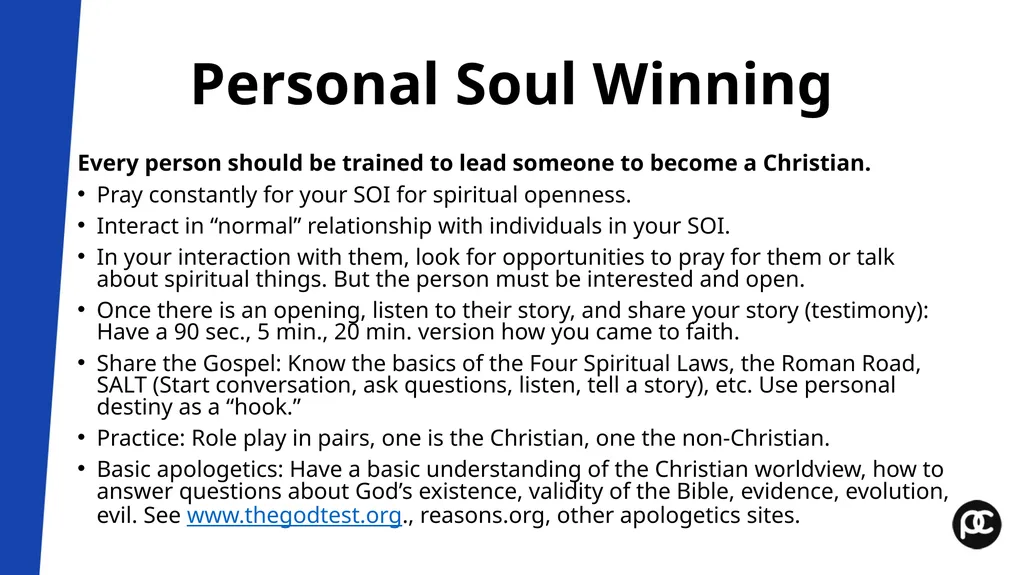
slide9. Personal Soul Winning Every person should be trained to lead someone to become a Christian.
Pray constantly for your SOI for spiritual openness.
Interact in “normal” relationship with individuals in your SOI.
In your interaction with them, look for opportunities to pray for them or talk about spiritual things. But the person must be interested and open.
Once there is an opening, listen to their story, and share your story (testimony): Have a 90 sec., 5 min., 20 min. version how you came to faith.
Share the Gospel: Know the basics of the Four Spiritual Laws, the Roman Road, SALT (Start conversation, ask questions, listen, tell a story), etc. Use personal destiny as a “hook.”
Practice: Role play in pairs, one is the Christian, one the non-Christian.
Basic apologetics: Have a basic understanding of the Christian worldview, how to answer questions about God’s existence, validity of the Bible, evidence, evolution, evil. See www.thegodtest.org., reasons.org, other apologetics sites.<br>
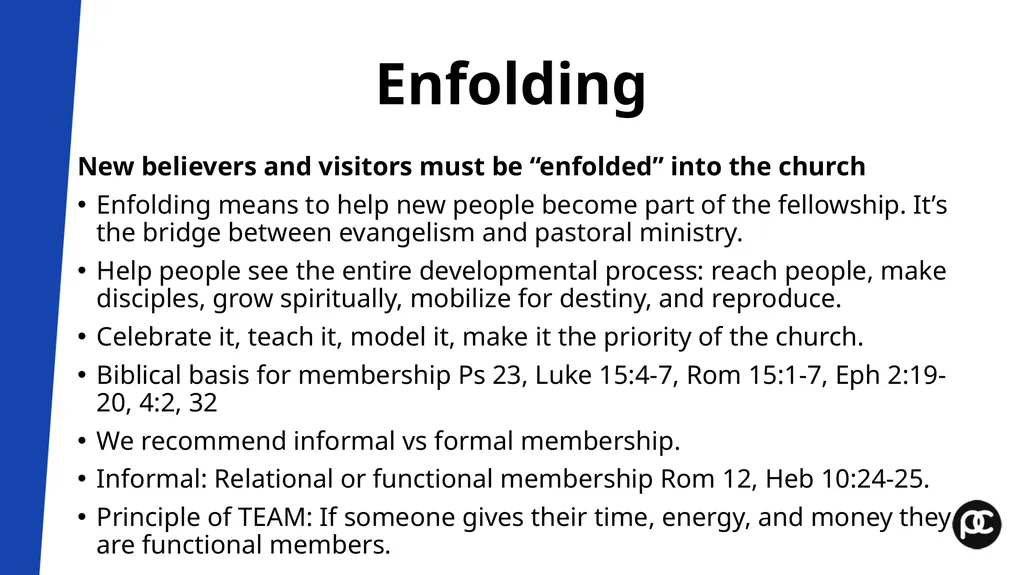
slide10. Enfolding New believers and visitors must be “enfolded” into the church
Enfolding means to help new people become part of the fellowship. It’s the bridge between evangelism and pastoral ministry.
Help people see the entire developmental process: reach people, make disciples, grow spiritually, mobilize for destiny, and reproduce.
Celebrate it, teach it, model it, make it the priority of the church.
Biblical basis for membership Ps 23, Luke 15:4-7, Rom 15:1-7, Eph 2:19-20, 4:2, 32
We recommend informal vs formal membership.
Informal: Relational or functional membership Rom 12, Heb 10:24-25.
Principle of TEAM: If someone gives their time, energy, and money they are functional members.<br>
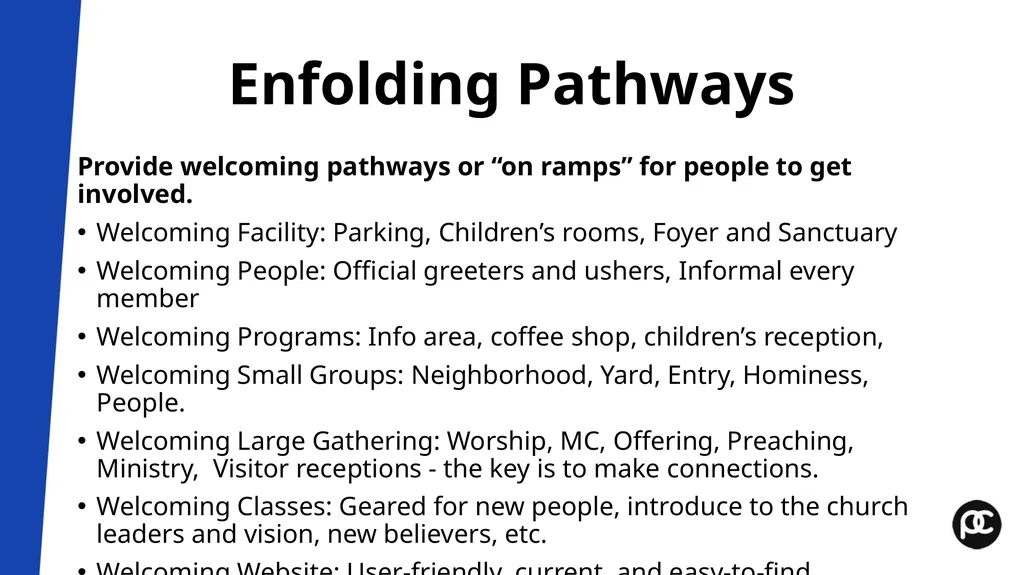
slide11. Enfolding Pathways Provide welcoming pathways or “on ramps” for people to get involved.
Welcoming Facility: Parking, Children’s rooms, Foyer and Sanctuary
Welcoming People: Official greeters and ushers, Informal every member
Welcoming Programs: Info area, coffee shop, children’s reception,
Welcoming Small Groups: Neighborhood, Yard, Entry, Hominess, People.
Welcoming Large Gathering: Worship, MC, Offering, Preaching, Ministry, Visitor receptions - the key is to make connections.
Welcoming Classes: Geared for new people, introduce to the church leaders and vision, new believers, etc.
Welcoming Website: User-friendly, current, and easy-to-find information.<br>
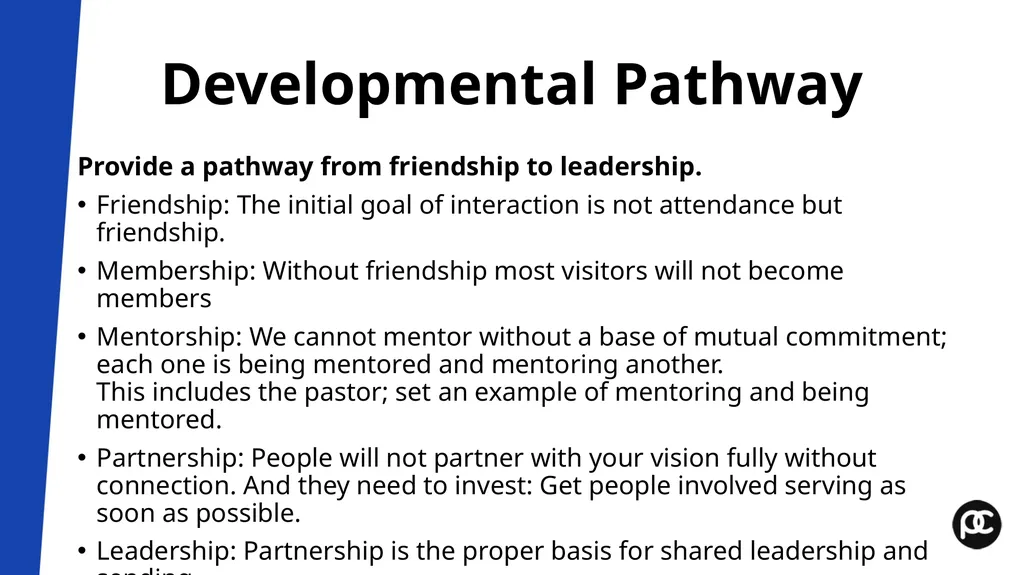
slide12. Developmental Pathway Provide a pathway from friendship to leadership.
Friendship: The initial goal of interaction is not attendance but friendship.
Membership: Without friendship most visitors will not become members
Mentorship: We cannot mentor without a base of mutual commitment; each one is being mentored and mentoring another. This includes the pastor; set an example of mentoring and being mentored.
Partnership: People will not partner with your vision fully without connection. And they need to invest: Get people involved serving as soon as possible.
Leadership: Partnership is the proper basis for shared leadership and sending.<br>
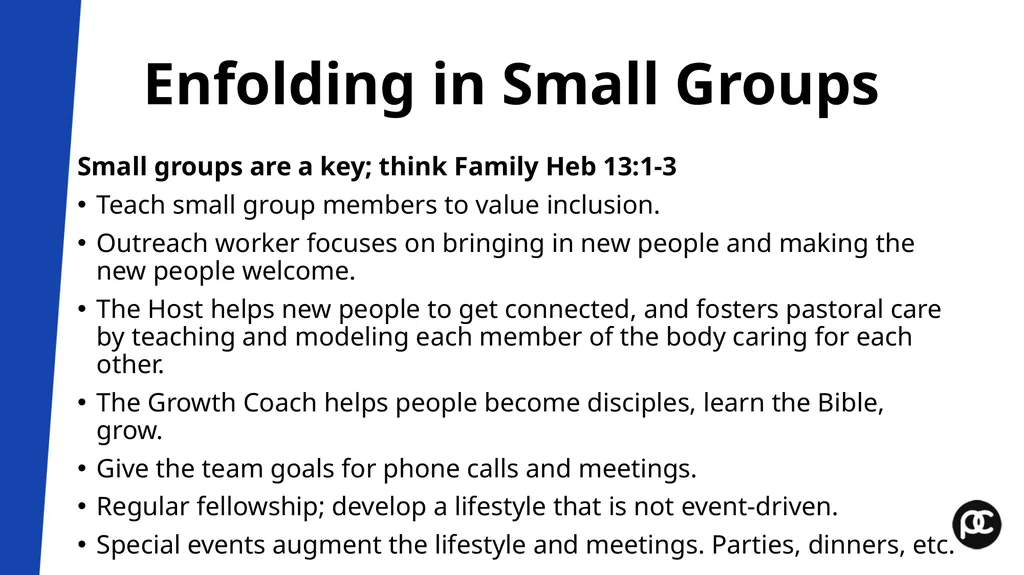
slide13. Enfolding in Small Groups Small groups are a key; think Family Heb 13:1-3
Teach small group members to value inclusion.
Outreach worker focuses on bringing in new people and making the new people welcome.
The Host helps new people to get connected, and fosters pastoral care by teaching and modeling each member of the body caring for each other.
The Growth Coach helps people become disciples, learn the Bible, grow.
Give the team goals for phone calls and meetings.
Regular fellowship; develop a lifestyle that is not event-driven.
Special events augment the lifestyle and meetings. Parties, dinners, etc.<br>
slide14. Conversation w/ a non-believer Michael did a podcast with a “progressive” non-believer online celebrity
This will give you some examples of how Michael interacted with someone with a different world view, asking questions, listening, etc.
https://www.fractalfriends.us/fractalfriends/michael-brodeur<br>
Module 7
Outreach and Enfolding
Pastor’s Coach Pastorscoach.com © 2020 Quintessant<br>
slide2. Evangelism Intro Everything can happen better in heaven except…Evangelism!
Reaching the lost is our main priority. The Great Commission Matt 28:19-20
Jesus had an agenda. To seek and to save that which was lost. Luke 19:10
The gospel is the good news, the message of salvation and the Kingdom.
Every Christian needs to share the gospel.
Every Christian needs to be trained in personal soul-winning even if evangelism is not their “gift.”
Most Christians think of “real evangelism” as street preaching; need to shift the understanding that evangelism is much more than that.
Key: The most important thing is to find someone who is open and then be able to share the message in a way that they can understand and respond. And then bring them in to the church.<br>
slide3. Types of Evangelism There are many kinds of evangelism.
High profile evangelism: Preaching, “on the streets,” passing out tracts.
Attractional evangelism: “Come and see;” invitations to services, events. John 4
Missional evangelism: “Go and tell;” door to door, foreign missions, etc. Mark 16:15
Viral evangelism: Luke 10 Find a house of peace; go into their world, pray for them, declare the kingdom.
Prayer and Power evangelism: Meet people randomly, impact spiritually.
Servant evangelism: Do service projects, hand out water, food, etc.
Relational / friendship evangelism: Develop relationships.<br>
slide4. Relational Evangelism Relational or lifestyle evangelism is the key to babies in the house!
Most people come to faith through friendship /relationship with a Christian.
Many believers have little or no meaningful friendships with non-Christians.
Must increase interaction; build trust for people to be open to the gospel.
SOI is the people you have regular contact with: family, friends, co-workers, activity group members, neighbors, friends of family.
Every church member needs to reach out to their Sphere of Influence (SOI) and develop friendships, looking for opportunities to share the gospel.<br>
slide5. Relational Evangelism cont. Primary mission field is your Sphere Of Influence (SOI) – look for open hearts
Seek to meet “felt needs’ – needs the non Christian feels strongest. Examples: sickness, loss of job, loneliness, lack of peace, etc.
A simple but powerful way to interact spiritually is to pray for a person for their need in their presence. Simple “non super-religious” prayer. Then the person will ask questions and that opens the door for spiritual ministry. Don’t rush the person. Invite to church if they are really open, otherwise work on friendship, building trust.
Develop friendships: Go to coffee or lunch. Invite to small group events designed for non-Christians. Be a real friend. Learn to listen, build trust.
Other ways to minister to felt needs: Sickness: visit in hospital, make a meal, bring a card; Job loss: help with resume or networking; Moving: help load truck; Neighbor: help with yard work.
Once it seems that the person is open, here is a great question: “Where are you at on your spiritual journey?” Let them answer and truly listen to their story. Then you can seek to share some of your story.<br>
slide6. Small Group Outreach Small groups can be a “platform” for outreach.
Groups can do casual “bridge” events: group members invite non-Christian friends from their SOI; this increases relational connection with them.
Invite some Christians from the group, and some non-Christians, keep it casual and relational, with food and drink.
At the events and in other interactions, look for opportunities to connect spiritually with the person and at some point, share your story and the gospel. It’s a process that often takes time.
Keep interacting one-on-one or in these events; don’t invite the non-Christian to the regular group meeting until they are truly open.
Examples: parties, barbeques, service projects, dinners, TV sports events gatherings such as Super Bowl or World Cup, men’s campout, etc.<br>
slide7. Other Outreach Events Church sponsored events are “attraction” evangelism: come and see.
Activity events: Block parties, holiday celebrations, Christmas and Easter.
Evangelistic meetings.
Movies with discussion afterwards.
Join with other churches or city-wide evangelistic events.
Once-a-month tailor your Sun service to be especially geared for visitors.
Key: The crucial thing is for a church member to make a connection with the non-Christian so there will be ongoing relationship. That’s why it’s generally more effective to interact with one’s SOI because there already IS an ongoing relationship.<br>
slide8. Evangelism Training Evangelistically-gifted leaders must equip others (Eph 4:11-12)
Testimonies are powerful: Sun morn, small group, personal story.
Small group outreach worker keeps small group focused outward by bringing evangelistic focus to meetings. Example: 5 min training on some aspect of evangelism, testimony, or activity such as writing names of people in SOI who are open and praying for them.
Small group training by outreach worker, and large group training by pastor or overseers/leaders: train members on personal evangelism: how to share testimony, lead person to faith, basic apologetics, follow up. Use role play to practice.
Larger outreaches or outreach teams engage in activities such as praying for people “on the streets” for healing, sharing prophetic words, spiritual treasure hunts; these encourage people and train “on the job.”<br>
slide9. Personal Soul Winning Every person should be trained to lead someone to become a Christian.
Pray constantly for your SOI for spiritual openness.
Interact in “normal” relationship with individuals in your SOI.
In your interaction with them, look for opportunities to pray for them or talk about spiritual things. But the person must be interested and open.
Once there is an opening, listen to their story, and share your story (testimony): Have a 90 sec., 5 min., 20 min. version how you came to faith.
Share the Gospel: Know the basics of the Four Spiritual Laws, the Roman Road, SALT (Start conversation, ask questions, listen, tell a story), etc. Use personal destiny as a “hook.”
Practice: Role play in pairs, one is the Christian, one the non-Christian.
Basic apologetics: Have a basic understanding of the Christian worldview, how to answer questions about God’s existence, validity of the Bible, evidence, evolution, evil. See www.thegodtest.org., reasons.org, other apologetics sites.<br>
slide10. Enfolding New believers and visitors must be “enfolded” into the church
Enfolding means to help new people become part of the fellowship. It’s the bridge between evangelism and pastoral ministry.
Help people see the entire developmental process: reach people, make disciples, grow spiritually, mobilize for destiny, and reproduce.
Celebrate it, teach it, model it, make it the priority of the church.
Biblical basis for membership Ps 23, Luke 15:4-7, Rom 15:1-7, Eph 2:19-20, 4:2, 32
We recommend informal vs formal membership.
Informal: Relational or functional membership Rom 12, Heb 10:24-25.
Principle of TEAM: If someone gives their time, energy, and money they are functional members.<br>
slide11. Enfolding Pathways Provide welcoming pathways or “on ramps” for people to get involved.
Welcoming Facility: Parking, Children’s rooms, Foyer and Sanctuary
Welcoming People: Official greeters and ushers, Informal every member
Welcoming Programs: Info area, coffee shop, children’s reception,
Welcoming Small Groups: Neighborhood, Yard, Entry, Hominess, People.
Welcoming Large Gathering: Worship, MC, Offering, Preaching, Ministry, Visitor receptions - the key is to make connections.
Welcoming Classes: Geared for new people, introduce to the church leaders and vision, new believers, etc.
Welcoming Website: User-friendly, current, and easy-to-find information.<br>
slide12. Developmental Pathway Provide a pathway from friendship to leadership.
Friendship: The initial goal of interaction is not attendance but friendship.
Membership: Without friendship most visitors will not become members
Mentorship: We cannot mentor without a base of mutual commitment; each one is being mentored and mentoring another. This includes the pastor; set an example of mentoring and being mentored.
Partnership: People will not partner with your vision fully without connection. And they need to invest: Get people involved serving as soon as possible.
Leadership: Partnership is the proper basis for shared leadership and sending.<br>
slide13. Enfolding in Small Groups Small groups are a key; think Family Heb 13:1-3
Teach small group members to value inclusion.
Outreach worker focuses on bringing in new people and making the new people welcome.
The Host helps new people to get connected, and fosters pastoral care by teaching and modeling each member of the body caring for each other.
The Growth Coach helps people become disciples, learn the Bible, grow.
Give the team goals for phone calls and meetings.
Regular fellowship; develop a lifestyle that is not event-driven.
Special events augment the lifestyle and meetings. Parties, dinners, etc.<br>
slide14. Conversation w/ a non-believer Michael did a podcast with a “progressive” non-believer online celebrity
This will give you some examples of how Michael interacted with someone with a different world view, asking questions, listening, etc.
https://www.fractalfriends.us/fractalfriends/michael-brodeur<br>