
Boston CASA Multicultural Advisory Committee (MAC)
MT
Published · 27 slides · 0 views
1 / 1

Description
Boston CASA Multicultural Advisory Committee (MAC) To ensure that Boston CASA is continuing to deliver in its commitment to upholding the values of Boston CASA, including racial equity and social justice issues that affect our program,
Related Topics
Share
Embed code
Download this presentation From Below
"Boston CASA Multicultural Advisory Committee (MAC)" is the property of its rightful owner. Permission is granted to download and print the materials on this website for personal, non-commercial use only, and to display it on your personal computer provided you do not modify the materials and that you retain all copyright notices contained in the materials. By downloading content from our website, you accept the terms of this agreement.
Presentation Transcript
01
Boston CASA Multicultural Advisory Committee (MAC) To ensure that Boston CASA is continuing to deliver in its commitment to upholding the values of Boston CASA, including racial equity and social justice issues that affect our program, children, youth, communities, and families.
In partnership with MAC, we aim to increase the diversity amongst our volunteer pool, ensure we provide the appropriate resources that address the myriad of challenges facing communities of color, and educate volunteers and staff about the cultural norms within our diverse communities. The goal is to ensure the most effective advocacy for our children and youth.<br>
In partnership with MAC, we aim to increase the diversity amongst our volunteer pool, ensure we provide the appropriate resources that address the myriad of challenges facing communities of color, and educate volunteers and staff about the cultural norms within our diverse communities. The goal is to ensure the most effective advocacy for our children and youth.<br>
02
Cultural Humility 101 Created By: 2025 MAC Training Group<br>
03
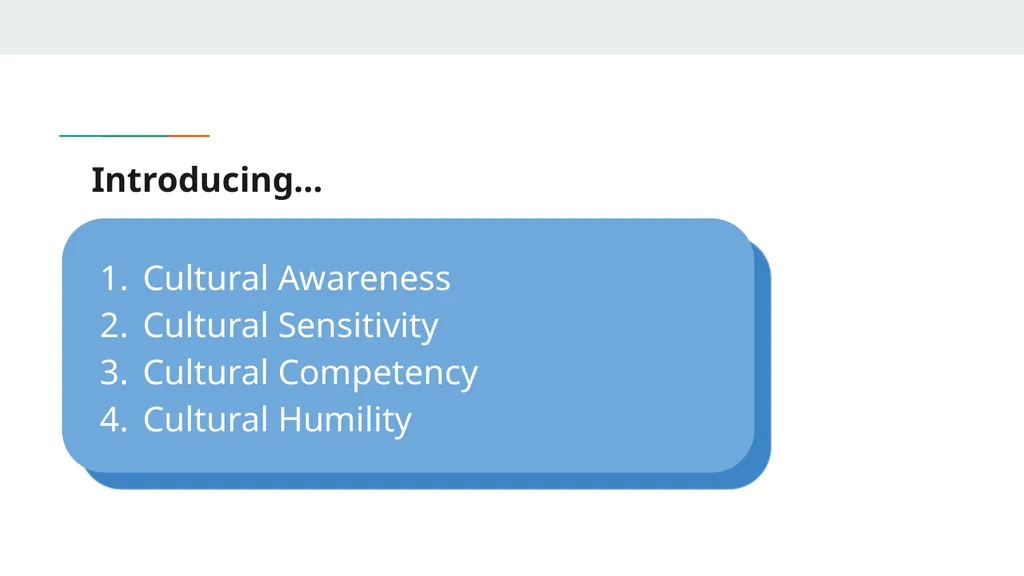
Introducing… Cultural Awareness
Cultural Sensitivity
Cultural Competency
Cultural Humility<br>
Cultural Sensitivity
Cultural Competency
Cultural Humility<br>
04
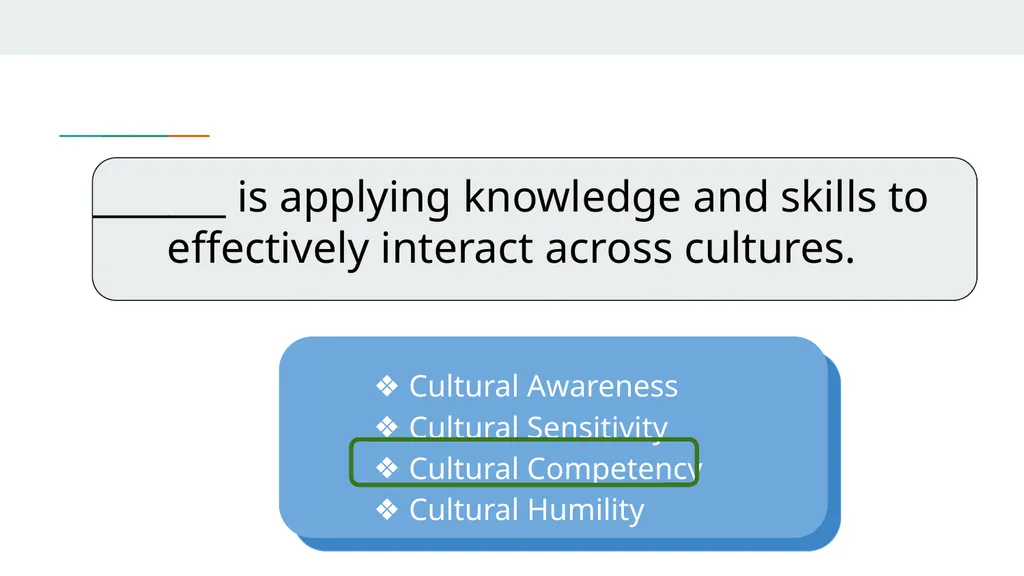
_______ is applying knowledge and skills to effectively interact across cultures. Cultural Awareness
Cultural Sensitivity
Cultural Competency
Cultural Humility<br>
Cultural Sensitivity
Cultural Competency
Cultural Humility<br>
05
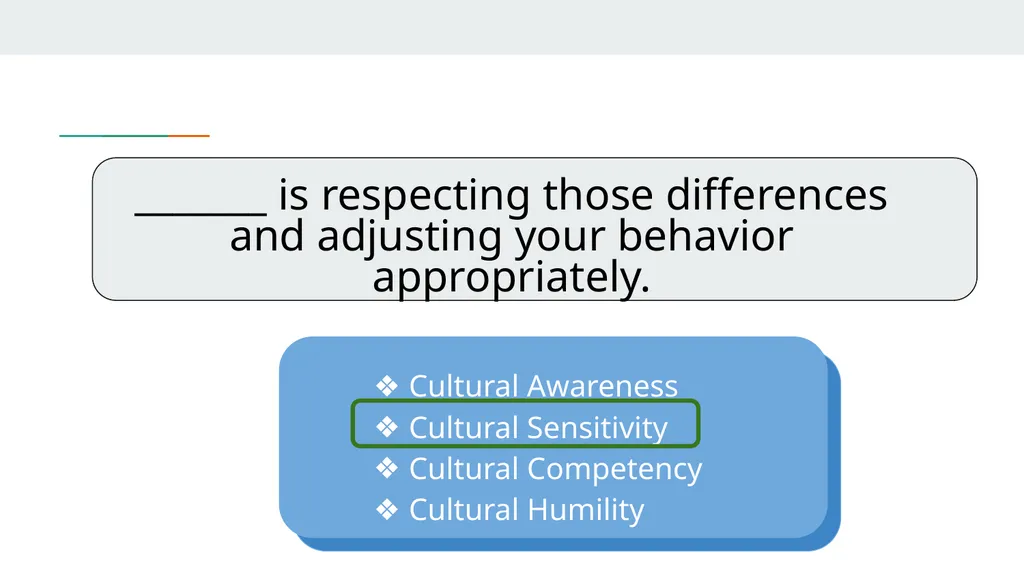
_______ is respecting those differences and adjusting your behavior appropriately. Cultural Awareness
Cultural Sensitivity
Cultural Competency
Cultural Humility<br>
Cultural Sensitivity
Cultural Competency
Cultural Humility<br>
06
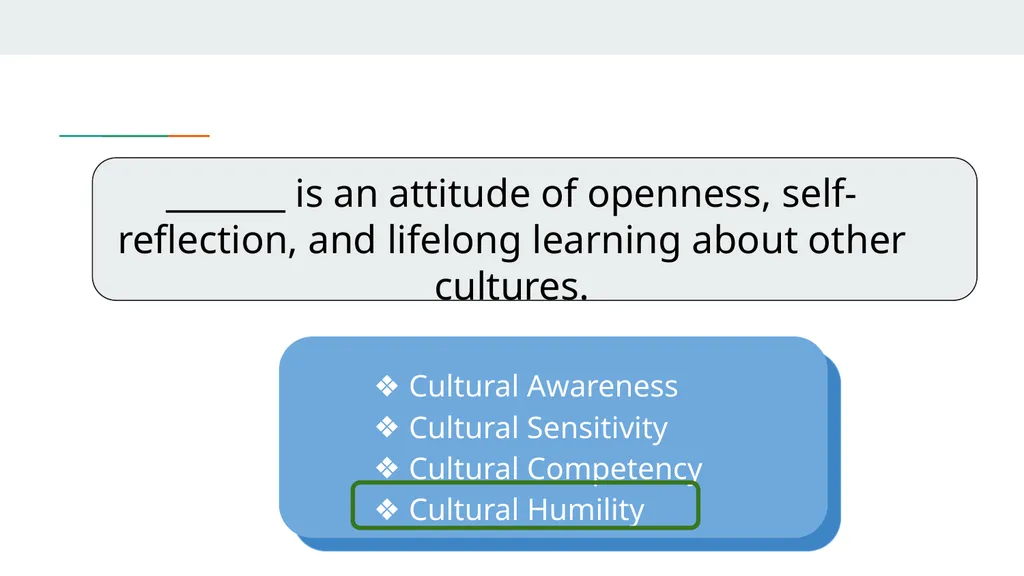
_______ is an attitude of openness, self-reflection, and lifelong learning about other cultures. Cultural Awareness
Cultural Sensitivity
Cultural Competency
Cultural Humility<br>
Cultural Sensitivity
Cultural Competency
Cultural Humility<br>
07
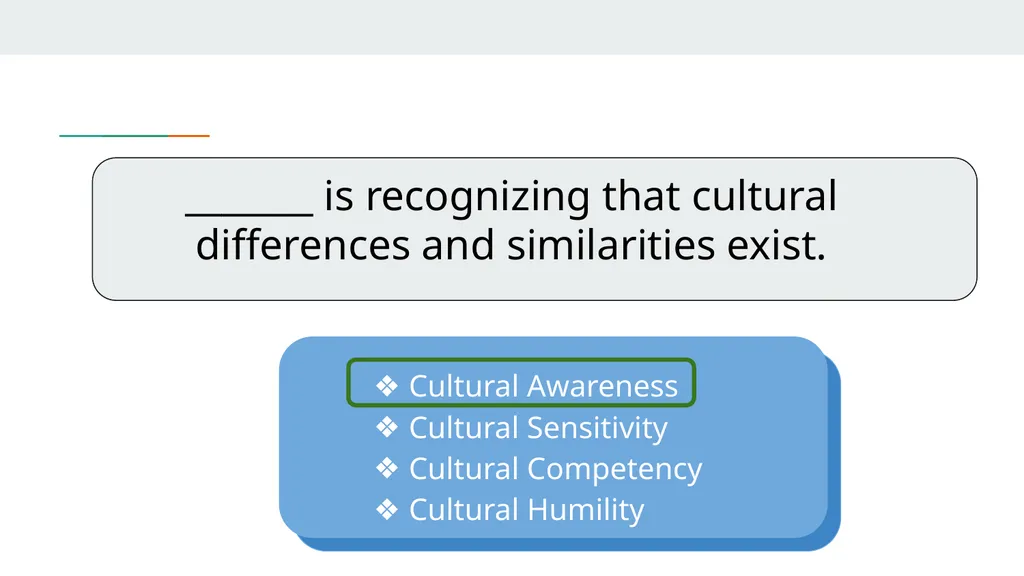
_______ is recognizing that cultural differences and similarities exist. Cultural Awareness
Cultural Sensitivity
Cultural Competency
Cultural Humility<br>
Cultural Sensitivity
Cultural Competency
Cultural Humility<br>
08
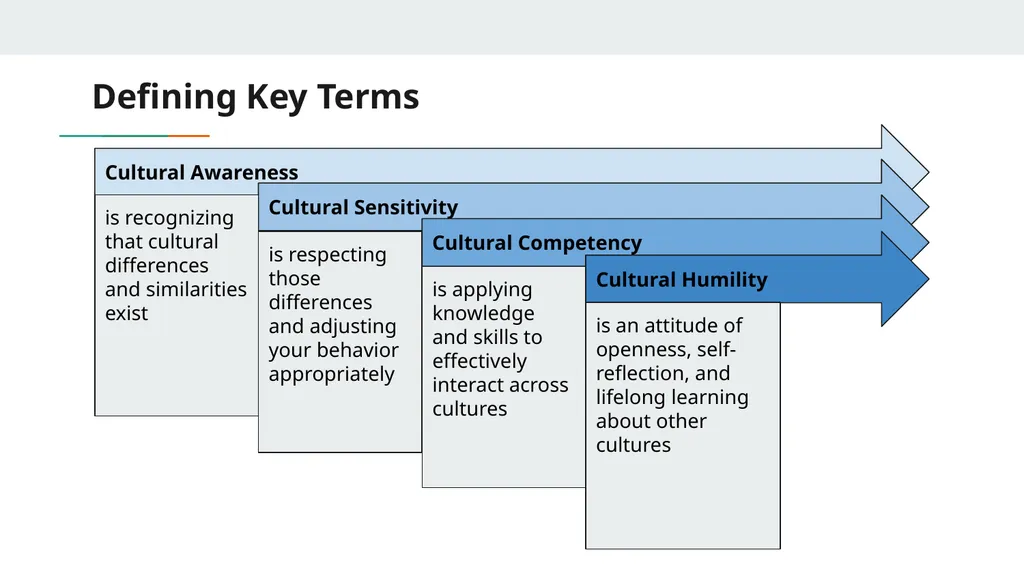
Defining Key Terms Cultural Awareness Cultural Sensitivity Cultural Competency is recognizing that cultural differences and similarities exist is respecting those differences and adjusting your behavior appropriately is applying knowledge and skills to effectively interact across cultures Cultural Humility is an attitude of openness, self-reflection, and lifelong learning about other cultures<br>
09
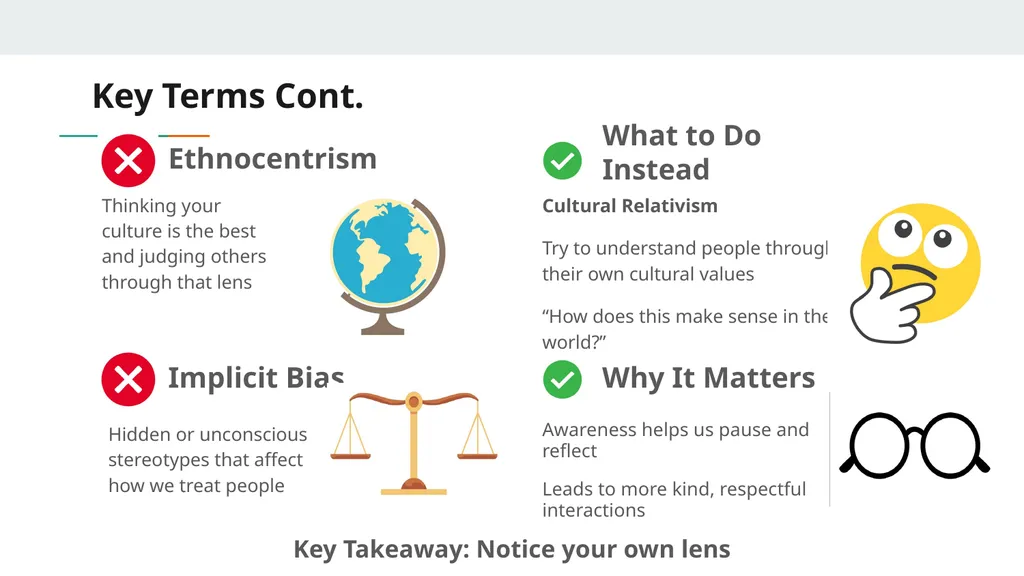
Key Terms Cont. Thinking your culture is the best and judging others through that lens Ethnocentrism Implicit Bias What to Do Instead Why It Matters Cultural Relativism
Try to understand people through their own cultural values
“How does this make sense in their world?” Hidden or unconscious stereotypes that affect how we treat people Awareness helps us pause and reflect
Leads to more kind, respectful interactions Key Takeaway: Notice your own lens<br>
Try to understand people through their own cultural values
“How does this make sense in their world?” Hidden or unconscious stereotypes that affect how we treat people Awareness helps us pause and reflect
Leads to more kind, respectful interactions Key Takeaway: Notice your own lens<br>
10
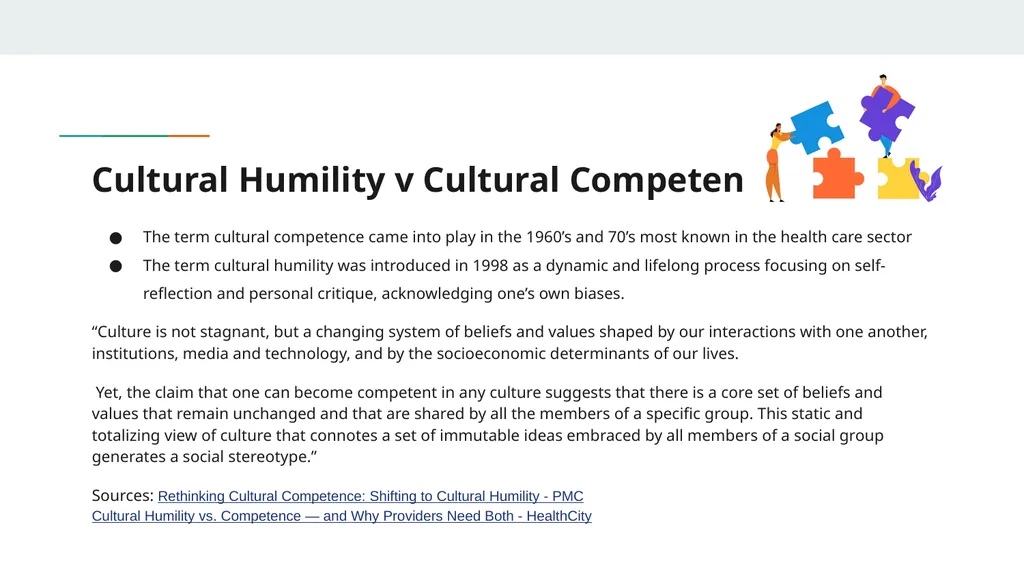
Cultural Humility v Cultural Competence The term cultural competence came into play in the 1960’s and 70’s most known in the health care sector
The term cultural humility was introduced in 1998 as a dynamic and lifelong process focusing on self-reflection and personal critique, acknowledging one’s own biases.
“Culture is not stagnant, but a changing system of beliefs and values shaped by our interactions with one another, institutions, media and technology, and by the socioeconomic determinants of our lives.
Yet, the claim that one can become competent in any culture suggests that there is a core set of beliefs and values that remain unchanged and that are shared by all the members of a specific group. This static and totalizing view of culture that connotes a set of immutable ideas embraced by all members of a social group generates a social stereotype.”
Sources: Rethinking Cultural Competence: Shifting to Cultural Humility - PMCCultural Humility vs. Competence — and Why Providers Need Both - HealthCity<br>
The term cultural humility was introduced in 1998 as a dynamic and lifelong process focusing on self-reflection and personal critique, acknowledging one’s own biases.
“Culture is not stagnant, but a changing system of beliefs and values shaped by our interactions with one another, institutions, media and technology, and by the socioeconomic determinants of our lives.
Yet, the claim that one can become competent in any culture suggests that there is a core set of beliefs and values that remain unchanged and that are shared by all the members of a specific group. This static and totalizing view of culture that connotes a set of immutable ideas embraced by all members of a social group generates a social stereotype.”
Sources: Rethinking Cultural Competence: Shifting to Cultural Humility - PMCCultural Humility vs. Competence — and Why Providers Need Both - HealthCity<br>
11
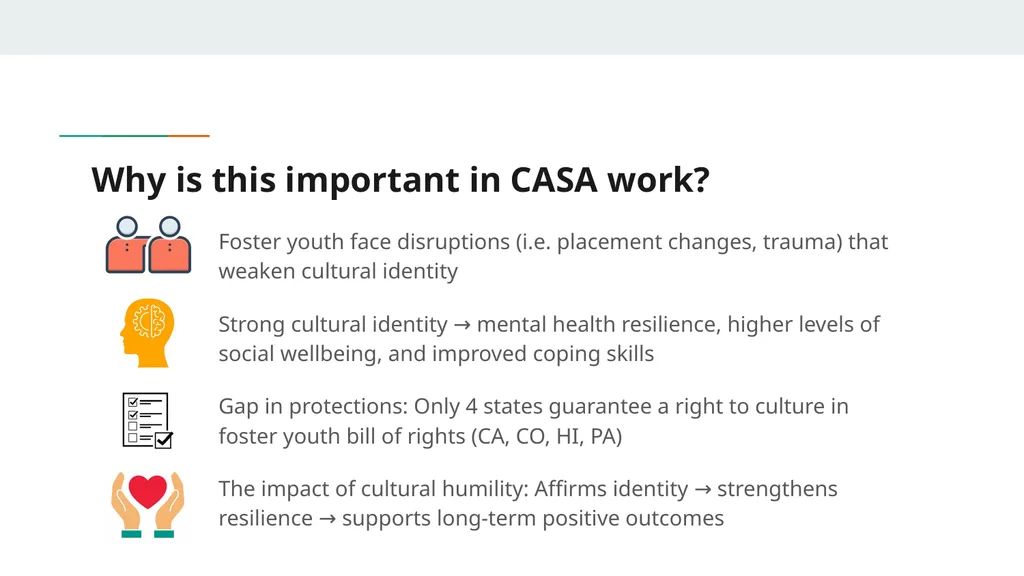
Why is this important in CASA work? Foster youth face disruptions (i.e. placement changes, trauma) that weaken cultural identity
Strong cultural identity → mental health resilience, higher levels of social wellbeing, and improved coping skills
Gap in protections: Only 4 states guarantee a right to culture in foster youth bill of rights (CA, CO, HI, PA)
The impact of cultural humility: Affirms identity → strengthens resilience → supports long-term positive outcomes<br>
Strong cultural identity → mental health resilience, higher levels of social wellbeing, and improved coping skills
Gap in protections: Only 4 states guarantee a right to culture in foster youth bill of rights (CA, CO, HI, PA)
The impact of cultural humility: Affirms identity → strengthens resilience → supports long-term positive outcomes<br>
12
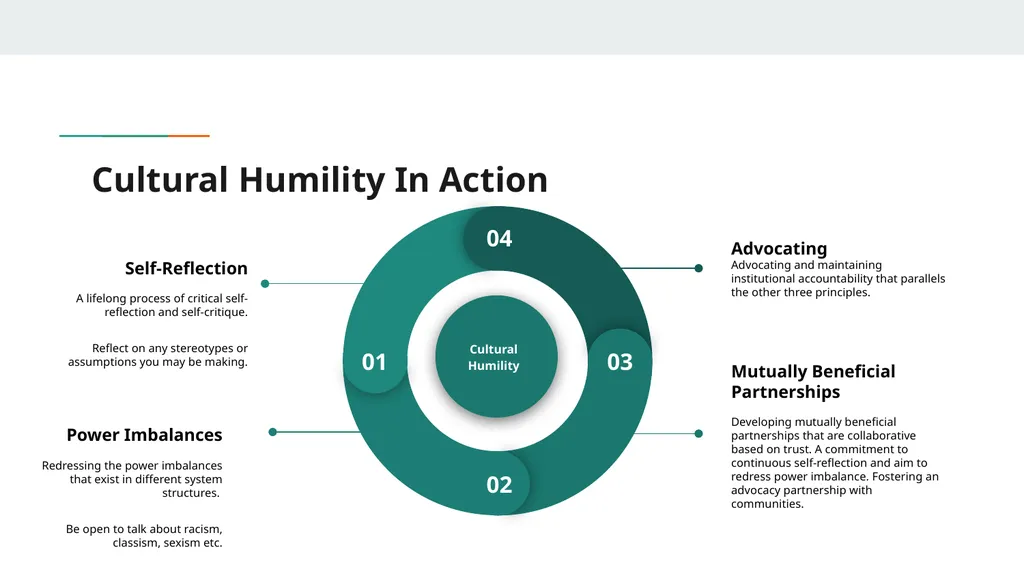
Cultural Humility In Action<br>
13
Cultural Humility in Action Continued - Scenario Time!<br>
14
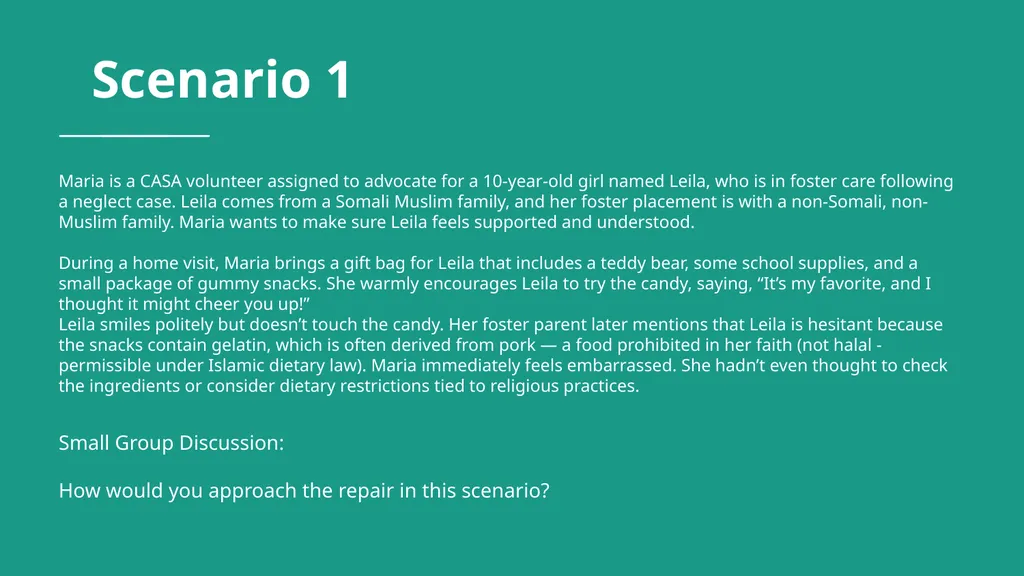
Scenario 1 Maria is a CASA volunteer assigned to advocate for a 10-year-old girl named Leila, who is in foster care following a neglect case. Leila comes from a Somali Muslim family, and her foster placement is with a non-Somali, non-Muslim family. Maria wants to make sure Leila feels supported and understood.
During a home visit, Maria brings a gift bag for Leila that includes a teddy bear, some school supplies, and a small package of gummy snacks. She warmly encourages Leila to try the candy, saying, “It’s my favorite, and I thought it might cheer you up!”
Leila smiles politely but doesn’t touch the candy. Her foster parent later mentions that Leila is hesitant because the snacks contain gelatin, which is often derived from pork — a food prohibited in her faith (not halal - permissible under Islamic dietary law). Maria immediately feels embarrassed. She hadn’t even thought to check the ingredients or consider dietary restrictions tied to religious practices. Small Group Discussion:
How would you approach the repair in this scenario?<br>
During a home visit, Maria brings a gift bag for Leila that includes a teddy bear, some school supplies, and a small package of gummy snacks. She warmly encourages Leila to try the candy, saying, “It’s my favorite, and I thought it might cheer you up!”
Leila smiles politely but doesn’t touch the candy. Her foster parent later mentions that Leila is hesitant because the snacks contain gelatin, which is often derived from pork — a food prohibited in her faith (not halal - permissible under Islamic dietary law). Maria immediately feels embarrassed. She hadn’t even thought to check the ingredients or consider dietary restrictions tied to religious practices. Small Group Discussion:
How would you approach the repair in this scenario?<br>
15
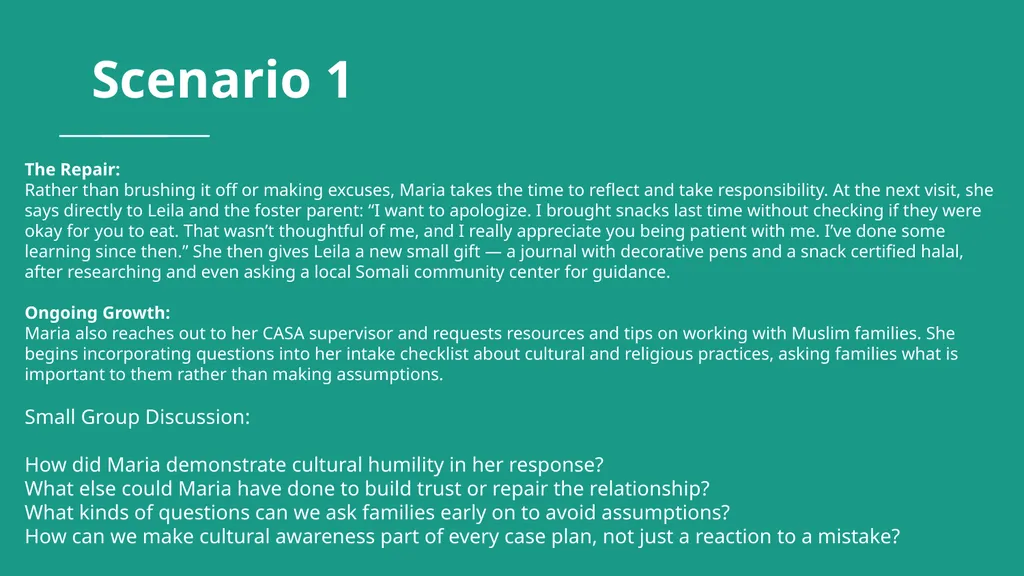
Scenario 1 The Repair:
Rather than brushing it off or making excuses, Maria takes the time to reflect and take responsibility. At the next visit, she says directly to Leila and the foster parent: “I want to apologize. I brought snacks last time without checking if they were okay for you to eat. That wasn’t thoughtful of me, and I really appreciate you being patient with me. I’ve done some learning since then.” She then gives Leila a new small gift — a journal with decorative pens and a snack certified halal, after researching and even asking a local Somali community center for guidance.
Ongoing Growth:
Maria also reaches out to her CASA supervisor and requests resources and tips on working with Muslim families. She begins incorporating questions into her intake checklist about cultural and religious practices, asking families what is important to them rather than making assumptions.
Small Group Discussion:
How did Maria demonstrate cultural humility in her response?
What else could Maria have done to build trust or repair the relationship?
What kinds of questions can we ask families early on to avoid assumptions?
How can we make cultural awareness part of every case plan, not just a reaction to a mistake?<br>
Ongoing Growth:
Maria also reaches out to her CASA supervisor and requests resources and tips on working with Muslim families. She begins incorporating questions into her intake checklist about cultural and religious practices, asking families what is important to them rather than making assumptions.
Small Group Discussion:
How did Maria demonstrate cultural humility in her response?
What else could Maria have done to build trust or repair the relationship?
What kinds of questions can we ask families early on to avoid assumptions?
How can we make cultural awareness part of every case plan, not just a reaction to a mistake?<br>
16
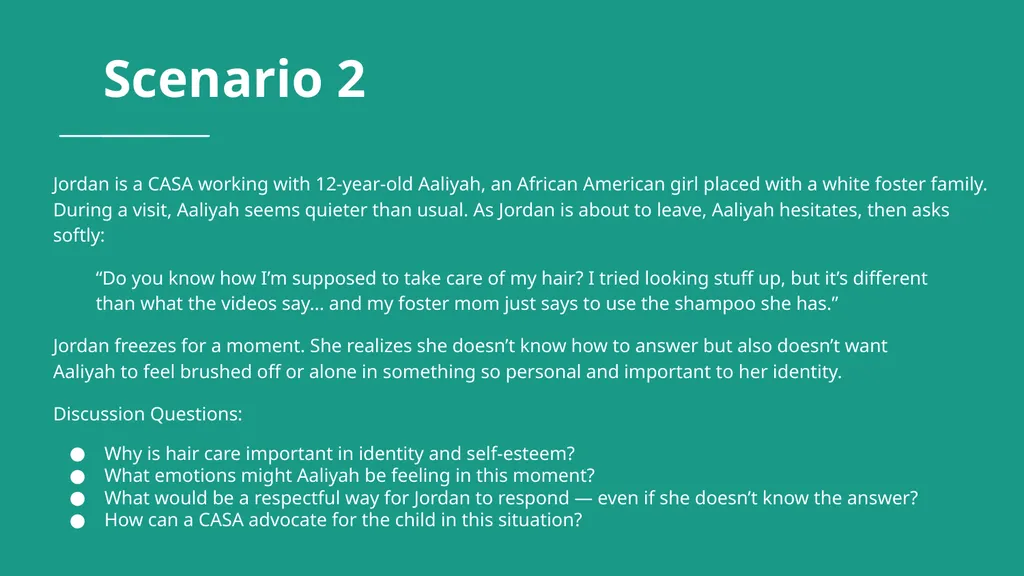
Scenario 2 Jordan is a CASA working with 12-year-old Aaliyah, an African American girl placed with a white foster family. During a visit, Aaliyah seems quieter than usual. As Jordan is about to leave, Aaliyah hesitates, then asks softly:
“Do you know how I’m supposed to take care of my hair? I tried looking stuff up, but it’s different than what the videos say… and my foster mom just says to use the shampoo she has.”
Jordan freezes for a moment. She realizes she doesn’t know how to answer but also doesn’t want Aaliyah to feel brushed off or alone in something so personal and important to her identity.
Discussion Questions:
Why is hair care important in identity and self-esteem?
What emotions might Aaliyah be feeling in this moment?
What would be a respectful way for Jordan to respond — even if she doesn’t know the answer?
How can a CASA advocate for the child in this situation?<br>
“Do you know how I’m supposed to take care of my hair? I tried looking stuff up, but it’s different than what the videos say… and my foster mom just says to use the shampoo she has.”
Jordan freezes for a moment. She realizes she doesn’t know how to answer but also doesn’t want Aaliyah to feel brushed off or alone in something so personal and important to her identity.
Discussion Questions:
Why is hair care important in identity and self-esteem?
What emotions might Aaliyah be feeling in this moment?
What would be a respectful way for Jordan to respond — even if she doesn’t know the answer?
How can a CASA advocate for the child in this situation?<br>
17
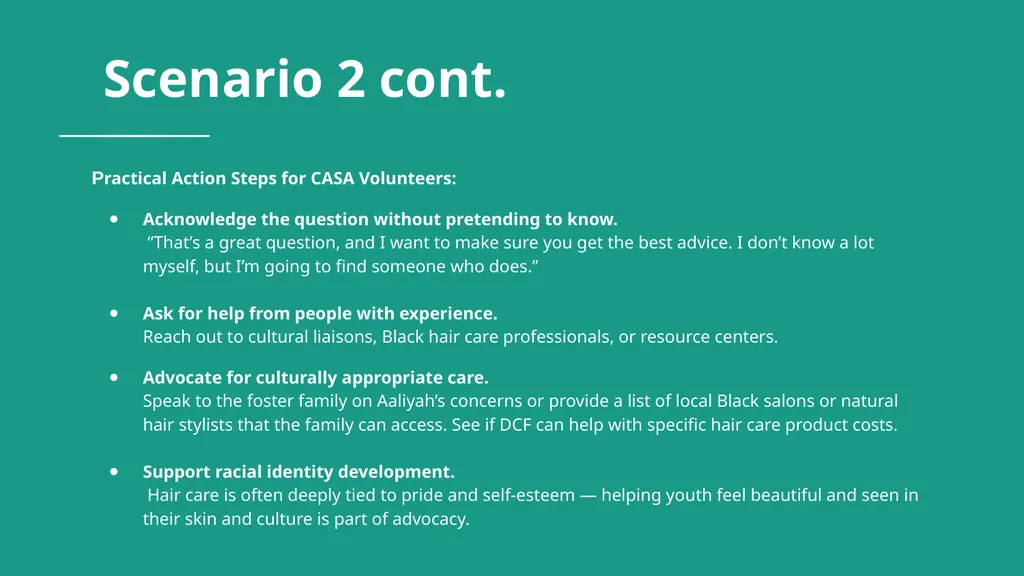
Practical Action Steps for CASA Volunteers:
Acknowledge the question without pretending to know. “That’s a great question, and I want to make sure you get the best advice. I don’t know a lot myself, but I’m going to find someone who does.”
Ask for help from people with experience. Reach out to cultural liaisons, Black hair care professionals, or resource centers.
Advocate for culturally appropriate care. Speak to the foster family on Aaliyah’s concerns or provide a list of local Black salons or natural hair stylists that the family can access. See if DCF can help with specific hair care product costs.
Support racial identity development. Hair care is often deeply tied to pride and self-esteem — helping youth feel beautiful and seen in their skin and culture is part of advocacy. Scenario 2 cont.<br>
Acknowledge the question without pretending to know. “That’s a great question, and I want to make sure you get the best advice. I don’t know a lot myself, but I’m going to find someone who does.”
Ask for help from people with experience. Reach out to cultural liaisons, Black hair care professionals, or resource centers.
Advocate for culturally appropriate care. Speak to the foster family on Aaliyah’s concerns or provide a list of local Black salons or natural hair stylists that the family can access. See if DCF can help with specific hair care product costs.
Support racial identity development. Hair care is often deeply tied to pride and self-esteem — helping youth feel beautiful and seen in their skin and culture is part of advocacy. Scenario 2 cont.<br>
18
Scenario 3 Opening Question What are some reasons families might distrust the child welfare system or people connected to it?<br>
19
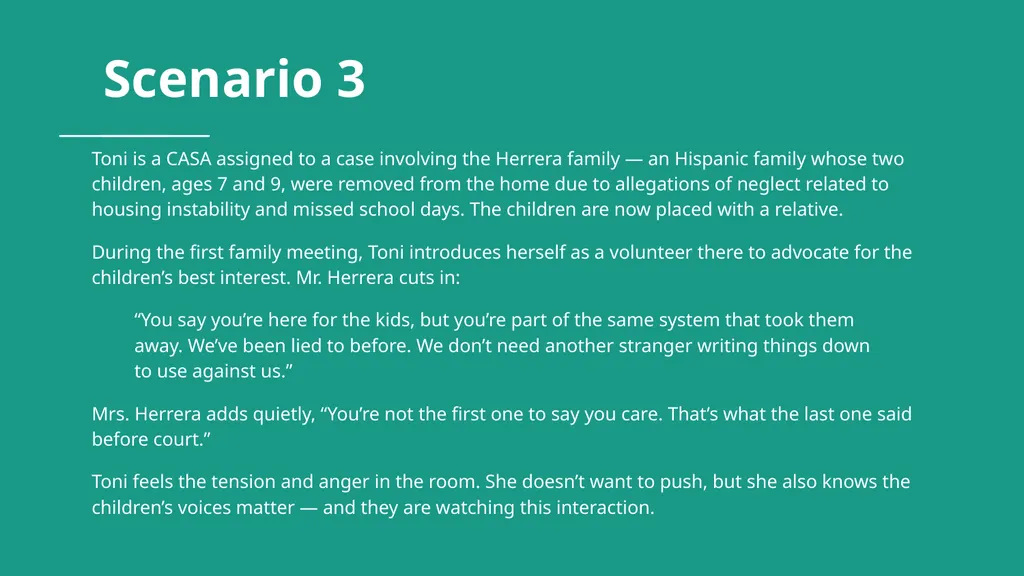
Scenario 3 Toni is a CASA assigned to a case involving the Herrera family — an Hispanic family whose two children, ages 7 and 9, were removed from the home due to allegations of neglect related to housing instability and missed school days. The children are now placed with a relative.
During the first family meeting, Toni introduces herself as a volunteer there to advocate for the children’s best interest. Mr. Herrera cuts in:
“You say you’re here for the kids, but you’re part of the same system that took them away. We’ve been lied to before. We don’t need another stranger writing things down to use against us.”
Mrs. Herrera adds quietly, “You’re not the first one to say you care. That’s what the last one said before court.”
Toni feels the tension and anger in the room. She doesn’t want to push, but she also knows the children’s voices matter — and they are watching this interaction.<br>
During the first family meeting, Toni introduces herself as a volunteer there to advocate for the children’s best interest. Mr. Herrera cuts in:
“You say you’re here for the kids, but you’re part of the same system that took them away. We’ve been lied to before. We don’t need another stranger writing things down to use against us.”
Mrs. Herrera adds quietly, “You’re not the first one to say you care. That’s what the last one said before court.”
Toni feels the tension and anger in the room. She doesn’t want to push, but she also knows the children’s voices matter — and they are watching this interaction.<br>
20
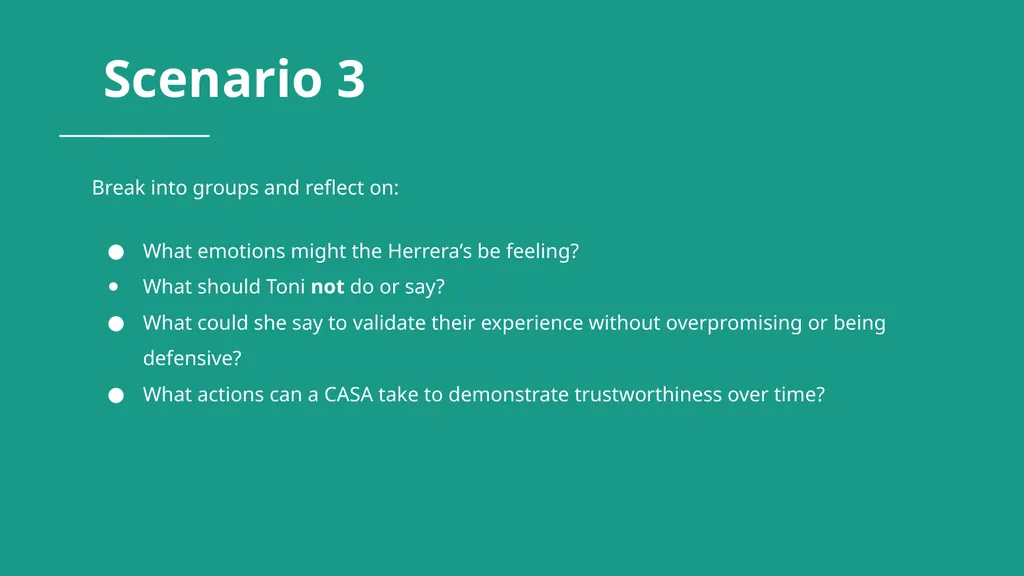
Scenario 3 Break into groups and reflect on:
What emotions might the Herrera’s be feeling?
What should Toni not do or say?
What could she say to validate their experience without overpromising or being defensive?
What actions can a CASA take to demonstrate trustworthiness over time?<br>
What emotions might the Herrera’s be feeling?
What should Toni not do or say?
What could she say to validate their experience without overpromising or being defensive?
What actions can a CASA take to demonstrate trustworthiness over time?<br>
21
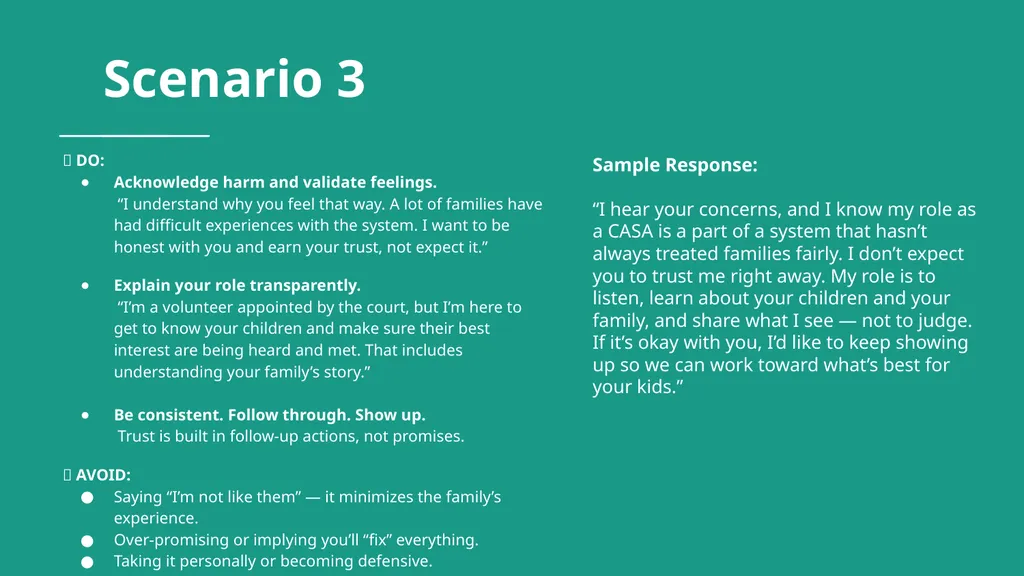
Scenario 3 ✅ DO:
Acknowledge harm and validate feelings. “I understand why you feel that way. A lot of families have had difficult experiences with the system. I want to be honest with you and earn your trust, not expect it.”
Explain your role transparently. “I’m a volunteer appointed by the court, but I’m here to get to know your children and make sure their best interest are being heard and met. That includes understanding your family’s story.”
Be consistent. Follow through. Show up. Trust is built in follow-up actions, not promises.
❌ AVOID:
Saying “I’m not like them” — it minimizes the family’s experience.
Over-promising or implying you’ll “fix” everything.
Taking it personally or becoming defensive. Sample Response:
“I hear your concerns, and I know my role as a CASA is a part of a system that hasn’t always treated families fairly. I don’t expect you to trust me right away. My role is to listen, learn about your children and your family, and share what I see — not to judge. If it’s okay with you, I’d like to keep showing up so we can work toward what’s best for your kids.”<br>
Acknowledge harm and validate feelings. “I understand why you feel that way. A lot of families have had difficult experiences with the system. I want to be honest with you and earn your trust, not expect it.”
Explain your role transparently. “I’m a volunteer appointed by the court, but I’m here to get to know your children and make sure their best interest are being heard and met. That includes understanding your family’s story.”
Be consistent. Follow through. Show up. Trust is built in follow-up actions, not promises.
❌ AVOID:
Saying “I’m not like them” — it minimizes the family’s experience.
Over-promising or implying you’ll “fix” everything.
Taking it personally or becoming defensive. Sample Response:
“I hear your concerns, and I know my role as a CASA is a part of a system that hasn’t always treated families fairly. I don’t expect you to trust me right away. My role is to listen, learn about your children and your family, and share what I see — not to judge. If it’s okay with you, I’d like to keep showing up so we can work toward what’s best for your kids.”<br>
22
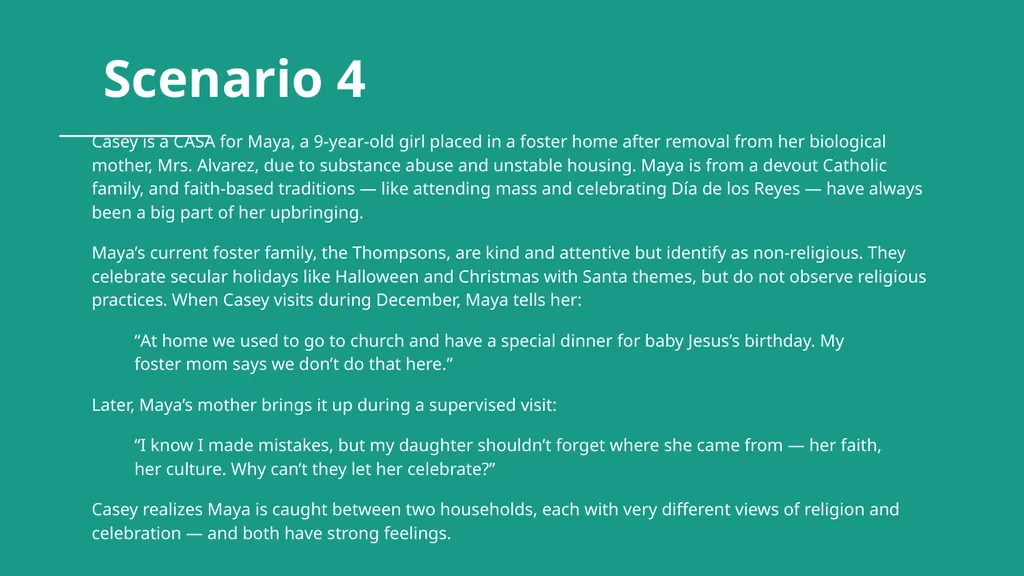
Scenario 4 Casey is a CASA for Maya, a 9-year-old girl placed in a foster home after removal from her biological mother, Mrs. Alvarez, due to substance abuse and unstable housing. Maya is from a devout Catholic family, and faith-based traditions — like attending mass and celebrating Día de los Reyes — have always been a big part of her upbringing.
Maya’s current foster family, the Thompsons, are kind and attentive but identify as non-religious. They celebrate secular holidays like Halloween and Christmas with Santa themes, but do not observe religious practices. When Casey visits during December, Maya tells her:
“At home we used to go to church and have a special dinner for baby Jesus’s birthday. My foster mom says we don’t do that here.”
Later, Maya’s mother brings it up during a supervised visit:
“I know I made mistakes, but my daughter shouldn’t forget where she came from — her faith, her culture. Why can’t they let her celebrate?”
Casey realizes Maya is caught between two households, each with very different views of religion and celebration — and both have strong feelings.<br>
Maya’s current foster family, the Thompsons, are kind and attentive but identify as non-religious. They celebrate secular holidays like Halloween and Christmas with Santa themes, but do not observe religious practices. When Casey visits during December, Maya tells her:
“At home we used to go to church and have a special dinner for baby Jesus’s birthday. My foster mom says we don’t do that here.”
Later, Maya’s mother brings it up during a supervised visit:
“I know I made mistakes, but my daughter shouldn’t forget where she came from — her faith, her culture. Why can’t they let her celebrate?”
Casey realizes Maya is caught between two households, each with very different views of religion and celebration — and both have strong feelings.<br>
23
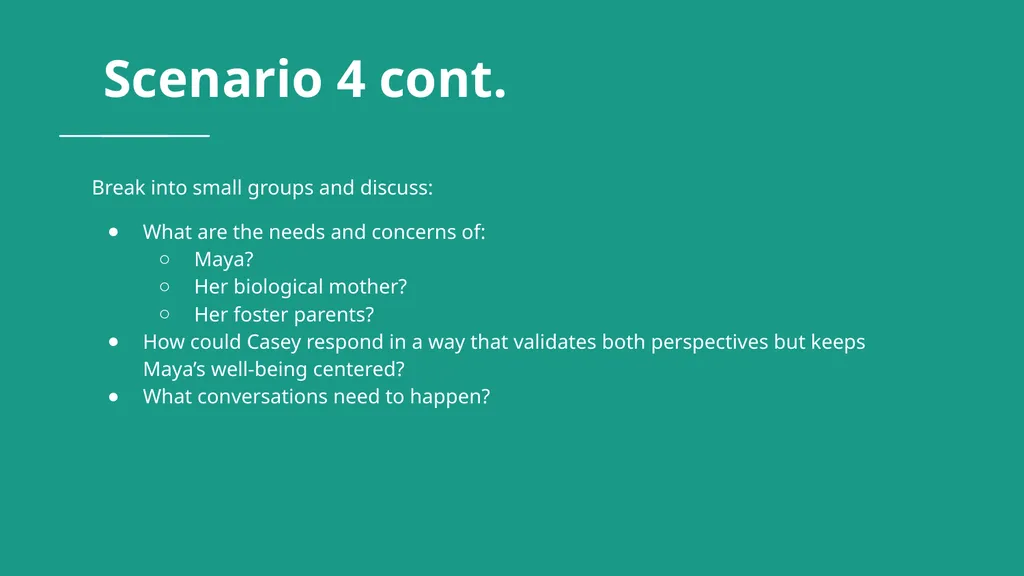
Scenario 4 cont. Break into small groups and discuss:
What are the needs and concerns of:
Maya?
Her biological mother?
Her foster parents?
How could Casey respond in a way that validates both perspectives but keeps Maya’s well-being centered?
What conversations need to happen?<br>
What are the needs and concerns of:
Maya?
Her biological mother?
Her foster parents?
How could Casey respond in a way that validates both perspectives but keeps Maya’s well-being centered?
What conversations need to happen?<br>
24
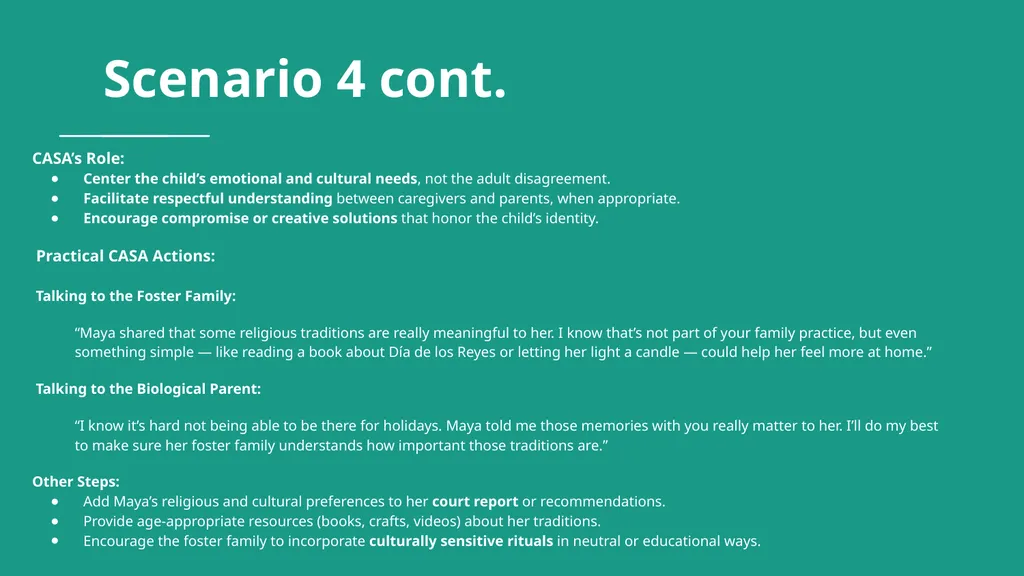
Scenario 4 cont. CASA’s Role:
Center the child’s emotional and cultural needs, not the adult disagreement.
Facilitate respectful understanding between caregivers and parents, when appropriate.
Encourage compromise or creative solutions that honor the child’s identity.
Practical CASA Actions:
Talking to the Foster Family:
“Maya shared that some religious traditions are really meaningful to her. I know that’s not part of your family practice, but even something simple — like reading a book about Día de los Reyes or letting her light a candle — could help her feel more at home.”
Talking to the Biological Parent:
“I know it’s hard not being able to be there for holidays. Maya told me those memories with you really matter to her. I’ll do my best to make sure her foster family understands how important those traditions are.”
Other Steps:
Add Maya’s religious and cultural preferences to her court report or recommendations.
Provide age-appropriate resources (books, crafts, videos) about her traditions.
Encourage the foster family to incorporate culturally sensitive rituals in neutral or educational ways.<br>
Center the child’s emotional and cultural needs, not the adult disagreement.
Facilitate respectful understanding between caregivers and parents, when appropriate.
Encourage compromise or creative solutions that honor the child’s identity.
Practical CASA Actions:
Talking to the Foster Family:
“Maya shared that some religious traditions are really meaningful to her. I know that’s not part of your family practice, but even something simple — like reading a book about Día de los Reyes or letting her light a candle — could help her feel more at home.”
Talking to the Biological Parent:
“I know it’s hard not being able to be there for holidays. Maya told me those memories with you really matter to her. I’ll do my best to make sure her foster family understands how important those traditions are.”
Other Steps:
Add Maya’s religious and cultural preferences to her court report or recommendations.
Provide age-appropriate resources (books, crafts, videos) about her traditions.
Encourage the foster family to incorporate culturally sensitive rituals in neutral or educational ways.<br>
25
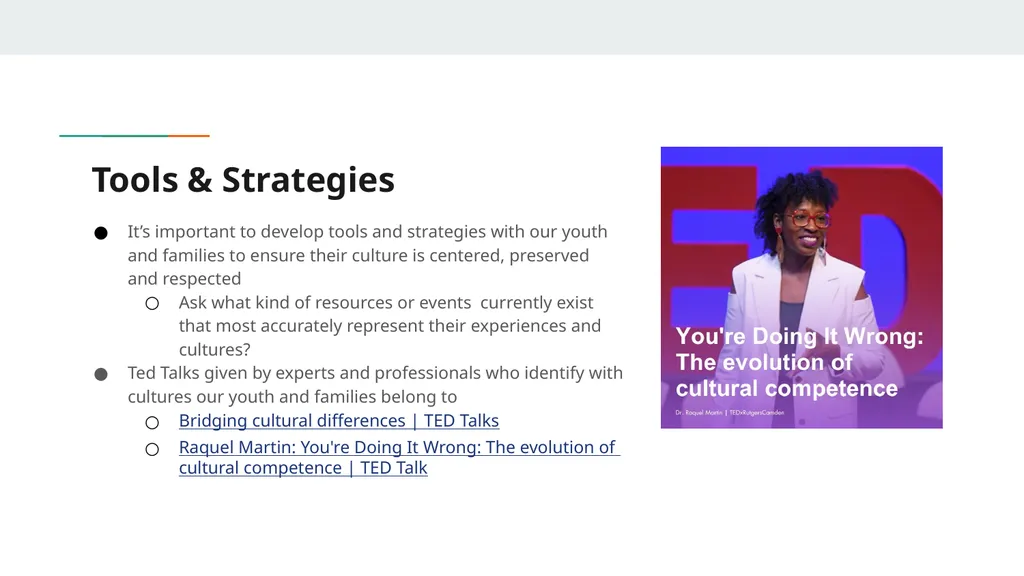
Tools & Strategies It’s important to develop tools and strategies with our youth and families to ensure their culture is centered, preserved and respected
Ask what kind of resources or events currently exist that most accurately represent their experiences and cultures?
Ted Talks given by experts and professionals who identify with cultures our youth and families belong to
Bridging cultural differences | TED Talks
Raquel Martin: You're Doing It Wrong: The evolution of cultural competence | TED Talk<br>
Ask what kind of resources or events currently exist that most accurately represent their experiences and cultures?
Ted Talks given by experts and professionals who identify with cultures our youth and families belong to
Bridging cultural differences | TED Talks
Raquel Martin: You're Doing It Wrong: The evolution of cultural competence | TED Talk<br>
26
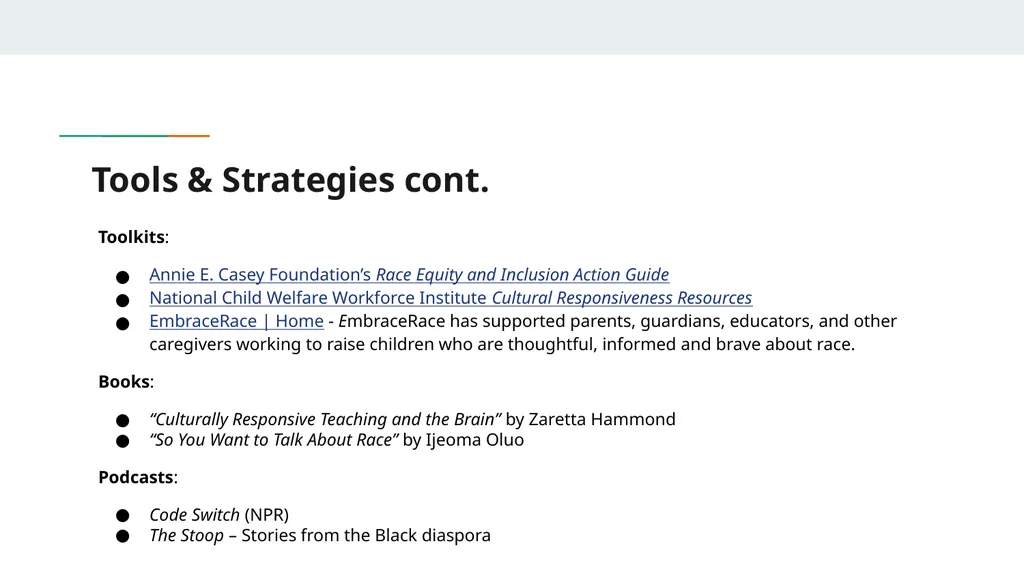
Tools & Strategies cont. Toolkits:
Annie E. Casey Foundation’s Race Equity and Inclusion Action Guide
National Child Welfare Workforce Institute Cultural Responsiveness Resources
EmbraceRace | Home - EmbraceRace has supported parents, guardians, educators, and other caregivers working to raise children who are thoughtful, informed and brave about race.
Books:
“Culturally Responsive Teaching and the Brain” by Zaretta Hammond
“So You Want to Talk About Race” by Ijeoma Oluo
Podcasts:
Code Switch (NPR)
The Stoop – Stories from the Black diaspora<br>
Annie E. Casey Foundation’s Race Equity and Inclusion Action Guide
National Child Welfare Workforce Institute Cultural Responsiveness Resources
EmbraceRace | Home - EmbraceRace has supported parents, guardians, educators, and other caregivers working to raise children who are thoughtful, informed and brave about race.
Books:
“Culturally Responsive Teaching and the Brain” by Zaretta Hammond
“So You Want to Talk About Race” by Ijeoma Oluo
Podcasts:
Code Switch (NPR)
The Stoop – Stories from the Black diaspora<br>
27
Thank you! Questions?<br>