06
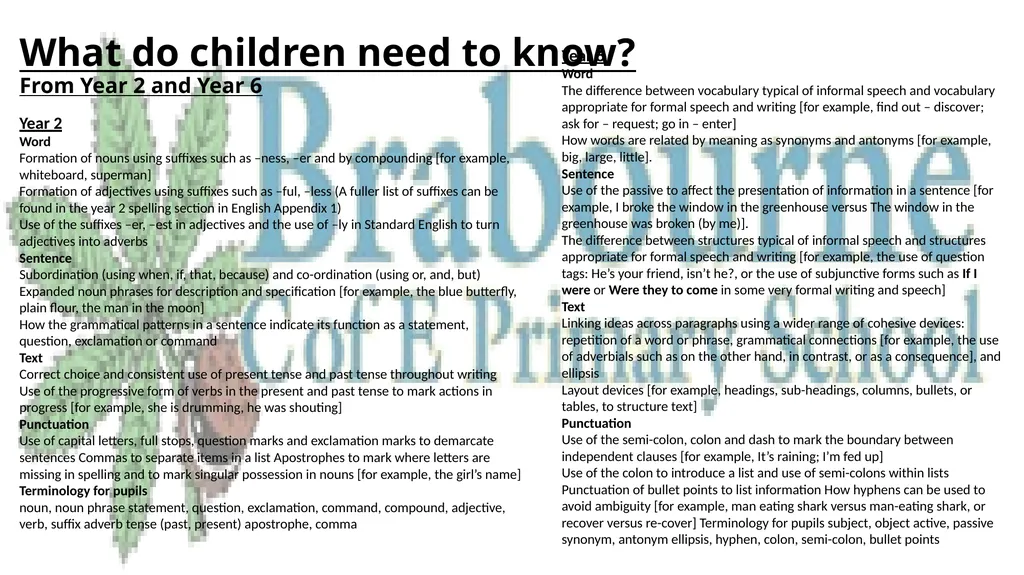
What do children need to know?�From Year 2 and Year 6 Year 2
Word
Formation of nouns using suffixes such as –ness, –er and by compounding [for example, whiteboard, superman]
Formation of adjectives using suffixes such as –ful, –less (A fuller list of suffixes can be found in the year 2 spelling section in English Appendix 1)
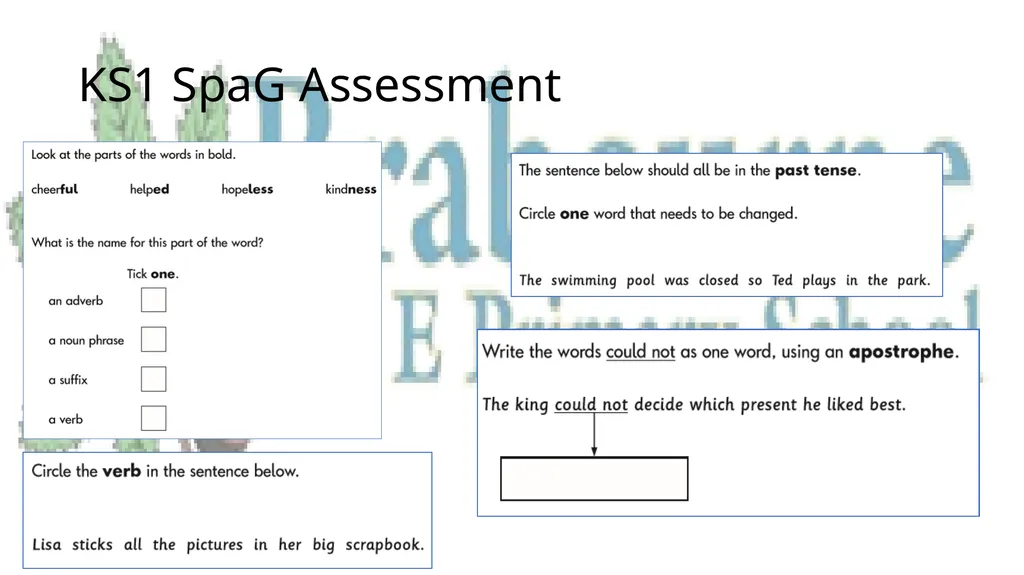
Use of the suffixes –er, –est in adjectives and the use of –ly in Standard English to turn adjectives into adverbs
Sentence
Subordination (using when, if, that, because) and co-ordination (using or, and, but)
Expanded noun phrases for description and specification [for example, the blue butterfly, plain flour, the man in the moon]
How the grammatical patterns in a sentence indicate its function as a statement, question, exclamation or command
Text
Correct choice and consistent use of present tense and past tense throughout writing
Use of the progressive form of verbs in the present and past tense to mark actions in progress [for example, she is drumming, he was shouting]
Punctuation
Use of capital letters, full stops, question marks and exclamation marks to demarcate sentences Commas to separate items in a list Apostrophes to mark where letters are missing in spelling and to mark singular possession in nouns [for example, the girl’s name]
Terminology for pupils
noun, noun phrase statement, question, exclamation, command, compound, adjective, verb, suffix adverb tense (past, present) apostrophe, comma Year 6
Word
The difference between vocabulary typical of informal speech and vocabulary appropriate for formal speech and writing [for example, find out – discover; ask for – request; go in – enter]
How words are related by meaning as synonyms and antonyms [for example, big, large, little].
Sentence
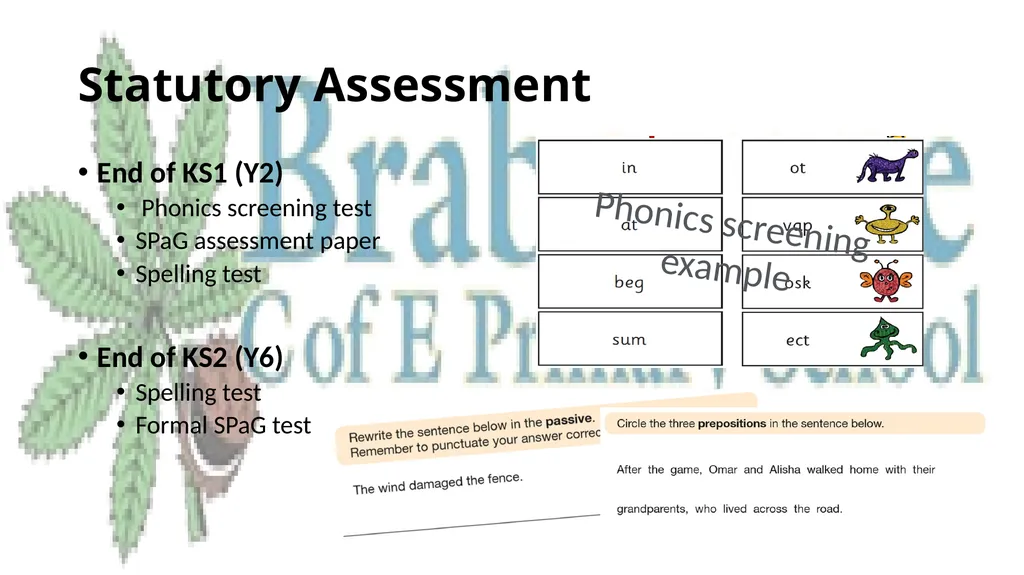
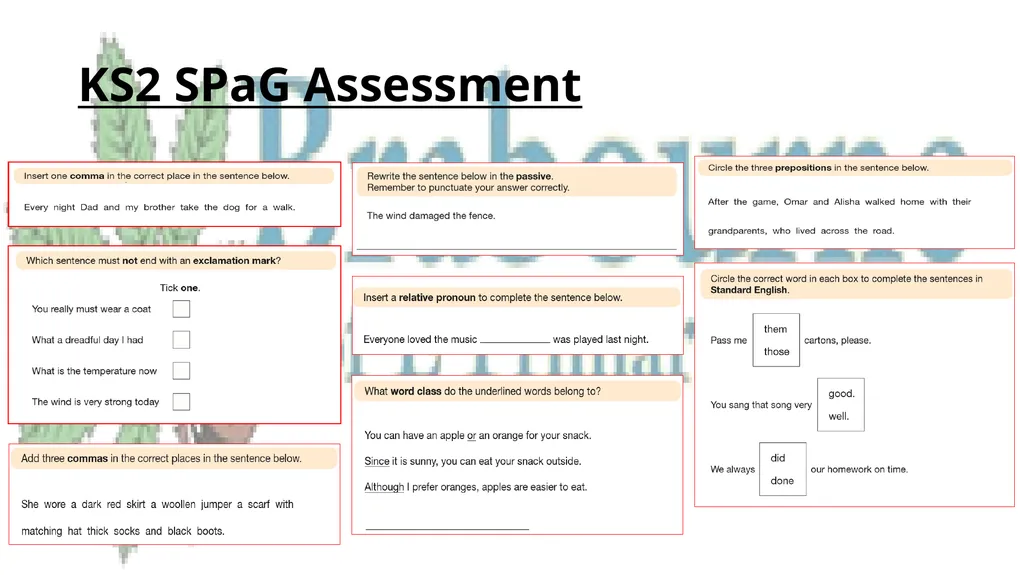
Use of the passive to affect the presentation of information in a sentence [for example, I broke the window in the greenhouse versus The window in the greenhouse was broken (by me)].
The difference between structures typical of informal speech and structures appropriate for formal speech and writing [for example, the use of question tags: He’s your friend, isn’t he?, or the use of subjunctive forms such as If I were or Were they to come in some very formal writing and speech]
Text
Linking ideas across paragraphs using a wider range of cohesive devices: repetition of a word or phrase, grammatical connections [for example, the use of adverbials such as on the other hand, in contrast, or as a consequence], and ellipsis
Layout devices [for example, headings, sub-headings, columns, bullets, or tables, to structure text]
Punctuation
Use of the semi-colon, colon and dash to mark the boundary between independent clauses [for example, It’s raining; I’m fed up]
Use of the colon to introduce a list and use of semi-colons within lists
Punctuation of bullet points to list information How hyphens can be used to avoid ambiguity [for example, man eating shark versus man-eating shark, or recover versus re-cover] Terminology for pupils subject, object active, passive synonym, antonym ellipsis, hyphen, colon, semi-colon, bullet points<br>