Bremer State High School Mathematics Subjects for Year 10 into Year 11 2025 Mathematics At Bremer, all students will study mathematics through to Year 12 Regardless of whether you see yourself pursuing a career in maths, being functionally
"Bremer State High School Mathematics Subjects for" is the property of its rightful owner. Permission is granted to
download and print the materials on this website for personal, non-commercial use only, and to display it
on your personal computer provided you do not modify the materials and that you retain all copyright
notices contained in the materials. By downloading content from our website, you accept the terms of this
agreement.
Presentation Transcript
01
Bremer State High School Mathematics
Subjects for Year 10 into Year 11 2025<br>
02
Mathematics At Bremer, all students will study mathematics through to Year 12
Regardless of whether you see yourself pursuing a career in maths, being functionally numerate is essential if you are going to succeed in life after school
Making the right choice for you depends on the maths you are currently studying in Year 10, what you are currently achieving, and what pre-requisites you are after<br>
03
Essential Maths (Applied)
2. General Maths (General)
3. Mathematical Methods (General)
4. Specialist Maths (General)
Note: students taking Specialist must be also taking Maths Methods MATHS SUBJECTS<br>
04
ESSENTIAL MATHS Essential Maths covers content that is relevant to being a functional adult in real life.
Areas covered include finances (savings, loans, repayments), measurement and renovations, budgeting, tax returns, travel, insurance, etc.
Pre-requisites: None
QCE Points: 4
Assessment (both Year 11 and Year 12):
2 x PSMTs (Problem Solving and Modelling Tasks)
2 x exams<br>
05
GENERAL MATHS General Maths covers content that is real life applied but at a higher level than Essential.
Work covers financial maths (annuities, investments), networks, bivariate statistics, time series, trigonometry, algebra, etc.
Pre-requisites: At least a B in Year 10 Maths, or at least a C in Year 10 Advanced Maths.
QCE Points: 4<br>
06
GENERAL MATHS Assessment Year 11 Assessment:
1 PSMT (Problem Solving and Modelling Task)
2 exams
Year 12 Assessment
1 (PSMT) Problem Solving and Modelling Task (20%) (Unit 3)
2 Internal Exams (15% each) (Unit 3, 4)
Each exam is 90 minutes long.
1 External Exam (50%)
Two papers; each 90 minute long.
Covers all of Unit 3 and 4.<br>
07
MATHS METHODS Maths Methods is a course for students who love maths, or who love maths AND think there is a good chance they’ll be studying maths at university.
Methods covers a lot: functions, algebra, calculus, statistics, probability, exponentials and logs, and trigonometry.
Pre-requisites: At least a B in Year 10 Advanced Maths (A preferred)
Strong algebra skills essential.
QCE Points: 4
Students will require a Graphics Calculator<br>
08
MATHS METHODS Assessment Year 11 Assessment:
1 PSMT (Problem Solving and Modelling Task)
2 exams
Year 12 Assessment
1 (PSMT) Problem Solving and Modelling Task (20%) (Unit 3)
2 Internal Exams (15% each) (Unit 3, 4)
Each exam is 90 minutes long.
1 External Exam (50%)
Two papers; each 90 minute long.
Covers all of Unit 3 and 4.<br>
09
MATHS METHODS Methods is challenging, even for students who enjoy maths.
Methods requires dedication and hard work.
As half of each exam is completed without a calculator, students need to be proficient at arithmetic.
Methods is designed to prepare students for studying mathematics at university in fields such as Engineering, Medicine, Health, Science.<br>
10
SPECIALIST MATHS Like Methods, Specialist Maths is for students who enjoy maths and are confident, capable, flexible thinkers.
Students taking Specialist must also be taking Methods, as Methods is expected knowledge.
Specialist covers maths that is more abstract in nature (complex numbers, proofs, matrices); maths that builds on work covered in Methods (differential equations, further integrals) and has a heavy cross over with Physics (vectors, projectile motion).
Pre-requisites: At least a B in Year 10 Advanced Maths (A preferred)
Strong algebra skills required.<br>
11
SPECIALIST MATHS Assessment Year 11 Assessment:
1 PSMT (Problem Solving and Modelling Task)
2 exams
Year 12 Assessment
1 (PSMT) Problem Solving and Modelling Task (20%) (Unit 3)
2 Internal Exams (15% each) (Unit 3, 4)
Each exam is 90 minutes long.
1 External Exam (50%)
Two papers; each 90 minute long.
Covers all of Unit 3 and 4.<br>
12
SPECIALIST MATHS Specialist Maths suits students who enjoy problem solving, are up for a challenge, and enjoy maths for the sake of maths.
Specialist is not a pre-requisite for many courses due to its abstract nature and difficulty, but is recommended for students intending to study Engineering or pure maths in any form.<br>
13
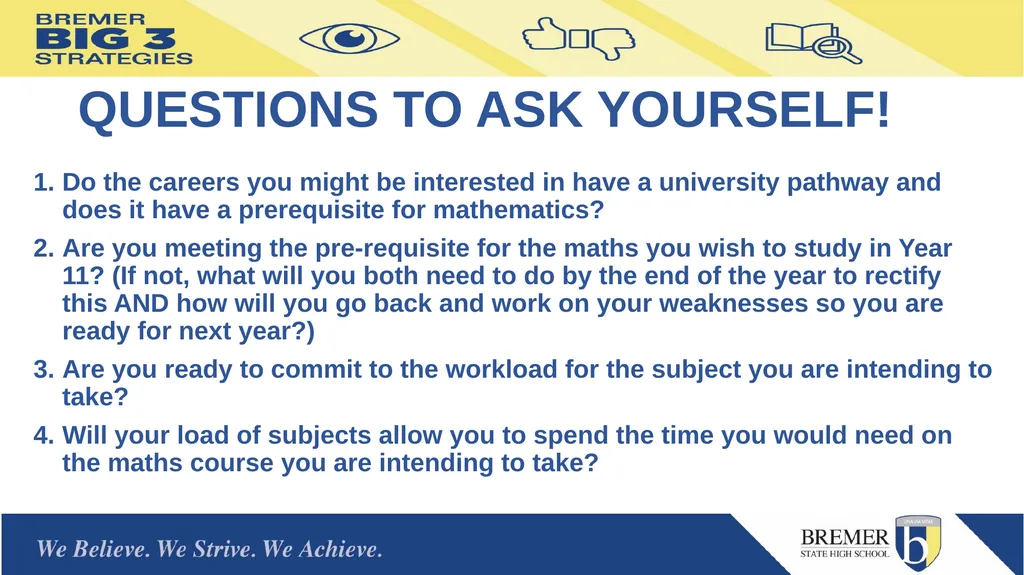
QUESTIONS TO ASK YOURSELF! Do the careers you might be interested in have a university pathway and does it have a prerequisite for mathematics?
Are you meeting the pre-requisite for the maths you wish to study in Year 11? (If not, what will you both need to do by the end of the year to rectify this AND how will you go back and work on your weaknesses so you are ready for next year?)
Are you ready to commit to the workload for the subject you are intending to take?
Will your load of subjects allow you to spend the time you would need on the maths course you are intending to take?<br>