
Brent Fairbanks Primary Examiner, Assistant
A
Published · 64 slides · 0 views

1 / 1









Description
Brent Fairbanks Primary Examiner, Assistant Outreach Coordinator October 11, 2023 Patent Basics: Demystifying the patent process Notice This content is for informational purposes only and is not legal advice. Please consult with appropriate
Related Topics
Share
Embed code
Download this presentation From Below
"Brent Fairbanks Primary Examiner, Assistant" is the property of its rightful owner. Permission is granted to download and print the materials on this website for personal, non-commercial use only, and to display it on your personal computer provided you do not modify the materials and that you retain all copyright notices contained in the materials. By downloading content from our website, you accept the terms of this agreement.
Presentation Transcript
01
Brent Fairbanks
Primary Examiner, Assistant Outreach Coordinator
October 11, 2023 Patent Basics: Demystifying the patent process<br>
Primary Examiner, Assistant Outreach Coordinator
October 11, 2023 Patent Basics: Demystifying the patent process<br>
02
Notice This content is for informational purposes only and is not legal advice. Please consult with appropriate sources for legal authority and guidance on these matters.<br>
03
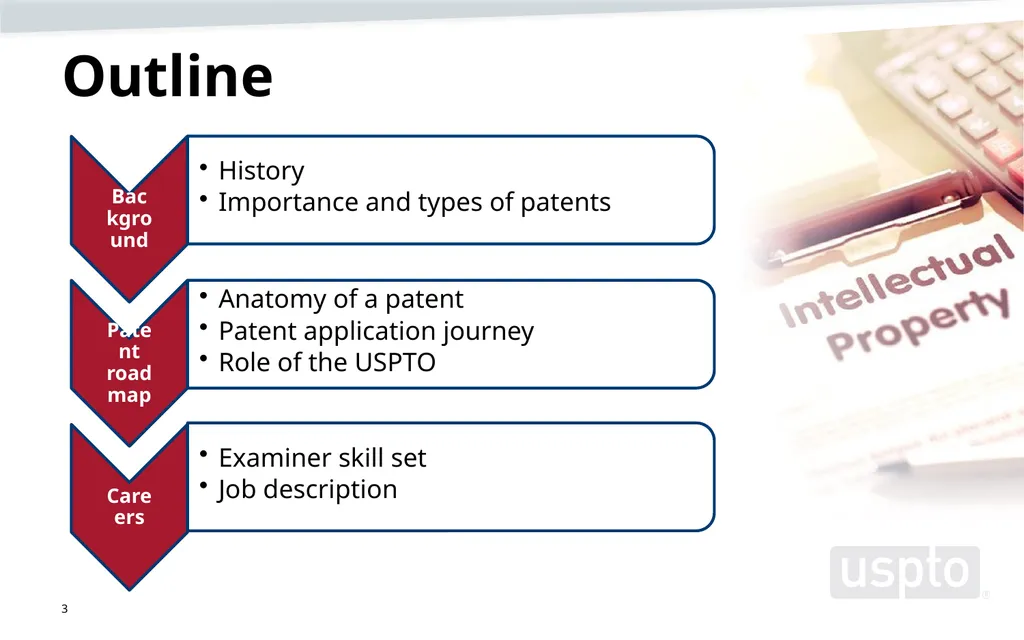
Outline 3<br>
04
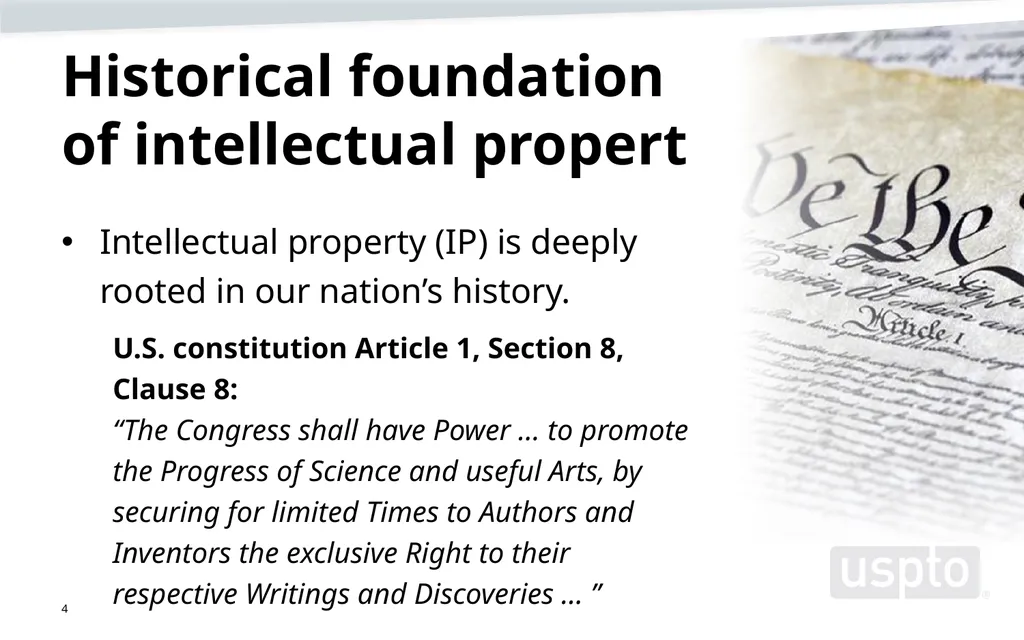
Intellectual property (IP) is deeply rooted in our nation’s history.
U.S. constitution Article 1, Section 8, Clause 8: “The Congress shall have Power … to promote the Progress of Science and useful Arts, by securing for limited Times to Authors and Inventors the exclusive Right to their respective Writings and Discoveries … ” Historical foundation of intellectual property 4<br>
U.S. constitution Article 1, Section 8, Clause 8: “The Congress shall have Power … to promote the Progress of Science and useful Arts, by securing for limited Times to Authors and Inventors the exclusive Right to their respective Writings and Discoveries … ” Historical foundation of intellectual property 4<br>
05
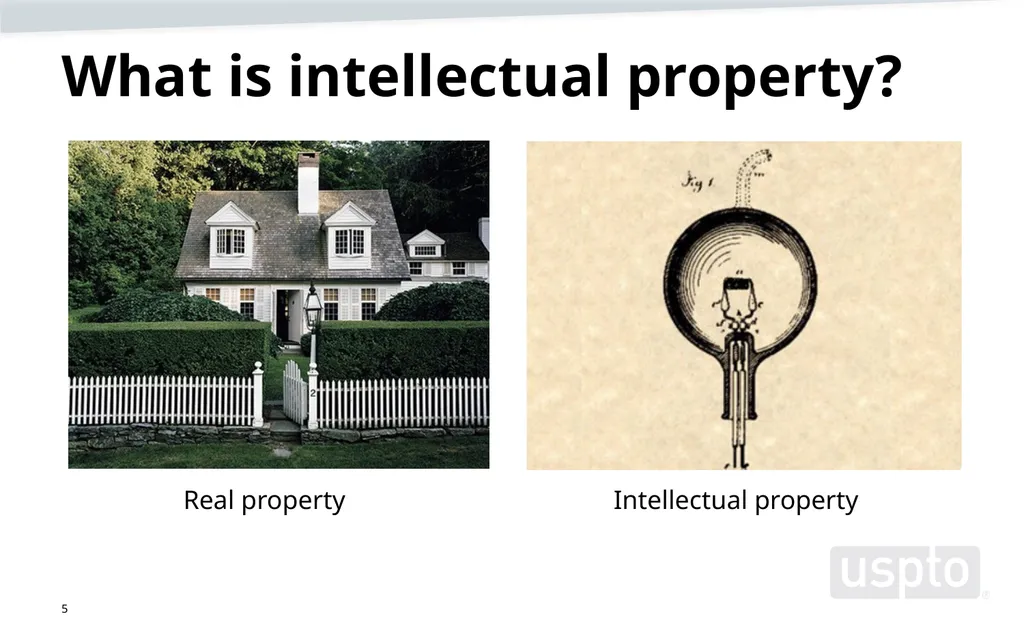
Intellectual property Real property What is intellectual property? 5<br>
06
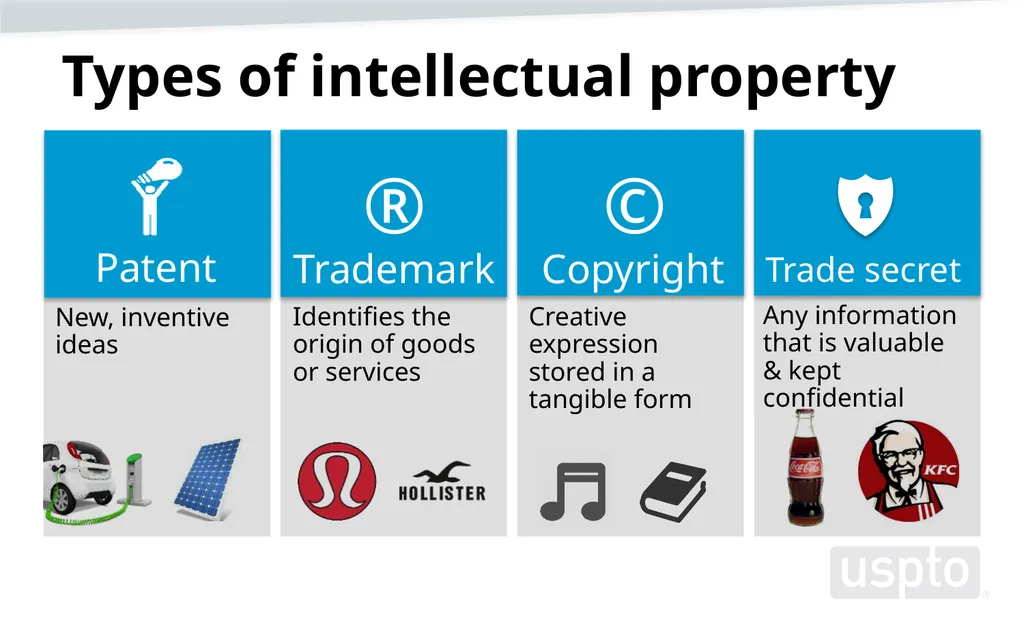
Any information that is valuable & kept confidential Trade secret Creative expression stored in a tangible form Copyright © Identifies the origin of goods or services Trademark ® New, inventive ideas Patent Types of intellectual property<br>
07
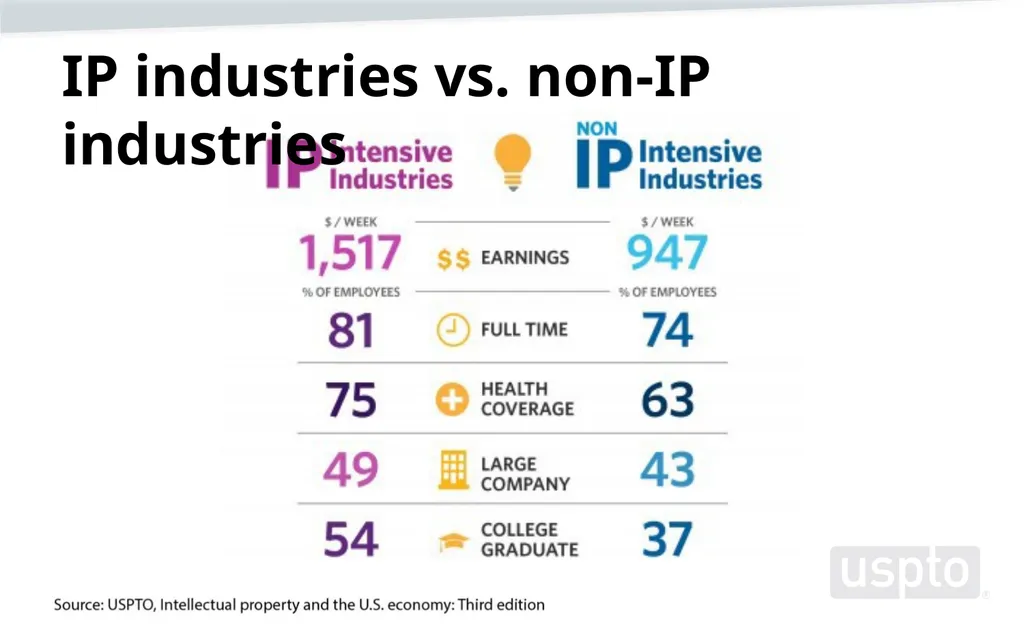
IP industries vs. non-IP industries<br>
08
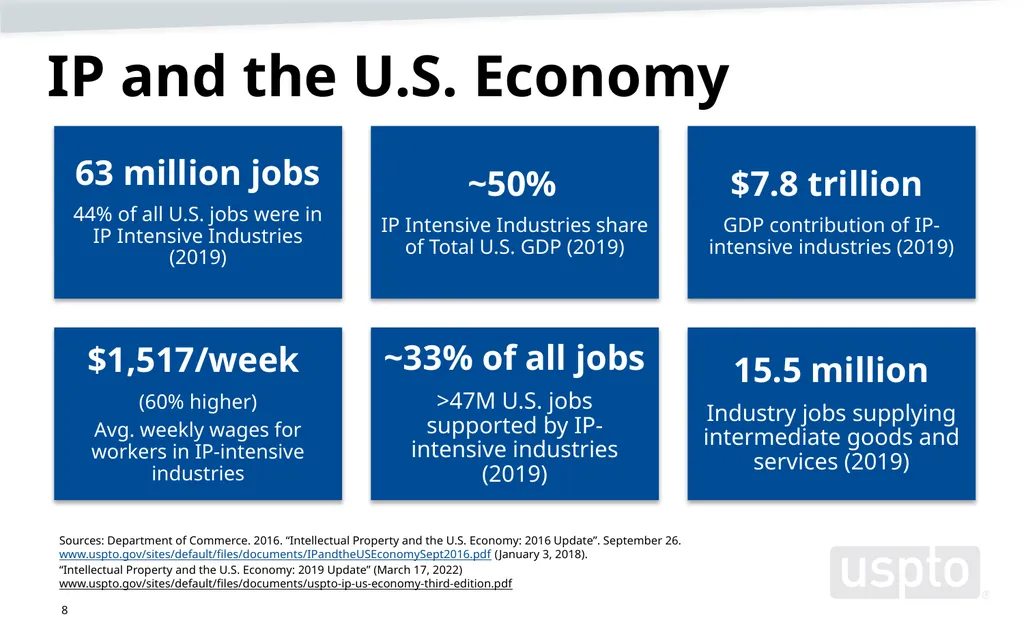
IP and the U.S. Economy Sources: Department of Commerce. 2016. “Intellectual Property and the U.S. Economy: 2016 Update”. September 26. www.uspto.gov/sites/default/files/documents/IPandtheUSEconomySept2016.pdf (January 3, 2018).
“Intellectual Property and the U.S. Economy: 2019 Update” (March 17, 2022)
www.uspto.gov/sites/default/files/documents/uspto-ip-us-economy-third-edition.pdf 8<br>
“Intellectual Property and the U.S. Economy: 2019 Update” (March 17, 2022)
www.uspto.gov/sites/default/files/documents/uspto-ip-us-economy-third-edition.pdf 8<br>
09
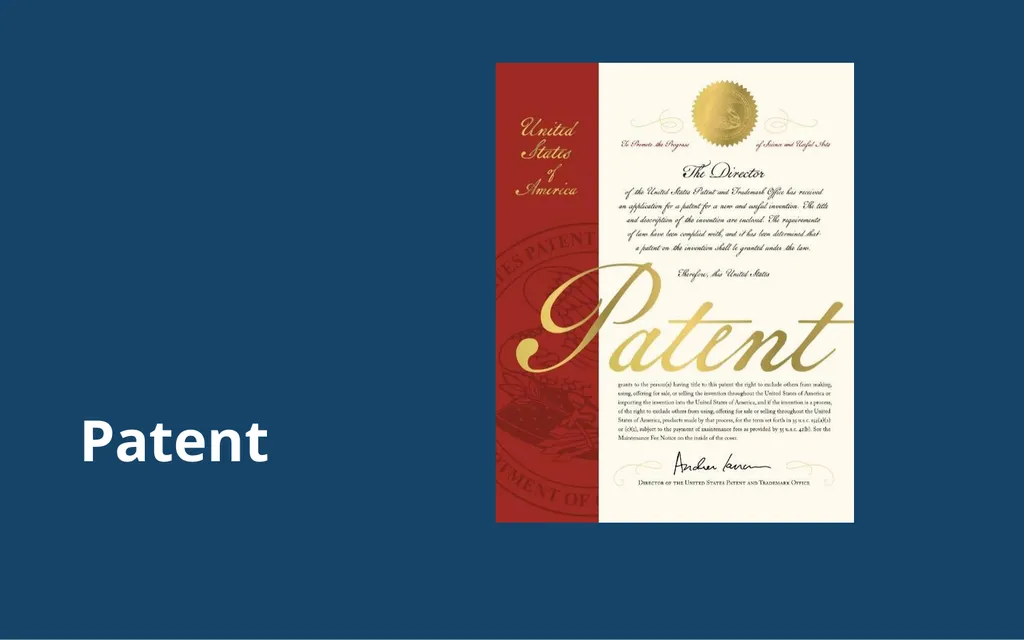
Patent<br>
10
A property right to exclude others from making, using, selling, offering for sale, or importing the claimed invention
Limited term
Territorial: U.S. patent provides protection only in the United States
No worldwide patents What is a patent? 10<br>
Limited term
Territorial: U.S. patent provides protection only in the United States
No worldwide patents What is a patent? 10<br>
11
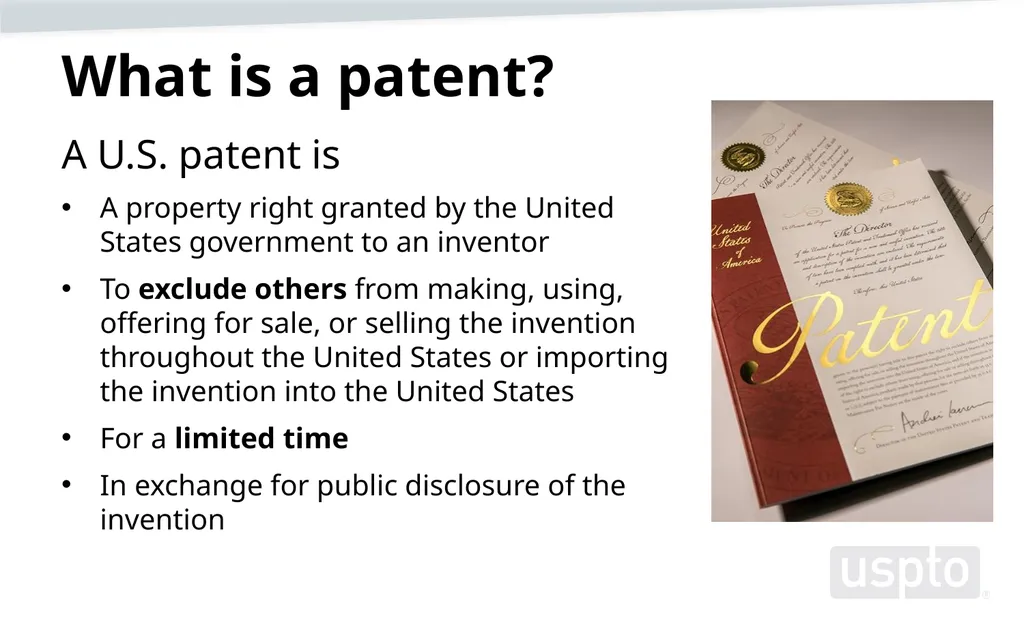
A U.S. patent is
A property right granted by the United States government to an inventor
To exclude others from making, using, offering for sale, or selling the invention throughout the United States or importing the invention into the United States
For a limited time
In exchange for public disclosure of the invention What is a patent?<br>
A property right granted by the United States government to an inventor
To exclude others from making, using, offering for sale, or selling the invention throughout the United States or importing the invention into the United States
For a limited time
In exchange for public disclosure of the invention What is a patent?<br>
12
Anyone who contributes to the conception of an invention
Alone, or in combination with others Who can be an inventor on a patent? 12<br>
Alone, or in combination with others Who can be an inventor on a patent? 12<br>
13
Patents can:
Promote innovation and help safeguard your inventions
Help companies grow
Benefit the community by making new goods and services available
Provide personal growth, development, and advancement Why invention matters and what this means to you 13<br>
Promote innovation and help safeguard your inventions
Help companies grow
Benefit the community by making new goods and services available
Provide personal growth, development, and advancement Why invention matters and what this means to you 13<br>
14
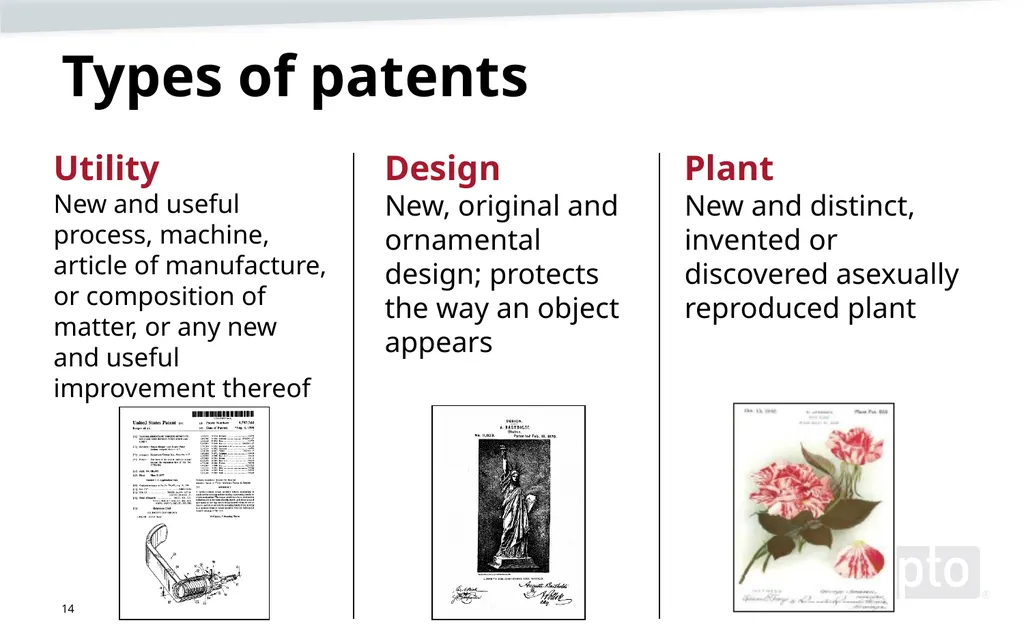
Plant
New and distinct, invented or discovered asexually reproduced plant Design
New, original and ornamental design; protects the way an object appears Utility
New and useful process, machine, article of manufacture, or composition of matter, or any new and useful improvement thereof Types of patents 14<br>
New and distinct, invented or discovered asexually reproduced plant Design
New, original and ornamental design; protects the way an object appears Utility
New and useful process, machine, article of manufacture, or composition of matter, or any new and useful improvement thereof Types of patents 14<br>
15
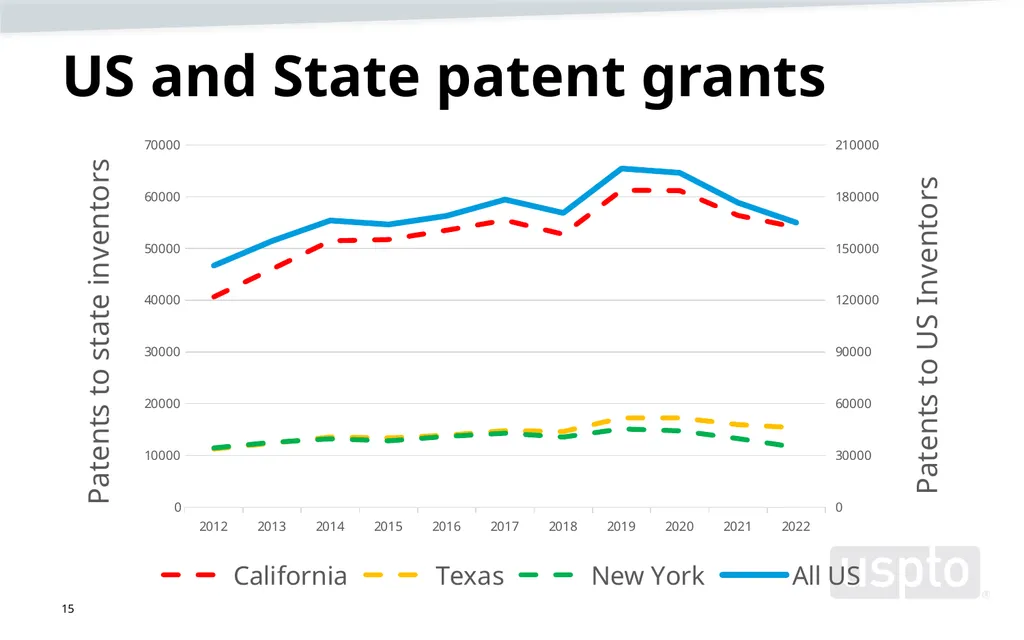
US and State patent grants 15<br>
16
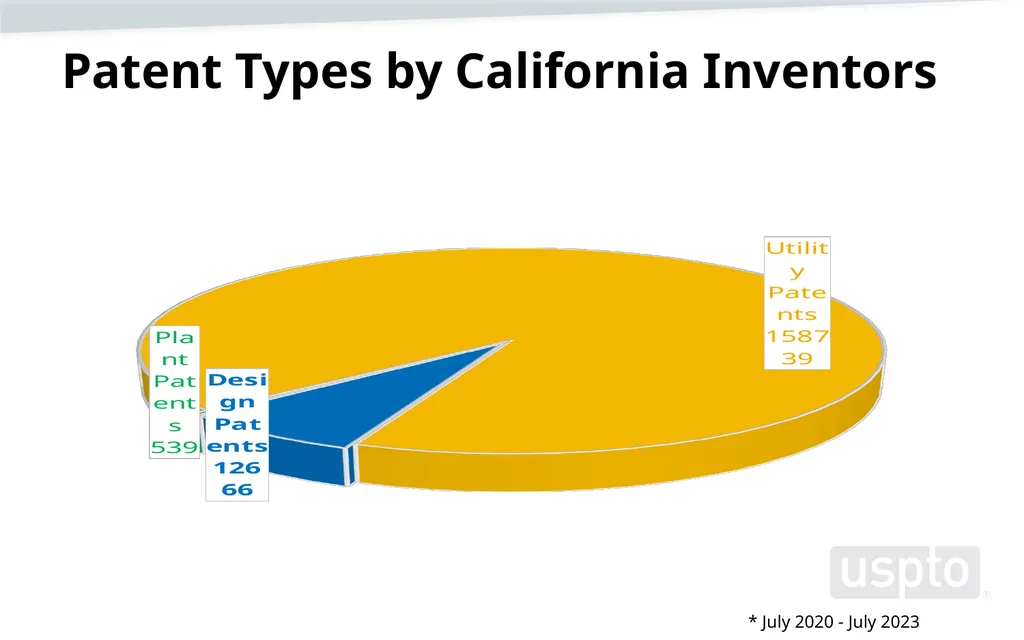
Patent Types by California Inventors * July 2020 - July 2023<br>
17
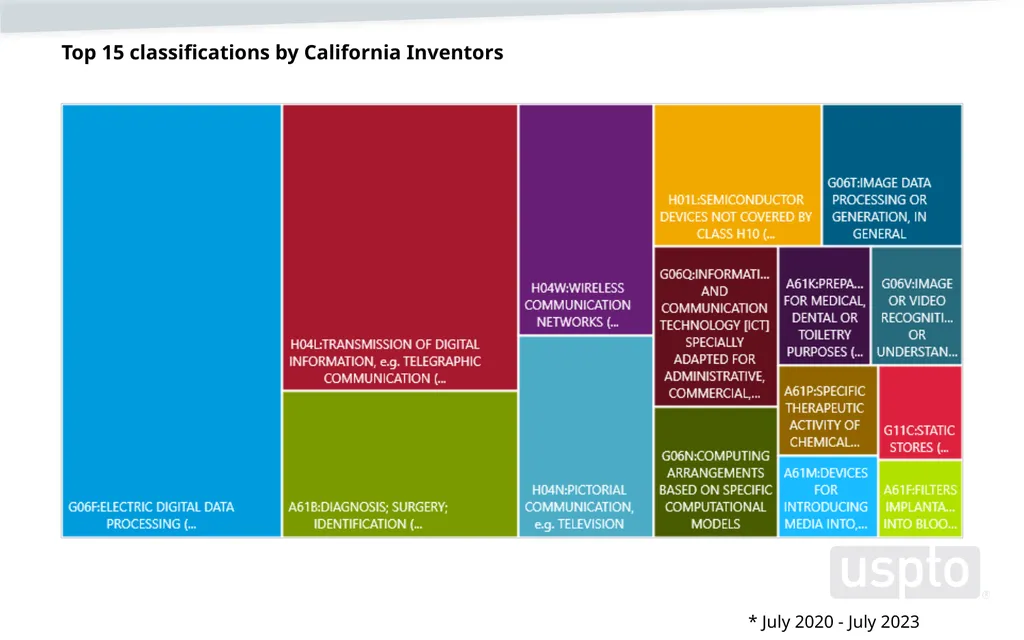
Top 15 classifications by California Inventors * July 2020 - July 2023<br>
18
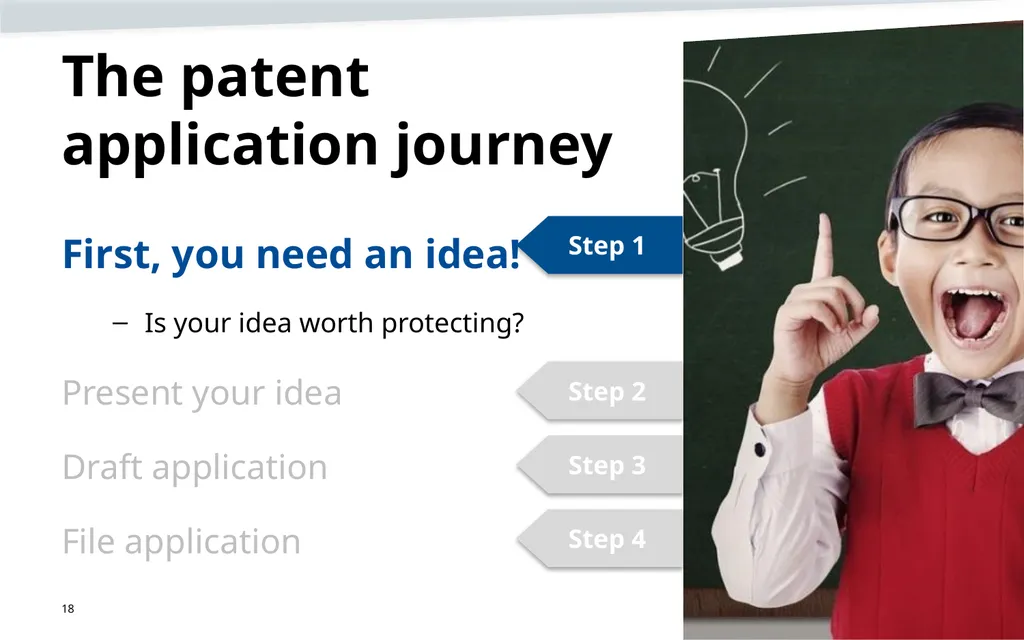
First, you need an idea!
Is your idea worth protecting?
Present your idea
Draft application
File application The patent application journey 18 Step 4 Step 3 Step 2 Step 1<br>
Is your idea worth protecting?
Present your idea
Draft application
File application The patent application journey 18 Step 4 Step 3 Step 2 Step 1<br>
19
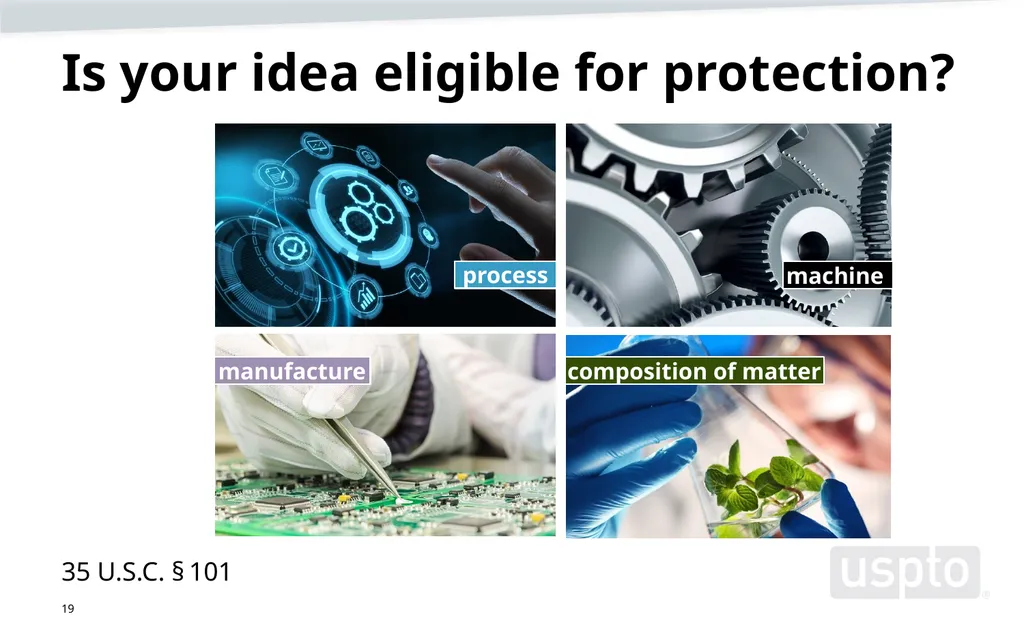
35 U.S.C. § 101 Is your idea eligible for protection? 19 composition of matter manufacture machine process<br>
20
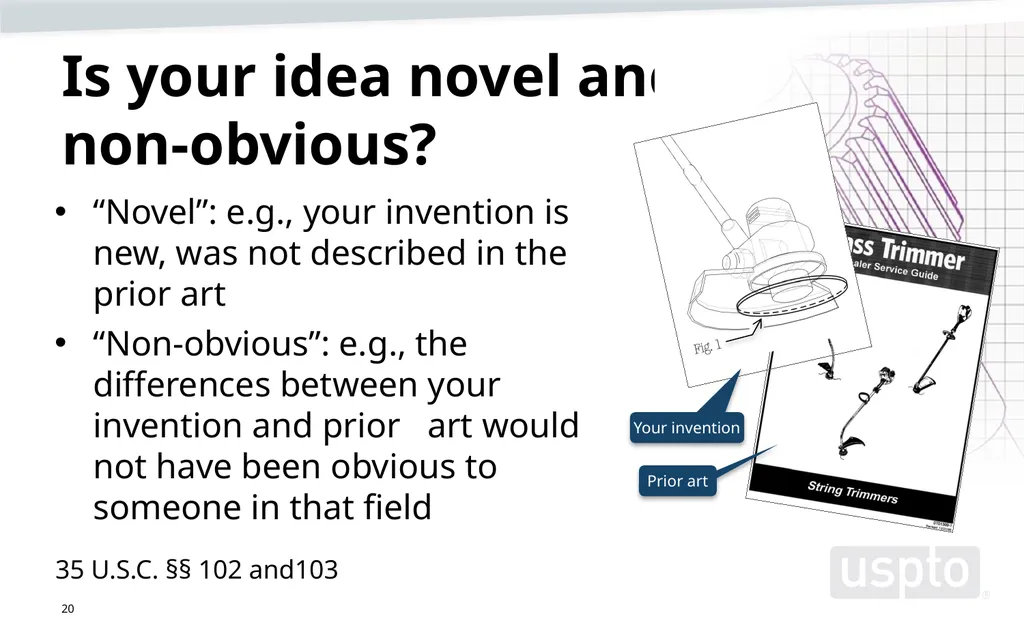
“Novel”: e.g., your invention is new, was not described in the prior art
“Non-obvious”: e.g., the differences between your invention and prior art would not have been obvious to someone in that field Is your idea novel and non-obvious? 20 35 U.S.C. §§ 102 and103 Prior art Your invention<br>
“Non-obvious”: e.g., the differences between your invention and prior art would not have been obvious to someone in that field Is your idea novel and non-obvious? 20 35 U.S.C. §§ 102 and103 Prior art Your invention<br>
21
Prior art includes:
patents,
printed publications,
other disclosures in the field of your invention that have been published before your effective filing date. What is prior art? 21<br>
patents,
printed publications,
other disclosures in the field of your invention that have been published before your effective filing date. What is prior art? 21<br>
22
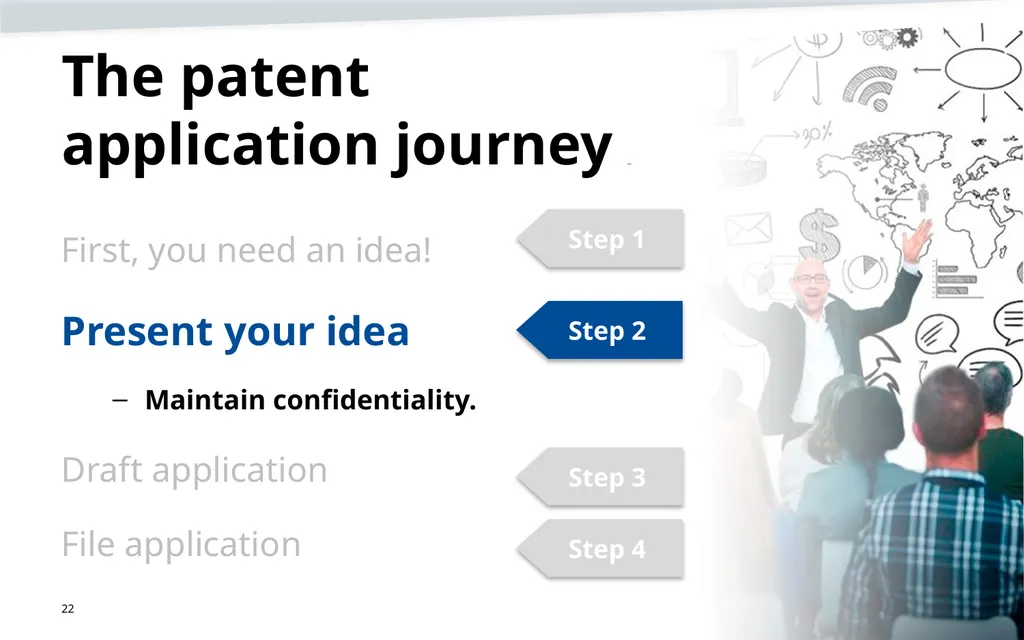
First, you need an idea!
Present your idea
Maintain confidentiality.
Draft application
File application The patent application journey Step 1 22 Step 4 Step 3 Step 2 Step 1<br>
Present your idea
Maintain confidentiality.
Draft application
File application The patent application journey Step 1 22 Step 4 Step 3 Step 2 Step 1<br>
23
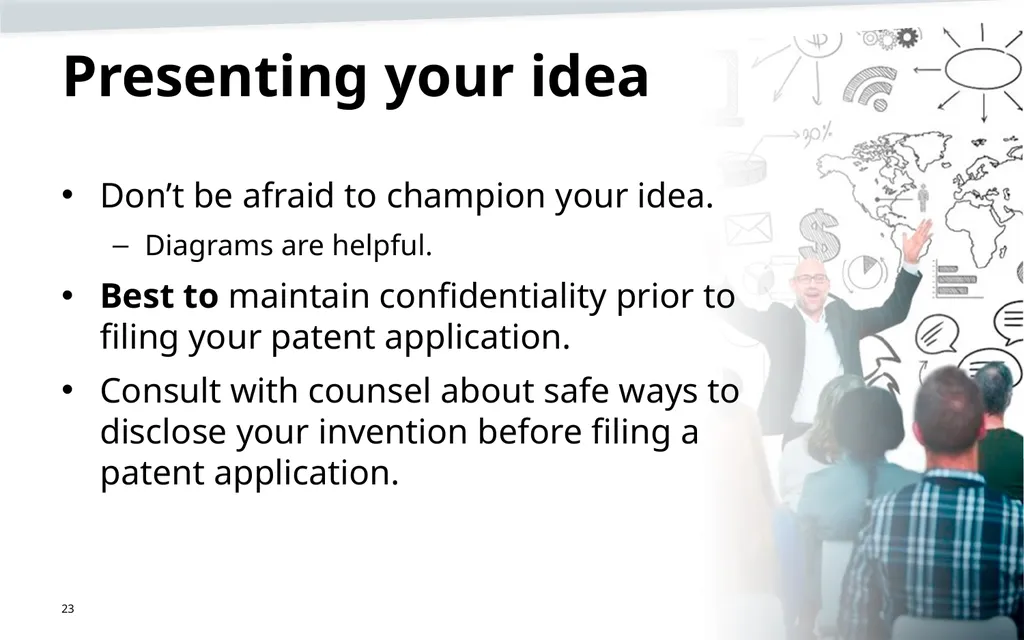
Don’t be afraid to champion your idea.
Diagrams are helpful.
Best to maintain confidentiality prior to filing your patent application.
Consult with counsel about safe ways to disclose your invention before filing a patent application. Presenting your idea 23<br>
Diagrams are helpful.
Best to maintain confidentiality prior to filing your patent application.
Consult with counsel about safe ways to disclose your invention before filing a patent application. Presenting your idea 23<br>
24
First, you need an idea!
Present your idea
Draft application
It’s now time to write up the patent application.
File application The patent application journey Step 3 24 Step 4 Step 3 Step 2 Step 1<br>
Present your idea
Draft application
It’s now time to write up the patent application.
File application The patent application journey Step 3 24 Step 4 Step 3 Step 2 Step 1<br>
25
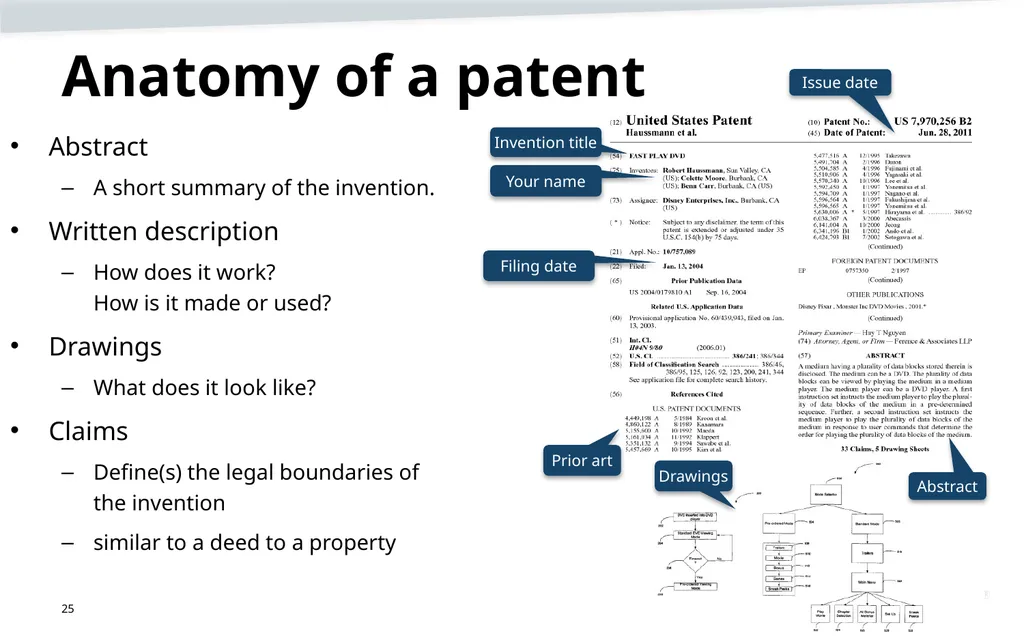
Anatomy of a patent 25 Abstract
A short summary of the invention.
Written description
How does it work? How is it made or used?
Drawings
What does it look like?
Claims
Define(s) the legal boundaries of the invention
similar to a deed to a property Invention title Your name Issue date Filing date Drawings Abstract Prior art<br>
A short summary of the invention.
Written description
How does it work? How is it made or used?
Drawings
What does it look like?
Claims
Define(s) the legal boundaries of the invention
similar to a deed to a property Invention title Your name Issue date Filing date Drawings Abstract Prior art<br>
26
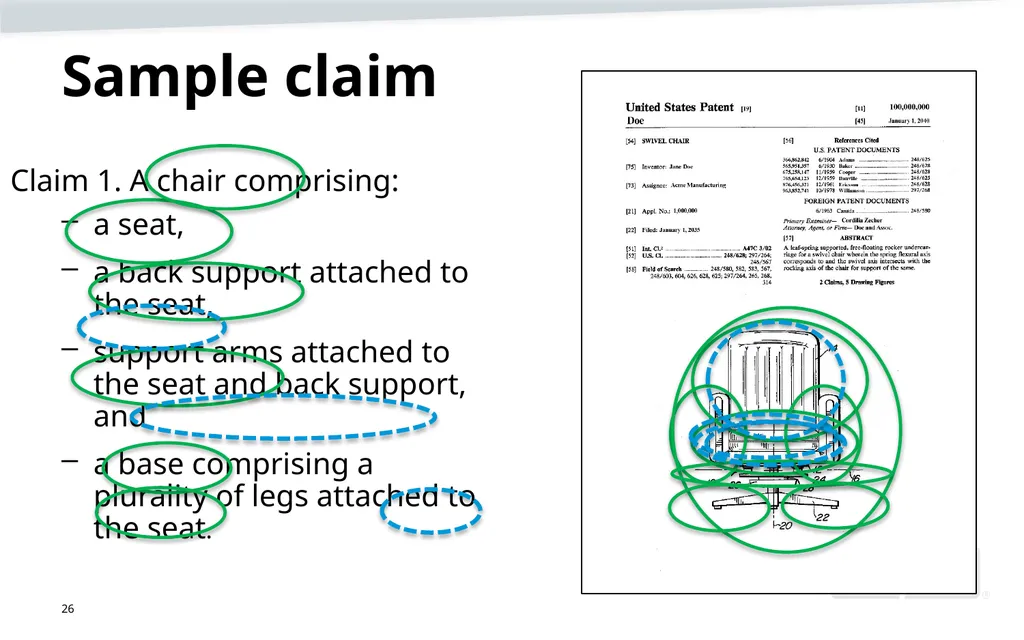
Sample claim 26 Claim 1. A chair comprising:
a seat,
a back support attached to the seat,
support arms attached to the seat and back support, and
a base comprising a plurality of legs attached to the seat.<br>
a seat,
a back support attached to the seat,
support arms attached to the seat and back support, and
a base comprising a plurality of legs attached to the seat.<br>
27
A patent is a quid pro quo:
In exchange for
The right to exclude others from making, using, importing, or selling your invention for a limited time period,
You must fully disclose your invention so the public can benefit from it and expand on it. 27 35 U.S.C. § 112 What do I need to disclose?<br>
In exchange for
The right to exclude others from making, using, importing, or selling your invention for a limited time period,
You must fully disclose your invention so the public can benefit from it and expand on it. 27 35 U.S.C. § 112 What do I need to disclose?<br>
28
Does the disclosure:
Demonstrate that the inventor was in possession of the claimed invention?
Teach one of ordinary skill to make and use the invention without undue experimentation?
Describe the best mode contemplated for carrying out the invention by the inventor? 28 35 U.S.C. § 112 (a) What do I need to disclose?<br>
Demonstrate that the inventor was in possession of the claimed invention?
Teach one of ordinary skill to make and use the invention without undue experimentation?
Describe the best mode contemplated for carrying out the invention by the inventor? 28 35 U.S.C. § 112 (a) What do I need to disclose?<br>
29
Are the claims clear enough that:
The public is informed of the boundaries of your invention?
It can be determined whether the claimed invention meets all the criteria for patentability? 29 35 U.S.C. § 112 (b) What do I need to disclose?<br>
The public is informed of the boundaries of your invention?
It can be determined whether the claimed invention meets all the criteria for patentability? 29 35 U.S.C. § 112 (b) What do I need to disclose?<br>
30
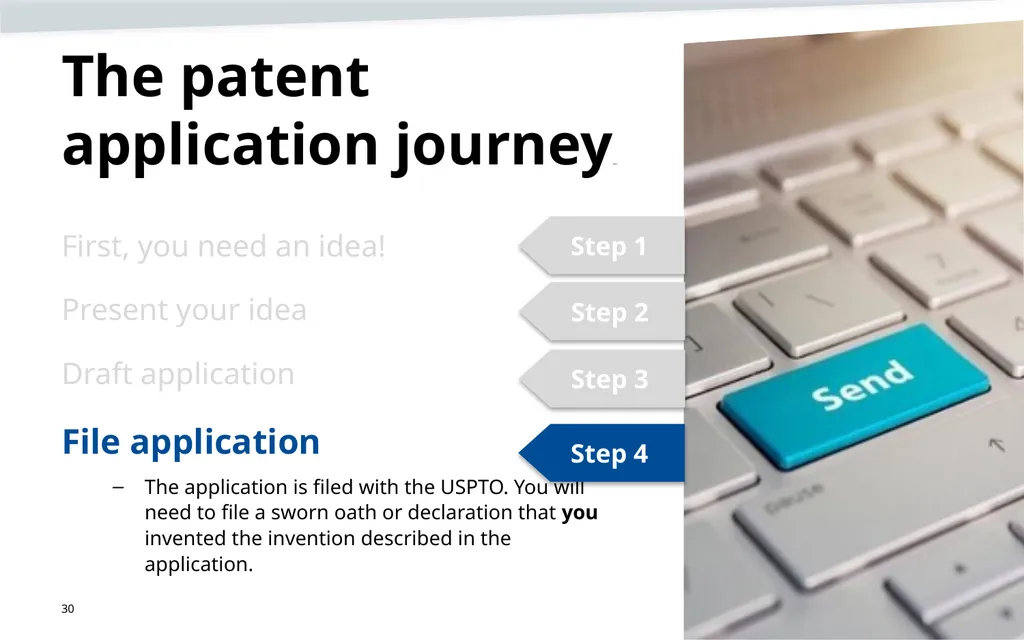
First, you need an idea!
Present your idea
Draft application
File application
The application is filed with the USPTO. You will need to file a sworn oath or declaration that you invented the invention described in the application. The patent application journey Step 4 30 Step 4 Step 3 Step 2 Step 1<br>
Present your idea
Draft application
File application
The application is filed with the USPTO. You will need to file a sworn oath or declaration that you invented the invention described in the application. The patent application journey Step 4 30 Step 4 Step 3 Step 2 Step 1<br>
31
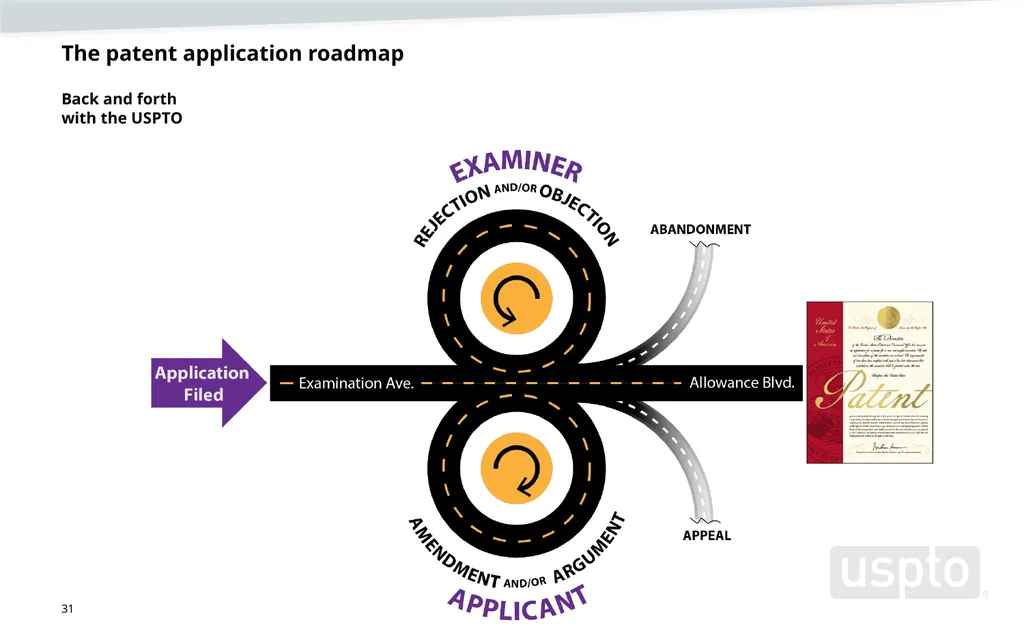
The patent application roadmap
Back and forth
with the USPTO 31<br>
32
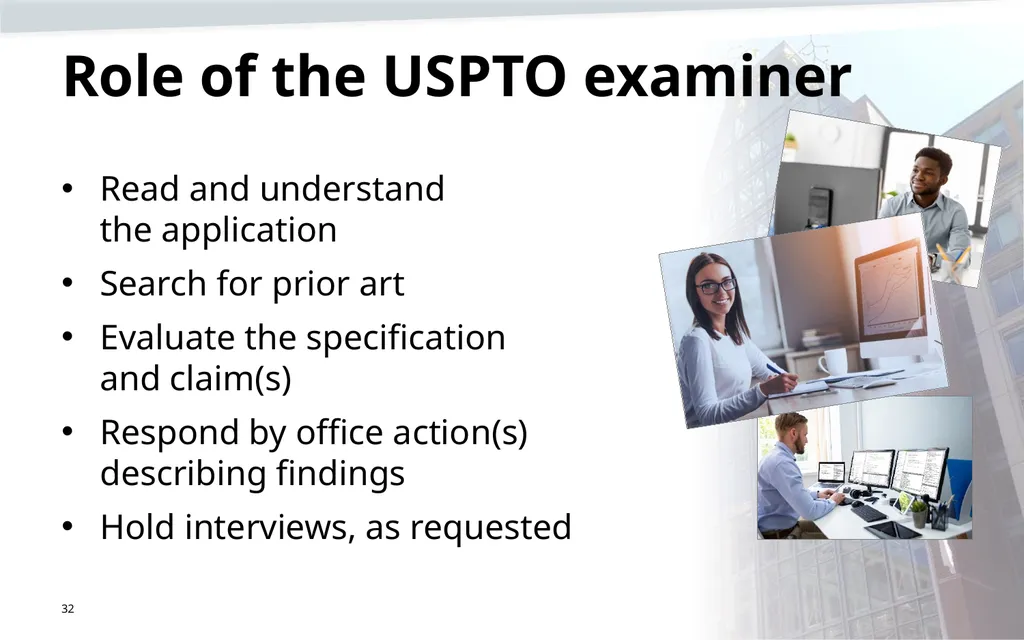
Read and understand
the application
Search for prior art
Evaluate the specification and claim(s)
Respond by office action(s) describing findings
Hold interviews, as requested 32 Role of the USPTO examiner<br>
Search for prior art
Evaluate the specification and claim(s)
Respond by office action(s) describing findings
Hold interviews, as requested 32 Role of the USPTO examiner<br>
33
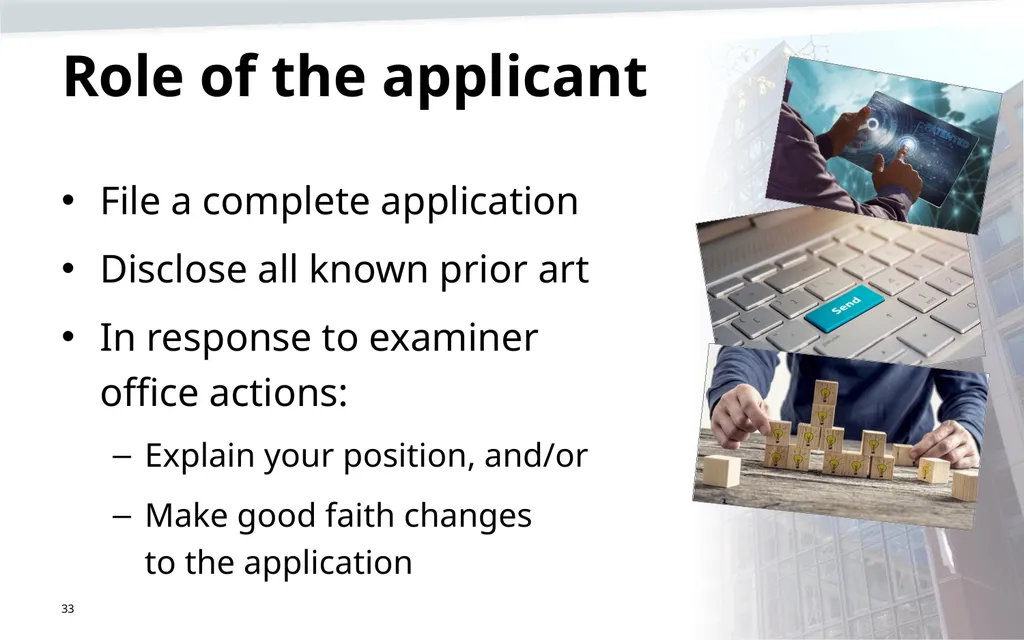
File a complete application
Disclose all known prior art
In response to examiner office actions:
Explain your position, and/or
Make good faith changes to the application Role of the applicant 33<br>
Disclose all known prior art
In response to examiner office actions:
Explain your position, and/or
Make good faith changes to the application Role of the applicant 33<br>
34
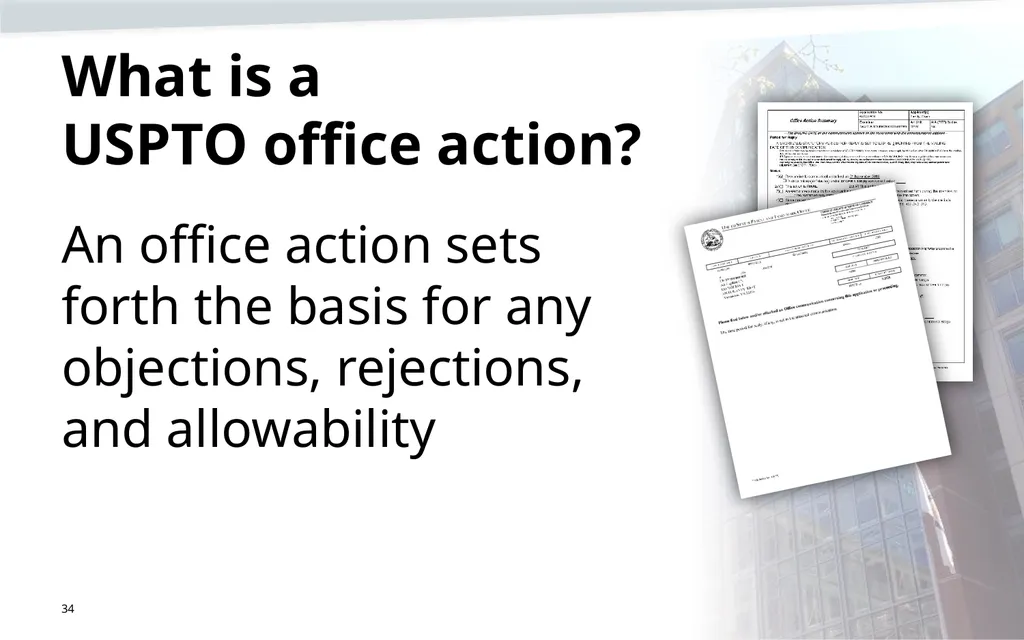
An office action sets forth the basis for any objections, rejections, and allowability What is a
USPTO office action? 34<br>
35
35 What does a rejection mean? Rejections are a normal
part of the process
They help define what is patentable
Often due to existing prior art
The examiner must have a basis to believe someone else may have come up with what you invented before you
Can often be overcome<br>
They help define what is patentable
Often due to existing prior art
The examiner must have a basis to believe someone else may have come up with what you invented before you
Can often be overcome<br>
36
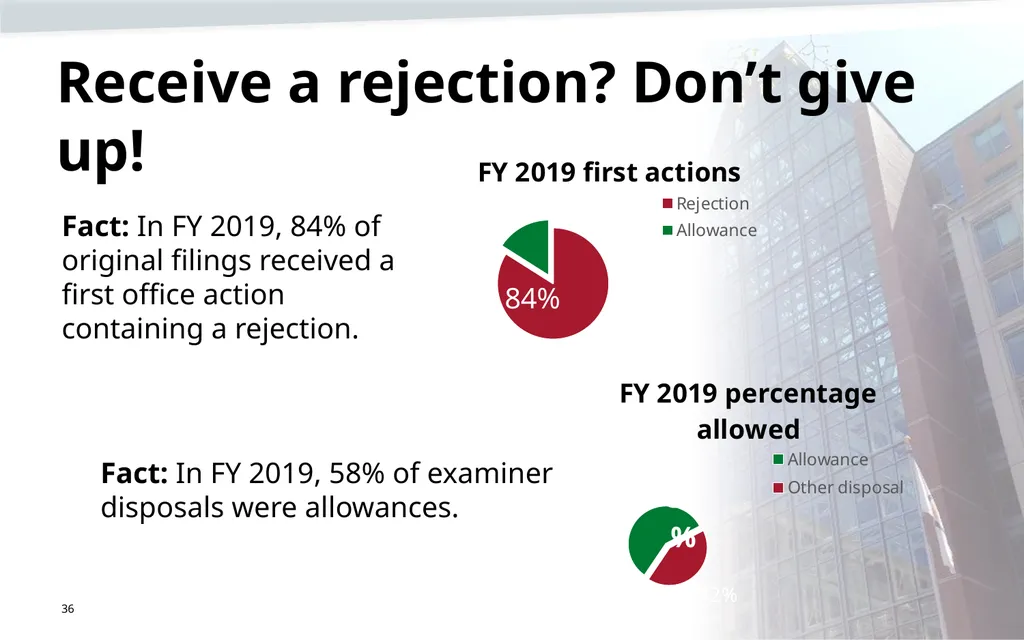
36 Fact: In FY 2019, 58% of examiner disposals were allowances. Fact: In FY 2019, 84% of original filings received a first office action containing a rejection. Receive a rejection? Don’t give up!<br>
37
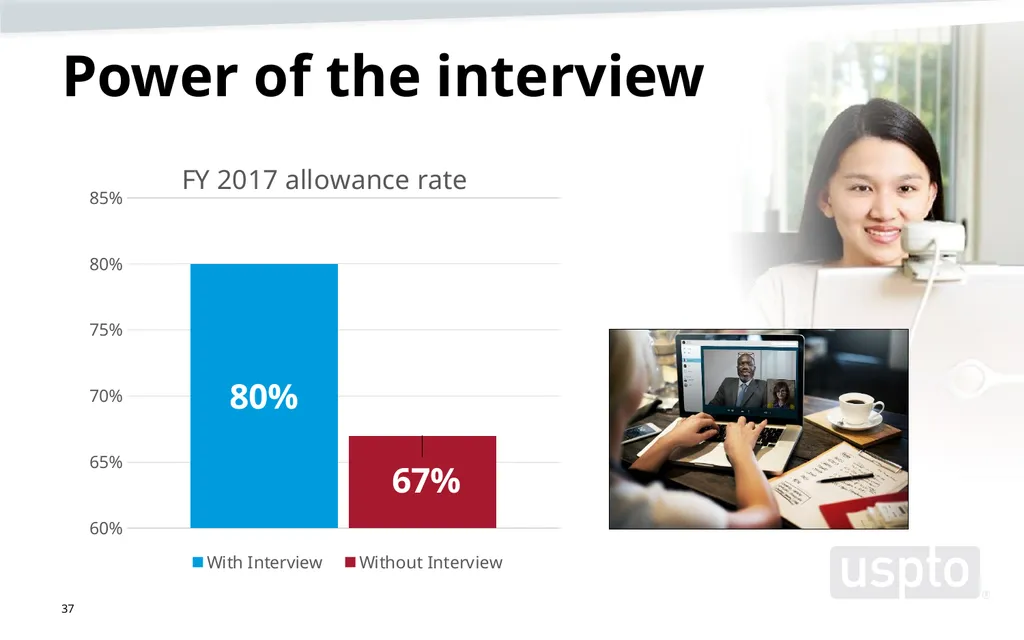
37 Power of the interview<br>
38
Even if you receive a final rejection, don’t panic. If you still disagree, you may still have options:
Request for continued examination (RCE),
Appeal, or
After-final response After-final practice 38<br>
Request for continued examination (RCE),
Appeal, or
After-final response After-final practice 38<br>
39
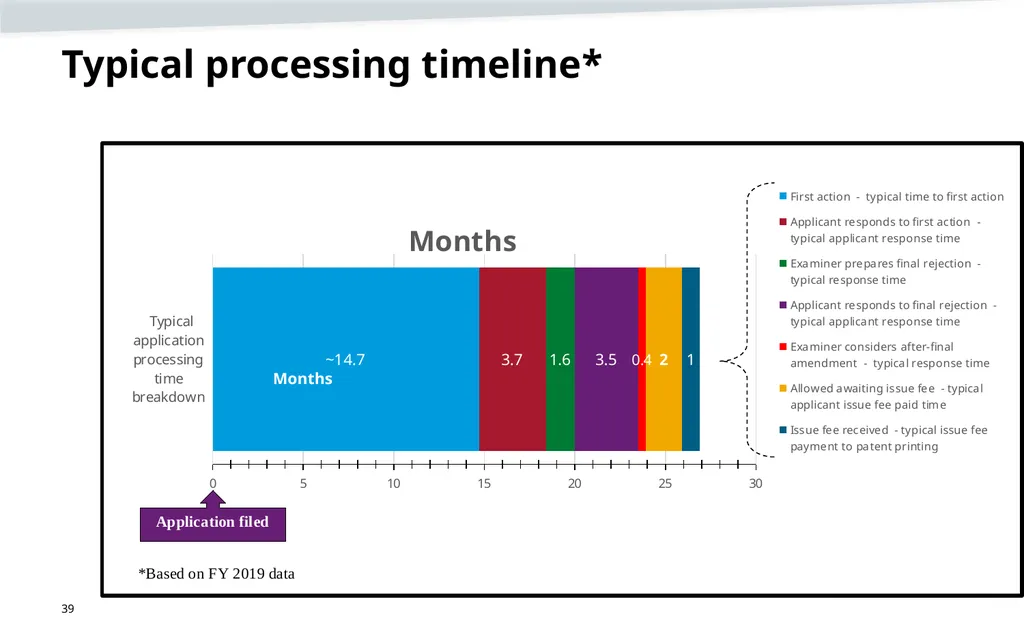
Typical processing timeline* Months 39<br>
40
A notice of allowance indicates all objections and rejections have been overcome and your application is ready for issuance.
Congratulations! Allowance and issuance 40<br>
Congratulations! Allowance and issuance 40<br>
41
Stay involved throughout the process. Remember 41<br>
42
As of 01/01/2020 Becoming a Patent Examiner<br>
43
Committed to:
Fostering innovation and economic growth
Creating a reliable, predictable, and high-quality IP system The USPTO is America’s innovation agency 43<br>
Fostering innovation and economic growth
Creating a reliable, predictable, and high-quality IP system The USPTO is America’s innovation agency 43<br>
44
Foster innovation, competitiveness, and job growth in the United States
Conduct high quality and timely patent and trademark examination
Produce reliable and predictable intellectual property rights
Improve intellectual property rights protection
Deliver intellectual property information and education worldwide USPTO’s mission 44<br>
Conduct high quality and timely patent and trademark examination
Produce reliable and predictable intellectual property rights
Improve intellectual property rights protection
Deliver intellectual property information and education worldwide USPTO’s mission 44<br>
45
Through a culture of quality, we promote excellence throughout the organization by valuing accurate and consistent results, primarily in the examination processes.
Through timeliness, we recognize the needs of our customers and stakeholders to have our products and services delivered at a time that meets their individual needs.
Through efficiency, we are sound financial stewards of the user fees paid by our customers, and we use the lowest number of inputs to create the greatest number of outputs, maximizing results.
Through effectiveness, we listen to our customers and stakeholders, and incorporate their feedback.
Through accountability, we measure our activities, accept responsibility for them, and disclose the results in a transparent manner. Guiding principles 45<br>
Through timeliness, we recognize the needs of our customers and stakeholders to have our products and services delivered at a time that meets their individual needs.
Through efficiency, we are sound financial stewards of the user fees paid by our customers, and we use the lowest number of inputs to create the greatest number of outputs, maximizing results.
Through effectiveness, we listen to our customers and stakeholders, and incorporate their feedback.
Through accountability, we measure our activities, accept responsibility for them, and disclose the results in a transparent manner. Guiding principles 45<br>
46
Year after year, USPTO is voted as… 46<br>
47
U.S. citizenship or national
Technical degree
Worksite located in the 50 United States, Washington DC, or Puerto Rico Employment requirements 47<br>
Technical degree
Worksite located in the 50 United States, Washington DC, or Puerto Rico Employment requirements 47<br>
48
Strong technical background
Analytical and research oriented
Able to make decisions
Able to independently manage time
Excellent written and oral communications skills
Attention to detail Patent examiner skill set 48<br>
Analytical and research oriented
Able to make decisions
Able to independently manage time
Excellent written and oral communications skills
Attention to detail Patent examiner skill set 48<br>
49
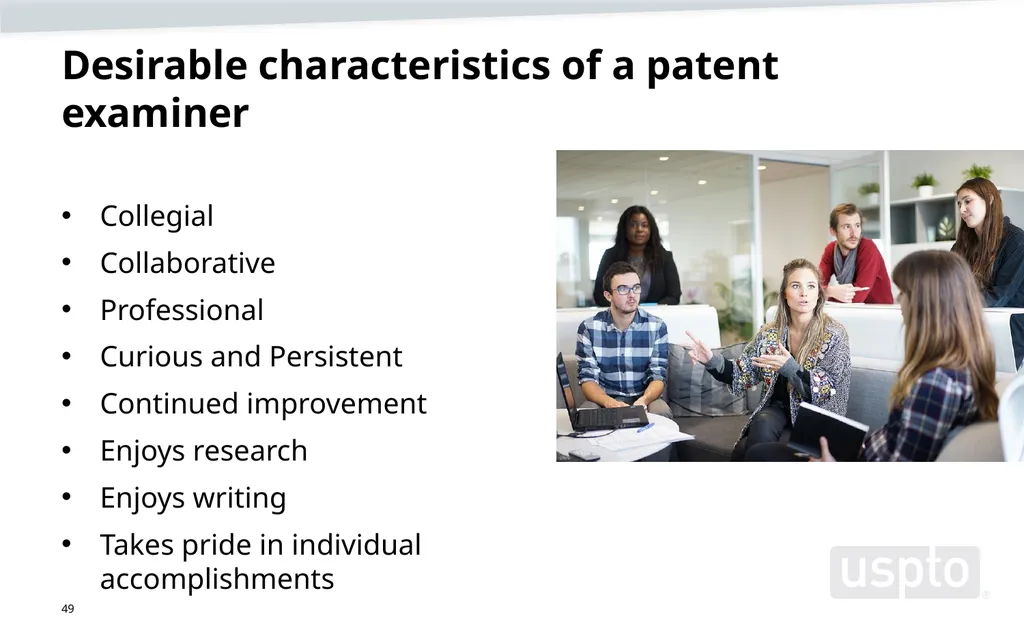
Collegial
Collaborative
Professional
Curious and Persistent
Continued improvement
Enjoys research
Enjoys writing
Takes pride in individual accomplishments Desirable characteristics of a patent examiner 49<br>
Collaborative
Professional
Curious and Persistent
Continued improvement
Enjoys research
Enjoys writing
Takes pride in individual accomplishments Desirable characteristics of a patent examiner 49<br>
50
Patent Training Academy and
in-house technical/legal training
Non-competitive promotions to GS-13
Reasonable Accommodations
Flexible work schedules
Optional overtime (dependent upon funding availability)
Telework opportunities
Competitive salary (special pay rate)
Training and Mentorship opportunities (ex. Leadership Development Program)
Height-Adjustable Desks
Affinity Groups: Society of Women Engineers, National Society of Black Engineers, Society of Hispanic Professional Engineers, PTO Society, Asian-Pacific American Network, etc.
Annual and quarterly performance awards
Law School Tuition Reimbursement Program (dependent upon funding availability)
Advanced Technical Degree Tuition Reimbursement Program
Thrift Savings Program (TSP): Federal employee version of the 401K with up to 5% matching)
Pension annuity that vests after 5 years of service Benefits of being a patent examiner 50<br>
Non-competitive promotions to GS-13
Reasonable Accommodations
Flexible work schedules
Optional overtime (dependent upon funding availability)
Telework opportunities
Competitive salary (special pay rate)
Training and Mentorship opportunities (ex. Leadership Development Program)
Height-Adjustable Desks
Affinity Groups: Society of Women Engineers, National Society of Black Engineers, Society of Hispanic Professional Engineers, PTO Society, Asian-Pacific American Network, etc.
Annual and quarterly performance awards
Law School Tuition Reimbursement Program (dependent upon funding availability)
Advanced Technical Degree Tuition Reimbursement Program
Thrift Savings Program (TSP): Federal employee version of the 401K with up to 5% matching)
Pension annuity that vests after 5 years of service Benefits of being a patent examiner 50<br>
51
USPTO Resources<br>
52
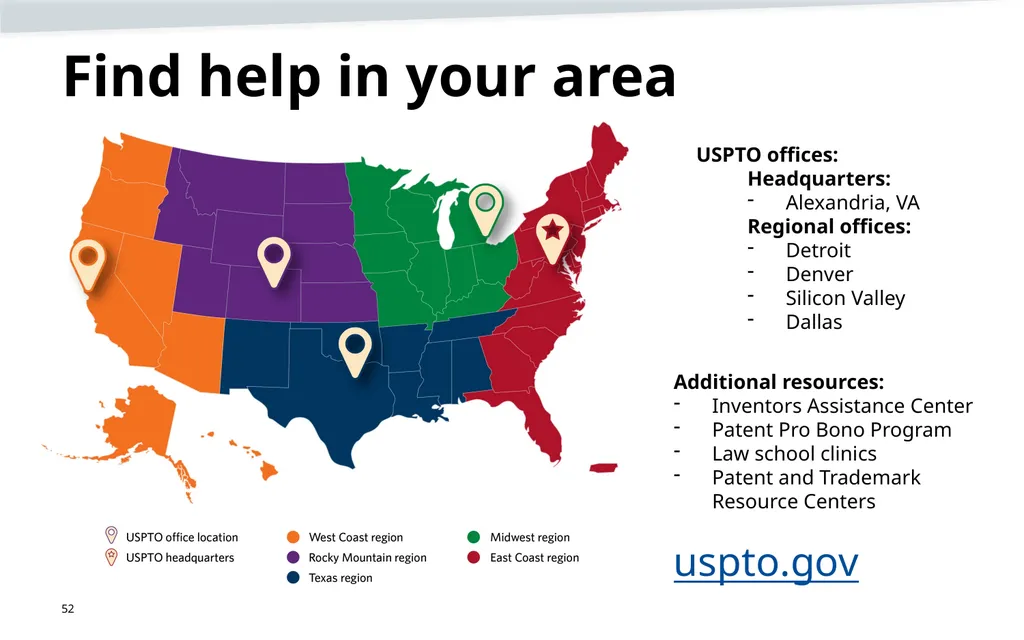
52 Find help in your area uspto.gov Additional resources:
Inventors Assistance Center
Patent Pro Bono Program
Law school clinics
Patent and Trademark Resource Centers USPTO offices:
Headquarters:
Alexandria, VA
Regional offices:
Detroit
Denver
Silicon Valley
Dallas<br>
Inventors Assistance Center
Patent Pro Bono Program
Law school clinics
Patent and Trademark Resource Centers USPTO offices:
Headquarters:
Alexandria, VA
Regional offices:
Detroit
Denver
Silicon Valley
Dallas<br>
53
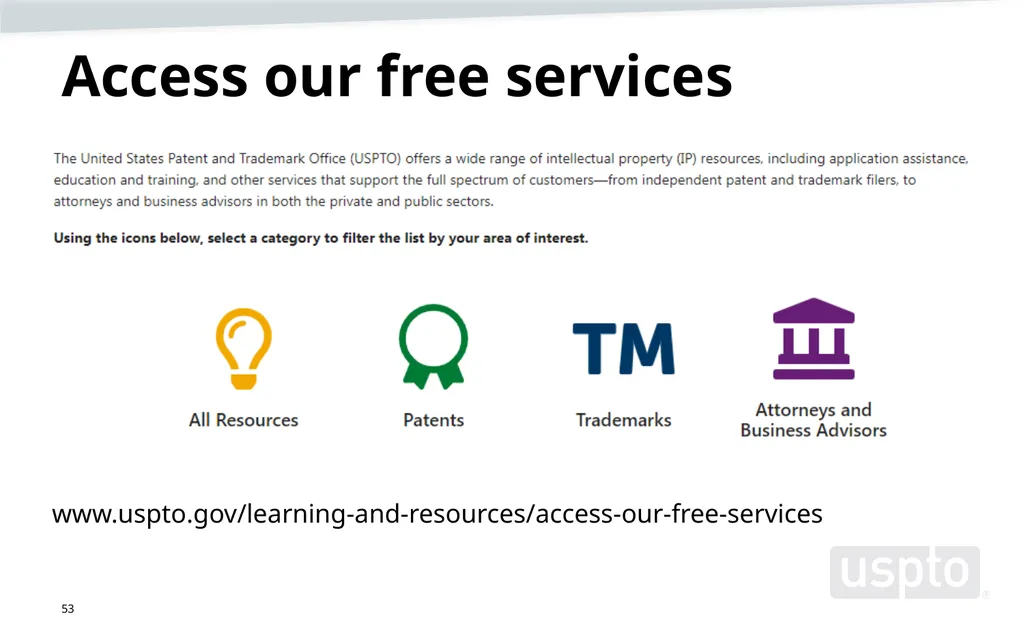
www.uspto.gov/learning-and-resources/access-our-free-services Access our free services 53<br>
54
This program is designed to encourage innovation for inventors who are new to the patent application process and is offered at no additional cost to the applicant.
Upon acceptance into the program, your patent application will receive special status:
Earlier first office action (a patent examiner’s written notice of findings)
Earlier indication of whether your invention is patentable First-Time Filer Expedited Examination Pilot Program 54 www.uspto.gov/FirstTimePatentFiler<br>
Upon acceptance into the program, your patent application will receive special status:
Earlier first office action (a patent examiner’s written notice of findings)
Earlier indication of whether your invention is patentable First-Time Filer Expedited Examination Pilot Program 54 www.uspto.gov/FirstTimePatentFiler<br>
55
You may be eligible if you have:
Filed a utility nonprovisional patent application meeting certain guidelines
Not been named as an inventor on any other nonprovisional application
Filed your application electronically using Patent Center (in DOCX format)
Completed your application when filing for acceptance into the program
Qualified for special status based on income
Received reasonable training in the basics of the patent application process
To apply
File a “Petition to Make Special” (Form PTO/SB/464). First-Time Filer Expedited Examination Pilot Program 55<br>
Filed a utility nonprovisional patent application meeting certain guidelines
Not been named as an inventor on any other nonprovisional application
Filed your application electronically using Patent Center (in DOCX format)
Completed your application when filing for acceptance into the program
Qualified for special status based on income
Received reasonable training in the basics of the patent application process
To apply
File a “Petition to Make Special” (Form PTO/SB/464). First-Time Filer Expedited Examination Pilot Program 55<br>
56
The Inventors Assistance Center (IAC) provides patent information and services to the public. The IAC is staffed by former supervisory patent examiners and experienced former primary examiners who answer general questions concerning patent examining policy and procedure. Inventors Assistance Center (IAC) 56 Monday – Friday,
8:30 a.m. – 8 p.m. ET,
except federal holidays
800-PTO-9199 (800-786-9199)
571-272-1000
TTY customers can dial 800-877-8339 for customer assistance<br>
800-PTO-9199 (800-786-9199)
571-272-1000
TTY customers can dial 800-877-8339 for customer assistance<br>
57
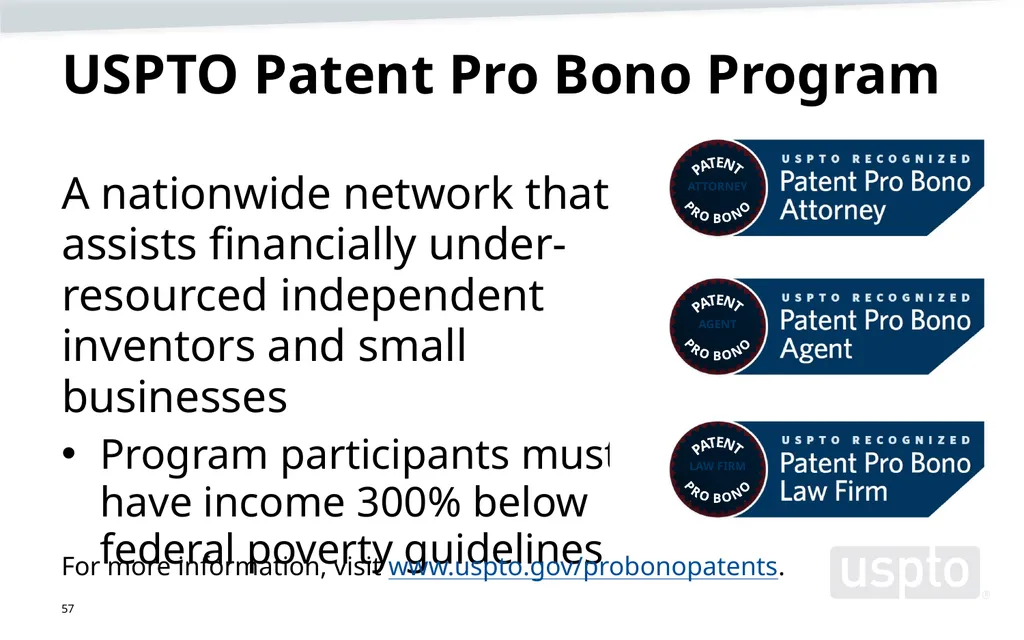
A nationwide network that assists financially under-resourced independent inventors and small businesses
Program participants must have income 300% below federal poverty guidelines USPTO Patent Pro Bono Program 57 For more information, visit www.uspto.gov/probonopatents. PATENT PRO BONO ATTORNEY PATENT PRO BONO AGENT PATENT PRO BONO LAW FIRM<br>
Program participants must have income 300% below federal poverty guidelines USPTO Patent Pro Bono Program 57 For more information, visit www.uspto.gov/probonopatents. PATENT PRO BONO ATTORNEY PATENT PRO BONO AGENT PATENT PRO BONO LAW FIRM<br>
58
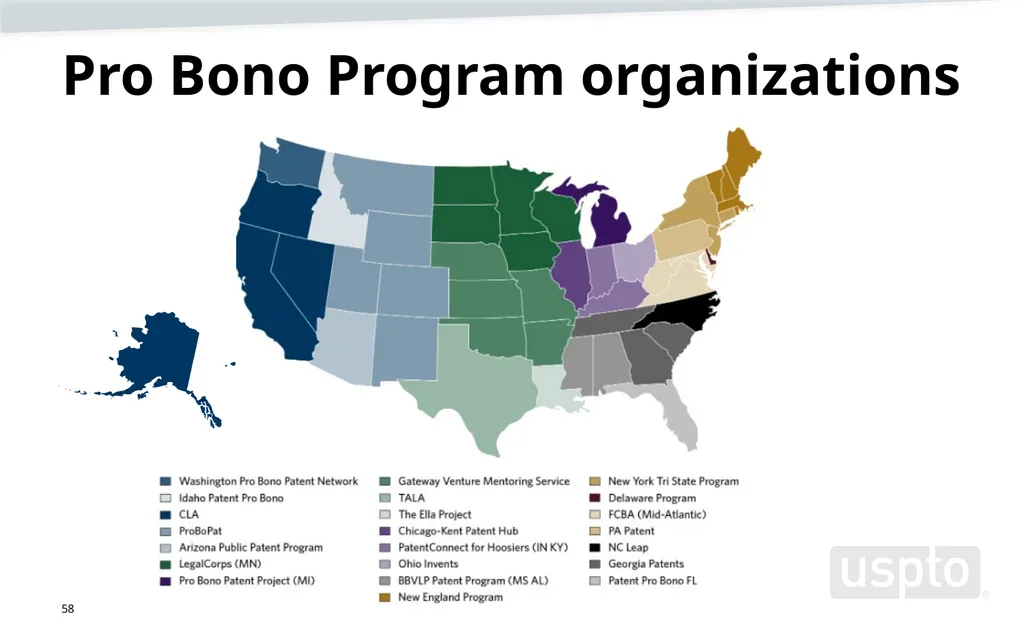
Pro Bono Program organizations 58<br>
59
The USPTO’s Law School Clinic Certification Program allows law students enrolled in a participating law school’s clinic program to practice before the USPTO under the guidance of a law school faculty clinic supervisor. Law school clinics 59 For more information, visit www.uspto.gov/lawschoolclinic.<br>
60
Patent and Trademark
Resource Centers (PTRC) 60 For more information, visit www.uspto.gov/ptrc. Nationwide network of public, state, and academic libraries designated by the USPTO to disseminate patent and trademark information and support the intellectual property needs of the public.
Phoenix PTRC
Located in the State of Arizona Research Library
https://azlibrary.gov/branches/state-arizona-research-library/patent-trademark-resources<br>
61
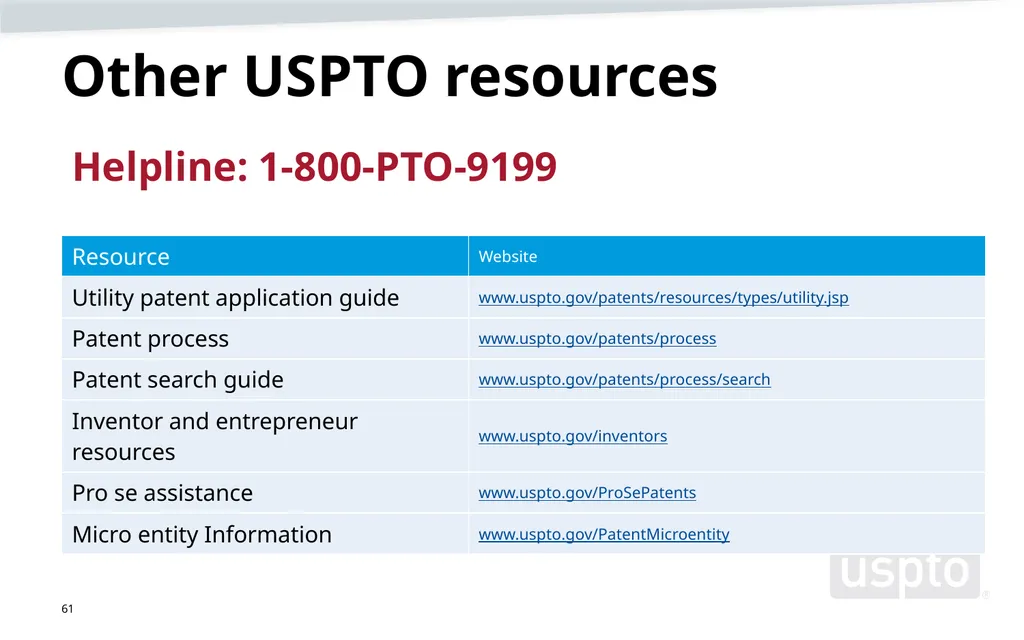
Other USPTO resources Helpline: 1-800-PTO-9199 61<br>
62
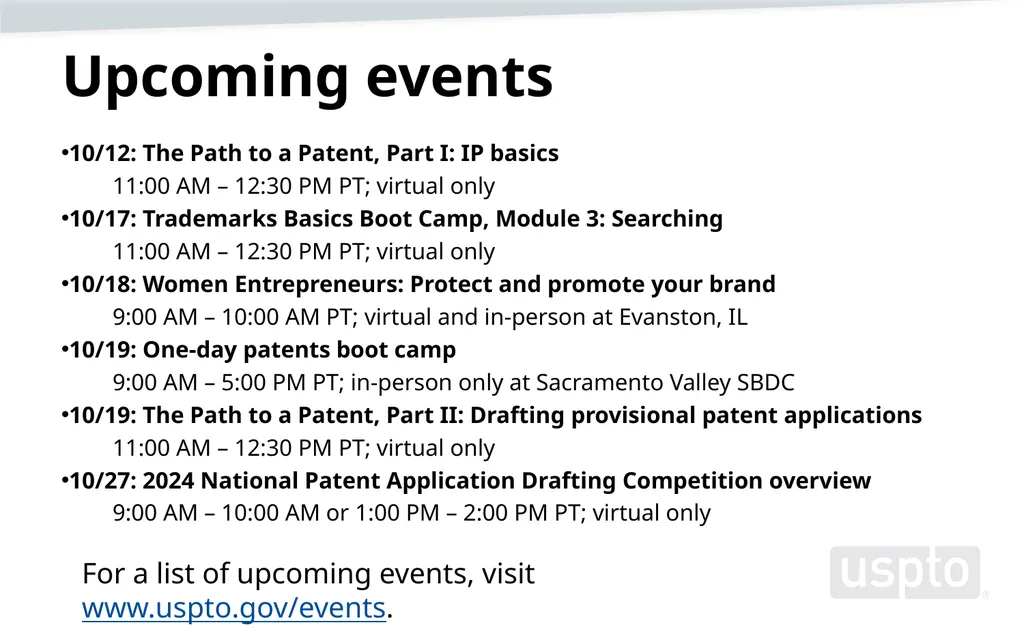
Upcoming events 10/12: The Path to a Patent, Part I: IP basics
11:00 AM – 12:30 PM PT; virtual only
10/17: Trademarks Basics Boot Camp, Module 3: Searching
11:00 AM – 12:30 PM PT; virtual only
10/18: Women Entrepreneurs: Protect and promote your brand
9:00 AM – 10:00 AM PT; virtual and in-person at Evanston, IL
10/19: One-day patents boot camp
9:00 AM – 5:00 PM PT; in-person only at Sacramento Valley SBDC
10/19: The Path to a Patent, Part II: Drafting provisional patent applications
11:00 AM – 12:30 PM PT; virtual only
10/27: 2024 National Patent Application Drafting Competition overview
9:00 AM – 10:00 AM or 1:00 PM – 2:00 PM PT; virtual only For a list of upcoming events, visit www.uspto.gov/events.<br>
11:00 AM – 12:30 PM PT; virtual only
10/17: Trademarks Basics Boot Camp, Module 3: Searching
11:00 AM – 12:30 PM PT; virtual only
10/18: Women Entrepreneurs: Protect and promote your brand
9:00 AM – 10:00 AM PT; virtual and in-person at Evanston, IL
10/19: One-day patents boot camp
9:00 AM – 5:00 PM PT; in-person only at Sacramento Valley SBDC
10/19: The Path to a Patent, Part II: Drafting provisional patent applications
11:00 AM – 12:30 PM PT; virtual only
10/27: 2024 National Patent Application Drafting Competition overview
9:00 AM – 10:00 AM or 1:00 PM – 2:00 PM PT; virtual only For a list of upcoming events, visit www.uspto.gov/events.<br>
63
Thank You Western Regional USPTO
SiliconValley@USPTO.GOV
(408) 918-9900
www.uspto.gov/SiliconValley
www.facebook.com/uspto.gov
www.youtube.com/USPTOvideo/<br>
SiliconValley@USPTO.GOV
(408) 918-9900
www.uspto.gov/SiliconValley
www.facebook.com/uspto.gov
www.youtube.com/USPTOvideo/<br>
64
1 Department of Commerce (2016, September). Intellectual Property and the U.S. Economy: 2016 Update. Retrieved from www.uspto.gov/sites/default/files/documents/IPandtheUSEconomySept2016.pdf. Endnotes 65<br>