
Brief Cognitive Behavioral Therapy for Pain


Description: Brief Cognitive Behavioral Therapy for Pain Disclosures The presenters have no relevant financial or non-financial relationships to disclose relating to the content of this activity The views expressed in this presentation are those of the
Related Topics
Download Presentation
"Brief Cognitive Behavioral Therapy for Pain" is the property of its rightful owner. Permission is granted to download and print the materials on this website for personal, non-commercial use only, and to display it on your personal computer provided you do not modify the materials and that you retain all copyright notices contained in the materials. By downloading content from our website, you accept the terms of this agreement.
Presentation Transcript
slide1. Brief Cognitive Behavioral Therapy for Pain<br>
slide2. Disclosures The presenters have no relevant financial or non-financial relationships to disclose relating to the content of this activity
The views expressed in this presentation are those of the author and do not necessarily reflect the official policy or position of the Department of Defense, nor the U.S. Government
This continuing education activity is managed and accredited by the Defense Health Agency J-7 Continuing Education Program Office (DHA J-7 CEPO). DHA J-7 CEPO and all accrediting organizations do not support or endorse any product or service mentioned in this activity
DHA J-7 CEPO staff, as well as activity planners and reviewers, have no relevant financial or non-financial interest to disclose
Commercial support was not received for this activity<br>
slide3. Learning Objectives (1/2) Outline DoD’s approach to improve pain treatment with the Stepped Care Model (SCM) for Pain
Describe the neuroscientific underpinnings of pain
Identify the differences between acute and chronic pain
Recognize factors which make the experience of pain better/worse
Discuss the long-term consequences of subpar management of pain
Use the Defense and Veterans Pain Rating Scale (DVPRS) to inform measurement-based care for chronic pain
Identify the components of a biopsychosocial assessment for pain<br>
slide4. Learning Objectives (2/2) Discuss co-morbidities that are interacting with pain
Identify patients who may benefit from a higher level of care for pain
Implement Brief Cognitive Behavioral Therapy for Chronic Pain (BCBT-CP) protocol for patients who experience chronic pain
Address common complexities in patients with chronic pain
Recognize and appropriately respond when patients are resistant or ambivalent to a non-pharmacological approach to managing pain
Use strategies to increase patients’ willingness to engage in BCBT-CP
Identify patients at risk for their acute pain to become chronic<br>
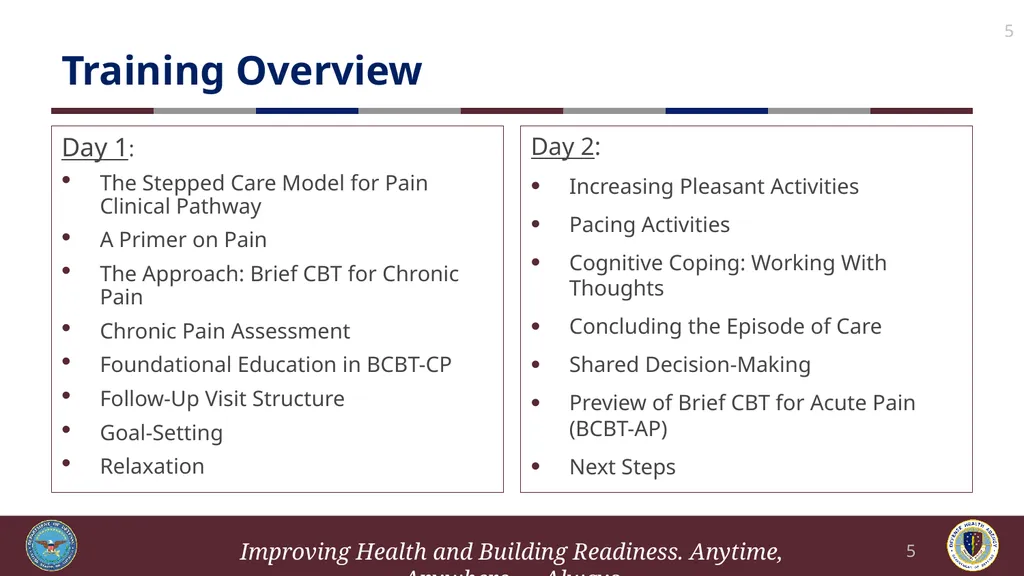
slide5. Training Overview Day 1:
The Stepped Care Model for Pain Clinical Pathway
A Primer on Pain
The Approach: Brief CBT for Chronic Pain
Chronic Pain Assessment
Foundational Education in BCBT-CP
Follow-Up Visit Structure
Goal-Setting
Relaxation Day 2:
Increasing Pleasant Activities
Pacing Activities
Cognitive Coping: Working With Thoughts
Concluding the Episode of Care
Shared Decision-Making
Preview of Brief CBT for Acute Pain (BCBT-AP)
Next Steps 5<br>
slide6. The Stepped Care Model for Pain Clinical Pathway<br>
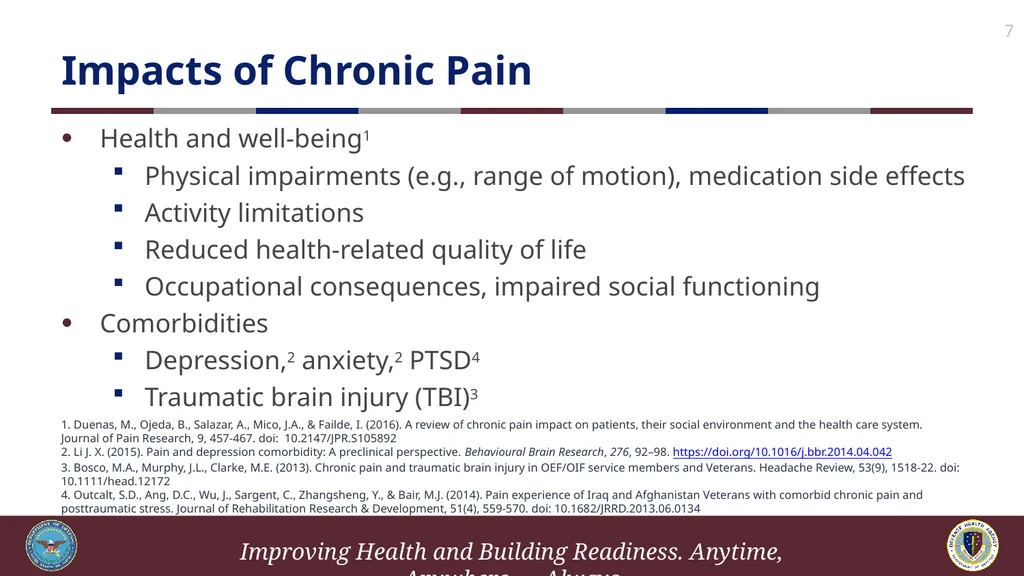
slide7. Impacts of Chronic Pain Health and well-being1
Physical impairments (e.g., range of motion), medication side effects
Activity limitations
Reduced health-related quality of life
Occupational consequences, impaired social functioning
Comorbidities
Depression,2 anxiety,2 PTSD4
Traumatic brain injury (TBI)3 1. Duenas, M., Ojeda, B., Salazar, A., Mico, J.A., & Failde, I. (2016). A review of chronic pain impact on patients, their social environment and the health care system. Journal of Pain Research, 9, 457-467. doi: 10.2147/JPR.S105892
2. Li J. X. (2015). Pain and depression comorbidity: A preclinical perspective. Behavioural Brain Research, 276, 92–98. https://doi.org/10.1016/j.bbr.2014.04.042
3. Bosco, M.A., Murphy, J.L., Clarke, M.E. (2013). Chronic pain and traumatic brain injury in OEF/OIF service members and Veterans. Headache Review, 53(9), 1518-22. doi: 10.1111/head.12172
4. Outcalt, S.D., Ang, D.C., Wu, J., Sargent, C., Zhangsheng, Y., & Bair, M.J. (2014). Pain experience of Iraq and Afghanistan Veterans with comorbid chronic pain and posttraumatic stress. Journal of Rehabilitation Research & Development, 51(4), 559-570. doi: 10.1682/JRRD.2013.06.0134<br>
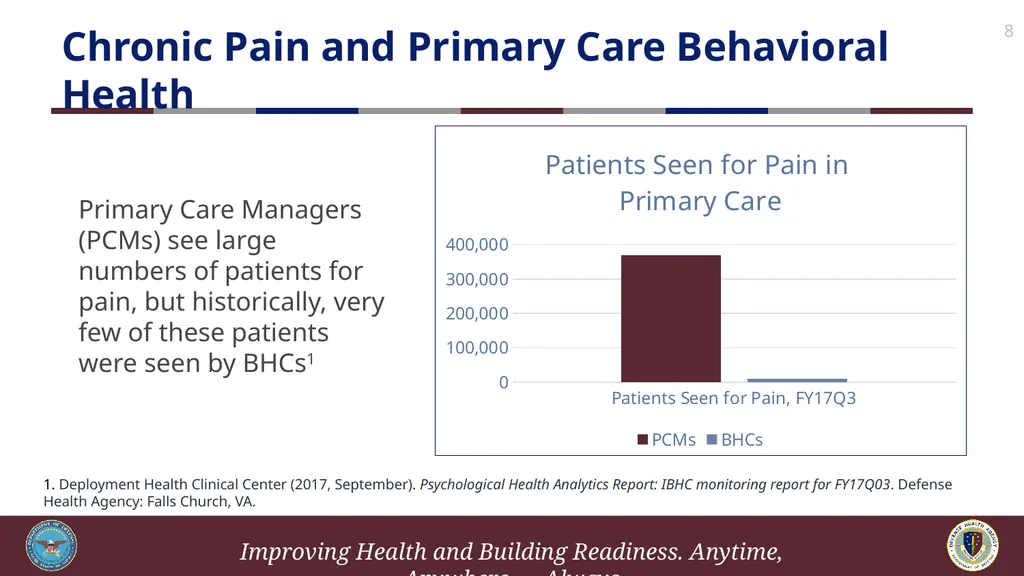
slide8. Chronic Pain and Primary Care Behavioral Health Primary Care Managers (PCMs) see large numbers of patients for pain, but historically, very few of these patients were seen by BHCs1 1. Deployment Health Clinical Center (2017, September). Psychological Health Analytics Report: IBHC monitoring report for FY17Q03. Defense Health Agency: Falls Church, VA.<br>
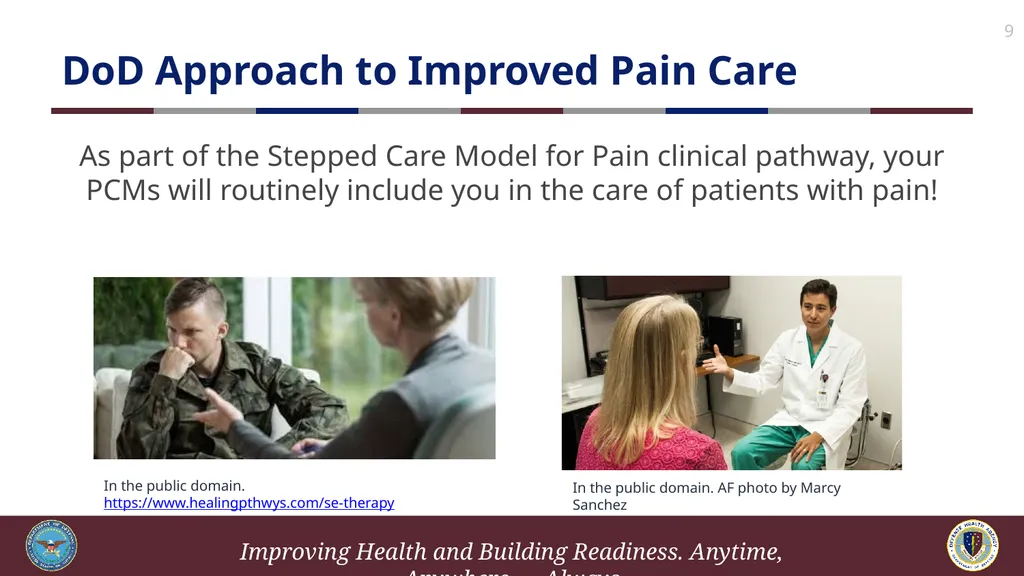
slide9. DoD Approach to Improved Pain Care As part of the Stepped Care Model for Pain clinical pathway, your PCMs will routinely include you in the care of patients with pain! In the public domain. https://www.healingpthwys.com/se-therapy In the public domain. AF photo by Marcy Sanchez<br>
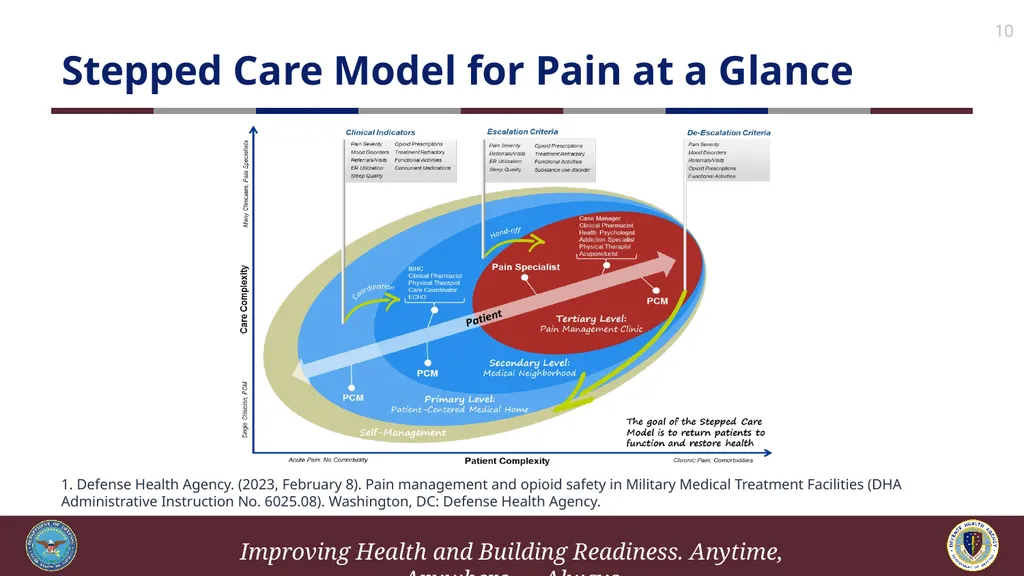
slide10. Stepped Care Model for Pain at a Glance 1. Defense Health Agency. (2023, February 8). Pain management and opioid safety in Military Medical Treatment Facilities (DHA Administrative Instruction No. 6025.08). Washington, DC: Defense Health Agency.<br>
slide11. Treatment Approaches in the Stepped Care Model for Pain To set you up for success in this pathway, this training focuses on evidence-based approaches to treating pain
This training will largely focus on how to address chronic pain using Brief Cognitive Behavioral Therapy for Chronic Pain (BCBT-CP)
There is a separate protocol to treat acute pain called Brief Cognitive Behavioral Treatment for Acute Pain (BCBT-AP)
Collectively, these two protocols are referred to as Brief CBT for Pain (BCBT-P)<br>
slide12. A Primer on Pain<br>
slide13. What Is Pain? Question for the group: How do you define pain?<br>
slide14. Commonly Cited Definition of Pain “Pain is an unpleasant sensory and emotional experience associated with, or resembling that associated with, actual or potential tissue damage,” International Association for the Study of Pain (IASP).
This definition strongly emphasizes tissue damage, even though we know that small amounts of tissue damage (e.g., paper cut) can cause significant pain and vice versa. 1. International Association for the Study of Pain. (2020 July 16). IASP Announces Revised Definition of Pain. Retrieved 2022 April 19 from
https://www.iasp-pain.org/publications/iasp-news/iasp-announces-revised-definition-of-pain/<br>
slide15. The Neuroscience of Pain Pain has been understood in different ways throughout history, from moral punishment (pre-Renaissance) to the brain’s “pain center” lighting up (Cartesian model from the Renaissance)
Neither of these understandings is accurate
Most comprehensive conceptualization of pain is through understanding the neuroscience of pain
We will review this conceptualization in brief, beginning with a quick review from our neurology and biology classes <br>
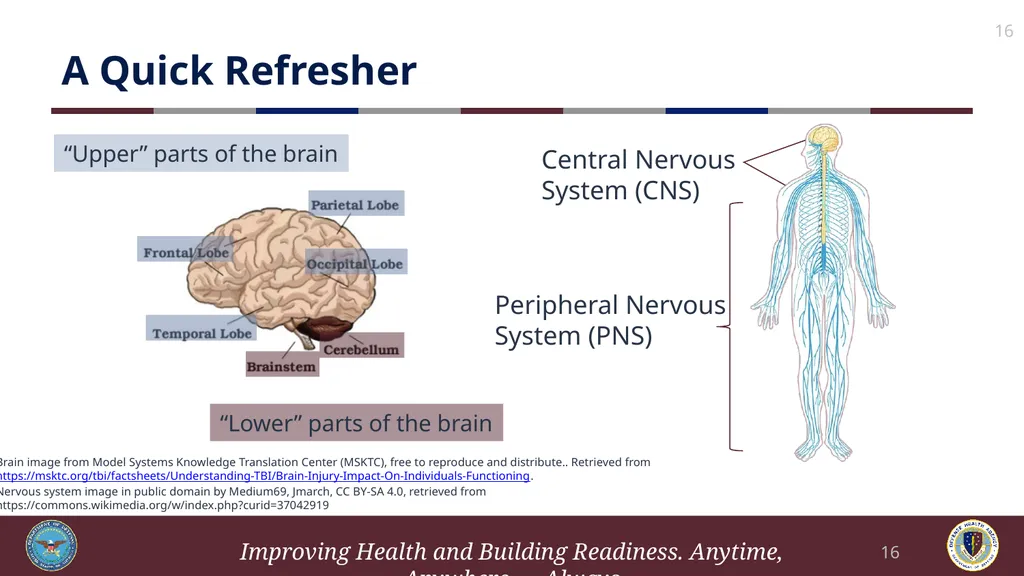
slide16. A Quick Refresher Brain image from Model Systems Knowledge Translation Center (MSKTC), free to reproduce and distribute.. Retrieved from https://msktc.org/tbi/factsheets/Understanding-TBI/Brain-Injury-Impact-On-Individuals-Functioning.
Nervous system image in public domain by Medium69, Jmarch, CC BY-SA 4.0, retrieved from https://commons.wikimedia.org/w/index.php?curid=37042919 16<br>
slide17. Neuroscience of Pain: Foundational Concepts1 Pain is experienced in the brain; can be related to tissue damage
When tissue damage occurs (e.g., you stub your toe), that injury is called nociception
All body parts have nociceptors (sensory receptors for painful stimuli)
Nociception alone is neither necessary nor sufficient to cause pain
Nociception is passed along nerve fibers to the brain
The brain’s appraisal and integration of multiple factors influences the experience of pain 1. Louw, A,, & Puentedura, E.. (2017). Therapeutic neuroscience education: Teaching people about pain. Orthopedic Physical Therapy Products<br>
slide18. How The Brain Determines the Pain Experience There is no single “pain center” in the brain that receives the nociception and automatically generates pain
Numerous brain scans have shown that several areas of the brain are active during a painful experience
Interaction of these areas creates what can be called a “pain neuromatrix” or “pain map” 1. Louw, A,, & Puentedura, E.. (2017). Therapeutic neuroscience education: Teaching people about pain. Orthopedic Physical Therapy Products<br>
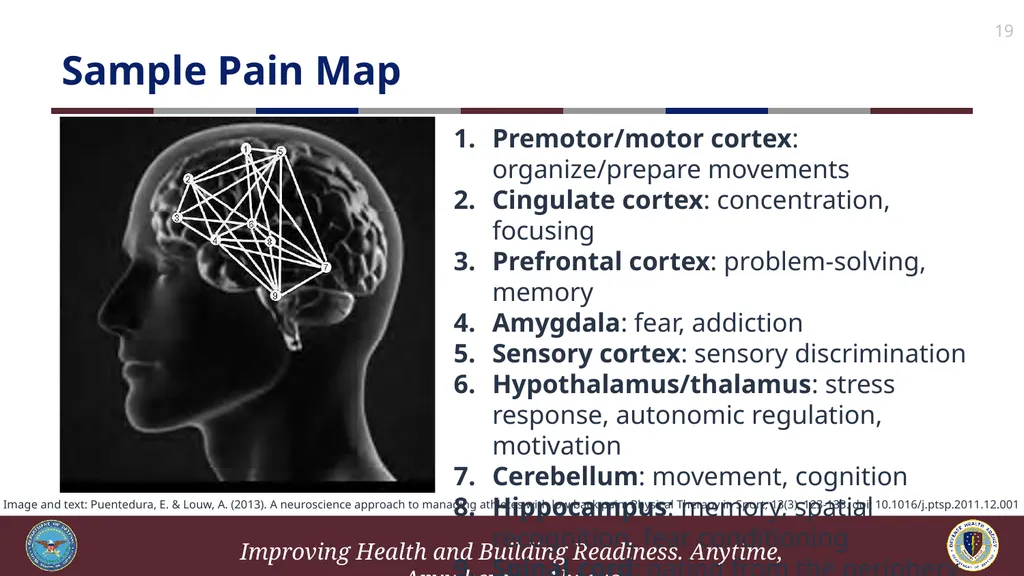
slide19. Sample Pain Map Premotor/motor cortex: organize/prepare movements
Cingulate cortex: concentration, focusing
Prefrontal cortex: problem-solving, memory
Amygdala: fear, addiction
Sensory cortex: sensory discrimination
Hypothalamus/thalamus: stress response, autonomic regulation, motivation
Cerebellum: movement, cognition
Hippocampus: memory, spatial recognition, fear conditioning
Spinal cord: gating from the periphery Image and text: Puentedura, E. & Louw, A. (2013). A neuroscience approach to managing athletes with low back pain. Physical Therapy in Sport, 13(3), 123-133. doi: 10.1016/j.ptsp.2011.12.001<br>
slide20. An Analogy: The Grandma “Lightbulb”1 Close your eyes and picture your grandmother
Are you imagining her in motion? Do you remember the smell of her perfume? Is she in a particular setting like the porch or her house?
Brain scans show that depending on what you picture, different areas of the brain are active (olfactory center for scents, hippocampus for specific memories, motor cortex for actions, etc.)
Key takeaway: No single part of your brain “lights up” when you think of your grandmother, in the same way that no one region of the brain “lights up” when we experience pain. Multiple regions are active, creating a “grandma map.” Pain works the same way 1. Louw, A,, & Puentedura, E.. (2017). Therapeutic neuroscience education: Teaching people about pain. Orthopedic Physical Therapy Products<br>
slide21. Why Does It Matter? Dispelling the myth of a “pain center” or “grandma center” is important, as our conceptualization has treatment implications. As recently as the 1970s, prefrontal lobotomies were performed to rid people of pain in their bodies because the pain center was thought to reside there.1 1. Louw, A,, & Puentedura, E.. (2017). Therapeutic neuroscience education: Teaching people about pain. Orthopedic Physical Therapy Products<br>
slide22. How the Pain Map is Generated1 The “lower” brain receives the nociception and creates an automatic response (e.g., pull hand out of the fire)
Nociception is then received by the “upper” brain regions, where multiple parts of the brain play a role in determining the pain response
The map represents all of the factors (e.g., degree of physical damage, memories, emotional state, planning, etc.) that may contribute to the pain experience 1. Louw, A,, & Puentedura, E.. (2017). Therapeutic neuroscience education: Teaching people about pain. Orthopedic Physical Therapy Products.<br>
slide23. Implications of a Pain Map Versus a Pain Center Historical explanations of pain dictate that the level of injury is directly proportionate to the amount of pain, as the injury “lit up the pain center” or “rang the pain bell”1
However, the “pain center” concept recognizes other factors that may play a role in the experience of pain:
The brain incorporates multiple pieces of data, including the environment and other situational demands to modulate the immediate pain response
The brain may produce endogenous protection (releasing adrenaline and endorphins) to allow us to do what we must to survive or perform 1. Louw, A,, & Puentedura, E.. (2017). Therapeutic neuroscience education: Teaching people about pain. Orthopedic Physical Therapy Products<br>
slide24. Further Evidence of the Brain’s Influence on Pain Pain, therefore, is both a brain issue and a “tissue issue”
Pain exists even in places where there is no tissue, as in phantom limb syndrome. A neuroscientific explanation of that phenomenon1:
The somatosensory cortex in the brain stores a mental map of our body parts; parts used more frequently are represented more prominently
When there are changes to the usage of a part (e.g., limb amputation), the brain wants to make sense of these changes
Sending pain signals is one way the brain attempts to obtain information about the missing limb 1. Louw, A,, & Puentedura, E.. (2017). Therapeutic neuroscience education: Teaching people about pain. Orthopedic Physical Therapy Products.<br>
slide25. Other Contributors to Chronic Pain (1/2) Peripheral sensitization1
Nociceptors detect painful stimuli sensory nerves “fire” (reach action potential) to communicate pain to other nerves and, ultimately, the brain
Post-injury: nociceptors become more sensitive (i.e., it takes less stimulation for them to fire), a normal sensitization response meant to protect against further injury
Sometimes the cells change at a structural level and remain at this lower threshold
Result: nociceptors are more likely to communicate injury and previously benign things are interpreted by the brain as more painful 1. Moghim, R. (2022). Understanding peripheral and central sensitization. Colorado Pain Care. https://coloradopaincare.com/understanding-peripheral-and-central-sensitization/<br>
slide26. Other Contributors to Chronic Pain (2/2) Central sensitization1
Similar to peripheral sensitization: nociceptors have become more sensitive leading to the brain being more reactive to painful stimuli
In this case, nociceptors are located in the central nervous system (CNS)
CNS has sensory receptors, so senses may be affected (e.g., patient more sensitive to light, sound, odors, etc.)
Cognitive functions may be impacted (e.g., memory, concentration, emotional regulation)
Central sensitization may originate with CNS injury (e.g., stroke, spinal injury) but there is often no well-defined origin 1. Moghim, R. (2022). Understanding peripheral and central sensitization. Colorado Pain Care. https://coloradopaincare.com/understanding-peripheral-and-central-sensitization/<br>
slide27. Back To Our Original Question: What Is Pain? Review of the IASP definition that strongly emphasizes tissue damage: “Pain is an unpleasant sensory and emotional experience associated with, or resembling that associated with, actual or potential tissue damage.”
For your consideration, a neuroscientific definition: “Pain is produced by the brain after a person’s neural signature has been activated and concluded the body is in danger and action is required.”2 1. International Association for the Study of Pain. (2020 July 16). IASP Announces Revised Definition of Pain. Retrieved 2022 April 19 from
https://www.iasp-pain.org/publications/iasp-news/iasp-announces-revised-definition-of-pain/
2. Louw, A,, & Puentedura, E.. (2017). Therapeutic neuroscience education: Teaching people about pain. Orthopedic Physical Therapy Products.<br>
slide28. “It’s All In Your Head” Over the course of their healthcare experiences, patients may have internalized the message that providers think the pain is “all in your head.”
How can we use a neuroscientific understanding of pain to respond to a patient who expresses this concern?<br>
slide29. How Do We Use This Information To Help Our Patients? In short, we need to help them appreciate the many factors affecting their pain experience beyond the physical
We can help them leverage these other factors and improve their pain experience by intervening on biopsychosocial components, including:
Overall level of stress/fear (related to pain or other psychosocial factors)
Beliefs/cognitions that reinforce these fears and negative emotional states (e.g., “This pain will kill me,” “I’m useless now that I have pain”)
Avoidance behaviors that make pain worse over time (e.g., physical inactivity, withdrawal from pleasurable experiences and events)<br>
slide30. Distilling All of This Down to Key Concepts for Patients Difference between acute and chronic pain
The biopsychosocial nature of pain
Factors that make pain better/worse
Chronic pain cycle<br>
slide31. The Approach: Brief CBT for Chronic Pain (BCBT-CP)<br>
slide32. CBT for Chronic Pain (Specialty Behavioral Health) BCBT-CP was derived from CBT-CP, a protocol used in specialty care to treat chronic pain patients1
Numerous reviews support the efficacy of CBT-CP, as compared to usual care and wait-list, in a variety of specific types of chronic pain2
Small to medium effects on pain intensity, catastrophizing, and mood
Small effects on pain-related disability and activity interference
Limitations of full course of CBT-CP:
Time and resource intensive for specialty BH clinics and patients
Not all patients need an intensive, specialty-level treatment
Patients may prefer to remain in primary care 1. Murphy, J.L., McKellar, J.D., Raffa, S.D., Clark, M.E., Kerns, R.D., & Karlin, B.E. (2014) Cognitive behavioral therapy for chronic pain among veterans: Therapist manual. Washington, DC: U.S. Department of Veterans Affairs. 2. Ehde, D. M., Dillworth, T. M., & Turner, J. A. (2014). Cognitive-behavioral therapy for individuals with chronic pain: Efficacy, innovations, and directions for research. The American Psychologist, 69(2), 153-66. doi: 10.1037/a0035747<br>
slide33. Brief CBT for Pain (Primary Care) Brief, primary care version of CBT-CP was developed and evaluated in VA’s Primary Care Mental Health Integration program
The Defense Health Agency’s (DHA) Psychological Health Center of Excellence (PHCoE) and VA’s Center for Integrated Healthcare (CIH) collaborated to adapt BCBT-CP for DoD2
Addresses chronic pain using a modular protocol that can be tailored to the unique needs of each patient 1. Beehler, G. P., Murphy, J. L., King, P. R., Dollar, K. M., Kearney, L, K., Halsam, A…. Goldstein, W. R. (2019). Brief Cognitive Behavioral Therapy for Chronic Pain: Results from a clinical demonstration project in primary care behavioral health. Clinical Journal of Pain, 35, 10, 809-817.
2. Beehler, G. P., Dobmeyer, A.C., Hunter, C. L., & Funderburk, J. S. (2018). Brief cognitive behavioral therapy for chronic pain: BHC manual. Silver Spring, MD: Defense Health Agency.<br>
slide34. Evidence for BCBT-CP A BCBT-CP demonstration project found the following starting at the third appointment1:
Significant decreases in pain intensity and functional limitations
Significantly improved pain-related self-efficacy
A survey of patient experiences with BCBT-CP indicated that they2:
Found the content to be useful (91%)
Were satisfied with the intervention overall, including appointment length, frequency of encounters, and comprehensibility of the content (89%)
On average, experienced somewhat better to moderately better pain-related functioning following treatment 1. Beehler, G. P., Murphy, J. L., King, P. R., Dollar, K. M., Kearney, L, K., Halsam, A…. Goldstein, W. R. (2019). Brief Cognitive Behavioral Therapy for Chronic Pain: Results from a clinical demonstration project in primary care behavioral health. Clinical Journal of Pain, 35, 10, 809-817.
2. Beehler, G.P., Loughran, T.A., King, P.R., Dollar, K.M., Murphy, J.L…Goldstein, W.R. (2021). Patients’ perspectives of brief cognitive behavioral therapy for chronic pain: Treatment satisfaction, perceived utility, and global assessment of change. Families, Systems, & Heath, 39(2), 351-357.<br>
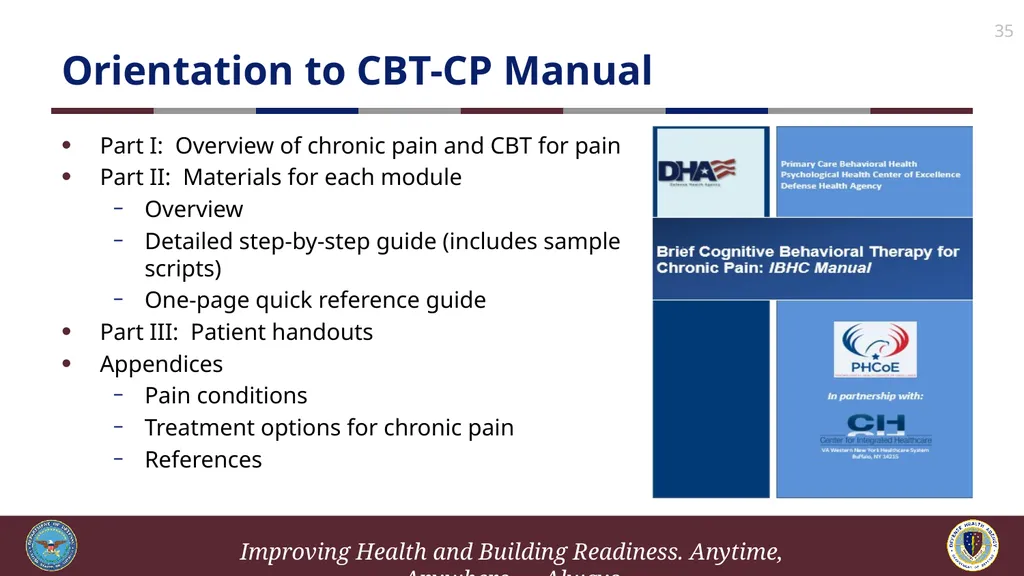
slide35. Orientation to CBT-CP Manual Part I: Overview of chronic pain and CBT for pain
Part II: Materials for each module
Overview
Detailed step-by-step guide (includes sample scripts)
One-page quick reference guide
Part III: Patient handouts
Appendices
Pain conditions
Treatment options for chronic pain
References<br>
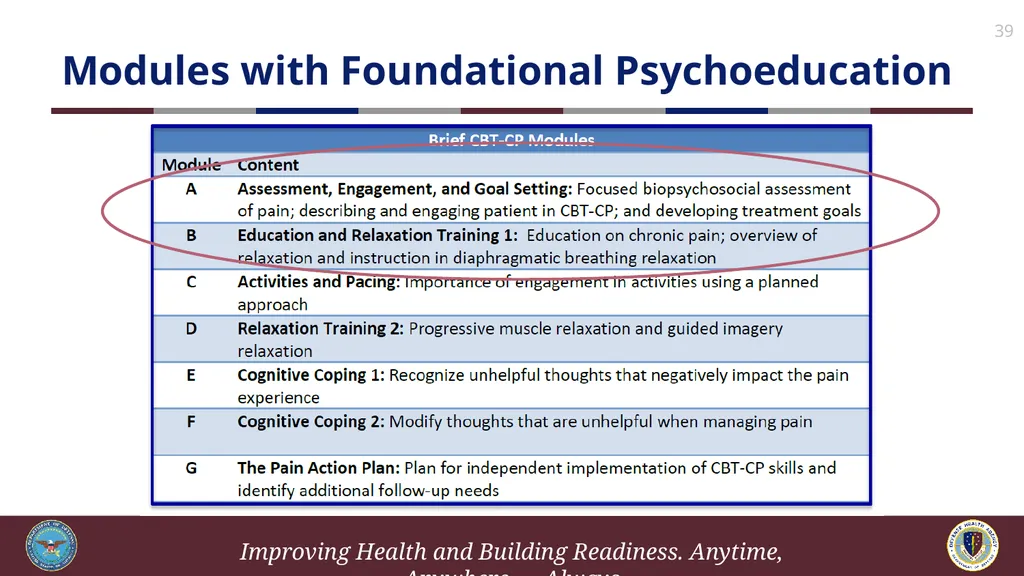
slide36. Core Components of BCBT-CP Psychoeducation: critical to explain the biopsychosocial nature of pain and to address any questions/concerns to gain patient buy-in1
Goal-setting
Relaxation
Pacing Activities
Engaging in Pleasurable Activities
Cognitive Coping
Pain Action Plan 1. Louw, A., Zimney, K., Puentedura, E.L., & Diener, I. (2016). The efficacy of pain neuroscience education on musculoskeletal pain: A systematic review of the literature. Physiotherapy Theory and Practice. doi: 10.1080/09593985.2016.1194646<br>
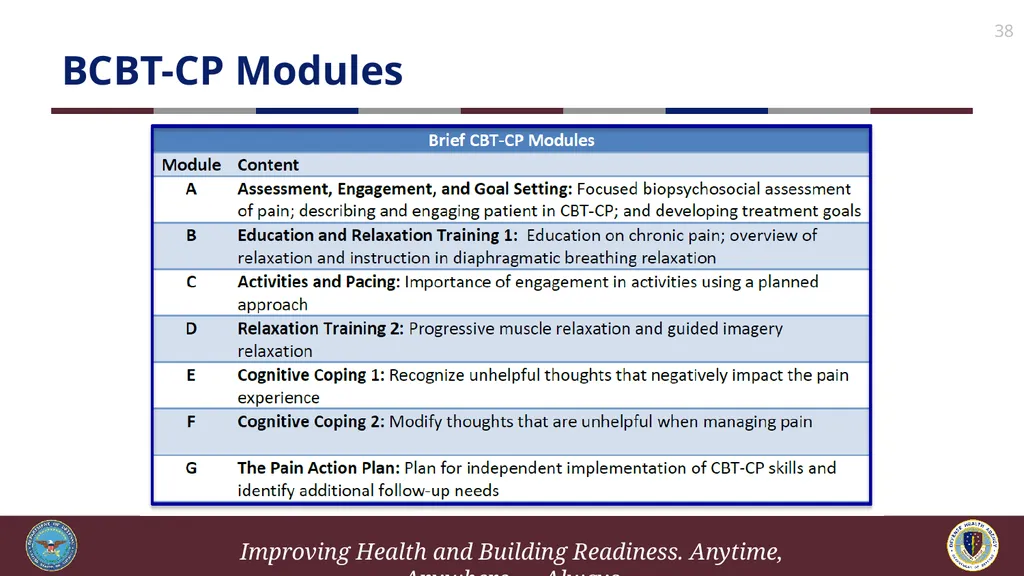
slide37. BCBT-CP Modules Complete protocol consists of seven 30-minute modules
Some patients will benefit from all seven modules, though many will only complete a subset. Selection and order of modules should be decided through joint decision-making with the patient
Aim to complete at least three modules with the patient: the first two, which contain key psychoeducation as well as intervention, and a third, to provide additional intervention<br>
slide38. BCBT-CP Modules<br>
slide39. Modules with Foundational Psychoeducation<br>
slide40. Use of Measurement Across the Modules Regardless of how many modules are completed, BHCs should adhere to principles of measurement-based care
Measurement-based care is the use of screening and ongoing symptom monitoring to guide treatment selection/changes to improve outcomes1
Assists with rapid and precise assessment of condition severity to improve treatment planning2
A common practice in primary care when managing chronic conditions
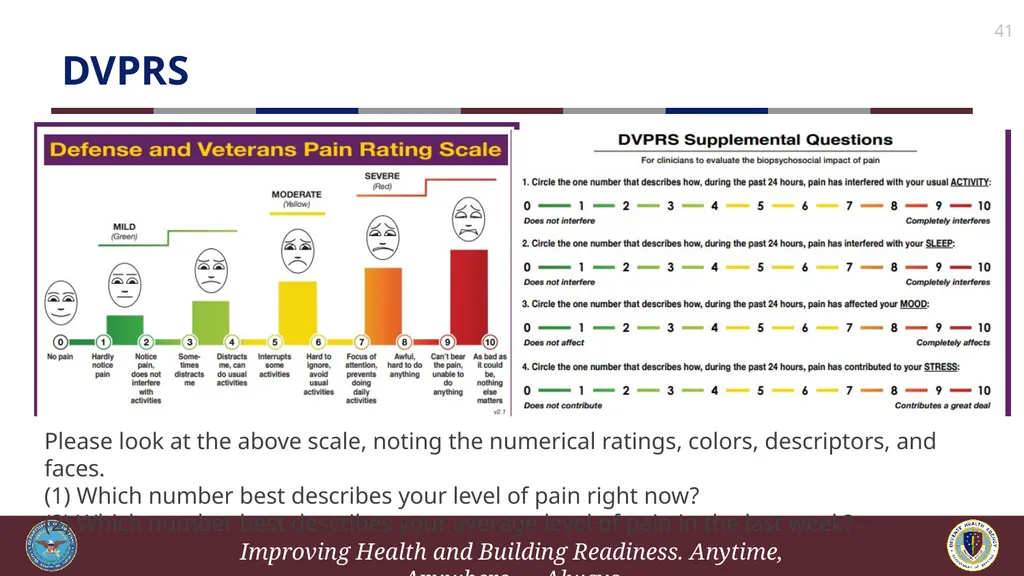
For patients with pain, we use the DVPRS as our assessment measure to track progress over time 1. Morris, D.W., Toups, M., & Trivedi, M.H. (2012). Measurement-based care in the treatment of clinical depression. Focus, 10(4), 428-433.
2. Harding, J.K.J., Rush, A.J., Arbuckle, M., Trivedi, M.H., & Pincus, H.A. (2011). Measurement-based care in psychiatric practice: A policy framework for implementation. Journal of Clinical Psychiatry, 72(8), 1136-1143.<br>
slide41. DVPRS Please look at the above scale, noting the numerical ratings, colors, descriptors, and faces.
(1) Which number best describes your level of pain right now?
(2) Which number best describes your average level of pain in the last week?<br>
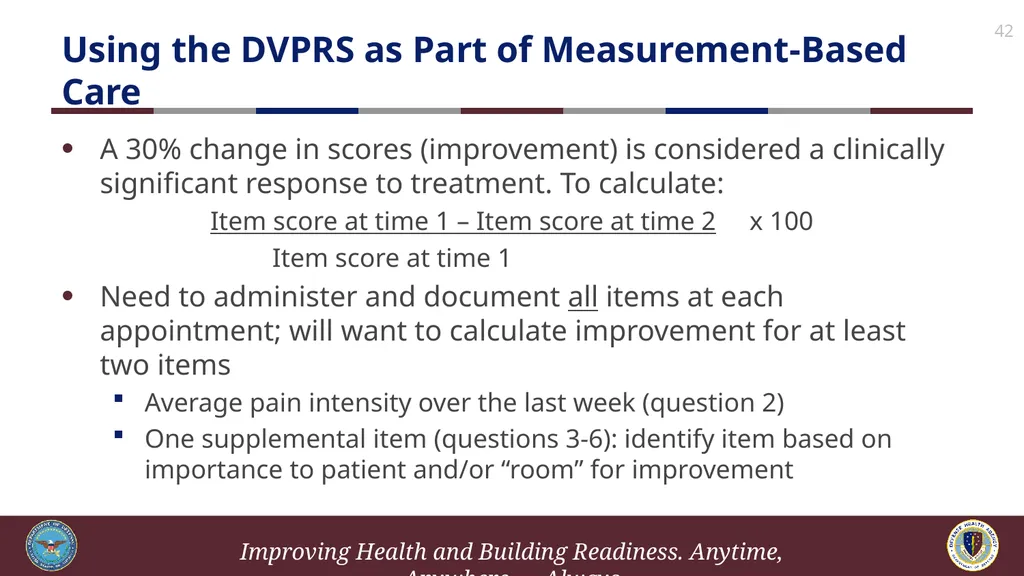
slide42. Using the DVPRS as Part of Measurement-Based Care A 30% change in scores (improvement) is considered a clinically significant response to treatment. To calculate:
Item score at time 1 – Item score at time 2 x 100
Item score at time 1
Need to administer and document all items at each appointment; will want to calculate improvement for at least two items
Average pain intensity over the last week (question 2)
One supplemental item (questions 3-6): identify item based on importance to patient and/or “room” for improvement<br>
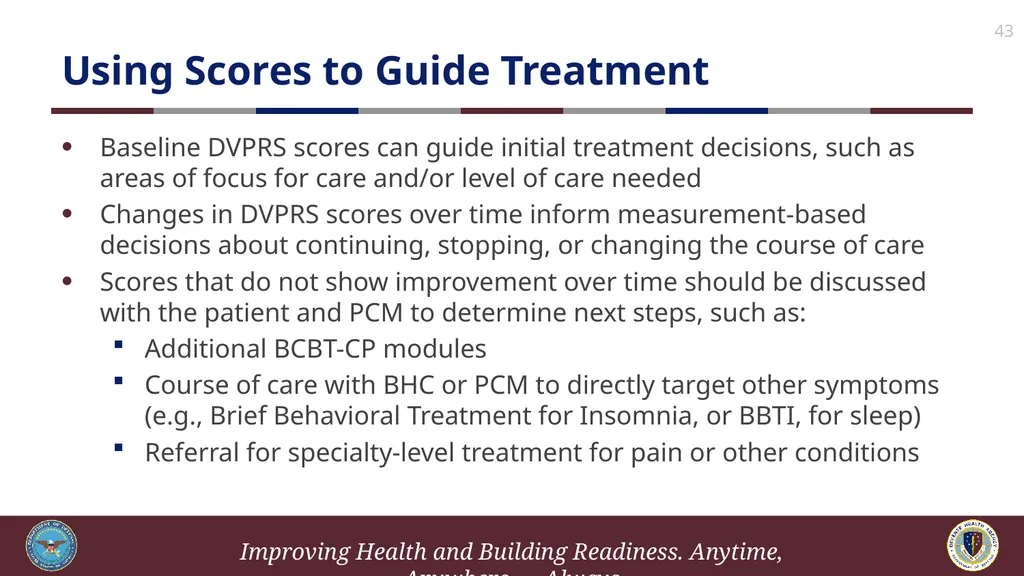
slide43. Using Scores to Guide Treatment Baseline DVPRS scores can guide initial treatment decisions, such as areas of focus for care and/or level of care needed
Changes in DVPRS scores over time inform measurement-based decisions about continuing, stopping, or changing the course of care
Scores that do not show improvement over time should be discussed with the patient and PCM to determine next steps, such as:
Additional BCBT-CP modules
Course of care with BHC or PCM to directly target other symptoms (e.g., Brief Behavioral Treatment for Insomnia, or BBTI, for sleep)
Referral for specialty-level treatment for pain or other conditions<br>
slide44. Chronic Pain Assessment<br>
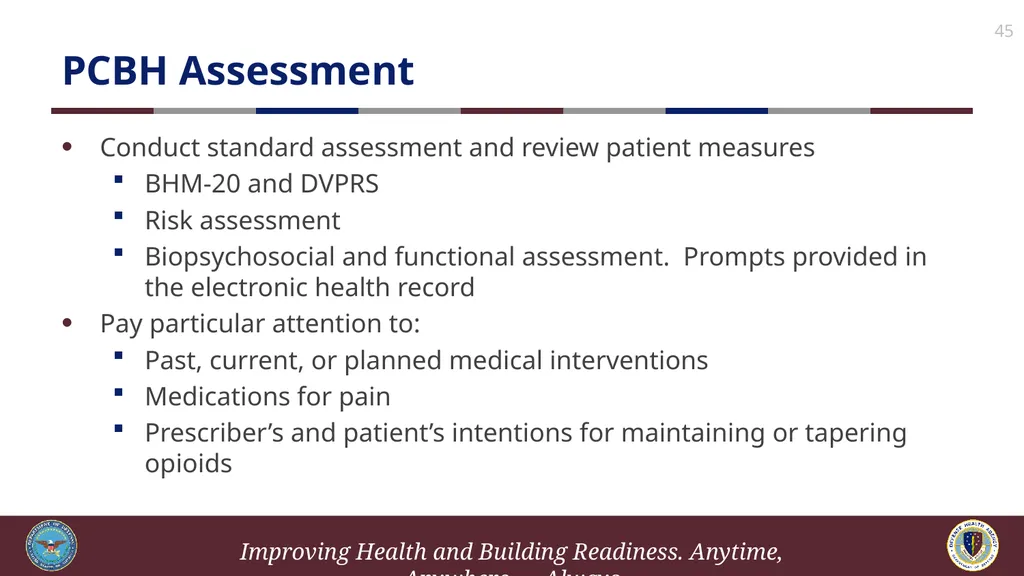
slide45. PCBH Assessment Conduct standard assessment and review patient measures
BHM-20 and DVPRS
Risk assessment
Biopsychosocial and functional assessment. Prompts provided in the electronic health record
Pay particular attention to:
Past, current, or planned medical interventions
Medications for pain
Prescriber’s and patient’s intentions for maintaining or tapering opioids<br>
slide46. Biopsychosocial Assessment Considerations: Physical Pain characteristics:
Intensity – scale of 0 to 10 for highest/lowest in past week
Character – shooting, burning, sharp, dull
Course – worsening, improving, waxing/waning
Frequency – of episodes or exacerbations
Ability/disability
Objective measures – gait, use of assistive devices
Subjective measures – patient perception of level of ability/disability<br>
slide47. Biopsychosocial Assessment Considerations: Emotional Depression: 60% prevalence, contributes to worse pain and disability. Includes being down, irritable, hopeless, helplessness1
PTSD: 10 to 50% prevalence, reduces response to treatment2
Suicide: perceiving oneself as a burden predicts ideation; low pain self-efficacy associated with ideation-to-action3,4 1. Rayner, L., Hotopf, M., Petkova, H., Matcham, F., Simpson, A., & McCracken, L. M. (2016). Depression in patients with chronic pain attending a specialized pain treatment centre: prevalence and impact on health care costs. Pain, 157(7), 1472.
2. Fishbain, D. A., Pulikal, A., Lewis, J. E., & Gao, J. (2017). Chronic pain types differ in their reported prevalence of post-traumatic stress disorder (PTSD) and there is consistent evidence that chronic pain is associated with PTSD: an evidence-based structured systematic review. Pain Medicine, 18(4), 711-735. 3. 3. Kanzler, K. E., Bryan, C. J., McGeary, D. D., & Morrow, C. E. (2012). Suicidal ideation and perceived burdensomeness in patients with chronic pain. Pain Practice, 12(8), 602-609.
4. Campbell, G., Bruno, R., Darke, S., Shand, F., Hall, W., Farrell, M., & Degenhardt, L. (2016). Prevalence and correlates of suicidal thoughts and suicide attempts in people prescribed pharmaceutical opioids for chronic pain. The Clinical journal of pain, 32(4), 292-301.<br>
slide48. Biopsychosocial Assessment Considerations: Cognitive Pain Thoughts:
Catastrophizing – helplessness, rumination, magnification
Fear Avoidance – avoidance of activity due to fear of causing harm
Level of burden – perception of dragging others down
Acceptance/Mindfulness
Willingness to engage in valued activities despite the pain
Observing pain as a sensation without attaching meaning or reacting<br>
slide49. Biopsychosocial Assessment Considerations: Behavioral Self-limiting of activities due to pain or fear of injury
Underdoing it; overdoing it; cycling between the two (“crash and burn” cycle)
Unhealthy coping: social isolation, substance misuse1
Healthy coping: staying active, engaging in distraction, connecting with social and professional supports 1. Landsman-Blumberg, P. B., Katz, N., Gajria, K., Coutinho, A. D., Yeung, P. P., & White, R. (2017). Burden of alcohol abuse or dependence among long-term opioid users with chronic noncancer pain. Journal of managed care & specialty pharmacy, 23(7), 718-724.<br>
slide50. Biopsychosocial Assessment Considerations: Social Relationships
Punishing – “Stop whining!”
Solicitous – “I’ll do the housework, you just rest.”
Distracting – “Let’s do something to get your mind off the pain.”
Socially isolating
Occupation
Increased absenteeism
“Presenteeism”: being present but doing less<br>
slide51. Biopsychosocial Assessment Considerations: Environmental Culture
Litigation
Disability status (SSDI)
Healthcare
Increased utilization of primary care, specialty care, ED
Seeking procedures<br>
slide52. Advising the Patient Upon Completing Assessment In sharing your biopsychosocial formulation with the patient, incorporate your impression regarding whether BCBT-CP is appropriate. Indications include:
Presence of chronic pain with mild to moderate functional impairment/distress
Some degree of openness to a non-pharmacological approach
Factors that may warrant a referral to specialty include: moderate to high suicide risk; current substance use disorder; current opioid prescription in the context of a substance use disorder; severe psychiatric symptoms that may interfere with BCBT-CP<br>
slide53. Advise Phase: Another Clinical Decision Point Ms. Peters was referred by her PCM due to fibromyalgia and moderate depressive symptoms. In your first appointment, Ms. Peters shares that she’s not sure whether to focus on pain or depression, saying “… they both seem bad.”
Your assessment indicates that pain and depression are both affecting physical activity (not doing any regular exercise), social life (fewer activities with friends and family), and accomplishing tasks at home (less housework due to pain and low interest). She is still working full-time as an accountant and is not at elevated acute risk of suicide.
- What should be the focus of the episode of care with Ms. Peters?<br>
slide54. Pain with Co-Morbidities: Where to Focus? In determining care plan with patients with comorbidities, consider:
Depression, anxiety, insomnia, and anger often co-occur with pain
Effective treatment of pain may improve co-occurring conditions
Goals related to interventions for co-occurring conditions may need to be developed in a manner that accommodates pain
Many BCBT-CP strategies may also affect other BH symptoms
Patients will likely benefit from discussion to make an informed choice
General guidance: unless the co-occurring condition will interfere with pain treatment or the patient has a strong preference to focus on treatment for the co-morbidity, pursue BCBT-CP<br>
slide55. When Patients Are Ambivalent What if your assessment indicates that BCBT-CP is indicated and the patient would like to focus on pain in this episode of care, but they share that they “don’t really think” that this course of treatment will help. What is the best response?
“I think it will, so let’s move on to setting some goals…”
“Fair enough, well, thanks for coming in.”
“I can definitely understand the skepticism, this is likely a new way to think about pain. Can you tell me more about what you’re uncertain about?”<br>
slide56. When Patients Express Resistance For patients, pain is often a very (perhaps almost exclusively, from their perspective) physical experience
Until recently, healthcare has reinforced the notion of chronic pain as an almost exclusively physical experience with treatment options that have revolved around physical remedies (e.g., medication, injections, surgeries, implants, etc.)
Thus, in taking a biopsychosocial approach to pain, we are suggesting a new way to think about pain that will naturally elicit resistance from some patients<br>
slide57. Advise Phase: Finding a “Hook” Therefore, when sharing our impression that BCBT-CP would help the patient, we may need to “sell” the treatment by finding something specific that the patient can latch onto (aka, a “hook”)
To find the hook, we want to ask questions about the patient’s values and main sources of distress. For example:
What is the hardest part of living with pain?
What is something you’ve given up due to pain that you really miss?
What brings your life the most meaning? If your pain was less interfering, how might those things be different?<br>
slide58. Advise Phase: Using The “Hook” (1/2) For example:
Some patients may miss a very specific activity (e.g., fishing)
Some patients may be discouraged by a diminished ability to accomplish tasks at work or home
Some patients might be concerned about how pain has affected their sleep or mood
Some patients are aware that they are doing far less with friends and family and they miss those connections
How, specifically, can BCBT-CP help with those things?<br>
slide59. Advise Phase: Using The “Hook” (2/2) Once you know what matters to them, convey confidence that the treatment can help with that. For example:
“Most of the patients who complete this intervention find that they see positive changes in their life. I believe you will be able to get back to doing more of the activities with your family that are so important to you.”
“Your PCM and I believe you will see a difference in your life if we can help you integrate these skills. We can put a priority on helping you accomplish the household chores while minimizing those bad pain flares.”
“If you can give me these five or six appointments, you should see positive outcomes…. like improvements in your mood and your outlook on life.”<br>
slide60. Alternatives to BCBT-CP When BCBT-CP is appropriate but…
The patient is not receptive to a non-pharmacological approach Motivational Interviewing
The patient declines BCBT-CP Before You Go handout, part of module A and in the Handouts section of the manual (p. 104)
When a different service or level of care is more appropriate
Specialty Behavioral Health for severe functional impairment or severe behavioral health disorder (can be done in tandem with PCBH)
Addiction services for substance use disorder<br>
slide61. Skills Practice #1: Enhancing Motivation Format: Video recording of a BHC enhancing patient motivation to engage in BCBT-CP
Tasks:
Note how the patient expresses ambivalence and resistance
Note what the BHC does to manage that ambivalence and resistance<br>
slide62. Skills Practice #1: Debrief Overall reactions/thoughts: is this consistent with how you practice or would this be a new approach?
What did you notice regarding how the patient expressed ambivalence and/or resistance?
What did you notice regarding how the BHC responded to the patient’s ambivalence and/or resistance?
What do you think was the deciding factor that made the patient decide to engage in treatment?<br>
slide63. Foundational Psychoeducation in BCBT-P<br>
slide64. Beginning The Episode of Care Let’s assume the patient wants to work with you on BCBT-CP. Hooray!
Understanding of pain-related psychoeducation is critical
In the manual: education is structured to be provided across the first two appointments (modules A and B)
In real life: these concepts have significant overlap and will be revisited time and again<br>
slide65. Key Concepts Difference between acute and chronic pain
The biopsychosocial nature of pain
Factors that make pain better/worse
Chronic pain cycle<br>
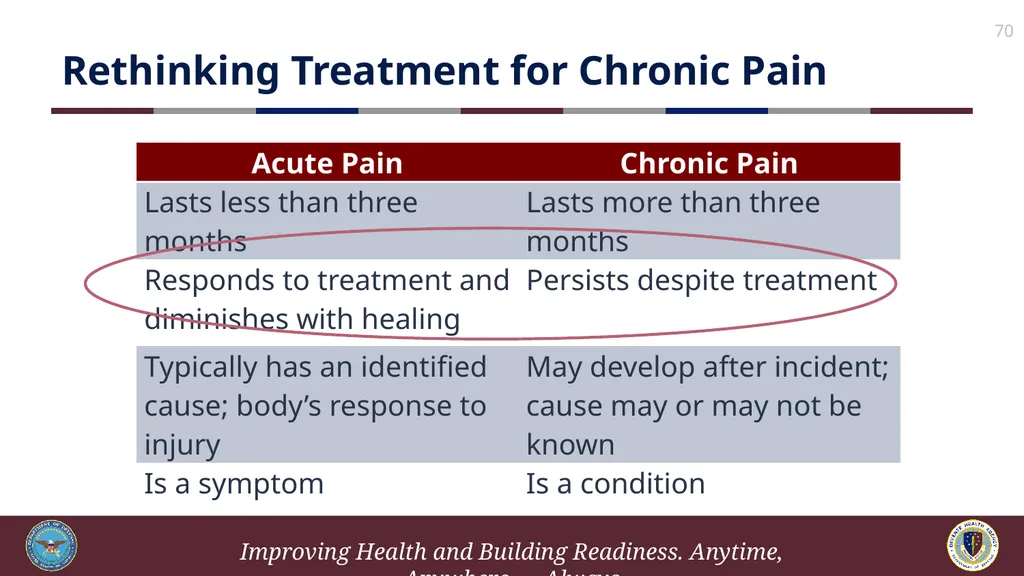
slide66. Acute Pain Definition “Acute pain has a short duration and is typically characterized by an identifiable injury or disease. Some acute pain is expected to occur in response to health events, such as childbirth or following surgery. Acute pain usually subsides over time as the body heals, and often responds to standard medical treatments.”1 1. Beehler, G. P., Dobmeyer, A.C., Hunter, C. L., & Funderburk, J. S. (2018). Brief cognitive behavioral therapy for chronic pain: BHC manual (pp. 15). Silver Spring, MD: Defense Health Agency.<br>
slide67. Chronic Pain: Definition “Chronic pain is an ongoing or recurrent pain lasting beyond the usual course of acute illness or injury. Chronic pain typically lasts more than three to six months and adversely affects the individual’s well-being. There may not be a clear underlying physiological cause to chronic pain.”1 1. Beehler, G. P., Dobmeyer, A.C., Hunter, C. L., & Funderburk, J. S. (2018). Brief cognitive behavioral therapy for chronic pain: BHC manual (pp. 15). Silver Spring, MD: Defense Health Agency.<br>
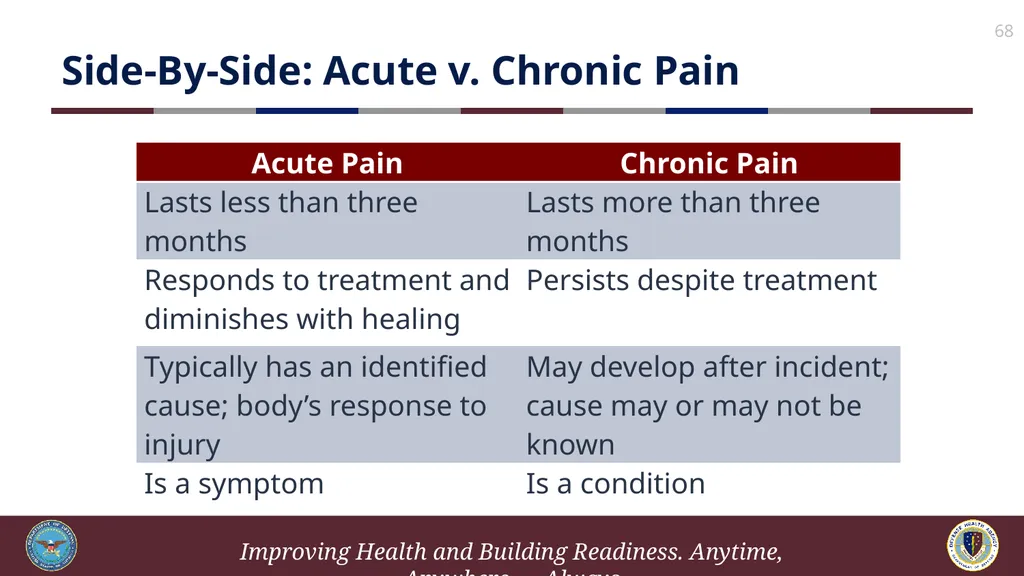
slide68. Side-By-Side: Acute v. Chronic Pain<br>
slide69. Distinguishing Acute from Chronic Pain: An Implication With acute pain, Hurt (may) = Harm
Because acute pain is a symptom of another problem and there is typically an underlying issue, acute pain in a given area may mean more harm is occurring
With chronic pain, Hurt (often) ≠ Harm
With chronic pain, pain is not a symptom, it is a condition. Pain is no longer a reliable indicator that anything harmful is happening in the body’s tissues
Many patients regard all pain as a reliable indicator of harm. This leads to fear of movement (kinesiophobia) and underactivity. For patients with chronic pain, these worsen health outcomes<br>
slide70. Rethinking Treatment for Chronic Pain<br>
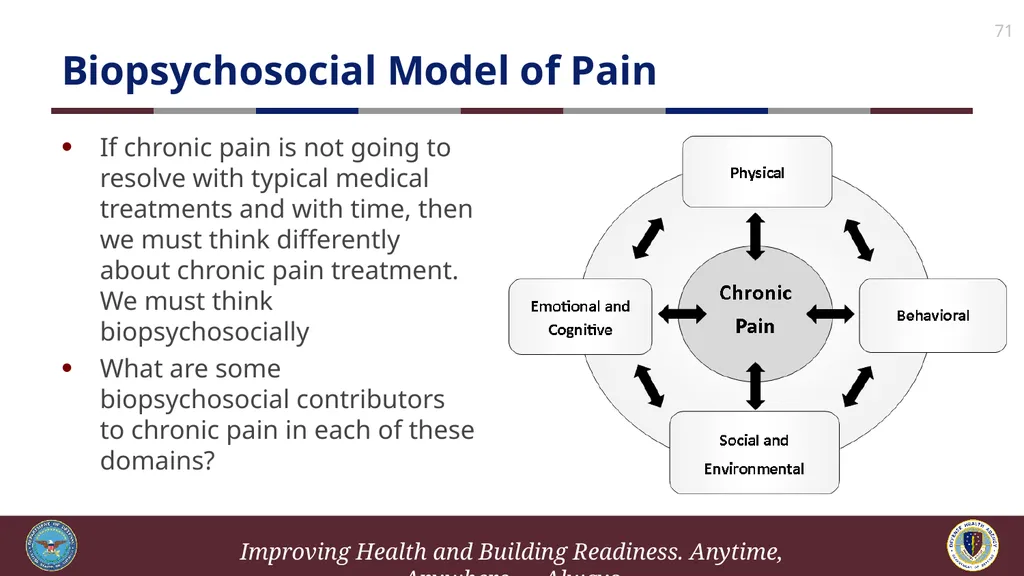
slide71. Biopsychosocial Model of Pain If chronic pain is not going to resolve with typical medical treatments and with time, then we must think differently about chronic pain treatment. We must think biopsychosocially
What are some biopsychosocial contributors to chronic pain in each of these domains?<br>
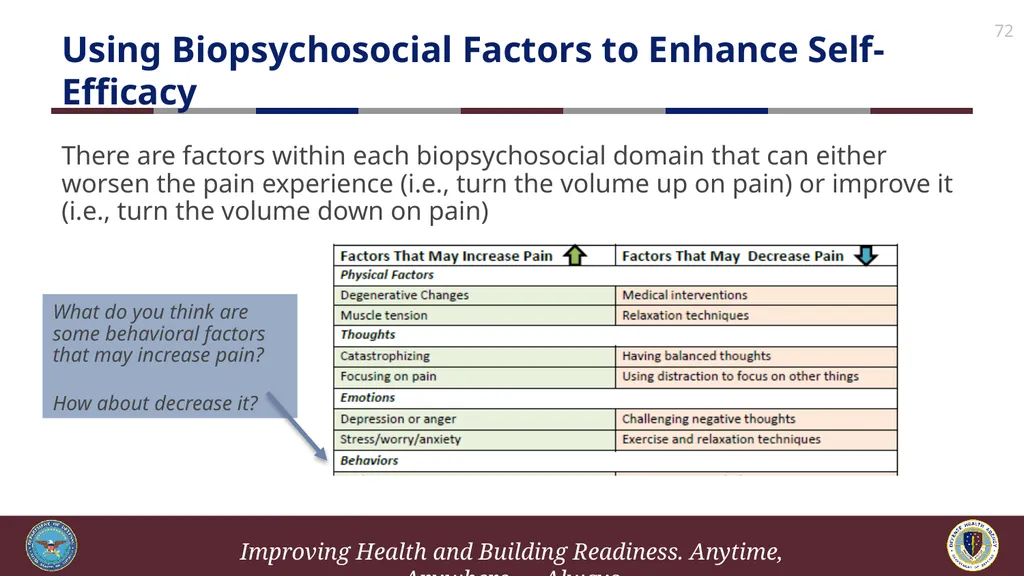
slide72. Using Biopsychosocial Factors to Enhance Self-Efficacy There are factors within each biopsychosocial domain that can either worsen the pain experience (i.e., turn the volume up on pain) or improve it (i.e., turn the volume down on pain) What do you think are some behavioral factors that may increase pain?
How about decrease it?<br>
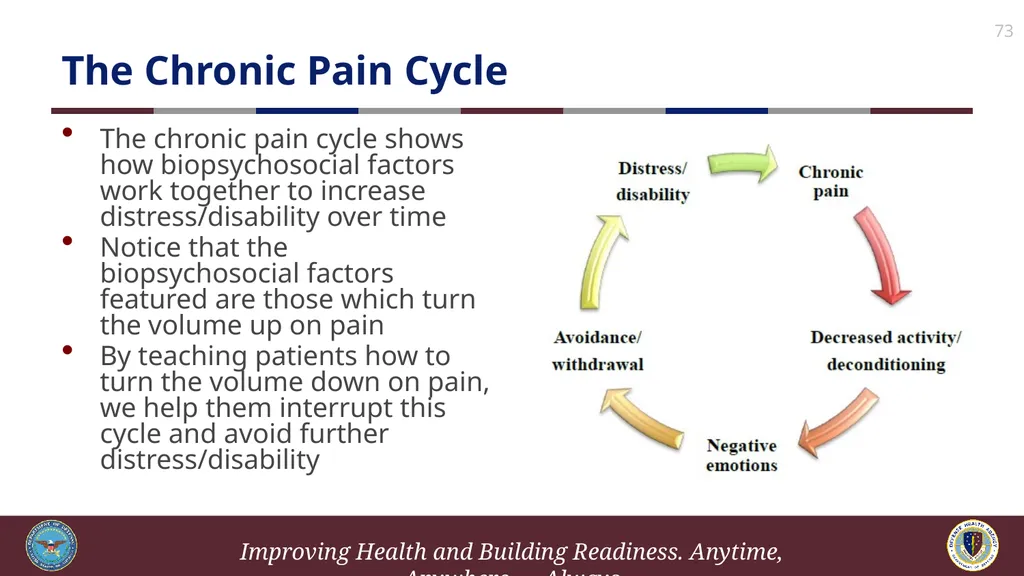
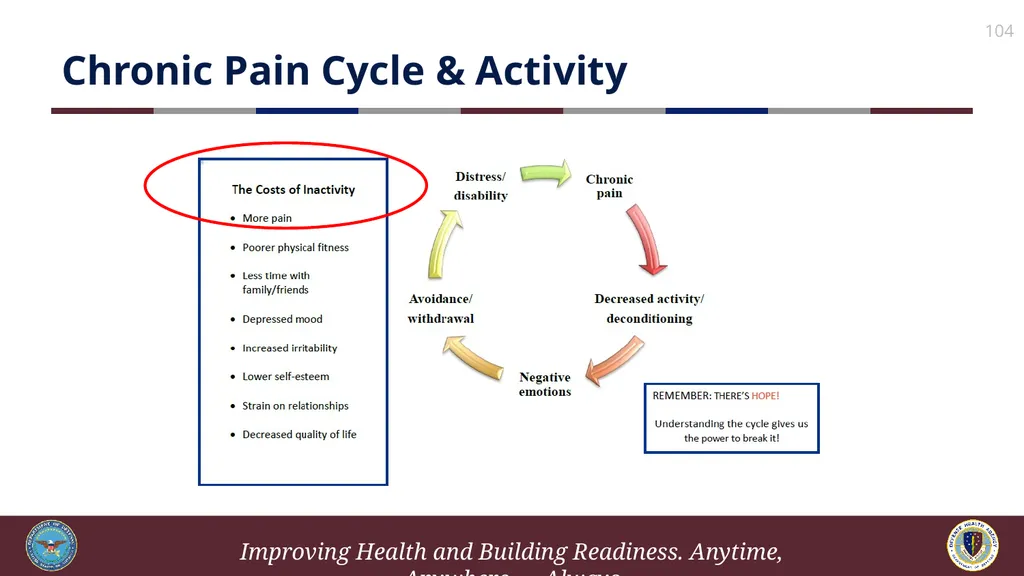
slide73. The Chronic Pain Cycle The chronic pain cycle shows how biopsychosocial factors work together to increase distress/disability over time
Notice that the biopsychosocial factors featured are those which turn the volume up on pain
By teaching patients how to turn the volume down on pain, we help them interrupt this cycle and avoid further distress/disability<br>
slide74. Providing Psychoeducation in the Protocol This psychoeducation is divided between the first two appointments in the BCBT-CP protocol
Module A: overview of biopsychosocial model of pain; summary of BCBT-CP treatment protocol (p. 40-43, manual)
Module B: acute v. chronic pain; factors that increase/decrease pain; chronic pain cycle (p. 47-50, manual)
But remember, flexibility is key – it may be helpful to touch on the difference between acute and chronic pain in the first appointment if a barrier to the patient engaging in treatment is a belief that medical treatments alone will help<br>
slide75. Skills Practice #2: Providing Psychoeducation Format: Role play in pairs using the case vignette provided. The second role play builds upon the first.
Objectives:
Role play 1: engage the patient in care through discussion of the biopsychosocial model of pain and overview of Brief CBT-CP
Role play 2: build upon the psychoeducation provided in the first role play by discussing the difference between acute and chronic pain and the factors that increase/decrease pain<br>
slide76. Skills Practice #2: Debrief Overall reactions/thoughts: any aspects that seemed to flow well? Any that were more challenging?
Any components of the psychoeducation that you anticipate will be most difficult to deliver to patients (e.g., biopsychosocial nature of pain, acute v. chronic, factors that increase/decrease pain, chronic pain cycle)?
How does the psychoeducation from each role play relate to one another?<br>
slide77. Follow-Up Visit Structure<br>
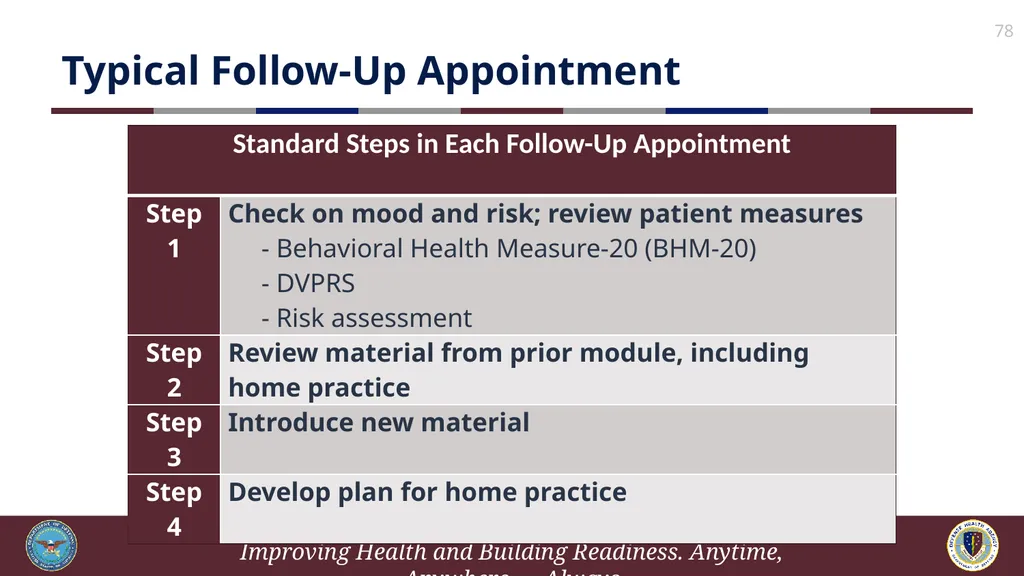
slide78. Typical Follow-Up Appointment<br>
slide79. Atypical Follow-Up Appointments Your follow-ups may be pretty straightforward as you work your way through the modules, reviewing previous content and introducing new skills each time, setting goals with patients…
…They also may not. What are some reasons why our follow-ups may go differently?<br>
slide80. $64,000 Question What do we do when our patients aren’t ready to move forward in the protocol?<br>
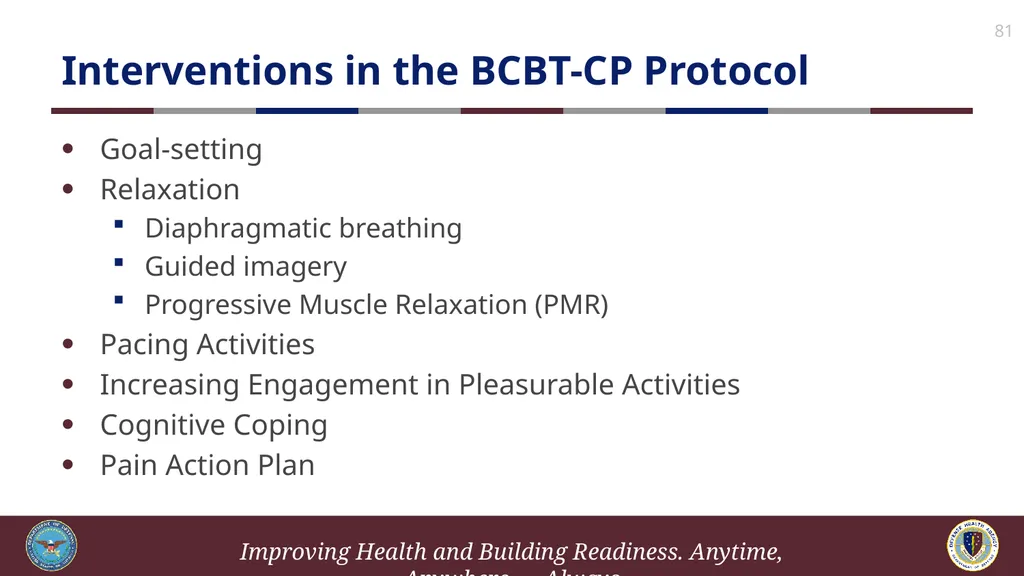
slide81. Interventions in the BCBT-CP Protocol Goal-setting
Relaxation
Diaphragmatic breathing
Guided imagery
Progressive Muscle Relaxation (PMR)
Pacing Activities
Increasing Engagement in Pleasurable Activities
Cognitive Coping
Pain Action Plan<br>
slide82. Goal-setting (Module A)<br>
slide83. Helping Patients Envision a More Positive Future Once the patient commits to BCBT-CP, the first intervention is a discussion of short-term and long-term goals for their treatment
Focus on improved functioning and quality of life
Shift away from goals exclusively focused on eliminating pain
In the appointment, set one short-term goal and one long-term goal with the patient
At-home practice: generate additional short- and long-term goals
The aim is to make the patient think more broadly and not to simply develop a change plan for the next 1-2 weeks<br>
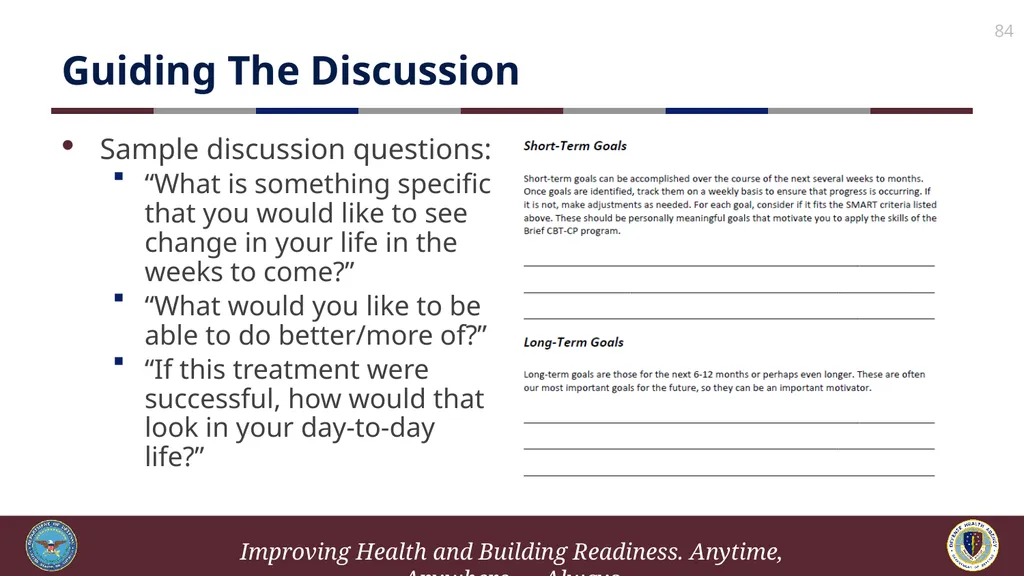
slide84. Guiding The Discussion Sample discussion questions:
“What is something specific that you would like to see change in your life in the weeks to come?”
“What would you like to be able to do better/more of?”
“If this treatment were successful, how would that look in your day-to-day life?”<br>
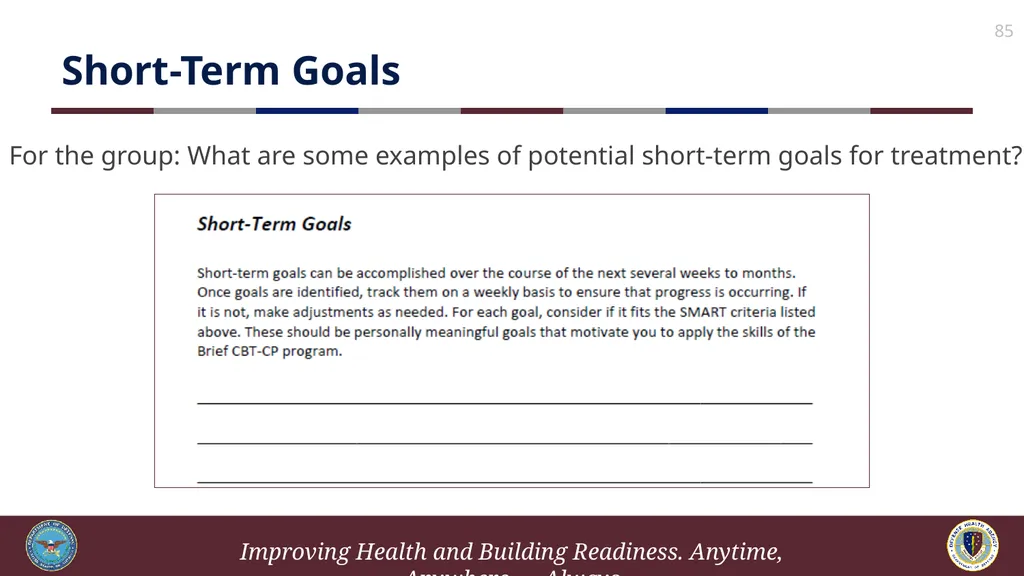
slide85. Short-Term Goals For the group: What are some examples of potential short-term goals for treatment?<br>
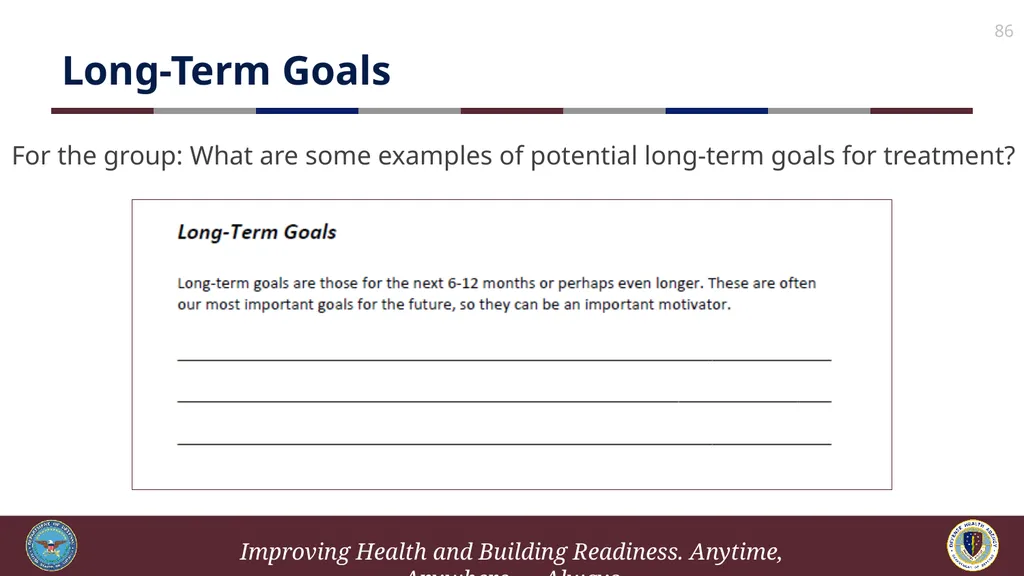
slide86. Long-Term Goals For the group: What are some examples of potential long-term goals for treatment?<br>
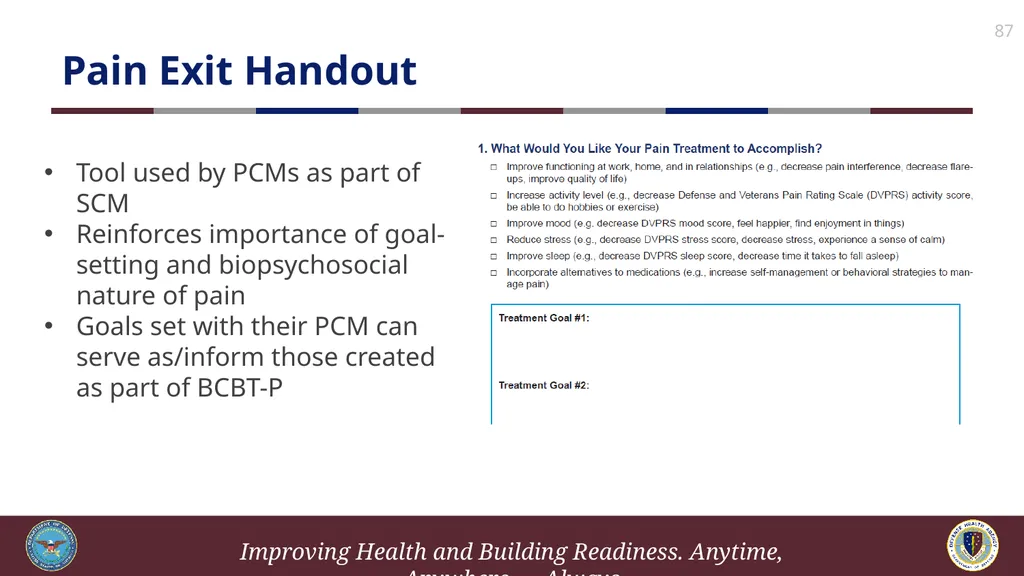
slide87. Pain Exit Handout Tool used by PCMs as part of SCM
Reinforces importance of goal-setting and biopsychosocial nature of pain
Goals set with their PCM can serve as/inform those created as part of BCBT-P<br>
slide88. Relaxation (Modules B & D)<br>
slide89. Basic Relaxation: Diaphragmatic (“Deep”) Breathing Deep breathing is a technique the patient has possibly learned (and you have very likely taught) for other reasons (e.g., improve sleep, decrease anxiety, generally manage stress)
Steps are the same regardless of context:
Sit in a neutral posture
Close eyes if comfortable; choose a single focal point if not
Slowly pull breath into the abdomen (stomach should rise, not chest)
Hold inhaled breath briefly
Exhale slowly<br>
slide90. Placing Skill in Chronic Pain Context Though the steps are the same, the rationale for deep breathing is somewhat more nuanced
What is the relationship between the fight-or-flight response and chronic pain?
Knowledge check:
How does deep breathing intervene upon the fight-or-flight response?<br>
slide91. Example of Low Patient Receptiveness to an Intervention Even though a patient commits to BCBT-CP, they will not necessarily show the same level of willingness to every intervention in the protocol
Reasons a patient may not be receptive to deep breathing:
Patient has already learned it and did not find it to be helpful
Patient already learned it and actively uses it and does not feel the need to review the intervention
Patient does not believe it is relevant to their problem
Patient simply isn’t interested
Others?<br>
slide92. Potential Responses to Patient Concerns Ask the patient to demonstrate how they do deep breathing to ensure that they are doing it in a manner that would allow them to benefit
Ensure that you have fully shared the rationale for deep breathing in the context of chronic pain
Highlight that deep breathing is a foundational skill for all relaxation strategies and we will build upon it
Suggest augmenting the skill with a mobile app
Move on to another skill
Others?<br>
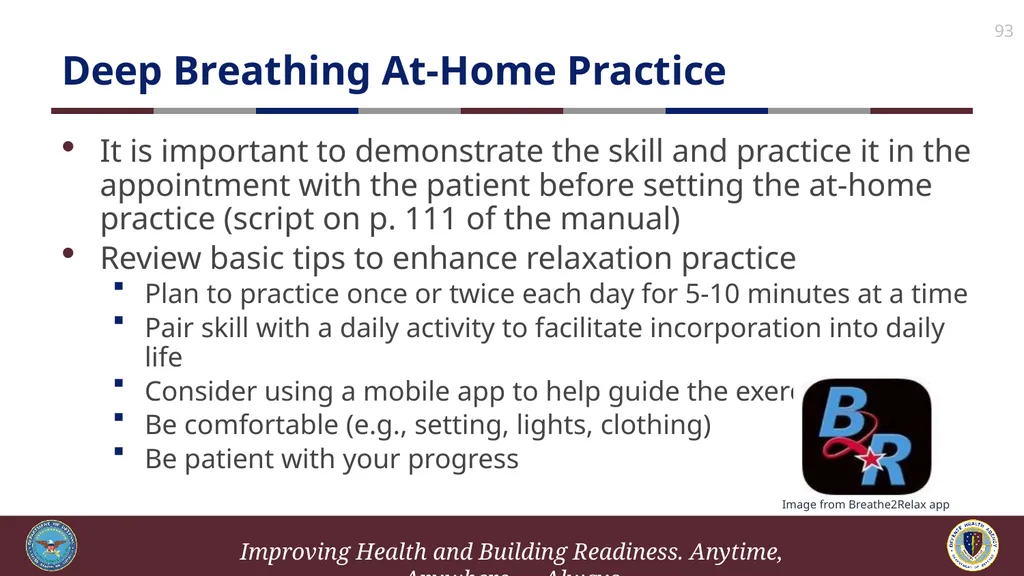
slide93. Deep Breathing At-Home Practice It is important to demonstrate the skill and practice it in the appointment with the patient before setting the at-home practice (script on p. 111 of the manual)
Review basic tips to enhance relaxation practice
Plan to practice once or twice each day for 5-10 minutes at a time
Pair skill with a daily activity to facilitate incorporation into daily life
Consider using a mobile app to help guide the exercise
Be comfortable (e.g., setting, lights, clothing)
Be patient with your progress Image from Breathe2Relax app<br>
slide94. Advanced Relaxation Training In the BCBT-CP protocol, two additional relaxation strategies are offered (module D):
Progressive Muscle Relaxation (PMR)
Guided Imagery
Scripts are available for both (p. 117-118 of the manual) that can be used for in-appointment demonstration and at-home practice
Will typically offer an advanced strategy in a separate appointment from deep breathing. However, deep breathing is a part of these advanced strategies, so review/reinforce that skill<br>
slide95. Progressive Muscle Relaxation Patients systematically (and gently) tense and relax specific muscle groups
Tensing muscles may feel slightly uncomfortable but should not hurt
If patients experience a pain exacerbation, they can simply notice tension in that area of the body (instead of inducing tension) and then relax
This skill helps retrain the body and mind to notice tension and release it rather than hold onto it
Muscles cannot be both tense and relaxed simultaneously
Patients learn to observe the difference between the sensations
The body learns to recognize tension and then release it
Over time, this more adaptive response will become automatic<br>
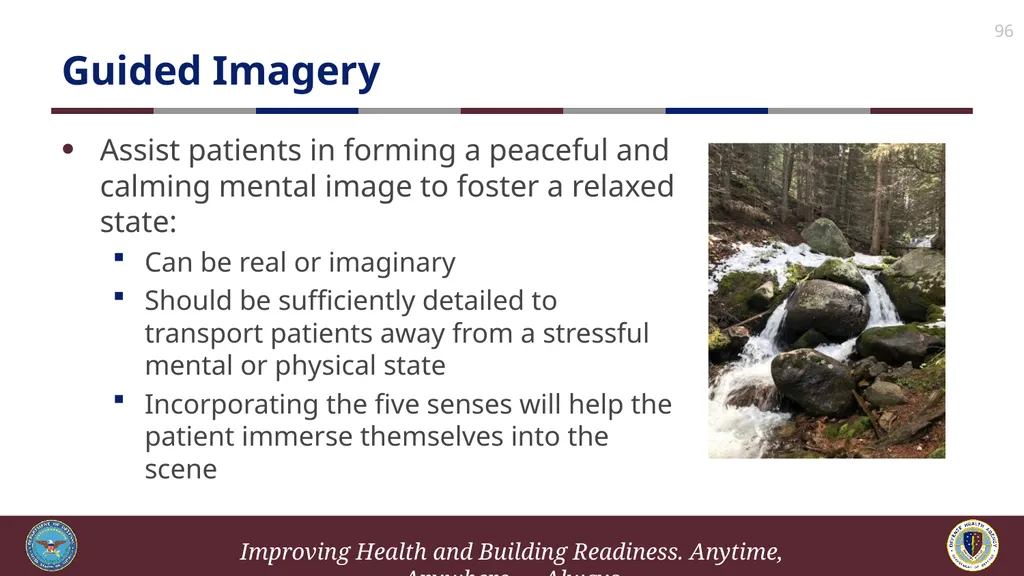
slide96. Guided Imagery Assist patients in forming a peaceful and calming mental image to foster a relaxed state:
Can be real or imaginary
Should be sufficiently detailed to transport patients away from a stressful mental or physical state
Incorporating the five senses will help the patient immerse themselves into the scene<br>
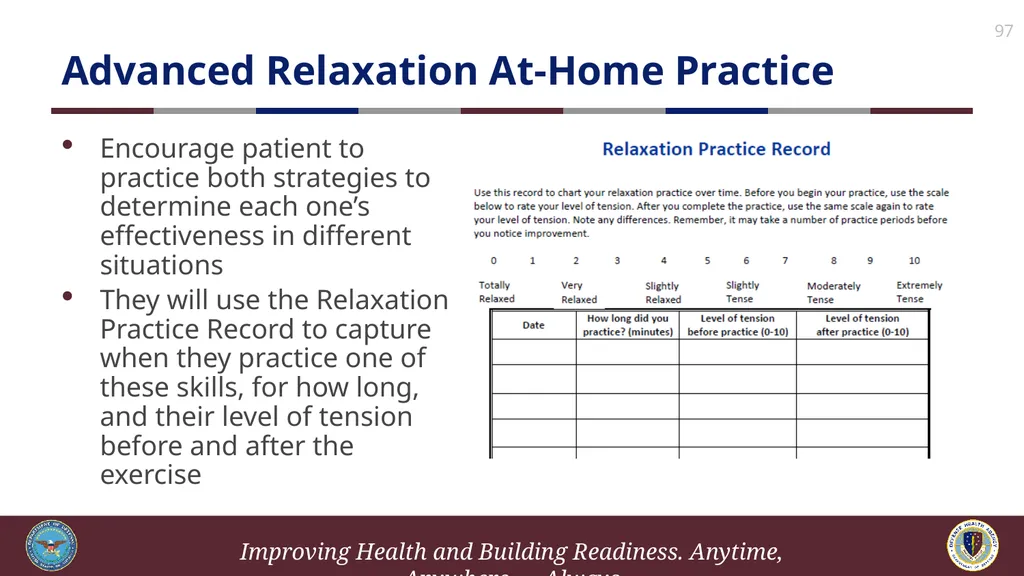
slide97. Advanced Relaxation At-Home Practice Encourage patient to practice both strategies to determine each one’s effectiveness in different situations
They will use the Relaxation Practice Record to capture when they practice one of these skills, for how long, and their level of tension before and after the exercise<br>
slide98. Day One Wrap-up Cognitive Behavioral Treatment for acute and chronic pain is an important component in the DoD’s Stepped Care Model for Pain
The experience of chronic pain involves not only elements related to the physical injury itself, but also psychosocial factors such as stress, cognitive factors, and behavioral factors
BCBT-CP aims to identify and modify these psychosocial factors to help improve functioning and quality of life
BCBT-CP uses a flexible and modular approach that includes psychoeducation, goal setting, stress management, activity management, engaging in pleasurable activities, cognitive coping, and creating a pain action plan<br>
slide99. Questions?<br>
slide100. Brief Cognitive Behavioral Therapy for Pain Part 2<br>
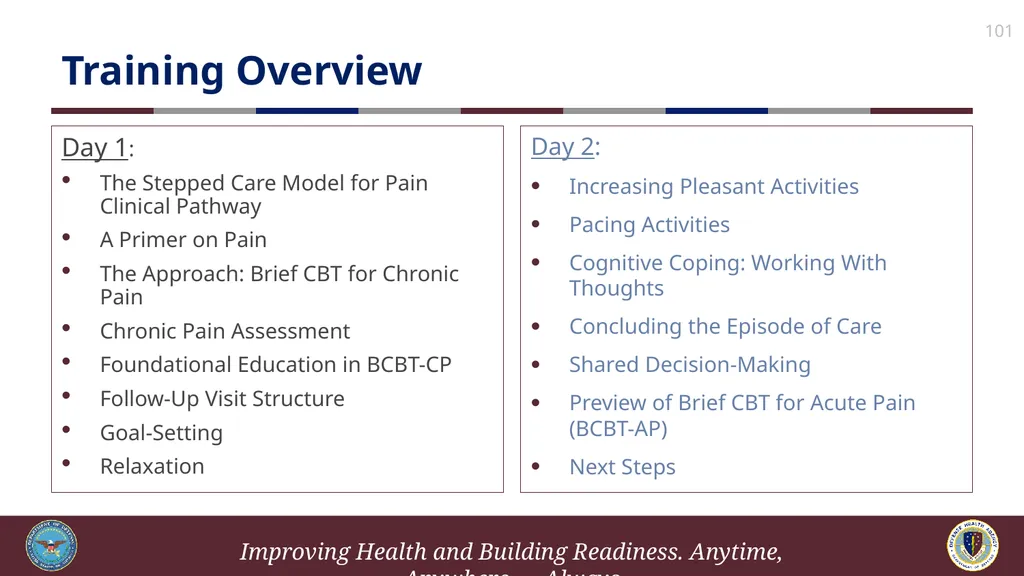
slide101. Training Overview Day 1:
The Stepped Care Model for Pain Clinical Pathway
A Primer on Pain
The Approach: Brief CBT for Chronic Pain
Chronic Pain Assessment
Foundational Education in BCBT-CP
Follow-Up Visit Structure
Goal-Setting
Relaxation Day 2:
Increasing Pleasant Activities
Pacing Activities
Cognitive Coping: Working With Thoughts
Concluding the Episode of Care
Shared Decision-Making
Preview of Brief CBT for Acute Pain (BCBT-AP)
Next Steps<br>
slide102. Increasing Pleasant Activities (Module C)<br>
slide103. Education To Review Patients with pain have often stopped engaging in activities, pleasant or otherwise, for multiple reasons
Common reasons include fear of doing harm and belief that “rest” will promote healing
Thus, for activity interventions, we may need to review educational concepts related to the difference between acute and chronic pain, including Hurt ≠ Harm
We also may need to review the chronic pain cycle and how continuing to do less will worsen their experience over time<br>
slide104. Chronic Pain Cycle & Activity<br>
slide105. What if… You attempt to introduce an activity goal and the patient’s fear of movement proves too interfering – no amount of education or motivational enhancement alleviates their fear that this will cause more harm, despite PCM assurance that activity is safe. What do you do?
Teach them the intervention anyway – they might use it eventually
Cross it off the list of possible interventions. No point in trying to revisit it later
Shift to discussing the thoughts you’re hearing that seem to be feeding the fear and introduce the idea of cognitive coping. Assuming the patient is amenable, pursue that intervention instead for now<br>
slide106. Rationale for Engaging in Pleasant Activities Even when the patient is open to becoming more active, they often have stopped attempting pleasant activities because they think they are unimportant or impossible to do
We may need to help them appreciate why engaging in pleasurable things is important
Question for the group: Why is it important to help chronic pain patients re-engage in pleasurable activities?<br>
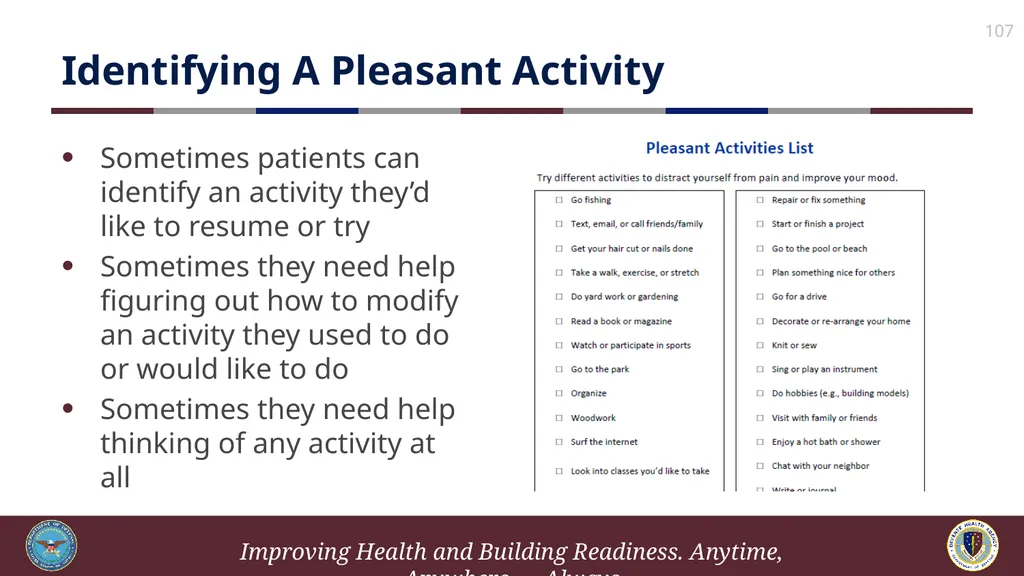
slide107. Identifying A Pleasant Activity Sometimes patients can identify an activity they’d like to resume or try
Sometimes they need help figuring out how to modify an activity they used to do or would like to do
Sometimes they need help thinking of any activity at all<br>
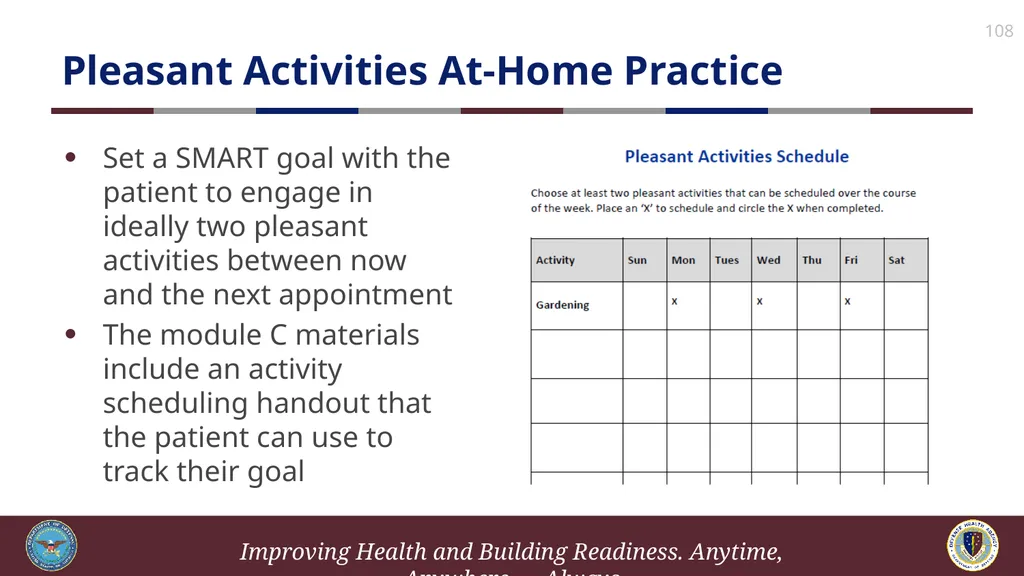
slide108. Pleasant Activities At-Home Practice Set a SMART goal with the patient to engage in ideally two pleasant activities between now and the next appointment
The module C materials include an activity scheduling handout that the patient can use to track their goal<br>
slide109. Pacing Activities (Module C)<br>
slide110. What Do We Mean By “Pacing”? Overexertion/overuse: when patients push themselves through activities despite pain and cause a pain flare
Underuse: when patients are underactive, often due to fear of movement or belief that “resting” will promote healing
A period of rest can promote healing with acute pain
For chronic pain, underuse ultimately leads to increased pain over time due to the deconditioning of muscles, stiffening of joints, etc.
Many patients cycle between the two extremes depending on how they feel on a given day
“Pacing”: finding a moderate level of activity that gets them out of the underuse/overuse cycle<br>
slide111. Overview of Time-Based Pacing Individual tasks are broken into “active” and “rest” periods with the goal of allowing the activity to be completed without a significant pain flare-up
“Active” periods: patient is engaging in the activity that may cause pain (e.g., mowing the lawn)
“Rest” periods: patient is engaging in an activity that does not cause or exacerbate pain (e.g., checking email)
“Rest” does NOT mean that they are literally resting; they are simply doing something that does not cause strain in the painful area<br>
slide112. Steps to Time-Based Pacing Help patient choose an activity to pace
Patient estimates how long they can do the activity before a pain flare
Subtract one minute from this estimate to set their “active” goal time
Patient estimates the amount of “rest” time they will need before resuming the activity
Patient will adhere to their estimates when doing this activity, both on “good” pain days and “bad” pain days
Ratios may, of course, be adjusted as needed
Once an active/rest split is found that works, time, not pain, should guide how long the patient engages in the activity versus rests<br>
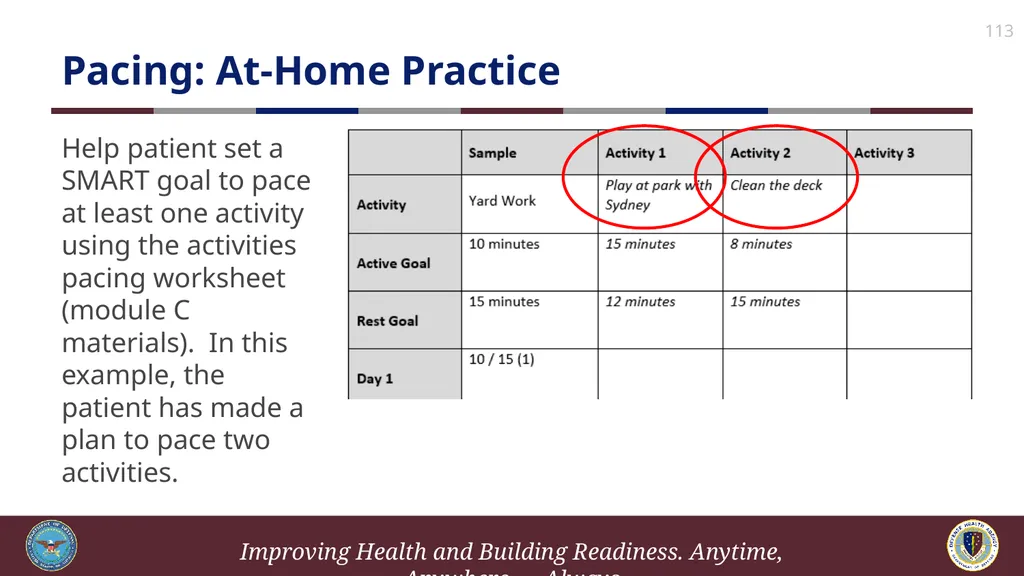
slide113. Pacing: At-Home Practice Help patient set a SMART goal to pace at least one activity using the activities pacing worksheet (module C materials). In this example, the patient has made a plan to pace two activities.<br>
slide114. Skills Practice #3: Pacing Activities Format: Role play in pairs using the case vignette provided. The second role play builds upon the first.
Objectives:
Role play 1: explain rationale and steps for time-based pacing. Assist patient in developing a tailored pacing home practice plan
Role play 2: build upon the first role play; the patient has returned for follow-up and brought his pacing log. Review the log<br>
slide115. Skills Practice #3: Debrief What strengths/weaknesses about the log were discussed in your group?
What challenges do you anticipate in setting pacing goals with patients?<br>
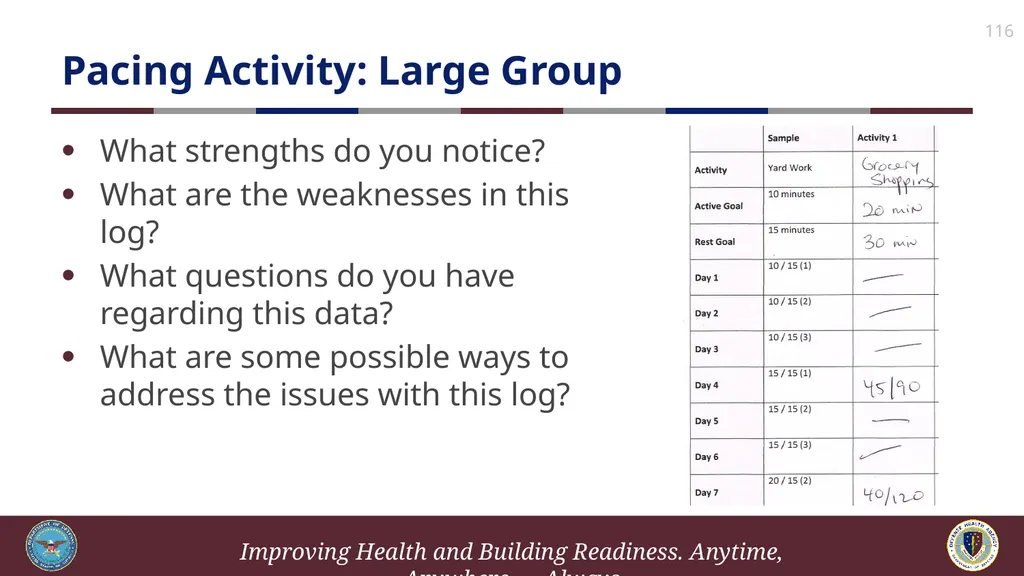
slide116. Pacing Activity: Large Group What strengths do you notice?
What are the weaknesses in this log?
What questions do you have regarding this data?
What are some possible ways to address the issues with this log?<br>
slide117. Cognitive Coping: Working with Thoughts (Modules E & F)<br>
slide118. Assisting with Cognitions The BCBT-CP cognitive coping modules provide a simplified way to restructure cognitions
First, help patients identify unhelpful thoughts (module E)
Provide psychoeducation on the link between cognitions and pain
Discuss the concept of automatic thoughts
Share the types of thoughts that are generally considered unhelpful (i.e., cognitive distortions)
Second, help patients challenge unhelpful thoughts (module F)
Follow your patient’s pace<br>
slide119. Education on Pain & Thoughts Negative thoughts are related to pain perception1
Thoughts impact pain experience but do not cause/cure pain
Experiencing pain can increase the occurrence of unhelpful thoughts
These thoughts are typically “automatic”
Occur outside an individual’s awareness
Directly impact emotions, behaviors, and pain intensity
Can be helpful or unhelpful (i.e., a factor that can make the pain better or worse/turn the dial up or down)
Patients have the ability to influence their pain experience by learning to “catch” these automatic thoughts and shift them 1. Lawrence, J., Hoeft, F., Sheau, K., & Mackey, S. (2011). Strategy-dependent dissociation of the neural correlates involved in pain modulation. Anesthesiology, 115(4), 844-851.<br>
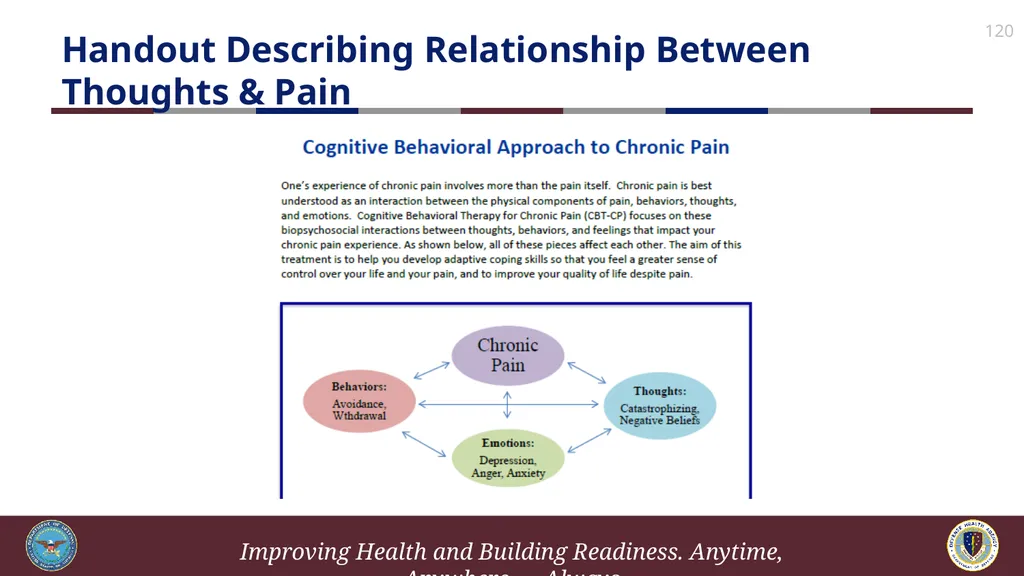
slide120. Handout Describing Relationship Between Thoughts & Pain<br>
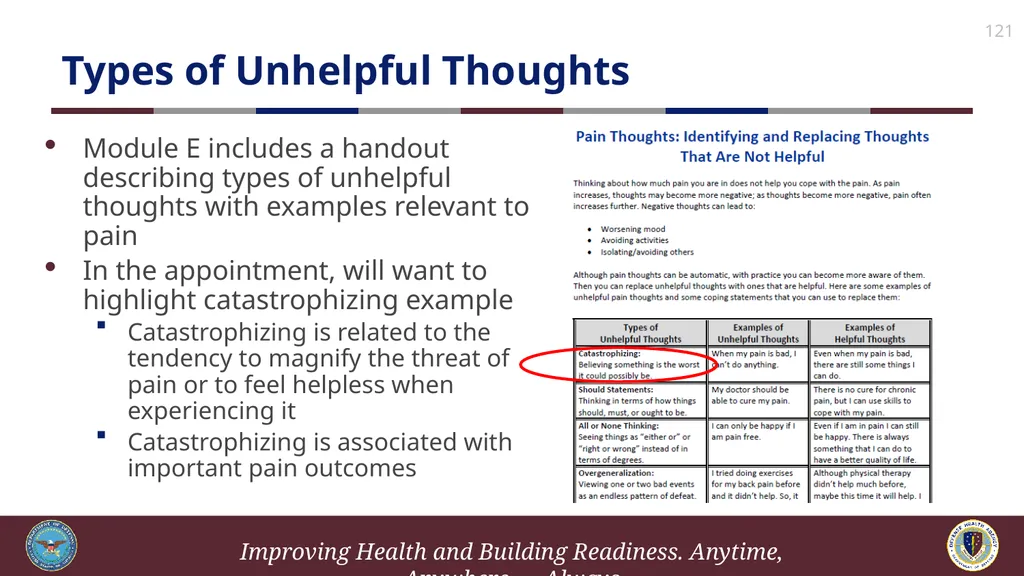
slide121. Types of Unhelpful Thoughts Module E includes a handout describing types of unhelpful thoughts with examples relevant to pain
In the appointment, will want to highlight catastrophizing example
Catastrophizing is related to the tendency to magnify the threat of pain or to feel helpless when experiencing it
Catastrophizing is associated with important pain outcomes<br>
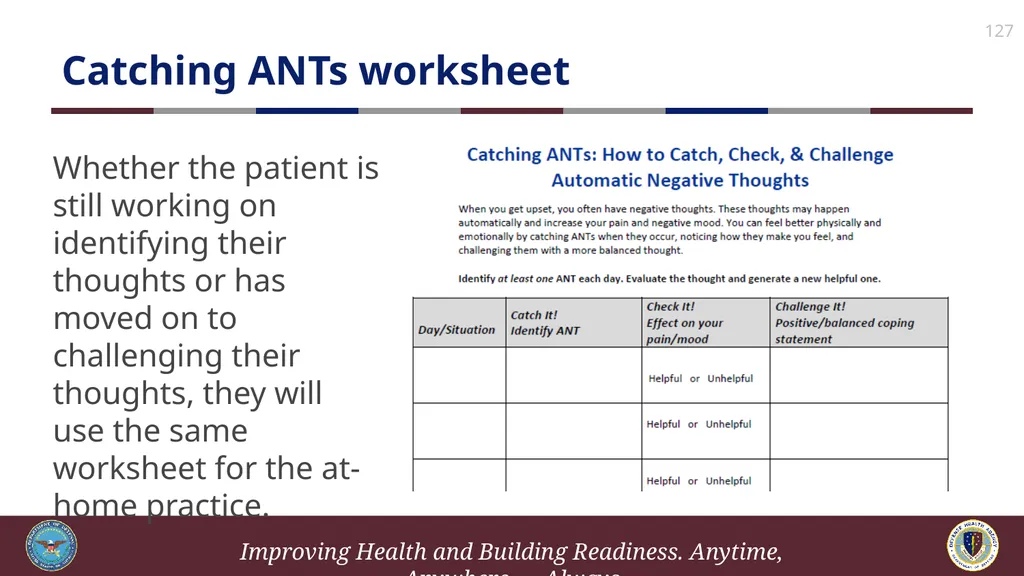
slide122. Identifying Unhelpful Thoughts or Catching “ANTS” Help patient identify automatic thoughts related to their pain
Automatic negative thoughts are called “ANTS” in BCBT-CP
May need to use examples you’ve heard in prior appointments or ask them to reflect on the last time they experienced a pain flare
Help patient appraise whether that thought is helpful or unhelpful
Do not focus on whether or not the thought is objectively true
Focus on how the thought impacted their mood, behavior, or pain
Focus on how those thoughts move them toward or away from the things they value in their lives<br>
slide123. Challenging Unhelpful Thoughts Once the patient has a list of unhelpful thoughts, help them shift these thoughts to something more balanced and helpful
The goal is not to create overly optimistic or unrealistic thoughts
You are helping them shift the thought to something that better connects them to their values, turns down the volume on pain, and/or has a more positive impact on their mood and behavior<br>
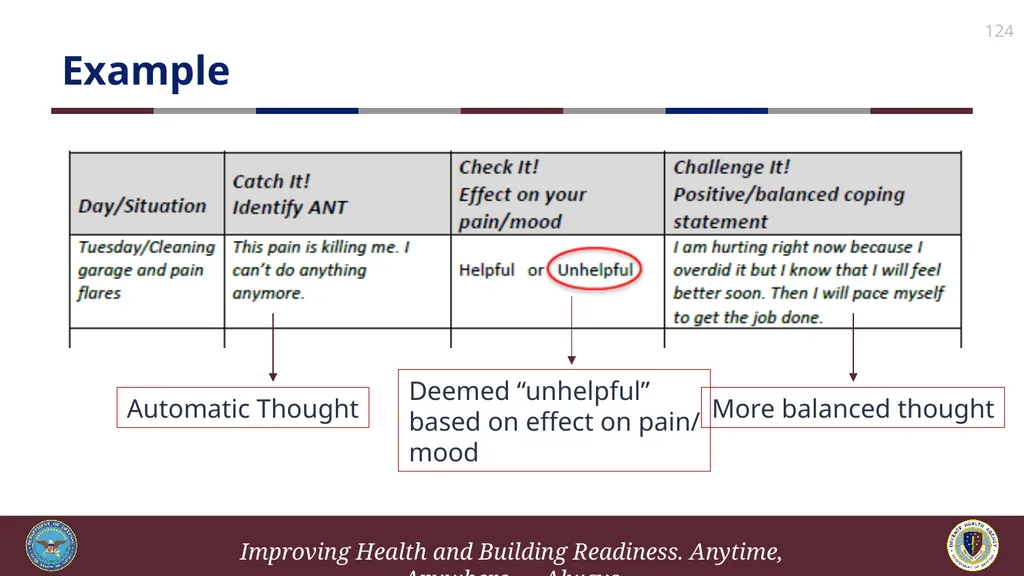
slide124. Example Automatic Thought Deemed “unhelpful”
based on effect on pain/
mood More balanced thought<br>
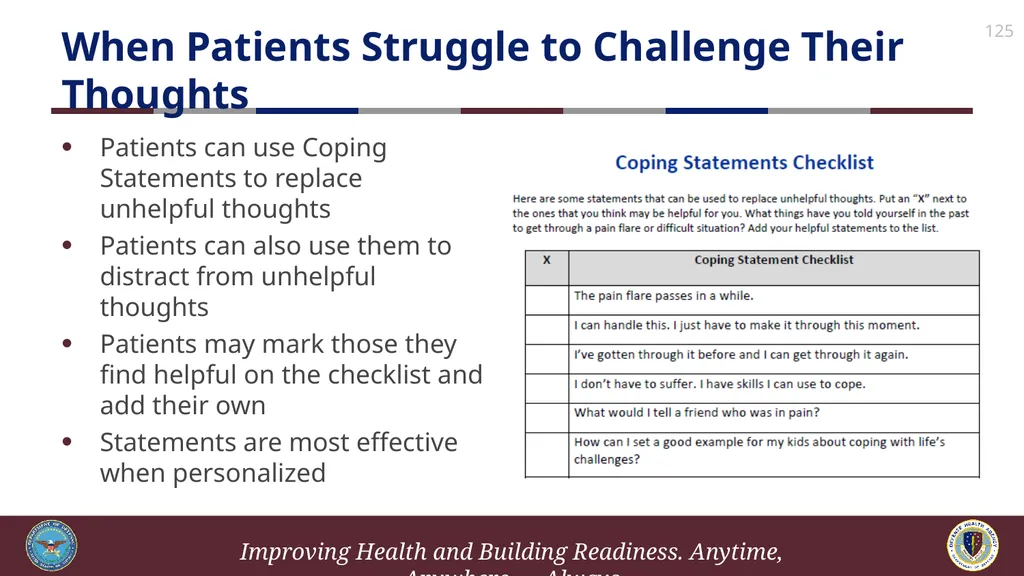
slide125. When Patients Struggle to Challenge Their Thoughts Patients can use Coping Statements to replace unhelpful thoughts
Patients can also use them to distract from unhelpful thoughts
Patients may mark those they find helpful on the checklist and add their own
Statements are most effective when personalized<br>
slide126. Cognitive Coping: At-Home Practice The at-home practice will depend upon how far you and the patient progressed in the cognitive coping skill
For patients still working to identify unhelpful thoughts: document automatic thoughts between now and the next appointment and try to determine if they are helpful or not
For those patients who are able to identify unhelpful thoughts and have been introduced to the idea of challenging them: document their thoughts and make attempts to create more balanced thoughts
Use of the coping statements checklist is optional<br>
slide127. Catching ANTs worksheet Whether the patient is still working on identifying their thoughts or has moved on to challenging their thoughts, they will use the same worksheet for the at-home practice.<br>
slide128. Skills Practice #4: Cognitive Coping Format: Role play in pairs using the case vignette provided. The second role play builds upon the first.
Objectives:
Role play 1: explain rationale for cognitive coping and describe the procedure for noticing and identifying unhelpful thoughts
Role play 2: build upon the first role play; the patient has returned for follow-up and brought his thought log; review the log and describe how to challenge thoughts<br>
slide129. Skills Practice #4: Debrief Overall reactions/thoughts: any aspects that seemed to flow well? Any that were more challenging?
This intervention has multiple parts: what part do you anticipate will be the most challenging for patients?
How did pairs approach helping patients examine their thoughts to determine if they were helpful?<br>
slide130. Concluding the Episode of Care<br>
slide131. Ending BCBT-CP In PCBH, episodes of care generally end when the BHC and patient are arranging for follow-up and agree that the patient can move forward on their own. We never “terminate” treatment
The BCBT-CP protocol includes a Pain Action Plan appointment (module G) that reinforces skills learned and continued integration of these skills into their lives going forward<br>
slide132. Concluding the Episode of Care: Reviewing Progress Emphasize gains in functioning and/or mood that patient has achieved since beginning treatment
Review the goals that the patient set at the beginning of treatment
Use assessment measurement (DVPRS, BHM-20) to highlight change
Use specific questions to identify progress:
In what ways have you become more active?
How has your mood changed?
What have you noticed in terms of your pain intensity?
Have others mentioned any changes they’ve seen in you?<br>
slide133. Revisiting SMART Goals As part of reviewing SMART goals initially set, discuss SMART goals for the coming weeks and months now that they’ve concluded treatment
Long-term goals would be accomplished over the next 6-12 months
Short-term goals would be completed over several weeks to months
Goals can enhance motivation, functioning, and/or well-being
A SMART Goal Setting handout is included in module G<br>
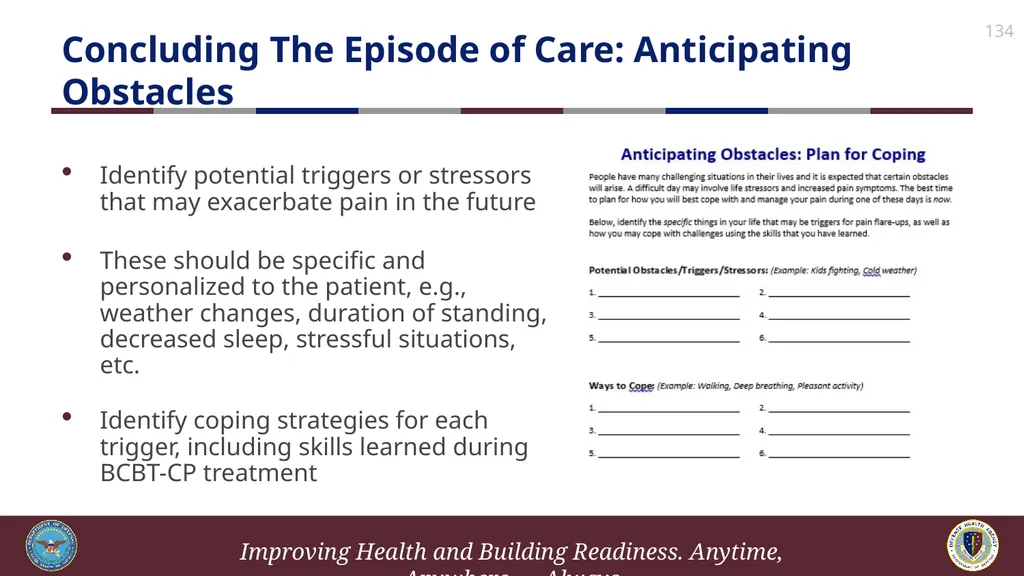
slide134. Concluding The Episode of Care: Anticipating Obstacles Identify potential triggers or stressors that may exacerbate pain in the future
These should be specific and personalized to the patient, e.g., weather changes, duration of standing, decreased sleep, stressful situations, etc.
Identify coping strategies for each trigger, including skills learned during BCBT-CP treatment<br>
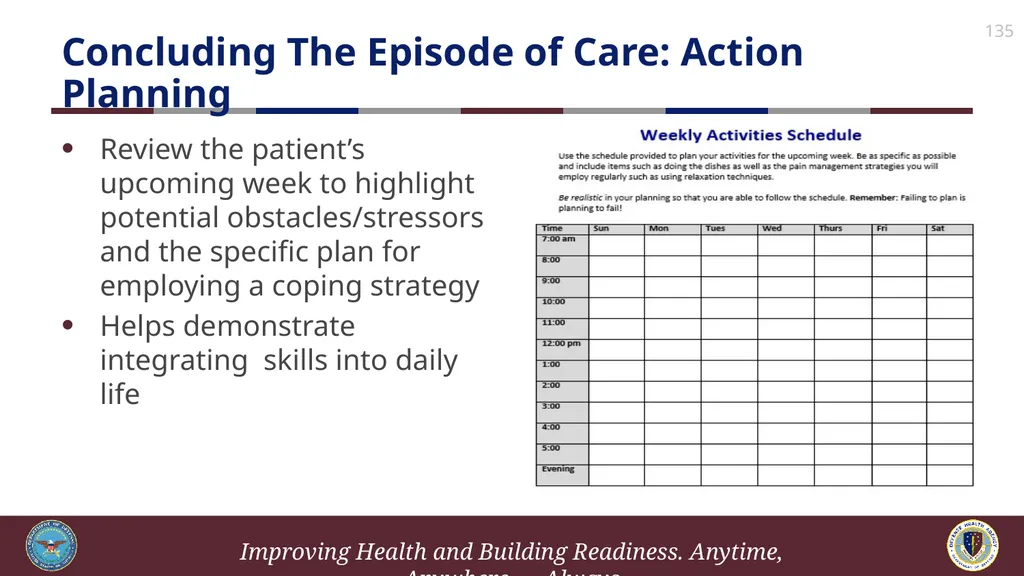
slide135. Concluding The Episode of Care: Action Planning Review the patient’s upcoming week to highlight potential obstacles/stressors and the specific plan for employing a coping strategy
Helps demonstrate integrating skills into daily life<br>
slide136. The Final “Arrange” Phase Determine if patients have additional needs and assist with linking to appropriate care
New episode of care with you for different problem
Referral to specialty BH
Reinforce that the patient can re-engage with you at any time for this problem or a different one<br>
slide137. Shared Decision-Making<br>
slide138. Keeping Our Patients Engaged We have emphasized the importance of applying this protocol flexibly and meeting our patients where they are to assist with patient buy-in
To help increase engagement in treatment, we want to maximize our collaboration with patients by helping them fully understand their options and by honoring their choices
The goal of BCBT-CP is not to make it through all seven modules in order; it is to keep the patient coming back in order to get what they need from the treatment<br>
slide139. A Model of Patient Collaboration: Shared Decision-Making “An approach where clinicians and patients share the best available evidence when faced with the task of making decisions, and where patients are supported to consider options, to achieve informed preferences.”1
Assumes that patient self-determination is a desirable goal
Clinician must provide specific knowledge and support so that the patient can make meaningful choices
Extends informed consent beyond simply sharing information to helping the patient fully think through options and honoring informed preferences 1. Elwyn, G., Frosch, D., Thomson, R., Joseph-Williams, N., Lloyd, A….Barry, M. (2012). Shared decision making: A model for clinical practice. Journal of General Internal Medicine, 27(10), 1361-1367. doi: 10.1007/s11606-012-2077-6<br>
slide140. Case example Patient is a 40-year-old female, active duty service member, who was referred to the BHC for depression. She has a history of depressive episodes that have been effectively managed with medication, though in this instance, she would also like to “talk to someone” since her low mood is being exacerbated by her mother’s death six months ago. Her symptoms are currently in the moderate range and she denies suicidal ideation.
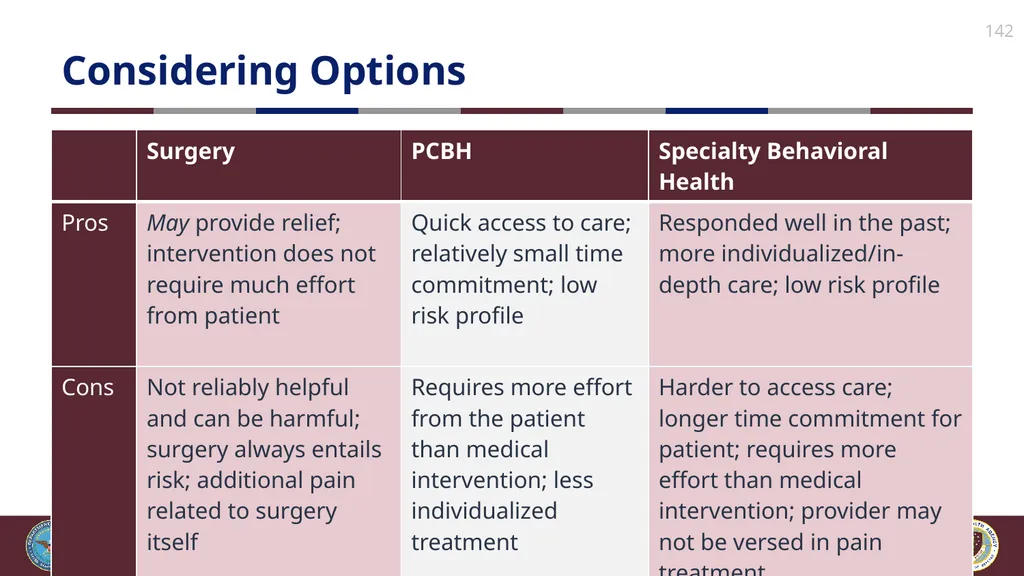
What are the patient’s treatment options?
What are the pros and cons of each?<br>
slide141. Example of Application to BCBT-CP A 60-year-old patient with chronic low back pain was referred to you by his PCM because the pain has worsened in the last six months. The PCM thinks this relates to the fact that the patient retired and has become less active. The patient thinks that it might be time to consider surgery, something friends of his have done with admittedly mixed results. As the BHC, you hear many ways in which BCBT-CP could be helpful (e.g., expressing thoughts that this will keep getting worse; withdrawing socially; resting to “heal”). He has comorbid depression and previously benefitted from therapy, though currently, his depressive symptoms are in the mild range.
What are the options the patient has to choose between?
What are the pros and cons of each? 1. Elwyn, G., Frosch, D., Thomson, R., Joseph-Williams, N., Lloyd, A….Barry, M. (2012). Shared decision making: A model for clinical practice. Journal of General Internal Medicine, 27(10), 1361-1367. doi: 10.1007/s11606-012-2077-6<br>
slide142. Considering Options<br>
slide143. Making a Choice Patient options include surgery, PCBH, Specialty BH, continuing self-management/self-monitoring, or a combination of these
What personal considerations will guide the patient’s decision?
What external factors will contribute to his decision?<br>
slide144. Clinician’s Role in Shared Decision-Making Ensure that the patient has sufficient information to understand his or her options
If they do not, empower the patient to get sufficient information and/or encourage them to continue to gather data
Help the patient think through those options and consider the benefits and drawbacks in the context of his or her own life
Honor the patient’s choice and prepare to help them manage the drawbacks they have accepted and maximize the benefits<br>
slide145. Choosing Modules Question for the group: Now that you have a firmer grasp on what’s included in the modules and what we mean by shared decision-making, what factors might come into play when speaking with a patient about which modules to complete?
Bonus question: What if a patient says they have no interest in a skill, but as a clinician, you heard in your assessment a lot of evidence that they would benefit from it. What would you do?<br>
slide146. Skills Practice #5: Applying Protocol Flexibly Format: Two video recordings of a BHC engaging in shared decision-making with a patient regarding how to proceed in treatment. The first is a poor example; the second is a good example.
Tasks:
Note the decision that the clinician is trying to help the patient make
Observe the differences between how the clinician responded to the patient’s difficulty achieving her at-home goal
Assess how “bought-in” the patient is to their next steps in each video<br>
slide147. Skills Practice #5: Debrief Overall reactions/thoughts: is this consistent with how you practice or would this be a new approach?
What made the BHC’s approach in the first video sub-optimal?
What made the BHC’s approach in the second video better?
The “good” approach takes a bit more time in that single appointment; do you think this is worth it when considering treatment as a whole? Why or why not?<br>
slide148. Courses of Care: Which Is the “Correct” One? (1/2) A BHC completes a course of BCBT-CP with a patient. Which course of care is the “best” one?
Patient and BHC agreed in their first appointment to do BCBT-CP and moved through all seven modules in order.
Patient and BHC planned to focus on depression but agreed in their second appointment that pain needed more explicit focus. The BHC was able to share the education from modules A and B in that appointment since much of the assessment had been completed earlier. The patient completed three additional appointments on cognitive coping and advanced relaxation before the patient indicated that he felt ready to reconnect on a PRN basis.<br>
slide149. Courses of Care: Which Is the “Correct” One? (2/2) A BHC completes a course of BCBT-CP with a patient. Which course of care is the “best” one?
In the initial appointment, patient and BHC agreed to do BCBT-CP. After three appointments, the patient shared that he wasn’t finding it to be helpful. The BHC engaged him in a discussion of his concerns, his values, what he’d hoped to get out of treatment, and shared specifics of how the treatment could help him. He remained disinterested, but had heard about insomnia treatment and was very interested in that. They agreed to shift focus in the next appointment.
All of the above<br>
slide150. Summary The BCBT-CP protocol provides a format and structure to provide evidence-based treatment for chronic pain in primary care
The protocol should be applied flexibly to maximize patient engagement, understanding, and benefit
Having a firm grasp on the nature of pain, attending to the patient’s level of motivation for both the treatment itself and individual interventions, and monitoring patient’s response to treatment will all significantly aid the clinician in applying this treatment effectively<br>
slide151. Preview of Brief CBT for Acute Pain (BCBT-AP) Protocol<br>
slide152. BCBT-CP v. BCBT-AP Significant overlap between protocols. Similarities include:
Education about the biopsychosocial model
Promotion of a return to activity
Relaxation strategies to cope with pain
Skill of identifying and challenging negative or unhelpful thoughts
Main content differences include:
Ability to foster expectation that pain will improve with acute pain
Emphasis on interrupting pain cycle early to prevent progression to chronic pain
Ability to delay pacing activities if there are activity restrictions related to injury<br>
slide153. Indications for BCBT-AP Patient is experiencing acute pain
Patients at increased risk of transitioning from acute to chronic pain, which includes those with1:
Co-morbid depressive symptoms
Tendency to catastrophize their pain
Fear of movement
Significant psychosocial stressors
CBT components (i.e., education, relaxation, coping skills training) have empirical support for patients with acute musculoskeletal pain2 1. Ncholas, M. K., Linton, S. J., Watson, P. J., Main, C. J., & Group, D. o. t. F. W. (2011). Early identification and management of psychological risk factors (“yellow flags”) in patients with low back pain: A reappraisal. Physical therapy, 91(5), 737-753.
2. Mariano, T. Y., Urman, R. D., Hutchison, C. A., Jamison, R. N., & Edwards, R. R. (2018). Cognitive Behavioral Therapy (CBT) for Subacute Low Back Pain: A Systematic Review. Current pain and headache reports, 22(3), 15.<br>
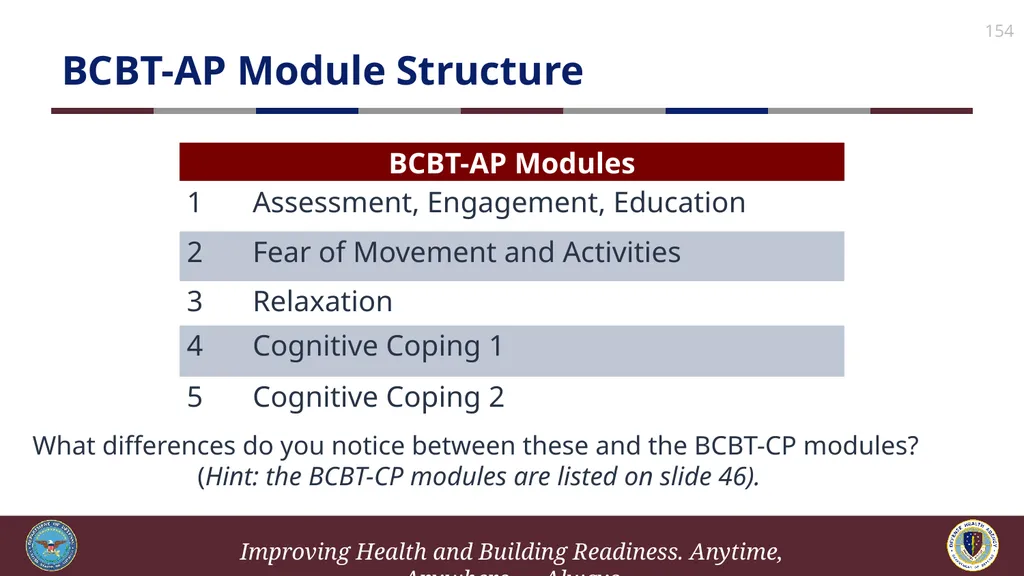
slide154. BCBT-AP Module Structure What differences do you notice between these and the BCBT-CP modules?
(Hint: the BCBT-CP modules are listed on slide 46).<br>
slide155. More Information on BCBT-AP Differences between BCBT-CP and BCBT-AP modules will be discussed in consultation call one
The BCBT-AP protocol manual will be attached to the calendar invitation for consultation call one
If you would like review BCBT-AP materials in advance, they are available on the PCBH SharePoint in the Training folder<br>
slide156. Next Steps<br>
slide157. I’ve been trained in BCBT-CP – now what? In two weeks, you will have your first consultation call
Between now and then:
Discover who in your clinic fulfills roles within the SCM pathway
Communicate with your team regarding your new skillset
Integrate the treatment of pain into your practice<br>
slide158. Roles Within SCM All team members receive training to support SCM for Pain:
Primary Care Pain Champion (PCPC): designated PCM; received specialized training on SCM with an emphasis on referring to the BHC
Pain Care Coordinator (PCC): a nurse who helps with specific components of SCM; BHCFs often fulfill this role
Other team members (including BHCs): computer-based training followed by discussion with PCPC<br>
slide159. Communicate With Your Team Talk to your PCPC: let them know you have received BCBT-P training; inquire about training status of team members
As soon as possible (e.g., at the next huddle or in one-on-one discussions) share with team members that you have received this training and can assist with their pain patients
Seek out opportunities to provide education (e.g., at provider meetings, training days) about what treatment entails (i.e., interventions, goals, expected outcomes)
Model referral language that PCMs can use with patients<br>
slide160. Sample Referral Language From PCM to patient: “We will keep working to find good medical options for the pain. In the meantime, I would like to bring in our BHC, [name], who has a bunch of skills to teach you that will help you get to your goal of [e.g., hiking with family, taking vacation, etc.] that we were talking about.”<br>
slide161. Integrate the Treatment of Pain Into Your Practice Review the BCBT-CP manual: be familiar with its structure so you can quickly access information when referrals for pain pick up
Familiarize yourself with the DVPRS so you can efficiently administer, score, and interpret it. More information on the DVPRS at http://www.dvcipm.org/clinical-resources/defense-veterans-pain-rating-scale-dvprs/
Scrub PCM visit lists to identify patients with chronic pain<br>
slide162. Consultation Calls Following this training, you will begin a consultation call series
Purpose: to provide clinical support and ongoing consultation which enable successful implementation of SCM and BCBT-P
Eight calls every two weeks (total duration: four months)
Continuing education credits are available for each call
Please ensure your schedule is blocked for the calls so that you can attend (Outlook calendar invitations will be sent)
Participation is voluntary but encouraged<br>
slide163. Format of Consultation Calls Each call starts with a brief didactic component (≈15 minutes) covering a topic related to treating pain in primary care
The remainder of the call is spent in discussion of any active cases and any implementation challenges (≈ 45 minutes)
Completion certificate is available
Must complete three unique BCBT-P appointments and all eight calls to obtain completion certificate
Missed calls can be rescheduled by emailing: dha.ncr.j-9.mbx.phcoe-stepped-care-model-for-pain@health.mil<br>
slide164. In Your First Consultation Call If you have a chronic pain patient, be prepared to share:
Basic case information: patient demographics, nature/course of pain
Content and impression of the appointment: e.g., module(s) completed, patient’s response, comfort level using protocol, etc.
Regarding the clinic/implementation level, you may be asked:
The name of your Pain Champion and if you have spoken to them
Your impression of the prevalence of chronic pain in your population based upon scrubbing PCM visit lists and discussions with your team<br>
slide165. For Your Awareness To assess impact of SCM, the DoD is tracking certain metrics
Those related to BHC practice:
Number of patients seen for pain, including # of encounters per patient
Percentage of encounters where DVPRS supplemental questions were administered
Percentage of encounters for pain when BHM-20 was administered<br>
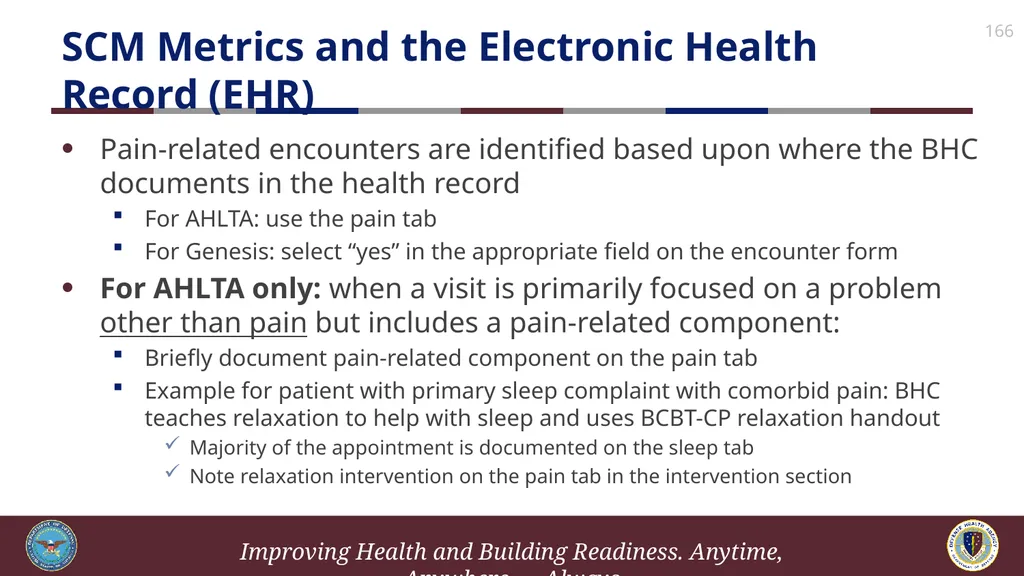
slide166. SCM Metrics and the Electronic Health Record (EHR) Pain-related encounters are identified based upon where the BHC documents in the health record
For AHLTA: use the pain tab
For Genesis: select “yes” in the appropriate field on the encounter form
For AHLTA only: when a visit is primarily focused on a problem other than pain but includes a pain-related component:
Briefly document pain-related component on the pain tab
Example for patient with primary sleep complaint with comorbid pain: BHC teaches relaxation to help with sleep and uses BCBT-CP relaxation handout
Majority of the appointment is documented on the sleep tab
Note relaxation intervention on the pain tab in the intervention section<br>
slide167. Other SCM Metrics Percentage of patients seen by PCMs for pain who had a BHC encounter in the subsequent 30 days (goal = 2.5%)
Encounter can focus on any problem area; BHC and patient determine most appropriate focus for visit (i.e., visit does not need to focus on pain to “count”)
BHC does not need to give a pain diagnosis or document in AHLTA pain tab
A metric related to PCM practice: Percentage of patients with an indication for naloxone and who received naloxone in the past year (goal = 90%).<br>
slide168. Key Takeaways (1/2) Cognitive Behavioral Treatment for acute and chronic pain is an important component in the DoD’s Stepped Care Model for Pain
The experience of chronic pain involves not only elements related to the physical injury itself, but also psychosocial factors such as stress, cognitive factors, and behavioral factors
CBT for acute and chronic pain aims to identify and modify these psychosocial factors to help improve functioning and quality of life
CBT for chronic pain is a modular approach that includes psychoeducation, goal setting, stress management, activity management, engaging in pleasurable activities, cognitive coping, and creating a pain action plan<br>
slide169. Key Takeaways (2/2) Modules for CBT for chronic pain are chosen based on key assessment data and collaboration with the patient
The number of modules delivered to patients can vary between 3 and 7, and are based on assessment and collaboration with the patient
Comorbid conditions such as depression and insomnia can be treated in the context of CBT for chronic pain, but may require additional episodes of care depending on the severity of the problem and treatment response
CBT for acute pain overlaps significantly with the CBT for chronic pain approach and is aims promote a return to normal activities and to interrupt the pain cycle<br>
slide170. References (1/7) Beehler, G. P., Dobmeyer, A.C., Hunter, C. L., & Funderburk, J. S. (2018). Brief cognitive behavioral therapy for chronic pain: BHC manual. Silver Spring, MD: Defense Health Agency.
Beehler, G. P., Murphy, J. L., King, P. R., Dollar, K. M., Kearney, L, K., Halsam, A…. Goldstein, W. R. (2019). Brief Cognitive Behavioral Therapy for Chronic Pain: Results from a clinical demonstration project in primary care behavioral health. Clinical Journal of Pain, 35, 10, 809-817.
Beehler, G.P., Loughran, T.A., King, P.R., Dollar, K.M., Murphy, J.L…Goldstein, W.R. (2021). Patients’ perspectives of brief cognitive behavioral therapy for chronic pain: Treatment satisfaction, perceived utility, and global assessment of change. Families, Systems, & Heath, 39(2), 351-357.
Bosco, M.A., Murphy, J.L., Clarke, M.E. (2013). Chronic pain and traumatic brain injury in OEF/OIF service members and Veterans. Headache Review, 53(9), 1518-22. doi: 10.1111/head.12172<br>
slide171. References (2/7) Brain image from Model Systems Knowledge Translation Center (MSKTC), free to reproduce and distribute. Retrieved from https://msktc.org/tbi/factsheets/Understanding-TBI/Brain-Injury-Impact-On-Individuals-Functioning.
Campbell, G., Bruno, R., Darke, S., Shand, F., Hall, W., Farrell, M., & Degenhardt, L. (2016). Prevalence and correlates of suicidal thoughts and suicide attempts in people prescribed pharmaceutical opioids for chronic pain. The Clinical Journal of Pain, 32(4), 292-301.
Defense Health Agency. (2023, February 08). Pain management and opioid safety in Military Medical Treatment Facilities (DHA Administrative Instruction No. 6025.08). Washington, DC: Defense Health Agency.
Deployment Health Clinical Center (2017, September). Psychological Health Analytics Report: IBHC monitoring report for FY17Q03. Defense Health Agency: Falls Church, VA.<br>
slide172. References (3/7) Duenas, M., Ojeda, B., Salazar, A., Mico, J.A., & Failde, I. (2016). A review of chronic pain impact on patients, their social environment and the health care system. Journal of Pain Research, 9, 457-467. doi: 10.2147/JPR.S105892
Ehde, D. M., Dillworth, T. M., & Turner, J. A. (2014). Cognitive-behavioral therapy for individuals with chronic pain: Efficacy, innovations, and directions for research. The American Psychologist, 69(2), 153-66. doi: 10.1037/a0035747
Elwyn, G., Frosch, D., Thomson, R., Joseph-Williams, N., Lloyd, A….Barry, M. (2012). Shared decision making: A model for clinical practice. Journal of General Internal Medicine, 27(10), 1361-1367. doi: 10.1007/s11606-012-2077-6
Fishbain, D. A., Pulikal, A., Lewis, J. E., & Gao, J. (2017). Chronic pain types differ in their reported prevalence of post-traumatic stress disorder (PTSD) and there is consistent evidence that chronic pain is associated with PTSD: an evidence-based structured systematic review. Pain Medicine, 18(4), 711-735.<br>
slide173. References (4/7) Harding, J.K.J., Rush, A.J., Arbuckle, M., Trivedi, M.H., & Pincus, H.A. (2011). Measurement-based care in psychiatric practice: A policy framework for implementation. Journal of Clinical Psychiatry, 72(8), 1136-1143.
International Association for the Study of Pain. (2020 July 16). IASP Announces Revised Definition of Pain. Retrieved 2022 April 19 from https://www.iasp-pain.org/publications/iasp-news/iasp-announces-revised-definition-of-pain/
Kanzler, K. E., Bryan, C. J., McGeary, D. D., & Morrow, C. E. (2012). Suicidal ideation and perceived burdensomeness in patients with chronic pain. Pain Practice, 12(8), 602-609.
Landsman-Blumberg, P. B., Katz, N., Gajria, K., Coutinho, A. D., Yeung, P. P., & White, R. (2017). Burden of alcohol abuse or dependence among long-term opioid users with chronic noncancer pain. Journal of Managed Care & Specialty Pharmacy, 23(7), 718-724.
Lawrence, J., Hoeft, F., Sheau, K., & Mackey, S. (2011). Strategy-dependent dissociation of the neural correlates involved in pain modulation. Anesthesiology, 115(4), 844-851.<br>
slide174. References (5/7) Li J. X. (2015). Pain and depression comorbidity: A preclinical perspective. Behavioural Brain Research, 276, 92–98. https://doi.org/10.1016/j.bbr.2014.04.042
Louw, A, & Puentedura, E. (2017). Therapeutic neuroscience education: Teaching people about pain. Orthopedic Physical Therapy Products
Louw, A., Zimney, K., Puentedura, E.L., & Diener, I. (2016). The efficacy of pain neuroscience education on musculoskeletal pain: A systematic review of the literature. Physiotherapy Theory and Practice. doi: 10.1080/09593985.2016.1194646
Mariano, T. Y., Urman, R. D., Hutchison, C. A., Jamison, R. N., & Edwards, R. R. (2018). Cognitive Behavioral Therapy (CBT) for Subacute Low Back Pain: A Systematic Review. Current Pain and Headache Reports, 22(3), 15
Moghim, R. (2022). Understanding peripheral and central sensitization. Colorado Pain Care. https://coloradopaincare.com/understanding-peripheral-and-central-sensitization/<br>
slide175. References (6/7) Morris, D.W., Toups, M., & Trivedi, M.H. (2012). Measurement-based care in the treatment of clinical depression. Focus, 10(4), 428-433.
Murphy, J.L., McKellar, J.D., Raffa, S.D., Clark, M.E., Kerns, R.D., & Karlin, B.E. (2014) Cognitive behavioral therapy for chronic pain among veterans: Therapist manual. Washington, DC: U.S. Department of Veterans Affairs.
Nervous system image in public domain by Medium69, Jmarch, CC BY-SA 4.0, retrieved from https://commons.wikimedia.org/w/index.php?curid=37042919
Nicholas, M. K., Linton, S. J., Watson, P. J., Main, C. J., & Group, D. o. t. F. W. (2011). Early identification and management of psychological risk factors (“yellow flags”) in patients with low back pain: A reappraisal. Physical Therapy, 91(5), 737-753.<br>
slide176. References (7/7) Outcalt, S.D., Ang, D.C., Wu, J., Sargent, C., Zhangsheng, Y., & Bair, M.J. (2014). Pain experience of Iraq and Afghanistan Veterans with comorbid chronic pain and posttraumatic stress. Journal of Rehabilitation Research & Development, 51(4), 559-570. doi: 10.1682/JRRD.2013.06.0134
Puentedura, E. & Louw, A. (2013). A neuroscience approach to managing athletes with low back pain. Physical Therapy in Sport, 13(3), 123-133. doi: 10.1016/j.ptsp.2011.12.001
Rayner, L., Hotopf, M., Petkova, H., Matcham, F., Simpson, A., & McCracken, L. M. (2016). Depression in patients with chronic pain attending a specialized pain treatment centre: prevalence and impact on health care costs. Pain, 157(7), 1472.<br>
slide177. Questions?<br>
slide178. Contact Us Primary Care Behavioral Health
J3 Medical Affairs/Clinical Support Division
Defense Health Agency
Email: dha.ncr.j-9.mbx.phcoe-stepped-care-model-for-pain@health.mil
POC: CAPT Anne Dobmeyer<br>
slide2. Disclosures The presenters have no relevant financial or non-financial relationships to disclose relating to the content of this activity
The views expressed in this presentation are those of the author and do not necessarily reflect the official policy or position of the Department of Defense, nor the U.S. Government
This continuing education activity is managed and accredited by the Defense Health Agency J-7 Continuing Education Program Office (DHA J-7 CEPO). DHA J-7 CEPO and all accrediting organizations do not support or endorse any product or service mentioned in this activity
DHA J-7 CEPO staff, as well as activity planners and reviewers, have no relevant financial or non-financial interest to disclose
Commercial support was not received for this activity<br>
slide3. Learning Objectives (1/2) Outline DoD’s approach to improve pain treatment with the Stepped Care Model (SCM) for Pain
Describe the neuroscientific underpinnings of pain
Identify the differences between acute and chronic pain
Recognize factors which make the experience of pain better/worse
Discuss the long-term consequences of subpar management of pain
Use the Defense and Veterans Pain Rating Scale (DVPRS) to inform measurement-based care for chronic pain
Identify the components of a biopsychosocial assessment for pain<br>
slide4. Learning Objectives (2/2) Discuss co-morbidities that are interacting with pain
Identify patients who may benefit from a higher level of care for pain
Implement Brief Cognitive Behavioral Therapy for Chronic Pain (BCBT-CP) protocol for patients who experience chronic pain
Address common complexities in patients with chronic pain
Recognize and appropriately respond when patients are resistant or ambivalent to a non-pharmacological approach to managing pain
Use strategies to increase patients’ willingness to engage in BCBT-CP
Identify patients at risk for their acute pain to become chronic<br>
slide5. Training Overview Day 1:
The Stepped Care Model for Pain Clinical Pathway
A Primer on Pain
The Approach: Brief CBT for Chronic Pain
Chronic Pain Assessment
Foundational Education in BCBT-CP
Follow-Up Visit Structure
Goal-Setting
Relaxation Day 2:
Increasing Pleasant Activities
Pacing Activities
Cognitive Coping: Working With Thoughts
Concluding the Episode of Care
Shared Decision-Making
Preview of Brief CBT for Acute Pain (BCBT-AP)
Next Steps 5<br>
slide6. The Stepped Care Model for Pain Clinical Pathway<br>
slide7. Impacts of Chronic Pain Health and well-being1
Physical impairments (e.g., range of motion), medication side effects
Activity limitations
Reduced health-related quality of life
Occupational consequences, impaired social functioning
Comorbidities
Depression,2 anxiety,2 PTSD4
Traumatic brain injury (TBI)3 1. Duenas, M., Ojeda, B., Salazar, A., Mico, J.A., & Failde, I. (2016). A review of chronic pain impact on patients, their social environment and the health care system. Journal of Pain Research, 9, 457-467. doi: 10.2147/JPR.S105892
2. Li J. X. (2015). Pain and depression comorbidity: A preclinical perspective. Behavioural Brain Research, 276, 92–98. https://doi.org/10.1016/j.bbr.2014.04.042
3. Bosco, M.A., Murphy, J.L., Clarke, M.E. (2013). Chronic pain and traumatic brain injury in OEF/OIF service members and Veterans. Headache Review, 53(9), 1518-22. doi: 10.1111/head.12172
4. Outcalt, S.D., Ang, D.C., Wu, J., Sargent, C., Zhangsheng, Y., & Bair, M.J. (2014). Pain experience of Iraq and Afghanistan Veterans with comorbid chronic pain and posttraumatic stress. Journal of Rehabilitation Research & Development, 51(4), 559-570. doi: 10.1682/JRRD.2013.06.0134<br>
slide8. Chronic Pain and Primary Care Behavioral Health Primary Care Managers (PCMs) see large numbers of patients for pain, but historically, very few of these patients were seen by BHCs1 1. Deployment Health Clinical Center (2017, September). Psychological Health Analytics Report: IBHC monitoring report for FY17Q03. Defense Health Agency: Falls Church, VA.<br>
slide9. DoD Approach to Improved Pain Care As part of the Stepped Care Model for Pain clinical pathway, your PCMs will routinely include you in the care of patients with pain! In the public domain. https://www.healingpthwys.com/se-therapy In the public domain. AF photo by Marcy Sanchez<br>
slide10. Stepped Care Model for Pain at a Glance 1. Defense Health Agency. (2023, February 8). Pain management and opioid safety in Military Medical Treatment Facilities (DHA Administrative Instruction No. 6025.08). Washington, DC: Defense Health Agency.<br>
slide11. Treatment Approaches in the Stepped Care Model for Pain To set you up for success in this pathway, this training focuses on evidence-based approaches to treating pain
This training will largely focus on how to address chronic pain using Brief Cognitive Behavioral Therapy for Chronic Pain (BCBT-CP)
There is a separate protocol to treat acute pain called Brief Cognitive Behavioral Treatment for Acute Pain (BCBT-AP)
Collectively, these two protocols are referred to as Brief CBT for Pain (BCBT-P)<br>
slide12. A Primer on Pain<br>
slide13. What Is Pain? Question for the group: How do you define pain?<br>
slide14. Commonly Cited Definition of Pain “Pain is an unpleasant sensory and emotional experience associated with, or resembling that associated with, actual or potential tissue damage,” International Association for the Study of Pain (IASP).
This definition strongly emphasizes tissue damage, even though we know that small amounts of tissue damage (e.g., paper cut) can cause significant pain and vice versa. 1. International Association for the Study of Pain. (2020 July 16). IASP Announces Revised Definition of Pain. Retrieved 2022 April 19 from
https://www.iasp-pain.org/publications/iasp-news/iasp-announces-revised-definition-of-pain/<br>
slide15. The Neuroscience of Pain Pain has been understood in different ways throughout history, from moral punishment (pre-Renaissance) to the brain’s “pain center” lighting up (Cartesian model from the Renaissance)
Neither of these understandings is accurate
Most comprehensive conceptualization of pain is through understanding the neuroscience of pain
We will review this conceptualization in brief, beginning with a quick review from our neurology and biology classes <br>
slide16. A Quick Refresher Brain image from Model Systems Knowledge Translation Center (MSKTC), free to reproduce and distribute.. Retrieved from https://msktc.org/tbi/factsheets/Understanding-TBI/Brain-Injury-Impact-On-Individuals-Functioning.
Nervous system image in public domain by Medium69, Jmarch, CC BY-SA 4.0, retrieved from https://commons.wikimedia.org/w/index.php?curid=37042919 16<br>
slide17. Neuroscience of Pain: Foundational Concepts1 Pain is experienced in the brain; can be related to tissue damage
When tissue damage occurs (e.g., you stub your toe), that injury is called nociception
All body parts have nociceptors (sensory receptors for painful stimuli)
Nociception alone is neither necessary nor sufficient to cause pain
Nociception is passed along nerve fibers to the brain
The brain’s appraisal and integration of multiple factors influences the experience of pain 1. Louw, A,, & Puentedura, E.. (2017). Therapeutic neuroscience education: Teaching people about pain. Orthopedic Physical Therapy Products<br>
slide18. How The Brain Determines the Pain Experience There is no single “pain center” in the brain that receives the nociception and automatically generates pain
Numerous brain scans have shown that several areas of the brain are active during a painful experience
Interaction of these areas creates what can be called a “pain neuromatrix” or “pain map” 1. Louw, A,, & Puentedura, E.. (2017). Therapeutic neuroscience education: Teaching people about pain. Orthopedic Physical Therapy Products<br>
slide19. Sample Pain Map Premotor/motor cortex: organize/prepare movements
Cingulate cortex: concentration, focusing
Prefrontal cortex: problem-solving, memory
Amygdala: fear, addiction
Sensory cortex: sensory discrimination
Hypothalamus/thalamus: stress response, autonomic regulation, motivation
Cerebellum: movement, cognition
Hippocampus: memory, spatial recognition, fear conditioning
Spinal cord: gating from the periphery Image and text: Puentedura, E. & Louw, A. (2013). A neuroscience approach to managing athletes with low back pain. Physical Therapy in Sport, 13(3), 123-133. doi: 10.1016/j.ptsp.2011.12.001<br>
slide20. An Analogy: The Grandma “Lightbulb”1 Close your eyes and picture your grandmother
Are you imagining her in motion? Do you remember the smell of her perfume? Is she in a particular setting like the porch or her house?
Brain scans show that depending on what you picture, different areas of the brain are active (olfactory center for scents, hippocampus for specific memories, motor cortex for actions, etc.)
Key takeaway: No single part of your brain “lights up” when you think of your grandmother, in the same way that no one region of the brain “lights up” when we experience pain. Multiple regions are active, creating a “grandma map.” Pain works the same way 1. Louw, A,, & Puentedura, E.. (2017). Therapeutic neuroscience education: Teaching people about pain. Orthopedic Physical Therapy Products<br>
slide21. Why Does It Matter? Dispelling the myth of a “pain center” or “grandma center” is important, as our conceptualization has treatment implications. As recently as the 1970s, prefrontal lobotomies were performed to rid people of pain in their bodies because the pain center was thought to reside there.1 1. Louw, A,, & Puentedura, E.. (2017). Therapeutic neuroscience education: Teaching people about pain. Orthopedic Physical Therapy Products<br>
slide22. How the Pain Map is Generated1 The “lower” brain receives the nociception and creates an automatic response (e.g., pull hand out of the fire)
Nociception is then received by the “upper” brain regions, where multiple parts of the brain play a role in determining the pain response
The map represents all of the factors (e.g., degree of physical damage, memories, emotional state, planning, etc.) that may contribute to the pain experience 1. Louw, A,, & Puentedura, E.. (2017). Therapeutic neuroscience education: Teaching people about pain. Orthopedic Physical Therapy Products.<br>
slide23. Implications of a Pain Map Versus a Pain Center Historical explanations of pain dictate that the level of injury is directly proportionate to the amount of pain, as the injury “lit up the pain center” or “rang the pain bell”1
However, the “pain center” concept recognizes other factors that may play a role in the experience of pain:
The brain incorporates multiple pieces of data, including the environment and other situational demands to modulate the immediate pain response
The brain may produce endogenous protection (releasing adrenaline and endorphins) to allow us to do what we must to survive or perform 1. Louw, A,, & Puentedura, E.. (2017). Therapeutic neuroscience education: Teaching people about pain. Orthopedic Physical Therapy Products<br>
slide24. Further Evidence of the Brain’s Influence on Pain Pain, therefore, is both a brain issue and a “tissue issue”
Pain exists even in places where there is no tissue, as in phantom limb syndrome. A neuroscientific explanation of that phenomenon1:
The somatosensory cortex in the brain stores a mental map of our body parts; parts used more frequently are represented more prominently
When there are changes to the usage of a part (e.g., limb amputation), the brain wants to make sense of these changes
Sending pain signals is one way the brain attempts to obtain information about the missing limb 1. Louw, A,, & Puentedura, E.. (2017). Therapeutic neuroscience education: Teaching people about pain. Orthopedic Physical Therapy Products.<br>
slide25. Other Contributors to Chronic Pain (1/2) Peripheral sensitization1
Nociceptors detect painful stimuli sensory nerves “fire” (reach action potential) to communicate pain to other nerves and, ultimately, the brain
Post-injury: nociceptors become more sensitive (i.e., it takes less stimulation for them to fire), a normal sensitization response meant to protect against further injury
Sometimes the cells change at a structural level and remain at this lower threshold
Result: nociceptors are more likely to communicate injury and previously benign things are interpreted by the brain as more painful 1. Moghim, R. (2022). Understanding peripheral and central sensitization. Colorado Pain Care. https://coloradopaincare.com/understanding-peripheral-and-central-sensitization/<br>
slide26. Other Contributors to Chronic Pain (2/2) Central sensitization1
Similar to peripheral sensitization: nociceptors have become more sensitive leading to the brain being more reactive to painful stimuli
In this case, nociceptors are located in the central nervous system (CNS)
CNS has sensory receptors, so senses may be affected (e.g., patient more sensitive to light, sound, odors, etc.)
Cognitive functions may be impacted (e.g., memory, concentration, emotional regulation)
Central sensitization may originate with CNS injury (e.g., stroke, spinal injury) but there is often no well-defined origin 1. Moghim, R. (2022). Understanding peripheral and central sensitization. Colorado Pain Care. https://coloradopaincare.com/understanding-peripheral-and-central-sensitization/<br>
slide27. Back To Our Original Question: What Is Pain? Review of the IASP definition that strongly emphasizes tissue damage: “Pain is an unpleasant sensory and emotional experience associated with, or resembling that associated with, actual or potential tissue damage.”
For your consideration, a neuroscientific definition: “Pain is produced by the brain after a person’s neural signature has been activated and concluded the body is in danger and action is required.”2 1. International Association for the Study of Pain. (2020 July 16). IASP Announces Revised Definition of Pain. Retrieved 2022 April 19 from
https://www.iasp-pain.org/publications/iasp-news/iasp-announces-revised-definition-of-pain/
2. Louw, A,, & Puentedura, E.. (2017). Therapeutic neuroscience education: Teaching people about pain. Orthopedic Physical Therapy Products.<br>
slide28. “It’s All In Your Head” Over the course of their healthcare experiences, patients may have internalized the message that providers think the pain is “all in your head.”
How can we use a neuroscientific understanding of pain to respond to a patient who expresses this concern?<br>
slide29. How Do We Use This Information To Help Our Patients? In short, we need to help them appreciate the many factors affecting their pain experience beyond the physical
We can help them leverage these other factors and improve their pain experience by intervening on biopsychosocial components, including:
Overall level of stress/fear (related to pain or other psychosocial factors)
Beliefs/cognitions that reinforce these fears and negative emotional states (e.g., “This pain will kill me,” “I’m useless now that I have pain”)
Avoidance behaviors that make pain worse over time (e.g., physical inactivity, withdrawal from pleasurable experiences and events)<br>
slide30. Distilling All of This Down to Key Concepts for Patients Difference between acute and chronic pain
The biopsychosocial nature of pain
Factors that make pain better/worse
Chronic pain cycle<br>
slide31. The Approach: Brief CBT for Chronic Pain (BCBT-CP)<br>
slide32. CBT for Chronic Pain (Specialty Behavioral Health) BCBT-CP was derived from CBT-CP, a protocol used in specialty care to treat chronic pain patients1
Numerous reviews support the efficacy of CBT-CP, as compared to usual care and wait-list, in a variety of specific types of chronic pain2
Small to medium effects on pain intensity, catastrophizing, and mood
Small effects on pain-related disability and activity interference
Limitations of full course of CBT-CP:
Time and resource intensive for specialty BH clinics and patients
Not all patients need an intensive, specialty-level treatment
Patients may prefer to remain in primary care 1. Murphy, J.L., McKellar, J.D., Raffa, S.D., Clark, M.E., Kerns, R.D., & Karlin, B.E. (2014) Cognitive behavioral therapy for chronic pain among veterans: Therapist manual. Washington, DC: U.S. Department of Veterans Affairs. 2. Ehde, D. M., Dillworth, T. M., & Turner, J. A. (2014). Cognitive-behavioral therapy for individuals with chronic pain: Efficacy, innovations, and directions for research. The American Psychologist, 69(2), 153-66. doi: 10.1037/a0035747<br>
slide33. Brief CBT for Pain (Primary Care) Brief, primary care version of CBT-CP was developed and evaluated in VA’s Primary Care Mental Health Integration program
The Defense Health Agency’s (DHA) Psychological Health Center of Excellence (PHCoE) and VA’s Center for Integrated Healthcare (CIH) collaborated to adapt BCBT-CP for DoD2
Addresses chronic pain using a modular protocol that can be tailored to the unique needs of each patient 1. Beehler, G. P., Murphy, J. L., King, P. R., Dollar, K. M., Kearney, L, K., Halsam, A…. Goldstein, W. R. (2019). Brief Cognitive Behavioral Therapy for Chronic Pain: Results from a clinical demonstration project in primary care behavioral health. Clinical Journal of Pain, 35, 10, 809-817.
2. Beehler, G. P., Dobmeyer, A.C., Hunter, C. L., & Funderburk, J. S. (2018). Brief cognitive behavioral therapy for chronic pain: BHC manual. Silver Spring, MD: Defense Health Agency.<br>
slide34. Evidence for BCBT-CP A BCBT-CP demonstration project found the following starting at the third appointment1:
Significant decreases in pain intensity and functional limitations
Significantly improved pain-related self-efficacy
A survey of patient experiences with BCBT-CP indicated that they2:
Found the content to be useful (91%)
Were satisfied with the intervention overall, including appointment length, frequency of encounters, and comprehensibility of the content (89%)
On average, experienced somewhat better to moderately better pain-related functioning following treatment 1. Beehler, G. P., Murphy, J. L., King, P. R., Dollar, K. M., Kearney, L, K., Halsam, A…. Goldstein, W. R. (2019). Brief Cognitive Behavioral Therapy for Chronic Pain: Results from a clinical demonstration project in primary care behavioral health. Clinical Journal of Pain, 35, 10, 809-817.
2. Beehler, G.P., Loughran, T.A., King, P.R., Dollar, K.M., Murphy, J.L…Goldstein, W.R. (2021). Patients’ perspectives of brief cognitive behavioral therapy for chronic pain: Treatment satisfaction, perceived utility, and global assessment of change. Families, Systems, & Heath, 39(2), 351-357.<br>
slide35. Orientation to CBT-CP Manual Part I: Overview of chronic pain and CBT for pain
Part II: Materials for each module
Overview
Detailed step-by-step guide (includes sample scripts)
One-page quick reference guide
Part III: Patient handouts
Appendices
Pain conditions
Treatment options for chronic pain
References<br>
slide36. Core Components of BCBT-CP Psychoeducation: critical to explain the biopsychosocial nature of pain and to address any questions/concerns to gain patient buy-in1
Goal-setting
Relaxation
Pacing Activities
Engaging in Pleasurable Activities
Cognitive Coping
Pain Action Plan 1. Louw, A., Zimney, K., Puentedura, E.L., & Diener, I. (2016). The efficacy of pain neuroscience education on musculoskeletal pain: A systematic review of the literature. Physiotherapy Theory and Practice. doi: 10.1080/09593985.2016.1194646<br>
slide37. BCBT-CP Modules Complete protocol consists of seven 30-minute modules
Some patients will benefit from all seven modules, though many will only complete a subset. Selection and order of modules should be decided through joint decision-making with the patient
Aim to complete at least three modules with the patient: the first two, which contain key psychoeducation as well as intervention, and a third, to provide additional intervention<br>
slide38. BCBT-CP Modules<br>
slide39. Modules with Foundational Psychoeducation<br>
slide40. Use of Measurement Across the Modules Regardless of how many modules are completed, BHCs should adhere to principles of measurement-based care
Measurement-based care is the use of screening and ongoing symptom monitoring to guide treatment selection/changes to improve outcomes1
Assists with rapid and precise assessment of condition severity to improve treatment planning2
A common practice in primary care when managing chronic conditions
For patients with pain, we use the DVPRS as our assessment measure to track progress over time 1. Morris, D.W., Toups, M., & Trivedi, M.H. (2012). Measurement-based care in the treatment of clinical depression. Focus, 10(4), 428-433.
2. Harding, J.K.J., Rush, A.J., Arbuckle, M., Trivedi, M.H., & Pincus, H.A. (2011). Measurement-based care in psychiatric practice: A policy framework for implementation. Journal of Clinical Psychiatry, 72(8), 1136-1143.<br>
slide41. DVPRS Please look at the above scale, noting the numerical ratings, colors, descriptors, and faces.
(1) Which number best describes your level of pain right now?
(2) Which number best describes your average level of pain in the last week?<br>
slide42. Using the DVPRS as Part of Measurement-Based Care A 30% change in scores (improvement) is considered a clinically significant response to treatment. To calculate:
Item score at time 1 – Item score at time 2 x 100
Item score at time 1
Need to administer and document all items at each appointment; will want to calculate improvement for at least two items
Average pain intensity over the last week (question 2)
One supplemental item (questions 3-6): identify item based on importance to patient and/or “room” for improvement<br>
slide43. Using Scores to Guide Treatment Baseline DVPRS scores can guide initial treatment decisions, such as areas of focus for care and/or level of care needed
Changes in DVPRS scores over time inform measurement-based decisions about continuing, stopping, or changing the course of care
Scores that do not show improvement over time should be discussed with the patient and PCM to determine next steps, such as:
Additional BCBT-CP modules
Course of care with BHC or PCM to directly target other symptoms (e.g., Brief Behavioral Treatment for Insomnia, or BBTI, for sleep)
Referral for specialty-level treatment for pain or other conditions<br>
slide44. Chronic Pain Assessment<br>
slide45. PCBH Assessment Conduct standard assessment and review patient measures
BHM-20 and DVPRS
Risk assessment
Biopsychosocial and functional assessment. Prompts provided in the electronic health record
Pay particular attention to:
Past, current, or planned medical interventions
Medications for pain
Prescriber’s and patient’s intentions for maintaining or tapering opioids<br>
slide46. Biopsychosocial Assessment Considerations: Physical Pain characteristics:
Intensity – scale of 0 to 10 for highest/lowest in past week
Character – shooting, burning, sharp, dull
Course – worsening, improving, waxing/waning
Frequency – of episodes or exacerbations
Ability/disability
Objective measures – gait, use of assistive devices
Subjective measures – patient perception of level of ability/disability<br>
slide47. Biopsychosocial Assessment Considerations: Emotional Depression: 60% prevalence, contributes to worse pain and disability. Includes being down, irritable, hopeless, helplessness1
PTSD: 10 to 50% prevalence, reduces response to treatment2
Suicide: perceiving oneself as a burden predicts ideation; low pain self-efficacy associated with ideation-to-action3,4 1. Rayner, L., Hotopf, M., Petkova, H., Matcham, F., Simpson, A., & McCracken, L. M. (2016). Depression in patients with chronic pain attending a specialized pain treatment centre: prevalence and impact on health care costs. Pain, 157(7), 1472.
2. Fishbain, D. A., Pulikal, A., Lewis, J. E., & Gao, J. (2017). Chronic pain types differ in their reported prevalence of post-traumatic stress disorder (PTSD) and there is consistent evidence that chronic pain is associated with PTSD: an evidence-based structured systematic review. Pain Medicine, 18(4), 711-735. 3. 3. Kanzler, K. E., Bryan, C. J., McGeary, D. D., & Morrow, C. E. (2012). Suicidal ideation and perceived burdensomeness in patients with chronic pain. Pain Practice, 12(8), 602-609.
4. Campbell, G., Bruno, R., Darke, S., Shand, F., Hall, W., Farrell, M., & Degenhardt, L. (2016). Prevalence and correlates of suicidal thoughts and suicide attempts in people prescribed pharmaceutical opioids for chronic pain. The Clinical journal of pain, 32(4), 292-301.<br>
slide48. Biopsychosocial Assessment Considerations: Cognitive Pain Thoughts:
Catastrophizing – helplessness, rumination, magnification
Fear Avoidance – avoidance of activity due to fear of causing harm
Level of burden – perception of dragging others down
Acceptance/Mindfulness
Willingness to engage in valued activities despite the pain
Observing pain as a sensation without attaching meaning or reacting<br>
slide49. Biopsychosocial Assessment Considerations: Behavioral Self-limiting of activities due to pain or fear of injury
Underdoing it; overdoing it; cycling between the two (“crash and burn” cycle)
Unhealthy coping: social isolation, substance misuse1
Healthy coping: staying active, engaging in distraction, connecting with social and professional supports 1. Landsman-Blumberg, P. B., Katz, N., Gajria, K., Coutinho, A. D., Yeung, P. P., & White, R. (2017). Burden of alcohol abuse or dependence among long-term opioid users with chronic noncancer pain. Journal of managed care & specialty pharmacy, 23(7), 718-724.<br>
slide50. Biopsychosocial Assessment Considerations: Social Relationships
Punishing – “Stop whining!”
Solicitous – “I’ll do the housework, you just rest.”
Distracting – “Let’s do something to get your mind off the pain.”
Socially isolating
Occupation
Increased absenteeism
“Presenteeism”: being present but doing less<br>
slide51. Biopsychosocial Assessment Considerations: Environmental Culture
Litigation
Disability status (SSDI)
Healthcare
Increased utilization of primary care, specialty care, ED
Seeking procedures<br>
slide52. Advising the Patient Upon Completing Assessment In sharing your biopsychosocial formulation with the patient, incorporate your impression regarding whether BCBT-CP is appropriate. Indications include:
Presence of chronic pain with mild to moderate functional impairment/distress
Some degree of openness to a non-pharmacological approach
Factors that may warrant a referral to specialty include: moderate to high suicide risk; current substance use disorder; current opioid prescription in the context of a substance use disorder; severe psychiatric symptoms that may interfere with BCBT-CP<br>
slide53. Advise Phase: Another Clinical Decision Point Ms. Peters was referred by her PCM due to fibromyalgia and moderate depressive symptoms. In your first appointment, Ms. Peters shares that she’s not sure whether to focus on pain or depression, saying “… they both seem bad.”
Your assessment indicates that pain and depression are both affecting physical activity (not doing any regular exercise), social life (fewer activities with friends and family), and accomplishing tasks at home (less housework due to pain and low interest). She is still working full-time as an accountant and is not at elevated acute risk of suicide.
- What should be the focus of the episode of care with Ms. Peters?<br>
slide54. Pain with Co-Morbidities: Where to Focus? In determining care plan with patients with comorbidities, consider:
Depression, anxiety, insomnia, and anger often co-occur with pain
Effective treatment of pain may improve co-occurring conditions
Goals related to interventions for co-occurring conditions may need to be developed in a manner that accommodates pain
Many BCBT-CP strategies may also affect other BH symptoms
Patients will likely benefit from discussion to make an informed choice
General guidance: unless the co-occurring condition will interfere with pain treatment or the patient has a strong preference to focus on treatment for the co-morbidity, pursue BCBT-CP<br>
slide55. When Patients Are Ambivalent What if your assessment indicates that BCBT-CP is indicated and the patient would like to focus on pain in this episode of care, but they share that they “don’t really think” that this course of treatment will help. What is the best response?
“I think it will, so let’s move on to setting some goals…”
“Fair enough, well, thanks for coming in.”
“I can definitely understand the skepticism, this is likely a new way to think about pain. Can you tell me more about what you’re uncertain about?”<br>
slide56. When Patients Express Resistance For patients, pain is often a very (perhaps almost exclusively, from their perspective) physical experience
Until recently, healthcare has reinforced the notion of chronic pain as an almost exclusively physical experience with treatment options that have revolved around physical remedies (e.g., medication, injections, surgeries, implants, etc.)
Thus, in taking a biopsychosocial approach to pain, we are suggesting a new way to think about pain that will naturally elicit resistance from some patients<br>
slide57. Advise Phase: Finding a “Hook” Therefore, when sharing our impression that BCBT-CP would help the patient, we may need to “sell” the treatment by finding something specific that the patient can latch onto (aka, a “hook”)
To find the hook, we want to ask questions about the patient’s values and main sources of distress. For example:
What is the hardest part of living with pain?
What is something you’ve given up due to pain that you really miss?
What brings your life the most meaning? If your pain was less interfering, how might those things be different?<br>
slide58. Advise Phase: Using The “Hook” (1/2) For example:
Some patients may miss a very specific activity (e.g., fishing)
Some patients may be discouraged by a diminished ability to accomplish tasks at work or home
Some patients might be concerned about how pain has affected their sleep or mood
Some patients are aware that they are doing far less with friends and family and they miss those connections
How, specifically, can BCBT-CP help with those things?<br>
slide59. Advise Phase: Using The “Hook” (2/2) Once you know what matters to them, convey confidence that the treatment can help with that. For example:
“Most of the patients who complete this intervention find that they see positive changes in their life. I believe you will be able to get back to doing more of the activities with your family that are so important to you.”
“Your PCM and I believe you will see a difference in your life if we can help you integrate these skills. We can put a priority on helping you accomplish the household chores while minimizing those bad pain flares.”
“If you can give me these five or six appointments, you should see positive outcomes…. like improvements in your mood and your outlook on life.”<br>
slide60. Alternatives to BCBT-CP When BCBT-CP is appropriate but…
The patient is not receptive to a non-pharmacological approach Motivational Interviewing
The patient declines BCBT-CP Before You Go handout, part of module A and in the Handouts section of the manual (p. 104)
When a different service or level of care is more appropriate
Specialty Behavioral Health for severe functional impairment or severe behavioral health disorder (can be done in tandem with PCBH)
Addiction services for substance use disorder<br>
slide61. Skills Practice #1: Enhancing Motivation Format: Video recording of a BHC enhancing patient motivation to engage in BCBT-CP
Tasks:
Note how the patient expresses ambivalence and resistance
Note what the BHC does to manage that ambivalence and resistance<br>
slide62. Skills Practice #1: Debrief Overall reactions/thoughts: is this consistent with how you practice or would this be a new approach?
What did you notice regarding how the patient expressed ambivalence and/or resistance?
What did you notice regarding how the BHC responded to the patient’s ambivalence and/or resistance?
What do you think was the deciding factor that made the patient decide to engage in treatment?<br>
slide63. Foundational Psychoeducation in BCBT-P<br>
slide64. Beginning The Episode of Care Let’s assume the patient wants to work with you on BCBT-CP. Hooray!
Understanding of pain-related psychoeducation is critical
In the manual: education is structured to be provided across the first two appointments (modules A and B)
In real life: these concepts have significant overlap and will be revisited time and again<br>
slide65. Key Concepts Difference between acute and chronic pain
The biopsychosocial nature of pain
Factors that make pain better/worse
Chronic pain cycle<br>
slide66. Acute Pain Definition “Acute pain has a short duration and is typically characterized by an identifiable injury or disease. Some acute pain is expected to occur in response to health events, such as childbirth or following surgery. Acute pain usually subsides over time as the body heals, and often responds to standard medical treatments.”1 1. Beehler, G. P., Dobmeyer, A.C., Hunter, C. L., & Funderburk, J. S. (2018). Brief cognitive behavioral therapy for chronic pain: BHC manual (pp. 15). Silver Spring, MD: Defense Health Agency.<br>
slide67. Chronic Pain: Definition “Chronic pain is an ongoing or recurrent pain lasting beyond the usual course of acute illness or injury. Chronic pain typically lasts more than three to six months and adversely affects the individual’s well-being. There may not be a clear underlying physiological cause to chronic pain.”1 1. Beehler, G. P., Dobmeyer, A.C., Hunter, C. L., & Funderburk, J. S. (2018). Brief cognitive behavioral therapy for chronic pain: BHC manual (pp. 15). Silver Spring, MD: Defense Health Agency.<br>
slide68. Side-By-Side: Acute v. Chronic Pain<br>
slide69. Distinguishing Acute from Chronic Pain: An Implication With acute pain, Hurt (may) = Harm
Because acute pain is a symptom of another problem and there is typically an underlying issue, acute pain in a given area may mean more harm is occurring
With chronic pain, Hurt (often) ≠ Harm
With chronic pain, pain is not a symptom, it is a condition. Pain is no longer a reliable indicator that anything harmful is happening in the body’s tissues
Many patients regard all pain as a reliable indicator of harm. This leads to fear of movement (kinesiophobia) and underactivity. For patients with chronic pain, these worsen health outcomes<br>
slide70. Rethinking Treatment for Chronic Pain<br>
slide71. Biopsychosocial Model of Pain If chronic pain is not going to resolve with typical medical treatments and with time, then we must think differently about chronic pain treatment. We must think biopsychosocially
What are some biopsychosocial contributors to chronic pain in each of these domains?<br>
slide72. Using Biopsychosocial Factors to Enhance Self-Efficacy There are factors within each biopsychosocial domain that can either worsen the pain experience (i.e., turn the volume up on pain) or improve it (i.e., turn the volume down on pain) What do you think are some behavioral factors that may increase pain?
How about decrease it?<br>
slide73. The Chronic Pain Cycle The chronic pain cycle shows how biopsychosocial factors work together to increase distress/disability over time
Notice that the biopsychosocial factors featured are those which turn the volume up on pain
By teaching patients how to turn the volume down on pain, we help them interrupt this cycle and avoid further distress/disability<br>
slide74. Providing Psychoeducation in the Protocol This psychoeducation is divided between the first two appointments in the BCBT-CP protocol
Module A: overview of biopsychosocial model of pain; summary of BCBT-CP treatment protocol (p. 40-43, manual)
Module B: acute v. chronic pain; factors that increase/decrease pain; chronic pain cycle (p. 47-50, manual)
But remember, flexibility is key – it may be helpful to touch on the difference between acute and chronic pain in the first appointment if a barrier to the patient engaging in treatment is a belief that medical treatments alone will help<br>
slide75. Skills Practice #2: Providing Psychoeducation Format: Role play in pairs using the case vignette provided. The second role play builds upon the first.
Objectives:
Role play 1: engage the patient in care through discussion of the biopsychosocial model of pain and overview of Brief CBT-CP
Role play 2: build upon the psychoeducation provided in the first role play by discussing the difference between acute and chronic pain and the factors that increase/decrease pain<br>
slide76. Skills Practice #2: Debrief Overall reactions/thoughts: any aspects that seemed to flow well? Any that were more challenging?
Any components of the psychoeducation that you anticipate will be most difficult to deliver to patients (e.g., biopsychosocial nature of pain, acute v. chronic, factors that increase/decrease pain, chronic pain cycle)?
How does the psychoeducation from each role play relate to one another?<br>
slide77. Follow-Up Visit Structure<br>
slide78. Typical Follow-Up Appointment<br>
slide79. Atypical Follow-Up Appointments Your follow-ups may be pretty straightforward as you work your way through the modules, reviewing previous content and introducing new skills each time, setting goals with patients…
…They also may not. What are some reasons why our follow-ups may go differently?<br>
slide80. $64,000 Question What do we do when our patients aren’t ready to move forward in the protocol?<br>
slide81. Interventions in the BCBT-CP Protocol Goal-setting
Relaxation
Diaphragmatic breathing
Guided imagery
Progressive Muscle Relaxation (PMR)
Pacing Activities
Increasing Engagement in Pleasurable Activities
Cognitive Coping
Pain Action Plan<br>
slide82. Goal-setting (Module A)<br>
slide83. Helping Patients Envision a More Positive Future Once the patient commits to BCBT-CP, the first intervention is a discussion of short-term and long-term goals for their treatment
Focus on improved functioning and quality of life
Shift away from goals exclusively focused on eliminating pain
In the appointment, set one short-term goal and one long-term goal with the patient
At-home practice: generate additional short- and long-term goals
The aim is to make the patient think more broadly and not to simply develop a change plan for the next 1-2 weeks<br>
slide84. Guiding The Discussion Sample discussion questions:
“What is something specific that you would like to see change in your life in the weeks to come?”
“What would you like to be able to do better/more of?”
“If this treatment were successful, how would that look in your day-to-day life?”<br>
slide85. Short-Term Goals For the group: What are some examples of potential short-term goals for treatment?<br>
slide86. Long-Term Goals For the group: What are some examples of potential long-term goals for treatment?<br>
slide87. Pain Exit Handout Tool used by PCMs as part of SCM
Reinforces importance of goal-setting and biopsychosocial nature of pain
Goals set with their PCM can serve as/inform those created as part of BCBT-P<br>
slide88. Relaxation (Modules B & D)<br>
slide89. Basic Relaxation: Diaphragmatic (“Deep”) Breathing Deep breathing is a technique the patient has possibly learned (and you have very likely taught) for other reasons (e.g., improve sleep, decrease anxiety, generally manage stress)
Steps are the same regardless of context:
Sit in a neutral posture
Close eyes if comfortable; choose a single focal point if not
Slowly pull breath into the abdomen (stomach should rise, not chest)
Hold inhaled breath briefly
Exhale slowly<br>
slide90. Placing Skill in Chronic Pain Context Though the steps are the same, the rationale for deep breathing is somewhat more nuanced
What is the relationship between the fight-or-flight response and chronic pain?
Knowledge check:
How does deep breathing intervene upon the fight-or-flight response?<br>
slide91. Example of Low Patient Receptiveness to an Intervention Even though a patient commits to BCBT-CP, they will not necessarily show the same level of willingness to every intervention in the protocol
Reasons a patient may not be receptive to deep breathing:
Patient has already learned it and did not find it to be helpful
Patient already learned it and actively uses it and does not feel the need to review the intervention
Patient does not believe it is relevant to their problem
Patient simply isn’t interested
Others?<br>
slide92. Potential Responses to Patient Concerns Ask the patient to demonstrate how they do deep breathing to ensure that they are doing it in a manner that would allow them to benefit
Ensure that you have fully shared the rationale for deep breathing in the context of chronic pain
Highlight that deep breathing is a foundational skill for all relaxation strategies and we will build upon it
Suggest augmenting the skill with a mobile app
Move on to another skill
Others?<br>
slide93. Deep Breathing At-Home Practice It is important to demonstrate the skill and practice it in the appointment with the patient before setting the at-home practice (script on p. 111 of the manual)
Review basic tips to enhance relaxation practice
Plan to practice once or twice each day for 5-10 minutes at a time
Pair skill with a daily activity to facilitate incorporation into daily life
Consider using a mobile app to help guide the exercise
Be comfortable (e.g., setting, lights, clothing)
Be patient with your progress Image from Breathe2Relax app<br>
slide94. Advanced Relaxation Training In the BCBT-CP protocol, two additional relaxation strategies are offered (module D):
Progressive Muscle Relaxation (PMR)
Guided Imagery
Scripts are available for both (p. 117-118 of the manual) that can be used for in-appointment demonstration and at-home practice
Will typically offer an advanced strategy in a separate appointment from deep breathing. However, deep breathing is a part of these advanced strategies, so review/reinforce that skill<br>
slide95. Progressive Muscle Relaxation Patients systematically (and gently) tense and relax specific muscle groups
Tensing muscles may feel slightly uncomfortable but should not hurt
If patients experience a pain exacerbation, they can simply notice tension in that area of the body (instead of inducing tension) and then relax
This skill helps retrain the body and mind to notice tension and release it rather than hold onto it
Muscles cannot be both tense and relaxed simultaneously
Patients learn to observe the difference between the sensations
The body learns to recognize tension and then release it
Over time, this more adaptive response will become automatic<br>
slide96. Guided Imagery Assist patients in forming a peaceful and calming mental image to foster a relaxed state:
Can be real or imaginary
Should be sufficiently detailed to transport patients away from a stressful mental or physical state
Incorporating the five senses will help the patient immerse themselves into the scene<br>
slide97. Advanced Relaxation At-Home Practice Encourage patient to practice both strategies to determine each one’s effectiveness in different situations
They will use the Relaxation Practice Record to capture when they practice one of these skills, for how long, and their level of tension before and after the exercise<br>
slide98. Day One Wrap-up Cognitive Behavioral Treatment for acute and chronic pain is an important component in the DoD’s Stepped Care Model for Pain
The experience of chronic pain involves not only elements related to the physical injury itself, but also psychosocial factors such as stress, cognitive factors, and behavioral factors
BCBT-CP aims to identify and modify these psychosocial factors to help improve functioning and quality of life
BCBT-CP uses a flexible and modular approach that includes psychoeducation, goal setting, stress management, activity management, engaging in pleasurable activities, cognitive coping, and creating a pain action plan<br>
slide99. Questions?<br>
slide100. Brief Cognitive Behavioral Therapy for Pain Part 2<br>
slide101. Training Overview Day 1:
The Stepped Care Model for Pain Clinical Pathway
A Primer on Pain
The Approach: Brief CBT for Chronic Pain
Chronic Pain Assessment
Foundational Education in BCBT-CP
Follow-Up Visit Structure
Goal-Setting
Relaxation Day 2:
Increasing Pleasant Activities
Pacing Activities
Cognitive Coping: Working With Thoughts
Concluding the Episode of Care
Shared Decision-Making
Preview of Brief CBT for Acute Pain (BCBT-AP)
Next Steps<br>
slide102. Increasing Pleasant Activities (Module C)<br>
slide103. Education To Review Patients with pain have often stopped engaging in activities, pleasant or otherwise, for multiple reasons
Common reasons include fear of doing harm and belief that “rest” will promote healing
Thus, for activity interventions, we may need to review educational concepts related to the difference between acute and chronic pain, including Hurt ≠ Harm
We also may need to review the chronic pain cycle and how continuing to do less will worsen their experience over time<br>
slide104. Chronic Pain Cycle & Activity<br>
slide105. What if… You attempt to introduce an activity goal and the patient’s fear of movement proves too interfering – no amount of education or motivational enhancement alleviates their fear that this will cause more harm, despite PCM assurance that activity is safe. What do you do?
Teach them the intervention anyway – they might use it eventually
Cross it off the list of possible interventions. No point in trying to revisit it later
Shift to discussing the thoughts you’re hearing that seem to be feeding the fear and introduce the idea of cognitive coping. Assuming the patient is amenable, pursue that intervention instead for now<br>
slide106. Rationale for Engaging in Pleasant Activities Even when the patient is open to becoming more active, they often have stopped attempting pleasant activities because they think they are unimportant or impossible to do
We may need to help them appreciate why engaging in pleasurable things is important
Question for the group: Why is it important to help chronic pain patients re-engage in pleasurable activities?<br>
slide107. Identifying A Pleasant Activity Sometimes patients can identify an activity they’d like to resume or try
Sometimes they need help figuring out how to modify an activity they used to do or would like to do
Sometimes they need help thinking of any activity at all<br>
slide108. Pleasant Activities At-Home Practice Set a SMART goal with the patient to engage in ideally two pleasant activities between now and the next appointment
The module C materials include an activity scheduling handout that the patient can use to track their goal<br>
slide109. Pacing Activities (Module C)<br>
slide110. What Do We Mean By “Pacing”? Overexertion/overuse: when patients push themselves through activities despite pain and cause a pain flare
Underuse: when patients are underactive, often due to fear of movement or belief that “resting” will promote healing
A period of rest can promote healing with acute pain
For chronic pain, underuse ultimately leads to increased pain over time due to the deconditioning of muscles, stiffening of joints, etc.
Many patients cycle between the two extremes depending on how they feel on a given day
“Pacing”: finding a moderate level of activity that gets them out of the underuse/overuse cycle<br>
slide111. Overview of Time-Based Pacing Individual tasks are broken into “active” and “rest” periods with the goal of allowing the activity to be completed without a significant pain flare-up
“Active” periods: patient is engaging in the activity that may cause pain (e.g., mowing the lawn)
“Rest” periods: patient is engaging in an activity that does not cause or exacerbate pain (e.g., checking email)
“Rest” does NOT mean that they are literally resting; they are simply doing something that does not cause strain in the painful area<br>
slide112. Steps to Time-Based Pacing Help patient choose an activity to pace
Patient estimates how long they can do the activity before a pain flare
Subtract one minute from this estimate to set their “active” goal time
Patient estimates the amount of “rest” time they will need before resuming the activity
Patient will adhere to their estimates when doing this activity, both on “good” pain days and “bad” pain days
Ratios may, of course, be adjusted as needed
Once an active/rest split is found that works, time, not pain, should guide how long the patient engages in the activity versus rests<br>
slide113. Pacing: At-Home Practice Help patient set a SMART goal to pace at least one activity using the activities pacing worksheet (module C materials). In this example, the patient has made a plan to pace two activities.<br>
slide114. Skills Practice #3: Pacing Activities Format: Role play in pairs using the case vignette provided. The second role play builds upon the first.
Objectives:
Role play 1: explain rationale and steps for time-based pacing. Assist patient in developing a tailored pacing home practice plan
Role play 2: build upon the first role play; the patient has returned for follow-up and brought his pacing log. Review the log<br>
slide115. Skills Practice #3: Debrief What strengths/weaknesses about the log were discussed in your group?
What challenges do you anticipate in setting pacing goals with patients?<br>
slide116. Pacing Activity: Large Group What strengths do you notice?
What are the weaknesses in this log?
What questions do you have regarding this data?
What are some possible ways to address the issues with this log?<br>
slide117. Cognitive Coping: Working with Thoughts (Modules E & F)<br>
slide118. Assisting with Cognitions The BCBT-CP cognitive coping modules provide a simplified way to restructure cognitions
First, help patients identify unhelpful thoughts (module E)
Provide psychoeducation on the link between cognitions and pain
Discuss the concept of automatic thoughts
Share the types of thoughts that are generally considered unhelpful (i.e., cognitive distortions)
Second, help patients challenge unhelpful thoughts (module F)
Follow your patient’s pace<br>
slide119. Education on Pain & Thoughts Negative thoughts are related to pain perception1
Thoughts impact pain experience but do not cause/cure pain
Experiencing pain can increase the occurrence of unhelpful thoughts
These thoughts are typically “automatic”
Occur outside an individual’s awareness
Directly impact emotions, behaviors, and pain intensity
Can be helpful or unhelpful (i.e., a factor that can make the pain better or worse/turn the dial up or down)
Patients have the ability to influence their pain experience by learning to “catch” these automatic thoughts and shift them 1. Lawrence, J., Hoeft, F., Sheau, K., & Mackey, S. (2011). Strategy-dependent dissociation of the neural correlates involved in pain modulation. Anesthesiology, 115(4), 844-851.<br>
slide120. Handout Describing Relationship Between Thoughts & Pain<br>
slide121. Types of Unhelpful Thoughts Module E includes a handout describing types of unhelpful thoughts with examples relevant to pain
In the appointment, will want to highlight catastrophizing example
Catastrophizing is related to the tendency to magnify the threat of pain or to feel helpless when experiencing it
Catastrophizing is associated with important pain outcomes<br>
slide122. Identifying Unhelpful Thoughts or Catching “ANTS” Help patient identify automatic thoughts related to their pain
Automatic negative thoughts are called “ANTS” in BCBT-CP
May need to use examples you’ve heard in prior appointments or ask them to reflect on the last time they experienced a pain flare
Help patient appraise whether that thought is helpful or unhelpful
Do not focus on whether or not the thought is objectively true
Focus on how the thought impacted their mood, behavior, or pain
Focus on how those thoughts move them toward or away from the things they value in their lives<br>
slide123. Challenging Unhelpful Thoughts Once the patient has a list of unhelpful thoughts, help them shift these thoughts to something more balanced and helpful
The goal is not to create overly optimistic or unrealistic thoughts
You are helping them shift the thought to something that better connects them to their values, turns down the volume on pain, and/or has a more positive impact on their mood and behavior<br>
slide124. Example Automatic Thought Deemed “unhelpful”
based on effect on pain/
mood More balanced thought<br>
slide125. When Patients Struggle to Challenge Their Thoughts Patients can use Coping Statements to replace unhelpful thoughts
Patients can also use them to distract from unhelpful thoughts
Patients may mark those they find helpful on the checklist and add their own
Statements are most effective when personalized<br>
slide126. Cognitive Coping: At-Home Practice The at-home practice will depend upon how far you and the patient progressed in the cognitive coping skill
For patients still working to identify unhelpful thoughts: document automatic thoughts between now and the next appointment and try to determine if they are helpful or not
For those patients who are able to identify unhelpful thoughts and have been introduced to the idea of challenging them: document their thoughts and make attempts to create more balanced thoughts
Use of the coping statements checklist is optional<br>
slide127. Catching ANTs worksheet Whether the patient is still working on identifying their thoughts or has moved on to challenging their thoughts, they will use the same worksheet for the at-home practice.<br>
slide128. Skills Practice #4: Cognitive Coping Format: Role play in pairs using the case vignette provided. The second role play builds upon the first.
Objectives:
Role play 1: explain rationale for cognitive coping and describe the procedure for noticing and identifying unhelpful thoughts
Role play 2: build upon the first role play; the patient has returned for follow-up and brought his thought log; review the log and describe how to challenge thoughts<br>
slide129. Skills Practice #4: Debrief Overall reactions/thoughts: any aspects that seemed to flow well? Any that were more challenging?
This intervention has multiple parts: what part do you anticipate will be the most challenging for patients?
How did pairs approach helping patients examine their thoughts to determine if they were helpful?<br>
slide130. Concluding the Episode of Care<br>
slide131. Ending BCBT-CP In PCBH, episodes of care generally end when the BHC and patient are arranging for follow-up and agree that the patient can move forward on their own. We never “terminate” treatment
The BCBT-CP protocol includes a Pain Action Plan appointment (module G) that reinforces skills learned and continued integration of these skills into their lives going forward<br>
slide132. Concluding the Episode of Care: Reviewing Progress Emphasize gains in functioning and/or mood that patient has achieved since beginning treatment
Review the goals that the patient set at the beginning of treatment
Use assessment measurement (DVPRS, BHM-20) to highlight change
Use specific questions to identify progress:
In what ways have you become more active?
How has your mood changed?
What have you noticed in terms of your pain intensity?
Have others mentioned any changes they’ve seen in you?<br>
slide133. Revisiting SMART Goals As part of reviewing SMART goals initially set, discuss SMART goals for the coming weeks and months now that they’ve concluded treatment
Long-term goals would be accomplished over the next 6-12 months
Short-term goals would be completed over several weeks to months
Goals can enhance motivation, functioning, and/or well-being
A SMART Goal Setting handout is included in module G<br>
slide134. Concluding The Episode of Care: Anticipating Obstacles Identify potential triggers or stressors that may exacerbate pain in the future
These should be specific and personalized to the patient, e.g., weather changes, duration of standing, decreased sleep, stressful situations, etc.
Identify coping strategies for each trigger, including skills learned during BCBT-CP treatment<br>
slide135. Concluding The Episode of Care: Action Planning Review the patient’s upcoming week to highlight potential obstacles/stressors and the specific plan for employing a coping strategy
Helps demonstrate integrating skills into daily life<br>
slide136. The Final “Arrange” Phase Determine if patients have additional needs and assist with linking to appropriate care
New episode of care with you for different problem
Referral to specialty BH
Reinforce that the patient can re-engage with you at any time for this problem or a different one<br>
slide137. Shared Decision-Making<br>
slide138. Keeping Our Patients Engaged We have emphasized the importance of applying this protocol flexibly and meeting our patients where they are to assist with patient buy-in
To help increase engagement in treatment, we want to maximize our collaboration with patients by helping them fully understand their options and by honoring their choices
The goal of BCBT-CP is not to make it through all seven modules in order; it is to keep the patient coming back in order to get what they need from the treatment<br>
slide139. A Model of Patient Collaboration: Shared Decision-Making “An approach where clinicians and patients share the best available evidence when faced with the task of making decisions, and where patients are supported to consider options, to achieve informed preferences.”1
Assumes that patient self-determination is a desirable goal
Clinician must provide specific knowledge and support so that the patient can make meaningful choices
Extends informed consent beyond simply sharing information to helping the patient fully think through options and honoring informed preferences 1. Elwyn, G., Frosch, D., Thomson, R., Joseph-Williams, N., Lloyd, A….Barry, M. (2012). Shared decision making: A model for clinical practice. Journal of General Internal Medicine, 27(10), 1361-1367. doi: 10.1007/s11606-012-2077-6<br>
slide140. Case example Patient is a 40-year-old female, active duty service member, who was referred to the BHC for depression. She has a history of depressive episodes that have been effectively managed with medication, though in this instance, she would also like to “talk to someone” since her low mood is being exacerbated by her mother’s death six months ago. Her symptoms are currently in the moderate range and she denies suicidal ideation.
What are the patient’s treatment options?
What are the pros and cons of each?<br>
slide141. Example of Application to BCBT-CP A 60-year-old patient with chronic low back pain was referred to you by his PCM because the pain has worsened in the last six months. The PCM thinks this relates to the fact that the patient retired and has become less active. The patient thinks that it might be time to consider surgery, something friends of his have done with admittedly mixed results. As the BHC, you hear many ways in which BCBT-CP could be helpful (e.g., expressing thoughts that this will keep getting worse; withdrawing socially; resting to “heal”). He has comorbid depression and previously benefitted from therapy, though currently, his depressive symptoms are in the mild range.
What are the options the patient has to choose between?
What are the pros and cons of each? 1. Elwyn, G., Frosch, D., Thomson, R., Joseph-Williams, N., Lloyd, A….Barry, M. (2012). Shared decision making: A model for clinical practice. Journal of General Internal Medicine, 27(10), 1361-1367. doi: 10.1007/s11606-012-2077-6<br>
slide142. Considering Options<br>
slide143. Making a Choice Patient options include surgery, PCBH, Specialty BH, continuing self-management/self-monitoring, or a combination of these
What personal considerations will guide the patient’s decision?
What external factors will contribute to his decision?<br>
slide144. Clinician’s Role in Shared Decision-Making Ensure that the patient has sufficient information to understand his or her options
If they do not, empower the patient to get sufficient information and/or encourage them to continue to gather data
Help the patient think through those options and consider the benefits and drawbacks in the context of his or her own life
Honor the patient’s choice and prepare to help them manage the drawbacks they have accepted and maximize the benefits<br>
slide145. Choosing Modules Question for the group: Now that you have a firmer grasp on what’s included in the modules and what we mean by shared decision-making, what factors might come into play when speaking with a patient about which modules to complete?
Bonus question: What if a patient says they have no interest in a skill, but as a clinician, you heard in your assessment a lot of evidence that they would benefit from it. What would you do?<br>
slide146. Skills Practice #5: Applying Protocol Flexibly Format: Two video recordings of a BHC engaging in shared decision-making with a patient regarding how to proceed in treatment. The first is a poor example; the second is a good example.
Tasks:
Note the decision that the clinician is trying to help the patient make
Observe the differences between how the clinician responded to the patient’s difficulty achieving her at-home goal
Assess how “bought-in” the patient is to their next steps in each video<br>
slide147. Skills Practice #5: Debrief Overall reactions/thoughts: is this consistent with how you practice or would this be a new approach?
What made the BHC’s approach in the first video sub-optimal?
What made the BHC’s approach in the second video better?
The “good” approach takes a bit more time in that single appointment; do you think this is worth it when considering treatment as a whole? Why or why not?<br>
slide148. Courses of Care: Which Is the “Correct” One? (1/2) A BHC completes a course of BCBT-CP with a patient. Which course of care is the “best” one?
Patient and BHC agreed in their first appointment to do BCBT-CP and moved through all seven modules in order.
Patient and BHC planned to focus on depression but agreed in their second appointment that pain needed more explicit focus. The BHC was able to share the education from modules A and B in that appointment since much of the assessment had been completed earlier. The patient completed three additional appointments on cognitive coping and advanced relaxation before the patient indicated that he felt ready to reconnect on a PRN basis.<br>
slide149. Courses of Care: Which Is the “Correct” One? (2/2) A BHC completes a course of BCBT-CP with a patient. Which course of care is the “best” one?
In the initial appointment, patient and BHC agreed to do BCBT-CP. After three appointments, the patient shared that he wasn’t finding it to be helpful. The BHC engaged him in a discussion of his concerns, his values, what he’d hoped to get out of treatment, and shared specifics of how the treatment could help him. He remained disinterested, but had heard about insomnia treatment and was very interested in that. They agreed to shift focus in the next appointment.
All of the above<br>
slide150. Summary The BCBT-CP protocol provides a format and structure to provide evidence-based treatment for chronic pain in primary care
The protocol should be applied flexibly to maximize patient engagement, understanding, and benefit
Having a firm grasp on the nature of pain, attending to the patient’s level of motivation for both the treatment itself and individual interventions, and monitoring patient’s response to treatment will all significantly aid the clinician in applying this treatment effectively<br>
slide151. Preview of Brief CBT for Acute Pain (BCBT-AP) Protocol<br>
slide152. BCBT-CP v. BCBT-AP Significant overlap between protocols. Similarities include:
Education about the biopsychosocial model
Promotion of a return to activity
Relaxation strategies to cope with pain
Skill of identifying and challenging negative or unhelpful thoughts
Main content differences include:
Ability to foster expectation that pain will improve with acute pain
Emphasis on interrupting pain cycle early to prevent progression to chronic pain
Ability to delay pacing activities if there are activity restrictions related to injury<br>
slide153. Indications for BCBT-AP Patient is experiencing acute pain
Patients at increased risk of transitioning from acute to chronic pain, which includes those with1:
Co-morbid depressive symptoms
Tendency to catastrophize their pain
Fear of movement
Significant psychosocial stressors
CBT components (i.e., education, relaxation, coping skills training) have empirical support for patients with acute musculoskeletal pain2 1. Ncholas, M. K., Linton, S. J., Watson, P. J., Main, C. J., & Group, D. o. t. F. W. (2011). Early identification and management of psychological risk factors (“yellow flags”) in patients with low back pain: A reappraisal. Physical therapy, 91(5), 737-753.
2. Mariano, T. Y., Urman, R. D., Hutchison, C. A., Jamison, R. N., & Edwards, R. R. (2018). Cognitive Behavioral Therapy (CBT) for Subacute Low Back Pain: A Systematic Review. Current pain and headache reports, 22(3), 15.<br>
slide154. BCBT-AP Module Structure What differences do you notice between these and the BCBT-CP modules?
(Hint: the BCBT-CP modules are listed on slide 46).<br>
slide155. More Information on BCBT-AP Differences between BCBT-CP and BCBT-AP modules will be discussed in consultation call one
The BCBT-AP protocol manual will be attached to the calendar invitation for consultation call one
If you would like review BCBT-AP materials in advance, they are available on the PCBH SharePoint in the Training folder<br>
slide156. Next Steps<br>
slide157. I’ve been trained in BCBT-CP – now what? In two weeks, you will have your first consultation call
Between now and then:
Discover who in your clinic fulfills roles within the SCM pathway
Communicate with your team regarding your new skillset
Integrate the treatment of pain into your practice<br>
slide158. Roles Within SCM All team members receive training to support SCM for Pain:
Primary Care Pain Champion (PCPC): designated PCM; received specialized training on SCM with an emphasis on referring to the BHC
Pain Care Coordinator (PCC): a nurse who helps with specific components of SCM; BHCFs often fulfill this role
Other team members (including BHCs): computer-based training followed by discussion with PCPC<br>
slide159. Communicate With Your Team Talk to your PCPC: let them know you have received BCBT-P training; inquire about training status of team members
As soon as possible (e.g., at the next huddle or in one-on-one discussions) share with team members that you have received this training and can assist with their pain patients
Seek out opportunities to provide education (e.g., at provider meetings, training days) about what treatment entails (i.e., interventions, goals, expected outcomes)
Model referral language that PCMs can use with patients<br>
slide160. Sample Referral Language From PCM to patient: “We will keep working to find good medical options for the pain. In the meantime, I would like to bring in our BHC, [name], who has a bunch of skills to teach you that will help you get to your goal of [e.g., hiking with family, taking vacation, etc.] that we were talking about.”<br>
slide161. Integrate the Treatment of Pain Into Your Practice Review the BCBT-CP manual: be familiar with its structure so you can quickly access information when referrals for pain pick up
Familiarize yourself with the DVPRS so you can efficiently administer, score, and interpret it. More information on the DVPRS at http://www.dvcipm.org/clinical-resources/defense-veterans-pain-rating-scale-dvprs/
Scrub PCM visit lists to identify patients with chronic pain<br>
slide162. Consultation Calls Following this training, you will begin a consultation call series
Purpose: to provide clinical support and ongoing consultation which enable successful implementation of SCM and BCBT-P
Eight calls every two weeks (total duration: four months)
Continuing education credits are available for each call
Please ensure your schedule is blocked for the calls so that you can attend (Outlook calendar invitations will be sent)
Participation is voluntary but encouraged<br>
slide163. Format of Consultation Calls Each call starts with a brief didactic component (≈15 minutes) covering a topic related to treating pain in primary care
The remainder of the call is spent in discussion of any active cases and any implementation challenges (≈ 45 minutes)
Completion certificate is available
Must complete three unique BCBT-P appointments and all eight calls to obtain completion certificate
Missed calls can be rescheduled by emailing: dha.ncr.j-9.mbx.phcoe-stepped-care-model-for-pain@health.mil<br>
slide164. In Your First Consultation Call If you have a chronic pain patient, be prepared to share:
Basic case information: patient demographics, nature/course of pain
Content and impression of the appointment: e.g., module(s) completed, patient’s response, comfort level using protocol, etc.
Regarding the clinic/implementation level, you may be asked:
The name of your Pain Champion and if you have spoken to them
Your impression of the prevalence of chronic pain in your population based upon scrubbing PCM visit lists and discussions with your team<br>
slide165. For Your Awareness To assess impact of SCM, the DoD is tracking certain metrics
Those related to BHC practice:
Number of patients seen for pain, including # of encounters per patient
Percentage of encounters where DVPRS supplemental questions were administered
Percentage of encounters for pain when BHM-20 was administered<br>
slide166. SCM Metrics and the Electronic Health Record (EHR) Pain-related encounters are identified based upon where the BHC documents in the health record
For AHLTA: use the pain tab
For Genesis: select “yes” in the appropriate field on the encounter form
For AHLTA only: when a visit is primarily focused on a problem other than pain but includes a pain-related component:
Briefly document pain-related component on the pain tab
Example for patient with primary sleep complaint with comorbid pain: BHC teaches relaxation to help with sleep and uses BCBT-CP relaxation handout
Majority of the appointment is documented on the sleep tab
Note relaxation intervention on the pain tab in the intervention section<br>
slide167. Other SCM Metrics Percentage of patients seen by PCMs for pain who had a BHC encounter in the subsequent 30 days (goal = 2.5%)
Encounter can focus on any problem area; BHC and patient determine most appropriate focus for visit (i.e., visit does not need to focus on pain to “count”)
BHC does not need to give a pain diagnosis or document in AHLTA pain tab
A metric related to PCM practice: Percentage of patients with an indication for naloxone and who received naloxone in the past year (goal = 90%).<br>
slide168. Key Takeaways (1/2) Cognitive Behavioral Treatment for acute and chronic pain is an important component in the DoD’s Stepped Care Model for Pain
The experience of chronic pain involves not only elements related to the physical injury itself, but also psychosocial factors such as stress, cognitive factors, and behavioral factors
CBT for acute and chronic pain aims to identify and modify these psychosocial factors to help improve functioning and quality of life
CBT for chronic pain is a modular approach that includes psychoeducation, goal setting, stress management, activity management, engaging in pleasurable activities, cognitive coping, and creating a pain action plan<br>
slide169. Key Takeaways (2/2) Modules for CBT for chronic pain are chosen based on key assessment data and collaboration with the patient
The number of modules delivered to patients can vary between 3 and 7, and are based on assessment and collaboration with the patient
Comorbid conditions such as depression and insomnia can be treated in the context of CBT for chronic pain, but may require additional episodes of care depending on the severity of the problem and treatment response
CBT for acute pain overlaps significantly with the CBT for chronic pain approach and is aims promote a return to normal activities and to interrupt the pain cycle<br>
slide170. References (1/7) Beehler, G. P., Dobmeyer, A.C., Hunter, C. L., & Funderburk, J. S. (2018). Brief cognitive behavioral therapy for chronic pain: BHC manual. Silver Spring, MD: Defense Health Agency.
Beehler, G. P., Murphy, J. L., King, P. R., Dollar, K. M., Kearney, L, K., Halsam, A…. Goldstein, W. R. (2019). Brief Cognitive Behavioral Therapy for Chronic Pain: Results from a clinical demonstration project in primary care behavioral health. Clinical Journal of Pain, 35, 10, 809-817.
Beehler, G.P., Loughran, T.A., King, P.R., Dollar, K.M., Murphy, J.L…Goldstein, W.R. (2021). Patients’ perspectives of brief cognitive behavioral therapy for chronic pain: Treatment satisfaction, perceived utility, and global assessment of change. Families, Systems, & Heath, 39(2), 351-357.
Bosco, M.A., Murphy, J.L., Clarke, M.E. (2013). Chronic pain and traumatic brain injury in OEF/OIF service members and Veterans. Headache Review, 53(9), 1518-22. doi: 10.1111/head.12172<br>
slide171. References (2/7) Brain image from Model Systems Knowledge Translation Center (MSKTC), free to reproduce and distribute. Retrieved from https://msktc.org/tbi/factsheets/Understanding-TBI/Brain-Injury-Impact-On-Individuals-Functioning.
Campbell, G., Bruno, R., Darke, S., Shand, F., Hall, W., Farrell, M., & Degenhardt, L. (2016). Prevalence and correlates of suicidal thoughts and suicide attempts in people prescribed pharmaceutical opioids for chronic pain. The Clinical Journal of Pain, 32(4), 292-301.
Defense Health Agency. (2023, February 08). Pain management and opioid safety in Military Medical Treatment Facilities (DHA Administrative Instruction No. 6025.08). Washington, DC: Defense Health Agency.
Deployment Health Clinical Center (2017, September). Psychological Health Analytics Report: IBHC monitoring report for FY17Q03. Defense Health Agency: Falls Church, VA.<br>
slide172. References (3/7) Duenas, M., Ojeda, B., Salazar, A., Mico, J.A., & Failde, I. (2016). A review of chronic pain impact on patients, their social environment and the health care system. Journal of Pain Research, 9, 457-467. doi: 10.2147/JPR.S105892
Ehde, D. M., Dillworth, T. M., & Turner, J. A. (2014). Cognitive-behavioral therapy for individuals with chronic pain: Efficacy, innovations, and directions for research. The American Psychologist, 69(2), 153-66. doi: 10.1037/a0035747
Elwyn, G., Frosch, D., Thomson, R., Joseph-Williams, N., Lloyd, A….Barry, M. (2012). Shared decision making: A model for clinical practice. Journal of General Internal Medicine, 27(10), 1361-1367. doi: 10.1007/s11606-012-2077-6
Fishbain, D. A., Pulikal, A., Lewis, J. E., & Gao, J. (2017). Chronic pain types differ in their reported prevalence of post-traumatic stress disorder (PTSD) and there is consistent evidence that chronic pain is associated with PTSD: an evidence-based structured systematic review. Pain Medicine, 18(4), 711-735.<br>
slide173. References (4/7) Harding, J.K.J., Rush, A.J., Arbuckle, M., Trivedi, M.H., & Pincus, H.A. (2011). Measurement-based care in psychiatric practice: A policy framework for implementation. Journal of Clinical Psychiatry, 72(8), 1136-1143.
International Association for the Study of Pain. (2020 July 16). IASP Announces Revised Definition of Pain. Retrieved 2022 April 19 from https://www.iasp-pain.org/publications/iasp-news/iasp-announces-revised-definition-of-pain/
Kanzler, K. E., Bryan, C. J., McGeary, D. D., & Morrow, C. E. (2012). Suicidal ideation and perceived burdensomeness in patients with chronic pain. Pain Practice, 12(8), 602-609.
Landsman-Blumberg, P. B., Katz, N., Gajria, K., Coutinho, A. D., Yeung, P. P., & White, R. (2017). Burden of alcohol abuse or dependence among long-term opioid users with chronic noncancer pain. Journal of Managed Care & Specialty Pharmacy, 23(7), 718-724.
Lawrence, J., Hoeft, F., Sheau, K., & Mackey, S. (2011). Strategy-dependent dissociation of the neural correlates involved in pain modulation. Anesthesiology, 115(4), 844-851.<br>
slide174. References (5/7) Li J. X. (2015). Pain and depression comorbidity: A preclinical perspective. Behavioural Brain Research, 276, 92–98. https://doi.org/10.1016/j.bbr.2014.04.042
Louw, A, & Puentedura, E. (2017). Therapeutic neuroscience education: Teaching people about pain. Orthopedic Physical Therapy Products
Louw, A., Zimney, K., Puentedura, E.L., & Diener, I. (2016). The efficacy of pain neuroscience education on musculoskeletal pain: A systematic review of the literature. Physiotherapy Theory and Practice. doi: 10.1080/09593985.2016.1194646
Mariano, T. Y., Urman, R. D., Hutchison, C. A., Jamison, R. N., & Edwards, R. R. (2018). Cognitive Behavioral Therapy (CBT) for Subacute Low Back Pain: A Systematic Review. Current Pain and Headache Reports, 22(3), 15
Moghim, R. (2022). Understanding peripheral and central sensitization. Colorado Pain Care. https://coloradopaincare.com/understanding-peripheral-and-central-sensitization/<br>
slide175. References (6/7) Morris, D.W., Toups, M., & Trivedi, M.H. (2012). Measurement-based care in the treatment of clinical depression. Focus, 10(4), 428-433.
Murphy, J.L., McKellar, J.D., Raffa, S.D., Clark, M.E., Kerns, R.D., & Karlin, B.E. (2014) Cognitive behavioral therapy for chronic pain among veterans: Therapist manual. Washington, DC: U.S. Department of Veterans Affairs.
Nervous system image in public domain by Medium69, Jmarch, CC BY-SA 4.0, retrieved from https://commons.wikimedia.org/w/index.php?curid=37042919
Nicholas, M. K., Linton, S. J., Watson, P. J., Main, C. J., & Group, D. o. t. F. W. (2011). Early identification and management of psychological risk factors (“yellow flags”) in patients with low back pain: A reappraisal. Physical Therapy, 91(5), 737-753.<br>
slide176. References (7/7) Outcalt, S.D., Ang, D.C., Wu, J., Sargent, C., Zhangsheng, Y., & Bair, M.J. (2014). Pain experience of Iraq and Afghanistan Veterans with comorbid chronic pain and posttraumatic stress. Journal of Rehabilitation Research & Development, 51(4), 559-570. doi: 10.1682/JRRD.2013.06.0134
Puentedura, E. & Louw, A. (2013). A neuroscience approach to managing athletes with low back pain. Physical Therapy in Sport, 13(3), 123-133. doi: 10.1016/j.ptsp.2011.12.001
Rayner, L., Hotopf, M., Petkova, H., Matcham, F., Simpson, A., & McCracken, L. M. (2016). Depression in patients with chronic pain attending a specialized pain treatment centre: prevalence and impact on health care costs. Pain, 157(7), 1472.<br>
slide177. Questions?<br>
slide178. Contact Us Primary Care Behavioral Health
J3 Medical Affairs/Clinical Support Division
Defense Health Agency
Email: dha.ncr.j-9.mbx.phcoe-stepped-care-model-for-pain@health.mil
POC: CAPT Anne Dobmeyer<br>