
Briefing on the 2017 Appropriation Bill For an
MY
Published · 25 slides · 0 views

1 / 1

Description
Briefing on the 2017 Appropriation Bill For an Equitable Sharing of National Revenue 17 May 2017 Background Submission made in terms of S4(4c) of MBPARMA (Act 9 of 2009) Requires Parliamentary Committees to consider any recommendations of
Related Topics
Share
Embed code
Download this presentation From Below
"Briefing on the 2017 Appropriation Bill For an" is the property of its rightful owner. Permission is granted to download and print the materials on this website for personal, non-commercial use only, and to display it on your personal computer provided you do not modify the materials and that you retain all copyright notices contained in the materials. By downloading content from our website, you accept the terms of this agreement.
Presentation Transcript
01
Briefing on the 2017 Appropriation Bill For an Equitable Sharing of National Revenue 17 May 2017<br>
02
Background Submission made in terms of S4(4c) of MBPARMA (Act 9 of 2009)
Requires Parliamentary Committees to consider any recommendations of FFC during their deliberations on Money Bills
Also made in terms of FFC Act of 1997
Requires that FFC responds to any requests for recommendations by any organ of state on any financial and/or fiscal matter(s) relevant to its mandate 2<br>
Requires Parliamentary Committees to consider any recommendations of FFC during their deliberations on Money Bills
Also made in terms of FFC Act of 1997
Requires that FFC responds to any requests for recommendations by any organ of state on any financial and/or fiscal matter(s) relevant to its mandate 2<br>
03
Presentation Outline In accordance with the request from Standing Committee on Appropriations, presentation will focus on an assessment of the 2017 Appropriation Bill with respect to:
Comprehensive overview on 2017 Appropriation Bill
Major revisions contained in 2017 Appropriation Bill and performance of votes
2017 Appropriation Bill with respect to Inclusive Growth and economic transformation
Assessment of progress in 2017 Appropriation Bill towards targets in the Medium Term Strategic Framework (MTSF)
Infrastructure investment
Challenges and opportunities of State Owned Entities (SOEs) and
Efficiencies and savings 3<br>
Comprehensive overview on 2017 Appropriation Bill
Major revisions contained in 2017 Appropriation Bill and performance of votes
2017 Appropriation Bill with respect to Inclusive Growth and economic transformation
Assessment of progress in 2017 Appropriation Bill towards targets in the Medium Term Strategic Framework (MTSF)
Infrastructure investment
Challenges and opportunities of State Owned Entities (SOEs) and
Efficiencies and savings 3<br>
04
1. Overview of the 2017 Appropriation Bill When FFC made its submission on 2017 Division of Revenue in March 2017, it noted that South Africa needed to balance the prospects of a moderate pickup in economic activity with potential adverse effects stemming from downside risks
The 2017 Appropriations Bill comes at a time when South Africa finds itself in a strained political environment that has exacerbated what was an already muted economic outlook
One of the big fallouts of the current political climate is the investment ratings downgrade by two ratings agencies
Ratings downgrade will increase Government’s debt servicing costs, which implies:
Less resources for public spending on infrastructure, social protection and other priority areas at the very least over the 2017 MTEF period.
If the ratings downgrade significantly affects business confidence, the decline in capital investment will be further exacerbated, making the potential for even modest growth, more elusive, thus increasing potential for job losses.
The segment of society that is least insulated from the aforementioned effects of the downgrade are the poorest of the poor
History of country downgrades to non-investment grade status, shows that countries take significant time to regain investment grade standing - reasonable to expect that repercussions of the downgrades on economy will still be felt in medium to long term 4<br>
The 2017 Appropriations Bill comes at a time when South Africa finds itself in a strained political environment that has exacerbated what was an already muted economic outlook
One of the big fallouts of the current political climate is the investment ratings downgrade by two ratings agencies
Ratings downgrade will increase Government’s debt servicing costs, which implies:
Less resources for public spending on infrastructure, social protection and other priority areas at the very least over the 2017 MTEF period.
If the ratings downgrade significantly affects business confidence, the decline in capital investment will be further exacerbated, making the potential for even modest growth, more elusive, thus increasing potential for job losses.
The segment of society that is least insulated from the aforementioned effects of the downgrade are the poorest of the poor
History of country downgrades to non-investment grade status, shows that countries take significant time to regain investment grade standing - reasonable to expect that repercussions of the downgrades on economy will still be felt in medium to long term 4<br>
05
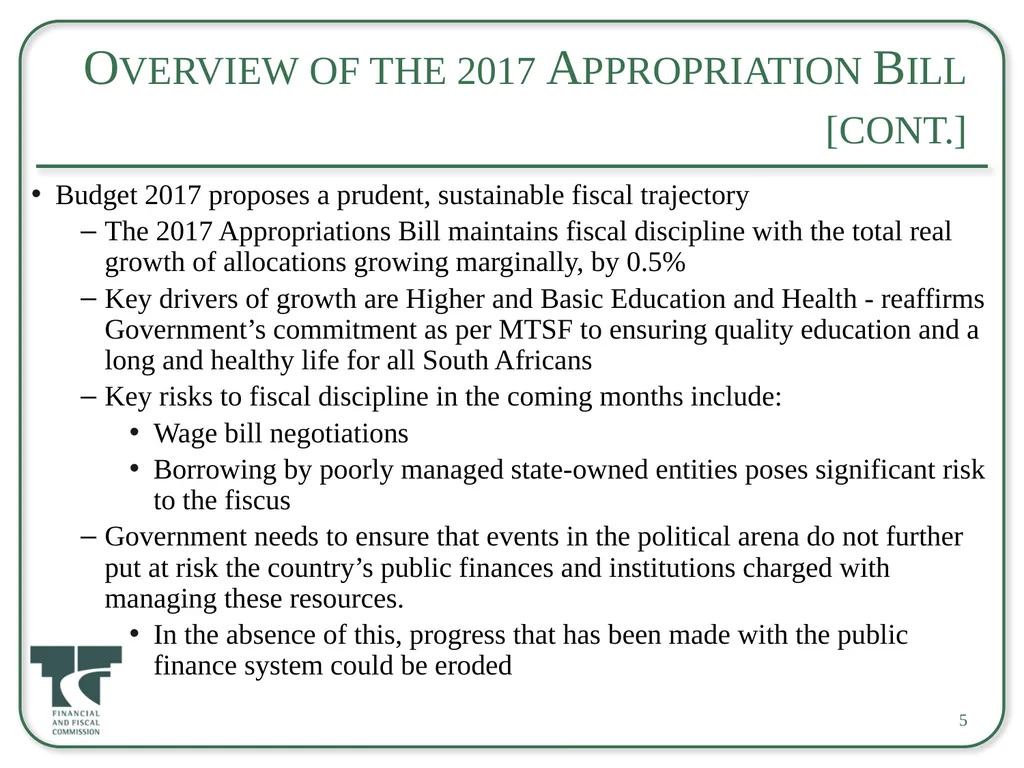
Overview of the 2017 Appropriation Bill [cont.] Budget 2017 proposes a prudent, sustainable fiscal trajectory
The 2017 Appropriations Bill maintains fiscal discipline with the total real growth of allocations growing marginally, by 0.5%
Key drivers of growth are Higher and Basic Education and Health - reaffirms Government’s commitment as per MTSF to ensuring quality education and a long and healthy life for all South Africans
Key risks to fiscal discipline in the coming months include:
Wage bill negotiations
Borrowing by poorly managed state-owned entities poses significant risk to the fiscus
Government needs to ensure that events in the political arena do not further put at risk the country’s public finances and institutions charged with managing these resources.
In the absence of this, progress that has been made with the public finance system could be eroded 5<br>
The 2017 Appropriations Bill maintains fiscal discipline with the total real growth of allocations growing marginally, by 0.5%
Key drivers of growth are Higher and Basic Education and Health - reaffirms Government’s commitment as per MTSF to ensuring quality education and a long and healthy life for all South Africans
Key risks to fiscal discipline in the coming months include:
Wage bill negotiations
Borrowing by poorly managed state-owned entities poses significant risk to the fiscus
Government needs to ensure that events in the political arena do not further put at risk the country’s public finances and institutions charged with managing these resources.
In the absence of this, progress that has been made with the public finance system could be eroded 5<br>
06
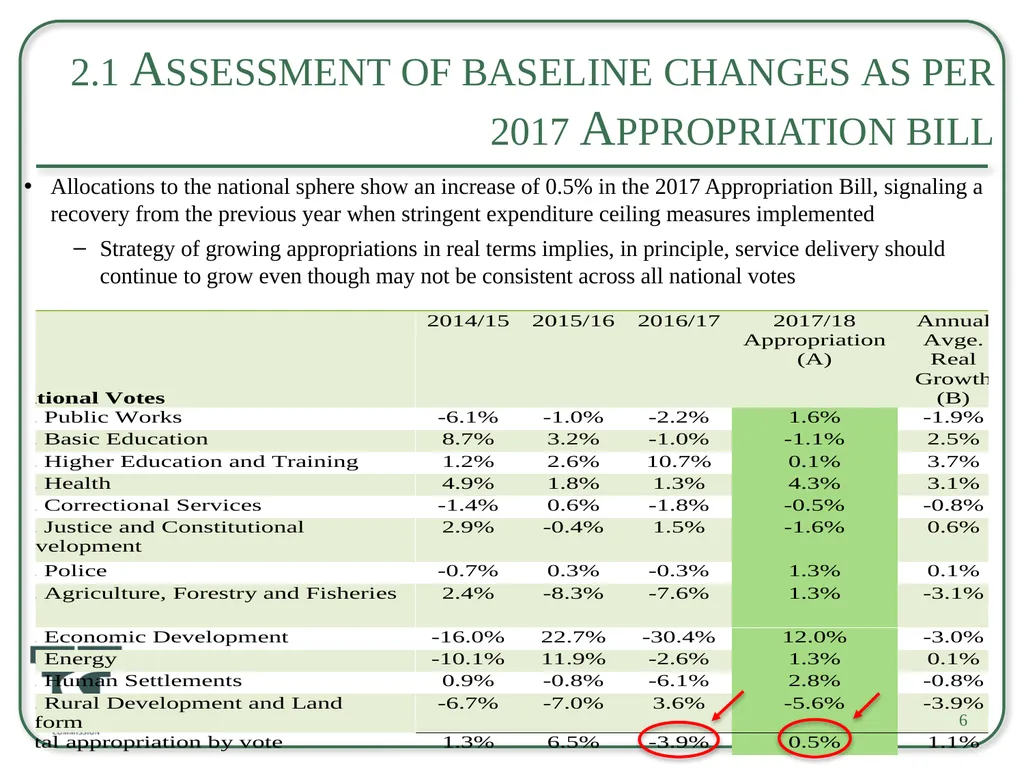
2.1 Assessment of baseline changes as per 2017 Appropriation bill Allocations to the national sphere show an increase of 0.5% in the 2017 Appropriation Bill, signaling a recovery from the previous year when stringent expenditure ceiling measures implemented
Strategy of growing appropriations in real terms implies, in principle, service delivery should continue to grow even though may not be consistent across all national votes 6<br>
Strategy of growing appropriations in real terms implies, in principle, service delivery should continue to grow even though may not be consistent across all national votes 6<br>
07
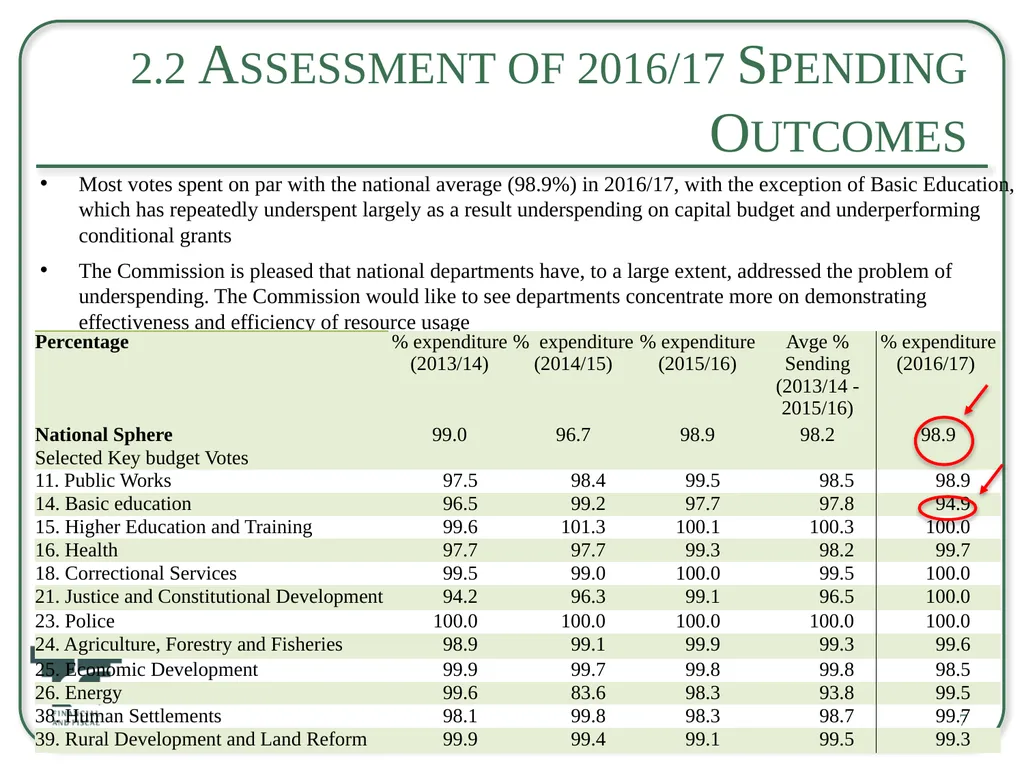
2.2 Assessment of 2016/17 Spending Outcomes Most votes spent on par with the national average (98.9%) in 2016/17, with the exception of Basic Education, which has repeatedly underspent largely as a result underspending on capital budget and underperforming conditional grants
The Commission is pleased that national departments have, to a large extent, addressed the problem of underspending. The Commission would like to see departments concentrate more on demonstrating effectiveness and efficiency of resource usage 7<br>
The Commission is pleased that national departments have, to a large extent, addressed the problem of underspending. The Commission would like to see departments concentrate more on demonstrating effectiveness and efficiency of resource usage 7<br>
08
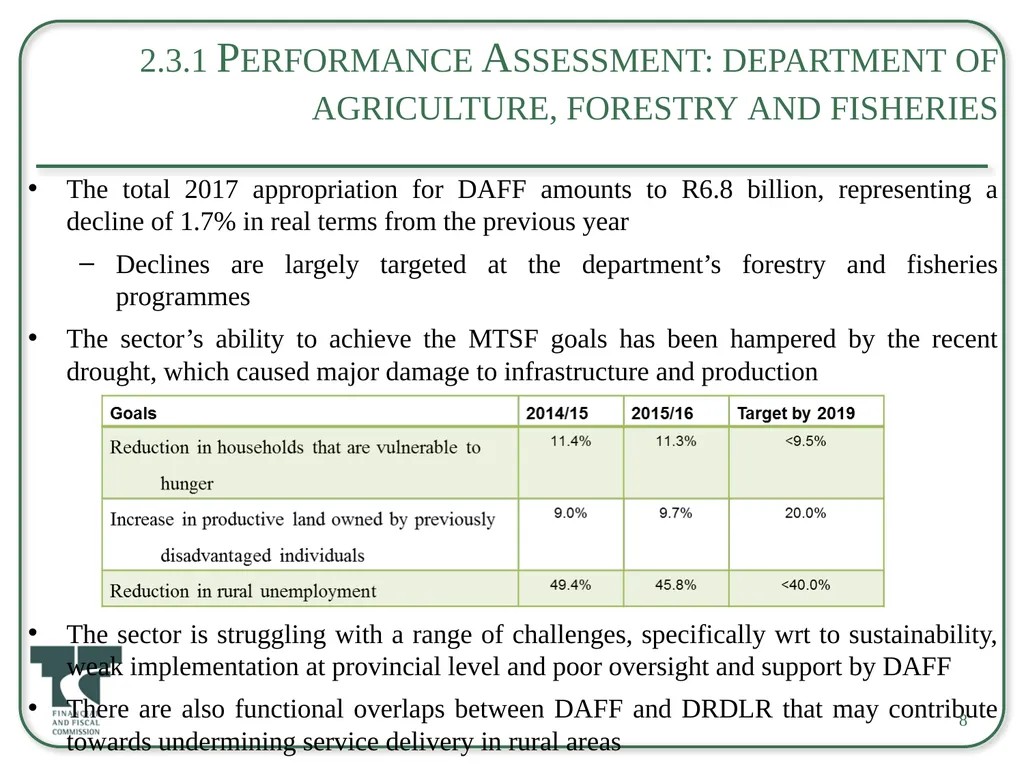
2.3.1 Performance Assessment: department of agriculture, forestry and fisheries The total 2017 appropriation for DAFF amounts to R6.8 billion, representing a decline of 1.7% in real terms from the previous year
Declines are largely targeted at the department’s forestry and fisheries programmes
The sector’s ability to achieve the MTSF goals has been hampered by the recent drought, which caused major damage to infrastructure and production
The sector is struggling with a range of challenges, specifically wrt to sustainability, weak implementation at provincial level and poor oversight and support by DAFF
There are also functional overlaps between DAFF and DRDLR that may contribute towards undermining service delivery in rural areas 8<br>
Declines are largely targeted at the department’s forestry and fisheries programmes
The sector’s ability to achieve the MTSF goals has been hampered by the recent drought, which caused major damage to infrastructure and production
The sector is struggling with a range of challenges, specifically wrt to sustainability, weak implementation at provincial level and poor oversight and support by DAFF
There are also functional overlaps between DAFF and DRDLR that may contribute towards undermining service delivery in rural areas 8<br>
09
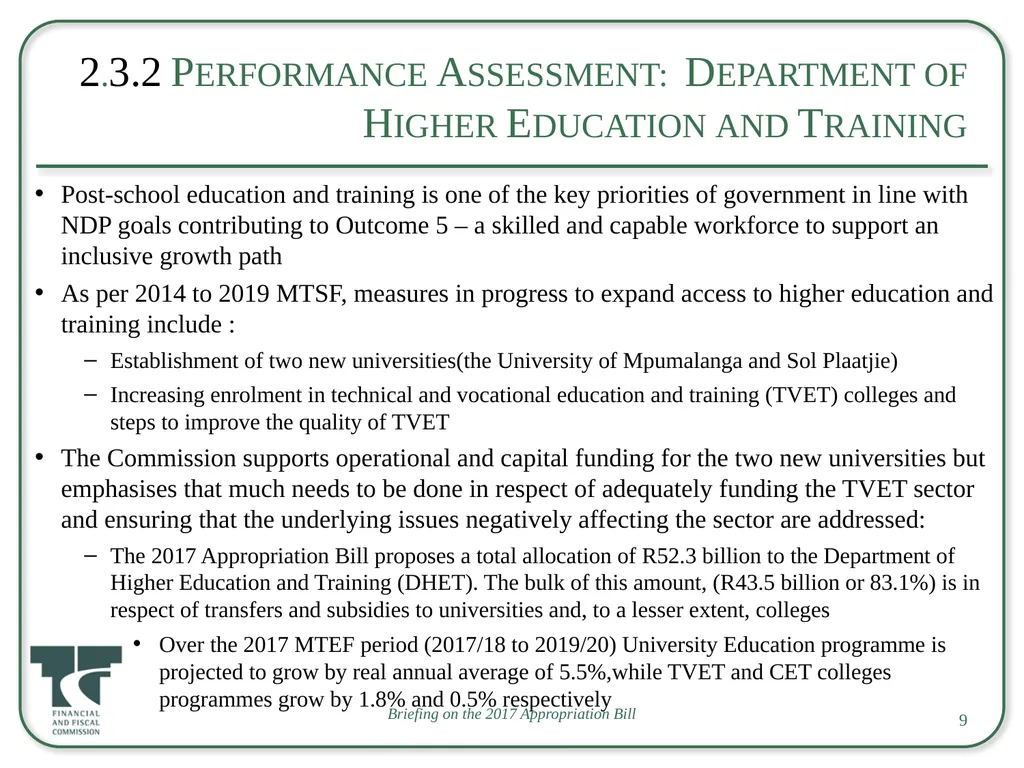
Briefing on the 2017 Appropriation Bill 2.3.2 Performance Assessment: Department of Higher Education and Training Post-school education and training is one of the key priorities of government in line with NDP goals contributing to Outcome 5 – a skilled and capable workforce to support an inclusive growth path
As per 2014 to 2019 MTSF, measures in progress to expand access to higher education and training include :
Establishment of two new universities(the University of Mpumalanga and Sol Plaatjie)
Increasing enrolment in technical and vocational education and training (TVET) colleges and steps to improve the quality of TVET
The Commission supports operational and capital funding for the two new universities but emphasises that much needs to be done in respect of adequately funding the TVET sector and ensuring that the underlying issues negatively affecting the sector are addressed:
The 2017 Appropriation Bill proposes a total allocation of R52.3 billion to the Department of Higher Education and Training (DHET). The bulk of this amount, (R43.5 billion or 83.1%) is in respect of transfers and subsidies to universities and, to a lesser extent, colleges
Over the 2017 MTEF period (2017/18 to 2019/20) University Education programme is projected to grow by real annual average of 5.5%,while TVET and CET colleges programmes grow by 1.8% and 0.5% respectively 9<br>
As per 2014 to 2019 MTSF, measures in progress to expand access to higher education and training include :
Establishment of two new universities(the University of Mpumalanga and Sol Plaatjie)
Increasing enrolment in technical and vocational education and training (TVET) colleges and steps to improve the quality of TVET
The Commission supports operational and capital funding for the two new universities but emphasises that much needs to be done in respect of adequately funding the TVET sector and ensuring that the underlying issues negatively affecting the sector are addressed:
The 2017 Appropriation Bill proposes a total allocation of R52.3 billion to the Department of Higher Education and Training (DHET). The bulk of this amount, (R43.5 billion or 83.1%) is in respect of transfers and subsidies to universities and, to a lesser extent, colleges
Over the 2017 MTEF period (2017/18 to 2019/20) University Education programme is projected to grow by real annual average of 5.5%,while TVET and CET colleges programmes grow by 1.8% and 0.5% respectively 9<br>
10
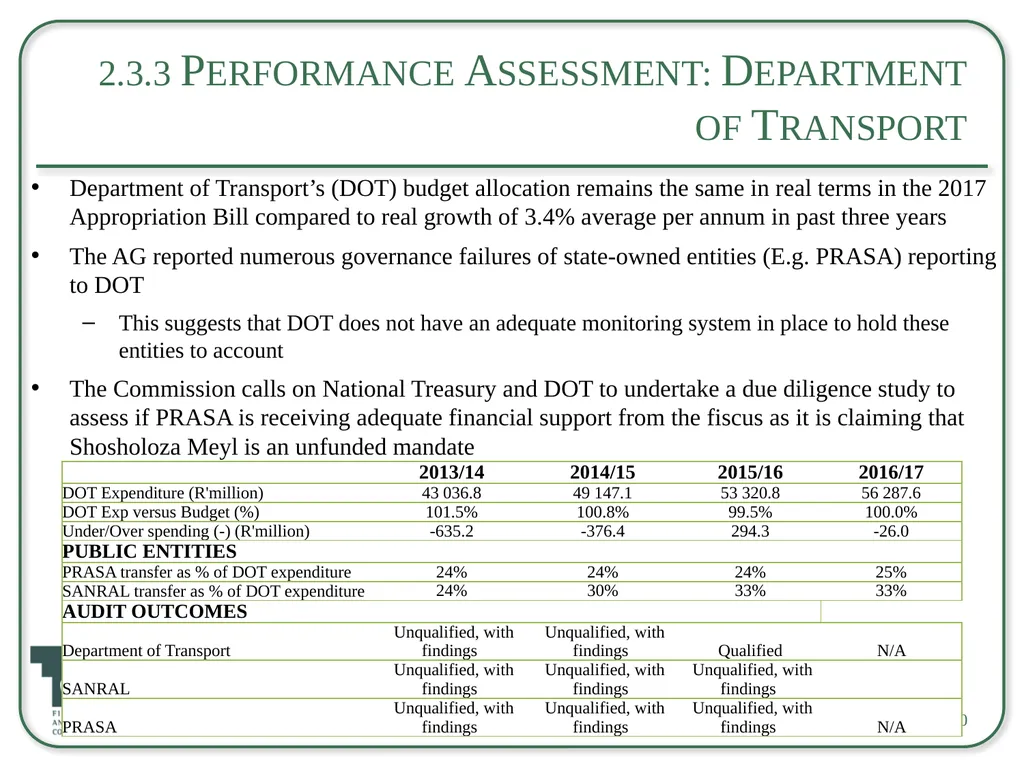
2.3.3 Performance Assessment: Department of Transport Department of Transport’s (DOT) budget allocation remains the same in real terms in the 2017 Appropriation Bill compared to real growth of 3.4% average per annum in past three years
The AG reported numerous governance failures of state-owned entities (E.g. PRASA) reporting to DOT
This suggests that DOT does not have an adequate monitoring system in place to hold these entities to account
The Commission calls on National Treasury and DOT to undertake a due diligence study to assess if PRASA is receiving adequate financial support from the fiscus as it is claiming that Shosholoza Meyl is an unfunded mandate 10<br>
The AG reported numerous governance failures of state-owned entities (E.g. PRASA) reporting to DOT
This suggests that DOT does not have an adequate monitoring system in place to hold these entities to account
The Commission calls on National Treasury and DOT to undertake a due diligence study to assess if PRASA is receiving adequate financial support from the fiscus as it is claiming that Shosholoza Meyl is an unfunded mandate 10<br>
11
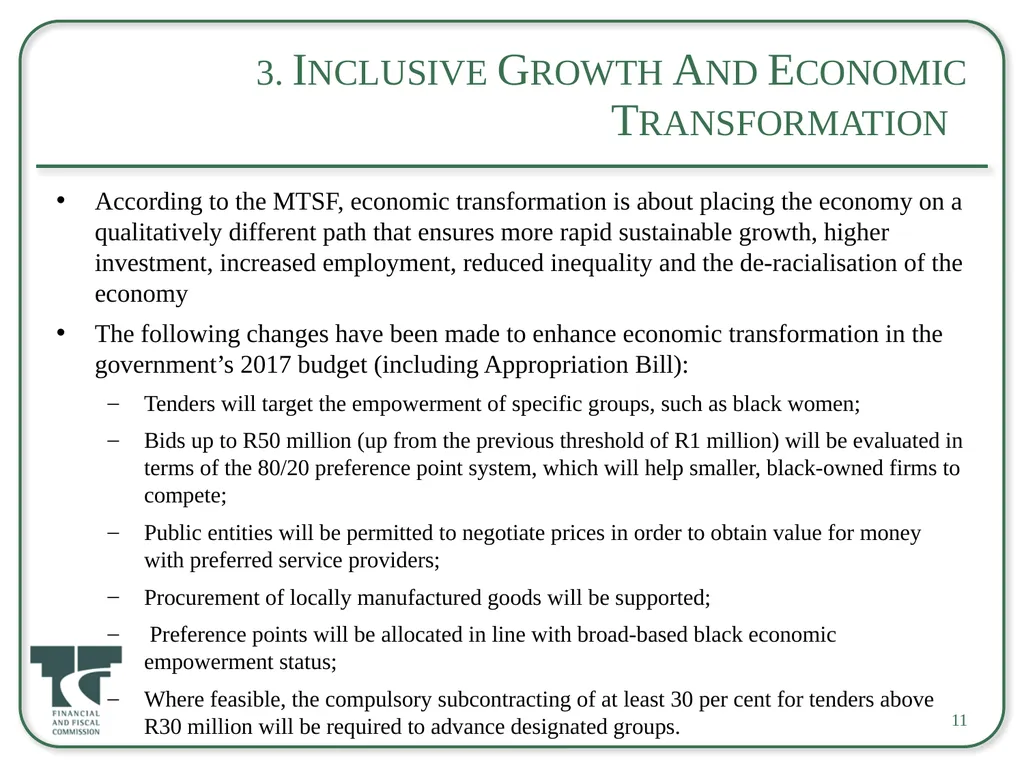
3. Inclusive Growth And Economic Transformation According to the MTSF, economic transformation is about placing the economy on a qualitatively different path that ensures more rapid sustainable growth, higher investment, increased employment, reduced inequality and the de-racialisation of the economy
The following changes have been made to enhance economic transformation in the government’s 2017 budget (including Appropriation Bill):
Tenders will target the empowerment of specific groups, such as black women;
Bids up to R50 million (up from the previous threshold of R1 million) will be evaluated in terms of the 80/20 preference point system, which will help smaller, black-owned firms to compete;
Public entities will be permitted to negotiate prices in order to obtain value for money with preferred service providers;
Procurement of locally manufactured goods will be supported;
Preference points will be allocated in line with broad-based black economic empowerment status;
Where feasible, the compulsory subcontracting of at least 30 per cent for tenders above R30 million will be required to advance designated groups. 11<br>
The following changes have been made to enhance economic transformation in the government’s 2017 budget (including Appropriation Bill):
Tenders will target the empowerment of specific groups, such as black women;
Bids up to R50 million (up from the previous threshold of R1 million) will be evaluated in terms of the 80/20 preference point system, which will help smaller, black-owned firms to compete;
Public entities will be permitted to negotiate prices in order to obtain value for money with preferred service providers;
Procurement of locally manufactured goods will be supported;
Preference points will be allocated in line with broad-based black economic empowerment status;
Where feasible, the compulsory subcontracting of at least 30 per cent for tenders above R30 million will be required to advance designated groups. 11<br>
12
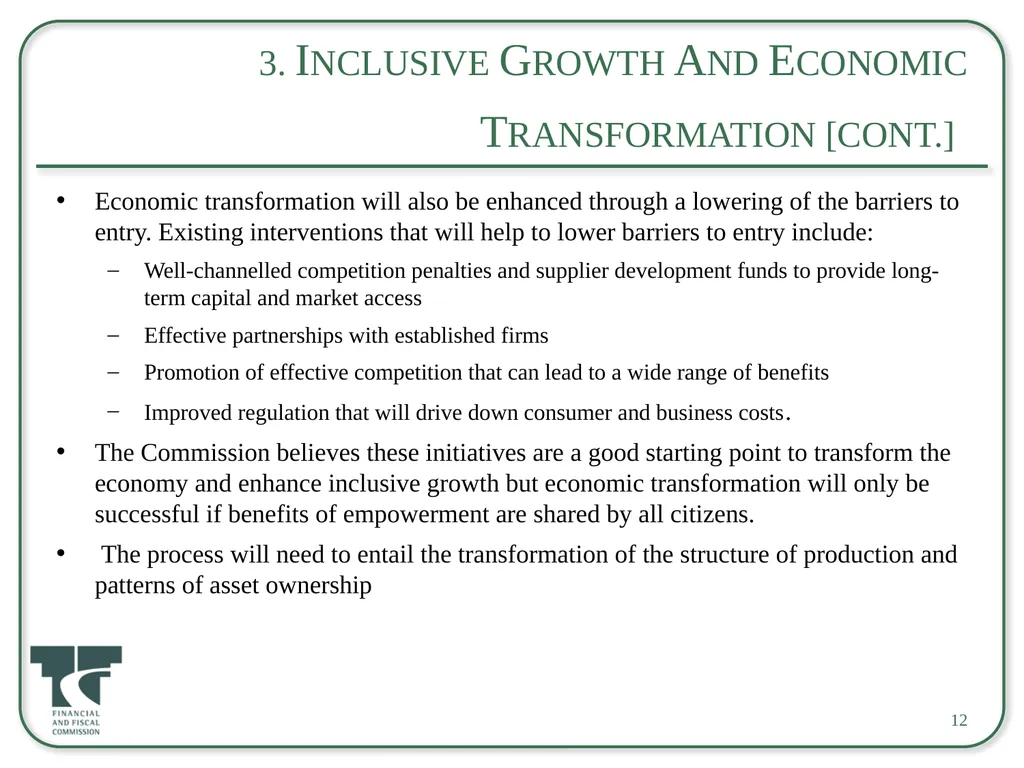
3. Inclusive Growth And Economic Transformation [cont.] Economic transformation will also be enhanced through a lowering of the barriers to entry. Existing interventions that will help to lower barriers to entry include:
Well-channelled competition penalties and supplier development funds to provide long-term capital and market access
Effective partnerships with established firms
Promotion of effective competition that can lead to a wide range of benefits
Improved regulation that will drive down consumer and business costs.
The Commission believes these initiatives are a good starting point to transform the economy and enhance inclusive growth but economic transformation will only be successful if benefits of empowerment are shared by all citizens.
The process will need to entail the transformation of the structure of production and patterns of asset ownership 12<br>
Well-channelled competition penalties and supplier development funds to provide long-term capital and market access
Effective partnerships with established firms
Promotion of effective competition that can lead to a wide range of benefits
Improved regulation that will drive down consumer and business costs.
The Commission believes these initiatives are a good starting point to transform the economy and enhance inclusive growth but economic transformation will only be successful if benefits of empowerment are shared by all citizens.
The process will need to entail the transformation of the structure of production and patterns of asset ownership 12<br>
13
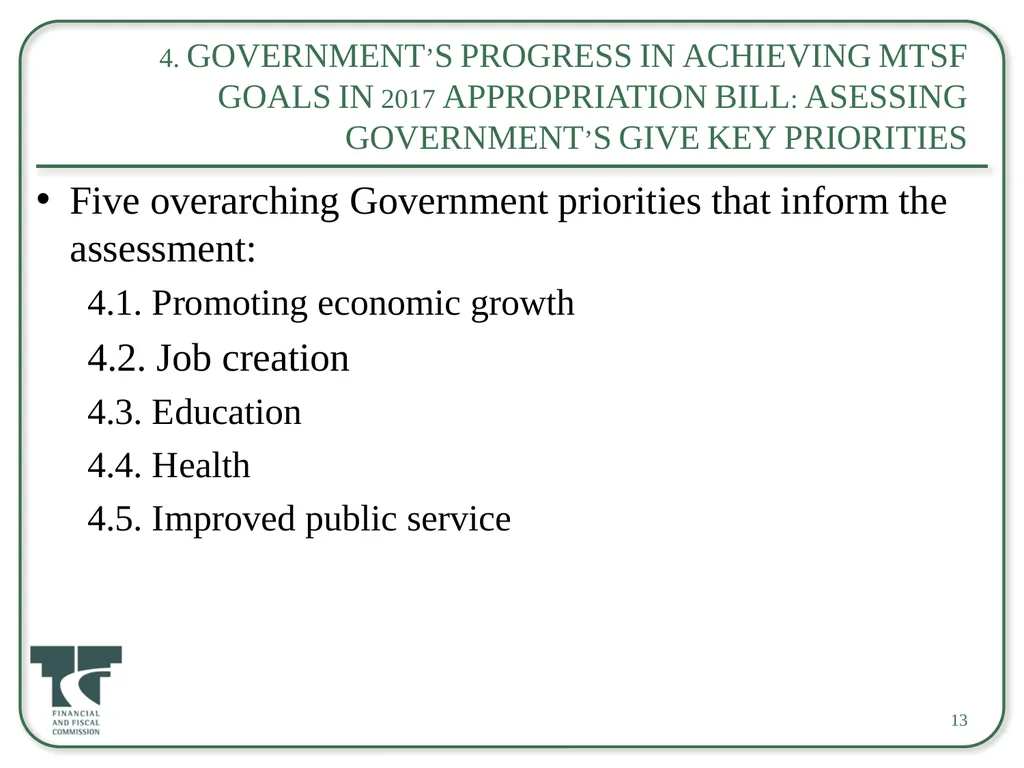
4. GOVERNMENT’S PROGRESS IN ACHIEVING MTSF GOALS IN 2017 APPROPRIATION BILL: ASESSING GOVERNMENT’S GIVE KEY PRIORITIES Five overarching Government priorities that inform the assessment:
4.1. Promoting economic growth
4.2. Job creation
4.3. Education
4.4. Health
4.5. Improved public service 13<br>
4.1. Promoting economic growth
4.2. Job creation
4.3. Education
4.4. Health
4.5. Improved public service 13<br>
14
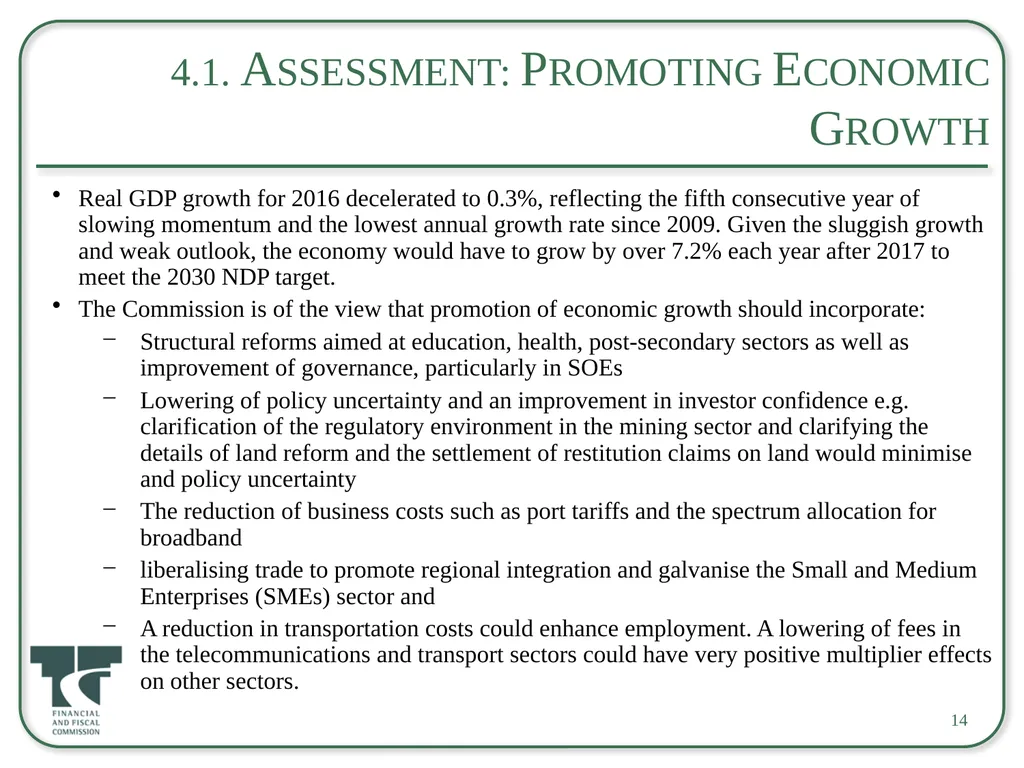
4.1. Assessment: Promoting Economic Growth 14 Real GDP growth for 2016 decelerated to 0.3%, reflecting the fifth consecutive year of slowing momentum and the lowest annual growth rate since 2009. Given the sluggish growth and weak outlook, the economy would have to grow by over 7.2% each year after 2017 to meet the 2030 NDP target.
The Commission is of the view that promotion of economic growth should incorporate:
Structural reforms aimed at education, health, post-secondary sectors as well as improvement of governance, particularly in SOEs
Lowering of policy uncertainty and an improvement in investor confidence e.g. clarification of the regulatory environment in the mining sector and clarifying the details of land reform and the settlement of restitution claims on land would minimise and policy uncertainty
The reduction of business costs such as port tariffs and the spectrum allocation for broadband
liberalising trade to promote regional integration and galvanise the Small and Medium Enterprises (SMEs) sector and
A reduction in transportation costs could enhance employment. A lowering of fees in the telecommunications and transport sectors could have very positive multiplier effects on other sectors.<br>
The Commission is of the view that promotion of economic growth should incorporate:
Structural reforms aimed at education, health, post-secondary sectors as well as improvement of governance, particularly in SOEs
Lowering of policy uncertainty and an improvement in investor confidence e.g. clarification of the regulatory environment in the mining sector and clarifying the details of land reform and the settlement of restitution claims on land would minimise and policy uncertainty
The reduction of business costs such as port tariffs and the spectrum allocation for broadband
liberalising trade to promote regional integration and galvanise the Small and Medium Enterprises (SMEs) sector and
A reduction in transportation costs could enhance employment. A lowering of fees in the telecommunications and transport sectors could have very positive multiplier effects on other sectors.<br>
15
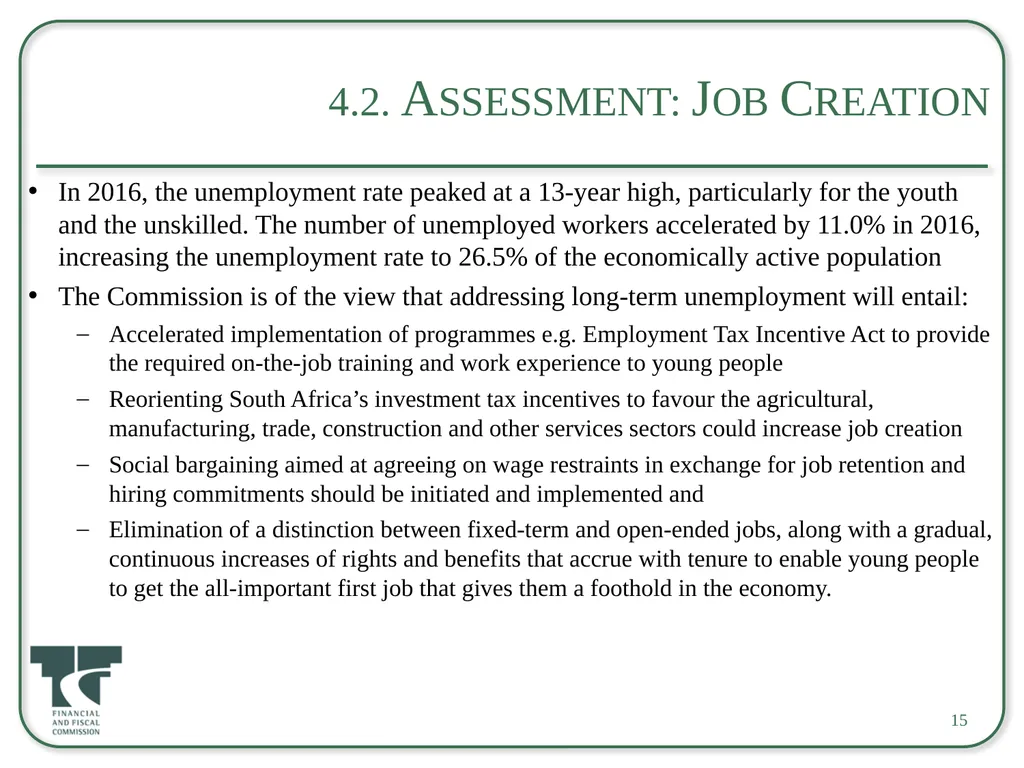
4.2. Assessment: Job Creation In 2016, the unemployment rate peaked at a 13-year high, particularly for the youth and the unskilled. The number of unemployed workers accelerated by 11.0% in 2016, increasing the unemployment rate to 26.5% of the economically active population
The Commission is of the view that addressing long-term unemployment will entail:
Accelerated implementation of programmes e.g. Employment Tax Incentive Act to provide the required on-the-job training and work experience to young people
Reorienting South Africa’s investment tax incentives to favour the agricultural, manufacturing, trade, construction and other services sectors could increase job creation
Social bargaining aimed at agreeing on wage restraints in exchange for job retention and hiring commitments should be initiated and implemented and
Elimination of a distinction between fixed-term and open-ended jobs, along with a gradual, continuous increases of rights and benefits that accrue with tenure to enable young people to get the all-important first job that gives them a foothold in the economy. 15<br>
The Commission is of the view that addressing long-term unemployment will entail:
Accelerated implementation of programmes e.g. Employment Tax Incentive Act to provide the required on-the-job training and work experience to young people
Reorienting South Africa’s investment tax incentives to favour the agricultural, manufacturing, trade, construction and other services sectors could increase job creation
Social bargaining aimed at agreeing on wage restraints in exchange for job retention and hiring commitments should be initiated and implemented and
Elimination of a distinction between fixed-term and open-ended jobs, along with a gradual, continuous increases of rights and benefits that accrue with tenure to enable young people to get the all-important first job that gives them a foothold in the economy. 15<br>
16
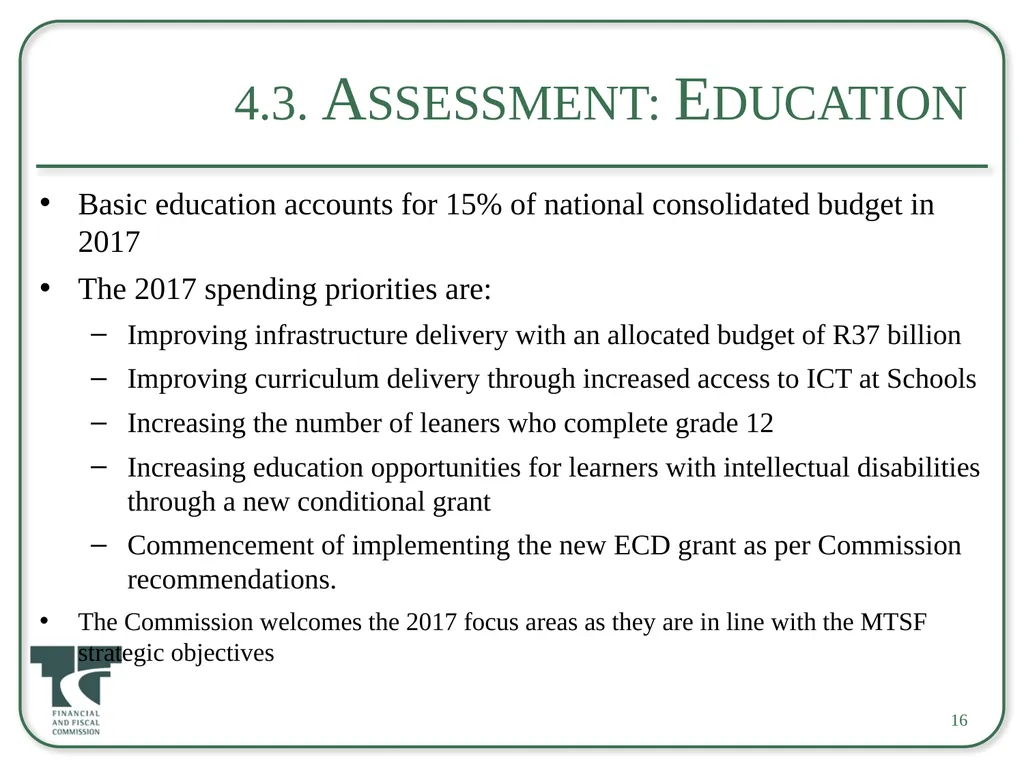
4.3. Assessment: Education Basic education accounts for 15% of national consolidated budget in 2017
The 2017 spending priorities are:
Improving infrastructure delivery with an allocated budget of R37 billion
Improving curriculum delivery through increased access to ICT at Schools
Increasing the number of leaners who complete grade 12
Increasing education opportunities for learners with intellectual disabilities through a new conditional grant
Commencement of implementing the new ECD grant as per Commission recommendations.
The Commission welcomes the 2017 focus areas as they are in line with the MTSF strategic objectives 16<br>
The 2017 spending priorities are:
Improving infrastructure delivery with an allocated budget of R37 billion
Improving curriculum delivery through increased access to ICT at Schools
Increasing the number of leaners who complete grade 12
Increasing education opportunities for learners with intellectual disabilities through a new conditional grant
Commencement of implementing the new ECD grant as per Commission recommendations.
The Commission welcomes the 2017 focus areas as they are in line with the MTSF strategic objectives 16<br>
17
4.4. Assessment: Health Health is allocated R184 billion in 2017/18 growing to R224 billion in 2019/20
Key spending priorities for 2017/16 are:
Expansion of the HIV/AIDS program with a budget allocation of R17 billion
With 3.5 million people receiving anti-retrovirals, government is making progress toward meeting MTSF delivery target of 5.1 million
Treatment of tuberculosis
Estimates indicate that the TB cure rate improved significantly from 54.0% in 2000 to 78.0% in 2015.
Compensation of employees continue to account for a bigger proportion of health budget (62%)
For the 2017/18 COE allocation growth rate is contained at 7% 17<br>
Key spending priorities for 2017/16 are:
Expansion of the HIV/AIDS program with a budget allocation of R17 billion
With 3.5 million people receiving anti-retrovirals, government is making progress toward meeting MTSF delivery target of 5.1 million
Treatment of tuberculosis
Estimates indicate that the TB cure rate improved significantly from 54.0% in 2000 to 78.0% in 2015.
Compensation of employees continue to account for a bigger proportion of health budget (62%)
For the 2017/18 COE allocation growth rate is contained at 7% 17<br>
18
4.5. Improved Public Service A capable state is required to achieve goals in the MTSF and NDP
Spending on general public administration increases from R45.2 billion in 2016/17 to R46.8 billion in 2017/18
The increase is meant to enhance Batho Pele initiative and implementation of Public Service Charter. These initiatives aim to improve accountability to citizens and are also priority areas in the MTSF
Further measures adopted in the 2017 Appropriation Bill to achieve MTSF goal of strengthening public service delivery are enhancing systems aimed at inspecting service delivery sites and conducting citizen surveys
The Commission views onsite service delivery visits as a critical oversight initiative that should become standard monitoring practise in all spheres of government
To avoid unintended consequences of cost containment measures on filling critical posts, the Commission notes the establishment of a recruitment committee that reports a turnaround time on filling vacant posts of 4-5 weeks
The Commission urges the committee to examine governance failures in national departments (e.g. DOT) that resulted partly due to delays in filling vacant critical posts 18<br>
Spending on general public administration increases from R45.2 billion in 2016/17 to R46.8 billion in 2017/18
The increase is meant to enhance Batho Pele initiative and implementation of Public Service Charter. These initiatives aim to improve accountability to citizens and are also priority areas in the MTSF
Further measures adopted in the 2017 Appropriation Bill to achieve MTSF goal of strengthening public service delivery are enhancing systems aimed at inspecting service delivery sites and conducting citizen surveys
The Commission views onsite service delivery visits as a critical oversight initiative that should become standard monitoring practise in all spheres of government
To avoid unintended consequences of cost containment measures on filling critical posts, the Commission notes the establishment of a recruitment committee that reports a turnaround time on filling vacant posts of 4-5 weeks
The Commission urges the committee to examine governance failures in national departments (e.g. DOT) that resulted partly due to delays in filling vacant critical posts 18<br>
19
5. Infrastructure Investment Investment in infrastructure is essential for sustaining economic growth
Over the 2017/18 MTEF consolidated government infrastructure amounts to R970 billion of which two –thirds are targeted at human settlements and municipal infrastructure
Infrastructure spent has been delivering sub-optimal outcomes largely as a result of poorly designed and managed infrastructure projects
To achieve sustained economic growth aligned and coordinated infrastructure investment plans should remain a key priority for government
The Commission would like to emphasize that while investment in new infrastructure is critical, management of existing infrastructure is also equally important. 19<br>
Over the 2017/18 MTEF consolidated government infrastructure amounts to R970 billion of which two –thirds are targeted at human settlements and municipal infrastructure
Infrastructure spent has been delivering sub-optimal outcomes largely as a result of poorly designed and managed infrastructure projects
To achieve sustained economic growth aligned and coordinated infrastructure investment plans should remain a key priority for government
The Commission would like to emphasize that while investment in new infrastructure is critical, management of existing infrastructure is also equally important. 19<br>
20
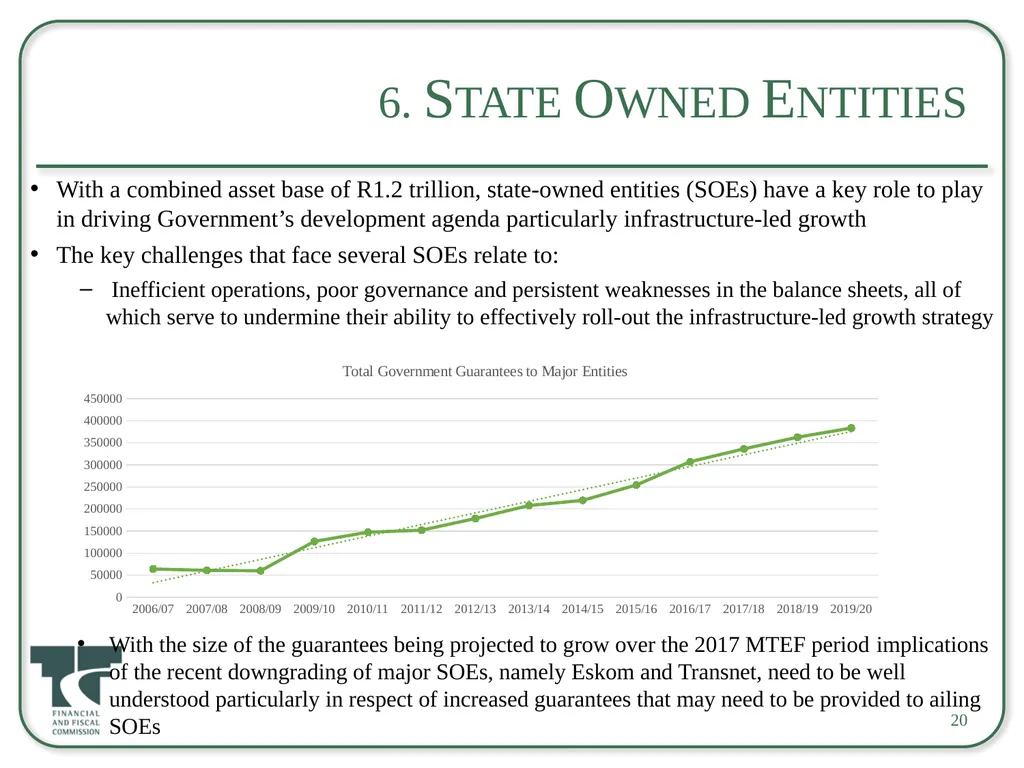
6. State Owned Entities With a combined asset base of R1.2 trillion, state-owned entities (SOEs) have a key role to play in driving Government’s development agenda particularly infrastructure-led growth
The key challenges that face several SOEs relate to:
Inefficient operations, poor governance and persistent weaknesses in the balance sheets, all of which serve to undermine their ability to effectively roll-out the infrastructure-led growth strategy 20 With the size of the guarantees being projected to grow over the 2017 MTEF period implications of the recent downgrading of major SOEs, namely Eskom and Transnet, need to be well understood particularly in respect of increased guarantees that may need to be provided to ailing SOEs<br>
The key challenges that face several SOEs relate to:
Inefficient operations, poor governance and persistent weaknesses in the balance sheets, all of which serve to undermine their ability to effectively roll-out the infrastructure-led growth strategy 20 With the size of the guarantees being projected to grow over the 2017 MTEF period implications of the recent downgrading of major SOEs, namely Eskom and Transnet, need to be well understood particularly in respect of increased guarantees that may need to be provided to ailing SOEs<br>
21
7. Measures to Stimulate Cost Efficiencies The Commission continues to be concerned about glaring efficiency gaps characterising public sector procurement, spending, and service delivery right across all spheres of government
High incidences of wasteful, irregular and unauthorised expenditure remain a major challenge in the public sector
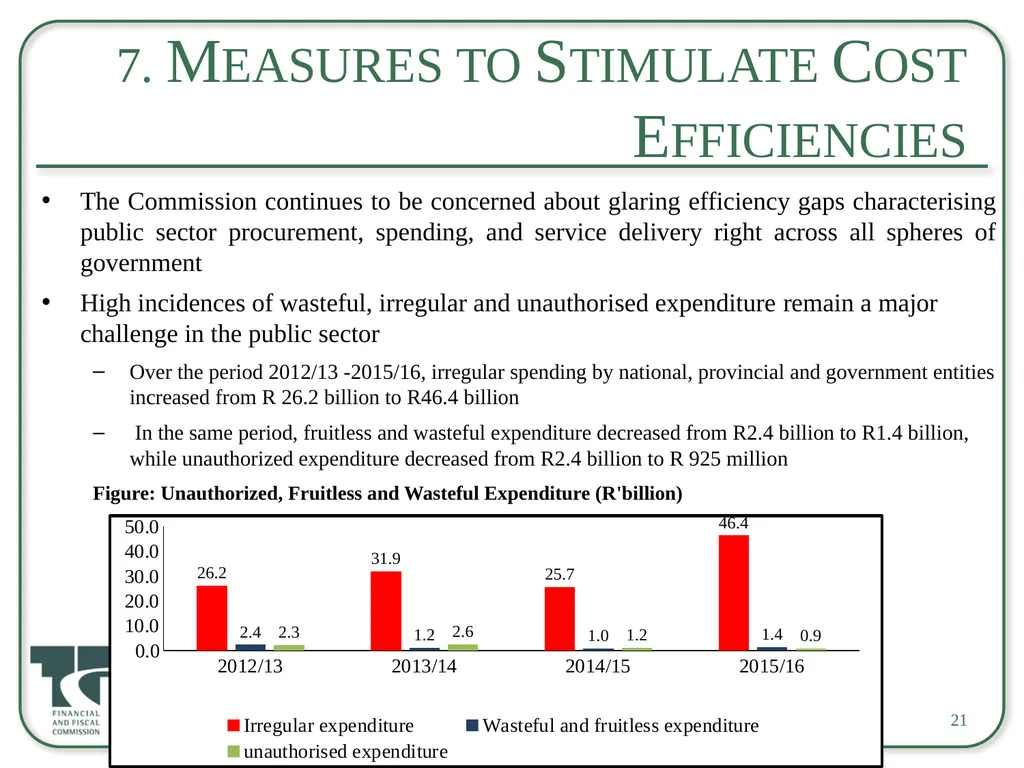
Over the period 2012/13 -2015/16, irregular spending by national, provincial and government entities increased from R 26.2 billion to R46.4 billion
In the same period, fruitless and wasteful expenditure decreased from R2.4 billion to R1.4 billion, while unauthorized expenditure decreased from R2.4 billion to R 925 million
Figure: Unauthorized, Fruitless and Wasteful Expenditure (R'billion) 21<br>
High incidences of wasteful, irregular and unauthorised expenditure remain a major challenge in the public sector
Over the period 2012/13 -2015/16, irregular spending by national, provincial and government entities increased from R 26.2 billion to R46.4 billion
In the same period, fruitless and wasteful expenditure decreased from R2.4 billion to R1.4 billion, while unauthorized expenditure decreased from R2.4 billion to R 925 million
Figure: Unauthorized, Fruitless and Wasteful Expenditure (R'billion) 21<br>
22
7. Measures to Stimulate Cost Efficiencies [cont.] The Commission believes the bedrock to stimulating government cost efficiencies involves developing and instilling a culture that is intolerant of waste among all workers and across all organs of state and developing a culture of innovation and provision of incentives/sanctions across all the three spheres of government
The Commission has also identified the following areas to improve public sector efficiency
PROCUREMENT
The Commission notes that the establishment of the CPO at NT has greatly improved cost efficiencies. However the Commission is concerned with the proliferation of supply chain management transgressions by all layers of government, especially the flouting of the provisions of Section 117 of the Constitution, the PFMA and MFMA
While R25 billion has been saved from procurement processes more needs to be done, including professionalising procurement across all national government departments, provinces and municipalities; minimising outsourcing of jobs that can best be performed by civil servants; establishing guides on when outsourcing is or is not appropriate; and leveraging on modern technologies in procurement and contracting 22<br>
The Commission has also identified the following areas to improve public sector efficiency
PROCUREMENT
The Commission notes that the establishment of the CPO at NT has greatly improved cost efficiencies. However the Commission is concerned with the proliferation of supply chain management transgressions by all layers of government, especially the flouting of the provisions of Section 117 of the Constitution, the PFMA and MFMA
While R25 billion has been saved from procurement processes more needs to be done, including professionalising procurement across all national government departments, provinces and municipalities; minimising outsourcing of jobs that can best be performed by civil servants; establishing guides on when outsourcing is or is not appropriate; and leveraging on modern technologies in procurement and contracting 22<br>
23
7. Measures to Stimulate Cost Efficiencies [cont.] PUBLIC SECTOR WAGE BILL
Over the 2017 MTEF, the wage bill is expected to grow by 7.2% per year and to account for approximately 35.5% of consolidated government spending, thereby crowding out other government priority expenditures and forcing sector departments to reallocate funding from priority areas to fund the wage bill
The Commission notes the projected cuts on the public sector compensation budget limits for the 2017 MTEF, however, the Commission believes efficiencies will also be gained by linking the public sector wage bill to public sector productivity; leveraging on the latest technologies in the provision of public goods and services; and investing more in monitoring and evaluation capabilities across all government spheres
IMPROVING EFFICIENCIES IN MUNICIPAL SPACES
Municipalities should always ensure that all their investments reflect good value for money, they minimize costs of service delivery, and tariffs are cost reflective
Among other things, municipalities should endeavour to leverage on modern technologies in the provision of electricity and water, cut energy expenses through energy saving measures; reduce water and electricity loses, improve billing systems and ensure repairs and maintenance of infrastructure are done on a regular basis 23<br>
Over the 2017 MTEF, the wage bill is expected to grow by 7.2% per year and to account for approximately 35.5% of consolidated government spending, thereby crowding out other government priority expenditures and forcing sector departments to reallocate funding from priority areas to fund the wage bill
The Commission notes the projected cuts on the public sector compensation budget limits for the 2017 MTEF, however, the Commission believes efficiencies will also be gained by linking the public sector wage bill to public sector productivity; leveraging on the latest technologies in the provision of public goods and services; and investing more in monitoring and evaluation capabilities across all government spheres
IMPROVING EFFICIENCIES IN MUNICIPAL SPACES
Municipalities should always ensure that all their investments reflect good value for money, they minimize costs of service delivery, and tariffs are cost reflective
Among other things, municipalities should endeavour to leverage on modern technologies in the provision of electricity and water, cut energy expenses through energy saving measures; reduce water and electricity loses, improve billing systems and ensure repairs and maintenance of infrastructure are done on a regular basis 23<br>
24
8. Conclusion The 2017 Appropriation Bill continues the same trend of both the 2017 Division of Revenue Bill and Fiscal Frameworks, and Revenue Proposals by keeping within the expenditure ceilings set by the 2017 Budget Review
As a response to low economic growth forecasts, Government continues with the thrust of balancing the need to protect social grants, while targeting non-core and non-performing programs as areas where expenditure can be cut and increasing taxes
The Commission calls on government to properly understand the consequences on the fiscus of the recent credit downgrades, and likely impact this may have on service delivery over the short-to-medium term. It also calls on government to outline measures to be taken to address any negative impact these downgrades could have on frontline services, job creation and economic growth 24<br>
As a response to low economic growth forecasts, Government continues with the thrust of balancing the need to protect social grants, while targeting non-core and non-performing programs as areas where expenditure can be cut and increasing taxes
The Commission calls on government to properly understand the consequences on the fiscus of the recent credit downgrades, and likely impact this may have on service delivery over the short-to-medium term. It also calls on government to outline measures to be taken to address any negative impact these downgrades could have on frontline services, job creation and economic growth 24<br>
25
Thank You. Financial and Fiscal Commission
Montrose Place (2nd Floor), Bekker Street,
Waterfall Park, Vorna Valley, Midrand,
Private Bag X69, Halfway House 1685
www.ffc.co.za
Tel: +27 11 207 2300
Fax: +27 86 589 1038<br>
Montrose Place (2nd Floor), Bekker Street,
Waterfall Park, Vorna Valley, Midrand,
Private Bag X69, Halfway House 1685
www.ffc.co.za
Tel: +27 11 207 2300
Fax: +27 86 589 1038<br>