
Briefing to Prospective Bidders Intervention to




Description: Briefing to Prospective Bidders Intervention to Enhance Finance and SCM Efficiencies Tender No: HP 14140 Presented by Tom Moir Finance Stabilisation 11December 2014 NDPW core business NDPW operating context Problem statement Expected
Related Topics
Download Presentation
"Briefing to Prospective Bidders Intervention to" is the property of its rightful owner. Permission is granted to download and print the materials on this website for personal, non-commercial use only, and to display it on your personal computer provided you do not modify the materials and that you retain all copyright notices contained in the materials. By downloading content from our website, you accept the terms of this agreement.
Presentation Transcript
slide1. Briefing to
Prospective Bidders
Intervention to Enhance Finance and SCM Efficiencies
Tender No: HP 14/140 Presented
by
Tom Moir
Finance Stabilisation 11December 2014<br>
slide2. NDPW core business
NDPW operating context
Problem statement
Expected outcomes
Summary of scope of services required
Project resourcing
Project deliverables
Other salient points
Project evaluation
Project costing CONTENTS<br>
slide3. NDPW Core Business<br>
slide4. Provider of accommodation for National government Departments
Enabler of sustainable economic growth through infrastructure development
Regulatory authority & leader in transforming the construction & property sectors
Lead co-ordinator in optimising state funding for job creation through Expanded Public Works Programme (“EPWP”) NDPW Core Business<br>
slide5. NDPW Operating Context<br>
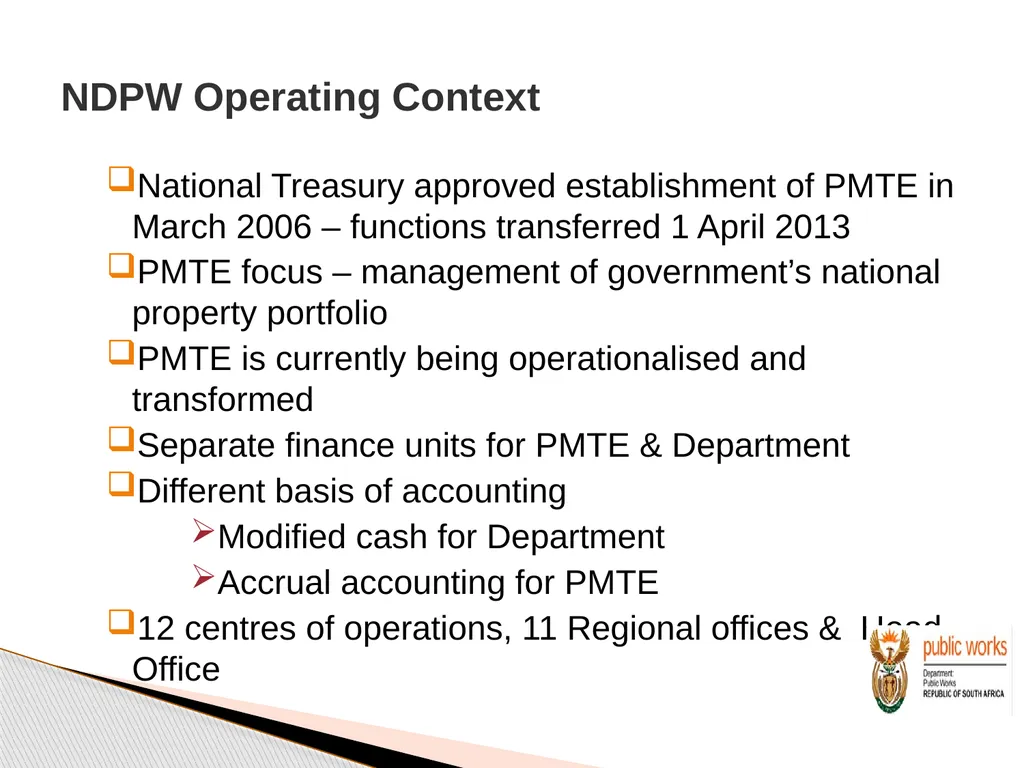
slide6. National Treasury approved establishment of PMTE in March 2006 – functions transferred 1 April 2013
PMTE focus – management of government’s national property portfolio
PMTE is currently being operationalised and transformed
Separate finance units for PMTE & Department
Different basis of accounting
Modified cash for Department
Accrual accounting for PMTE
12 centres of operations, 11 Regional offices & Head Office NDPW Operating Context<br>
slide7. Problem Statement
(Why this intervention?)<br>
slide8. Need to sustain the gains made with the stabilisation intervention
Historic negative outcomes starting to change
Main Account unqualified – various non compliance matters and performance management of concern
PMTE Qualified on the basis of:
Irregular expenditure
Accruals
Leases management Audit outcomes<br>
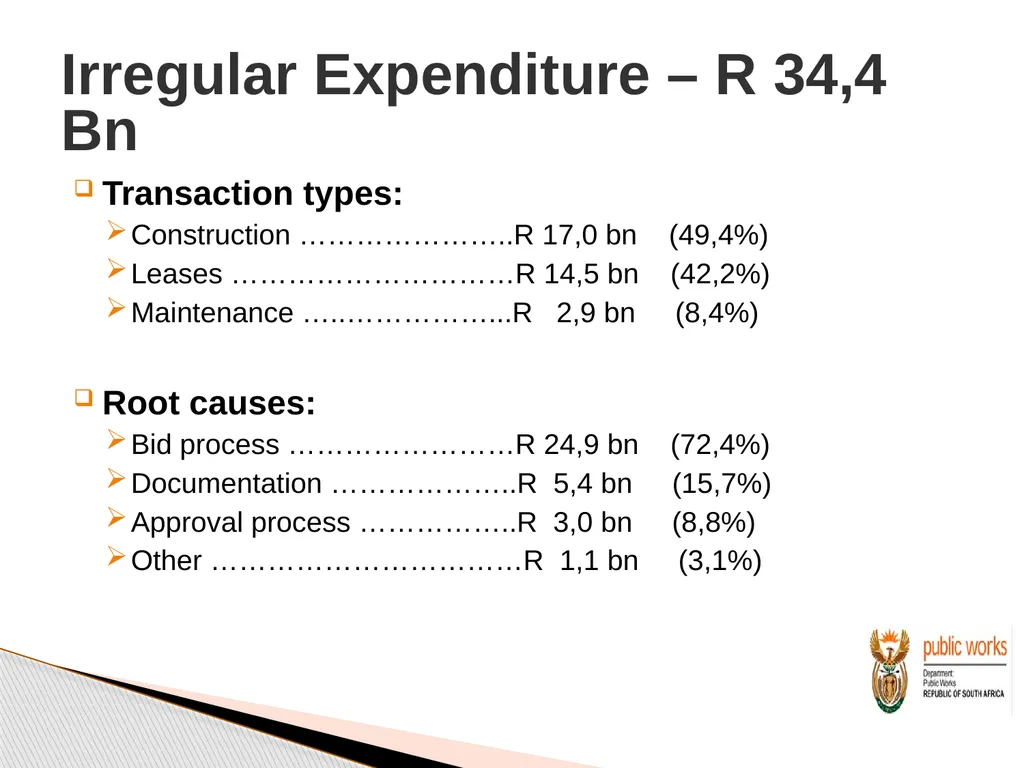
slide9. Transaction types:
Construction …………………..R 17,0 bn (49,4%)
Leases …………………………R 14,5 bn (42,2%)
Maintenance …..……………...R 2,9 bn (8,4%)
Root causes:
Bid process ……………………R 24,9 bn (72,4%)
Documentation ………………..R 5,4 bn (15,7%)
Approval process ……………..R 3,0 bn (8,8%)
Other ……………………………R 1,1 bn (3,1%) Irregular Expenditure – R 34,4 Bn<br>
slide10. Operational gains made with the stabilisation project need to be enhanced to entrench improved efficiencies
Parallel transformation interventions
Transfer of functions on 1 April 2013
Conversion to GRAP accounting standards in PMTE
Impact of assets, liabilities, staff, etc. needs to be accommodated
Development of a financial system for PMTE
Inappropriate SCM delivery mechanism
Inadequate staff capacity and skills base
Change management to establish
Stakeholder buy-in
Behavioural change Problem statement (cont’d)<br>
slide11. Systems environment does not yet effectively support the operational requirements of Finance and SCM
Key SCM functions not aligned to functional requirements to maximise returns (Demand management)
Disjuncture with IDMS requirements
Audit and corrective action management
Contract management
Document control Problem statement (cont’d)<br>
slide12. Expected Outcomes of this Project<br>
slide13. Highly effective finance and SCM units
Finance and SCM units designed to directly support operating model of PMTE
Appropriately skilled staff that can function independently<br>
slide14. How can a sustainable solution be attained through this project?<br>
slide15. Design and develop
Review, assess and evaluate
Training and skills development Sustainability through ………<br>
slide16. Summary of scope of Services Required<br>
slide17. Clear the root causes of negative audit findings in areas of Finance & SCM
Revamp the Finance and SCM units into centres of excellence that directly support the core business of PMTE in particular
Design systems that will effectively support the operations and management of these units
Manage the audit process with technical efficiency
Roll out a comprehensive Skills Transfer Programme for all affected staff
Conceptualise & implement a change management strategy Summary of scope of services<br>
slide18. Project Resourcing<br>
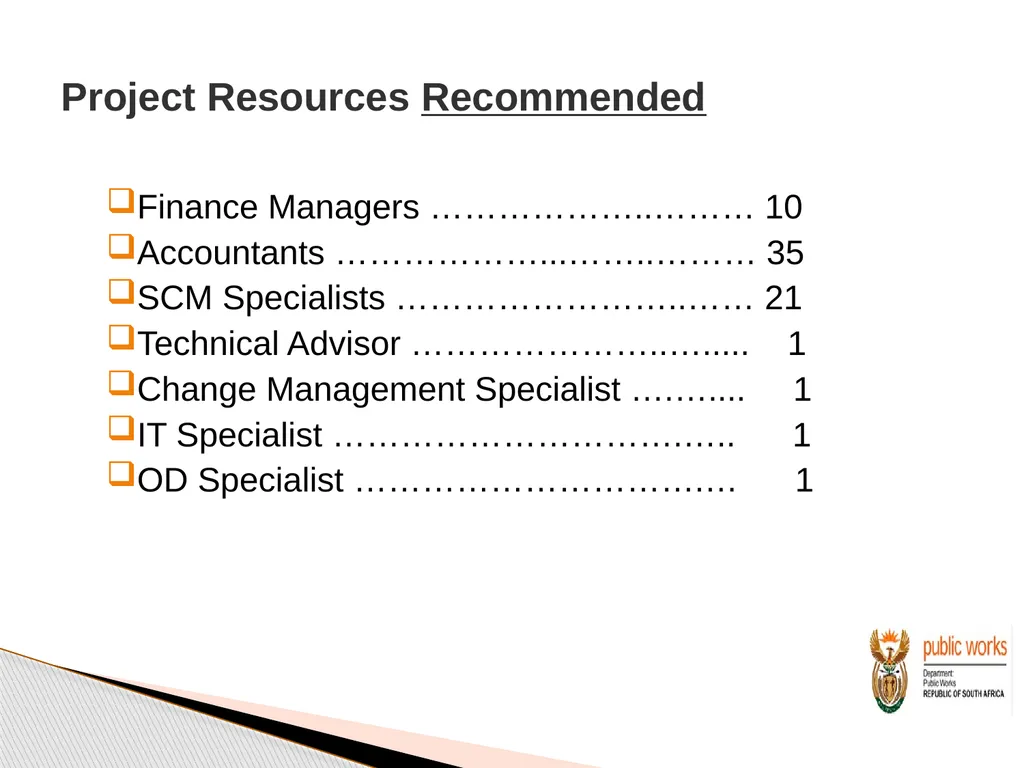
slide19. Finance Managers ………………..……… 10
Accountants ………………...……..……… 35
SCM Specialists ……………………..…… 21
Technical Advisor …………………..…..... 1
Change Management Specialist ….….... 1
IT Specialist ………………………….….. 1
OD Specialist ………………………….… 1 Project Resources Recommended<br>
slide20. Project Deliverables<br>
slide21. Supply Chain Management<br>
slide22. Prescribed functional framework
Demand Management (NB: link to IDMS)
Acquisition Management (NB: link to IDMS)
Logistics Management
Disposal Management
Risk Management
SCM reporting and Monitoring
Assessment of SCM performance Supply Chain Management (SCM)<br>
slide23. Construction Management (Infrastructure projects)
Property Management (Leases, day to day maintenance, etc.)
Goods and services SCM – Specialised Streams<br>
slide24. Policy framework approved by National Treasury for all specialised streams
Departmental policies to support the framework
Unit effectively organised to deliver on this diverse model
Prescribed business processes (SOP’s) for specialised streams
Systems design and set up to effectively support the model
Units’ staffing aligned to delivery requirements
Appropriate and extensive training to all affected staff SCM: Operational requirements<br>
slide25. PMTE Finance<br>
slide26. Ensure finance requirements are catered for in ERP systems planning and development
Align finance functional requirements to latest business developments:
Salaries management
Movable assets
Immovable assets module design and set-up
Dovetailing systems requirements between finance and SCM
GRAP compliance PMTE Operationalisation<br>
slide27. Update /develop policies, processes and standard operating procedures in line with industry best practice and new systems processes
Develop blue prints to be used for systems enhancements and customisation
Re-align the job profiles and content of affected staff based on changed business processes and new systems capabilities and functions
Review, develop and enhance systems controls (e.g. segregation of duties embedded)
Provide comprehensive training to all affected staff Policies, processes and SOP’s<br>
slide28. Assess the effectiveness of the current manual processes applied to detect and report on accruals and irregular expenditure
Review and update plans to automate the identification and reporting on accruals and irregular expenditure
Develop a model for itemised billing to user departments
Design blue prints for the customisation of the relevant systems to deliver such billing capability Accruals, Irregular Expenditure and Debtors<br>
slide29. Ensure that the budgeting and reporting framework is configured to effectively manage the financial resources of the trading entity
Develop standard reports for internal and external use by all relevant stakeholders
Design standardised systems reports (e.g. dashboards and alerts), to improve the management of critical operational deliverables
Develop and implement a financing model and tariff structure that will direct the financial sustainability of the PMTE over a pre-determined period
Advise the PMTE on revenue generation strategies Budgeting and reporting framework<br>
slide30. Other
salient considerations for bid<br>
slide31. Tools of trade for deployed staff will be for the cost of the bidder
Project duration – estimated 10 to 12 months
Progress payments made on the basis of deliverables achieved
Deployed staff to remain unchanged per cycle
As the project progresses, the Department reserves right to request resources to be redirected due to changed circumstances & requirements
Formation of consortia for bid encouraged Other salient considerations for bid<br>
slide32. Evaluation of bids<br>
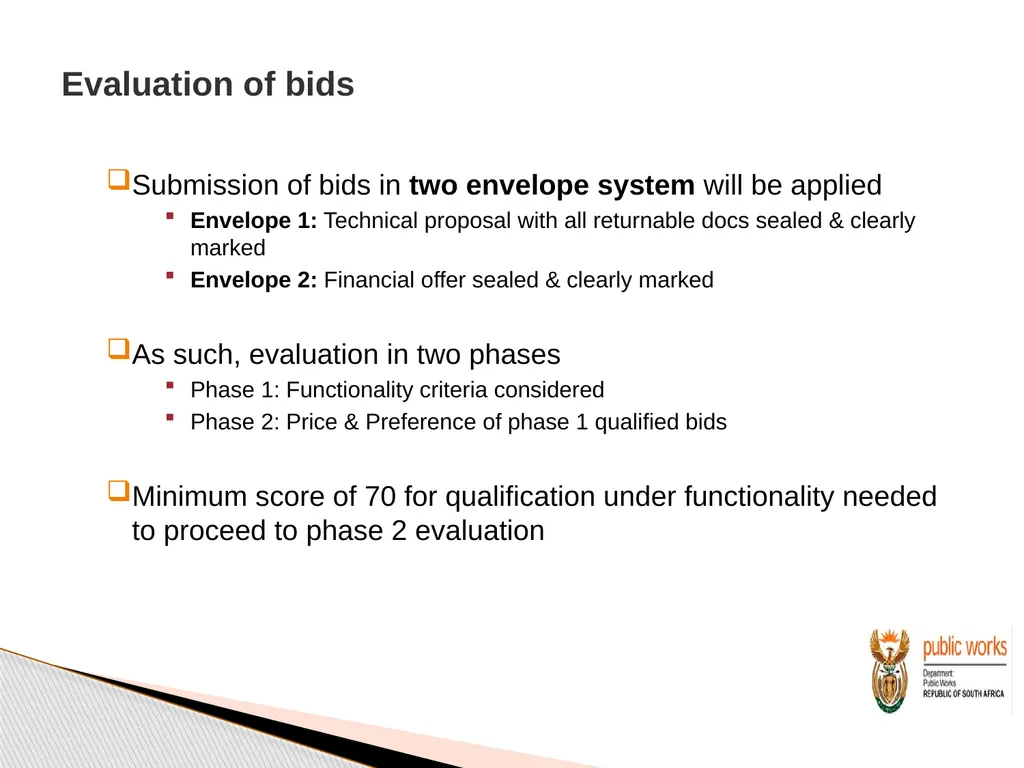
slide33. Submission of bids in two envelope system will be applied
Envelope 1: Technical proposal with all returnable docs sealed & clearly marked
Envelope 2: Financial offer sealed & clearly marked
As such, evaluation in two phases
Phase 1: Functionality criteria considered
Phase 2: Price & Preference of phase 1 qualified bids
Minimum score of 70 for qualification under functionality needed to proceed to phase 2 evaluation Evaluation of bids<br>
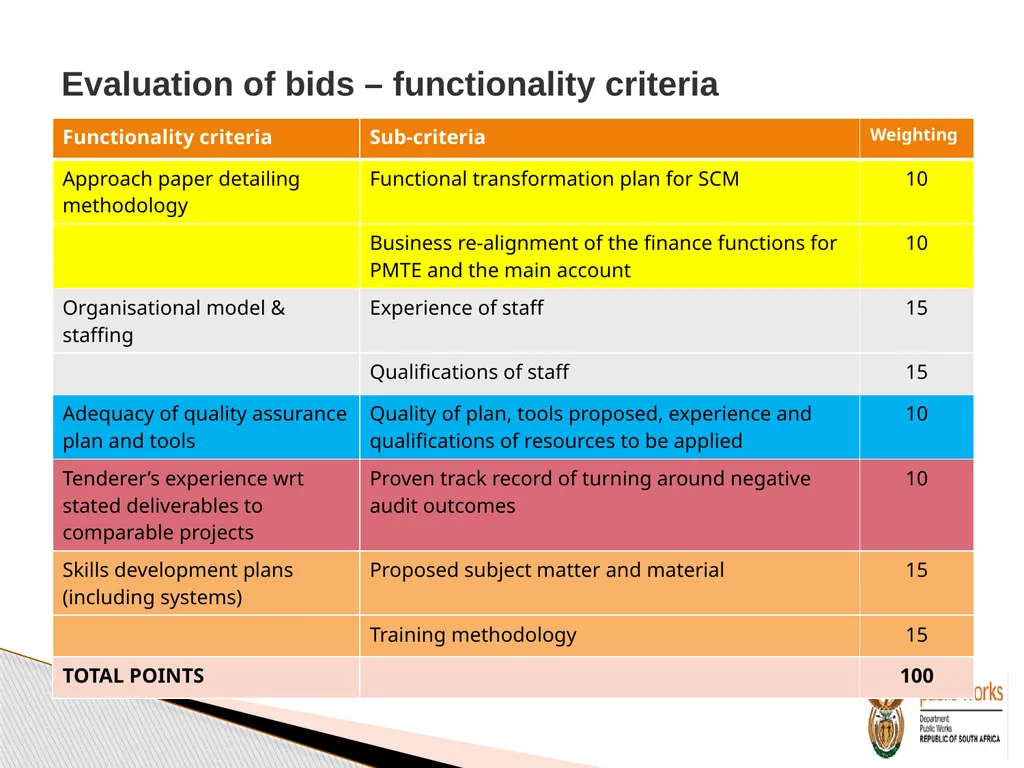
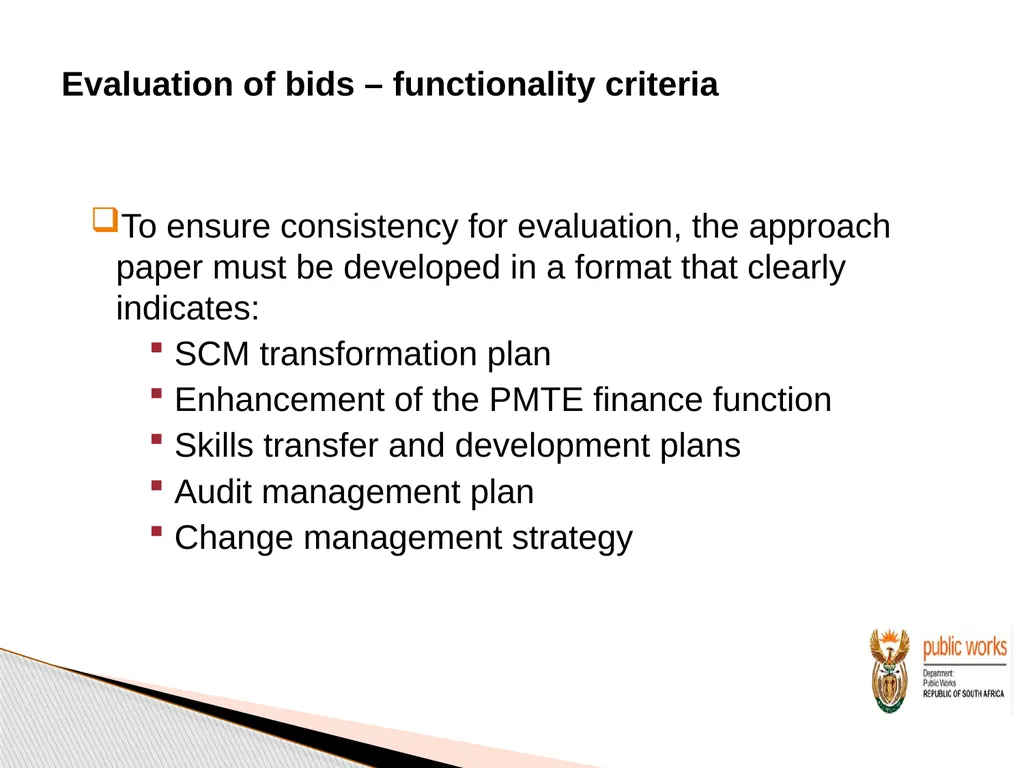
slide34. Evaluation of bids – functionality criteria<br>
slide35. To ensure consistency for evaluation, the approach paper must be developed in a format that clearly indicates:
SCM transformation plan
Enhancement of the PMTE finance function
Skills transfer and development plans
Audit management plan
Change management strategy Evaluation of bids – functionality criteria<br>
slide36. Project costing<br>
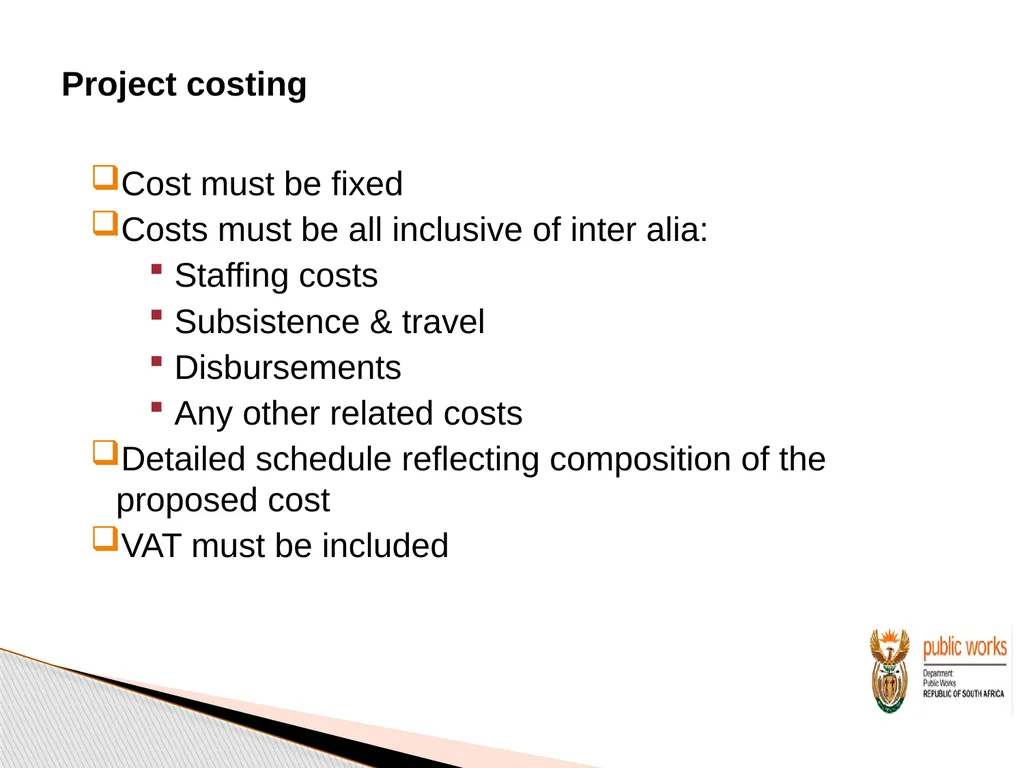
slide37. Cost must be fixed
Costs must be all inclusive of inter alia:
Staffing costs
Subsistence & travel
Disbursements
Any other related costs
Detailed schedule reflecting composition of the proposed cost
VAT must be included Project costing<br>
slide38. GOOD LUCK
&
THANK YOU<br>
Prospective Bidders
Intervention to Enhance Finance and SCM Efficiencies
Tender No: HP 14/140 Presented
by
Tom Moir
Finance Stabilisation 11December 2014<br>
slide2. NDPW core business
NDPW operating context
Problem statement
Expected outcomes
Summary of scope of services required
Project resourcing
Project deliverables
Other salient points
Project evaluation
Project costing CONTENTS<br>
slide3. NDPW Core Business<br>
slide4. Provider of accommodation for National government Departments
Enabler of sustainable economic growth through infrastructure development
Regulatory authority & leader in transforming the construction & property sectors
Lead co-ordinator in optimising state funding for job creation through Expanded Public Works Programme (“EPWP”) NDPW Core Business<br>
slide5. NDPW Operating Context<br>
slide6. National Treasury approved establishment of PMTE in March 2006 – functions transferred 1 April 2013
PMTE focus – management of government’s national property portfolio
PMTE is currently being operationalised and transformed
Separate finance units for PMTE & Department
Different basis of accounting
Modified cash for Department
Accrual accounting for PMTE
12 centres of operations, 11 Regional offices & Head Office NDPW Operating Context<br>
slide7. Problem Statement
(Why this intervention?)<br>
slide8. Need to sustain the gains made with the stabilisation intervention
Historic negative outcomes starting to change
Main Account unqualified – various non compliance matters and performance management of concern
PMTE Qualified on the basis of:
Irregular expenditure
Accruals
Leases management Audit outcomes<br>
slide9. Transaction types:
Construction …………………..R 17,0 bn (49,4%)
Leases …………………………R 14,5 bn (42,2%)
Maintenance …..……………...R 2,9 bn (8,4%)
Root causes:
Bid process ……………………R 24,9 bn (72,4%)
Documentation ………………..R 5,4 bn (15,7%)
Approval process ……………..R 3,0 bn (8,8%)
Other ……………………………R 1,1 bn (3,1%) Irregular Expenditure – R 34,4 Bn<br>
slide10. Operational gains made with the stabilisation project need to be enhanced to entrench improved efficiencies
Parallel transformation interventions
Transfer of functions on 1 April 2013
Conversion to GRAP accounting standards in PMTE
Impact of assets, liabilities, staff, etc. needs to be accommodated
Development of a financial system for PMTE
Inappropriate SCM delivery mechanism
Inadequate staff capacity and skills base
Change management to establish
Stakeholder buy-in
Behavioural change Problem statement (cont’d)<br>
slide11. Systems environment does not yet effectively support the operational requirements of Finance and SCM
Key SCM functions not aligned to functional requirements to maximise returns (Demand management)
Disjuncture with IDMS requirements
Audit and corrective action management
Contract management
Document control Problem statement (cont’d)<br>
slide12. Expected Outcomes of this Project<br>
slide13. Highly effective finance and SCM units
Finance and SCM units designed to directly support operating model of PMTE
Appropriately skilled staff that can function independently<br>
slide14. How can a sustainable solution be attained through this project?<br>
slide15. Design and develop
Review, assess and evaluate
Training and skills development Sustainability through ………<br>
slide16. Summary of scope of Services Required<br>
slide17. Clear the root causes of negative audit findings in areas of Finance & SCM
Revamp the Finance and SCM units into centres of excellence that directly support the core business of PMTE in particular
Design systems that will effectively support the operations and management of these units
Manage the audit process with technical efficiency
Roll out a comprehensive Skills Transfer Programme for all affected staff
Conceptualise & implement a change management strategy Summary of scope of services<br>
slide18. Project Resourcing<br>
slide19. Finance Managers ………………..……… 10
Accountants ………………...……..……… 35
SCM Specialists ……………………..…… 21
Technical Advisor …………………..…..... 1
Change Management Specialist ….….... 1
IT Specialist ………………………….….. 1
OD Specialist ………………………….… 1 Project Resources Recommended<br>
slide20. Project Deliverables<br>
slide21. Supply Chain Management<br>
slide22. Prescribed functional framework
Demand Management (NB: link to IDMS)
Acquisition Management (NB: link to IDMS)
Logistics Management
Disposal Management
Risk Management
SCM reporting and Monitoring
Assessment of SCM performance Supply Chain Management (SCM)<br>
slide23. Construction Management (Infrastructure projects)
Property Management (Leases, day to day maintenance, etc.)
Goods and services SCM – Specialised Streams<br>
slide24. Policy framework approved by National Treasury for all specialised streams
Departmental policies to support the framework
Unit effectively organised to deliver on this diverse model
Prescribed business processes (SOP’s) for specialised streams
Systems design and set up to effectively support the model
Units’ staffing aligned to delivery requirements
Appropriate and extensive training to all affected staff SCM: Operational requirements<br>
slide25. PMTE Finance<br>
slide26. Ensure finance requirements are catered for in ERP systems planning and development
Align finance functional requirements to latest business developments:
Salaries management
Movable assets
Immovable assets module design and set-up
Dovetailing systems requirements between finance and SCM
GRAP compliance PMTE Operationalisation<br>
slide27. Update /develop policies, processes and standard operating procedures in line with industry best practice and new systems processes
Develop blue prints to be used for systems enhancements and customisation
Re-align the job profiles and content of affected staff based on changed business processes and new systems capabilities and functions
Review, develop and enhance systems controls (e.g. segregation of duties embedded)
Provide comprehensive training to all affected staff Policies, processes and SOP’s<br>
slide28. Assess the effectiveness of the current manual processes applied to detect and report on accruals and irregular expenditure
Review and update plans to automate the identification and reporting on accruals and irregular expenditure
Develop a model for itemised billing to user departments
Design blue prints for the customisation of the relevant systems to deliver such billing capability Accruals, Irregular Expenditure and Debtors<br>
slide29. Ensure that the budgeting and reporting framework is configured to effectively manage the financial resources of the trading entity
Develop standard reports for internal and external use by all relevant stakeholders
Design standardised systems reports (e.g. dashboards and alerts), to improve the management of critical operational deliverables
Develop and implement a financing model and tariff structure that will direct the financial sustainability of the PMTE over a pre-determined period
Advise the PMTE on revenue generation strategies Budgeting and reporting framework<br>
slide30. Other
salient considerations for bid<br>
slide31. Tools of trade for deployed staff will be for the cost of the bidder
Project duration – estimated 10 to 12 months
Progress payments made on the basis of deliverables achieved
Deployed staff to remain unchanged per cycle
As the project progresses, the Department reserves right to request resources to be redirected due to changed circumstances & requirements
Formation of consortia for bid encouraged Other salient considerations for bid<br>
slide32. Evaluation of bids<br>
slide33. Submission of bids in two envelope system will be applied
Envelope 1: Technical proposal with all returnable docs sealed & clearly marked
Envelope 2: Financial offer sealed & clearly marked
As such, evaluation in two phases
Phase 1: Functionality criteria considered
Phase 2: Price & Preference of phase 1 qualified bids
Minimum score of 70 for qualification under functionality needed to proceed to phase 2 evaluation Evaluation of bids<br>
slide34. Evaluation of bids – functionality criteria<br>
slide35. To ensure consistency for evaluation, the approach paper must be developed in a format that clearly indicates:
SCM transformation plan
Enhancement of the PMTE finance function
Skills transfer and development plans
Audit management plan
Change management strategy Evaluation of bids – functionality criteria<br>
slide36. Project costing<br>
slide37. Cost must be fixed
Costs must be all inclusive of inter alia:
Staffing costs
Subsistence & travel
Disbursements
Any other related costs
Detailed schedule reflecting composition of the proposed cost
VAT must be included Project costing<br>
slide38. GOOD LUCK
&
THANK YOU<br>