
Briefing to the Select Committee on Appropriations
KB
Published · 33 slides · 0 views

1 / 1





Description
Briefing to the Select Committee on Appropriations For an Equitable Sharing of National Revenue Financial and Fiscal Commission 10 June 2020 Introduction The 2020 Budget was formulated against the backdrop of an accelerated deteriorating
Related Topics
Share
Embed code
Download this presentation From Below
"Briefing to the Select Committee on Appropriations" is the property of its rightful owner. Permission is granted to download and print the materials on this website for personal, non-commercial use only, and to display it on your personal computer provided you do not modify the materials and that you retain all copyright notices contained in the materials. By downloading content from our website, you accept the terms of this agreement.
Presentation Transcript
01
Briefing to the Select Committee on Appropriations For an Equitable Sharing of National Revenue Financial and Fiscal Commission
10 June 2020<br>
10 June 2020<br>
02
Introduction The 2020 Budget was formulated against the backdrop of an accelerated deteriorating economic environment- trend experienced since the 2009 financial crisis-the economy had effectively slipped into a second technical recession end of 2019
Post 2020 February budget, economy suffered two major setbacks: the Covid-19 pandemic and downgrading of South Africa’s sovereign debt rating to junk status
The Covid-19 pandemic has caused unprecedented disruptions to the socio-economic landscape of South Africa-forcing Government to make difficult choices between protecting lives, livelih,./oods and the economy.
It has turned the February 2020 budget upside down and made the fiscal framework tabled in February no longer attainable
In line with the request from SCoA, and in anticipation of an adjustment budget, the Commission makes this submission in terms of S4(4c) of MBARARMA (Act 9 of 2009), as amended focusing on:
the macroeconomic and fiscal outlook;
revenue and expenditure proposals as contained in the 2020 Budget;
Government’s fiscal and monetary responses to Covid-19 and
Reprioritisation for Covid-19 pandemic<br>
Post 2020 February budget, economy suffered two major setbacks: the Covid-19 pandemic and downgrading of South Africa’s sovereign debt rating to junk status
The Covid-19 pandemic has caused unprecedented disruptions to the socio-economic landscape of South Africa-forcing Government to make difficult choices between protecting lives, livelih,./oods and the economy.
It has turned the February 2020 budget upside down and made the fiscal framework tabled in February no longer attainable
In line with the request from SCoA, and in anticipation of an adjustment budget, the Commission makes this submission in terms of S4(4c) of MBARARMA (Act 9 of 2009), as amended focusing on:
the macroeconomic and fiscal outlook;
revenue and expenditure proposals as contained in the 2020 Budget;
Government’s fiscal and monetary responses to Covid-19 and
Reprioritisation for Covid-19 pandemic<br>
03
Background: Macroeconomic and Fiscal Policy Outlook FFC Briefing to the Select Committee on Appropriations 10/06/2020<br>
04
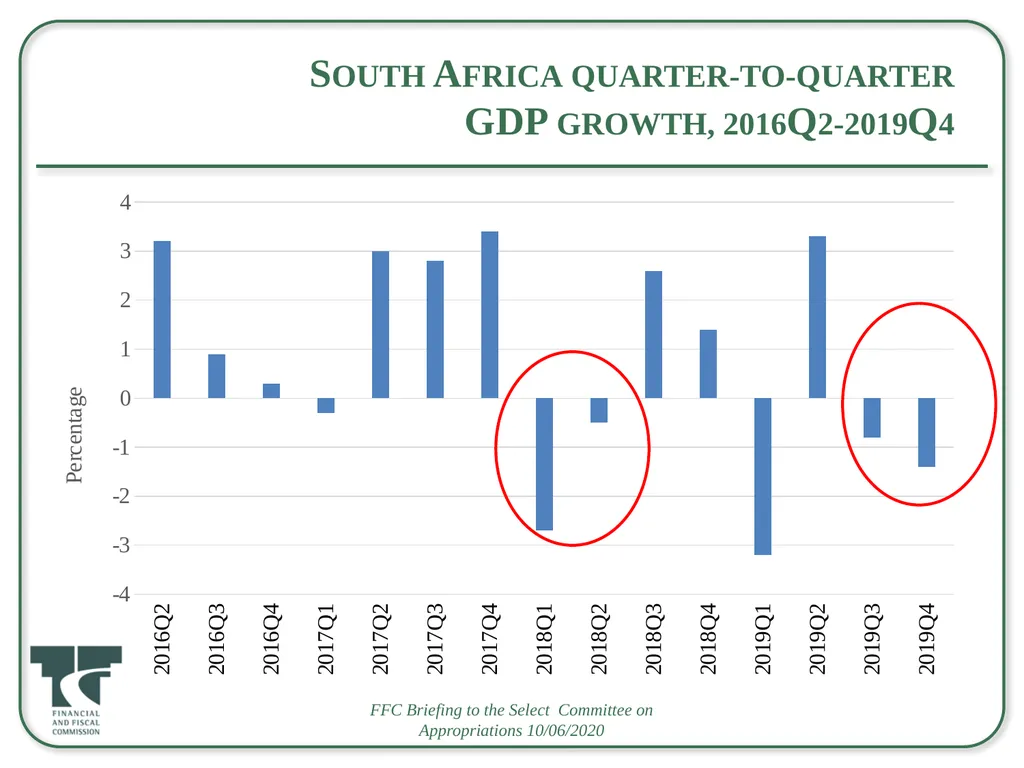
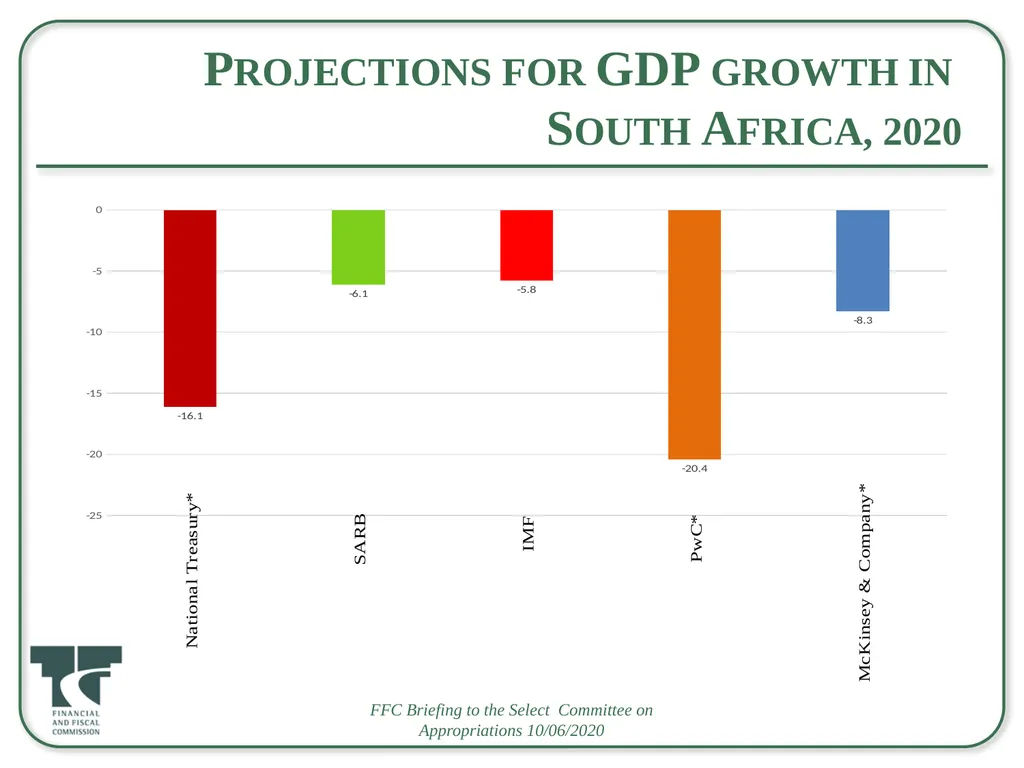
Fragile Domestic economy hit by covid-19 South Africa quarter-to-quarter GDP growth, 2016Q2-2019Q4 Source: Statistics South Africa, 2020 Projections for GDP growth in South Africa, 2020 Source: National Treasury, South African Reserve Bank, IMF, PwC, McKinsey & Company NB *projection of worst-case scenario by institution SA economy grew by 0.2% in 2019 and by end of 2019 it had slipped into technical recession - second in 2 years.
The impact of COVID-19 will push the country into a deep economic contraction this year.
SA’s recent sovereign credit downgrade is to exacerbate the outlook.
All projections indicate that SA is likely to face deep economic contraction-because of disruptions in household and businesses, disruptions of supply value chains and depression of exports.<br>
The impact of COVID-19 will push the country into a deep economic contraction this year.
SA’s recent sovereign credit downgrade is to exacerbate the outlook.
All projections indicate that SA is likely to face deep economic contraction-because of disruptions in household and businesses, disruptions of supply value chains and depression of exports.<br>
05
FFC Briefing to the Select Committee on Appropriations 10/06/2020 South Africa quarter-to-quarter
GDP growth, 2016Q2-2019Q4<br>
06
Projections for GDP growth in
South Africa, 2020 FFC Briefing to the Select Committee on Appropriations 10/06/2020<br>
07
The fiscal metrics Fiscal deficit:
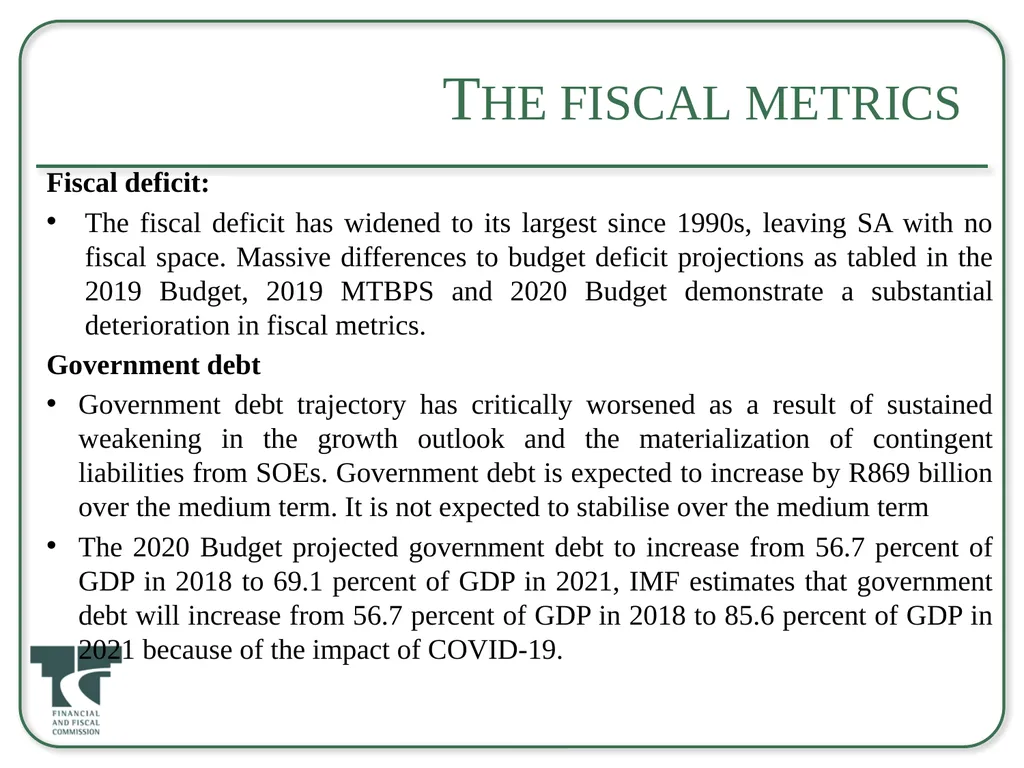
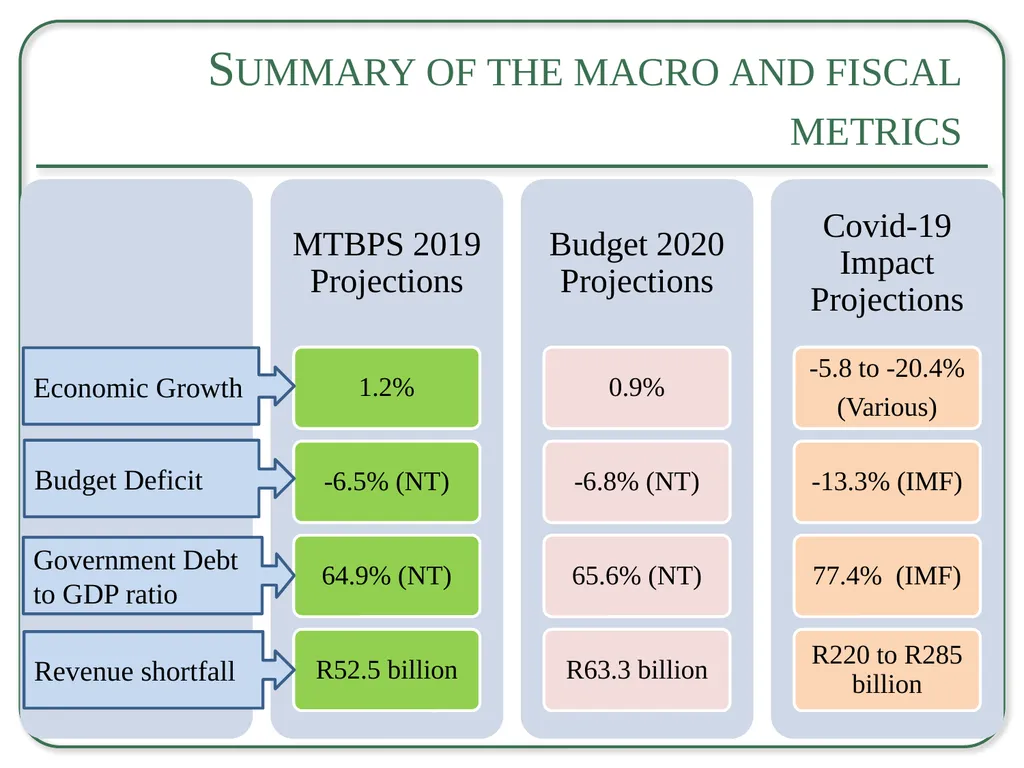
The fiscal deficit has widened to its largest since 1990s, leaving SA with no fiscal space. Massive differences to budget deficit projections as tabled in the 2019 Budget, 2019 MTBPS and 2020 Budget demonstrate a substantial deterioration in fiscal metrics.
Government debt
Government debt trajectory has critically worsened as a result of sustained weakening in the growth outlook and the materialization of contingent liabilities from SOEs. Government debt is expected to increase by R869 billion over the medium term. It is not expected to stabilise over the medium term
The 2020 Budget projected government debt to increase from 56.7 percent of GDP in 2018 to 69.1 percent of GDP in 2021, IMF estimates that government debt will increase from 56.7 percent of GDP in 2018 to 85.6 percent of GDP in 2021 because of the impact of COVID-19.<br>
The fiscal deficit has widened to its largest since 1990s, leaving SA with no fiscal space. Massive differences to budget deficit projections as tabled in the 2019 Budget, 2019 MTBPS and 2020 Budget demonstrate a substantial deterioration in fiscal metrics.
Government debt
Government debt trajectory has critically worsened as a result of sustained weakening in the growth outlook and the materialization of contingent liabilities from SOEs. Government debt is expected to increase by R869 billion over the medium term. It is not expected to stabilise over the medium term
The 2020 Budget projected government debt to increase from 56.7 percent of GDP in 2018 to 69.1 percent of GDP in 2021, IMF estimates that government debt will increase from 56.7 percent of GDP in 2018 to 85.6 percent of GDP in 2021 because of the impact of COVID-19.<br>
08
Summary of the macro and fiscal metrics Economic Growth Budget Deficit Government Debt to GDP ratio Revenue shortfall<br>
09
COVID-19 Pandemic and the Health Shock Extraordinary Health Shock: The COVID-19 pandemic is a health crisis as much as it is an economic one. Demands on the health sector are huge.
Need to prepare for the worst: what are the needs?
Health care access, specifically, effective ambulance system, Intensive Care units (ICUs) with ventilators and drugs to maximise chances of survival until vaccine is developed.
Construction of field hospitals/clinics construction, especially in cities; Environmental and port health; Communications; Health personnel and personal protective equipment (PPE), ventilators, pharmaceutical requirements.
In the context of Covid-19, government must continue to prioritize the establishment of the NHI alongside other reform agenda imperatives (noted in subsequent slides)<br>
Need to prepare for the worst: what are the needs?
Health care access, specifically, effective ambulance system, Intensive Care units (ICUs) with ventilators and drugs to maximise chances of survival until vaccine is developed.
Construction of field hospitals/clinics construction, especially in cities; Environmental and port health; Communications; Health personnel and personal protective equipment (PPE), ventilators, pharmaceutical requirements.
In the context of Covid-19, government must continue to prioritize the establishment of the NHI alongside other reform agenda imperatives (noted in subsequent slides)<br>
10
Overview of FFC response to revenue and expenditure proposals in the 2020 Budget FFC Briefing to the Select Committee on Appropriations 10/06/2020<br>
11
revenue and expenditure proposals-Summary The Commission notes and welcomes the shift from a purely “social sector” focus evident over the 2016/17 to 2019/20 period to economic development, community development and social development over the next three years. This approach balances the financing for the provision of a safety net to the poor alongside interventions to grow the economy;
The rapid growth in debt service costs outstrips and crowds out spending on all aspects of government service delivery programmes, e.g. spending on debt service costs will exceed spending on health and community development;
The assessment of spending by economic classification highlights government’s attempts to rein in spending on personnel while at the same time increasing spending on capital.
The Commission notes that the debate on the public sector wage bill should be preceded by a determination of the size and shape of government that suits the South African context. Already, the amount of potential savings as proposed in Budget 2020 related to a muted wage freeze, cannot materialise as it is being offset in the Covid-19 frontline personnel response – and will continue throughout the 2020/21 financial year.<br>
The rapid growth in debt service costs outstrips and crowds out spending on all aspects of government service delivery programmes, e.g. spending on debt service costs will exceed spending on health and community development;
The assessment of spending by economic classification highlights government’s attempts to rein in spending on personnel while at the same time increasing spending on capital.
The Commission notes that the debate on the public sector wage bill should be preceded by a determination of the size and shape of government that suits the South African context. Already, the amount of potential savings as proposed in Budget 2020 related to a muted wage freeze, cannot materialise as it is being offset in the Covid-19 frontline personnel response – and will continue throughout the 2020/21 financial year.<br>
12
Covid-19 Fiscal and Monetary Response for Transformation and Growth FFC Briefing to the Select Committee on Appropriations 10/06/2020<br>
13
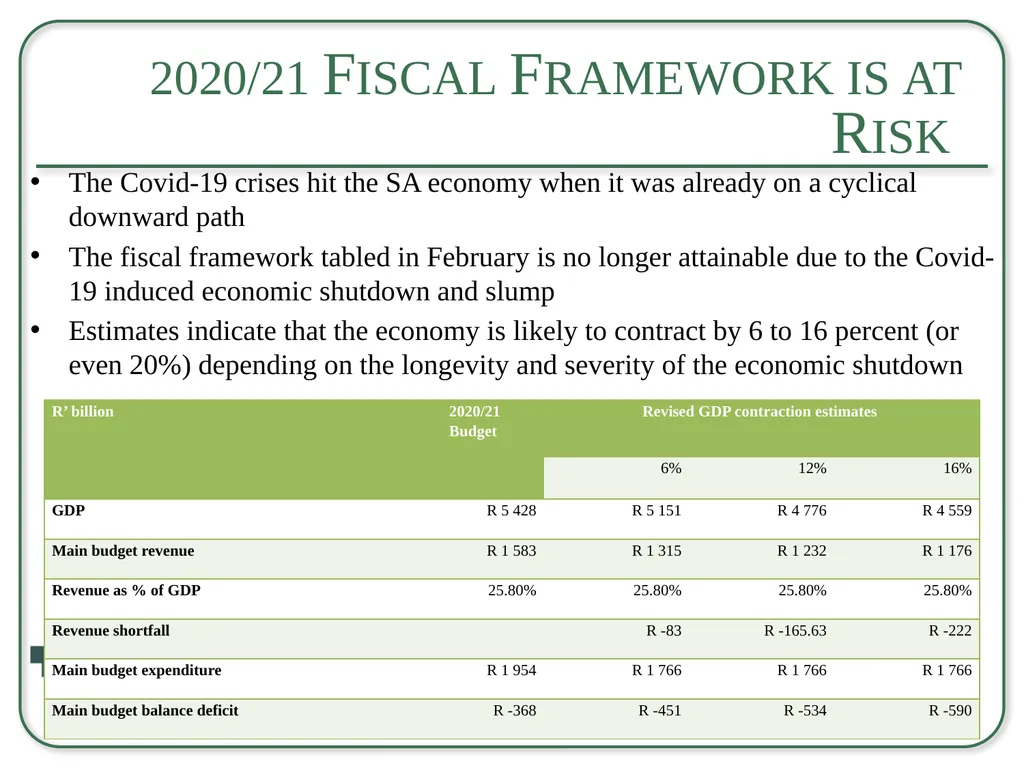
2020/21 Fiscal Framework is at Risk The Covid-19 crises hit the SA economy when it was already on a cyclical downward path
The fiscal framework tabled in February is no longer attainable due to the Covid-19 induced economic shutdown and slump
Estimates indicate that the economy is likely to contract by 6 to 16 percent (or even 20%) depending on the longevity and severity of the economic shutdown<br>
The fiscal framework tabled in February is no longer attainable due to the Covid-19 induced economic shutdown and slump
Estimates indicate that the economy is likely to contract by 6 to 16 percent (or even 20%) depending on the longevity and severity of the economic shutdown<br>
14
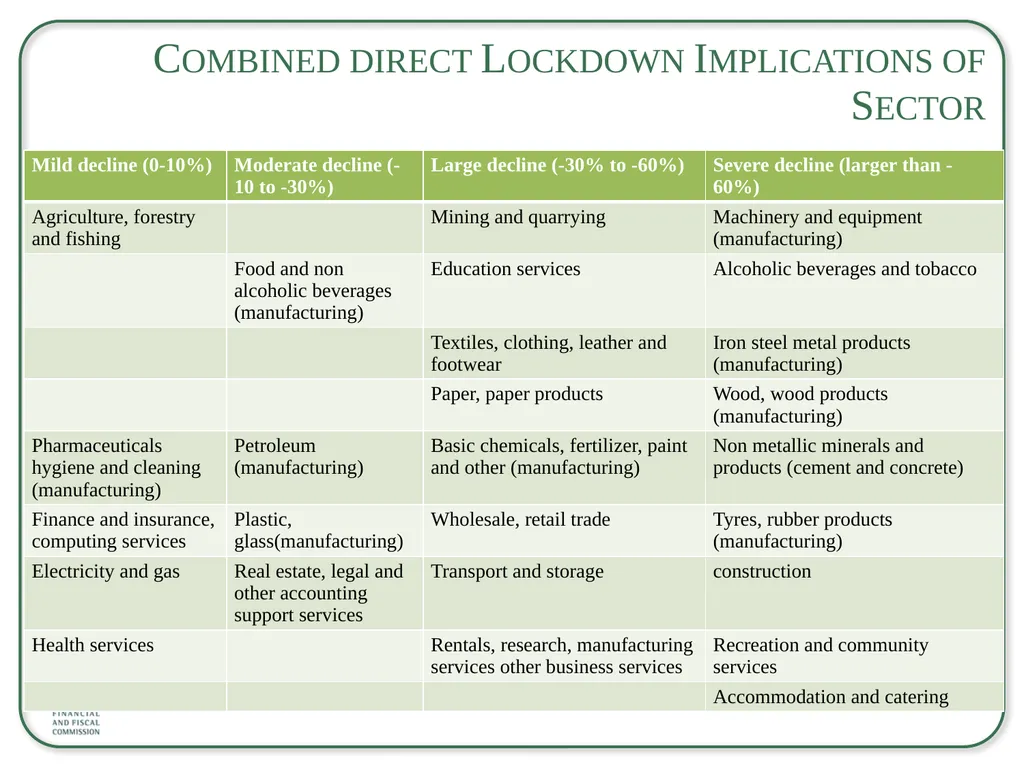
Combined direct Lockdown Implications of Sector<br>
15
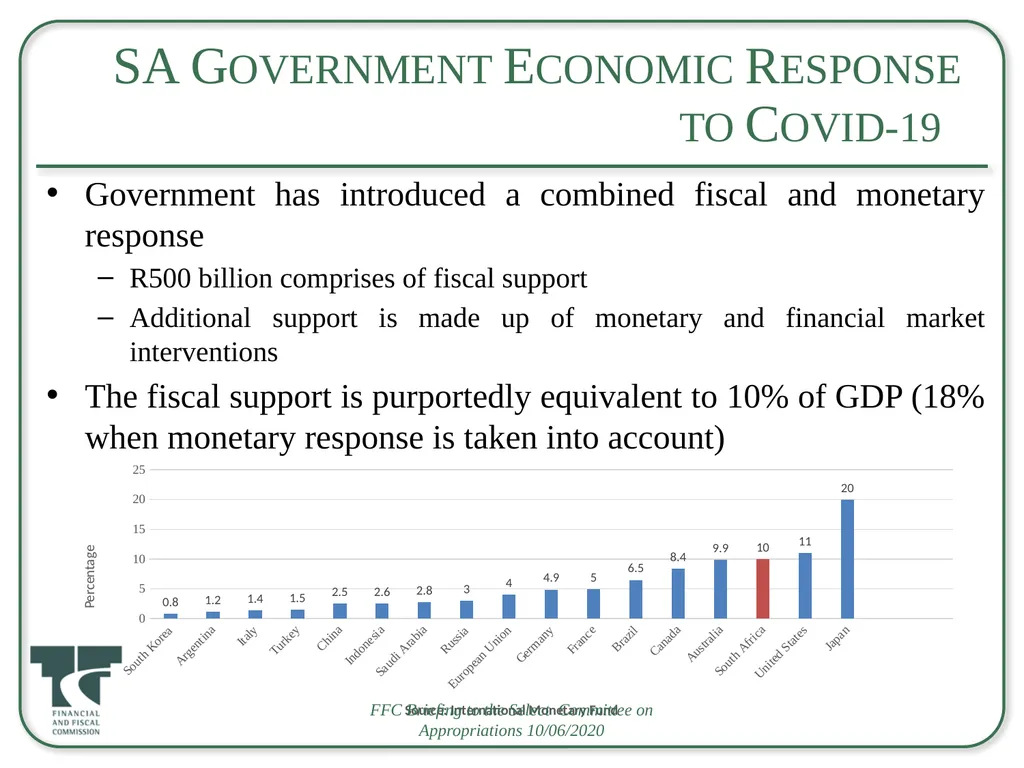
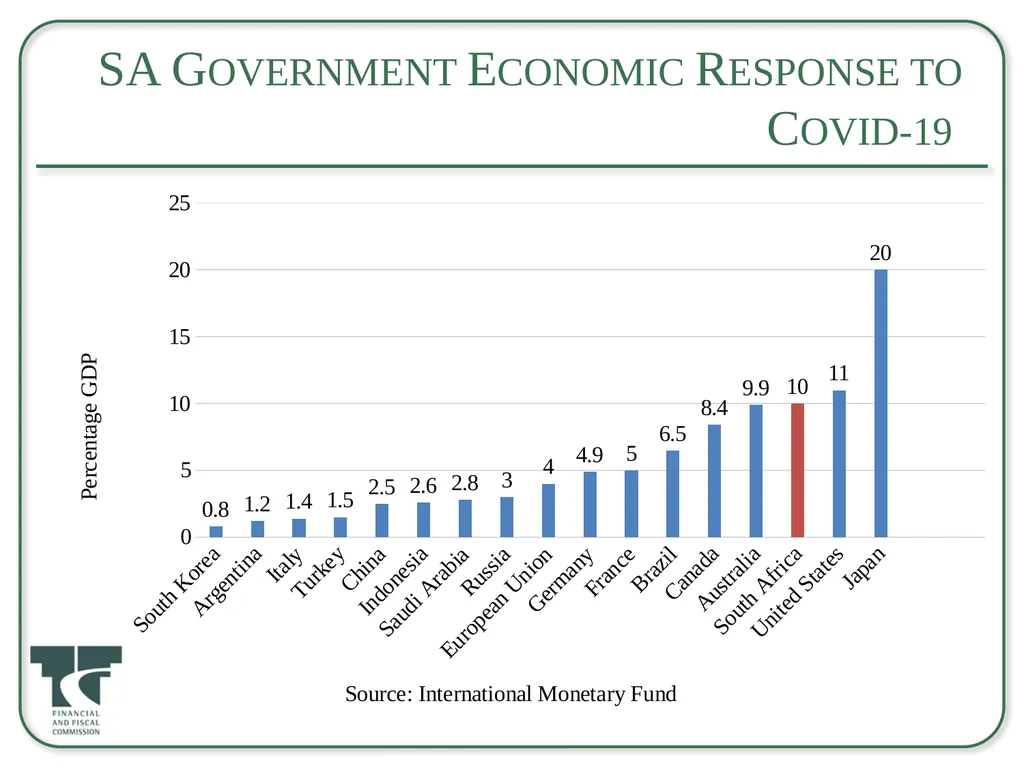
SA Government Economic Response to Covid-19 Government has introduced a combined fiscal and monetary response
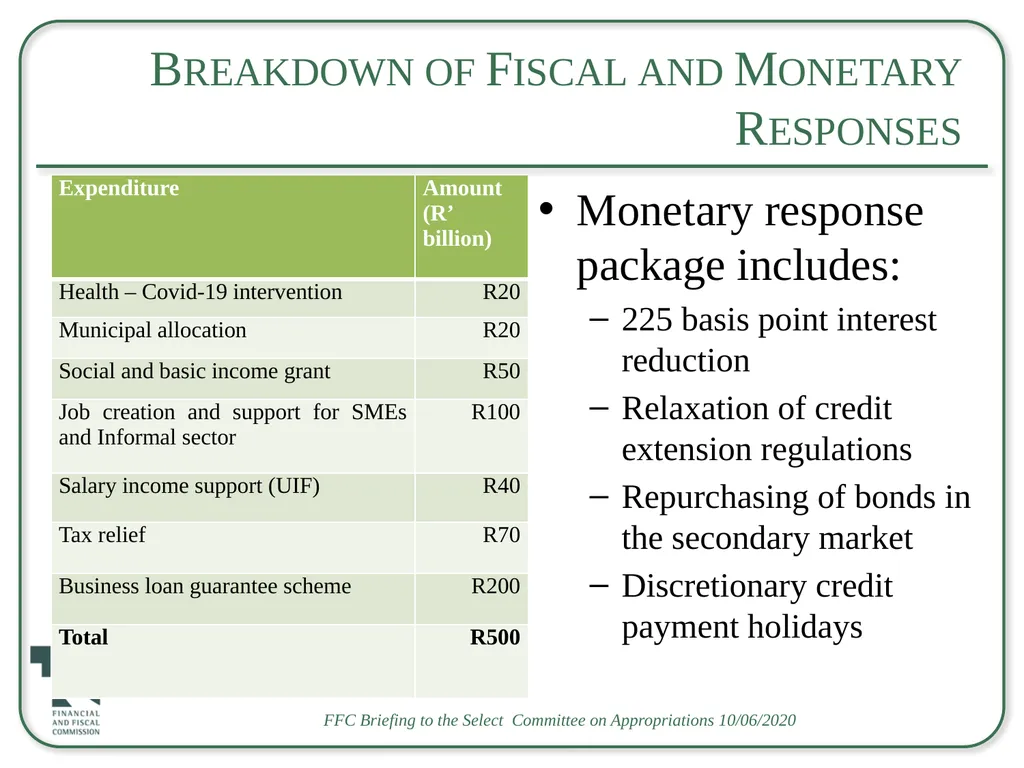
R500 billion comprises of fiscal support
Additional support is made up of monetary and financial market interventions
The fiscal support is purportedly equivalent to 10% of GDP (18% when monetary response is taken into account) FFC Briefing to the Select Committee on Appropriations 10/06/2020<br>
R500 billion comprises of fiscal support
Additional support is made up of monetary and financial market interventions
The fiscal support is purportedly equivalent to 10% of GDP (18% when monetary response is taken into account) FFC Briefing to the Select Committee on Appropriations 10/06/2020<br>
16
SA Government Economic Response to Covid-19<br>
17
Breakdown of Fiscal and Monetary Responses Monetary response package includes:
225 basis point interest reduction
Relaxation of credit extension regulations
Repurchasing of bonds in the secondary market
Discretionary credit payment holidays FFC Briefing to the Select Committee on Appropriations 10/06/2020<br>
225 basis point interest reduction
Relaxation of credit extension regulations
Repurchasing of bonds in the secondary market
Discretionary credit payment holidays FFC Briefing to the Select Committee on Appropriations 10/06/2020<br>
18
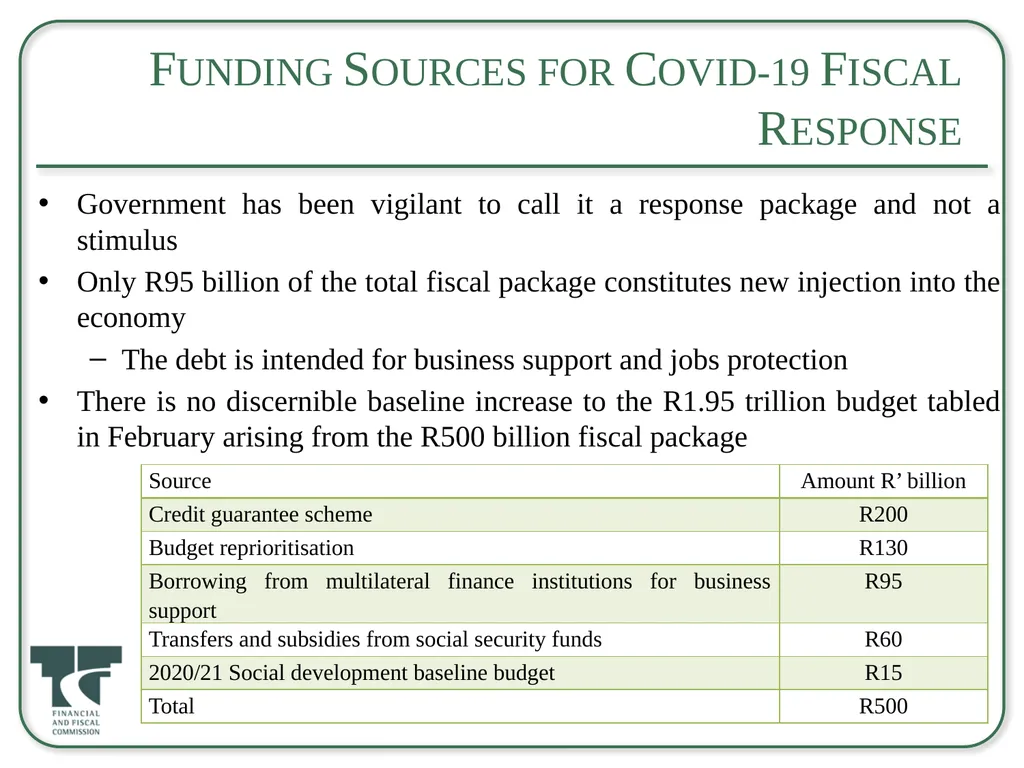
Funding Sources for Covid-19 Fiscal Response Government has been vigilant to call it a response package and not a stimulus
Only R95 billion of the total fiscal package constitutes new injection into the economy
The debt is intended for business support and jobs protection
There is no discernible baseline increase to the R1.95 trillion budget tabled in February arising from the R500 billion fiscal package<br>
Only R95 billion of the total fiscal package constitutes new injection into the economy
The debt is intended for business support and jobs protection
There is no discernible baseline increase to the R1.95 trillion budget tabled in February arising from the R500 billion fiscal package<br>
19
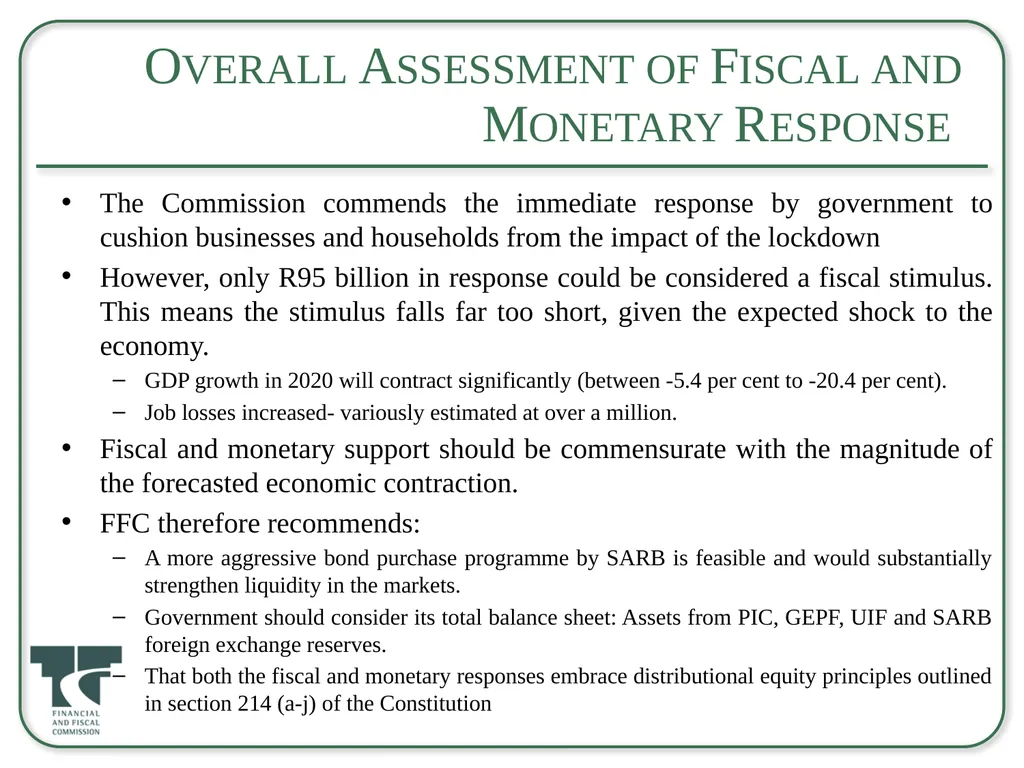
Overall Assessment of Fiscal and Monetary Response The Commission commends the immediate response by government to cushion businesses and households from the impact of the lockdown
However, only R95 billion in response could be considered a fiscal stimulus. This means the stimulus falls far too short, given the expected shock to the economy.
GDP growth in 2020 will contract significantly (between -5.4 per cent to -20.4 per cent).
Job losses increased- variously estimated at over a million.
Fiscal and monetary support should be commensurate with the magnitude of the forecasted economic contraction.
FFC therefore recommends:
A more aggressive bond purchase programme by SARB is feasible and would substantially strengthen liquidity in the markets.
Government should consider its total balance sheet: Assets from PIC, GEPF, UIF and SARB foreign exchange reserves.
That both the fiscal and monetary responses embrace distributional equity principles outlined in section 214 (a-j) of the Constitution<br>
However, only R95 billion in response could be considered a fiscal stimulus. This means the stimulus falls far too short, given the expected shock to the economy.
GDP growth in 2020 will contract significantly (between -5.4 per cent to -20.4 per cent).
Job losses increased- variously estimated at over a million.
Fiscal and monetary support should be commensurate with the magnitude of the forecasted economic contraction.
FFC therefore recommends:
A more aggressive bond purchase programme by SARB is feasible and would substantially strengthen liquidity in the markets.
Government should consider its total balance sheet: Assets from PIC, GEPF, UIF and SARB foreign exchange reserves.
That both the fiscal and monetary responses embrace distributional equity principles outlined in section 214 (a-j) of the Constitution<br>
20
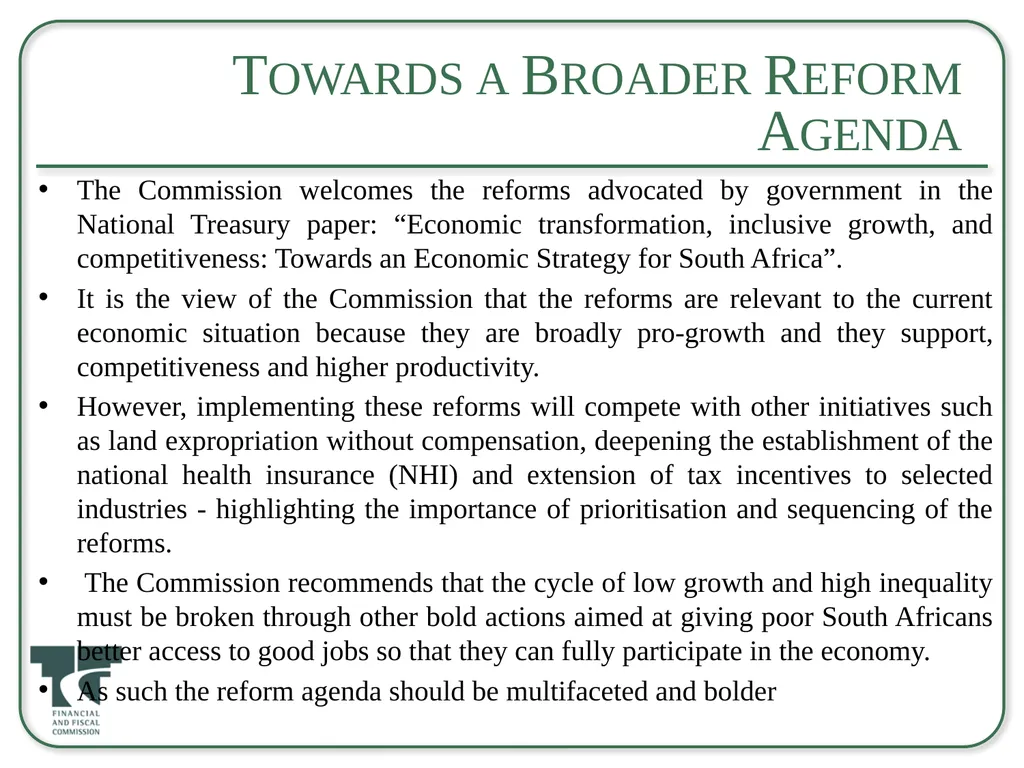
Towards a Broader Reform Agenda The Commission welcomes the reforms advocated by government in the National Treasury paper: “Economic transformation, inclusive growth, and competitiveness: Towards an Economic Strategy for South Africa”.
It is the view of the Commission that the reforms are relevant to the current economic situation because they are broadly pro-growth and they support, competitiveness and higher productivity.
However, implementing these reforms will compete with other initiatives such as land expropriation without compensation, deepening the establishment of the national health insurance (NHI) and extension of tax incentives to selected industries - highlighting the importance of prioritisation and sequencing of the reforms.
The Commission recommends that the cycle of low growth and high inequality must be broken through other bold actions aimed at giving poor South Africans better access to good jobs so that they can fully participate in the economy.
As such the reform agenda should be multifaceted and bolder<br>
It is the view of the Commission that the reforms are relevant to the current economic situation because they are broadly pro-growth and they support, competitiveness and higher productivity.
However, implementing these reforms will compete with other initiatives such as land expropriation without compensation, deepening the establishment of the national health insurance (NHI) and extension of tax incentives to selected industries - highlighting the importance of prioritisation and sequencing of the reforms.
The Commission recommends that the cycle of low growth and high inequality must be broken through other bold actions aimed at giving poor South Africans better access to good jobs so that they can fully participate in the economy.
As such the reform agenda should be multifaceted and bolder<br>
21
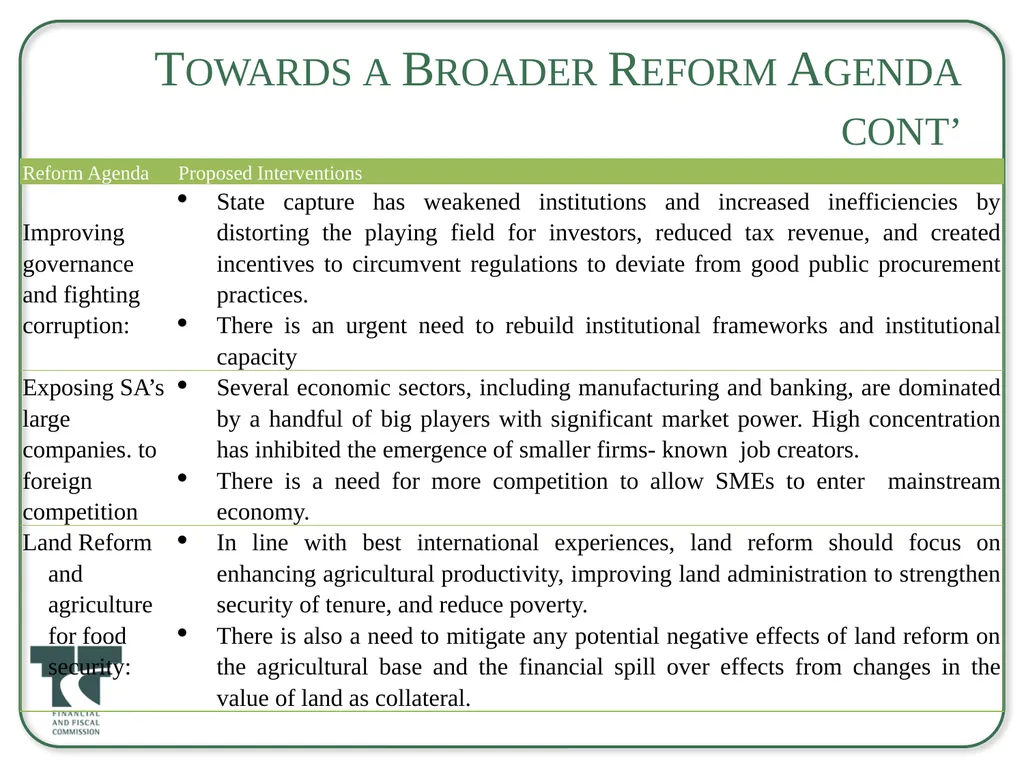
Towards a Broader Reform Agenda cont’<br>
22
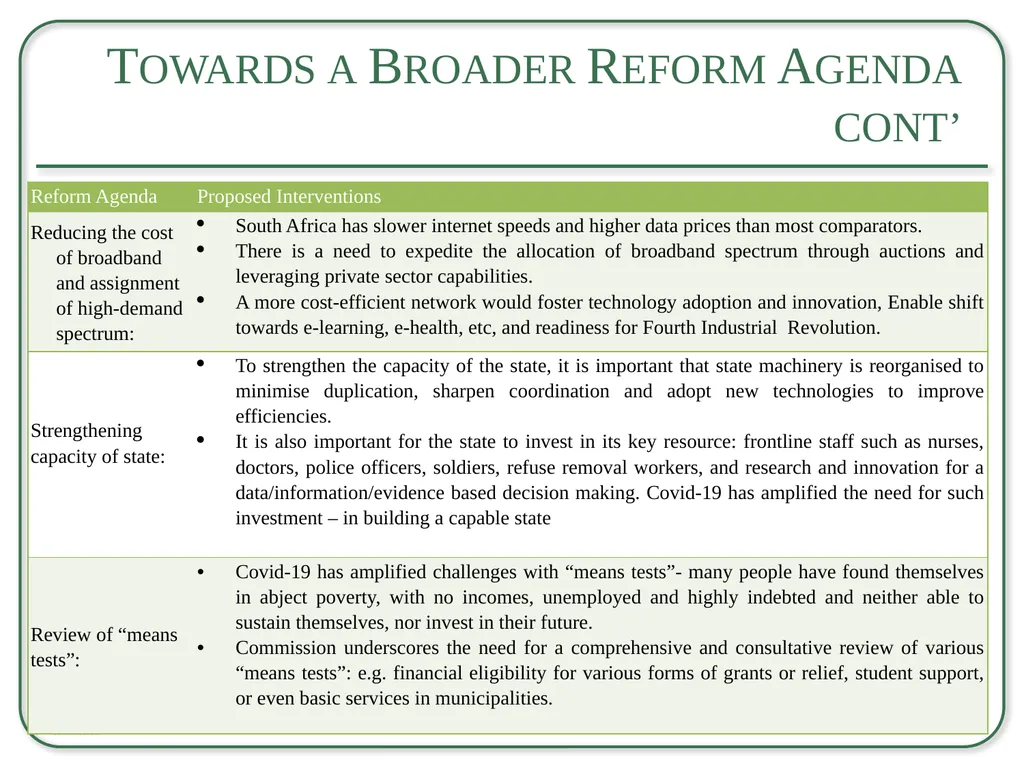
Towards a Broader Reform Agenda cont’<br>
23
Where will the money come from? Reprioritisation in response to Covid-19 FFC Briefing to the Select Committee on Appropriations 10/06/2020<br>
24
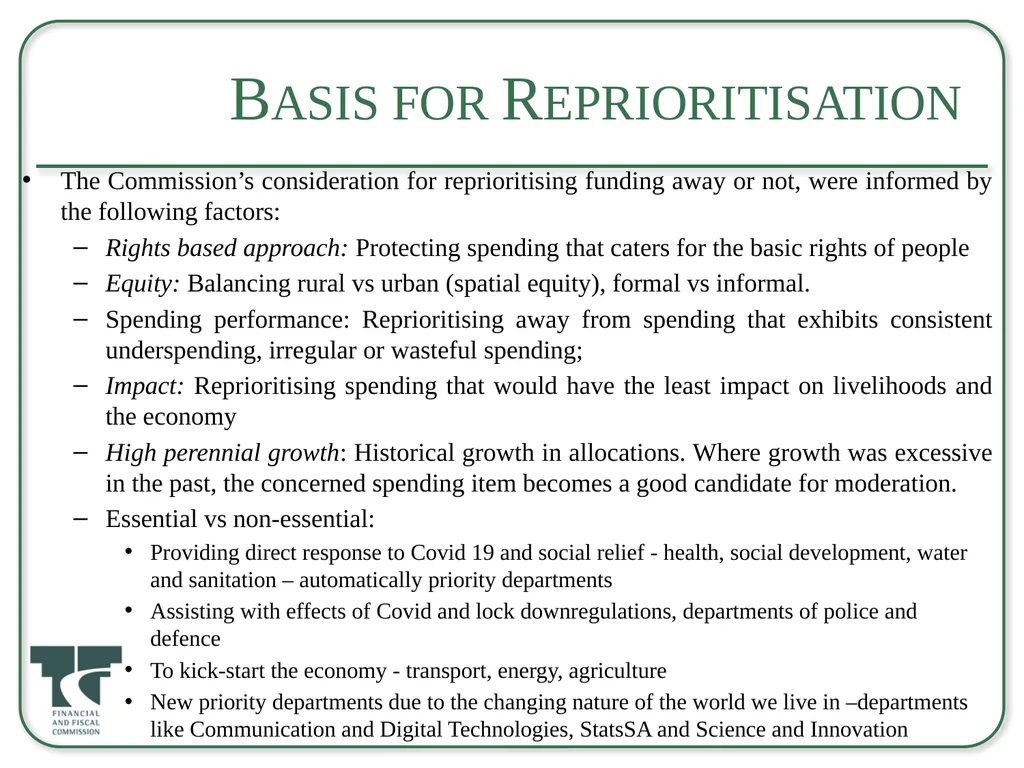
Basis for Reprioritisation The Commission’s consideration for reprioritising funding away or not, were informed by the following factors:
Rights based approach: Protecting spending that caters for the basic rights of people
Equity: Balancing rural vs urban (spatial equity), formal vs informal.
Spending performance: Reprioritising away from spending that exhibits consistent underspending, irregular or wasteful spending;
Impact: Reprioritising spending that would have the least impact on livelihoods and the economy
High perennial growth: Historical growth in allocations. Where growth was excessive in the past, the concerned spending item becomes a good candidate for moderation.
Essential vs non-essential:
Providing direct response to Covid 19 and social relief - health, social development, water and sanitation – automatically priority departments
Assisting with effects of Covid and lock downregulations, departments of police and defence
To kick-start the economy - transport, energy, agriculture
New priority departments due to the changing nature of the world we live in –departments like Communication and Digital Technologies, StatsSA and Science and Innovation<br>
Rights based approach: Protecting spending that caters for the basic rights of people
Equity: Balancing rural vs urban (spatial equity), formal vs informal.
Spending performance: Reprioritising away from spending that exhibits consistent underspending, irregular or wasteful spending;
Impact: Reprioritising spending that would have the least impact on livelihoods and the economy
High perennial growth: Historical growth in allocations. Where growth was excessive in the past, the concerned spending item becomes a good candidate for moderation.
Essential vs non-essential:
Providing direct response to Covid 19 and social relief - health, social development, water and sanitation – automatically priority departments
Assisting with effects of Covid and lock downregulations, departments of police and defence
To kick-start the economy - transport, energy, agriculture
New priority departments due to the changing nature of the world we live in –departments like Communication and Digital Technologies, StatsSA and Science and Innovation<br>
25
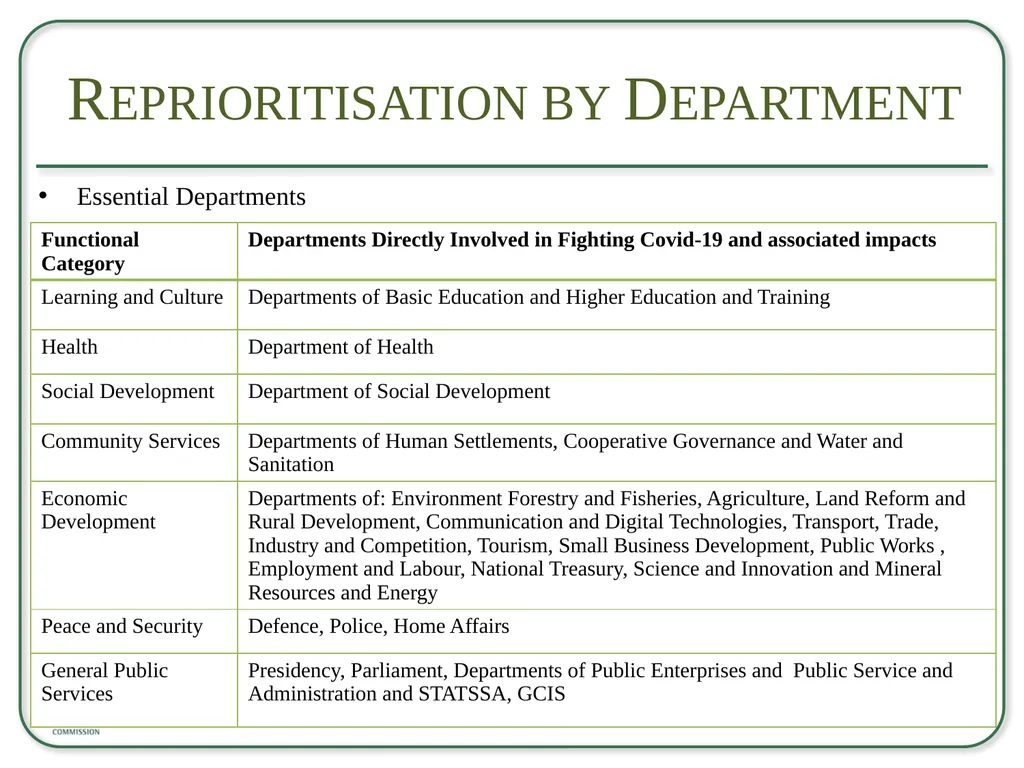
Reprioritisation by Department Essential Departments<br>
26
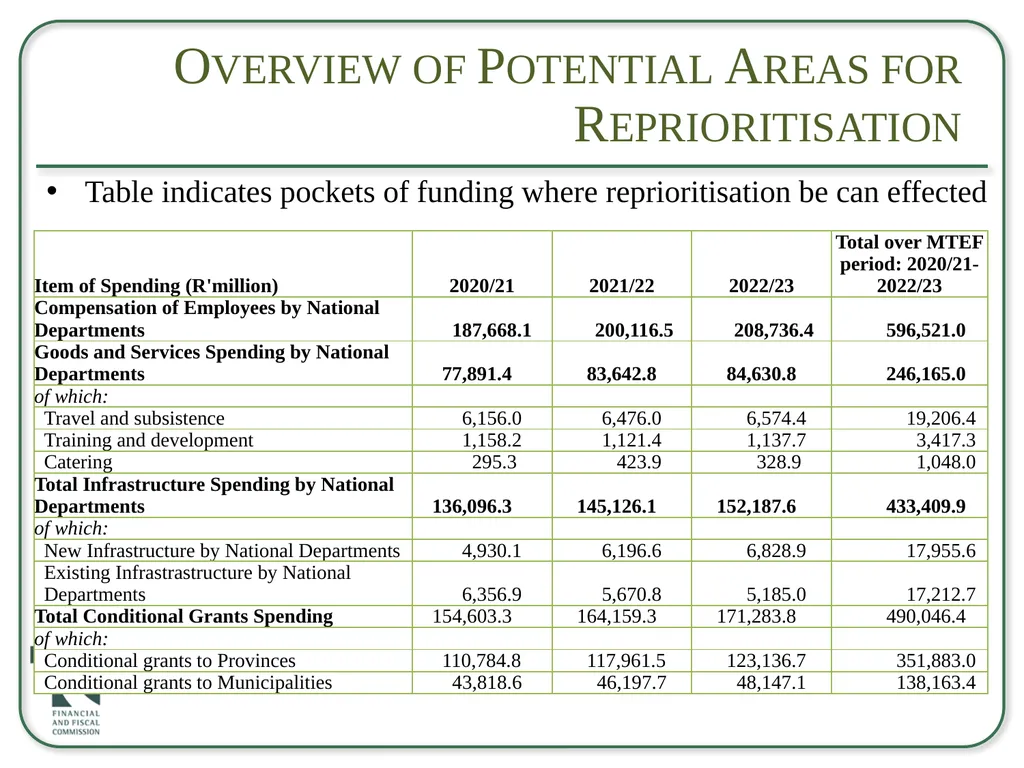
Overview of Potential Areas for Reprioritisation Table indicates pockets of funding where reprioritisation be can effected<br>
27
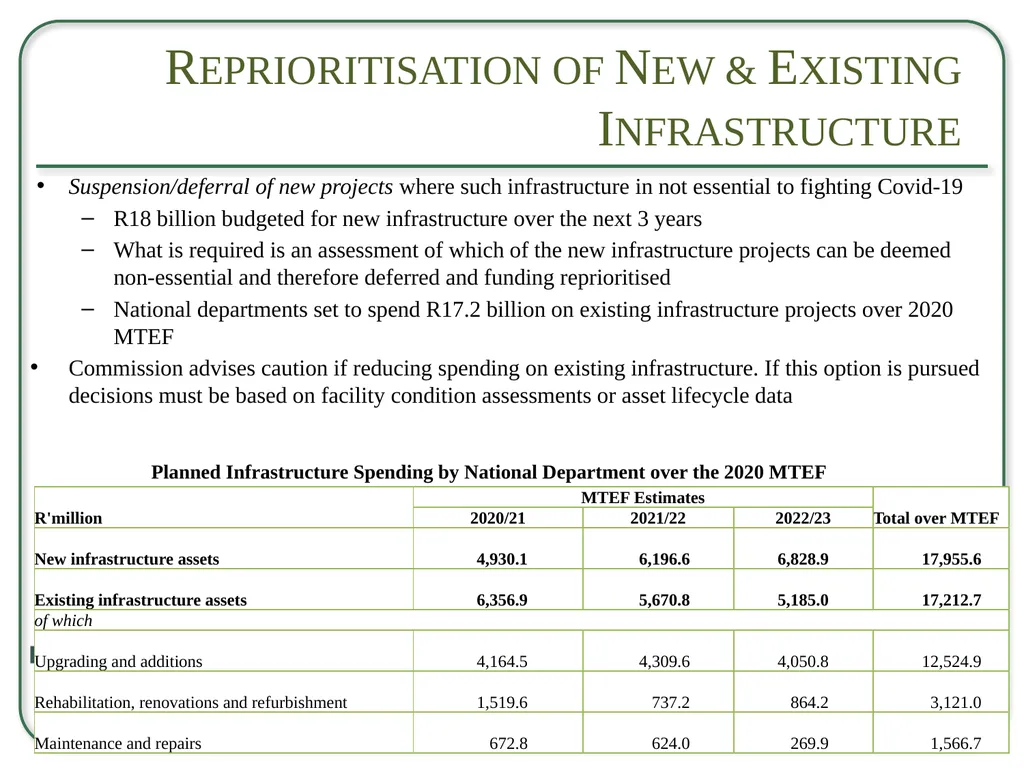
Reprioritisation of New & Existing Infrastructure Suspension/deferral of new projects where such infrastructure in not essential to fighting Covid-19
R18 billion budgeted for new infrastructure over the next 3 years
What is required is an assessment of which of the new infrastructure projects can be deemed non-essential and therefore deferred and funding reprioritised
National departments set to spend R17.2 billion on existing infrastructure projects over 2020 MTEF
Commission advises caution if reducing spending on existing infrastructure. If this option is pursued decisions must be based on facility condition assessments or asset lifecycle data Planned Infrastructure Spending by National Department over the 2020 MTEF<br>
R18 billion budgeted for new infrastructure over the next 3 years
What is required is an assessment of which of the new infrastructure projects can be deemed non-essential and therefore deferred and funding reprioritised
National departments set to spend R17.2 billion on existing infrastructure projects over 2020 MTEF
Commission advises caution if reducing spending on existing infrastructure. If this option is pursued decisions must be based on facility condition assessments or asset lifecycle data Planned Infrastructure Spending by National Department over the 2020 MTEF<br>
28
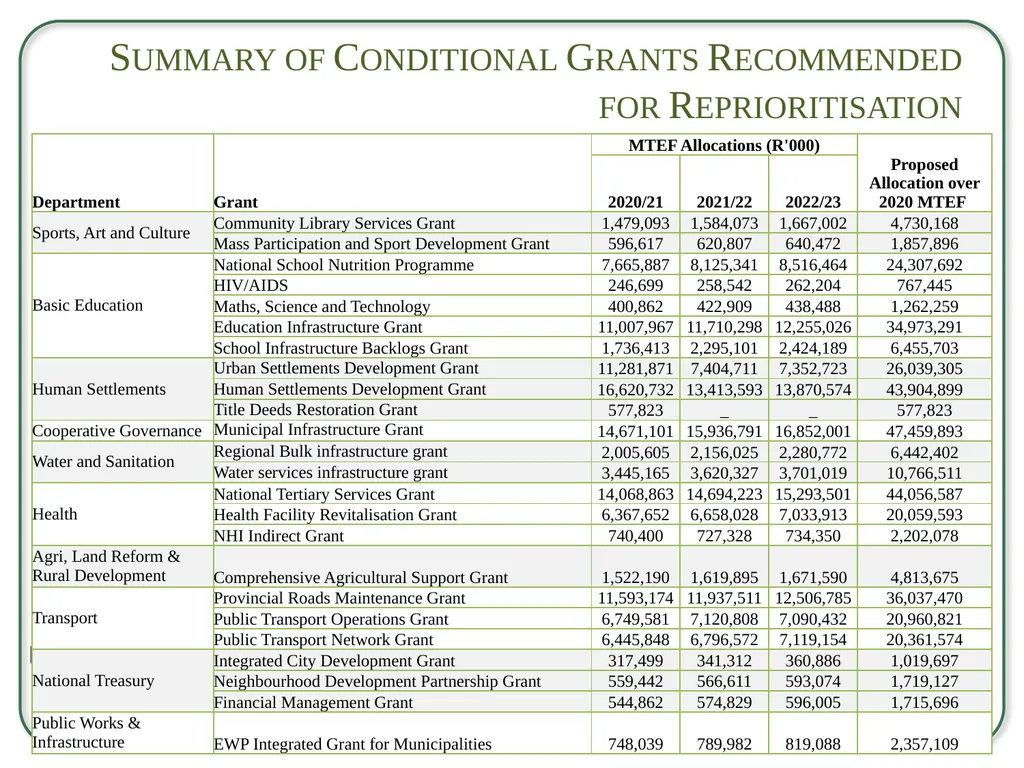
Summary of Conditional Grants Recommended for Reprioritisation<br>
29
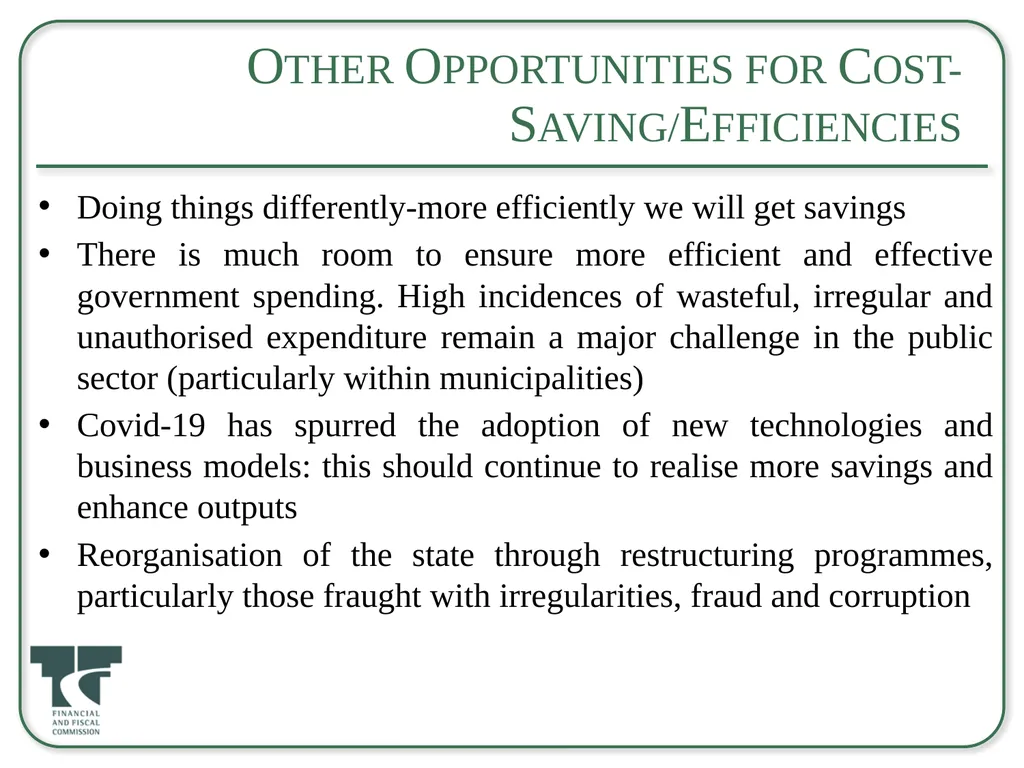
Other Opportunities for Cost-Saving/Efficiencies Doing things differently-more efficiently we will get savings
There is much room to ensure more efficient and effective government spending. High incidences of wasteful, irregular and unauthorised expenditure remain a major challenge in the public sector (particularly within municipalities)
Covid-19 has spurred the adoption of new technologies and business models: this should continue to realise more savings and enhance outputs
Reorganisation of the state through restructuring programmes, particularly those fraught with irregularities, fraud and corruption<br>
There is much room to ensure more efficient and effective government spending. High incidences of wasteful, irregular and unauthorised expenditure remain a major challenge in the public sector (particularly within municipalities)
Covid-19 has spurred the adoption of new technologies and business models: this should continue to realise more savings and enhance outputs
Reorganisation of the state through restructuring programmes, particularly those fraught with irregularities, fraud and corruption<br>
30
Concluding Remarks FFC Briefing to the Select Committee on Appropriations 10/06/2020<br>
31
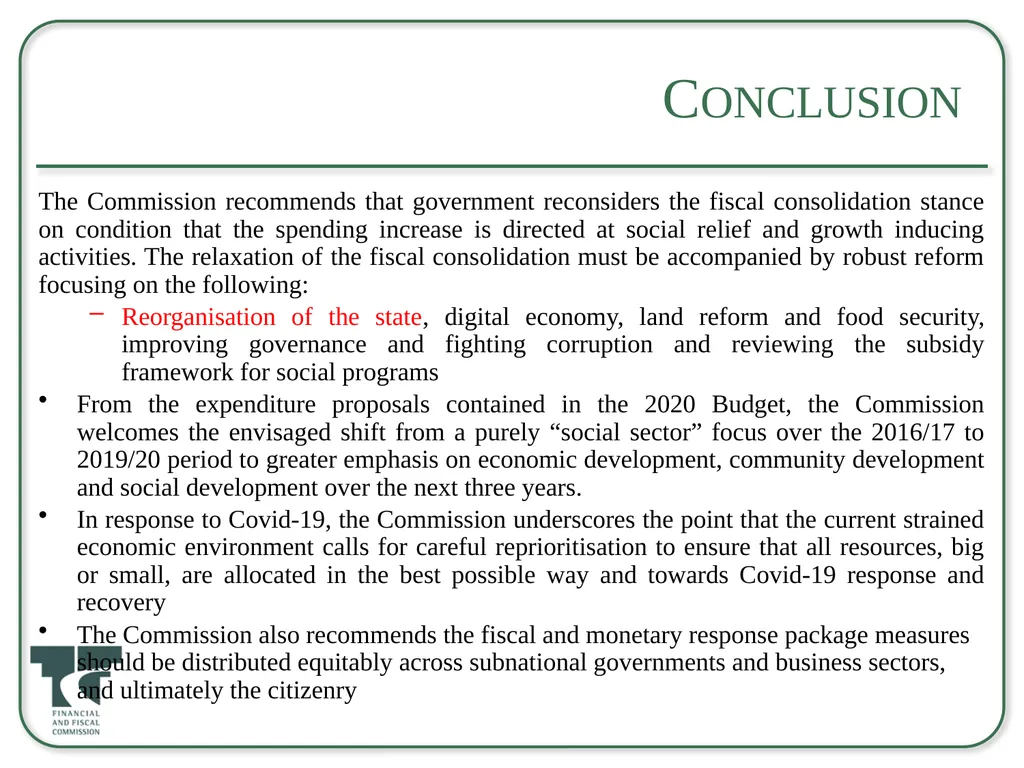
Conclusion The Commission recommends that government reconsiders the fiscal consolidation stance on condition that the spending increase is directed at social relief and growth inducing activities. The relaxation of the fiscal consolidation must be accompanied by robust reform focusing on the following:
Reorganisation of the state, digital economy, land reform and food security, improving governance and fighting corruption and reviewing the subsidy framework for social programs
From the expenditure proposals contained in the 2020 Budget, the Commission welcomes the envisaged shift from a purely “social sector” focus over the 2016/17 to 2019/20 period to greater emphasis on economic development, community development and social development over the next three years.
In response to Covid-19, the Commission underscores the point that the current strained economic environment calls for careful reprioritisation to ensure that all resources, big or small, are allocated in the best possible way and towards Covid-19 response and recovery
The Commission also recommends the fiscal and monetary response package measures should be distributed equitably across subnational governments and business sectors, and ultimately the citizenry<br>
Reorganisation of the state, digital economy, land reform and food security, improving governance and fighting corruption and reviewing the subsidy framework for social programs
From the expenditure proposals contained in the 2020 Budget, the Commission welcomes the envisaged shift from a purely “social sector” focus over the 2016/17 to 2019/20 period to greater emphasis on economic development, community development and social development over the next three years.
In response to Covid-19, the Commission underscores the point that the current strained economic environment calls for careful reprioritisation to ensure that all resources, big or small, are allocated in the best possible way and towards Covid-19 response and recovery
The Commission also recommends the fiscal and monetary response package measures should be distributed equitably across subnational governments and business sectors, and ultimately the citizenry<br>
32
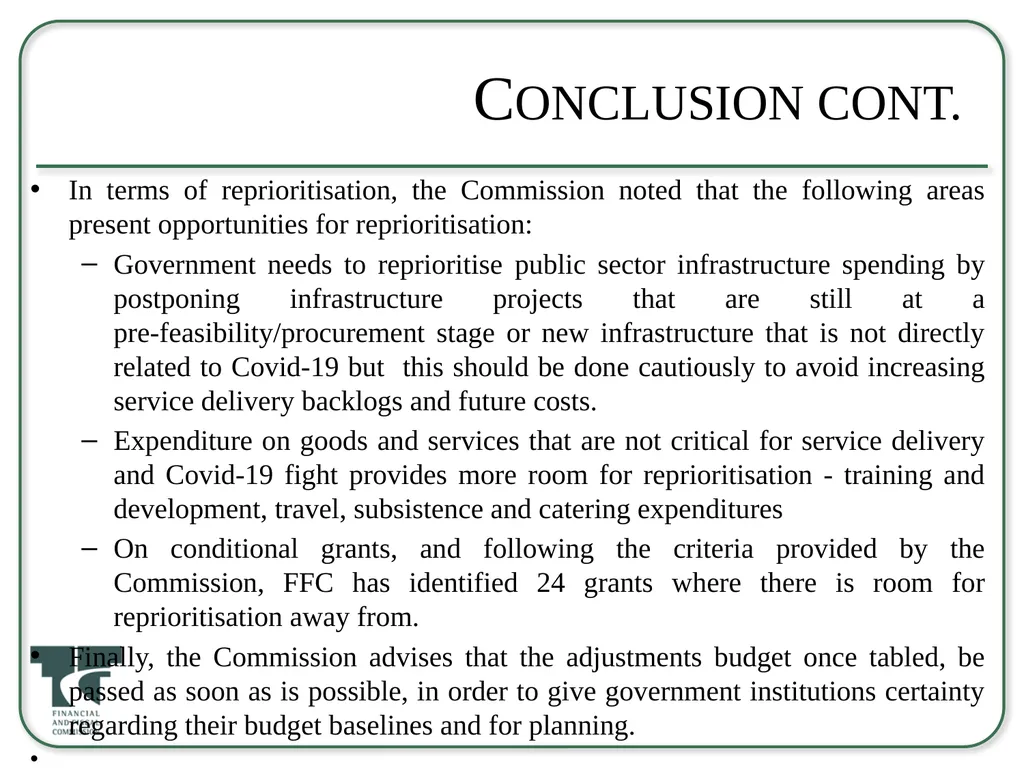
Conclusion cont. In terms of reprioritisation, the Commission noted that the following areas present opportunities for reprioritisation:
Government needs to reprioritise public sector infrastructure spending by postponing infrastructure projects that are still at a pre-feasibility/procurement stage or new infrastructure that is not directly related to Covid-19 but this should be done cautiously to avoid increasing service delivery backlogs and future costs.
Expenditure on goods and services that are not critical for service delivery and Covid-19 fight provides more room for reprioritisation - training and development, travel, subsistence and catering expenditures
On conditional grants, and following the criteria provided by the Commission, FFC has identified 24 grants where there is room for reprioritisation away from.
Finally, the Commission advises that the adjustments budget once tabled, be passed as soon as is possible, in order to give government institutions certainty regarding their budget baselines and for planning.<br>
Government needs to reprioritise public sector infrastructure spending by postponing infrastructure projects that are still at a pre-feasibility/procurement stage or new infrastructure that is not directly related to Covid-19 but this should be done cautiously to avoid increasing service delivery backlogs and future costs.
Expenditure on goods and services that are not critical for service delivery and Covid-19 fight provides more room for reprioritisation - training and development, travel, subsistence and catering expenditures
On conditional grants, and following the criteria provided by the Commission, FFC has identified 24 grants where there is room for reprioritisation away from.
Finally, the Commission advises that the adjustments budget once tabled, be passed as soon as is possible, in order to give government institutions certainty regarding their budget baselines and for planning.<br>
33
Thank You FFC Briefing to the Select Committee on Appropriations 10/06/2020<br>