
Broward County Public Schools Code of Conduct
EM
Published · 20 slides · 0 views

1 / 1

Description
Broward County Public Schools Code of Conduct 2019-2020 Attendance Student Responsibilities Students have a responsibility to attend all classes. Students have a responsibility to be on time for school and all classes. Students have a
Related Topics
Share
Embed code
Download this presentation From Below
"Broward County Public Schools Code of Conduct" is the property of its rightful owner. Permission is granted to download and print the materials on this website for personal, non-commercial use only, and to display it on your personal computer provided you do not modify the materials and that you retain all copyright notices contained in the materials. By downloading content from our website, you accept the terms of this agreement.
Presentation Transcript
01
Broward County Public Schools Code of Conduct 2019-2020<br>
02
Attendance – Student Responsibilities Students have a responsibility to attend all classes.
Students have a responsibility to be on time for school and all classes.
Students have a responsibility to ask their parents to notify the school when they are absent.
Students have a responsibility to ask teachers for, and to complete, make-up assignments, in accordance with the guidelines from Make-Up Work (see Policy 6000.1: Student Progression Plan at https://www.browardschools.com/Page/37754.
Students having or suspected of having a communicable disease are not allowed to attend school. In order to return to school, parents must obtain a doctor’s note stating that the student is no longer contagious. Chickenpox is the only infectious disease that does not require a doctor’s note.<br>
Students have a responsibility to be on time for school and all classes.
Students have a responsibility to ask their parents to notify the school when they are absent.
Students have a responsibility to ask teachers for, and to complete, make-up assignments, in accordance with the guidelines from Make-Up Work (see Policy 6000.1: Student Progression Plan at https://www.browardschools.com/Page/37754.
Students having or suspected of having a communicable disease are not allowed to attend school. In order to return to school, parents must obtain a doctor’s note stating that the student is no longer contagious. Chickenpox is the only infectious disease that does not require a doctor’s note.<br>
03
Attendance – Excused vs. Unexcused Absences 1. Illness
2. Illness of an immediate family member
3. Death in the family
4. Religious holidays of the student’s specific faith
5. Required court appearance or subpoena by a law enforcement agency
6. Special event. Examples of special events include important public functions, education enrichment activities, conferences, state/national competitions, college/university campus tour/visit as well as exceptional cases of family need.
7. Scheduled doctor, dentist appointments, or treatment for autism spectrum disorder by a licensed health care practitioner or certified behavior analyst
8. Students having or suspected of having a communicable disease or infestation that can be transmitted are to be excluded from school and are not allowed to return to school until they no longer present a health hazard. Examples of communicable diseases and infestations include, but are not limited to, fleas, head lice, ringworm, impetigo, and scabies. Students are allowed a maximum of five (5) days excused absence for each infestation of head lice.
9. Students on field trips, students who attend alternative-to-suspension programs, or internal in-school suspension programs are not considered absent.
Absences are excused only for the reasons previously listed. If absences are not excused, as defined in the previous section, the absences are considered unexcused. This does not apply to suspensions.<br>
2. Illness of an immediate family member
3. Death in the family
4. Religious holidays of the student’s specific faith
5. Required court appearance or subpoena by a law enforcement agency
6. Special event. Examples of special events include important public functions, education enrichment activities, conferences, state/national competitions, college/university campus tour/visit as well as exceptional cases of family need.
7. Scheduled doctor, dentist appointments, or treatment for autism spectrum disorder by a licensed health care practitioner or certified behavior analyst
8. Students having or suspected of having a communicable disease or infestation that can be transmitted are to be excluded from school and are not allowed to return to school until they no longer present a health hazard. Examples of communicable diseases and infestations include, but are not limited to, fleas, head lice, ringworm, impetigo, and scabies. Students are allowed a maximum of five (5) days excused absence for each infestation of head lice.
9. Students on field trips, students who attend alternative-to-suspension programs, or internal in-school suspension programs are not considered absent.
Absences are excused only for the reasons previously listed. If absences are not excused, as defined in the previous section, the absences are considered unexcused. This does not apply to suspensions.<br>
04
Tardiness Tardiness is disruptive to the learning environment and can have a negative impact on student achievement. Tardiness may also count toward establishing a pattern of non-attendance that may indicate early signs of truancy. A pattern of non-attendance may be established by an accumulation of tardiness, absences (excused and unexcused), and early sign outs that exceed five (5) days in a marking period or ten (10) days in two (2) marking periods.
Tardiness is defined as a student not being in the classroom when classes are scheduled to begin. A student who has an excused tardy (note or telephone call) should report directly to class after first checking in at the designated check-in area of the school.
Excessive tardiness will be addressed on a case-by-case basis to determine if there is a pattern of non-attendance.
Tardiness to any class without documentation may be considered unexcused.<br>
Tardiness is defined as a student not being in the classroom when classes are scheduled to begin. A student who has an excused tardy (note or telephone call) should report directly to class after first checking in at the designated check-in area of the school.
Excessive tardiness will be addressed on a case-by-case basis to determine if there is a pattern of non-attendance.
Tardiness to any class without documentation may be considered unexcused.<br>
05
Respect for Persons and Property –
Student Responsibilities Students have the responsibility to demonstrate the character education traits: Responsibility, Citizenship, Kindness, Respect, Honesty, Self-Control, Tolerance, and Cooperation
Students have the responsibility to treat others with respect and honesty.
Students have the responsibility to respect the rights of others.
Students have the responsibility to treat school property and the property of others with respect and to act in a way that does not interfere with the rights of others and is not harmful to the health and safety of others.
Students have the responsibility to provide information on any potentially dangerous situations to a staff member or through one of the anonymous tip lines provided by the school system.<br>
Students have the responsibility to treat others with respect and honesty.
Students have the responsibility to respect the rights of others.
Students have the responsibility to treat school property and the property of others with respect and to act in a way that does not interfere with the rights of others and is not harmful to the health and safety of others.
Students have the responsibility to provide information on any potentially dangerous situations to a staff member or through one of the anonymous tip lines provided by the school system.<br>
06
Respect for persons and Property –
Expected Behaviors Treat others with respect and honesty
Prepare for class by bringing paper, pencil, pen, books, and other needed supplies
Complete all class work and homework
Use class time properly
Take home and return necessary forms
Follow rules and regulations, including those for field trips
Take care of and return all textbooks, library books, or other school-owned materials loaned to them
Act responsibly on campus, on buses, on field trips, and at all school-sponsored events, regardless of location
Secondary students must wear identification (ID) badges, if the school has the infrastructure and/or funding in place to require ID badges and the school’s handbook specifies the rules and consequences for ID badges<br>
Prepare for class by bringing paper, pencil, pen, books, and other needed supplies
Complete all class work and homework
Use class time properly
Take home and return necessary forms
Follow rules and regulations, including those for field trips
Take care of and return all textbooks, library books, or other school-owned materials loaned to them
Act responsibly on campus, on buses, on field trips, and at all school-sponsored events, regardless of location
Secondary students must wear identification (ID) badges, if the school has the infrastructure and/or funding in place to require ID badges and the school’s handbook specifies the rules and consequences for ID badges<br>
07
UNACCEPTABLE BEHAVIORS LEADING TO DISCIPLINARY ACTION Leaving class or school without permission
Not attending school (truancy)
Being tardy excessively
Skipping class
Out of assigned area
Violating the dress code
Taking, possessing, displaying, distributing, and/or transmitting pictures using a camera telephone during the school day.
Littering This Photo by Unknown Author is licensed under CC BY-SA-NC<br>
Not attending school (truancy)
Being tardy excessively
Skipping class
Out of assigned area
Violating the dress code
Taking, possessing, displaying, distributing, and/or transmitting pictures using a camera telephone during the school day.
Littering This Photo by Unknown Author is licensed under CC BY-SA-NC<br>
08
UNACCEPTABLE BEHAVIORS LEADING TO DISCIPLINARY ACTION Disturbing the class or school by: being disrespectful or rude, refusing to obey any staff member, failing to follow classroom rules, running in the halls, throwing objects, possessing or igniting fireworks or firearms, fighting, gambling, or bringing distracting items to school. Examples of distracting items include, but are not limited to: skateboards, scooters, in-line skates/roller blades/heelies (sneakers with wheels), toys, playing cards, games, cigarette lighters, radios, audio recorders, or laser pointers/pens and other laser devices.
Sole possession of a wireless communication device is not a violation of the Code of Student Conduct. However, the possession of a wireless communication device which disrupts the educational process; the use of a wireless communication device during school hours; except as indicated below; the use of a wireless communication device on school buses in the absence of an emergency concerning safety-to-life issues (defined as a bus accident, mechanical breakdown which delays the normal route, and/or thirty (30) minutes or more in a route delay); and the possession or use of a cellular telephone (other than text messaging that does not disrupt the bus driver), would be a violation of the Code of Student Conduct, subjecting violators to progressive discipline.
Personal technology, should be turned off or silenced and kept out-of-sight during all instructional and class time activities. No cell phone, video, audio, voice-monitoring/recording or image capturing devices, or other personal technology may be used except under the direction of a teacher or administrator for instructional purposes.
Due to school and safety concerns, personal technology (headphones, earbuds, or other accessories) is restricted to minimal volume only to be heard by its user. One ear must remain free of the accessory at all times. Violations of this policy will result in confiscation, and the device will only be released to the parent. Progressive discipline will apply for repeated violations.<br>
Sole possession of a wireless communication device is not a violation of the Code of Student Conduct. However, the possession of a wireless communication device which disrupts the educational process; the use of a wireless communication device during school hours; except as indicated below; the use of a wireless communication device on school buses in the absence of an emergency concerning safety-to-life issues (defined as a bus accident, mechanical breakdown which delays the normal route, and/or thirty (30) minutes or more in a route delay); and the possession or use of a cellular telephone (other than text messaging that does not disrupt the bus driver), would be a violation of the Code of Student Conduct, subjecting violators to progressive discipline.
Personal technology, should be turned off or silenced and kept out-of-sight during all instructional and class time activities. No cell phone, video, audio, voice-monitoring/recording or image capturing devices, or other personal technology may be used except under the direction of a teacher or administrator for instructional purposes.
Due to school and safety concerns, personal technology (headphones, earbuds, or other accessories) is restricted to minimal volume only to be heard by its user. One ear must remain free of the accessory at all times. Violations of this policy will result in confiscation, and the device will only be released to the parent. Progressive discipline will apply for repeated violations.<br>
09
UNACCEPTABLE BEHAVIORS LEADING TO DISCIPLINARY ACTION Possessing pornographic/obscene material or drug paraphernalia at school
Misrepresenting oneself by cheating, copying, plagiarizing, counterfeiting, using false identification, or making false reports by posing as a parent to excuse absences or tardiness, sign a report card, etc.
Abusing another student or staff member including, but not limited to, verbal abuse, actual or threatened physical harm, extortion, destruction of personal property, intentionally making a false accusation, or intentionally providing misinformation.
Conducting, recruiting, or participating in youth gang activities on campus
Using gang-related or cult-related gestures, language, and/or signs
Unauthorized presence on school property
Endangering the lives of students and staff by setting off unfounded fire alarms
Gambling<br>
Misrepresenting oneself by cheating, copying, plagiarizing, counterfeiting, using false identification, or making false reports by posing as a parent to excuse absences or tardiness, sign a report card, etc.
Abusing another student or staff member including, but not limited to, verbal abuse, actual or threatened physical harm, extortion, destruction of personal property, intentionally making a false accusation, or intentionally providing misinformation.
Conducting, recruiting, or participating in youth gang activities on campus
Using gang-related or cult-related gestures, language, and/or signs
Unauthorized presence on school property
Endangering the lives of students and staff by setting off unfounded fire alarms
Gambling<br>
10
UNACCEPTABLE BEHAVIORS LEADING TO DISCIPLINARY ACTION Possessing or using drugs, alcohol, tobacco products, e-cigarette, vapor devices or similar, and/or unauthorized over-the-counter medications or unauthorized prescription medications
Sale or attempted sale and/or transmittal of drugs, alcohol, and/or tobacco products, e-cigarette, vapor devices or similar, and/or authorized or unauthorized over-the-counter medications or prescription medications
Possessing drug paraphernalia
Bullying and/or harassment
Cyberbullying
Taking part in physical acts of a sexual nature, engaging in sexual harassment, or offending others by indecent exposure
Using insulting, abusive, profane, racially or sexually offensive written or oral language, or making obscene remarks or gestures
Harassing others because of age, color, gender, gender identity, gender expression, national origin, marital status, race, religion, or sexual orientation<br>
Sale or attempted sale and/or transmittal of drugs, alcohol, and/or tobacco products, e-cigarette, vapor devices or similar, and/or authorized or unauthorized over-the-counter medications or prescription medications
Possessing drug paraphernalia
Bullying and/or harassment
Cyberbullying
Taking part in physical acts of a sexual nature, engaging in sexual harassment, or offending others by indecent exposure
Using insulting, abusive, profane, racially or sexually offensive written or oral language, or making obscene remarks or gestures
Harassing others because of age, color, gender, gender identity, gender expression, national origin, marital status, race, religion, or sexual orientation<br>
11
UNACCEPTABLE BEHAVIORS LEADING TO DISCIPLINARY ACTION Harassing others because of a disability
Harassing others because of ethnicity, socio-economic background, or linguistic differences
Harassing others because of physical appearance or for any other reason
Hazing
Threatening, stalking, hitting, or hurting a teacher or other school personnel
Intentionally making a false accusation that jeopardizes the professional reputation, employment, or certification of a teacher or other member of a school staff
Committing a hate crime
Fighting<br>
Harassing others because of ethnicity, socio-economic background, or linguistic differences
Harassing others because of physical appearance or for any other reason
Hazing
Threatening, stalking, hitting, or hurting a teacher or other school personnel
Intentionally making a false accusation that jeopardizes the professional reputation, employment, or certification of a teacher or other member of a school staff
Committing a hate crime
Fighting<br>
12
UNACCEPTABLE BEHAVIORS LEADING TO DISCIPLINARY ACTION Damaging, destroying, or vandalizing school property
Misusing technology
Starting a fire (arson)
Committing petty theft
Breaking and entering/burglary
Having and/or hiding a weapon (see definitions of weapons)
Threatening or hurting a person with a weapon
Committing robbery
Forcing someone to give money, possessions, or other things of value to another or oneself (extortion)
Endangering the lives of students and staff by failing to report a threat of violence against others
Making a bomb threat
Sexual battery
Kidnapping or abduction
Homicide
Committing other criminal acts<br>
Misusing technology
Starting a fire (arson)
Committing petty theft
Breaking and entering/burglary
Having and/or hiding a weapon (see definitions of weapons)
Threatening or hurting a person with a weapon
Committing robbery
Forcing someone to give money, possessions, or other things of value to another or oneself (extortion)
Endangering the lives of students and staff by failing to report a threat of violence against others
Making a bomb threat
Sexual battery
Kidnapping or abduction
Homicide
Committing other criminal acts<br>
13
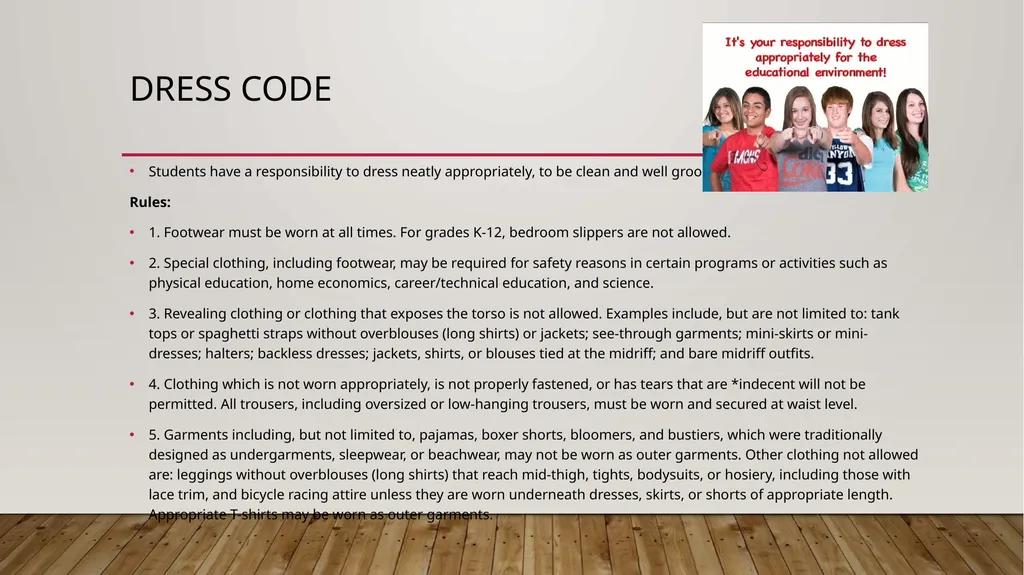
Dress Code Students have a responsibility to dress neatly appropriately, to be clean and well groomed.
Rules:
1. Footwear must be worn at all times. For grades K-12, bedroom slippers are not allowed.
2. Special clothing, including footwear, may be required for safety reasons in certain programs or activities such as physical education, home economics, career/technical education, and science.
3. Revealing clothing or clothing that exposes the torso is not allowed. Examples include, but are not limited to: tank tops or spaghetti straps without overblouses (long shirts) or jackets; see-through garments; mini-skirts or mini-dresses; halters; backless dresses; jackets, shirts, or blouses tied at the midriff; and bare midriff outfits.
4. Clothing which is not worn appropriately, is not properly fastened, or has tears that are *indecent will not be permitted. All trousers, including oversized or low-hanging trousers, must be worn and secured at waist level.
5. Garments including, but not limited to, pajamas, boxer shorts, bloomers, and bustiers, which were traditionally designed as undergarments, sleepwear, or beachwear, may not be worn as outer garments. Other clothing not allowed are: leggings without overblouses (long shirts) that reach mid-thigh, tights, bodysuits, or hosiery, including those with lace trim, and bicycle racing attire unless they are worn underneath dresses, skirts, or shorts of appropriate length. Appropriate T-shirts may be worn as outer garments.<br>
Rules:
1. Footwear must be worn at all times. For grades K-12, bedroom slippers are not allowed.
2. Special clothing, including footwear, may be required for safety reasons in certain programs or activities such as physical education, home economics, career/technical education, and science.
3. Revealing clothing or clothing that exposes the torso is not allowed. Examples include, but are not limited to: tank tops or spaghetti straps without overblouses (long shirts) or jackets; see-through garments; mini-skirts or mini-dresses; halters; backless dresses; jackets, shirts, or blouses tied at the midriff; and bare midriff outfits.
4. Clothing which is not worn appropriately, is not properly fastened, or has tears that are *indecent will not be permitted. All trousers, including oversized or low-hanging trousers, must be worn and secured at waist level.
5. Garments including, but not limited to, pajamas, boxer shorts, bloomers, and bustiers, which were traditionally designed as undergarments, sleepwear, or beachwear, may not be worn as outer garments. Other clothing not allowed are: leggings without overblouses (long shirts) that reach mid-thigh, tights, bodysuits, or hosiery, including those with lace trim, and bicycle racing attire unless they are worn underneath dresses, skirts, or shorts of appropriate length. Appropriate T-shirts may be worn as outer garments.<br>
14
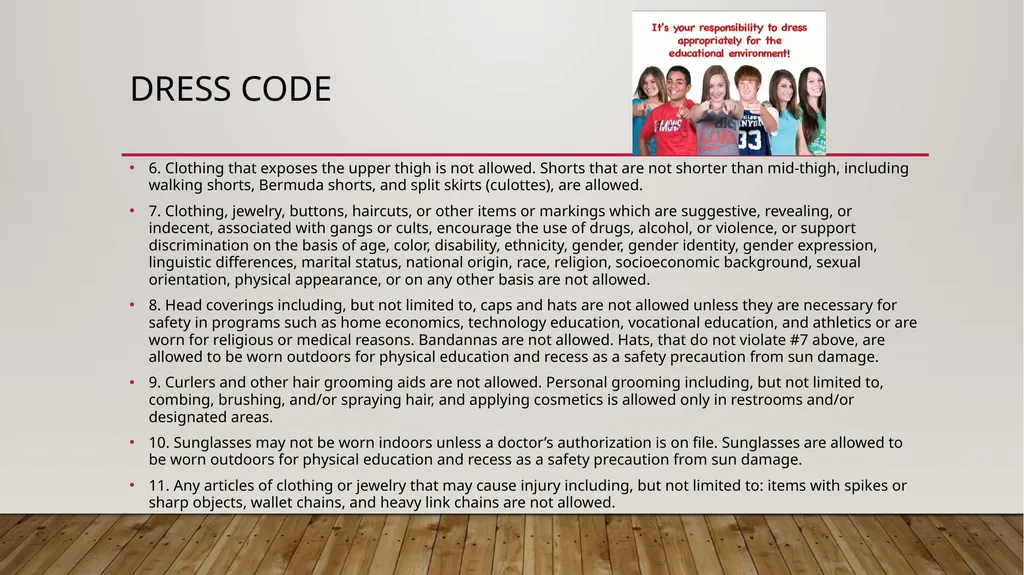
Dress COde 6. Clothing that exposes the upper thigh is not allowed. Shorts that are not shorter than mid-thigh, including walking shorts, Bermuda shorts, and split skirts (culottes), are allowed.
7. Clothing, jewelry, buttons, haircuts, or other items or markings which are suggestive, revealing, or indecent, associated with gangs or cults, encourage the use of drugs, alcohol, or violence, or support discrimination on the basis of age, color, disability, ethnicity, gender, gender identity, gender expression, linguistic differences, marital status, national origin, race, religion, socioeconomic background, sexual orientation, physical appearance, or on any other basis are not allowed.
8. Head coverings including, but not limited to, caps and hats are not allowed unless they are necessary for safety in programs such as home economics, technology education, vocational education, and athletics or are worn for religious or medical reasons. Bandannas are not allowed. Hats, that do not violate #7 above, are allowed to be worn outdoors for physical education and recess as a safety precaution from sun damage.
9. Curlers and other hair grooming aids are not allowed. Personal grooming including, but not limited to, combing, brushing, and/or spraying hair, and applying cosmetics is allowed only in restrooms and/or designated areas.
10. Sunglasses may not be worn indoors unless a doctor’s authorization is on file. Sunglasses are allowed to be worn outdoors for physical education and recess as a safety precaution from sun damage.
11. Any articles of clothing or jewelry that may cause injury including, but not limited to: items with spikes or sharp objects, wallet chains, and heavy link chains are not allowed.<br>
7. Clothing, jewelry, buttons, haircuts, or other items or markings which are suggestive, revealing, or indecent, associated with gangs or cults, encourage the use of drugs, alcohol, or violence, or support discrimination on the basis of age, color, disability, ethnicity, gender, gender identity, gender expression, linguistic differences, marital status, national origin, race, religion, socioeconomic background, sexual orientation, physical appearance, or on any other basis are not allowed.
8. Head coverings including, but not limited to, caps and hats are not allowed unless they are necessary for safety in programs such as home economics, technology education, vocational education, and athletics or are worn for religious or medical reasons. Bandannas are not allowed. Hats, that do not violate #7 above, are allowed to be worn outdoors for physical education and recess as a safety precaution from sun damage.
9. Curlers and other hair grooming aids are not allowed. Personal grooming including, but not limited to, combing, brushing, and/or spraying hair, and applying cosmetics is allowed only in restrooms and/or designated areas.
10. Sunglasses may not be worn indoors unless a doctor’s authorization is on file. Sunglasses are allowed to be worn outdoors for physical education and recess as a safety precaution from sun damage.
11. Any articles of clothing or jewelry that may cause injury including, but not limited to: items with spikes or sharp objects, wallet chains, and heavy link chains are not allowed.<br>
15
Technology Usage – Responsibilities Students have a responsibility to understand the difference between appropriate and unacceptable uses of online communications and information systems, the Internet and networks.
Students have a responsibility to use online communications and information systems, the Internet and networks in a responsible, efficient, ethical, and legal manner in accordance with their educational mission.
Students have a responsibility to recognize that the use of online communications and information systems, the Internet and networks is a privilege that can be withdrawn if they engage in unacceptable or illegal use of this resource.<br>
Students have a responsibility to use online communications and information systems, the Internet and networks in a responsible, efficient, ethical, and legal manner in accordance with their educational mission.
Students have a responsibility to recognize that the use of online communications and information systems, the Internet and networks is a privilege that can be withdrawn if they engage in unacceptable or illegal use of this resource.<br>
16
Student activities and Assembly -- Responsibilities Students have a responsibility to keep their extracurricular activities from interfering with their academic work and to know and follow the rules for the activities they choose.
Students have a responsibility to ensure that their actions as members of school clubs and groups meet the standards that have been set by the school administration.
Students have a responsibility to educate themselves as to the qualities needed for leadership and choose officers who have those qualities.
Students who hold office have a responsibility to learn how to do their jobs, support the goals of the group that elected them, and to treat other members of the group fairly.
Students who participate in field trips, social and/or extra curricular activities that are school-approved and/or sponsored by school clubs or groups, have a responsibility to follow the rules set forth in the Code of Student Conduct, and where applicable, by the conferences, conventions or contests they may attend.<br>
Students have a responsibility to ensure that their actions as members of school clubs and groups meet the standards that have been set by the school administration.
Students have a responsibility to educate themselves as to the qualities needed for leadership and choose officers who have those qualities.
Students who hold office have a responsibility to learn how to do their jobs, support the goals of the group that elected them, and to treat other members of the group fairly.
Students who participate in field trips, social and/or extra curricular activities that are school-approved and/or sponsored by school clubs or groups, have a responsibility to follow the rules set forth in the Code of Student Conduct, and where applicable, by the conferences, conventions or contests they may attend.<br>
17
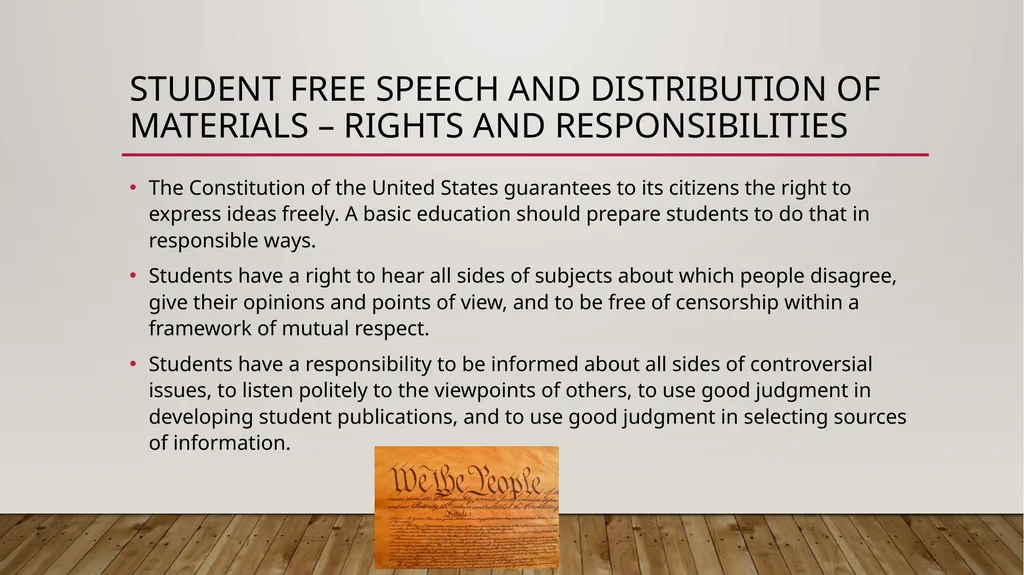
Student free speech and distribution of materials – Rights and responsibilities The Constitution of the United States guarantees to its citizens the right to express ideas freely. A basic education should prepare students to do that in responsible ways.
Students have a right to hear all sides of subjects about which people disagree, give their opinions and points of view, and to be free of censorship within a framework of mutual respect.
Students have a responsibility to be informed about all sides of controversial issues, to listen politely to the viewpoints of others, to use good judgment in developing student publications, and to use good judgment in selecting sources of information.<br>
Students have a right to hear all sides of subjects about which people disagree, give their opinions and points of view, and to be free of censorship within a framework of mutual respect.
Students have a responsibility to be informed about all sides of controversial issues, to listen politely to the viewpoints of others, to use good judgment in developing student publications, and to use good judgment in selecting sources of information.<br>
18
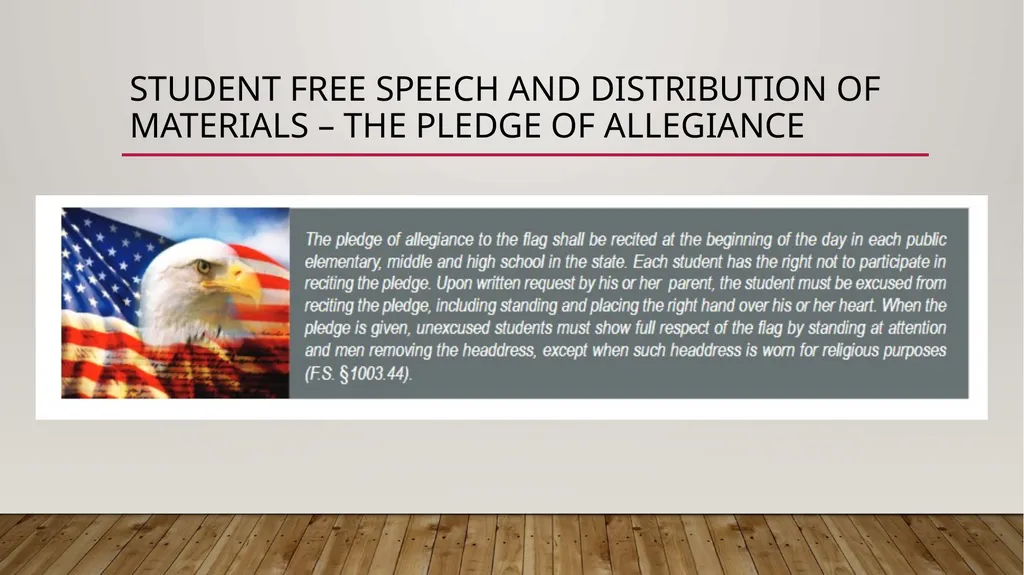
Student free speech and distribution of materials – the Pledge of allegiance<br>
19
Privacy of student records Students have the right to expect that schools will keep student records safe, secure, and private. Students who are eighteen (18) years or older have the right to see their own school records.
Students have a right to expect that others will respect personal belongings.
Students have a responsibility to learn how the information in their school records is gathered, how it is used, and what it means.<br>
Students have a right to expect that others will respect personal belongings.
Students have a responsibility to learn how the information in their school records is gathered, how it is used, and what it means.<br>
20
Information about Interventions and/or Consequences, the Right to Appeal and Grievance Procedures, as well as the Discipline Matrix can be found in Sections IX, X, and XI of the Student Code of Conduct, which can be found at https://www.browardschools.com/codeofconduct<br>