
Building a Program of Research & Post-Doctoral
Description: Building a Program of Research Post-Doctoral Considerations Nursing Research Field Advisory Committee Office of Nursing Services 4 1 15 Program of Research Definition: Cohesive approach to sequencing a series of studies to efficiently and
Related Topics
Download Presentation
"Building a Program of Research & Post-Doctoral" is the property of its rightful owner. Permission is granted to download and print the materials on this website for personal, non-commercial use only, and to display it on your personal computer provided you do not modify the materials and that you retain all copyright notices contained in the materials. By downloading content from our website, you accept the terms of this agreement.
Presentation Transcript
slide1. Building a Program of Research & Post-Doctoral Considerations Nursing Research Field Advisory Committee
Office of Nursing Services 4 1 15<br>
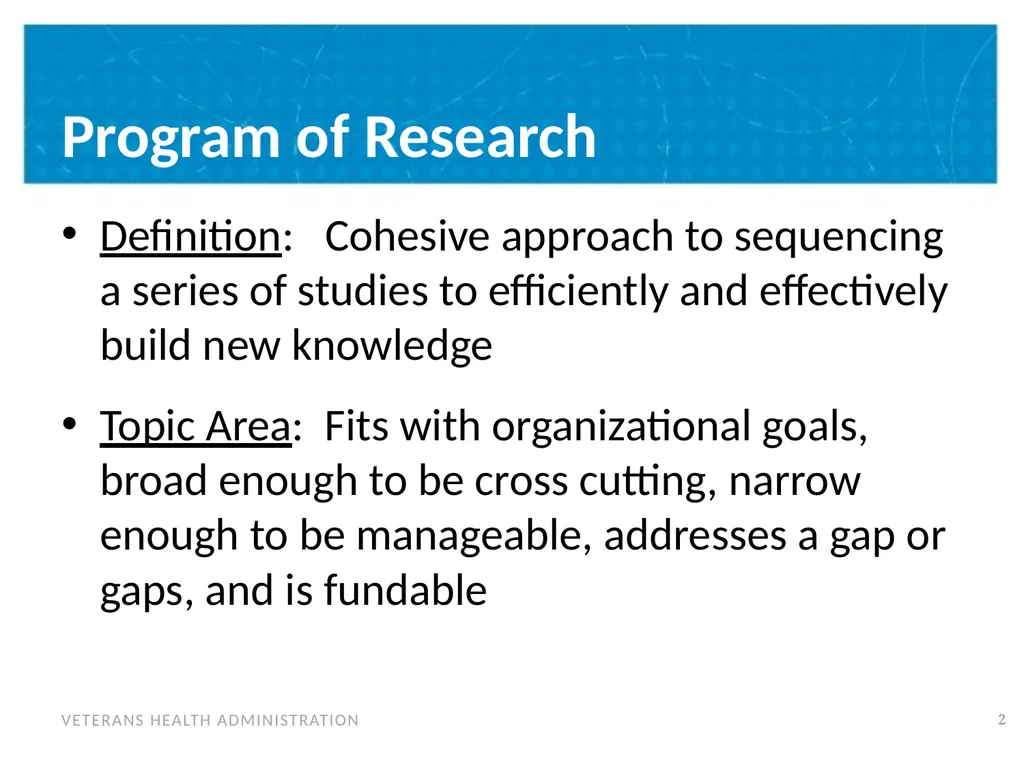
slide2. Program of Research Definition: Cohesive approach to sequencing a series of studies to efficiently and effectively build new knowledge
Topic Area: Fits with organizational goals, broad enough to be cross cutting, narrow enough to be manageable, addresses a gap or gaps, and is fundable 1<br>
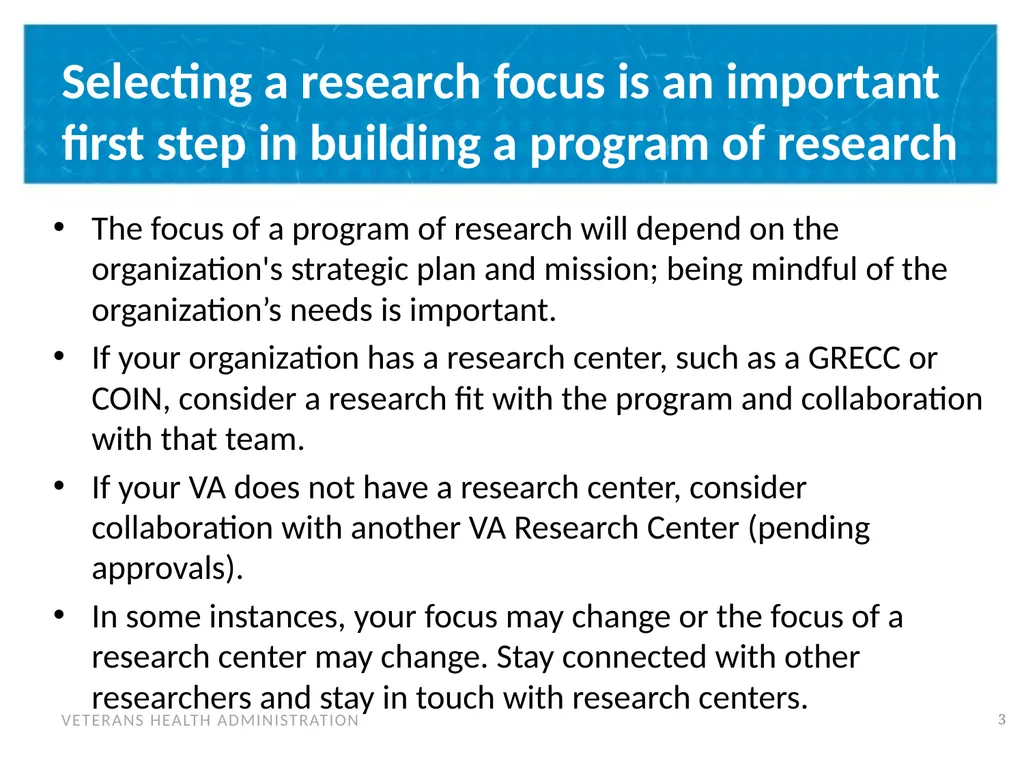
slide3. Selecting a research focus is an important first step in building a program of research The focus of a program of research will depend on the organization's strategic plan and mission; being mindful of the organization’s needs is important.
If your organization has a research center, such as a GRECC or COIN, consider a research fit with the program and collaboration with that team.
If your VA does not have a research center, consider collaboration with another VA Research Center (pending approvals).
In some instances, your focus may change or the focus of a research center may change. Stay connected with other researchers and stay in touch with research centers. 2<br>
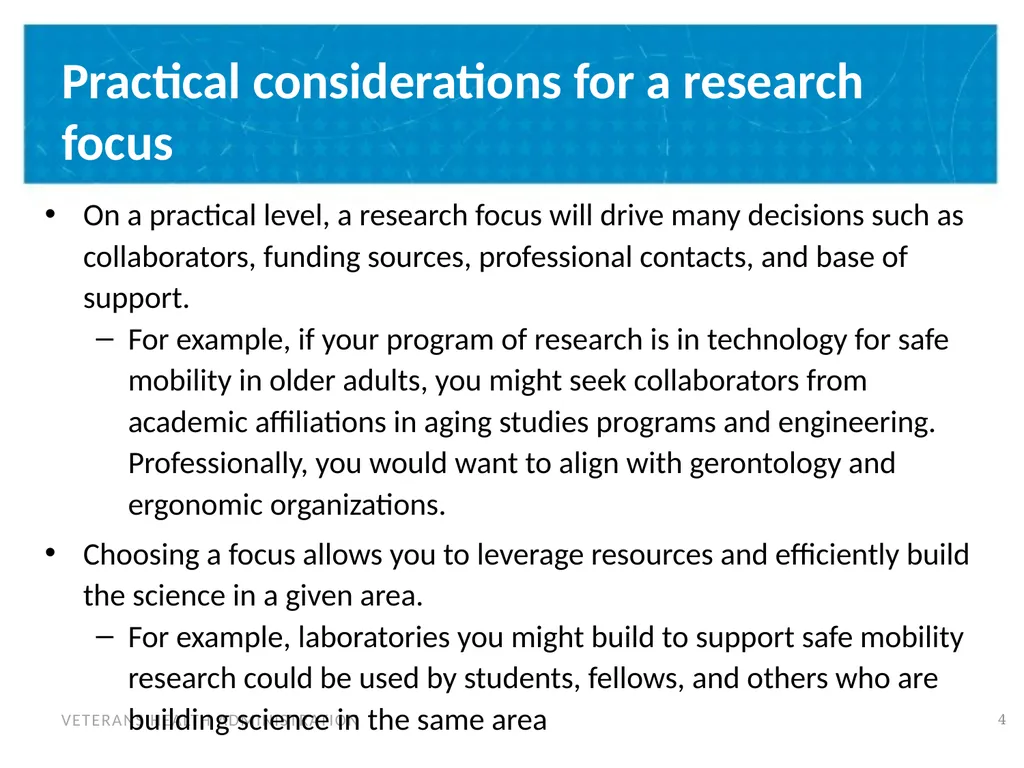
slide4. Practical considerations for a research focus On a practical level, a research focus will drive many decisions such as collaborators, funding sources, professional contacts, and base of support.
For example, if your program of research is in technology for safe mobility in older adults, you might seek collaborators from academic affiliations in aging studies programs and engineering. Professionally, you would want to align with gerontology and ergonomic organizations.
Choosing a focus allows you to leverage resources and efficiently build the science in a given area.
For example, laboratories you might build to support safe mobility research could be used by students, fellows, and others who are building science in the same area 3<br>
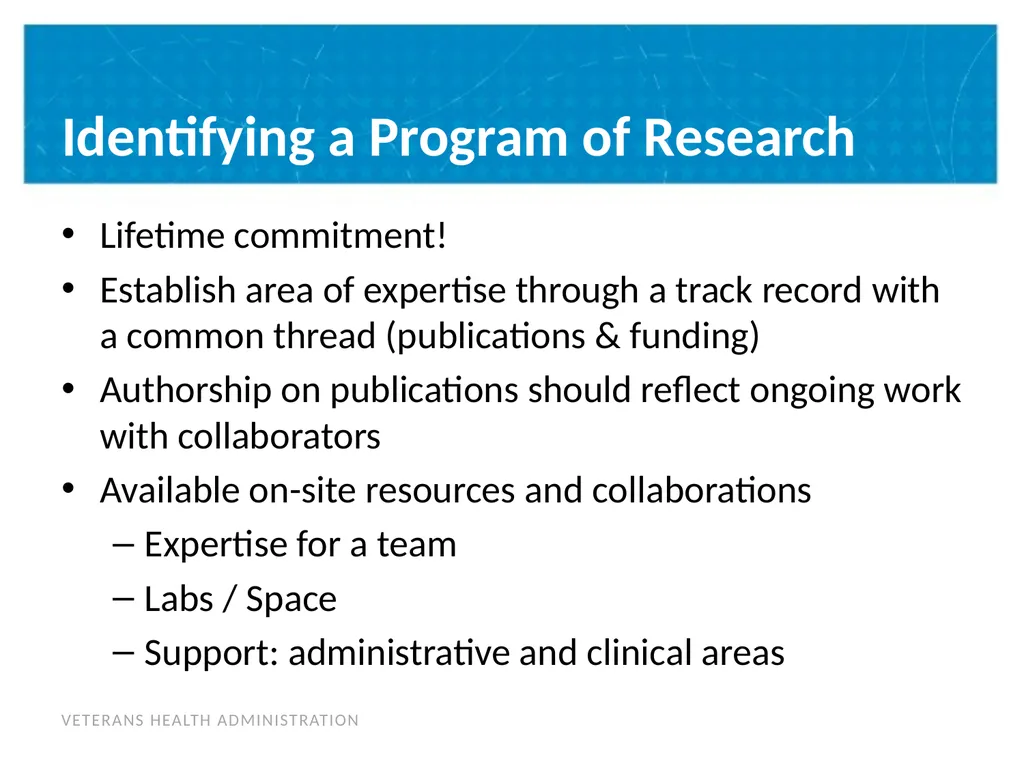
slide5. Identifying a Program of Research Lifetime commitment!
Establish area of expertise through a track record with a common thread (publications & funding)
Authorship on publications should reflect ongoing work with collaborators
Available on-site resources and collaborations
Expertise for a team
Labs / Space
Support: administrative and clinical areas<br>
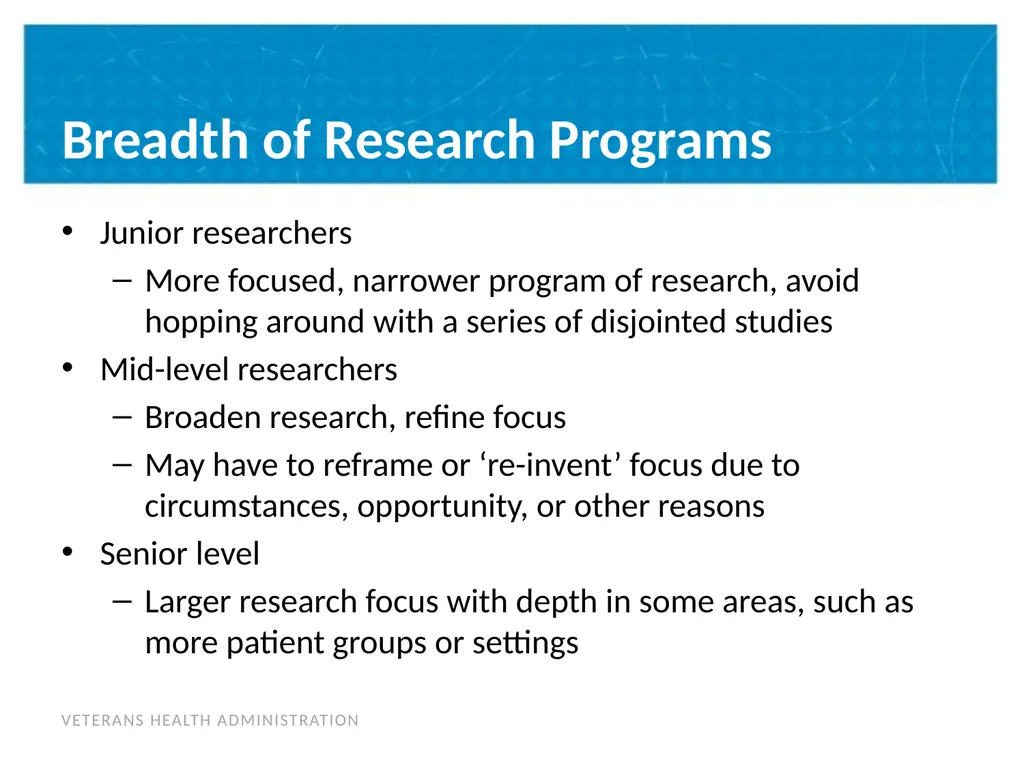
slide6. Breadth of Research Programs Junior researchers
More focused, narrower program of research, avoid hopping around with a series of disjointed studies
Mid-level researchers
Broaden research, refine focus
May have to reframe or ‘re-invent’ focus due to circumstances, opportunity, or other reasons
Senior level
Larger research focus with depth in some areas, such as more patient groups or settings<br>
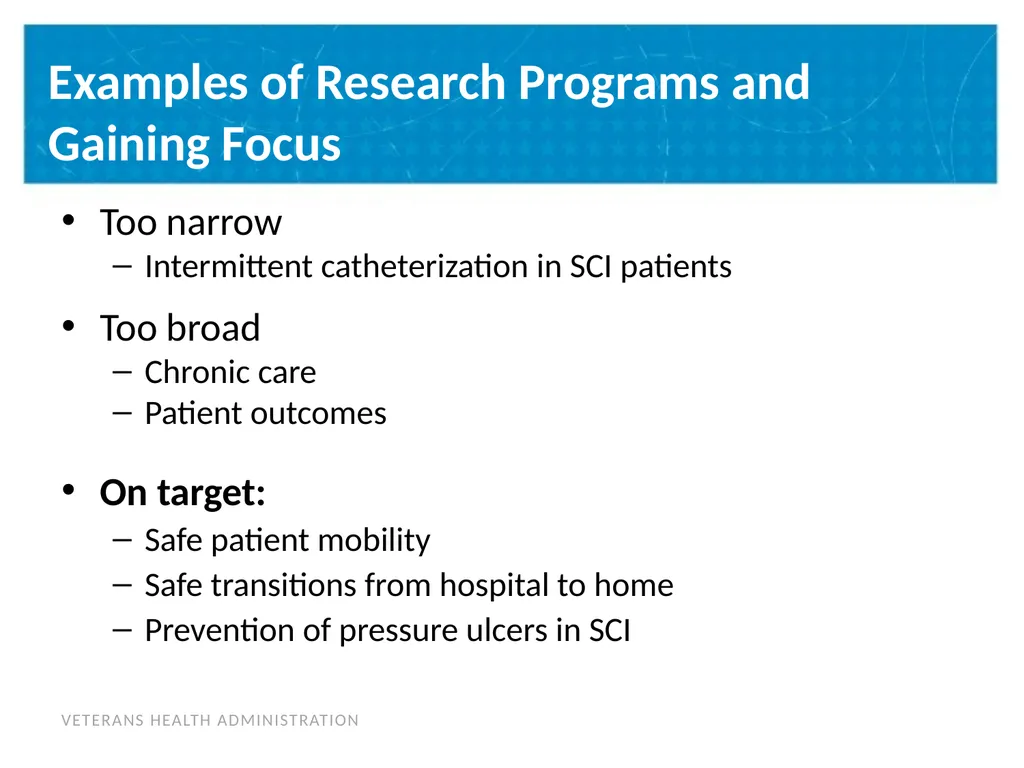
slide7. Examples of Research Programs and Gaining Focus Too narrow
Intermittent catheterization in SCI patients
Too broad
Chronic care
Patient outcomes
On target:
Safe patient mobility
Safe transitions from hospital to home
Prevention of pressure ulcers in SCI<br>
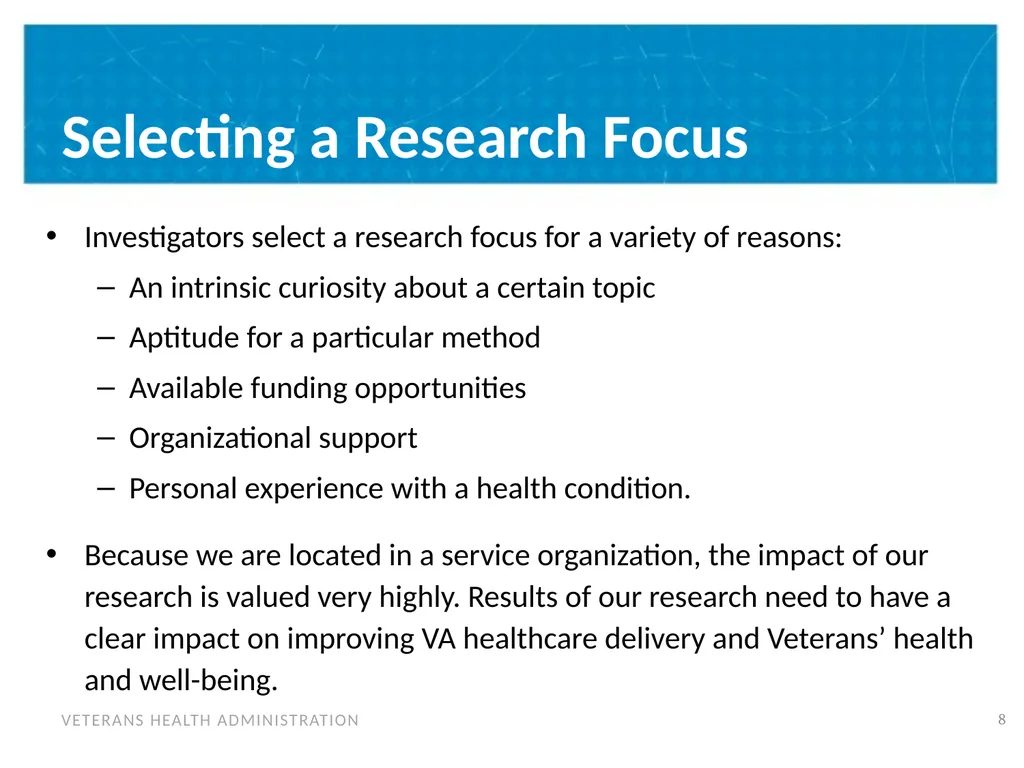
slide8. Selecting a Research Focus Investigators select a research focus for a variety of reasons:
An intrinsic curiosity about a certain topic
Aptitude for a particular method
Available funding opportunities
Organizational support
Personal experience with a health condition.
Because we are located in a service organization, the impact of our research is valued very highly. Results of our research need to have a clear impact on improving VA healthcare delivery and Veterans’ health and well-being. 7<br>
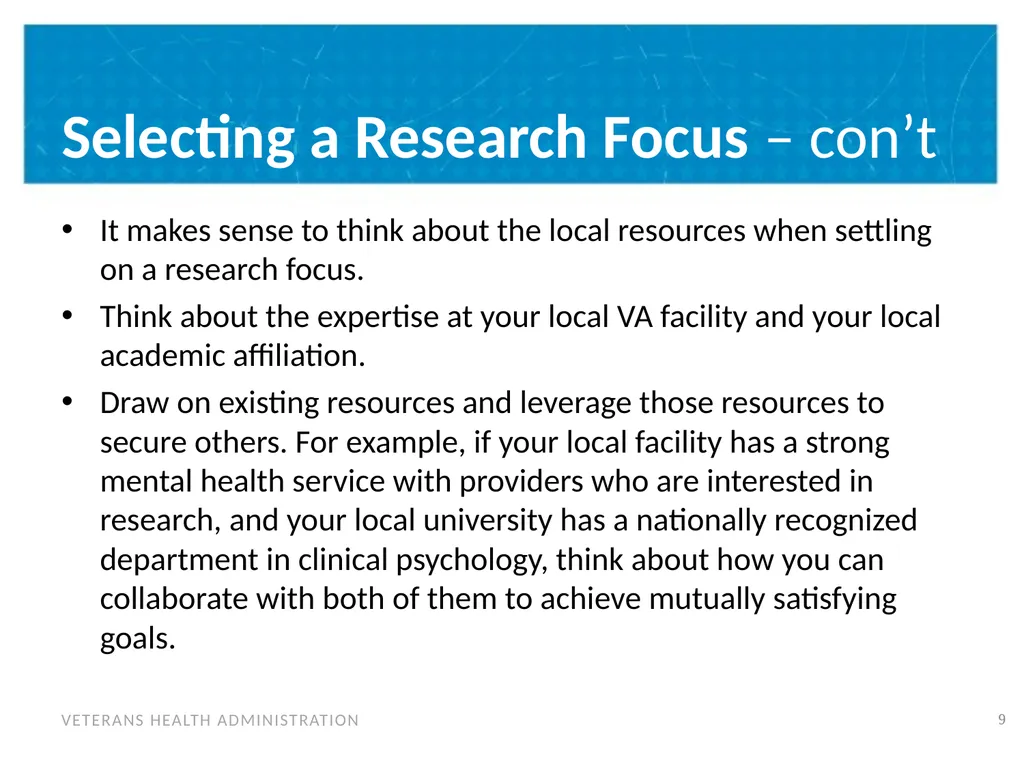
slide9. Selecting a Research Focus – con’t It makes sense to think about the local resources when settling on a research focus.
Think about the expertise at your local VA facility and your local academic affiliation.
Draw on existing resources and leverage those resources to secure others. For example, if your local facility has a strong mental health service with providers who are interested in research, and your local university has a nationally recognized department in clinical psychology, think about how you can collaborate with both of them to achieve mutually satisfying goals. 8<br>
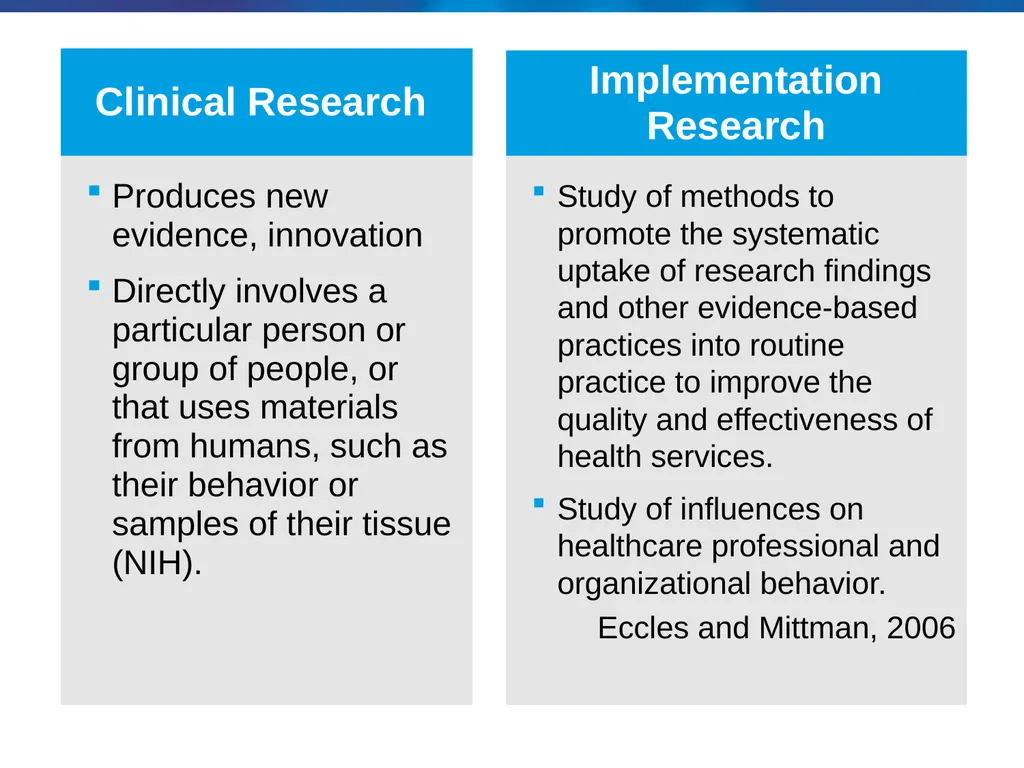
slide10. Clinical Research Produces new evidence, innovation
Directly involves a particular person or group of people, or that uses materials from humans, such as their behavior or samples of their tissue (NIH). Implementation Research Study of methods to promote the systematic uptake of research findings and other evidence-based practices into routine practice to improve the quality and effectiveness of health services.
Study of influences on healthcare professional and organizational behavior.
Eccles and Mittman, 2006<br>
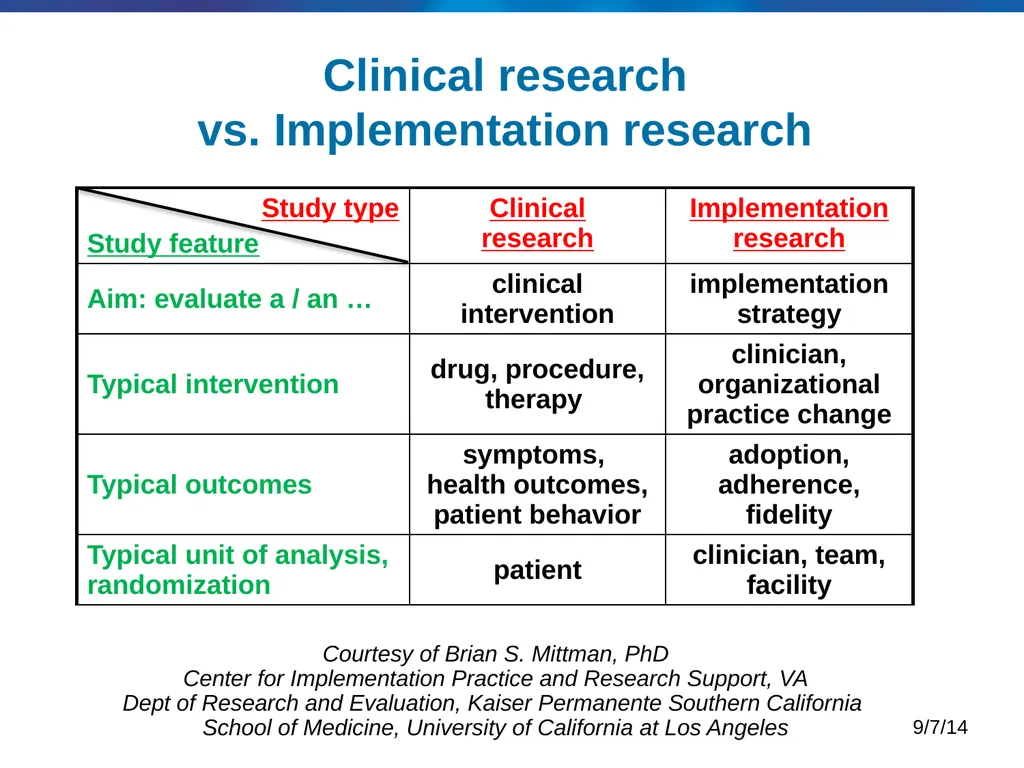
slide11. Clinical research vs. Implementation research Courtesy of Brian S. Mittman, PhD Center for Implementation Practice and Research Support, VA
Dept of Research and Evaluation, Kaiser Permanente Southern California
School of Medicine, University of California at Los Angeles 9/7/14<br>
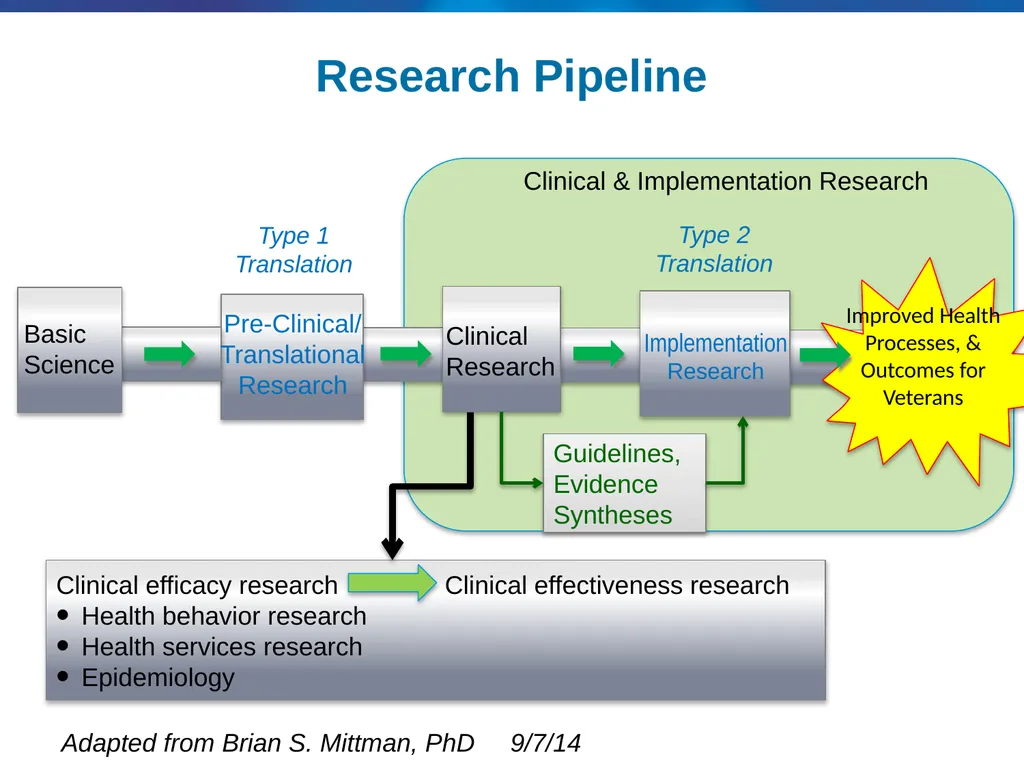
slide12. Research Pipeline Basic
Science Pre-Clinical/ Translational Research Type 2
Translation Implementation Research Clinical Research Type 1
Translation Improved Health Processes, & Outcomes for Veterans Clinical & Implementation Research Clinical efficacy research Clinical effectiveness research
Health behavior research
Health services research
Epidemiology Guidelines,
Evidence Syntheses Adapted from Brian S. Mittman, PhD 9/7/14<br>
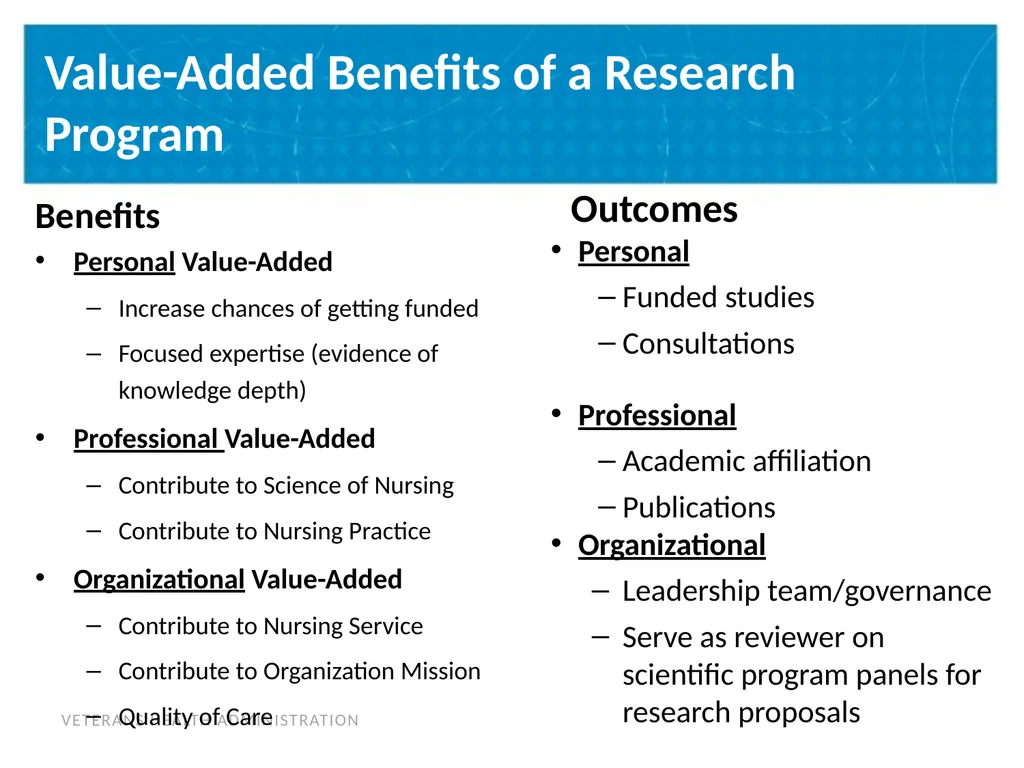
slide13. Value-Added Benefits of a Research Program Benefits
Personal Value-Added
Increase chances of getting funded
Focused expertise (evidence of knowledge depth)
Professional Value-Added
Contribute to Science of Nursing
Contribute to Nursing Practice
Organizational Value-Added
Contribute to Nursing Service
Contribute to Organization Mission
Quality of Care Outcomes
Personal
Funded studies
Consultations
Professional
Academic affiliation
Publications
Organizational
Leadership team/governance
Serve as reviewer on scientific program panels for research proposals<br>
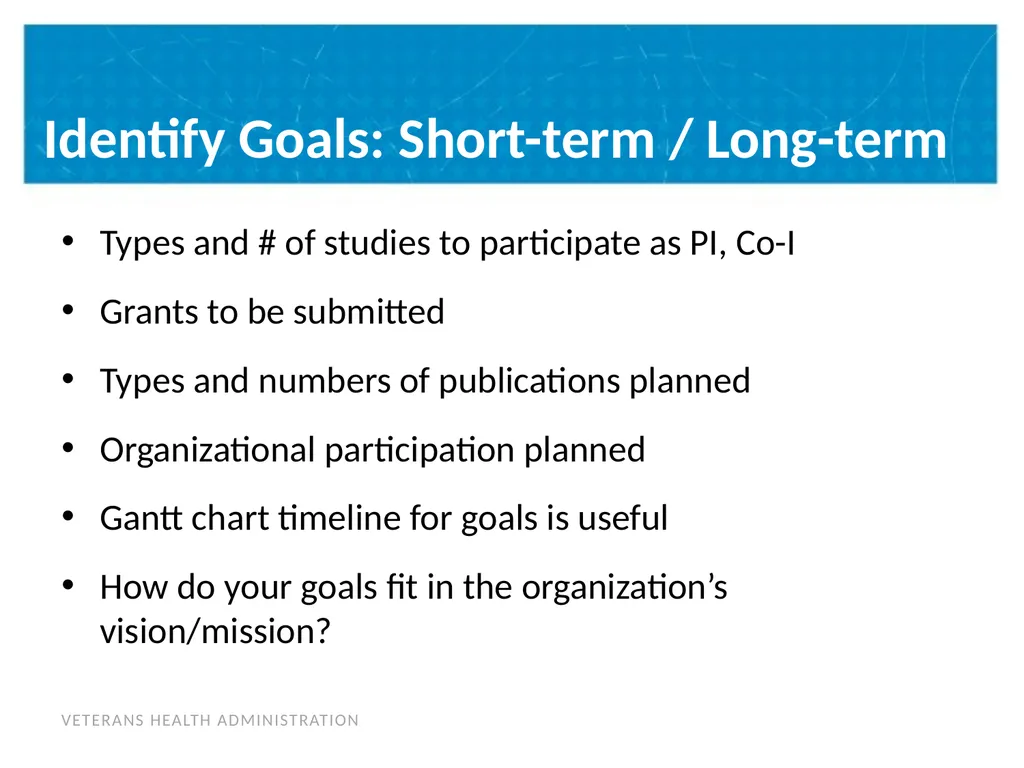
slide14. Identify Goals: Short-term / Long-term Types and # of studies to participate as PI, Co-I
Grants to be submitted
Types and numbers of publications planned
Organizational participation planned
Gantt chart timeline for goals is useful
How do your goals fit in the organization’s vision/mission?<br>
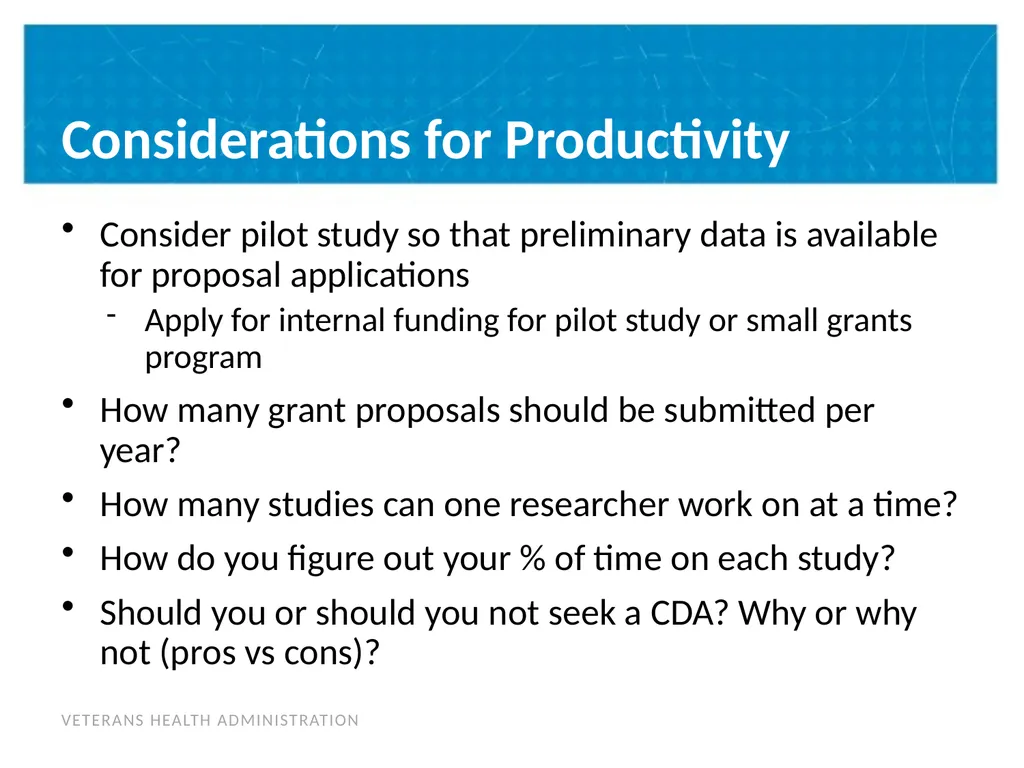
slide15. Considerations for Productivity Consider pilot study so that preliminary data is available for proposal applications
Apply for internal funding for pilot study or small grants program
How many grant proposals should be submitted per year?
How many studies can one researcher work on at a time?
How do you figure out your % of time on each study?
Should you or should you not seek a CDA? Why or why not (pros vs cons)?<br>
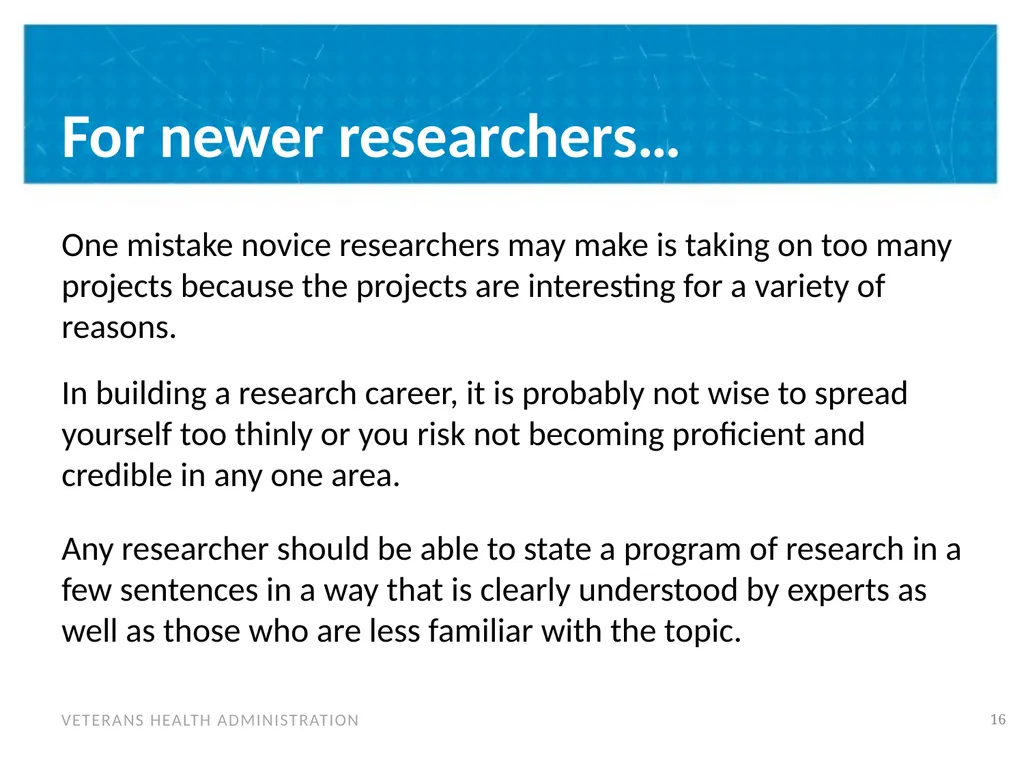
slide16. For newer researchers… One mistake novice researchers may make is taking on too many projects because the projects are interesting for a variety of reasons.
In building a research career, it is probably not wise to spread yourself too thinly or you risk not becoming proficient and credible in any one area.
Any researcher should be able to state a program of research in a few sentences in a way that is clearly understood by experts as well as those who are less familiar with the topic. 15<br>
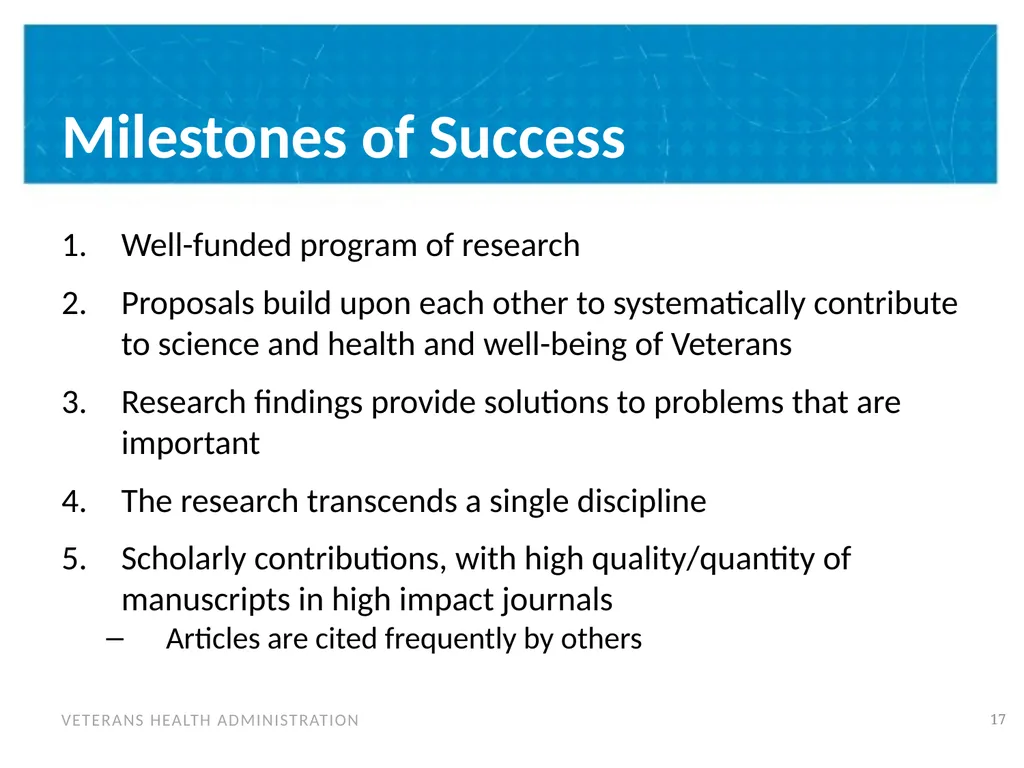
slide17. Milestones of Success Well-funded program of research
Proposals build upon each other to systematically contribute to science and health and well-being of Veterans
Research findings provide solutions to problems that are important
The research transcends a single discipline
Scholarly contributions, with high quality/quantity of manuscripts in high impact journals
Articles are cited frequently by others 16<br>
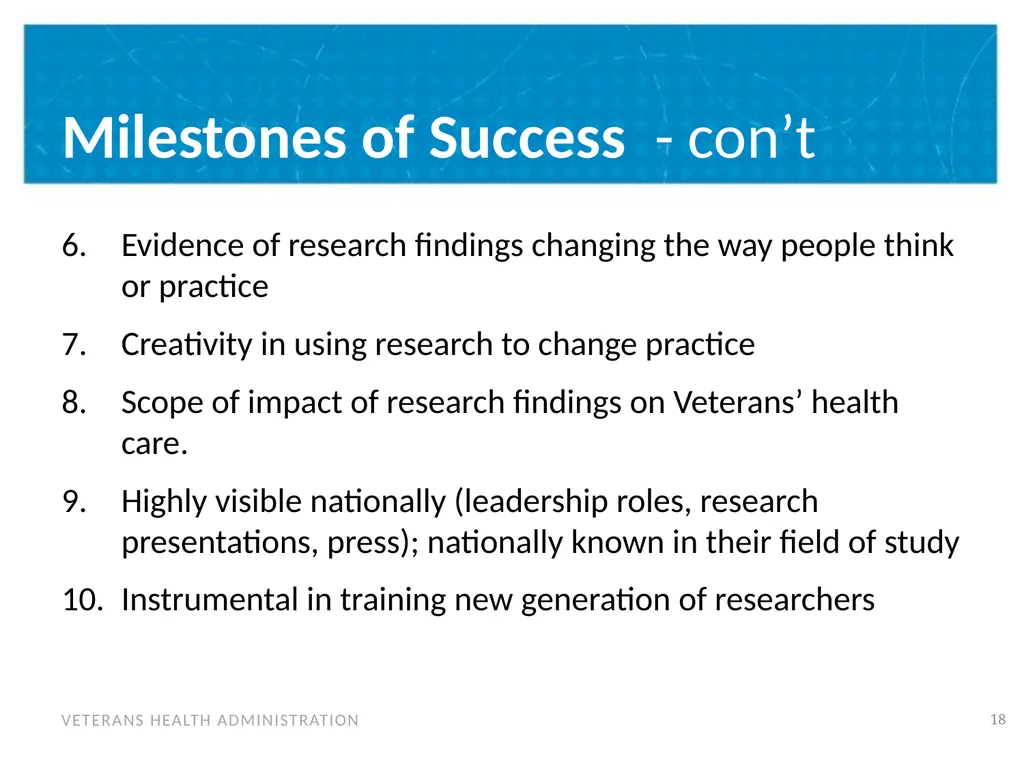
slide18. Milestones of Success - con’t Evidence of research findings changing the way people think or practice
Creativity in using research to change practice
Scope of impact of research findings on Veterans’ health care.
Highly visible nationally (leadership roles, research presentations, press); nationally known in their field of study
Instrumental in training new generation of researchers 17<br>
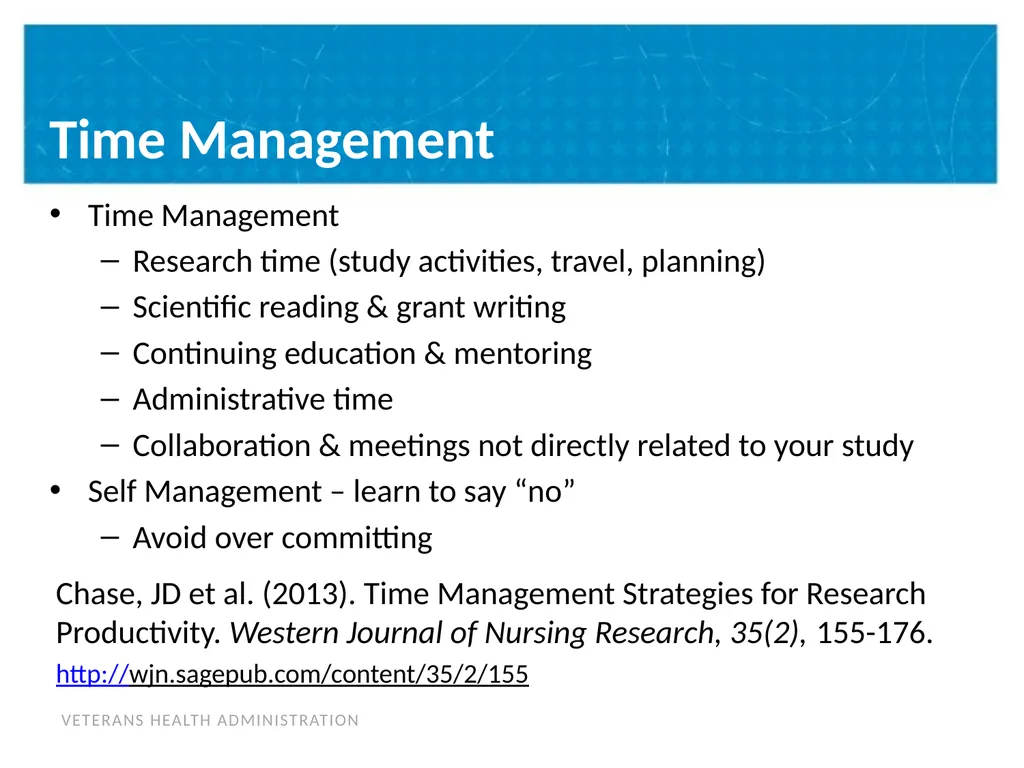
slide19. Time Management Time Management
Research time (study activities, travel, planning)
Scientific reading & grant writing
Continuing education & mentoring
Administrative time
Collaboration & meetings not directly related to your study
Self Management – learn to say “no”
Avoid over committing
Chase, JD et al. (2013). Time Management Strategies for Research Productivity. Western Journal of Nursing Research, 35(2), 155-176.
http://wjn.sagepub.com/content/35/2/155<br>
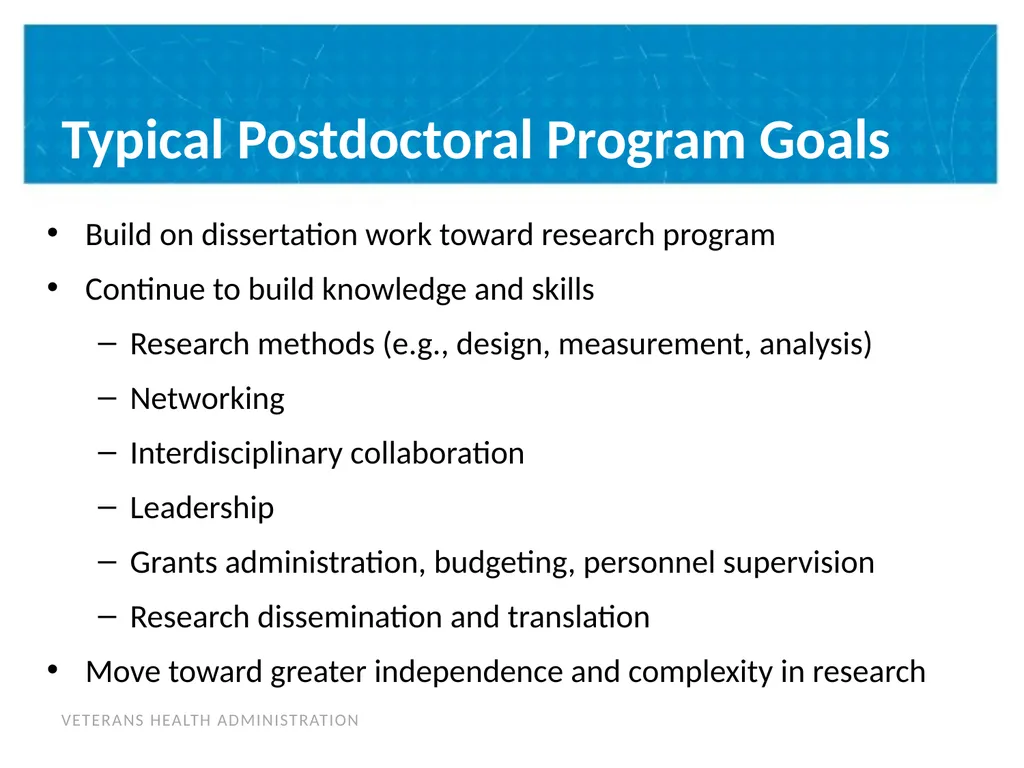
slide20. Typical Postdoctoral Program Goals Build on dissertation work toward research program
Continue to build knowledge and skills
Research methods (e.g., design, measurement, analysis)
Networking
Interdisciplinary collaboration
Leadership
Grants administration, budgeting, personnel supervision
Research dissemination and translation
Move toward greater independence and complexity in research<br>
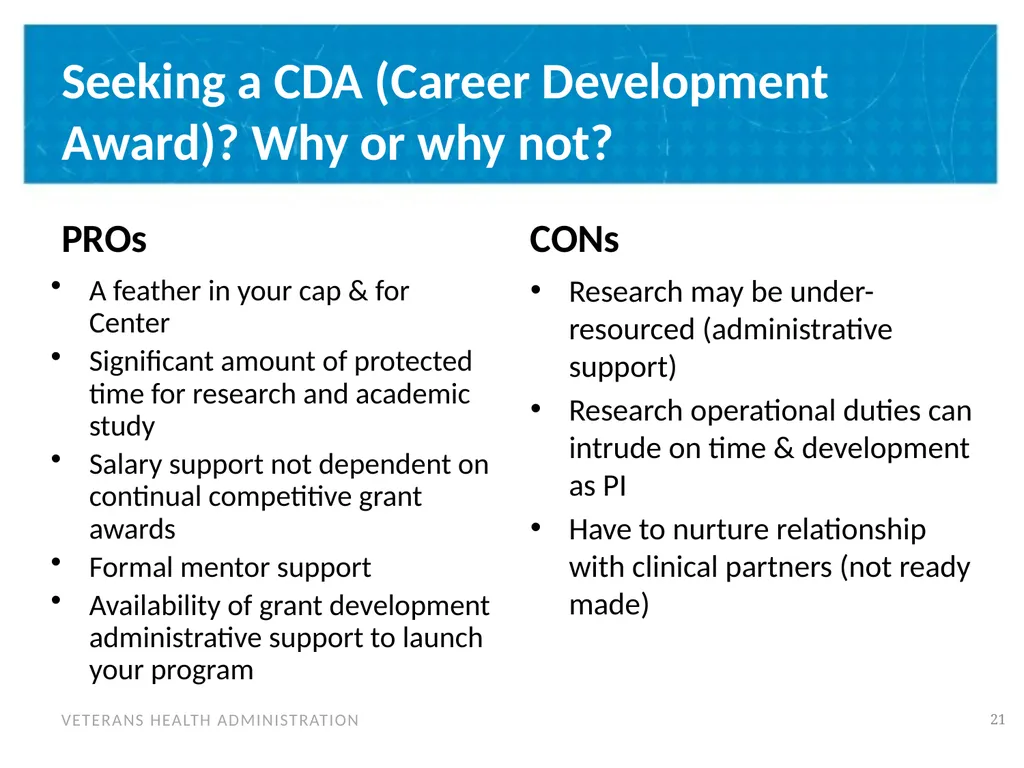
slide21. Seeking a CDA (Career Development Award)? Why or why not? PROs A feather in your cap & for Center
Significant amount of protected time for research and academic study
Salary support not dependent on continual competitive grant awards
Formal mentor support
Availability of grant development administrative support to launch your program CONs Research may be under-resourced (administrative support)
Research operational duties can intrude on time & development as PI
Have to nurture relationship with clinical partners (not ready made) 20<br>
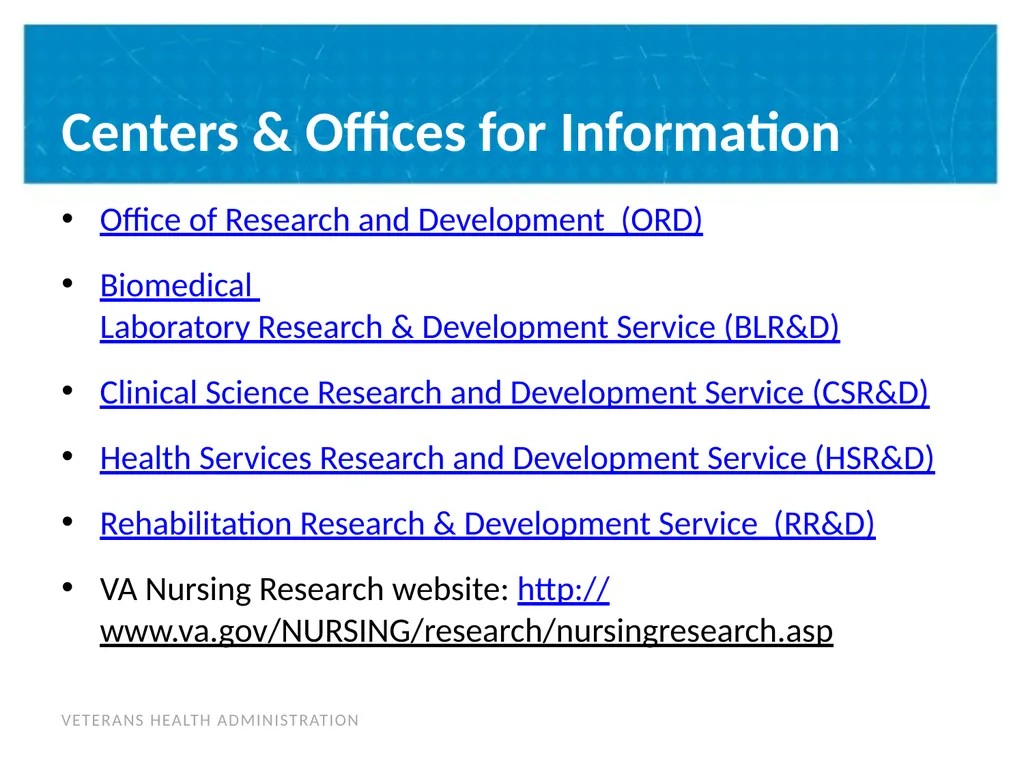
slide22. Centers & Offices for Information Office of Research and Development (ORD)
Biomedical Laboratory Research & Development Service (BLR&D)
Clinical Science Research and Development Service (CSR&D)
Health Services Research and Development Service (HSR&D)
Rehabilitation Research & Development Service (RR&D)
VA Nursing Research website: http://www.va.gov/NURSING/research/nursingresearch.asp<br>
slide23. Contributors to Content All members over the years from the Nursing Research Field Advisory Committee (formerly Nursing Research Advisory Group)
Audrey Nelson, PhD, RN, FAAN
Gail Powell-Cope, PhD, ARNP, FAAN<br>
slide24. VHA ONS Points of Contact Beverly Priefer, PhD, RN
Acting Director, Research & Evidence-Based Practice
Beverly.priefer@va.gov
Roberta K. Oka, PhD, RNP
Acting Associate Director, Research & Evidence Based Practice
Roberta.Oka@va.gov 23<br>
Office of Nursing Services 4 1 15<br>
slide2. Program of Research Definition: Cohesive approach to sequencing a series of studies to efficiently and effectively build new knowledge
Topic Area: Fits with organizational goals, broad enough to be cross cutting, narrow enough to be manageable, addresses a gap or gaps, and is fundable 1<br>
slide3. Selecting a research focus is an important first step in building a program of research The focus of a program of research will depend on the organization's strategic plan and mission; being mindful of the organization’s needs is important.
If your organization has a research center, such as a GRECC or COIN, consider a research fit with the program and collaboration with that team.
If your VA does not have a research center, consider collaboration with another VA Research Center (pending approvals).
In some instances, your focus may change or the focus of a research center may change. Stay connected with other researchers and stay in touch with research centers. 2<br>
slide4. Practical considerations for a research focus On a practical level, a research focus will drive many decisions such as collaborators, funding sources, professional contacts, and base of support.
For example, if your program of research is in technology for safe mobility in older adults, you might seek collaborators from academic affiliations in aging studies programs and engineering. Professionally, you would want to align with gerontology and ergonomic organizations.
Choosing a focus allows you to leverage resources and efficiently build the science in a given area.
For example, laboratories you might build to support safe mobility research could be used by students, fellows, and others who are building science in the same area 3<br>
slide5. Identifying a Program of Research Lifetime commitment!
Establish area of expertise through a track record with a common thread (publications & funding)
Authorship on publications should reflect ongoing work with collaborators
Available on-site resources and collaborations
Expertise for a team
Labs / Space
Support: administrative and clinical areas<br>
slide6. Breadth of Research Programs Junior researchers
More focused, narrower program of research, avoid hopping around with a series of disjointed studies
Mid-level researchers
Broaden research, refine focus
May have to reframe or ‘re-invent’ focus due to circumstances, opportunity, or other reasons
Senior level
Larger research focus with depth in some areas, such as more patient groups or settings<br>
slide7. Examples of Research Programs and Gaining Focus Too narrow
Intermittent catheterization in SCI patients
Too broad
Chronic care
Patient outcomes
On target:
Safe patient mobility
Safe transitions from hospital to home
Prevention of pressure ulcers in SCI<br>
slide8. Selecting a Research Focus Investigators select a research focus for a variety of reasons:
An intrinsic curiosity about a certain topic
Aptitude for a particular method
Available funding opportunities
Organizational support
Personal experience with a health condition.
Because we are located in a service organization, the impact of our research is valued very highly. Results of our research need to have a clear impact on improving VA healthcare delivery and Veterans’ health and well-being. 7<br>
slide9. Selecting a Research Focus – con’t It makes sense to think about the local resources when settling on a research focus.
Think about the expertise at your local VA facility and your local academic affiliation.
Draw on existing resources and leverage those resources to secure others. For example, if your local facility has a strong mental health service with providers who are interested in research, and your local university has a nationally recognized department in clinical psychology, think about how you can collaborate with both of them to achieve mutually satisfying goals. 8<br>
slide10. Clinical Research Produces new evidence, innovation
Directly involves a particular person or group of people, or that uses materials from humans, such as their behavior or samples of their tissue (NIH). Implementation Research Study of methods to promote the systematic uptake of research findings and other evidence-based practices into routine practice to improve the quality and effectiveness of health services.
Study of influences on healthcare professional and organizational behavior.
Eccles and Mittman, 2006<br>
slide11. Clinical research vs. Implementation research Courtesy of Brian S. Mittman, PhD Center for Implementation Practice and Research Support, VA
Dept of Research and Evaluation, Kaiser Permanente Southern California
School of Medicine, University of California at Los Angeles 9/7/14<br>
slide12. Research Pipeline Basic
Science Pre-Clinical/ Translational Research Type 2
Translation Implementation Research Clinical Research Type 1
Translation Improved Health Processes, & Outcomes for Veterans Clinical & Implementation Research Clinical efficacy research Clinical effectiveness research
Health behavior research
Health services research
Epidemiology Guidelines,
Evidence Syntheses Adapted from Brian S. Mittman, PhD 9/7/14<br>
slide13. Value-Added Benefits of a Research Program Benefits
Personal Value-Added
Increase chances of getting funded
Focused expertise (evidence of knowledge depth)
Professional Value-Added
Contribute to Science of Nursing
Contribute to Nursing Practice
Organizational Value-Added
Contribute to Nursing Service
Contribute to Organization Mission
Quality of Care Outcomes
Personal
Funded studies
Consultations
Professional
Academic affiliation
Publications
Organizational
Leadership team/governance
Serve as reviewer on scientific program panels for research proposals<br>
slide14. Identify Goals: Short-term / Long-term Types and # of studies to participate as PI, Co-I
Grants to be submitted
Types and numbers of publications planned
Organizational participation planned
Gantt chart timeline for goals is useful
How do your goals fit in the organization’s vision/mission?<br>
slide15. Considerations for Productivity Consider pilot study so that preliminary data is available for proposal applications
Apply for internal funding for pilot study or small grants program
How many grant proposals should be submitted per year?
How many studies can one researcher work on at a time?
How do you figure out your % of time on each study?
Should you or should you not seek a CDA? Why or why not (pros vs cons)?<br>
slide16. For newer researchers… One mistake novice researchers may make is taking on too many projects because the projects are interesting for a variety of reasons.
In building a research career, it is probably not wise to spread yourself too thinly or you risk not becoming proficient and credible in any one area.
Any researcher should be able to state a program of research in a few sentences in a way that is clearly understood by experts as well as those who are less familiar with the topic. 15<br>
slide17. Milestones of Success Well-funded program of research
Proposals build upon each other to systematically contribute to science and health and well-being of Veterans
Research findings provide solutions to problems that are important
The research transcends a single discipline
Scholarly contributions, with high quality/quantity of manuscripts in high impact journals
Articles are cited frequently by others 16<br>
slide18. Milestones of Success - con’t Evidence of research findings changing the way people think or practice
Creativity in using research to change practice
Scope of impact of research findings on Veterans’ health care.
Highly visible nationally (leadership roles, research presentations, press); nationally known in their field of study
Instrumental in training new generation of researchers 17<br>
slide19. Time Management Time Management
Research time (study activities, travel, planning)
Scientific reading & grant writing
Continuing education & mentoring
Administrative time
Collaboration & meetings not directly related to your study
Self Management – learn to say “no”
Avoid over committing
Chase, JD et al. (2013). Time Management Strategies for Research Productivity. Western Journal of Nursing Research, 35(2), 155-176.
http://wjn.sagepub.com/content/35/2/155<br>
slide20. Typical Postdoctoral Program Goals Build on dissertation work toward research program
Continue to build knowledge and skills
Research methods (e.g., design, measurement, analysis)
Networking
Interdisciplinary collaboration
Leadership
Grants administration, budgeting, personnel supervision
Research dissemination and translation
Move toward greater independence and complexity in research<br>
slide21. Seeking a CDA (Career Development Award)? Why or why not? PROs A feather in your cap & for Center
Significant amount of protected time for research and academic study
Salary support not dependent on continual competitive grant awards
Formal mentor support
Availability of grant development administrative support to launch your program CONs Research may be under-resourced (administrative support)
Research operational duties can intrude on time & development as PI
Have to nurture relationship with clinical partners (not ready made) 20<br>
slide22. Centers & Offices for Information Office of Research and Development (ORD)
Biomedical Laboratory Research & Development Service (BLR&D)
Clinical Science Research and Development Service (CSR&D)
Health Services Research and Development Service (HSR&D)
Rehabilitation Research & Development Service (RR&D)
VA Nursing Research website: http://www.va.gov/NURSING/research/nursingresearch.asp<br>
slide23. Contributors to Content All members over the years from the Nursing Research Field Advisory Committee (formerly Nursing Research Advisory Group)
Audrey Nelson, PhD, RN, FAAN
Gail Powell-Cope, PhD, ARNP, FAAN<br>
slide24. VHA ONS Points of Contact Beverly Priefer, PhD, RN
Acting Director, Research & Evidence-Based Practice
Beverly.priefer@va.gov
Roberta K. Oka, PhD, RNP
Acting Associate Director, Research & Evidence Based Practice
Roberta.Oka@va.gov 23<br>