
Building a relationship with your supervisor Niamh


Description: Building a relationship with your supervisor Niamh NicGhabhann, Assistant Dean (Research), Faculty of Arts, Humanities and Social Sciences, UL. Establish good working practices from the start Decide on when to meet, how often, and where.
Related Topics
Download Presentation
"Building a relationship with your supervisor Niamh" is the property of its rightful owner. Permission is granted to download and print the materials on this website for personal, non-commercial use only, and to display it on your personal computer provided you do not modify the materials and that you retain all copyright notices contained in the materials. By downloading content from our website, you accept the terms of this agreement.
Presentation Transcript
slide1. Building a relationship with your supervisor Niamh NicGhabhann, Assistant Dean (Research),
Faculty of Arts, Humanities and Social Sciences, UL.<br>
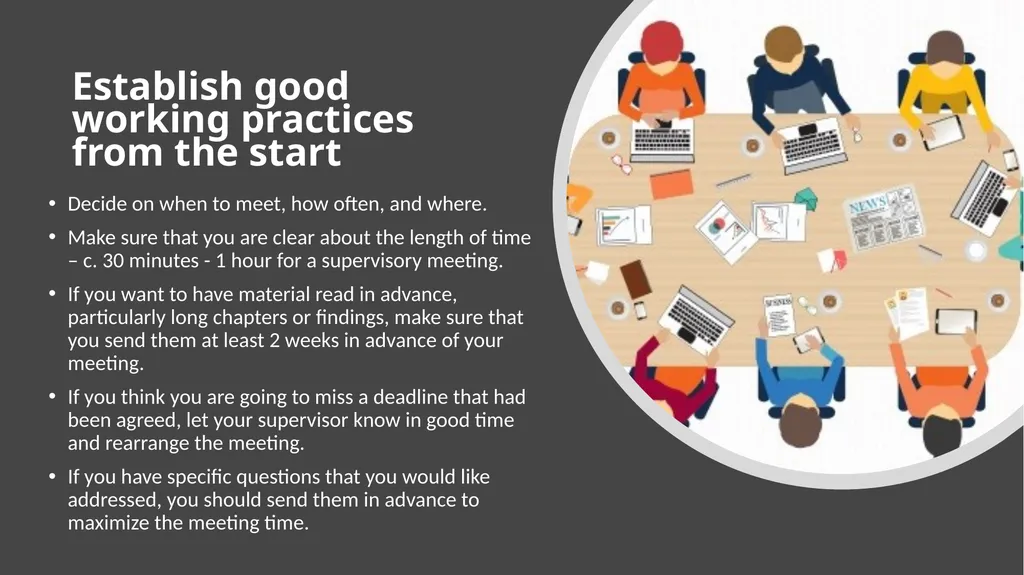
slide2. Establish good working practices from the start Decide on when to meet, how often, and where.
Make sure that you are clear about the length of time – c. 30 minutes - 1 hour for a supervisory meeting.
If you want to have material read in advance, particularly long chapters or findings, make sure that you send them at least 2 weeks in advance of your meeting.
If you think you are going to miss a deadline that had been agreed, let your supervisor know in good time and rearrange the meeting.
If you have specific questions that you would like addressed, you should send them in advance to maximize the meeting time.<br>
slide3. Make your meetings worthwhile Come to the meeting with a specific purpose – either to get advice and direction or feedback;
If sending work for comment, send complete drafts of work to be read to your supervisor where possible
Proof-read your work and make sure that your citations are in order (check out the Regional Writing Centre resources around this)
You want the meeting with your supervisor to focus on the subject of your research, rather than formatting or citation issues, so try to deal with these using the resources available to you through the university.<br>
slide4. Clarity – essential for a good working relationship In each meeting, take written notes of any advice or comments provided;
If you are unclear about any point, don’t be afraid to ask for advice or clarification. Every PhD supervisor was a PhD student once!
Write up a short record of the meeting and any actions decided on and send them to your supervisor after the meeting to make sure that you both agree;
Decide on the next meeting or course of action to be taken in that meeting.
Check your official UL email regularly! Communicate using UL email to avoid things going astray.<br>
slide5. Balancing self-direction with direction from your supervisor Whether you are part of a structured PhD programme, or working on a traditional model, PhD work involves working on your own and being self-directed.
Managing your own time is an essential skill – making sure that you meet deadlines, manage your own productivity, and notice and act on any problems or issues arising in good time.
In the beginning, you might work more closely with your supervisor, taking specific direction from them, but you should work more independently as your work progresses.<br>
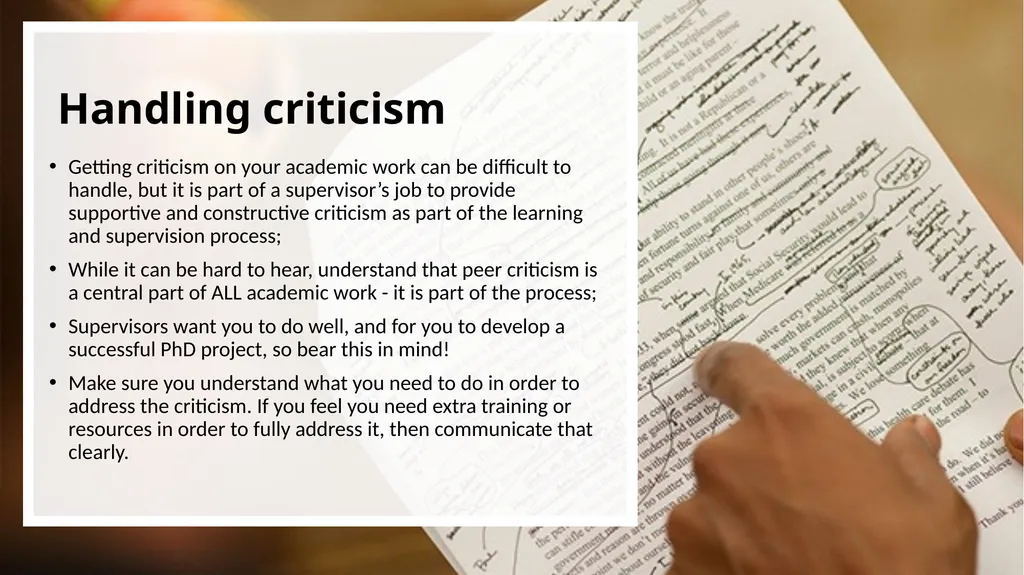
slide6. Handling criticism Getting criticism on your academic work can be difficult to handle, but it is part of a supervisor’s job to provide supportive and constructive criticism as part of the learning and supervision process;
While it can be hard to hear, understand that peer criticism is a central part of ALL academic work - it is part of the process;
Supervisors want you to do well, and for you to develop a successful PhD project, so bear this in mind!
Make sure you understand what you need to do in order to address the criticism. If you feel you need extra training or resources in order to fully address it, then communicate that clearly.<br>
slide7. If problems arise, keep in touch If an issue arises (academic, financial or personal – these things happen), try to stay in touch with your supervisor;
They might not be able to help you directly, but they should be able to point you towards the right services within the university who may be able to help;
Don’t cut off contact – if you are worried about academic progression, let your supervisor know and they may be able to develop a course of action that can help support your skills – it could be around auditing a module or taking a course at the Writing Centre.<br>
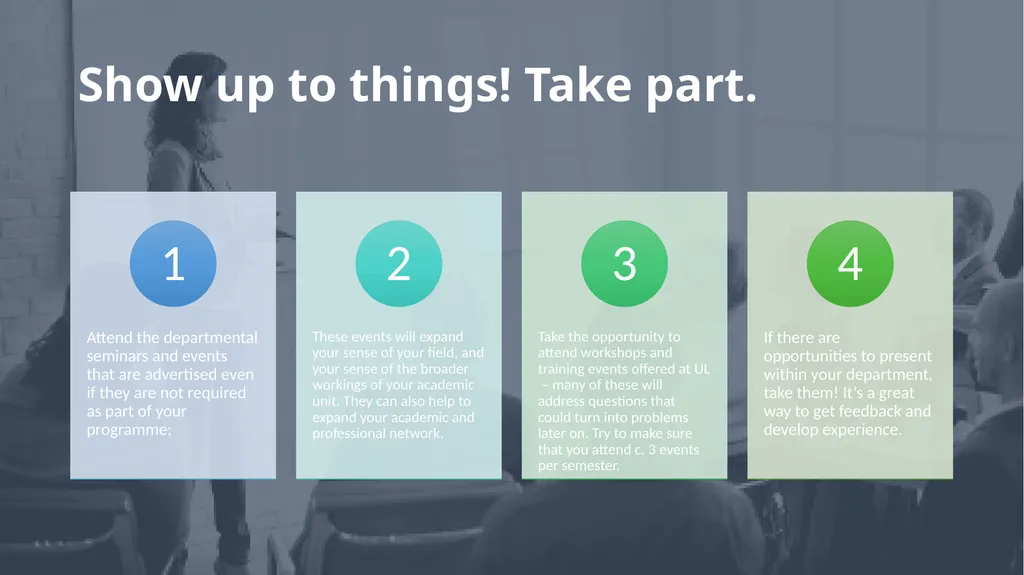
slide8. Show up to things! Take part.<br>
Faculty of Arts, Humanities and Social Sciences, UL.<br>
slide2. Establish good working practices from the start Decide on when to meet, how often, and where.
Make sure that you are clear about the length of time – c. 30 minutes - 1 hour for a supervisory meeting.
If you want to have material read in advance, particularly long chapters or findings, make sure that you send them at least 2 weeks in advance of your meeting.
If you think you are going to miss a deadline that had been agreed, let your supervisor know in good time and rearrange the meeting.
If you have specific questions that you would like addressed, you should send them in advance to maximize the meeting time.<br>
slide3. Make your meetings worthwhile Come to the meeting with a specific purpose – either to get advice and direction or feedback;
If sending work for comment, send complete drafts of work to be read to your supervisor where possible
Proof-read your work and make sure that your citations are in order (check out the Regional Writing Centre resources around this)
You want the meeting with your supervisor to focus on the subject of your research, rather than formatting or citation issues, so try to deal with these using the resources available to you through the university.<br>
slide4. Clarity – essential for a good working relationship In each meeting, take written notes of any advice or comments provided;
If you are unclear about any point, don’t be afraid to ask for advice or clarification. Every PhD supervisor was a PhD student once!
Write up a short record of the meeting and any actions decided on and send them to your supervisor after the meeting to make sure that you both agree;
Decide on the next meeting or course of action to be taken in that meeting.
Check your official UL email regularly! Communicate using UL email to avoid things going astray.<br>
slide5. Balancing self-direction with direction from your supervisor Whether you are part of a structured PhD programme, or working on a traditional model, PhD work involves working on your own and being self-directed.
Managing your own time is an essential skill – making sure that you meet deadlines, manage your own productivity, and notice and act on any problems or issues arising in good time.
In the beginning, you might work more closely with your supervisor, taking specific direction from them, but you should work more independently as your work progresses.<br>
slide6. Handling criticism Getting criticism on your academic work can be difficult to handle, but it is part of a supervisor’s job to provide supportive and constructive criticism as part of the learning and supervision process;
While it can be hard to hear, understand that peer criticism is a central part of ALL academic work - it is part of the process;
Supervisors want you to do well, and for you to develop a successful PhD project, so bear this in mind!
Make sure you understand what you need to do in order to address the criticism. If you feel you need extra training or resources in order to fully address it, then communicate that clearly.<br>
slide7. If problems arise, keep in touch If an issue arises (academic, financial or personal – these things happen), try to stay in touch with your supervisor;
They might not be able to help you directly, but they should be able to point you towards the right services within the university who may be able to help;
Don’t cut off contact – if you are worried about academic progression, let your supervisor know and they may be able to develop a course of action that can help support your skills – it could be around auditing a module or taking a course at the Writing Centre.<br>
slide8. Show up to things! Take part.<br>