
Business English programs for Saudi students:
TD
Published · 44 slides · 0 views
1 / 1

Description
Business English programs for Saudi students: using classroom hours effectively Pedagogical issues in western universities Pedagogical issues in western universities Conference note: In September 2012, the Saudi Cultural Bureau decided to
Related Topics
Share
Embed code
Download this presentation From Below
"Business English programs for Saudi students:" is the property of its rightful owner. Permission is granted to download and print the materials on this website for personal, non-commercial use only, and to display it on your personal computer provided you do not modify the materials and that you retain all copyright notices contained in the materials. By downloading content from our website, you accept the terms of this agreement.
Presentation Transcript
01
Business English programs for Saudi students:
using classroom hours effectively Pedagogical issues in western universities<br>
02
Pedagogical issues in western universities Conference note:
In September 2012, the Saudi Cultural Bureau decided to cancel the ‘extra ESL hours’ that KASP students typically receive. In order to preserve the relevance and applicability of the presentation, the scope has been expanded to include more general ESL issues that Arabic ESL learners encounter.<br>
In September 2012, the Saudi Cultural Bureau decided to cancel the ‘extra ESL hours’ that KASP students typically receive. In order to preserve the relevance and applicability of the presentation, the scope has been expanded to include more general ESL issues that Arabic ESL learners encounter.<br>
03
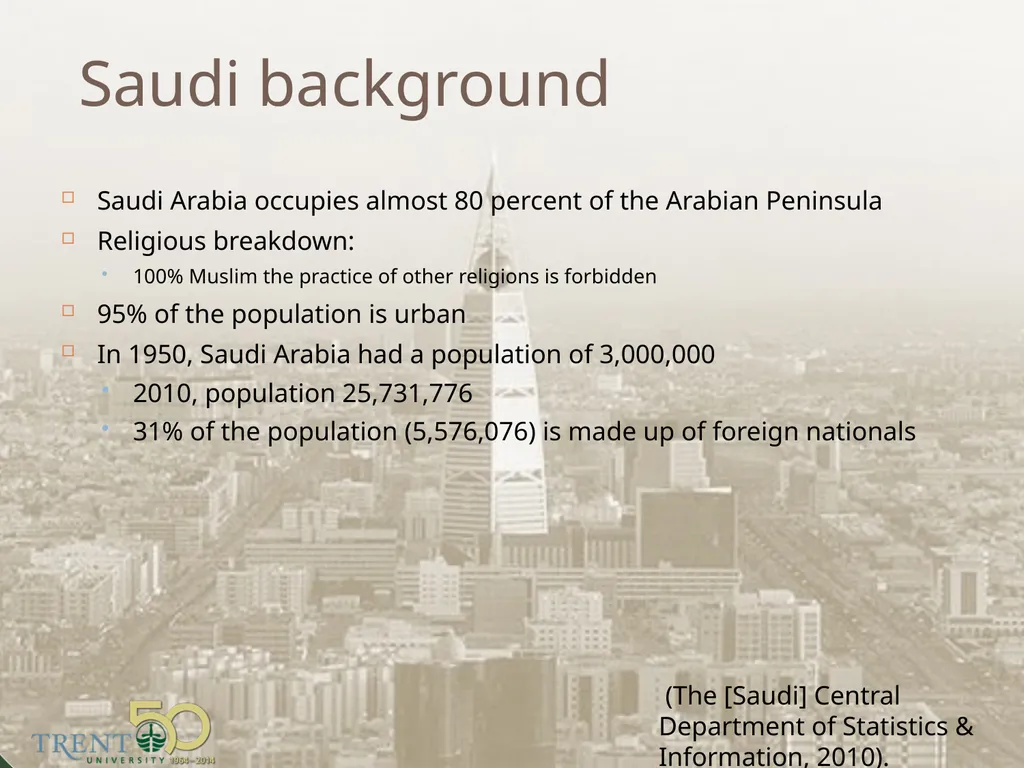
Saudi background Saudi Arabia occupies almost 80 percent of the Arabian Peninsula
Religious breakdown:
100% Muslim the practice of other religions is forbidden
95% of the population is urban
In 1950, Saudi Arabia had a population of 3,000,000
2010, population 25,731,776
31% of the population (5,576,076) is made up of foreign nationals (The [Saudi] Central Department of Statistics & Information, 2010).<br>
Religious breakdown:
100% Muslim the practice of other religions is forbidden
95% of the population is urban
In 1950, Saudi Arabia had a population of 3,000,000
2010, population 25,731,776
31% of the population (5,576,076) is made up of foreign nationals (The [Saudi] Central Department of Statistics & Information, 2010).<br>
04
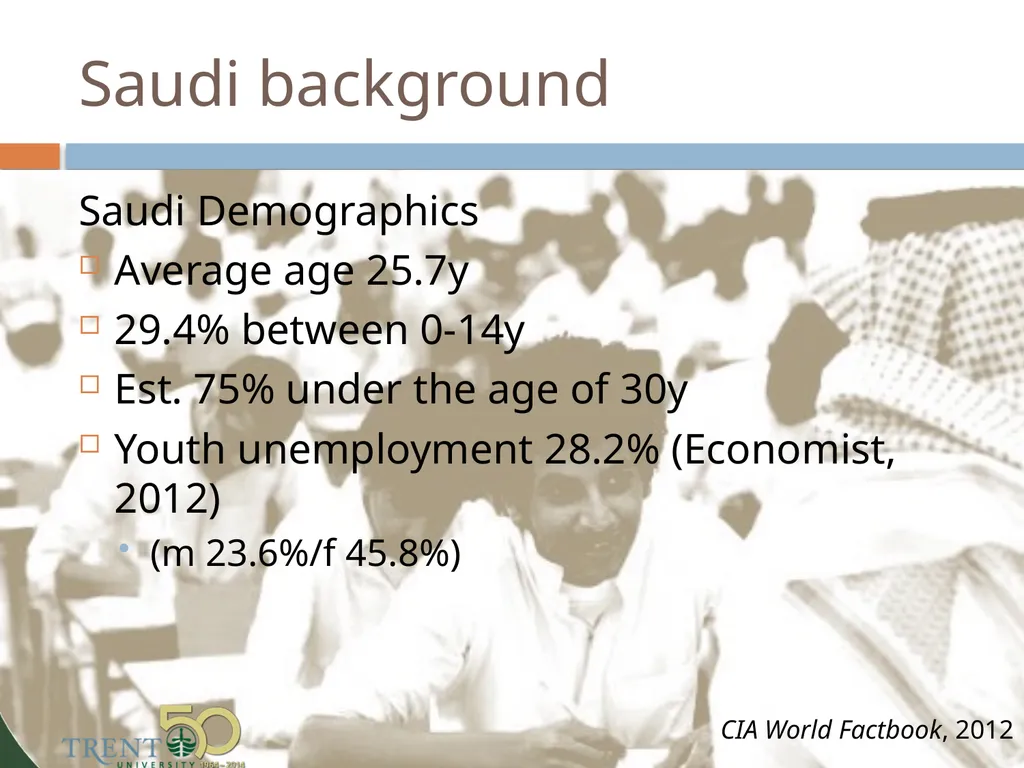
Saudi background Saudi Demographics
Average age 25.7y
29.4% between 0-14y
Est. 75% under the age of 30y
Youth unemployment 28.2% (Economist, 2012)
(m 23.6%/f 45.8%) CIA World Factbook, 2012<br>
Average age 25.7y
29.4% between 0-14y
Est. 75% under the age of 30y
Youth unemployment 28.2% (Economist, 2012)
(m 23.6%/f 45.8%) CIA World Factbook, 2012<br>
05
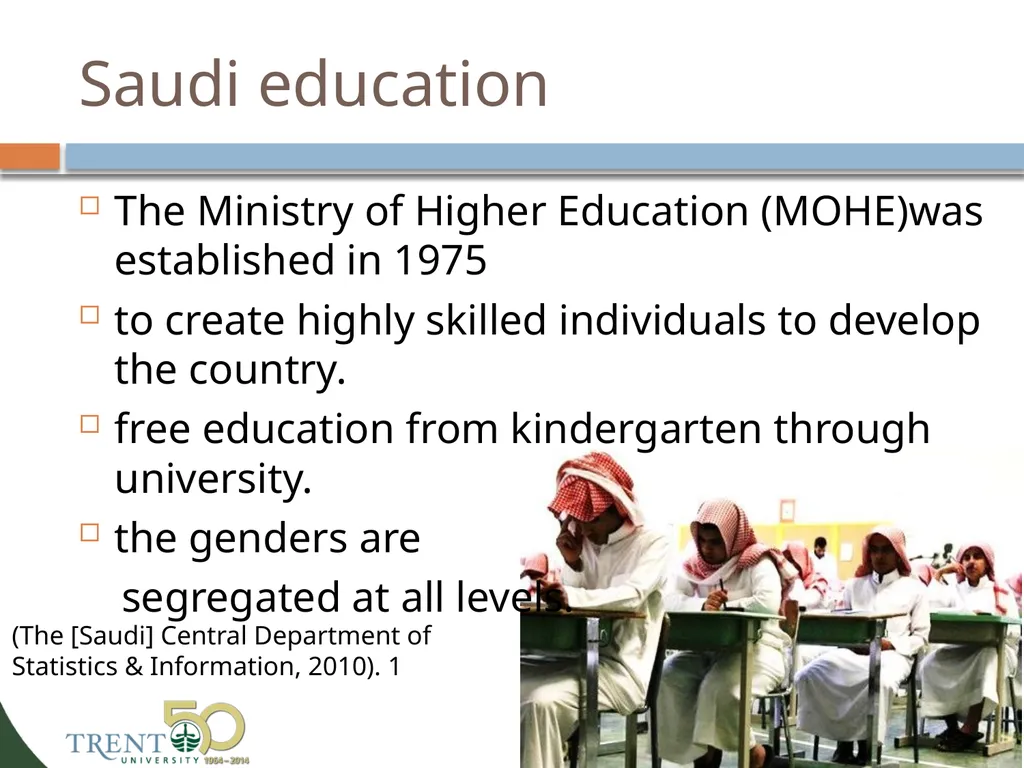
Saudi education The Ministry of Higher Education (MOHE)was established in 1975
to create highly skilled individuals to develop the country.
free education from kindergarten through university.
the genders are
segregated at all levels. (The [Saudi] Central Department of Statistics & Information, 2010). 1<br>
to create highly skilled individuals to develop the country.
free education from kindergarten through university.
the genders are
segregated at all levels. (The [Saudi] Central Department of Statistics & Information, 2010). 1<br>
06
Saudi education: in the classroom In the 2007, Saudi schoolchildren ranked near the bottom of the 48 countries surveyed according to U.S. National Center for Education Statistics, 2007 (in Lindsey, 2010)
teaching methods used within the Saudi classrooms
focused on memorization and rote learning (Ministry of Higher Education, 2000 in AlSharif & Atweh, 2010).
lack of understanding and critical thought. (Lindsey, 2010)
Little emphasis on formulating, planning and revision (Bersamina, 2009)
Questionable qualifications in teaching staff (Alosaimi, 2007)
Censorship, criticism and exposure to foreign concepts<br>
teaching methods used within the Saudi classrooms
focused on memorization and rote learning (Ministry of Higher Education, 2000 in AlSharif & Atweh, 2010).
lack of understanding and critical thought. (Lindsey, 2010)
Little emphasis on formulating, planning and revision (Bersamina, 2009)
Questionable qualifications in teaching staff (Alosaimi, 2007)
Censorship, criticism and exposure to foreign concepts<br>
07
Problems that develop from Ed background Most Arab students (Haq in Bersamina, 2009)
Fumble in their writing skills
Gross lexical errors
Weakness in tenses, verb structure, (Kambal in A Case Study of Saudi ESL Learners)
Pronunciation, morphology, knowledge and use of syntax and spelling
Difficulty expressing themselves in every day and scholarly issues
Have higher confidence in oral than writing skills<br>
Fumble in their writing skills
Gross lexical errors
Weakness in tenses, verb structure, (Kambal in A Case Study of Saudi ESL Learners)
Pronunciation, morphology, knowledge and use of syntax and spelling
Difficulty expressing themselves in every day and scholarly issues
Have higher confidence in oral than writing skills<br>
08
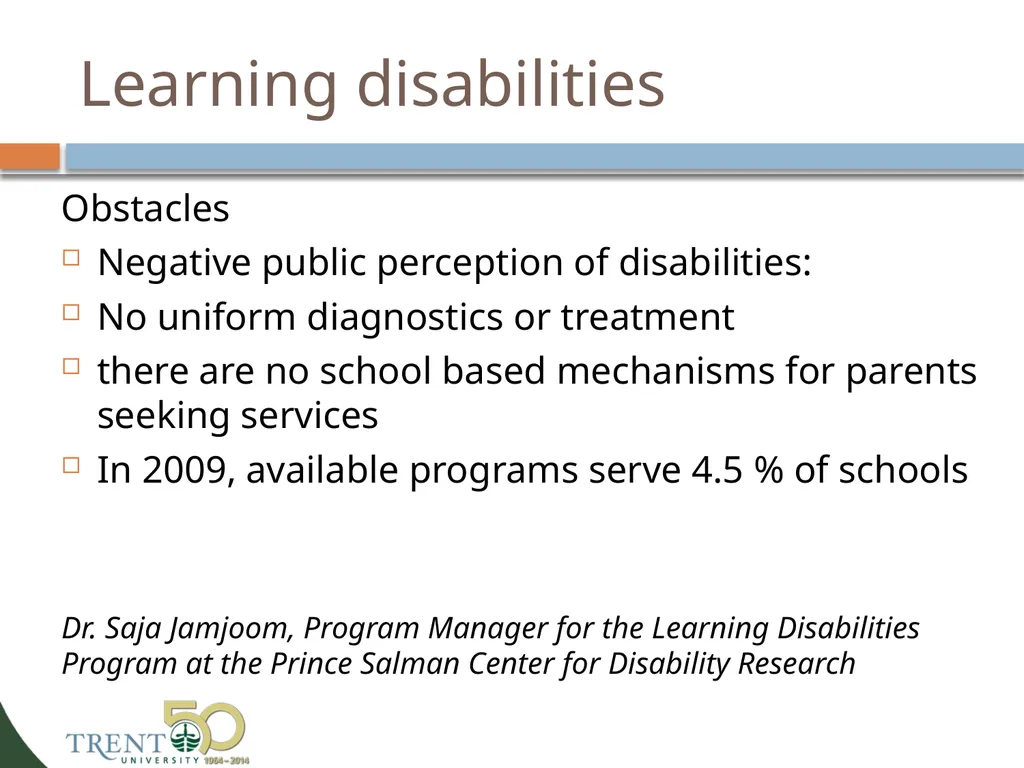
Learning disabilities Obstacles
Negative public perception of disabilities:
No uniform diagnostics or treatment
there are no school based mechanisms for parents seeking services
In 2009, available programs serve 4.5 % of schools
Dr. Saja Jamjoom, Program Manager for the Learning Disabilities Program at the Prince Salman Center for Disability Research<br>
Negative public perception of disabilities:
No uniform diagnostics or treatment
there are no school based mechanisms for parents seeking services
In 2009, available programs serve 4.5 % of schools
Dr. Saja Jamjoom, Program Manager for the Learning Disabilities Program at the Prince Salman Center for Disability Research<br>
09
Education, Culture and Wasta ‘Wasta.’ “an individual’s ability to leverage strategically beneficial relationships in order to consolidate the groups/families’ social standing” you help your brother with his problems. (Fagan, 2008)
social relationships to overcome various challenges resulting in (Muhammed, 2012)
Passing of ‘undeserving students’
‘cheating’
University rankings<br>
social relationships to overcome various challenges resulting in (Muhammed, 2012)
Passing of ‘undeserving students’
‘cheating’
University rankings<br>
10
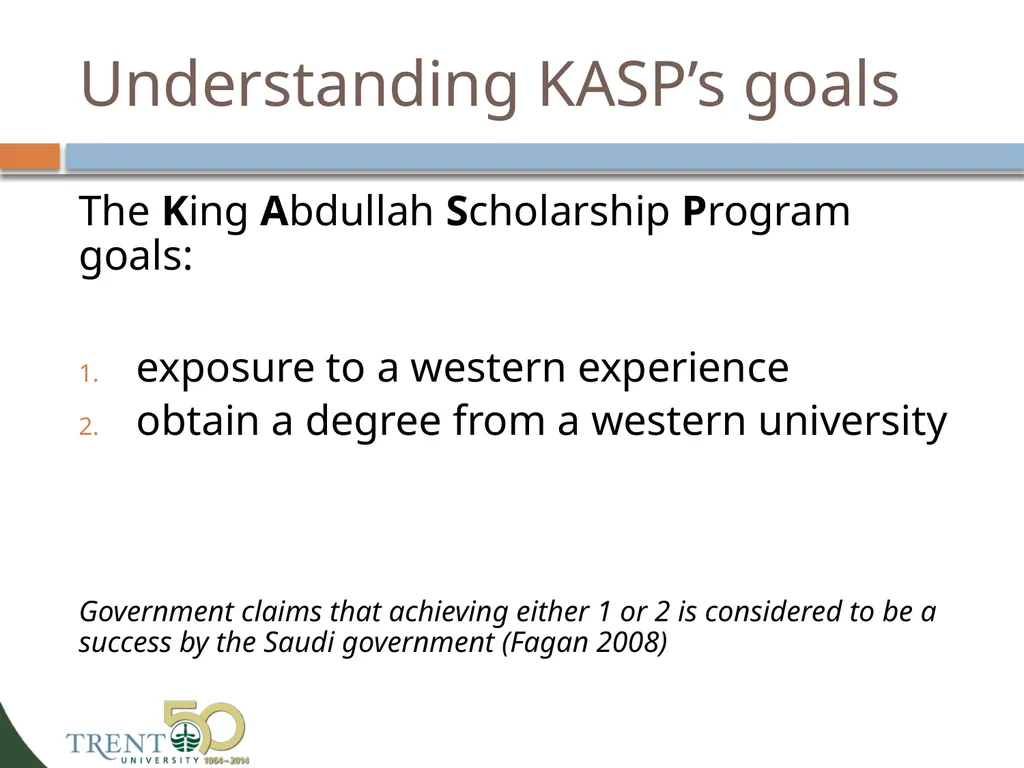
Understanding KASP’s goals The King Abdullah Scholarship Program goals:
exposure to a western experience
obtain a degree from a western university
Government claims that achieving either 1 or 2 is considered to be a success by the Saudi government (Fagan 2008)<br>
exposure to a western experience
obtain a degree from a western university
Government claims that achieving either 1 or 2 is considered to be a success by the Saudi government (Fagan 2008)<br>
11
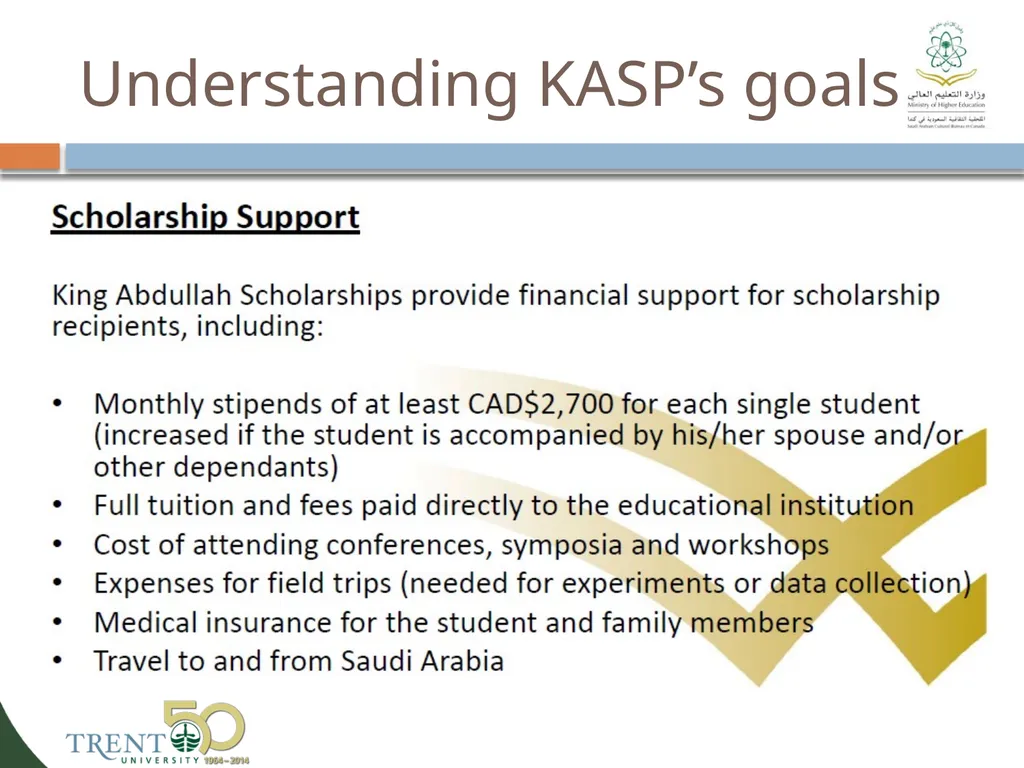
Understanding KASP’s goals<br>
12
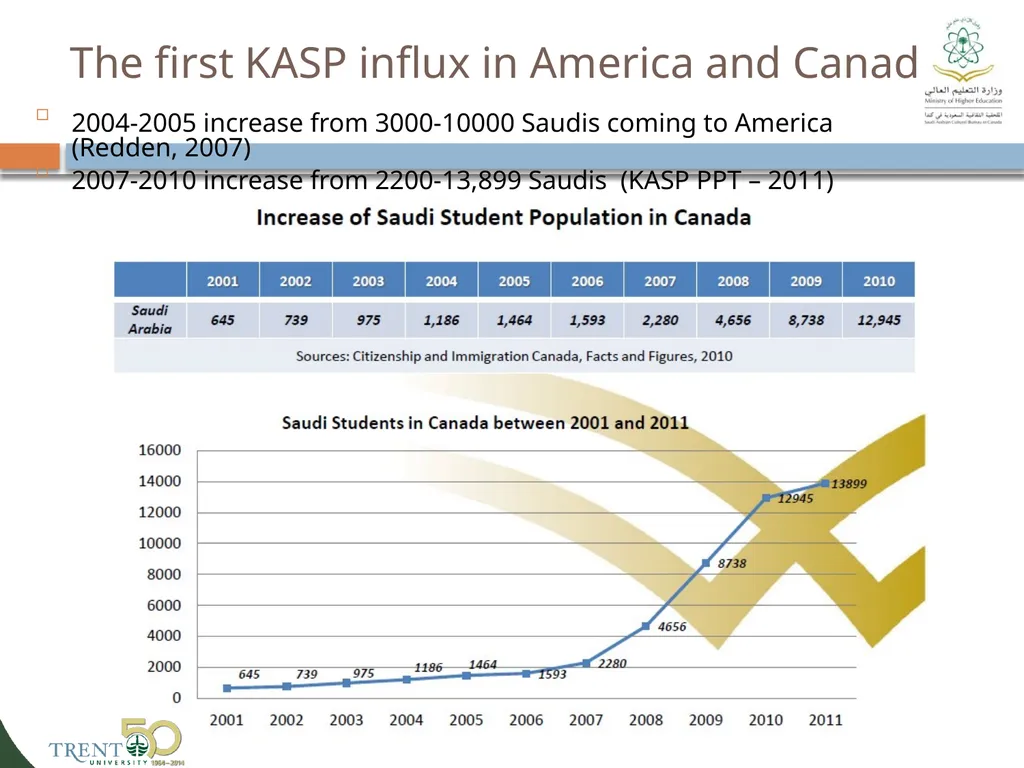
The first KASP influx in America and Canada 2004-2005 increase from 3000-10000 Saudis coming to America (Redden, 2007)
2007-2010 increase from 2200-13,899 Saudis (KASP PPT – 2011)<br>
2007-2010 increase from 2200-13,899 Saudis (KASP PPT – 2011)<br>
13
Understanding the economics motivating KASP (Saudization) Saudization of the private sector:
limit dependence on foreign labour,
create a more dynamic economy
"is the fact that there aren't enough well-trained Saudis in the kind of jobs that are needed.“ J. Sfakianakis - Saudi Franzi Bank (in Lindsey, 2010)
"generally lacks the education and technical skills the private sector needs" (CIA Factbook, 2012; Lindsey, 2010)<br>
limit dependence on foreign labour,
create a more dynamic economy
"is the fact that there aren't enough well-trained Saudis in the kind of jobs that are needed.“ J. Sfakianakis - Saudi Franzi Bank (in Lindsey, 2010)
"generally lacks the education and technical skills the private sector needs" (CIA Factbook, 2012; Lindsey, 2010)<br>
14
The first KASP influx in America and Canada But by and large, the recent history of Saudi-U.S. interaction on U.S. campuses is characterized by “broad failures,” (Redden, 2007)
first influx never screened academically
Key challenges including:
real skill sets vs. eligibility for academic programs (Fagan, 2008)
Low students unable to meet ESL requirements in time (Redden, 2007)<br>
first influx never screened academically
Key challenges including:
real skill sets vs. eligibility for academic programs (Fagan, 2008)
Low students unable to meet ESL requirements in time (Redden, 2007)<br>
15
BICS and CALP (Cummins,1979) BICS is Basic Interpersonal Communication Skills
conversational language
CALP is Cognitive Academic Language Proficiency
academic language
Children* develop native speaker conversational language within two years of immersion,
academic language takes between 5-7 years for a child to develop<br>
conversational language
CALP is Cognitive Academic Language Proficiency
academic language
Children* develop native speaker conversational language within two years of immersion,
academic language takes between 5-7 years for a child to develop<br>
16
Summary of Educational issues Underdeveloped skills in analysis, problem-solving, and critical thinking
Undiagnosed learning disabilities
Non representative grading/qualifications
Outmoded pedagogical practices
Gaps between knowledge and ability
Limited amount of time/funding to bring students up-to-speed<br>
Undiagnosed learning disabilities
Non representative grading/qualifications
Outmoded pedagogical practices
Gaps between knowledge and ability
Limited amount of time/funding to bring students up-to-speed<br>
17
linguistic issues and solutions Business English programs for Saudi students:
using classroom hours effectively<br>
18
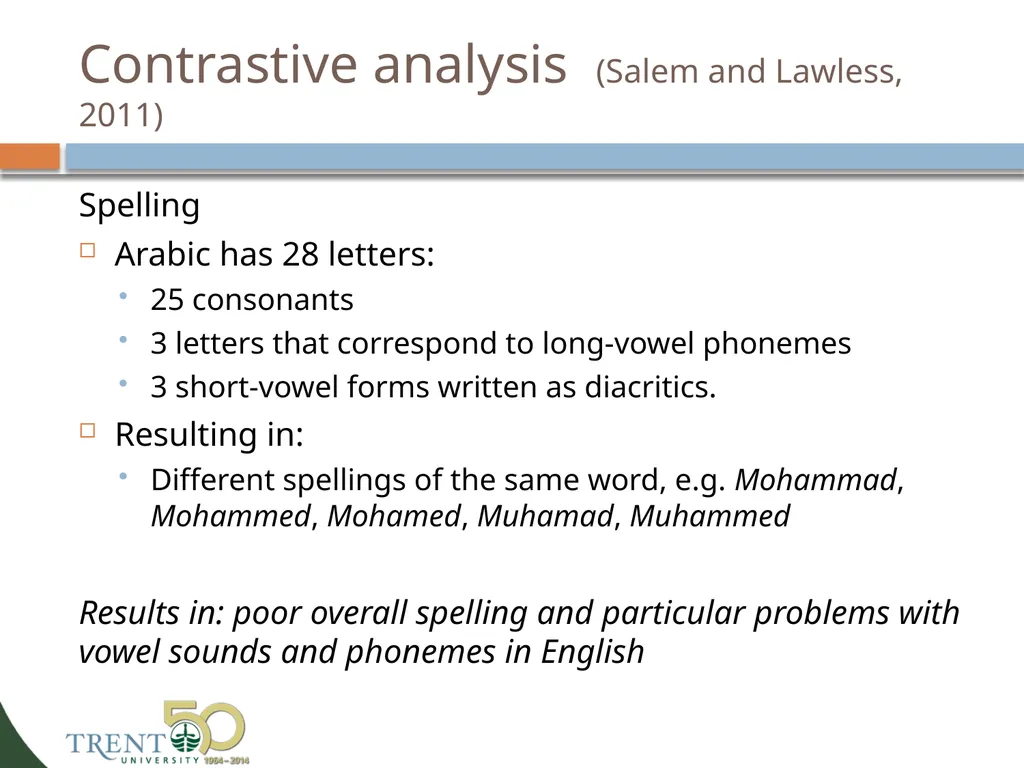
Contrastive analysis (Salem and Lawless, 2011) Spelling
Arabic has 28 letters:
25 consonants
3 letters that correspond to long-vowel phonemes
3 short-vowel forms written as diacritics.
Resulting in:
Different spellings of the same word, e.g. Mohammad, Mohammed, Mohamed, Muhamad, Muhammed
Results in: poor overall spelling and particular problems with vowel sounds and phonemes in English<br>
Arabic has 28 letters:
25 consonants
3 letters that correspond to long-vowel phonemes
3 short-vowel forms written as diacritics.
Resulting in:
Different spellings of the same word, e.g. Mohammad, Mohammed, Mohamed, Muhamad, Muhammed
Results in: poor overall spelling and particular problems with vowel sounds and phonemes in English<br>
19
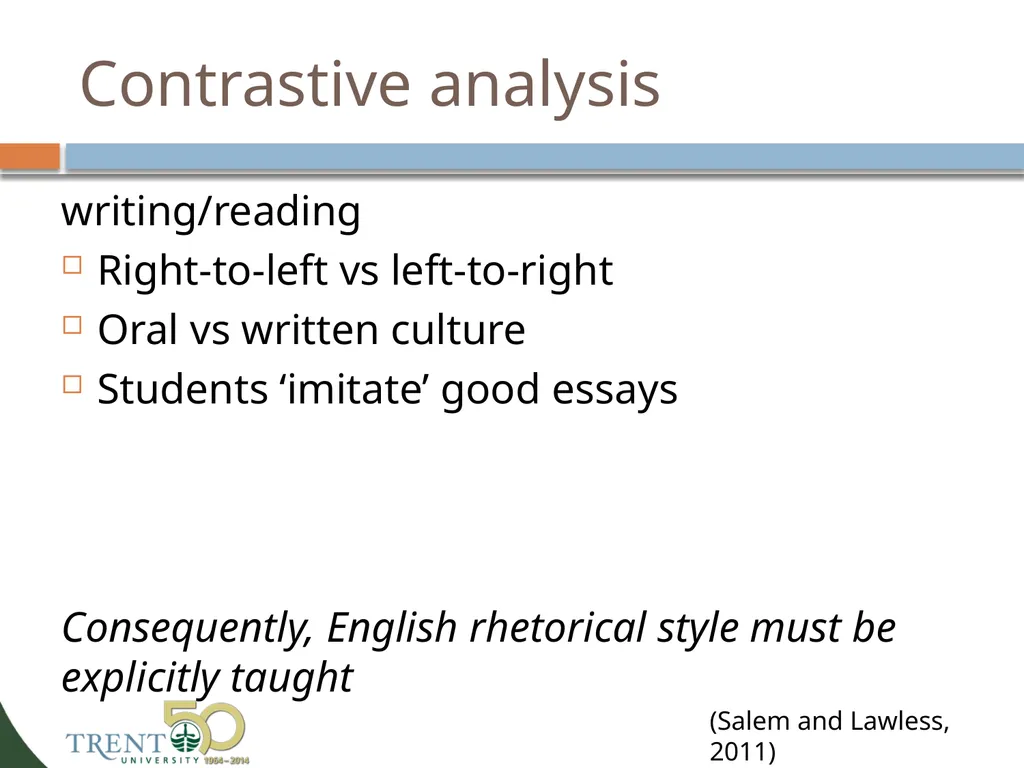
Contrastive analysis writing/reading
Right-to-left vs left-to-right
Oral vs written culture
Students ‘imitate’ good essays
Consequently, English rhetorical style must be explicitly taught (Salem and Lawless, 2011)<br>
Right-to-left vs left-to-right
Oral vs written culture
Students ‘imitate’ good essays
Consequently, English rhetorical style must be explicitly taught (Salem and Lawless, 2011)<br>
20
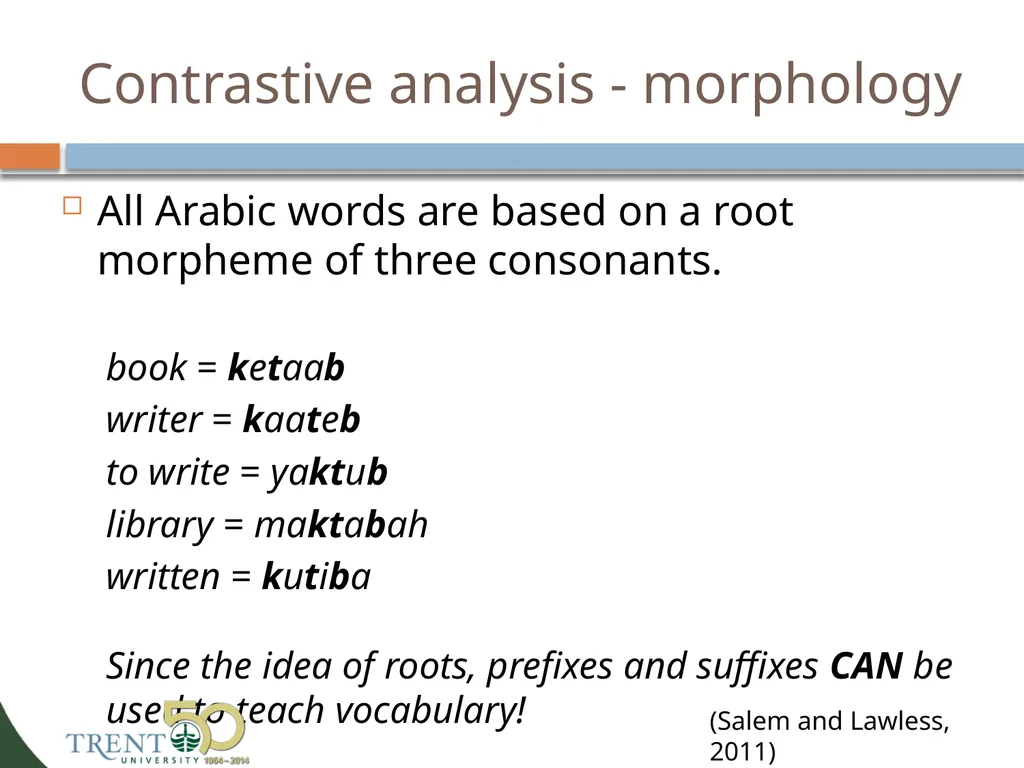
Contrastive analysis - morphology All Arabic words are based on a root morpheme of three consonants.
book = ketaab
writer = kaateb
to write = yaktub
library = maktabah
written = kutiba Since the idea of roots, prefixes and suffixes CAN be used to teach vocabulary! (Salem and Lawless, 2011)<br>
book = ketaab
writer = kaateb
to write = yaktub
library = maktabah
written = kutiba Since the idea of roots, prefixes and suffixes CAN be used to teach vocabulary! (Salem and Lawless, 2011)<br>
21
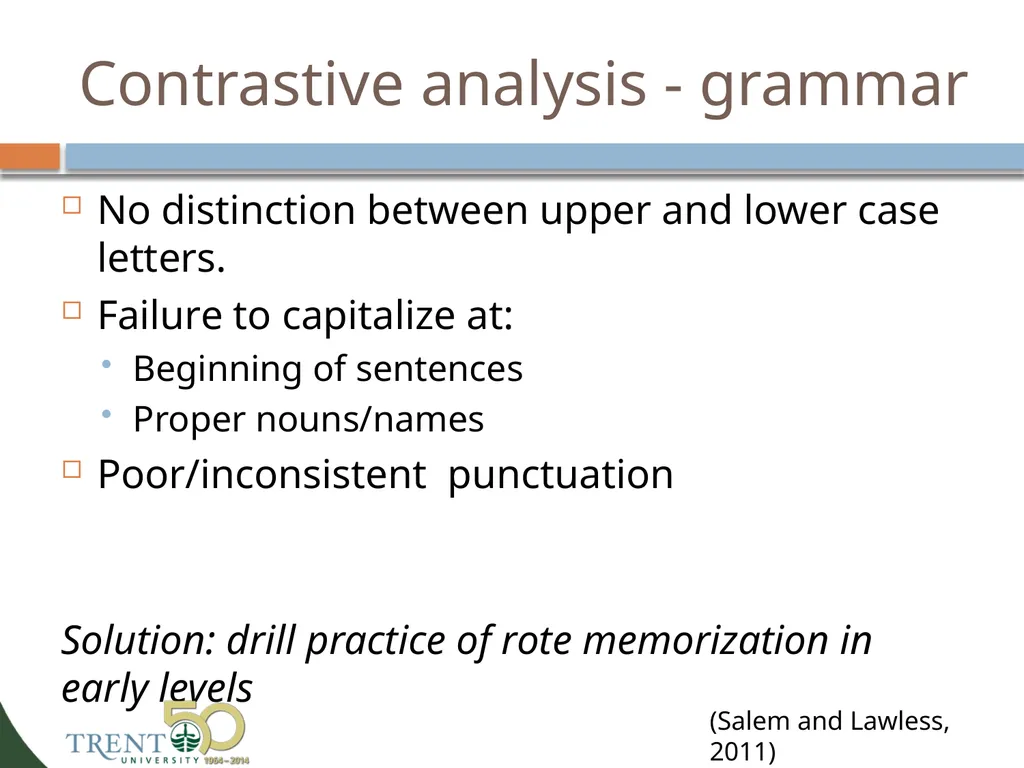
Contrastive analysis - grammar No distinction between upper and lower case letters.
Failure to capitalize at:
Beginning of sentences
Proper nouns/names
Poor/inconsistent punctuation
Solution: drill practice of rote memorization in early levels (Salem and Lawless, 2011)<br>
Failure to capitalize at:
Beginning of sentences
Proper nouns/names
Poor/inconsistent punctuation
Solution: drill practice of rote memorization in early levels (Salem and Lawless, 2011)<br>
22
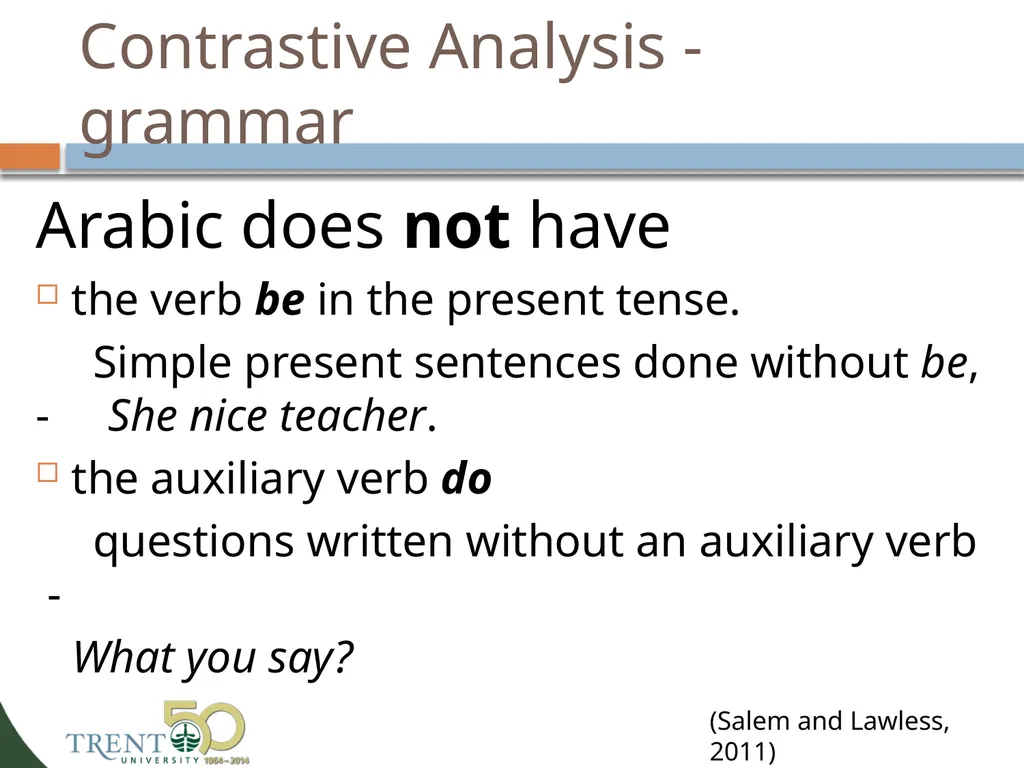
Contrastive Analysis - grammar Arabic does not have
the verb be in the present tense.
Simple present sentences done without be, - She nice teacher.
the auxiliary verb do
questions written without an auxiliary verb -
What you say? (Salem and Lawless, 2011)<br>
the verb be in the present tense.
Simple present sentences done without be, - She nice teacher.
the auxiliary verb do
questions written without an auxiliary verb -
What you say? (Salem and Lawless, 2011)<br>
23
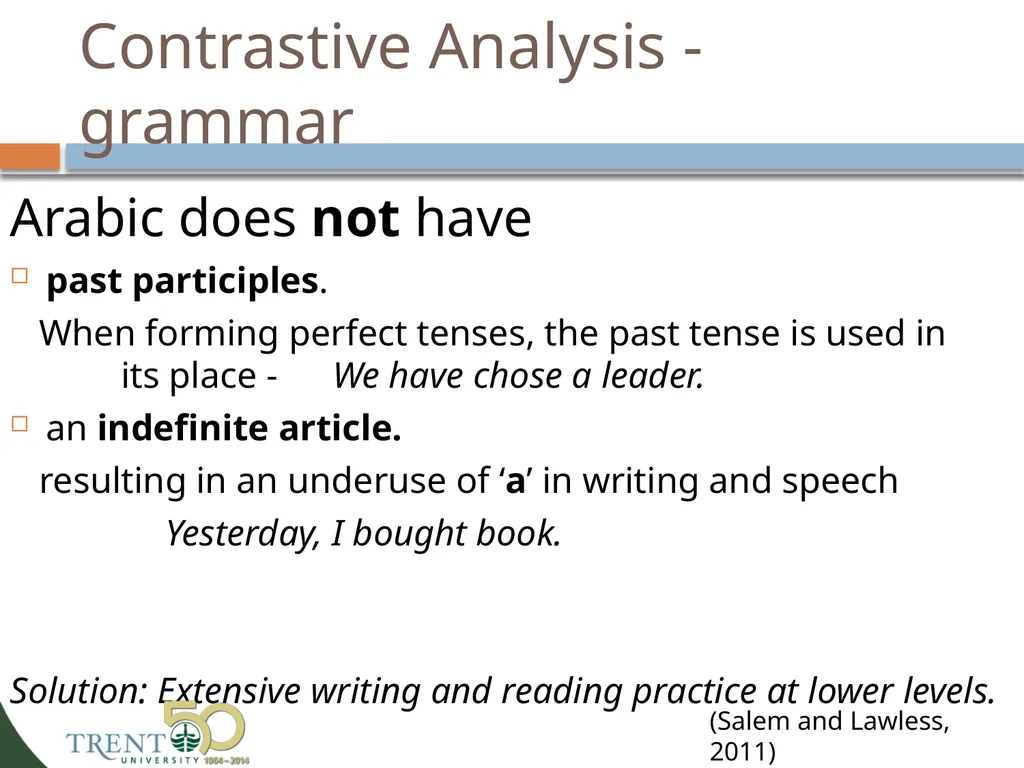
Contrastive Analysis - grammar Arabic does not have
past participles.
When forming perfect tenses, the past tense is used in its place - We have chose a leader.
an indefinite article.
resulting in an underuse of ‘a’ in writing and speech
Yesterday, I bought book.
Solution: Extensive writing and reading practice at lower levels. (Salem and Lawless, 2011)<br>
past participles.
When forming perfect tenses, the past tense is used in its place - We have chose a leader.
an indefinite article.
resulting in an underuse of ‘a’ in writing and speech
Yesterday, I bought book.
Solution: Extensive writing and reading practice at lower levels. (Salem and Lawless, 2011)<br>
24
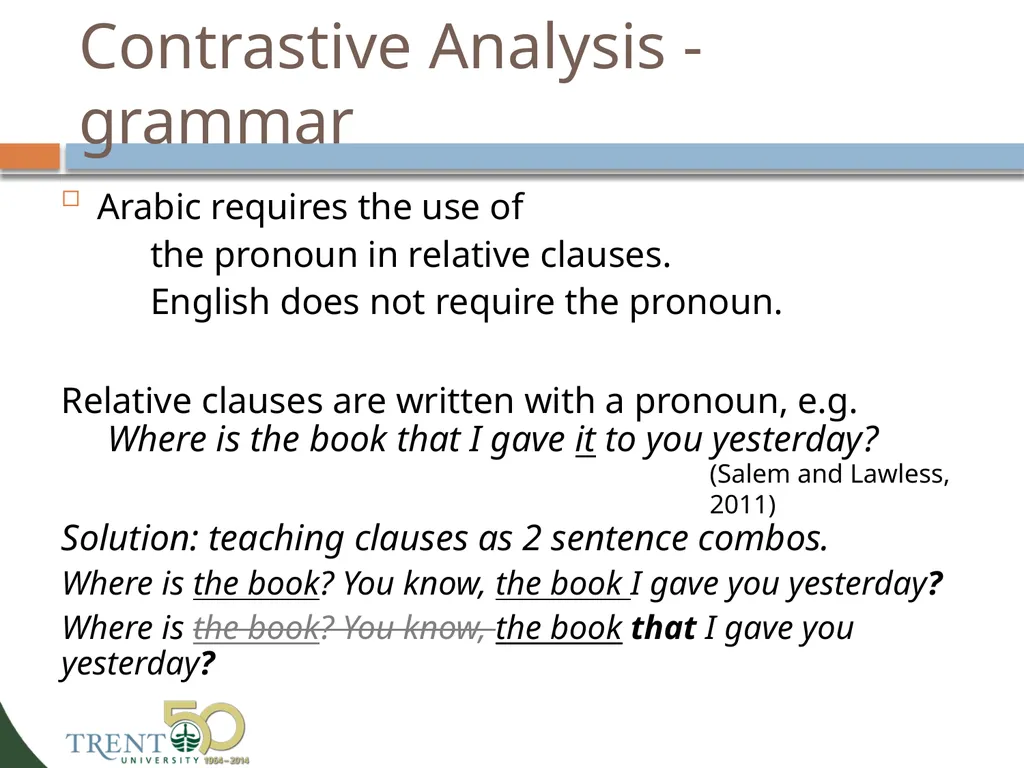
Contrastive Analysis - grammar Arabic requires the use of
the pronoun in relative clauses.
English does not require the pronoun.
Relative clauses are written with a pronoun, e.g. Where is the book that I gave it to you yesterday?
Solution: teaching clauses as 2 sentence combos.
Where is the book? You know, the book I gave you yesterday?
Where is the book? You know, the book that I gave you yesterday? (Salem and Lawless, 2011)<br>
the pronoun in relative clauses.
English does not require the pronoun.
Relative clauses are written with a pronoun, e.g. Where is the book that I gave it to you yesterday?
Solution: teaching clauses as 2 sentence combos.
Where is the book? You know, the book I gave you yesterday?
Where is the book? You know, the book that I gave you yesterday? (Salem and Lawless, 2011)<br>
25
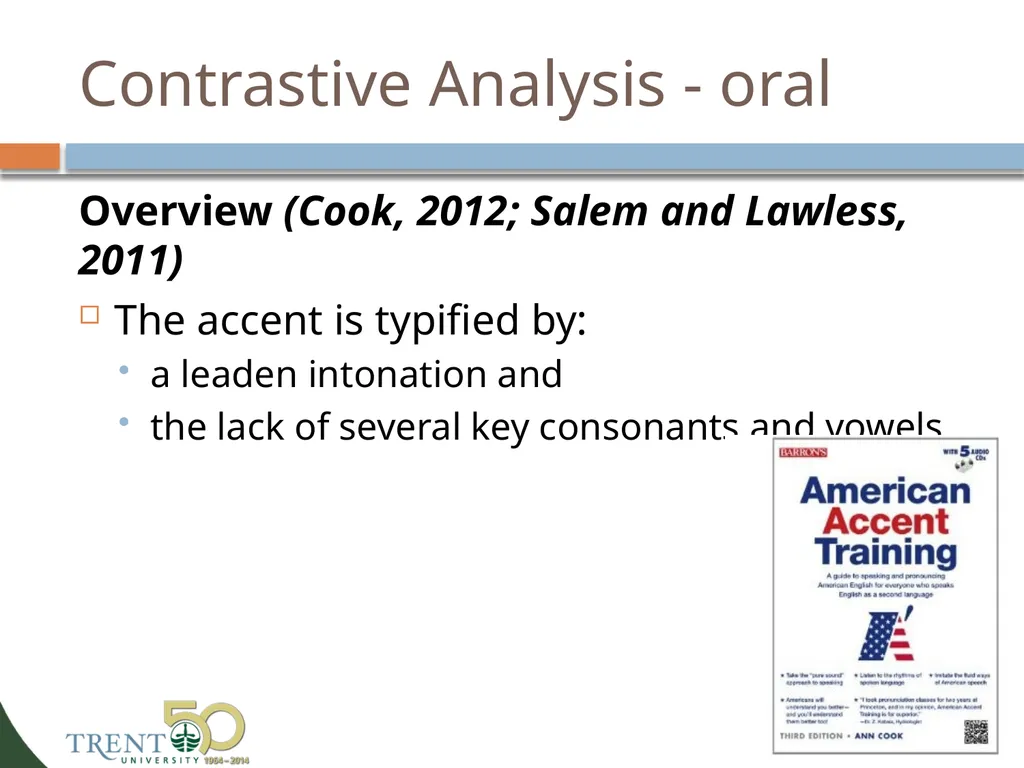
Contrastive Analysis - oral Overview (Cook, 2012; Salem and Lawless, 2011)
The accent is typified by:
a leaden intonation and
the lack of several key consonants and vowels<br>
The accent is typified by:
a leaden intonation and
the lack of several key consonants and vowels<br>
26
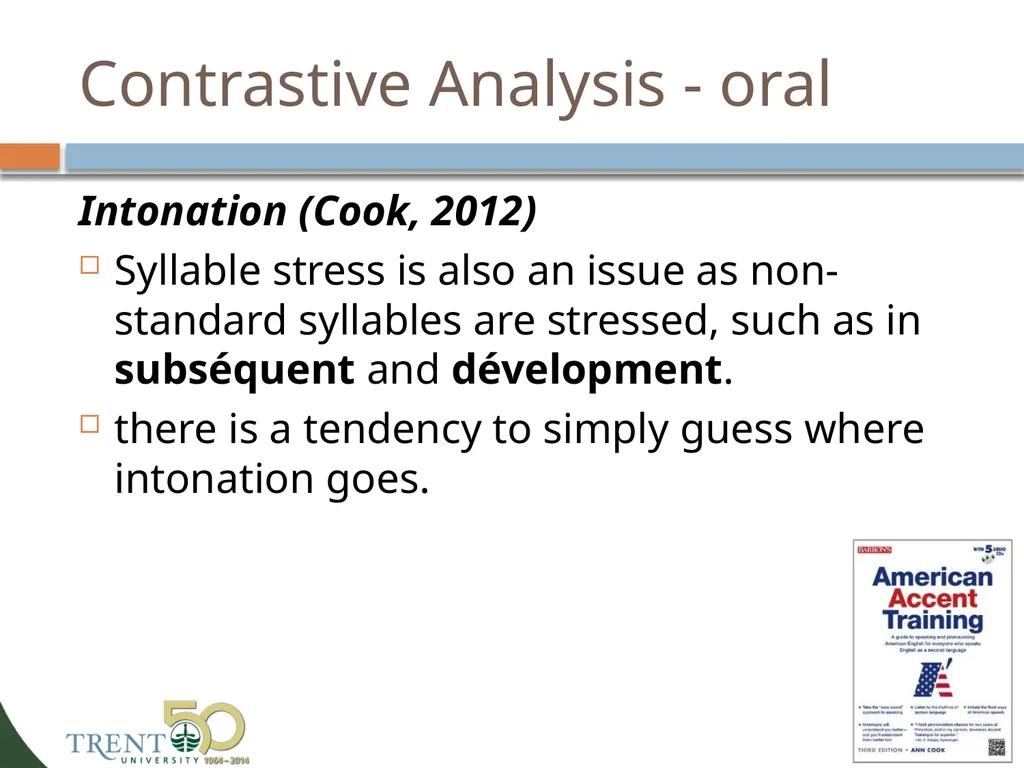
Contrastive Analysis - oral Intonation (Cook, 2012)
Syllable stress is also an issue as non-standard syllables are stressed, such as in subséquent and dévelopment.
there is a tendency to simply guess where intonation goes.<br>
Syllable stress is also an issue as non-standard syllables are stressed, such as in subséquent and dévelopment.
there is a tendency to simply guess where intonation goes.<br>
27
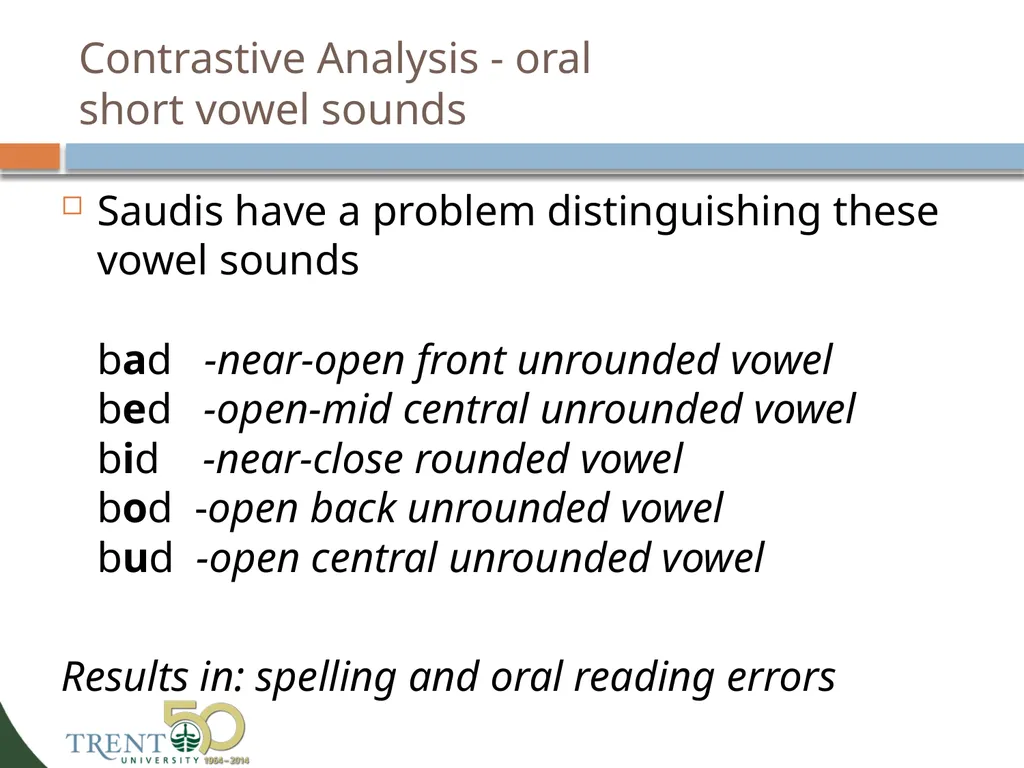
Contrastive Analysis - oral
short vowel sounds Saudis have a problem distinguishing these vowel sounds
bad -near-open front unrounded vowel
bed -open-mid central unrounded vowel
bid -near-close rounded vowel
bod -open back unrounded vowel
bud -open central unrounded vowel
Results in: spelling and oral reading errors<br>
Results in: spelling and oral reading errors<br>
28
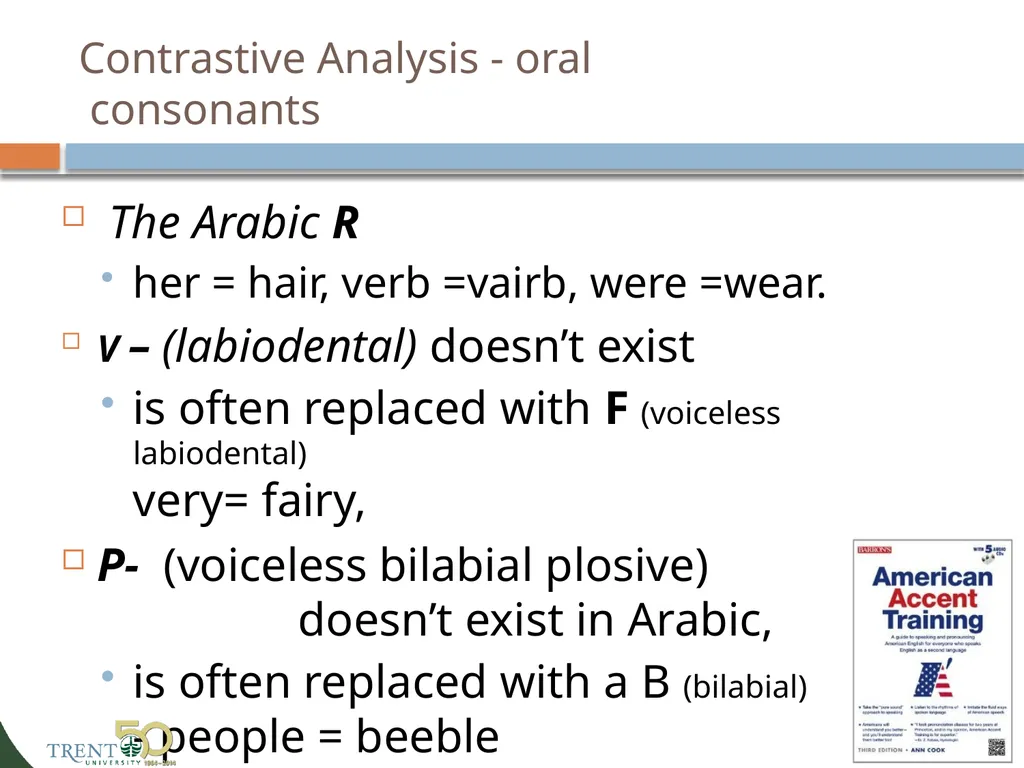
Contrastive Analysis - oral
consonants The Arabic R
her = hair, verb =vairb, were =wear.
V – (labiodental) doesn’t exist
is often replaced with F (voiceless labiodental) very= fairy,
P- (voiceless bilabial plosive) doesn’t exist in Arabic,
is often replaced with a B (bilabial) - people = beeble<br>
her = hair, verb =vairb, were =wear.
V – (labiodental) doesn’t exist
is often replaced with F (voiceless labiodental) very= fairy,
P- (voiceless bilabial plosive) doesn’t exist in Arabic,
is often replaced with a B (bilabial) - people = beeble<br>
29
Contrastive Analysis – Oral
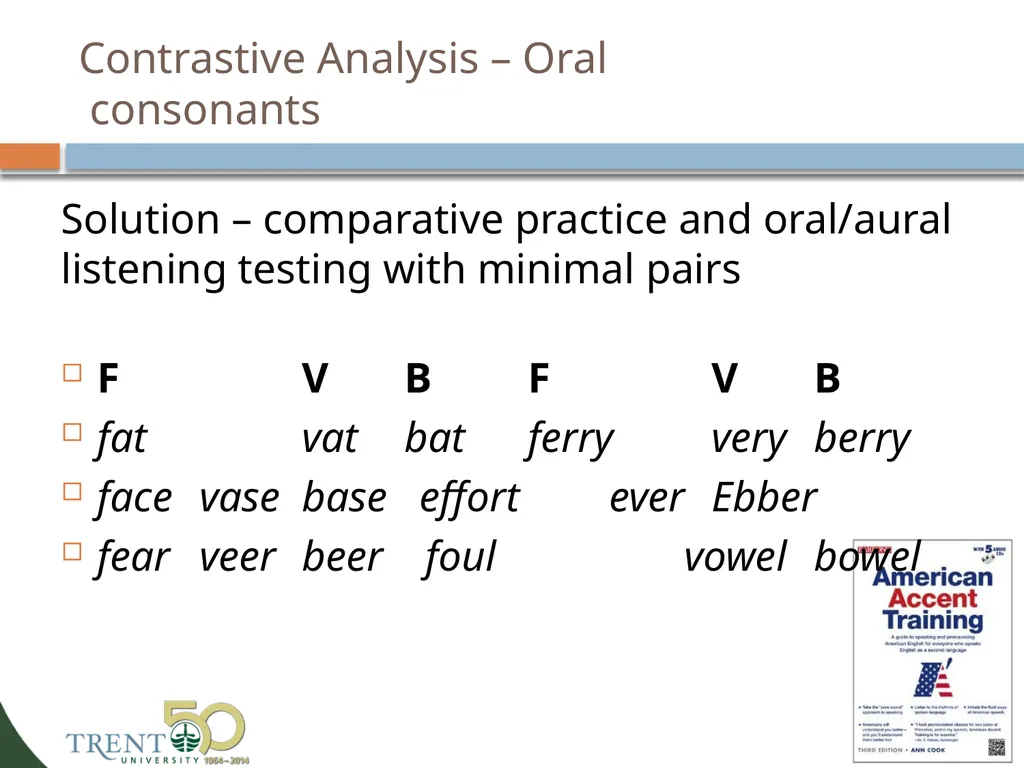
consonants Solution – comparative practice and oral/aural listening testing with minimal pairs
F V B F V B
fat vat bat ferry very berry
face vase base effort ever Ebber
fear veer beer foul vowel bowel<br>
F V B F V B
fat vat bat ferry very berry
face vase base effort ever Ebber
fear veer beer foul vowel bowel<br>
30
Contrastive Analysis - writing During previous writing instruction in Arabic:
Arabic does not have strict punctuation rules
mostly descriptive or expository essays
writing is a product, not a process
repetition and paraphrase are rhetorically effective
display their linguistic in Modern Standard Arabic.
No critical analysis
rarely argumentative essays (Salem and Lawless, 2011; Bersamina, 2009)<br>
Arabic does not have strict punctuation rules
mostly descriptive or expository essays
writing is a product, not a process
repetition and paraphrase are rhetorically effective
display their linguistic in Modern Standard Arabic.
No critical analysis
rarely argumentative essays (Salem and Lawless, 2011; Bersamina, 2009)<br>
31
Contrastive Analysis - writing Consequently
From a bottom up perspective, ESL writing displays:
loose punctuation
frequent use of synonyms or near synonyms.
frequent use of coordinating conjunctions,
e.g. and, but, so. (Salem and Lawless, 2011; Bersamina, 2009)<br>
From a bottom up perspective, ESL writing displays:
loose punctuation
frequent use of synonyms or near synonyms.
frequent use of coordinating conjunctions,
e.g. and, but, so. (Salem and Lawless, 2011; Bersamina, 2009)<br>
32
Contrastive Analysis - writing Consequently
From a top down perspective, paragraphs and essays display:
plagiarism through memorization.
repetition of ideas (paraphrase– restatement).
Little critical thought or analysis
Content:
Lacks focus and specificity
sufficient information
Vague and abstract ideas. (Salem and Lawless, 2011; Bersamina, 2009)<br>
From a top down perspective, paragraphs and essays display:
plagiarism through memorization.
repetition of ideas (paraphrase– restatement).
Little critical thought or analysis
Content:
Lacks focus and specificity
sufficient information
Vague and abstract ideas. (Salem and Lawless, 2011; Bersamina, 2009)<br>
33
Contrastive Analysis - writing Subsequently, solutions involve:
Explicit instruction in:
English rhetorical styles
Clear sentence-by-sentence outlines
Explanation of the consequences of plagiarism
Connection support to thesis
Additional emphasis on
revision (and grade for drafts)
Not compromising on grammar vs content
Scaffolded problem solving.
Paper Eng-Eng dictionary skills (Salem and Lawless, 2011; Bersamina, 2009)<br>
Explicit instruction in:
English rhetorical styles
Clear sentence-by-sentence outlines
Explanation of the consequences of plagiarism
Connection support to thesis
Additional emphasis on
revision (and grade for drafts)
Not compromising on grammar vs content
Scaffolded problem solving.
Paper Eng-Eng dictionary skills (Salem and Lawless, 2011; Bersamina, 2009)<br>
34
Beyond the language: business English Business English programs for Saudi students:
using classroom hours effectively<br>
35
Math and Numeracy In Arabic
the (.) in Arabic means zero,
(0) means five in Arabic
13.6 = 1306, 250 = 255.
Difficulties in reading large numbers
Units of measure: km, kg, mm
Transfer of mathematical knowledge across languages Yushau, 2004<br>
the (.) in Arabic means zero,
(0) means five in Arabic
13.6 = 1306, 250 = 255.
Difficulties in reading large numbers
Units of measure: km, kg, mm
Transfer of mathematical knowledge across languages Yushau, 2004<br>
36
Rhetorical Differences – cover letters Some strategies do not transfer between cultures
When students were asked to write cover letters:
Cultural religious greetings
‘Glorified the institution of the prospective employer’
Bhatia (1993 in Al-Ali 2004) self-glorification ‘an unsupported claim of the writer’s own superiority based simply on feeling or desire rather than on rational judgment’
Invoking compassion Al-Ali 2004<br>
When students were asked to write cover letters:
Cultural religious greetings
‘Glorified the institution of the prospective employer’
Bhatia (1993 in Al-Ali 2004) self-glorification ‘an unsupported claim of the writer’s own superiority based simply on feeling or desire rather than on rational judgment’
Invoking compassion Al-Ali 2004<br>
37
Is the mountain to high? Business English programs for Saudi students:
using classroom hours effectively<br>
38
In summary and solution - linguistically Grammar issues
Spelling issues
Pronunciation issues<br>
Spelling issues
Pronunciation issues<br>
39
In summary and solution - linguistically Grammar issues – intensive formulaic writing IN CLASS
Spelling issues – etymology, basic phoneme practice, dictionary practice
Pronunciation issues – focused exercises, minimal pair practice<br>
Spelling issues – etymology, basic phoneme practice, dictionary practice
Pronunciation issues – focused exercises, minimal pair practice<br>
40
In summary and solution - pedagogically Problems:
Skill deficits
Critical thinking skills
Rhetorical styles
Literacy
Innumeracy<br>
Skill deficits
Critical thinking skills
Rhetorical styles
Literacy
Innumeracy<br>
41
In summary and solution - pedagogically Problems:
Skill deficits – ESP classes/focused projects in areas of interest
Critical thinking skills – simple analytical problem solving
Rhetorical styles – explicit instruction with clear outlines
Literacy – in class reading, extensive reading and dictionary work (former students & course profs)
Innumeracy – simple mathematical business problems<br>
Skill deficits – ESP classes/focused projects in areas of interest
Critical thinking skills – simple analytical problem solving
Rhetorical styles – explicit instruction with clear outlines
Literacy – in class reading, extensive reading and dictionary work (former students & course profs)
Innumeracy – simple mathematical business problems<br>
42
The takeaway- can we do it? Face significant pedagogical/linguistic challenges
But we’ve faced similar from other countries and overcome, this is no different.
Success is a combined effort on the part of the teacher and the student (Bersamina, 2009)
بإمكان أن تقود الخيل للماء. ولكن، لن تستطيع اجباره لشربه
“you can take a horse to water, but you can’t make it drink”<br>
But we’ve faced similar from other countries and overcome, this is no different.
Success is a combined effort on the part of the teacher and the student (Bersamina, 2009)
بإمكان أن تقود الخيل للماء. ولكن، لن تستطيع اجباره لشربه
“you can take a horse to water, but you can’t make it drink”<br>
43
Thank you – references to follow Business English programs for Saudi students:
using classroom hours effectively<br>
44
References Abaalkhail, F. A. (November 20, 2011) CBIE’S 45th Annual conference on international education. Saudi Arabian Cultural Attaché in Canada Ottawa, Ontario
Al-Ali, M. (2004) How to Get Yourself on the Door of a Job: A Cross-cultural Contrastive Study of Arabic and English Job Application Letters Journal of Multilingual and Multicultural Development l. 25, 1
Alosaimi, N. (30 November2007), English Teachers Not Always Qualified, Arab News, 30 November. Retrieved from http://www.arabnews.com/?page=1§ion=0&article=104142&d=30&m=11&y=2007
Alsharif, K., Atweh, B. (2010) Gaps in Understanding and Implementing Connectedness in Mathematics Teaching by Saudi Student Teachers. AARE International Education Research Conference 2010, Nov 28, 2010, Melbourne, Victoria. Retrieved from www.aare.edu.au/10pap/2525AlsharifAtweh.pdf
Bersamina, F. (2009) English as Second Language (ESL) Learners in Saudi Arabia A Case Study. Retrieved from http://voices.yahoo.com/english-as-second-language-esl-learners-saudi-arabia-2899149.html
CIA Factbook (2012) Saudi Arabia Retrieved from https://www.cia.gov/library/publications/the-world-factbook/geos/sa.html
Cook, A (2012) American Accent training 3rd Edition Revised & Enlarged Barrons NY, NY
Cummins, J. (1979). Cognitive/academic language proficiency, linguistic interdependence, the optimum age question and some other matters. Working Papers on Bilingualism, No. 19, 121-129.
Cummins, J. (1980). Psychological assessment of immigrant children: Logic or intuition? Journal of Multilingual and Multicultural Development. 1, 97-lll.
Economist, (23 June 2012) The long day closes: As royal heirs succumb to old age, Saudi Arabia faces an uncertain future. The Economist Online. Retrieved from http://www.economist.com/node/21557327
Muhammed, A. (20 June 2012) Disaster: ‘Wasta’ Undermines Saudi Education System. MiddleEastPosts.com Retrieved from http://mideastposts.com/2012/06/disaster-wasta-undermines-saudi-education-system
Lindsey, U (Oct 3 2010) Saudi Arabia's Education Reforms Emphasize Training for Jobs. The Chronicle of Higher Education Retrieved from http://chronicle.com/article/Saudi-Arabias-Education/124771/
Salem, N. and Lawless, M. (2011) The Effect of Language Differences on Arab Learners’ ESL Writing Contact 37 (3) 20
Saudi Arabia. (n.d.) Saudi Central department of Statistics and information. Retrieved from http://www.cdsi.gov.sa/english/
Redden, E. (2007) Supporting Saudi Students. Inside Higher Education. Retrieved from http://www.insidehighered.com/news/2007/08/16/saudi
Yushau, B. (2009) Language and Mathematics: A Mediational Approach to Bilingual Arabs International Journal of Mathematical Education. Science and Technology, (40)7, 915–926<br>
Al-Ali, M. (2004) How to Get Yourself on the Door of a Job: A Cross-cultural Contrastive Study of Arabic and English Job Application Letters Journal of Multilingual and Multicultural Development l. 25, 1
Alosaimi, N. (30 November2007), English Teachers Not Always Qualified, Arab News, 30 November. Retrieved from http://www.arabnews.com/?page=1§ion=0&article=104142&d=30&m=11&y=2007
Alsharif, K., Atweh, B. (2010) Gaps in Understanding and Implementing Connectedness in Mathematics Teaching by Saudi Student Teachers. AARE International Education Research Conference 2010, Nov 28, 2010, Melbourne, Victoria. Retrieved from www.aare.edu.au/10pap/2525AlsharifAtweh.pdf
Bersamina, F. (2009) English as Second Language (ESL) Learners in Saudi Arabia A Case Study. Retrieved from http://voices.yahoo.com/english-as-second-language-esl-learners-saudi-arabia-2899149.html
CIA Factbook (2012) Saudi Arabia Retrieved from https://www.cia.gov/library/publications/the-world-factbook/geos/sa.html
Cook, A (2012) American Accent training 3rd Edition Revised & Enlarged Barrons NY, NY
Cummins, J. (1979). Cognitive/academic language proficiency, linguistic interdependence, the optimum age question and some other matters. Working Papers on Bilingualism, No. 19, 121-129.
Cummins, J. (1980). Psychological assessment of immigrant children: Logic or intuition? Journal of Multilingual and Multicultural Development. 1, 97-lll.
Economist, (23 June 2012) The long day closes: As royal heirs succumb to old age, Saudi Arabia faces an uncertain future. The Economist Online. Retrieved from http://www.economist.com/node/21557327
Muhammed, A. (20 June 2012) Disaster: ‘Wasta’ Undermines Saudi Education System. MiddleEastPosts.com Retrieved from http://mideastposts.com/2012/06/disaster-wasta-undermines-saudi-education-system
Lindsey, U (Oct 3 2010) Saudi Arabia's Education Reforms Emphasize Training for Jobs. The Chronicle of Higher Education Retrieved from http://chronicle.com/article/Saudi-Arabias-Education/124771/
Salem, N. and Lawless, M. (2011) The Effect of Language Differences on Arab Learners’ ESL Writing Contact 37 (3) 20
Saudi Arabia. (n.d.) Saudi Central department of Statistics and information. Retrieved from http://www.cdsi.gov.sa/english/
Redden, E. (2007) Supporting Saudi Students. Inside Higher Education. Retrieved from http://www.insidehighered.com/news/2007/08/16/saudi
Yushau, B. (2009) Language and Mathematics: A Mediational Approach to Bilingual Arabs International Journal of Mathematical Education. Science and Technology, (40)7, 915–926<br>