
BUSINESS RESPONSIBILITY Orientation on NVGs and
OM
Published · 51 slides · 0 views

1 / 1



Description
BUSINESS RESPONSIBILITY Orientation on NVGs and their Operationalisation Chetna Kaura 1 2 Historical and Socio-economic Context Religious background Charity and philanthropy Principle of Trusteeship Social Responsibility - The Western
Related Topics
Share
Embed code
Download this presentation From Below
"BUSINESS RESPONSIBILITY Orientation on NVGs and" is the property of its rightful owner. Permission is granted to download and print the materials on this website for personal, non-commercial use only, and to display it on your personal computer provided you do not modify the materials and that you retain all copyright notices contained in the materials. By downloading content from our website, you accept the terms of this agreement.
Presentation Transcript
01
BUSINESS RESPONSIBILITY
Orientation on NVGs and their Operationalisation Chetna Kaura 1<br>
02
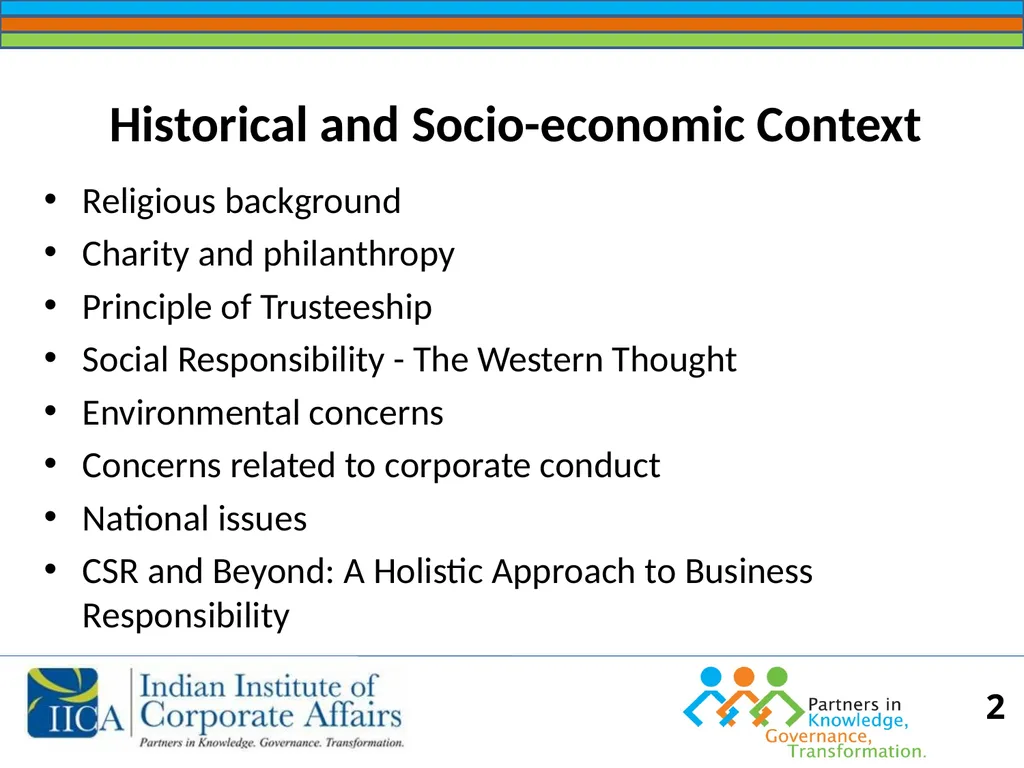
2 Historical and Socio-economic Context Religious background
Charity and philanthropy
Principle of Trusteeship
Social Responsibility - The Western Thought
Environmental concerns
Concerns related to corporate conduct
National issues
CSR and Beyond: A Holistic Approach to Business Responsibility<br>
Charity and philanthropy
Principle of Trusteeship
Social Responsibility - The Western Thought
Environmental concerns
Concerns related to corporate conduct
National issues
CSR and Beyond: A Holistic Approach to Business Responsibility<br>
03
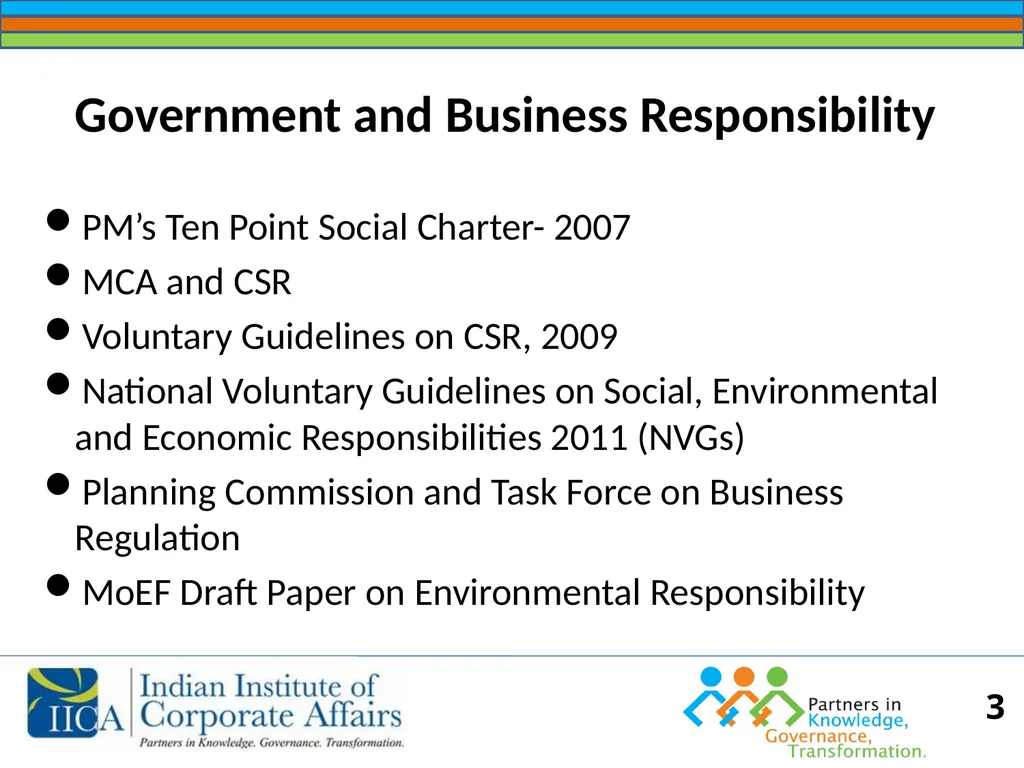
3 Government and Business Responsibility PM’s Ten Point Social Charter- 2007
MCA and CSR
Voluntary Guidelines on CSR, 2009
National Voluntary Guidelines on Social, Environmental and Economic Responsibilities 2011 (NVGs)
Planning Commission and Task Force on Business Regulation
MoEF Draft Paper on Environmental Responsibility<br>
MCA and CSR
Voluntary Guidelines on CSR, 2009
National Voluntary Guidelines on Social, Environmental and Economic Responsibilities 2011 (NVGs)
Planning Commission and Task Force on Business Regulation
MoEF Draft Paper on Environmental Responsibility<br>
04
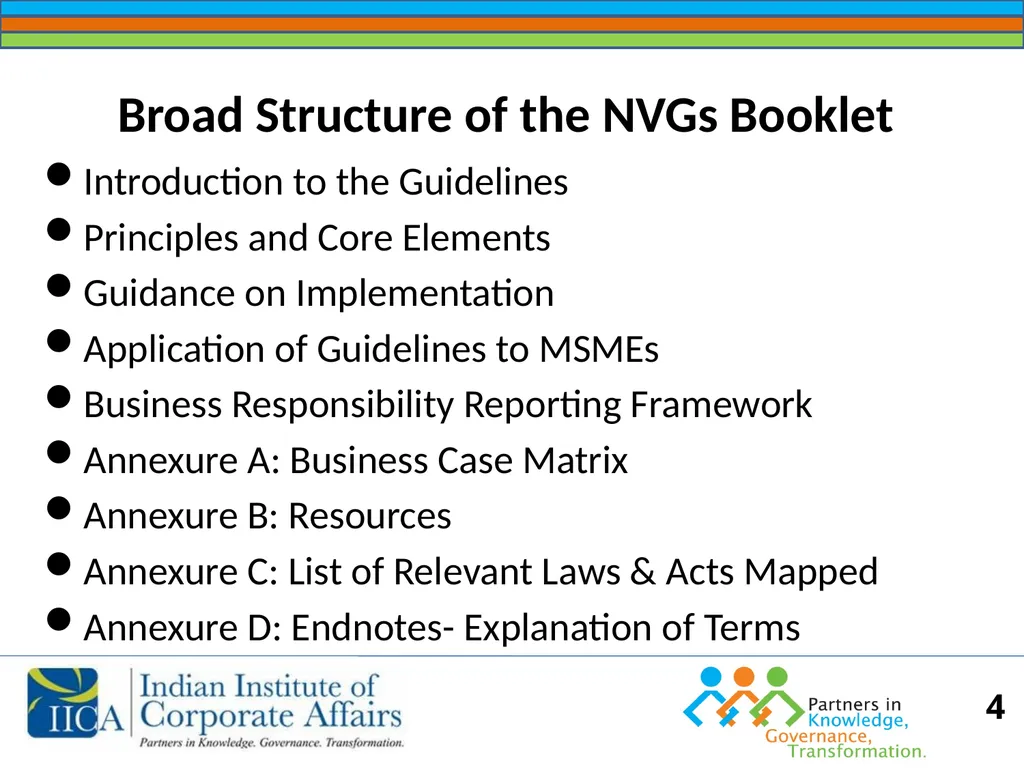
4 Broad Structure of the NVGs Booklet Introduction to the Guidelines
Principles and Core Elements
Guidance on Implementation
Application of Guidelines to MSMEs
Business Responsibility Reporting Framework
Annexure A: Business Case Matrix
Annexure B: Resources
Annexure C: List of Relevant Laws & Acts Mapped
Annexure D: Endnotes- Explanation of Terms<br>
Principles and Core Elements
Guidance on Implementation
Application of Guidelines to MSMEs
Business Responsibility Reporting Framework
Annexure A: Business Case Matrix
Annexure B: Resources
Annexure C: List of Relevant Laws & Acts Mapped
Annexure D: Endnotes- Explanation of Terms<br>
05
5 Introduction to the Guidelines Refinement over CSR Voluntary Guidelines 2009
Mandate and Process
Applicability
Content and Structure – 9 Principles, 48 Core Elements
Case studies<br>
Mandate and Process
Applicability
Content and Structure – 9 Principles, 48 Core Elements
Case studies<br>
06
6 Nine Principles of the NVGs Principle 1: Businesses should conduct and govern themselves with Ethics, Transparency and Accountability
Principle 2: Businesses should provide goods and services that are safe and contribute to sustainability throughout their lifecycle
Principle 3: Businesses should promote the wellbeing of all employees<br>
Principle 2: Businesses should provide goods and services that are safe and contribute to sustainability throughout their lifecycle
Principle 3: Businesses should promote the wellbeing of all employees<br>
07
7 Nine Principles of the NVGs Principle 4: Businesses should respect the interests of, and be responsive towards all stakeholders, especially those who are disadvantaged, vulnerable and marginalised
Principle 5: Businesses should respect and promote human rights
Principle 6: Businesses should respect, protect and make efforts to restore the environment<br>
Principle 5: Businesses should respect and promote human rights
Principle 6: Businesses should respect, protect and make efforts to restore the environment<br>
08
8 Nine Principles of the NVGs Principle 7: Businesses when engaged in influencing public and regulatory policy, should do so in a responsible manner
Principle 8: Businesses should support inclusive growth and equitable development
Principle 9: Businesses should engage with and provide value to their customers and consumers in a responsible manner<br>
Principle 8: Businesses should support inclusive growth and equitable development
Principle 9: Businesses should engage with and provide value to their customers and consumers in a responsible manner<br>
09
9 Guidance on Implementation Leadership
Integration
Engagement
Reporting
Determining a Business Case<br>
Integration
Engagement
Reporting
Determining a Business Case<br>
10
10 Application of NVGs to MSMEs Supply chain
Globalization
Multiplicity of prevailing codes is a challenge
Multi pronged approach suggested:
1) Facilitating MSMEs to recognise the business case for adopting Responsible Business practices
2)Preference by public agencies and large players in value chains to MSMEs that follow BR practices
3)Handholding MSMEs during the adoption of the NVGs<br>
Globalization
Multiplicity of prevailing codes is a challenge
Multi pronged approach suggested:
1) Facilitating MSMEs to recognise the business case for adopting Responsible Business practices
2)Preference by public agencies and large players in value chains to MSMEs that follow BR practices
3)Handholding MSMEs during the adoption of the NVGs<br>
11
11 Annual Business Responsibility Report Section A: General Information about the Company
Section B: Financial Details of the Company
Section C: Other Details
Section D: Business Responsibility Information
Section E: NVG Principle-wise Performance
SEBI directive<br>
Section B: Financial Details of the Company
Section C: Other Details
Section D: Business Responsibility Information
Section E: NVG Principle-wise Performance
SEBI directive<br>
12
12 Objectives of the ABRR Help companies to understand the ethos of NVG in context of implementation
Help companies establish internal processes as well as identify deficiencies
Assist in providing aggregated data on corporate BR performance to aid policy formulation/research
Assist the stakeholders to review/assess BR performance<br>
Help companies establish internal processes as well as identify deficiencies
Assist in providing aggregated data on corporate BR performance to aid policy formulation/research
Assist the stakeholders to review/assess BR performance<br>
13
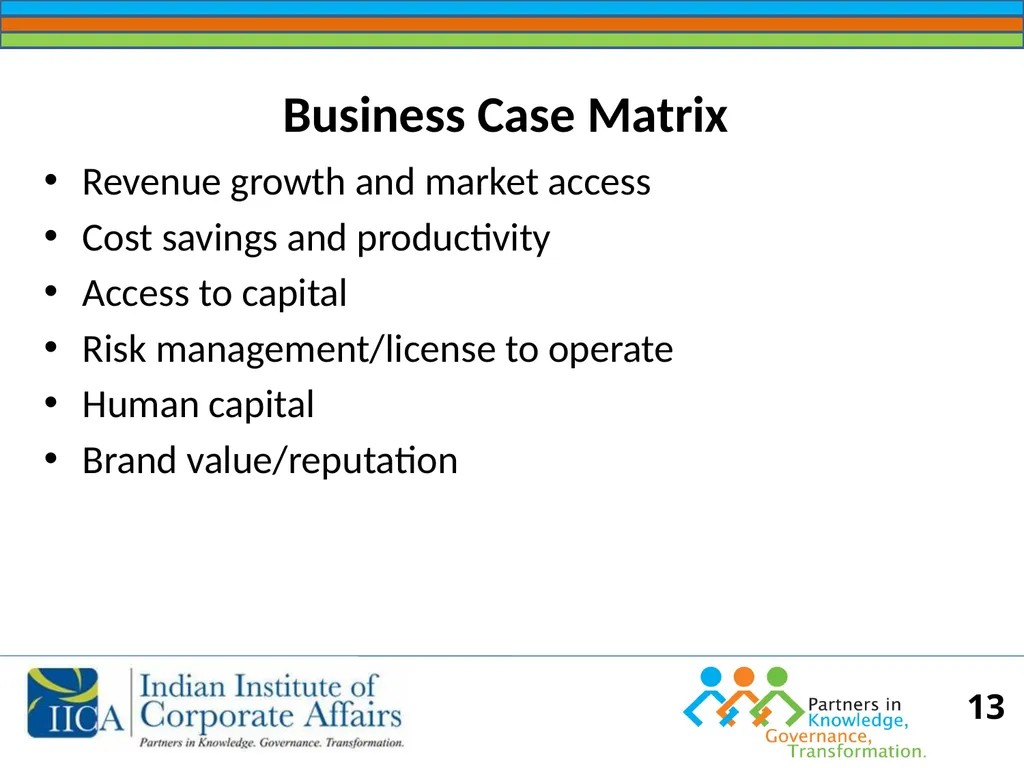
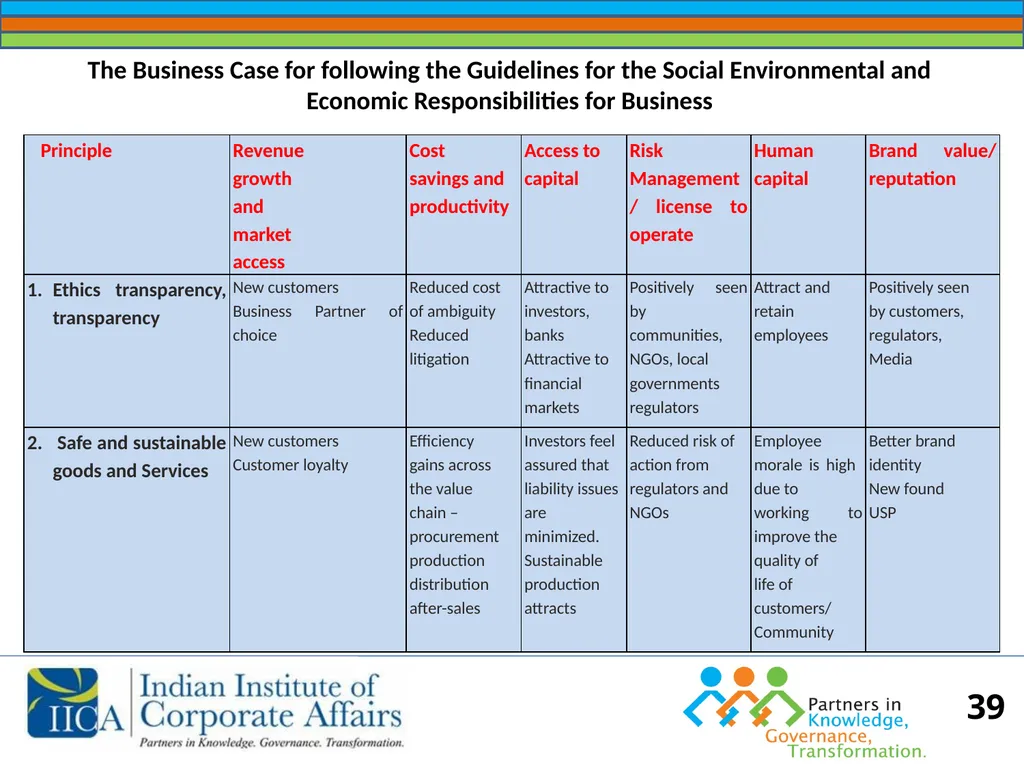
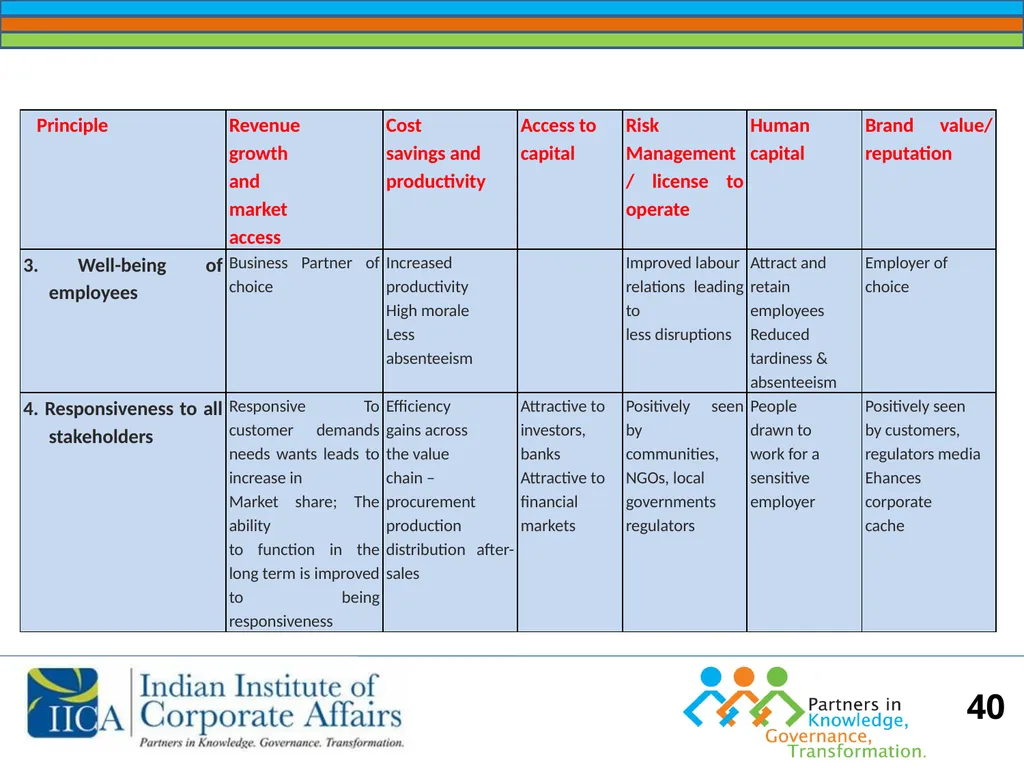
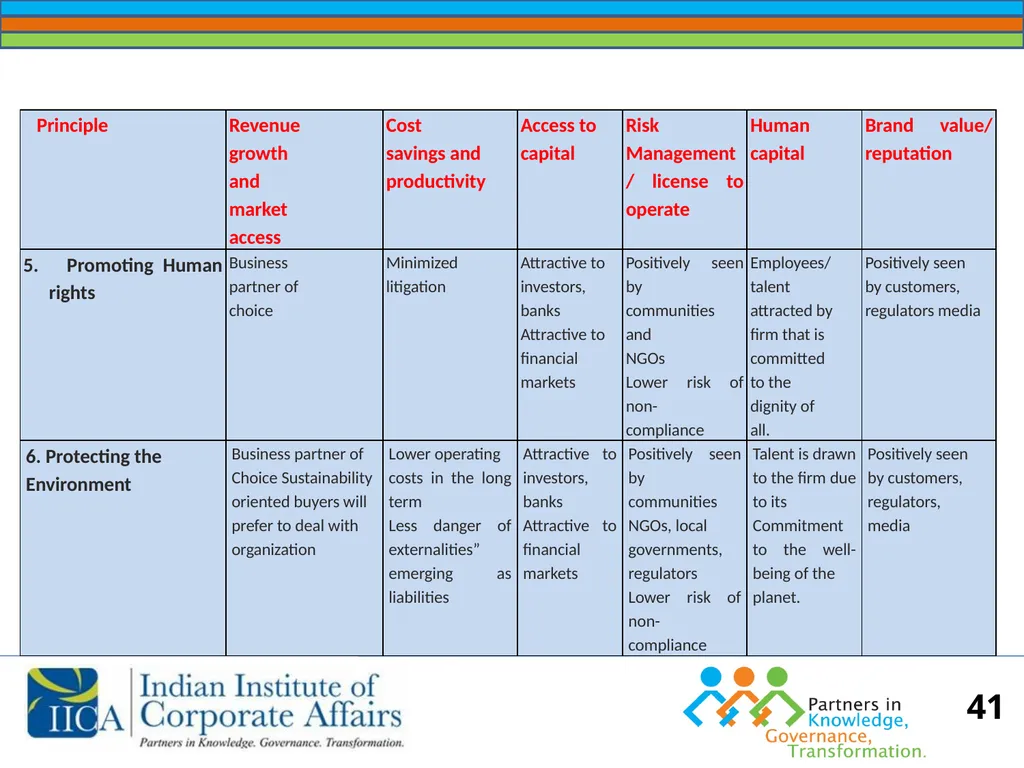
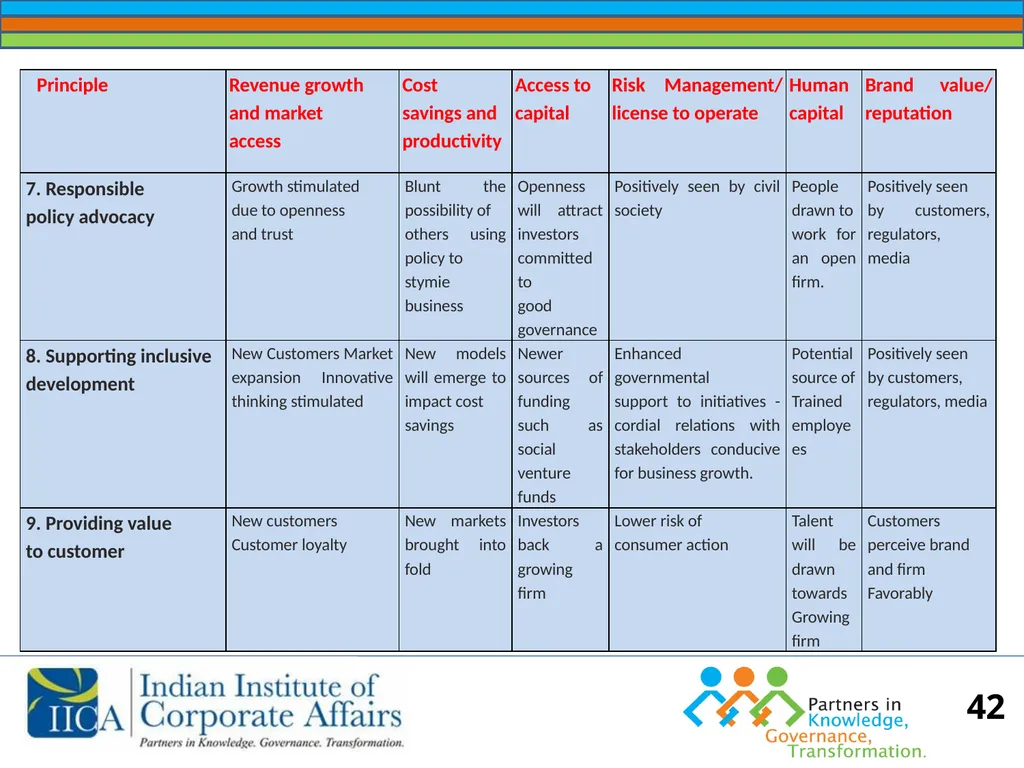
13 Business Case Matrix Revenue growth and market access
Cost savings and productivity
Access to capital
Risk management/license to operate
Human capital
Brand value/reputation<br>
Cost savings and productivity
Access to capital
Risk management/license to operate
Human capital
Brand value/reputation<br>
14
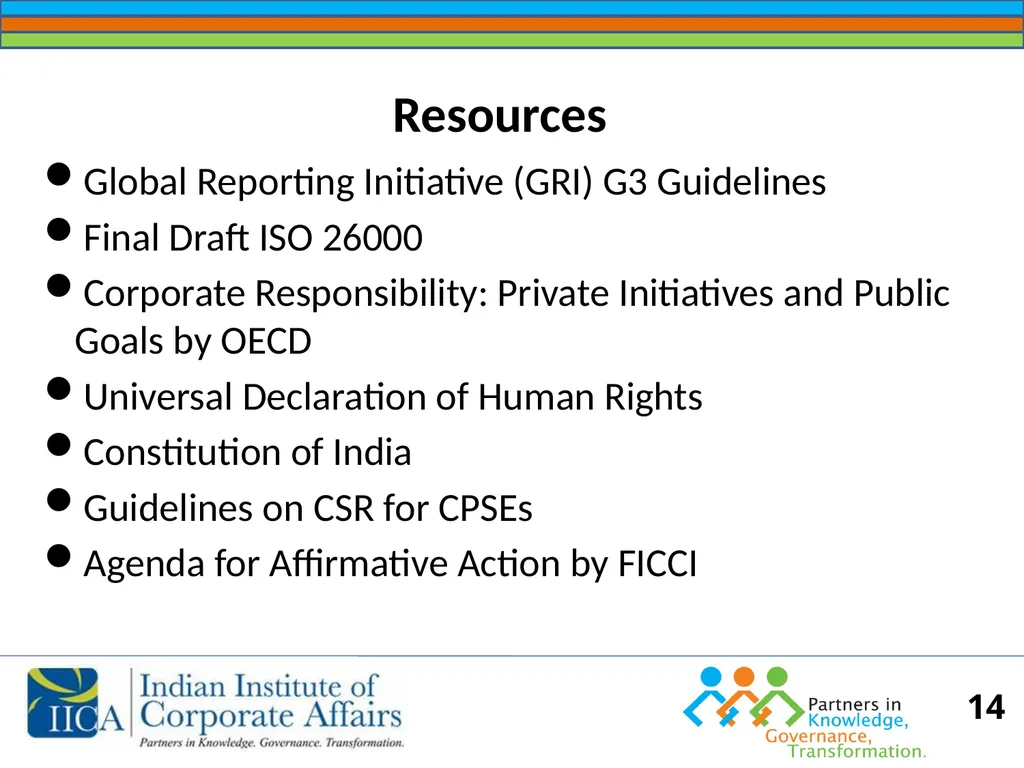
14 Resources Global Reporting Initiative (GRI) G3 Guidelines
Final Draft ISO 26000
Corporate Responsibility: Private Initiatives and Public Goals by OECD
Universal Declaration of Human Rights
Constitution of India
Guidelines on CSR for CPSEs
Agenda for Affirmative Action by FICCI<br>
Final Draft ISO 26000
Corporate Responsibility: Private Initiatives and Public Goals by OECD
Universal Declaration of Human Rights
Constitution of India
Guidelines on CSR for CPSEs
Agenda for Affirmative Action by FICCI<br>
15
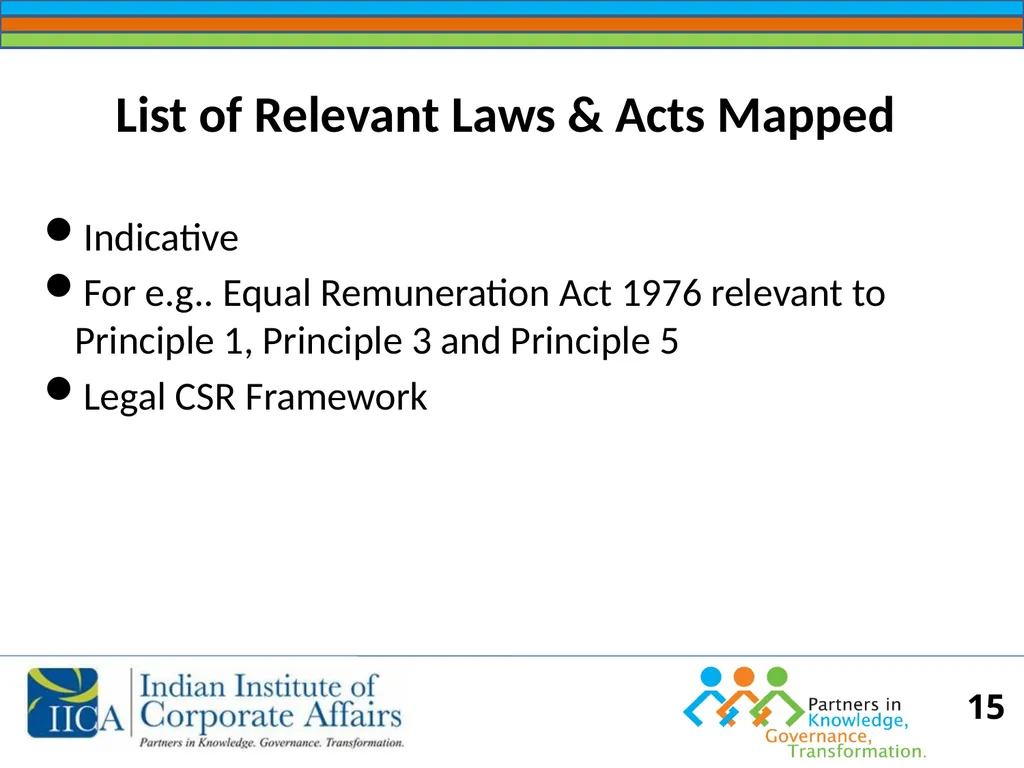
15 List of Relevant Laws & Acts Mapped Indicative
For e.g.. Equal Remuneration Act 1976 relevant to Principle 1, Principle 3 and Principle 5
Legal CSR Framework<br>
For e.g.. Equal Remuneration Act 1976 relevant to Principle 1, Principle 3 and Principle 5
Legal CSR Framework<br>
16
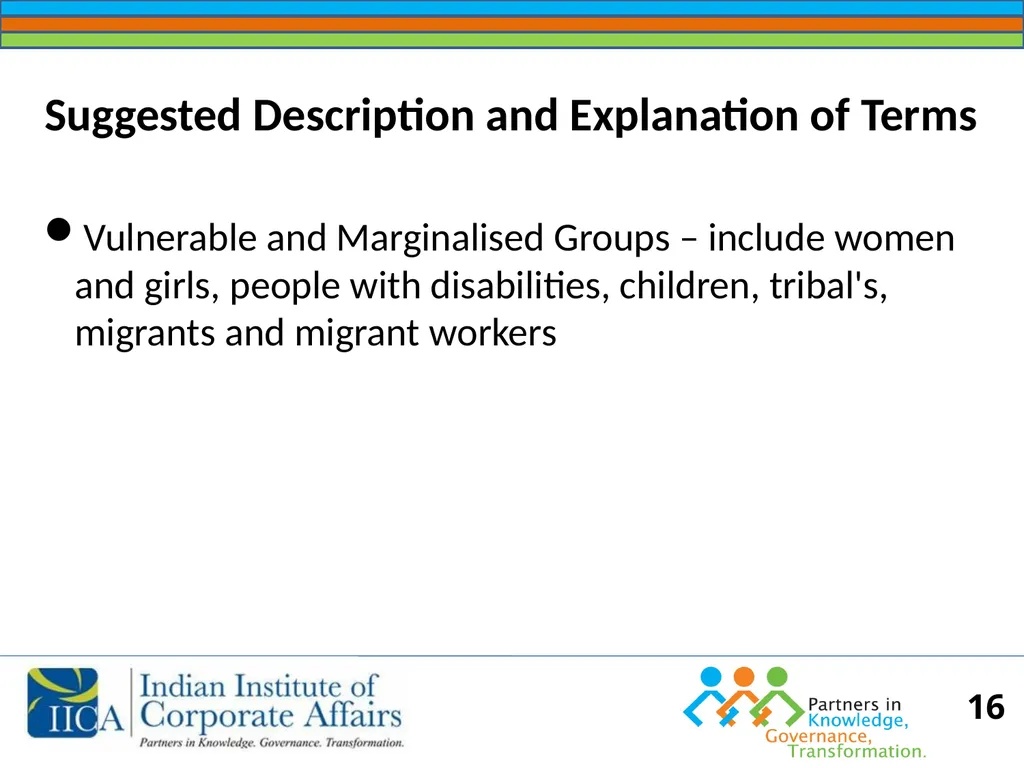
16 Suggested Description and Explanation of Terms Vulnerable and Marginalised Groups – include women and girls, people with disabilities, children, tribal's, migrants and migrant workers<br>
17
17 Next Steps Mainstreaming through advocacy and capacity building activities
Formulation of sector specific guidelines
Coordination and integration of guidelines of all Ministries
Annual Business Responsibility Report uptake by Ministry of Corporate Affairs<br>
Formulation of sector specific guidelines
Coordination and integration of guidelines of all Ministries
Annual Business Responsibility Report uptake by Ministry of Corporate Affairs<br>
18
Contact:
chetnakaura.iica@hotmail.com
chetnakaura@iica.in 18<br>
19
19<br>
20
20<br>
21
21 Annual Business Responsibility Report (ABRR) Section A: General Information about the Company Corporate Identity Number (CIN) of the Company
Name of the Company
Registered address
Website
e-mail id
Financial Year reported
Sector(s) that the Company is engaged in (industrial activity code-wise)
List three key products/services that the Company manufactures/provides (as in balance sheet)
Total number of locations where business activity is undertaken by the Company
Number of International Locations (Provide details of major 5)
Number of National Locations
Markets served by the Company<br>
Name of the Company
Registered address
Website
e-mail id
Financial Year reported
Sector(s) that the Company is engaged in (industrial activity code-wise)
List three key products/services that the Company manufactures/provides (as in balance sheet)
Total number of locations where business activity is undertaken by the Company
Number of International Locations (Provide details of major 5)
Number of National Locations
Markets served by the Company<br>
22
22 Section B: Financial Details of the Company
Paid up Capital (INR)
Total Turnover (INR)
Total profit after taxes (INR)
Total Spending on Corporate Social Responsibility (CSR)
In terms of Section 135 of Company’s Bill, 2011 (INR)
As percentage of profit after tax (%)
List the activities as per Schedule VII of Company’s Bill, 2011 in which expenditure in 4 above has been incurred.
a.
b.
c.<br>
Paid up Capital (INR)
Total Turnover (INR)
Total profit after taxes (INR)
Total Spending on Corporate Social Responsibility (CSR)
In terms of Section 135 of Company’s Bill, 2011 (INR)
As percentage of profit after tax (%)
List the activities as per Schedule VII of Company’s Bill, 2011 in which expenditure in 4 above has been incurred.
a.
b.
c.<br>
23
23 Section C: Other Details
Does the Company have any Subsidiary Company/ Companies?
Do the Subsidiary Company/Companies participate in the BR Initiatives of the parent company? If yes, then indicate the number of such subsidiary company(s)
Do any other entity/entities (e.g. suppliers, distributors etc.) that the Company does business with, participate in the BR initiatives of the Company? If yes, then indicate the percentage of such entity/entities? [ Less than 30%, 30-60%, More than 60%]<br>
Does the Company have any Subsidiary Company/ Companies?
Do the Subsidiary Company/Companies participate in the BR Initiatives of the parent company? If yes, then indicate the number of such subsidiary company(s)
Do any other entity/entities (e.g. suppliers, distributors etc.) that the Company does business with, participate in the BR initiatives of the Company? If yes, then indicate the percentage of such entity/entities? [ Less than 30%, 30-60%, More than 60%]<br>
24
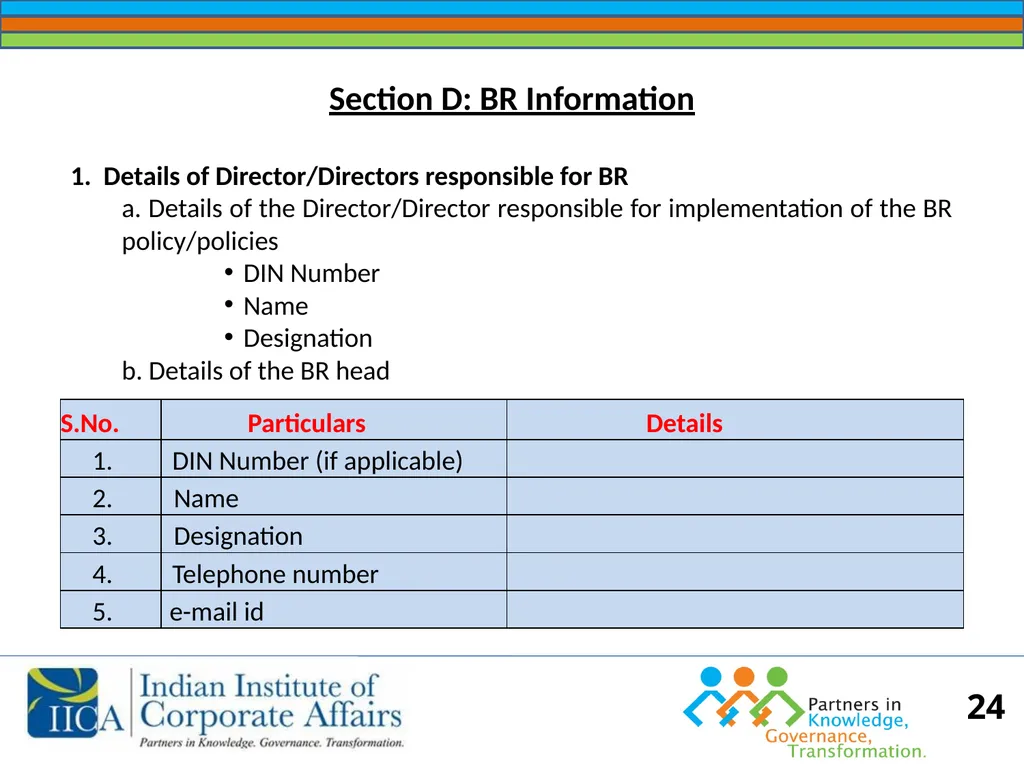
24 Section D: BR Information
1. Details of Director/Directors responsible for BR
a. Details of the Director/Director responsible for implementation of the BR policy/policies
DIN Number
Name
Designation
b. Details of the BR head<br>
1. Details of Director/Directors responsible for BR
a. Details of the Director/Director responsible for implementation of the BR policy/policies
DIN Number
Name
Designation
b. Details of the BR head<br>
25
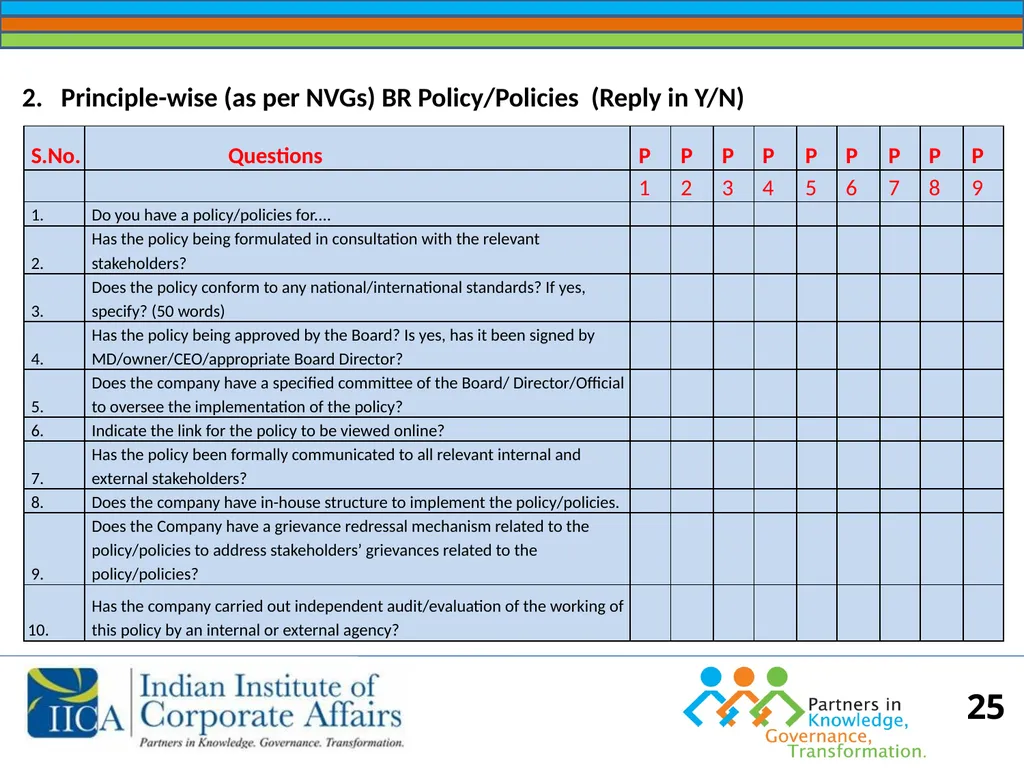
25 2. Principle-wise (as per NVGs) BR Policy/Policies (Reply in Y/N)<br>
26
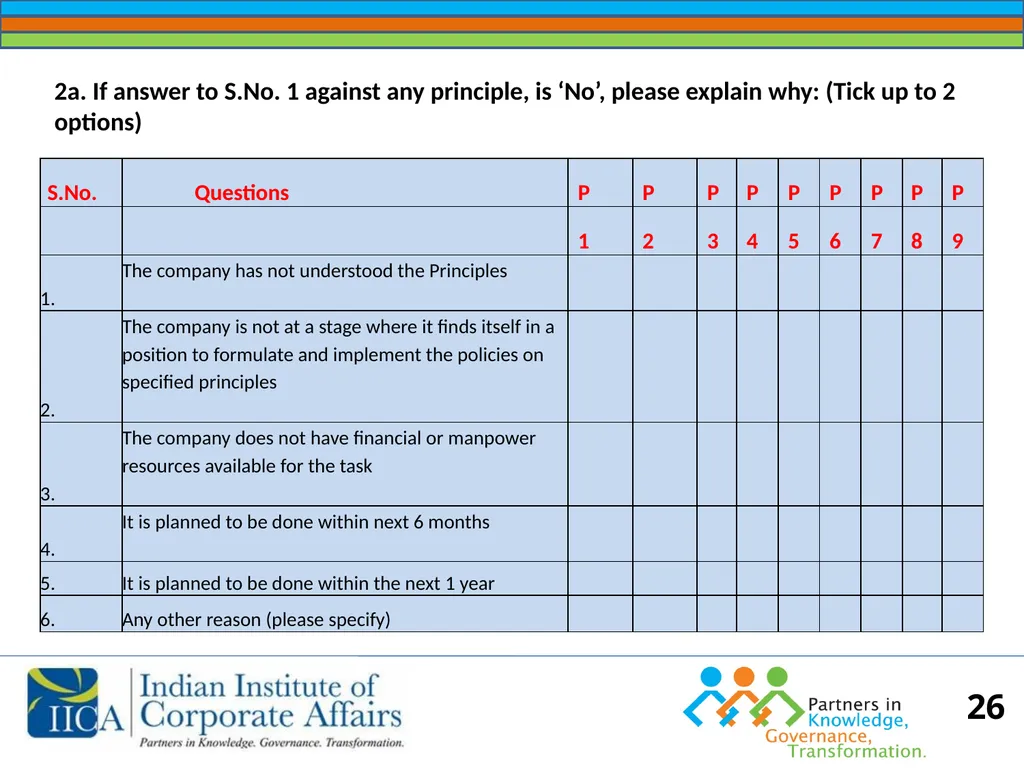
26 2a. If answer to S.No. 1 against any principle, is ‘No’, please explain why: (Tick up to 2 options)<br>
27
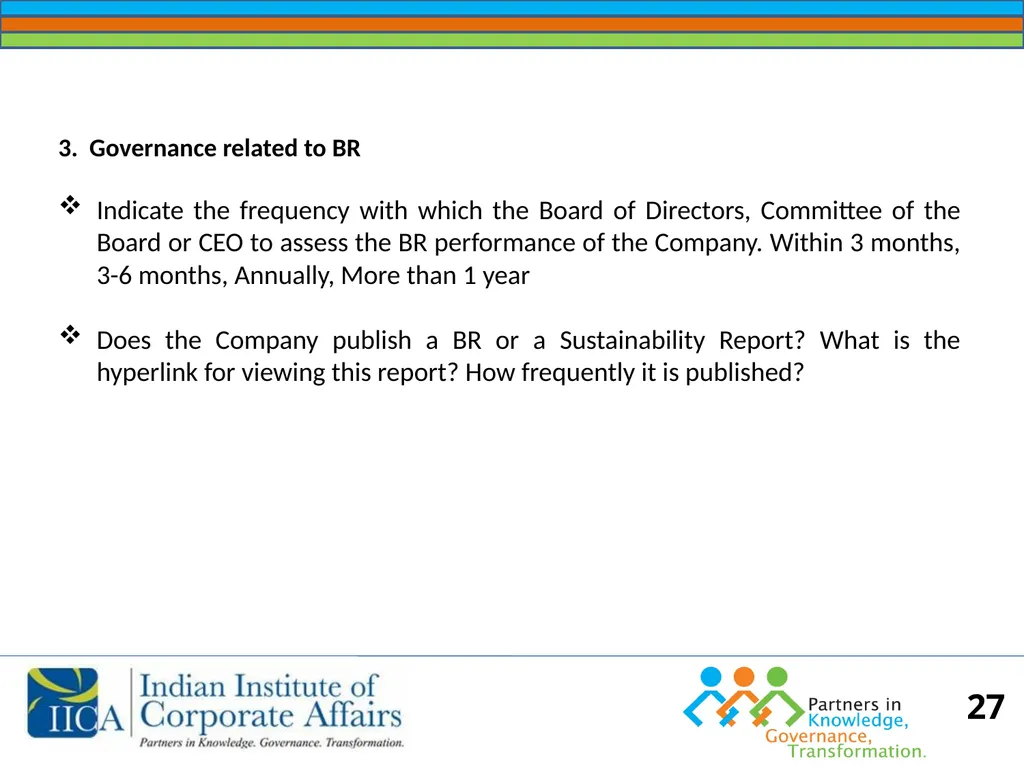
27 3. Governance related to BR
Indicate the frequency with which the Board of Directors, Committee of the Board or CEO to assess the BR performance of the Company. Within 3 months, 3-6 months, Annually, More than 1 year
Does the Company publish a BR or a Sustainability Report? What is the hyperlink for viewing this report? How frequently it is published?<br>
Indicate the frequency with which the Board of Directors, Committee of the Board or CEO to assess the BR performance of the Company. Within 3 months, 3-6 months, Annually, More than 1 year
Does the Company publish a BR or a Sustainability Report? What is the hyperlink for viewing this report? How frequently it is published?<br>
28
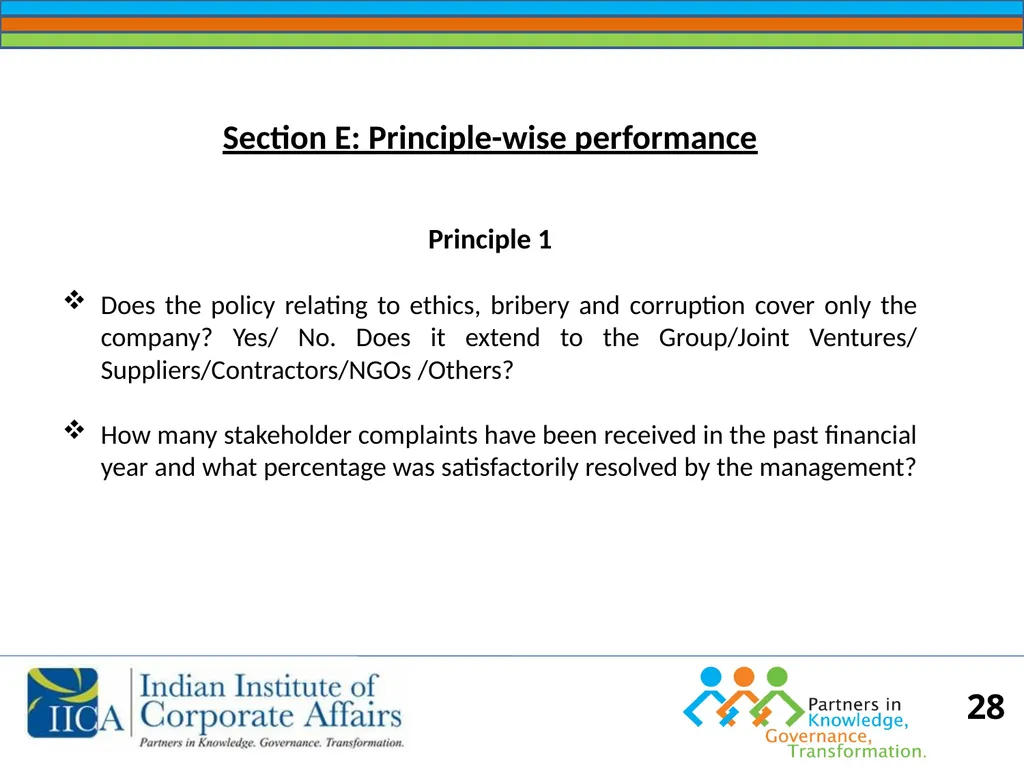
28 Section E: Principle-wise performance
Principle 1
Does the policy relating to ethics, bribery and corruption cover only the company? Yes/ No. Does it extend to the Group/Joint Ventures/ Suppliers/Contractors/NGOs /Others?
How many stakeholder complaints have been received in the past financial year and what percentage was satisfactorily resolved by the management?<br>
Principle 1
Does the policy relating to ethics, bribery and corruption cover only the company? Yes/ No. Does it extend to the Group/Joint Ventures/ Suppliers/Contractors/NGOs /Others?
How many stakeholder complaints have been received in the past financial year and what percentage was satisfactorily resolved by the management?<br>
29
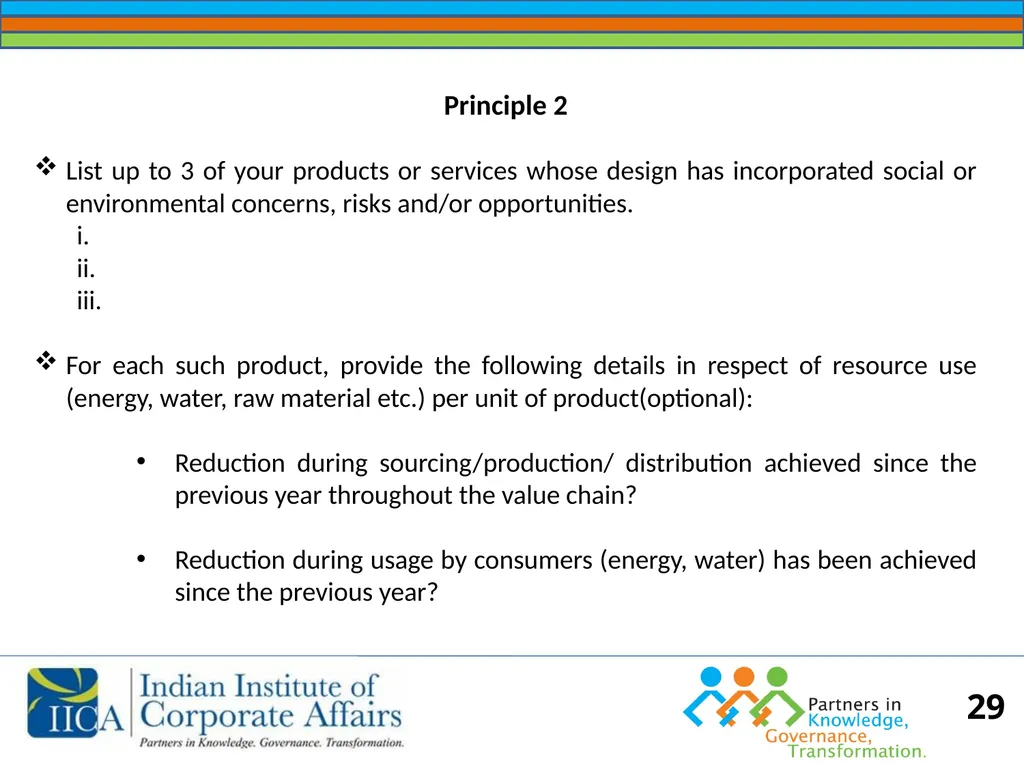
29 Principle 2
List up to 3 of your products or services whose design has incorporated social or environmental concerns, risks and/or opportunities.
i.
ii.
iii.
For each such product, provide the following details in respect of resource use (energy, water, raw material etc.) per unit of product(optional):
Reduction during sourcing/production/ distribution achieved since the previous year throughout the value chain?
Reduction during usage by consumers (energy, water) has been achieved since the previous year?<br>
List up to 3 of your products or services whose design has incorporated social or environmental concerns, risks and/or opportunities.
i.
ii.
iii.
For each such product, provide the following details in respect of resource use (energy, water, raw material etc.) per unit of product(optional):
Reduction during sourcing/production/ distribution achieved since the previous year throughout the value chain?
Reduction during usage by consumers (energy, water) has been achieved since the previous year?<br>
30
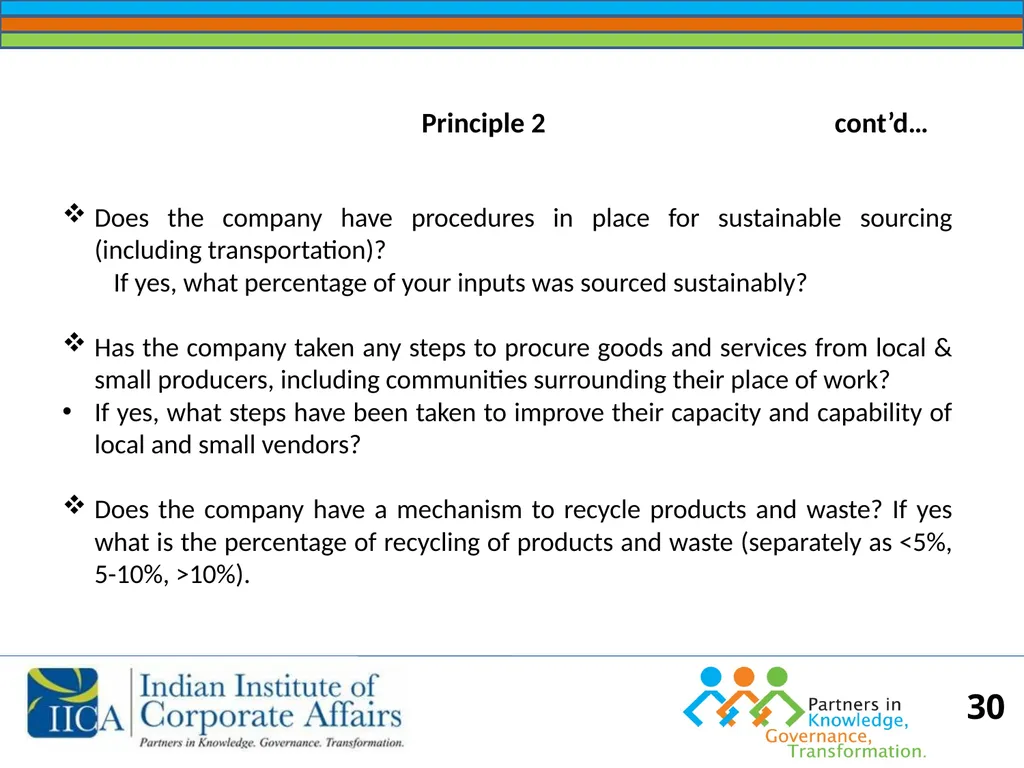
30 Principle 2 cont’d…
Does the company have procedures in place for sustainable sourcing (including transportation)?
If yes, what percentage of your inputs was sourced sustainably?
Has the company taken any steps to procure goods and services from local & small producers, including communities surrounding their place of work?
If yes, what steps have been taken to improve their capacity and capability of local and small vendors?
Does the company have a mechanism to recycle products and waste? If yes what is the percentage of recycling of products and waste (separately as <5%, 5-10%, >10%).<br>
Does the company have procedures in place for sustainable sourcing (including transportation)?
If yes, what percentage of your inputs was sourced sustainably?
Has the company taken any steps to procure goods and services from local & small producers, including communities surrounding their place of work?
If yes, what steps have been taken to improve their capacity and capability of local and small vendors?
Does the company have a mechanism to recycle products and waste? If yes what is the percentage of recycling of products and waste (separately as <5%, 5-10%, >10%).<br>
31
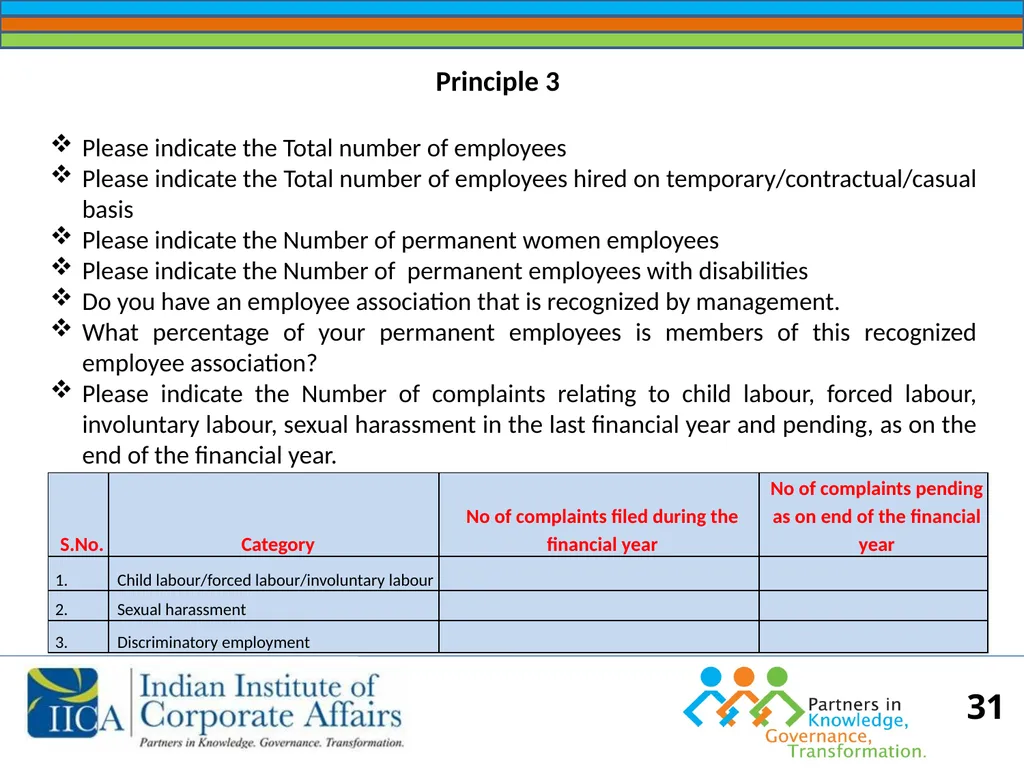
31 Principle 3 Please indicate the Total number of employees
Please indicate the Total number of employees hired on temporary/contractual/casual basis
Please indicate the Number of permanent women employees
Please indicate the Number of permanent employees with disabilities
Do you have an employee association that is recognized by management.
What percentage of your permanent employees is members of this recognized employee association?
Please indicate the Number of complaints relating to child labour, forced labour, involuntary labour, sexual harassment in the last financial year and pending, as on the end of the financial year.<br>
Please indicate the Total number of employees hired on temporary/contractual/casual basis
Please indicate the Number of permanent women employees
Please indicate the Number of permanent employees with disabilities
Do you have an employee association that is recognized by management.
What percentage of your permanent employees is members of this recognized employee association?
Please indicate the Number of complaints relating to child labour, forced labour, involuntary labour, sexual harassment in the last financial year and pending, as on the end of the financial year.<br>
32
32 What percentage of your under mentioned employees were given safety & skill up-gradation training in the last year?
Permanent Employees
Permanent Women Employees
Casual/Temporary/Contractual Employees
Employees with Disabilities Principle 3 cont’d……<br>
Permanent Employees
Permanent Women Employees
Casual/Temporary/Contractual Employees
Employees with Disabilities Principle 3 cont’d……<br>
33
33 Principle 4
Has the company mapped its internal and external stakeholders? Yes/No
Out of the above, has the company identified the disadvantaged, vulnerable & marginalized stakeholders.
Are there any special initiatives taken by the company to engage with the disadvantaged, vulnerable and marginalized stakeholders.<br>
Has the company mapped its internal and external stakeholders? Yes/No
Out of the above, has the company identified the disadvantaged, vulnerable & marginalized stakeholders.
Are there any special initiatives taken by the company to engage with the disadvantaged, vulnerable and marginalized stakeholders.<br>
34
34 Principle 5
Does the policy of the company on human rights cover only the company or extend to the Group/Joint Ventures/Suppliers/Contractors/NGOs/Others?
How many stakeholder complaints have been received in the past financial year and what percent was satisfactorily resolved by the management?<br>
Does the policy of the company on human rights cover only the company or extend to the Group/Joint Ventures/Suppliers/Contractors/NGOs/Others?
How many stakeholder complaints have been received in the past financial year and what percent was satisfactorily resolved by the management?<br>
35
35 Principle 6
Does the policy related to Principle 6 cover only the company or extends to the Group/Joint Ventures/Suppliers/Contractors/NGOs/others
Does the company have strategies/ initiatives to address global environmental issues such as climate change, global warming, etc.? Y/N. If yes, please give hyperlink for webpage etc.
Does the company identify and assess potential environmental risks? Y/N
Does the company have any project related to Clean Development Mechanism? If Yes, whether any environmental compliance report is filed?
Has the company undertaken any other initiatives on – clean technology, energy efficiency, renewable energy, etc. Y/N. If yes, please give hyperlink for web page etc.
Are the Emissions/Waste generated by the company within the permissible limits given by CPCB/SPCB for the financial year being reported?
Number of show cause/ legal notices received from CPCB/SPCB which are pending (i.e. not resolved to satisfaction) as on end of Financial Year.<br>
Does the policy related to Principle 6 cover only the company or extends to the Group/Joint Ventures/Suppliers/Contractors/NGOs/others
Does the company have strategies/ initiatives to address global environmental issues such as climate change, global warming, etc.? Y/N. If yes, please give hyperlink for webpage etc.
Does the company identify and assess potential environmental risks? Y/N
Does the company have any project related to Clean Development Mechanism? If Yes, whether any environmental compliance report is filed?
Has the company undertaken any other initiatives on – clean technology, energy efficiency, renewable energy, etc. Y/N. If yes, please give hyperlink for web page etc.
Are the Emissions/Waste generated by the company within the permissible limits given by CPCB/SPCB for the financial year being reported?
Number of show cause/ legal notices received from CPCB/SPCB which are pending (i.e. not resolved to satisfaction) as on end of Financial Year.<br>
36
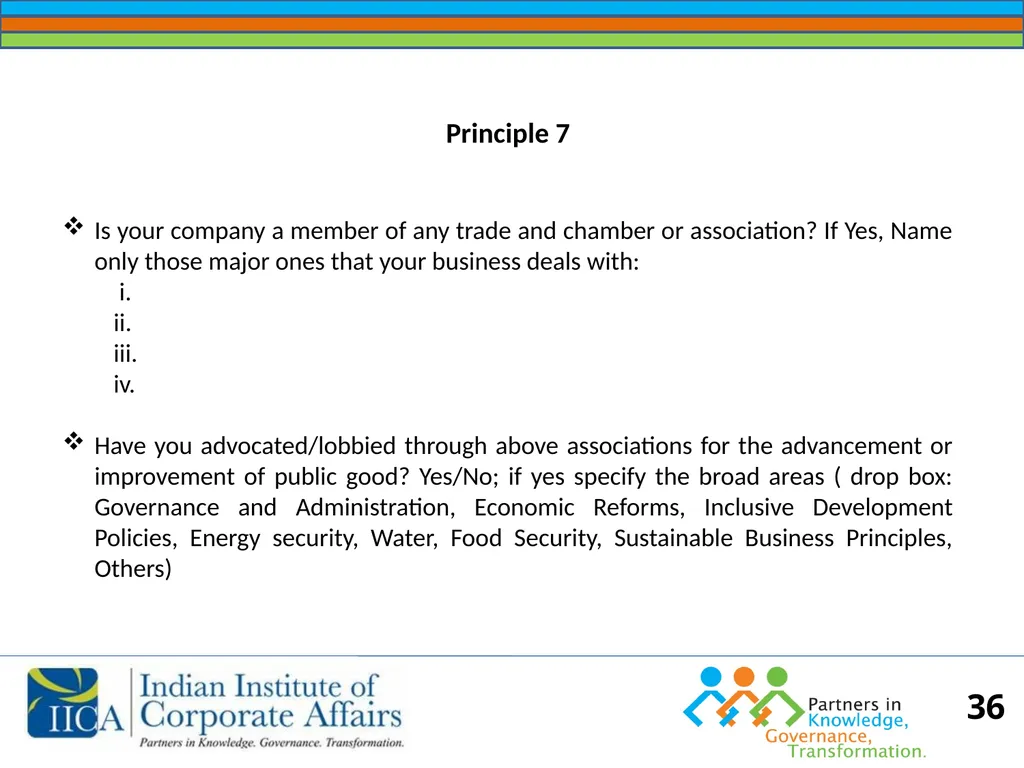
36 Principle 7
Is your company a member of any trade and chamber or association? If Yes, Name only those major ones that your business deals with:
i.
ii.
iii.
iv.
Have you advocated/lobbied through above associations for the advancement or improvement of public good? Yes/No; if yes specify the broad areas ( drop box: Governance and Administration, Economic Reforms, Inclusive Development Policies, Energy security, Water, Food Security, Sustainable Business Principles, Others)<br>
Is your company a member of any trade and chamber or association? If Yes, Name only those major ones that your business deals with:
i.
ii.
iii.
iv.
Have you advocated/lobbied through above associations for the advancement or improvement of public good? Yes/No; if yes specify the broad areas ( drop box: Governance and Administration, Economic Reforms, Inclusive Development Policies, Energy security, Water, Food Security, Sustainable Business Principles, Others)<br>
37
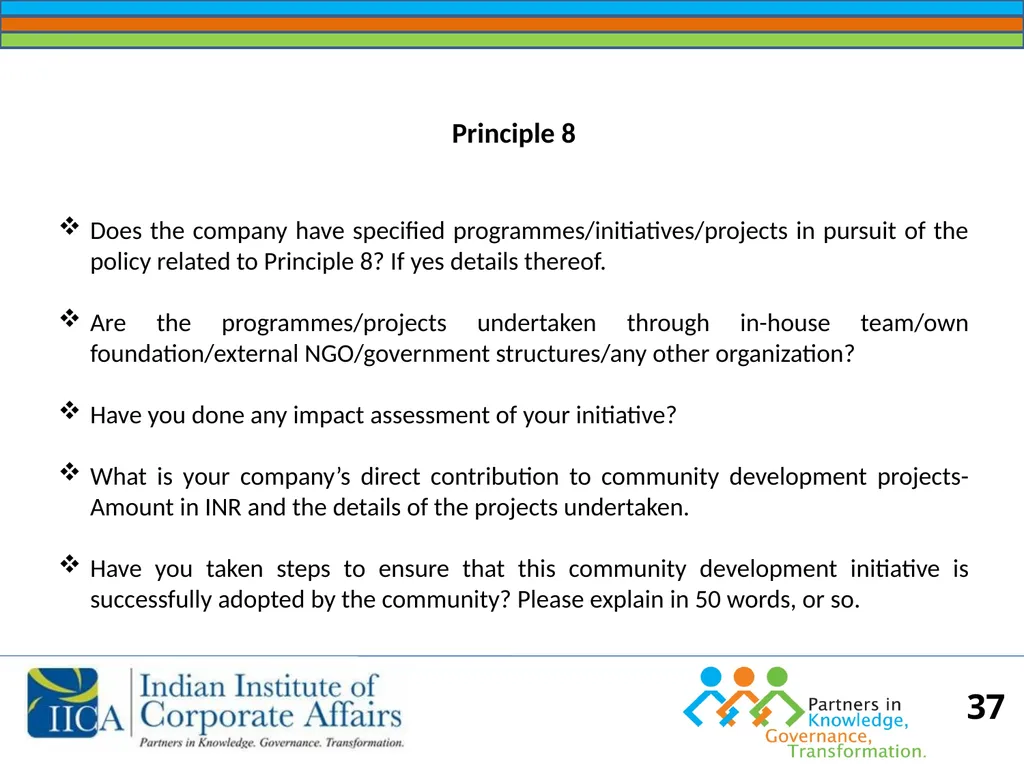
37 Principle 8
Does the company have specified programmes/initiatives/projects in pursuit of the policy related to Principle 8? If yes details thereof.
Are the programmes/projects undertaken through in-house team/own foundation/external NGO/government structures/any other organization?
Have you done any impact assessment of your initiative?
What is your company’s direct contribution to community development projects- Amount in INR and the details of the projects undertaken.
Have you taken steps to ensure that this community development initiative is successfully adopted by the community? Please explain in 50 words, or so.<br>
Does the company have specified programmes/initiatives/projects in pursuit of the policy related to Principle 8? If yes details thereof.
Are the programmes/projects undertaken through in-house team/own foundation/external NGO/government structures/any other organization?
Have you done any impact assessment of your initiative?
What is your company’s direct contribution to community development projects- Amount in INR and the details of the projects undertaken.
Have you taken steps to ensure that this community development initiative is successfully adopted by the community? Please explain in 50 words, or so.<br>
38
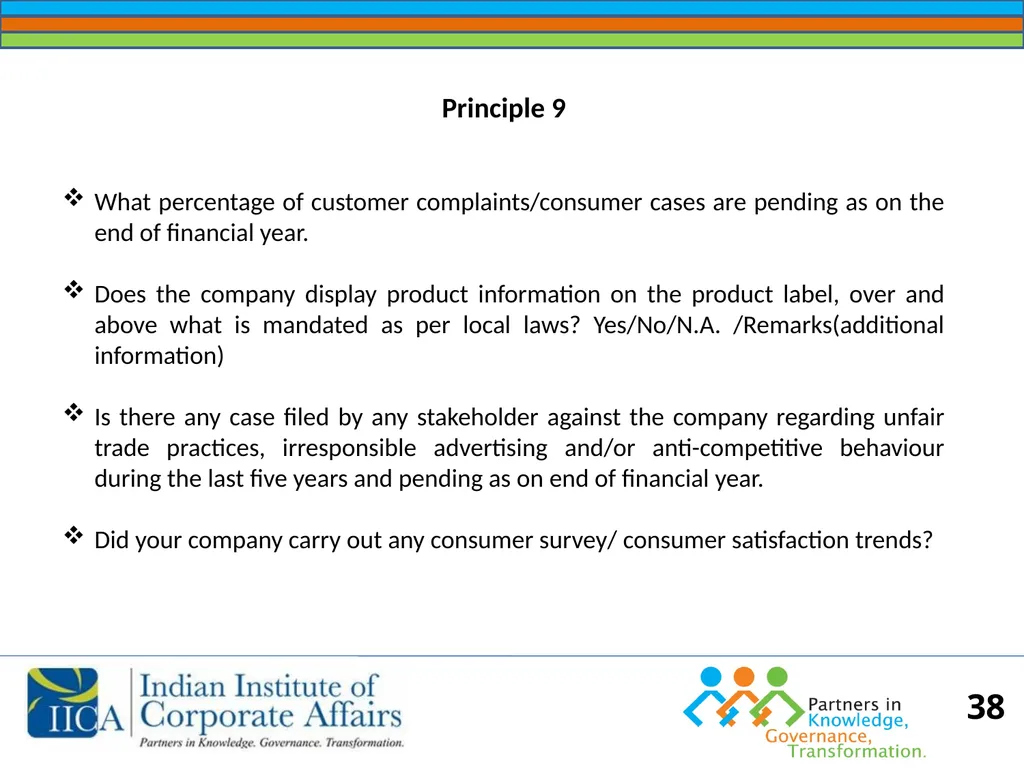
38 Principle 9
What percentage of customer complaints/consumer cases are pending as on the end of financial year.
Does the company display product information on the product label, over and above what is mandated as per local laws? Yes/No/N.A. /Remarks(additional information)
Is there any case filed by any stakeholder against the company regarding unfair trade practices, irresponsible advertising and/or anti-competitive behaviour during the last five years and pending as on end of financial year.
Did your company carry out any consumer survey/ consumer satisfaction trends?<br>
What percentage of customer complaints/consumer cases are pending as on the end of financial year.
Does the company display product information on the product label, over and above what is mandated as per local laws? Yes/No/N.A. /Remarks(additional information)
Is there any case filed by any stakeholder against the company regarding unfair trade practices, irresponsible advertising and/or anti-competitive behaviour during the last five years and pending as on end of financial year.
Did your company carry out any consumer survey/ consumer satisfaction trends?<br>
39
39 The Business Case for following the Guidelines for the Social Environmental and Economic Responsibilities for Business<br>
40
40<br>
41
41<br>
42
42<br>
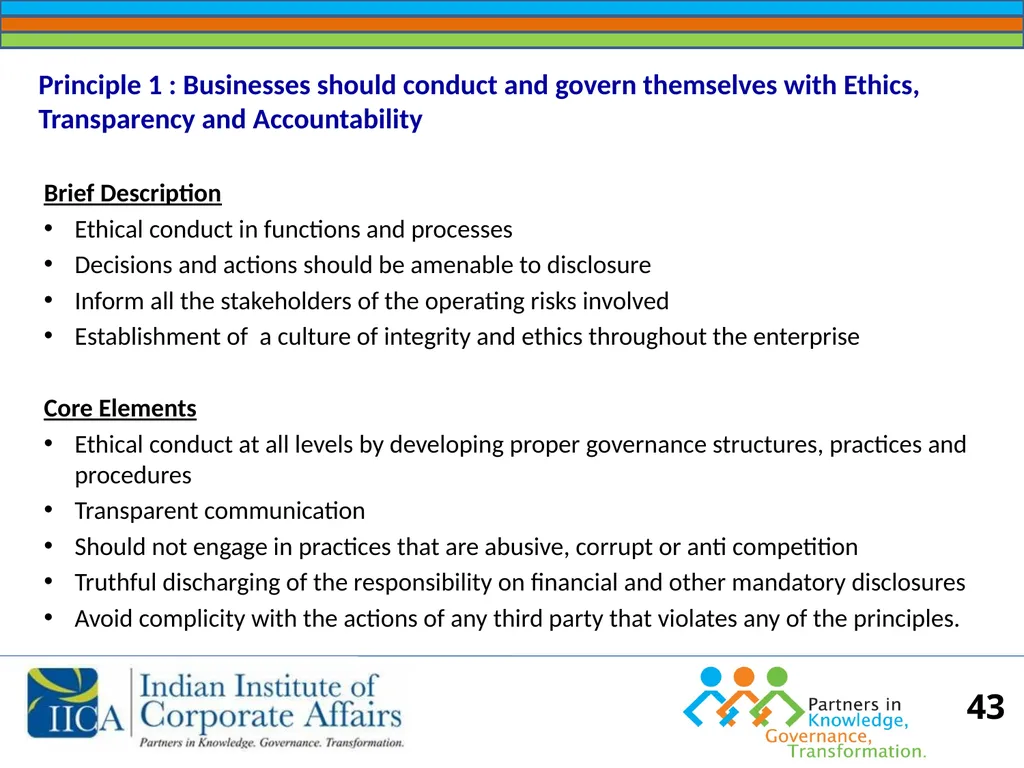
43
43 Principle 1 : Businesses should conduct and govern themselves with Ethics, Transparency and Accountability Brief Description
Ethical conduct in functions and processes
Decisions and actions should be amenable to disclosure
Inform all the stakeholders of the operating risks involved
Establishment of a culture of integrity and ethics throughout the enterprise
Core Elements
Ethical conduct at all levels by developing proper governance structures, practices and procedures
Transparent communication
Should not engage in practices that are abusive, corrupt or anti competition
Truthful discharging of the responsibility on financial and other mandatory disclosures
Avoid complicity with the actions of any third party that violates any of the principles.<br>
Ethical conduct in functions and processes
Decisions and actions should be amenable to disclosure
Inform all the stakeholders of the operating risks involved
Establishment of a culture of integrity and ethics throughout the enterprise
Core Elements
Ethical conduct at all levels by developing proper governance structures, practices and procedures
Transparent communication
Should not engage in practices that are abusive, corrupt or anti competition
Truthful discharging of the responsibility on financial and other mandatory disclosures
Avoid complicity with the actions of any third party that violates any of the principles.<br>
44
44 Principle 2: Businesses should provide goods and services that are safe and contribute to sustainability “throughout their life cycle” Brief Description
To function effectively and profitable the businesses should work to improve the quality of life of people
Engineer value in goods and services by keeping the impact of a product on the society through all stages of the product life cycle
Core Elements
Assure safety and optimal resource use over the life cycle of the product
Recognize the rights of its consumers through education, product labeling, appropriate and helpful communication, full details of the contents and safe usage.
Ensure that the manufacturing processes and technologies are resource efficient and sustainable
Regularly review and improve upon the process of new technology development, deployment and commercialization, incorporating social, ethical and environmental considerations
Recognize and respect the intellectual property rights
Promote sustainable consumption<br>
To function effectively and profitable the businesses should work to improve the quality of life of people
Engineer value in goods and services by keeping the impact of a product on the society through all stages of the product life cycle
Core Elements
Assure safety and optimal resource use over the life cycle of the product
Recognize the rights of its consumers through education, product labeling, appropriate and helpful communication, full details of the contents and safe usage.
Ensure that the manufacturing processes and technologies are resource efficient and sustainable
Regularly review and improve upon the process of new technology development, deployment and commercialization, incorporating social, ethical and environmental considerations
Recognize and respect the intellectual property rights
Promote sustainable consumption<br>
45
45 Principle 3: Businesses should promote the wellbeing of all employees Brief Description
The principle encompasses all policies and practices relating to dignity and wellbeing of employees engaged within a business or in its value chain
The principle extends to all categories of employees within and outside its boundaries and covers work performed by individuals, including subcontracted and home based.
Core Elements
Respect the right to freedom of association, participation, collective bargaining and access to proper grievance redressal mechanism
Equal opportunities to all caste, creed, gender, religion, race, disability or sex
No child labor, forced labor or any form of involuntary labor (paid or unpaid)
Cognizance of work life balance of employees especially women
Provide facilities for the wellbeing
Safe, hygienic and humane work place environment
Ensure continuous skill and competence up gradation of all employees
Harassment free work place<br>
The principle encompasses all policies and practices relating to dignity and wellbeing of employees engaged within a business or in its value chain
The principle extends to all categories of employees within and outside its boundaries and covers work performed by individuals, including subcontracted and home based.
Core Elements
Respect the right to freedom of association, participation, collective bargaining and access to proper grievance redressal mechanism
Equal opportunities to all caste, creed, gender, religion, race, disability or sex
No child labor, forced labor or any form of involuntary labor (paid or unpaid)
Cognizance of work life balance of employees especially women
Provide facilities for the wellbeing
Safe, hygienic and humane work place environment
Ensure continuous skill and competence up gradation of all employees
Harassment free work place<br>
46
46 Principle 4: Businesses should respect the interests of, and be responsive towards all stakeholders, especially those who are disadvantaged, vulnerable and marginalized Brief Description
Responsibility to think and act beyond the interests of its shareholders to include all their stakeholders
Proactively engage with and respond to those that are disadvantaged, vulnerable and marginalized
Core Elements
Systematically identify their stakeholders, understand their concerns, define purpose and scope of engagement, and commit to engaging with them.
Acknowledge, assume responsibility and be transparent about the impact of their policies, decisions, product and services and associated operations on the stakeholders.
Give special attention to stakeholders in areas that are underdeveloped
Resolve differences with stakeholders in a just, fair and equitable manner<br>
Responsibility to think and act beyond the interests of its shareholders to include all their stakeholders
Proactively engage with and respond to those that are disadvantaged, vulnerable and marginalized
Core Elements
Systematically identify their stakeholders, understand their concerns, define purpose and scope of engagement, and commit to engaging with them.
Acknowledge, assume responsibility and be transparent about the impact of their policies, decisions, product and services and associated operations on the stakeholders.
Give special attention to stakeholders in areas that are underdeveloped
Resolve differences with stakeholders in a just, fair and equitable manner<br>
47
47 Principle 5: Businesses should respect and promote human rights Brief Description
Recognizes that human rights are the codification and agreement of what it means to treat others with dignity and respect.
Imbibes its spirit from the Constitution of India
Takes into account the “Corporate Responsibility to Respect Human Rights”
Core Elements
Understand the human rights content of the Constitution of India, national laws and policies and content of International Bill of Human rights.
Integrate respect for human rights in management systems through assessing and managing human rights impacts of the business operation
Recognize and respect all human rights of all relevant stakeholders and groups within and beyond workplace
Promote the awareness and realization of rights across its value chain
Should not be complicit with human rights abuses by third party<br>
Recognizes that human rights are the codification and agreement of what it means to treat others with dignity and respect.
Imbibes its spirit from the Constitution of India
Takes into account the “Corporate Responsibility to Respect Human Rights”
Core Elements
Understand the human rights content of the Constitution of India, national laws and policies and content of International Bill of Human rights.
Integrate respect for human rights in management systems through assessing and managing human rights impacts of the business operation
Recognize and respect all human rights of all relevant stakeholders and groups within and beyond workplace
Promote the awareness and realization of rights across its value chain
Should not be complicit with human rights abuses by third party<br>
48
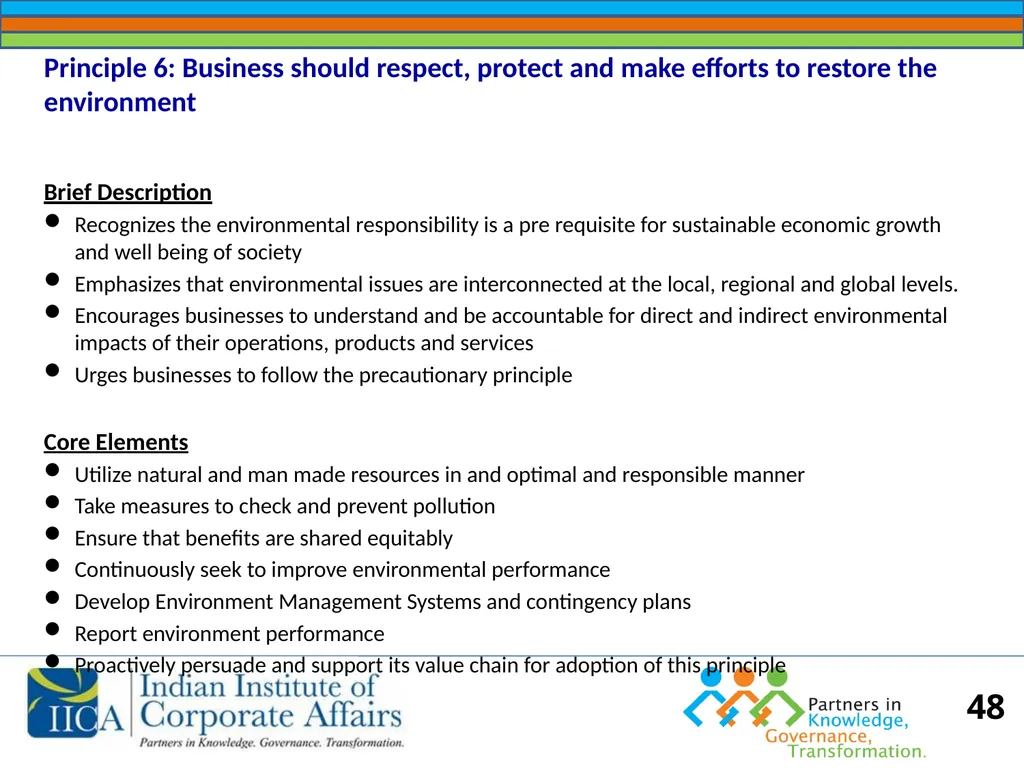
48 Principle 6: Business should respect, protect and make efforts to restore the environment Brief Description
Recognizes the environmental responsibility is a pre requisite for sustainable economic growth and well being of society
Emphasizes that environmental issues are interconnected at the local, regional and global levels.
Encourages businesses to understand and be accountable for direct and indirect environmental impacts of their operations, products and services
Urges businesses to follow the precautionary principle
Core Elements
Utilize natural and man made resources in and optimal and responsible manner
Take measures to check and prevent pollution
Ensure that benefits are shared equitably
Continuously seek to improve environmental performance
Develop Environment Management Systems and contingency plans
Report environment performance
Proactively persuade and support its value chain for adoption of this principle<br>
Recognizes the environmental responsibility is a pre requisite for sustainable economic growth and well being of society
Emphasizes that environmental issues are interconnected at the local, regional and global levels.
Encourages businesses to understand and be accountable for direct and indirect environmental impacts of their operations, products and services
Urges businesses to follow the precautionary principle
Core Elements
Utilize natural and man made resources in and optimal and responsible manner
Take measures to check and prevent pollution
Ensure that benefits are shared equitably
Continuously seek to improve environmental performance
Develop Environment Management Systems and contingency plans
Report environment performance
Proactively persuade and support its value chain for adoption of this principle<br>
49
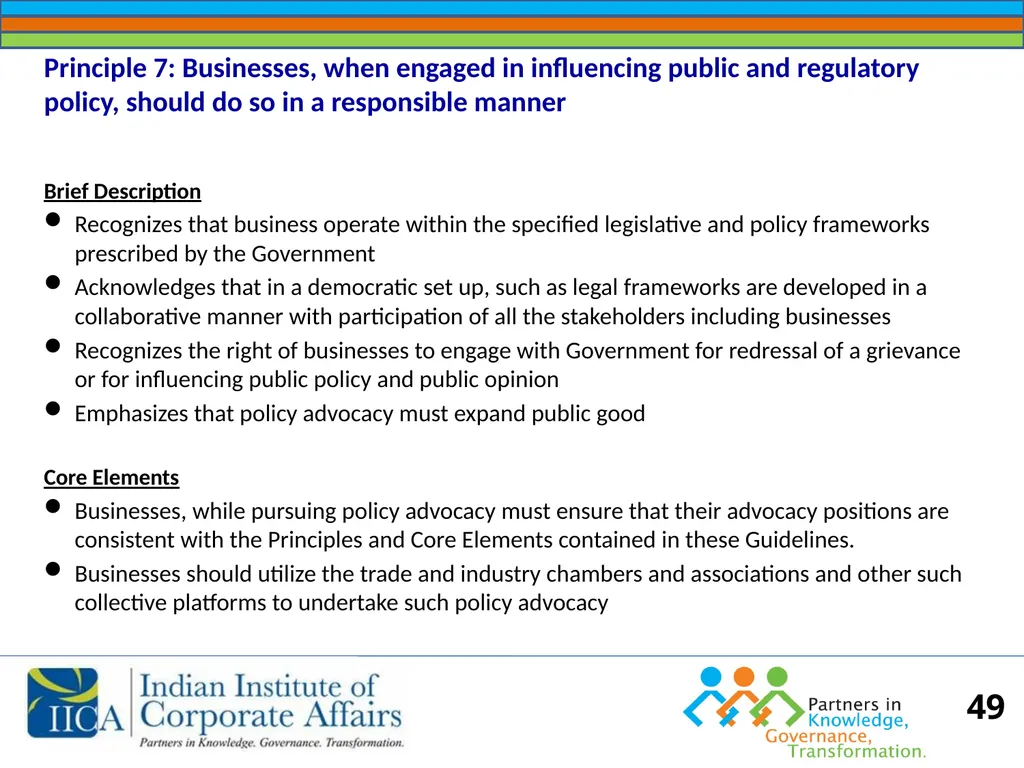
49 Principle 7: Businesses, when engaged in influencing public and regulatory policy, should do so in a responsible manner Brief Description
Recognizes that business operate within the specified legislative and policy frameworks prescribed by the Government
Acknowledges that in a democratic set up, such as legal frameworks are developed in a collaborative manner with participation of all the stakeholders including businesses
Recognizes the right of businesses to engage with Government for redressal of a grievance or for influencing public policy and public opinion
Emphasizes that policy advocacy must expand public good
Core Elements
Businesses, while pursuing policy advocacy must ensure that their advocacy positions are consistent with the Principles and Core Elements contained in these Guidelines.
Businesses should utilize the trade and industry chambers and associations and other such collective platforms to undertake such policy advocacy<br>
Recognizes that business operate within the specified legislative and policy frameworks prescribed by the Government
Acknowledges that in a democratic set up, such as legal frameworks are developed in a collaborative manner with participation of all the stakeholders including businesses
Recognizes the right of businesses to engage with Government for redressal of a grievance or for influencing public policy and public opinion
Emphasizes that policy advocacy must expand public good
Core Elements
Businesses, while pursuing policy advocacy must ensure that their advocacy positions are consistent with the Principles and Core Elements contained in these Guidelines.
Businesses should utilize the trade and industry chambers and associations and other such collective platforms to undertake such policy advocacy<br>
50
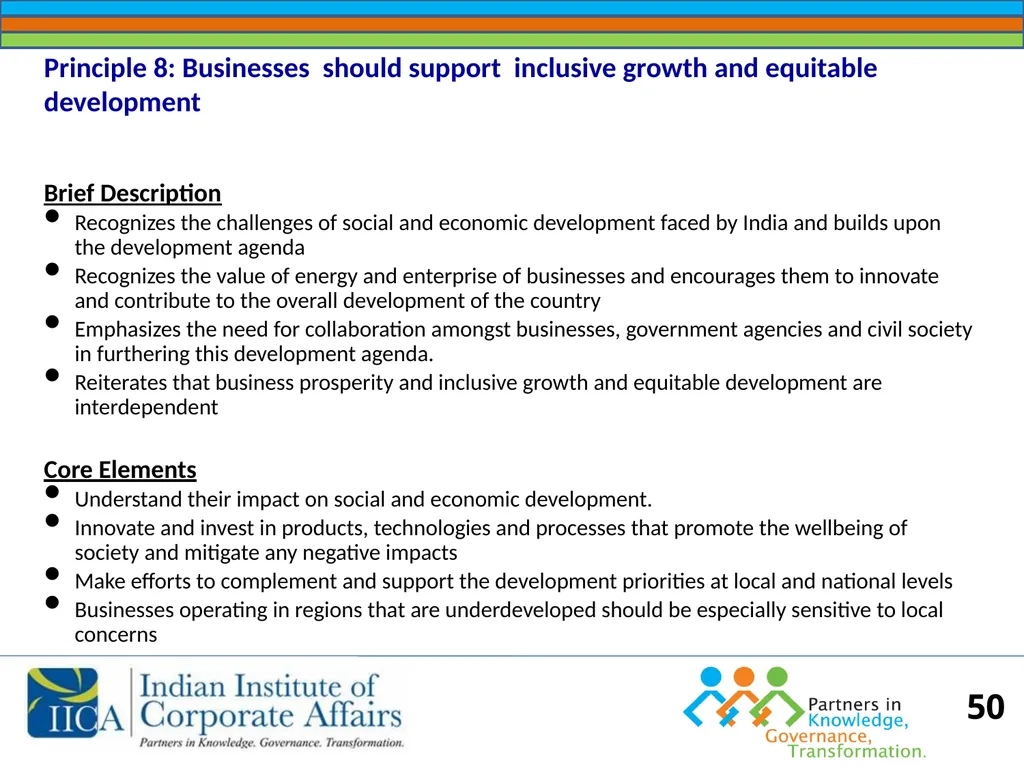
50 Principle 8: Businesses should support inclusive growth and equitable development Brief Description
Recognizes the challenges of social and economic development faced by India and builds upon the development agenda
Recognizes the value of energy and enterprise of businesses and encourages them to innovate and contribute to the overall development of the country
Emphasizes the need for collaboration amongst businesses, government agencies and civil society in furthering this development agenda.
Reiterates that business prosperity and inclusive growth and equitable development are interdependent
Core Elements
Understand their impact on social and economic development.
Innovate and invest in products, technologies and processes that promote the wellbeing of society and mitigate any negative impacts
Make efforts to complement and support the development priorities at local and national levels
Businesses operating in regions that are underdeveloped should be especially sensitive to local concerns<br>
Recognizes the challenges of social and economic development faced by India and builds upon the development agenda
Recognizes the value of energy and enterprise of businesses and encourages them to innovate and contribute to the overall development of the country
Emphasizes the need for collaboration amongst businesses, government agencies and civil society in furthering this development agenda.
Reiterates that business prosperity and inclusive growth and equitable development are interdependent
Core Elements
Understand their impact on social and economic development.
Innovate and invest in products, technologies and processes that promote the wellbeing of society and mitigate any negative impacts
Make efforts to complement and support the development priorities at local and national levels
Businesses operating in regions that are underdeveloped should be especially sensitive to local concerns<br>
51
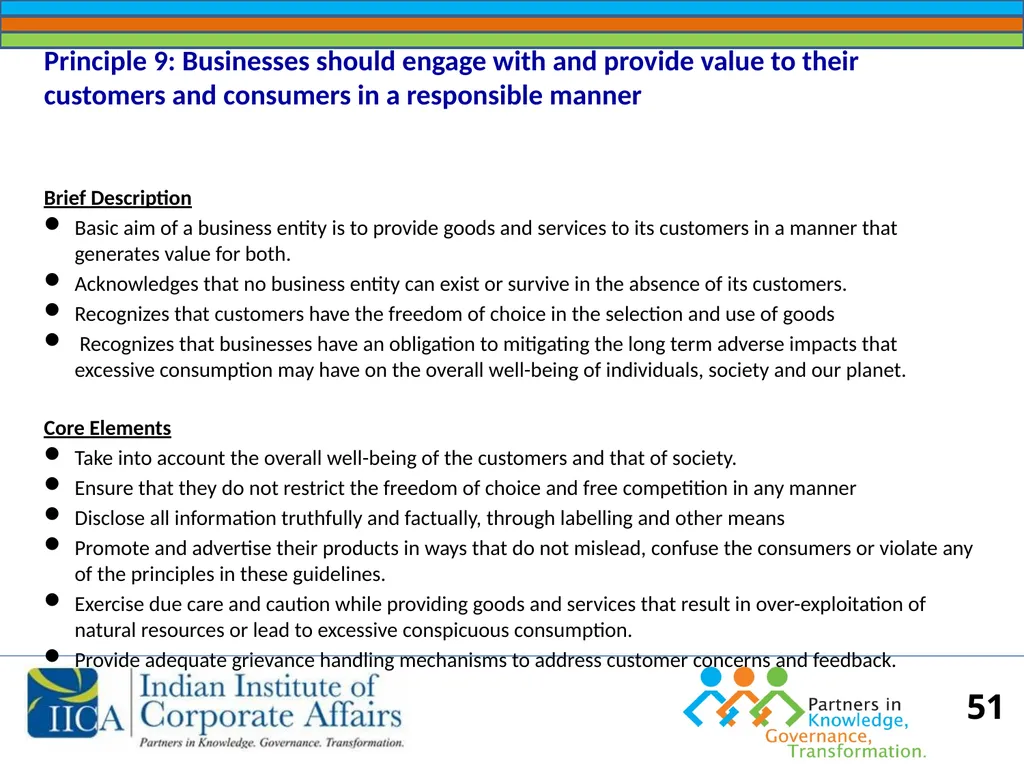
51 Principle 9: Businesses should engage with and provide value to their customers and consumers in a responsible manner Brief Description
Basic aim of a business entity is to provide goods and services to its customers in a manner that generates value for both.
Acknowledges that no business entity can exist or survive in the absence of its customers.
Recognizes that customers have the freedom of choice in the selection and use of goods
Recognizes that businesses have an obligation to mitigating the long term adverse impacts that excessive consumption may have on the overall well-being of individuals, society and our planet.
Core Elements
Take into account the overall well-being of the customers and that of society.
Ensure that they do not restrict the freedom of choice and free competition in any manner
Disclose all information truthfully and factually, through labelling and other means
Promote and advertise their products in ways that do not mislead, confuse the consumers or violate any of the principles in these guidelines.
Exercise due care and caution while providing goods and services that result in over-exploitation of natural resources or lead to excessive conspicuous consumption.
Provide adequate grievance handling mechanisms to address customer concerns and feedback.<br>
Basic aim of a business entity is to provide goods and services to its customers in a manner that generates value for both.
Acknowledges that no business entity can exist or survive in the absence of its customers.
Recognizes that customers have the freedom of choice in the selection and use of goods
Recognizes that businesses have an obligation to mitigating the long term adverse impacts that excessive consumption may have on the overall well-being of individuals, society and our planet.
Core Elements
Take into account the overall well-being of the customers and that of society.
Ensure that they do not restrict the freedom of choice and free competition in any manner
Disclose all information truthfully and factually, through labelling and other means
Promote and advertise their products in ways that do not mislead, confuse the consumers or violate any of the principles in these guidelines.
Exercise due care and caution while providing goods and services that result in over-exploitation of natural resources or lead to excessive conspicuous consumption.
Provide adequate grievance handling mechanisms to address customer concerns and feedback.<br>