
C2 Chapter 9 Differentiation Dr J Frost


Description: C2 Chapter 9 Differentiation Dr J Frost (jfrosttiffin.kingston.sch.uk) Last modified: 5th October 2013 A function is increasing if for any two values of x, x1 and x2 where x2 x1, then f(x2) f(x1) A function is strictly increasing if
Related Topics
Download Presentation
"C2 Chapter 9 Differentiation Dr J Frost" is the property of its rightful owner. Permission is granted to download and print the materials on this website for personal, non-commercial use only, and to display it on your personal computer provided you do not modify the materials and that you retain all copyright notices contained in the materials. By downloading content from our website, you accept the terms of this agreement.
Presentation Transcript
slide1. C2 Chapter 9 Differentiation Dr J Frost (jfrost@tiffin.kingston.sch.uk) Last modified: 5th October 2013<br>
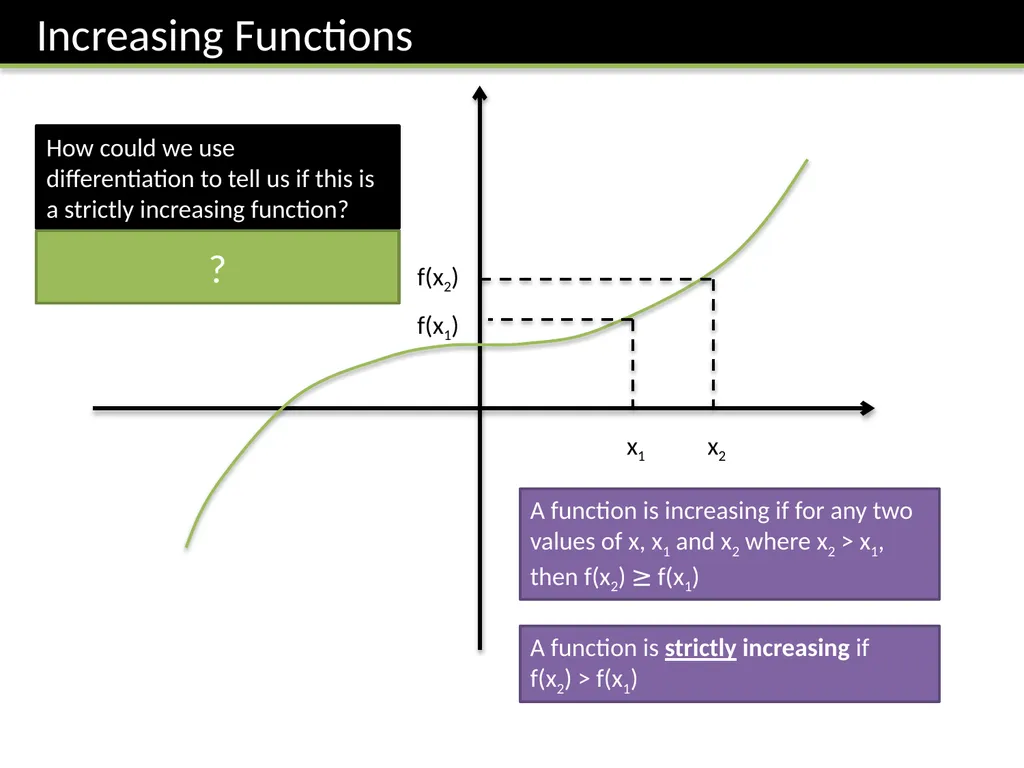
slide2. A function is increasing if for any two values of x, x1 and x2 where x2 > x1, then f(x2) ≥ f(x1) A function is strictly increasing if
f(x2) > f(x1) How could we use differentiation to tell us if this is a strictly increasing function? ...if the gradient is always positive, i.e. f’(x) > 0 for all x. ?<br>
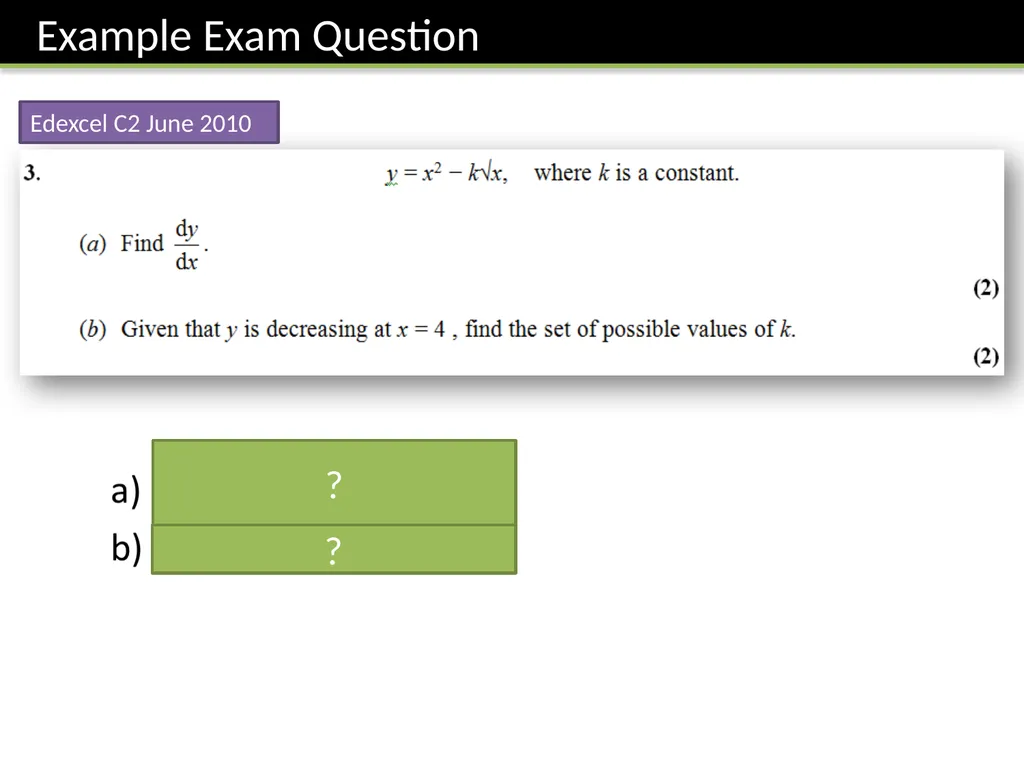
slide3. Edexcel C2 June 2010 ? ?<br>
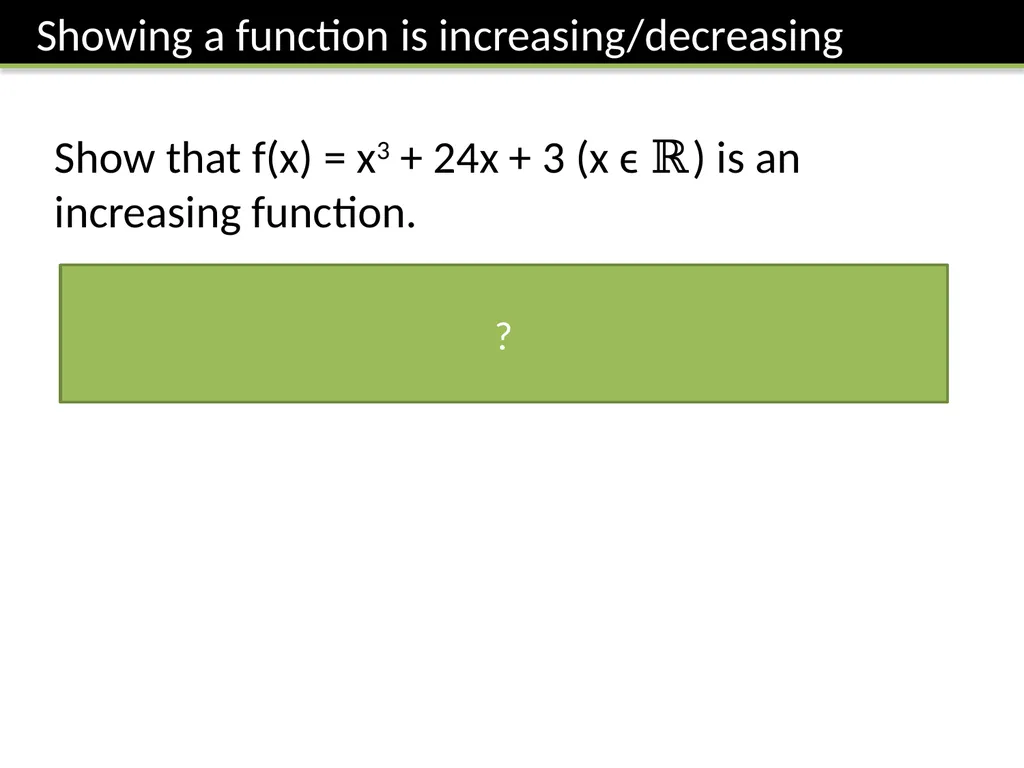
slide4. Show that f(x) = x3 + 24x + 3 (x ϵ ℝ) is an increasing function. ?<br>
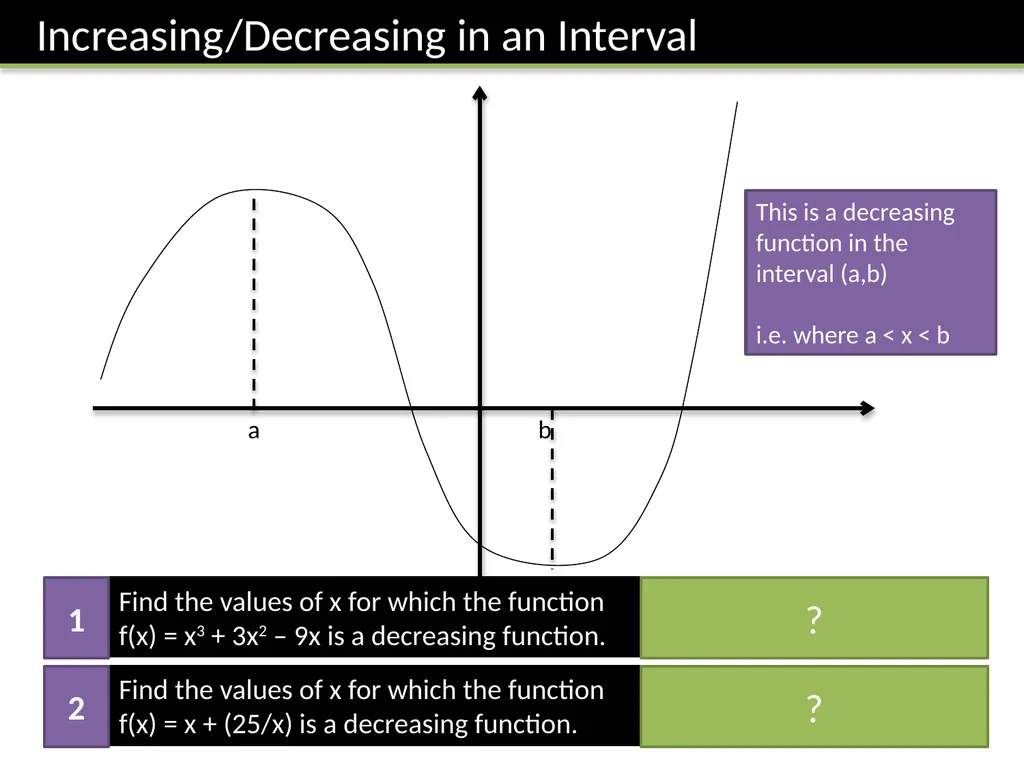
slide5. This is a decreasing function in the interval (a,b)
i.e. where a < x < b Find the values of x for which the function
f(x) = x3 + 3x2 – 9x is a decreasing function. 3x2 + 6x – 9 < 0
Thus -3 < x < 1 ? Find the values of x for which the function f(x) = x + (25/x) is a decreasing function. 1 – (25/x2) < 0
Thus -5 < x < 5 ? 1 2<br>
slide6. Questions C2 pg 130
Exercise 9A<br>
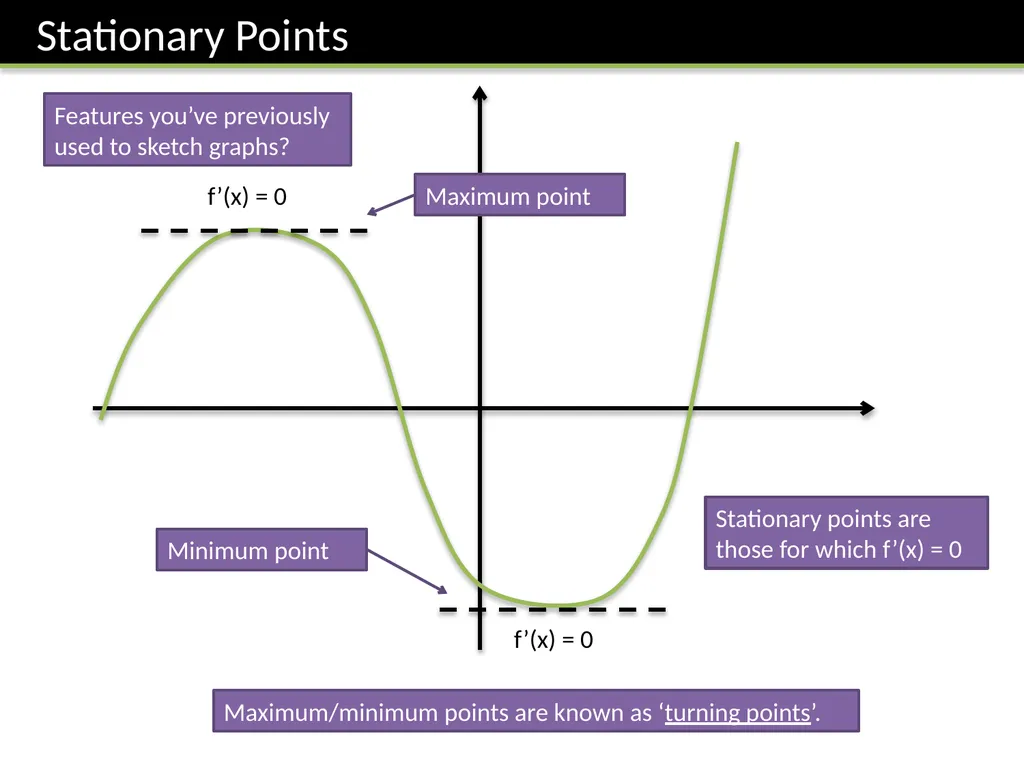
slide7. Features you’ve previously used to sketch graphs? f’(x) = 0 f’(x) = 0 Stationary points are those for which f’(x) = 0 Maximum/minimum points are known as ‘turning points’.<br>
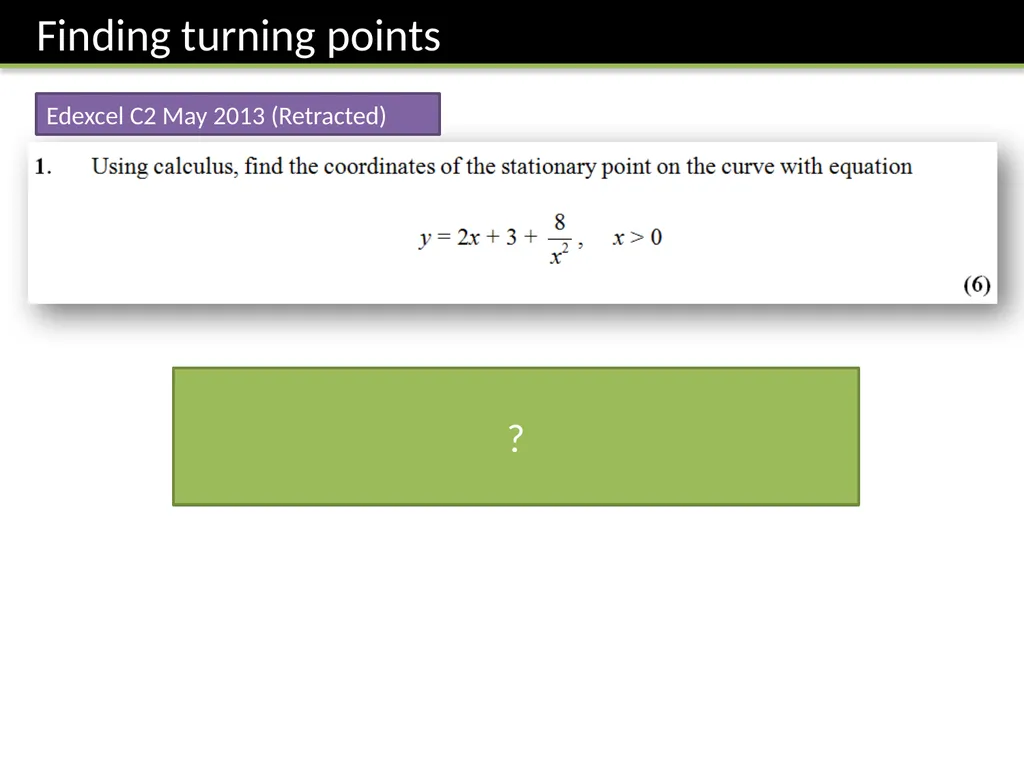
slide8. Edexcel C2 May 2013 (Retracted) (2,9)
Although it might be interest to know if this is a minimum point or a maximum point... ?<br>
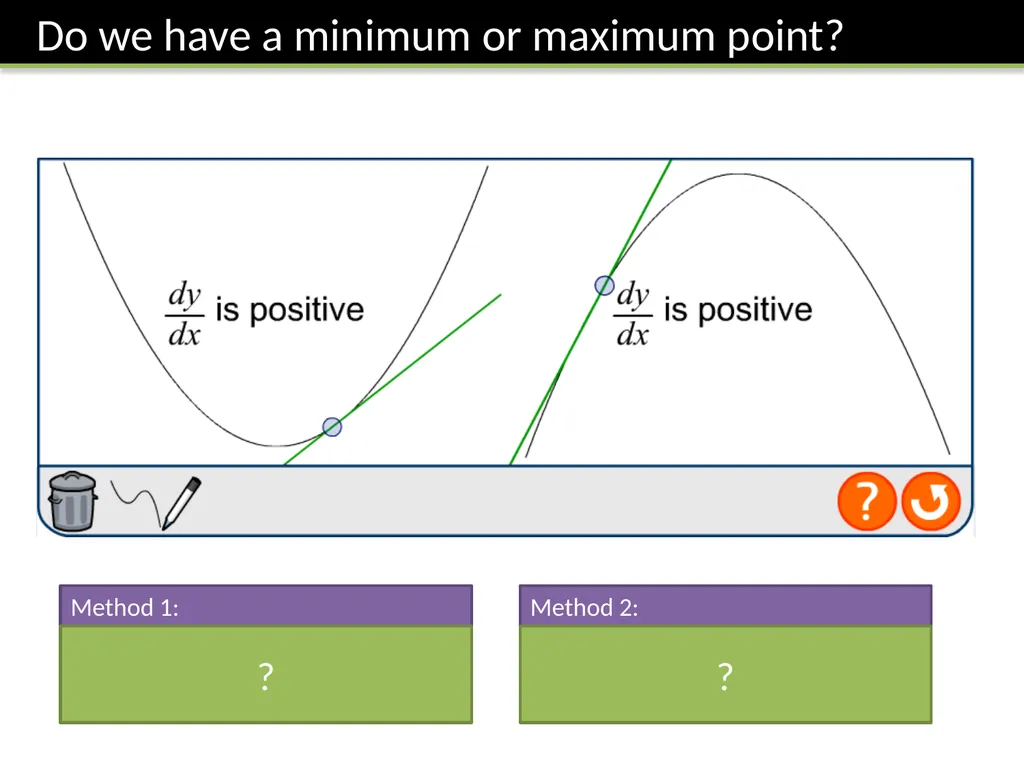
slide9. Method 1:
Consider the points immediately before and after the stationary point. Method 2:
Use the second-order derivative to see whether the gradient is increasing or decreasing. ? ?<br>
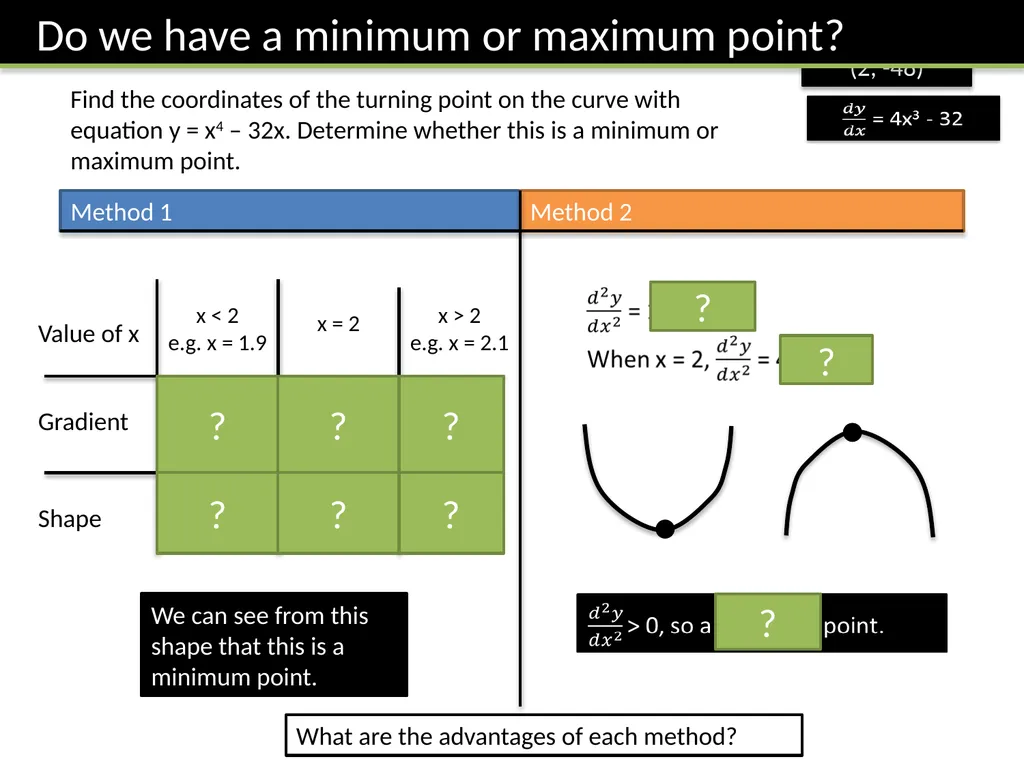
slide10. Find the coordinates of the turning point on the curve with equation y = x4 – 32x. Determine whether this is a minimum or maximum point. (2, -48) Method 1 Method 2 Value of x Gradient Shape x < 2
e.g. x = 1.9 x = 2 x > 2
e.g. x = 2.1 e.g. -4.56 e.g. 5.04 0 We can see from this shape that this is a minimum point. What are the advantages of each method? ? ? ? ? ? ? ? ? ?<br>
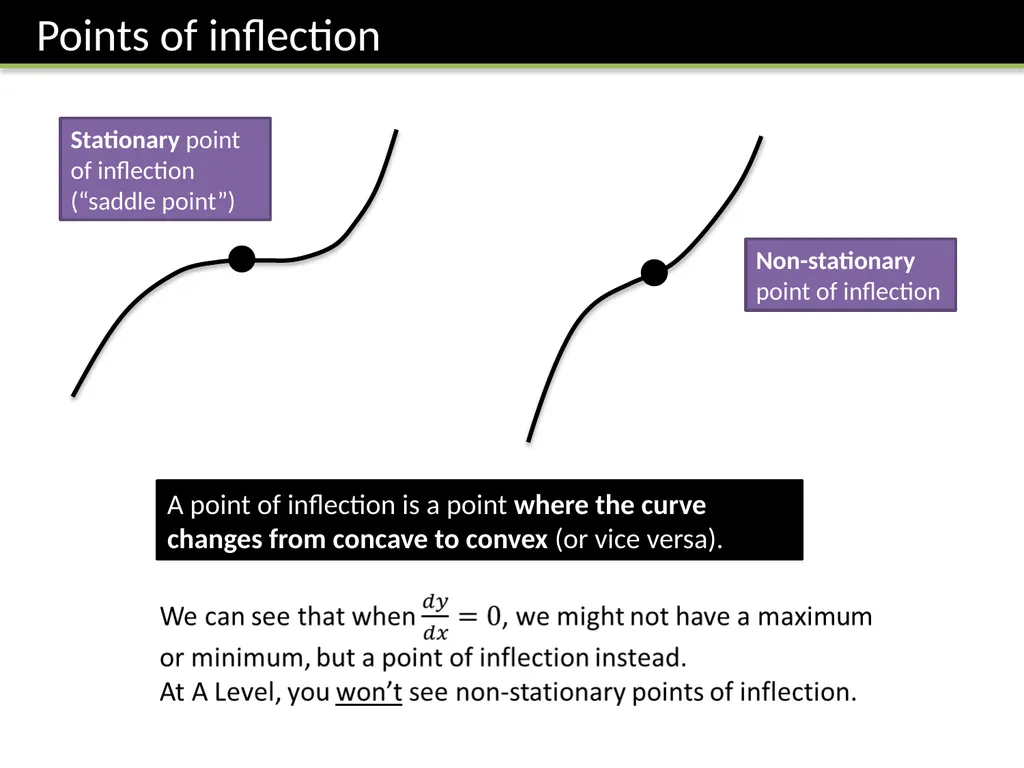
slide11. A point of inflection is a point where the curve changes from concave to convex (or vice versa). Stationary point of inflection (“saddle point”) Non-stationary point of inflection<br>
slide12. So how can we tell if a stationary point is a point of inflection?<br>
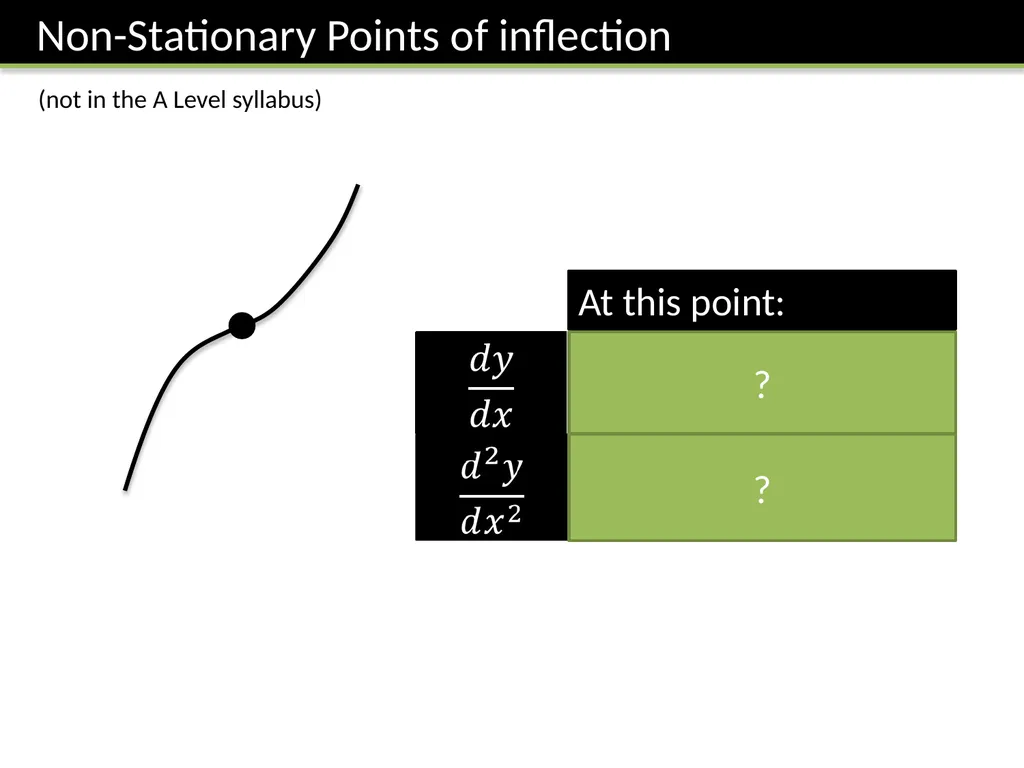
slide13. (not in the A Level syllabus) At this point: > 0 (i.e. not stationary) = 0 (i.e. gradient is not changing at this point) ? ?<br>
slide14. y = x4 has a turning point at x = 0. Show that this is a minimum point. dy/dx = 4x3.
d2y/dx2 = 12x2
When x = 0, d2y/dx2 = 0, so we can’t classify immediately.
When x = -0.1, dy/dx = -0.004. When x = +0.1, dy/dx = +0.004. Gradient goes from negative to positive, so minimum point. ?<br>
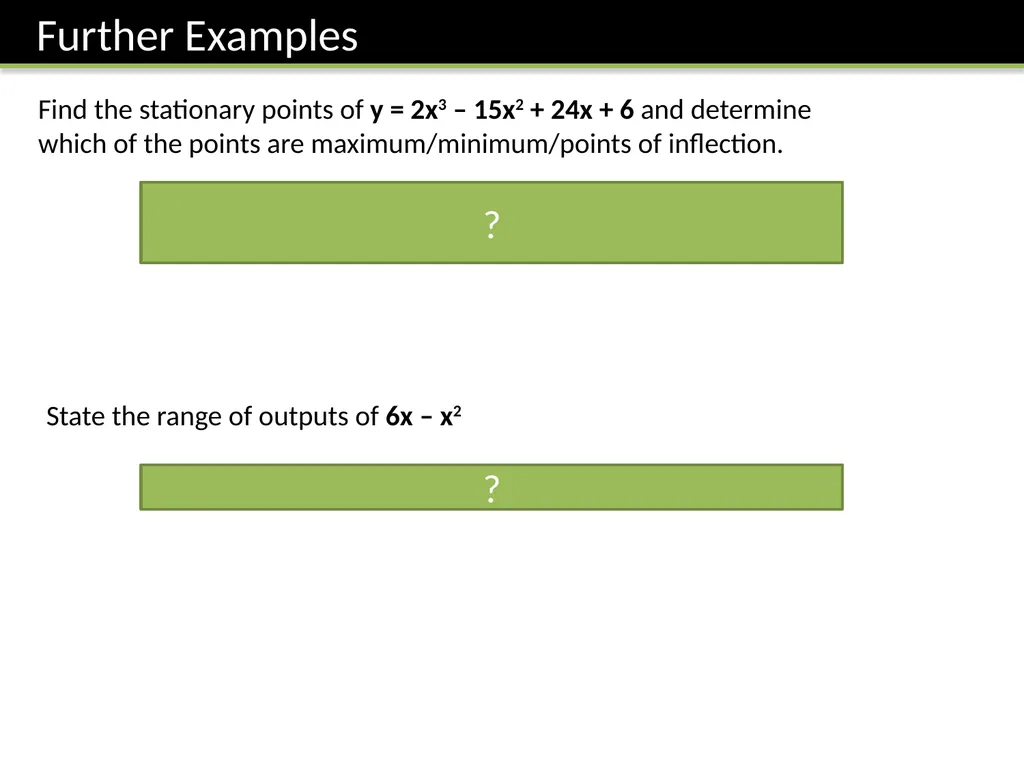
slide15. Find the stationary points of y = 2x3 – 15x2 + 24x + 6 and determine which of the points are maximum/minimum/points of inflection. State the range of outputs of 6x – x2 (1, 17) is a maximum point.
(4, -10) is a maximum point. ? ?<br>
slide16. Exercise 9B<br>
slide17. Differentiation – Practical applications Dr Frost Objectives: Use differentiation in real-life problems that involve optimisation of some variable.<br>
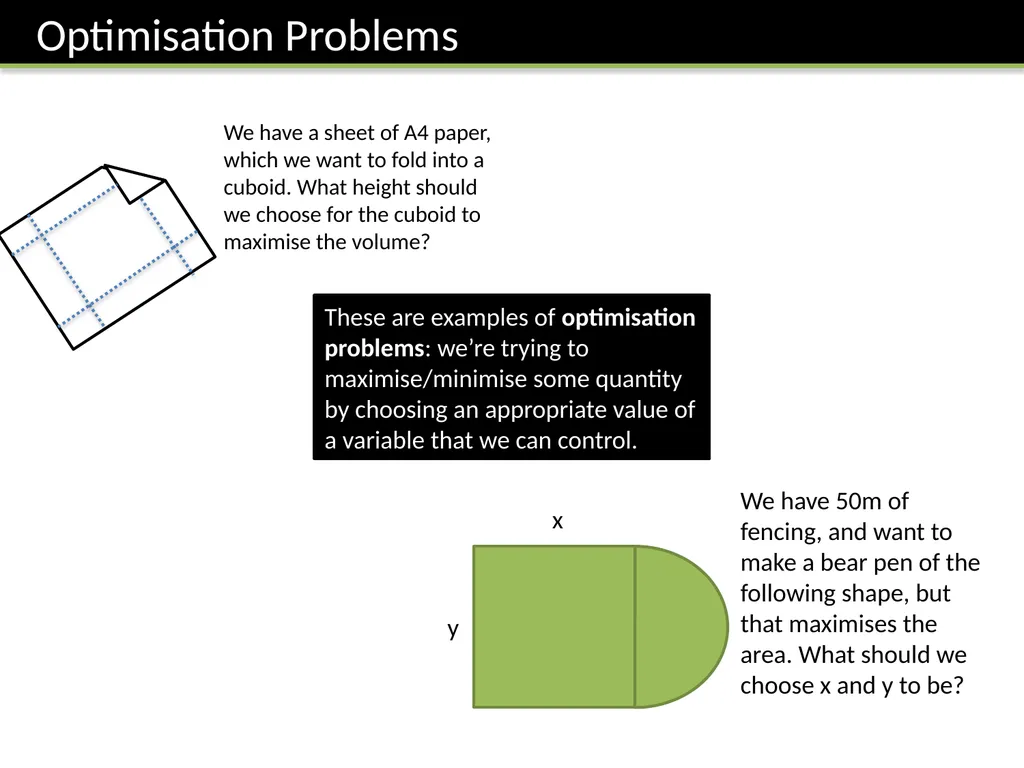
slide18. These are examples of optimisation problems: we’re trying to maximise/minimise some quantity by choosing an appropriate value of a variable that we can control. We have a sheet of A4 paper, which we want to fold into a cuboid. What height should we choose for the cuboid to maximise the volume? x y We have 50m of fencing, and want to make a bear pen of the following shape, but that maximises the area. What should we choose x and y to be?<br>
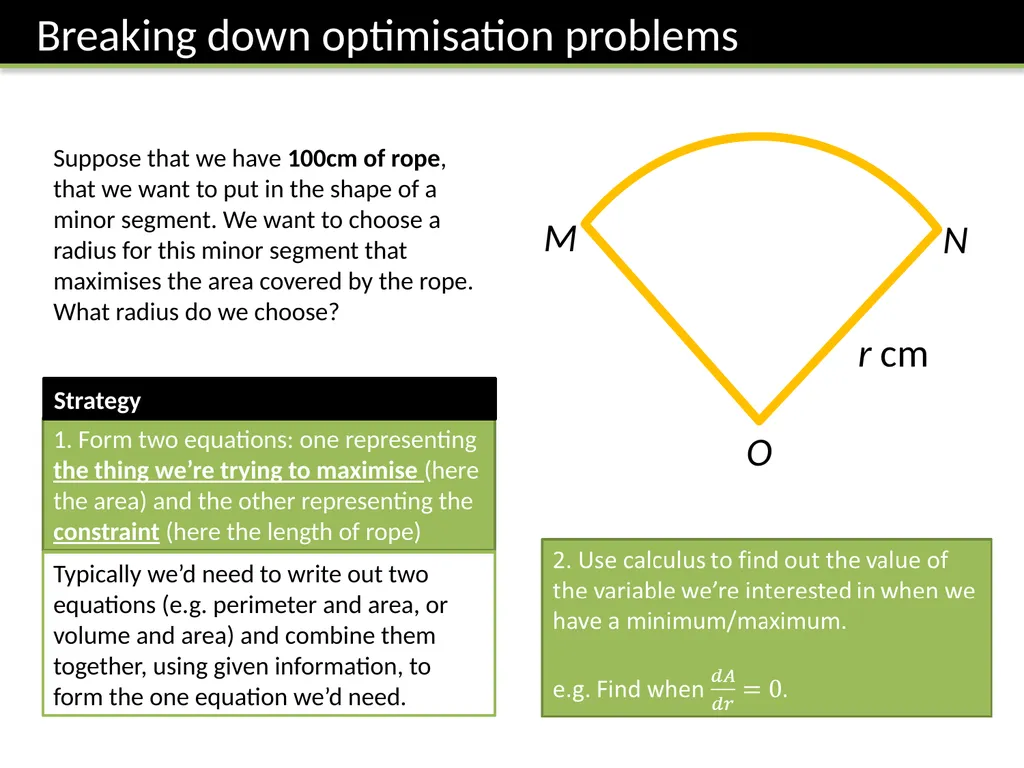
slide19. r cm N M O Suppose that we have 100cm of rope, that we want to put in the shape of a minor segment. We want to choose a radius for this minor segment that maximises the area covered by the rope. What radius do we choose? 1. Form two equations: one representing the thing we’re trying to maximise (here the area) and the other representing the constraint (here the length of rope) Strategy Typically we’d need to write out two equations (e.g. perimeter and area, or volume and area) and combine them together, using given information, to form the one equation we’d need.<br>
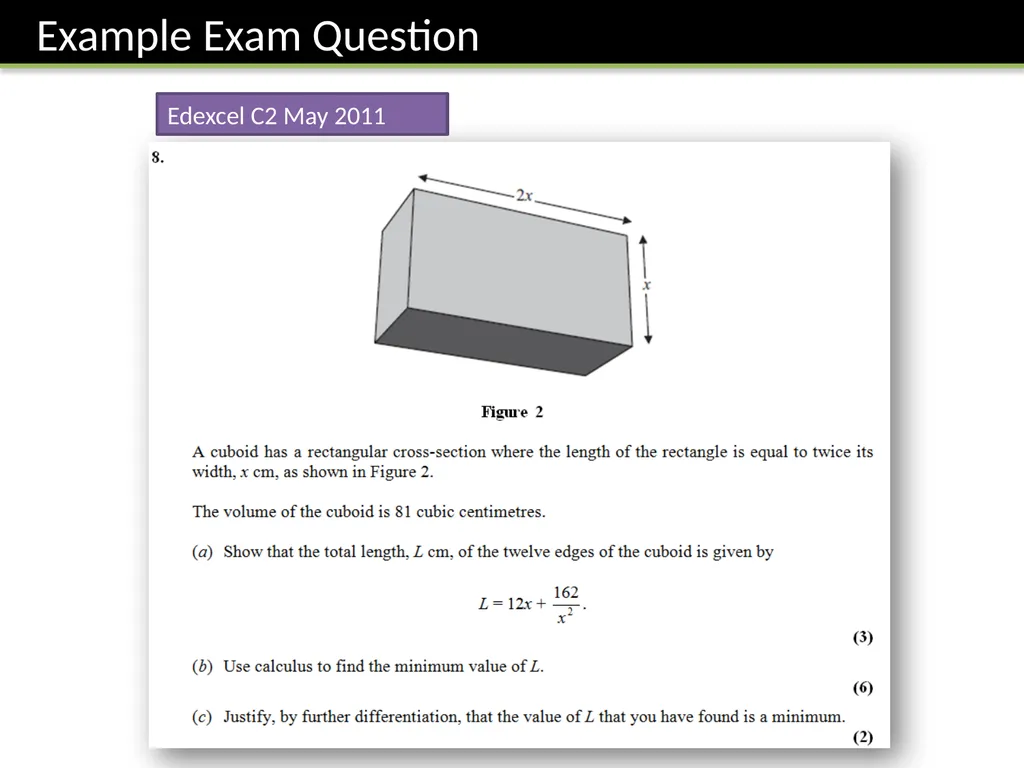
slide20. Edexcel C2 May 2011<br>
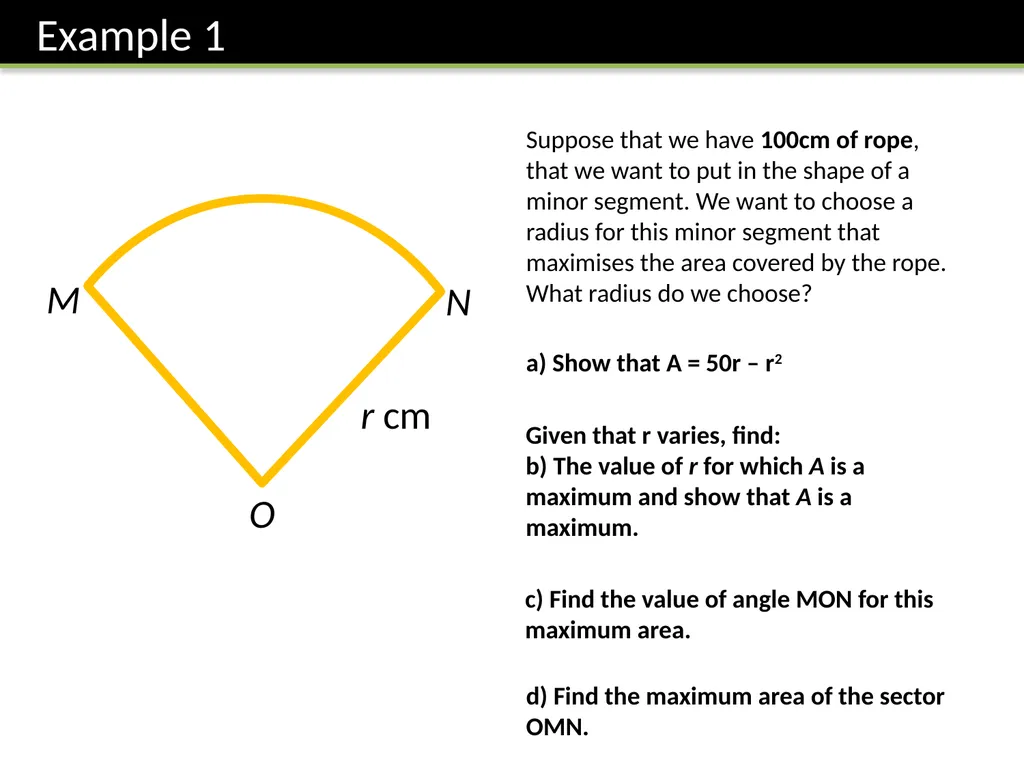
slide21. r cm N M O Suppose that we have 100cm of rope, that we want to put in the shape of a minor segment. We want to choose a radius for this minor segment that maximises the area covered by the rope. What radius do we choose? a) Show that A = 50r – r2 Given that r varies, find:
b) The value of r for which A is a maximum and show that A is a maximum. c) Find the value of angle MON for this maximum area. d) Find the maximum area of the sector OMN.<br>
slide2. A function is increasing if for any two values of x, x1 and x2 where x2 > x1, then f(x2) ≥ f(x1) A function is strictly increasing if
f(x2) > f(x1) How could we use differentiation to tell us if this is a strictly increasing function? ...if the gradient is always positive, i.e. f’(x) > 0 for all x. ?<br>
slide3. Edexcel C2 June 2010 ? ?<br>
slide4. Show that f(x) = x3 + 24x + 3 (x ϵ ℝ) is an increasing function. ?<br>
slide5. This is a decreasing function in the interval (a,b)
i.e. where a < x < b Find the values of x for which the function
f(x) = x3 + 3x2 – 9x is a decreasing function. 3x2 + 6x – 9 < 0
Thus -3 < x < 1 ? Find the values of x for which the function f(x) = x + (25/x) is a decreasing function. 1 – (25/x2) < 0
Thus -5 < x < 5 ? 1 2<br>
slide6. Questions C2 pg 130
Exercise 9A<br>
slide7. Features you’ve previously used to sketch graphs? f’(x) = 0 f’(x) = 0 Stationary points are those for which f’(x) = 0 Maximum/minimum points are known as ‘turning points’.<br>
slide8. Edexcel C2 May 2013 (Retracted) (2,9)
Although it might be interest to know if this is a minimum point or a maximum point... ?<br>
slide9. Method 1:
Consider the points immediately before and after the stationary point. Method 2:
Use the second-order derivative to see whether the gradient is increasing or decreasing. ? ?<br>
slide10. Find the coordinates of the turning point on the curve with equation y = x4 – 32x. Determine whether this is a minimum or maximum point. (2, -48) Method 1 Method 2 Value of x Gradient Shape x < 2
e.g. x = 1.9 x = 2 x > 2
e.g. x = 2.1 e.g. -4.56 e.g. 5.04 0 We can see from this shape that this is a minimum point. What are the advantages of each method? ? ? ? ? ? ? ? ? ?<br>
slide11. A point of inflection is a point where the curve changes from concave to convex (or vice versa). Stationary point of inflection (“saddle point”) Non-stationary point of inflection<br>
slide12. So how can we tell if a stationary point is a point of inflection?<br>
slide13. (not in the A Level syllabus) At this point: > 0 (i.e. not stationary) = 0 (i.e. gradient is not changing at this point) ? ?<br>
slide14. y = x4 has a turning point at x = 0. Show that this is a minimum point. dy/dx = 4x3.
d2y/dx2 = 12x2
When x = 0, d2y/dx2 = 0, so we can’t classify immediately.
When x = -0.1, dy/dx = -0.004. When x = +0.1, dy/dx = +0.004. Gradient goes from negative to positive, so minimum point. ?<br>
slide15. Find the stationary points of y = 2x3 – 15x2 + 24x + 6 and determine which of the points are maximum/minimum/points of inflection. State the range of outputs of 6x – x2 (1, 17) is a maximum point.
(4, -10) is a maximum point. ? ?<br>
slide16. Exercise 9B<br>
slide17. Differentiation – Practical applications Dr Frost Objectives: Use differentiation in real-life problems that involve optimisation of some variable.<br>
slide18. These are examples of optimisation problems: we’re trying to maximise/minimise some quantity by choosing an appropriate value of a variable that we can control. We have a sheet of A4 paper, which we want to fold into a cuboid. What height should we choose for the cuboid to maximise the volume? x y We have 50m of fencing, and want to make a bear pen of the following shape, but that maximises the area. What should we choose x and y to be?<br>
slide19. r cm N M O Suppose that we have 100cm of rope, that we want to put in the shape of a minor segment. We want to choose a radius for this minor segment that maximises the area covered by the rope. What radius do we choose? 1. Form two equations: one representing the thing we’re trying to maximise (here the area) and the other representing the constraint (here the length of rope) Strategy Typically we’d need to write out two equations (e.g. perimeter and area, or volume and area) and combine them together, using given information, to form the one equation we’d need.<br>
slide20. Edexcel C2 May 2011<br>
slide21. r cm N M O Suppose that we have 100cm of rope, that we want to put in the shape of a minor segment. We want to choose a radius for this minor segment that maximises the area covered by the rope. What radius do we choose? a) Show that A = 50r – r2 Given that r varies, find:
b) The value of r for which A is a maximum and show that A is a maximum. c) Find the value of angle MON for this maximum area. d) Find the maximum area of the sector OMN.<br>