California Pollution Control Financing Authority Meeting the Demand for Bio-Resource Recovery in California: Accelerating and De-Risking Private Capital Reneé Webster-Hawkins Executive Director November 15, 2019 Presented to the California
"California Pollution Control Financing Authority" is the property of its rightful owner. Permission is granted to
download and print the materials on this website for personal, non-commercial use only, and to display it
on your personal computer provided you do not modify the materials and that you retain all copyright
notices contained in the materials. By downloading content from our website, you accept the terms of this
agreement.
Presentation Transcript
01
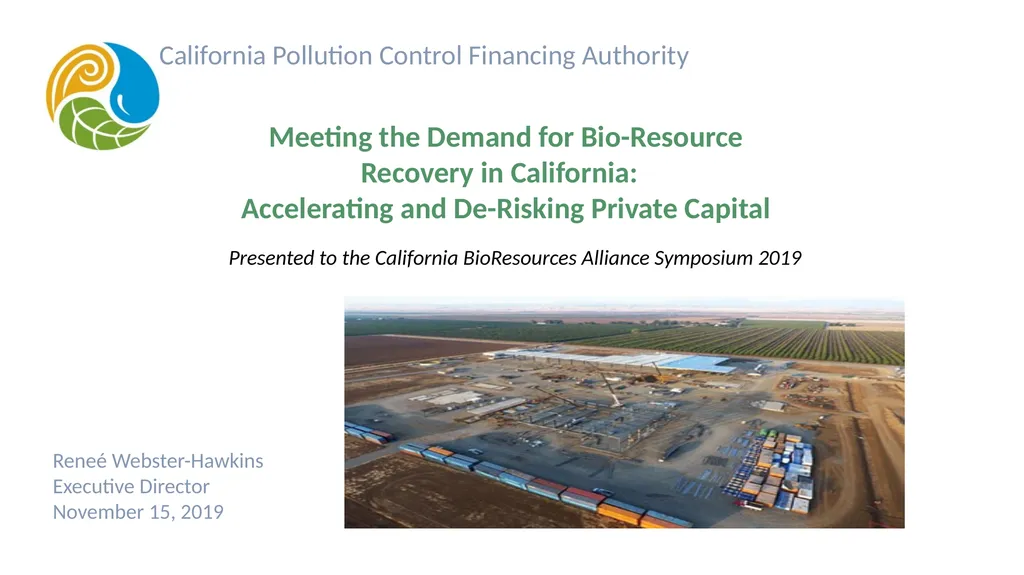
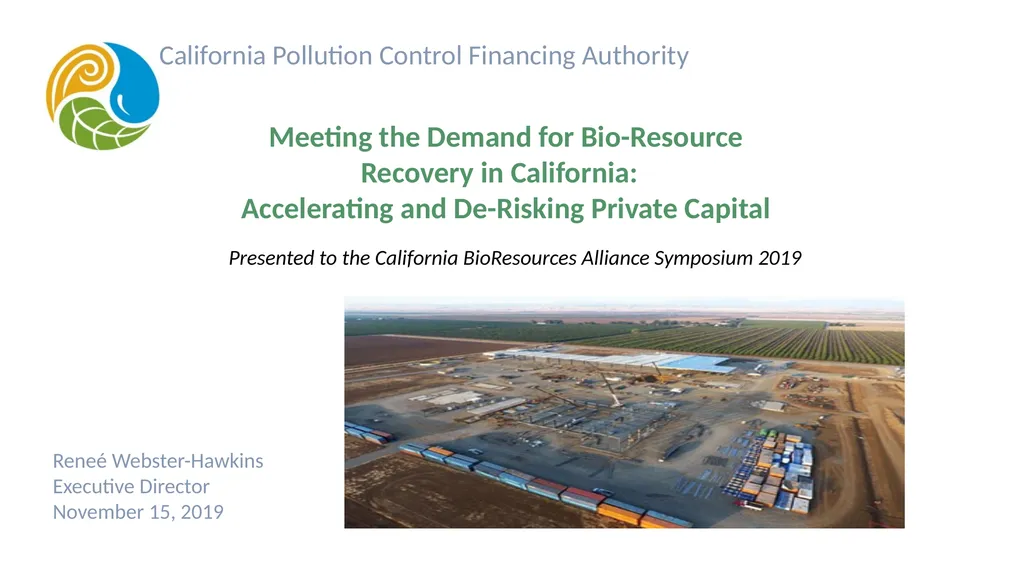
California Pollution Control Financing Authority Meeting the Demand for Bio-Resource Recovery in California:
Accelerating and De-Risking Private Capital Reneé Webster-Hawkins
Executive Director
November 15, 2019 Presented to the California BioResources Alliance Symposium 2019<br>
02
California Pollution Control Financing Authority What does CPCFA do?
CPCFA’s financing programs stimulate environmental cleanup, community economic development and job growth throughout the state.
What was CPCFA’s original purpose?
Founded in 1973 as a conduit bond issuer for private pollution control facilities serving a public benefit.
Tax-exempt bond financing provides qualified borrowers with lower interest costs than conventional financing.
Fees assessed on bond issuances to large businesses established the Small Business Assistance Fund (SBAF) to offset costs of issuance for small business borrowers
How has CPCFA innovated and evolved?
Positive fund balance in the SBAF supported the creation of innovative financing programs in addition to conduit bond issuances.
CALReUSE: Grants and loans for assessment of brownfield and infill development sites.
CalCAP: Loan Loss Reserve Accounts that incentivize green manufacturing and B Corporations.
Partnerships with state and federal agencies increased the funds and credit enhancement programs administered by CPCFA.
State: CARB, CalRecycle, HCD, CEC, General Fund
Federal: US Treasury History: What is CPCFA?<br>
03
California Pollution Control Financing Authority CPCFA’s VISION
California Pollution Control Financing Authority is the premier state agency uniquely qualified to attract private capital to business enterprises through public financing and incentives to make California economically prosperous, environmentally clean and resilient to climate change. Mission & Vision CPCFA’s MISSION STATEMENT
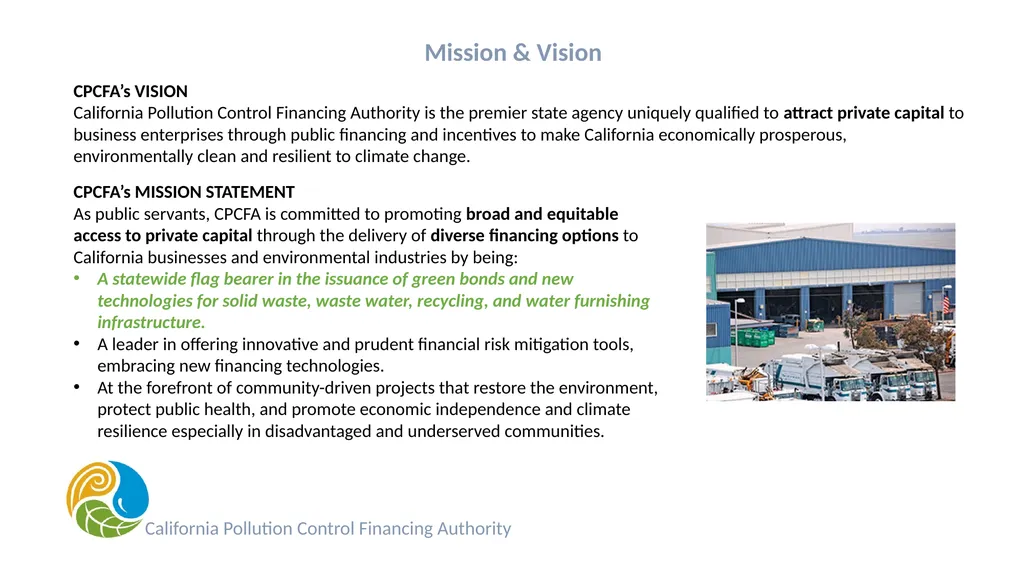
As public servants, CPCFA is committed to promoting broad and equitable access to private capital through the delivery of diverse financing options to California businesses and environmental industries by being:
A statewide flag bearer in the issuance of green bonds and new technologies for solid waste, waste water, recycling, and water furnishing infrastructure.
A leader in offering innovative and prudent financial risk mitigation tools, embracing new financing technologies.
At the forefront of community-driven projects that restore the environment, protect public health, and promote economic independence and climate resilience especially in disadvantaged and underserved communities.<br>
04
The Pollution Control Tax-Exempt Bond Financing Program facilitates low cost capital through private activity, tax-exempt bonds. The securities pay for acquisition, construction or installation of qualified pollution control, water furnishing, waste disposal, waste recovery facilities and equipment. Tax-exempt bond financing assists qualified borrowers to get lower interest than through conventional loans. Types of projects defined by the Internal Revenue Service which qualify for tax-exempt bond financing:
Curbside collection facilities
Recycling facilities
Anaerobic digesters
Composting facilities
Materials recovery facilities
Transfer station
Landfills
Waste-to-energy facilities
Qualified solid waste or hazardous waste disposal projects
Waste recovery facilities
Purchase of collection vehicles and residential waste containers
Water Furnishing Facilities
Wastewater Treatment Facilities Pollution Control Bonds California Pollution Control Financing Authority<br>
05
California Pollution Control Financing Authority Green Bond and Climate Resilience Financing New! In October 2018, CPCFA signed the Green Bond Pledge, and has established a transparent framework for Green Bond designation for qualifying projects. CPCFA is the First Financing Authority in California to sign the Green Bond Pledge! CPCFA Green Bond Framework
Independent technical report or second-party verification that the project is consistent with Green Bond Principles or the taxonomy under the Climate Bond Initiative and in support of California environmental and clean energy policies
Bonds subject to post-issuance verification of the use and management of proceeds
Periodic report through project completion date that project objectives have been met and project has not changed Benefits of a CPCFA-issued Green Bond
Attracts bond purchasers interested in ESG investments.
CPCFA is a nationally credible issuer supporting new technologies.
Advantage in basis points beginning to be seen.
Small businesses can have costs of green bond verification or certification reimbursed by CPCFA’s SBAF.<br>
06
Project Challenges
Prototype
Unanticipated delays (2000 – 2020)
Engineering contract disagreements
Unforeseen Disruptions in Economy
Great Recession
Tax Cuts and Jobs Act of 2017
Steel tariffs Green Bond Project: CalPlant, LLC Project Highlights
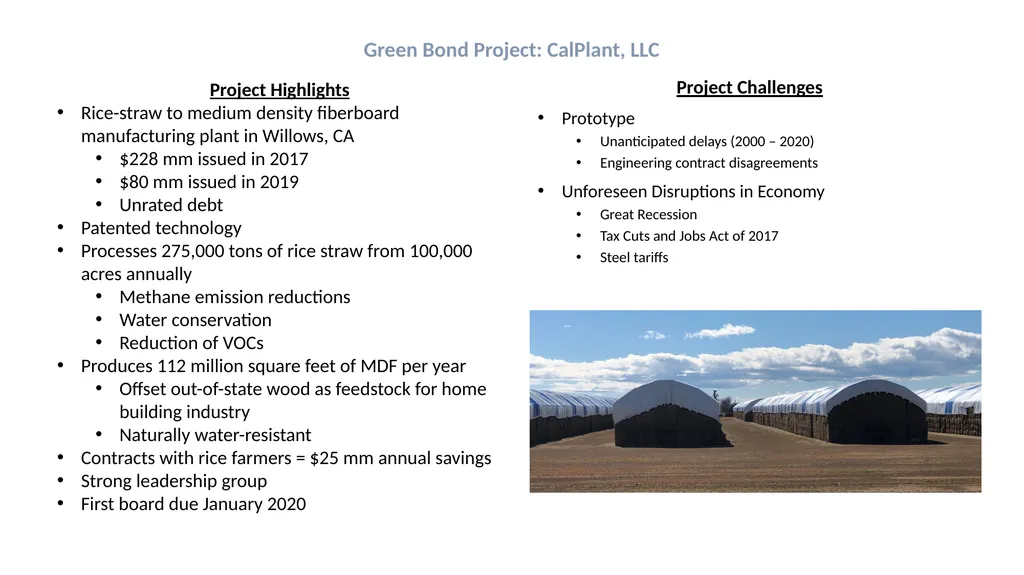
Rice-straw to medium density fiberboard manufacturing plant in Willows, CA
$228 mm issued in 2017
$80 mm issued in 2019
Unrated debt
Patented technology
Processes 275,000 tons of rice straw from 100,000 acres annually
Methane emission reductions
Water conservation
Reduction of VOCs
Produces 112 million square feet of MDF per year
Offset out-of-state wood as feedstock for home building industry
Naturally water-resistant
Contracts with rice farmers = $25 mm annual savings
Strong leadership group
First board due January 2020<br>
07
Project Challenges
Prototype
Unanticipated delays (seven year development)
Complicated ownership, equity and tax challenges
Unforeseen Disruptions in Economy
Tax Cuts and Jobs Act of 2017
Steel tariffs Green Bond Project: Rialto BioEnergy, LLC Project Highlights
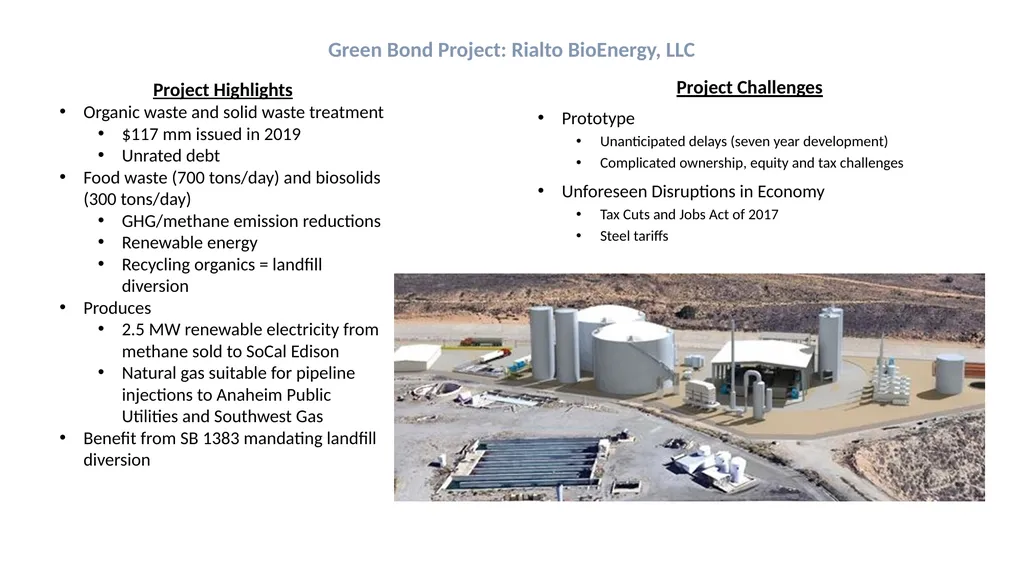
Organic waste and solid waste treatment
$117 mm issued in 2019
Unrated debt
Food waste (700 tons/day) and biosolids (300 tons/day)
GHG/methane emission reductions
Renewable energy
Recycling organics = landfill diversion
Produces
2.5 MW renewable electricity from methane sold to SoCal Edison
Natural gas suitable for pipeline injections to Anaheim Public Utilities and Southwest Gas
Benefit from SB 1383 mandating landfill diversion<br>
08
Project Challenges
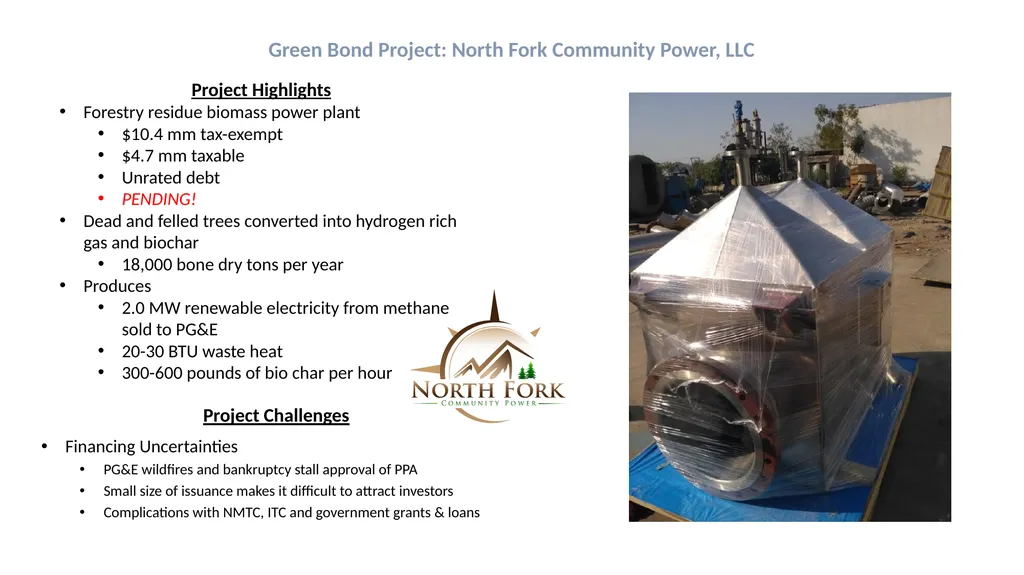
Financing Uncertainties
PG&E wildfires and bankruptcy stall approval of PPA
Small size of issuance makes it difficult to attract investors
Complications with NMTC, ITC and government grants & loans Green Bond Project: North Fork Community Power, LLC Project Highlights
Forestry residue biomass power plant
$10.4 mm tax-exempt
$4.7 mm taxable
Unrated debt
PENDING!
Dead and felled trees converted into hydrogen rich gas and biochar
18,000 bone dry tons per year
Produces
2.0 MW renewable electricity from methane sold to PG&E
20-30 BTU waste heat
300-600 pounds of bio char per hour<br>
09
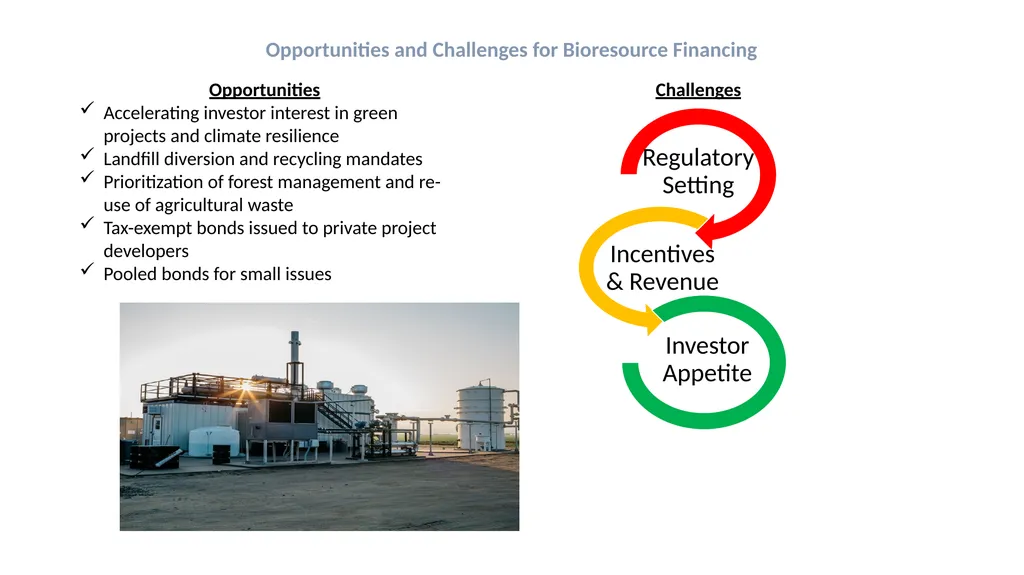
Opportunities and Challenges for Bioresource Financing Opportunities
Accelerating investor interest in green projects and climate resilience
Landfill diversion and recycling mandates
Prioritization of forest management and re-use of agricultural waste
Tax-exempt bonds issued to private project developers
Pooled bonds for small issues Challenges<br>
10
California Pollution Control Financing Authority Meeting the Demand for Bio-Resource Recovery in California:
Accelerating and De-Risking Private Capital Reneé Webster-Hawkins
rwebster@treasurer.ca.gov
Executive Director
November 15, 2019 Q&A<br>