
Cambridge Phonics and Handwriting Our approach:
AS
Published · 21 slides · 0 views

1 / 1
Description
Cambridge Phonics and Handwriting Our approach: for practitioners and parents Introduction This is an exciting time for young learners as they begin to engage with the words, sounds and text around them, discovering that marks on a page
Related Topics
Download this presentation From Below
"Cambridge Phonics and Handwriting Our approach:" is the property of its rightful owner. Permission is granted to download and print the materials on this website for personal, non-commercial use only, and to display it on your personal computer provided you do not modify the materials and that you retain all copyright notices contained in the materials. By downloading content from our website, you accept the terms of this agreement.
Share
Embed code
Presentation Transcript
01
Cambridge Phonics and Handwriting Our approach: for practitioners and parents<br>
02
Introduction This is an exciting time for young learners as they begin
to engage with the words, sounds and text around them,
discovering that marks on a page have meaning.
The Cambridge Phonics and Handwriting Scheme focuses on a structured approach to teaching systematic synthetic phonics and handwriting.
This Phonics and Handwriting scheme is designed to complement the broader Cambridge Early Years programme, to fully support the Communication, Language and Literacy curriculum area.<br>
The Cambridge Phonics and Handwriting Scheme focuses on a structured approach to teaching systematic synthetic phonics and handwriting.
This Phonics and Handwriting scheme is designed to complement the broader Cambridge Early Years programme, to fully support the Communication, Language and Literacy curriculum area.<br>
03
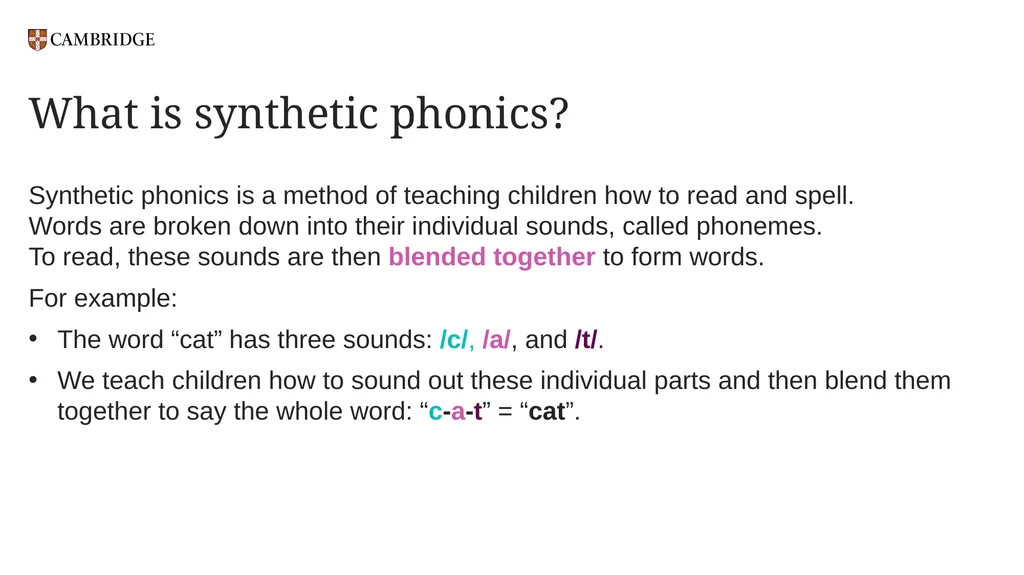
What is synthetic phonics? Synthetic phonics is a method of teaching children how to read and spell.
Words are broken down into their individual sounds, called phonemes.
To read, these sounds are then blended together to form words.
For example:
The word “cat” has three sounds: /c/, /a/, and /t/.
We teach children how to sound out these individual parts and then blend them together to say the whole word: “c-a-t” = “cat”.<br>
For example:
The word “cat” has three sounds: /c/, /a/, and /t/.
We teach children how to sound out these individual parts and then blend them together to say the whole word: “c-a-t” = “cat”.<br>
04
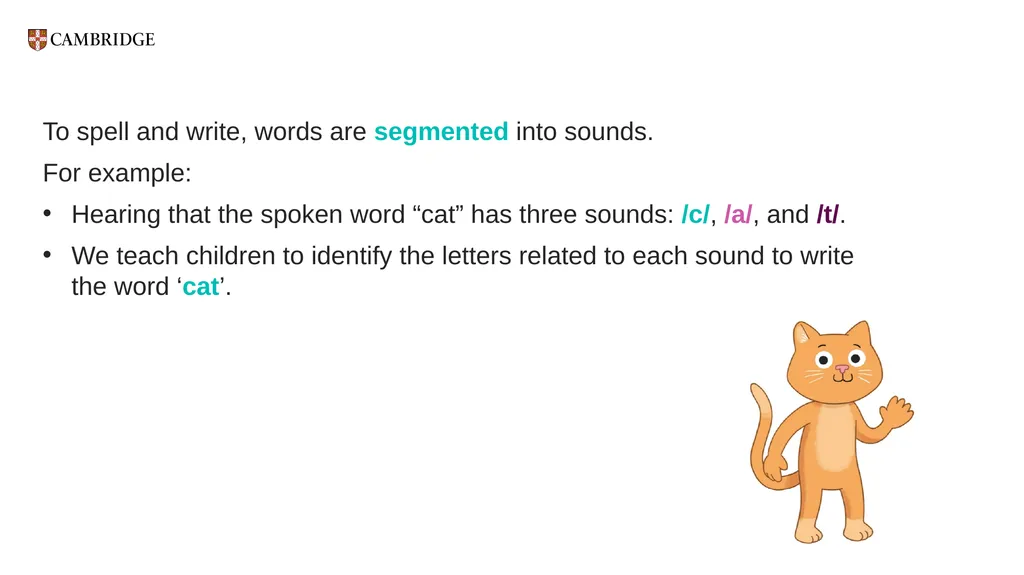
To spell and write, words are segmented into sounds.
For example:
Hearing that the spoken word “cat” has three sounds: /c/, /a/, and /t/.
We teach children to identify the letters related to each sound to write the word ‘cat’.<br>
For example:
Hearing that the spoken word “cat” has three sounds: /c/, /a/, and /t/.
We teach children to identify the letters related to each sound to write the word ‘cat’.<br>
05
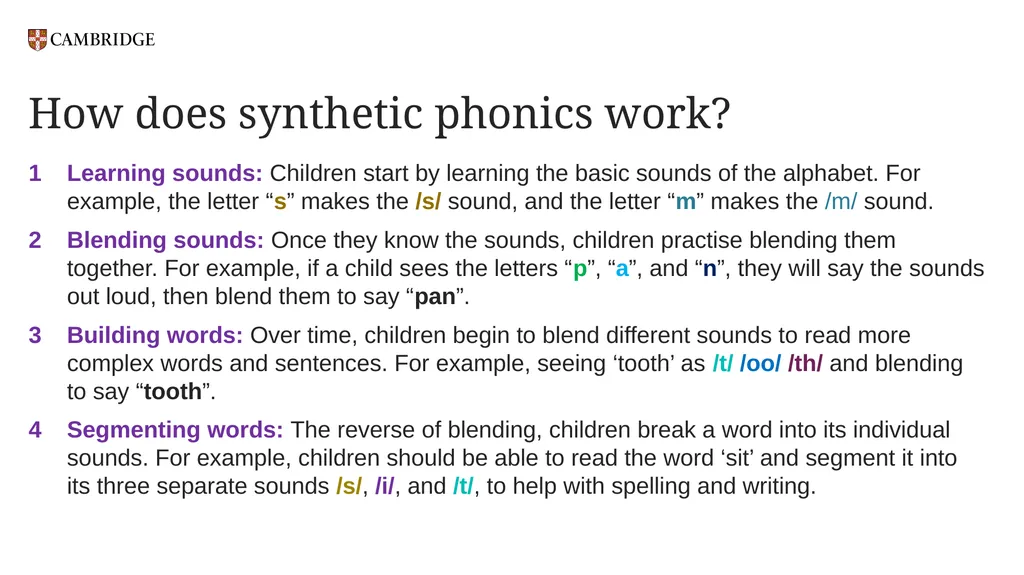
How does synthetic phonics work? 1 Learning sounds: Children start by learning the basic sounds of the alphabet. For example, the letter “s” makes the /s/ sound, and the letter “m” makes the /m/ sound.
2 Blending sounds: Once they know the sounds, children practise blending them together. For example, if a child sees the letters “p”, “a”, and “n”, they will say the sounds out loud, then blend them to say “pan”.
3 Building words: Over time, children begin to blend different sounds to read more complex words and sentences. For example, seeing ‘tooth’ as /t/ /oo/ /th/ and blending to say “tooth”.
4 Segmenting words: The reverse of blending, children break a word into its individual sounds. For example, children should be able to read the word ‘sit’ and segment it into its three separate sounds /s/, /i/, and /t/, to help with spelling and writing.<br>
2 Blending sounds: Once they know the sounds, children practise blending them together. For example, if a child sees the letters “p”, “a”, and “n”, they will say the sounds out loud, then blend them to say “pan”.
3 Building words: Over time, children begin to blend different sounds to read more complex words and sentences. For example, seeing ‘tooth’ as /t/ /oo/ /th/ and blending to say “tooth”.
4 Segmenting words: The reverse of blending, children break a word into its individual sounds. For example, children should be able to read the word ‘sit’ and segment it into its three separate sounds /s/, /i/, and /t/, to help with spelling and writing.<br>
06
Why is phonics important? Phonics helps children understand how letters and sounds work together.
It gives them the skills they need to read and write new words independently.
The step-by-step process builds their confidence as readers. Phonics definitions:
Phoneme – a single sound in a spoken word. For example, the /b/ sound in ‘bat’ or the /ch/ sound in ‘chat’.
Grapheme – the written letter or group of letters that represent a sound. For example, the letter ‘b’ is a grapheme for the /b/ sound. And ‘ch’ the two letters ‘c’ and ‘h’ together represents the /ch/ sound.<br>
Phoneme – a single sound in a spoken word. For example, the /b/ sound in ‘bat’ or the /ch/ sound in ‘chat’.
Grapheme – the written letter or group of letters that represent a sound. For example, the letter ‘b’ is a grapheme for the /b/ sound. And ‘ch’ the two letters ‘c’ and ‘h’ together represents the /ch/ sound.<br>
07
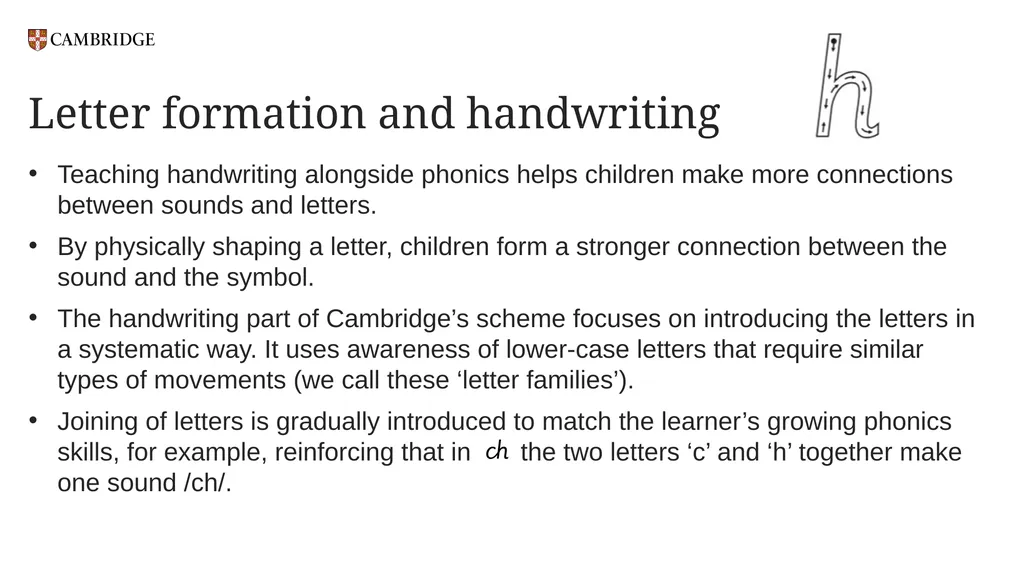
Letter formation and handwriting Teaching handwriting alongside phonics helps children make more connections between sounds and letters.
By physically shaping a letter, children form a stronger connection between the sound and the symbol.
The handwriting part of Cambridge’s scheme focuses on introducing the letters in a systematic way. It uses awareness of lower-case letters that require similar types of movements (we call these ‘letter families’).
Joining of letters is gradually introduced to match the learner’s growing phonics skills, for example, reinforcing that in the two letters ‘c’ and ‘h’ together make one sound /ch/.<br>
By physically shaping a letter, children form a stronger connection between the sound and the symbol.
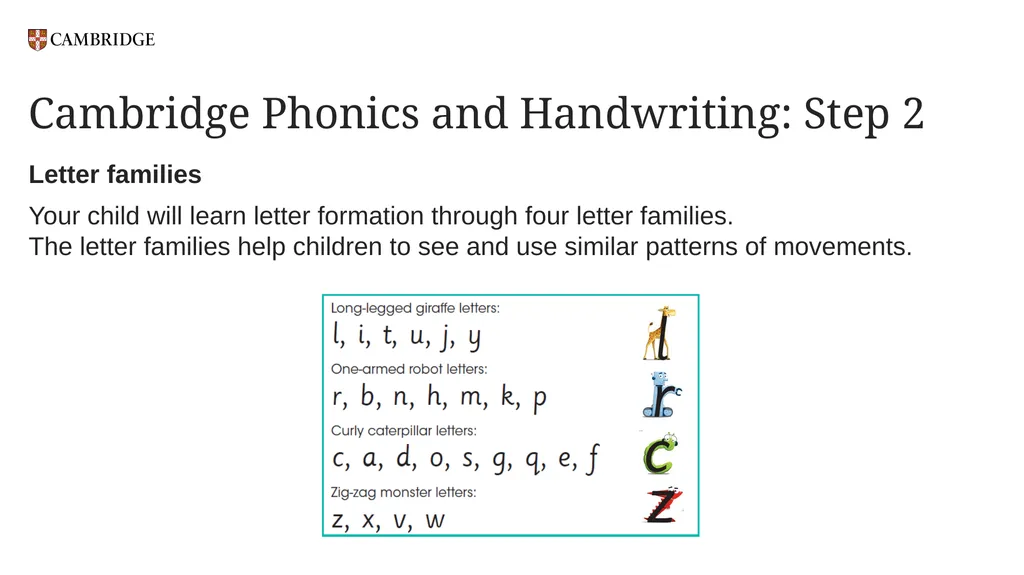
The handwriting part of Cambridge’s scheme focuses on introducing the letters in a systematic way. It uses awareness of lower-case letters that require similar types of movements (we call these ‘letter families’).
Joining of letters is gradually introduced to match the learner’s growing phonics skills, for example, reinforcing that in the two letters ‘c’ and ‘h’ together make one sound /ch/.<br>
08
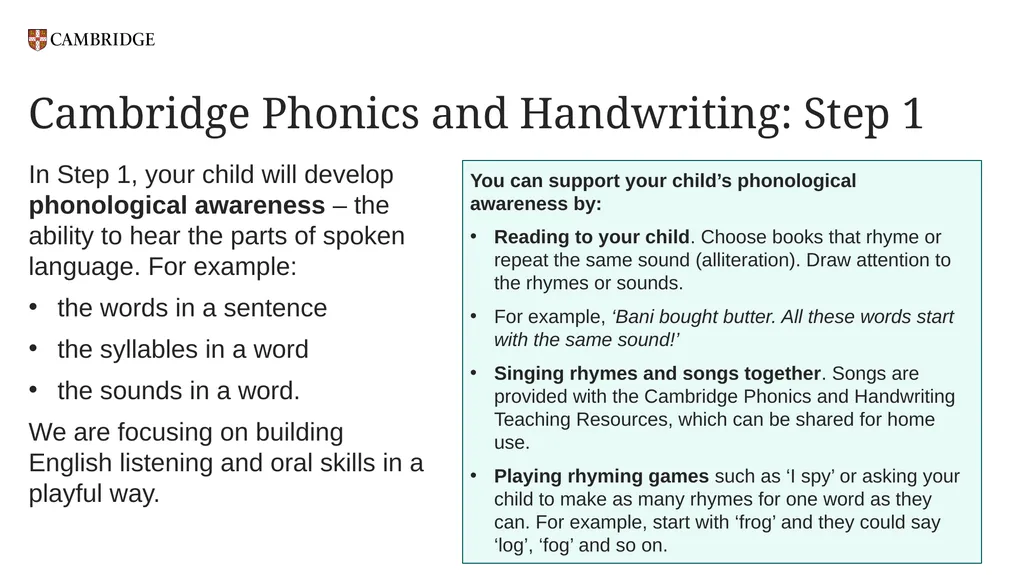
Cambridge Phonics and Handwriting: Step 1 In Step 1, your child will develop phonological awareness – the ability to hear the parts of spoken language. For example:
the words in a sentence
the syllables in a word
the sounds in a word.
We are focusing on building English listening and oral skills in a playful way. You can support your child’s phonological awareness by:
Reading to your child. Choose books that rhyme or repeat the same sound (alliteration). Draw attention to the rhymes or sounds.
For example, ‘Bani bought butter. All these words start with the same sound!’
Singing rhymes and songs together. Songs are provided with the Cambridge Phonics and Handwriting Teaching Resources, which can be shared for home use.
Playing rhyming games such as ‘I spy’ or asking your child to make as many rhymes for one word as they can. For example, start with ‘frog’ and they could say ‘log’, ‘fog’ and so on.<br>
the words in a sentence
the syllables in a word
the sounds in a word.
We are focusing on building English listening and oral skills in a playful way. You can support your child’s phonological awareness by:
Reading to your child. Choose books that rhyme or repeat the same sound (alliteration). Draw attention to the rhymes or sounds.
For example, ‘Bani bought butter. All these words start with the same sound!’
Singing rhymes and songs together. Songs are provided with the Cambridge Phonics and Handwriting Teaching Resources, which can be shared for home use.
Playing rhyming games such as ‘I spy’ or asking your child to make as many rhymes for one word as they can. For example, start with ‘frog’ and they could say ‘log’, ‘fog’ and so on.<br>
09
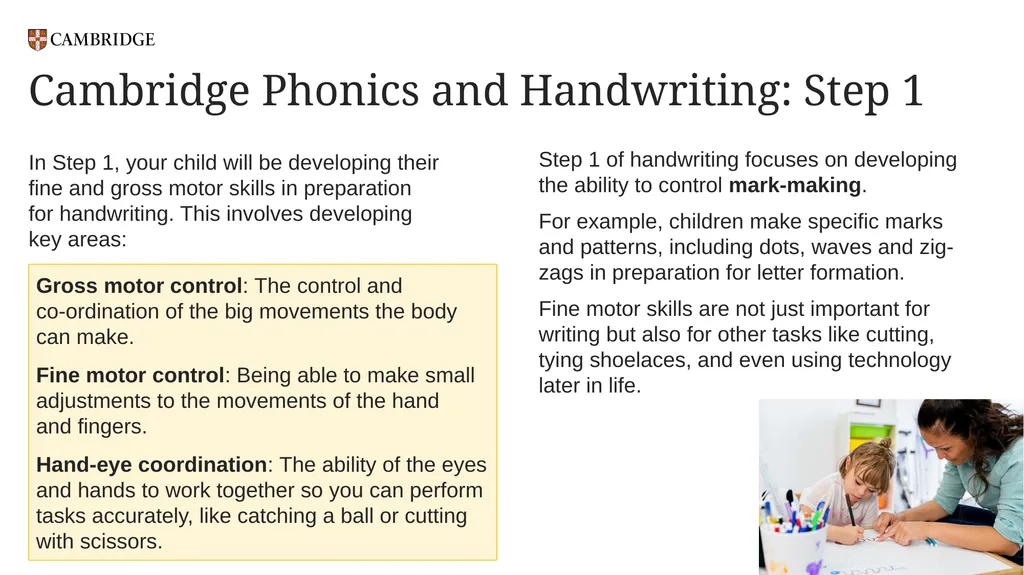
Cambridge Phonics and Handwriting: Step 1 In Step 1, your child will be developing their fine and gross motor skills in preparation for handwriting. This involves developing key areas: Step 1 of handwriting focuses on developing the ability to control mark-making.
For example, children make specific marks and patterns, including dots, waves and zig-zags in preparation for letter formation.
Fine motor skills are not just important for writing but also for other tasks like cutting, tying shoelaces, and even using technology later in life. Gross motor control: The control and co-ordination of the big movements the body can make.
Fine motor control: Being able to make small adjustments to the movements of the hand and fingers.
Hand-eye coordination: The ability of the eyes and hands to work together so you can perform tasks accurately, like catching a ball or cutting with scissors.<br>
For example, children make specific marks and patterns, including dots, waves and zig-zags in preparation for letter formation.
Fine motor skills are not just important for writing but also for other tasks like cutting, tying shoelaces, and even using technology later in life. Gross motor control: The control and co-ordination of the big movements the body can make.
Fine motor control: Being able to make small adjustments to the movements of the hand and fingers.
Hand-eye coordination: The ability of the eyes and hands to work together so you can perform tasks accurately, like catching a ball or cutting with scissors.<br>
10
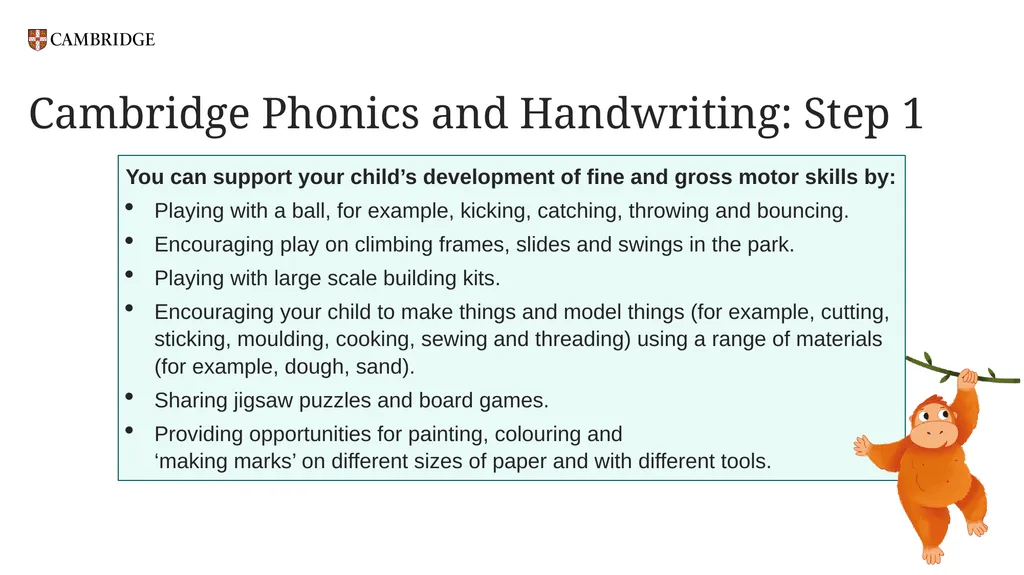
Cambridge Phonics and Handwriting: Step 1 You can support your child’s development of fine and gross motor skills by:
Playing with a ball, for example, kicking, catching, throwing and bouncing.
Encouraging play on climbing frames, slides and swings in the park.
Playing with large scale building kits.
Encouraging your child to make things and model things (for example, cutting, sticking, moulding, cooking, sewing and threading) using a range of materials (for example, dough, sand).
Sharing jigsaw puzzles and board games.
Providing opportunities for painting, colouring and ‘making marks’ on different sizes of paper and with different tools.<br>
Playing with a ball, for example, kicking, catching, throwing and bouncing.
Encouraging play on climbing frames, slides and swings in the park.
Playing with large scale building kits.
Encouraging your child to make things and model things (for example, cutting, sticking, moulding, cooking, sewing and threading) using a range of materials (for example, dough, sand).
Sharing jigsaw puzzles and board games.
Providing opportunities for painting, colouring and ‘making marks’ on different sizes of paper and with different tools.<br>
11
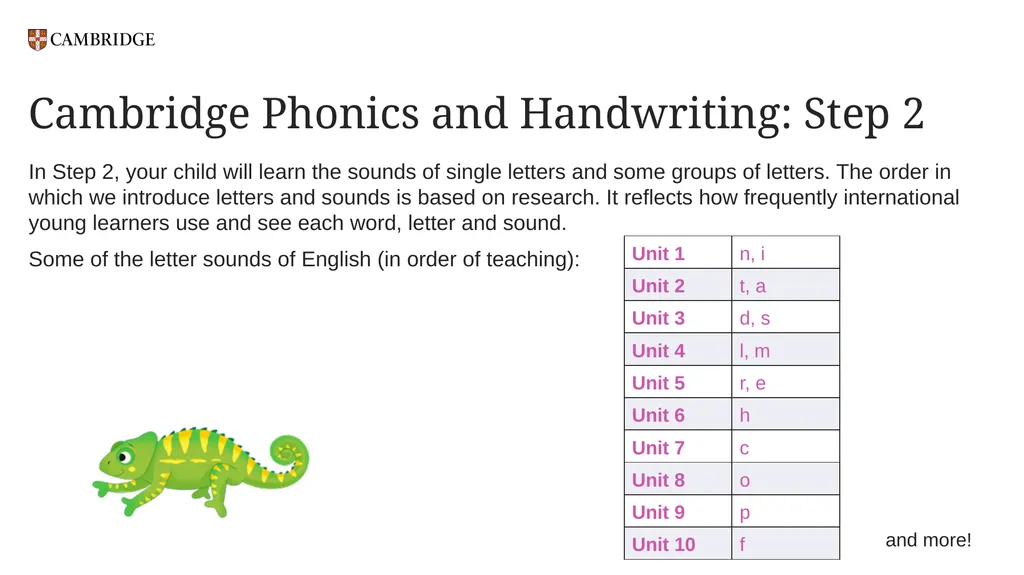
Cambridge Phonics and Handwriting: Step 2 In Step 2, your child will learn the sounds of single letters and some groups of letters. The order in which we introduce letters and sounds is based on research. It reflects how frequently international young learners use and see each word, letter and sound.
Some of the letter sounds of English (in order of teaching): and more!<br>
Some of the letter sounds of English (in order of teaching): and more!<br>
12
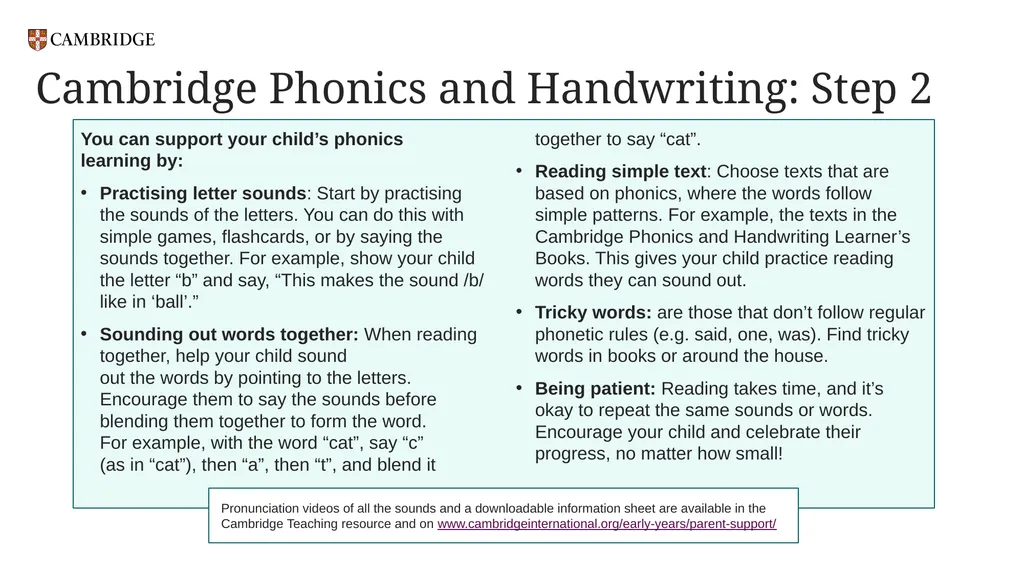
Cambridge Phonics and Handwriting: Step 2 You can support your child’s phonics
learning by:
Practising letter sounds: Start by practising the sounds of the letters. You can do this with simple games, flashcards, or by saying the sounds together. For example, show your child the letter “b” and say, “This makes the sound /b/ like in ‘ball’.”
Sounding out words together: When reading together, help your child sound out the words by pointing to the letters. Encourage them to say the sounds before blending them together to form the word. For example, with the word “cat”, say “c” (as in “cat”), then “a”, then “t”, and blend it together to say “cat”.
Reading simple text: Choose texts that are based on phonics, where the words follow simple patterns. For example, the texts in the Cambridge Phonics and Handwriting Learner’s Books. This gives your child practice reading words they can sound out.
Tricky words: are those that don’t follow regular phonetic rules (e.g. said, one, was). Find tricky words in books or around the house.
Being patient: Reading takes time, and it’s okay to repeat the same sounds or words. Encourage your child and celebrate their progress, no matter how small! Pronunciation videos of all the sounds and a downloadable information sheet are available in the Cambridge Teaching resource and on www.cambridgeinternational.org/early-years/parent-support/<br>
Practising letter sounds: Start by practising the sounds of the letters. You can do this with simple games, flashcards, or by saying the sounds together. For example, show your child the letter “b” and say, “This makes the sound /b/ like in ‘ball’.”
Sounding out words together: When reading together, help your child sound out the words by pointing to the letters. Encourage them to say the sounds before blending them together to form the word. For example, with the word “cat”, say “c” (as in “cat”), then “a”, then “t”, and blend it together to say “cat”.
Reading simple text: Choose texts that are based on phonics, where the words follow simple patterns. For example, the texts in the Cambridge Phonics and Handwriting Learner’s Books. This gives your child practice reading words they can sound out.
Tricky words: are those that don’t follow regular phonetic rules (e.g. said, one, was). Find tricky words in books or around the house.
Being patient: Reading takes time, and it’s okay to repeat the same sounds or words. Encourage your child and celebrate their progress, no matter how small! Pronunciation videos of all the sounds and a downloadable information sheet are available in the Cambridge Teaching resource and on www.cambridgeinternational.org/early-years/parent-support/<br>
13
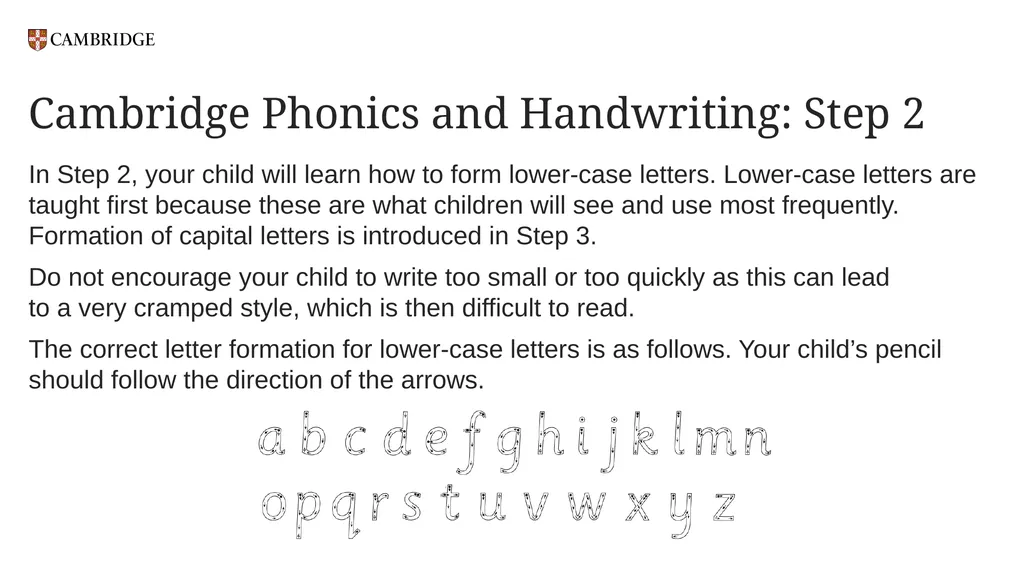
Cambridge Phonics and Handwriting: Step 2 In Step 2, your child will learn how to form lower-case letters. Lower-case letters are taught first because these are what children will see and use most frequently. Formation of capital letters is introduced in Step 3.
Do not encourage your child to write too small or too quickly as this can lead to a very cramped style, which is then difficult to read.
The correct letter formation for lower-case letters is as follows. Your child’s pencil should follow the direction of the arrows.<br>
Do not encourage your child to write too small or too quickly as this can lead to a very cramped style, which is then difficult to read.
The correct letter formation for lower-case letters is as follows. Your child’s pencil should follow the direction of the arrows.<br>
14
Cambridge Phonics and Handwriting: Step 2 Letter families
Your child will learn letter formation through four letter families. The letter families help children to see and use similar patterns of movements.<br>
Your child will learn letter formation through four letter families. The letter families help children to see and use similar patterns of movements.<br>
15
Cambridge Phonics and Handwriting: Step 2 You can support your child’s letter formation by:
Using sensory materials: like sand, finger paint or shaving cream to trace letters. This provides a hands-on experience and helps with motor memory.
Encouraging your child to practise writing their name even if they are still learning to form letters. This gives them a sense of pride and purpose.
Offering plenty of opportunities to write, such as creating simple shopping lists, making cards or doodling.
Practising letters in different ways, such as drawing letters in the air with a finger, or tracing over dotted lines.
Celebrating the effort more than the result. Offer praise for their hard work, instead of focusing too much on mistakes. A downloadable ‘letters and sounds information' sheet and ‘letter families’ sheet is available in the Cambridge Teaching resource and on www.cambridgeinternational.org/early-years/parent-support/ for your reference<br>
Using sensory materials: like sand, finger paint or shaving cream to trace letters. This provides a hands-on experience and helps with motor memory.
Encouraging your child to practise writing their name even if they are still learning to form letters. This gives them a sense of pride and purpose.
Offering plenty of opportunities to write, such as creating simple shopping lists, making cards or doodling.
Practising letters in different ways, such as drawing letters in the air with a finger, or tracing over dotted lines.
Celebrating the effort more than the result. Offer praise for their hard work, instead of focusing too much on mistakes. A downloadable ‘letters and sounds information' sheet and ‘letter families’ sheet is available in the Cambridge Teaching resource and on www.cambridgeinternational.org/early-years/parent-support/ for your reference<br>
16
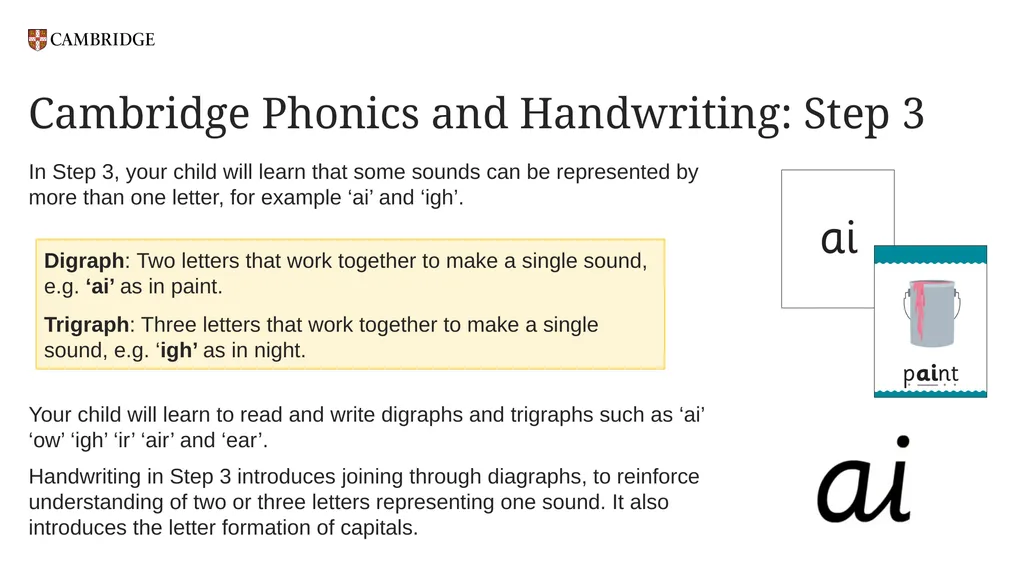
Cambridge Phonics and Handwriting: Step 3 In Step 3, your child will learn that some sounds can be represented by more than one letter, for example ‘ai’ and ‘igh’.
Your child will learn to read and write digraphs and trigraphs such as ‘ai’ ‘ow’ ‘igh’ ‘ir’ ‘air’ and ‘ear’.
Handwriting in Step 3 introduces joining through diagraphs, to reinforce understanding of two or three letters representing one sound. It also introduces the letter formation of capitals. Digraph: Two letters that work together to make a single sound, e.g. ‘ai’ as in paint.
Trigraph: Three letters that work together to make a single sound, e.g. ‘igh’ as in night.<br>
Your child will learn to read and write digraphs and trigraphs such as ‘ai’ ‘ow’ ‘igh’ ‘ir’ ‘air’ and ‘ear’.
Handwriting in Step 3 introduces joining through diagraphs, to reinforce understanding of two or three letters representing one sound. It also introduces the letter formation of capitals. Digraph: Two letters that work together to make a single sound, e.g. ‘ai’ as in paint.
Trigraph: Three letters that work together to make a single sound, e.g. ‘igh’ as in night.<br>
17
Cambridge Phonics and Handwriting: Step 4 Across Step 3 and Step 4, children will continue to practise their blending skills to read.
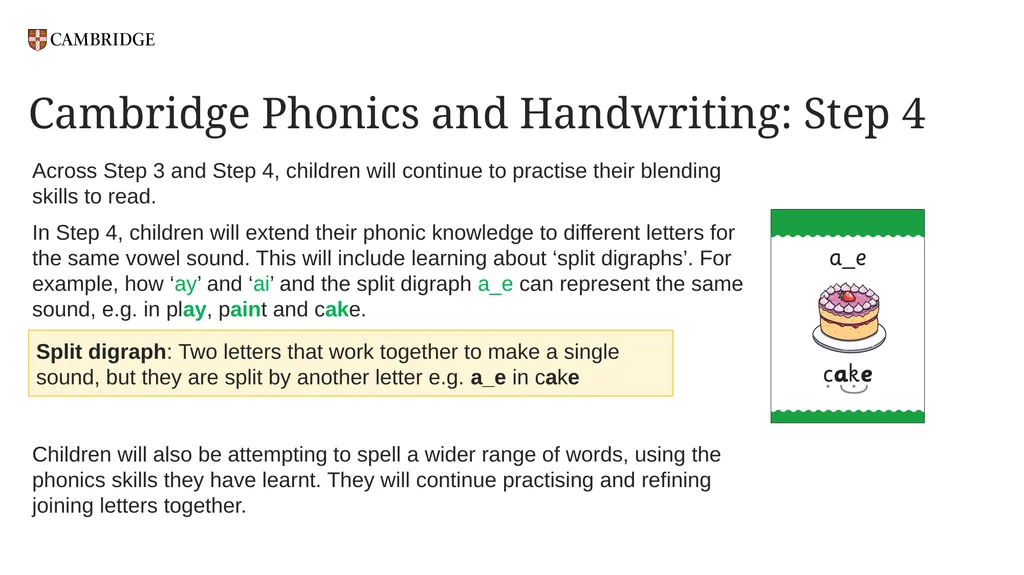
In Step 4, children will extend their phonic knowledge to different letters for the same vowel sound. This will include learning about ‘split digraphs’. For example, how ‘ay’ and ‘ai’ and the split digraph a_e can represent the same sound, e.g. in play, paint and cake.
Children will also be attempting to spell a wider range of words, using the phonics skills they have learnt. They will continue practising and refining joining letters together. Split digraph: Two letters that work together to make a single sound, but they are split by another letter e.g. a_e in cake<br>
In Step 4, children will extend their phonic knowledge to different letters for the same vowel sound. This will include learning about ‘split digraphs’. For example, how ‘ay’ and ‘ai’ and the split digraph a_e can represent the same sound, e.g. in play, paint and cake.
Children will also be attempting to spell a wider range of words, using the phonics skills they have learnt. They will continue practising and refining joining letters together. Split digraph: Two letters that work together to make a single sound, but they are split by another letter e.g. a_e in cake<br>
18
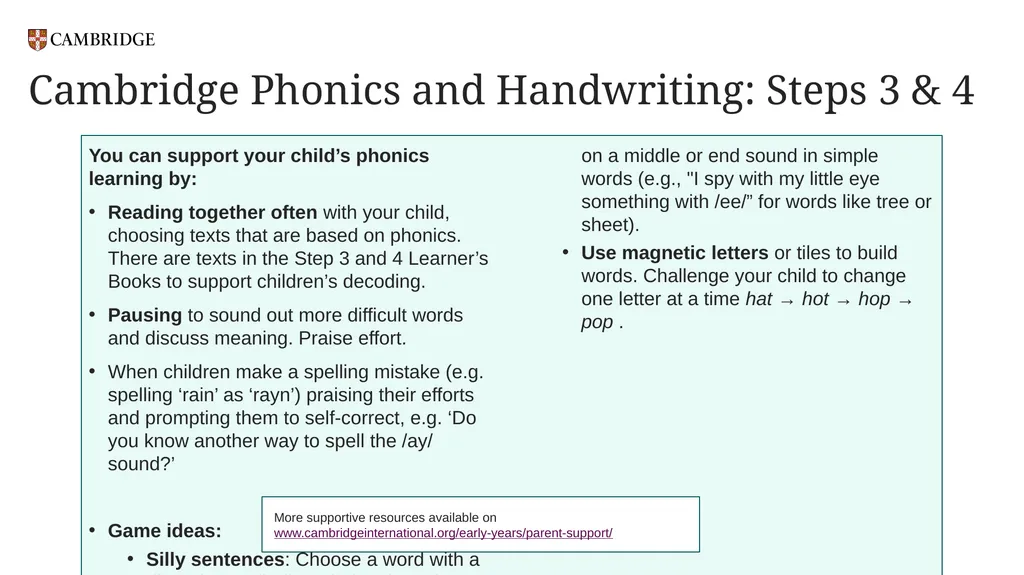
Cambridge Phonics and Handwriting: Steps 3 & 4 You can support your child’s phonics learning by:
Reading together often with your child, choosing texts that are based on phonics. There are texts in the Step 3 and 4 Learner’s Books to support children’s decoding.
Pausing to sound out more difficult words and discuss meaning. Praise effort.
When children make a spelling mistake (e.g. spelling ‘rain’ as ‘rayn’) praising their efforts and prompting them to self-correct, e.g. ‘Do you know another way to spell the /ay/ sound?’
Game ideas:
Silly sentences: Choose a word with a digraph or split digraph they have been learning that week and work together to write a funny sentence using it.
"I spy": Play "I spy" with a twist. Focus on a middle or end sound in simple words (e.g., "I spy with my little eye something with /ee/” for words like tree or sheet).
Use magnetic letters or tiles to build words. Challenge your child to change one letter at a time hat → hot → hop → pop . More supportive resources available on www.cambridgeinternational.org/early-years/parent-support/<br>
Reading together often with your child, choosing texts that are based on phonics. There are texts in the Step 3 and 4 Learner’s Books to support children’s decoding.
Pausing to sound out more difficult words and discuss meaning. Praise effort.
When children make a spelling mistake (e.g. spelling ‘rain’ as ‘rayn’) praising their efforts and prompting them to self-correct, e.g. ‘Do you know another way to spell the /ay/ sound?’
Game ideas:
Silly sentences: Choose a word with a digraph or split digraph they have been learning that week and work together to write a funny sentence using it.
"I spy": Play "I spy" with a twist. Focus on a middle or end sound in simple words (e.g., "I spy with my little eye something with /ee/” for words like tree or sheet).
Use magnetic letters or tiles to build words. Challenge your child to change one letter at a time hat → hot → hop → pop . More supportive resources available on www.cambridgeinternational.org/early-years/parent-support/<br>
19
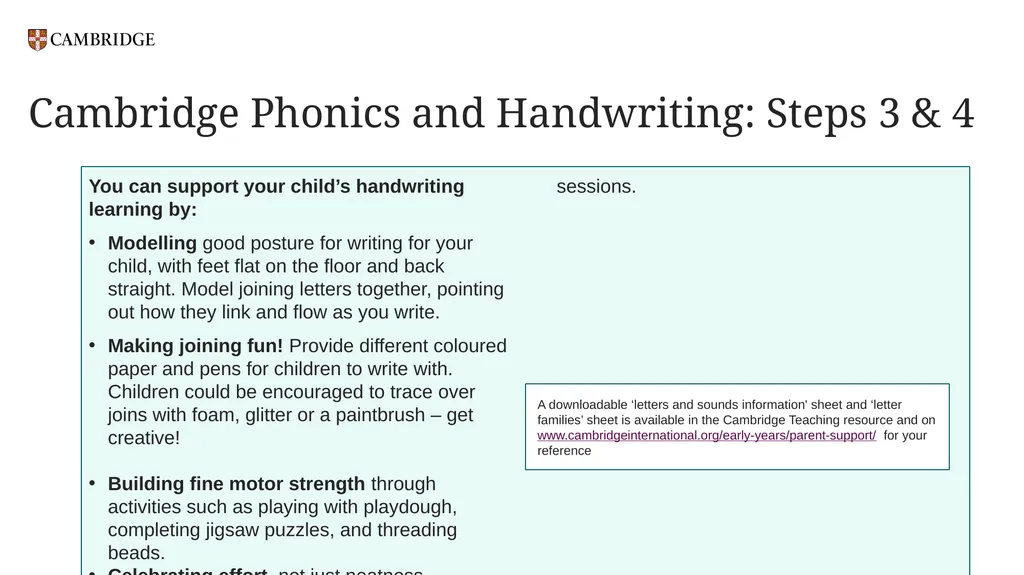
Cambridge Phonics and Handwriting: Steps 3 & 4 You can support your child’s handwriting learning by:
Modelling good posture for writing for your child, with feet flat on the floor and back straight. Model joining letters together, pointing out how they link and flow as you write.
Making joining fun! Provide different coloured paper and pens for children to write with. Children could be encouraged to trace over joins with foam, glitter or a paintbrush – get creative!
Building fine motor strength through activities such as playing with playdough, completing jigsaw puzzles, and threading beads.
Celebrating effort, not just neatness.
Keeping activities short and consistent – daily practice works better than long infrequent sessions. A downloadable ‘letters and sounds information' sheet and ‘letter families’ sheet is available in the Cambridge Teaching resource and on www.cambridgeinternational.org/early-years/parent-support/ for your reference<br>
Modelling good posture for writing for your child, with feet flat on the floor and back straight. Model joining letters together, pointing out how they link and flow as you write.
Making joining fun! Provide different coloured paper and pens for children to write with. Children could be encouraged to trace over joins with foam, glitter or a paintbrush – get creative!
Building fine motor strength through activities such as playing with playdough, completing jigsaw puzzles, and threading beads.
Celebrating effort, not just neatness.
Keeping activities short and consistent – daily practice works better than long infrequent sessions. A downloadable ‘letters and sounds information' sheet and ‘letter families’ sheet is available in the Cambridge Teaching resource and on www.cambridgeinternational.org/early-years/parent-support/ for your reference<br>
20
Tips for encouraging reading and writing
at home Make reading fun! Try different voices for different
characters or use props like puppets.
Set aside regular time for reading each day. Even just 10–15 minutes can make a big difference.
Be a reading role model! Let your child see you reading and enjoying books.
Provide meaningful opportunities for children to write. For example, they could write labels, create simple shopping lists and make cards.<br>
Set aside regular time for reading each day. Even just 10–15 minutes can make a big difference.
Be a reading role model! Let your child see you reading and enjoying books.
Provide meaningful opportunities for children to write. For example, they could write labels, create simple shopping lists and make cards.<br>
21
Summary The Cambridge Phonics and Handwriting Scheme is great way to help your child start reading and writing by understanding how sounds and letters work together.
With practice and patience, your child will become a confident reader and writer. Remember, your support and encouragement will make a big difference in their learning journey!<br>
With practice and patience, your child will become a confident reader and writer. Remember, your support and encouragement will make a big difference in their learning journey!<br>