
Can hope be a reinforcer? Middle-terms and


Description: Can hope be a reinforcer? Middle-terms and workability by Pierre Cousineau, Ph.D. 1 Is this a fact? As to my understanding, it seems that every human being urinates What are my hard core data about this statement? Honestly, they are very
Related Topics
Download Presentation
"Can hope be a reinforcer? Middle-terms and" is the property of its rightful owner. Permission is granted to download and print the materials on this website for personal, non-commercial use only, and to display it on your personal computer provided you do not modify the materials and that you retain all copyright notices contained in the materials. By downloading content from our website, you accept the terms of this agreement.
Presentation Transcript
slide1. Can hope be a reinforcer? Middle-terms and workability
by
Pierre Cousineau, Ph.D. 1<br>
slide2. Is this a fact? As to my understanding, it seems that every human being urinates
What are my hard core data about this statement?
Honestly, they are very limited – I directly observed my children and myself, that’s about it. 2<br>
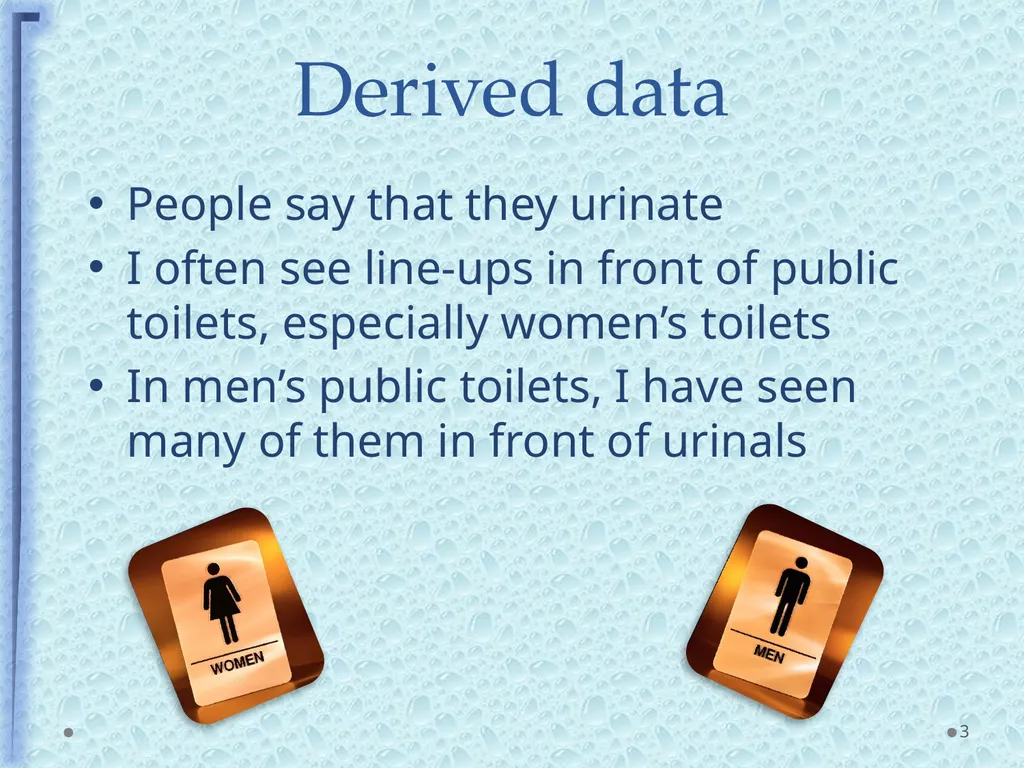
slide3. Derived data People say that they urinate
I often see line-ups in front of public toilets, especially women’s toilets
In men’s public toilets, I have seen many of them in front of urinals 3<br>
slide4. Do we need the need concept? NO! Babies are able to pee before knowing on a conceptual or verbal level that they are doing it 4<br>
slide5. The learning of a need Parents teach them they have this “need” to pee – especially, to do it elsewhere than on the living room carpet!
This is socialization shaping that promotes awareness of a process (internal and external discriminative stimuli) 5<br>
slide6. My first conclusion (on the 6th slide!) It’s not the need to urinate that makes us urinate, that’s a false causality; we knew how to do it before we even heard the word
It’s not a causality, it’s an awareness and information processing issue 6<br>
slide7. Impossible to bypass Whatever the reinforcement or punishment learning history, whatever the context, at one point or another, we will pee… even if it is in our pants!
Physiological regulation and emotional regulation are a given – there is no way to erase them 7<br>
slide8. Quick conceptual shift (15 seconds) Psychological needs?
I prefer “emotion-regulation systems” to “needs”
Not enough time to explain, but read Panksepp (1998), Gilbert (2010), Siegel (2012) 8<br>
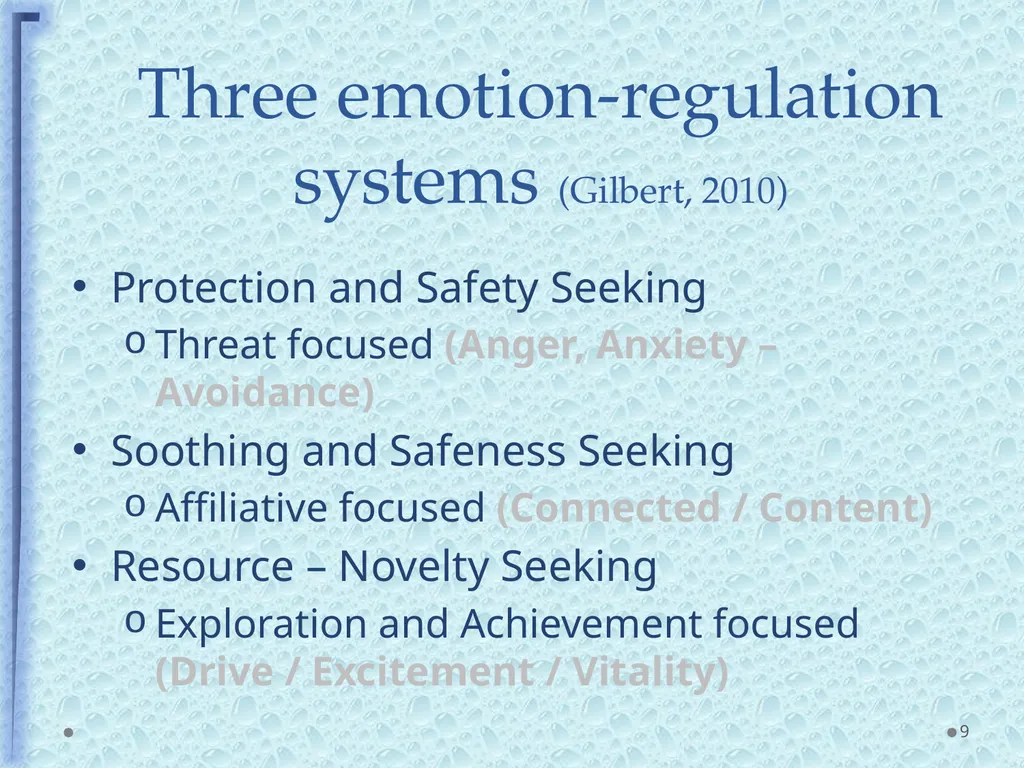
slide9. Three emotion-regulation systems (Gilbert, 2010) Protection and Safety Seeking
Threat focused (Anger, Anxiety – Avoidance)
Soothing and Safeness Seeking
Affiliative focused (Connected / Content)
Resource – Novelty Seeking
Exploration and Achievement focused (Drive / Excitement / Vitality) 9<br>
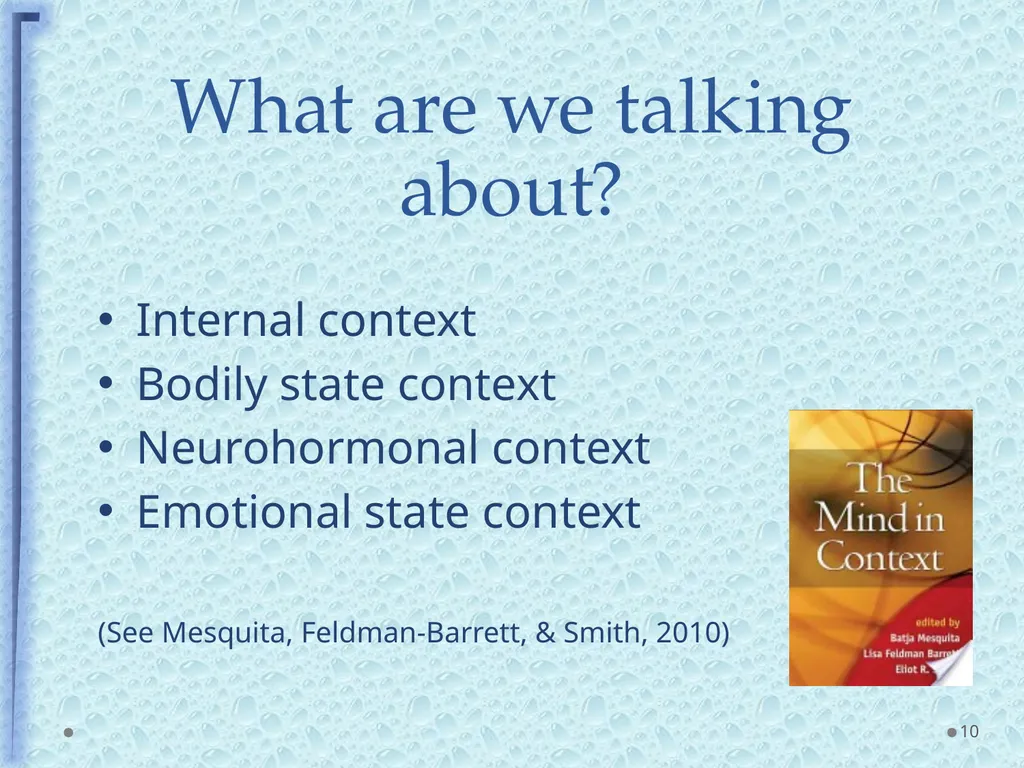
slide10. What are we talking about? Internal context
Bodily state context
Neurohormonal context
Emotional state context
(See Mesquita, Feldman-Barrett, & Smith, 2010) 10<br>
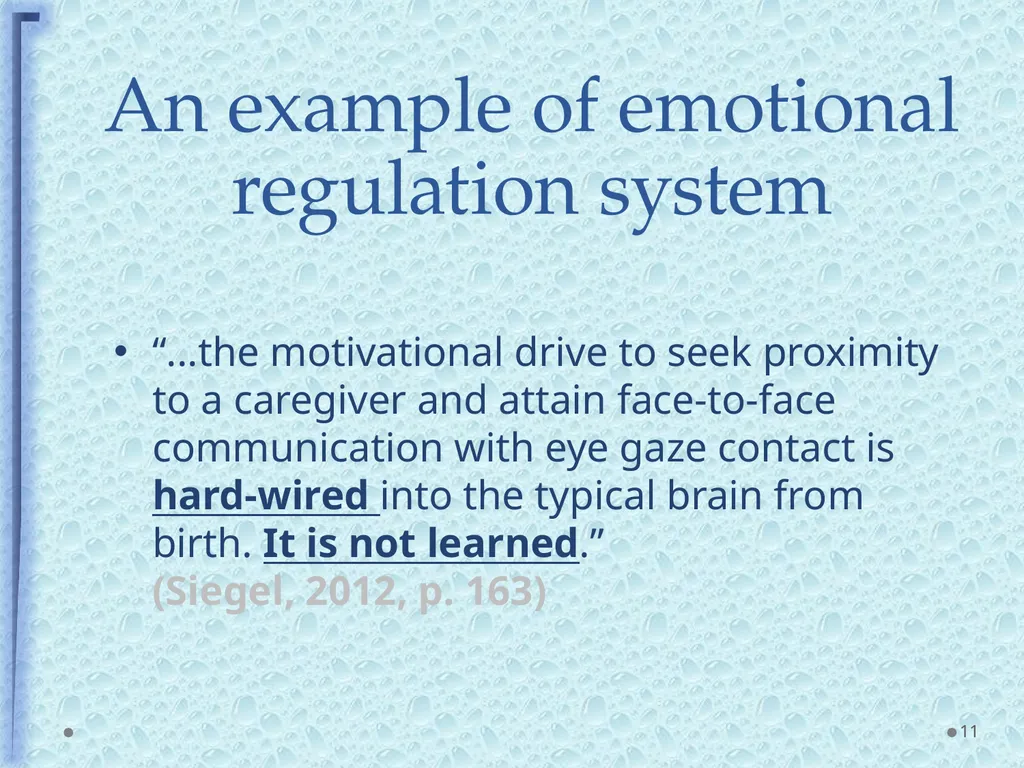
slide11. An example of emotional regulation system “...the motivational drive to seek proximity to a caregiver and attain face-to-face communication with eye gaze contact is hard-wired into the typical brain from birth. It is not learned.” (Siegel, 2012, p. 163) 11<br>
slide12. The destiny of an emotional drive What could be learned though, is that this emotional communication seeking may be punished – for example, by being constantly dismissed (frustration) or harshly belittled (rejection)
In such a situation, Grawe (2004) would predict a conflict between approach and avoidance motivational systems 12<br>
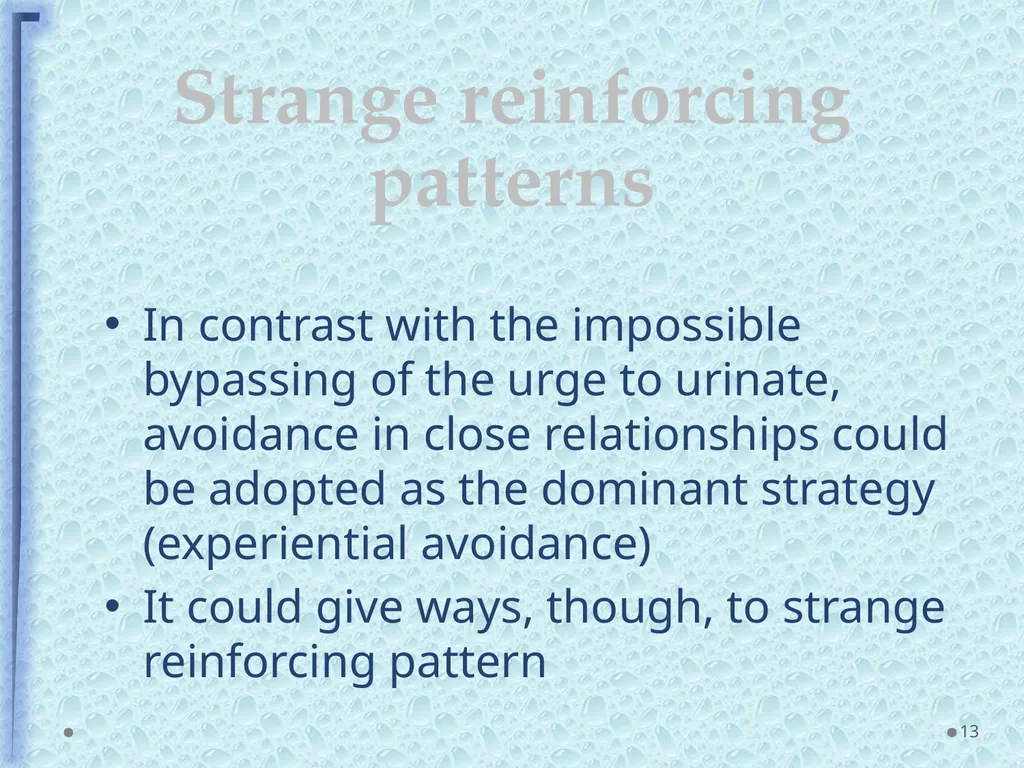
slide13. Strange reinforcing patterns In contrast with the impossible bypassing of the urge to urinate, avoidance in close relationships could be adopted as the dominant strategy (experiential avoidance)
It could give ways, though, to strange reinforcing pattern 13<br>
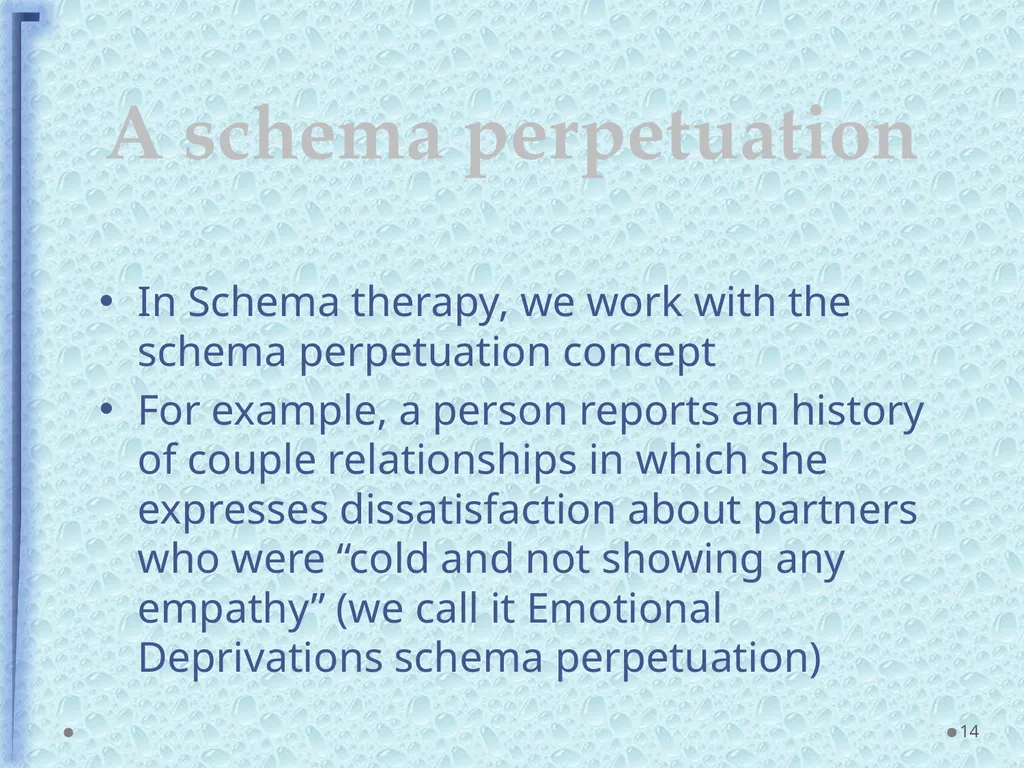
slide14. A schema perpetuation In Schema therapy, we work with the schema perpetuation concept
For example, a person reports an history of couple relationships in which she expresses dissatisfaction about partners who were “cold and not showing any empathy” (we call it Emotional Deprivations schema perpetuation) 14<br>
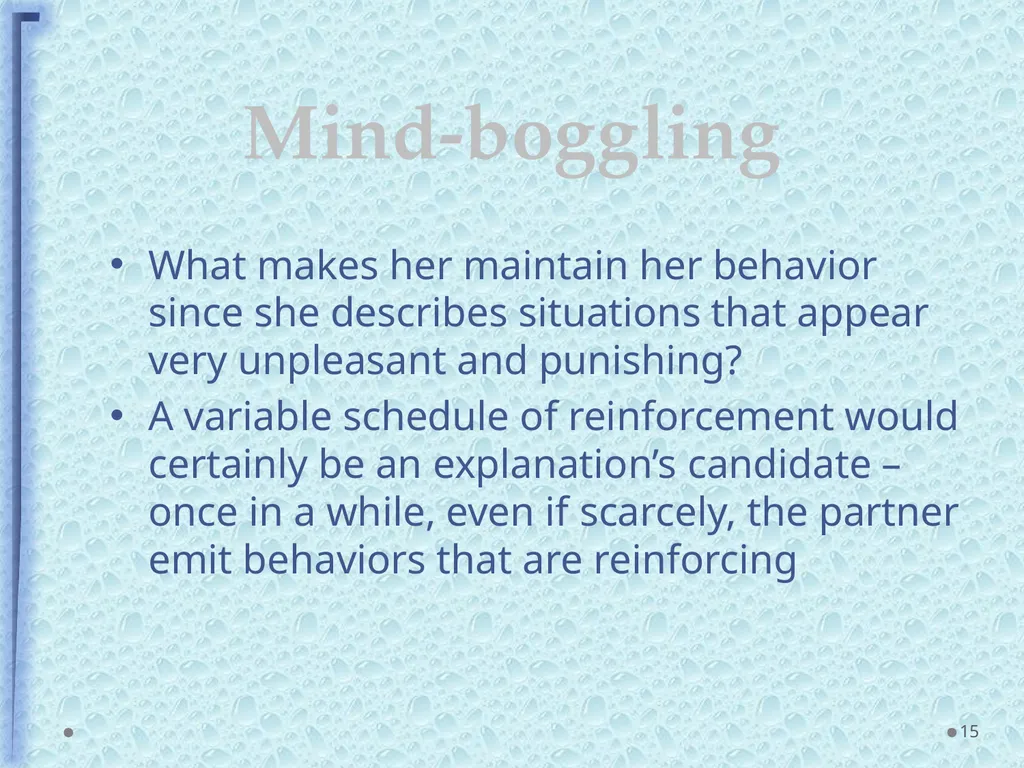
slide15. Mind-boggling What makes her maintain her behavior since she describes situations that appear very unpleasant and punishing?
A variable schedule of reinforcement would certainly be an explanation’s candidate – once in a while, even if scarcely, the partner emit behaviors that are reinforcing 15<br>
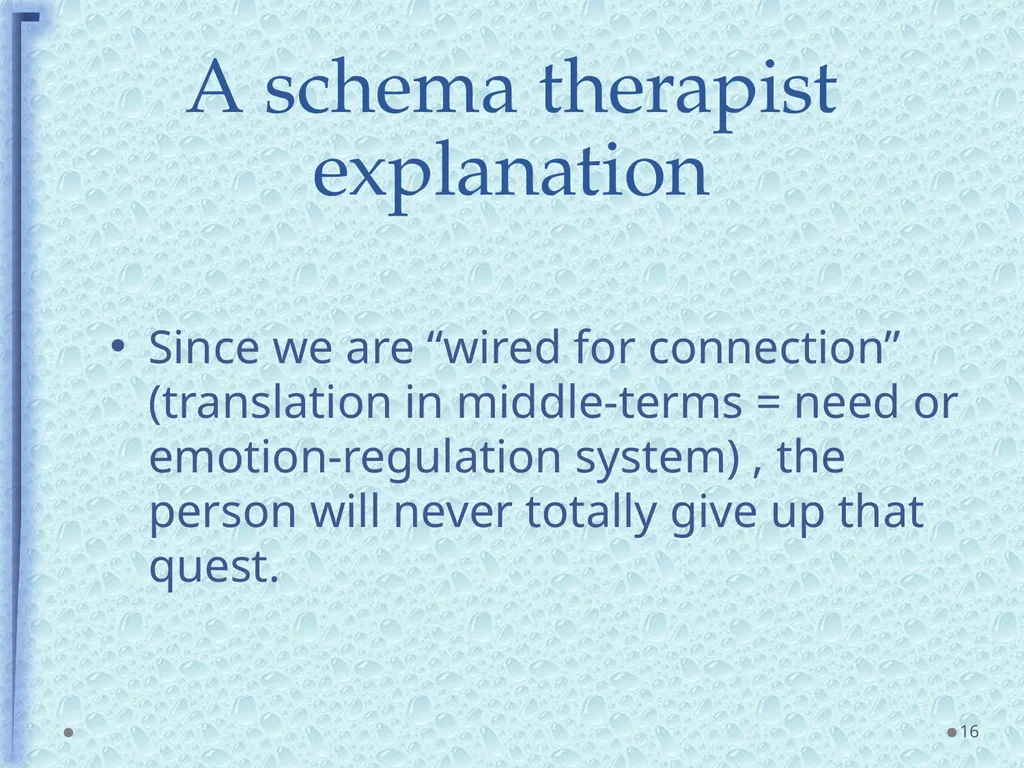
slide16. A schema therapist explanation Since we are “wired for connection” (translation in middle-terms = need or emotion-regulation system) , the person will never totally give up that quest. 16<br>
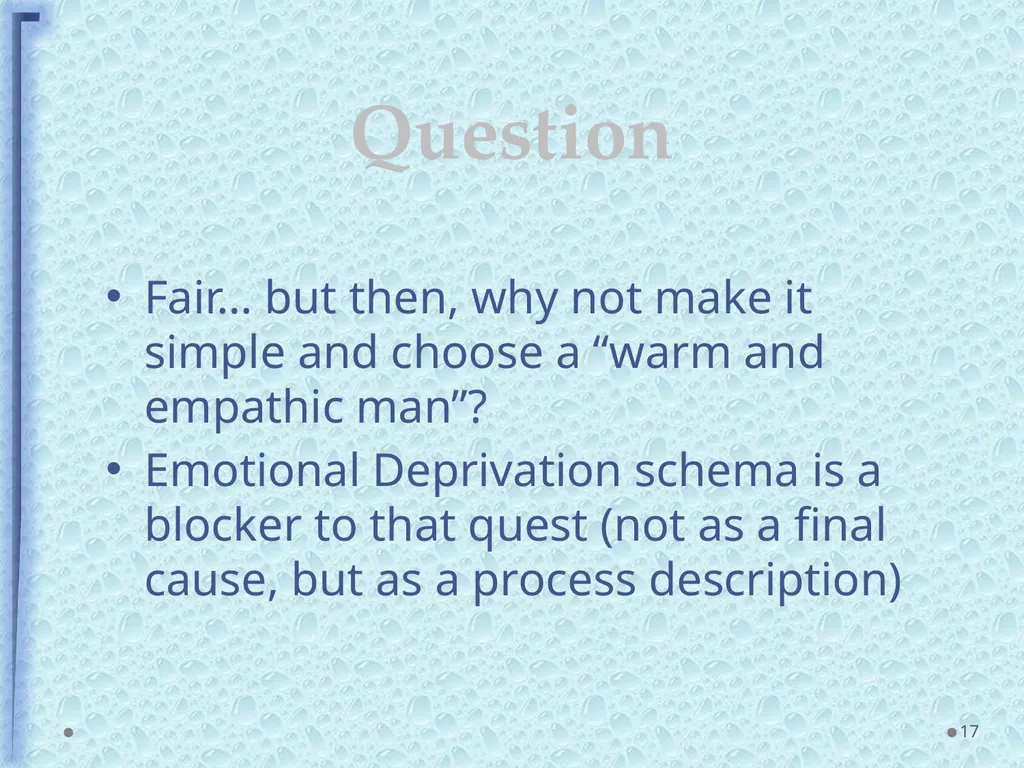
slide17. Question Fair… but then, why not make it simple and choose a “warm and empathic man”?
Emotional Deprivation schema is a blocker to that quest (not as a final cause, but as a process description) 17<br>
slide18. Let’s try an alternative understanding Like most human beings, this woman is “wired for connection” (Attachment – Soothing and Safeness Seeking)
Her learning history hasn’t been much reinforcing in that respect
Like “physiological needs”, basic “emotion-regulation systems” can’t be erased-but, their experiential avoidance don’t kill 18<br>
slide19. Hope Hope is a middle-term that embodies the quest for a response to that inherited disposition for connection
Why with a “cold and not empathic” partner?
The learning history of the person (discriminative stimuli) has linked that quest for connection to this kind of relational context 19<br>
slide20. Conclusion Still a lot to think about
But, let me conclude that I don’t use these “middle-terms” (emotion-regulation systems, schemas) as “final causes”, but as way to promote awareness at specific processes 20<br>
by
Pierre Cousineau, Ph.D. 1<br>
slide2. Is this a fact? As to my understanding, it seems that every human being urinates
What are my hard core data about this statement?
Honestly, they are very limited – I directly observed my children and myself, that’s about it. 2<br>
slide3. Derived data People say that they urinate
I often see line-ups in front of public toilets, especially women’s toilets
In men’s public toilets, I have seen many of them in front of urinals 3<br>
slide4. Do we need the need concept? NO! Babies are able to pee before knowing on a conceptual or verbal level that they are doing it 4<br>
slide5. The learning of a need Parents teach them they have this “need” to pee – especially, to do it elsewhere than on the living room carpet!
This is socialization shaping that promotes awareness of a process (internal and external discriminative stimuli) 5<br>
slide6. My first conclusion (on the 6th slide!) It’s not the need to urinate that makes us urinate, that’s a false causality; we knew how to do it before we even heard the word
It’s not a causality, it’s an awareness and information processing issue 6<br>
slide7. Impossible to bypass Whatever the reinforcement or punishment learning history, whatever the context, at one point or another, we will pee… even if it is in our pants!
Physiological regulation and emotional regulation are a given – there is no way to erase them 7<br>
slide8. Quick conceptual shift (15 seconds) Psychological needs?
I prefer “emotion-regulation systems” to “needs”
Not enough time to explain, but read Panksepp (1998), Gilbert (2010), Siegel (2012) 8<br>
slide9. Three emotion-regulation systems (Gilbert, 2010) Protection and Safety Seeking
Threat focused (Anger, Anxiety – Avoidance)
Soothing and Safeness Seeking
Affiliative focused (Connected / Content)
Resource – Novelty Seeking
Exploration and Achievement focused (Drive / Excitement / Vitality) 9<br>
slide10. What are we talking about? Internal context
Bodily state context
Neurohormonal context
Emotional state context
(See Mesquita, Feldman-Barrett, & Smith, 2010) 10<br>
slide11. An example of emotional regulation system “...the motivational drive to seek proximity to a caregiver and attain face-to-face communication with eye gaze contact is hard-wired into the typical brain from birth. It is not learned.” (Siegel, 2012, p. 163) 11<br>
slide12. The destiny of an emotional drive What could be learned though, is that this emotional communication seeking may be punished – for example, by being constantly dismissed (frustration) or harshly belittled (rejection)
In such a situation, Grawe (2004) would predict a conflict between approach and avoidance motivational systems 12<br>
slide13. Strange reinforcing patterns In contrast with the impossible bypassing of the urge to urinate, avoidance in close relationships could be adopted as the dominant strategy (experiential avoidance)
It could give ways, though, to strange reinforcing pattern 13<br>
slide14. A schema perpetuation In Schema therapy, we work with the schema perpetuation concept
For example, a person reports an history of couple relationships in which she expresses dissatisfaction about partners who were “cold and not showing any empathy” (we call it Emotional Deprivations schema perpetuation) 14<br>
slide15. Mind-boggling What makes her maintain her behavior since she describes situations that appear very unpleasant and punishing?
A variable schedule of reinforcement would certainly be an explanation’s candidate – once in a while, even if scarcely, the partner emit behaviors that are reinforcing 15<br>
slide16. A schema therapist explanation Since we are “wired for connection” (translation in middle-terms = need or emotion-regulation system) , the person will never totally give up that quest. 16<br>
slide17. Question Fair… but then, why not make it simple and choose a “warm and empathic man”?
Emotional Deprivation schema is a blocker to that quest (not as a final cause, but as a process description) 17<br>
slide18. Let’s try an alternative understanding Like most human beings, this woman is “wired for connection” (Attachment – Soothing and Safeness Seeking)
Her learning history hasn’t been much reinforcing in that respect
Like “physiological needs”, basic “emotion-regulation systems” can’t be erased-but, their experiential avoidance don’t kill 18<br>
slide19. Hope Hope is a middle-term that embodies the quest for a response to that inherited disposition for connection
Why with a “cold and not empathic” partner?
The learning history of the person (discriminative stimuli) has linked that quest for connection to this kind of relational context 19<br>
slide20. Conclusion Still a lot to think about
But, let me conclude that I don’t use these “middle-terms” (emotion-regulation systems, schemas) as “final causes”, but as way to promote awareness at specific processes 20<br>