
Can Maths help me get better at Art? LO:
NS
Published · 34 slides · 0 views

1 / 1

Description
Can Maths help me get better at Art? LO: Investigate the Fibonacci sequence in nature Starter: Complete the following sequences 8.6.23 Can Maths help me get better at art? LO: Investigate the Fibonacci sequence in nature Fibonnacci Who,
Related Topics
Share
Embed code
Download this presentation From Below
"Can Maths help me get better at Art? LO:" is the property of its rightful owner. Permission is granted to download and print the materials on this website for personal, non-commercial use only, and to display it on your personal computer provided you do not modify the materials and that you retain all copyright notices contained in the materials. By downloading content from our website, you accept the terms of this agreement.
Presentation Transcript
01
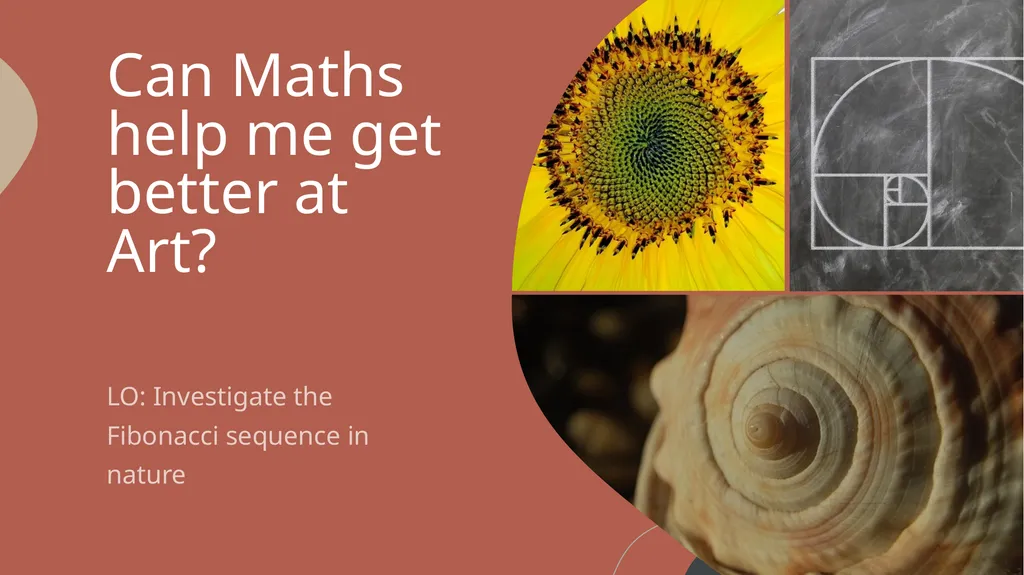
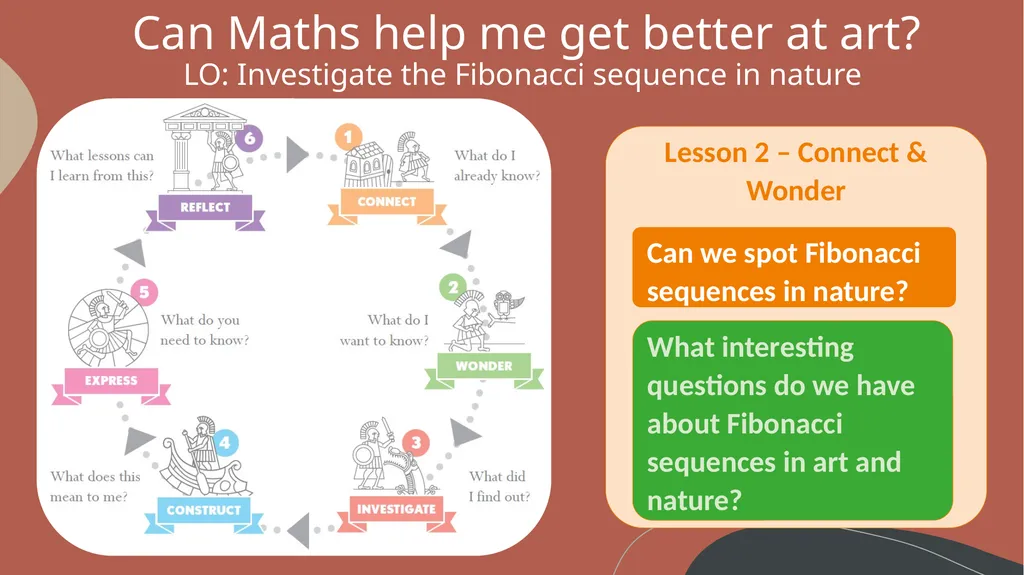
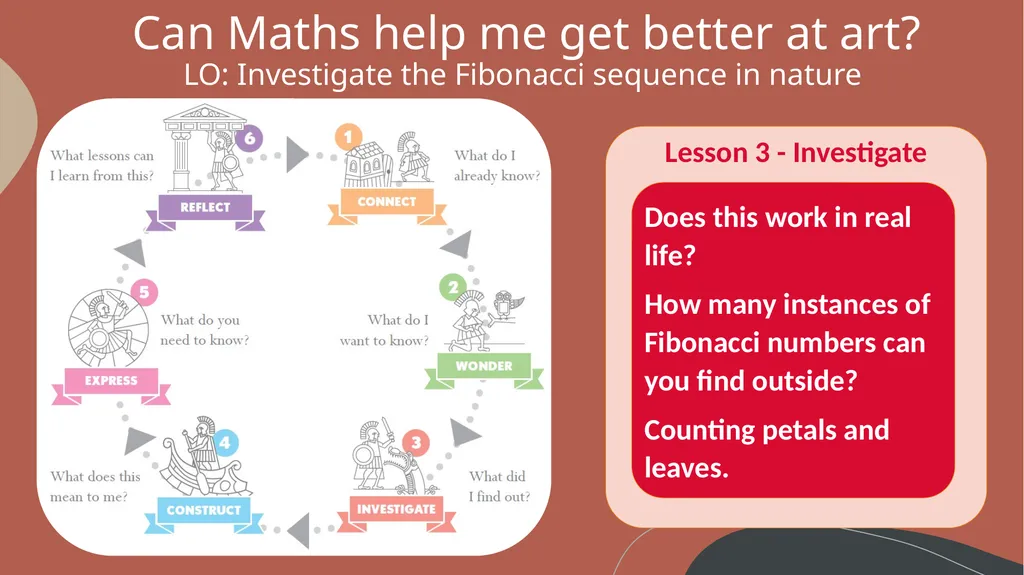
Can Maths help me get better at Art? LO: Investigate the Fibonacci sequence in nature<br>
02
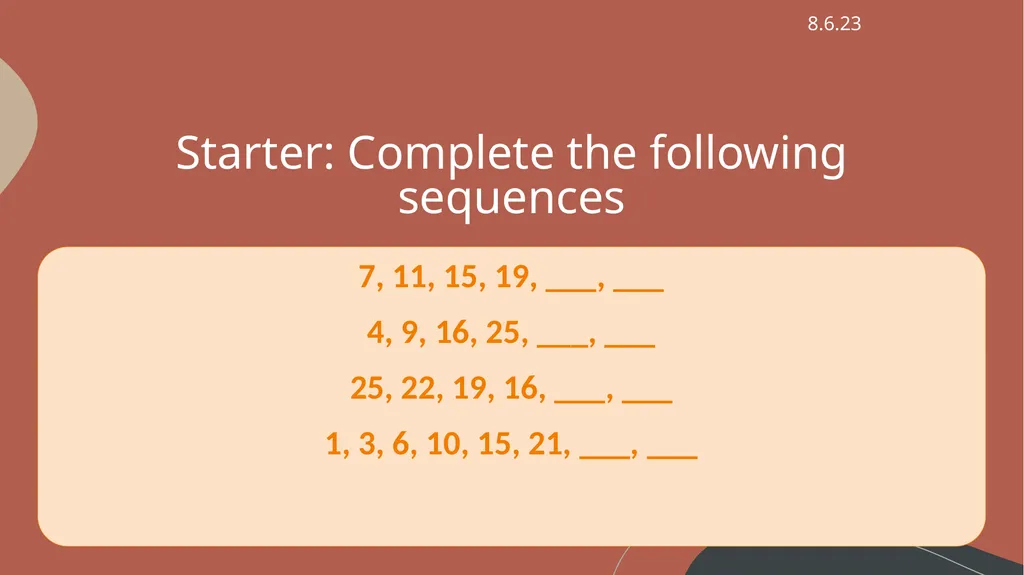
Starter: Complete the following sequences 8.6.23<br>
03
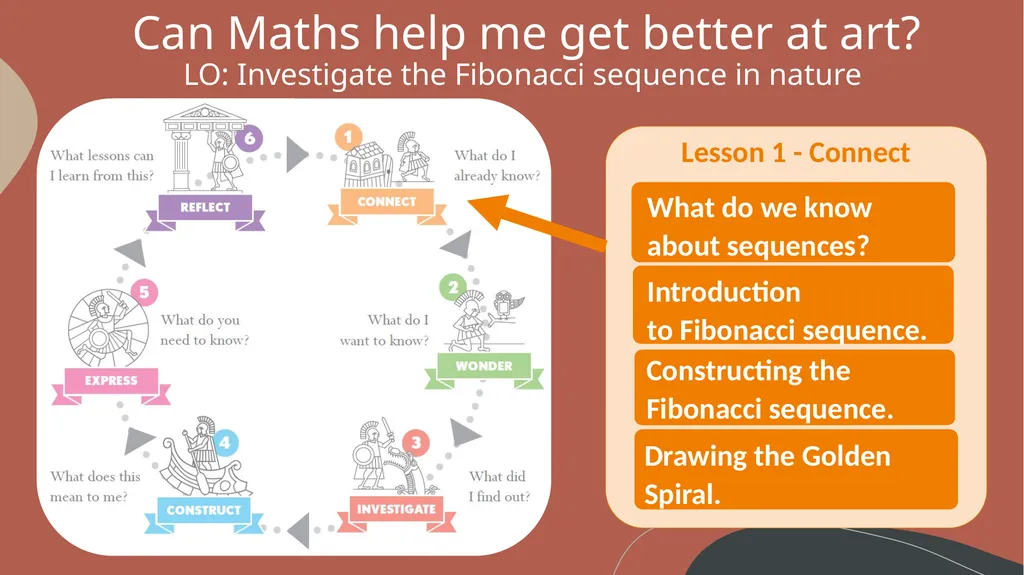
Can Maths help me get better at art?
LO: Investigate the Fibonacci sequence in nature<br>
04
Fibonnacci
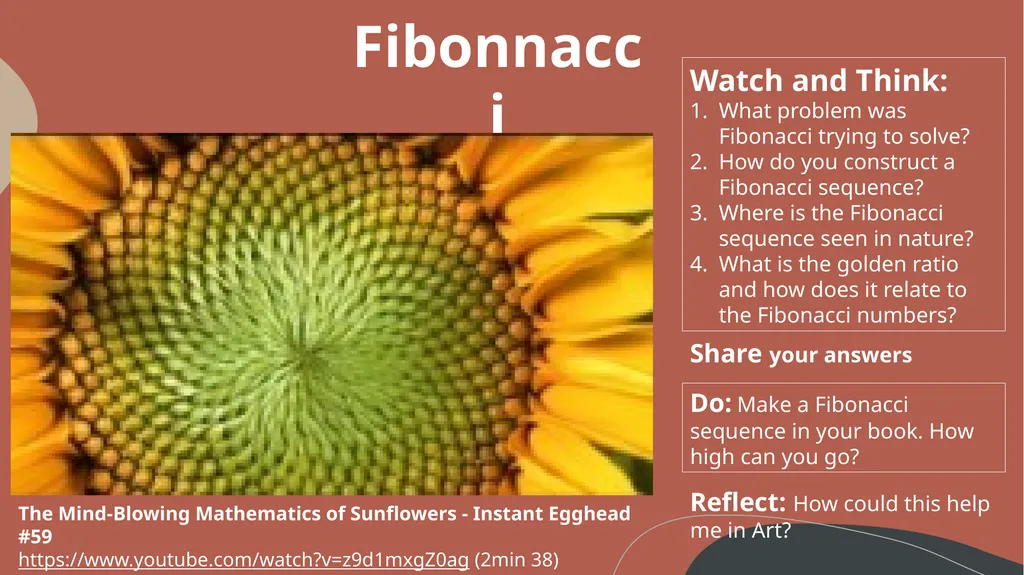
Who, what, why? The Mind-Blowing Mathematics of Sunflowers - Instant Egghead #59
https://www.youtube.com/watch?v=z9d1mxgZ0ag (2min 38) Watch and Think:
What problem was Fibonacci trying to solve?
How do you construct a Fibonacci sequence?
Where is the Fibonacci sequence seen in nature?
What is the golden ratio and how does it relate to the Fibonacci numbers? Share your answers Do: Make a Fibonacci sequence in your book. How high can you go? Reflect: How could this help me in Art?<br>
Who, what, why? The Mind-Blowing Mathematics of Sunflowers - Instant Egghead #59
https://www.youtube.com/watch?v=z9d1mxgZ0ag (2min 38) Watch and Think:
What problem was Fibonacci trying to solve?
How do you construct a Fibonacci sequence?
Where is the Fibonacci sequence seen in nature?
What is the golden ratio and how does it relate to the Fibonacci numbers? Share your answers Do: Make a Fibonacci sequence in your book. How high can you go? Reflect: How could this help me in Art?<br>
05
Golden spiral
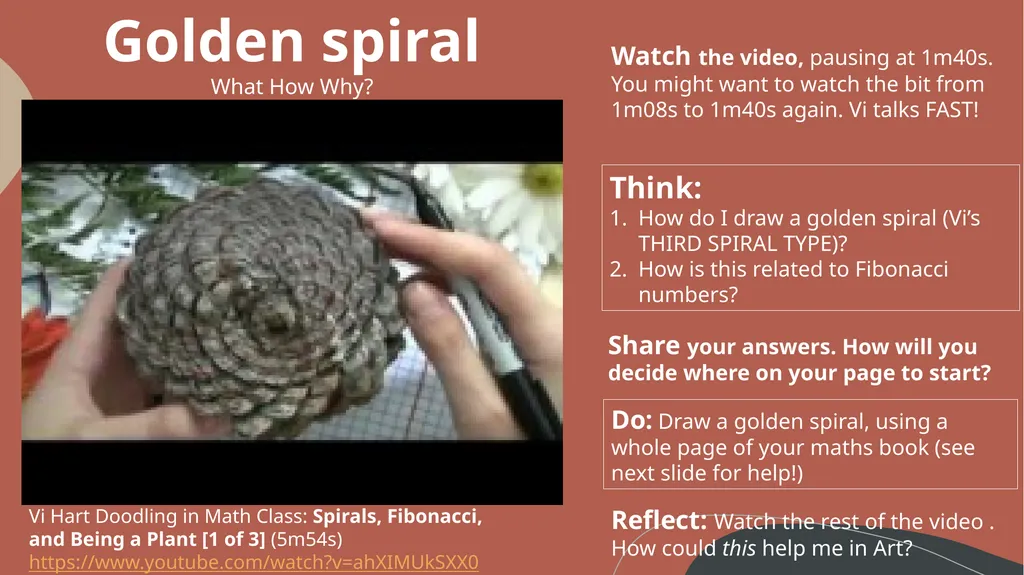
What How Why? Vi Hart Doodling in Math Class: Spirals, Fibonacci, and Being a Plant [1 of 3] (5m54s) https://www.youtube.com/watch?v=ahXIMUkSXX0 Think:
How do I draw a golden spiral (Vi’s THIRD SPIRAL TYPE)?
How is this related to Fibonacci numbers? Share your answers. How will you decide where on your page to start? Do: Draw a golden spiral, using a whole page of your maths book (see next slide for help!) Reflect: Watch the rest of the video . How could this help me in Art? Watch the video, pausing at 1m40s. You might want to watch the bit from 1m08s to 1m40s again. Vi talks FAST!<br>
What How Why? Vi Hart Doodling in Math Class: Spirals, Fibonacci, and Being a Plant [1 of 3] (5m54s) https://www.youtube.com/watch?v=ahXIMUkSXX0 Think:
How do I draw a golden spiral (Vi’s THIRD SPIRAL TYPE)?
How is this related to Fibonacci numbers? Share your answers. How will you decide where on your page to start? Do: Draw a golden spiral, using a whole page of your maths book (see next slide for help!) Reflect: Watch the rest of the video . How could this help me in Art? Watch the video, pausing at 1m40s. You might want to watch the bit from 1m08s to 1m40s again. Vi talks FAST!<br>
06
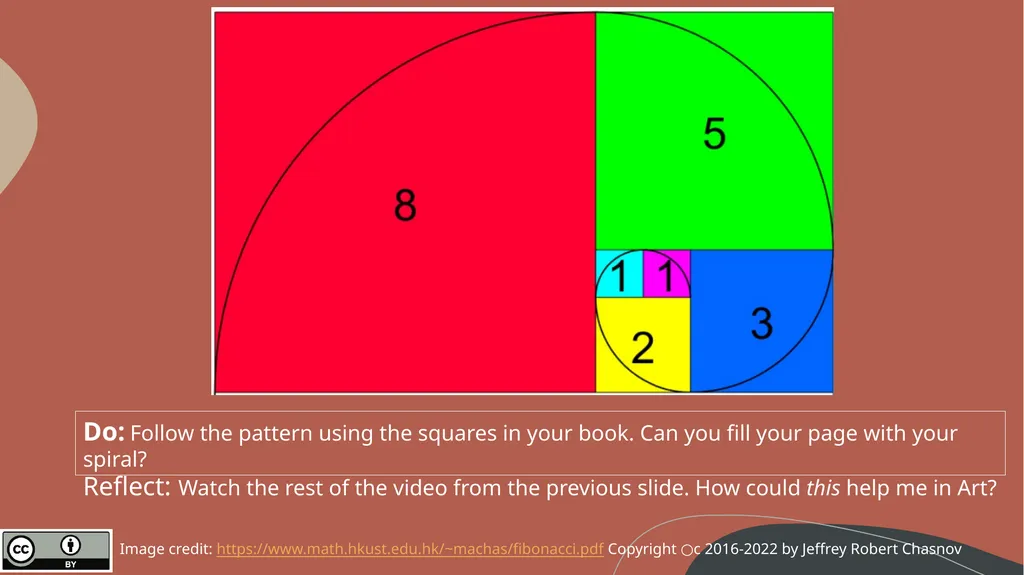
Do: Follow the pattern using the squares in your book. Can you fill your page with your spiral? Image credit: https://www.math.hkust.edu.hk/~machas/fibonacci.pdf Copyright ○c 2016-2022 by Jeffrey Robert Chasnov Reflect: Watch the rest of the video from the previous slide. How could this help me in Art?<br>
07
Going beyond…
Keep your eyes open for Fibonacci numbers and Golden Spirals in unexpected places
Have a look at some of Vi Hart’s other maths videos
there are two more in the Doodling in Math Class: Spirals, Fibonacci, and Being a Plant series
but she’s got lots of other (completely unrelated) ones too. Hexaflexagons are one of Mrs Toerien’s favourites…
Practise doodling those Golden Spirals – or see how high you can get in the Fibonacci sequence<br>
Keep your eyes open for Fibonacci numbers and Golden Spirals in unexpected places
Have a look at some of Vi Hart’s other maths videos
there are two more in the Doodling in Math Class: Spirals, Fibonacci, and Being a Plant series
but she’s got lots of other (completely unrelated) ones too. Hexaflexagons are one of Mrs Toerien’s favourites…
Practise doodling those Golden Spirals – or see how high you can get in the Fibonacci sequence<br>
08
Can Maths help me get better at art?
LO: Investigate the Fibonacci sequence in nature<br>
09
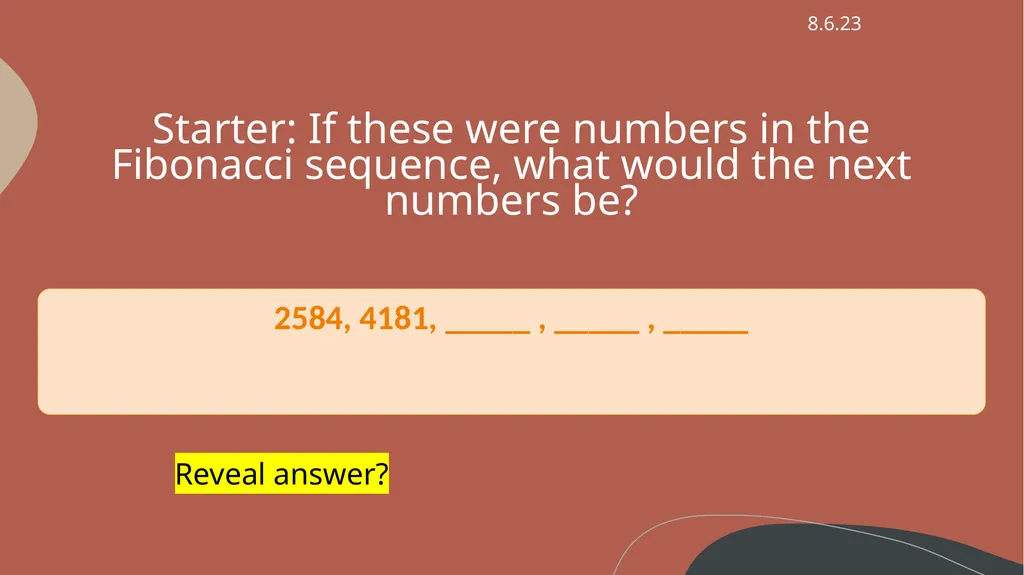
Starter: If these were numbers in the Fibonacci sequence, what would the next numbers be? 8.6.23 Reveal answer?<br>
10
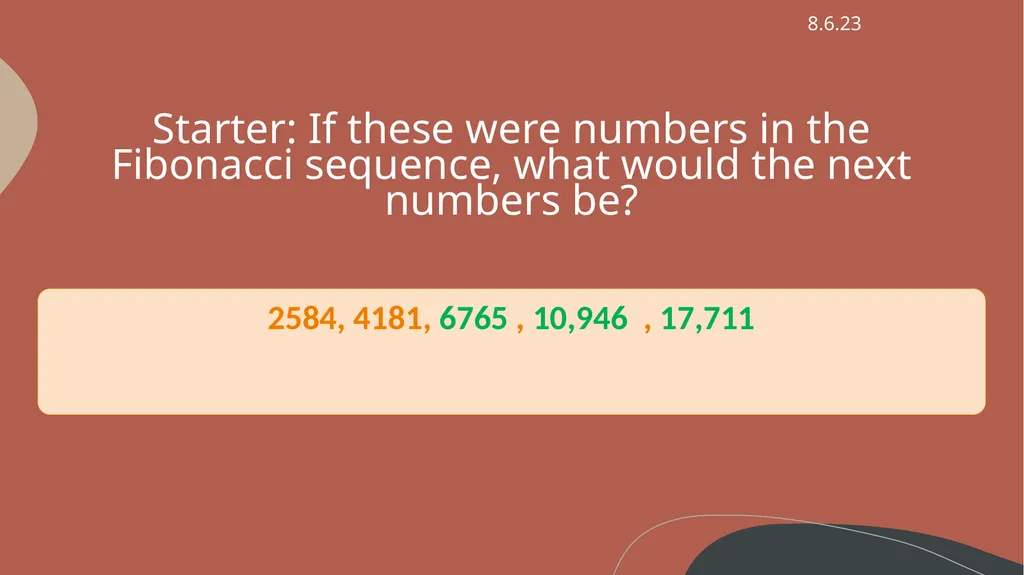
Starter: If these were numbers in the Fibonacci sequence, what would the next numbers be? 8.6.23<br>
11
Can Maths help me to get better at Art? What do you think now? Do you have other questions that might help you to answer this big question?<br>
12
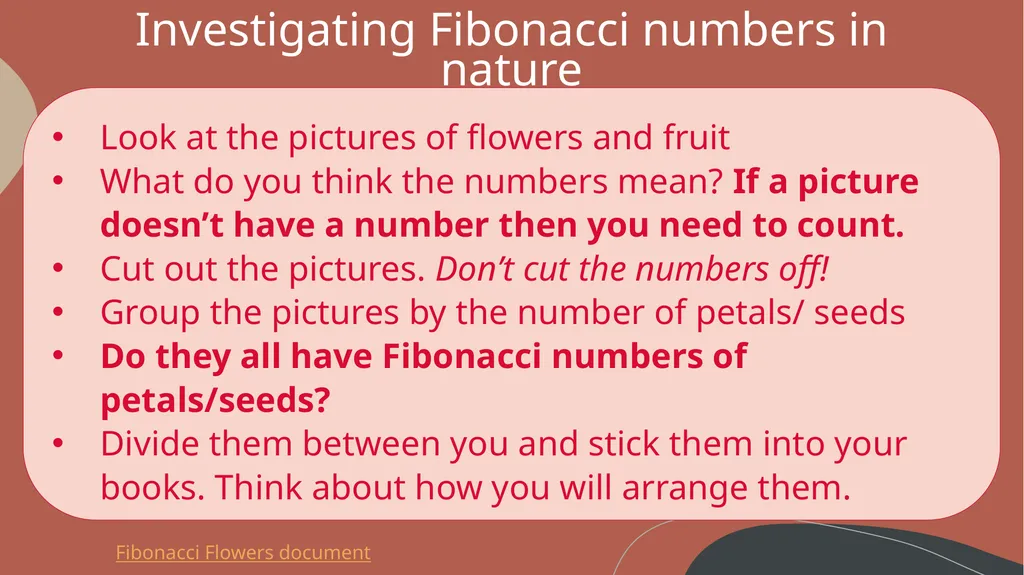
Look at the pictures of flowers and fruit
What do you think the numbers mean? If a picture doesn’t have a number then you need to count.
Cut out the pictures. Don’t cut the numbers off!
Group the pictures by the number of petals/ seeds
Do they all have Fibonacci numbers of petals/seeds?
Divide them between you and stick them into your books. Think about how you will arrange them. Investigating Fibonacci numbers in nature Fibonacci Flowers document<br>
What do you think the numbers mean? If a picture doesn’t have a number then you need to count.
Cut out the pictures. Don’t cut the numbers off!
Group the pictures by the number of petals/ seeds
Do they all have Fibonacci numbers of petals/seeds?
Divide them between you and stick them into your books. Think about how you will arrange them. Investigating Fibonacci numbers in nature Fibonacci Flowers document<br>
13
Cut out the pictures of sunflowers, pinecones and cacti and share them between you
Can you draw spirals out from the centre like Vi did last lesson?
Count the spirals
Are they all Fibonacci numbers?
Stick the pictures into your book Investigating Fibonacci spirals in nature<br>
Can you draw spirals out from the centre like Vi did last lesson?
Count the spirals
Are they all Fibonacci numbers?
Stick the pictures into your book Investigating Fibonacci spirals in nature<br>
14
Golden angle
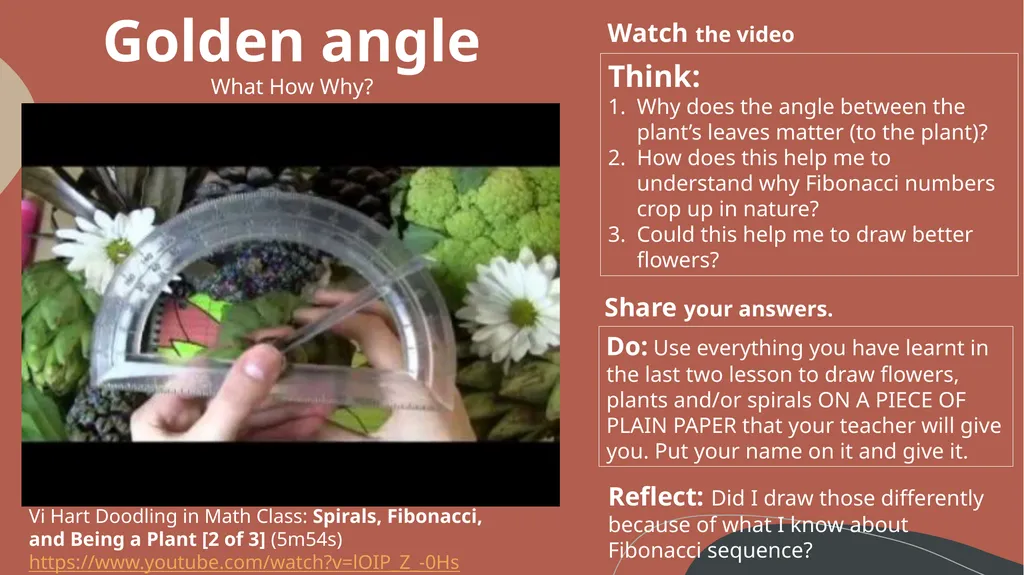
What How Why? Vi Hart Doodling in Math Class: Spirals, Fibonacci, and Being a Plant [2 of 3] (5m54s) https://www.youtube.com/watch?v=lOIP_Z_-0Hs Think:
Why does the angle between the plant’s leaves matter (to the plant)?
How does this help me to understand why Fibonacci numbers crop up in nature?
Could this help me to draw better flowers? Share your answers. Do: Use everything you have learnt in the last two lesson to draw flowers, plants and/or spirals ON A PIECE OF PLAIN PAPER that your teacher will give you. Put your name on it and give it. Reflect: Did I draw those differently because of what I know about Fibonacci sequence? Watch the video<br>
What How Why? Vi Hart Doodling in Math Class: Spirals, Fibonacci, and Being a Plant [2 of 3] (5m54s) https://www.youtube.com/watch?v=lOIP_Z_-0Hs Think:
Why does the angle between the plant’s leaves matter (to the plant)?
How does this help me to understand why Fibonacci numbers crop up in nature?
Could this help me to draw better flowers? Share your answers. Do: Use everything you have learnt in the last two lesson to draw flowers, plants and/or spirals ON A PIECE OF PLAIN PAPER that your teacher will give you. Put your name on it and give it. Reflect: Did I draw those differently because of what I know about Fibonacci sequence? Watch the video<br>
15
Going beyond…
Keep your eyes open for Fibonacci numbers and Golden Spirals in unexpected places
Have a go at drawing/doodling some more plants, animals and spirals using your knowledge of the Fibonacci sequence. If you make any good ones, bring them in to use on a poster at the end of the project<br>
Keep your eyes open for Fibonacci numbers and Golden Spirals in unexpected places
Have a go at drawing/doodling some more plants, animals and spirals using your knowledge of the Fibonacci sequence. If you make any good ones, bring them in to use on a poster at the end of the project<br>
16
Can Maths help me get better at art?
LO: Investigate the Fibonacci sequence in nature<br>
17
Can Maths help me get better at Art? Homework on Teams
Your homework is to re-watch the video, make an 'angletron' and draw some flowers. Be as creative as you would like! I will need these in for Monday 19th to gain merit points. The video link is Doodling in Math Class: Spirals, Fibonacci, and Being a Plant [2 of 3] - YouTube’
Collect a piece of coloured paper from your teacher. Do not stick it in – you might want to cut your drawings out and use them on a poster at the end of the inquiry. 14.6.23<br>
Your homework is to re-watch the video, make an 'angletron' and draw some flowers. Be as creative as you would like! I will need these in for Monday 19th to gain merit points. The video link is Doodling in Math Class: Spirals, Fibonacci, and Being a Plant [2 of 3] - YouTube’
Collect a piece of coloured paper from your teacher. Do not stick it in – you might want to cut your drawings out and use them on a poster at the end of the inquiry. 14.6.23<br>
18
How common are Fibonacci numbers in nature? We are going to explore outside to find out how common Fibonacci numbers really are
Stick your record sheet in your book
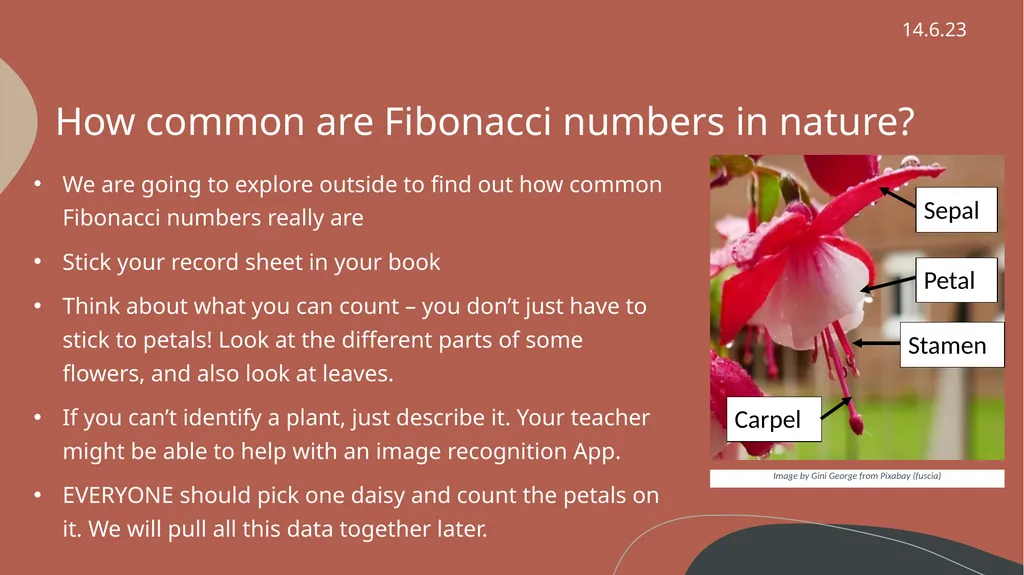
Think about what you can count – you don’t just have to stick to petals! Look at the different parts of some flowers, and also look at leaves.
If you can’t identify a plant, just describe it. Your teacher might be able to help with an image recognition App.
EVERYONE should pick one daisy and count the petals on it. We will pull all this data together later. 14.6.23<br>
Stick your record sheet in your book
Think about what you can count – you don’t just have to stick to petals! Look at the different parts of some flowers, and also look at leaves.
If you can’t identify a plant, just describe it. Your teacher might be able to help with an image recognition App.
EVERYONE should pick one daisy and count the petals on it. We will pull all this data together later. 14.6.23<br>
19
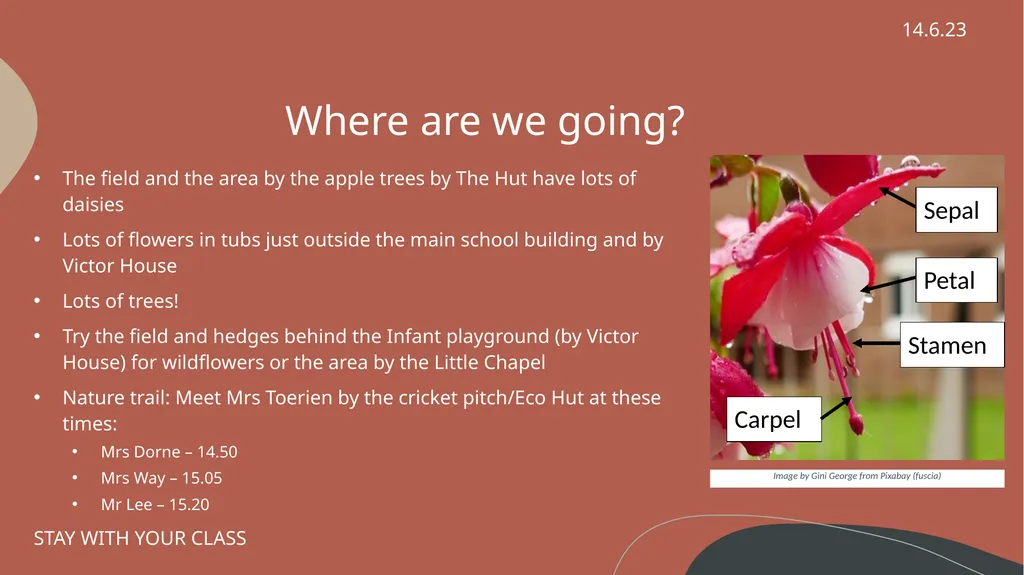
Where are we going? The field and the area by the apple trees by The Hut have lots of daisies
Lots of flowers in tubs just outside the main school building and by Victor House
Lots of trees!
Try the field and hedges behind the Infant playground (by Victor House) for wildflowers or the area by the Little Chapel
Nature trail: Meet Mrs Toerien by the cricket pitch/Eco Hut at these times:
Mrs Dorne – 14.50
Mrs Way – 15.05
Mr Lee – 15.20
STAY WITH YOUR CLASS 14.6.23<br>
Lots of flowers in tubs just outside the main school building and by Victor House
Lots of trees!
Try the field and hedges behind the Infant playground (by Victor House) for wildflowers or the area by the Little Chapel
Nature trail: Meet Mrs Toerien by the cricket pitch/Eco Hut at these times:
Mrs Dorne – 14.50
Mrs Way – 15.05
Mr Lee – 15.20
STAY WITH YOUR CLASS 14.6.23<br>
20
Ground rules 14.6.23 Stay with your class group. Don’t wander off and join another class.
Take care on the roads. Always use the crossings and look both ways for traffic yourself. Don’t assume someone else is looking.
On the way to the nature trail we will be on public roads. Keep your eyes open. Stay to one side and do not fill in your table until we get off the roads.
Watch your step on uneven ground. Stay away from and do not startle cows.
You should pick one daisy, do not pick any other flowers.
Watch out for nettles and brambles.
Let your teacher know BEFORE going out if you have a history of experiencing strong allergic reactions to bites or stings.
If you don’t know the name of a plant, just describe it. Ask your teacher for help.<br>
Take care on the roads. Always use the crossings and look both ways for traffic yourself. Don’t assume someone else is looking.
On the way to the nature trail we will be on public roads. Keep your eyes open. Stay to one side and do not fill in your table until we get off the roads.
Watch your step on uneven ground. Stay away from and do not startle cows.
You should pick one daisy, do not pick any other flowers.
Watch out for nettles and brambles.
Let your teacher know BEFORE going out if you have a history of experiencing strong allergic reactions to bites or stings.
If you don’t know the name of a plant, just describe it. Ask your teacher for help.<br>
21
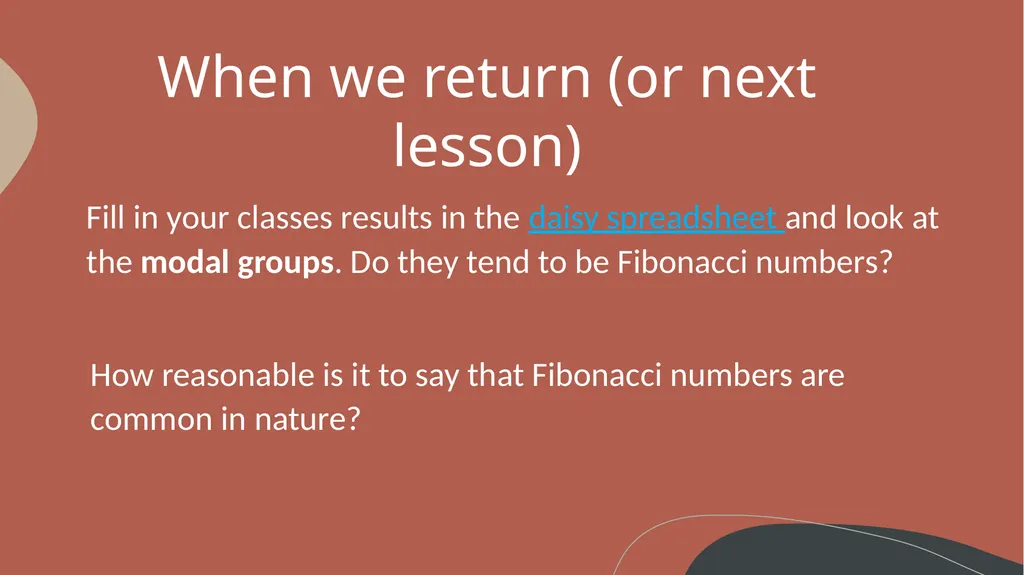
When we return (or next lesson) How reasonable is it to say that Fibonacci numbers are common in nature? Fill in your classes results in the daisy spreadsheet and look at the modal groups. Do they tend to be Fibonacci numbers?<br>
22
Can Maths help me get better at art?
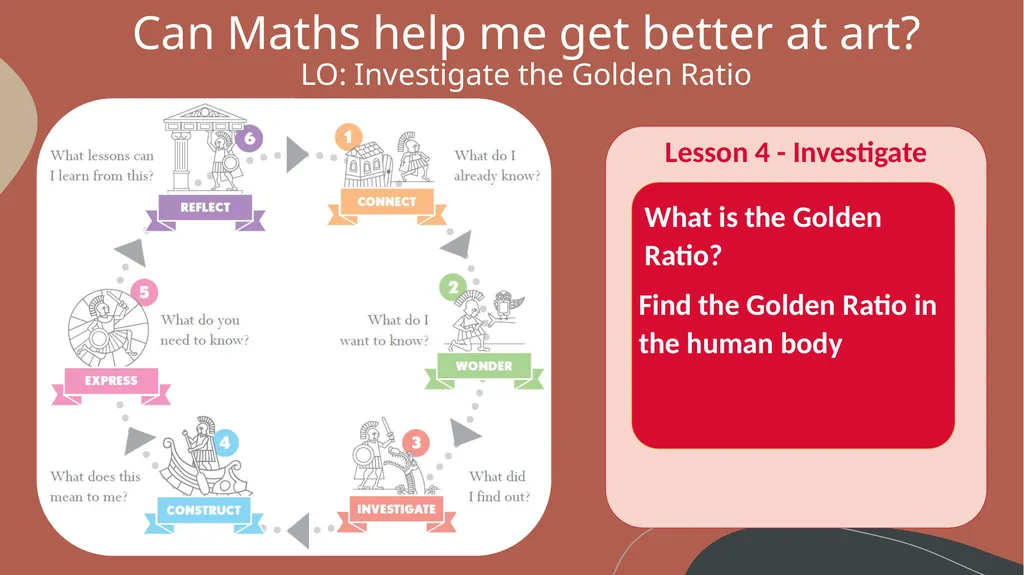
LO: Investigate the Golden Ratio What is the Golden Ratio? Find the Golden Ratio in the human body<br>
23
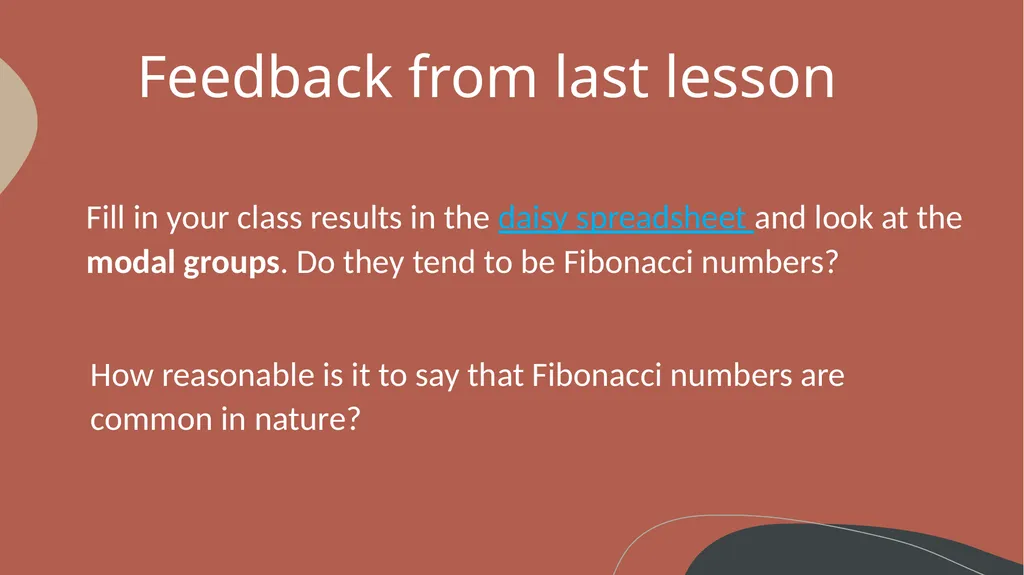
Feedback from last lesson How reasonable is it to say that Fibonacci numbers are common in nature? Fill in your class results in the daisy spreadsheet and look at the modal groups. Do they tend to be Fibonacci numbers?<br>
24
Can Maths help me get better at art?
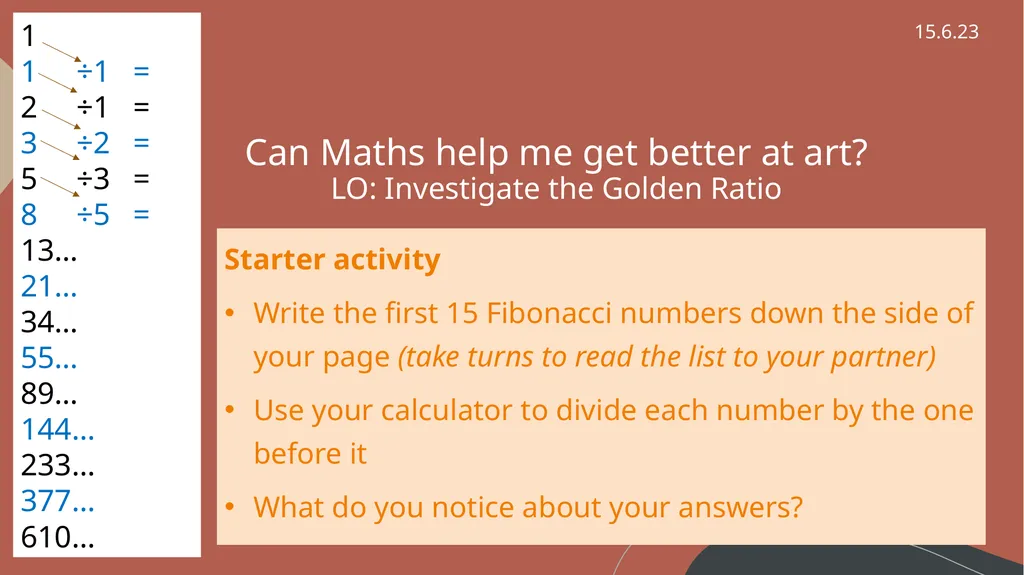
LO: Investigate the Golden Ratio Starter activity
Write the first 15 Fibonacci numbers down the side of your page (take turns to read the list to your partner)
Use your calculator to divide each number by the one before it
What do you notice about your answers? 15.6.23 1
1 ÷1 =
2 ÷1 =
3 ÷2 =
5 ÷3 =
8 ÷5 =
13…
21…
34…
55…
89…
144…
233…
377…
610…<br>
Write the first 15 Fibonacci numbers down the side of your page (take turns to read the list to your partner)
Use your calculator to divide each number by the one before it
What do you notice about your answers? 15.6.23 1
1 ÷1 =
2 ÷1 =
3 ÷2 =
5 ÷3 =
8 ÷5 =
13…
21…
34…
55…
89…
144…
233…
377…
610…<br>
25
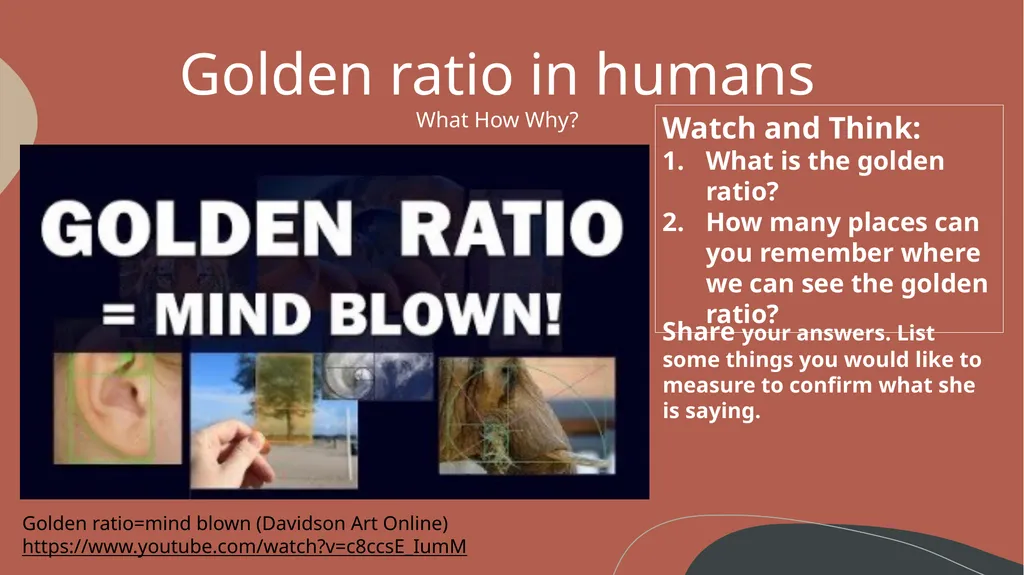
Golden ratio in humans
What How Why? Golden ratio=mind blown (Davidson Art Online)
https://www.youtube.com/watch?v=c8ccsE_IumM Watch and Think:
What is the golden ratio?
How many places can you remember where we can see the golden ratio? Share your answers. List some things you would like to measure to confirm what she is saying.<br>
What How Why? Golden ratio=mind blown (Davidson Art Online)
https://www.youtube.com/watch?v=c8ccsE_IumM Watch and Think:
What is the golden ratio?
How many places can you remember where we can see the golden ratio? Share your answers. List some things you would like to measure to confirm what she is saying.<br>
26
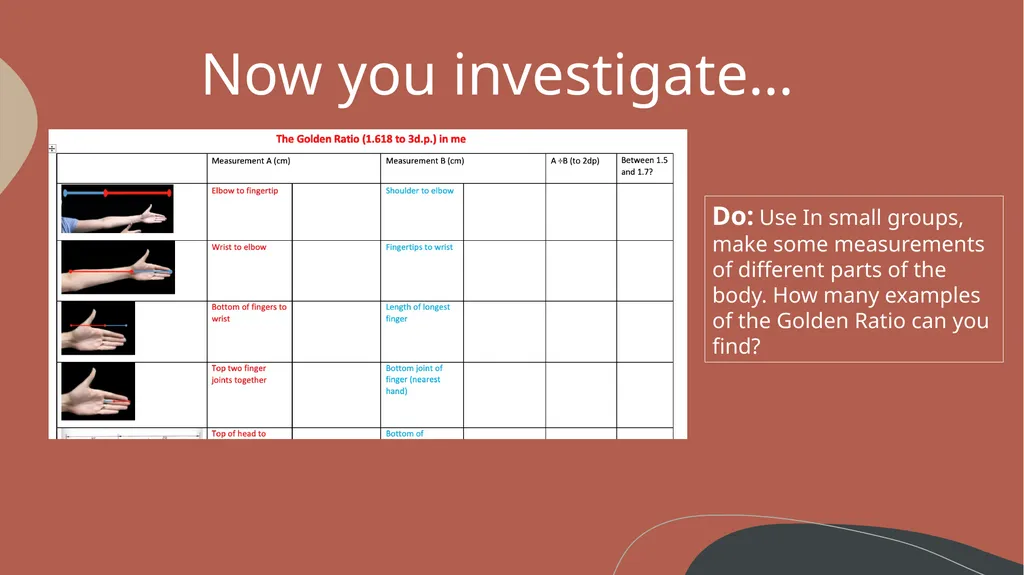
Now you investigate… Do: Use In small groups, make some measurements of different parts of the body. How many examples of the Golden Ratio can you find?<br>
27
Reflect Could I use this to draw more realistic people? How? Do you think the Golden Ratio is really everywhere, or do you think that if I chose a different ratio (e.g. 1:4) I could choose to measure parts of my body that would show that too?<br>
28
Work in progress beyond this point!<br>
29
Can Maths help me get better at art?<br>
30
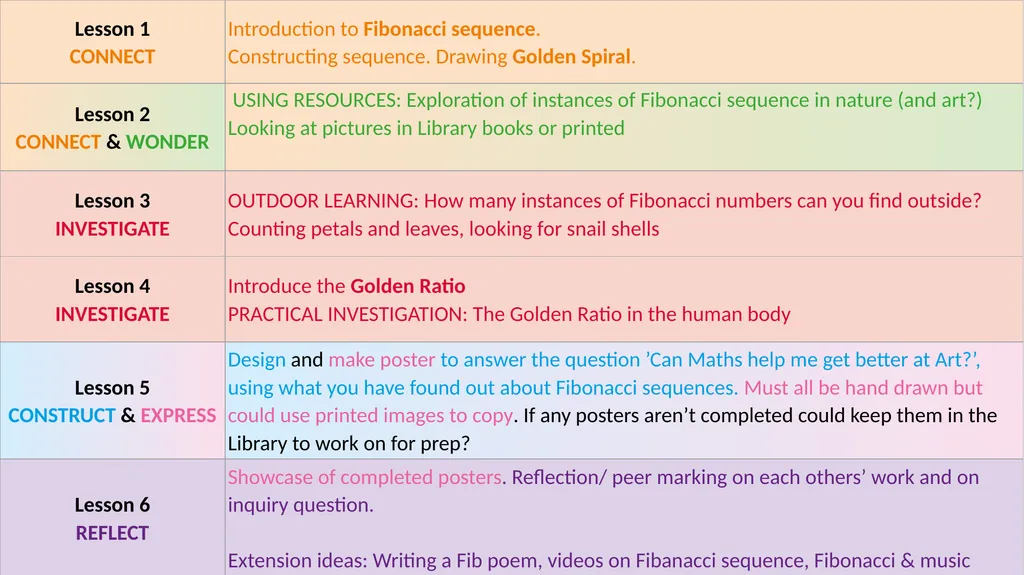
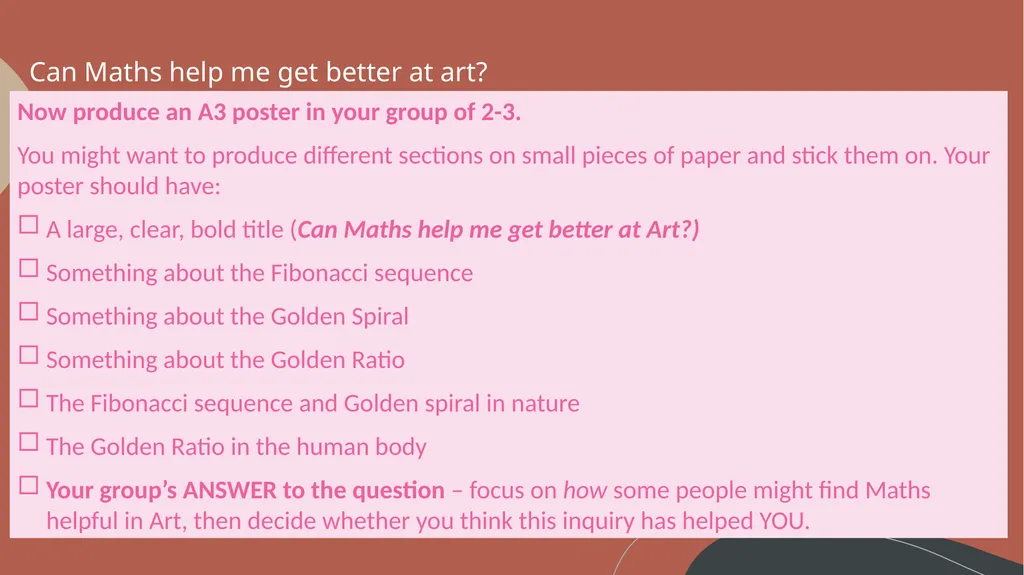
Can Maths help me get better at art? Now produce an A3 poster in your group of 2-3.
You might want to produce different sections on small pieces of paper and stick them on. Your poster should have:
A large, clear, bold title (Can Maths help me get better at Art?)
Something about the Fibonacci sequence
Something about the Golden Spiral
Something about the Golden Ratio
The Fibonacci sequence and Golden spiral in nature
The Golden Ratio in the human body
Your group’s ANSWER to the question – focus on how some people might find Maths helpful in Art, then decide whether you think this inquiry has helped YOU.<br>
You might want to produce different sections on small pieces of paper and stick them on. Your poster should have:
A large, clear, bold title (Can Maths help me get better at Art?)
Something about the Fibonacci sequence
Something about the Golden Spiral
Something about the Golden Ratio
The Fibonacci sequence and Golden spiral in nature
The Golden Ratio in the human body
Your group’s ANSWER to the question – focus on how some people might find Maths helpful in Art, then decide whether you think this inquiry has helped YOU.<br>
31
Can Maths help me get better at art?<br>
32
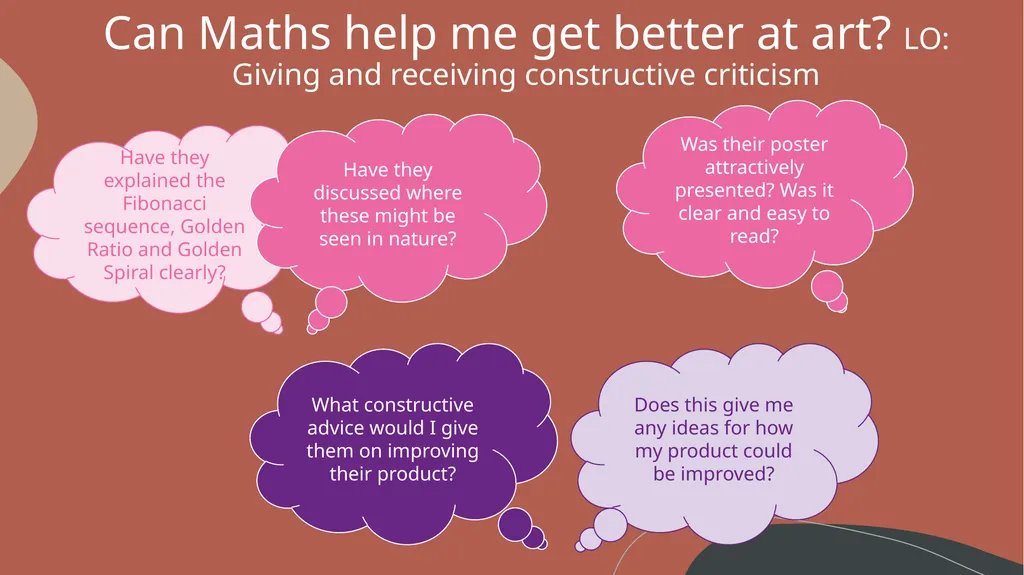
Can Maths help me get better at art? LO: Giving and receiving constructive criticism Have they explained the Fibonacci sequence, Golden Ratio and Golden Spiral clearly? Have they discussed where these might be seen in nature? Was their poster attractively presented? Was it clear and easy to read? What constructive advice would I give them on improving their product? Does this give me any ideas for how my product could be improved?<br>
33
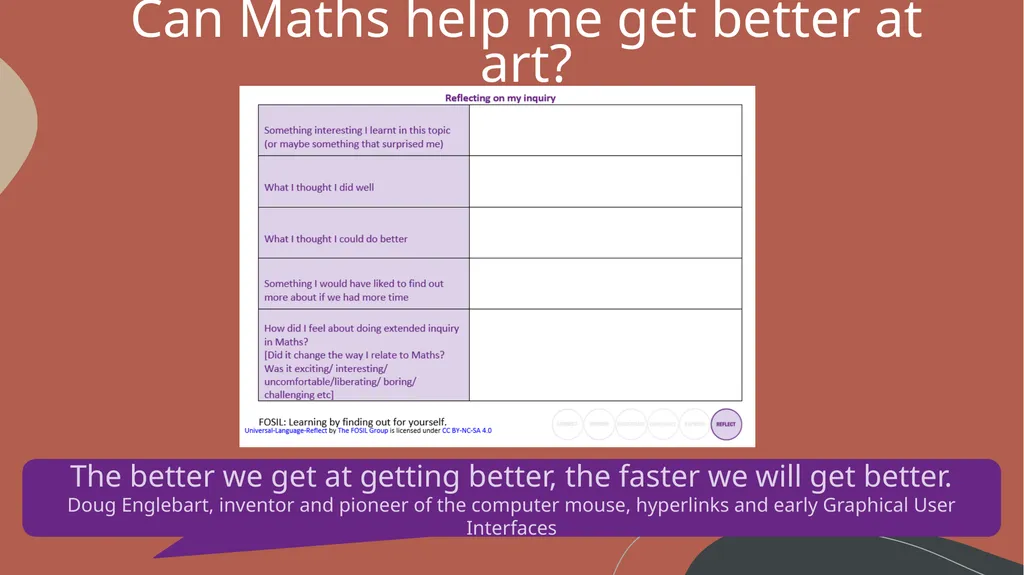
Can Maths help me get better at art? The better we get at getting better, the faster we will get better.
Doug Englebart, inventor and pioneer of the computer mouse, hyperlinks and early Graphical User Interfaces<br>
Doug Englebart, inventor and pioneer of the computer mouse, hyperlinks and early Graphical User Interfaces<br>