
Cancellations – Best Practice Working together to
NS
Published · 17 slides · 0 views
1 / 1
Description
Cancellations Best Practice Working together to improve customer retention 2nd Edition 23Oct19 Contributions from Purpose - (this is a shared problem for both Insurers and Distributors) In short, Cancellations (especially year 1) are
Related Topics
Share
Embed code
Download this presentation From Below
"Cancellations – Best Practice Working together to" is the property of its rightful owner. Permission is granted to download and print the materials on this website for personal, non-commercial use only, and to display it on your personal computer provided you do not modify the materials and that you retain all copyright notices contained in the materials. By downloading content from our website, you accept the terms of this agreement.
Presentation Transcript
01
Cancellations – Best Practice
Working together to improve customer retention
2nd Edition 23Oct19
Contributions from<br>
Working together to improve customer retention
2nd Edition 23Oct19
Contributions from<br>
02
Purpose - (this is a shared problem for both Insurers and Distributors) In short, Cancellations (especially year 1) are rising slowly but surely year on year, despite better products and a rise in policy benefits
Consumer behaviour is changing
Expectations of flexibility and service are higher
Distrust remains uncomfortably high
Documentation is now delivered electronically making insurance seem less and less tangible in the eyes of the consumer.
Therefore, we need to look at the PROCESS of how INSURERS handle cancellations, especially direct debit cancellations, missed payments and reinstatement.
Then how BROKERS work in tandem with insurers to MINIMISE cancellations and maximise RECOVERY/RESINTATEMENTS<br>
Consumer behaviour is changing
Expectations of flexibility and service are higher
Distrust remains uncomfortably high
Documentation is now delivered electronically making insurance seem less and less tangible in the eyes of the consumer.
Therefore, we need to look at the PROCESS of how INSURERS handle cancellations, especially direct debit cancellations, missed payments and reinstatement.
Then how BROKERS work in tandem with insurers to MINIMISE cancellations and maximise RECOVERY/RESINTATEMENTS<br>
03
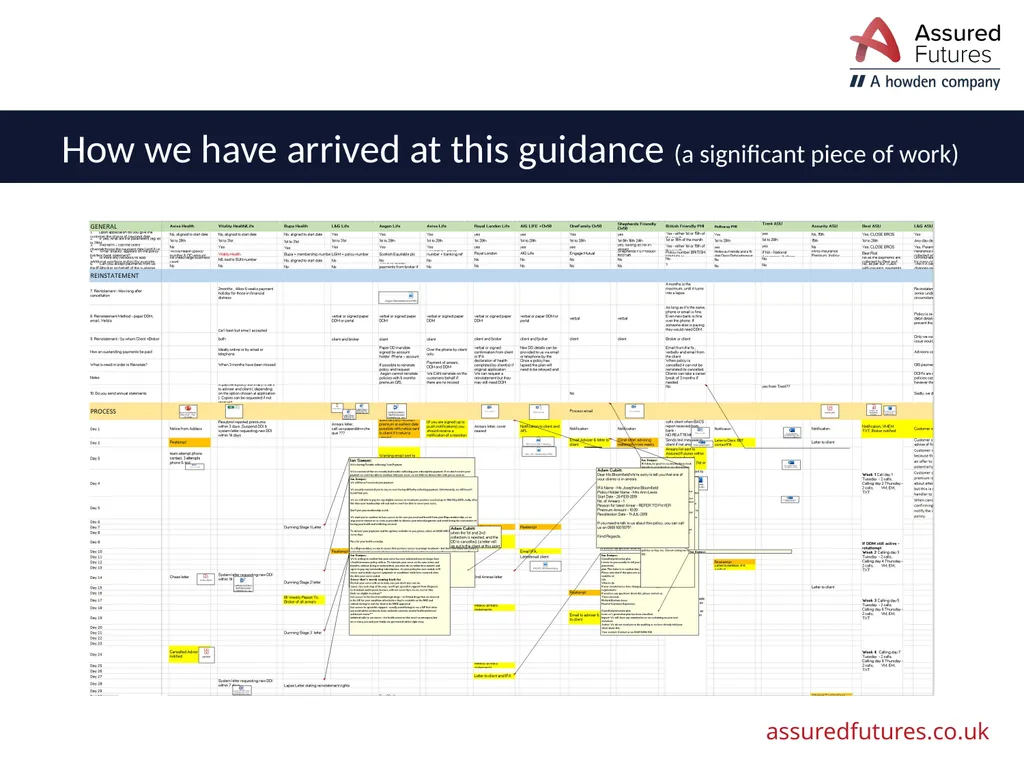
How we have arrived at this guidance We have mapped the cancellation processes of many insurers across different insurance markets;
Life Insurance
Over 50’s
Income Protection
Private Medical Insurance
Accident & Sickness Cover
All are discretionary purchase insurance and all paid monthly by direct debit.<br>
Life Insurance
Over 50’s
Income Protection
Private Medical Insurance
Accident & Sickness Cover
All are discretionary purchase insurance and all paid monthly by direct debit.<br>
04
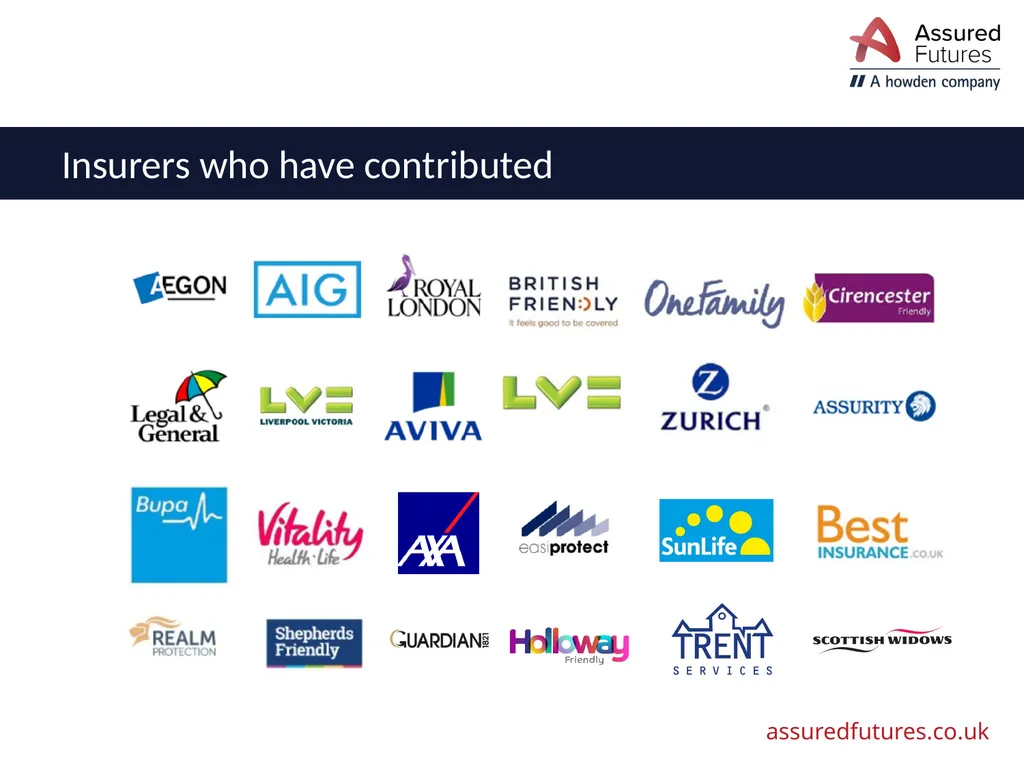
Insurers who have contributed<br>
05
How we have arrived at this guidance (a significant piece of work)<br>
06
Our Findings We have discovered a wide variety of approaches where use of letters, text, calls and emails were all used in a plethora of ways - we can now spot best practice.
We cross-referenced the insurer processes against our retention rates (first 2 years) to establish consistency between performance and process.
By looking across the different market sectors, LIFE, HEALTH and GI INCOME PROTECTION we have gained a unique perspective on this matter and can share helpful guidance and best practice, for all firms to benefit.
Included:
Key findings
Suggested Process
Suggested Letters and Texts<br>
We cross-referenced the insurer processes against our retention rates (first 2 years) to establish consistency between performance and process.
By looking across the different market sectors, LIFE, HEALTH and GI INCOME PROTECTION we have gained a unique perspective on this matter and can share helpful guidance and best practice, for all firms to benefit.
Included:
Key findings
Suggested Process
Suggested Letters and Texts<br>
07
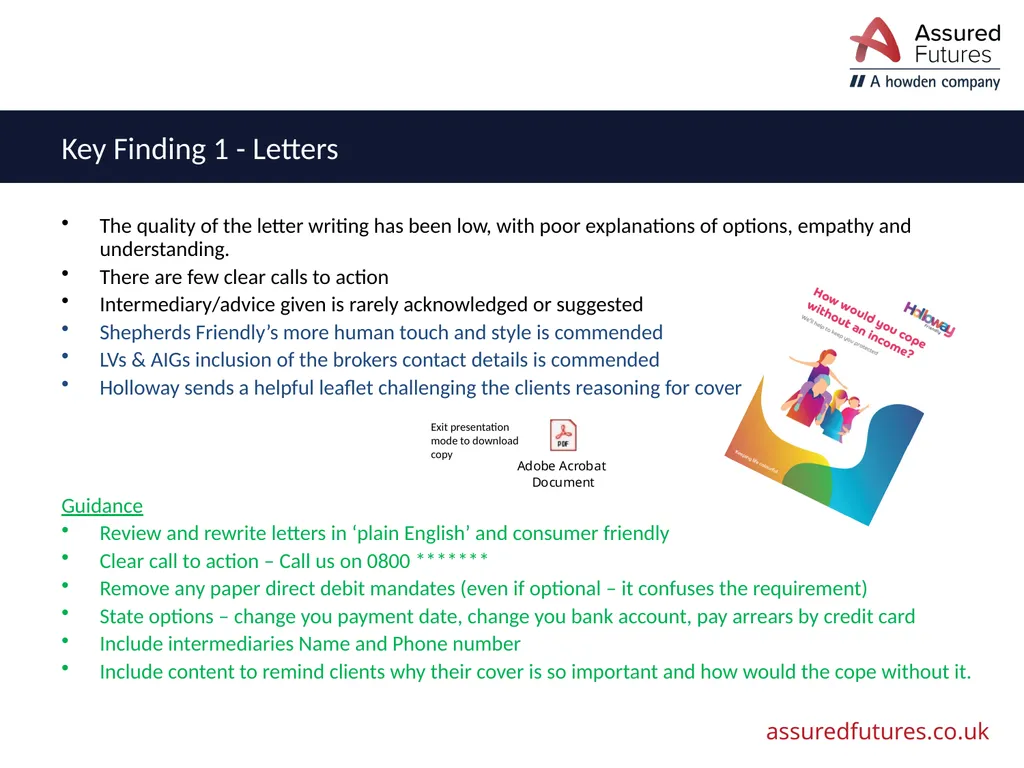
Key Finding 1 - Letters The quality of the letter writing has been low, with poor explanations of options, empathy and understanding.
There are few clear calls to action
Intermediary/advice given is rarely acknowledged or suggested
Shepherds Friendly’s more human touch and style is commended
LVs & AIGs inclusion of the brokers contact details is commended
Holloway sends a helpful leaflet challenging the clients reasoning for cover
Guidance
Review and rewrite letters in ‘plain English’ and consumer friendly
Clear call to action – Call us on 0800 *******
Remove any paper direct debit mandates (even if optional – it confuses the requirement)
State options – change you payment date, change you bank account, pay arrears by credit card
Include intermediaries Name and Phone number
Include content to remind clients why their cover is so important and how would the cope without it. Exit presentation mode to download copy<br>
There are few clear calls to action
Intermediary/advice given is rarely acknowledged or suggested
Shepherds Friendly’s more human touch and style is commended
LVs & AIGs inclusion of the brokers contact details is commended
Holloway sends a helpful leaflet challenging the clients reasoning for cover
Guidance
Review and rewrite letters in ‘plain English’ and consumer friendly
Clear call to action – Call us on 0800 *******
Remove any paper direct debit mandates (even if optional – it confuses the requirement)
State options – change you payment date, change you bank account, pay arrears by credit card
Include intermediaries Name and Phone number
Include content to remind clients why their cover is so important and how would the cope without it. Exit presentation mode to download copy<br>
08
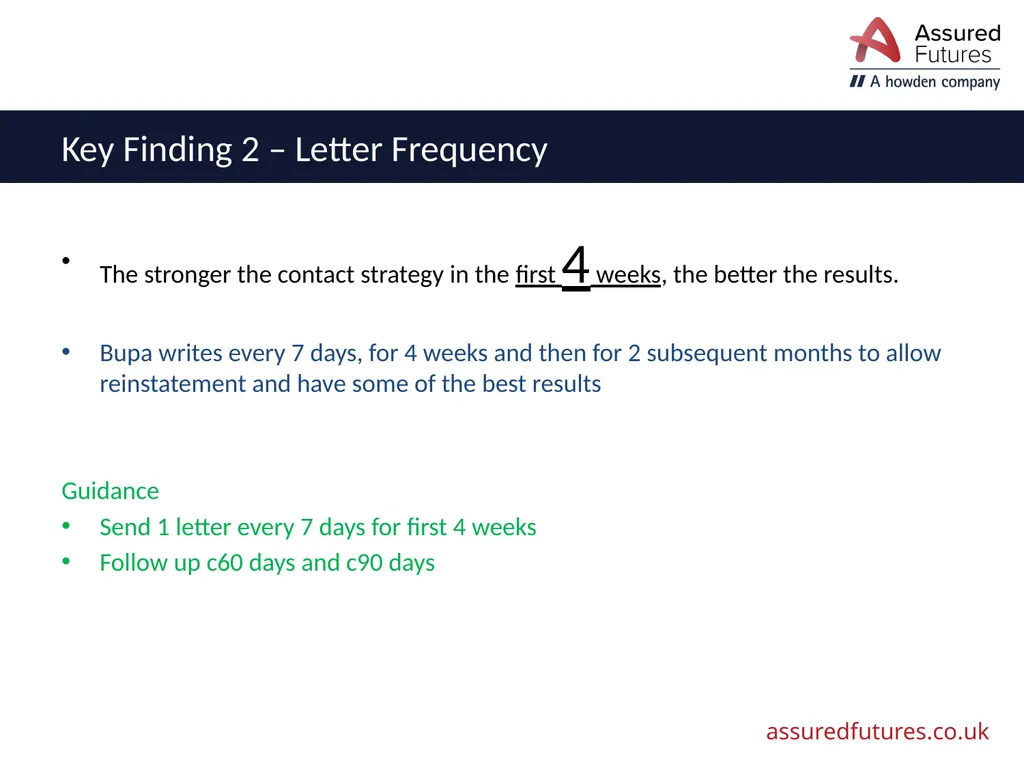
Key Finding 2 – Letter Frequency The stronger the contact strategy in the first 4 weeks, the better the results.
Bupa writes every 7 days, for 4 weeks and then for 2 subsequent months to allow reinstatement and have some of the best results
Guidance
Send 1 letter every 7 days for first 4 weeks
Follow up c60 days and c90 days<br>
Bupa writes every 7 days, for 4 weeks and then for 2 subsequent months to allow reinstatement and have some of the best results
Guidance
Send 1 letter every 7 days for first 4 weeks
Follow up c60 days and c90 days<br>
09
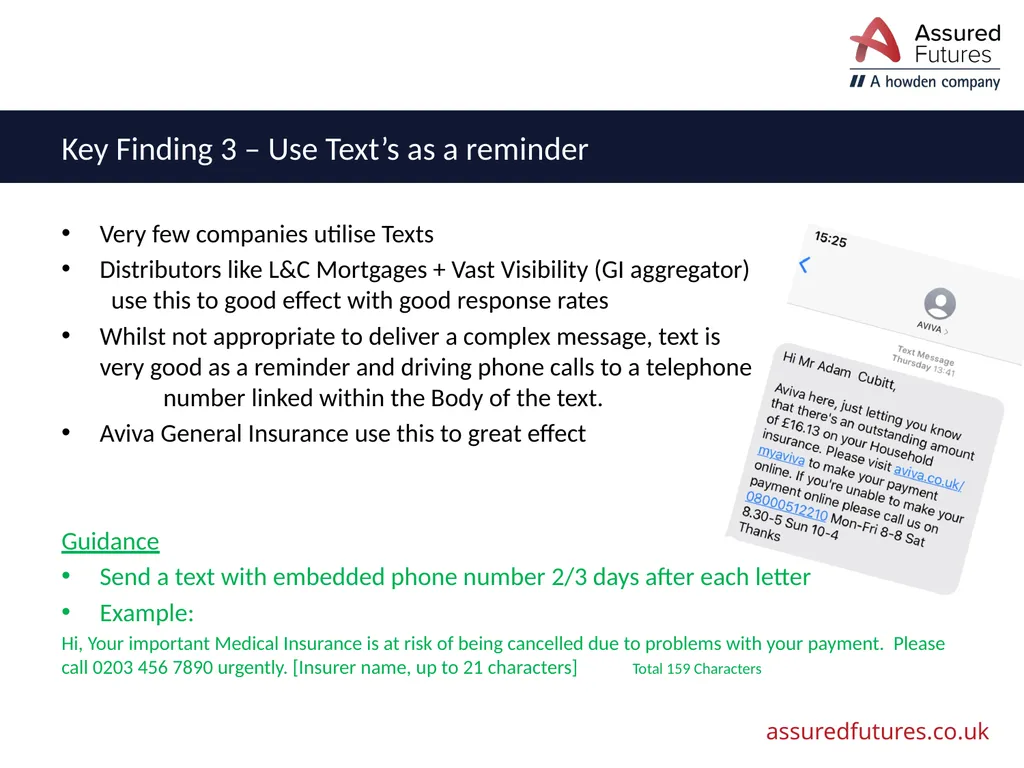
Key Finding 3 – Use Text’s as a reminder Very few companies utilise Texts
Distributors like L&C Mortgages + Vast Visibility (GI aggregator) use this to good effect with good response rates
Whilst not appropriate to deliver a complex message, text is very good as a reminder and driving phone calls to a telephone number linked within the Body of the text.
Aviva General Insurance use this to great effect
Guidance
Send a text with embedded phone number 2/3 days after each letter
Example:
Hi, Your important Medical Insurance is at risk of being cancelled due to problems with your payment. Please call 0203 456 7890 urgently. [Insurer name, up to 21 characters] Total 159 Characters<br>
Distributors like L&C Mortgages + Vast Visibility (GI aggregator) use this to good effect with good response rates
Whilst not appropriate to deliver a complex message, text is very good as a reminder and driving phone calls to a telephone number linked within the Body of the text.
Aviva General Insurance use this to great effect
Guidance
Send a text with embedded phone number 2/3 days after each letter
Example:
Hi, Your important Medical Insurance is at risk of being cancelled due to problems with your payment. Please call 0203 456 7890 urgently. [Insurer name, up to 21 characters] Total 159 Characters<br>
10
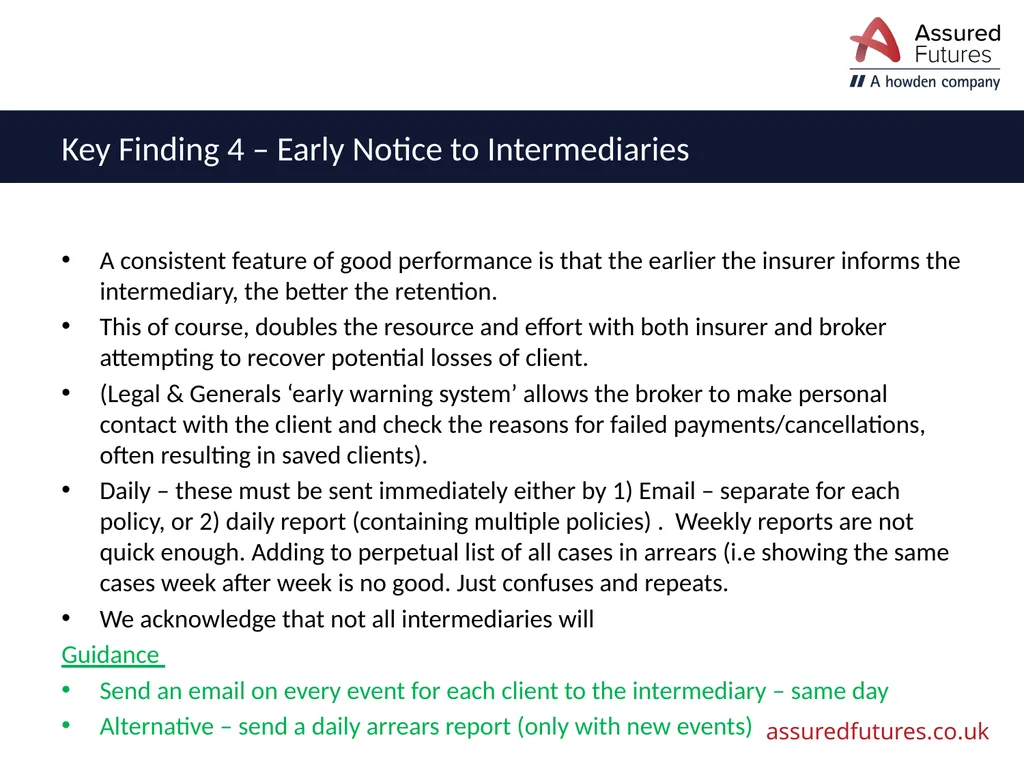
Key Finding 4 – Early Notice to Intermediaries A consistent feature of good performance is that the earlier the insurer informs the intermediary, the better the retention.
This of course, doubles the resource and effort with both insurer and broker attempting to recover potential losses of client.
(Legal & Generals ‘early warning system’ allows the broker to make personal contact with the client and check the reasons for failed payments/cancellations, often resulting in saved clients).
Daily – these must be sent immediately either by 1) Email – separate for each policy, or 2) daily report (containing multiple policies) . Weekly reports are not quick enough. Adding to perpetual list of all cases in arrears (i.e showing the same cases week after week is no good. Just confuses and repeats.
We acknowledge that not all intermediaries will
Guidance
Send an email on every event for each client to the intermediary – same day
Alternative – send a daily arrears report (only with new events)<br>
This of course, doubles the resource and effort with both insurer and broker attempting to recover potential losses of client.
(Legal & Generals ‘early warning system’ allows the broker to make personal contact with the client and check the reasons for failed payments/cancellations, often resulting in saved clients).
Daily – these must be sent immediately either by 1) Email – separate for each policy, or 2) daily report (containing multiple policies) . Weekly reports are not quick enough. Adding to perpetual list of all cases in arrears (i.e showing the same cases week after week is no good. Just confuses and repeats.
We acknowledge that not all intermediaries will
Guidance
Send an email on every event for each client to the intermediary – same day
Alternative – send a daily arrears report (only with new events)<br>
11
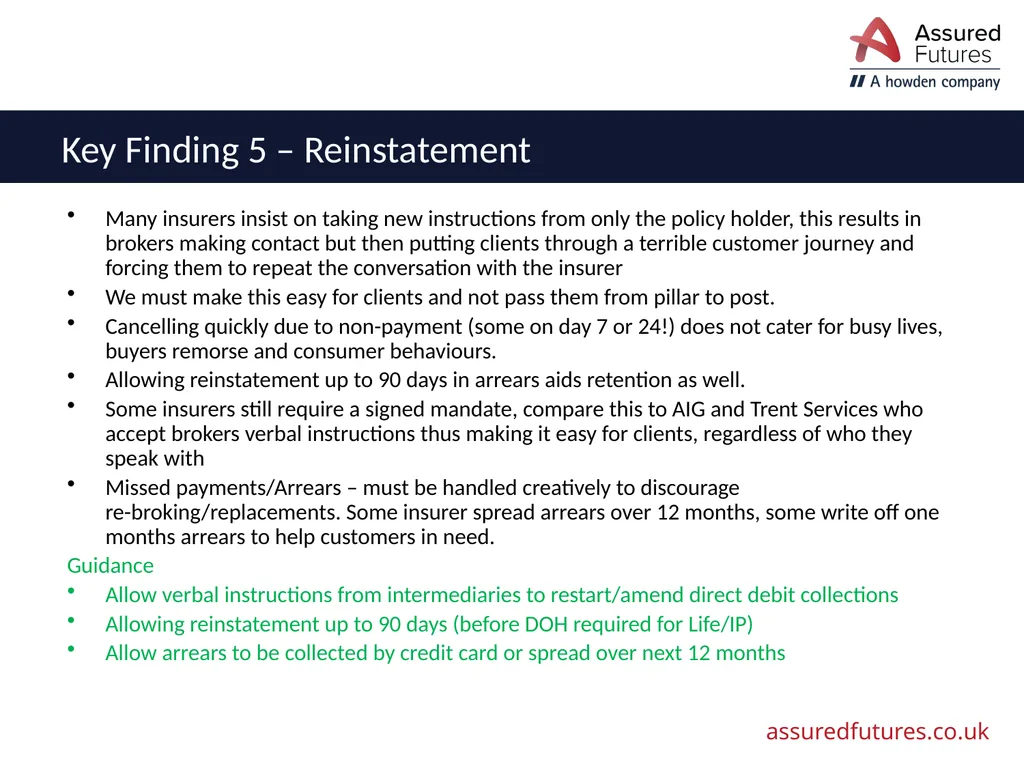
Key Finding 5 – Reinstatement Many insurers insist on taking new instructions from only the policy holder, this results in brokers making contact but then putting clients through a terrible customer journey and forcing them to repeat the conversation with the insurer
We must make this easy for clients and not pass them from pillar to post.
Cancelling quickly due to non-payment (some on day 7 or 24!) does not cater for busy lives, buyers remorse and consumer behaviours.
Allowing reinstatement up to 90 days in arrears aids retention as well.
Some insurers still require a signed mandate, compare this to AIG and Trent Services who accept brokers verbal instructions thus making it easy for clients, regardless of who they speak with
Missed payments/Arrears – must be handled creatively to discourage re-broking/replacements. Some insurer spread arrears over 12 months, some write off one months arrears to help customers in need.
Guidance
Allow verbal instructions from intermediaries to restart/amend direct debit collections
Allowing reinstatement up to 90 days (before DOH required for Life/IP)
Allow arrears to be collected by credit card or spread over next 12 months<br>
We must make this easy for clients and not pass them from pillar to post.
Cancelling quickly due to non-payment (some on day 7 or 24!) does not cater for busy lives, buyers remorse and consumer behaviours.
Allowing reinstatement up to 90 days in arrears aids retention as well.
Some insurers still require a signed mandate, compare this to AIG and Trent Services who accept brokers verbal instructions thus making it easy for clients, regardless of who they speak with
Missed payments/Arrears – must be handled creatively to discourage re-broking/replacements. Some insurer spread arrears over 12 months, some write off one months arrears to help customers in need.
Guidance
Allow verbal instructions from intermediaries to restart/amend direct debit collections
Allowing reinstatement up to 90 days (before DOH required for Life/IP)
Allow arrears to be collected by credit card or spread over next 12 months<br>
12
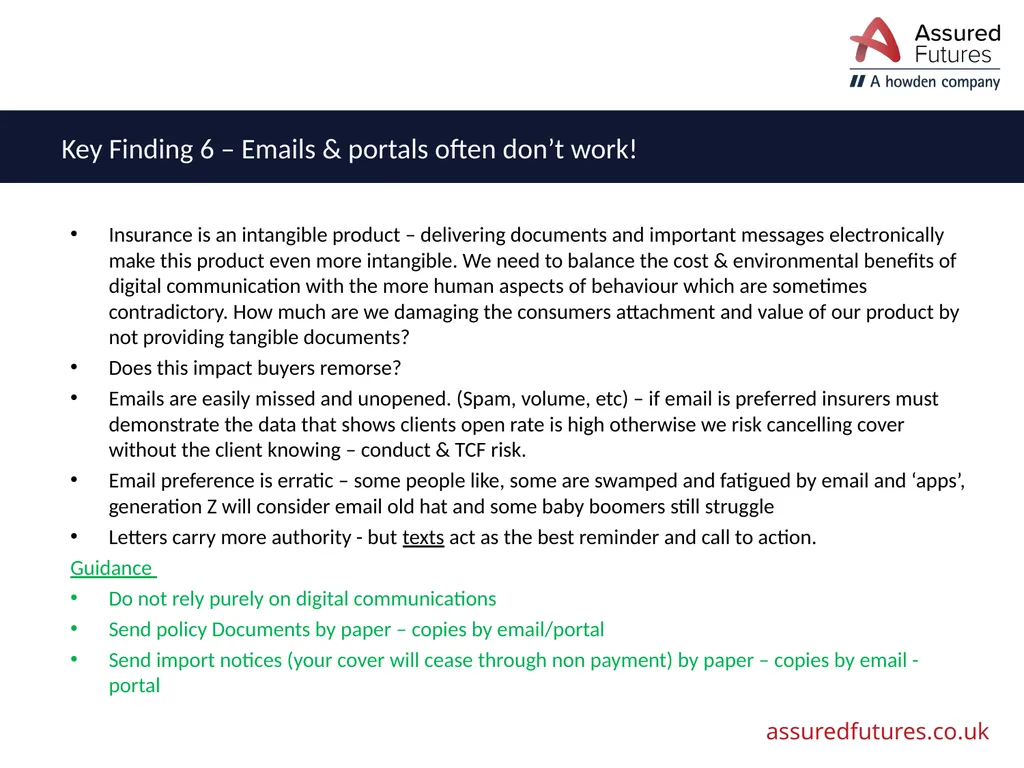
Key Finding 6 – Emails & portals often don’t work! Insurance is an intangible product – delivering documents and important messages electronically make this product even more intangible. We need to balance the cost & environmental benefits of digital communication with the more human aspects of behaviour which are sometimes contradictory. How much are we damaging the consumers attachment and value of our product by not providing tangible documents?
Does this impact buyers remorse?
Emails are easily missed and unopened. (Spam, volume, etc) – if email is preferred insurers must demonstrate the data that shows clients open rate is high otherwise we risk cancelling cover without the client knowing – conduct & TCF risk.
Email preference is erratic – some people like, some are swamped and fatigued by email and ‘apps’, generation Z will consider email old hat and some baby boomers still struggle
Letters carry more authority - but texts act as the best reminder and call to action.
Guidance
Do not rely purely on digital communications
Send policy Documents by paper – copies by email/portal
Send import notices (your cover will cease through non payment) by paper – copies by email - portal<br>
Does this impact buyers remorse?
Emails are easily missed and unopened. (Spam, volume, etc) – if email is preferred insurers must demonstrate the data that shows clients open rate is high otherwise we risk cancelling cover without the client knowing – conduct & TCF risk.
Email preference is erratic – some people like, some are swamped and fatigued by email and ‘apps’, generation Z will consider email old hat and some baby boomers still struggle
Letters carry more authority - but texts act as the best reminder and call to action.
Guidance
Do not rely purely on digital communications
Send policy Documents by paper – copies by email/portal
Send import notices (your cover will cease through non payment) by paper – copies by email - portal<br>
13
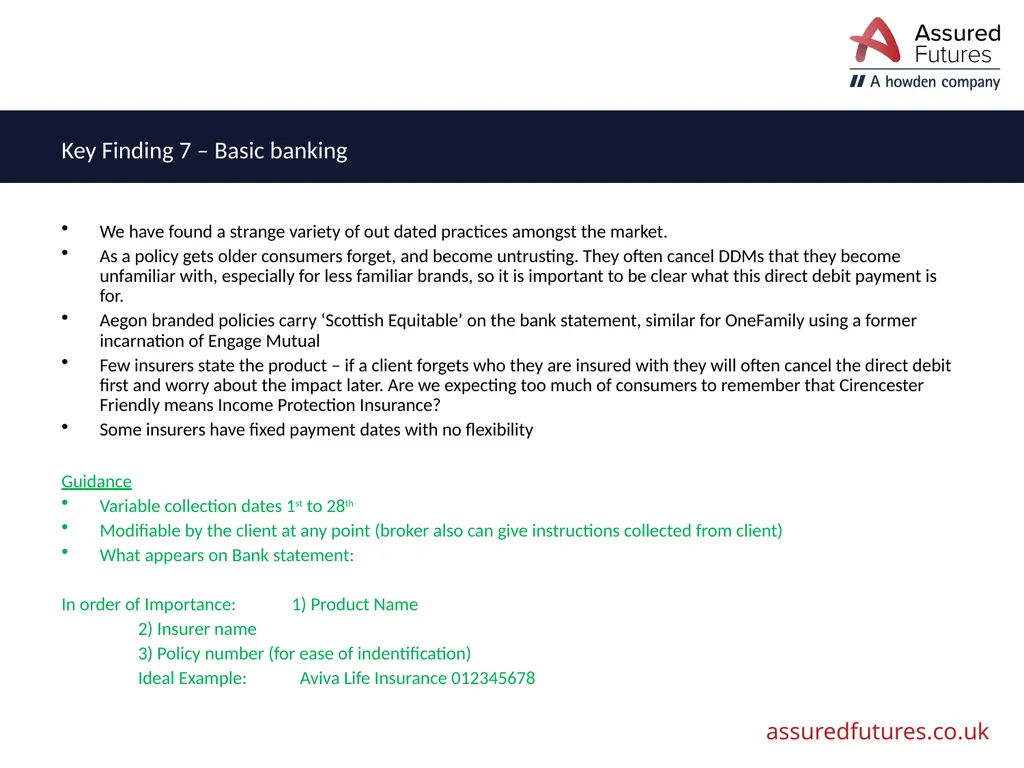
Key Finding 7 – Basic banking We have found a strange variety of out dated practices amongst the market.
As a policy gets older consumers forget, and become untrusting. They often cancel DDMs that they become unfamiliar with, especially for less familiar brands, so it is important to be clear what this direct debit payment is for.
Aegon branded policies carry ‘Scottish Equitable’ on the bank statement, similar for OneFamily using a former incarnation of Engage Mutual
Few insurers state the product – if a client forgets who they are insured with they will often cancel the direct debit first and worry about the impact later. Are we expecting too much of consumers to remember that Cirencester Friendly means Income Protection Insurance?
Some insurers have fixed payment dates with no flexibility
Guidance
Variable collection dates 1st to 28th
Modifiable by the client at any point (broker also can give instructions collected from client)
What appears on Bank statement:
In order of Importance: 1) Product Name
2) Insurer name
3) Policy number (for ease of indentification)
Ideal Example: Aviva Life Insurance 012345678<br>
As a policy gets older consumers forget, and become untrusting. They often cancel DDMs that they become unfamiliar with, especially for less familiar brands, so it is important to be clear what this direct debit payment is for.
Aegon branded policies carry ‘Scottish Equitable’ on the bank statement, similar for OneFamily using a former incarnation of Engage Mutual
Few insurers state the product – if a client forgets who they are insured with they will often cancel the direct debit first and worry about the impact later. Are we expecting too much of consumers to remember that Cirencester Friendly means Income Protection Insurance?
Some insurers have fixed payment dates with no flexibility
Guidance
Variable collection dates 1st to 28th
Modifiable by the client at any point (broker also can give instructions collected from client)
What appears on Bank statement:
In order of Importance: 1) Product Name
2) Insurer name
3) Policy number (for ease of indentification)
Ideal Example: Aviva Life Insurance 012345678<br>
14
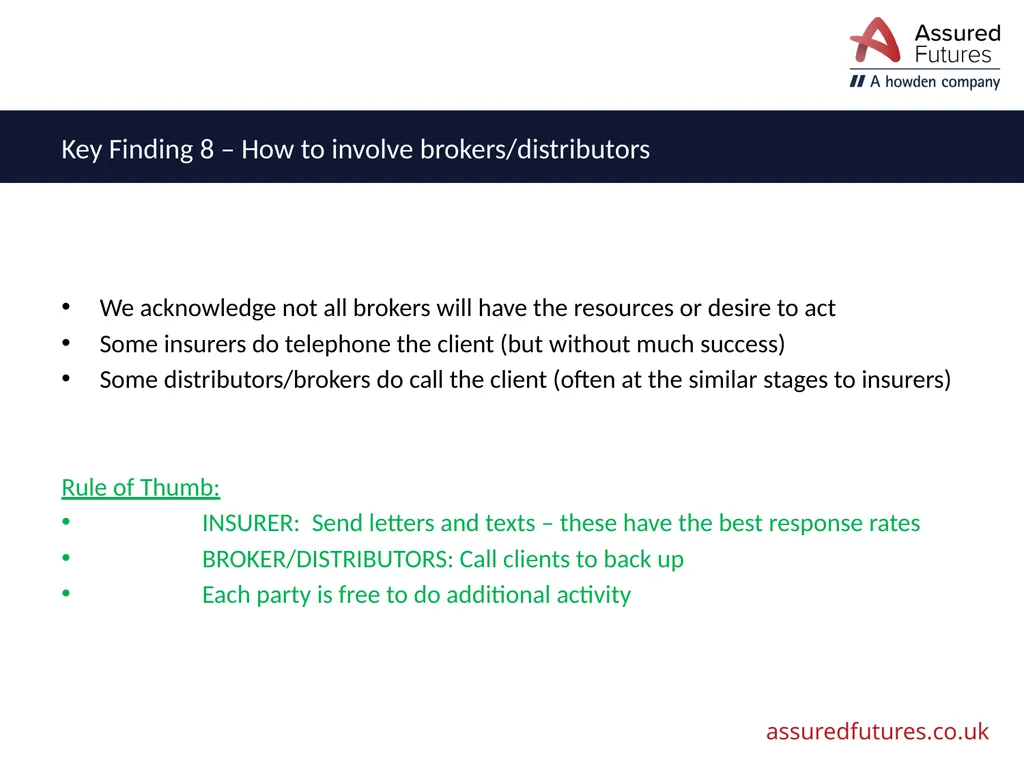
Key Finding 8 – How to involve brokers/distributors We acknowledge not all brokers will have the resources or desire to act
Some insurers do telephone the client (but without much success)
Some distributors/brokers do call the client (often at the similar stages to insurers)
Rule of Thumb:
INSURER: Send letters and texts – these have the best response rates
BROKER/DISTRIBUTORS: Call clients to back up
Each party is free to do additional activity<br>
Some insurers do telephone the client (but without much success)
Some distributors/brokers do call the client (often at the similar stages to insurers)
Rule of Thumb:
INSURER: Send letters and texts – these have the best response rates
BROKER/DISTRIBUTORS: Call clients to back up
Each party is free to do additional activity<br>
15
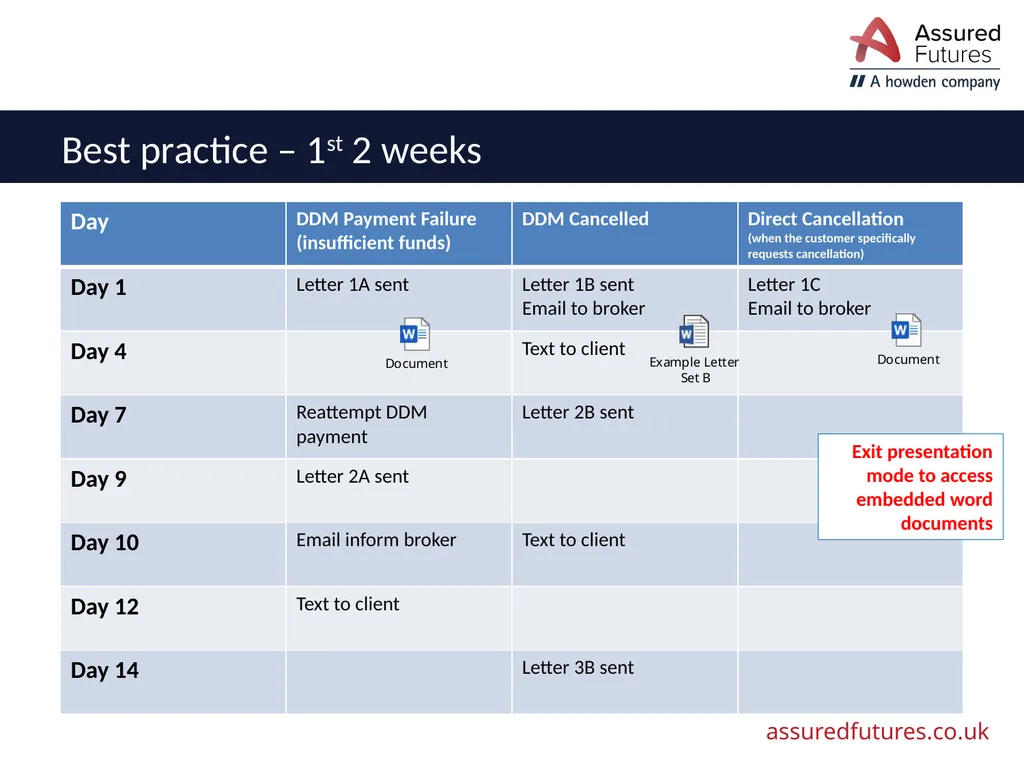
Best practice – 1st 2 weeks Exit presentation mode to access embedded word documents<br>
16
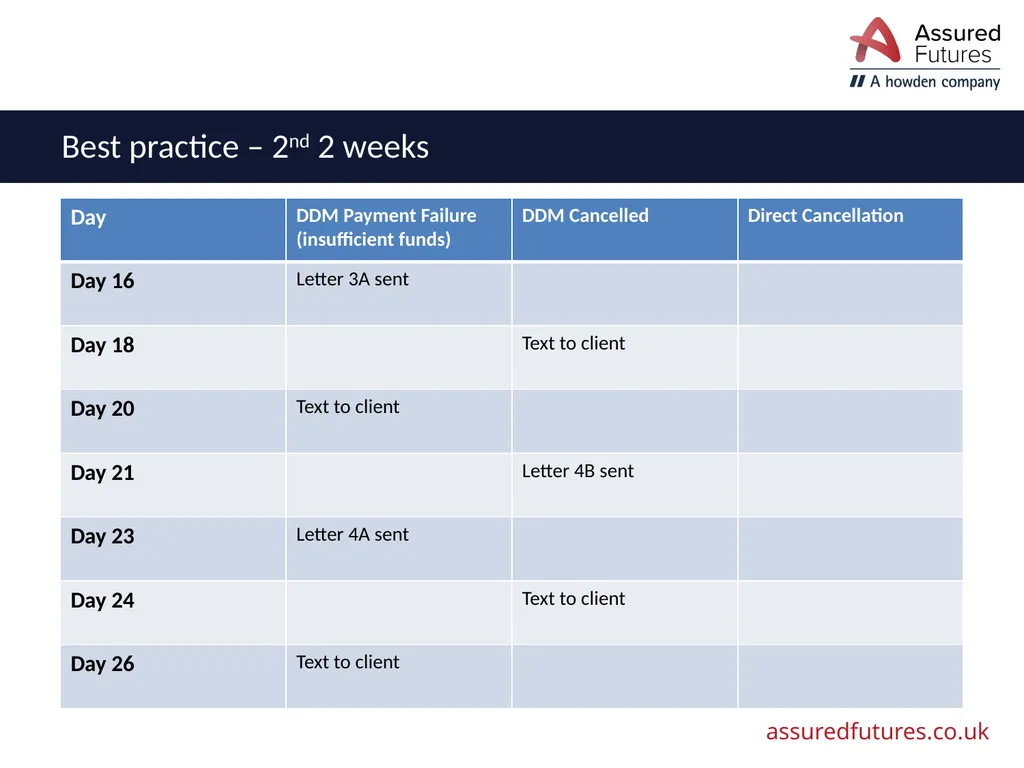
Best practice – 2nd 2 weeks<br>
17
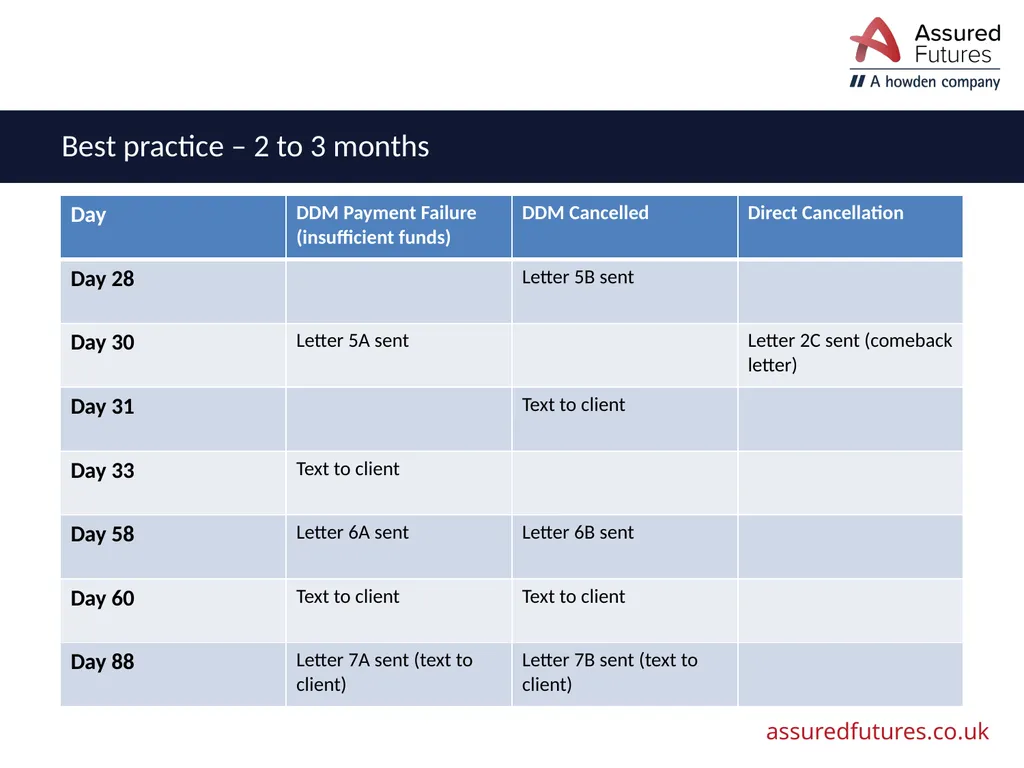
Best practice – 2 to 3 months<br>