
Cancer Prevention & Early Detection Facts &
BR
Published · 51 slides · 0 views

1 / 1











Description
Cancer Prevention Early Detection Facts Figures 2026 A presentation from the American Cancer Society Please note that ACS reserves all rights with respect to this publication and the materials provided herein. Any reproduction or re-use
Related Topics
Share
Embed code
Download this presentation From Below
"Cancer Prevention & Early Detection Facts &" is the property of its rightful owner. Permission is granted to download and print the materials on this website for personal, non-commercial use only, and to display it on your personal computer provided you do not modify the materials and that you retain all copyright notices contained in the materials. By downloading content from our website, you accept the terms of this agreement.
Presentation Transcript
01
Cancer Prevention & Early Detection Facts & Figures 2026 A presentation from the American Cancer Society Please note that ACS reserves all rights with respect to this publication and the materials provided herein. Any reproduction or re-use of this publication or portions of it, should credit the appropriate edition of the American Cancer Society Annual Cancer Prevention & Early Detection Facts & Figures publication. For permissions, please email the ACS Legal Department at permissionrequest@cancer.org.<br>
02
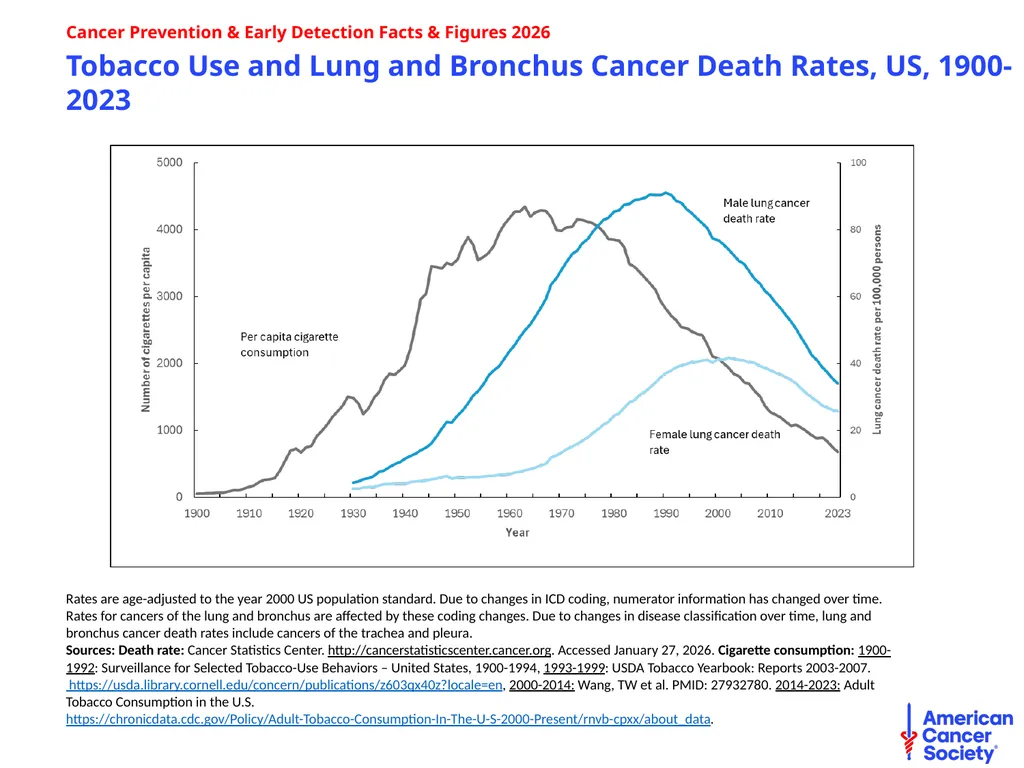
Tobacco Use and Lung and Bronchus Cancer Death Rates, US, 1900-2023 Rates are age-adjusted to the year 2000 US population standard. Due to changes in ICD coding, numerator information has changed over time. Rates for cancers of the lung and bronchus are affected by these coding changes. Due to changes in disease classification over time, lung and bronchus cancer death rates include cancers of the trachea and pleura.
Sources: Death rate: Cancer Statistics Center. http://cancerstatisticscenter.cancer.org. Accessed January 27, 2026. Cigarette consumption: 1900-1992: Surveillance for Selected Tobacco-Use Behaviors – United States, 1900-1994, 1993-1999: USDA Tobacco Yearbook: Reports 2003-2007. https://usda.library.cornell.edu/concern/publications/z603qx40z?locale=en, 2000-2014: Wang, TW et al. PMID: 27932780. 2014-2023: Adult Tobacco Consumption in the U.S. https://chronicdata.cdc.gov/Policy/Adult-Tobacco-Consumption-In-The-U-S-2000-Present/rnvb-cpxx/about_data. Cancer Prevention & Early Detection Facts & Figures 2026<br>
Sources: Death rate: Cancer Statistics Center. http://cancerstatisticscenter.cancer.org. Accessed January 27, 2026. Cigarette consumption: 1900-1992: Surveillance for Selected Tobacco-Use Behaviors – United States, 1900-1994, 1993-1999: USDA Tobacco Yearbook: Reports 2003-2007. https://usda.library.cornell.edu/concern/publications/z603qx40z?locale=en, 2000-2014: Wang, TW et al. PMID: 27932780. 2014-2023: Adult Tobacco Consumption in the U.S. https://chronicdata.cdc.gov/Policy/Adult-Tobacco-Consumption-In-The-U-S-2000-Present/rnvb-cpxx/about_data. Cancer Prevention & Early Detection Facts & Figures 2026<br>
03
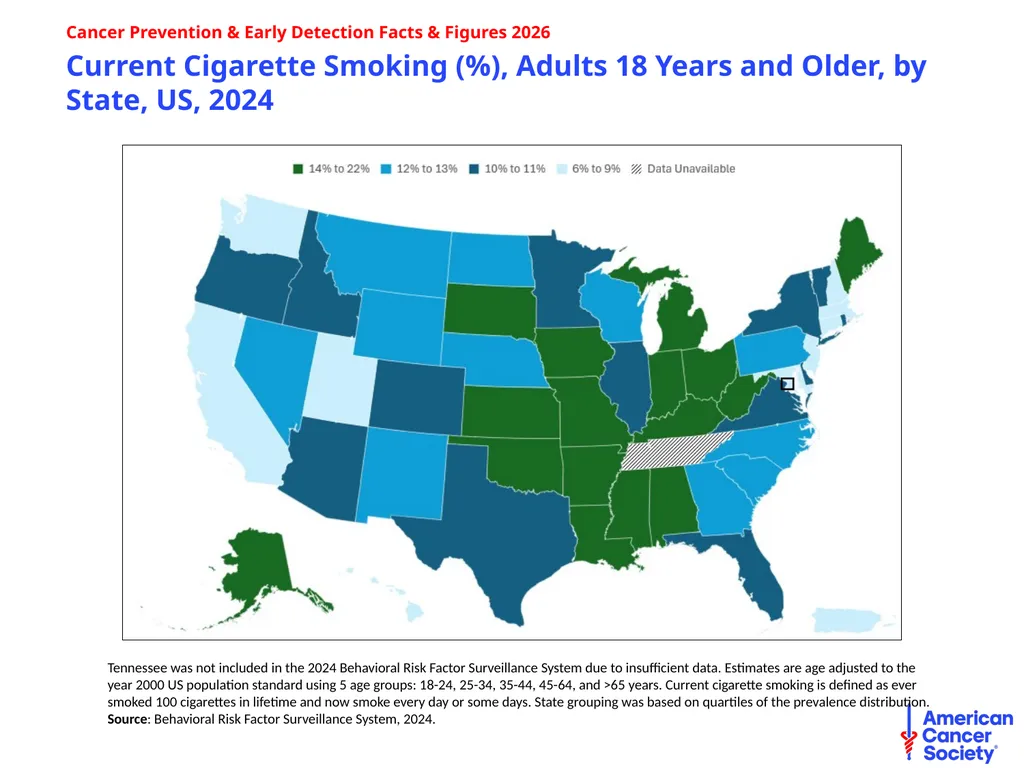
Current Cigarette Smoking (%), Adults 18 Years and Older, by State, US, 2024 Tennessee was not included in the 2024 Behavioral Risk Factor Surveillance System due to insufficient data. Estimates are age adjusted to the year 2000 US population standard using 5 age groups: 18-24, 25-34, 35-44, 45-64, and >65 years. Current cigarette smoking is defined as ever smoked 100 cigarettes in lifetime and now smoke every day or some days. State grouping was based on quartiles of the prevalence distribution.
Source: Behavioral Risk Factor Surveillance System, 2024. Cancer Prevention & Early Detection Facts & Figures 2026<br>
Source: Behavioral Risk Factor Surveillance System, 2024. Cancer Prevention & Early Detection Facts & Figures 2026<br>
04
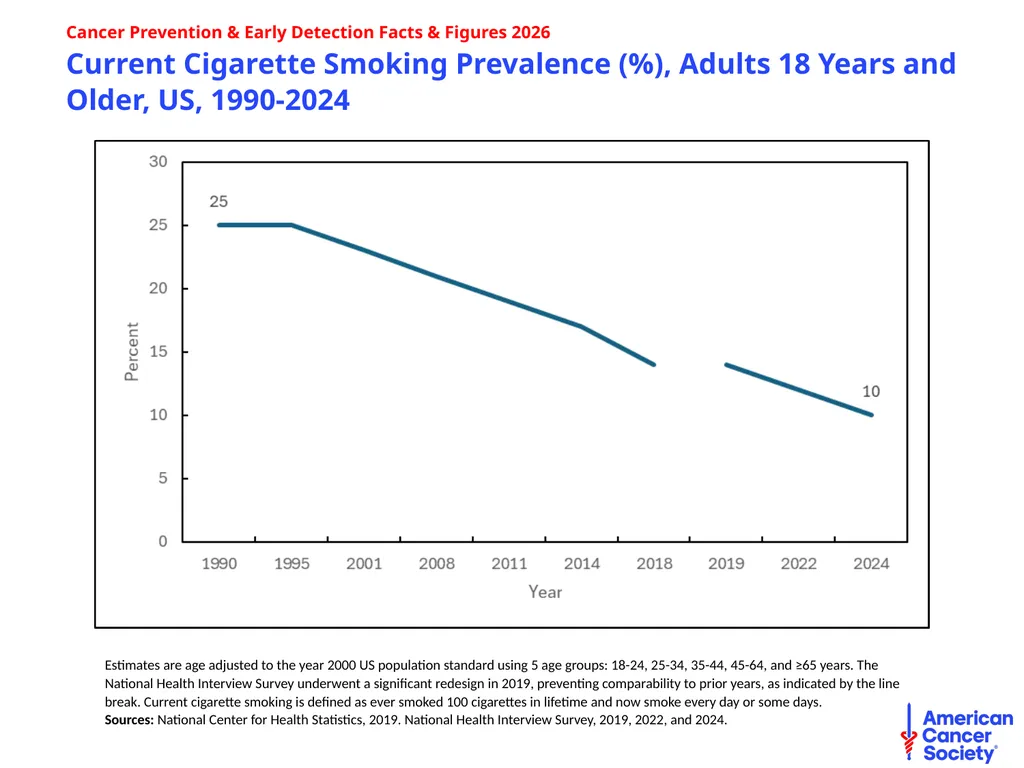
Current Cigarette Smoking Prevalence (%), Adults 18 Years and Older, US, 1990-2024 Estimates are age adjusted to the year 2000 US population standard using 5 age groups: 18-24, 25-34, 35-44, 45-64, and ≥65 years. The National Health Interview Survey underwent a significant redesign in 2019, preventing comparability to prior years, as indicated by the line break. Current cigarette smoking is defined as ever smoked 100 cigarettes in lifetime and now smoke every day or some days.
Sources: National Center for Health Statistics, 2019. National Health Interview Survey, 2019, 2022, and 2024. Cancer Prevention & Early Detection Facts & Figures 2026<br>
Sources: National Center for Health Statistics, 2019. National Health Interview Survey, 2019, 2022, and 2024. Cancer Prevention & Early Detection Facts & Figures 2026<br>
05
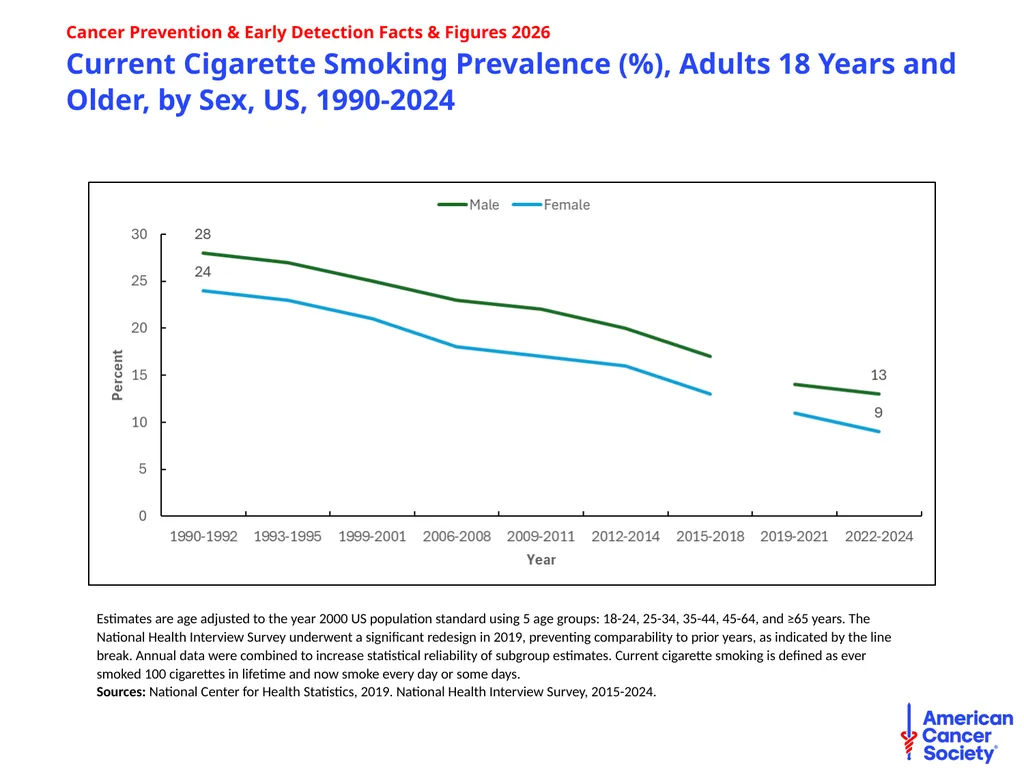
Estimates are age adjusted to the year 2000 US population standard using 5 age groups: 18-24, 25-34, 35-44, 45-64, and ≥65 years. The National Health Interview Survey underwent a significant redesign in 2019, preventing comparability to prior years, as indicated by the line break. Annual data were combined to increase statistical reliability of subgroup estimates. Current cigarette smoking is defined as ever smoked 100 cigarettes in lifetime and now smoke every day or some days.
Sources: National Center for Health Statistics, 2019. National Health Interview Survey, 2015-2024. Current Cigarette Smoking Prevalence (%), Adults 18 Years and Older, by Sex, US, 1990-2024 Cancer Prevention & Early Detection Facts & Figures 2026<br>
Sources: National Center for Health Statistics, 2019. National Health Interview Survey, 2015-2024. Current Cigarette Smoking Prevalence (%), Adults 18 Years and Older, by Sex, US, 1990-2024 Cancer Prevention & Early Detection Facts & Figures 2026<br>
06
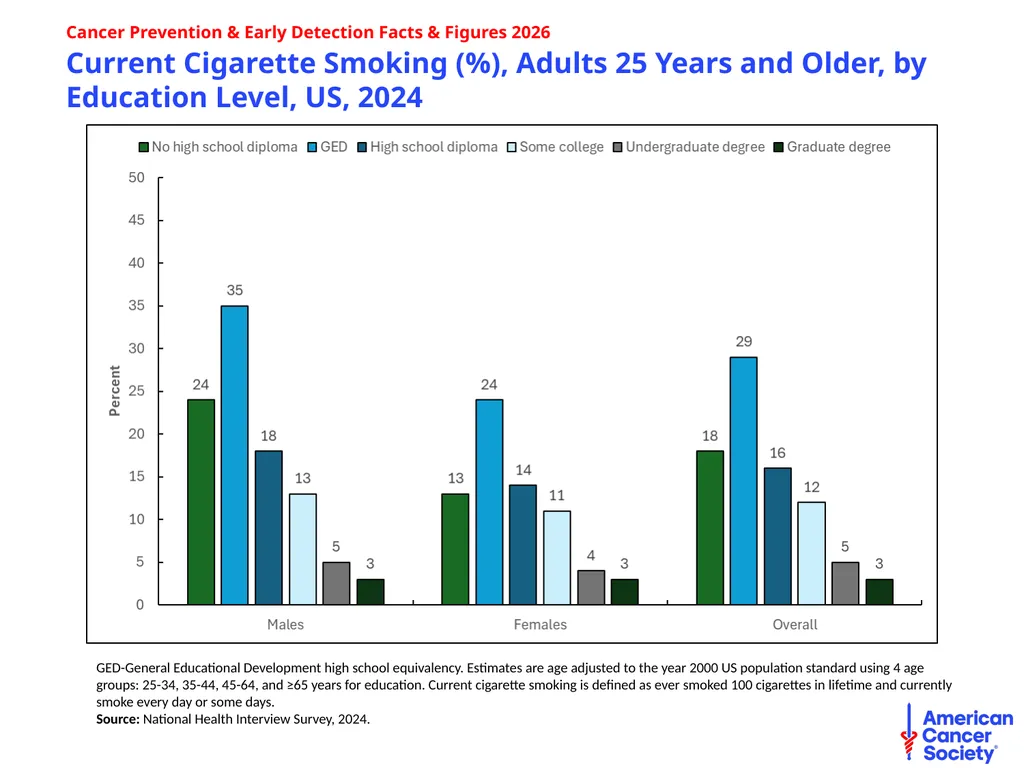
GED-General Educational Development high school equivalency. Estimates are age adjusted to the year 2000 US population standard using 4 age groups: 25-34, 35-44, 45-64, and ≥65 years for education. Current cigarette smoking is defined as ever smoked 100 cigarettes in lifetime and currently smoke every day or some days.
Source: National Health Interview Survey, 2024. Current Cigarette Smoking (%), Adults 25 Years and Older, by Education Level, US, 2024 Cancer Prevention & Early Detection Facts & Figures 2026<br>
Source: National Health Interview Survey, 2024. Current Cigarette Smoking (%), Adults 25 Years and Older, by Education Level, US, 2024 Cancer Prevention & Early Detection Facts & Figures 2026<br>
07
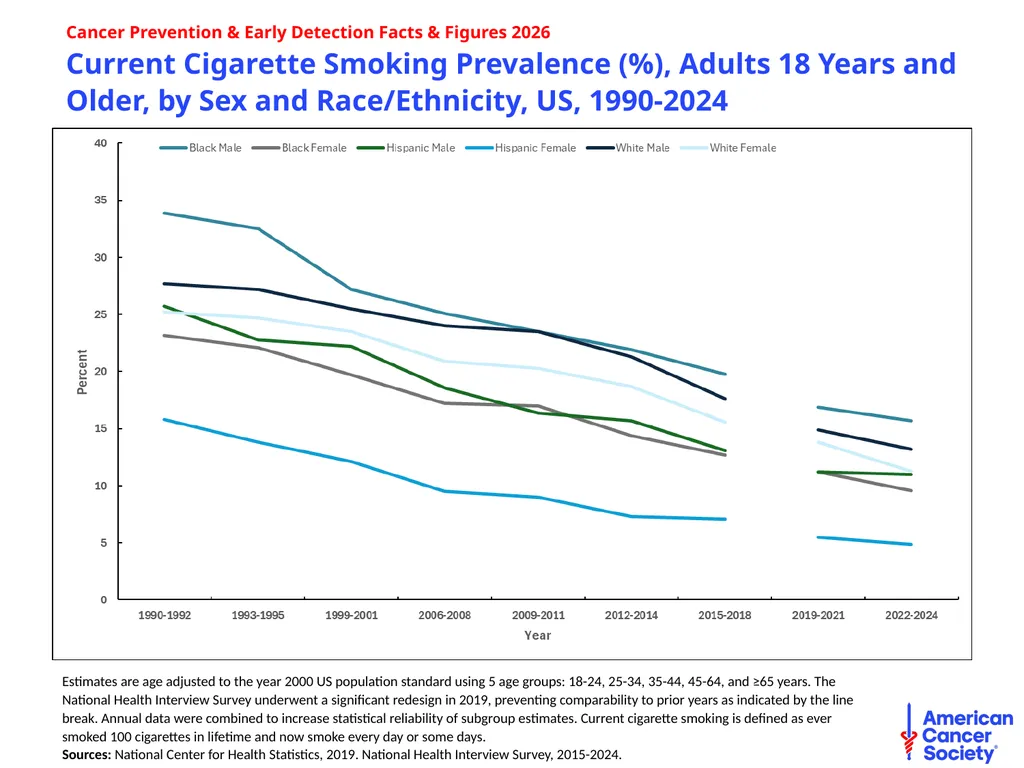
Estimates are age adjusted to the year 2000 US population standard using 5 age groups: 18-24, 25-34, 35-44, 45-64, and ≥65 years. The National Health Interview Survey underwent a significant redesign in 2019, preventing comparability to prior years as indicated by the line break. Annual data were combined to increase statistical reliability of subgroup estimates. Current cigarette smoking is defined as ever smoked 100 cigarettes in lifetime and now smoke every day or some days.
Sources: National Center for Health Statistics, 2019. National Health Interview Survey, 2015-2024. Current Cigarette Smoking Prevalence (%), Adults 18 Years and Older, by Sex and Race/Ethnicity, US, 1990-2024 Cancer Prevention & Early Detection Facts & Figures 2026<br>
Sources: National Center for Health Statistics, 2019. National Health Interview Survey, 2015-2024. Current Cigarette Smoking Prevalence (%), Adults 18 Years and Older, by Sex and Race/Ethnicity, US, 1990-2024 Cancer Prevention & Early Detection Facts & Figures 2026<br>
08
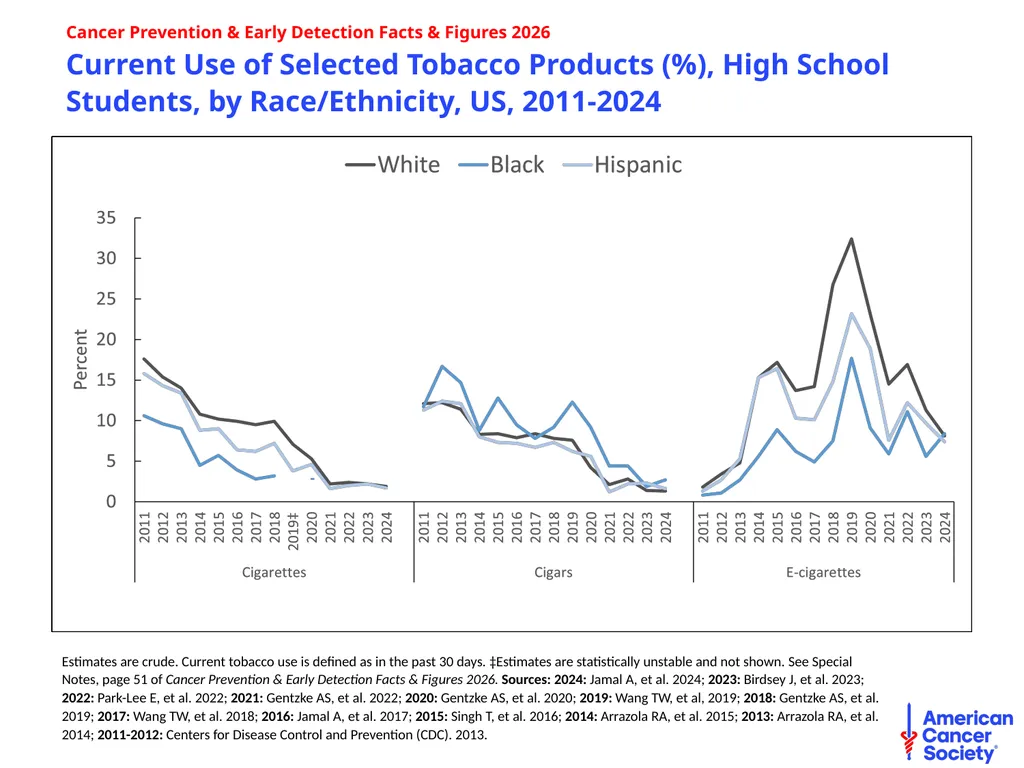
Estimates are crude. Current tobacco use is defined as in the past 30 days. ‡Estimates are statistically unstable and not shown. See Special Notes, page 51 of Cancer Prevention & Early Detection Facts & Figures 2026. Sources: 2024: Jamal A, et al. 2024; 2023: Birdsey J, et al. 2023; 2022: Park-Lee E, et al. 2022; 2021: Gentzke AS, et al. 2022; 2020: Gentzke AS, et al. 2020; 2019: Wang TW, et al, 2019; 2018: Gentzke AS, et al. 2019; 2017: Wang TW, et al. 2018; 2016: Jamal A, et al. 2017; 2015: Singh T, et al. 2016; 2014: Arrazola RA, et al. 2015; 2013: Arrazola RA, et al. 2014; 2011-2012: Centers for Disease Control and Prevention (CDC). 2013. Current Use of Selected Tobacco Products (%), High School Students, by Race/Ethnicity, US, 2011-2024 Cancer Prevention & Early Detection Facts & Figures 2026<br>
09
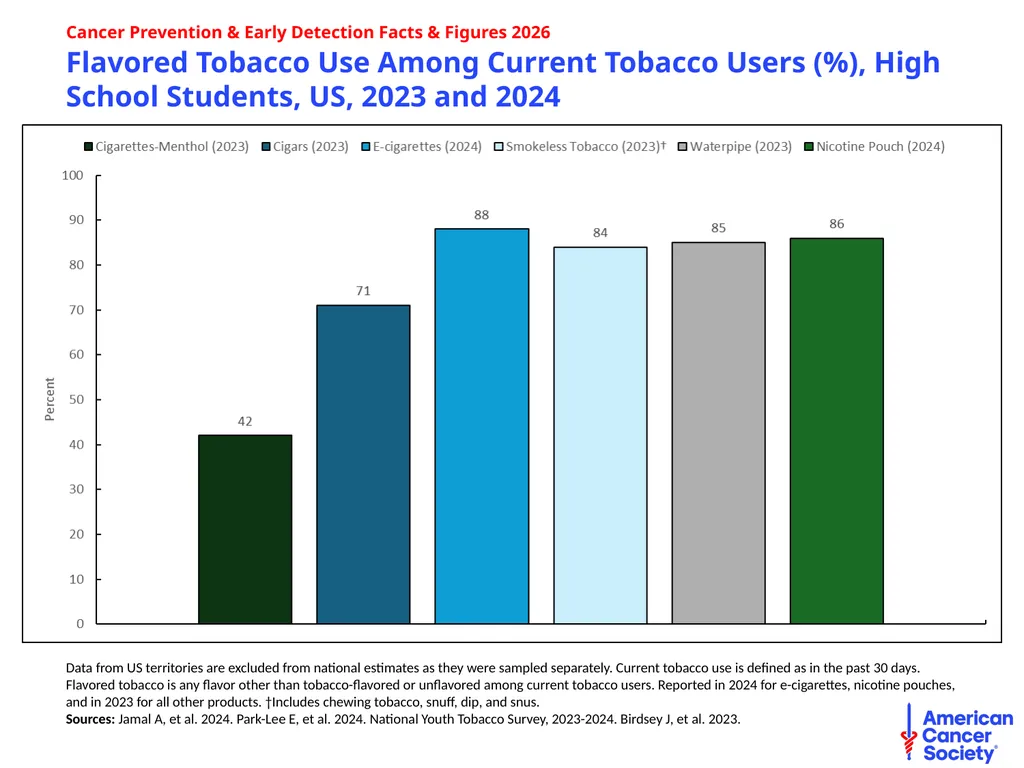
Data from US territories are excluded from national estimates as they were sampled separately. Current tobacco use is defined as in the past 30 days. Flavored tobacco is any flavor other than tobacco-flavored or unflavored among current tobacco users. Reported in 2024 for e-cigarettes, nicotine pouches, and in 2023 for all other products. †Includes chewing tobacco, snuff, dip, and snus.
Sources: Jamal A, et al. 2024. Park-Lee E, et al. 2024. National Youth Tobacco Survey, 2023-2024. Birdsey J, et al. 2023. Flavored Tobacco Use Among Current Tobacco Users (%), High School Students, US, 2023 and 2024 Cancer Prevention & Early Detection Facts & Figures 2026<br>
Sources: Jamal A, et al. 2024. Park-Lee E, et al. 2024. National Youth Tobacco Survey, 2023-2024. Birdsey J, et al. 2023. Flavored Tobacco Use Among Current Tobacco Users (%), High School Students, US, 2023 and 2024 Cancer Prevention & Early Detection Facts & Figures 2026<br>
10
BMI-Body mass index. For adults (ages 20+ years), obesity is a BMI at or above 30.0 kg/m2, and severe obesity is a BMI at or above 40.0 kg/m2. Pregnant females are excluded from the analysis. Estimates are age adjusted to the year 2000 US population standard using 3 age groups: 20-39, 40-59, and ≥60 years.
Sources: Fryar CD, et al. 2020. National Health and Nutrition Examination Survey, 2017-August 2023. Obesity and Severe Obesity Trends (%), Adults 20+ Years, by Sex, US, 1988-August 2023 Cancer Prevention & Early Detection Facts & Figures 2026<br>
Sources: Fryar CD, et al. 2020. National Health and Nutrition Examination Survey, 2017-August 2023. Obesity and Severe Obesity Trends (%), Adults 20+ Years, by Sex, US, 1988-August 2023 Cancer Prevention & Early Detection Facts & Figures 2026<br>
11
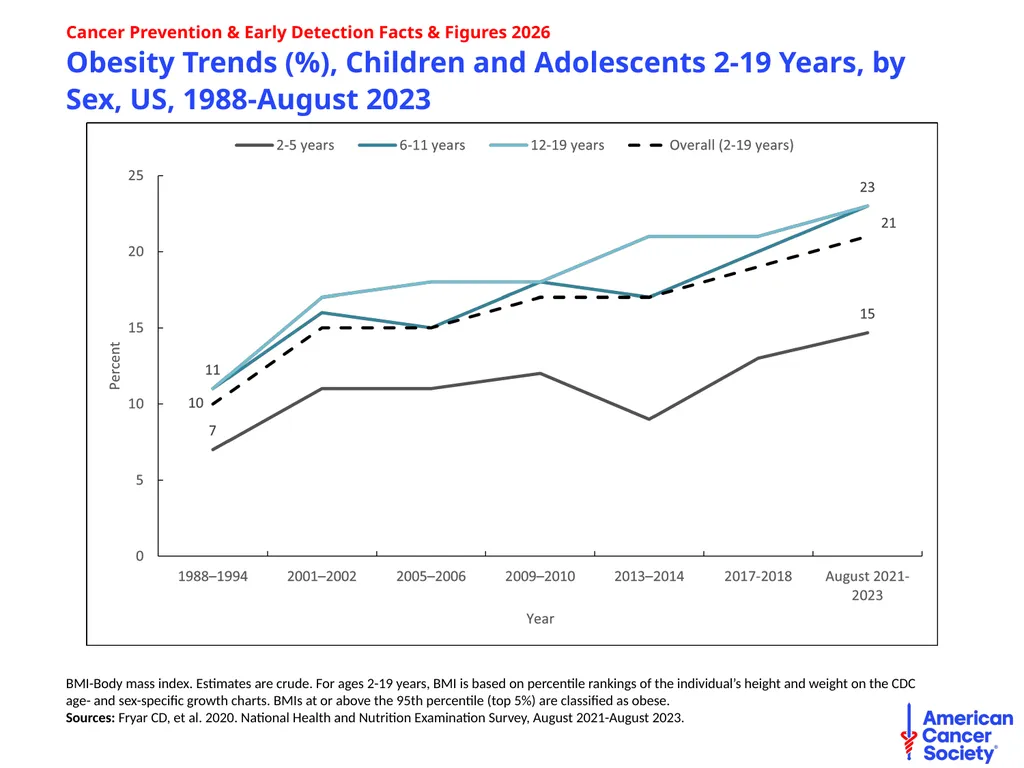
BMI-Body mass index. Estimates are crude. For ages 2-19 years, BMI is based on percentile rankings of the individual’s height and weight on the CDC age- and sex-specific growth charts. BMIs at or above the 95th percentile (top 5%) are classified as obese.
Sources: Fryar CD, et al. 2020. National Health and Nutrition Examination Survey, August 2021-August 2023. Obesity Trends (%), Children and Adolescents 2-19 Years, by Sex, US, 1988-August 2023 Cancer Prevention & Early Detection Facts & Figures 2026<br>
Sources: Fryar CD, et al. 2020. National Health and Nutrition Examination Survey, August 2021-August 2023. Obesity Trends (%), Children and Adolescents 2-19 Years, by Sex, US, 1988-August 2023 Cancer Prevention & Early Detection Facts & Figures 2026<br>
12
BMI-Body mass index. F-females, M-males, O-overall. For youth (ages 2-19 years), BMI is based on percentile rankings of the individual’s height and weight on age- and sex-specific growth charts; BMIs between the top 85th and <95th percentile are considered overweight, and BMIs at or above the 95th percentile (top 5%) are classified as obese. Estimates are crude. For adults (ages 20+ years), a BMI of 25.0 to <30.0 kg/m2 is overweight, and a BMI of ≥30.0 kg/m2 is obese. Excess body weight is a BMI of ≥25.0 kg/m2. Estimates for ages 20+ are age adjusted to the year 2000 US population standard using 5 age groups: 20-34, 35-44, 45-54, 55-64, and ≥65 years.
Source: National Health and Nutrition Examination Survey, August 2021-2023. Overweight and Obesity (%), Youth and Adults, US, August 2021-August 2023 Cancer Prevention & Early Detection Facts & Figures 2026<br>
Source: National Health and Nutrition Examination Survey, August 2021-2023. Overweight and Obesity (%), Youth and Adults, US, August 2021-August 2023 Cancer Prevention & Early Detection Facts & Figures 2026<br>
13
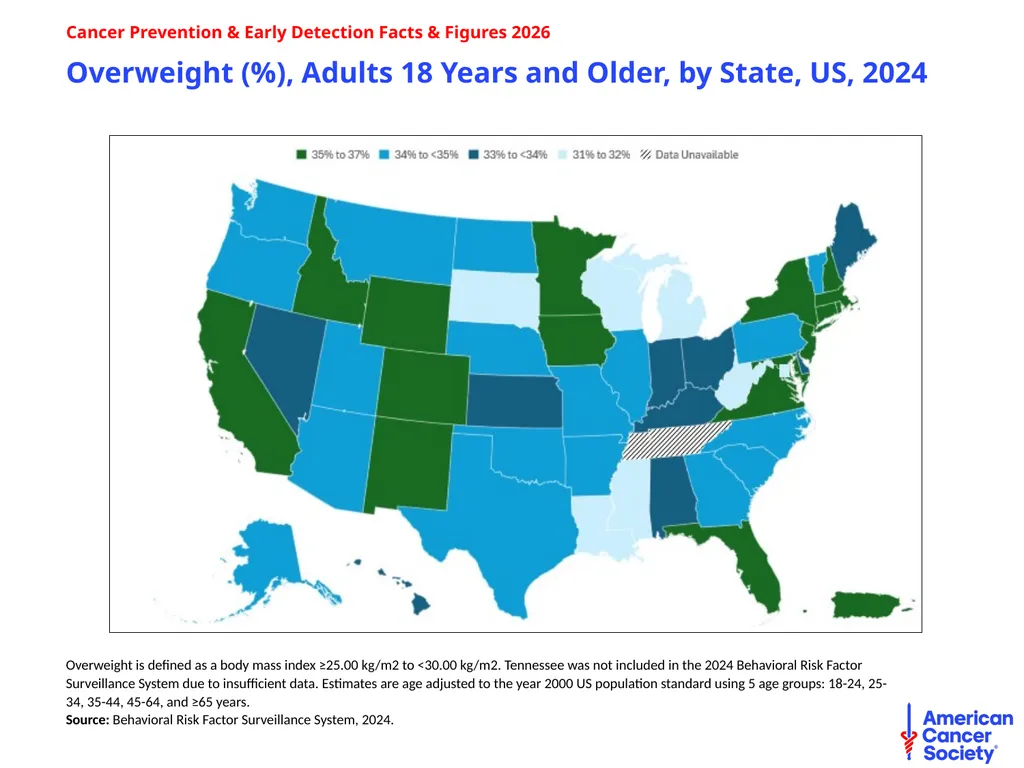
Overweight is defined as a body mass index ≥25.00 kg/m2 to <30.00 kg/m2. Tennessee was not included in the 2024 Behavioral Risk Factor Surveillance System due to insufficient data. Estimates are age adjusted to the year 2000 US population standard using 5 age groups: 18-24, 25-34, 35-44, 45-64, and ≥65 years.
Source: Behavioral Risk Factor Surveillance System, 2024. Overweight (%), Adults 18 Years and Older, by State, US, 2024 Cancer Prevention & Early Detection Facts & Figures 2026<br>
Source: Behavioral Risk Factor Surveillance System, 2024. Overweight (%), Adults 18 Years and Older, by State, US, 2024 Cancer Prevention & Early Detection Facts & Figures 2026<br>
14
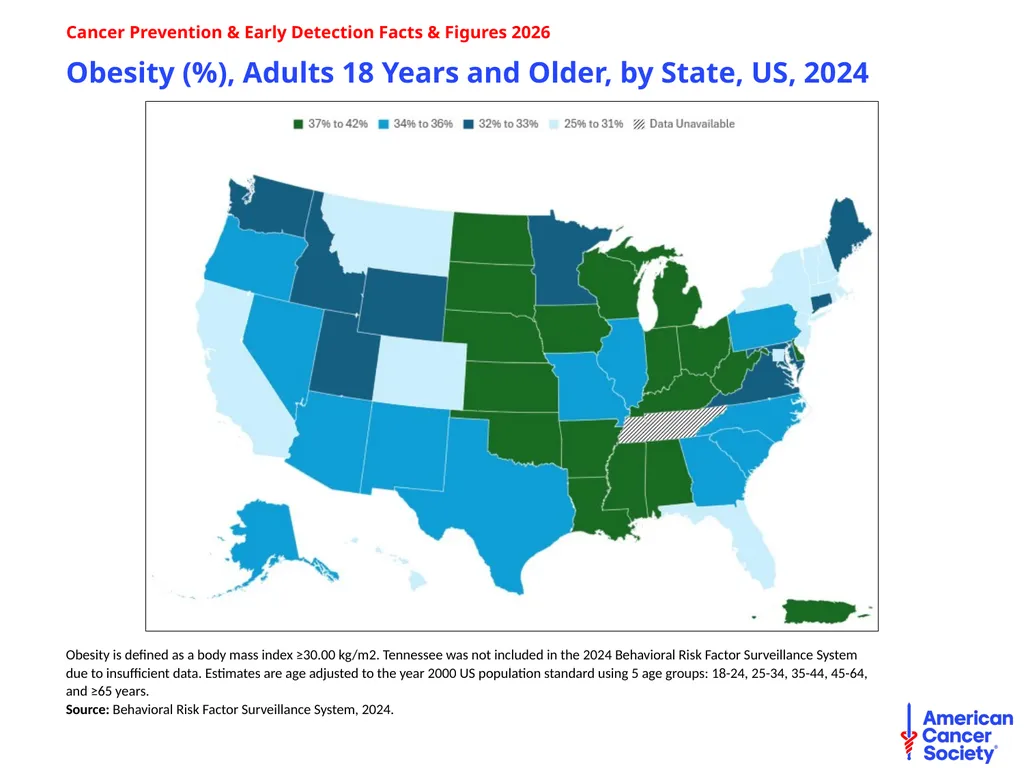
Obesity is defined as a body mass index ≥30.00 kg/m2. Tennessee was not included in the 2024 Behavioral Risk Factor Surveillance System due to insufficient data. Estimates are age adjusted to the year 2000 US population standard using 5 age groups: 18-24, 25-34, 35-44, 45-64, and ≥65 years.
Source: Behavioral Risk Factor Surveillance System, 2024. Obesity (%), Adults 18 Years and Older, by State, US, 2024 Cancer Prevention & Early Detection Facts & Figures 2026<br>
Source: Behavioral Risk Factor Surveillance System, 2024. Obesity (%), Adults 18 Years and Older, by State, US, 2024 Cancer Prevention & Early Detection Facts & Figures 2026<br>
15
Tennessee was not included in the 2024 Behavioral Risk Factor Surveillance System due to insufficient data. Estimates are age adjusted to the year 2000 US population standard using 5 age groups: 18-24, 25-34, 35-44, 45-64, and ≥65 years. No leisure-time physical activity in the past month.
Source: Behavioral Risk Factor Surveillance System, 2024. No Leisure-time Physical Activity (%), Adults 18 Years and Older, by State, US, 2024 Cancer Prevention & Early Detection Facts & Figures 2026<br>
Source: Behavioral Risk Factor Surveillance System, 2024. No Leisure-time Physical Activity (%), Adults 18 Years and Older, by State, US, 2024 Cancer Prevention & Early Detection Facts & Figures 2026<br>
16
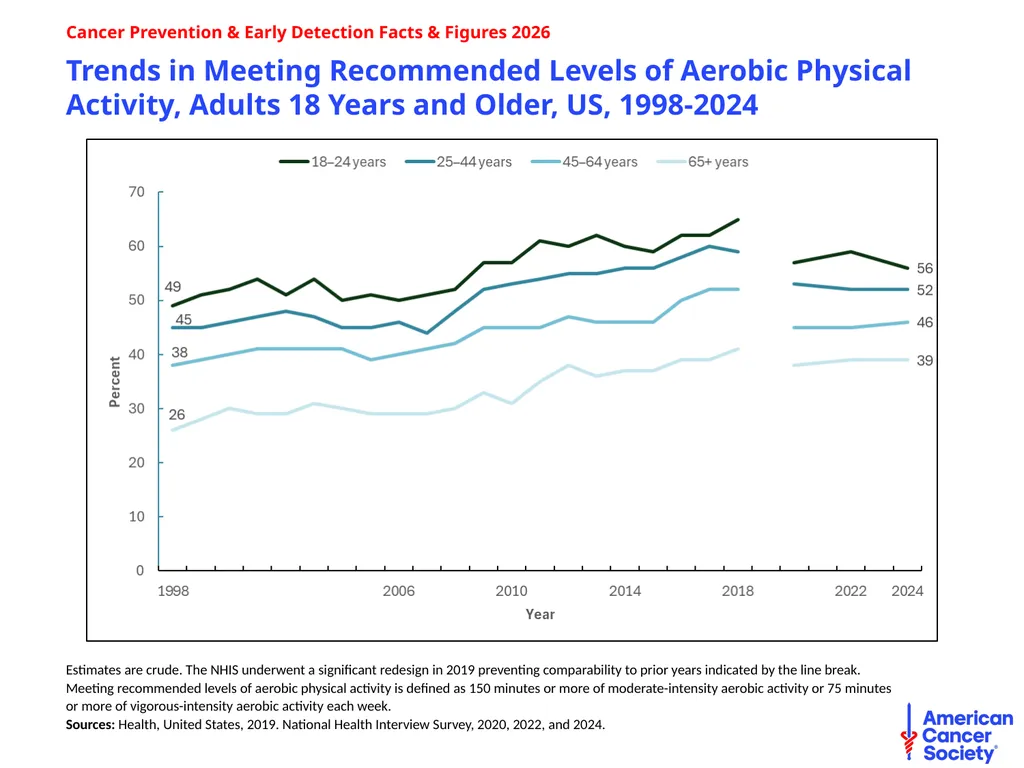
Estimates are crude. The NHIS underwent a significant redesign in 2019 preventing comparability to prior years indicated by the line break. Meeting recommended levels of aerobic physical activity is defined as 150 minutes or more of moderate-intensity aerobic activity or 75 minutes or more of vigorous-intensity aerobic activity each week.
Sources: Health, United States, 2019. National Health Interview Survey, 2020, 2022, and 2024. Trends in Meeting Recommended Levels of Aerobic Physical Activity, Adults 18 Years and Older, US, 1998-2024 Cancer Prevention & Early Detection Facts & Figures 2026<br>
Sources: Health, United States, 2019. National Health Interview Survey, 2020, 2022, and 2024. Trends in Meeting Recommended Levels of Aerobic Physical Activity, Adults 18 Years and Older, US, 1998-2024 Cancer Prevention & Early Detection Facts & Figures 2026<br>
17
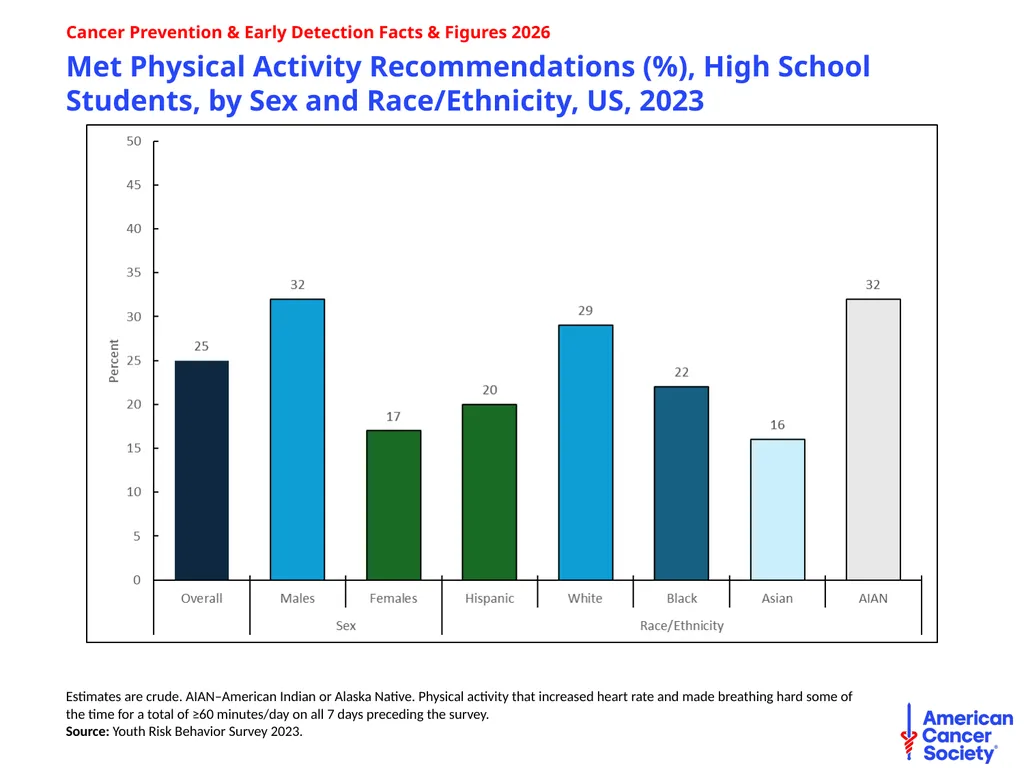
Estimates are crude. AIAN–American Indian or Alaska Native. Physical activity that increased heart rate and made breathing hard some of the time for a total of ≥60 minutes/day on all 7 days preceding the survey.
Source: Youth Risk Behavior Survey 2023. Met Physical Activity Recommendations (%), High School Students, by Sex and Race/Ethnicity, US, 2023 Cancer Prevention & Early Detection Facts & Figures 2026<br>
Source: Youth Risk Behavior Survey 2023. Met Physical Activity Recommendations (%), High School Students, by Sex and Race/Ethnicity, US, 2023 Cancer Prevention & Early Detection Facts & Figures 2026<br>
18
Florida was not included in the 2021 Behavioral Risk Factor Surveillance System due to insufficient data. Estimates are age adjusted to the year 2000 US population standard using five age groups: 18-24, 25-34, 35-44, 45-64, and ≥65 years.
Source: Behavioral Risk Factor Surveillance System, 2021. Fruit Consumption (2+ servings per day, %), Adults 18 Years and Older, by State, US, 2021 Cancer Prevention & Early Detection Facts & Figures 2026<br>
Source: Behavioral Risk Factor Surveillance System, 2021. Fruit Consumption (2+ servings per day, %), Adults 18 Years and Older, by State, US, 2021 Cancer Prevention & Early Detection Facts & Figures 2026<br>
19
Florida was not included in the 2021 Behavioral Risk Factor Surveillance System due to insufficient data. Estimates are age adjusted to the year 2000 US population standard using five age groups: 18-24, 25-34, 35-44, 45-64, and ≥65 years.
Source: Behavioral Risk Factor Surveillance System, 2021. Vegetable Consumption (3+ servings per day, %), Adults 18 Years and Older, by State, US, 2021 Cancer Prevention & Early Detection Facts & Figures 2026<br>
Source: Behavioral Risk Factor Surveillance System, 2021. Vegetable Consumption (3+ servings per day, %), Adults 18 Years and Older, by State, US, 2021 Cancer Prevention & Early Detection Facts & Figures 2026<br>
20
AIAN-American Indian or Alaska Native. All estimates except age are age adjusted to the year 2000 US population standard using 5 age groups: 18-24, 25-34, 35-44, 45-64, and ≥65 years. Any sunburns in the past 12 months. Sunburn is defined as when even a small part of your skin turns red or hurts for 12 hours or more.
Source: National Health Interview Survey, 2024. Sunburn (%), Adults 18 Years and Older, by Sex and Race/Ethnicity, US, 2024 Cancer Prevention & Early Detection Facts & Figures 2026<br>
Source: National Health Interview Survey, 2024. Sunburn (%), Adults 18 Years and Older, by Sex and Race/Ethnicity, US, 2024 Cancer Prevention & Early Detection Facts & Figures 2026<br>
21
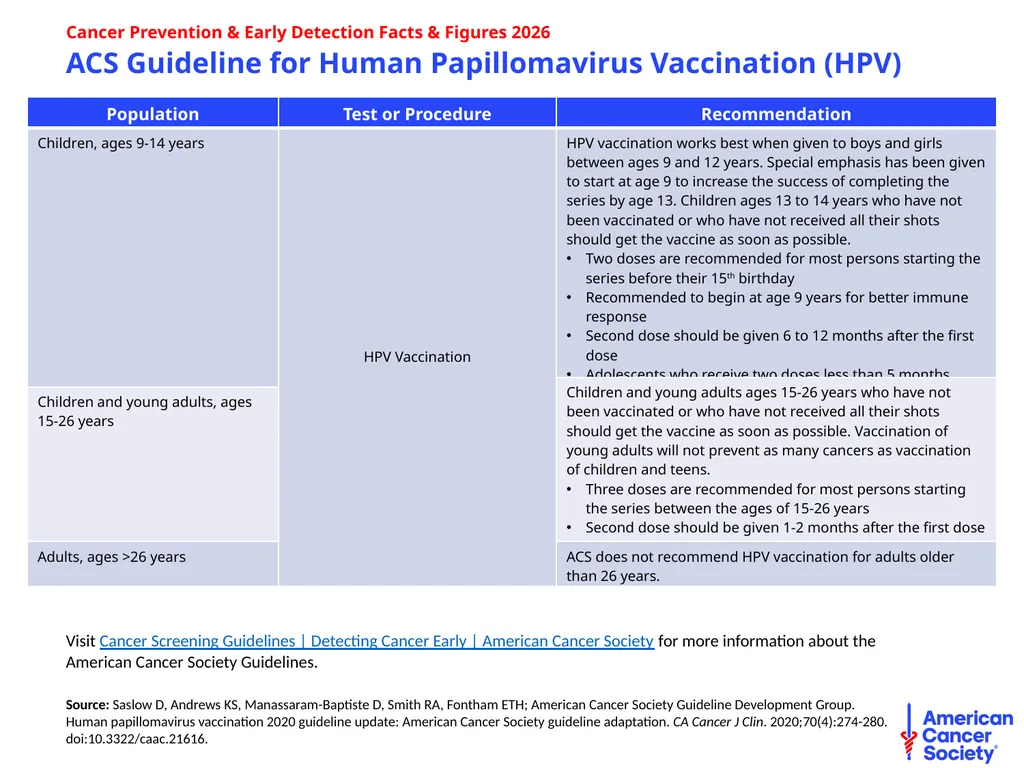
Visit Cancer Screening Guidelines | Detecting Cancer Early | American Cancer Society for more information about the American Cancer Society Guidelines.
Source: Saslow D, Andrews KS, Manassaram-Baptiste D, Smith RA, Fontham ETH; American Cancer Society Guideline Development Group. Human papillomavirus vaccination 2020 guideline update: American Cancer Society guideline adaptation. CA Cancer J Clin. 2020;70(4):274-280. doi:10.3322/caac.21616. ACS Guideline for Human Papillomavirus Vaccination (HPV) Cancer Prevention & Early Detection Facts & Figures 2026<br>
Source: Saslow D, Andrews KS, Manassaram-Baptiste D, Smith RA, Fontham ETH; American Cancer Society Guideline Development Group. Human papillomavirus vaccination 2020 guideline update: American Cancer Society guideline adaptation. CA Cancer J Clin. 2020;70(4):274-280. doi:10.3322/caac.21616. ACS Guideline for Human Papillomavirus Vaccination (HPV) Cancer Prevention & Early Detection Facts & Figures 2026<br>
22
Estimates are crude. AIAN-American Indian or Alaska Native. Data from US territories excluded from national estimates as they were sampled separately. Up-to-date HPV in ages 13-17 years is defined as 2 doses separated by 5 months (minus 4 days) for immunocompetent adolescents initiating the HPV series before their 15th birthday, and 3 doses for all others.
Sources: National Immunization Survey-Teen, 2024. Up-to-Date Human Papillomavirus Vaccination (%), Youth 13-17 Years, by Sex and Race/Ethnicity, US, 2024 Cancer Prevention & Early Detection Facts & Figures 2026<br>
Sources: National Immunization Survey-Teen, 2024. Up-to-Date Human Papillomavirus Vaccination (%), Youth 13-17 Years, by Sex and Race/Ethnicity, US, 2024 Cancer Prevention & Early Detection Facts & Figures 2026<br>
23
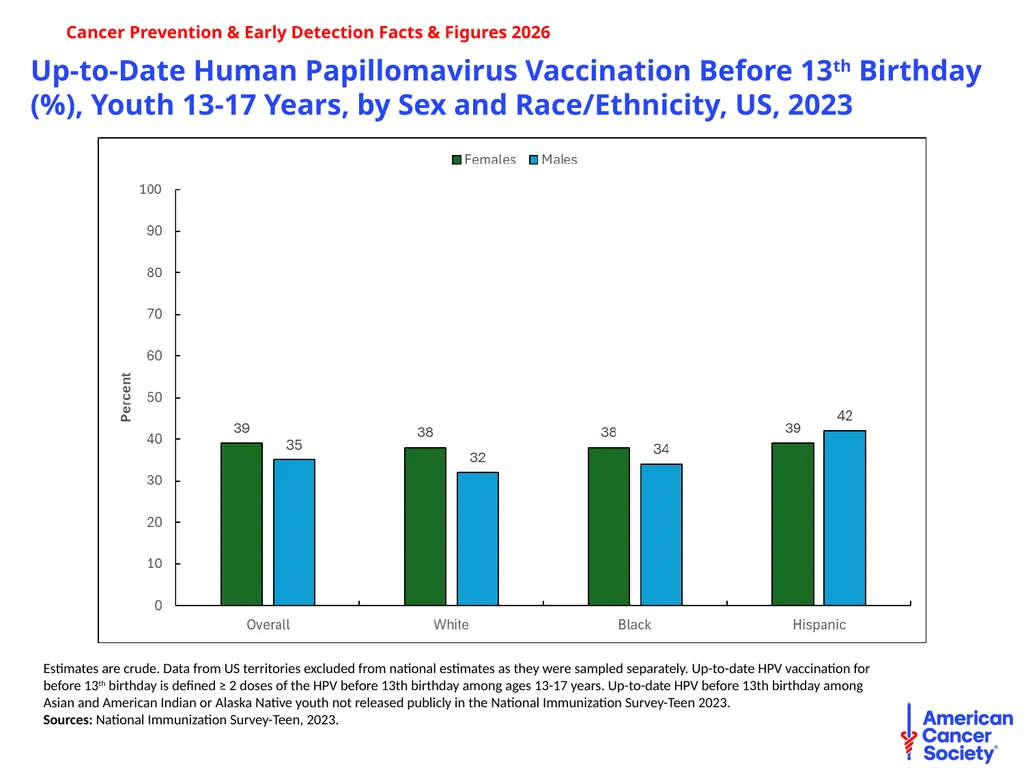
Estimates are crude. Data from US territories excluded from national estimates as they were sampled separately. Up-to-date HPV vaccination for before 13th birthday is defined ≥ 2 doses of the HPV before 13th birthday among ages 13-17 years. Up-to-date HPV before 13th birthday among Asian and American Indian or Alaska Native youth not released publicly in the National Immunization Survey-Teen 2023.
Sources: National Immunization Survey-Teen, 2023. Up-to-Date Human Papillomavirus Vaccination Before 13th Birthday (%), Youth 13-17 Years, by Sex and Race/Ethnicity, US, 2023 Cancer Prevention & Early Detection Facts & Figures 2026<br>
Sources: National Immunization Survey-Teen, 2023. Up-to-Date Human Papillomavirus Vaccination Before 13th Birthday (%), Youth 13-17 Years, by Sex and Race/Ethnicity, US, 2023 Cancer Prevention & Early Detection Facts & Figures 2026<br>
24
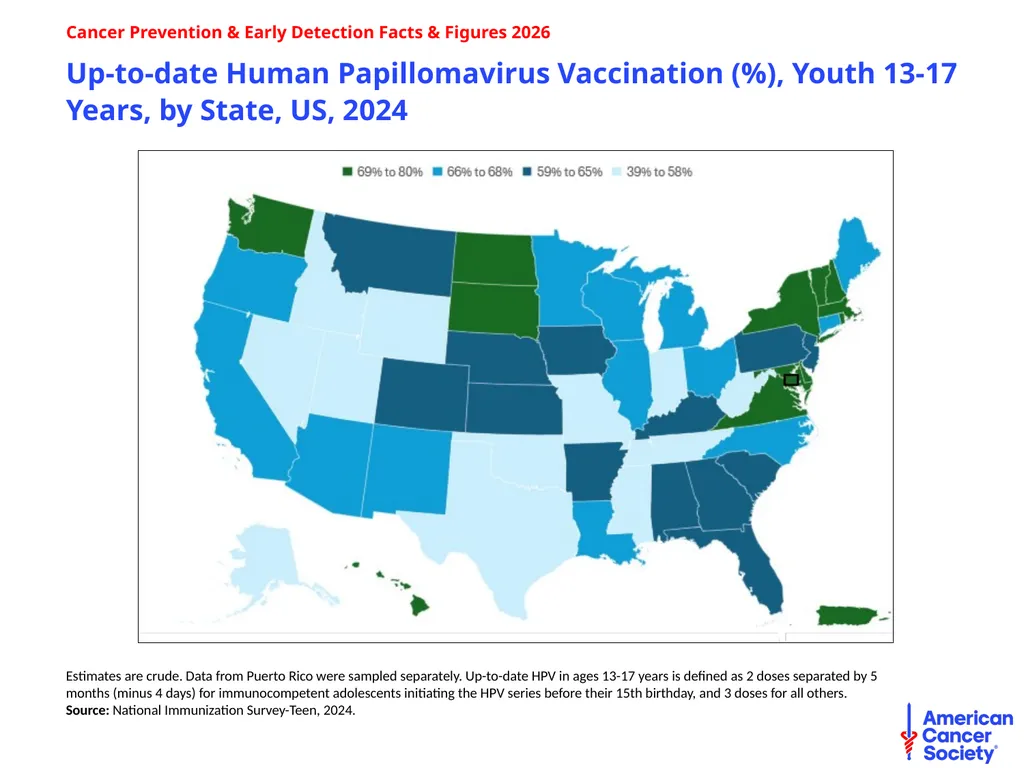
Estimates are crude. Data from Puerto Rico were sampled separately. Up-to-date HPV in ages 13-17 years is defined as 2 doses separated by 5 months (minus 4 days) for immunocompetent adolescents initiating the HPV series before their 15th birthday, and 3 doses for all others.
Source: National Immunization Survey-Teen, 2024. Up-to-date Human Papillomavirus Vaccination (%), Youth 13-17 Years, by State, US, 2024 Cancer Prevention & Early Detection Facts & Figures 2026<br>
Source: National Immunization Survey-Teen, 2024. Up-to-date Human Papillomavirus Vaccination (%), Youth 13-17 Years, by State, US, 2024 Cancer Prevention & Early Detection Facts & Figures 2026<br>
25
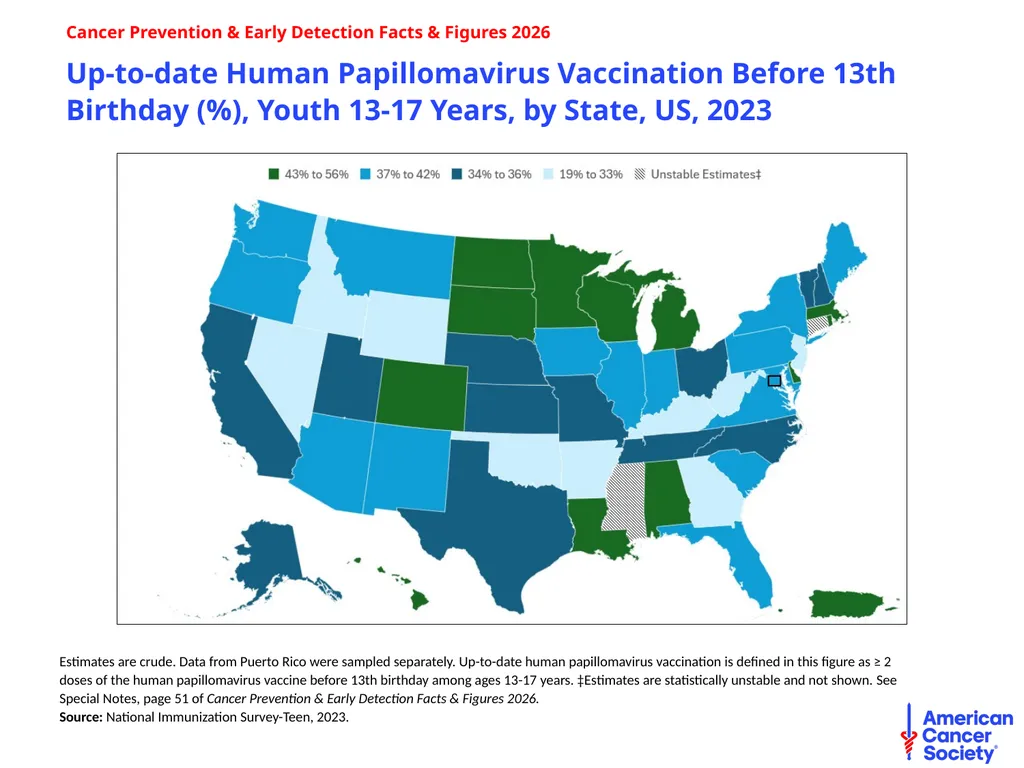
Estimates are crude. Data from Puerto Rico were sampled separately. Up-to-date human papillomavirus vaccination is defined in this figure as ≥ 2 doses of the human papillomavirus vaccine before 13th birthday among ages 13-17 years. ‡Estimates are statistically unstable and not shown. See Special Notes, page 51 of Cancer Prevention & Early Detection Facts & Figures 2026.
Source: National Immunization Survey-Teen, 2023. Up-to-date Human Papillomavirus Vaccination Before 13th Birthday (%), Youth 13-17 Years, by State, US, 2023 Cancer Prevention & Early Detection Facts & Figures 2026<br>
Source: National Immunization Survey-Teen, 2023. Up-to-date Human Papillomavirus Vaccination Before 13th Birthday (%), Youth 13-17 Years, by State, US, 2023 Cancer Prevention & Early Detection Facts & Figures 2026<br>
26
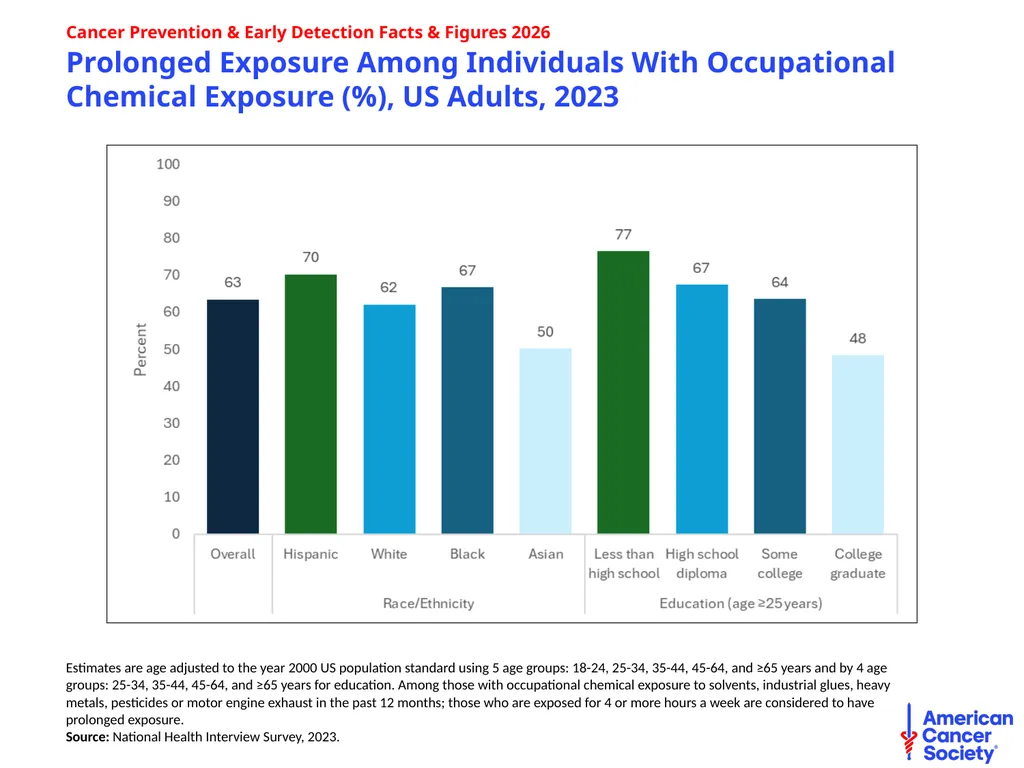
Estimates are age adjusted to the year 2000 US population standard using 5 age groups: 18-24, 25-34, 35-44, 45-64, and ≥65 years and by 4 age groups: 25-34, 35-44, 45-64, and ≥65 years for education. Among those with occupational chemical exposure to solvents, industrial glues, heavy metals, pesticides or motor engine exhaust in the past 12 months; those who are exposed for 4 or more hours a week are considered to have prolonged exposure.
Source: National Health Interview Survey, 2023. Prolonged Exposure Among Individuals With Occupational Chemical Exposure (%), US Adults, 2023 Cancer Prevention & Early Detection Facts & Figures 2026<br>
Source: National Health Interview Survey, 2023. Prolonged Exposure Among Individuals With Occupational Chemical Exposure (%), US Adults, 2023 Cancer Prevention & Early Detection Facts & Figures 2026<br>
27
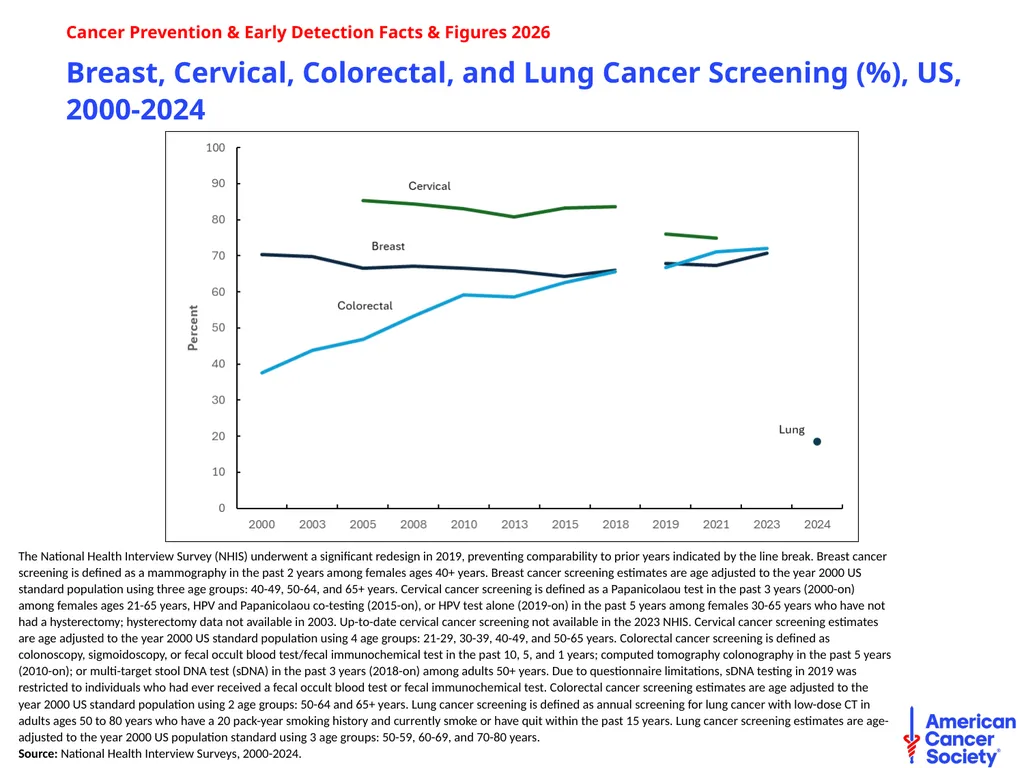
Breast, Cervical, Colorectal, and Lung Cancer Screening (%), US, 2000-2024 The National Health Interview Survey (NHIS) underwent a significant redesign in 2019, preventing comparability to prior years indicated by the line break. Breast cancer screening is defined as a mammography in the past 2 years among females ages 40+ years. Breast cancer screening estimates are age adjusted to the year 2000 US standard population using three age groups: 40-49, 50-64, and 65+ years. Cervical cancer screening is defined as a Papanicolaou test in the past 3 years (2000-on) among females ages 21-65 years, HPV and Papanicolaou co-testing (2015-on), or HPV test alone (2019-on) in the past 5 years among females 30-65 years who have not had a hysterectomy; hysterectomy data not available in 2003. Up-to-date cervical cancer screening not available in the 2023 NHIS. Cervical cancer screening estimates are age adjusted to the year 2000 US standard population using 4 age groups: 21-29, 30-39, 40-49, and 50-65 years. Colorectal cancer screening is defined as colonoscopy, sigmoidoscopy, or fecal occult blood test/fecal immunochemical test in the past 10, 5, and 1 years; computed tomography colonography in the past 5 years (2010-on); or multi-target stool DNA test (sDNA) in the past 3 years (2018-on) among adults 50+ years. Due to questionnaire limitations, sDNA testing in 2019 was restricted to individuals who had ever received a fecal occult blood test or fecal immunochemical test. Colorectal cancer screening estimates are age adjusted to the year 2000 US standard population using 2 age groups: 50-64 and 65+ years. Lung cancer screening is defined as annual screening for lung cancer with low-dose CT in adults ages 50 to 80 years who have a 20 pack-year smoking history and currently smoke or have quit within the past 15 years. Lung cancer screening estimates are age-adjusted to the year 2000 US population standard using 3 age groups: 50-59, 60-69, and 70-80 years.
Source: National Health Interview Surveys, 2000-2024. Cancer Prevention & Early Detection Facts & Figures 2026<br>
Source: National Health Interview Surveys, 2000-2024. Cancer Prevention & Early Detection Facts & Figures 2026<br>
28
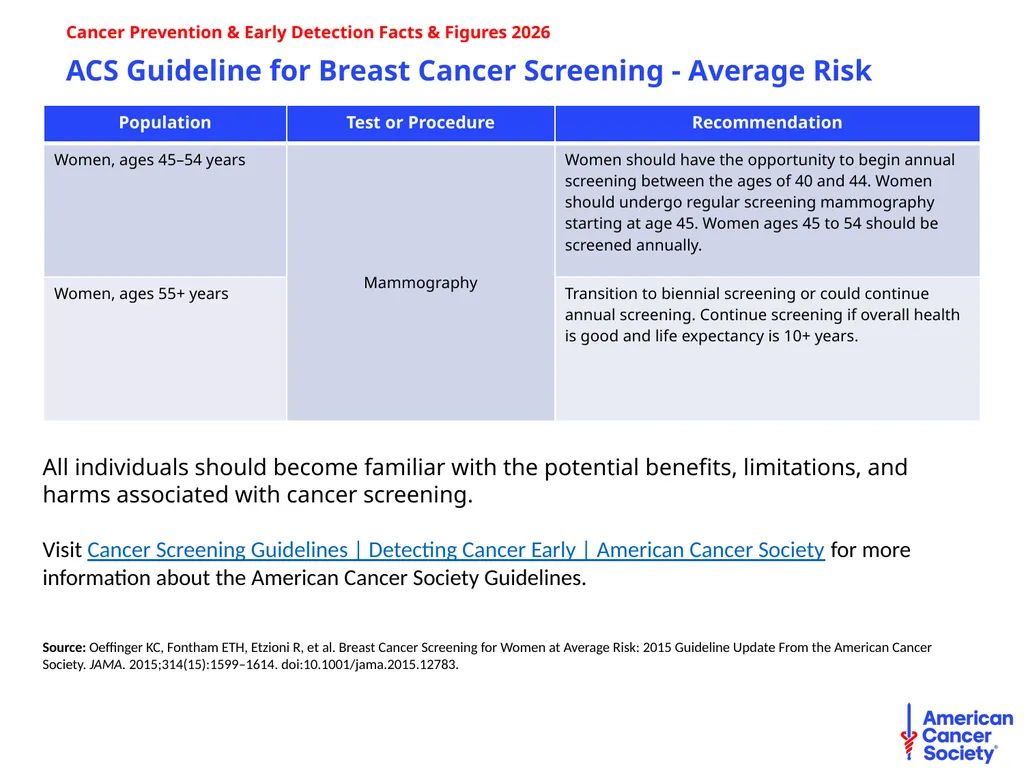
All individuals should become familiar with the potential benefits, limitations, and harms associated with cancer screening.
Visit Cancer Screening Guidelines | Detecting Cancer Early | American Cancer Society for more information about the American Cancer Society Guidelines.
Source: Oeffinger KC, Fontham ETH, Etzioni R, et al. Breast Cancer Screening for Women at Average Risk: 2015 Guideline Update From the American Cancer Society. JAMA. 2015;314(15):1599–1614. doi:10.1001/jama.2015.12783. ACS Guideline for Breast Cancer Screening - Average Risk Cancer Prevention & Early Detection Facts & Figures 2026<br>
Visit Cancer Screening Guidelines | Detecting Cancer Early | American Cancer Society for more information about the American Cancer Society Guidelines.
Source: Oeffinger KC, Fontham ETH, Etzioni R, et al. Breast Cancer Screening for Women at Average Risk: 2015 Guideline Update From the American Cancer Society. JAMA. 2015;314(15):1599–1614. doi:10.1001/jama.2015.12783. ACS Guideline for Breast Cancer Screening - Average Risk Cancer Prevention & Early Detection Facts & Figures 2026<br>
29
Tennessee was not included in the 2024 Behavioral Risk Factor Surveillance System due to insufficient data. Mammogram within the past year (ages 45-54 years) or past two years (ages ≥55 years). Estimates are age adjusted to the year 2000 US population standard using 3 age groups: 45-49, 50-64, and ≥65 years.
Source: Behavioral Risk Factor Surveillance System, 2024. Breast Cancer Screening (%), Females 45 Years and Older, by State, US, 2024 Cancer Prevention & Early Detection Facts & Figures 2026<br>
Source: Behavioral Risk Factor Surveillance System, 2024. Breast Cancer Screening (%), Females 45 Years and Older, by State, US, 2024 Cancer Prevention & Early Detection Facts & Figures 2026<br>
30
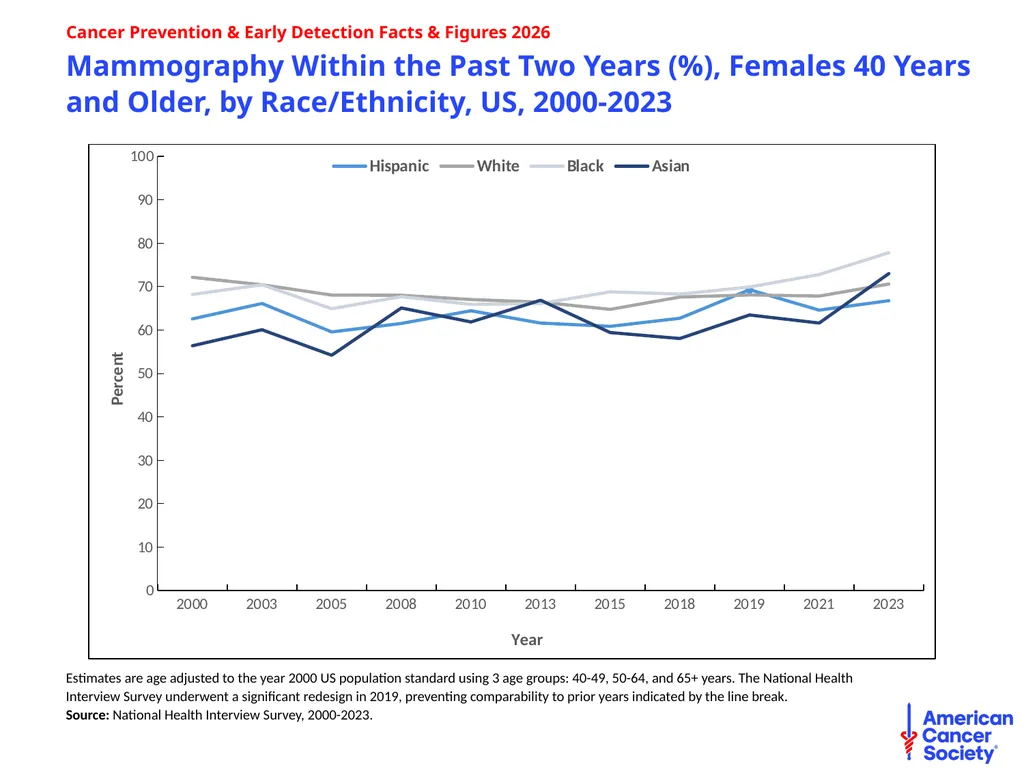
Estimates are age adjusted to the year 2000 US population standard using 3 age groups: 40-49, 50-64, and 65+ years. The National Health Interview Survey underwent a significant redesign in 2019, preventing comparability to prior years indicated by the line break.
Source: National Health Interview Survey, 2000-2023. Mammography Within the Past Two Years (%), Females 40 Years and Older, by Race/Ethnicity, US, 2000-2023 Cancer Prevention & Early Detection Facts & Figures 2026<br>
Source: National Health Interview Survey, 2000-2023. Mammography Within the Past Two Years (%), Females 40 Years and Older, by Race/Ethnicity, US, 2000-2023 Cancer Prevention & Early Detection Facts & Figures 2026<br>
31
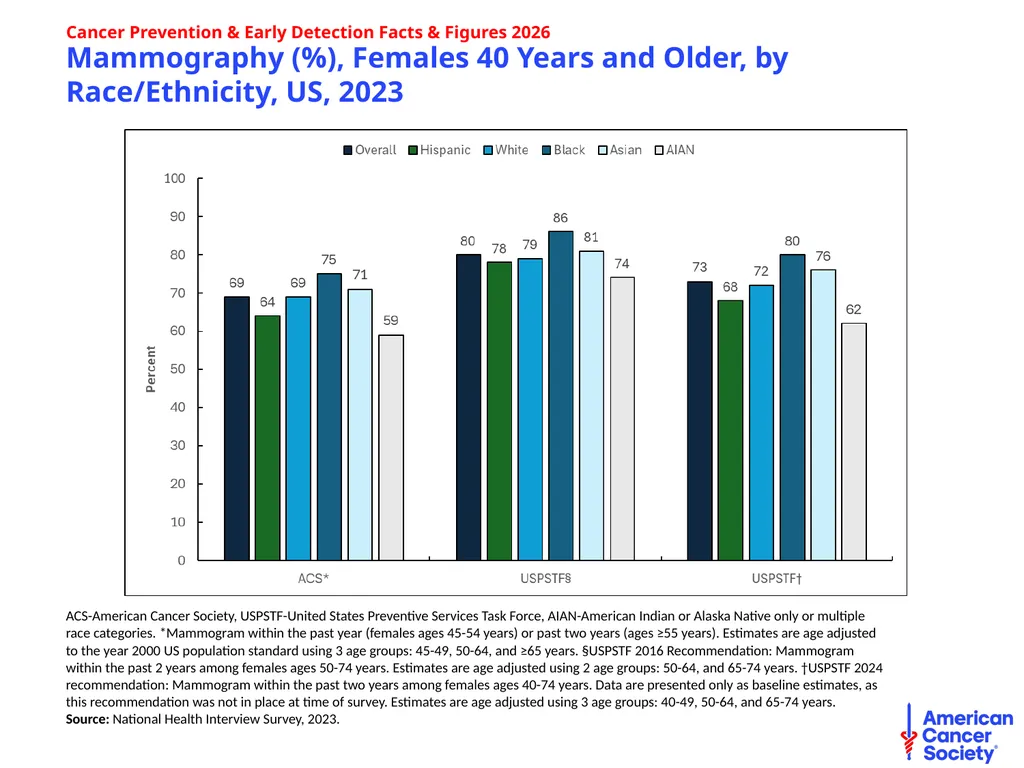
ACS-American Cancer Society, USPSTF-United States Preventive Services Task Force, AIAN-American Indian or Alaska Native only or multiple race categories. *Mammogram within the past year (females ages 45-54 years) or past two years (ages ≥55 years). Estimates are age adjusted to the year 2000 US population standard using 3 age groups: 45-49, 50-64, and ≥65 years. §USPSTF 2016 Recommendation: Mammogram within the past 2 years among females ages 50-74 years. Estimates are age adjusted using 2 age groups: 50-64, and 65-74 years. †USPSTF 2024 recommendation: Mammogram within the past two years among females ages 40-74 years. Data are presented only as baseline estimates, as this recommendation was not in place at time of survey. Estimates are age adjusted using 3 age groups: 40-49, 50-64, and 65-74 years.
Source: National Health Interview Survey, 2023. Mammography (%), Females 40 Years and Older, by Race/Ethnicity, US, 2023 Cancer Prevention & Early Detection Facts & Figures 2026<br>
Source: National Health Interview Survey, 2023. Mammography (%), Females 40 Years and Older, by Race/Ethnicity, US, 2023 Cancer Prevention & Early Detection Facts & Figures 2026<br>
32
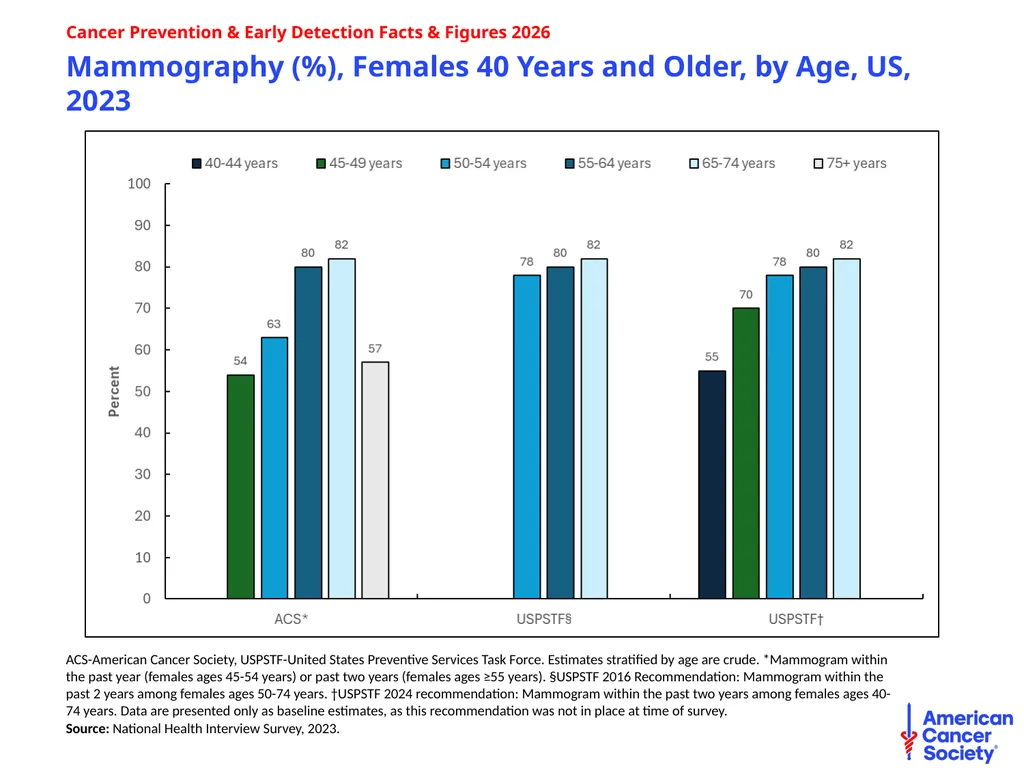
ACS-American Cancer Society, USPSTF-United States Preventive Services Task Force. Estimates stratified by age are crude. *Mammogram within the past year (females ages 45-54 years) or past two years (females ages ≥55 years). §USPSTF 2016 Recommendation: Mammogram within the past 2 years among females ages 50-74 years. †USPSTF 2024 recommendation: Mammogram within the past two years among females ages 40-74 years. Data are presented only as baseline estimates, as this recommendation was not in place at time of survey.
Source: National Health Interview Survey, 2023. Mammography (%), Females 40 Years and Older, by Age, US, 2023 Cancer Prevention & Early Detection Facts & Figures 2026<br>
Source: National Health Interview Survey, 2023. Mammography (%), Females 40 Years and Older, by Age, US, 2023 Cancer Prevention & Early Detection Facts & Figures 2026<br>
33
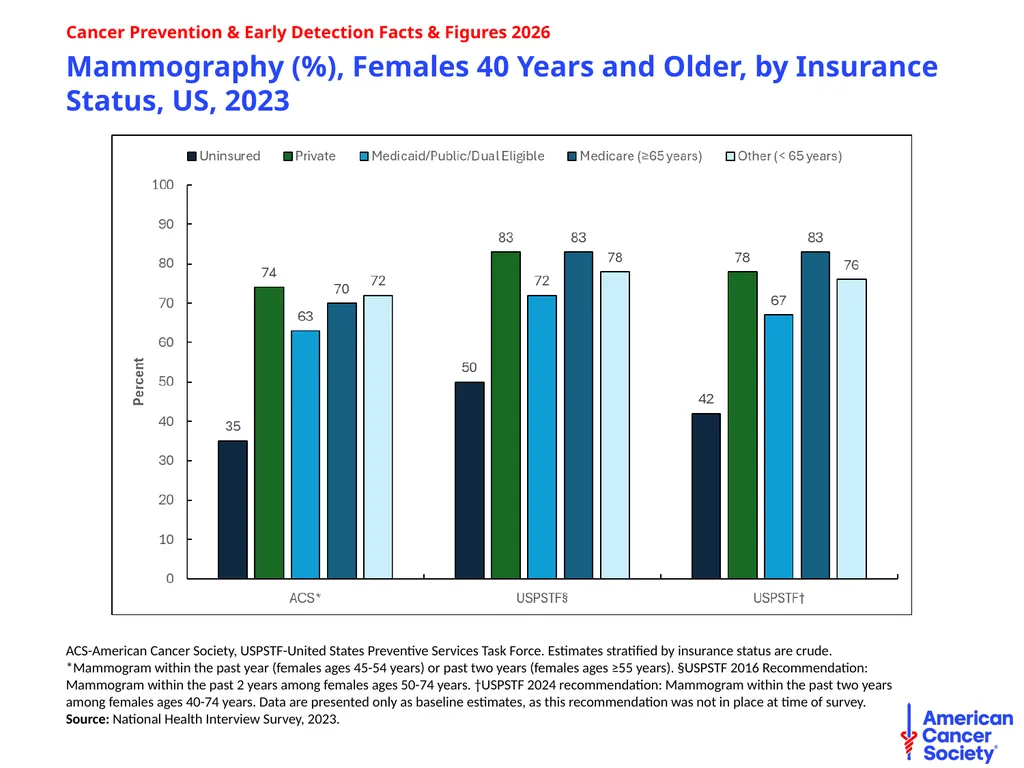
ACS-American Cancer Society, USPSTF-United States Preventive Services Task Force. Estimates stratified by insurance status are crude. *Mammogram within the past year (females ages 45-54 years) or past two years (females ages ≥55 years). §USPSTF 2016 Recommendation: Mammogram within the past 2 years among females ages 50-74 years. †USPSTF 2024 recommendation: Mammogram within the past two years among females ages 40-74 years. Data are presented only as baseline estimates, as this recommendation was not in place at time of survey.
Source: National Health Interview Survey, 2023. Mammography (%), Females 40 Years and Older, by Insurance Status, US, 2023 Cancer Prevention & Early Detection Facts & Figures 2026<br>
Source: National Health Interview Survey, 2023. Mammography (%), Females 40 Years and Older, by Insurance Status, US, 2023 Cancer Prevention & Early Detection Facts & Figures 2026<br>
34
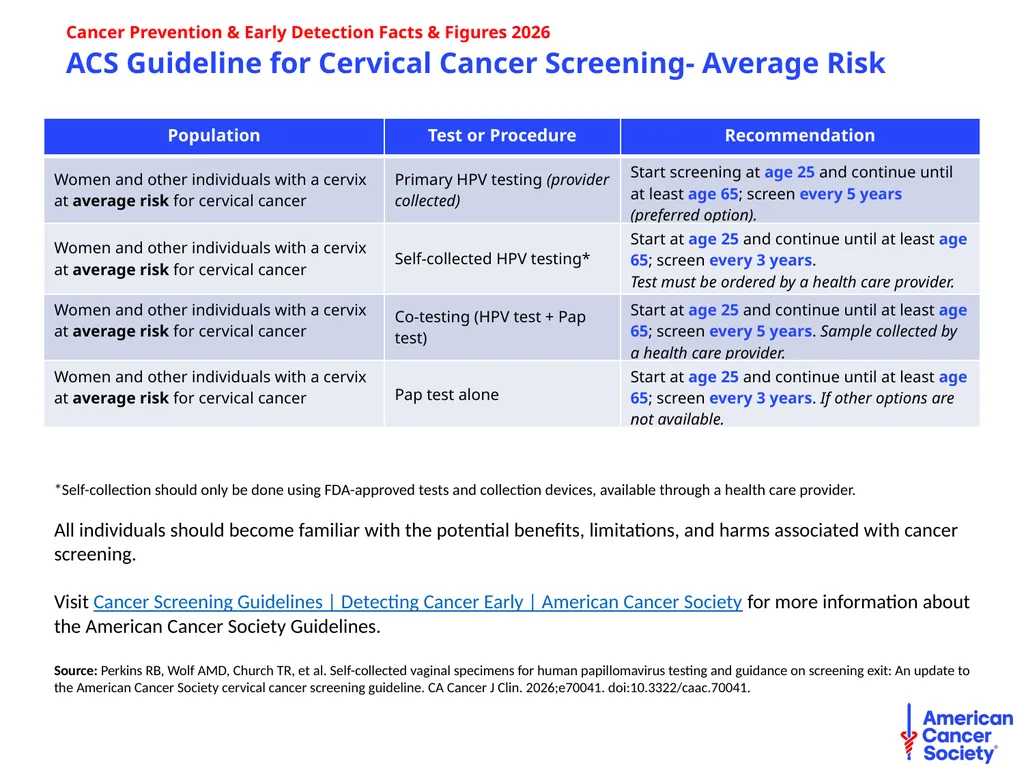
*Self-collection should only be done using FDA-approved tests and collection devices, available through a health care provider.
All individuals should become familiar with the potential benefits, limitations, and harms associated with cancer screening.
Visit Cancer Screening Guidelines | Detecting Cancer Early | American Cancer Society for more information about the American Cancer Society Guidelines.
Source: Perkins RB, Wolf AMD, Church TR, et al. Self-collected vaginal specimens for human papillomavirus testing and guidance on screening exit: An update to the American Cancer Society cervical cancer screening guideline. CA Cancer J Clin. 2026;e70041. doi:10.3322/caac.70041. ACS Guideline for Cervical Cancer Screening- Average Risk Cancer Prevention & Early Detection Facts & Figures 2026<br>
All individuals should become familiar with the potential benefits, limitations, and harms associated with cancer screening.
Visit Cancer Screening Guidelines | Detecting Cancer Early | American Cancer Society for more information about the American Cancer Society Guidelines.
Source: Perkins RB, Wolf AMD, Church TR, et al. Self-collected vaginal specimens for human papillomavirus testing and guidance on screening exit: An update to the American Cancer Society cervical cancer screening guideline. CA Cancer J Clin. 2026;e70041. doi:10.3322/caac.70041. ACS Guideline for Cervical Cancer Screening- Average Risk Cancer Prevention & Early Detection Facts & Figures 2026<br>
35
Tennessee was not included in the 2024 Behavioral Risk Factor Surveillance System due to insufficient data. Estimates are among females who have not had a hysterectomy. All estimates are age adjusted to the year 2000 US population standard using 4 age groups: 25-29, 30-39, 40-49, and 50-65 years. Pap test in the past 3 years or Pap test and HPV test or HPV test alone within the past 5 years among females 25-65 years.
Source: Behavioral Risk Factor Surveillance System, 2024. Cervical Cancer Screening (%), Females 25-65 Years, by State, US, 2024 Cancer Prevention & Early Detection Facts & Figures 2026<br>
Source: Behavioral Risk Factor Surveillance System, 2024. Cervical Cancer Screening (%), Females 25-65 Years, by State, US, 2024 Cancer Prevention & Early Detection Facts & Figures 2026<br>
36
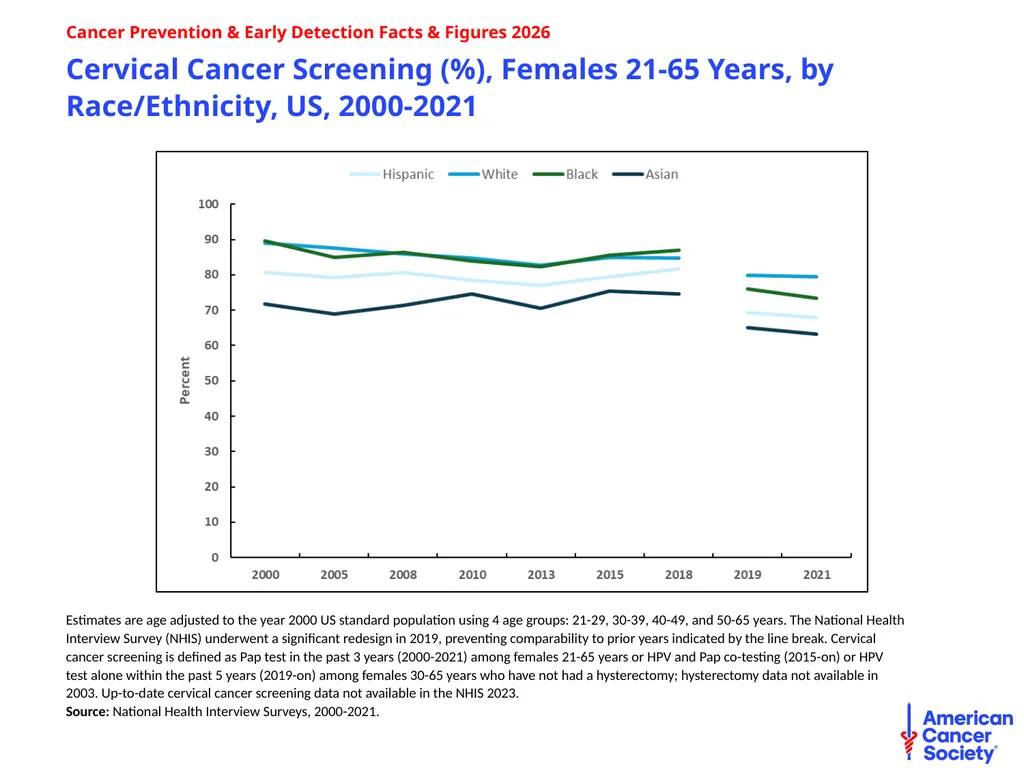
Estimates are age adjusted to the year 2000 US standard population using 4 age groups: 21-29, 30-39, 40-49, and 50-65 years. The National Health Interview Survey (NHIS) underwent a significant redesign in 2019, preventing comparability to prior years indicated by the line break. Cervical cancer screening is defined as Pap test in the past 3 years (2000-2021) among females 21-65 years or HPV and Pap co-testing (2015-on) or HPV test alone within the past 5 years (2019-on) among females 30-65 years who have not had a hysterectomy; hysterectomy data not available in 2003. Up-to-date cervical cancer screening data not available in the NHIS 2023.
Source: National Health Interview Surveys, 2000-2021. Cervical Cancer Screening (%), Females 21-65 Years, by Race/Ethnicity, US, 2000-2021 Cancer Prevention & Early Detection Facts & Figures 2026<br>
Source: National Health Interview Surveys, 2000-2021. Cervical Cancer Screening (%), Females 21-65 Years, by Race/Ethnicity, US, 2000-2021 Cancer Prevention & Early Detection Facts & Figures 2026<br>
37
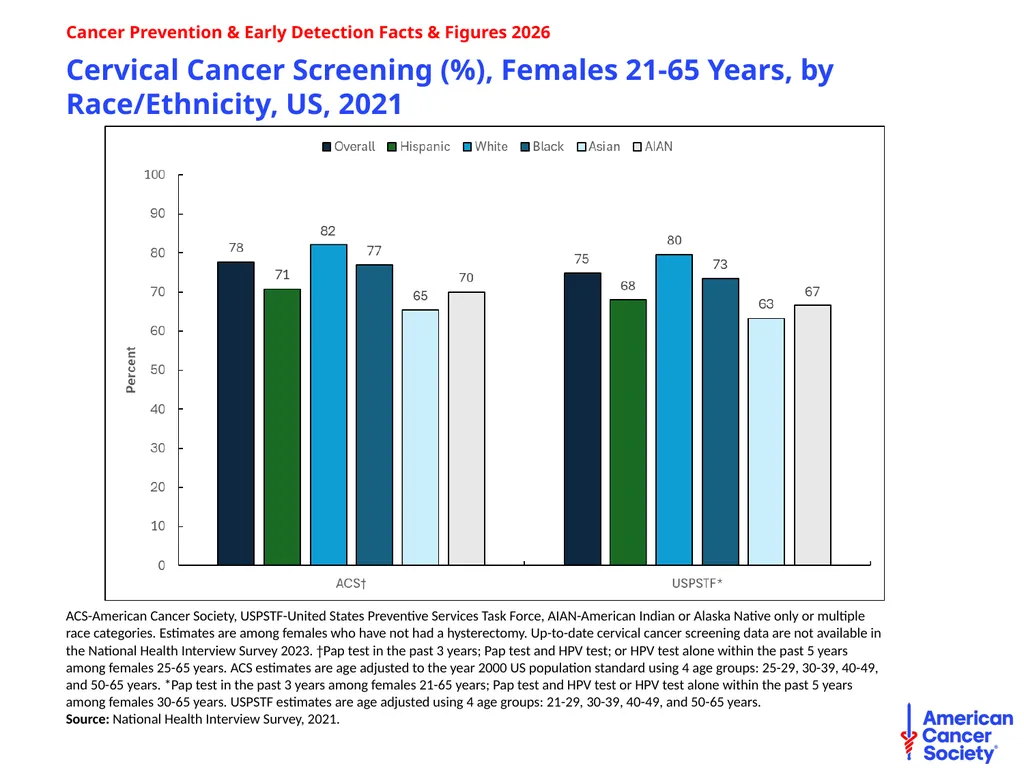
ACS-American Cancer Society, USPSTF-United States Preventive Services Task Force, AIAN-American Indian or Alaska Native only or multiple race categories. Estimates are among females who have not had a hysterectomy. Up-to-date cervical cancer screening data are not available in the National Health Interview Survey 2023. †Pap test in the past 3 years; Pap test and HPV test; or HPV test alone within the past 5 years among females 25-65 years. ACS estimates are age adjusted to the year 2000 US population standard using 4 age groups: 25-29, 30-39, 40-49, and 50-65 years. *Pap test in the past 3 years among females 21-65 years; Pap test and HPV test or HPV test alone within the past 5 years among females 30-65 years. USPSTF estimates are age adjusted using 4 age groups: 21-29, 30-39, 40-49, and 50-65 years.
Source: National Health Interview Survey, 2021. Cervical Cancer Screening (%), Females 21-65 Years, by Race/Ethnicity, US, 2021 Cancer Prevention & Early Detection Facts & Figures 2026<br>
Source: National Health Interview Survey, 2021. Cervical Cancer Screening (%), Females 21-65 Years, by Race/Ethnicity, US, 2021 Cancer Prevention & Early Detection Facts & Figures 2026<br>
38
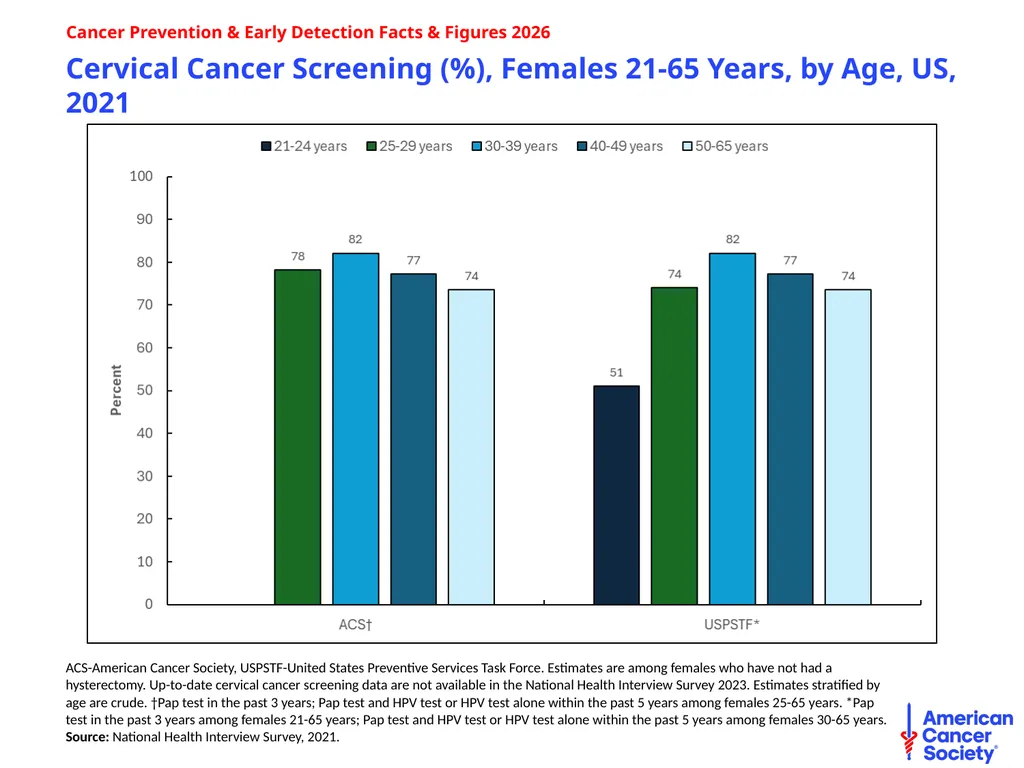
ACS-American Cancer Society, USPSTF-United States Preventive Services Task Force. Estimates are among females who have not had a hysterectomy. Up-to-date cervical cancer screening data are not available in the National Health Interview Survey 2023. Estimates stratified by age are crude. †Pap test in the past 3 years; Pap test and HPV test or HPV test alone within the past 5 years among females 25-65 years. *Pap test in the past 3 years among females 21-65 years; Pap test and HPV test or HPV test alone within the past 5 years among females 30-65 years.
Source: National Health Interview Survey, 2021. Cervical Cancer Screening (%), Females 21-65 Years, by Age, US, 2021 Cancer Prevention & Early Detection Facts & Figures 2026<br>
Source: National Health Interview Survey, 2021. Cervical Cancer Screening (%), Females 21-65 Years, by Age, US, 2021 Cancer Prevention & Early Detection Facts & Figures 2026<br>
39
ACS-American Cancer Society, USPSTF-United States Preventive Services Task Force. Insurance estimates are crude. Estimates are among females who have not had a hysterectomy. Up-to-date cervical cancer screening data are not available in the National Health Interview Survey 2023. Estimates stratified by insurance status are crude. †Pap test in the past 3 years; Pap test and HPV test or HPV test alone within the past 5 years among females 25-65 years. *Pap test in the past 3 years among females 21-65 years; Pap test and HPV test or HPV test alone within the past 5 years among females 30-65 years.
Source: National Health Interview Survey, 2021. Cervical Cancer Screening (%), Females 21-65 Years, by Insurance Status, US, 2021 Cancer Prevention & Early Detection Facts & Figures 2026<br>
Source: National Health Interview Survey, 2021. Cervical Cancer Screening (%), Females 21-65 Years, by Insurance Status, US, 2021 Cancer Prevention & Early Detection Facts & Figures 2026<br>
40
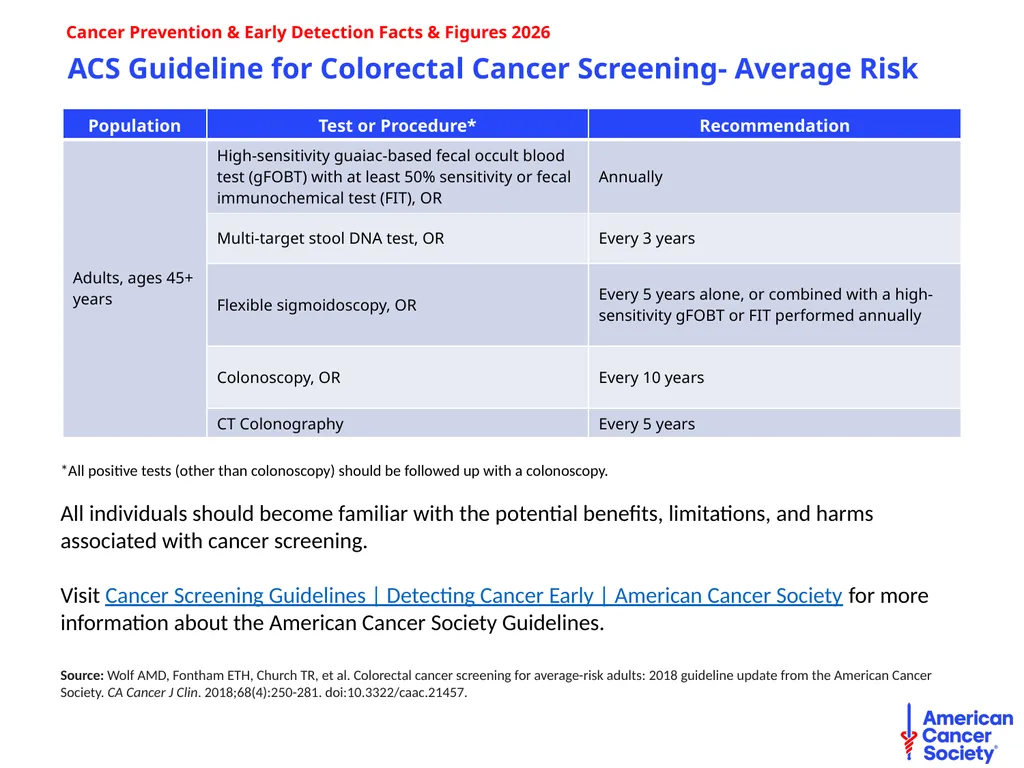
*All positive tests (other than colonoscopy) should be followed up with a colonoscopy.
All individuals should become familiar with the potential benefits, limitations, and harms associated with cancer screening.
Visit Cancer Screening Guidelines | Detecting Cancer Early | American Cancer Society for more information about the American Cancer Society Guidelines.
Source: Wolf AMD, Fontham ETH, Church TR, et al. Colorectal cancer screening for average-risk adults: 2018 guideline update from the American Cancer Society. CA Cancer J Clin. 2018;68(4):250-281. doi:10.3322/caac.21457. ACS Guideline for Colorectal Cancer Screening- Average Risk Cancer Prevention & Early Detection Facts & Figures 2026<br>
All individuals should become familiar with the potential benefits, limitations, and harms associated with cancer screening.
Visit Cancer Screening Guidelines | Detecting Cancer Early | American Cancer Society for more information about the American Cancer Society Guidelines.
Source: Wolf AMD, Fontham ETH, Church TR, et al. Colorectal cancer screening for average-risk adults: 2018 guideline update from the American Cancer Society. CA Cancer J Clin. 2018;68(4):250-281. doi:10.3322/caac.21457. ACS Guideline for Colorectal Cancer Screening- Average Risk Cancer Prevention & Early Detection Facts & Figures 2026<br>
41
Tennessee was not included in the 2024 Behavioral Risk Factor Surveillance System due to insufficient data. FOBT/FIT, sigmoidoscopy, colonoscopy, computed tomography (CT) colonography, or sDNA within the past 1, 5, 10, 5, and 3 years, respectively. Estimates are age adjusted to the year 2000 US population standard using 3 age groups: 45-49, 50-64, and ≥65 years.
Source: Behavioral Risk Factor Surveillance System, 2024. Colorectal Cancer Screening (%), Adults 45 Years and Older, by State, US, 2024 Cancer Prevention & Early Detection Facts & Figures 2026<br>
Source: Behavioral Risk Factor Surveillance System, 2024. Colorectal Cancer Screening (%), Adults 45 Years and Older, by State, US, 2024 Cancer Prevention & Early Detection Facts & Figures 2026<br>
42
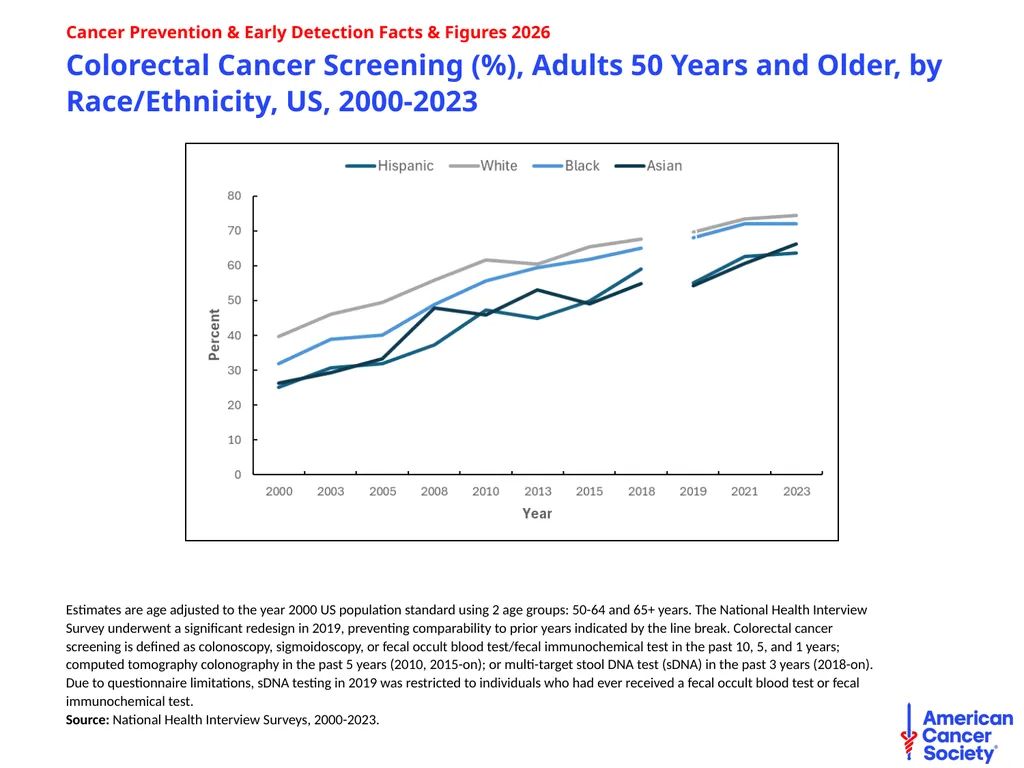
Colorectal Cancer Screening (%), Adults 50 Years and Older, by Race/Ethnicity, US, 2000-2023 Estimates are age adjusted to the year 2000 US population standard using 2 age groups: 50-64 and 65+ years. The National Health Interview Survey underwent a significant redesign in 2019, preventing comparability to prior years indicated by the line break. Colorectal cancer screening is defined as colonoscopy, sigmoidoscopy, or fecal occult blood test/fecal immunochemical test in the past 10, 5, and 1 years; computed tomography colonography in the past 5 years (2010, 2015-on); or multi-target stool DNA test (sDNA) in the past 3 years (2018-on). Due to questionnaire limitations, sDNA testing in 2019 was restricted to individuals who had ever received a fecal occult blood test or fecal immunochemical test.
Source: National Health Interview Surveys, 2000-2023. Cancer Prevention & Early Detection Facts & Figures 2026<br>
Source: National Health Interview Surveys, 2000-2023. Cancer Prevention & Early Detection Facts & Figures 2026<br>
43
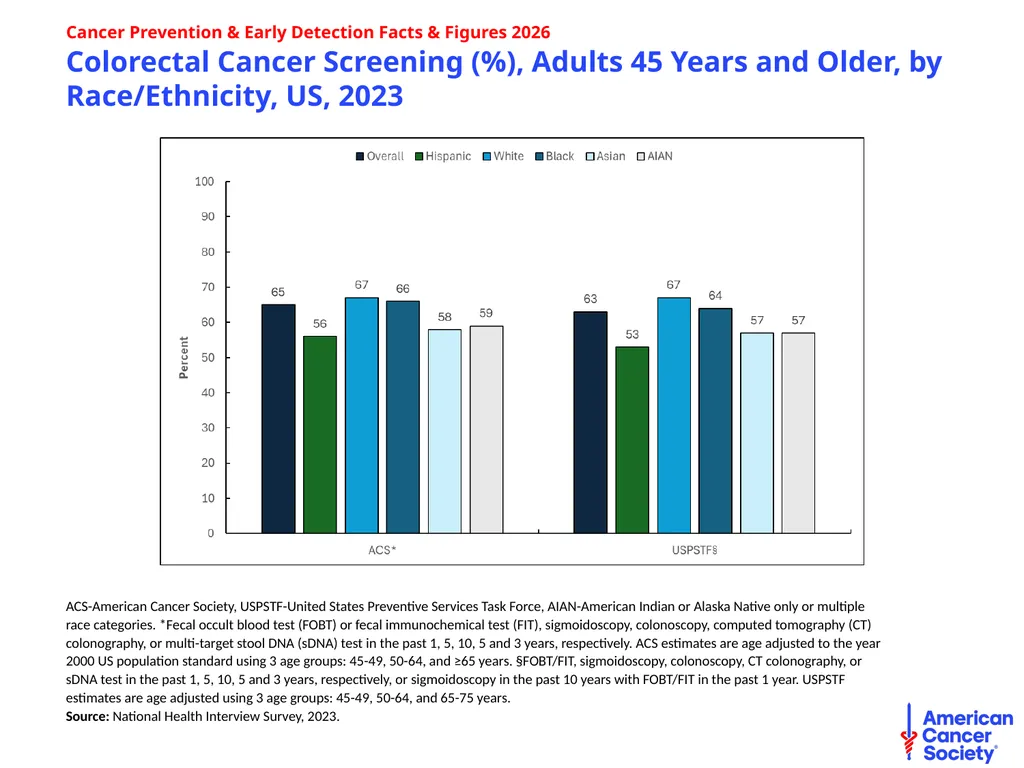
Colorectal Cancer Screening (%), Adults 45 Years and Older, by Race/Ethnicity, US, 2023 ACS-American Cancer Society, USPSTF-United States Preventive Services Task Force, AIAN-American Indian or Alaska Native only or multiple race categories. *Fecal occult blood test (FOBT) or fecal immunochemical test (FIT), sigmoidoscopy, colonoscopy, computed tomography (CT) colonography, or multi-target stool DNA (sDNA) test in the past 1, 5, 10, 5 and 3 years, respectively. ACS estimates are age adjusted to the year 2000 US population standard using 3 age groups: 45-49, 50-64, and ≥65 years. §FOBT/FIT, sigmoidoscopy, colonoscopy, CT colonography, or sDNA test in the past 1, 5, 10, 5 and 3 years, respectively, or sigmoidoscopy in the past 10 years with FOBT/FIT in the past 1 year. USPSTF estimates are age adjusted using 3 age groups: 45-49, 50-64, and 65-75 years.
Source: National Health Interview Survey, 2023. Cancer Prevention & Early Detection Facts & Figures 2026<br>
Source: National Health Interview Survey, 2023. Cancer Prevention & Early Detection Facts & Figures 2026<br>
44
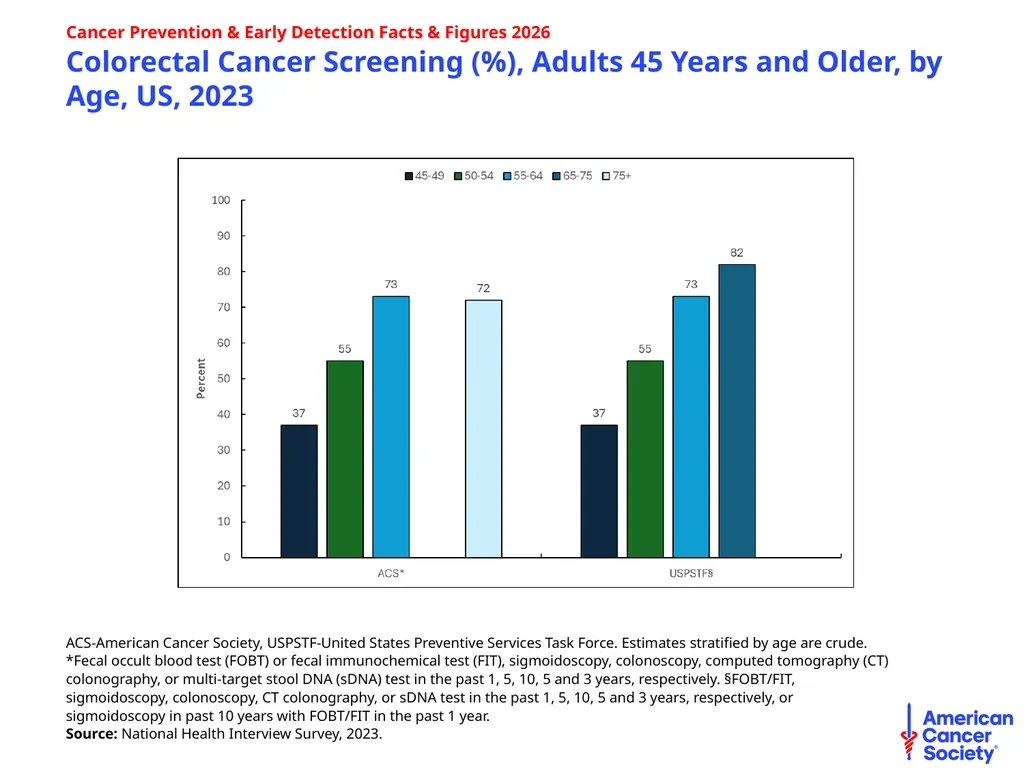
Colorectal Cancer Screening (%), Adults 45 Years and Older, by Age, US, 2023 ACS-American Cancer Society, USPSTF-United States Preventive Services Task Force. Estimates stratified by age are crude. *Fecal occult blood test (FOBT) or fecal immunochemical test (FIT), sigmoidoscopy, colonoscopy, computed tomography (CT) colonography, or multi-target stool DNA (sDNA) test in the past 1, 5, 10, 5 and 3 years, respectively. §FOBT/FIT, sigmoidoscopy, colonoscopy, CT colonography, or sDNA test in the past 1, 5, 10, 5 and 3 years, respectively, or sigmoidoscopy in past 10 years with FOBT/FIT in the past 1 year.
Source: National Health Interview Survey, 2023. Cancer Prevention & Early Detection Facts & Figures 2026<br>
Source: National Health Interview Survey, 2023. Cancer Prevention & Early Detection Facts & Figures 2026<br>
45
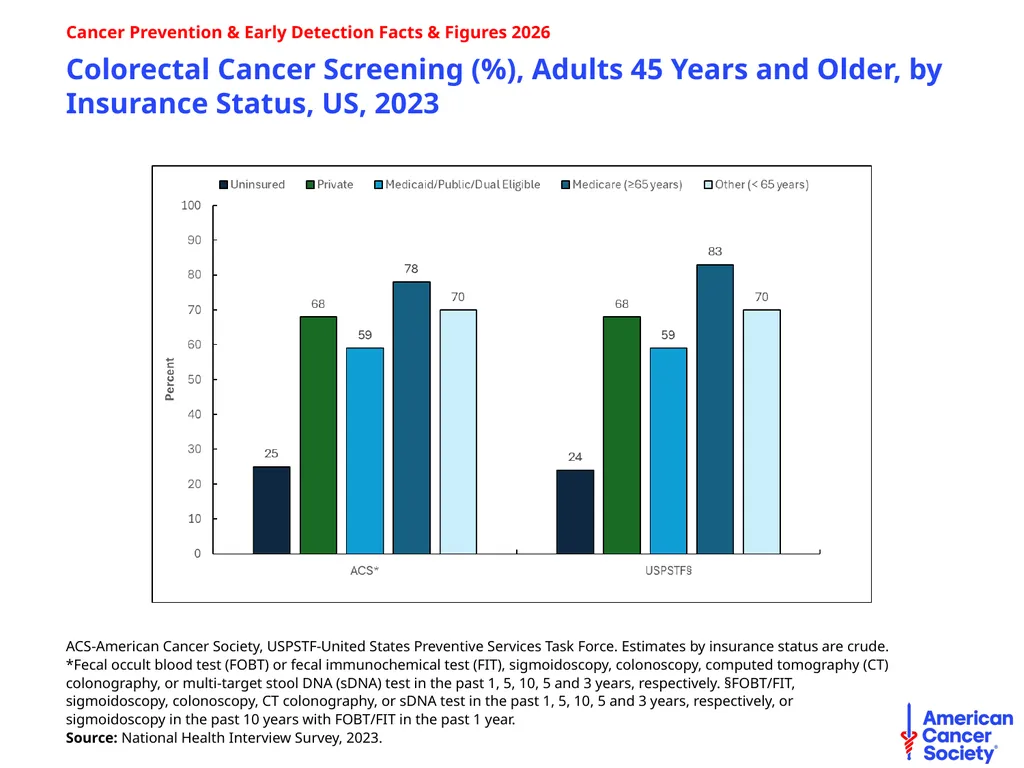
Colorectal Cancer Screening (%), Adults 45 Years and Older, by Insurance Status, US, 2023 ACS-American Cancer Society, USPSTF-United States Preventive Services Task Force. Estimates by insurance status are crude. *Fecal occult blood test (FOBT) or fecal immunochemical test (FIT), sigmoidoscopy, colonoscopy, computed tomography (CT) colonography, or multi-target stool DNA (sDNA) test in the past 1, 5, 10, 5 and 3 years, respectively. §FOBT/FIT, sigmoidoscopy, colonoscopy, CT colonography, or sDNA test in the past 1, 5, 10, 5 and 3 years, respectively, or sigmoidoscopy in the past 10 years with FOBT/FIT in the past 1 year.
Source: National Health Interview Survey, 2023. Cancer Prevention & Early Detection Facts & Figures 2026<br>
Source: National Health Interview Survey, 2023. Cancer Prevention & Early Detection Facts & Figures 2026<br>
46
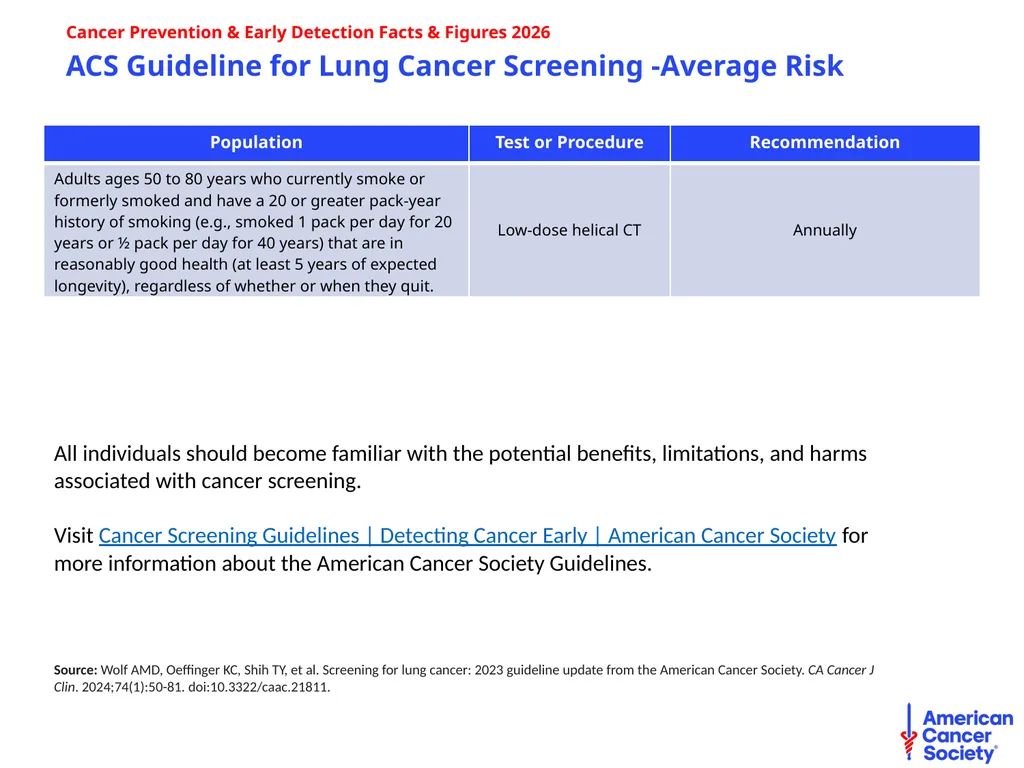
All individuals should become familiar with the potential benefits, limitations, and harms associated with cancer screening.
Visit Cancer Screening Guidelines | Detecting Cancer Early | American Cancer Society for more information about the American Cancer Society Guidelines.
Source: Wolf AMD, Oeffinger KC, Shih TY, et al. Screening for lung cancer: 2023 guideline update from the American Cancer Society. CA Cancer J Clin. 2024;74(1):50-81. doi:10.3322/caac.21811. ACS Guideline for Lung Cancer Screening -Average Risk Cancer Prevention & Early Detection Facts & Figures 2026<br>
Visit Cancer Screening Guidelines | Detecting Cancer Early | American Cancer Society for more information about the American Cancer Society Guidelines.
Source: Wolf AMD, Oeffinger KC, Shih TY, et al. Screening for lung cancer: 2023 guideline update from the American Cancer Society. CA Cancer J Clin. 2024;74(1):50-81. doi:10.3322/caac.21811. ACS Guideline for Lung Cancer Screening -Average Risk Cancer Prevention & Early Detection Facts & Figures 2026<br>
47
Tennessee was not included in the 2024 Behavioral Risk Factor Surveillance System due to insufficient data. All estimates are age adjusted to the year 2000 US population standard using 3 age groups: 50-59, 60-69, and 70-80 years. The American Cancer Society recommends annual screening for lung cancer with a low-dose CT (LDCT) scan for people ages 50 to 80 years who smoke or used to smoke and have at least a 20 pack-year history of smoking. Puerto Rico is not shown due to statically unstable estimates.
Source: Behavioral Risk Factor Surveillance System, 2024. Lung Cancer Screening (%), Adults 50-80 Years, by State, US, 2024 Cancer Prevention & Early Detection Facts & Figures 2026<br>
Source: Behavioral Risk Factor Surveillance System, 2024. Lung Cancer Screening (%), Adults 50-80 Years, by State, US, 2024 Cancer Prevention & Early Detection Facts & Figures 2026<br>
48
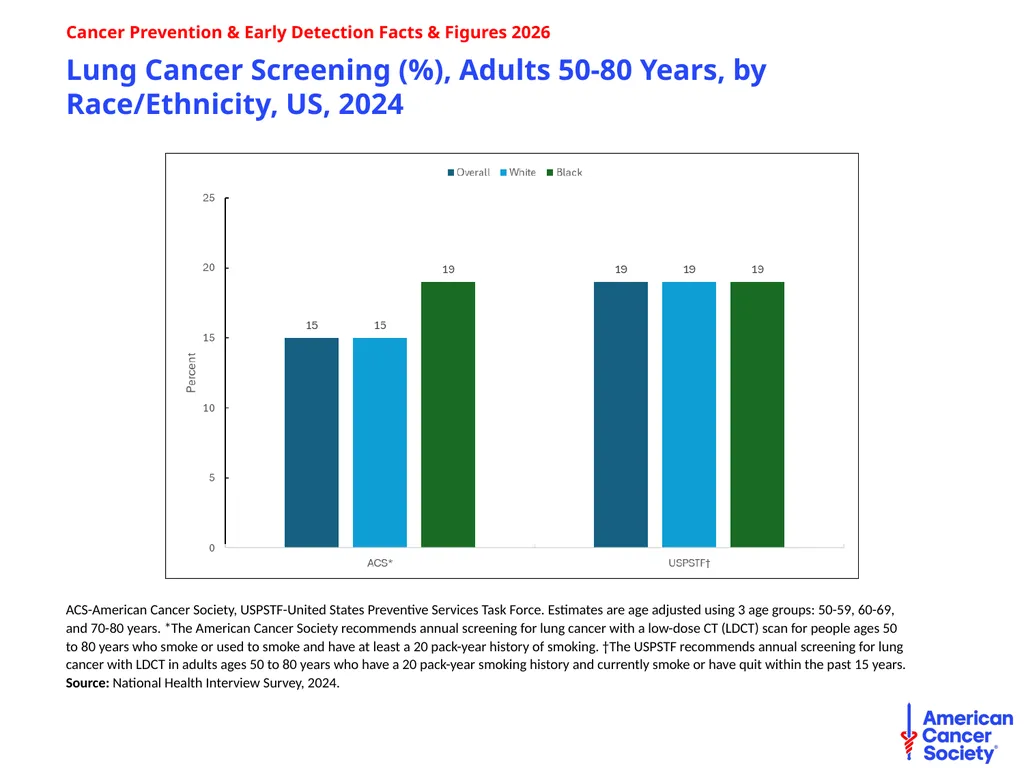
ACS-American Cancer Society, USPSTF-United States Preventive Services Task Force. Estimates are age adjusted using 3 age groups: 50-59, 60-69, and 70-80 years. *The American Cancer Society recommends annual screening for lung cancer with a low-dose CT (LDCT) scan for people ages 50 to 80 years who smoke or used to smoke and have at least a 20 pack-year history of smoking. †The USPSTF recommends annual screening for lung cancer with LDCT in adults ages 50 to 80 years who have a 20 pack-year smoking history and currently smoke or have quit within the past 15 years.
Source: National Health Interview Survey, 2024. Lung Cancer Screening (%), Adults 50-80 Years, by Race/Ethnicity, US, 2024 Cancer Prevention & Early Detection Facts & Figures 2026<br>
Source: National Health Interview Survey, 2024. Lung Cancer Screening (%), Adults 50-80 Years, by Race/Ethnicity, US, 2024 Cancer Prevention & Early Detection Facts & Figures 2026<br>
49
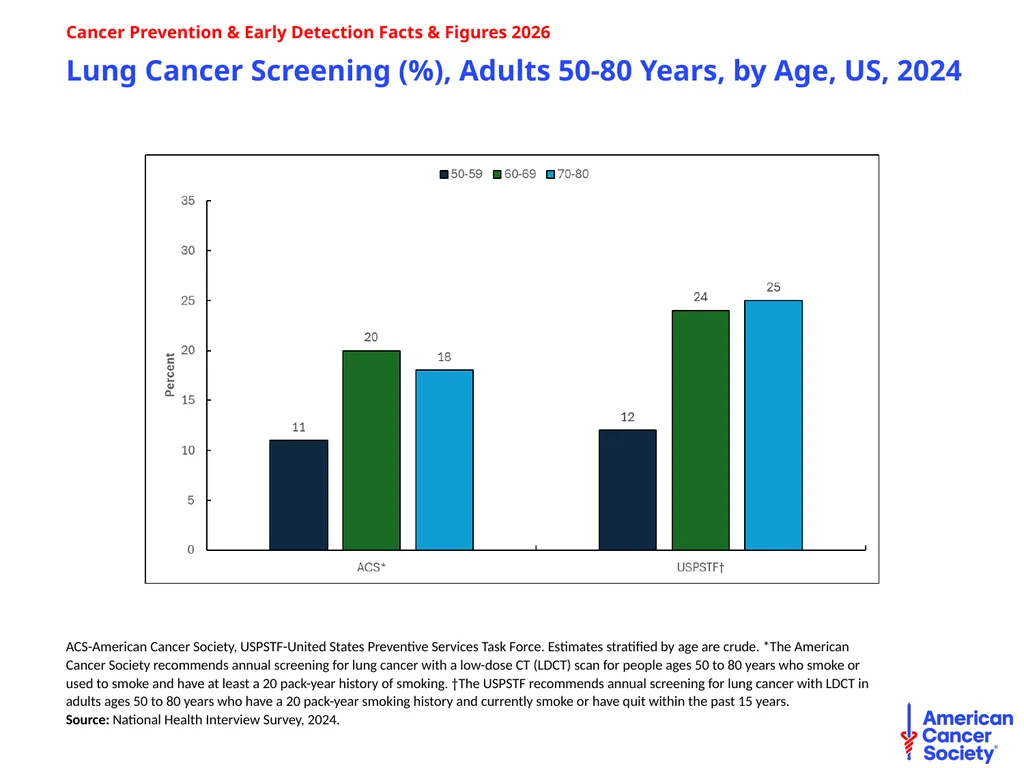
ACS-American Cancer Society, USPSTF-United States Preventive Services Task Force. Estimates stratified by age are crude. *The American Cancer Society recommends annual screening for lung cancer with a low-dose CT (LDCT) scan for people ages 50 to 80 years who smoke or used to smoke and have at least a 20 pack-year history of smoking. †The USPSTF recommends annual screening for lung cancer with LDCT in adults ages 50 to 80 years who have a 20 pack-year smoking history and currently smoke or have quit within the past 15 years.
Source: National Health Interview Survey, 2024. Lung Cancer Screening (%), Adults 50-80 Years, by Age, US, 2024 Cancer Prevention & Early Detection Facts & Figures 2026<br>
Source: National Health Interview Survey, 2024. Lung Cancer Screening (%), Adults 50-80 Years, by Age, US, 2024 Cancer Prevention & Early Detection Facts & Figures 2026<br>
50
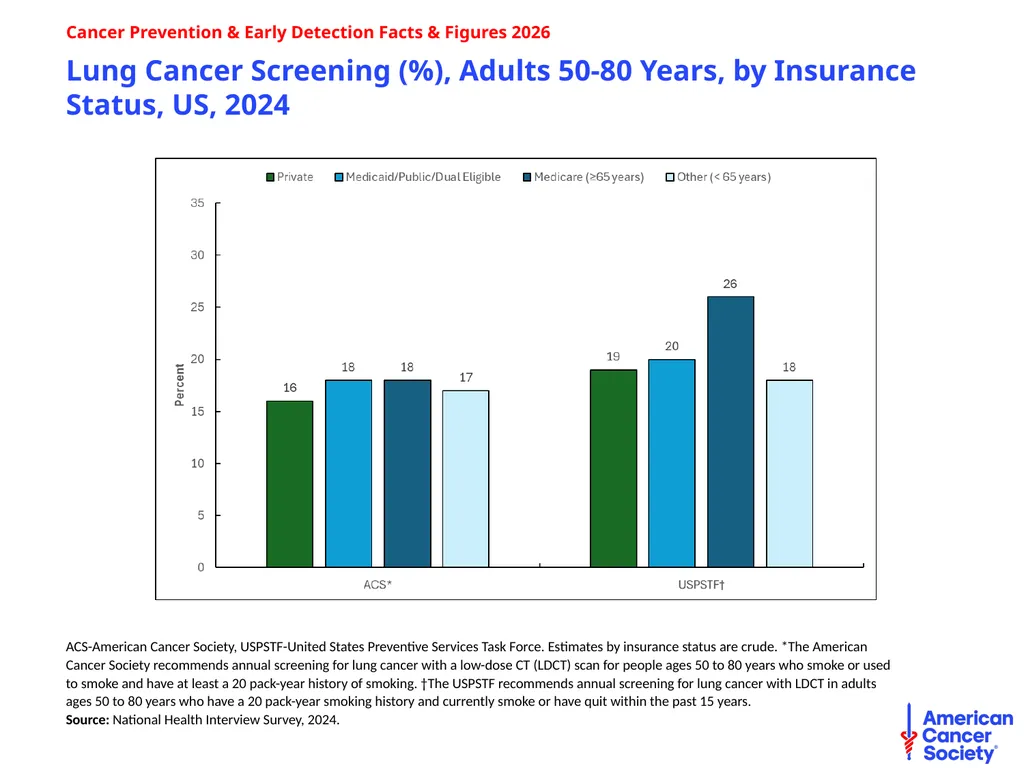
ACS-American Cancer Society, USPSTF-United States Preventive Services Task Force. Estimates by insurance status are crude. *The American Cancer Society recommends annual screening for lung cancer with a low-dose CT (LDCT) scan for people ages 50 to 80 years who smoke or used to smoke and have at least a 20 pack-year history of smoking. †The USPSTF recommends annual screening for lung cancer with LDCT in adults ages 50 to 80 years who have a 20 pack-year smoking history and currently smoke or have quit within the past 15 years.
Source: National Health Interview Survey, 2024. Lung Cancer Screening (%), Adults 50-80 Years, by Insurance Status, US, 2024 Cancer Prevention & Early Detection Facts & Figures 2026<br>
Source: National Health Interview Survey, 2024. Lung Cancer Screening (%), Adults 50-80 Years, by Insurance Status, US, 2024 Cancer Prevention & Early Detection Facts & Figures 2026<br>
51
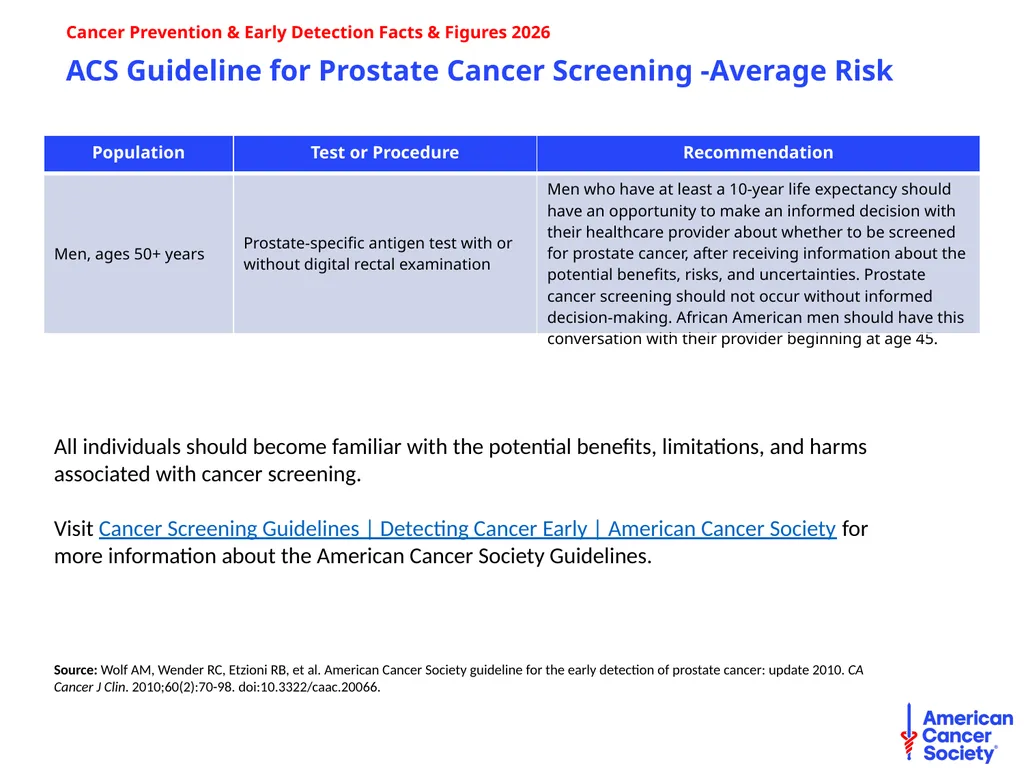
All individuals should become familiar with the potential benefits, limitations, and harms associated with cancer screening.
Visit Cancer Screening Guidelines | Detecting Cancer Early | American Cancer Society for more information about the American Cancer Society Guidelines.
Source: Wolf AM, Wender RC, Etzioni RB, et al. American Cancer Society guideline for the early detection of prostate cancer: update 2010. CA Cancer J Clin. 2010;60(2):70-98. doi:10.3322/caac.20066. ACS Guideline for Prostate Cancer Screening -Average Risk Cancer Prevention & Early Detection Facts & Figures 2026<br>
Visit Cancer Screening Guidelines | Detecting Cancer Early | American Cancer Society for more information about the American Cancer Society Guidelines.
Source: Wolf AM, Wender RC, Etzioni RB, et al. American Cancer Society guideline for the early detection of prostate cancer: update 2010. CA Cancer J Clin. 2010;60(2):70-98. doi:10.3322/caac.20066. ACS Guideline for Prostate Cancer Screening -Average Risk Cancer Prevention & Early Detection Facts & Figures 2026<br>