
CAPABILITIES Revolves primarily around people.
GB
Published · 51 slides · 0 views
1 / 1

Description
CAPABILITIES Revolves primarily around people. Refers to the abilities of both individuals and teams collectively. Covers areas such as: Information capital etc. CULTURE Emphasizes the need to always think of ways to get better. Considers
Related Topics
Share
Embed code
Download this presentation From Below
"CAPABILITIES Revolves primarily around people." is the property of its rightful owner. Permission is granted to download and print the materials on this website for personal, non-commercial use only, and to display it on your personal computer provided you do not modify the materials and that you retain all copyright notices contained in the materials. By downloading content from our website, you accept the terms of this agreement.
Presentation Transcript
01
CAPABILITIES
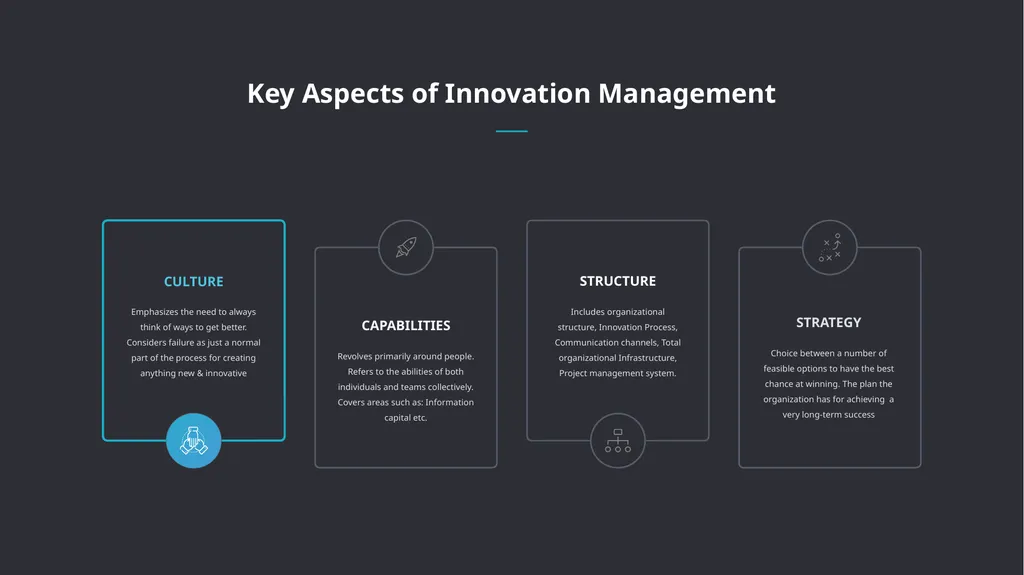
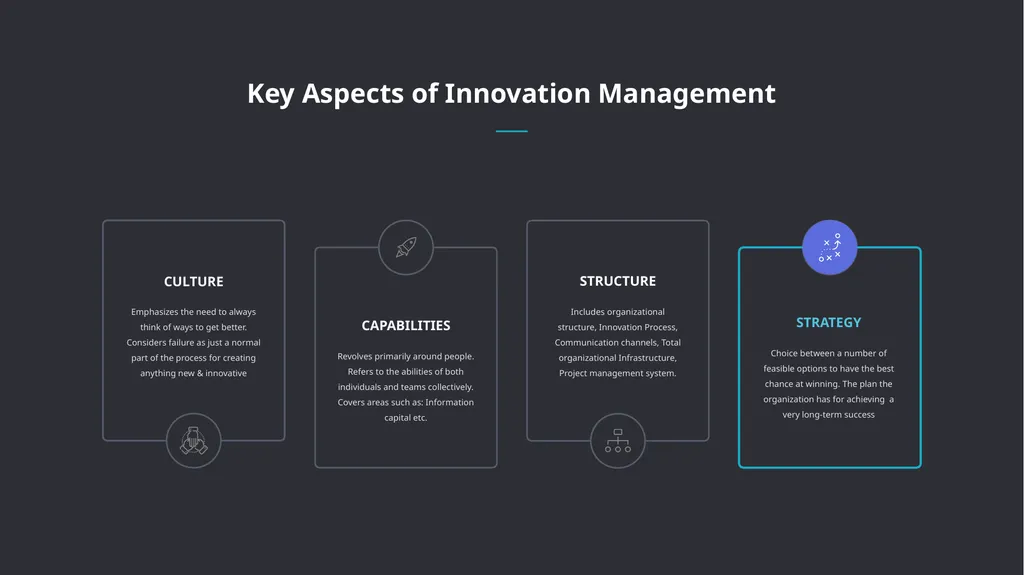
Revolves primarily around people. Refers to the abilities of both individuals and teams collectively. Covers areas such as: Information capital etc. CULTURE
Emphasizes the need to always think of ways to get better. Considers failure as just a normal part of the process for creating anything new & innovative STRUCTURE
Includes organizational structure, Innovation Process, Communication channels, Total organizational Infrastructure, Project management system. STRATEGY
Choice between a number of feasible options to have the best chance at winning. The plan the organization has for achieving a very long-term success Key Aspects of Innovation Management<br>
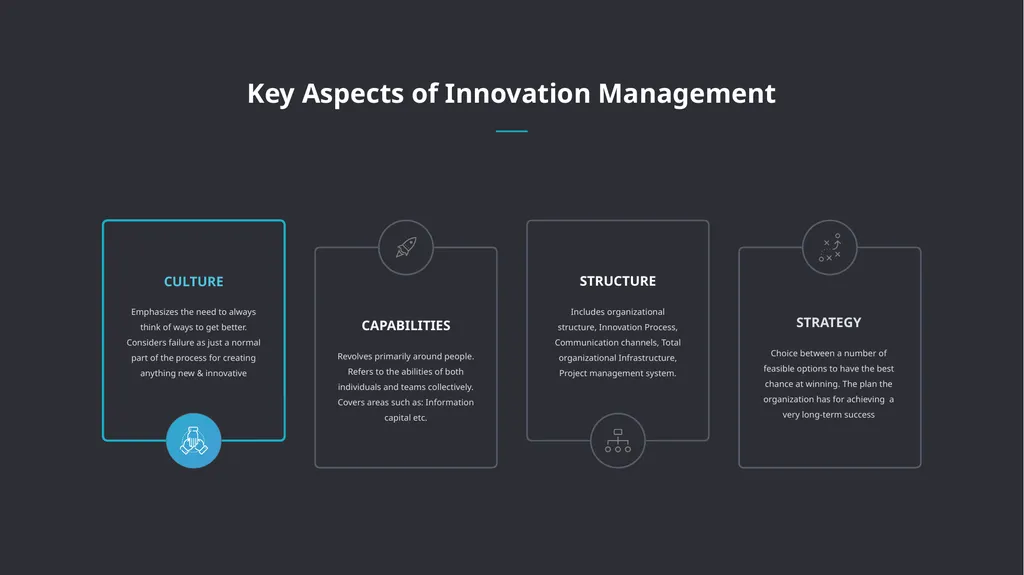
Revolves primarily around people. Refers to the abilities of both individuals and teams collectively. Covers areas such as: Information capital etc. CULTURE
Emphasizes the need to always think of ways to get better. Considers failure as just a normal part of the process for creating anything new & innovative STRUCTURE
Includes organizational structure, Innovation Process, Communication channels, Total organizational Infrastructure, Project management system. STRATEGY
Choice between a number of feasible options to have the best chance at winning. The plan the organization has for achieving a very long-term success Key Aspects of Innovation Management<br>
02
CAPABILITIES
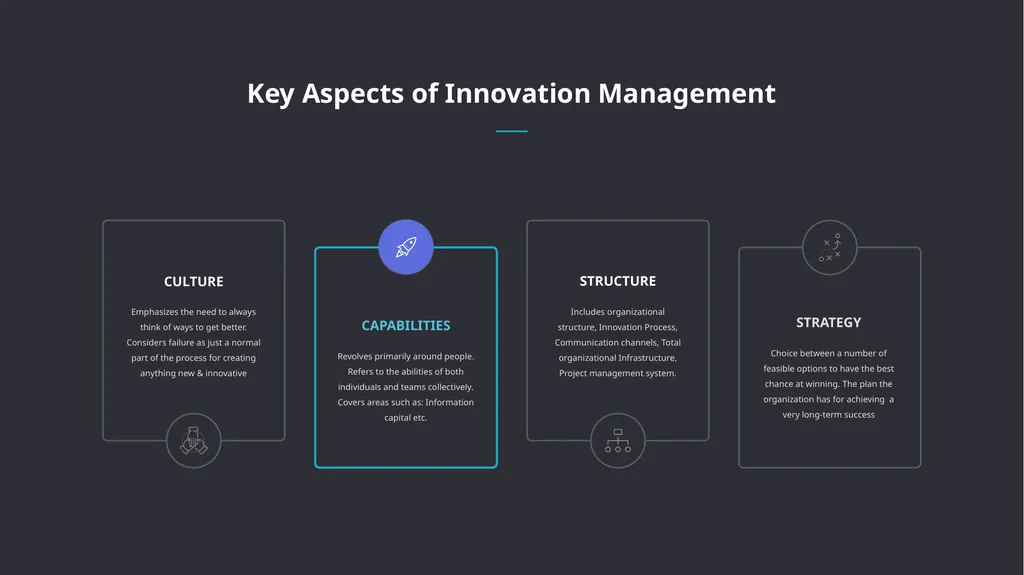
Revolves primarily around people. Refers to the abilities of both individuals and teams collectively. Covers areas such as: Information capital etc. CULTURE
Emphasizes the need to always think of ways to get better. Considers failure as just a normal part of the process for creating anything new & innovative STRUCTURE
Includes organizational structure, Innovation Process, Communication channels, Total organizational Infrastructure, Project management system. STRATEGY
Choice between a number of feasible options to have the best chance at winning. The plan the organization has for achieving a very long-term success Key Aspects of Innovation Management<br>
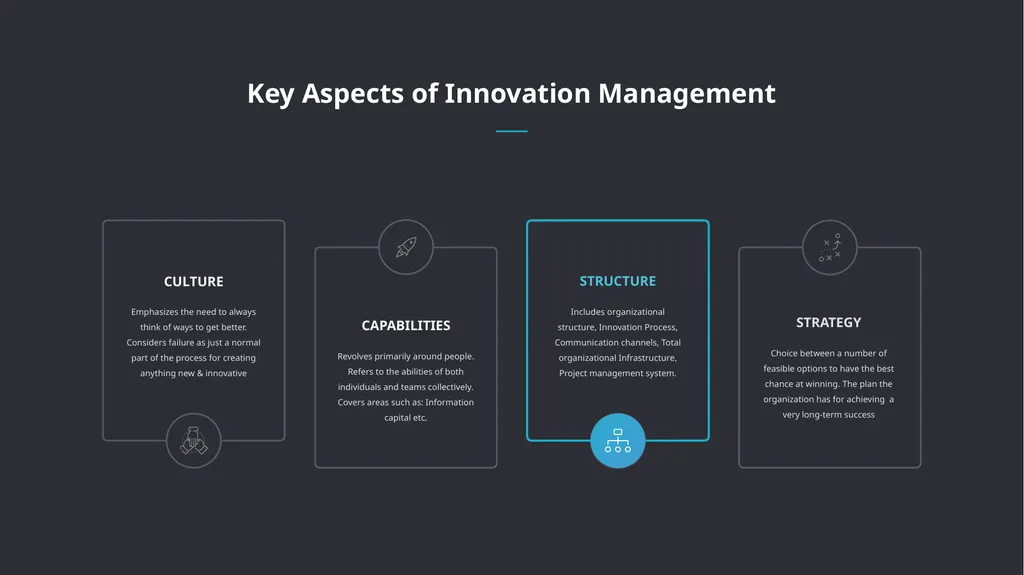
Revolves primarily around people. Refers to the abilities of both individuals and teams collectively. Covers areas such as: Information capital etc. CULTURE
Emphasizes the need to always think of ways to get better. Considers failure as just a normal part of the process for creating anything new & innovative STRUCTURE
Includes organizational structure, Innovation Process, Communication channels, Total organizational Infrastructure, Project management system. STRATEGY
Choice between a number of feasible options to have the best chance at winning. The plan the organization has for achieving a very long-term success Key Aspects of Innovation Management<br>
03
CAPABILITIES
Revolves primarily around people. Refers to the abilities of both individuals and teams collectively. Covers areas such as: Information capital etc. CULTURE
Emphasizes the need to always think of ways to get better. Considers failure as just a normal part of the process for creating anything new & innovative STRUCTURE
Includes organizational structure, Innovation Process, Communication channels, Total organizational Infrastructure, Project management system. STRATEGY
Choice between a number of feasible options to have the best chance at winning. The plan the organization has for achieving a very long-term success Key Aspects of Innovation Management<br>
Revolves primarily around people. Refers to the abilities of both individuals and teams collectively. Covers areas such as: Information capital etc. CULTURE
Emphasizes the need to always think of ways to get better. Considers failure as just a normal part of the process for creating anything new & innovative STRUCTURE
Includes organizational structure, Innovation Process, Communication channels, Total organizational Infrastructure, Project management system. STRATEGY
Choice between a number of feasible options to have the best chance at winning. The plan the organization has for achieving a very long-term success Key Aspects of Innovation Management<br>
04
CAPABILITIES
Revolves primarily around people. Refers to the abilities of both individuals and teams collectively. Covers areas such as: Information capital etc. CULTURE
Emphasizes the need to always think of ways to get better. Considers failure as just a normal part of the process for creating anything new & innovative STRUCTURE
Includes organizational structure, Innovation Process, Communication channels, Total organizational Infrastructure, Project management system. STRATEGY
Choice between a number of feasible options to have the best chance at winning. The plan the organization has for achieving a very long-term success Key Aspects of Innovation Management<br>
Revolves primarily around people. Refers to the abilities of both individuals and teams collectively. Covers areas such as: Information capital etc. CULTURE
Emphasizes the need to always think of ways to get better. Considers failure as just a normal part of the process for creating anything new & innovative STRUCTURE
Includes organizational structure, Innovation Process, Communication channels, Total organizational Infrastructure, Project management system. STRATEGY
Choice between a number of feasible options to have the best chance at winning. The plan the organization has for achieving a very long-term success Key Aspects of Innovation Management<br>
05
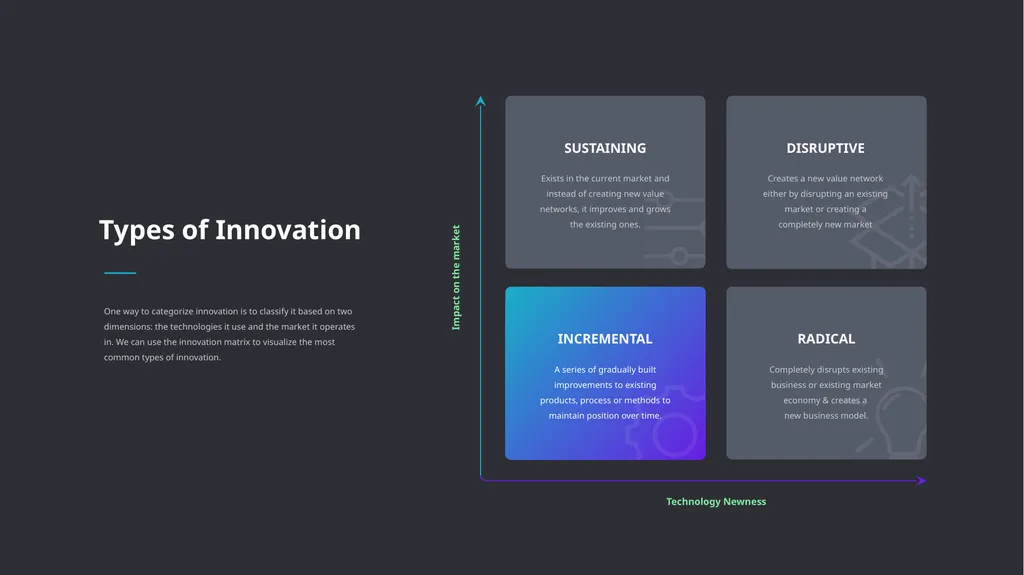
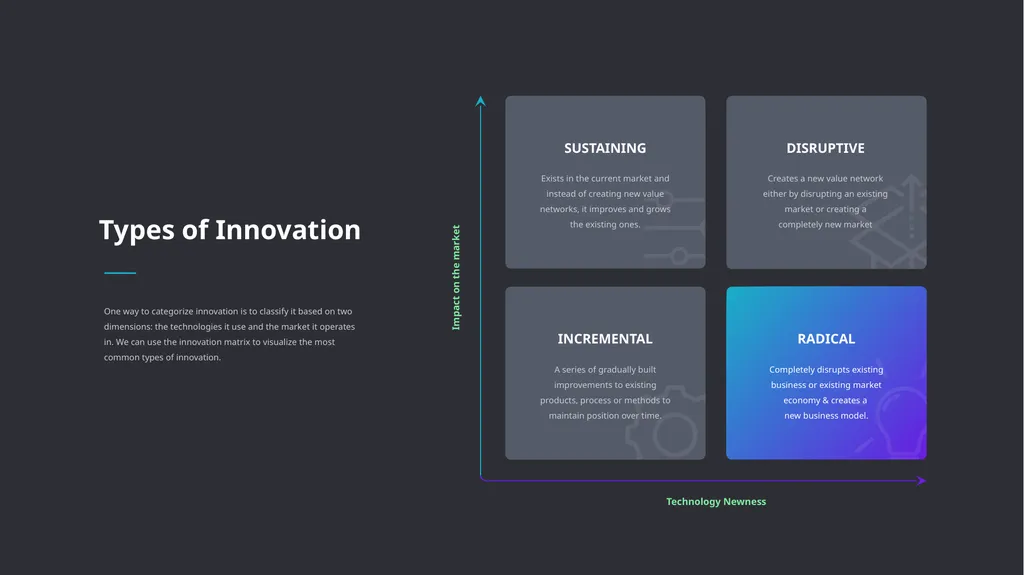
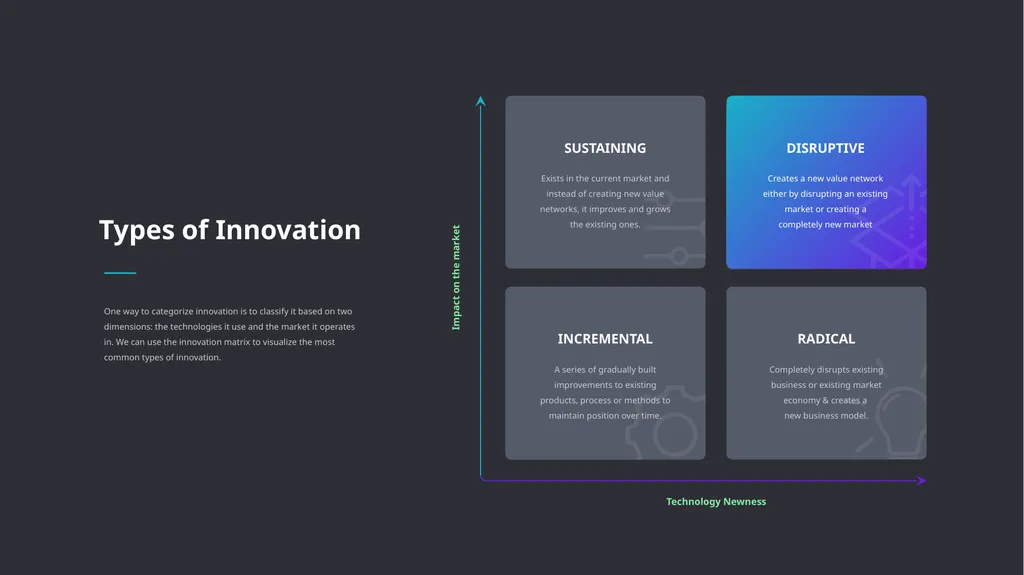
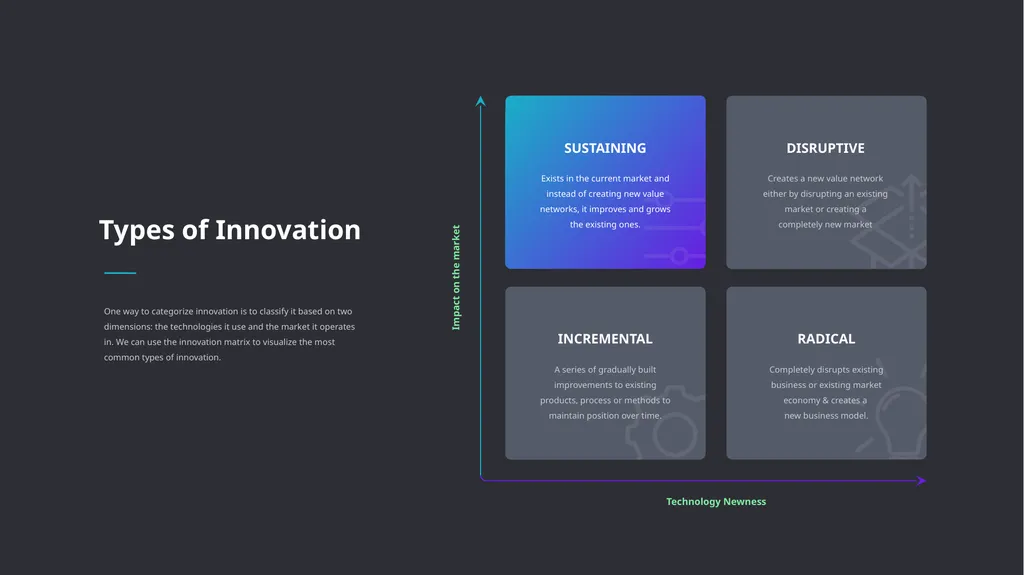
SUSTAINING
Exists in the current market and instead of creating new value networks, it improves and grows the existing ones. DISRUPTIVE
Creates a new value network either by disrupting an existing market or creating a completely new market INCREMENTAL
A series of gradually built improvements to existing products, process or methods to maintain position over time. RADICAL
Completely disrupts existing business or existing market economy & creates a
new business model. Impact on the market Technology Newness Types of Innovation One way to categorize innovation is to classify it based on two dimensions: the technologies it use and the market it operates in. We can use the innovation matrix to visualize the most common types of innovation.<br>
Exists in the current market and instead of creating new value networks, it improves and grows the existing ones. DISRUPTIVE
Creates a new value network either by disrupting an existing market or creating a completely new market INCREMENTAL
A series of gradually built improvements to existing products, process or methods to maintain position over time. RADICAL
Completely disrupts existing business or existing market economy & creates a
new business model. Impact on the market Technology Newness Types of Innovation One way to categorize innovation is to classify it based on two dimensions: the technologies it use and the market it operates in. We can use the innovation matrix to visualize the most common types of innovation.<br>
06
SUSTAINING
Exists in the current market and instead of creating new value networks, it improves and grows the existing ones. DISRUPTIVE
Creates a new value network either by disrupting an existing market or creating a completely new market INCREMENTAL
A series of gradually built improvements to existing products, process or methods to maintain position over time. RADICAL
Completely disrupts existing business or existing market economy & creates a
new business model. Impact on the market Technology Newness Types of Innovation One way to categorize innovation is to classify it based on two dimensions: the technologies it use and the market it operates in. We can use the innovation matrix to visualize the most common types of innovation.<br>
Exists in the current market and instead of creating new value networks, it improves and grows the existing ones. DISRUPTIVE
Creates a new value network either by disrupting an existing market or creating a completely new market INCREMENTAL
A series of gradually built improvements to existing products, process or methods to maintain position over time. RADICAL
Completely disrupts existing business or existing market economy & creates a
new business model. Impact on the market Technology Newness Types of Innovation One way to categorize innovation is to classify it based on two dimensions: the technologies it use and the market it operates in. We can use the innovation matrix to visualize the most common types of innovation.<br>
07
SUSTAINING
Exists in the current market and instead of creating new value networks, it improves and grows the existing ones. DISRUPTIVE
Creates a new value network either by disrupting an existing market or creating a completely new market INCREMENTAL
A series of gradually built improvements to existing products, process or methods to maintain position over time. RADICAL
Completely disrupts existing business or existing market economy & creates a
new business model. Impact on the market Technology Newness Types of Innovation One way to categorize innovation is to classify it based on two dimensions: the technologies it use and the market it operates in. We can use the innovation matrix to visualize the most common types of innovation.<br>
Exists in the current market and instead of creating new value networks, it improves and grows the existing ones. DISRUPTIVE
Creates a new value network either by disrupting an existing market or creating a completely new market INCREMENTAL
A series of gradually built improvements to existing products, process or methods to maintain position over time. RADICAL
Completely disrupts existing business or existing market economy & creates a
new business model. Impact on the market Technology Newness Types of Innovation One way to categorize innovation is to classify it based on two dimensions: the technologies it use and the market it operates in. We can use the innovation matrix to visualize the most common types of innovation.<br>
08
SUSTAINING
Exists in the current market and instead of creating new value networks, it improves and grows the existing ones. DISRUPTIVE
Creates a new value network either by disrupting an existing market or creating a completely new market INCREMENTAL
A series of gradually built improvements to existing products, process or methods to maintain position over time. RADICAL
Completely disrupts existing business or existing market economy & creates a
new business model. Impact on the market Technology Newness Types of Innovation One way to categorize innovation is to classify it based on two dimensions: the technologies it use and the market it operates in. We can use the innovation matrix to visualize the most common types of innovation.<br>
Exists in the current market and instead of creating new value networks, it improves and grows the existing ones. DISRUPTIVE
Creates a new value network either by disrupting an existing market or creating a completely new market INCREMENTAL
A series of gradually built improvements to existing products, process or methods to maintain position over time. RADICAL
Completely disrupts existing business or existing market economy & creates a
new business model. Impact on the market Technology Newness Types of Innovation One way to categorize innovation is to classify it based on two dimensions: the technologies it use and the market it operates in. We can use the innovation matrix to visualize the most common types of innovation.<br>
09
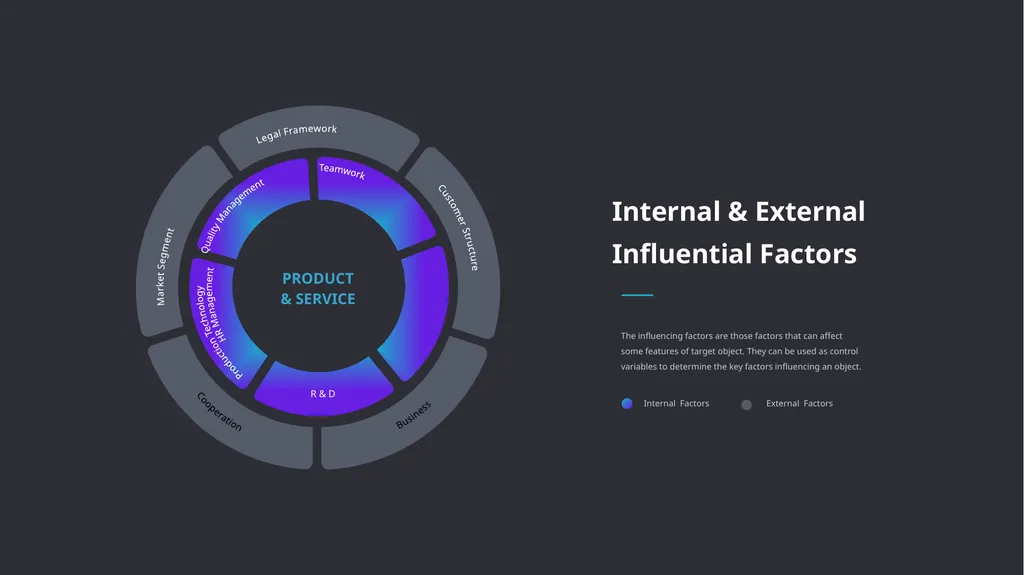
PRODUCT
& SERVICE Internal & External
Influential Factors The influencing factors are those factors that can affect
some features of target object. They can be used as control variables to determine the key factors influencing an object. Internal Factors External Factors<br>
& SERVICE Internal & External
Influential Factors The influencing factors are those factors that can affect
some features of target object. They can be used as control variables to determine the key factors influencing an object. Internal Factors External Factors<br>
10
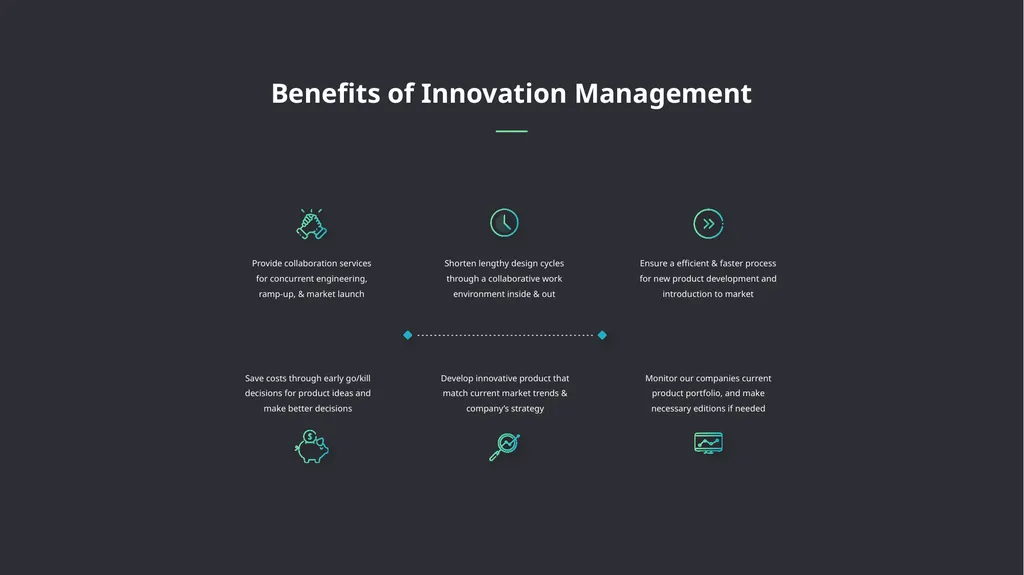
Provide collaboration services for concurrent engineering, ramp-up, & market launch Shorten lengthy design cycles through a collaborative work environment inside & out Ensure a efficient & faster process for new product development and introduction to market Save costs through early go/kill decisions for product ideas and make better decisions Develop innovative product that match current market trends & company’s strategy Monitor our companies current product portfolio, and make necessary editions if needed Benefits of Innovation Management<br>
11
MARKET
Disruptive vs. Sustaining PRODUCT
Incremental vs. Radical<br>
Disruptive vs. Sustaining PRODUCT
Incremental vs. Radical<br>
12
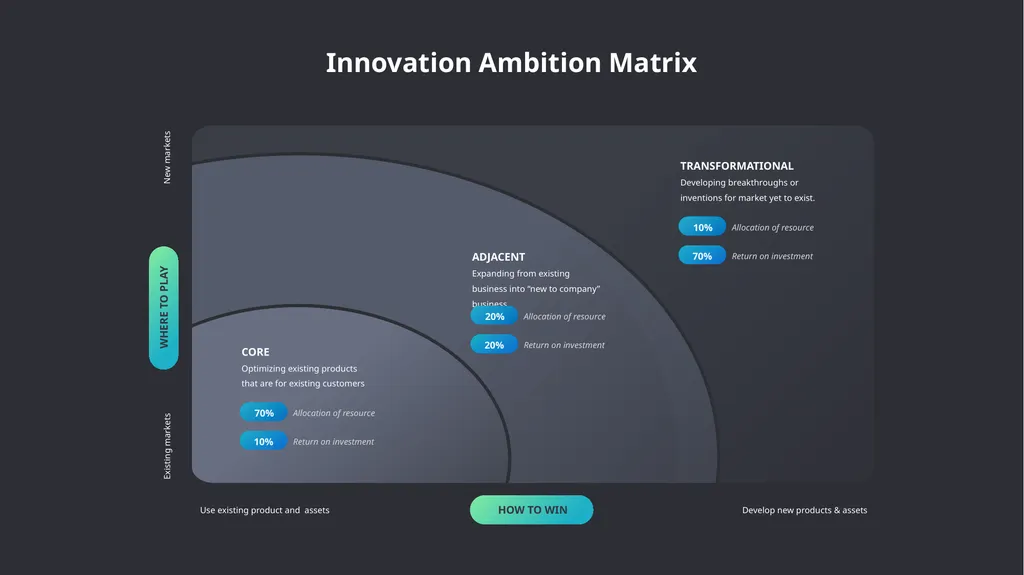
Innovation Ambition Matrix Existing markets New markets Use existing product and assets Develop new products & assets CORE
Optimizing existing products that are for existing customers ADJACENT
Expanding from existing business into “new to company” business TRANSFORMATIONAL
Developing breakthroughs or inventions for market yet to exist.<br>
Optimizing existing products that are for existing customers ADJACENT
Expanding from existing business into “new to company” business TRANSFORMATIONAL
Developing breakthroughs or inventions for market yet to exist.<br>
13
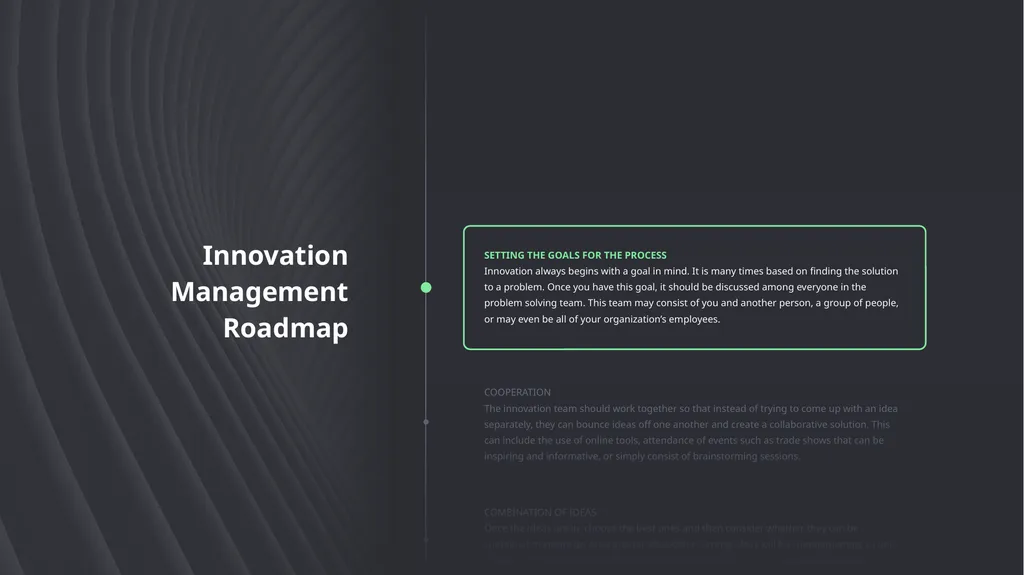
SETTING THE GOALS FOR THE PROCESS
Innovation always begins with a goal in mind. It is many times based on finding the solution to a problem. Once you have this goal, it should be discussed among everyone in the problem solving team. This team may consist of you and another person, a group of people, or may even be all of your organization’s employees. COOPERATION
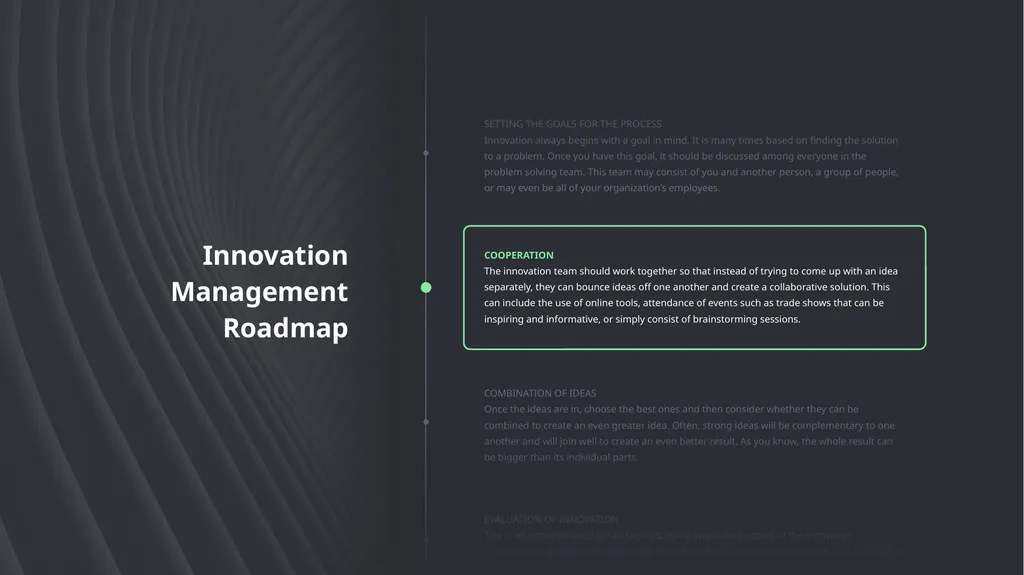
The innovation team should work together so that instead of trying to come up with an idea separately, they can bounce ideas off one another and create a collaborative solution. This can include the use of online tools, attendance of events such as trade shows that can be inspiring and informative, or simply consist of brainstorming sessions. COMBINATION OF IDEAS
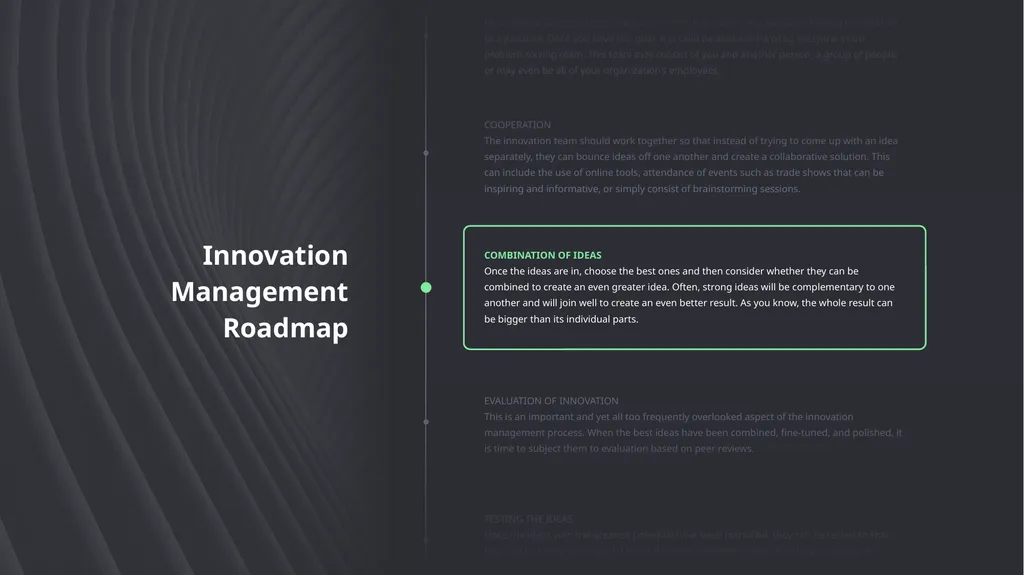
Once the ideas are in, choose the best ones and then consider whether they can be combined to create an even greater idea. Often, strong ideas will be complementary to one another and will join well to create an even better result. As you know, the whole result can be bigger than its individual parts. Innovation
Management
Roadmap<br>
Innovation always begins with a goal in mind. It is many times based on finding the solution to a problem. Once you have this goal, it should be discussed among everyone in the problem solving team. This team may consist of you and another person, a group of people, or may even be all of your organization’s employees. COOPERATION
The innovation team should work together so that instead of trying to come up with an idea separately, they can bounce ideas off one another and create a collaborative solution. This can include the use of online tools, attendance of events such as trade shows that can be inspiring and informative, or simply consist of brainstorming sessions. COMBINATION OF IDEAS
Once the ideas are in, choose the best ones and then consider whether they can be combined to create an even greater idea. Often, strong ideas will be complementary to one another and will join well to create an even better result. As you know, the whole result can be bigger than its individual parts. Innovation
Management
Roadmap<br>
14
COOPERATION
The innovation team should work together so that instead of trying to come up with an idea separately, they can bounce ideas off one another and create a collaborative solution. This can include the use of online tools, attendance of events such as trade shows that can be inspiring and informative, or simply consist of brainstorming sessions. COMBINATION OF IDEAS
Once the ideas are in, choose the best ones and then consider whether they can be combined to create an even greater idea. Often, strong ideas will be complementary to one another and will join well to create an even better result. As you know, the whole result can be bigger than its individual parts. EVALUATION OF INNOVATION
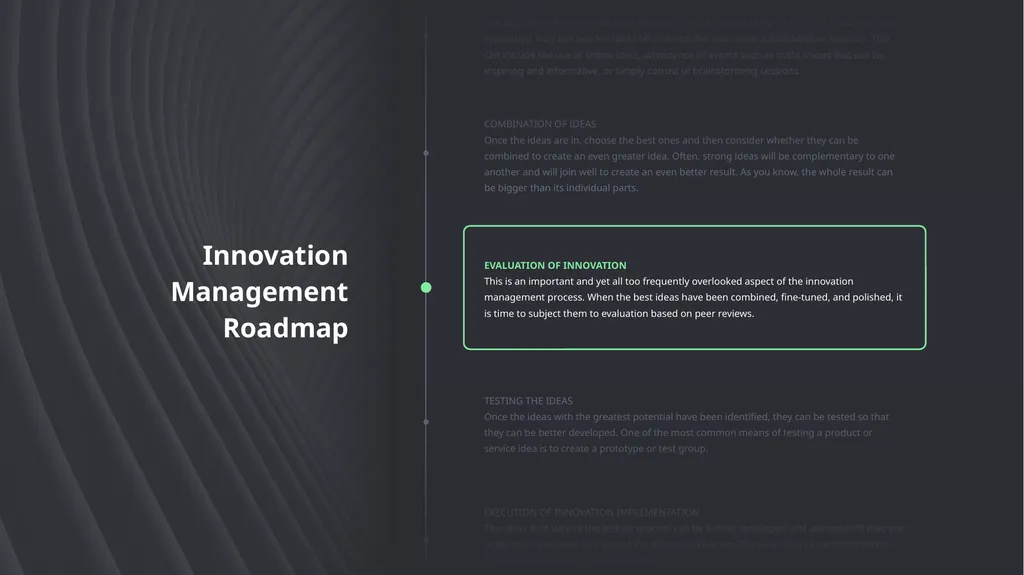
This is an important and yet all too frequently overlooked aspect of the innovation management process. When the best ideas have been combined, fine-tuned, and polished, it is time to subject them to evaluation based on peer reviews. SETTING THE GOALS FOR THE PROCESS
Innovation always begins with a goal in mind. It is many times based on finding the solution to a problem. Once you have this goal, it should be discussed among everyone in the problem solving team. This team may consist of you and another person, a group of people, or may even be all of your organization’s employees. Innovation
Management
Roadmap<br>
The innovation team should work together so that instead of trying to come up with an idea separately, they can bounce ideas off one another and create a collaborative solution. This can include the use of online tools, attendance of events such as trade shows that can be inspiring and informative, or simply consist of brainstorming sessions. COMBINATION OF IDEAS
Once the ideas are in, choose the best ones and then consider whether they can be combined to create an even greater idea. Often, strong ideas will be complementary to one another and will join well to create an even better result. As you know, the whole result can be bigger than its individual parts. EVALUATION OF INNOVATION
This is an important and yet all too frequently overlooked aspect of the innovation management process. When the best ideas have been combined, fine-tuned, and polished, it is time to subject them to evaluation based on peer reviews. SETTING THE GOALS FOR THE PROCESS
Innovation always begins with a goal in mind. It is many times based on finding the solution to a problem. Once you have this goal, it should be discussed among everyone in the problem solving team. This team may consist of you and another person, a group of people, or may even be all of your organization’s employees. Innovation
Management
Roadmap<br>
15
COMBINATION OF IDEAS
Once the ideas are in, choose the best ones and then consider whether they can be combined to create an even greater idea. Often, strong ideas will be complementary to one another and will join well to create an even better result. As you know, the whole result can be bigger than its individual parts. EVALUATION OF INNOVATION
This is an important and yet all too frequently overlooked aspect of the innovation management process. When the best ideas have been combined, fine-tuned, and polished, it is time to subject them to evaluation based on peer reviews. TESTING THE IDEAS
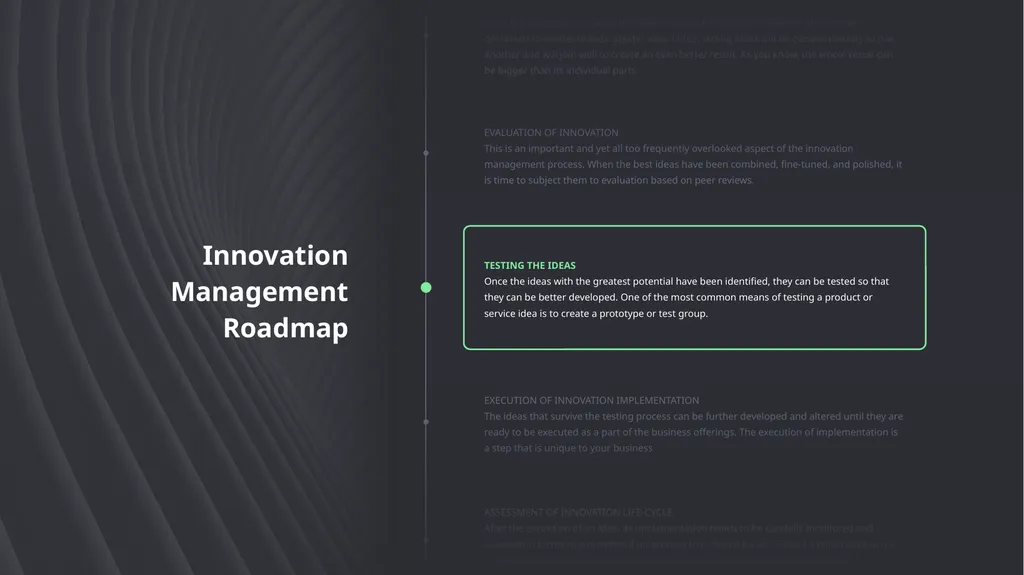
Once the ideas with the greatest potential have been identified, they can be tested so that they can be better developed. One of the most common means of testing a product or service idea is to create a prototype or test group. SETTING THE GOALS FOR THE PROCESS
Innovation always begins with a goal in mind. It is many times based on finding the solution to a problem. Once you have this goal, it should be discussed among everyone in the problem solving team. This team may consist of you and another person, a group of people, or may even be all of your organization’s employees. COOPERATION
The innovation team should work together so that instead of trying to come up with an idea separately, they can bounce ideas off one another and create a collaborative solution. This can include the use of online tools, attendance of events such as trade shows that can be inspiring and informative, or simply consist of brainstorming sessions. Innovation
Management
Roadmap<br>
Once the ideas are in, choose the best ones and then consider whether they can be combined to create an even greater idea. Often, strong ideas will be complementary to one another and will join well to create an even better result. As you know, the whole result can be bigger than its individual parts. EVALUATION OF INNOVATION
This is an important and yet all too frequently overlooked aspect of the innovation management process. When the best ideas have been combined, fine-tuned, and polished, it is time to subject them to evaluation based on peer reviews. TESTING THE IDEAS
Once the ideas with the greatest potential have been identified, they can be tested so that they can be better developed. One of the most common means of testing a product or service idea is to create a prototype or test group. SETTING THE GOALS FOR THE PROCESS
Innovation always begins with a goal in mind. It is many times based on finding the solution to a problem. Once you have this goal, it should be discussed among everyone in the problem solving team. This team may consist of you and another person, a group of people, or may even be all of your organization’s employees. COOPERATION
The innovation team should work together so that instead of trying to come up with an idea separately, they can bounce ideas off one another and create a collaborative solution. This can include the use of online tools, attendance of events such as trade shows that can be inspiring and informative, or simply consist of brainstorming sessions. Innovation
Management
Roadmap<br>
16
EVALUATION OF INNOVATION
This is an important and yet all too frequently overlooked aspect of the innovation management process. When the best ideas have been combined, fine-tuned, and polished, it is time to subject them to evaluation based on peer reviews. TESTING THE IDEAS
Once the ideas with the greatest potential have been identified, they can be tested so that they can be better developed. One of the most common means of testing a product or service idea is to create a prototype or test group. EXECUTION OF INNOVATION IMPLEMENTATION
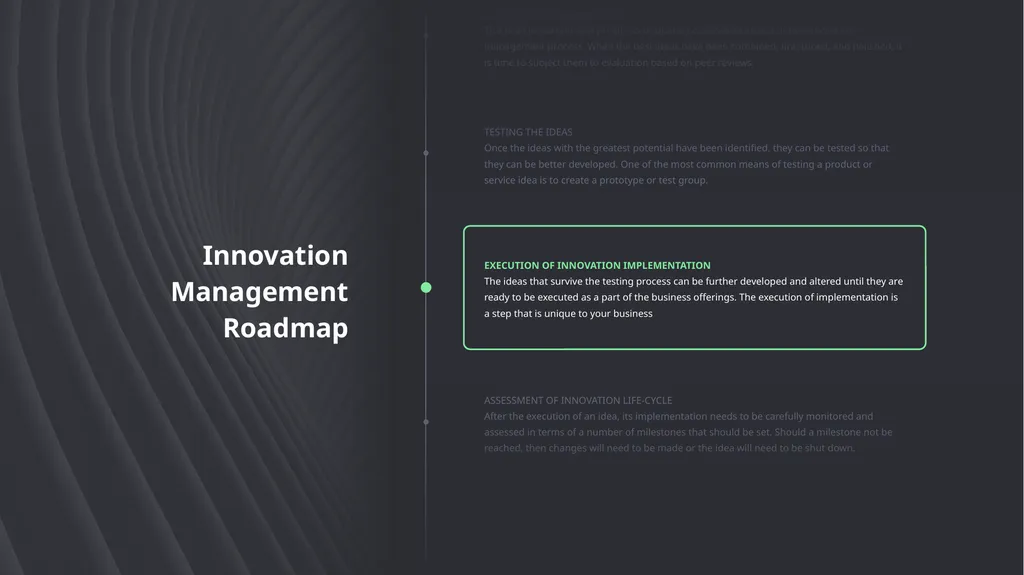
The ideas that survive the testing process can be further developed and altered until they are ready to be executed as a part of the business offerings. The execution of implementation is a step that is unique to your business COOPERATION
The innovation team should work together so that instead of trying to come up with an idea separately, they can bounce ideas off one another and create a collaborative solution. This can include the use of online tools, attendance of events such as trade shows that can be inspiring and informative, or simply consist of brainstorming sessions. COMBINATION OF IDEAS
Once the ideas are in, choose the best ones and then consider whether they can be combined to create an even greater idea. Often, strong ideas will be complementary to one another and will join well to create an even better result. As you know, the whole result can be bigger than its individual parts. Innovation
Management
Roadmap<br>
This is an important and yet all too frequently overlooked aspect of the innovation management process. When the best ideas have been combined, fine-tuned, and polished, it is time to subject them to evaluation based on peer reviews. TESTING THE IDEAS
Once the ideas with the greatest potential have been identified, they can be tested so that they can be better developed. One of the most common means of testing a product or service idea is to create a prototype or test group. EXECUTION OF INNOVATION IMPLEMENTATION
The ideas that survive the testing process can be further developed and altered until they are ready to be executed as a part of the business offerings. The execution of implementation is a step that is unique to your business COOPERATION
The innovation team should work together so that instead of trying to come up with an idea separately, they can bounce ideas off one another and create a collaborative solution. This can include the use of online tools, attendance of events such as trade shows that can be inspiring and informative, or simply consist of brainstorming sessions. COMBINATION OF IDEAS
Once the ideas are in, choose the best ones and then consider whether they can be combined to create an even greater idea. Often, strong ideas will be complementary to one another and will join well to create an even better result. As you know, the whole result can be bigger than its individual parts. Innovation
Management
Roadmap<br>
17
TESTING THE IDEAS
Once the ideas with the greatest potential have been identified, they can be tested so that they can be better developed. One of the most common means of testing a product or service idea is to create a prototype or test group. EXECUTION OF INNOVATION IMPLEMENTATION
The ideas that survive the testing process can be further developed and altered until they are ready to be executed as a part of the business offerings. The execution of implementation is a step that is unique to your business ASSESSMENT OF INNOVATION LIFE-CYCLE
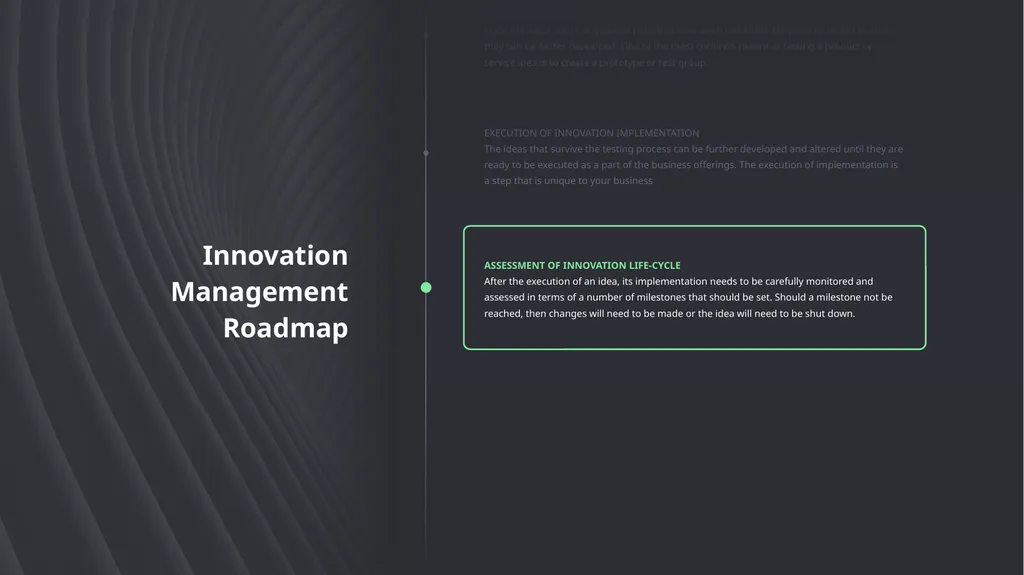
After the execution of an idea, its implementation needs to be carefully monitored and assessed in terms of a number of milestones that should be set. Should a milestone not be reached, then changes will need to be made or the idea will need to be shut down. COMBINATION OF IDEAS
Once the ideas are in, choose the best ones and then consider whether they can be combined to create an even greater idea. Often, strong ideas will be complementary to one another and will join well to create an even better result. As you know, the whole result can be bigger than its individual parts. EVALUATION OF INNOVATION
This is an important and yet all too frequently overlooked aspect of the innovation management process. When the best ideas have been combined, fine-tuned, and polished, it is time to subject them to evaluation based on peer reviews. Innovation
Management
Roadmap<br>
Once the ideas with the greatest potential have been identified, they can be tested so that they can be better developed. One of the most common means of testing a product or service idea is to create a prototype or test group. EXECUTION OF INNOVATION IMPLEMENTATION
The ideas that survive the testing process can be further developed and altered until they are ready to be executed as a part of the business offerings. The execution of implementation is a step that is unique to your business ASSESSMENT OF INNOVATION LIFE-CYCLE
After the execution of an idea, its implementation needs to be carefully monitored and assessed in terms of a number of milestones that should be set. Should a milestone not be reached, then changes will need to be made or the idea will need to be shut down. COMBINATION OF IDEAS
Once the ideas are in, choose the best ones and then consider whether they can be combined to create an even greater idea. Often, strong ideas will be complementary to one another and will join well to create an even better result. As you know, the whole result can be bigger than its individual parts. EVALUATION OF INNOVATION
This is an important and yet all too frequently overlooked aspect of the innovation management process. When the best ideas have been combined, fine-tuned, and polished, it is time to subject them to evaluation based on peer reviews. Innovation
Management
Roadmap<br>
18
EXECUTION OF INNOVATION IMPLEMENTATION
The ideas that survive the testing process can be further developed and altered until they are ready to be executed as a part of the business offerings. The execution of implementation is a step that is unique to your business ASSESSMENT OF INNOVATION LIFE-CYCLE
After the execution of an idea, its implementation needs to be carefully monitored and assessed in terms of a number of milestones that should be set. Should a milestone not be reached, then changes will need to be made or the idea will need to be shut down. EVALUATION OF INNOVATION
This is an important and yet all too frequently overlooked aspect of the innovation management process. When the best ideas have been combined, fine-tuned, and polished, it is time to subject them to evaluation based on peer reviews. TESTING THE IDEAS
Once the ideas with the greatest potential have been identified, they can be tested so that they can be better developed. One of the most common means of testing a product or service idea is to create a prototype or test group. Innovation
Management
Roadmap<br>
The ideas that survive the testing process can be further developed and altered until they are ready to be executed as a part of the business offerings. The execution of implementation is a step that is unique to your business ASSESSMENT OF INNOVATION LIFE-CYCLE
After the execution of an idea, its implementation needs to be carefully monitored and assessed in terms of a number of milestones that should be set. Should a milestone not be reached, then changes will need to be made or the idea will need to be shut down. EVALUATION OF INNOVATION
This is an important and yet all too frequently overlooked aspect of the innovation management process. When the best ideas have been combined, fine-tuned, and polished, it is time to subject them to evaluation based on peer reviews. TESTING THE IDEAS
Once the ideas with the greatest potential have been identified, they can be tested so that they can be better developed. One of the most common means of testing a product or service idea is to create a prototype or test group. Innovation
Management
Roadmap<br>
19
ASSESSMENT OF INNOVATION LIFE-CYCLE
After the execution of an idea, its implementation needs to be carefully monitored and assessed in terms of a number of milestones that should be set. Should a milestone not be reached, then changes will need to be made or the idea will need to be shut down. TESTING THE IDEAS
Once the ideas with the greatest potential have been identified, they can be tested so that they can be better developed. One of the most common means of testing a product or service idea is to create a prototype or test group. EXECUTION OF INNOVATION IMPLEMENTATION
The ideas that survive the testing process can be further developed and altered until they are ready to be executed as a part of the business offerings. The execution of implementation is a step that is unique to your business Innovation
Management
Roadmap<br>
After the execution of an idea, its implementation needs to be carefully monitored and assessed in terms of a number of milestones that should be set. Should a milestone not be reached, then changes will need to be made or the idea will need to be shut down. TESTING THE IDEAS
Once the ideas with the greatest potential have been identified, they can be tested so that they can be better developed. One of the most common means of testing a product or service idea is to create a prototype or test group. EXECUTION OF INNOVATION IMPLEMENTATION
The ideas that survive the testing process can be further developed and altered until they are ready to be executed as a part of the business offerings. The execution of implementation is a step that is unique to your business Innovation
Management
Roadmap<br>
20
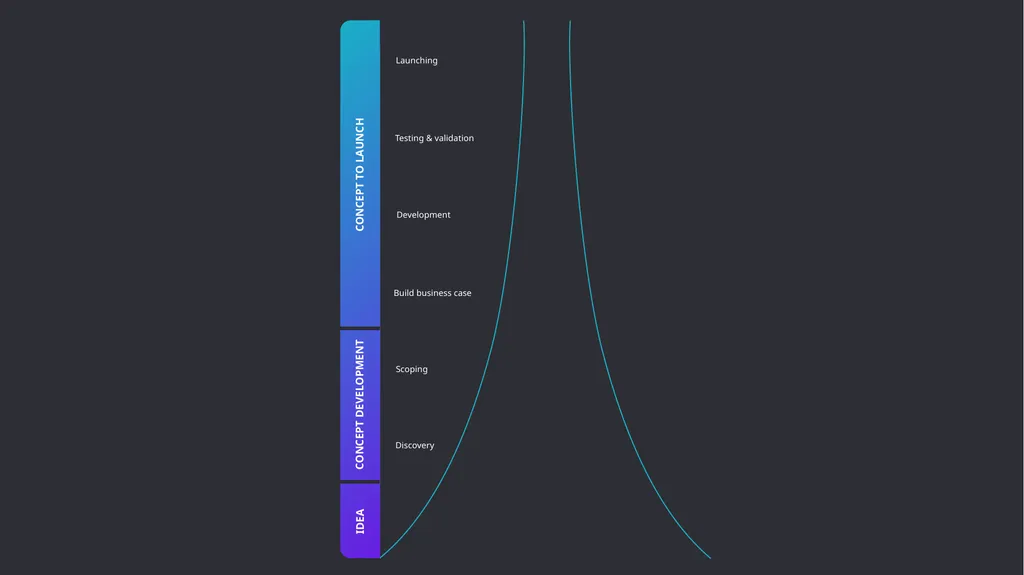
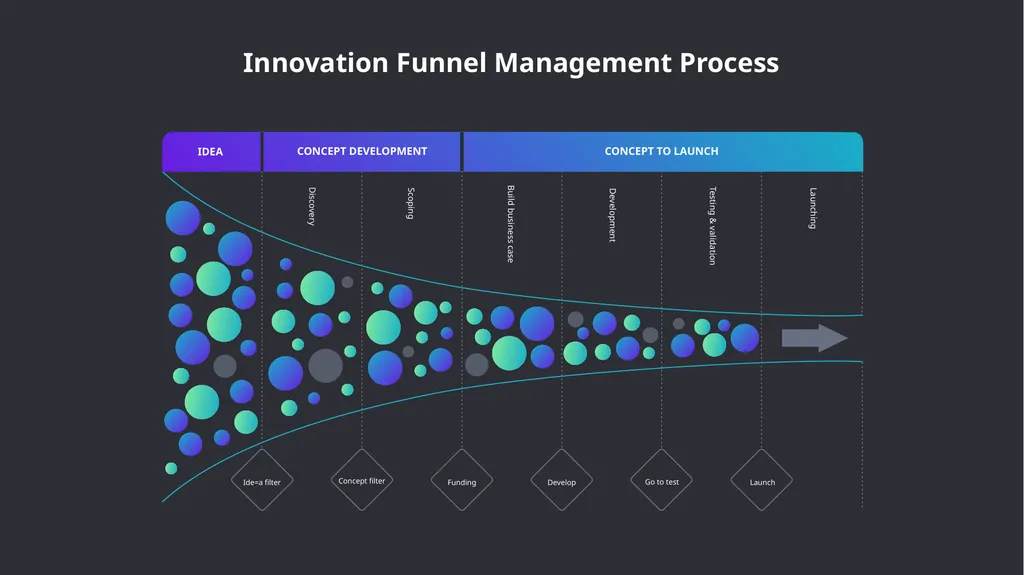
IDEA CONCEPT DEVELOPMENT CONCEPT TO LAUNCH Discovery Scoping Build business case Development Testing & validation Launching<br>
21
IDEA CONCEPT DEVELOPMENT CONCEPT TO LAUNCH Discovery Scoping Build business case Development Testing & validation Launching Innovation Funnel Management Process<br>
22
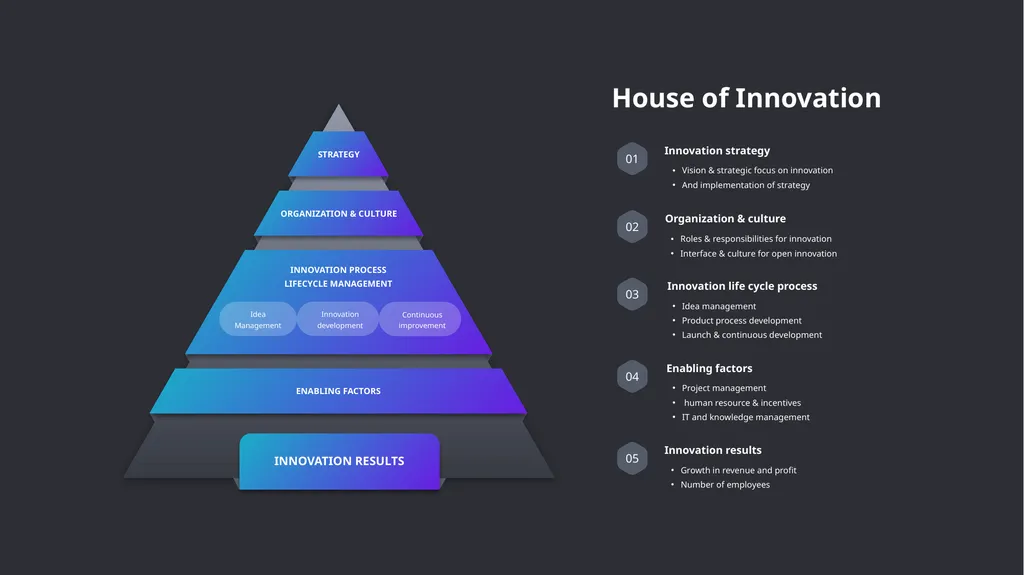
01 02 03 04 05 STRATEGY ORGANIZATION & CULTURE Innovation
development Idea
Management ENABLING FACTORS INNOVATION RESULTS House of Innovation INNOVATION PROCESS
LIFECYCLE MANAGEMENT Continuous improvement<br>
development Idea
Management ENABLING FACTORS INNOVATION RESULTS House of Innovation INNOVATION PROCESS
LIFECYCLE MANAGEMENT Continuous improvement<br>
23
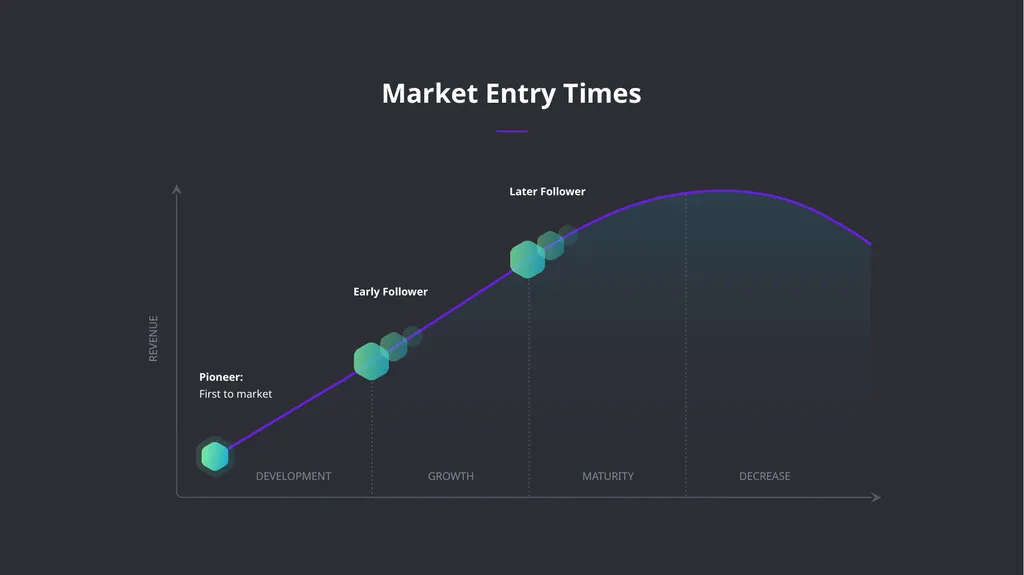
DEVELOPMENT GROWTH MATURITY DECREASE Pioneer:
First to market Early Follower Later Follower REVENUE Market Entry Times<br>
First to market Early Follower Later Follower REVENUE Market Entry Times<br>
24
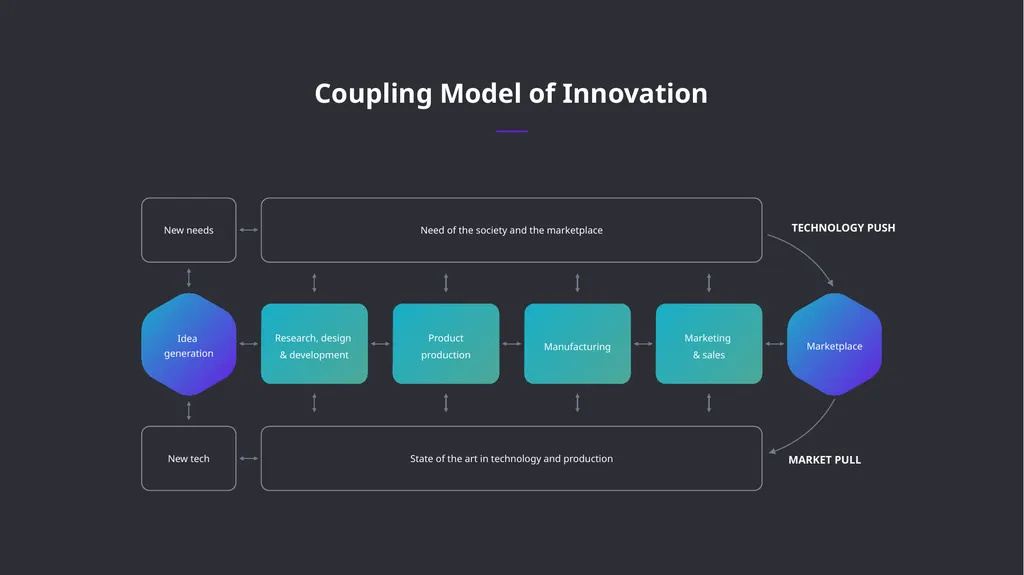
Idea
generation Marketplace Research, design
& development Product
production Manufacturing New needs New tech Need of the society and the marketplace State of the art in technology and production Marketing
& sales TECHNOLOGY PUSH MARKET PULL<br>
generation Marketplace Research, design
& development Product
production Manufacturing New needs New tech Need of the society and the marketplace State of the art in technology and production Marketing
& sales TECHNOLOGY PUSH MARKET PULL<br>
25
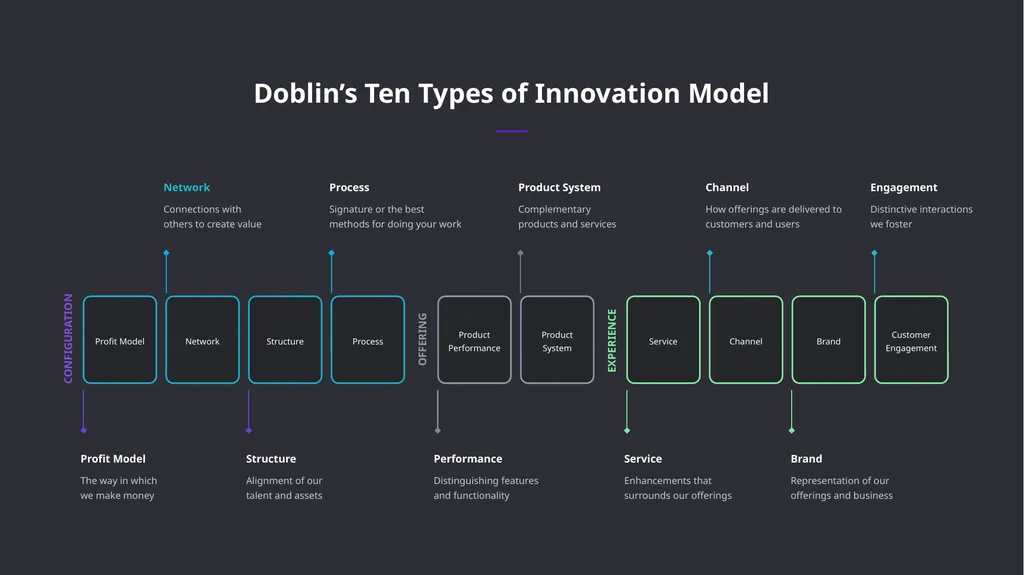
OFFERING CONFIGURATION EXPERIENCE Network
Connections with others to create value Process
Signature or the best methods for doing your work Product System
Complementary products and services Channel
How offerings are delivered to customers and users Engagement
Distinctive interactions we foster Profit Model
The way in which we make money Structure
Alignment of our talent and assets Performance
Distinguishing features and functionality Service
Enhancements that surrounds our offerings Brand
Representation of our offerings and business Doblin’s Ten Types of Innovation Model<br>
Connections with others to create value Process
Signature or the best methods for doing your work Product System
Complementary products and services Channel
How offerings are delivered to customers and users Engagement
Distinctive interactions we foster Profit Model
The way in which we make money Structure
Alignment of our talent and assets Performance
Distinguishing features and functionality Service
Enhancements that surrounds our offerings Brand
Representation of our offerings and business Doblin’s Ten Types of Innovation Model<br>
26
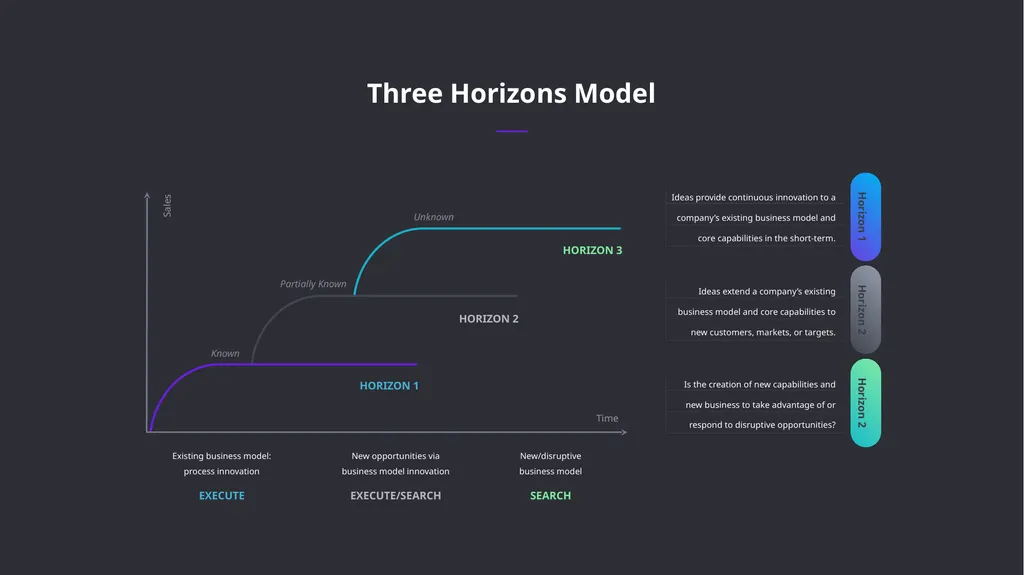
Three Horizons Model HORIZON 1 HORIZON 2 HORIZON 3 Known Partially Known Unknown Existing business model:
process innovation
EXECUTE New opportunities via
business model innovation
EXECUTE/SEARCH New/disruptive
business model
SEARCH Time Sales<br>
process innovation
EXECUTE New opportunities via
business model innovation
EXECUTE/SEARCH New/disruptive
business model
SEARCH Time Sales<br>
27
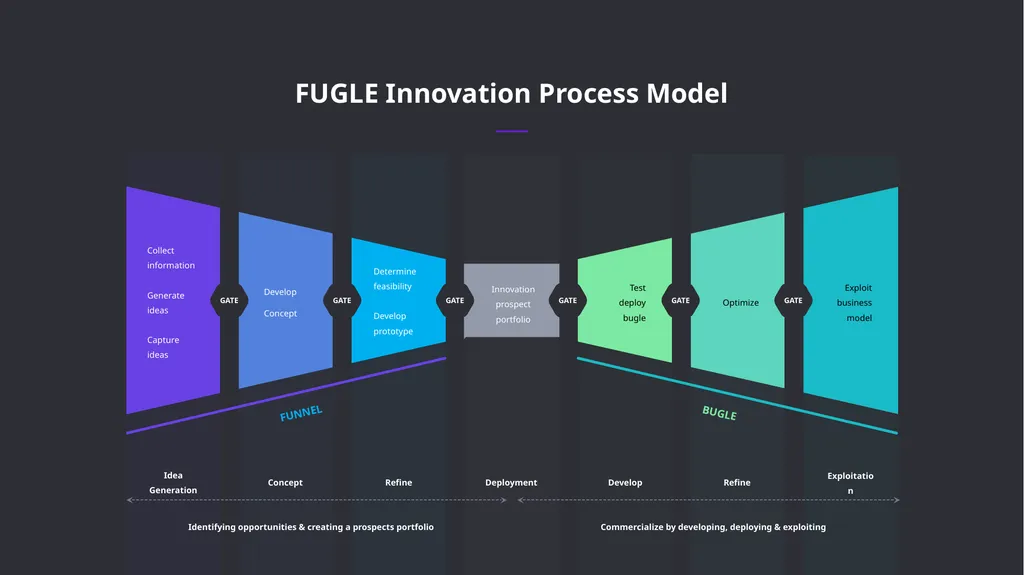
FUGLE Innovation Process Model Idea Generation Concept Refine Exploitation Refine Develop Deployment GATE GATE GATE GATE GATE GATE Collect information
Generate ideas
Capture ideas Develop
Concept Determine feasibility
Develop prototype Innovation prospect portfolio Test deploy bugle Optimize Exploit business model FUNNEL BUGLE Identifying opportunities & creating a prospects portfolio Commercialize by developing, deploying & exploiting<br>
Generate ideas
Capture ideas Develop
Concept Determine feasibility
Develop prototype Innovation prospect portfolio Test deploy bugle Optimize Exploit business model FUNNEL BUGLE Identifying opportunities & creating a prospects portfolio Commercialize by developing, deploying & exploiting<br>
28
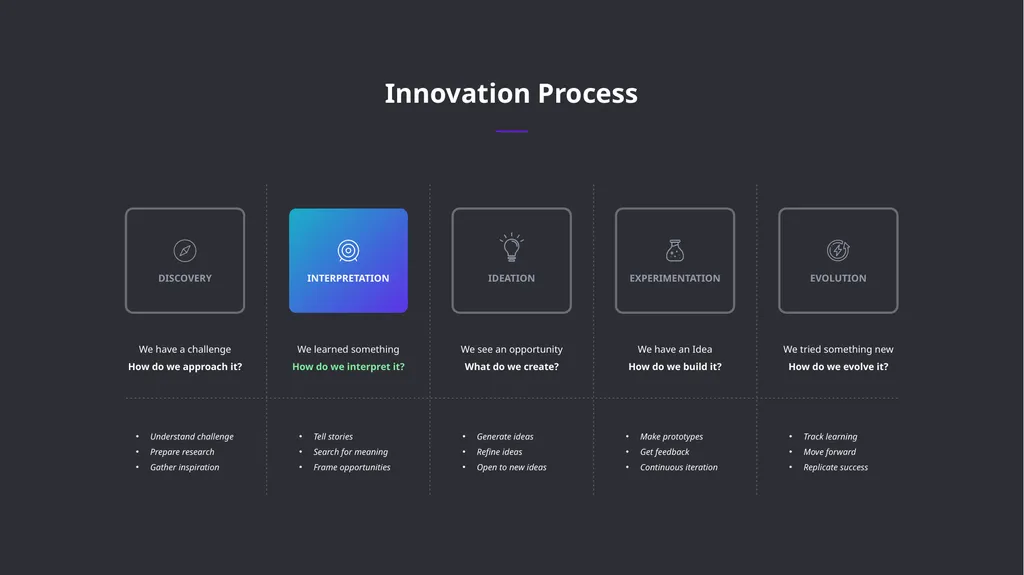
Innovation Process INTERPRETATION EXPERIMENTATION IDEATION EVOLUTION DISCOVERY We have a challenge
How do we approach it? We learned something
How do we interpret it? We see an opportunity
What do we create? We have an Idea
How do we build it? We tried something new
How do we evolve it? Understand challenge
Prepare research
Gather inspiration Tell stories
Search for meaning
Frame opportunities Generate ideas
Refine ideas
Open to new ideas Make prototypes
Get feedback
Continuous iteration Track learning
Move forward
Replicate success<br>
How do we approach it? We learned something
How do we interpret it? We see an opportunity
What do we create? We have an Idea
How do we build it? We tried something new
How do we evolve it? Understand challenge
Prepare research
Gather inspiration Tell stories
Search for meaning
Frame opportunities Generate ideas
Refine ideas
Open to new ideas Make prototypes
Get feedback
Continuous iteration Track learning
Move forward
Replicate success<br>
29
Mindfulness Environment Competence Mood Motivation Creative
skills R&D Market
needs INNOVATION Sit Design thinking Lean
startup Design
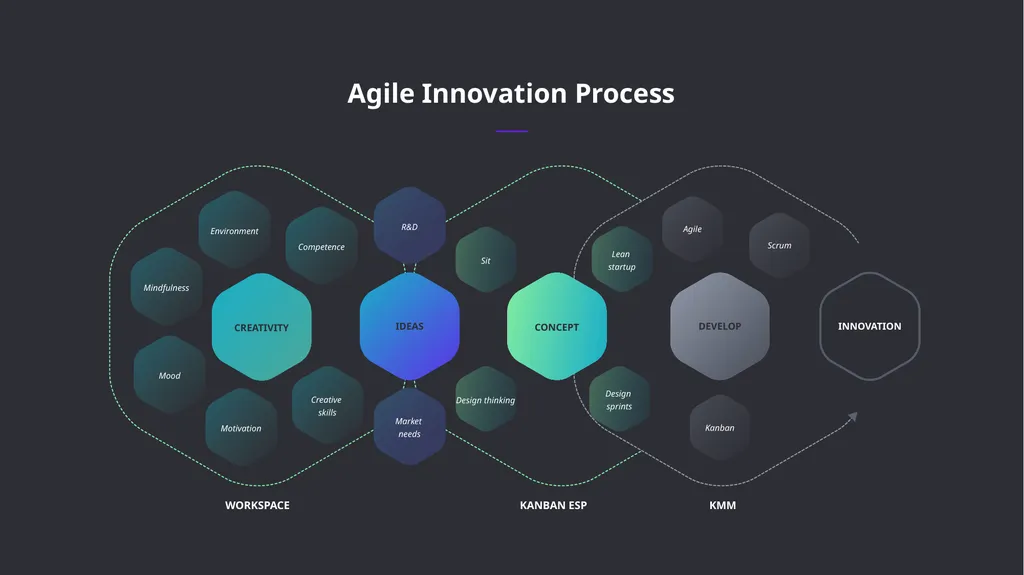
sprints Agile Scrum Kanban WORKSPACE KANBAN ESP KMM Agile Innovation Process CREATIVITY IDEAS CONCEPT DEVELOP<br>
skills R&D Market
needs INNOVATION Sit Design thinking Lean
startup Design
sprints Agile Scrum Kanban WORKSPACE KANBAN ESP KMM Agile Innovation Process CREATIVITY IDEAS CONCEPT DEVELOP<br>
30
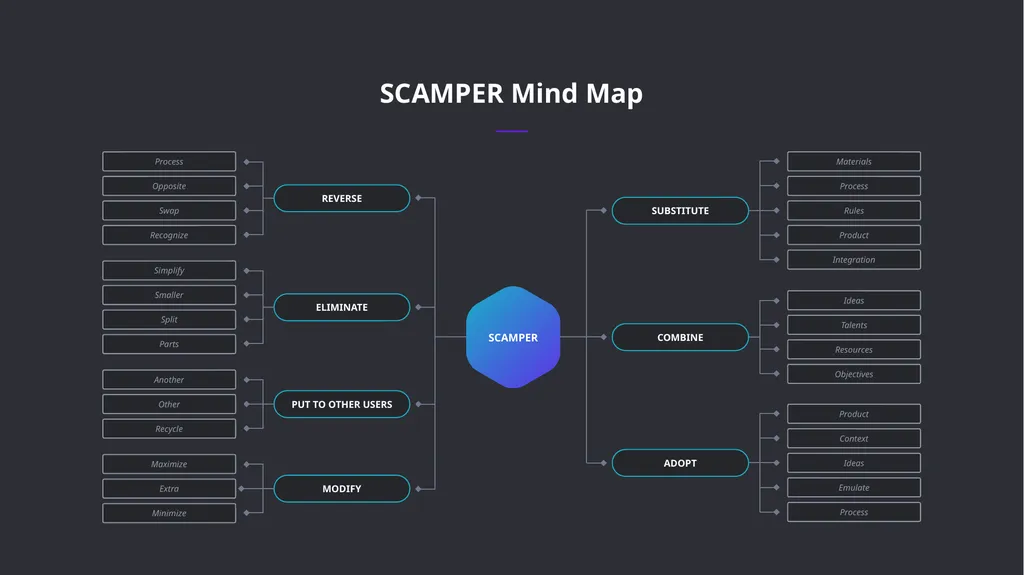
SCAMPER Mind Map SCAMPER REVERSE ELIMINATE PUT TO OTHER USERS MODIFY SUBSTITUTE COMBINE ADOPT<br>
31
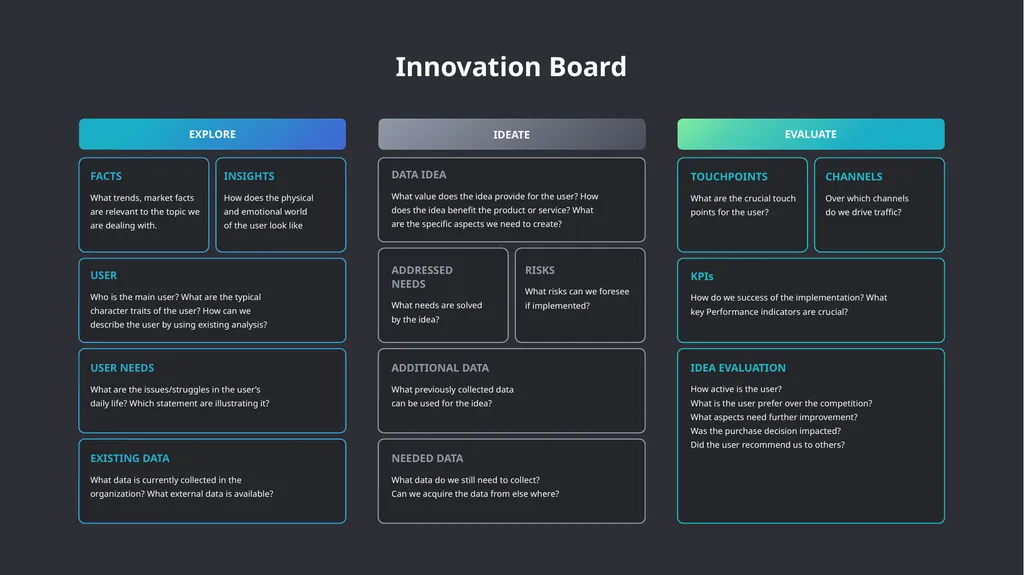
Innovation Board<br>
32
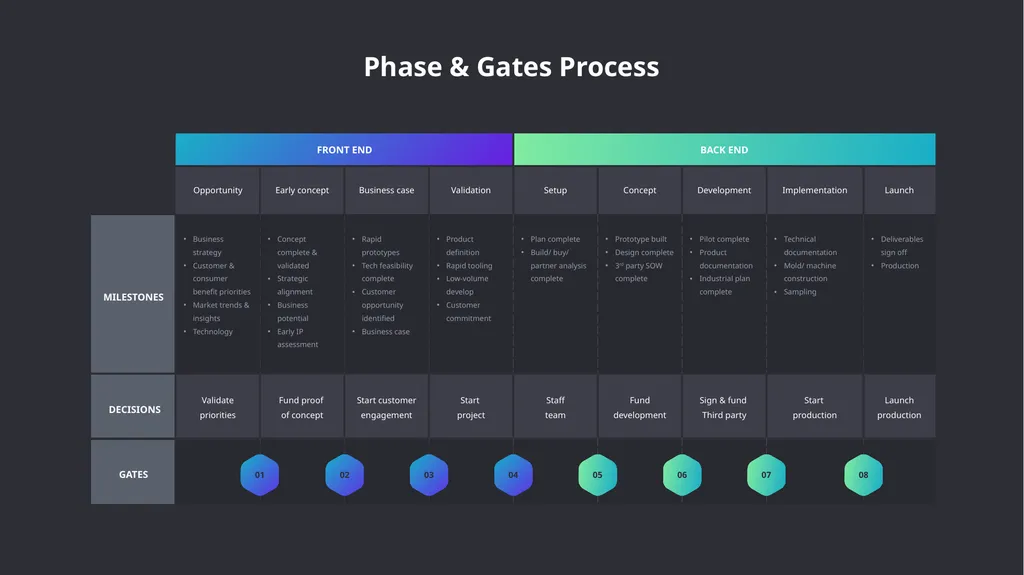
Phase & Gates Process 01 02 03 04 05 06 07 08<br>
33
EXTERNAL INPUTS
Macro factors, competition,
profit, growth, diversification
costs and input prices EXTERNAL INPUTS
Scientific & technological
development, competitors,
suppliers, customers EXTERNAL INPUTS
Societal needs, competition
distributors, customers,
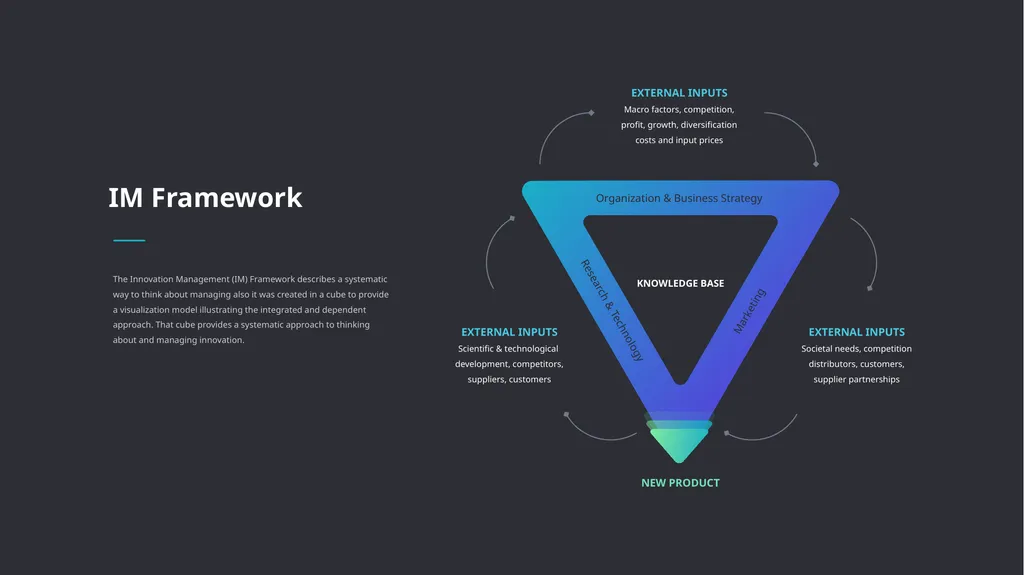
supplier partnerships NEW PRODUCT KNOWLEDGE BASE IM Framework The Innovation Management (IM) Framework describes a systematic way to think about managing also it was created in a cube to provide a visualization model illustrating the integrated and dependent approach. That cube provides a systematic approach to thinking about and managing innovation.<br>
Macro factors, competition,
profit, growth, diversification
costs and input prices EXTERNAL INPUTS
Scientific & technological
development, competitors,
suppliers, customers EXTERNAL INPUTS
Societal needs, competition
distributors, customers,
supplier partnerships NEW PRODUCT KNOWLEDGE BASE IM Framework The Innovation Management (IM) Framework describes a systematic way to think about managing also it was created in a cube to provide a visualization model illustrating the integrated and dependent approach. That cube provides a systematic approach to thinking about and managing innovation.<br>
34
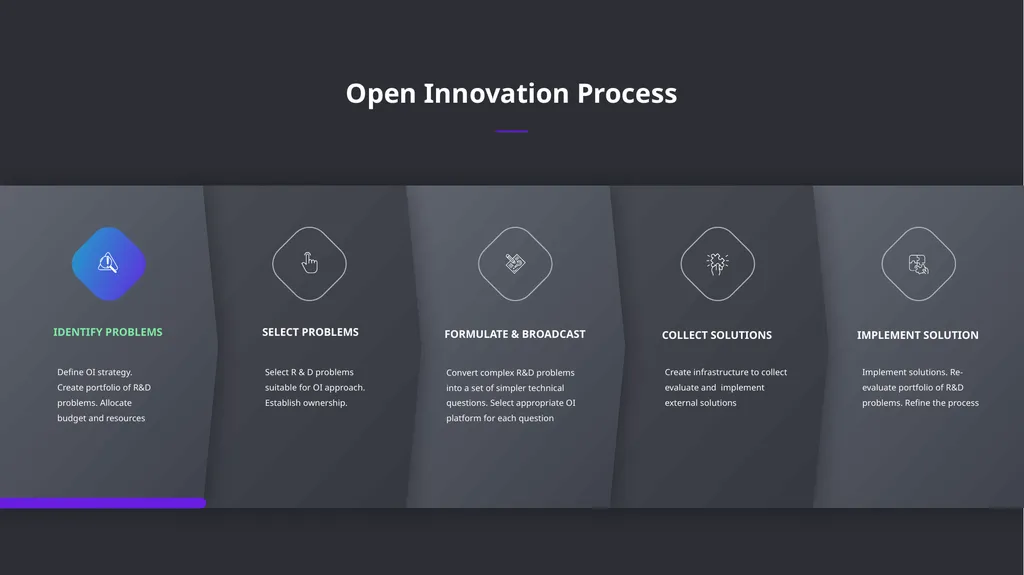
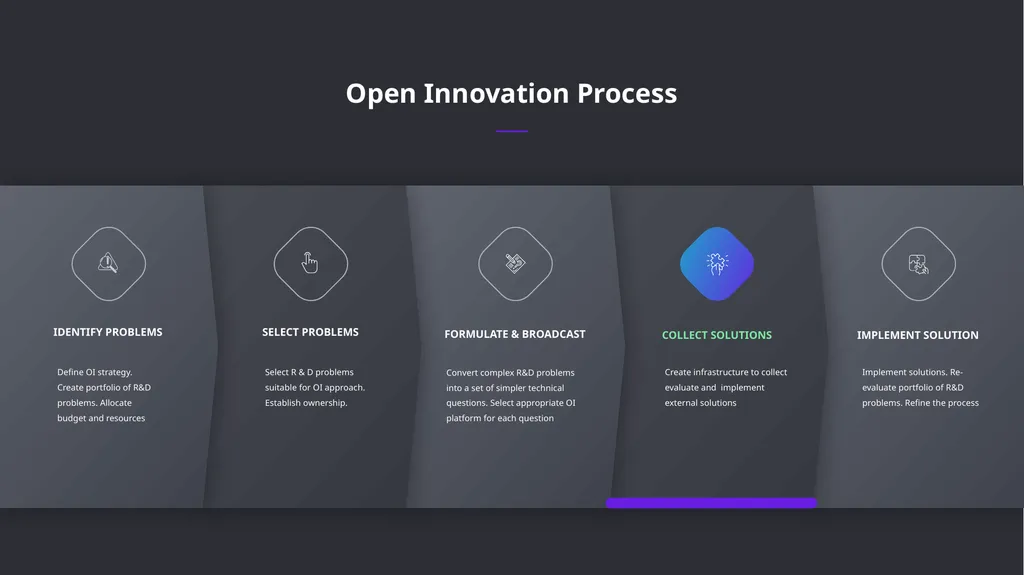
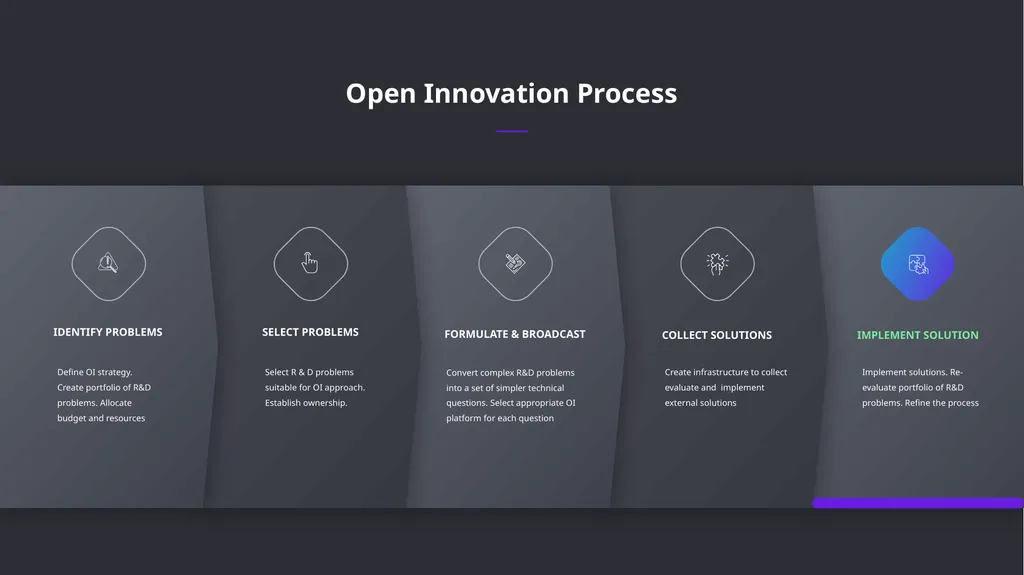
IDENTIFY PROBLEMS Define OI strategy. Create portfolio of R&D problems. Allocate budget and resources SELECT PROBLEMS Select R & D problems suitable for OI approach. Establish ownership. FORMULATE & BROADCAST Convert complex R&D problems into a set of simpler technical questions. Select appropriate OI platform for each question COLLECT SOLUTIONS Create infrastructure to collect evaluate and implement external solutions IMPLEMENT SOLUTION Implement solutions. Re-evaluate portfolio of R&D problems. Refine the process Open Innovation Process<br>
35
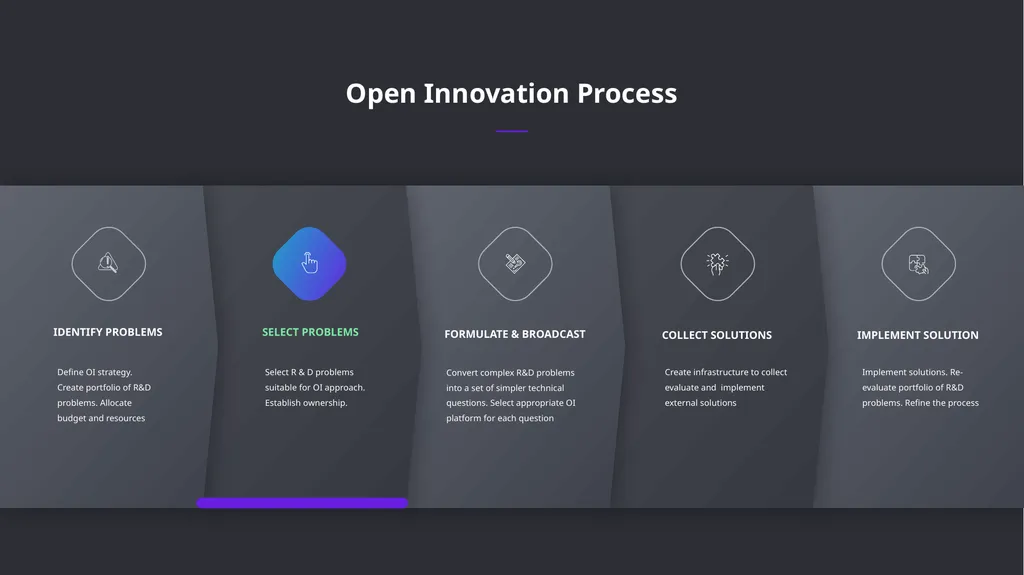
IDENTIFY PROBLEMS Define OI strategy. Create portfolio of R&D problems. Allocate budget and resources SELECT PROBLEMS Select R & D problems suitable for OI approach. Establish ownership. FORMULATE & BROADCAST Convert complex R&D problems into a set of simpler technical questions. Select appropriate OI platform for each question COLLECT SOLUTIONS Create infrastructure to collect evaluate and implement external solutions IMPLEMENT SOLUTION Implement solutions. Re-evaluate portfolio of R&D problems. Refine the process Open Innovation Process<br>
36
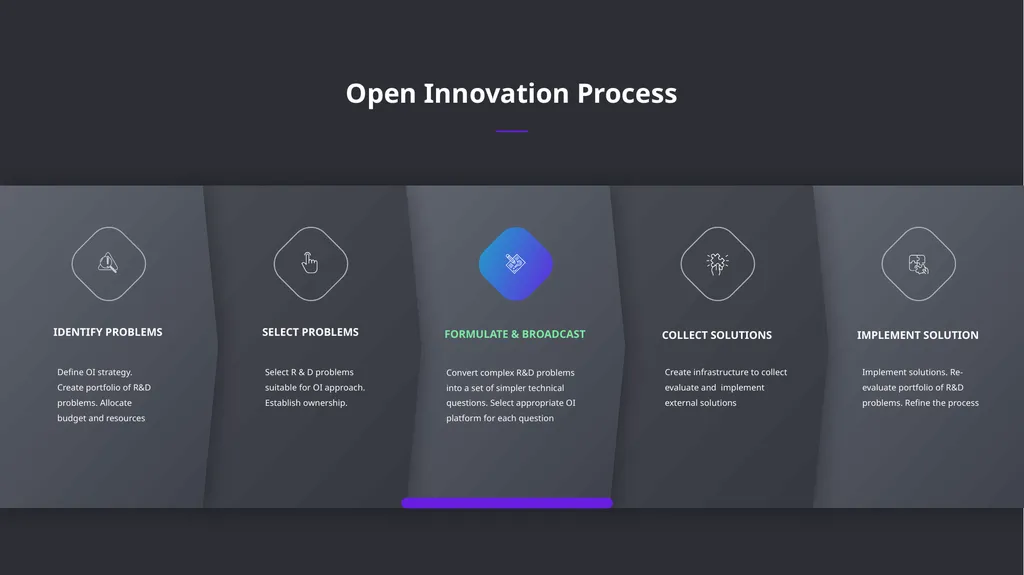
IDENTIFY PROBLEMS Define OI strategy. Create portfolio of R&D problems. Allocate budget and resources SELECT PROBLEMS Select R & D problems suitable for OI approach. Establish ownership. FORMULATE & BROADCAST Convert complex R&D problems into a set of simpler technical questions. Select appropriate OI platform for each question COLLECT SOLUTIONS Create infrastructure to collect evaluate and implement external solutions IMPLEMENT SOLUTION Implement solutions. Re-evaluate portfolio of R&D problems. Refine the process Open Innovation Process<br>
37
IDENTIFY PROBLEMS Define OI strategy. Create portfolio of R&D problems. Allocate budget and resources SELECT PROBLEMS Select R & D problems suitable for OI approach. Establish ownership. FORMULATE & BROADCAST Convert complex R&D problems into a set of simpler technical questions. Select appropriate OI platform for each question COLLECT SOLUTIONS Create infrastructure to collect evaluate and implement external solutions IMPLEMENT SOLUTION Implement solutions. Re-evaluate portfolio of R&D problems. Refine the process Open Innovation Process<br>
38
IDENTIFY PROBLEMS Define OI strategy. Create portfolio of R&D problems. Allocate budget and resources SELECT PROBLEMS Select R & D problems suitable for OI approach. Establish ownership. FORMULATE & BROADCAST Convert complex R&D problems into a set of simpler technical questions. Select appropriate OI platform for each question COLLECT SOLUTIONS Create infrastructure to collect evaluate and implement external solutions IMPLEMENT SOLUTION Implement solutions. Re-evaluate portfolio of R&D problems. Refine the process Open Innovation Process<br>
39
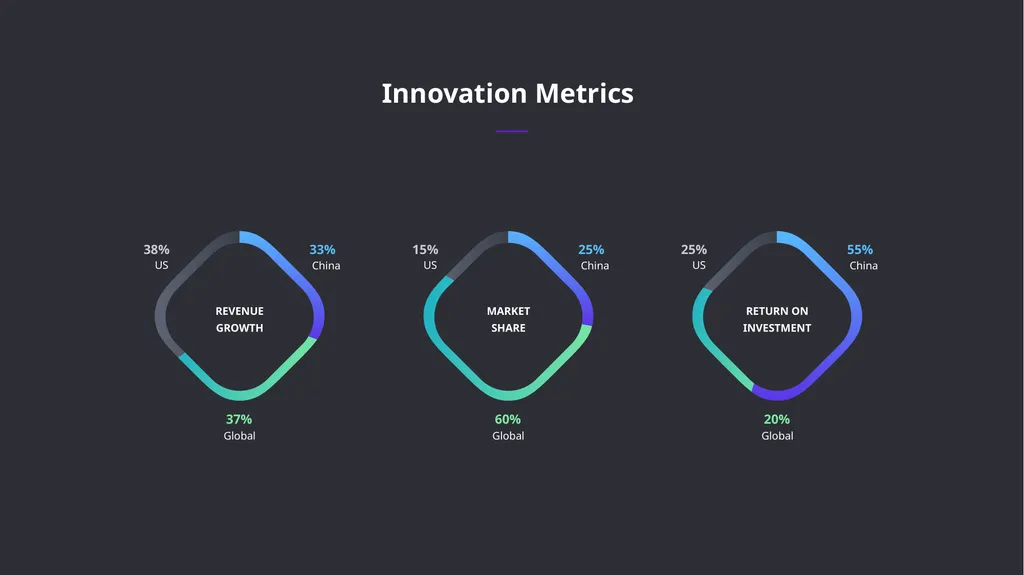
Innovation Metrics REVENUE
GROWTH RETURN ON
INVESTMENT MARKET
SHARE<br>
GROWTH RETURN ON
INVESTMENT MARKET
SHARE<br>
40
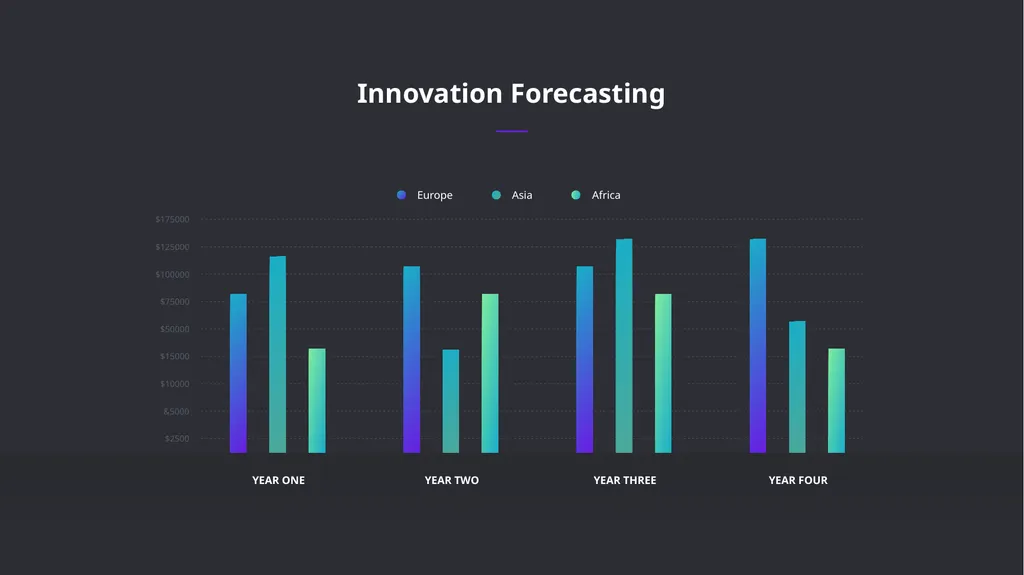
Innovation Forecasting $2500 &5000 $175000 $125000 $100000 $75000 $50000 $15000 $10000 YEAR ONE YEAR TWO YEAR THREE YEAR FOUR<br>
41
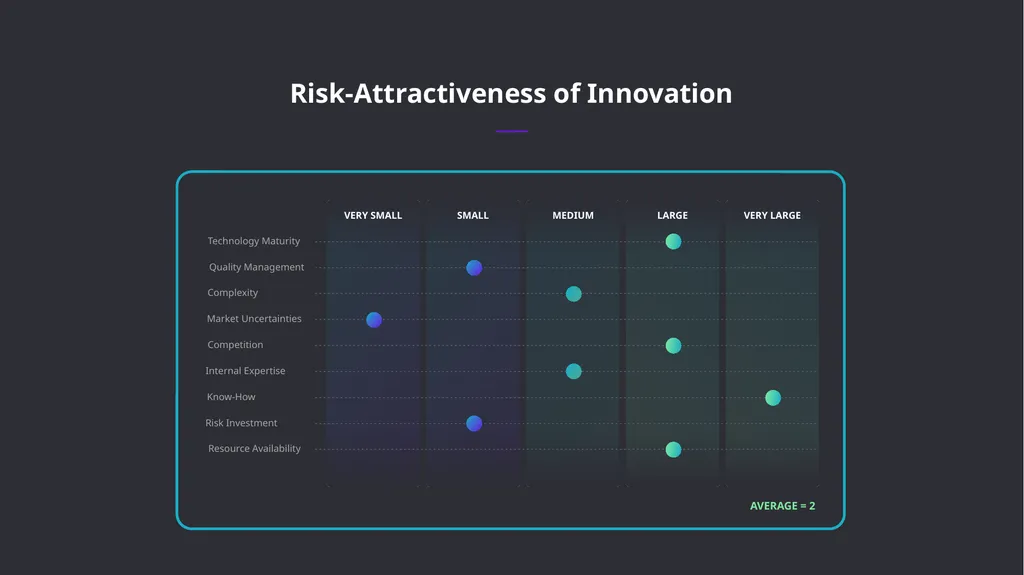
Risk-Attractiveness of Innovation Technology Maturity Quality Management Complexity Market Uncertainties Competition Internal Expertise Know-How Risk Investment Resource Availability VERY SMALL SMALL MEDIUM LARGE VERY LARGE AVERAGE = 2<br>
42
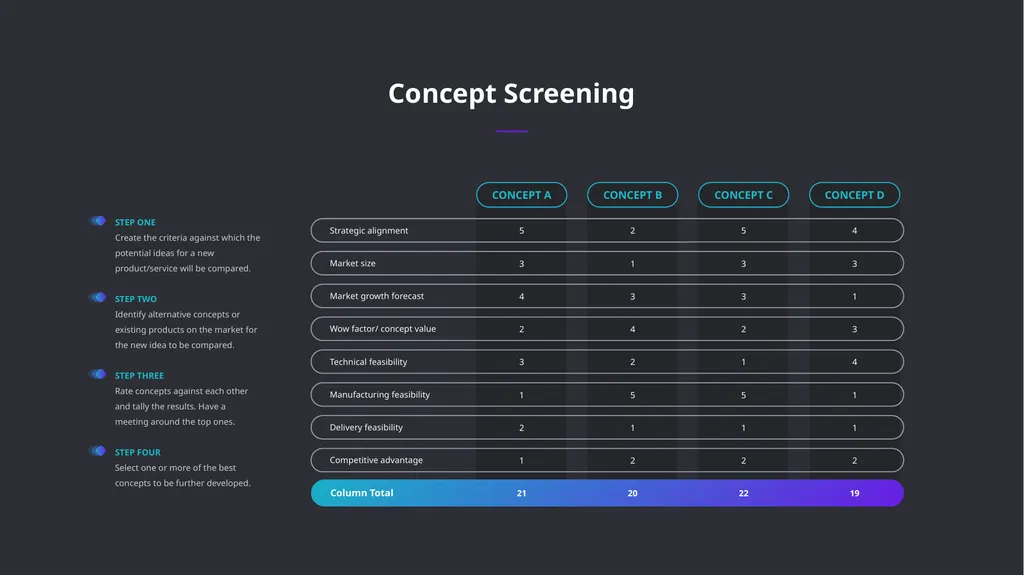
Strategic alignment Market size Market growth forecast Wow factor/ concept value Technical feasibility Manufacturing feasibility Delivery feasibility Competitive advantage Column Total STEP ONE
Create the criteria against which the potential ideas for a new product/service will be compared. STEP TWO
Identify alternative concepts or existing products on the market for the new idea to be compared. STEP THREE
Rate concepts against each other and tally the results. Have a meeting around the top ones. STEP FOUR
Select one or more of the best concepts to be further developed. Concept Screening<br>
Create the criteria against which the potential ideas for a new product/service will be compared. STEP TWO
Identify alternative concepts or existing products on the market for the new idea to be compared. STEP THREE
Rate concepts against each other and tally the results. Have a meeting around the top ones. STEP FOUR
Select one or more of the best concepts to be further developed. Concept Screening<br>
43
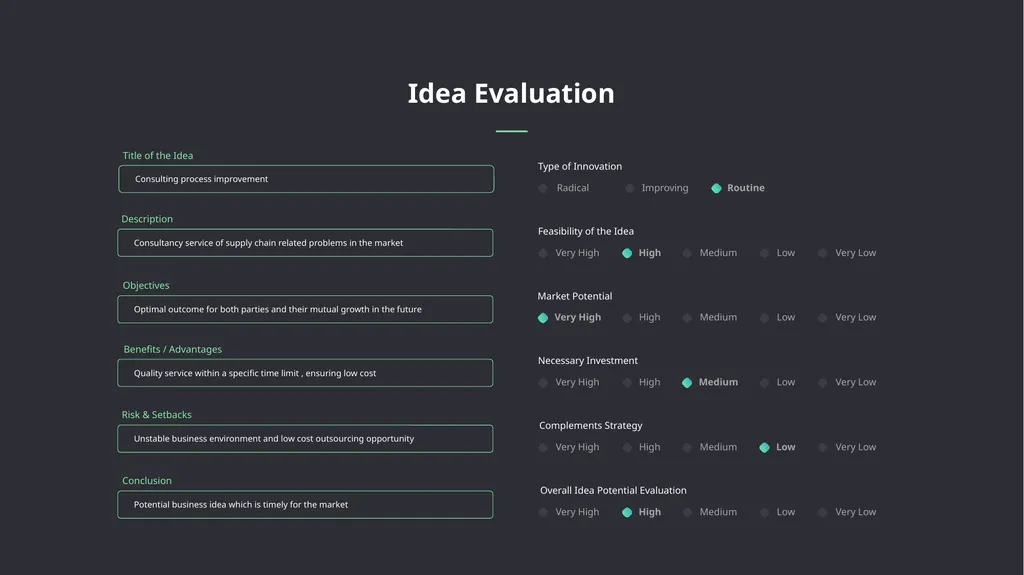
Idea Evaluation Consulting process improvement Title of the Idea Consultancy service of supply chain related problems in the market Description Optimal outcome for both parties and their mutual growth in the future Objectives Quality service within a specific time limit , ensuring low cost Benefits / Advantages Unstable business environment and low cost outsourcing opportunity Risk & Setbacks Potential business idea which is timely for the market Conclusion Type of Innovation Radical Improving Routine Feasibility of the Idea Very High High Medium Low Very Low Market Potential Very High High Medium Low Very Low Necessary Investment Very High High Medium Low Very Low Complements Strategy Very High High Medium Low Very Low Overall Idea Potential Evaluation Very High High Medium Low Very Low<br>
44
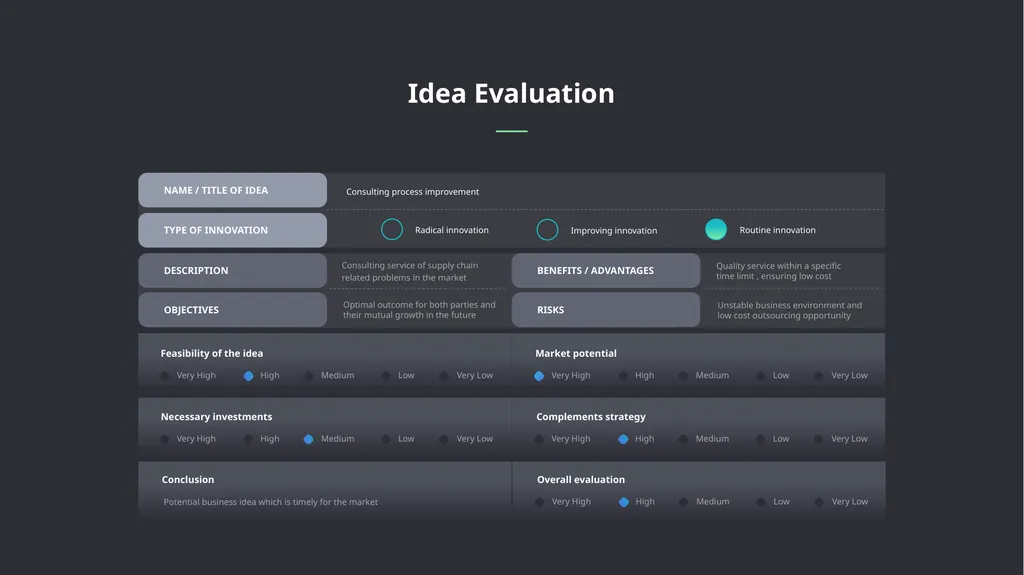
DESCRIPTION OBJECTIVES BENEFITS / ADVANTAGES RISKS Idea Evaluation Consulting service of supply chain related problems in the market Optimal outcome for both parties and their mutual growth in the future Quality service within a specific time limit , ensuring low cost Unstable business environment and low cost outsourcing opportunity Radical innovation Improving innovation Routine innovation Consulting process improvement NAME / TITLE OF IDEA TYPE OF INNOVATION<br>
45
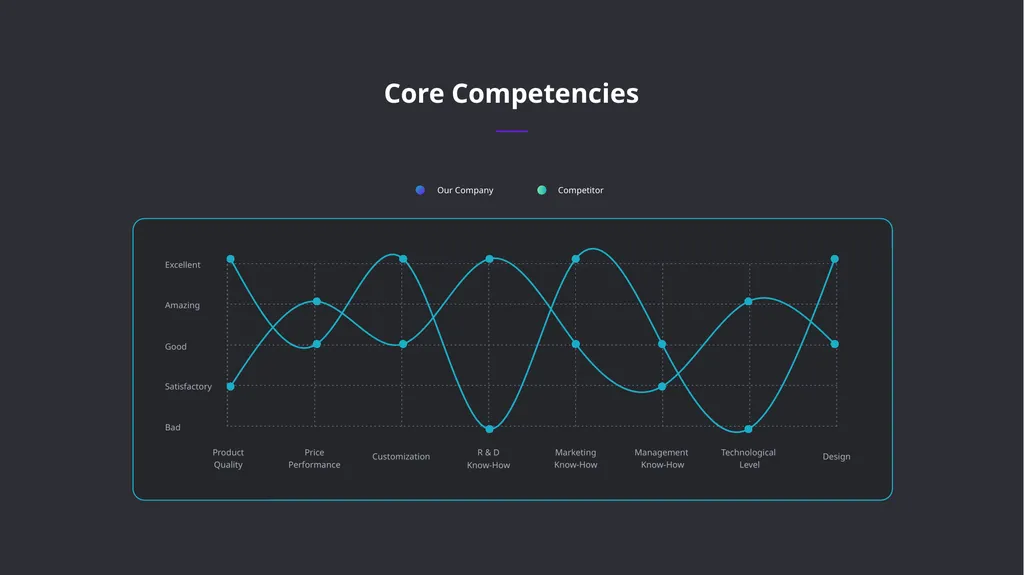
Core Competencies<br>
46
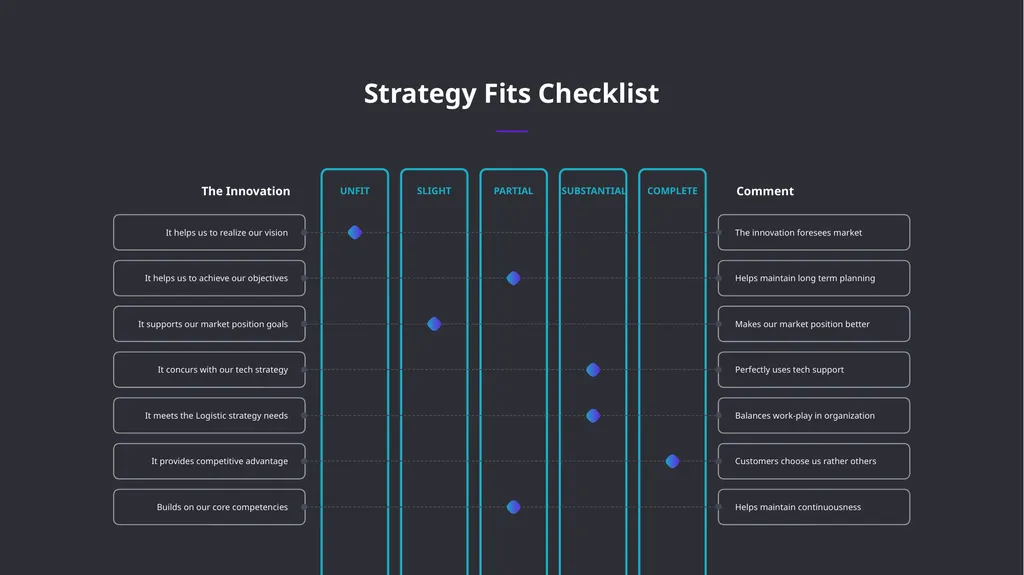
It helps us to realize our vision It helps us to achieve our objectives It supports our market position goals It concurs with our tech strategy It meets the Logistic strategy needs It provides competitive advantage Builds on our core competencies The innovation foresees market Helps maintain long term planning Makes our market position better Perfectly uses tech support Balances work-play in organization Customers choose us rather others Helps maintain continuousness The Innovation Comment Strategy Fits Checklist<br>
47
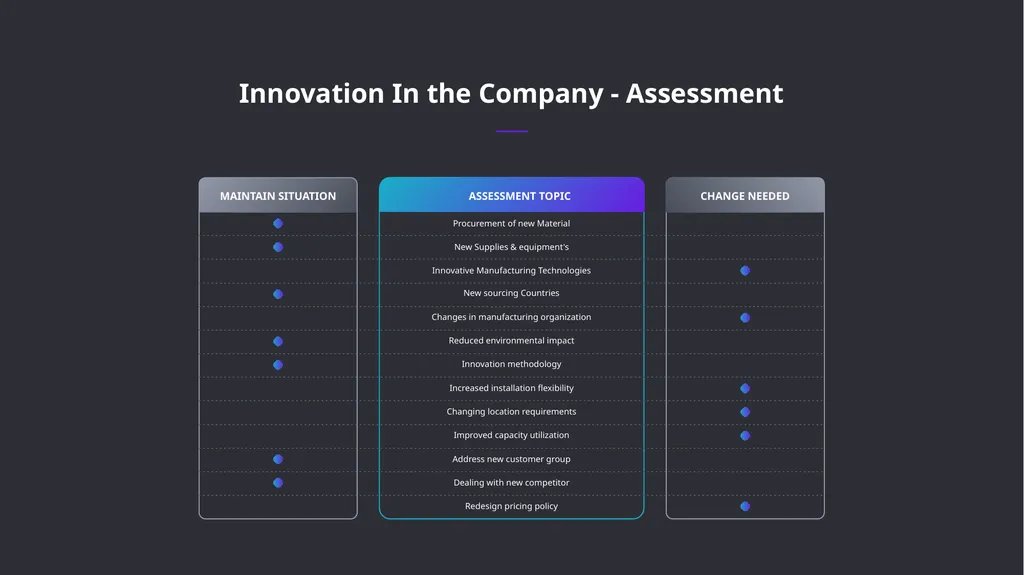
Innovation In the Company - Assessment<br>
48
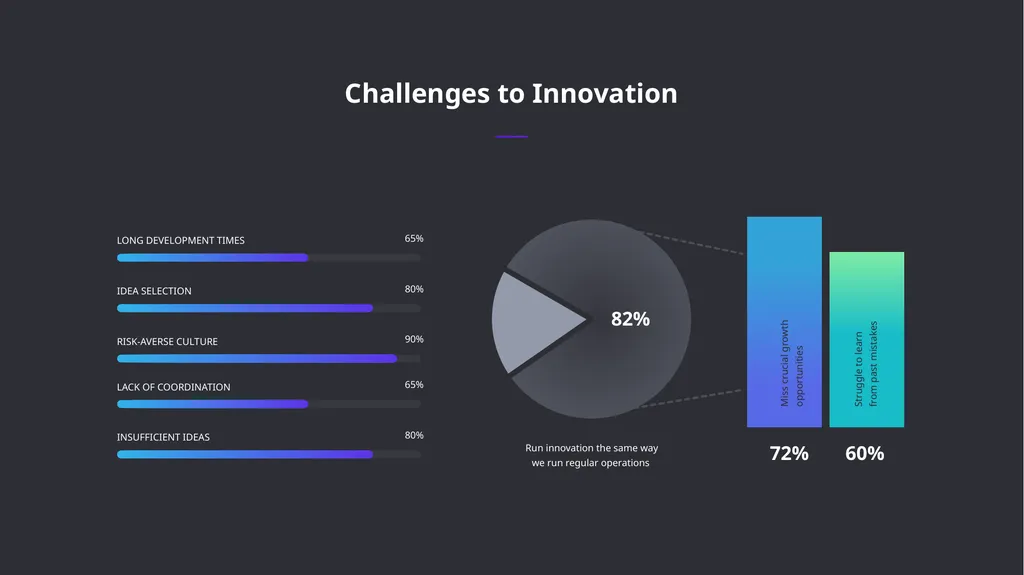
Challenges to Innovation Run innovation the same way we run regular operations Miss crucial growth opportunities Struggle to learn from past mistakes 72% 60% 82%<br>
49
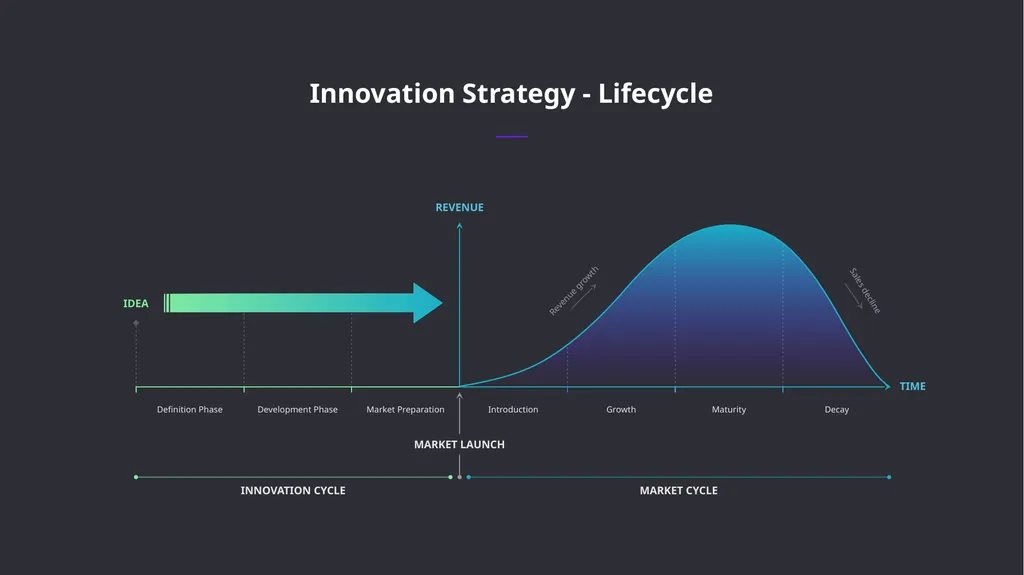
Innovation Strategy - Lifecycle Definition Phase Development Phase Market Preparation Introduction Growth Maturity Decay IDEA REVENUE TIME MARKET LAUNCH MARKET CYCLE INNOVATION CYCLE<br>
50
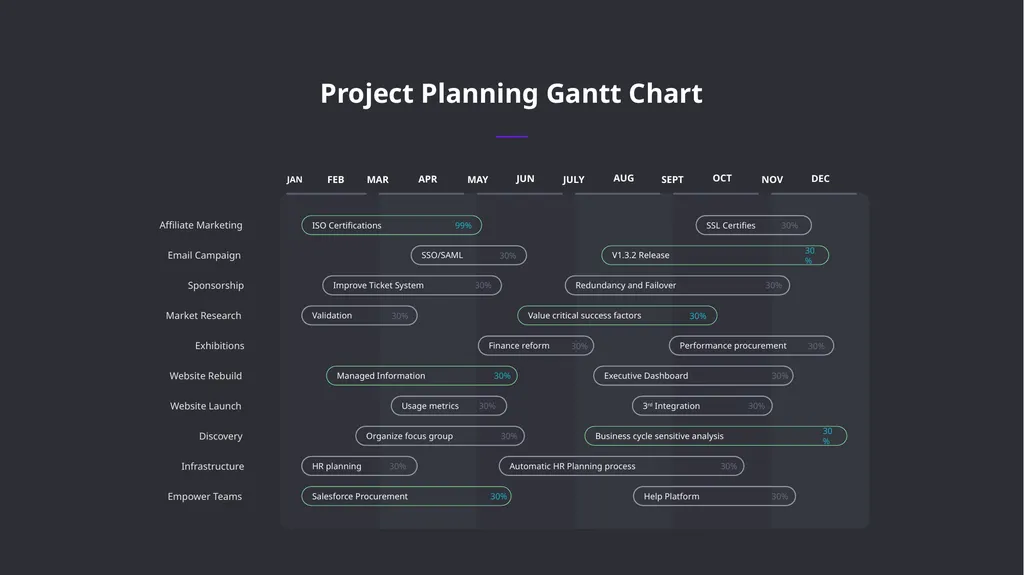
Project Planning Gantt Chart<br>
51
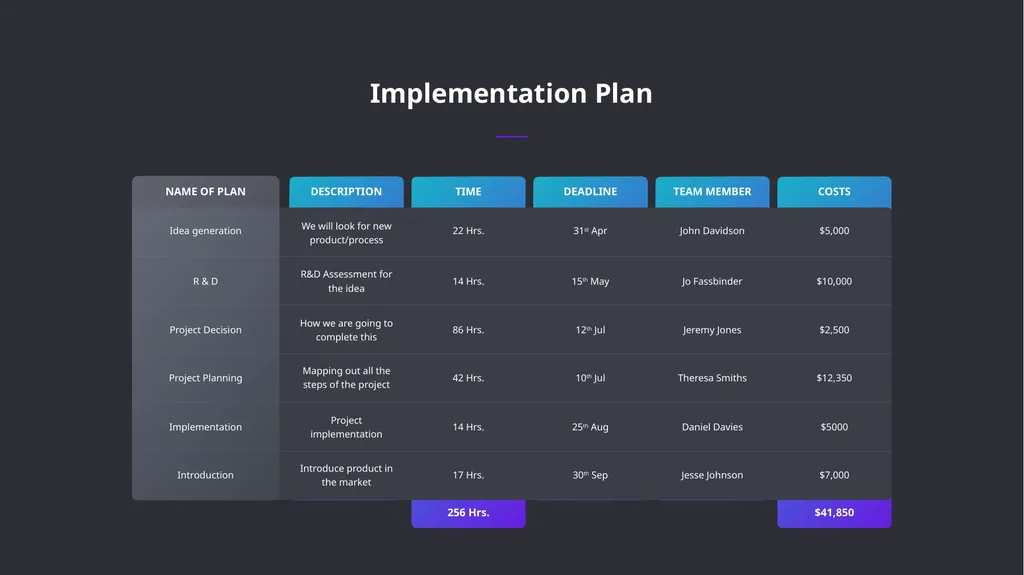
Implementation Plan<br>