CARBON CYCLE 1 : system concepts WJEC Focus Box 3.1.6 Eduqas Focus Box 2.1.6 We are grateful to Hodder for their permission to use the diagrams in this resource. Carbon Cycle 1 Carbon system components Stores are the amounts of carbon held
"CARBON CYCLE 1 : system concepts WJEC Focus Box" is the property of its rightful owner. Permission is granted to
download and print the materials on this website for personal, non-commercial use only, and to display it
on your personal computer provided you do not modify the materials and that you retain all copyright
notices contained in the materials. By downloading content from our website, you accept the terms of this
agreement.
Presentation Transcript
01
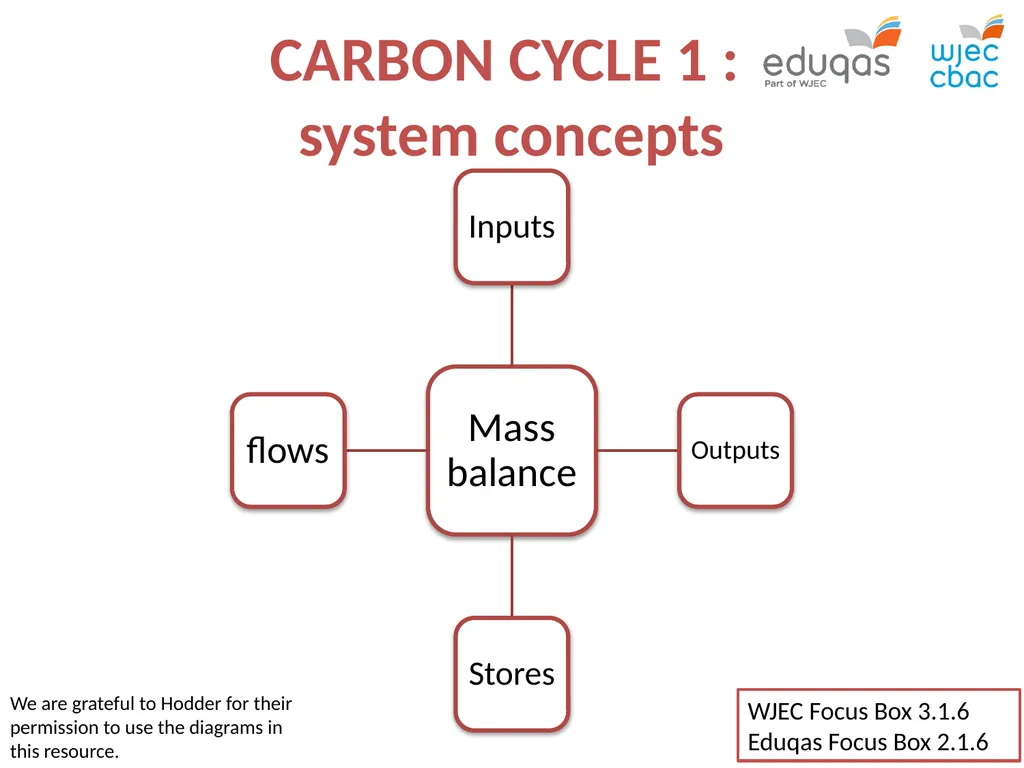
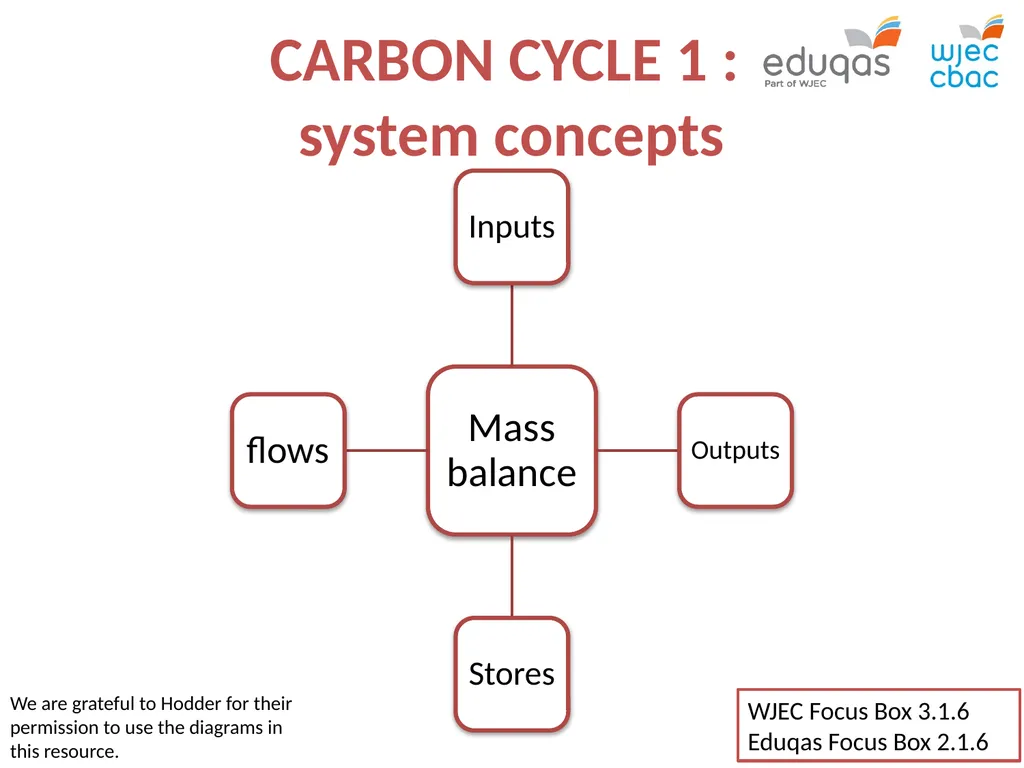
CARBON CYCLE 1 : system concepts WJEC Focus Box 3.1.6
Eduqas Focus Box 2.1.6 We are grateful to Hodder for their permission to use the diagrams in this resource.<br>
02
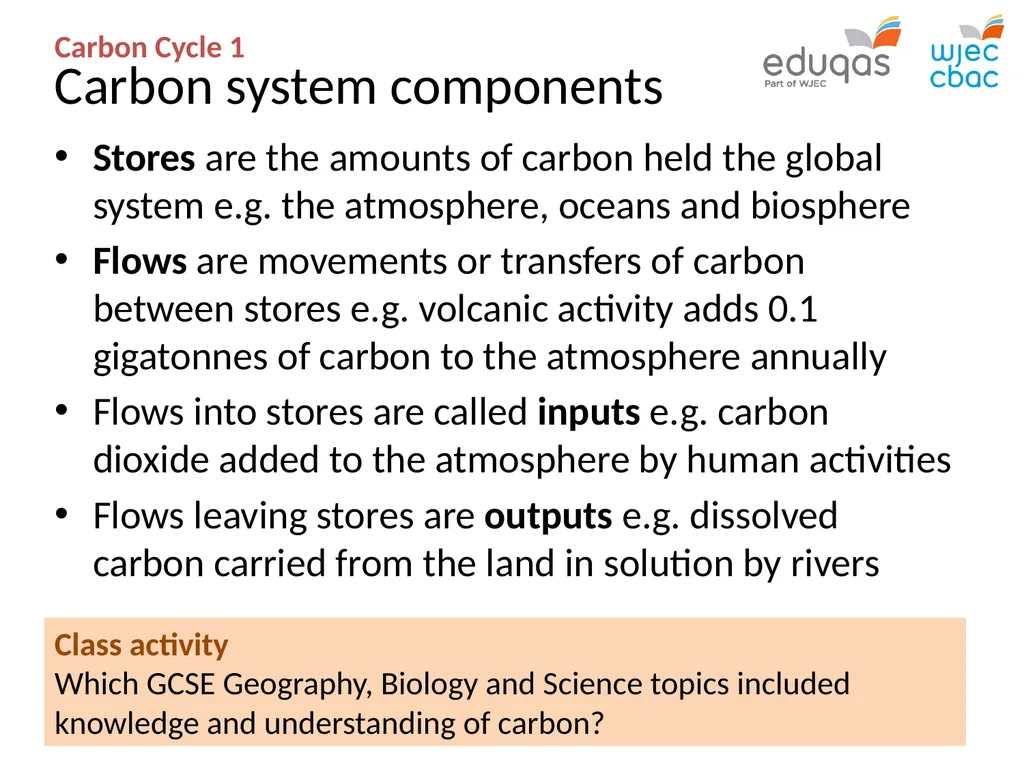
Carbon Cycle 1 Carbon system components Stores are the amounts of carbon held the global system e.g. the atmosphere, oceans and biosphere
Flows are movements or transfers of carbon between stores e.g. volcanic activity adds 0.1 gigatonnes of carbon to the atmosphere annually
Flows into stores are called inputs e.g. carbon dioxide added to the atmosphere by human activities
Flows leaving stores are outputs e.g. dissolved carbon carried from the land in solution by rivers Class activity
Which GCSE Geography, Biology and Science topics included knowledge and understanding of carbon?<br>
03
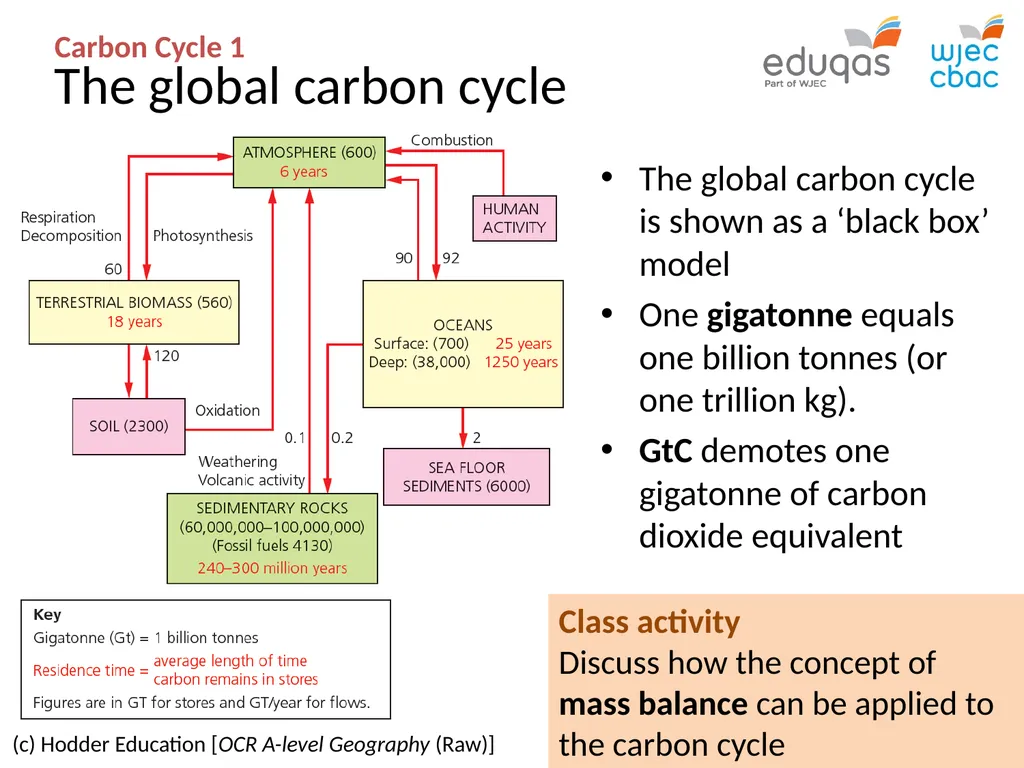
Carbon Cycle 1 The global carbon cycle (c) Hodder Education [OCR A-level Geography (Raw)] Class activity
Discuss how the concept of mass balance can be applied to the carbon cycle The global carbon cycle is shown as a ‘black box’ model
One gigatonne equals one billion tonnes (or one trillion kg).
GtC demotes one gigatonne of carbon dioxide equivalent<br>
04
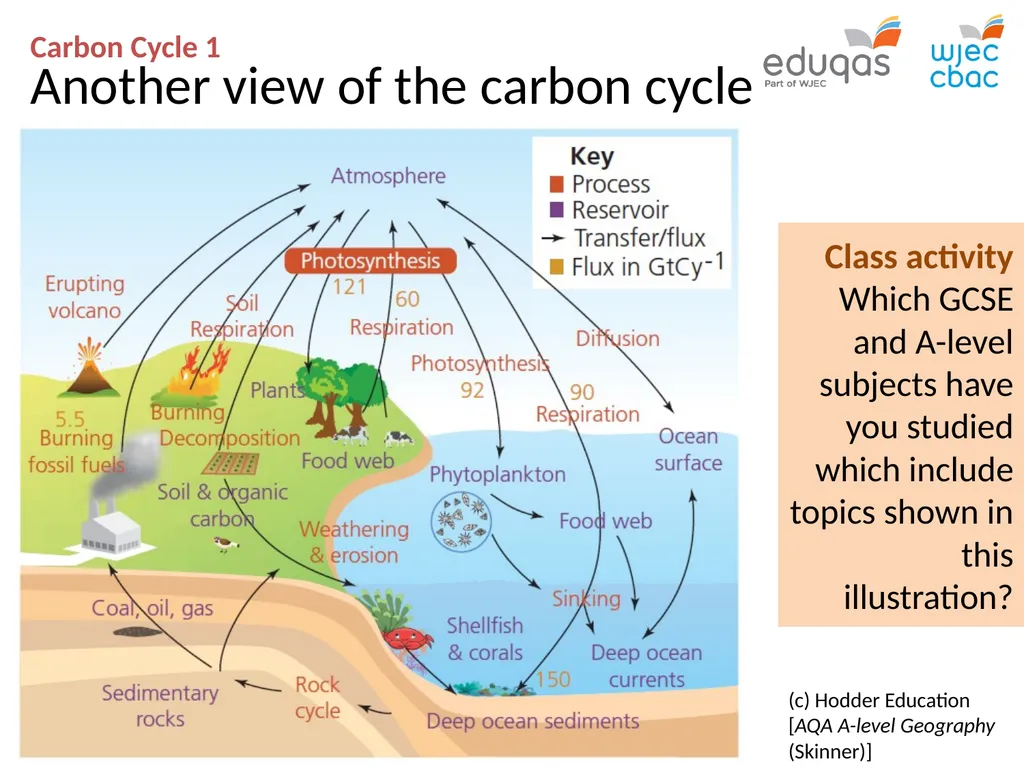
Carbon Cycle 1 Another view of the carbon cycle Class activity
Which GCSE and A-level subjects have you studied which include topics shown in this illustration? (c) Hodder Education [AQA A-level Geography (Skinner)]<br>
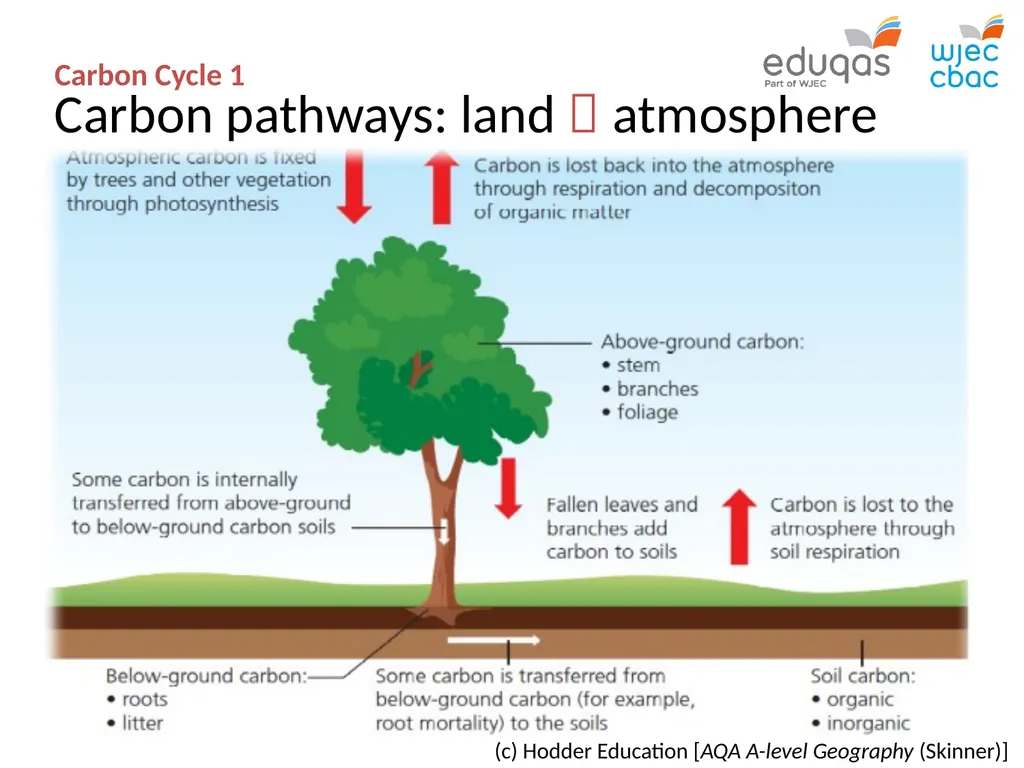
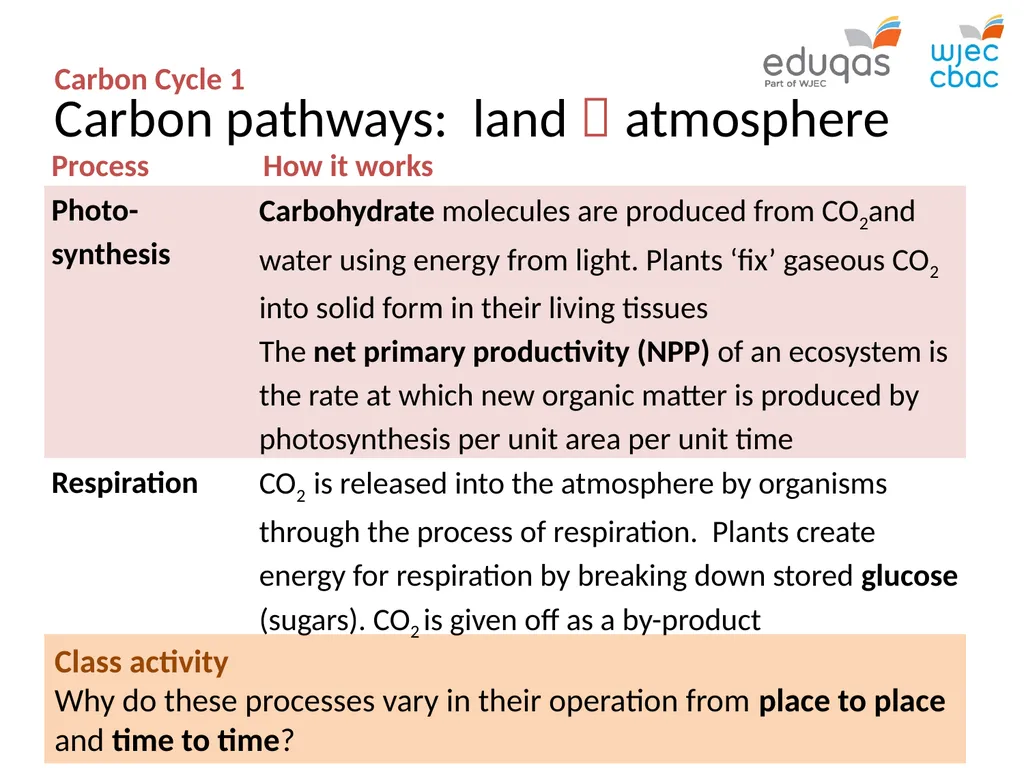
Carbon Cycle 1 Carbon pathways: land atmosphere Class activity
Why do these processes vary in their operation from place to place and time to time?<br>
07
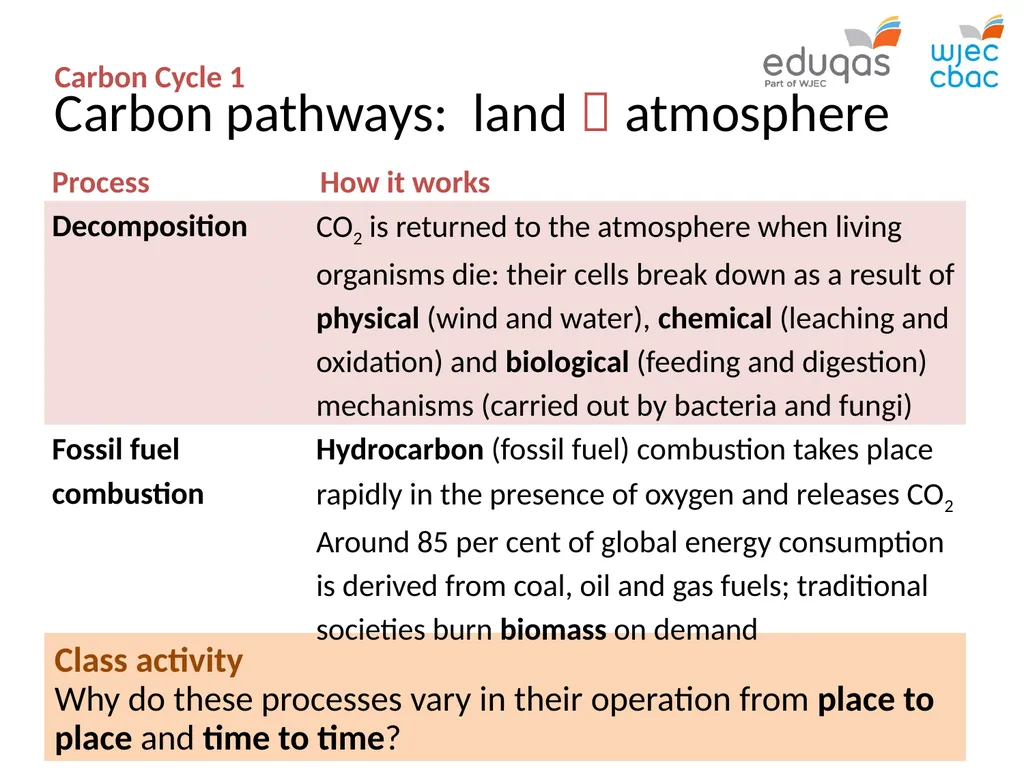
Carbon Cycle 1 Carbon pathways: land atmosphere Class activity
Why do these processes vary in their operation from place to place and time to time?<br>
08
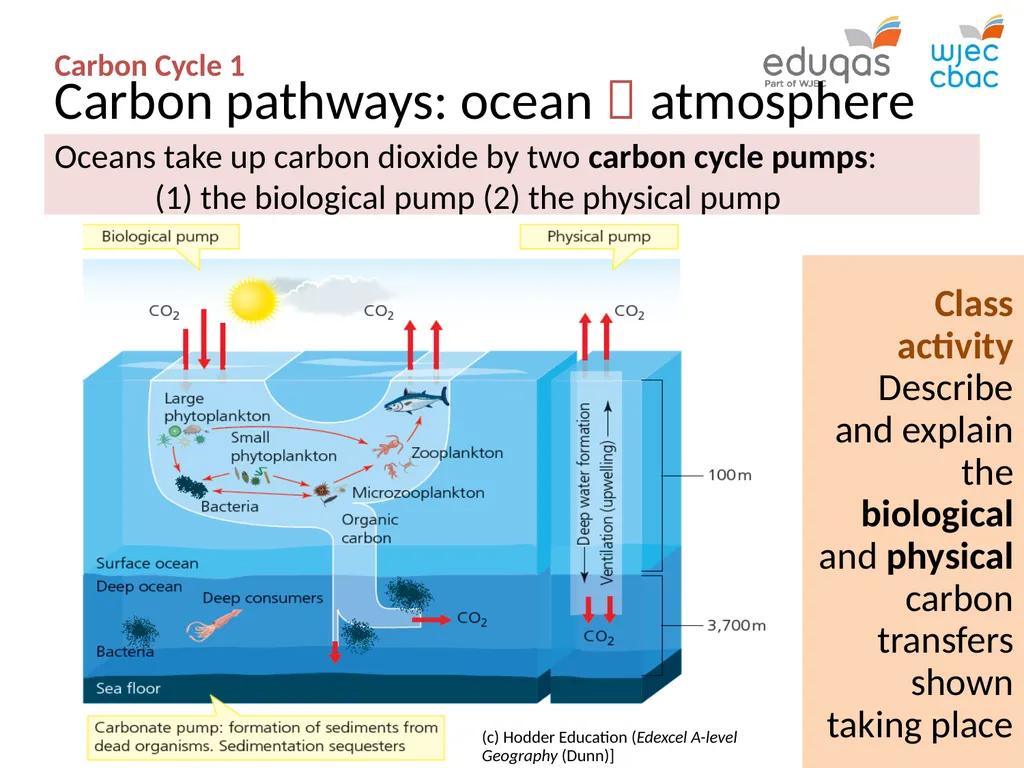
Carbon Cycle 1 Carbon pathways: ocean atmosphere Oceans take up carbon dioxide by two carbon cycle pumps: (1) the biological pump (2) the physical pump Class activity
Describe and explain the biological and physical carbon transfers shown taking place (c) Hodder Education (Edexcel A-level Geography (Dunn)]<br>
09
Carbon Cycle 1 Carbon pathways: ocean atmosphere The physical (inorganic) pump involves the movement of carbon dioxide from the atmosphere to the ocean by a process called diffusion
CO2 dissolved in the surface of the ocean can be transferred to the deep ocean in areas where cold dense surface waters sink
This downwelling carries carbon molecules to great depths where they may remain for centuries
CO2 diffusion determines the acidity of the oceans Class activity
What geographical factors might cause the rate of diffusion to vary from place to place or time to time?<br>
10
Carbon Cycle 1 Carbon pathways: ocean atmosphere The biological (organic) pump is driven by ocean phytoplankton absorbing CO2 via photosynthesis
These organisms form the bottom of the marine food web, and live in the ocean’s surface layer
Phytoplankton are consumed by other organisms and carbon is transferred along food chains
Organic carbon may eventually be transferred to the deep ocean when dead organisms sink towards the ocean floor Class activity
Using examples, describe how carbon moves through food webs in (1) marine (2) terrestrial ecosystems<br>
11
Carbon Cycle 1 Carbon pathways: land ocean Cycling of carbon between terrestrial bedrock and oceans occurs over millions of years
Rainwater containing weak carbonic acid reacts with Limestone to produce soluble calcium bicarbonate
Calcium bicarbonate moves through the water cycle in solution into rivers and the ocean
Next, calcium bicarbonate is used by marine organisms to create shells; these are deposited later as carbonate-rich sediment on the ocean floor where they are lithified Class activity
Discuss your prior learning of chemical weathering and river transport of material in solution<br>
12
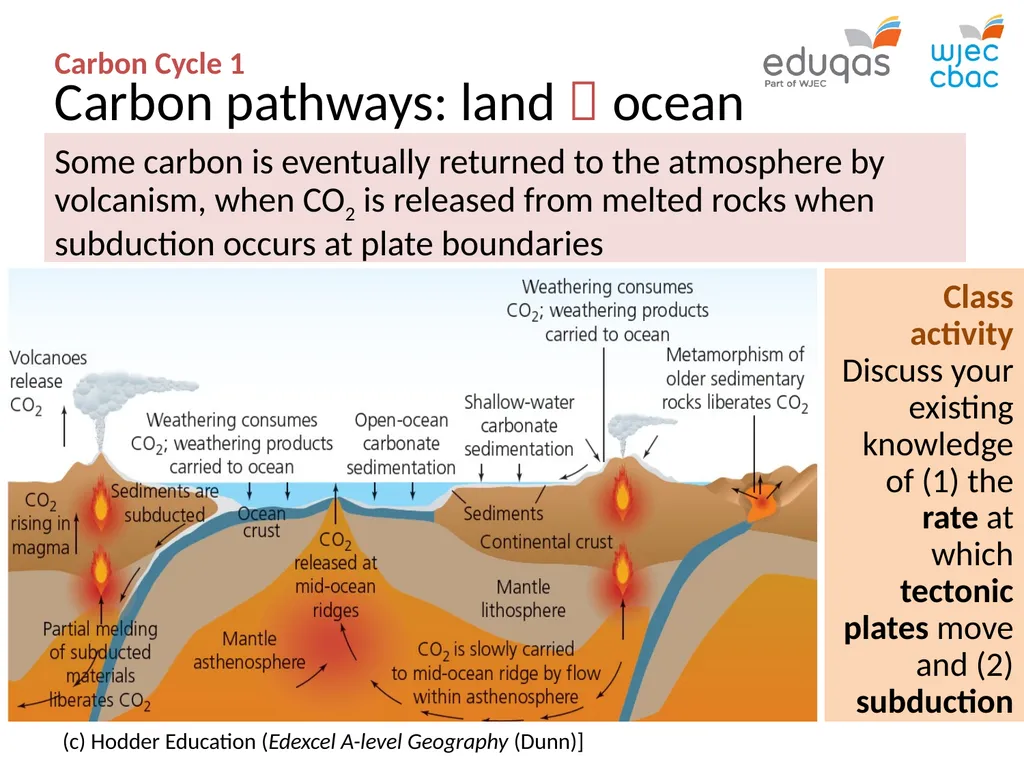
Carbon Cycle 1 Carbon pathways: land ocean Some carbon is eventually returned to the atmosphere by volcanism, when CO2 is released from melted rocks when subduction occurs at plate boundaries Class activity
Discuss your existing knowledge of (1) the rate at which tectonic plates move and (2) subduction (c) Hodder Education (Edexcel A-level Geography (Dunn)]<br>
13
Carbon Cycle 1 Plenary The global carbon cycle consists of stores, flows, inputs and outputs e.g. carbon stored in sedimentary rocks and deep ocean sediments
Photosynthesis, respiration, decomposition and fossil fuel combustion are important processes controlling carbon flows between the atmosphere and the land
Carbon flows from the atmosphere to the ocean take place via the physical pump and the biological pump
A slow carbon cycle operates between the land and the ocean over millions of years, involving carbonation, river transport and plate tectonic movement<br>