"Carcass Disposal Composting Composting Carcasses" is the property of its rightful owner. Permission is granted to
download and print the materials on this website for personal, non-commercial use only, and to display it
on your personal computer provided you do not modify the materials and that you retain all copyright
notices contained in the materials. By downloading content from our website, you accept the terms of this
agreement.
Presentation Transcript
01
Carcass Disposal Composting<br>
02
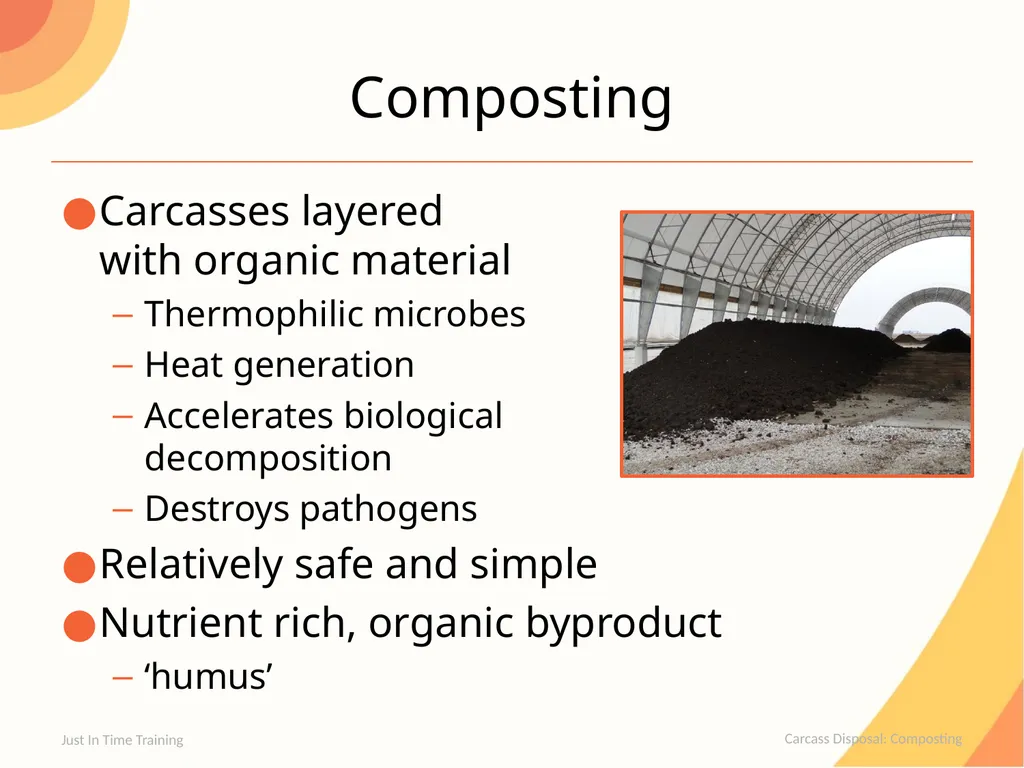
Composting Carcasses layered with organic material
Thermophilic microbes
Heat generation
Accelerates biological decomposition
Destroys pathogens
Relatively safe and simple
Nutrient rich, organic byproduct
‘humus’ Just In Time Training Carcass Disposal: Composting<br>
03
Compost Components Nitrogen
Carcasses, manure
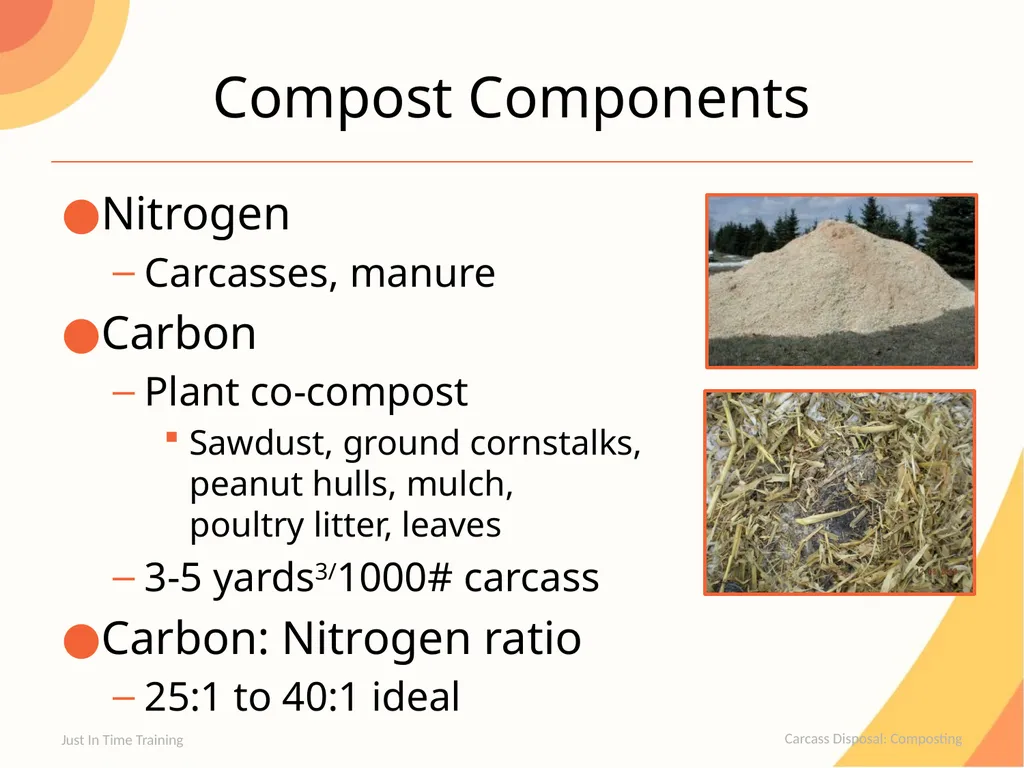
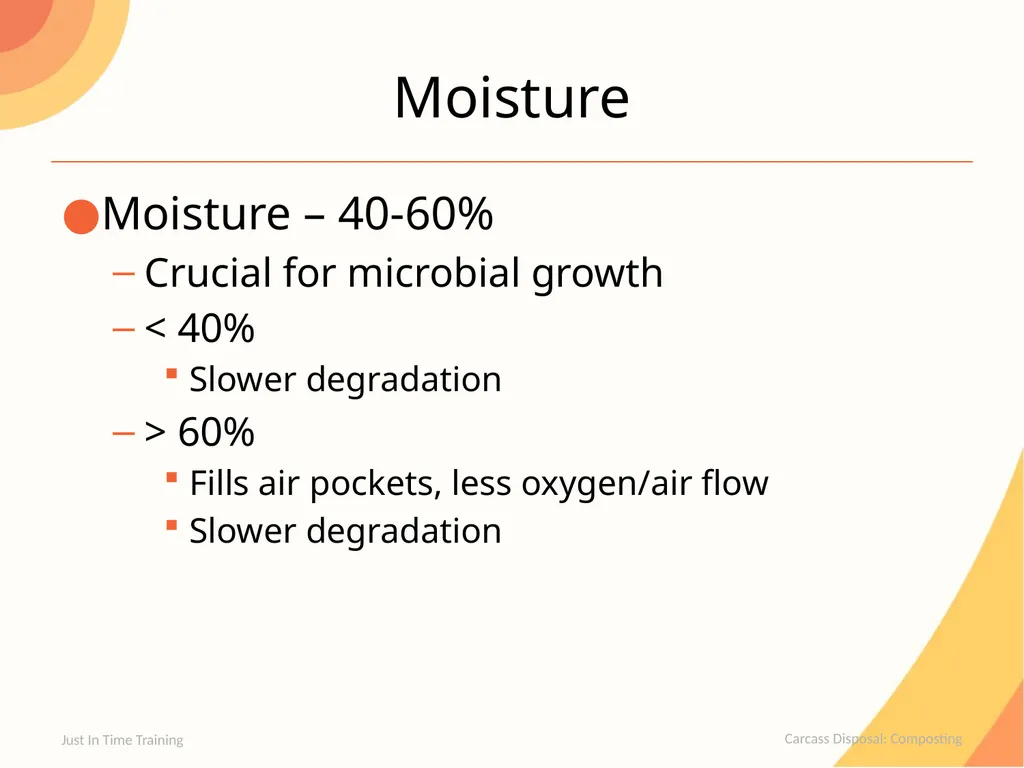
Carbon
Plant co-compost
Sawdust, ground cornstalks, peanut hulls, mulch, poultry litter, leaves
3-5 yards3/1000# carcass
Carbon: Nitrogen ratio
25:1 to 40:1 ideal Just In Time Training Carcass Disposal: Composting<br>
04
Moisture Moisture – 40-60%
Crucial for microbial growth
< 40%
Slower degradation
> 60%
Fills air pockets, less oxygen/air flow
Slower degradation Just In Time Training Carcass Disposal: Composting<br>
05
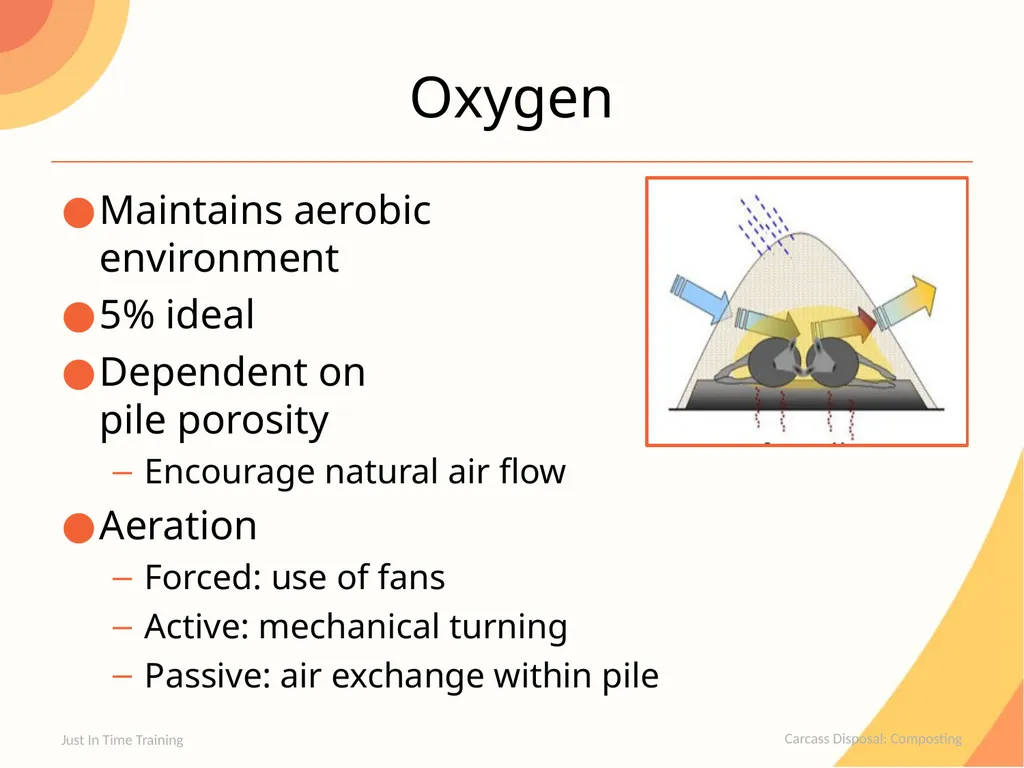
Oxygen Maintains aerobic environment
5% ideal
Dependent on pile porosity
Encourage natural air flow
Aeration
Forced: use of fans
Active: mechanical turning
Passive: air exchange within pile Just In Time Training Carcass Disposal: Composting<br>
06
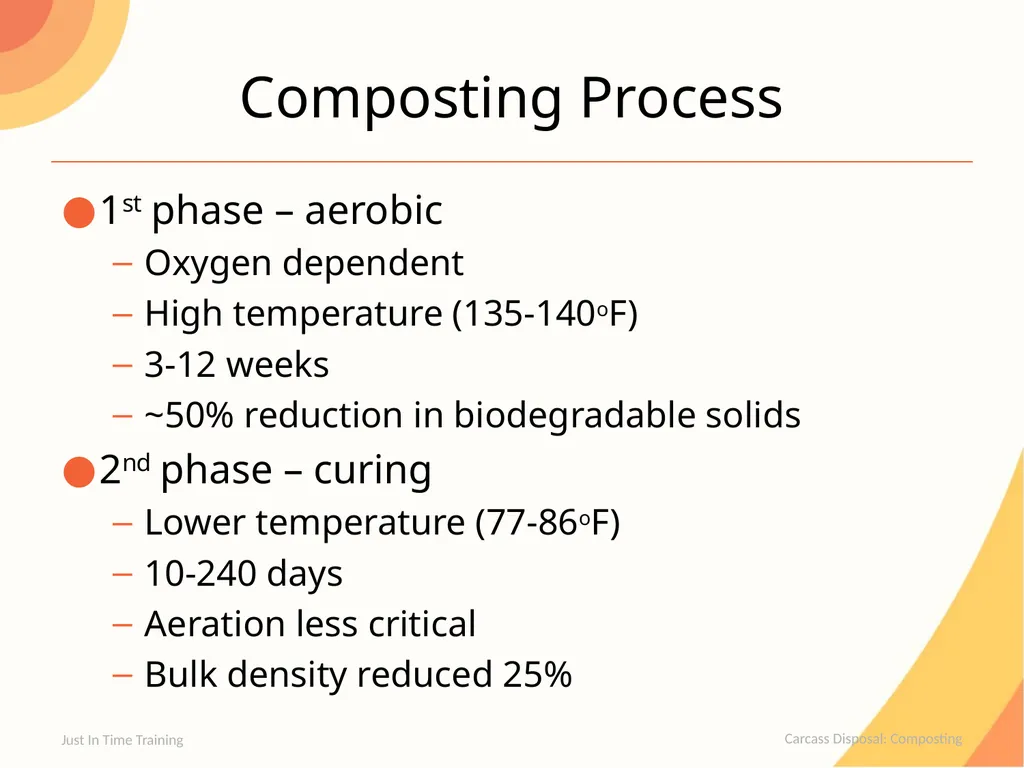
Composting Process 1st phase – aerobic
Oxygen dependent
High temperature (135-140oF)
3-12 weeks
~50% reduction in biodegradable solids
2nd phase – curing
Lower temperature (77-86oF)
10-240 days
Aeration less critical
Bulk density reduced 25% Just In Time Training Carcass Disposal: Composting<br>
07
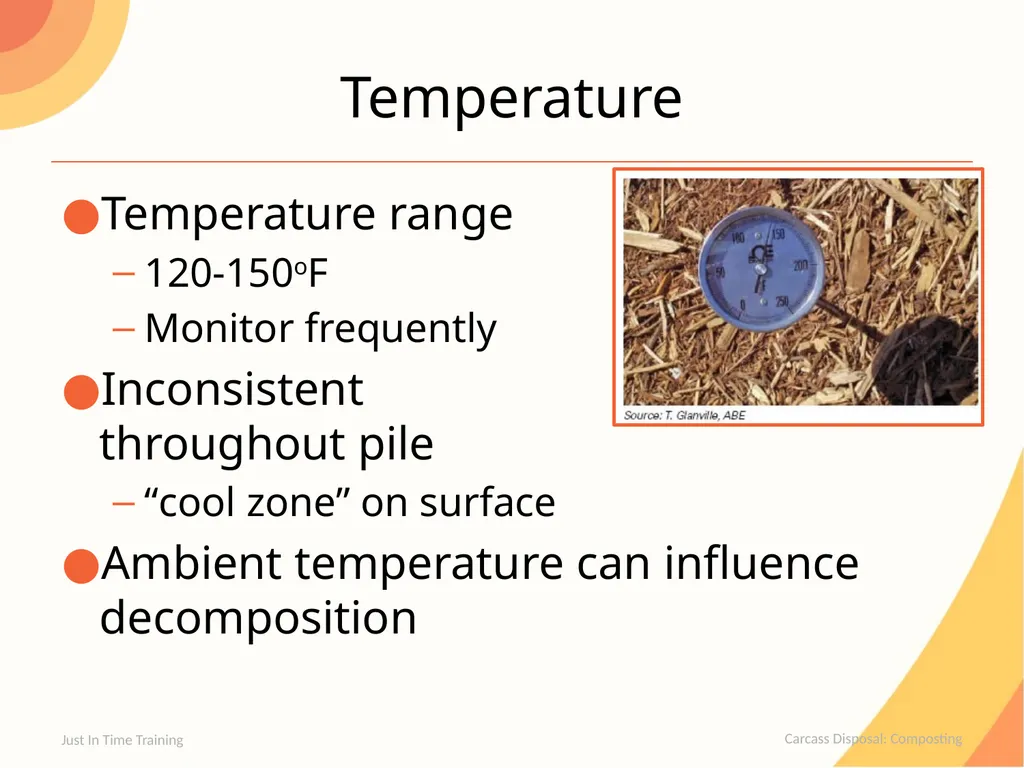
Temperature Temperature range
120-150oF
Monitor frequently
Inconsistent throughout pile
“cool zone” on surface
Ambient temperature can influence decomposition Just In Time Training Carcass Disposal: Composting<br>
08
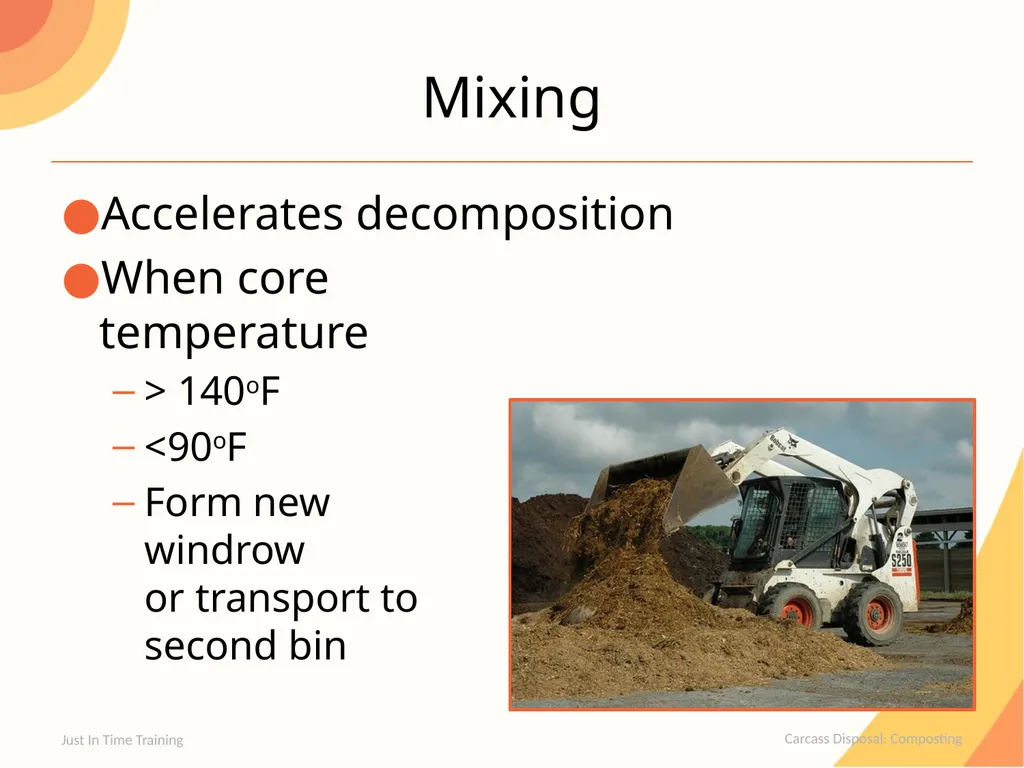
Mixing Accelerates decomposition
When core temperature
> 140oF
<90oF
Form new windrow or transport to second bin Just In Time Training Carcass Disposal: Composting<br>
09
Compost Design Just In Time Training Carcass Disposal: Composting<br>
10
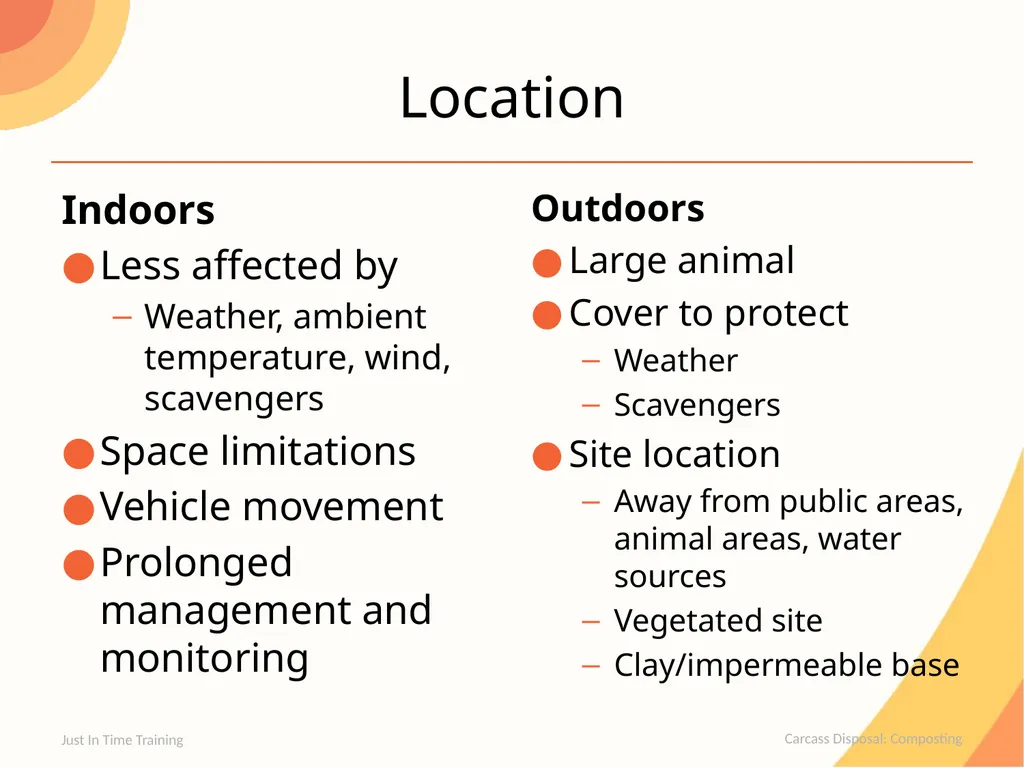
Location Indoors
Less affected by
Weather, ambient temperature, wind, scavengers
Space limitations
Vehicle movement
Prolonged management and monitoring Outdoors
Large animal
Cover to protect
Weather
Scavengers
Site location
Away from public areas, animal areas, water sources
Vegetated site
Clay/impermeable base Just In Time Training Carcass Disposal: Composting<br>
11
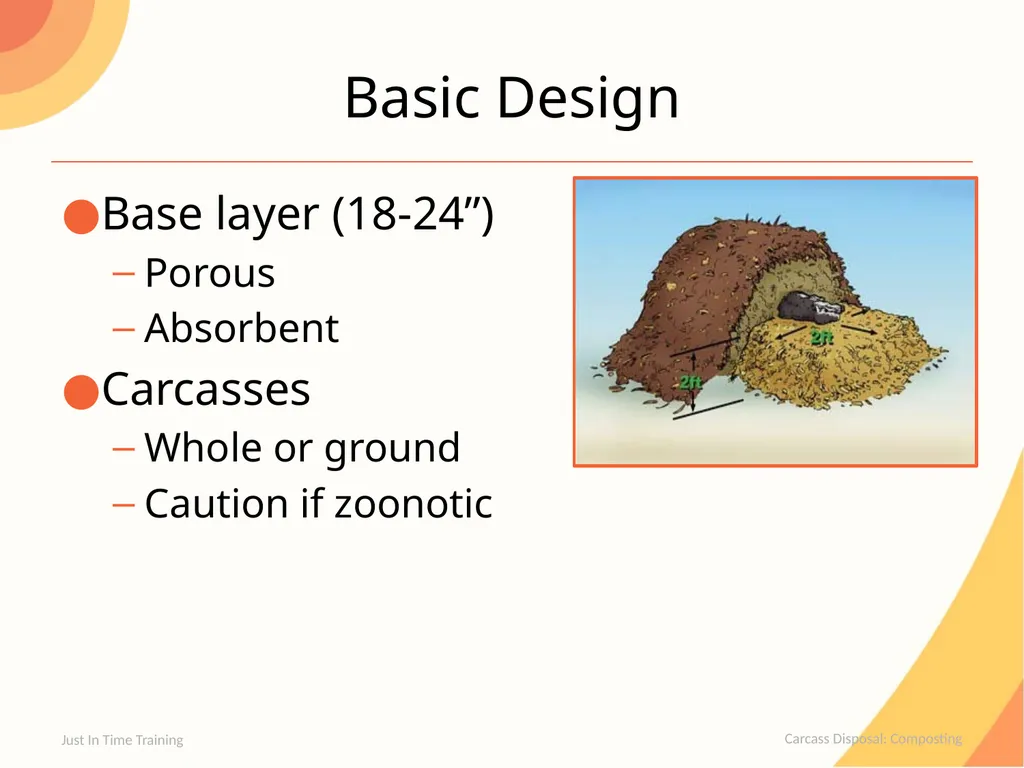
Basic Design Base layer (18-24”)
Porous
Absorbent
Carcasses
Whole or ground
Caution if zoonotic Just In Time Training Carcass Disposal: Composting<br>
12
Basic Design Layer with co-compost (4-6”)
5-7 feet high total
12 inches on sides
Biofilter layer on top
Weather dependent
Cool weather-silage
Warm weather-cornstalks
Porous materials
Absorbs moisture and promotes air flow Just In Time Training Carcass Disposal: Composting<br>
13
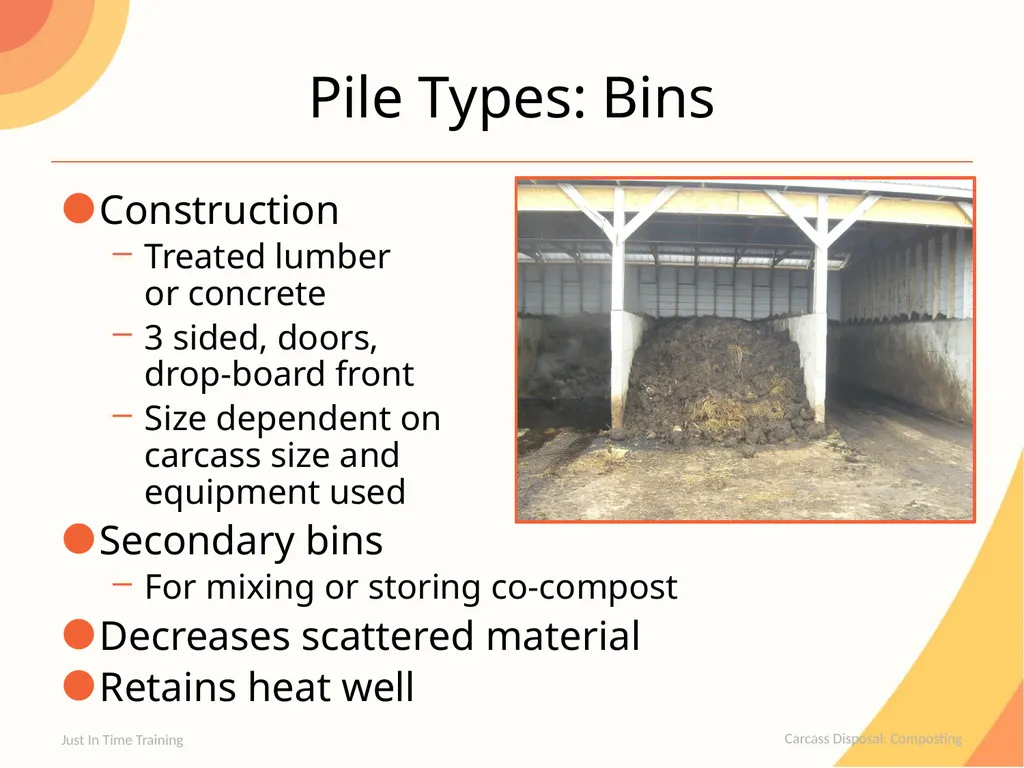
Pile Types: Bins Construction
Treated lumber or concrete
3 sided, doors, drop-board front
Size dependent on carcass size and equipment used
Secondary bins
For mixing or storing co-compost
Decreases scattered material
Retains heat well Just In Time Training Carcass Disposal: Composting<br>
14
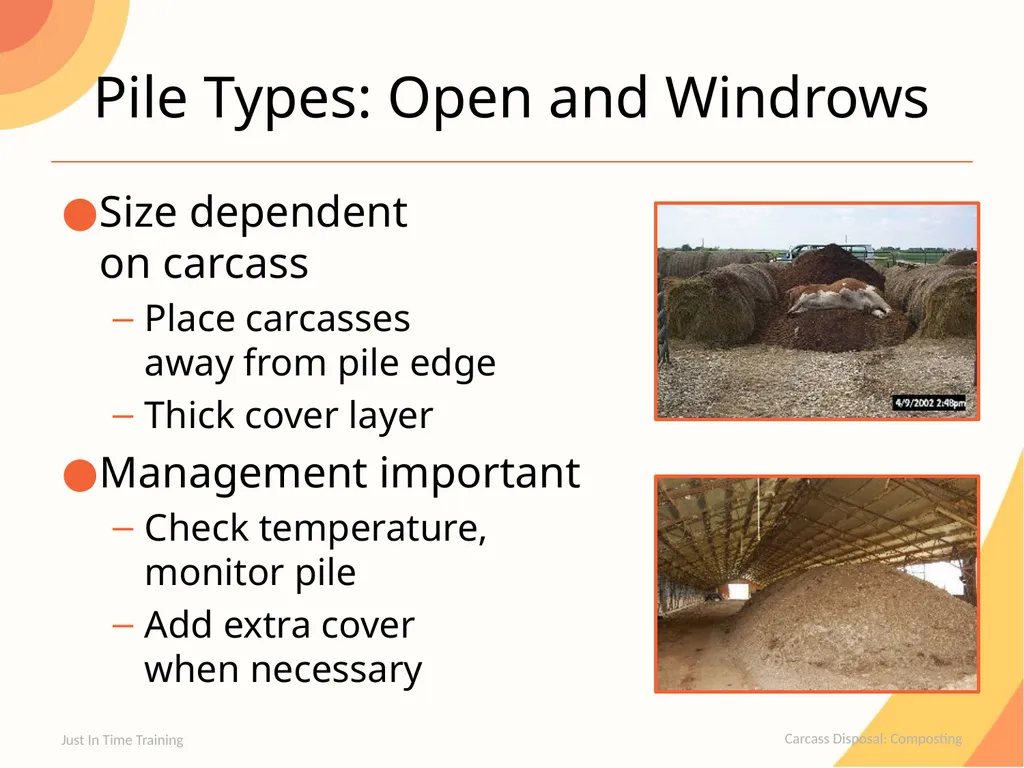
Pile Types: Open and Windrows Size dependent on carcass
Place carcasses away from pile edge
Thick cover layer
Management important
Check temperature, monitor pile
Add extra cover when necessary Just In Time Training Carcass Disposal: Composting<br>
15
Distributing Compost FAD may make compost unsafe for cropland
Soft tissue should be decomposed
Large bones should be buried
Nutrient levels should be tested
Reuse as compost cover material Just In Time Training Carcass Disposal: Composting<br>
16
Considerations Just In Time Training Carcass Disposal: Composting<br>
17
Composting Considerations On-site process
Adaptable process
Nutrient rich end product
Transport of co-compost material
Regulations Just In Time Training Carcass Disposal: Composting<br>
18
Record Keeping Start date of each compost batch
Date and quantity of dead animal(s) or additions
Internal temperature of each active compost batch
Measured, at minimum, weekly
Date compost material aerated Just In Time Training Carcass Disposal: Composting<br>
19
Biosecurity Responders must
Wear appropriate PPE
Follow movement control procedures
Vehicle cleaning and disinfection
Site security
Public perception Just In Time Training Carcass Disposal: Composting<br>
20
Resources USDA Foreign Animal Disease Preparedness (FAD PReP) Guidelines: Disposal
http://www.aphis.usda.gov/animal_health/emrs/nahems.shtml
USDA Foreign Animal Disease Preparedness Standard Operating Procedures (SOP): Disposal
http://www.aphis.usda.gov/emergency_response/tools/aphis_role_emergency_tools.shtml Just In Time Training Carcass Disposal: Composting<br>
21
Acknowledgments Development of this presentation was by the Center for Food Security and Public Health at Iowa State University through funding from the Multi-State Partnership for Security in Agriculture Authors: Jessica Kennicker, BS
Reviewer: Glenda Dvorak, DVM, MPH, DACVPM<br>