
Caring for survivors: A principled approach 2
AS
Published · 23 slides · 0 views

1 / 1

Description
Caring for survivors: A principled approach 2 Module 2 2 Self-reflection and values clarification GROUP EXERCISE Reflecting on our values Module 2 3 Myth: She provoked the assault because of her sexy dress. Reality: Violence and abuse is
Related Topics
Share
Embed code
Download this presentation From Below
"Caring for survivors: A principled approach 2" is the property of its rightful owner. Permission is granted to download and print the materials on this website for personal, non-commercial use only, and to display it on your personal computer provided you do not modify the materials and that you retain all copyright notices contained in the materials. By downloading content from our website, you accept the terms of this agreement.
Presentation Transcript
01
Caring for survivors:
A principled approach 2<br>
A principled approach 2<br>
02
Module 2 2 Self-reflection and values clarification GROUP EXERCISE
Reflecting on our values<br>
Reflecting on our values<br>
03
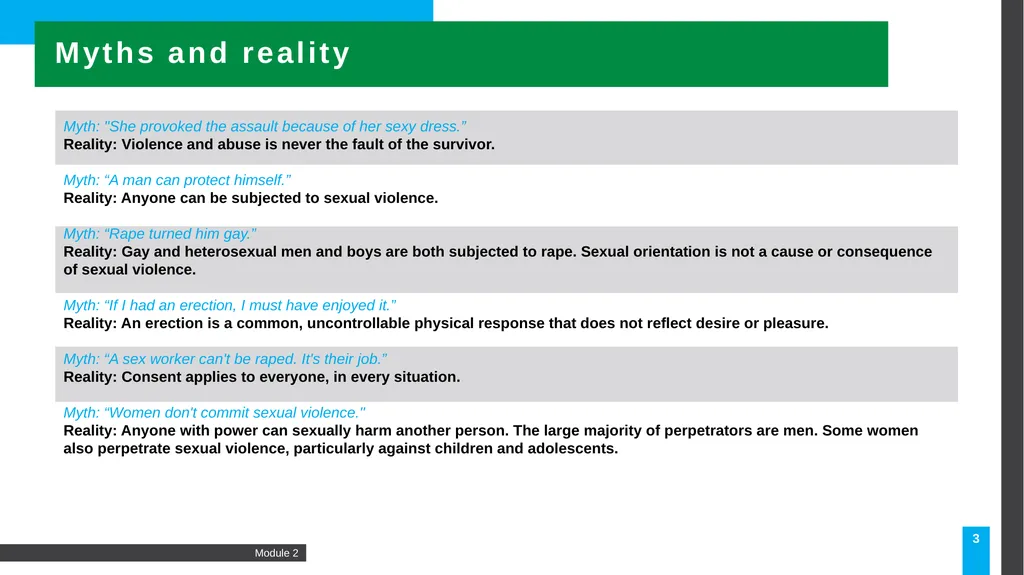
Module 2 3 Myth: "She provoked the assault because of her sexy dress.”
Reality: Violence and abuse is never the fault of the survivor.
Myth: “A man can protect himself.”
Reality: Anyone can be subjected to sexual violence.
Myth: “Rape turned him gay.”
Reality: Gay and heterosexual men and boys are both subjected to rape. Sexual orientation is not a cause or consequence of sexual violence.
Myth: “If I had an erection, I must have enjoyed it.”
Reality: An erection is a common, uncontrollable physical response that does not reflect desire or pleasure.
Myth: “A sex worker can't be raped. It's their job.” Reality: Consent applies to everyone, in every situation.
Myth: “Women don't commit sexual violence."
Reality: Anyone with power can sexually harm another person. The large majority of perpetrators are men. Some women also perpetrate sexual violence, particularly against children and adolescents. Myths and reality<br>
Reality: Violence and abuse is never the fault of the survivor.
Myth: “A man can protect himself.”
Reality: Anyone can be subjected to sexual violence.
Myth: “Rape turned him gay.”
Reality: Gay and heterosexual men and boys are both subjected to rape. Sexual orientation is not a cause or consequence of sexual violence.
Myth: “If I had an erection, I must have enjoyed it.”
Reality: An erection is a common, uncontrollable physical response that does not reflect desire or pleasure.
Myth: “A sex worker can't be raped. It's their job.” Reality: Consent applies to everyone, in every situation.
Myth: “Women don't commit sexual violence."
Reality: Anyone with power can sexually harm another person. The large majority of perpetrators are men. Some women also perpetrate sexual violence, particularly against children and adolescents. Myths and reality<br>
04
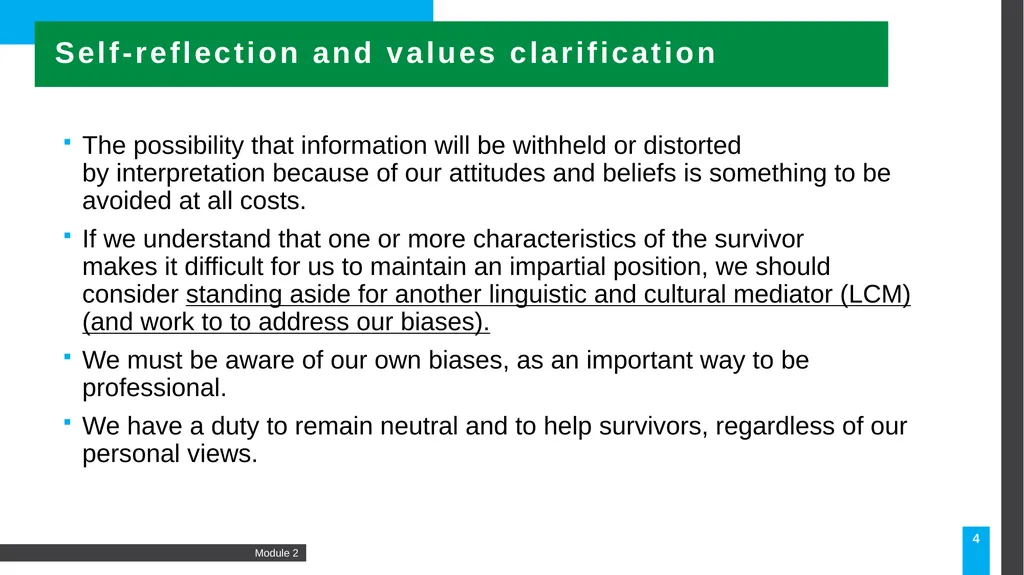
Module 2 4 The possibility that information will be withheld or distorted by interpretation because of our attitudes and beliefs is something to be avoided at all costs.
If we understand that one or more characteristics of the survivor makes it difficult for us to maintain an impartial position, we should consider standing aside for another linguistic and cultural mediator (LCM) (and work to to address our biases).
We must be aware of our own biases, as an important way to be professional.
We have a duty to remain neutral and to help survivors, regardless of our personal views. Self-reflection and values clarification<br>
If we understand that one or more characteristics of the survivor makes it difficult for us to maintain an impartial position, we should consider standing aside for another linguistic and cultural mediator (LCM) (and work to to address our biases).
We must be aware of our own biases, as an important way to be professional.
We have a duty to remain neutral and to help survivors, regardless of our personal views. Self-reflection and values clarification<br>
05
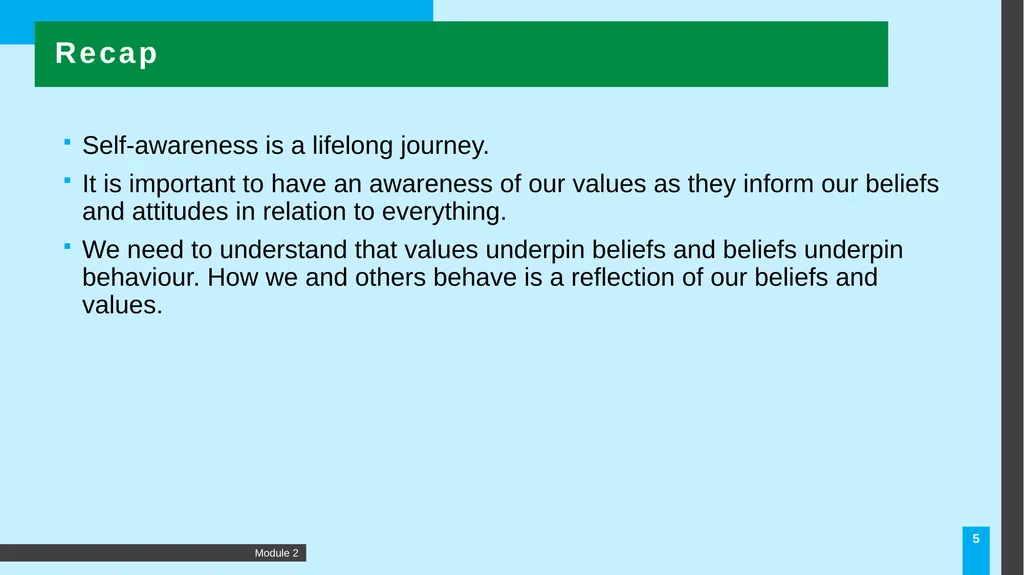
Module 2 5 Self-awareness is a lifelong journey.
It is important to have an awareness of our values as they inform our beliefs and attitudes in relation to everything.
We need to understand that values underpin beliefs and beliefs underpin behaviour. How we and others behave is a reflection of our beliefs and values. Recap<br>
It is important to have an awareness of our values as they inform our beliefs and attitudes in relation to everything.
We need to understand that values underpin beliefs and beliefs underpin behaviour. How we and others behave is a reflection of our beliefs and values. Recap<br>
06
A survivor-centred approach Module 2 6<br>
07
Module 2 7 A survivor-centred approach aims to put the rights of each survivor at the forefront of all actions and ensure that each survivor is treated with dignity and respect.
By putting the survivor at the centre of the process, such an approach promotes their recovery, reduces the risk of further harm and reinforces their agency and self-determination.
Practicing a survivor-centred approach means establishing a relationship with the survivor that promotes their emotional and physical safety, builds trust and helps them to restore some control over their life. Survivor-centred approach<br>
By putting the survivor at the centre of the process, such an approach promotes their recovery, reduces the risk of further harm and reinforces their agency and self-determination.
Practicing a survivor-centred approach means establishing a relationship with the survivor that promotes their emotional and physical safety, builds trust and helps them to restore some control over their life. Survivor-centred approach<br>
08
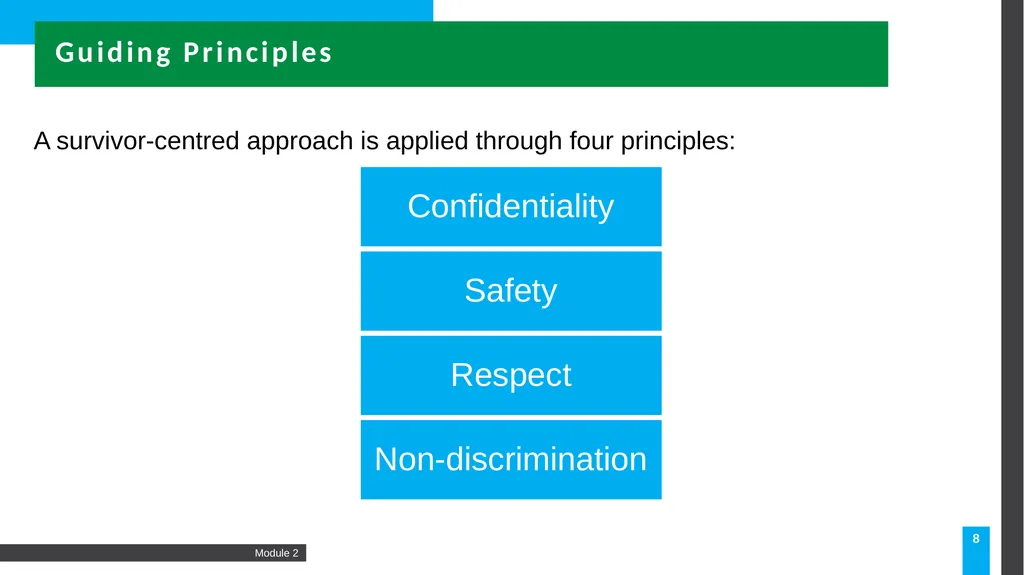
Module 2 8 Guiding Principles A survivor-centred approach is applied through four principles:<br>
09
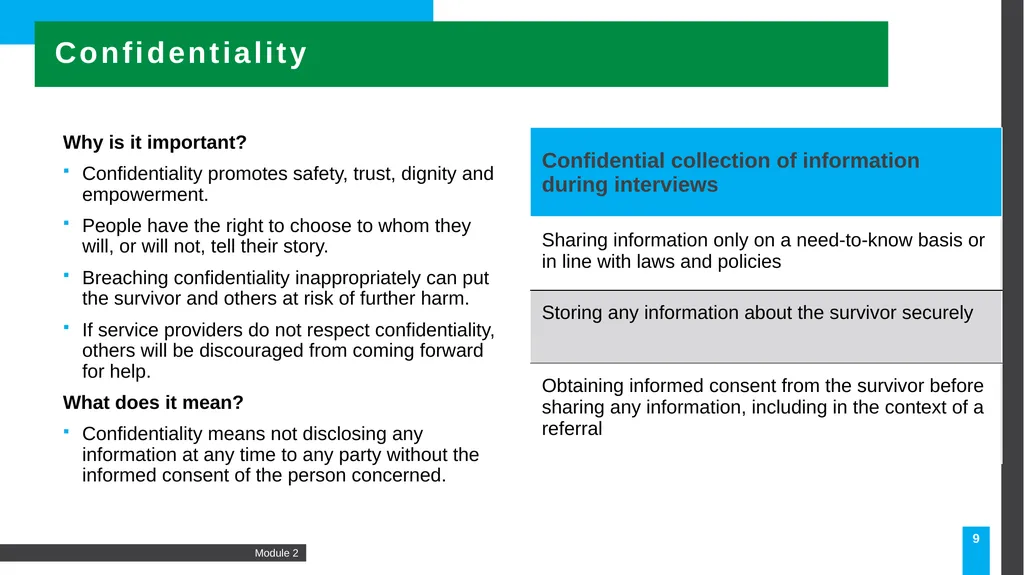
Module 2 9 Why is it important?
Confidentiality promotes safety, trust, dignity and empowerment.
People have the right to choose to whom they will, or will not, tell their story.
Breaching confidentiality inappropriately can put the survivor and others at risk of further harm.
If service providers do not respect confidentiality, others will be discouraged from coming forward for help.
What does it mean?
Confidentiality means not disclosing any information at any time to any party without the informed consent of the person concerned. Confidentiality<br>
Confidentiality promotes safety, trust, dignity and empowerment.
People have the right to choose to whom they will, or will not, tell their story.
Breaching confidentiality inappropriately can put the survivor and others at risk of further harm.
If service providers do not respect confidentiality, others will be discouraged from coming forward for help.
What does it mean?
Confidentiality means not disclosing any information at any time to any party without the informed consent of the person concerned. Confidentiality<br>
10
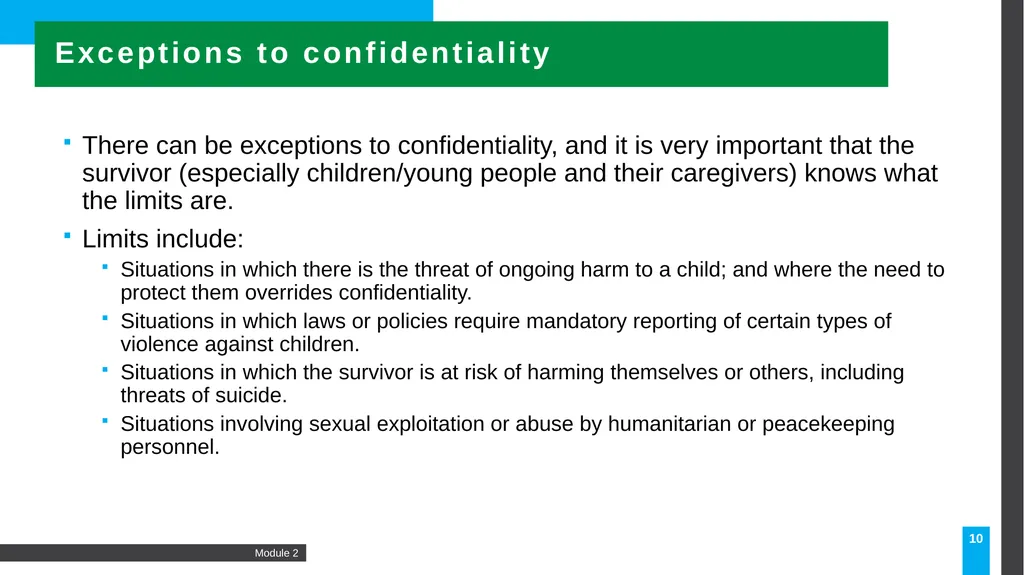
Module 2 10 There can be exceptions to confidentiality, and it is very important that the survivor (especially children/young people and their caregivers) knows what the limits are.
Limits include:
Situations in which there is the threat of ongoing harm to a child; and where the need to protect them overrides confidentiality.
Situations in which laws or policies require mandatory reporting of certain types of violence against children.
Situations in which the survivor is at risk of harming themselves or others, including threats of suicide.
Situations involving sexual exploitation or abuse by humanitarian or peacekeeping personnel. Exceptions to confidentiality<br>
Limits include:
Situations in which there is the threat of ongoing harm to a child; and where the need to protect them overrides confidentiality.
Situations in which laws or policies require mandatory reporting of certain types of violence against children.
Situations in which the survivor is at risk of harming themselves or others, including threats of suicide.
Situations involving sexual exploitation or abuse by humanitarian or peacekeeping personnel. Exceptions to confidentiality<br>
11
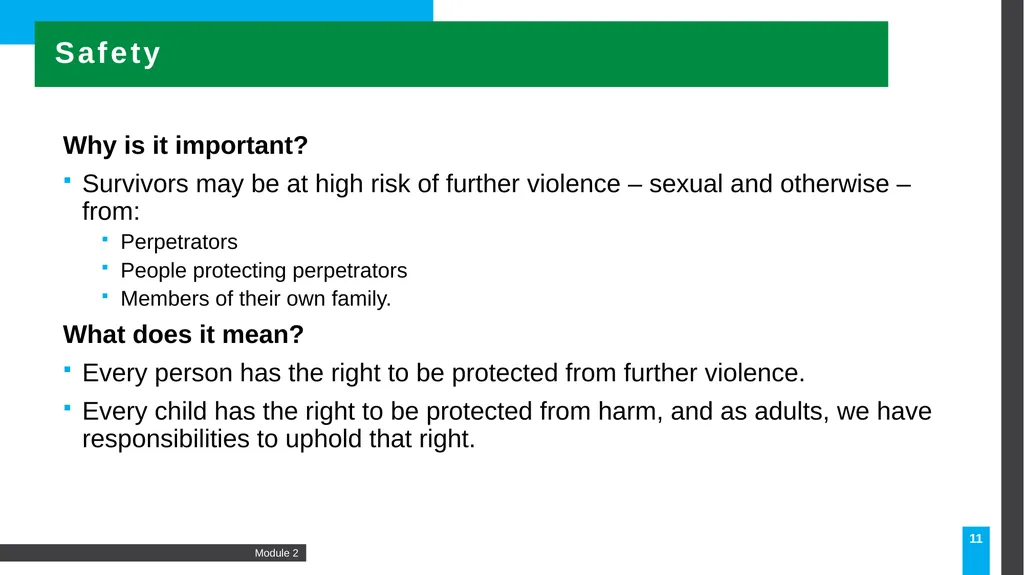
Module 2 11 Why is it important?
Survivors may be at high risk of further violence – sexual and otherwise – from:
Perpetrators
People protecting perpetrators
Members of their own family.
What does it mean?
Every person has the right to be protected from further violence.
Every child has the right to be protected from harm, and as adults, we have responsibilities to uphold that right. Safety<br>
Survivors may be at high risk of further violence – sexual and otherwise – from:
Perpetrators
People protecting perpetrators
Members of their own family.
What does it mean?
Every person has the right to be protected from further violence.
Every child has the right to be protected from harm, and as adults, we have responsibilities to uphold that right. Safety<br>
12
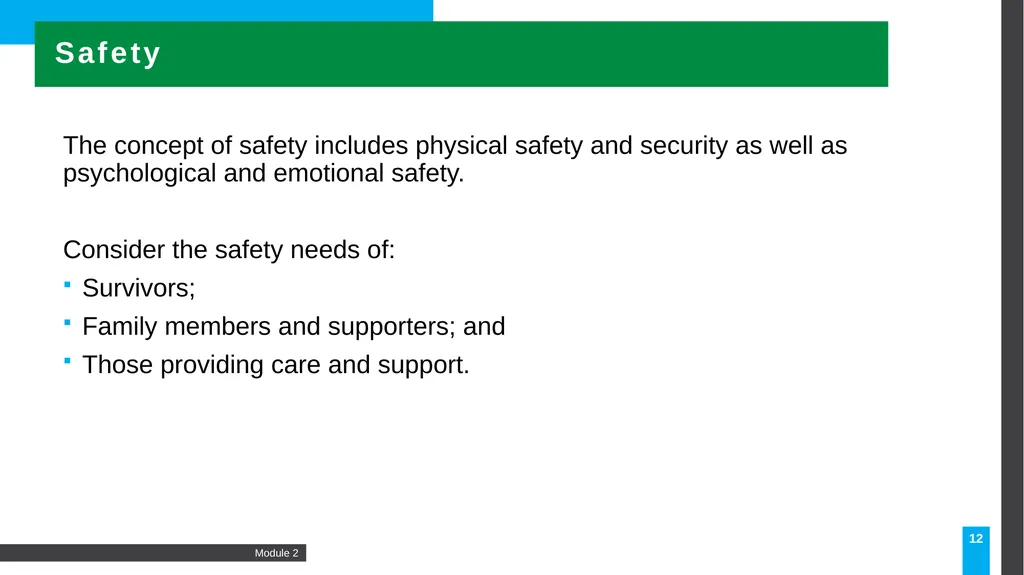
Module 2 12 The concept of safety includes physical safety and security as well as psychological and emotional safety.
Consider the safety needs of:
Survivors;
Family members and supporters; and
Those providing care and support. Safety<br>
Consider the safety needs of:
Survivors;
Family members and supporters; and
Those providing care and support. Safety<br>
13
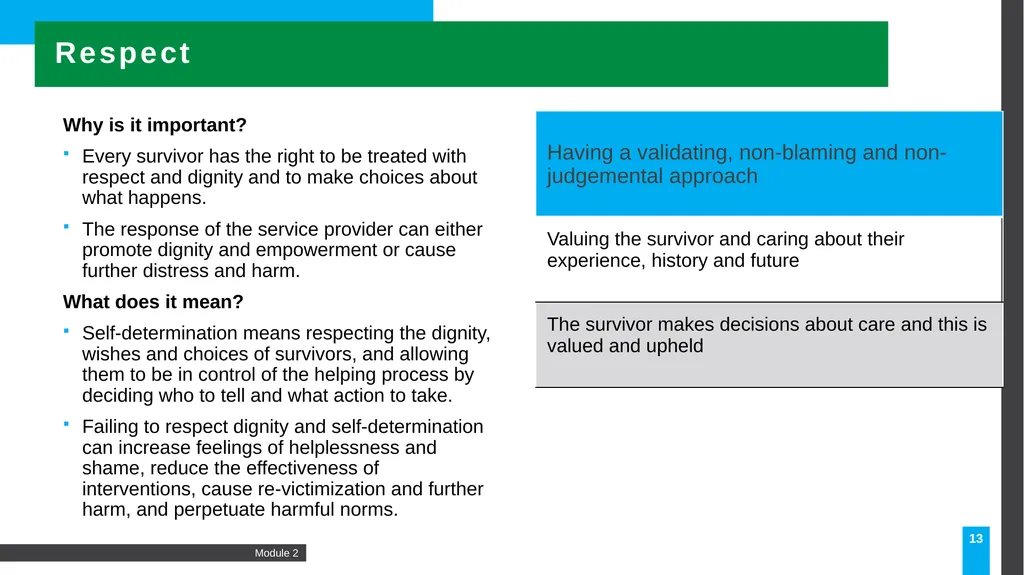
Module 2 13 Respect Why is it important?
Every survivor has the right to be treated with respect and dignity and to make choices about what happens.
The response of the service provider can either promote dignity and empowerment or cause further distress and harm.
What does it mean?
Self-determination means respecting the dignity, wishes and choices of survivors, and allowing them to be in control of the helping process by deciding who to tell and what action to take.
Failing to respect dignity and self-determination can increase feelings of helplessness and shame, reduce the effectiveness of interventions, cause re-victimization and further harm, and perpetuate harmful norms.<br>
Every survivor has the right to be treated with respect and dignity and to make choices about what happens.
The response of the service provider can either promote dignity and empowerment or cause further distress and harm.
What does it mean?
Self-determination means respecting the dignity, wishes and choices of survivors, and allowing them to be in control of the helping process by deciding who to tell and what action to take.
Failing to respect dignity and self-determination can increase feelings of helplessness and shame, reduce the effectiveness of interventions, cause re-victimization and further harm, and perpetuate harmful norms.<br>
14
Module 2 14 What does it mean?
All people have an equal right to the best possible assistance without unfair discrimination on the basis of:
Gender
Disability
Race, ethnicity or tribe
Colour
Language
Religious or political beliefs
Status or social class, etc. Non-discrimination<br>
All people have an equal right to the best possible assistance without unfair discrimination on the basis of:
Gender
Disability
Race, ethnicity or tribe
Colour
Language
Religious or political beliefs
Status or social class, etc. Non-discrimination<br>
15
Module 2 15 The voluntary agreement of an individual who has the legal capacity to give consent.
To provide informed consent, the individual must have the capacity and maturity to know about and understand the services being offered and be legally able to give their consent. Informed consent<br>
To provide informed consent, the individual must have the capacity and maturity to know about and understand the services being offered and be legally able to give their consent. Informed consent<br>
16
Module 2 16 To ensure consent is ‘informed,’ service providers must provide the following information to the survivor:
All the possible information and options available to the person so she/he can make choices.
Inform the person that she/he may need to share his/her information with others who can provide additional services.
Explain to the person what will happen as you work with her/him.
Explain the benefits and risks of services to the person.
Explain to the person that she/he has the right to decline or refuse any part of services. Explain limits to confidentiality. Informed consent<br>
All the possible information and options available to the person so she/he can make choices.
Inform the person that she/he may need to share his/her information with others who can provide additional services.
Explain to the person what will happen as you work with her/him.
Explain the benefits and risks of services to the person.
Explain to the person that she/he has the right to decline or refuse any part of services. Explain limits to confidentiality. Informed consent<br>
17
Module 2 17 Why is it important?
The primary purpose of intervening is to provide care, support and protection for individual children.
What does it mean?
Every child is unique and will be affected differently by sexual violence. Decisions and actions affecting them should reflect what is best for the safety, well-being and development of that particular child. Best interest of the child<br>
The primary purpose of intervening is to provide care, support and protection for individual children.
What does it mean?
Every child is unique and will be affected differently by sexual violence. Decisions and actions affecting them should reflect what is best for the safety, well-being and development of that particular child. Best interest of the child<br>
18
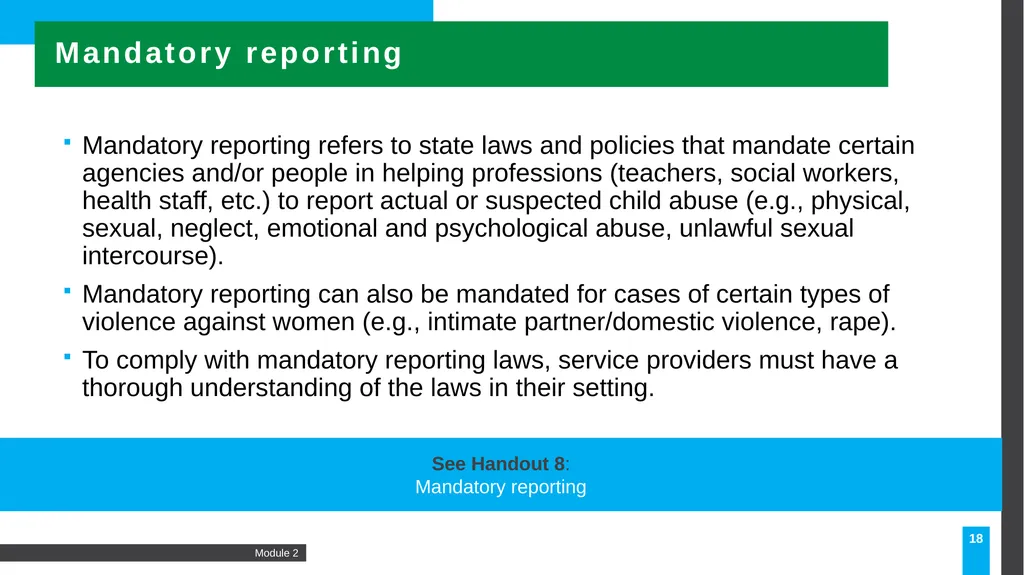
Module 2 18 Mandatory reporting refers to state laws and policies that mandate certain agencies and/or people in helping professions (teachers, social workers, health staff, etc.) to report actual or suspected child abuse (e.g., physical, sexual, neglect, emotional and psychological abuse, unlawful sexual intercourse).
Mandatory reporting can also be mandated for cases of certain types of violence against women (e.g., intimate partner/domestic violence, rape).
To comply with mandatory reporting laws, service providers must have a thorough understanding of the laws in their setting. Mandatory reporting See Handout 8:
Mandatory reporting<br>
Mandatory reporting can also be mandated for cases of certain types of violence against women (e.g., intimate partner/domestic violence, rape).
To comply with mandatory reporting laws, service providers must have a thorough understanding of the laws in their setting. Mandatory reporting See Handout 8:
Mandatory reporting<br>
19
Module 2 19 To be modified for setting Mandatory reporting<br>
20
Module 1 20 To be modified for setting Mandatory reporting<br>
21
Module 2 21 x GROUP WORK
Guiding Principles and Linguistic Cultural Mediation<br>
Guiding Principles and Linguistic Cultural Mediation<br>
22
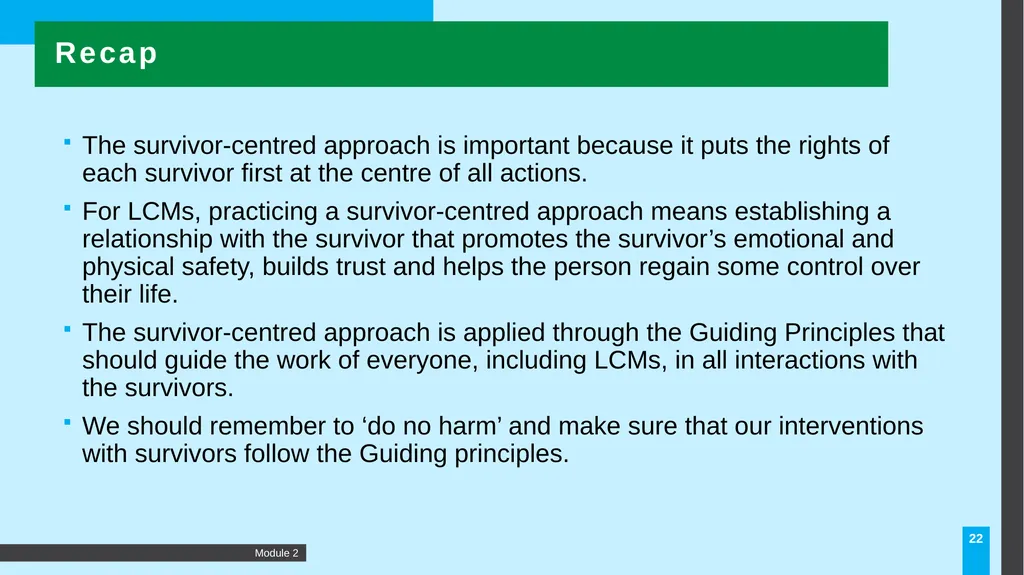
The survivor-centred approach is important because it puts the rights of each survivor first at the centre of all actions.
For LCMs, practicing a survivor-centred approach means establishing a relationship with the survivor that promotes the survivor’s emotional and physical safety, builds trust and helps the person regain some control over their life.
The survivor-centred approach is applied through the Guiding Principles that should guide the work of everyone, including LCMs, in all interactions with the survivors.
We should remember to ‘do no harm’ and make sure that our interventions with survivors follow the Guiding principles. Recap Module 2 22<br>
For LCMs, practicing a survivor-centred approach means establishing a relationship with the survivor that promotes the survivor’s emotional and physical safety, builds trust and helps the person regain some control over their life.
The survivor-centred approach is applied through the Guiding Principles that should guide the work of everyone, including LCMs, in all interactions with the survivors.
We should remember to ‘do no harm’ and make sure that our interventions with survivors follow the Guiding principles. Recap Module 2 22<br>
23
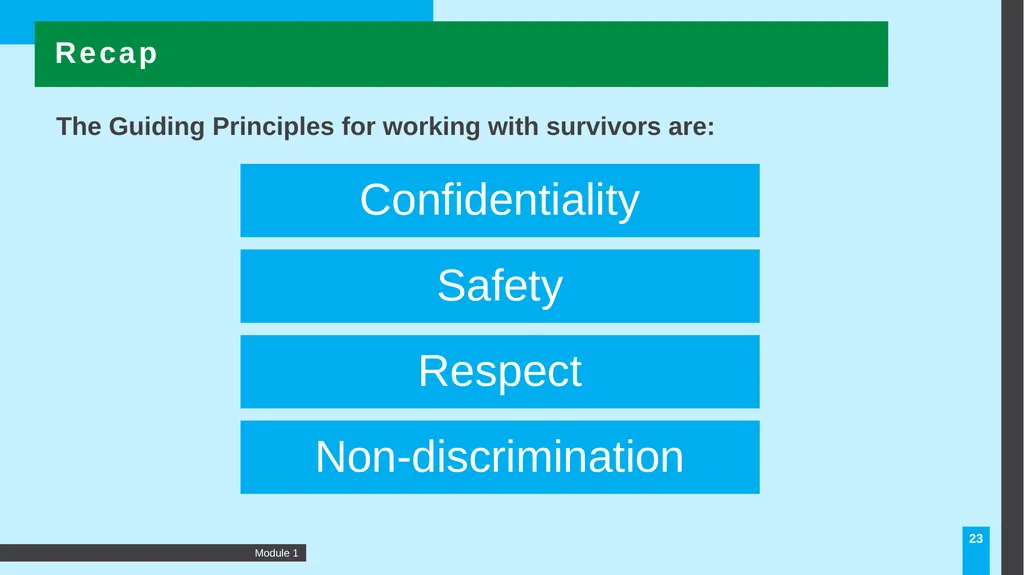
Module 1 23 Recap The Guiding Principles for working with survivors are:<br>