Case Reporting examination questions How to
Description: Case Reporting examination questions How to approach each case. Clinical Radiology Phase 2 Examination Introduction This presentation is to equip candidates with a greater understanding of strategies and approaches needed to successfully
Related Topics
Download Presentation
"Case Reporting examination questions How to" is the property of its rightful owner. Permission is granted to download and print the materials on this website for personal, non-commercial use only, and to display it on your personal computer provided you do not modify the materials and that you retain all copyright notices contained in the materials. By downloading content from our website, you accept the terms of this agreement.
Presentation Transcript
slide1. Case Reporting examination questions How to approach each case. Clinical Radiology – Phase 2 Examination<br>
slide2. Introduction This presentation is to equip candidates with a greater understanding of strategies and approaches needed to successfully tackle Case Reporting examination questions.
Understanding and following question guidelines is essential for different types of cases as it helps you provide accurate and clear answers that meet each case's specific needs while helping you score well on exams. CASE REPORTING - INTRODUCTION<br>
slide3. Case Reporting Examination
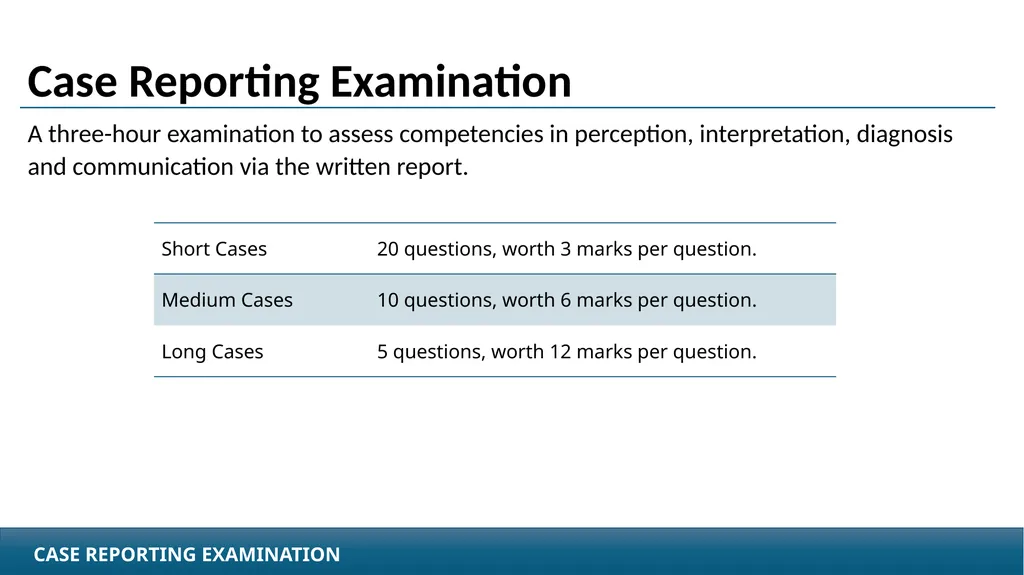
A three-hour examination to assess competencies in perception, interpretation, diagnosis and communication via the written report. CASE REPORTING EXAMINATION<br>
slide4. SHORT CASES
Simply provide a single, most likely diagnosis based on the given provided and imaging features. CASE REPORTING - SHORT CASES<br>
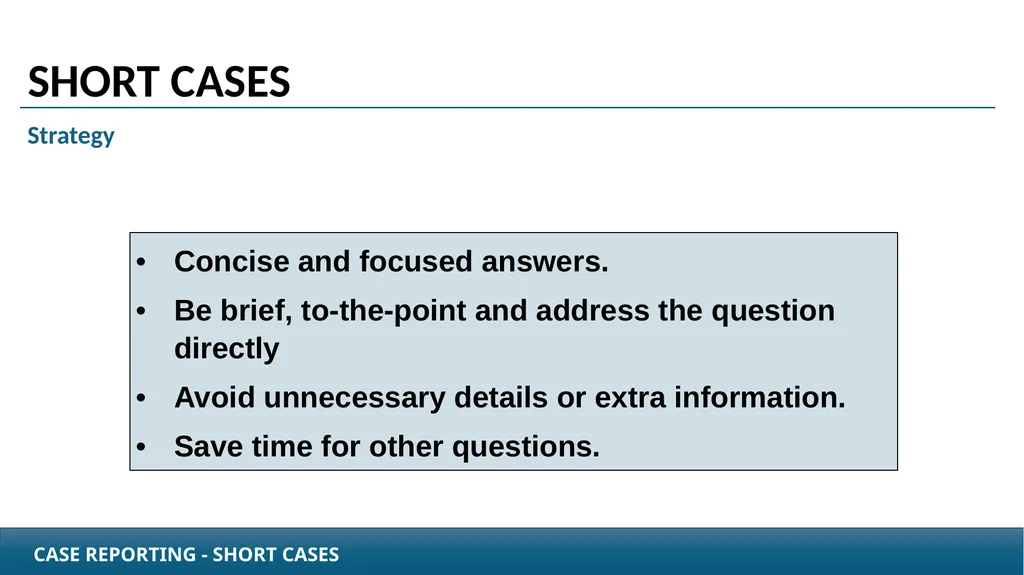
slide5. SHORT CASES CASE REPORTING - SHORT CASES Strategy<br>
slide6. SHORT CASES CASE REPORTING - SHORT CASES Marks
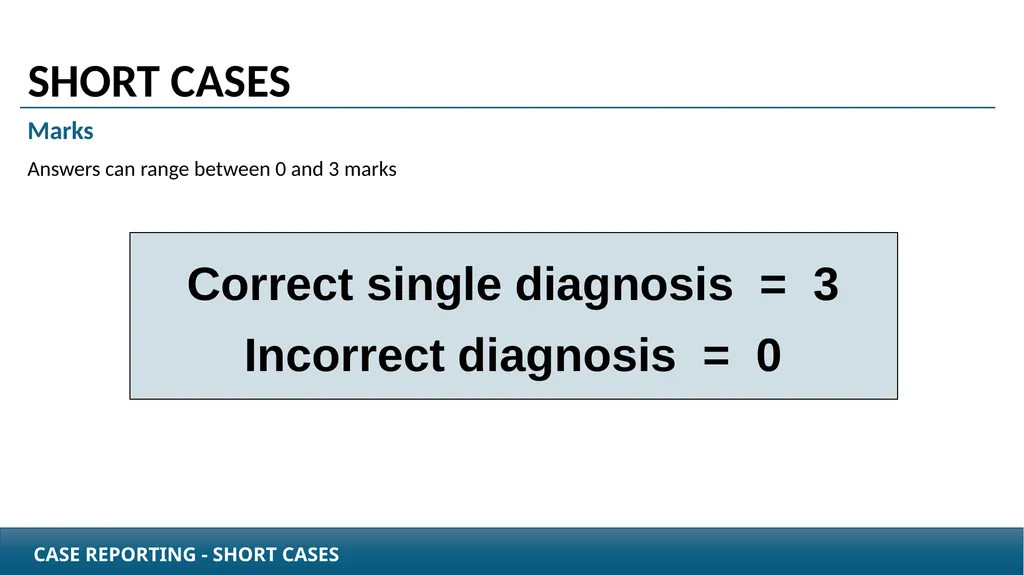
Answers can range between 0 and 3 marks<br>
slide7. Poor technique
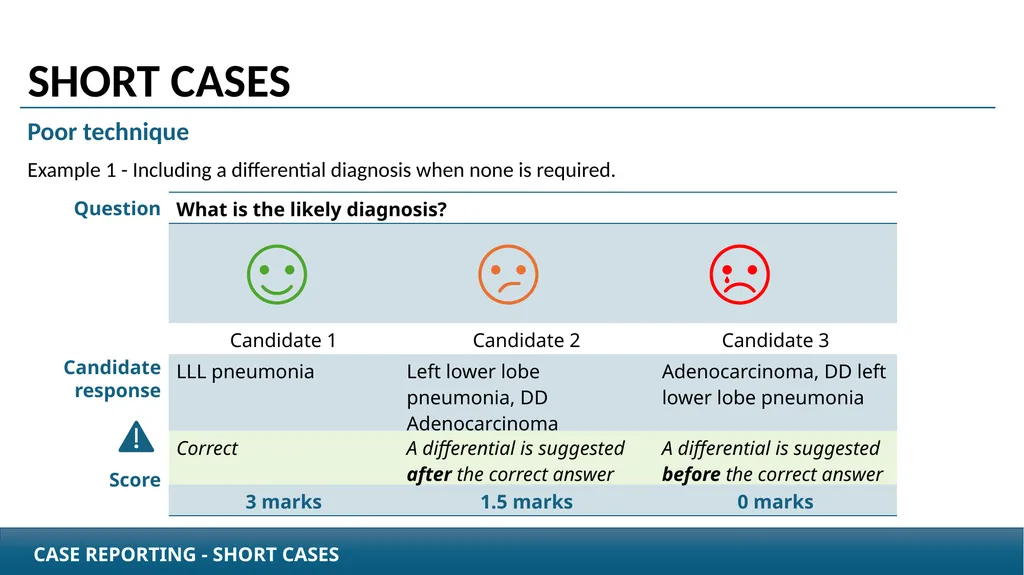
Example 1 - Including a differential diagnosis when none is required. CASE REPORTING - SHORT CASES Score Question SHORT CASES Candidate response<br>
slide8. Poor technique
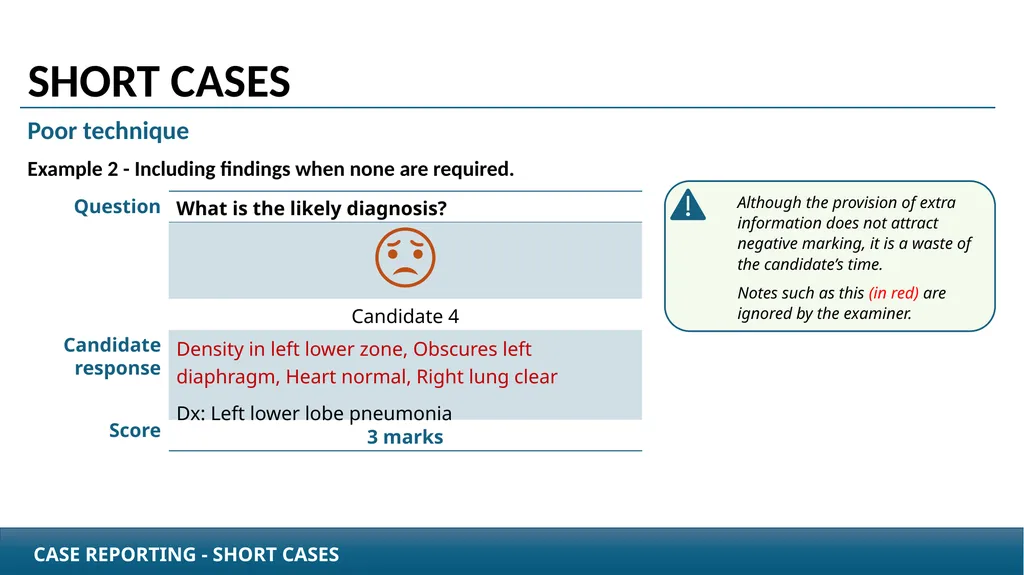
Example 2 - Including findings when none are required. CASE REPORTING - SHORT CASES Score Question SHORT CASES Candidate response Although the provision of extra information does not attract negative marking, it is a waste of the candidate’s time.
Notes such as this (in red) are ignored by the examiner.<br>
slide9. MEDIUM CASES
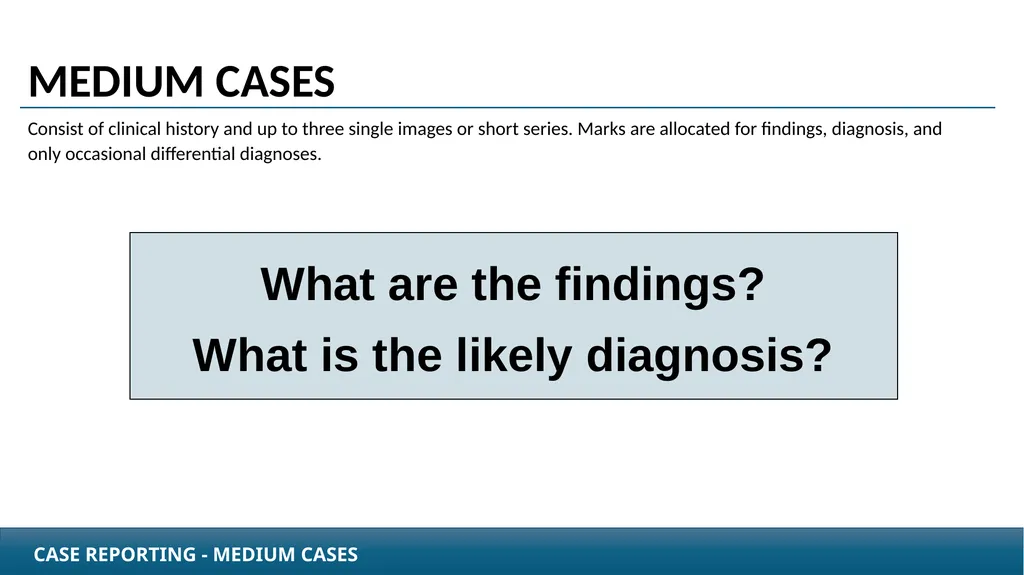
Consist of clinical history and up to three single images or short series. Marks are allocated for findings, diagnosis, and only occasional differential diagnoses. CASE REPORTING - MEDIUM CASES<br>
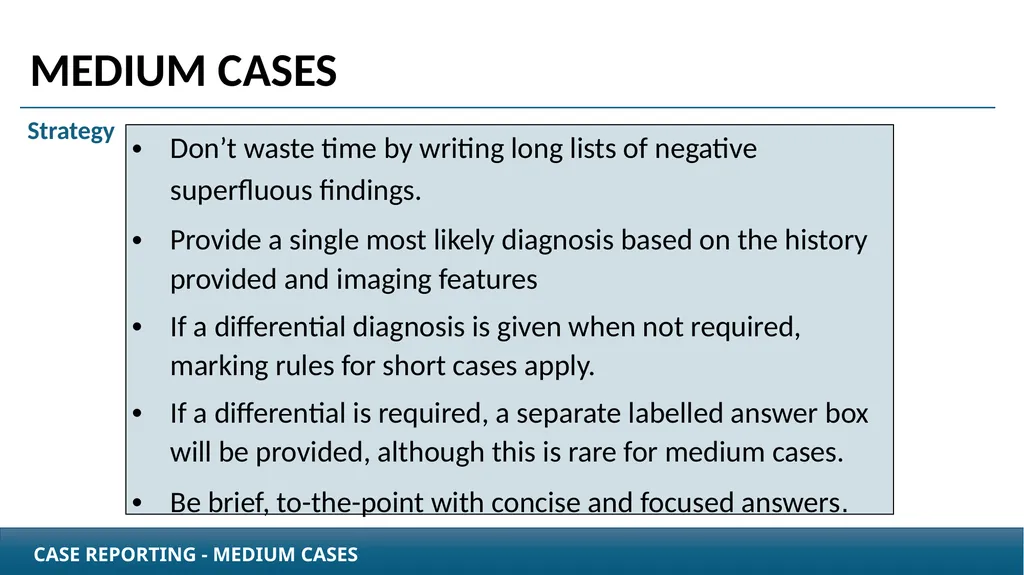
slide10. MEDIUM CASES CASE REPORTING - MEDIUM CASES Strategy<br>
slide11. MEDIUM CASES CASE REPORTING - MEDIUM CASES Marks
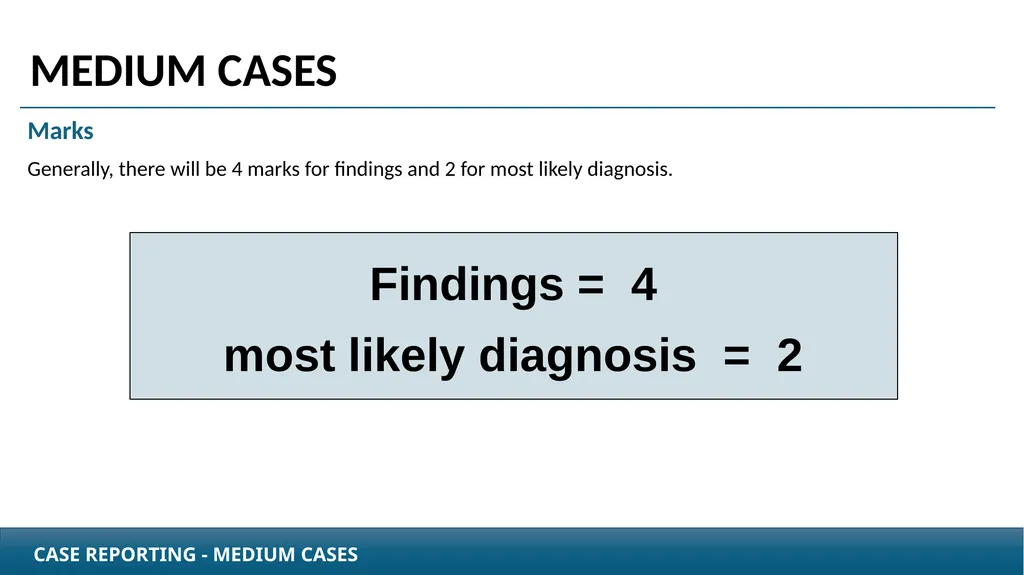
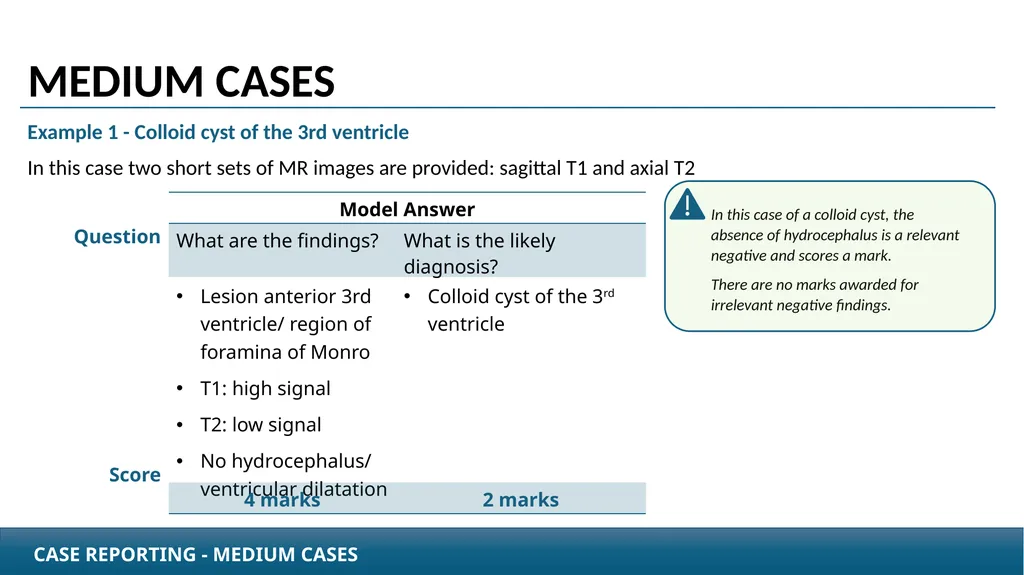
Generally, there will be 4 marks for findings and 2 for most likely diagnosis.<br>
slide12. Example 1 - Colloid cyst of the 3rd ventricle
In this case two short sets of MR images are provided: sagittal T1 and axial T2 CASE REPORTING - MEDIUM CASES Score Question MEDIUM CASES In this case of a colloid cyst, the absence of hydrocephalus is a relevant negative and scores a mark.
There are no marks awarded for irrelevant negative findings.<br>
slide13. Poor candidate response
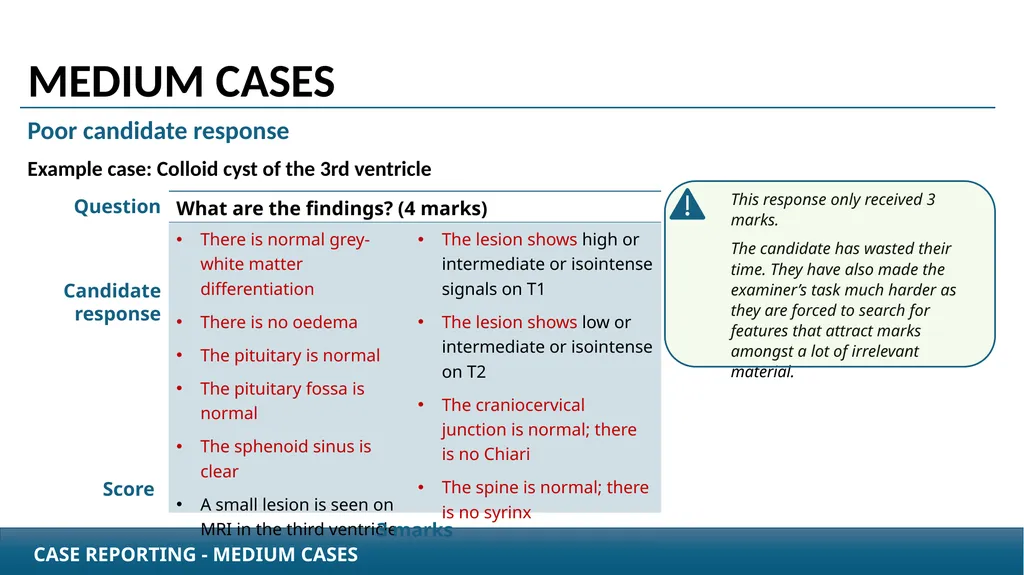
Example case: Colloid cyst of the 3rd ventricle CASE REPORTING - MEDIUM CASES Score Question MEDIUM CASES Candidate response This response only received 3 marks.
The candidate has wasted their time. They have also made the examiner’s task much harder as they are forced to search for features that attract marks amongst a lot of irrelevant material.<br>
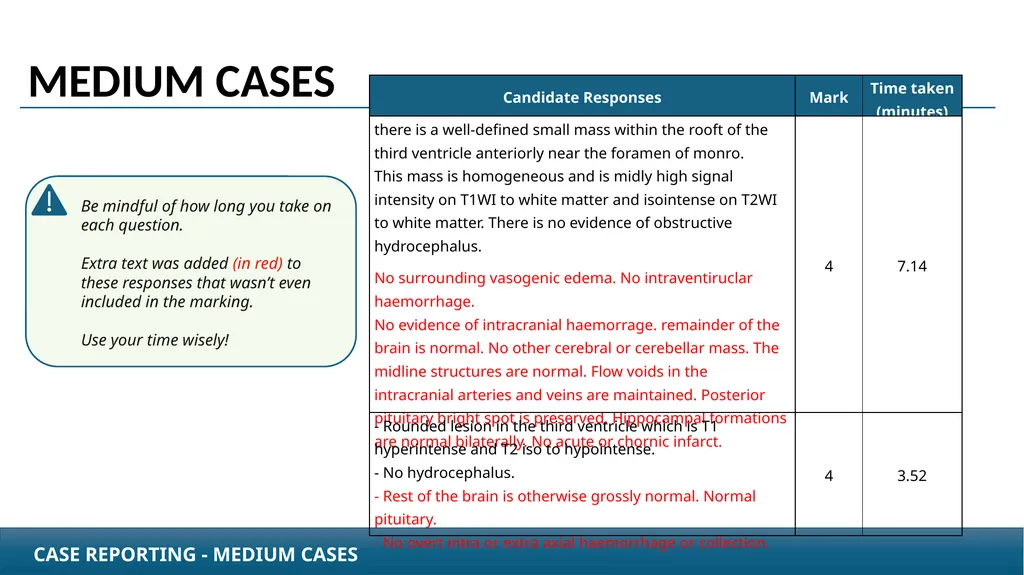
slide14. CASE REPORTING - MEDIUM CASES MEDIUM CASES Be mindful of how long you take on each question.
Extra text was added (in red) to these responses that wasn’t even included in the marking.
Use your time wisely!<br>
slide15. LONG CASES
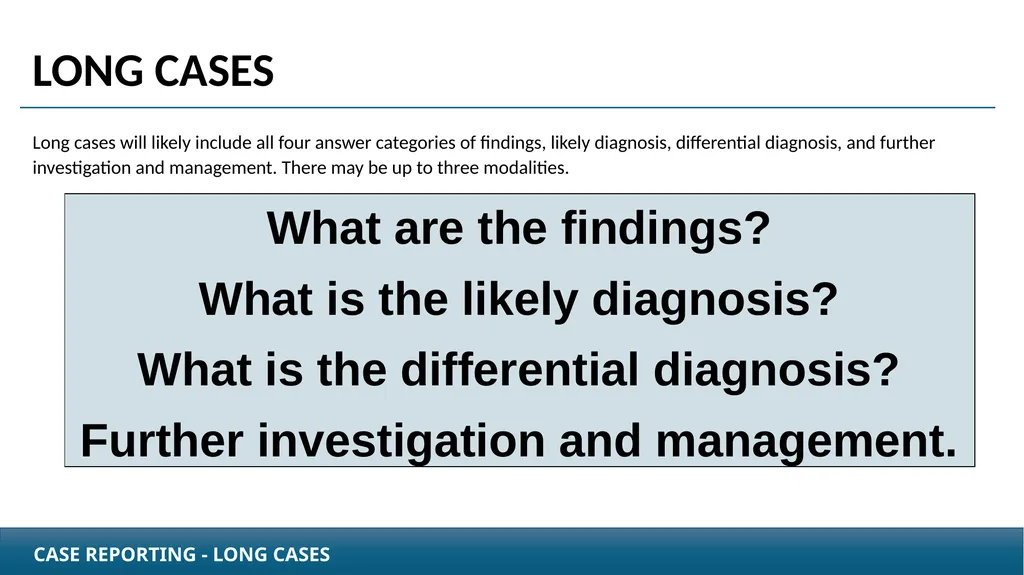
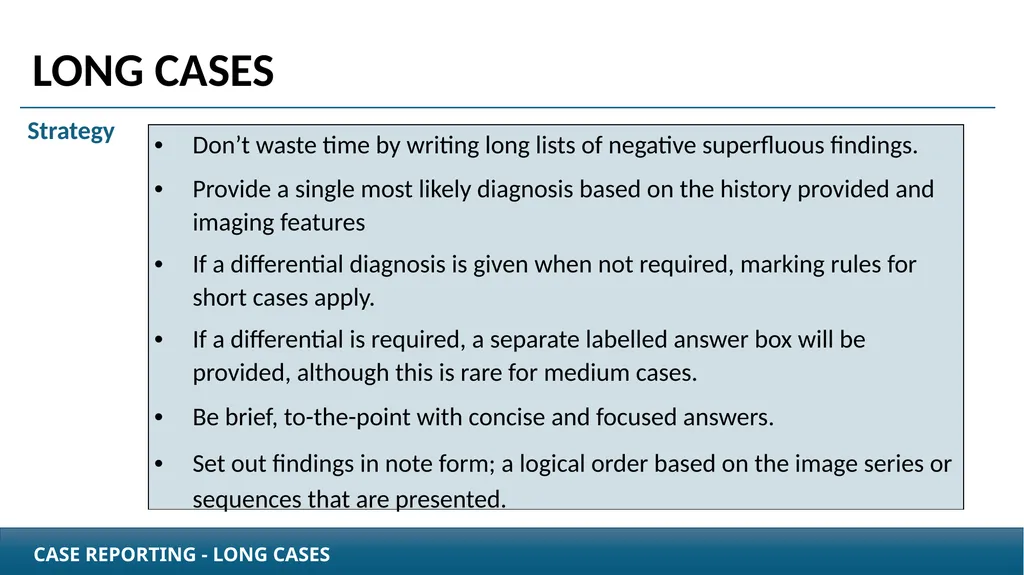
Long cases will likely include all four answer categories of findings, likely diagnosis, differential diagnosis, and further investigation and management. There may be up to three modalities. CASE REPORTING - LONG CASES<br>
slide16. LONG CASES CASE REPORTING - LONG CASES Strategy<br>
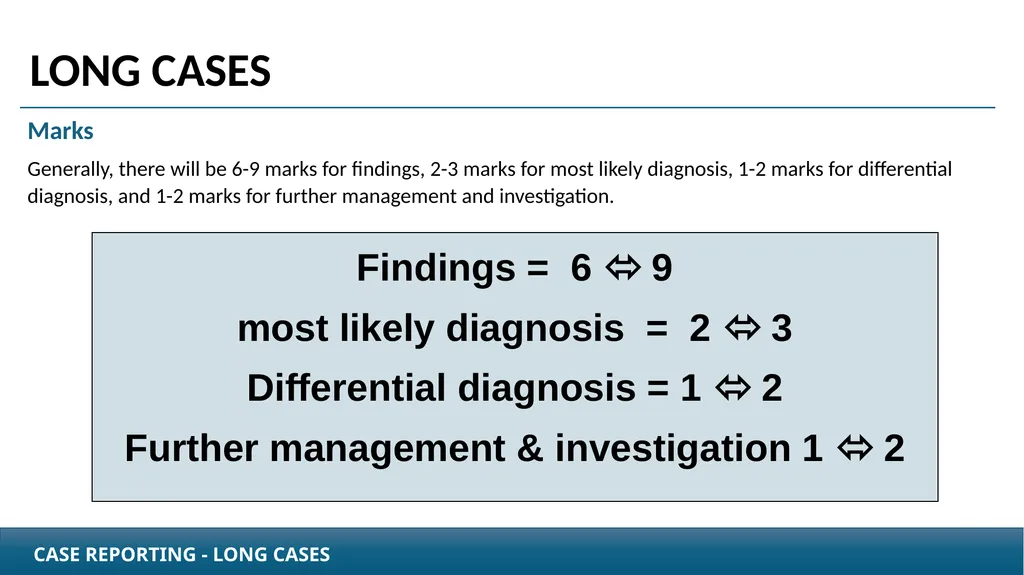
slide17. LONG CASES CASE REPORTING - LONG CASES Marks
Generally, there will be 6-9 marks for findings, 2-3 marks for most likely diagnosis, 1-2 marks for differential diagnosis, and 1-2 marks for further management and investigation.<br>
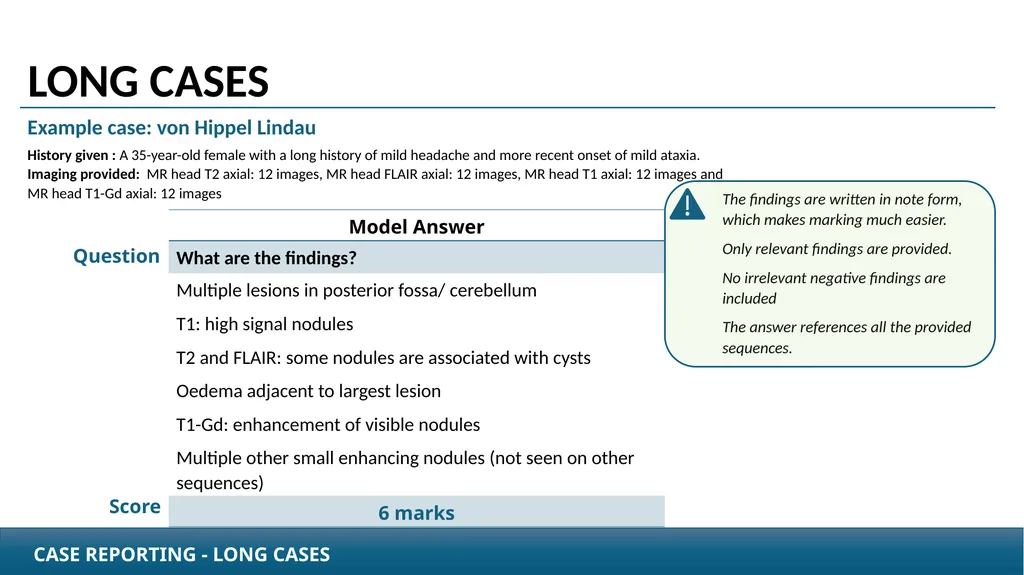
slide18. Example case: von Hippel Lindau CASE REPORTING - LONG CASES Score Question LONG CASES The findings are written in note form, which makes marking much easier.
Only relevant findings are provided.
No irrelevant negative findings are included
The answer references all the provided sequences. History given : A 35-year-old female with a long history of mild headache and more recent onset of mild ataxia.Imaging provided: MR head T2 axial: 12 images, MR head FLAIR axial: 12 images, MR head T1 axial: 12 images and MR head T1-Gd axial: 12 images<br>
slide19. Example case: von Hippel Lindau
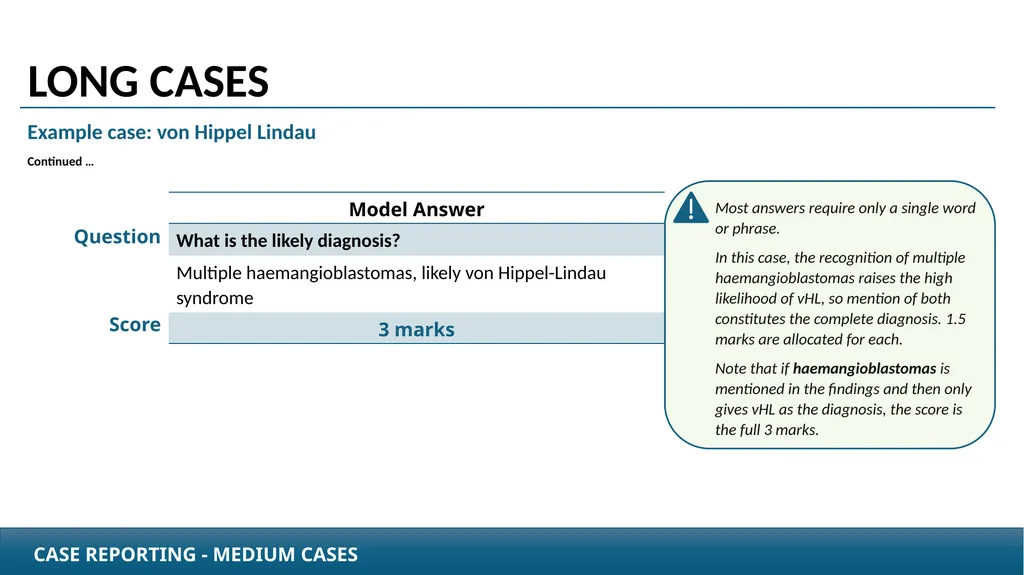
Continued … CASE REPORTING - MEDIUM CASES Score Question LONG CASES Most answers require only a single word or phrase.
In this case, the recognition of multiple haemangioblastomas raises the high likelihood of vHL, so mention of both constitutes the complete diagnosis. 1.5 marks are allocated for each.
Note that if haemangioblastomas is mentioned in the findings and then only gives vHL as the diagnosis, the score is the full 3 marks.<br>
slide20. Example case: von Hippel Lindau
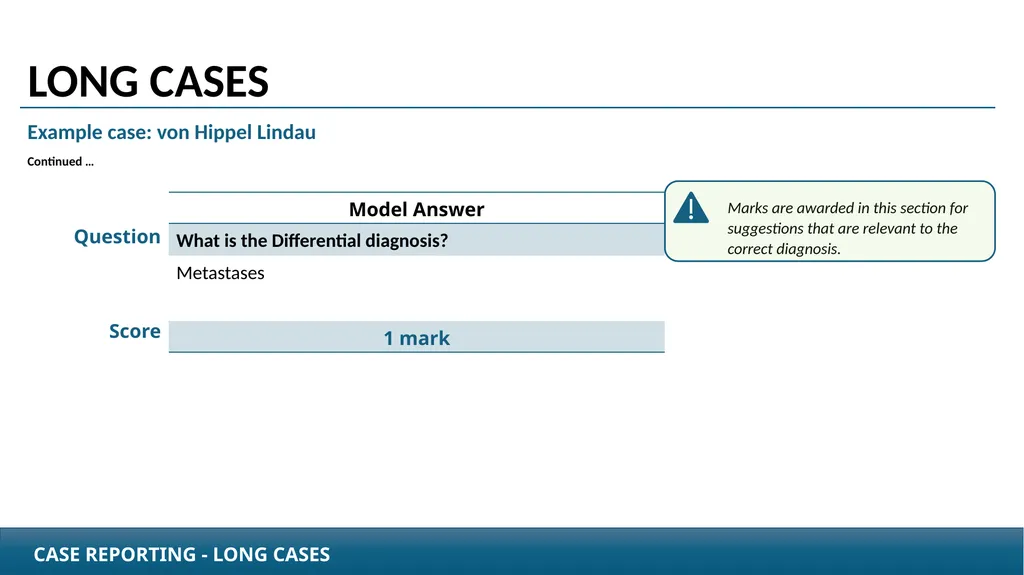
Continued … CASE REPORTING - LONG CASES Score Question LONG CASES Marks are awarded in this section for suggestions that are relevant to the correct diagnosis.<br>
slide21. Example case: von Hippel Lindau
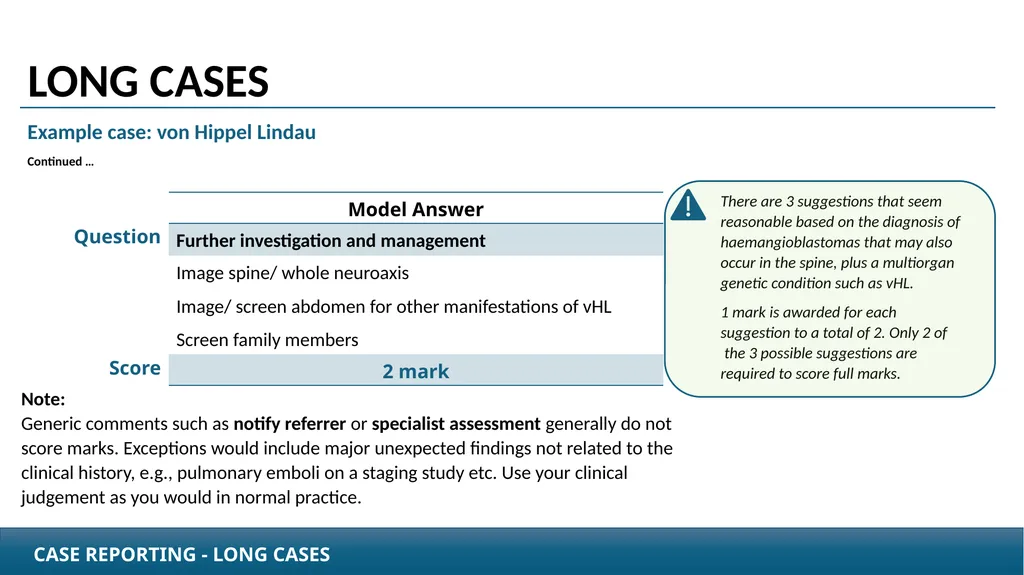
Continued … CASE REPORTING - LONG CASES Score Question LONG CASES There are 3 suggestions that seem reasonable based on the diagnosis of haemangioblastomas that may also occur in the spine, plus a multiorgan genetic condition such as vHL.
1 mark is awarded for each suggestion to a total of 2. Only 2 of the 3 possible suggestions are required to score full marks. Note:Generic comments such as notify referrer or specialist assessment generally do not score marks. Exceptions would include major unexpected findings not related to the clinical history, e.g., pulmonary emboli on a staging study etc. Use your clinical judgement as you would in normal practice.<br>
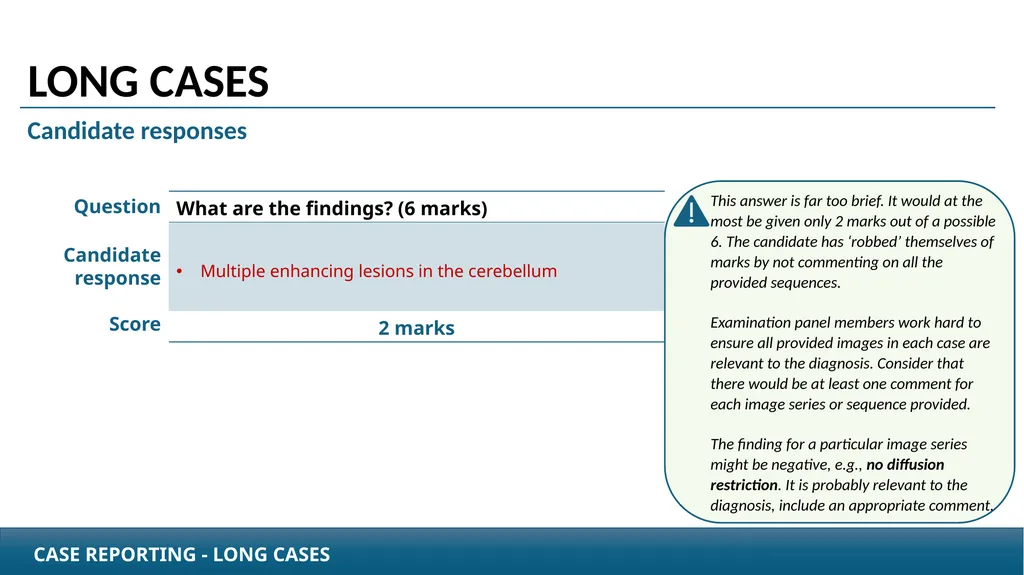
slide22. Candidate responses CASE REPORTING - LONG CASES Score Question LONG CASES Candidate response This answer is far too brief. It would at the most be given only 2 marks out of a possible 6. The candidate has ‘robbed’ themselves of marks by not commenting on all the provided sequences.
Examination panel members work hard to ensure all provided images in each case are relevant to the diagnosis. Consider that there would be at least one comment for each image series or sequence provided.
The finding for a particular image series might be negative, e.g., no diffusion restriction. It is probably relevant to the diagnosis, include an appropriate comment.<br>
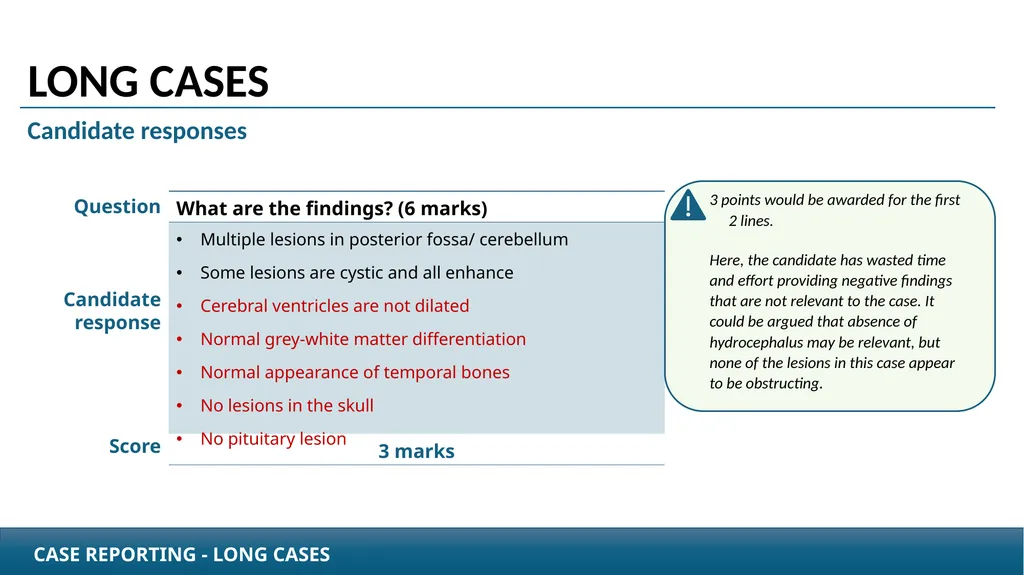
slide23. Candidate responses CASE REPORTING - LONG CASES Score Question LONG CASES Candidate response 3 points would be awarded for the first 2 lines.
Here, the candidate has wasted time and effort providing negative findings that are not relevant to the case. It could be argued that absence of hydrocephalus may be relevant, but none of the lesions in this case appear to be obstructing.<br>
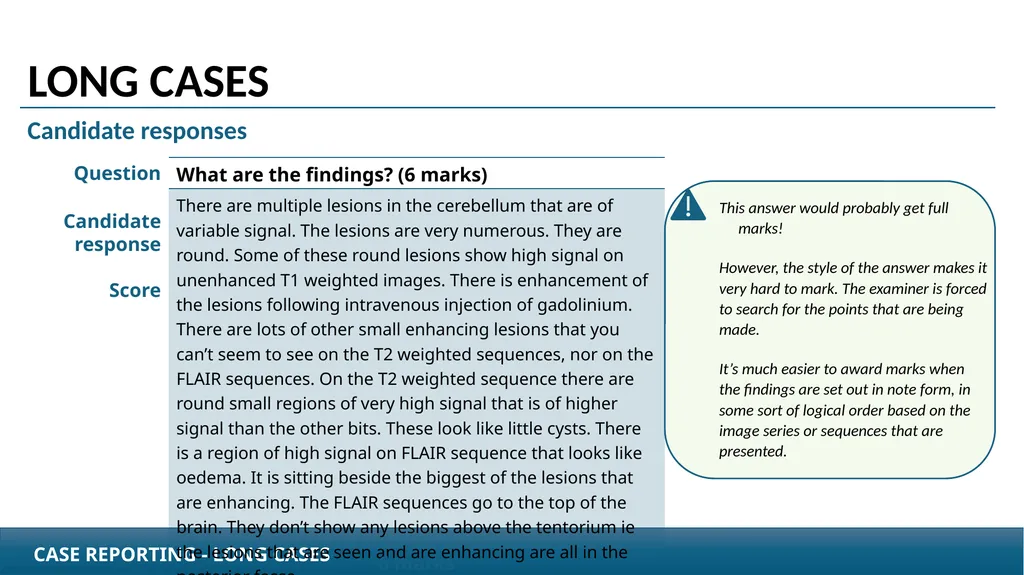
slide24. Candidate responses CASE REPORTING - LONG CASES Score Question LONG CASES Candidate response This answer would probably get full marks!
However, the style of the answer makes it very hard to mark. The examiner is forced to search for the points that are being made.
It’s much easier to award marks when the findings are set out in note form, in some sort of logical order based on the image series or sequences that are presented.<br>
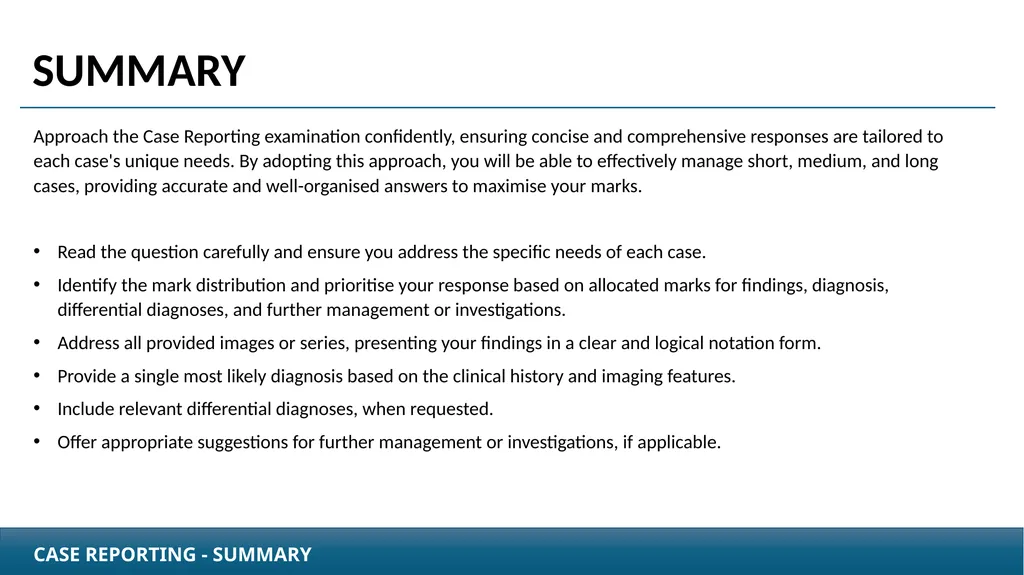
slide25. SUMMARY CASE REPORTING - SUMMARY Approach the Case Reporting examination confidently, ensuring concise and comprehensive responses are tailored to each case's unique needs. By adopting this approach, you will be able to effectively manage short, medium, and long cases, providing accurate and well-organised answers to maximise your marks.
Read the question carefully and ensure you address the specific needs of each case.
Identify the mark distribution and prioritise your response based on allocated marks for findings, diagnosis, differential diagnoses, and further management or investigations.
Address all provided images or series, presenting your findings in a clear and logical notation form.
Provide a single most likely diagnosis based on the clinical history and imaging features.
Include relevant differential diagnoses, when requested.
Offer appropriate suggestions for further management or investigations, if applicable.<br>

slide2. Introduction This presentation is to equip candidates with a greater understanding of strategies and approaches needed to successfully tackle Case Reporting examination questions.
Understanding and following question guidelines is essential for different types of cases as it helps you provide accurate and clear answers that meet each case's specific needs while helping you score well on exams. CASE REPORTING - INTRODUCTION<br>
slide3. Case Reporting Examination
A three-hour examination to assess competencies in perception, interpretation, diagnosis and communication via the written report. CASE REPORTING EXAMINATION<br>
slide4. SHORT CASES
Simply provide a single, most likely diagnosis based on the given provided and imaging features. CASE REPORTING - SHORT CASES<br>
slide5. SHORT CASES CASE REPORTING - SHORT CASES Strategy<br>
slide6. SHORT CASES CASE REPORTING - SHORT CASES Marks
Answers can range between 0 and 3 marks<br>
slide7. Poor technique
Example 1 - Including a differential diagnosis when none is required. CASE REPORTING - SHORT CASES Score Question SHORT CASES Candidate response<br>
slide8. Poor technique
Example 2 - Including findings when none are required. CASE REPORTING - SHORT CASES Score Question SHORT CASES Candidate response Although the provision of extra information does not attract negative marking, it is a waste of the candidate’s time.
Notes such as this (in red) are ignored by the examiner.<br>
slide9. MEDIUM CASES
Consist of clinical history and up to three single images or short series. Marks are allocated for findings, diagnosis, and only occasional differential diagnoses. CASE REPORTING - MEDIUM CASES<br>
slide10. MEDIUM CASES CASE REPORTING - MEDIUM CASES Strategy<br>
slide11. MEDIUM CASES CASE REPORTING - MEDIUM CASES Marks
Generally, there will be 4 marks for findings and 2 for most likely diagnosis.<br>
slide12. Example 1 - Colloid cyst of the 3rd ventricle
In this case two short sets of MR images are provided: sagittal T1 and axial T2 CASE REPORTING - MEDIUM CASES Score Question MEDIUM CASES In this case of a colloid cyst, the absence of hydrocephalus is a relevant negative and scores a mark.
There are no marks awarded for irrelevant negative findings.<br>
slide13. Poor candidate response
Example case: Colloid cyst of the 3rd ventricle CASE REPORTING - MEDIUM CASES Score Question MEDIUM CASES Candidate response This response only received 3 marks.
The candidate has wasted their time. They have also made the examiner’s task much harder as they are forced to search for features that attract marks amongst a lot of irrelevant material.<br>
slide14. CASE REPORTING - MEDIUM CASES MEDIUM CASES Be mindful of how long you take on each question.
Extra text was added (in red) to these responses that wasn’t even included in the marking.
Use your time wisely!<br>
slide15. LONG CASES
Long cases will likely include all four answer categories of findings, likely diagnosis, differential diagnosis, and further investigation and management. There may be up to three modalities. CASE REPORTING - LONG CASES<br>
slide16. LONG CASES CASE REPORTING - LONG CASES Strategy<br>
slide17. LONG CASES CASE REPORTING - LONG CASES Marks
Generally, there will be 6-9 marks for findings, 2-3 marks for most likely diagnosis, 1-2 marks for differential diagnosis, and 1-2 marks for further management and investigation.<br>
slide18. Example case: von Hippel Lindau CASE REPORTING - LONG CASES Score Question LONG CASES The findings are written in note form, which makes marking much easier.
Only relevant findings are provided.
No irrelevant negative findings are included
The answer references all the provided sequences. History given : A 35-year-old female with a long history of mild headache and more recent onset of mild ataxia.Imaging provided: MR head T2 axial: 12 images, MR head FLAIR axial: 12 images, MR head T1 axial: 12 images and MR head T1-Gd axial: 12 images<br>
slide19. Example case: von Hippel Lindau
Continued … CASE REPORTING - MEDIUM CASES Score Question LONG CASES Most answers require only a single word or phrase.
In this case, the recognition of multiple haemangioblastomas raises the high likelihood of vHL, so mention of both constitutes the complete diagnosis. 1.5 marks are allocated for each.
Note that if haemangioblastomas is mentioned in the findings and then only gives vHL as the diagnosis, the score is the full 3 marks.<br>
slide20. Example case: von Hippel Lindau
Continued … CASE REPORTING - LONG CASES Score Question LONG CASES Marks are awarded in this section for suggestions that are relevant to the correct diagnosis.<br>
slide21. Example case: von Hippel Lindau
Continued … CASE REPORTING - LONG CASES Score Question LONG CASES There are 3 suggestions that seem reasonable based on the diagnosis of haemangioblastomas that may also occur in the spine, plus a multiorgan genetic condition such as vHL.
1 mark is awarded for each suggestion to a total of 2. Only 2 of the 3 possible suggestions are required to score full marks. Note:Generic comments such as notify referrer or specialist assessment generally do not score marks. Exceptions would include major unexpected findings not related to the clinical history, e.g., pulmonary emboli on a staging study etc. Use your clinical judgement as you would in normal practice.<br>
slide22. Candidate responses CASE REPORTING - LONG CASES Score Question LONG CASES Candidate response This answer is far too brief. It would at the most be given only 2 marks out of a possible 6. The candidate has ‘robbed’ themselves of marks by not commenting on all the provided sequences.
Examination panel members work hard to ensure all provided images in each case are relevant to the diagnosis. Consider that there would be at least one comment for each image series or sequence provided.
The finding for a particular image series might be negative, e.g., no diffusion restriction. It is probably relevant to the diagnosis, include an appropriate comment.<br>
slide23. Candidate responses CASE REPORTING - LONG CASES Score Question LONG CASES Candidate response 3 points would be awarded for the first 2 lines.
Here, the candidate has wasted time and effort providing negative findings that are not relevant to the case. It could be argued that absence of hydrocephalus may be relevant, but none of the lesions in this case appear to be obstructing.<br>
slide24. Candidate responses CASE REPORTING - LONG CASES Score Question LONG CASES Candidate response This answer would probably get full marks!
However, the style of the answer makes it very hard to mark. The examiner is forced to search for the points that are being made.
It’s much easier to award marks when the findings are set out in note form, in some sort of logical order based on the image series or sequences that are presented.<br>
slide25. SUMMARY CASE REPORTING - SUMMARY Approach the Case Reporting examination confidently, ensuring concise and comprehensive responses are tailored to each case's unique needs. By adopting this approach, you will be able to effectively manage short, medium, and long cases, providing accurate and well-organised answers to maximise your marks.
Read the question carefully and ensure you address the specific needs of each case.
Identify the mark distribution and prioritise your response based on allocated marks for findings, diagnosis, differential diagnoses, and further management or investigations.
Address all provided images or series, presenting your findings in a clear and logical notation form.
Provide a single most likely diagnosis based on the clinical history and imaging features.
Include relevant differential diagnoses, when requested.
Offer appropriate suggestions for further management or investigations, if applicable.<br>