
CASE STUDY Arctic Cold Environments Environment &


Description: CASE STUDY Arctic Cold Environments Environment Empire A-Level Geography The Arctic is a polar region at the north of the Earth It includes territory that is part of the following countries: United States, Canada, Denmark, Sweden,
Related Topics
Download Presentation
"CASE STUDY Arctic Cold Environments Environment &" is the property of its rightful owner. Permission is granted to download and print the materials on this website for personal, non-commercial use only, and to display it on your personal computer provided you do not modify the materials and that you retain all copyright notices contained in the materials. By downloading content from our website, you accept the terms of this agreement.
Presentation Transcript
slide1. CASE STUDY
Arctic Cold Environments Environment & Empire
A-Level Geography<br>
slide2. The Arctic is a polar region at the north of the Earth
It includes territory that is part of the following countries:
United States, Canada, Denmark, Sweden, Iceland, Finland, Norway, and Russia
The Arctic is a cold environment which features:
Snow and ice cover
Permafrost
Sea ice
Glaciers
The average winter temperature in the Arctic is −40° C The Arctic Region Map of the Arctic. USGS. Public Domain.<br>
slide3. The Arctic is home to around 4 million people.
Of those, there are around 400,000 Indigenous people living in the Arctic today.
Indigenous people are the descendants of the original inhabitants of the region.
These include the Inuit, Chukchi, Yupik, Sami, Evenks, Yakuts, Aleut, Nenets, and other groups. People in the Arctic Map of Indigenous communities in the Arctic. Wikimedia.<br>
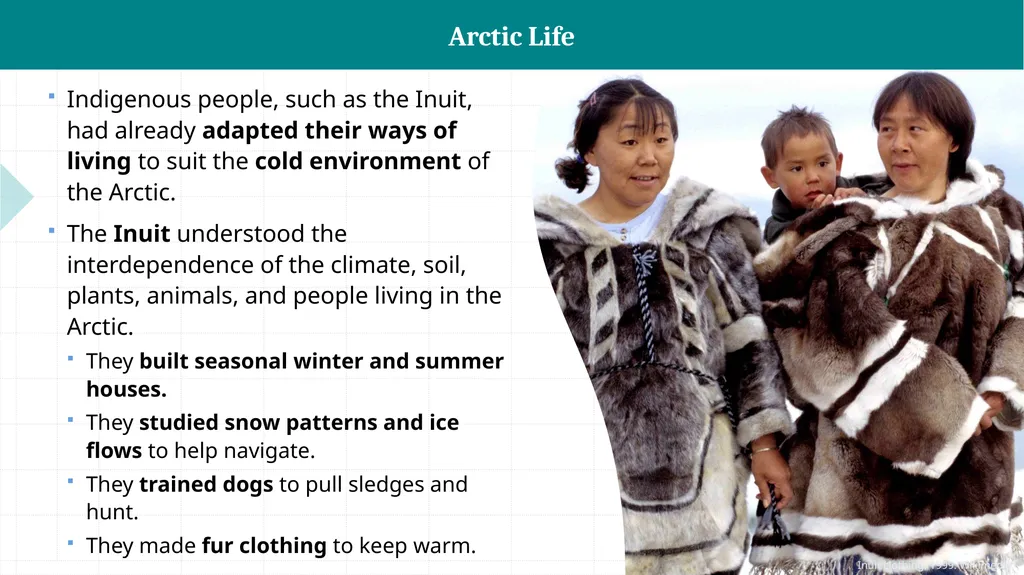
slide4. Indigenous people, such as the Inuit, had already adapted their ways of living to suit the cold environment of the Arctic.
The Inuit understood the interdependence of the climate, soil, plants, animals, and people living in the Arctic.
They built seasonal winter and summer houses.
They studied snow patterns and ice flows to help navigate.
They trained dogs to pull sledges and hunt.
They made fur clothing to keep warm.
European explorers relied on Indigenous people in order to navigate and survive in the Arctic. Inuit clothing, 1999. Wikimedia Arctic Life<br>
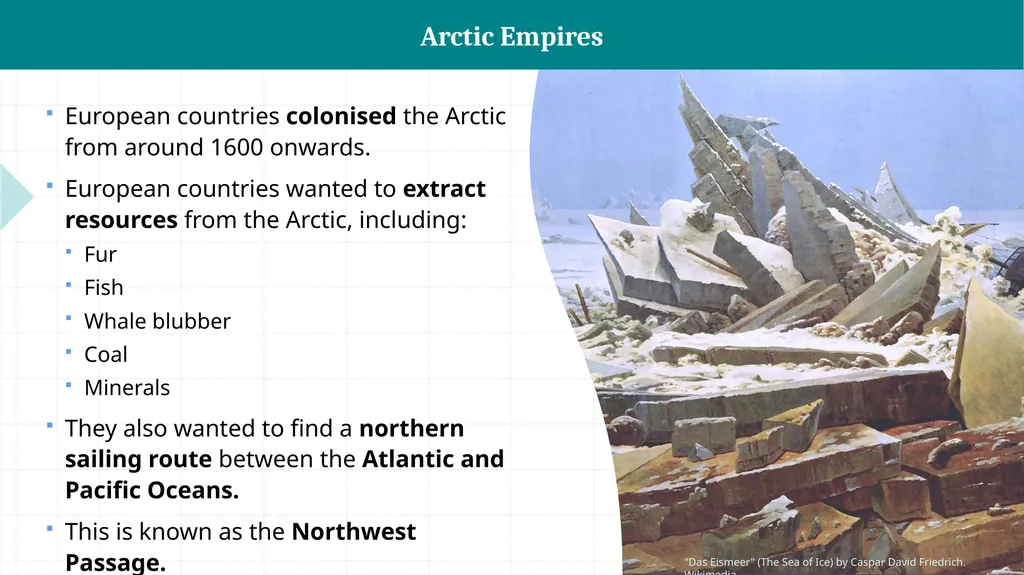
slide5. European countries colonised the Arctic from around 1600 onwards.
European countries wanted to extract resources from the Arctic, including:
Fur
Fish
Whale blubber
Coal
Minerals
They also wanted to find a northern sailing route between the Atlantic and Pacific Oceans.
This is known as the Northwest Passage. "Das Eismeer" (The Sea of Ice) by Caspar David Friedrich. Wikimedia. Arctic Empires<br>
slide6. Today, the Arctic is seen as a development opportunity.
European and North American countries still want to extract resources from the Arctic.
This includes fish, coal, minerals, and oil.
However, the Arctic is also under threat of climate change and overdevelopment.
Indigenous people are rarely properly consulted on development.
Indigenous people rarely benefit from development.
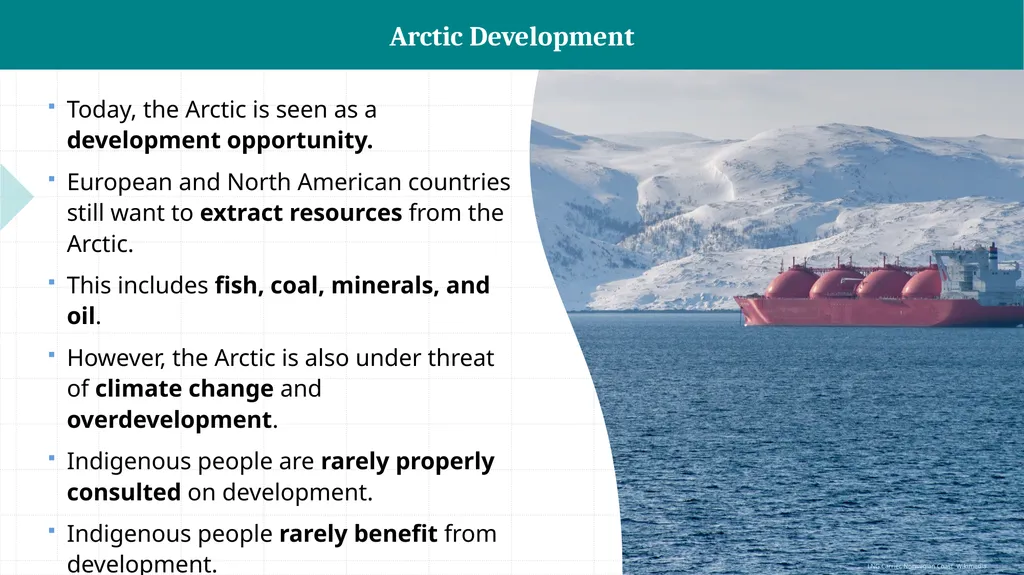
Is this a continuation of colonialism? LNG Carrier, Norwegian Coast. Wikimedia Arctic Development<br>
slide7. Today, Indigenous people continue to play a significant role in developing our understanding of the Arctic.
They monitor and record the effects of climate change and development on the Arctic.
They propose alternative solutions, based on traditional Indigenous knowledge, to climate change and development in the Arctic.
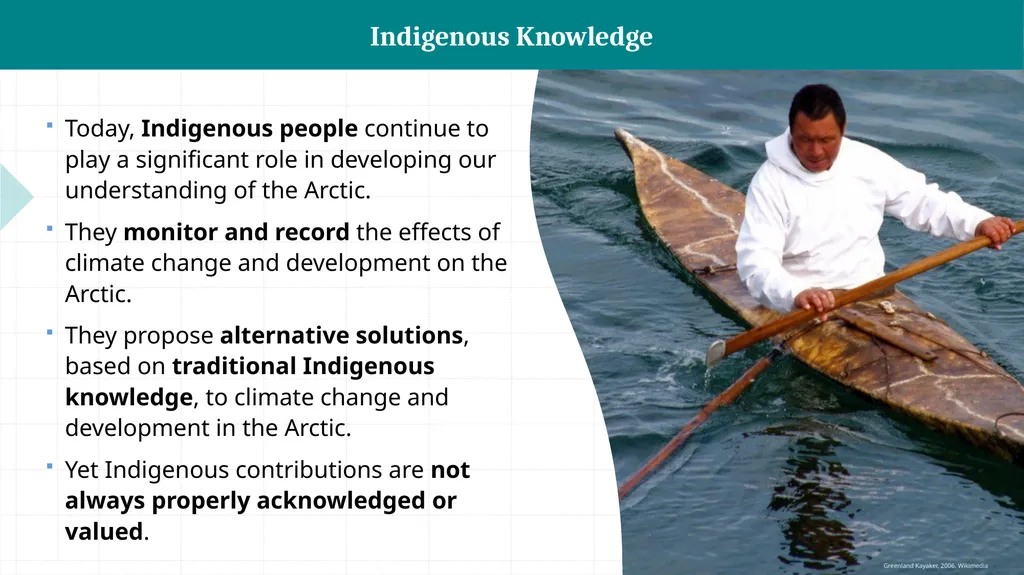
Yet Indigenous contributions are not always properly acknowledged or valued. Greenland Kayaker, 2006. Wikimedia Indigenous Knowledge<br>
slide8. LNG Carrier, Norwegian Coast. Wikimedia<br>
slide9. Born into a Chukchi family in Siberia around 1730.
Captured by a Russian explorer as a boy.
Trained at the Irkutsk Navigational School in Siberia.
Surveyed the Bering Strait in the 1760s.
Worked as a navigator for Russian navy.
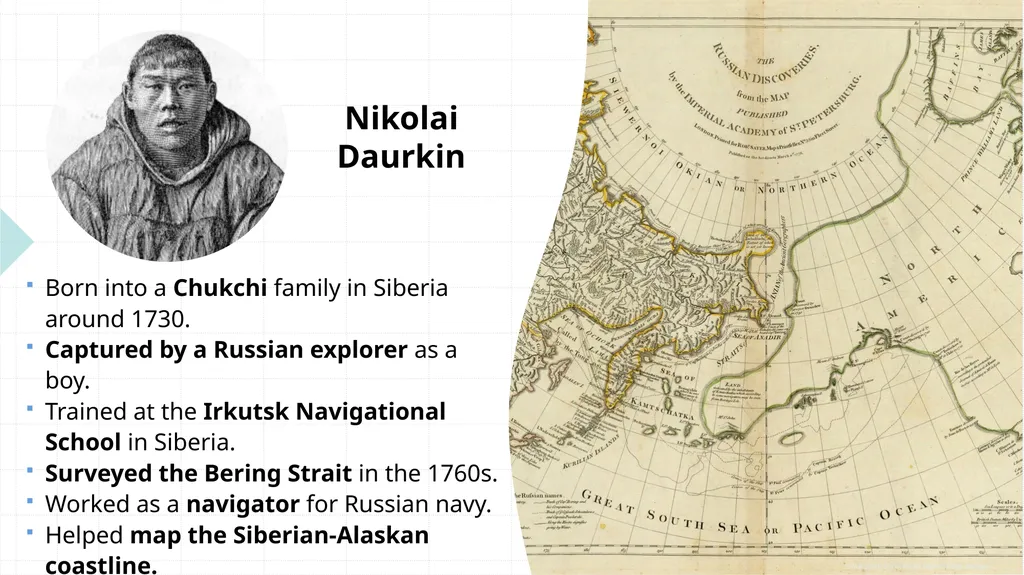
Helped map the Siberian-Alaskan coastline. Nikolai Daurkin ”Great South Sea or Pacific Ocean”. Public Domain.<br>
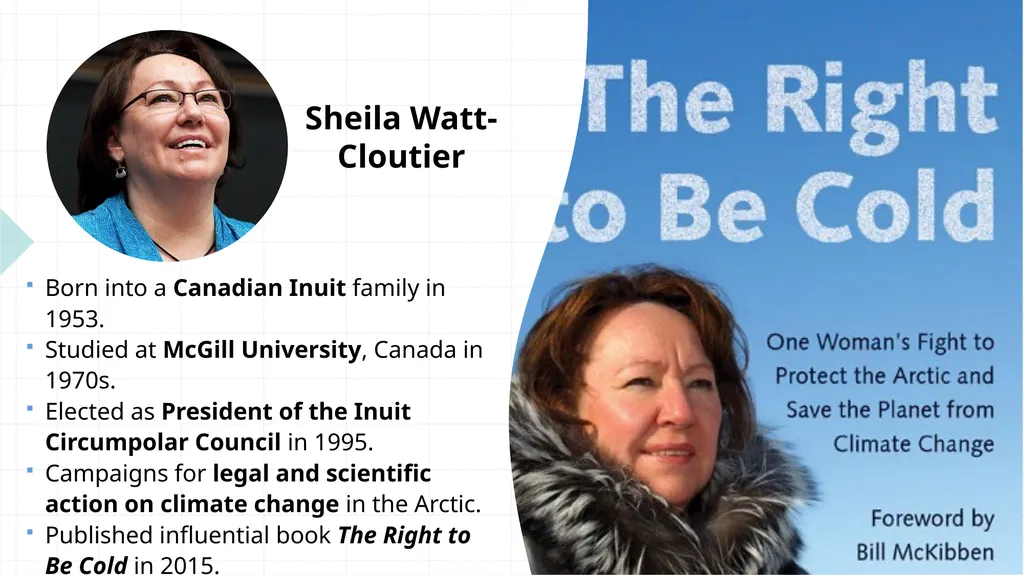
slide10. Born into a Canadian Inuit family in 1953.
Studied at McGill University, Canada in 1970s.
Elected as President of the Inuit Circumpolar Council in 1995.
Campaigns for legal and scientific action on climate change in the Arctic.
Published influential book The Right to Be Cold in 2015. Sheila Watt-Cloutier<br>
Arctic Cold Environments Environment & Empire
A-Level Geography<br>
slide2. The Arctic is a polar region at the north of the Earth
It includes territory that is part of the following countries:
United States, Canada, Denmark, Sweden, Iceland, Finland, Norway, and Russia
The Arctic is a cold environment which features:
Snow and ice cover
Permafrost
Sea ice
Glaciers
The average winter temperature in the Arctic is −40° C The Arctic Region Map of the Arctic. USGS. Public Domain.<br>
slide3. The Arctic is home to around 4 million people.
Of those, there are around 400,000 Indigenous people living in the Arctic today.
Indigenous people are the descendants of the original inhabitants of the region.
These include the Inuit, Chukchi, Yupik, Sami, Evenks, Yakuts, Aleut, Nenets, and other groups. People in the Arctic Map of Indigenous communities in the Arctic. Wikimedia.<br>
slide4. Indigenous people, such as the Inuit, had already adapted their ways of living to suit the cold environment of the Arctic.
The Inuit understood the interdependence of the climate, soil, plants, animals, and people living in the Arctic.
They built seasonal winter and summer houses.
They studied snow patterns and ice flows to help navigate.
They trained dogs to pull sledges and hunt.
They made fur clothing to keep warm.
European explorers relied on Indigenous people in order to navigate and survive in the Arctic. Inuit clothing, 1999. Wikimedia Arctic Life<br>
slide5. European countries colonised the Arctic from around 1600 onwards.
European countries wanted to extract resources from the Arctic, including:
Fur
Fish
Whale blubber
Coal
Minerals
They also wanted to find a northern sailing route between the Atlantic and Pacific Oceans.
This is known as the Northwest Passage. "Das Eismeer" (The Sea of Ice) by Caspar David Friedrich. Wikimedia. Arctic Empires<br>
slide6. Today, the Arctic is seen as a development opportunity.
European and North American countries still want to extract resources from the Arctic.
This includes fish, coal, minerals, and oil.
However, the Arctic is also under threat of climate change and overdevelopment.
Indigenous people are rarely properly consulted on development.
Indigenous people rarely benefit from development.
Is this a continuation of colonialism? LNG Carrier, Norwegian Coast. Wikimedia Arctic Development<br>
slide7. Today, Indigenous people continue to play a significant role in developing our understanding of the Arctic.
They monitor and record the effects of climate change and development on the Arctic.
They propose alternative solutions, based on traditional Indigenous knowledge, to climate change and development in the Arctic.
Yet Indigenous contributions are not always properly acknowledged or valued. Greenland Kayaker, 2006. Wikimedia Indigenous Knowledge<br>
slide8. LNG Carrier, Norwegian Coast. Wikimedia<br>
slide9. Born into a Chukchi family in Siberia around 1730.
Captured by a Russian explorer as a boy.
Trained at the Irkutsk Navigational School in Siberia.
Surveyed the Bering Strait in the 1760s.
Worked as a navigator for Russian navy.
Helped map the Siberian-Alaskan coastline. Nikolai Daurkin ”Great South Sea or Pacific Ocean”. Public Domain.<br>
slide10. Born into a Canadian Inuit family in 1953.
Studied at McGill University, Canada in 1970s.
Elected as President of the Inuit Circumpolar Council in 1995.
Campaigns for legal and scientific action on climate change in the Arctic.
Published influential book The Right to Be Cold in 2015. Sheila Watt-Cloutier<br>