
Case Study Method A case study is a detailed study
LO
Published · 11 slides · 0 views

1 / 1

Description
Case Study Method A case study is a detailed study of a specific subject, such as a person, group, place, event, organization, or phenomenon. Case studies are commonly used in social, educational, clinical, and business research. A case
Related Topics
Share
Embed code
Download this presentation From Below
"Case Study Method A case study is a detailed study" is the property of its rightful owner. Permission is granted to download and print the materials on this website for personal, non-commercial use only, and to display it on your personal computer provided you do not modify the materials and that you retain all copyright notices contained in the materials. By downloading content from our website, you accept the terms of this agreement.
Presentation Transcript
01
Case Study Method<br>
02
A case study is a detailed study of a specific subject, such as a person, group, place, event, organization, or phenomenon. Case studies are commonly used in social, educational, clinical, and business research.
A case study research design usually involves qualitative methods, but quantitative methods are sometimes also used. Case studies are good for describing, comparing, evaluating and understanding different aspects of a research problem.<br>
A case study research design usually involves qualitative methods, but quantitative methods are sometimes also used. Case studies are good for describing, comparing, evaluating and understanding different aspects of a research problem.<br>
03
When to do a case study? A case study is an appropriate research design when you want to gain concrete, contextual, in-depth knowledge about a specific real-world subject. It allows you to explore the key characteristics, meanings, and implications of the case.
Case studies are often a good choice in a thesis or dissertation. They keep your project focused and manageable when you don’t have the time or resources to do large-scale research.
You might use just one complex case study where you explore a single subject in depth, or conduct multiple case studies to compare and illuminate different aspects of your research problem.<br>
Case studies are often a good choice in a thesis or dissertation. They keep your project focused and manageable when you don’t have the time or resources to do large-scale research.
You might use just one complex case study where you explore a single subject in depth, or conduct multiple case studies to compare and illuminate different aspects of your research problem.<br>
04
Step 1: Select a case Once you have developed your problem statement and research questions, you should be ready to choose the specific case that you want to focus on. A good case study should have the potential to:
Provide new or unexpected insights into the subject
Challenge or complicate existing assumptions and theories
Propose practical courses of action to resolve a problem
Open up new directions for future research.
Unlike quantitative or experimental research, a strong case study does not require a random or representative sample. In fact, case studies often deliberately focus on unusual, neglected, or outlying cases which may shed new light on the research problem.
However, you can also choose a more common or representative case to exemplify a particular category, experience or phenomenon.<br>
Provide new or unexpected insights into the subject
Challenge or complicate existing assumptions and theories
Propose practical courses of action to resolve a problem
Open up new directions for future research.
Unlike quantitative or experimental research, a strong case study does not require a random or representative sample. In fact, case studies often deliberately focus on unusual, neglected, or outlying cases which may shed new light on the research problem.
However, you can also choose a more common or representative case to exemplify a particular category, experience or phenomenon.<br>
05
Step 2: Build a theoretical framework While case studies focus more on concrete details than general theories, they should usually have some connection with theory in the field. This way the case study is not just an isolated description, but is integrated into existing knowledge about the topic. It might aim to:
Exemplify a theory by showing how it explains the case under investigation
Expand on a theory by uncovering new concepts and ideas that need to be incorporated
Challenge a theory by exploring an outlier case that doesn’t fit with established assumptions
To ensure that your analysis of the case has a solid academic grounding, you should conduct a literature review of sources related to the topic and develop a theoretical framework. This means identifying key concepts and theories to guide your analysis and interpretation.<br>
Exemplify a theory by showing how it explains the case under investigation
Expand on a theory by uncovering new concepts and ideas that need to be incorporated
Challenge a theory by exploring an outlier case that doesn’t fit with established assumptions
To ensure that your analysis of the case has a solid academic grounding, you should conduct a literature review of sources related to the topic and develop a theoretical framework. This means identifying key concepts and theories to guide your analysis and interpretation.<br>
06
Step 3: Collect your data There are many different research methods you can use to collect data on your subject. Case studies tend to focus on qualitative data using methods such as interviews, observations, and analysis of primary and secondary sources (e.g., newspaper articles, photographs, official records). Sometimes a case study will also collect quantitative data.
The aim is to gain as thorough an understanding as possible of the case and its context.<br>
The aim is to gain as thorough an understanding as possible of the case and its context.<br>
07
Step 4: Describe and analyze the case In writing up the case study, you need to bring together all the relevant aspects to give as complete a picture as possible of the subject.
How you report your findings depends on the type of research you are doing. Some case studies are structured like a standard scientific paper or thesis, with separate sections or chapters for the methods, results and discussion.
Others are written in a more narrative style, aiming to explore the case from various angles and analyze its meanings and implications (for example, by using textual analysis or discourse analysis).In all cases, though, make sure to give contextual details about the case, connect it back to the literature and theory, and discuss how it fits into wider patterns or debates.<br>
How you report your findings depends on the type of research you are doing. Some case studies are structured like a standard scientific paper or thesis, with separate sections or chapters for the methods, results and discussion.
Others are written in a more narrative style, aiming to explore the case from various angles and analyze its meanings and implications (for example, by using textual analysis or discourse analysis).In all cases, though, make sure to give contextual details about the case, connect it back to the literature and theory, and discuss how it fits into wider patterns or debates.<br>
08
Characteristics of Case Study Case studies are characterized by several key features that distinguish them from other research methods. Here are some essential characteristics of case studies:
In-depth Exploration: Case studies involve a thorough and detailed examination of a specific case or instance. Researchers aim to explore the complexities and nuances of the subject under investigation, often using multiple data sources and methods to gather comprehensive information.
Contextual Analysis: Case studies emphasize the importance of understanding the context in which the case unfolds. Researchers seek to examine the unique circumstances, background, and environmental factors that contribute to the dynamics of the case. Contextual analysis is crucial for drawing meaningful conclusions and generalizing findings to similar situations.
Holistic Perspective: Rather than focusing on isolated variables, case studies take a holistic approach to studying a phenomenon. Researchers consider a wide range of factors and their interrelationships, aiming to capture the richness and complexity of the case. This holistic perspective helps in providing a more complete understanding of the subject.<br>
In-depth Exploration: Case studies involve a thorough and detailed examination of a specific case or instance. Researchers aim to explore the complexities and nuances of the subject under investigation, often using multiple data sources and methods to gather comprehensive information.
Contextual Analysis: Case studies emphasize the importance of understanding the context in which the case unfolds. Researchers seek to examine the unique circumstances, background, and environmental factors that contribute to the dynamics of the case. Contextual analysis is crucial for drawing meaningful conclusions and generalizing findings to similar situations.
Holistic Perspective: Rather than focusing on isolated variables, case studies take a holistic approach to studying a phenomenon. Researchers consider a wide range of factors and their interrelationships, aiming to capture the richness and complexity of the case. This holistic perspective helps in providing a more complete understanding of the subject.<br>
09
Qualitative and/or Quantitative Data: Case studies can incorporate both qualitative and quantitative data, depending on the research question and objectives. Qualitative data often include interviews, observations, and document analysis, while quantitative data may involve statistical measures or numerical information. The combination of these data types enhances the depth and validity of the study.
Longitudinal or Retrospective Design: Case studies can be designed as longitudinal studies, where the researcher follows the case over an extended period, or retrospective studies, where the focus is on examining past events. This temporal dimension allows researchers to capture changes and developments within the case.
Unique and Unpredictable Nature: Each case study is unique, and the findings may not be easily generalized to other situations. The unpredictable nature of real-world cases adds a layer of authenticity to the study, making it an effective method for exploring complex and dynamic phenomena.
Theory Building or Testing: Case studies can serve different purposes, including theory building or theory testing. In some cases, researchers use case studies to develop new theories or refine existing ones. In others, they may test existing theories by applying them to real-world situations and assessing their explanatory power.
Understanding these key characteristics is essential for researchers and practitioners using case studies as a methodological approach, as it helps guide the design, implementation, and analysis of the study.<br>
Longitudinal or Retrospective Design: Case studies can be designed as longitudinal studies, where the researcher follows the case over an extended period, or retrospective studies, where the focus is on examining past events. This temporal dimension allows researchers to capture changes and developments within the case.
Unique and Unpredictable Nature: Each case study is unique, and the findings may not be easily generalized to other situations. The unpredictable nature of real-world cases adds a layer of authenticity to the study, making it an effective method for exploring complex and dynamic phenomena.
Theory Building or Testing: Case studies can serve different purposes, including theory building or theory testing. In some cases, researchers use case studies to develop new theories or refine existing ones. In others, they may test existing theories by applying them to real-world situations and assessing their explanatory power.
Understanding these key characteristics is essential for researchers and practitioners using case studies as a methodological approach, as it helps guide the design, implementation, and analysis of the study.<br>
10
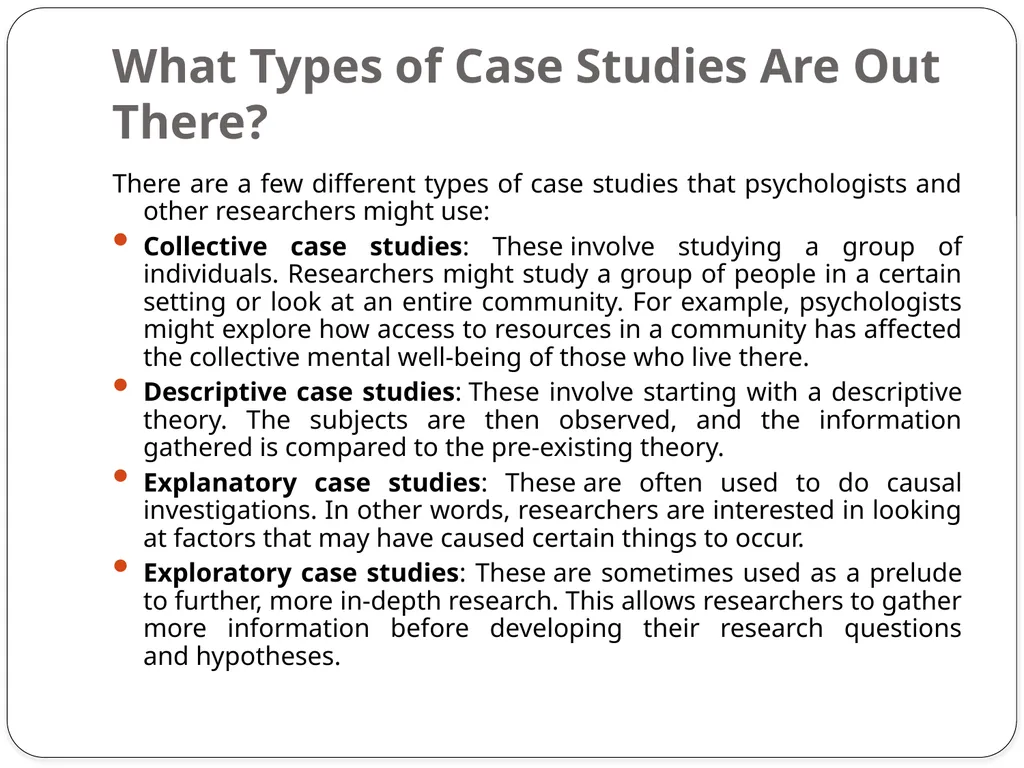
What Types of Case Studies Are Out There? There are a few different types of case studies that psychologists and other researchers might use:
Collective case studies: These involve studying a group of individuals. Researchers might study a group of people in a certain setting or look at an entire community. For example, psychologists might explore how access to resources in a community has affected the collective mental well-being of those who live there.
Descriptive case studies: These involve starting with a descriptive theory. The subjects are then observed, and the information gathered is compared to the pre-existing theory.
Explanatory case studies: These are often used to do causal investigations. In other words, researchers are interested in looking at factors that may have caused certain things to occur.
Exploratory case studies: These are sometimes used as a prelude to further, more in-depth research. This allows researchers to gather more information before developing their research questions and hypotheses.<br>
Collective case studies: These involve studying a group of individuals. Researchers might study a group of people in a certain setting or look at an entire community. For example, psychologists might explore how access to resources in a community has affected the collective mental well-being of those who live there.
Descriptive case studies: These involve starting with a descriptive theory. The subjects are then observed, and the information gathered is compared to the pre-existing theory.
Explanatory case studies: These are often used to do causal investigations. In other words, researchers are interested in looking at factors that may have caused certain things to occur.
Exploratory case studies: These are sometimes used as a prelude to further, more in-depth research. This allows researchers to gather more information before developing their research questions and hypotheses.<br>
11
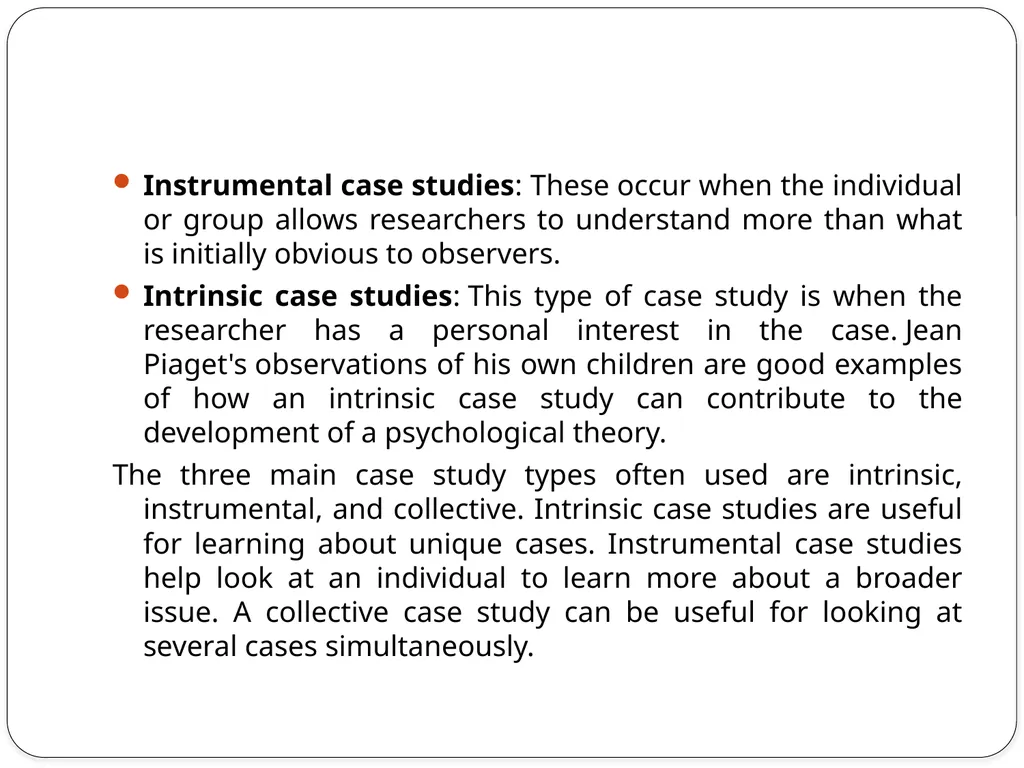
Instrumental case studies: These occur when the individual or group allows researchers to understand more than what is initially obvious to observers.
Intrinsic case studies: This type of case study is when the researcher has a personal interest in the case. Jean Piaget's observations of his own children are good examples of how an intrinsic case study can contribute to the development of a psychological theory.
The three main case study types often used are intrinsic, instrumental, and collective. Intrinsic case studies are useful for learning about unique cases. Instrumental case studies help look at an individual to learn more about a broader issue. A collective case study can be useful for looking at several cases simultaneously.<br>
Intrinsic case studies: This type of case study is when the researcher has a personal interest in the case. Jean Piaget's observations of his own children are good examples of how an intrinsic case study can contribute to the development of a psychological theory.
The three main case study types often used are intrinsic, instrumental, and collective. Intrinsic case studies are useful for learning about unique cases. Instrumental case studies help look at an individual to learn more about a broader issue. A collective case study can be useful for looking at several cases simultaneously.<br>