
Case Study Research and Ethnography DR. Rania






Description: Case Study Research and Ethnography DR. Rania AlBsoul 1 Announcements - Midterm Exam : 14th November 2019 (3-4 pm). Weight: 30 - Final Exam: 14th December 2019 (12:15-2:15 pm) Weight: 40 2 DISCUSSION Paper Title: How does accreditation
Related Topics
Download Presentation
"Case Study Research and Ethnography DR. Rania" is the property of its rightful owner. Permission is granted to download and print the materials on this website for personal, non-commercial use only, and to display it on your personal computer provided you do not modify the materials and that you retain all copyright notices contained in the materials. By downloading content from our website, you accept the terms of this agreement.
Presentation Transcript
slide1. Case Study Research and Ethnography DR. Rania AlBsoul 1<br>
slide2. Announcements - Midterm Exam : 14th November 2019 (3-4 pm). Weight: 30% - Final Exam: 14th December 2019 (12:15-2:15 pm) Weight: 40% 2<br>
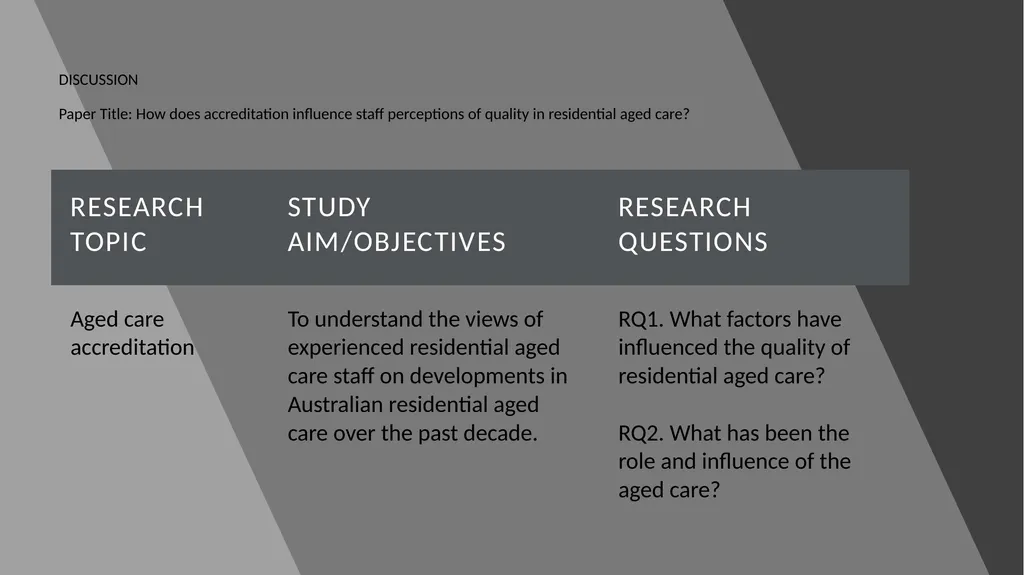
slide3. DISCUSSION Paper Title: How does accreditation influence staff perceptions of quality in residential aged care?<br>
slide4. Discussion Topics suggestions and examples of qualitative research questions.
Start thinking of your own topic!
What is the approach that best fit your research questions?
What are the data collection methods you need to address the research questions? 4<br>
slide5. Learning objectives After this lecture, you should be able to:
Understand the definition of case study.
Identify data collection methods in case study research.
Describe the steps of performing case study research.
Identify the limitations of case study research.
Describe the details of ethnographic research.
Understand the aim of ethnographic research. 5<br>
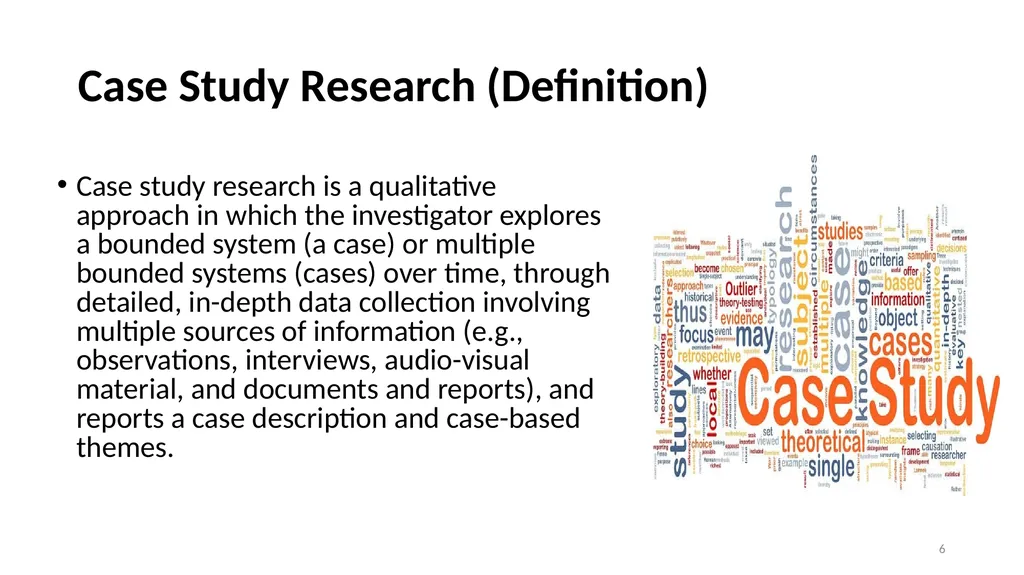
slide6. Case Study Research (Definition) Case study research is a qualitative approach in which the investigator explores a bounded system (a case) or multiple bounded systems (cases) over time, through detailed, in-depth data collection involving multiple sources of information (e.g., observations, interviews, audio-visual material, and documents and reports), and reports a case description and case-based themes. 6<br>
slide7. Background about case study Case studies have been long established in healthcare, medicine, anthropology, and psychology research.
Case study research is effective to investigate and understand complex issues in real world settings
The case usually describes a series of events that reflect the activity or problem as it happened.
Case can be individual, group, project, policy, institution, program or an anomaly. 7<br>
slide8. Background about case study research (continued) The power of case study research is the ability to use multiple sources and techniques for comprehensive depth and breadth of inquiry.
Case study research is not exclusively concerned with qualitative methods.
Document analysis, archival records, interviews, surveys and participant observation are considered the main data sources for case study research.
Triangulation 8<br>
slide9. Background about case study (continued) Statistical versus analytical generalisation.
The difference between case study and experiment. 9<br>
slide10. Background about case study (continued) Analytic generalisation is distinct from statistical generalisation
- It does not draw inferences from data to a population. Instead, analytic generalisation compares the results of a case study to a previously developed theory.
- In doing a case study, your goal will be to expand and generalize theories (analytic generalization) and not to enumerate frequencies (statistical generalization) (Yin, 2010).
- Research might produce analytical generalizability when a new concept or new theory is constructed that later makes sense and has significance in other research, even if the contexts or populations are different (Smith, 2018).
- The researcher might re-examine established concepts and theories in a study through a different methodology and, in turn, produce new conceptual and theoretical understandings of a topic. When that occurs, and the researcher or other researchers show the value of such concepts or theories in other research, then again it can be said that the work generates a form of analytical generalisation (Smith, 2018). 10<br>
slide11. Types of case study Exploratory: aims to explore and determine the purposes of any subsequent research.
Descriptive: aims to describe the phenomenon of interest.
Explanatory: aims to reveal cause–effect associations of the studied phenomena. 11<br>
slide12. How to perform a case study? Determine and define the research questions.
Select the cases and determine data-gathering and analysis techniques.
Prepare to collect data.
Collect data in the field.
Evaluate and analyse the data.
Prepare the report 12<br>
slide13. Step 1: Determine and Define the Research Questions The focus or intent is established once an intensive review of the relevant literature has been completed and the problem has been well identified.
The importance of framing your research direction in the form of questions is that you are then driven to consider your methods:
How would I answer those questions?
What information do I need?
how would I go about getting it? 13<br>
slide14. Step 1: Determine and Define the Research Questions (continued) Good research questions are those which will enable you to achieve your aim and which are capable of being answered in the research setting.
Broad aims often remain the same. What changes and evolves is the set of research questions. 14<br>
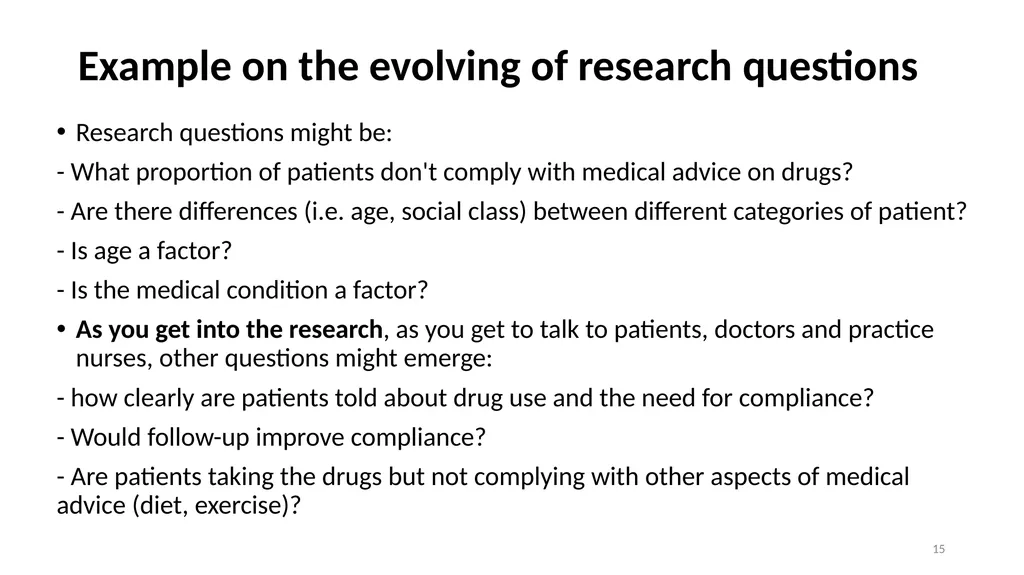
slide15. Example on the evolving of research questions Research questions might be:
- What proportion of patients don't comply with medical advice on drugs?
- Are there differences (i.e. age, social class) between different categories of patient?
- Is age a factor?
- Is the medical condition a factor?
As you get into the research, as you get to talk to patients, doctors and practice nurses, other questions might emerge:
- how clearly are patients told about drug use and the need for compliance?
- Would follow-up improve compliance?
- Are patients taking the drugs but not complying with other aspects of medical advice (diet, exercise)? 15<br>
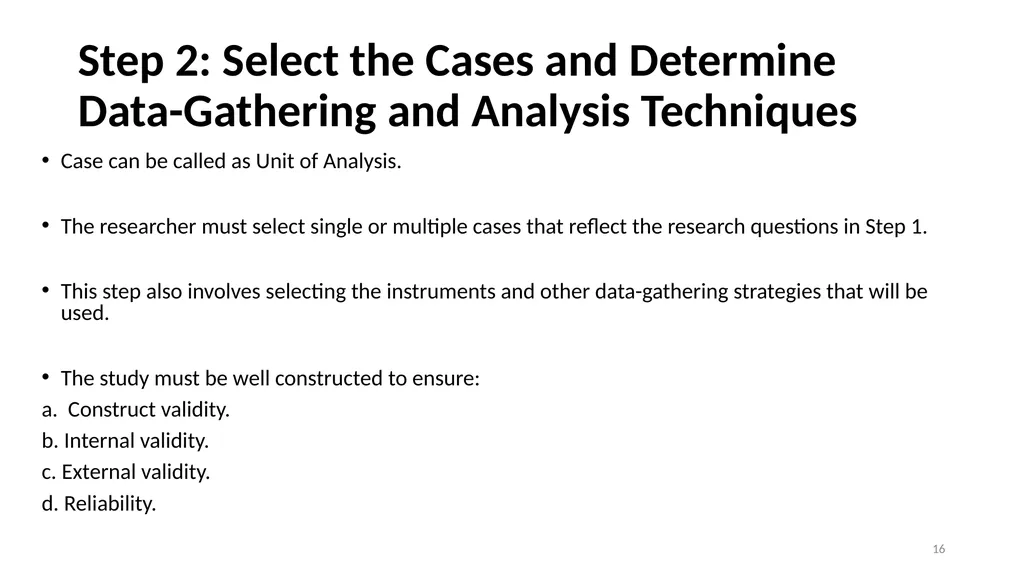
slide16. Step 2: Select the Cases and Determine Data-Gathering and Analysis Techniques Case can be called as Unit of Analysis.
The researcher must select single or multiple cases that reflect the research questions in Step 1.
This step also involves selecting the instruments and other data-gathering strategies that will be used.
The study must be well constructed to ensure:
a. Construct validity.
b. Internal validity.
c. External validity.
d. Reliability. 16<br>
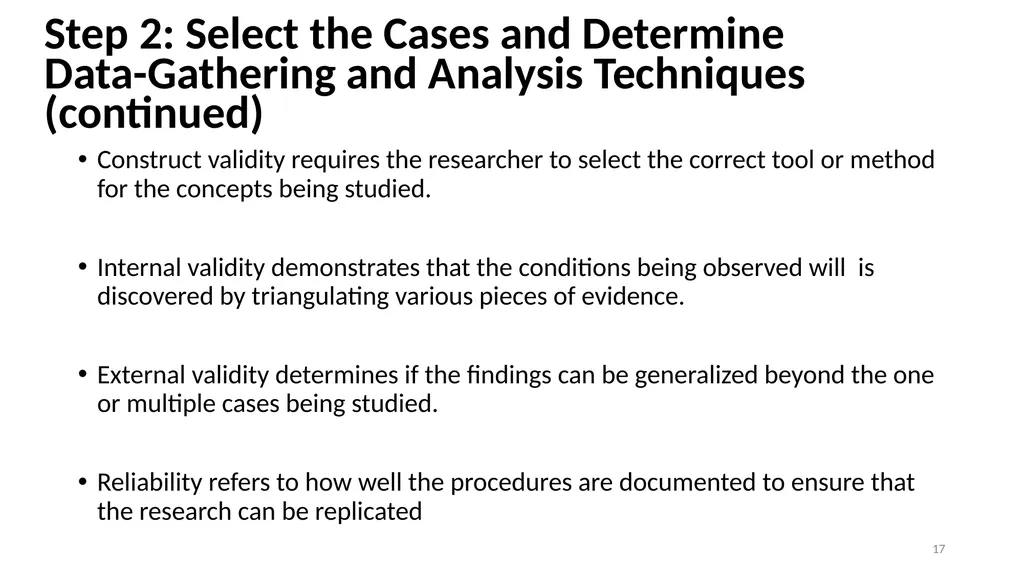
slide17. Step 2: Select the Cases and Determine Data-Gathering and Analysis Techniques (continued) Construct validity requires the researcher to select the correct tool or method for the concepts being studied.
Internal validity demonstrates that the conditions being observed will is discovered by triangulating various pieces of evidence.
External validity determines if the findings can be generalized beyond the one or multiple cases being studied.
Reliability refers to how well the procedures are documented to ensure that the research can be replicated 17<br>
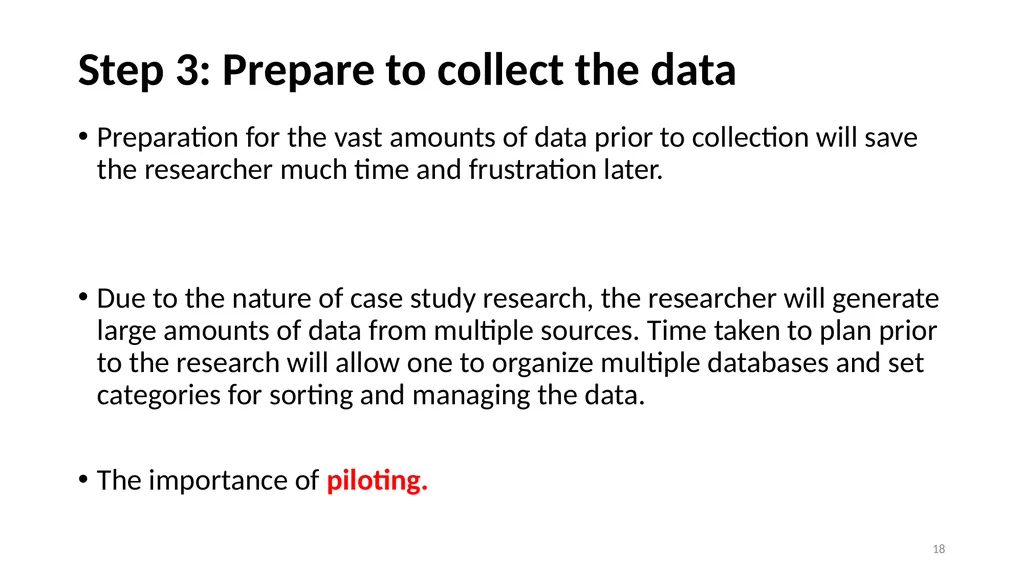
slide18. Step 3: Prepare to collect the data Preparation for the vast amounts of data prior to collection will save the researcher much time and frustration later.
Due to the nature of case study research, the researcher will generate large amounts of data from multiple sources. Time taken to plan prior to the research will allow one to organize multiple databases and set categories for sorting and managing the data.
The importance of piloting. 18<br>
slide19. Step 4: Collect data in the field Data collection is emergent.
The importance of field notes.
Time to end data collection (time and budgetary limitations). 19<br>
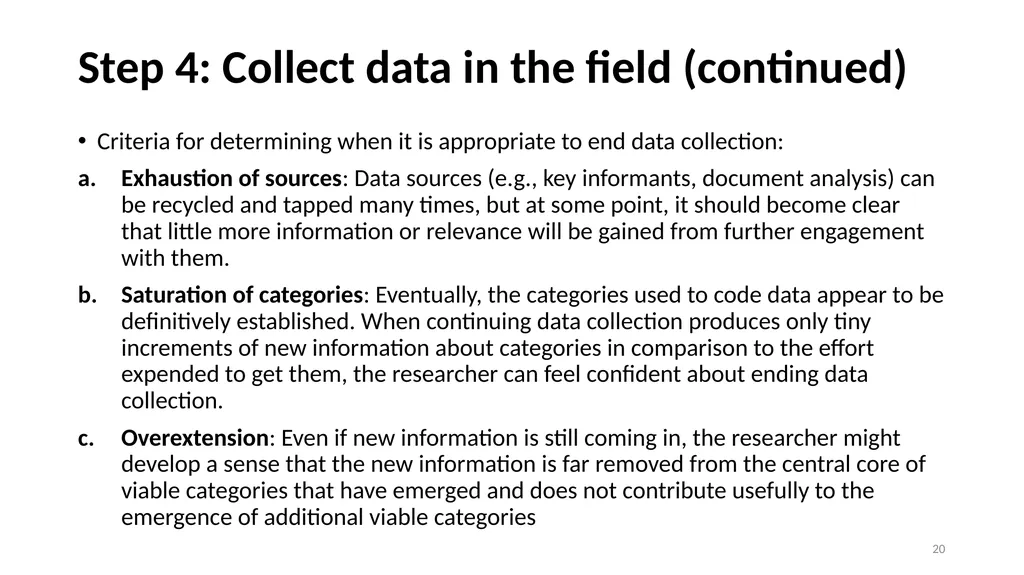
slide20. Step 4: Collect data in the field (continued) Criteria for determining when it is appropriate to end data collection:
Exhaustion of sources: Data sources (e.g., key informants, document analysis) can be recycled and tapped many times, but at some point, it should become clear that little more information or relevance will be gained from further engagement with them.
Saturation of categories: Eventually, the categories used to code data appear to be definitively established. When continuing data collection produces only tiny increments of new information about categories in comparison to the effort expended to get them, the researcher can feel confident about ending data collection.
Overextension: Even if new information is still coming in, the researcher might develop a sense that the new information is far removed from the central core of viable categories that have emerged and does not contribute usefully to the emergence of additional viable categories 20<br>
slide21. Step 5: Evaluate and Analyse the data Triangulation.
Structural versus reflective analysis.
- Researcher’s own reflections.
When multiple cases are chosen, a typical format is to first provide a detailed description of each case and themes within the case, called a within-case analysis followed by a thematic analysis across the cases, called a cross-case analysis. 21<br>
slide22. Step 6: Prepare the report Reflective reporting versus analytic reporting. 22<br>
slide23. Limitations of case study The large quantity of data, combined with the limited timeframe available for some researches may impact on the depth of analysis of the data within the available time and resources.
Deciding the "boundaries“ of a case-how it might be constrained in terms of time, events, and processes-may be challenging.
Large quantity of data may veer away from the research focus.
Providing little basis for generalisation (please see slide 10).
- Use large number of cases 23<br>
slide24. Further reading (Case study paper) A multiple-case study in nurse practitioner-led clinics: an exploration of the quality of care for patients with multimorbidity ( please read the methods section). 24<br>
slide25. Ethnography Ethno: people or folk; Graphy: describe something.
Ethnography: describing and understanding another way of life from the native point of view. 25<br>
slide26. Ethnography ( Please watch the video) 26 https://youtu.be/6lIzz3DlEWQ<br>
slide27. Ethnography (Definition) Ethnography is the study of social interactions, behaviours, and perceptions that occur within groups, teams, organisations, and communities.
The central aim of ethnography is to provide rich, holistic insights into people’s views and actions, as well as the nature of the location they inhabit, through the collection of detailed observations and interviews.
Typically, the studied group in ethnography is one that has been together for an extended period of time, so that their shared language, patterns of behaviour, and attitudes have merged into a discernible pattern. 27<br>
slide28. Ethnography ( continued) Through the collection of observations, interviews and documentary data, which are triangulated (i.e. compared and contrasted with one another).
Through its use of in situ observations ethnographers can ‘immerse’ themselves in a social setting, thereby generating a rich understanding of social action.
Participant observation also provides ethnographers an opportunity to gather empirical insights into social practices which are normally ‘hidden’ from the public gaze.
Ethnographer not only observes a social group, setting or subject matter, but engages in the participation actively with a general commitment to observing everyday social life. 28<br>
slide29. Ethnography ( continued) Ethnographic research is exploratory in nature. This approach means that the ethnographer goes into the field to explore a cultural group and/or explore certain social interactions.
Due to the complexity of ethnography, unlike many other forms of qualitative research, ethnographic research is more difficult to undertake.
The unpredictability of everyday life often means that data collection activities can be disrupted or access withdrawn depending on ever-changing local circumstances and politics. 29<br>
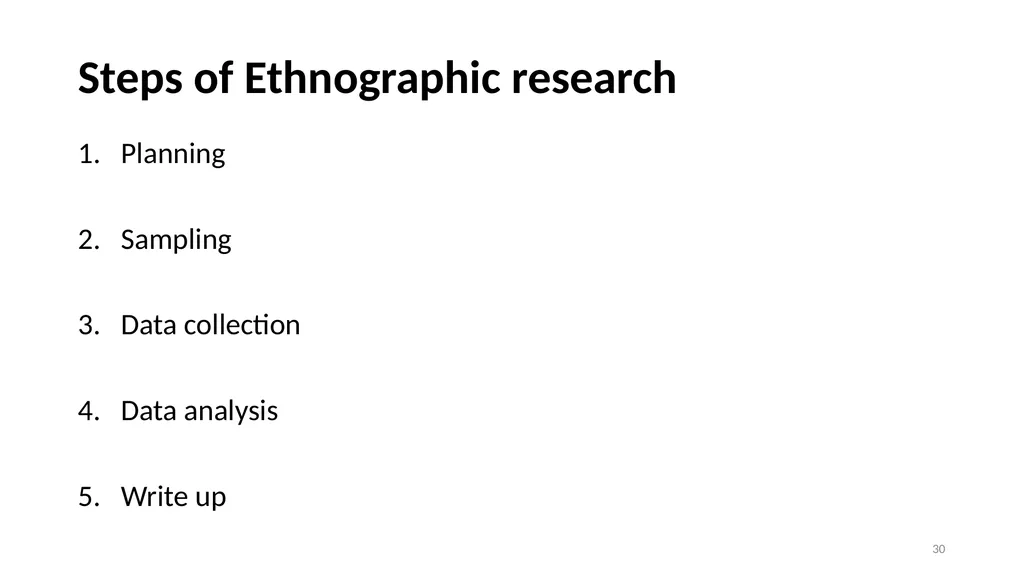
slide30. Steps of Ethnographic research Planning
Sampling
Data collection
Data analysis
Write up 30<br>
slide31. Step 1: Planning Access and ethics
- Attaining approval from the appropriate decision makers for access to a research setting is an essential first step in planning an ethnography.
- Attaining access may be challenging. For example, some people are often reluctant at the thought of being ‘scrutinised’ by researchers. 31<br>
slide32. Step 1: Planning (continued) Establish rapport.
Gatekeepers.
Ethical approvals
Ethical issues:
- Avoidance of harm.
- Informed consent.
- Privacy and confidentiality. 32<br>
slide33. Step 2: Sampling Sampling of the research setting is an important component of data collection.
Often, a single study site is selected, but multiple individuals, actions and activities embedded within this setting are selected to develop an insightful account of daily life. 33<br>
slide34. Step 3: Data collection Gather information where the group works and lives (Fieldwork).
Gathering the types of information typically needed in an ethnography involves going to the research site, respecting the daily lives of individuals at the site, and collecting a wide variety of materials. 34<br>
slide35. Step 3: Data collection (continued) Participant observation
- A field strategy that simultaneously combines document analysis, interviewing of respondents and informants, direct participation and observation, and introspection (reflection).
- Ethnographic fieldwork typically involves the development of close connections between the fieldworker and subjects and situations being studied
- However, the ethnographer carries a sense of objectivity towards participant observation whereby one can separate oneself from the group being studied.
- Other components of participant observation include the use of additional qualitative and quantitative methods.
- Several methods are commonly used as a component of participant observation and include in-depth interviews, life histories and document analysis. 35<br>
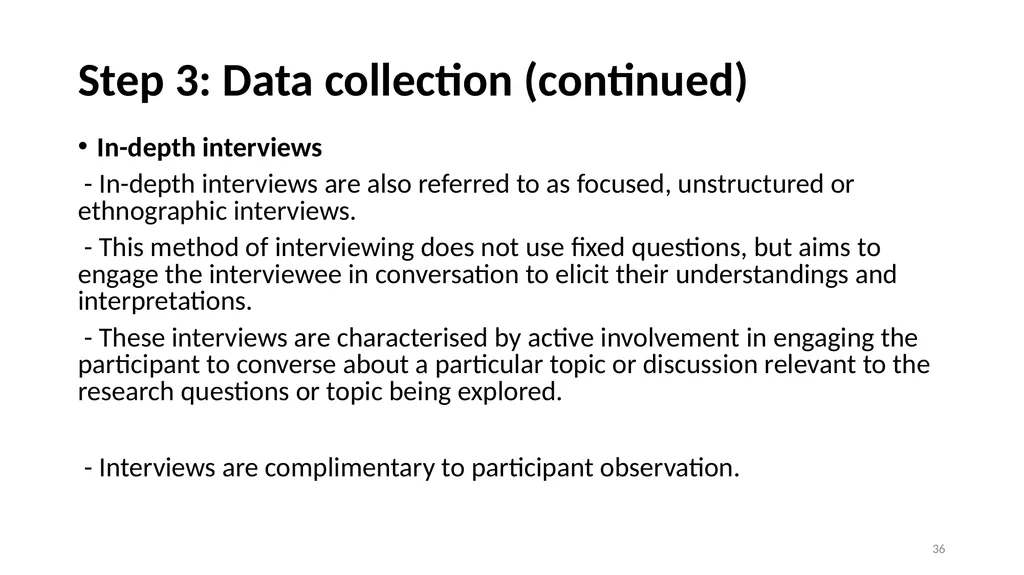
slide36. Step 3: Data collection (continued) In-depth interviews
- In-depth interviews are also referred to as focused, unstructured or ethnographic interviews.
- This method of interviewing does not use fixed questions, but aims to engage the interviewee in conversation to elicit their understandings and interpretations.
- These interviews are characterised by active involvement in engaging the participant to converse about a particular topic or discussion relevant to the research questions or topic being explored.
- Interviews are complimentary to participant observation. 36<br>
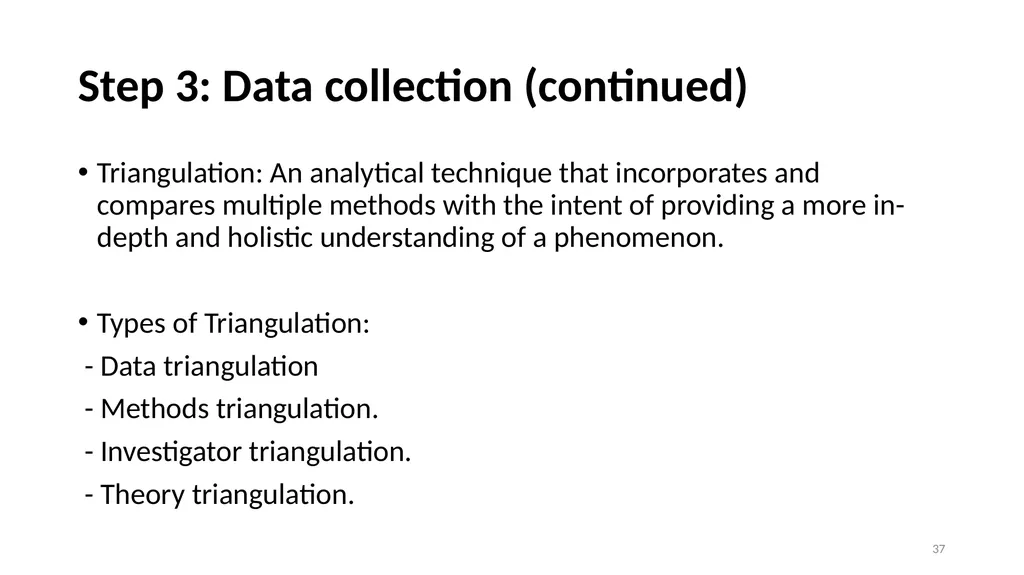
slide37. Step 3: Data collection (continued) Triangulation: An analytical technique that incorporates and compares multiple methods with the intent of providing a more in-depth and holistic understanding of a phenomenon.
Types of Triangulation:
- Data triangulation
- Methods triangulation.
- Investigator triangulation.
- Theory triangulation. 37<br>
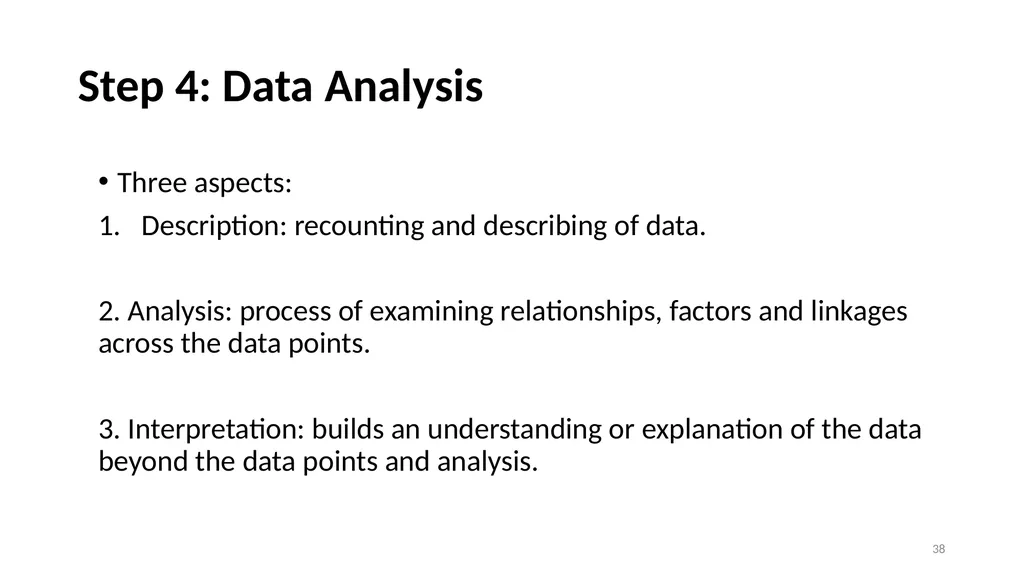
slide38. Step 4: Data Analysis Three aspects:
Description: recounting and describing of data.
2. Analysis: process of examining relationships, factors and linkages across the data points.
3. Interpretation: builds an understanding or explanation of the data beyond the data points and analysis. 38<br>
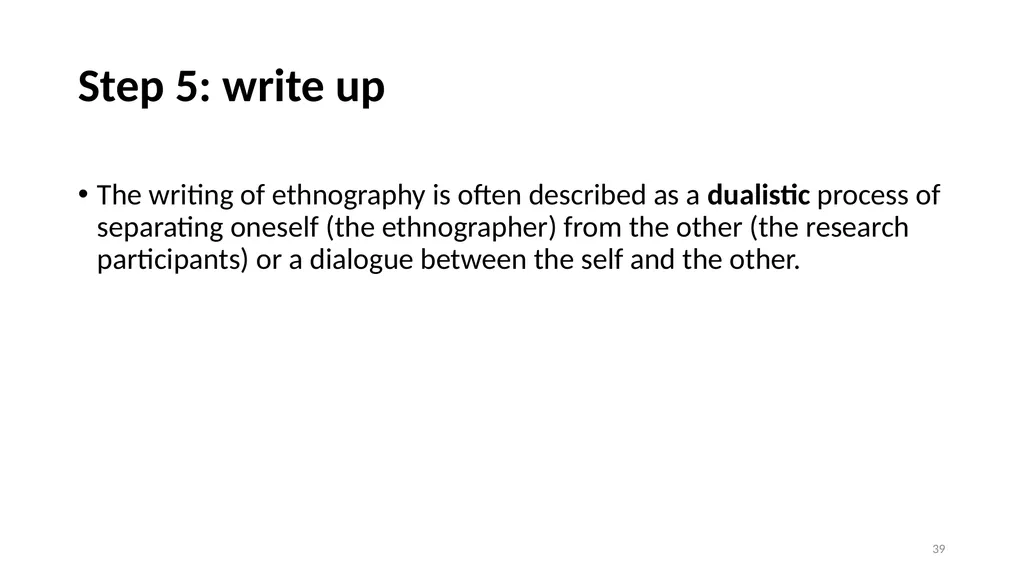
slide39. Step 5: write up The writing of ethnography is often described as a dualistic process of separating oneself (the ethnographer) from the other (the research participants) or a dialogue between the self and the other. 39<br>
slide40. Advantages “ Real- world data”
Provides in-depth understanding of people in an organisation. 40<br>
slide41. Challenges The time to collect data is extensive, involving prolonged time in the field.
There is a possibility that the researcher will "go native" and be unable to complete the study or be compromised in the study.
Data is too messy and unstructured.
Complex array of fieldwork issues facing ethnographers who venture into an unfamiliar cultural group or system. 41<br>
slide42. Reading Material Power point presentation
Qualitative inquiry and research design: choosing among five approaches, page 68-76 42<br>
slide43. References Creswell, J. W., & Poth, C. N. (2007). Qualitative inquiry and research design: Choosing among five approaches: Sage publications.
Smith, B. (2018). Generalizability in qualitative research: Misunderstandings, opportunities and recommendations for the sport and exercise sciences. Qualitative Research in Sport, Exercise and Health, 10(1), 137-149.
Yin, R. (2010). Analytic generalization. Encyclopedia of case study research, 1, 20-22. 43<br>
slide44. Thank you ! Comments
Questions 44<br>
slide2. Announcements - Midterm Exam : 14th November 2019 (3-4 pm). Weight: 30% - Final Exam: 14th December 2019 (12:15-2:15 pm) Weight: 40% 2<br>
slide3. DISCUSSION Paper Title: How does accreditation influence staff perceptions of quality in residential aged care?<br>
slide4. Discussion Topics suggestions and examples of qualitative research questions.
Start thinking of your own topic!
What is the approach that best fit your research questions?
What are the data collection methods you need to address the research questions? 4<br>
slide5. Learning objectives After this lecture, you should be able to:
Understand the definition of case study.
Identify data collection methods in case study research.
Describe the steps of performing case study research.
Identify the limitations of case study research.
Describe the details of ethnographic research.
Understand the aim of ethnographic research. 5<br>
slide6. Case Study Research (Definition) Case study research is a qualitative approach in which the investigator explores a bounded system (a case) or multiple bounded systems (cases) over time, through detailed, in-depth data collection involving multiple sources of information (e.g., observations, interviews, audio-visual material, and documents and reports), and reports a case description and case-based themes. 6<br>
slide7. Background about case study Case studies have been long established in healthcare, medicine, anthropology, and psychology research.
Case study research is effective to investigate and understand complex issues in real world settings
The case usually describes a series of events that reflect the activity or problem as it happened.
Case can be individual, group, project, policy, institution, program or an anomaly. 7<br>
slide8. Background about case study research (continued) The power of case study research is the ability to use multiple sources and techniques for comprehensive depth and breadth of inquiry.
Case study research is not exclusively concerned with qualitative methods.
Document analysis, archival records, interviews, surveys and participant observation are considered the main data sources for case study research.
Triangulation 8<br>
slide9. Background about case study (continued) Statistical versus analytical generalisation.
The difference between case study and experiment. 9<br>
slide10. Background about case study (continued) Analytic generalisation is distinct from statistical generalisation
- It does not draw inferences from data to a population. Instead, analytic generalisation compares the results of a case study to a previously developed theory.
- In doing a case study, your goal will be to expand and generalize theories (analytic generalization) and not to enumerate frequencies (statistical generalization) (Yin, 2010).
- Research might produce analytical generalizability when a new concept or new theory is constructed that later makes sense and has significance in other research, even if the contexts or populations are different (Smith, 2018).
- The researcher might re-examine established concepts and theories in a study through a different methodology and, in turn, produce new conceptual and theoretical understandings of a topic. When that occurs, and the researcher or other researchers show the value of such concepts or theories in other research, then again it can be said that the work generates a form of analytical generalisation (Smith, 2018). 10<br>
slide11. Types of case study Exploratory: aims to explore and determine the purposes of any subsequent research.
Descriptive: aims to describe the phenomenon of interest.
Explanatory: aims to reveal cause–effect associations of the studied phenomena. 11<br>
slide12. How to perform a case study? Determine and define the research questions.
Select the cases and determine data-gathering and analysis techniques.
Prepare to collect data.
Collect data in the field.
Evaluate and analyse the data.
Prepare the report 12<br>
slide13. Step 1: Determine and Define the Research Questions The focus or intent is established once an intensive review of the relevant literature has been completed and the problem has been well identified.
The importance of framing your research direction in the form of questions is that you are then driven to consider your methods:
How would I answer those questions?
What information do I need?
how would I go about getting it? 13<br>
slide14. Step 1: Determine and Define the Research Questions (continued) Good research questions are those which will enable you to achieve your aim and which are capable of being answered in the research setting.
Broad aims often remain the same. What changes and evolves is the set of research questions. 14<br>
slide15. Example on the evolving of research questions Research questions might be:
- What proportion of patients don't comply with medical advice on drugs?
- Are there differences (i.e. age, social class) between different categories of patient?
- Is age a factor?
- Is the medical condition a factor?
As you get into the research, as you get to talk to patients, doctors and practice nurses, other questions might emerge:
- how clearly are patients told about drug use and the need for compliance?
- Would follow-up improve compliance?
- Are patients taking the drugs but not complying with other aspects of medical advice (diet, exercise)? 15<br>
slide16. Step 2: Select the Cases and Determine Data-Gathering and Analysis Techniques Case can be called as Unit of Analysis.
The researcher must select single or multiple cases that reflect the research questions in Step 1.
This step also involves selecting the instruments and other data-gathering strategies that will be used.
The study must be well constructed to ensure:
a. Construct validity.
b. Internal validity.
c. External validity.
d. Reliability. 16<br>
slide17. Step 2: Select the Cases and Determine Data-Gathering and Analysis Techniques (continued) Construct validity requires the researcher to select the correct tool or method for the concepts being studied.
Internal validity demonstrates that the conditions being observed will is discovered by triangulating various pieces of evidence.
External validity determines if the findings can be generalized beyond the one or multiple cases being studied.
Reliability refers to how well the procedures are documented to ensure that the research can be replicated 17<br>
slide18. Step 3: Prepare to collect the data Preparation for the vast amounts of data prior to collection will save the researcher much time and frustration later.
Due to the nature of case study research, the researcher will generate large amounts of data from multiple sources. Time taken to plan prior to the research will allow one to organize multiple databases and set categories for sorting and managing the data.
The importance of piloting. 18<br>
slide19. Step 4: Collect data in the field Data collection is emergent.
The importance of field notes.
Time to end data collection (time and budgetary limitations). 19<br>
slide20. Step 4: Collect data in the field (continued) Criteria for determining when it is appropriate to end data collection:
Exhaustion of sources: Data sources (e.g., key informants, document analysis) can be recycled and tapped many times, but at some point, it should become clear that little more information or relevance will be gained from further engagement with them.
Saturation of categories: Eventually, the categories used to code data appear to be definitively established. When continuing data collection produces only tiny increments of new information about categories in comparison to the effort expended to get them, the researcher can feel confident about ending data collection.
Overextension: Even if new information is still coming in, the researcher might develop a sense that the new information is far removed from the central core of viable categories that have emerged and does not contribute usefully to the emergence of additional viable categories 20<br>
slide21. Step 5: Evaluate and Analyse the data Triangulation.
Structural versus reflective analysis.
- Researcher’s own reflections.
When multiple cases are chosen, a typical format is to first provide a detailed description of each case and themes within the case, called a within-case analysis followed by a thematic analysis across the cases, called a cross-case analysis. 21<br>
slide22. Step 6: Prepare the report Reflective reporting versus analytic reporting. 22<br>
slide23. Limitations of case study The large quantity of data, combined with the limited timeframe available for some researches may impact on the depth of analysis of the data within the available time and resources.
Deciding the "boundaries“ of a case-how it might be constrained in terms of time, events, and processes-may be challenging.
Large quantity of data may veer away from the research focus.
Providing little basis for generalisation (please see slide 10).
- Use large number of cases 23<br>
slide24. Further reading (Case study paper) A multiple-case study in nurse practitioner-led clinics: an exploration of the quality of care for patients with multimorbidity ( please read the methods section). 24<br>
slide25. Ethnography Ethno: people or folk; Graphy: describe something.
Ethnography: describing and understanding another way of life from the native point of view. 25<br>
slide26. Ethnography ( Please watch the video) 26 https://youtu.be/6lIzz3DlEWQ<br>
slide27. Ethnography (Definition) Ethnography is the study of social interactions, behaviours, and perceptions that occur within groups, teams, organisations, and communities.
The central aim of ethnography is to provide rich, holistic insights into people’s views and actions, as well as the nature of the location they inhabit, through the collection of detailed observations and interviews.
Typically, the studied group in ethnography is one that has been together for an extended period of time, so that their shared language, patterns of behaviour, and attitudes have merged into a discernible pattern. 27<br>
slide28. Ethnography ( continued) Through the collection of observations, interviews and documentary data, which are triangulated (i.e. compared and contrasted with one another).
Through its use of in situ observations ethnographers can ‘immerse’ themselves in a social setting, thereby generating a rich understanding of social action.
Participant observation also provides ethnographers an opportunity to gather empirical insights into social practices which are normally ‘hidden’ from the public gaze.
Ethnographer not only observes a social group, setting or subject matter, but engages in the participation actively with a general commitment to observing everyday social life. 28<br>
slide29. Ethnography ( continued) Ethnographic research is exploratory in nature. This approach means that the ethnographer goes into the field to explore a cultural group and/or explore certain social interactions.
Due to the complexity of ethnography, unlike many other forms of qualitative research, ethnographic research is more difficult to undertake.
The unpredictability of everyday life often means that data collection activities can be disrupted or access withdrawn depending on ever-changing local circumstances and politics. 29<br>
slide30. Steps of Ethnographic research Planning
Sampling
Data collection
Data analysis
Write up 30<br>
slide31. Step 1: Planning Access and ethics
- Attaining approval from the appropriate decision makers for access to a research setting is an essential first step in planning an ethnography.
- Attaining access may be challenging. For example, some people are often reluctant at the thought of being ‘scrutinised’ by researchers. 31<br>
slide32. Step 1: Planning (continued) Establish rapport.
Gatekeepers.
Ethical approvals
Ethical issues:
- Avoidance of harm.
- Informed consent.
- Privacy and confidentiality. 32<br>
slide33. Step 2: Sampling Sampling of the research setting is an important component of data collection.
Often, a single study site is selected, but multiple individuals, actions and activities embedded within this setting are selected to develop an insightful account of daily life. 33<br>
slide34. Step 3: Data collection Gather information where the group works and lives (Fieldwork).
Gathering the types of information typically needed in an ethnography involves going to the research site, respecting the daily lives of individuals at the site, and collecting a wide variety of materials. 34<br>
slide35. Step 3: Data collection (continued) Participant observation
- A field strategy that simultaneously combines document analysis, interviewing of respondents and informants, direct participation and observation, and introspection (reflection).
- Ethnographic fieldwork typically involves the development of close connections between the fieldworker and subjects and situations being studied
- However, the ethnographer carries a sense of objectivity towards participant observation whereby one can separate oneself from the group being studied.
- Other components of participant observation include the use of additional qualitative and quantitative methods.
- Several methods are commonly used as a component of participant observation and include in-depth interviews, life histories and document analysis. 35<br>
slide36. Step 3: Data collection (continued) In-depth interviews
- In-depth interviews are also referred to as focused, unstructured or ethnographic interviews.
- This method of interviewing does not use fixed questions, but aims to engage the interviewee in conversation to elicit their understandings and interpretations.
- These interviews are characterised by active involvement in engaging the participant to converse about a particular topic or discussion relevant to the research questions or topic being explored.
- Interviews are complimentary to participant observation. 36<br>
slide37. Step 3: Data collection (continued) Triangulation: An analytical technique that incorporates and compares multiple methods with the intent of providing a more in-depth and holistic understanding of a phenomenon.
Types of Triangulation:
- Data triangulation
- Methods triangulation.
- Investigator triangulation.
- Theory triangulation. 37<br>
slide38. Step 4: Data Analysis Three aspects:
Description: recounting and describing of data.
2. Analysis: process of examining relationships, factors and linkages across the data points.
3. Interpretation: builds an understanding or explanation of the data beyond the data points and analysis. 38<br>
slide39. Step 5: write up The writing of ethnography is often described as a dualistic process of separating oneself (the ethnographer) from the other (the research participants) or a dialogue between the self and the other. 39<br>
slide40. Advantages “ Real- world data”
Provides in-depth understanding of people in an organisation. 40<br>
slide41. Challenges The time to collect data is extensive, involving prolonged time in the field.
There is a possibility that the researcher will "go native" and be unable to complete the study or be compromised in the study.
Data is too messy and unstructured.
Complex array of fieldwork issues facing ethnographers who venture into an unfamiliar cultural group or system. 41<br>
slide42. Reading Material Power point presentation
Qualitative inquiry and research design: choosing among five approaches, page 68-76 42<br>
slide43. References Creswell, J. W., & Poth, C. N. (2007). Qualitative inquiry and research design: Choosing among five approaches: Sage publications.
Smith, B. (2018). Generalizability in qualitative research: Misunderstandings, opportunities and recommendations for the sport and exercise sciences. Qualitative Research in Sport, Exercise and Health, 10(1), 137-149.
Yin, R. (2010). Analytic generalization. Encyclopedia of case study research, 1, 20-22. 43<br>
slide44. Thank you ! Comments
Questions 44<br>