
Cash flow forecasts E1 Cash flow forecasts Do you
Description: Cash flow forecasts E1 Cash flow forecasts Do you agree with these quotes? Sales for vanity, profit for sanity but cash is king Profitable businesses can still go under if they run out of cash at a critical moment. Forecasting is the
Related Topics
Download Presentation
"Cash flow forecasts E1 Cash flow forecasts Do you" is the property of its rightful owner. Permission is granted to download and print the materials on this website for personal, non-commercial use only, and to display it on your personal computer provided you do not modify the materials and that you retain all copyright notices contained in the materials. By downloading content from our website, you accept the terms of this agreement.
Presentation Transcript
slide1. Cash flow forecasts E1
Cash flow forecasts Do you agree with these quotes?
“Sales for vanity, profit for sanity but cash is king”
“Profitable businesses can still go under if they run out of cash at a critical moment. Forecasting is the most focused method of avoiding that obstacle.”
Peter Jones<br>
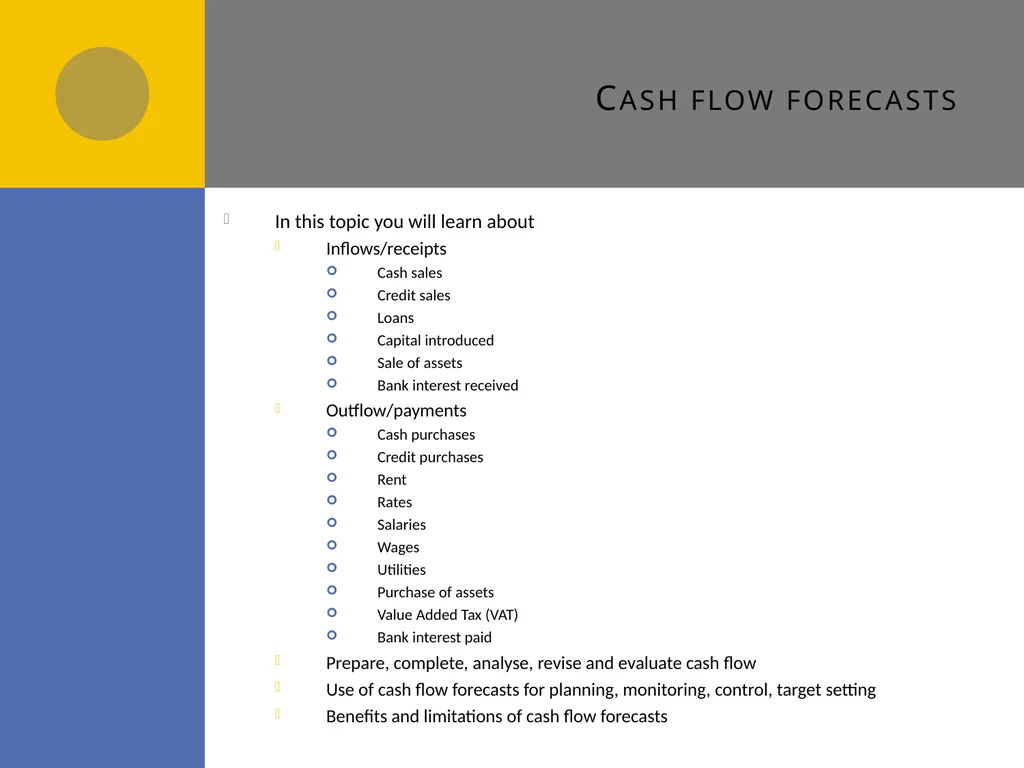
slide2. Cash flow forecasts In this topic you will learn about
Inflows/receipts
Cash sales
Credit sales
Loans
Capital introduced
Sale of assets
Bank interest received
Outflow/payments
Cash purchases
Credit purchases
Rent
Rates
Salaries
Wages
Utilities
Purchase of assets
Value Added Tax (VAT)
Bank interest paid
Prepare, complete, analyse, revise and evaluate cash flow
Use of cash flow forecasts for planning, monitoring, control, target setting
Benefits and limitations of cash flow forecasts<br>
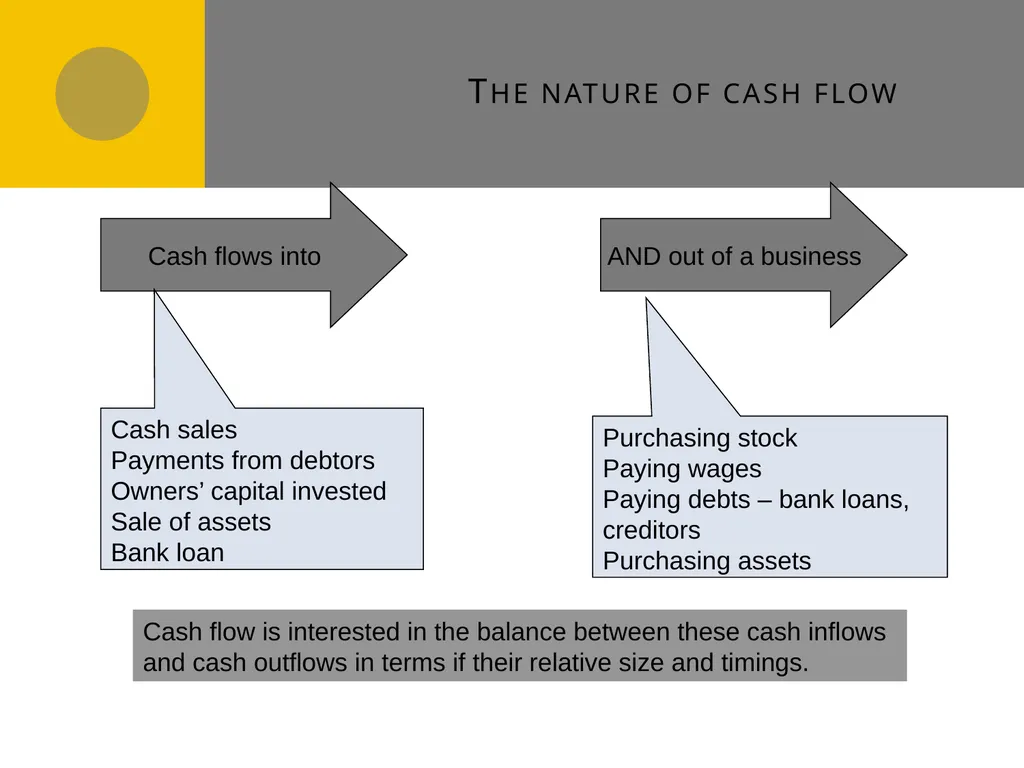
slide3. The nature of cash flow Cash flows into AND out of a business Cash sales
Payments from debtors
Owners’ capital invested
Sale of assets
Bank loan Purchasing stock
Paying wages
Paying debts – bank loans, creditors
Purchasing assets Cash flow is interested in the balance between these cash inflows and cash outflows in terms if their relative size and timings.<br>
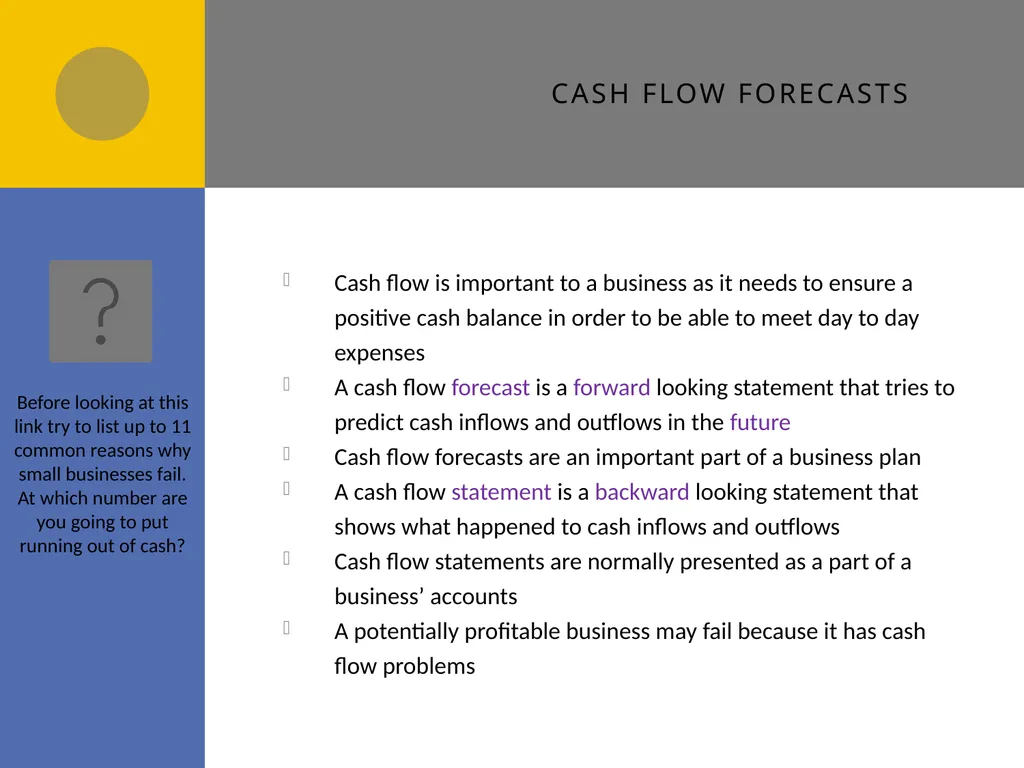
slide4. cash flow forecasts Cash flow is important to a business as it needs to ensure a positive cash balance in order to be able to meet day to day expenses
A cash flow forecast is a forward looking statement that tries to predict cash inflows and outflows in the future
Cash flow forecasts are an important part of a business plan
A cash flow statement is a backward looking statement that shows what happened to cash inflows and outflows
Cash flow statements are normally presented as a part of a business’ accounts
A potentially profitable business may fail because it has cash flow problems Before looking at this link try to list up to 11 common reasons why small businesses fail. At which number are you going to put running out of cash?<br>
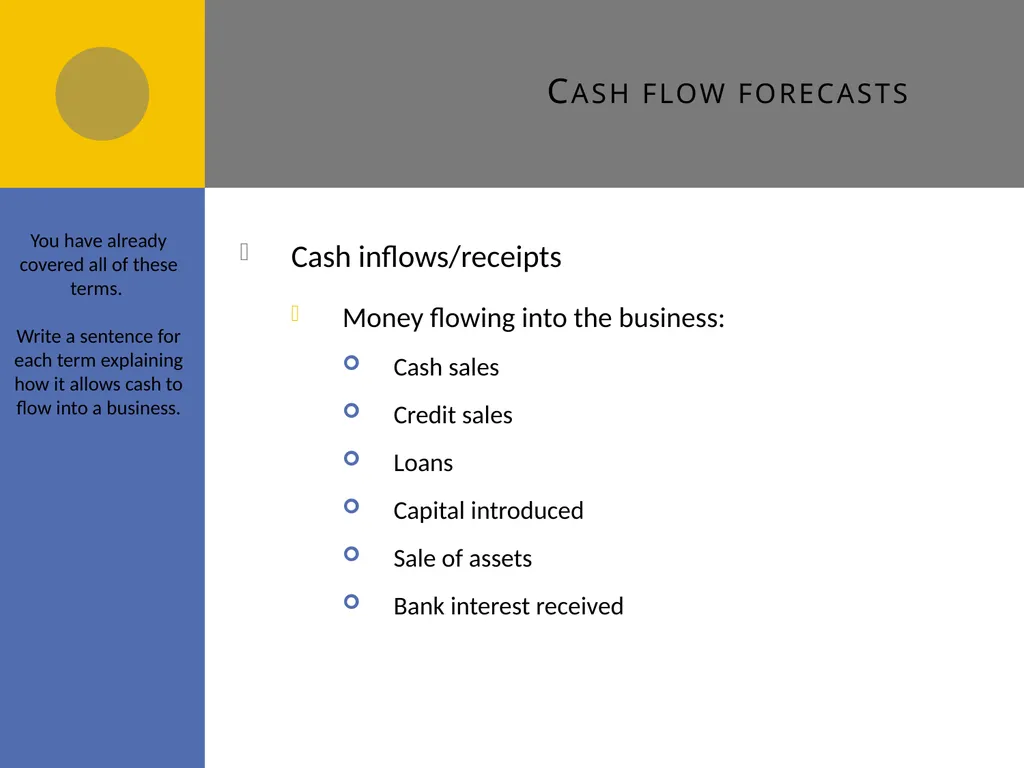
slide5. Cash flow forecasts Cash inflows/receipts
Money flowing into the business:
Cash sales
Credit sales
Loans
Capital introduced
Sale of assets
Bank interest received You have already covered all of these terms.
Write a sentence for each term explaining how it allows cash to flow into a business.<br>
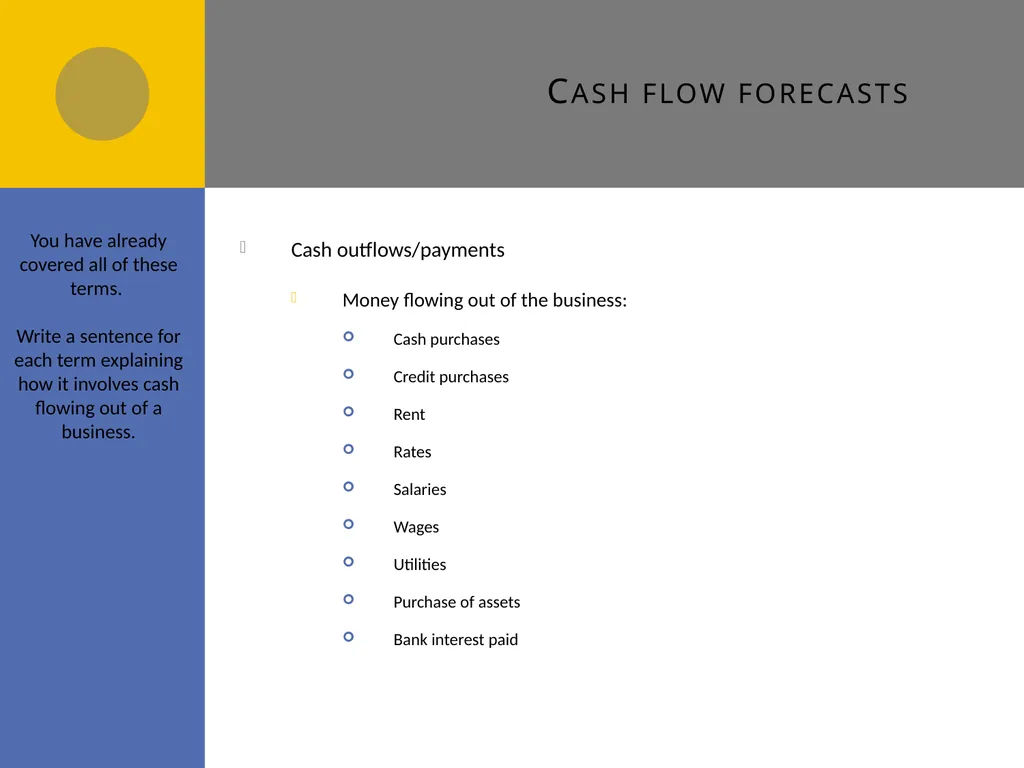
slide6. Cash flow forecasts Cash outflows/payments
Money flowing out of the business:
Cash purchases
Credit purchases
Rent
Rates
Salaries
Wages
Utilities
Purchase of assets
Bank interest paid You have already covered all of these terms.
Write a sentence for each term explaining how it involves cash flowing out of a business.<br>
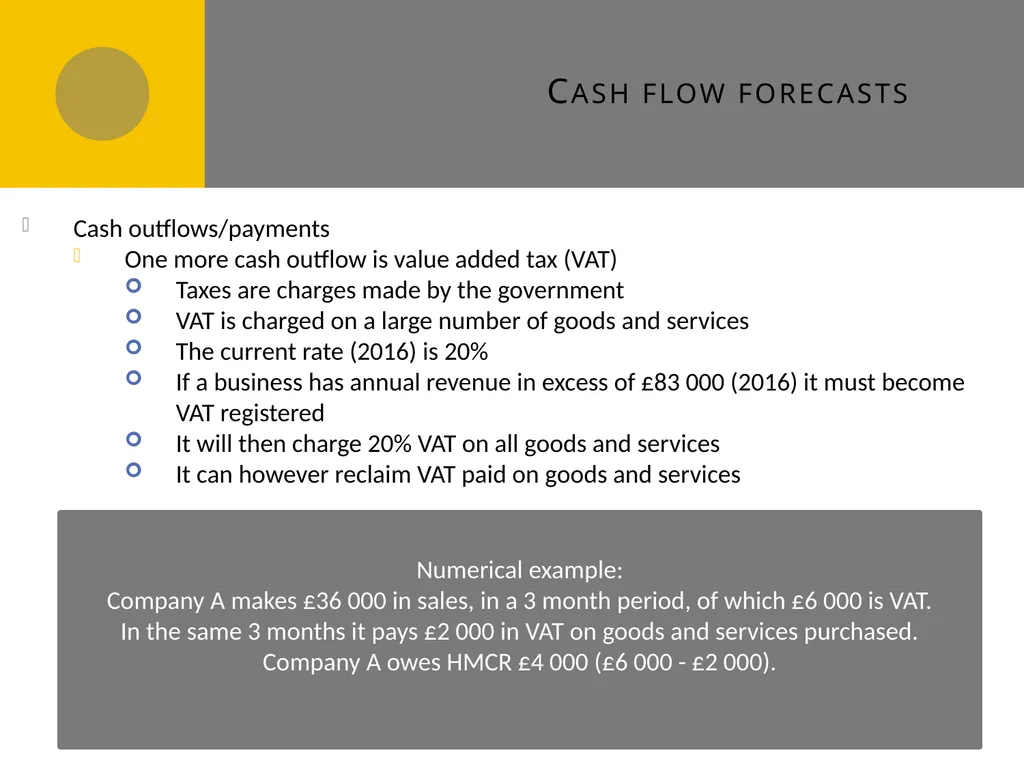
slide7. Cash flow forecasts Cash outflows/payments
One more cash outflow is value added tax (VAT)
Taxes are charges made by the government
VAT is charged on a large number of goods and services
The current rate (2016) is 20%
If a business has annual revenue in excess of £83 000 (2016) it must become VAT registered
It will then charge 20% VAT on all goods and services
It can however reclaim VAT paid on goods and services Numerical example:
Company A makes £36 000 in sales, in a 3 month period, of which £6 000 is VAT.
In the same 3 months it pays £2 000 in VAT on goods and services purchased.
Company A owes HMCR £4 000 (£6 000 - £2 000).<br>
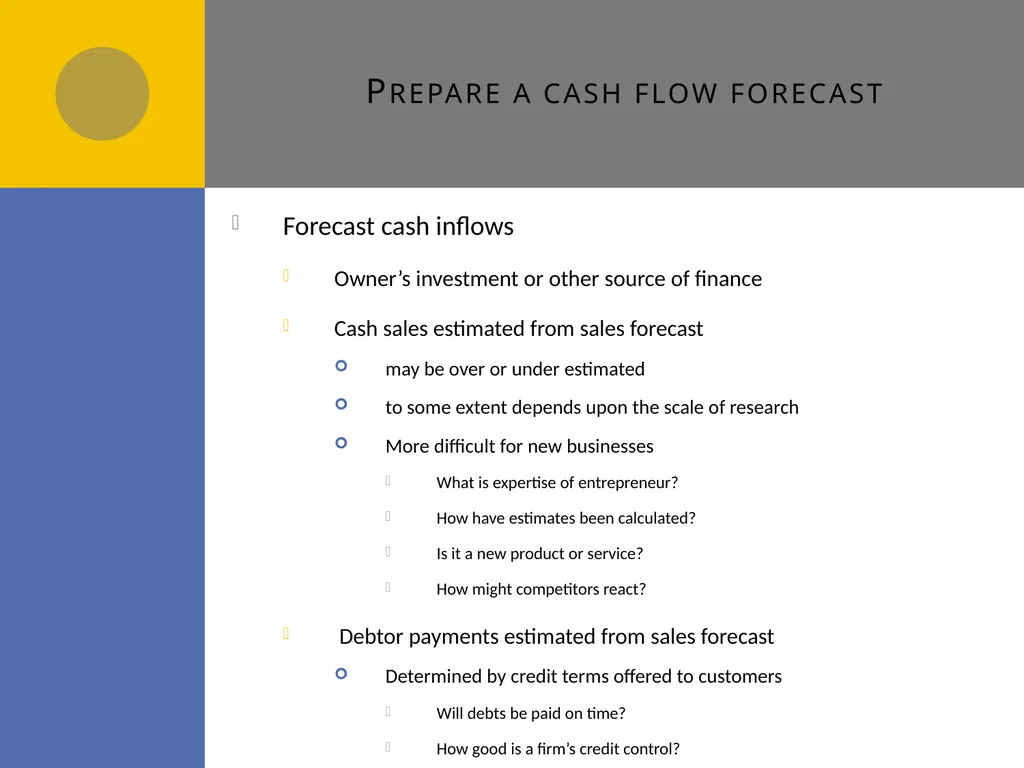
slide8. Prepare a cash flow forecast Forecast cash inflows
Owner’s investment or other source of finance
Cash sales estimated from sales forecast
may be over or under estimated
to some extent depends upon the scale of research
More difficult for new businesses
What is expertise of entrepreneur?
How have estimates been calculated?
Is it a new product or service?
How might competitors react?
Debtor payments estimated from sales forecast
Determined by credit terms offered to customers
Will debts be paid on time?
How good is a firm’s credit control?<br>
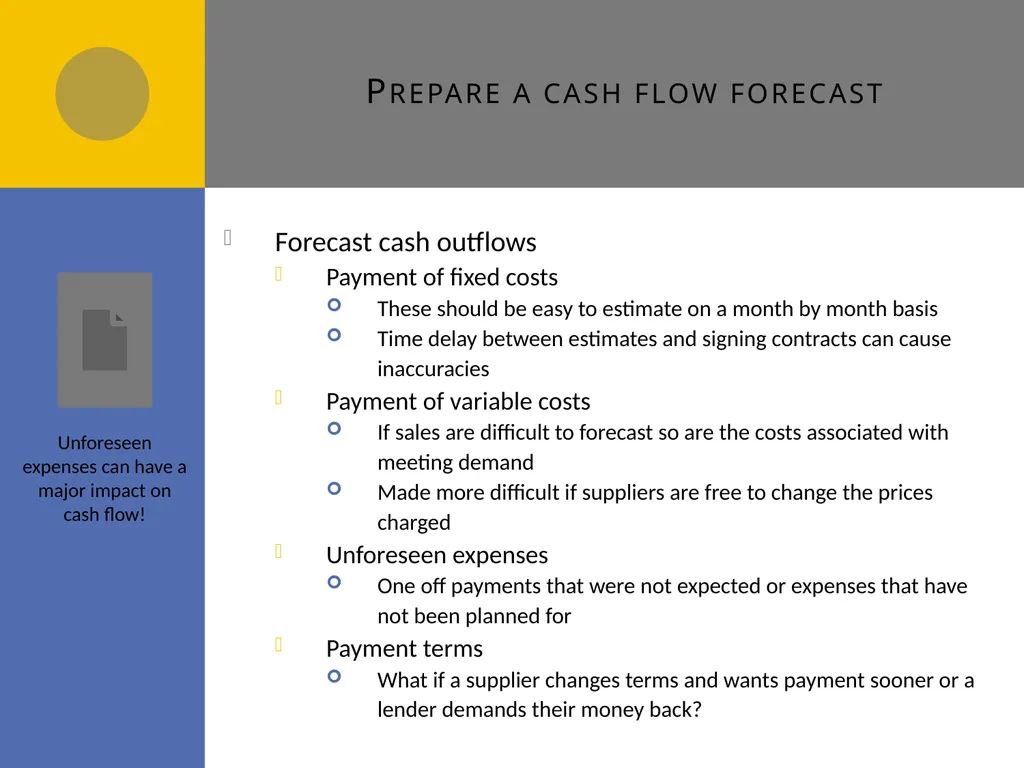
slide9. Prepare a cash flow forecast Forecast cash outflows
Payment of fixed costs
These should be easy to estimate on a month by month basis
Time delay between estimates and signing contracts can cause inaccuracies
Payment of variable costs
If sales are difficult to forecast so are the costs associated with meeting demand
Made more difficult if suppliers are free to change the prices charged
Unforeseen expenses
One off payments that were not expected or expenses that have not been planned for
Payment terms
What if a supplier changes terms and wants payment sooner or a lender demands their money back? Unforeseen expenses can have a major impact on cash flow!<br>
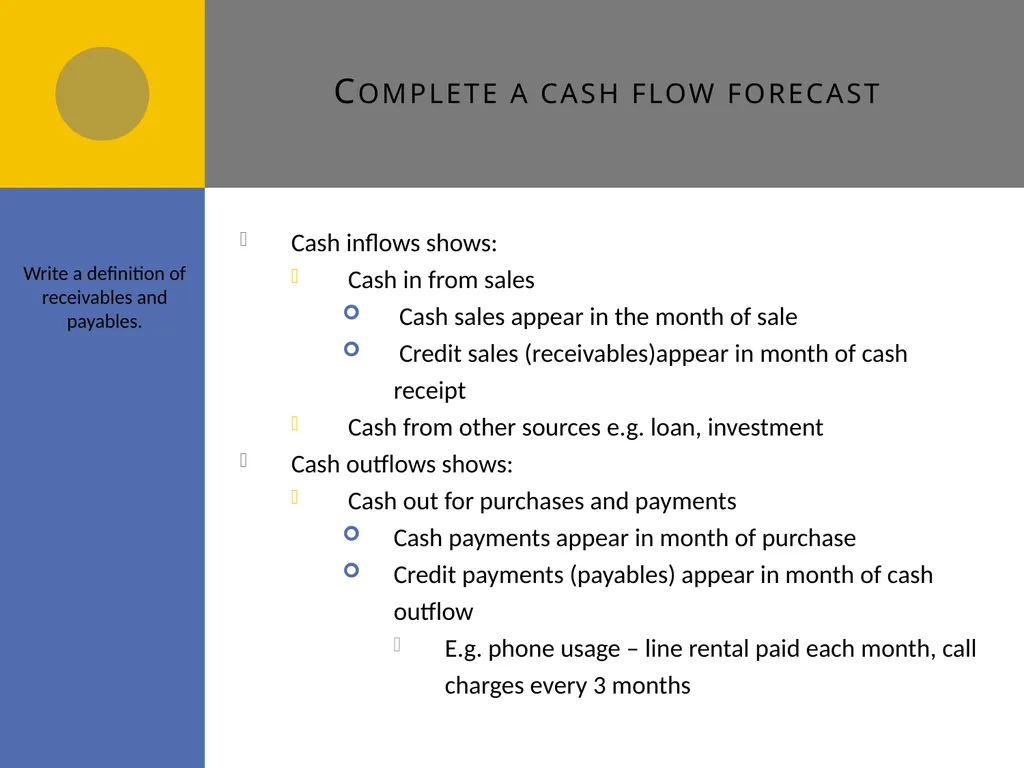
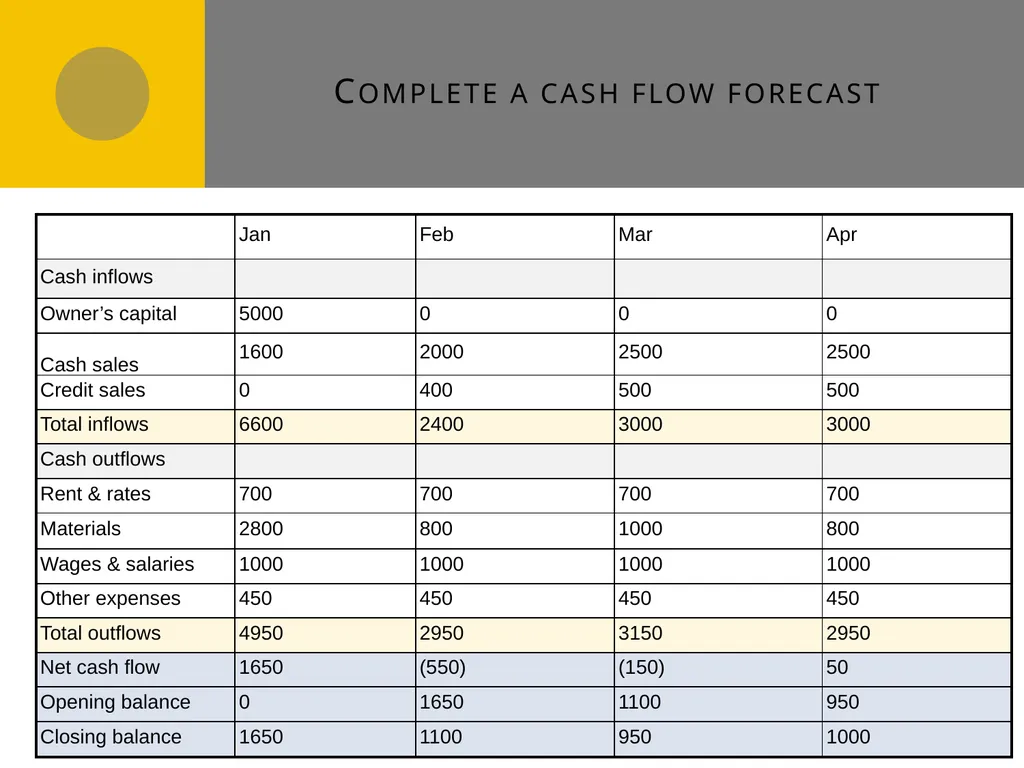
slide10. Complete a cash flow forecast Cash inflows shows:
Cash in from sales
Cash sales appear in the month of sale
Credit sales (receivables)appear in month of cash receipt
Cash from other sources e.g. loan, investment
Cash outflows shows:
Cash out for purchases and payments
Cash payments appear in month of purchase
Credit payments (payables) appear in month of cash outflow
E.g. phone usage – line rental paid each month, call charges every 3 months Write a definition of receivables and payables.<br>
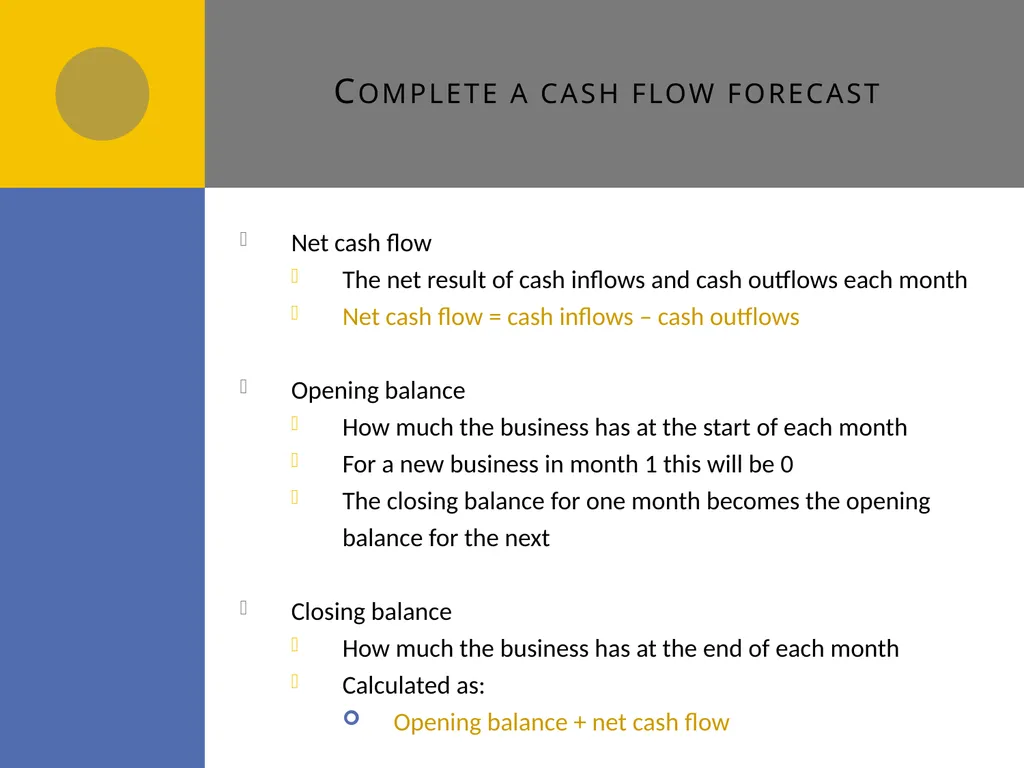
slide11. Complete a cash flow forecast Net cash flow
The net result of cash inflows and cash outflows each month
Net cash flow = cash inflows – cash outflows
Opening balance
How much the business has at the start of each month
For a new business in month 1 this will be 0
The closing balance for one month becomes the opening balance for the next
Closing balance
How much the business has at the end of each month
Calculated as:
Opening balance + net cash flow<br>
slide12. Complete a cash flow forecast<br>
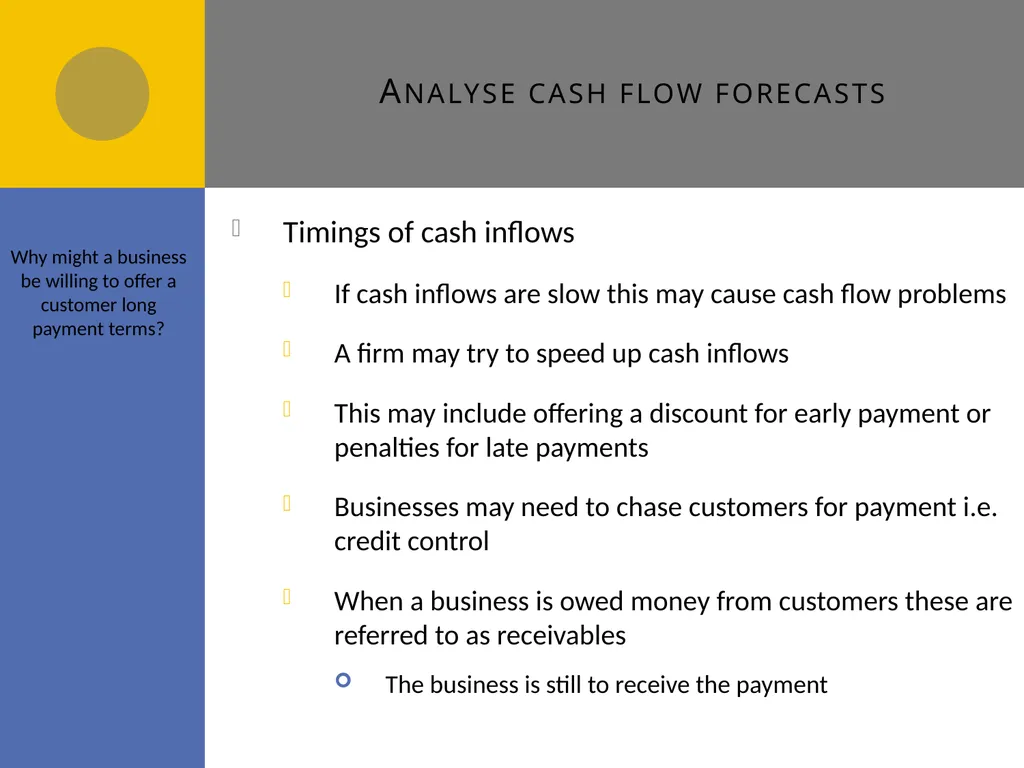
slide13. Analyse cash flow forecasts Timings of cash inflows
If cash inflows are slow this may cause cash flow problems
A firm may try to speed up cash inflows
This may include offering a discount for early payment or penalties for late payments
Businesses may need to chase customers for payment i.e. credit control
When a business is owed money from customers these are referred to as receivables
The business is still to receive the payment Why might a business be willing to offer a customer long payment terms?<br>
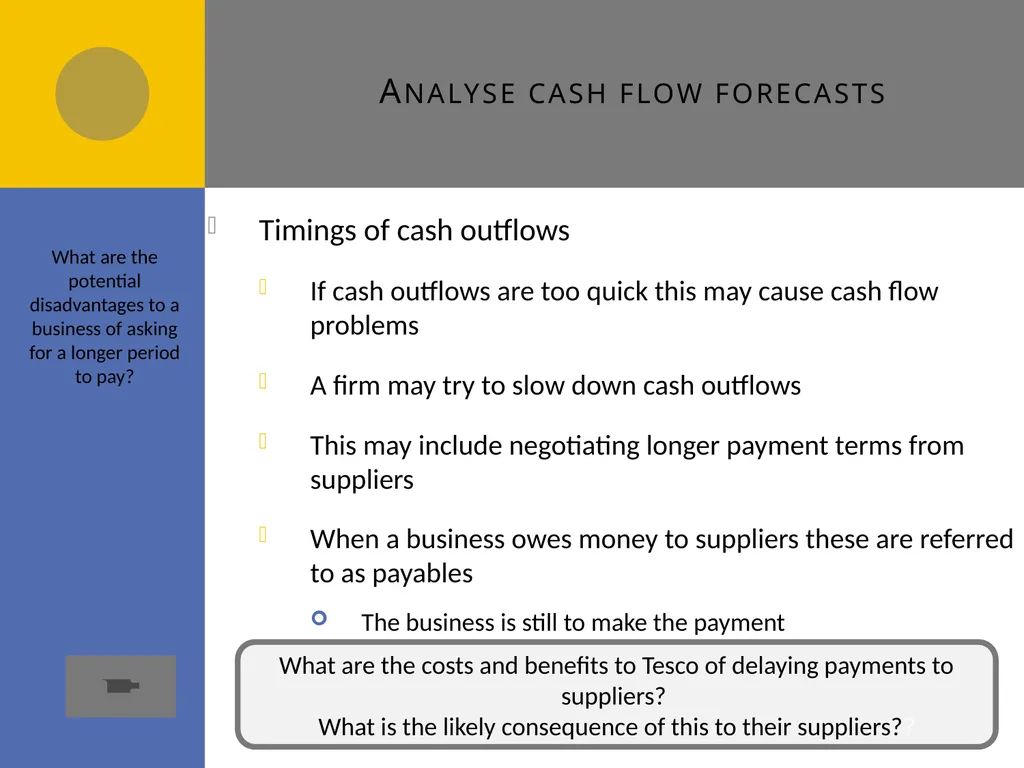
slide14. Analyse cash flow forecasts Timings of cash outflows
If cash outflows are too quick this may cause cash flow problems
A firm may try to slow down cash outflows
This may include negotiating longer payment terms from suppliers
When a business owes money to suppliers these are referred to as payables
The business is still to make the payment What are the potential disadvantages to a business of asking for a longer period to pay? What are the costs and benefits to Tesco of delaying payments to suppliers?
What is the likely consequence of this to their suppliers??<br>
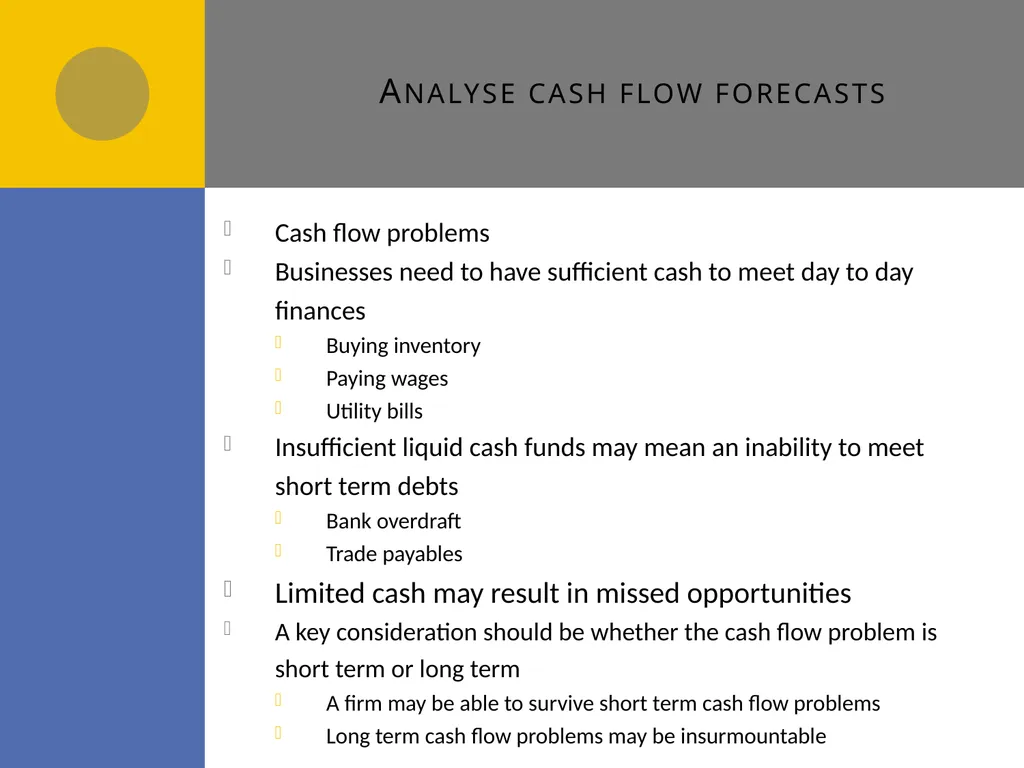
slide15. Analyse cash flow forecasts Cash flow problems
Businesses need to have sufficient cash to meet day to day finances
Buying inventory
Paying wages
Utility bills
Insufficient liquid cash funds may mean an inability to meet short term debts
Bank overdraft
Trade payables
Limited cash may result in missed opportunities
A key consideration should be whether the cash flow problem is short term or long term
A firm may be able to survive short term cash flow problems
Long term cash flow problems may be insurmountable<br>
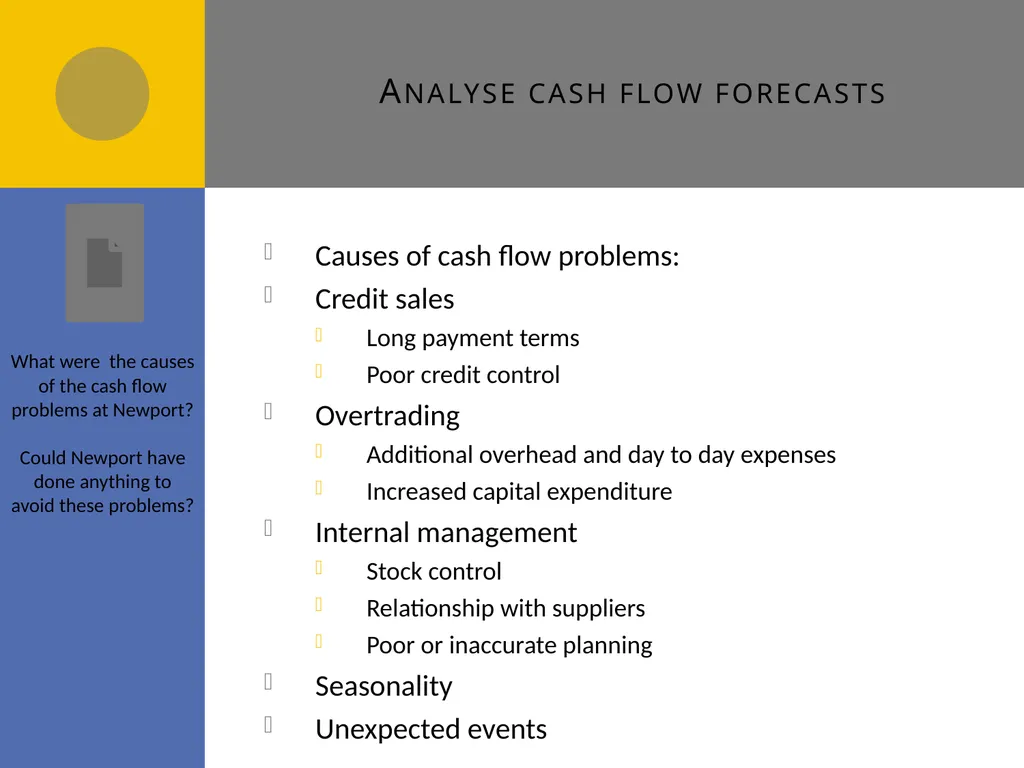
slide16. Analyse cash flow forecasts Causes of cash flow problems:
Credit sales
Long payment terms
Poor credit control
Overtrading
Additional overhead and day to day expenses
Increased capital expenditure
Internal management
Stock control
Relationship with suppliers
Poor or inaccurate planning
Seasonality
Unexpected events What were the causes of the cash flow problems at Newport?
Could Newport have done anything to avoid these problems?<br>
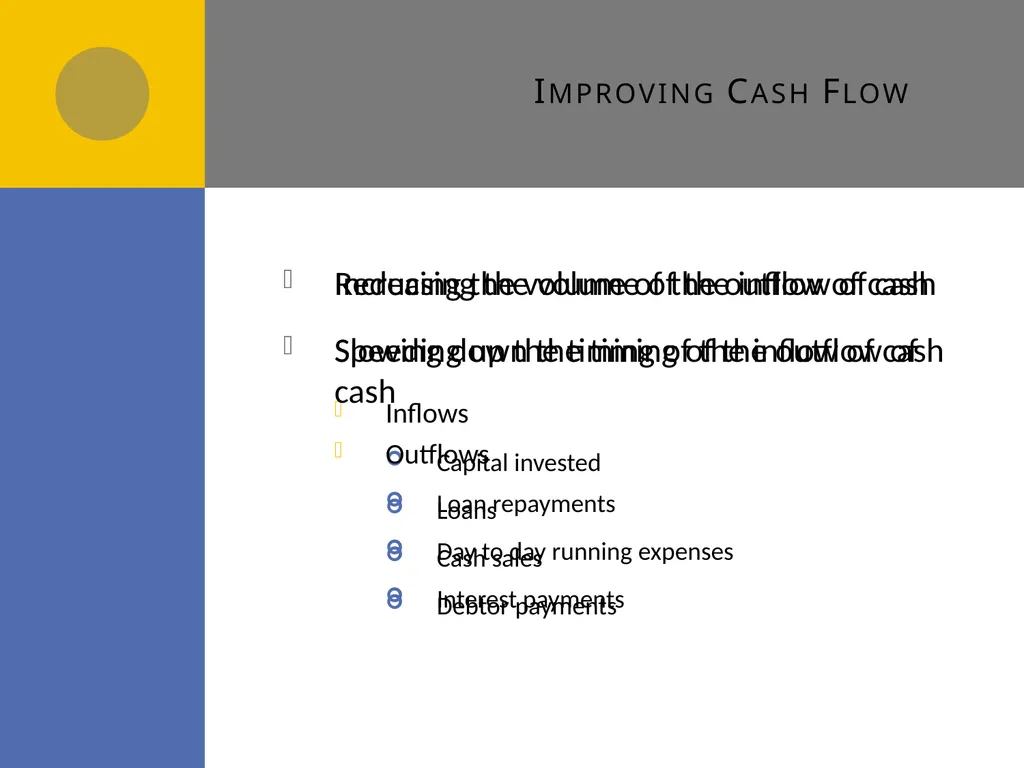
slide17. Improving Cash Flow Increasing the volume of the inflow of cash
Speeding up the timing of the inflow of cash
Inflows
Capital invested
Loans
Cash sales
Debtor payments Reducing the volume of the outflow of cash
Slowing down the timing of the outflow of cash
Outflows
Loan repayments
Day to day running expenses
Interest payments<br>
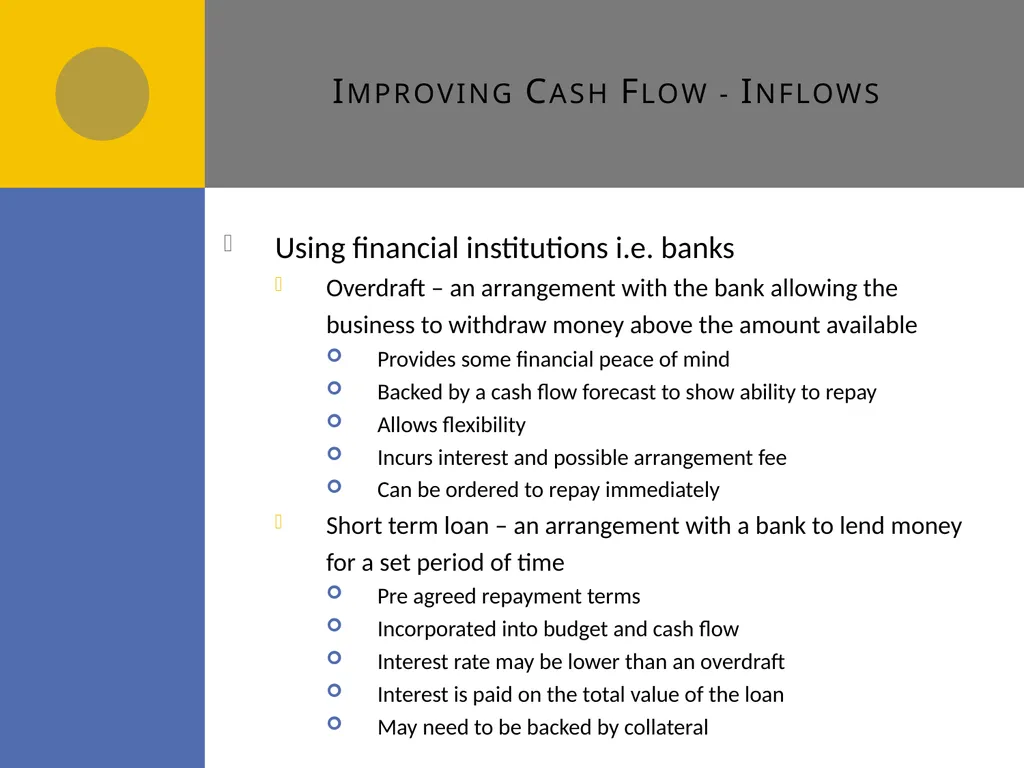
slide18. Improving Cash Flow - Inflows Using financial institutions i.e. banks
Overdraft – an arrangement with the bank allowing the business to withdraw money above the amount available
Provides some financial peace of mind
Backed by a cash flow forecast to show ability to repay
Allows flexibility
Incurs interest and possible arrangement fee
Can be ordered to repay immediately
Short term loan – an arrangement with a bank to lend money for a set period of time
Pre agreed repayment terms
Incorporated into budget and cash flow
Interest rate may be lower than an overdraft
Interest is paid on the total value of the loan
May need to be backed by collateral<br>
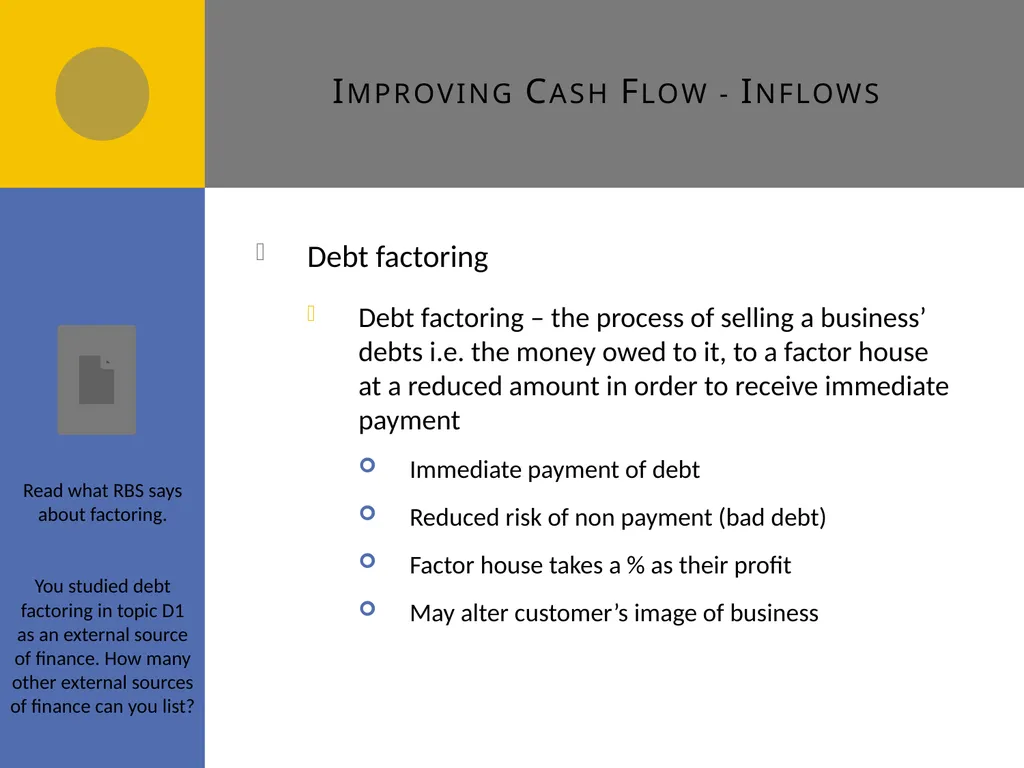
slide19. Improving Cash Flow - Inflows Debt factoring
Debt factoring – the process of selling a business’ debts i.e. the money owed to it, to a factor house at a reduced amount in order to receive immediate payment
Immediate payment of debt
Reduced risk of non payment (bad debt)
Factor house takes a % as their profit
May alter customer’s image of business Read what RBS says about factoring.
You studied debt factoring in topic D1 as an external source of finance. How many other external sources of finance can you list?<br>
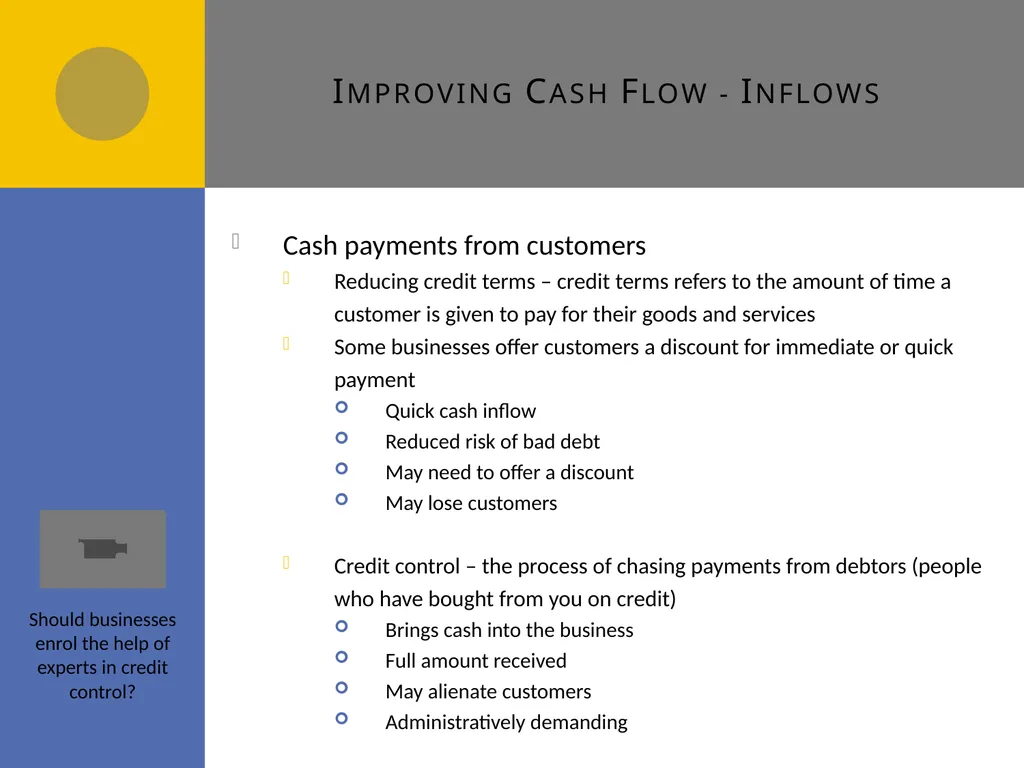
slide20. Improving Cash Flow - Inflows Cash payments from customers
Reducing credit terms – credit terms refers to the amount of time a customer is given to pay for their goods and services
Some businesses offer customers a discount for immediate or quick payment
Quick cash inflow
Reduced risk of bad debt
May need to offer a discount
May lose customers
Credit control – the process of chasing payments from debtors (people who have bought from you on credit)
Brings cash into the business
Full amount received
May alienate customers
Administratively demanding Should businesses enrol the help of experts in credit control?<br>
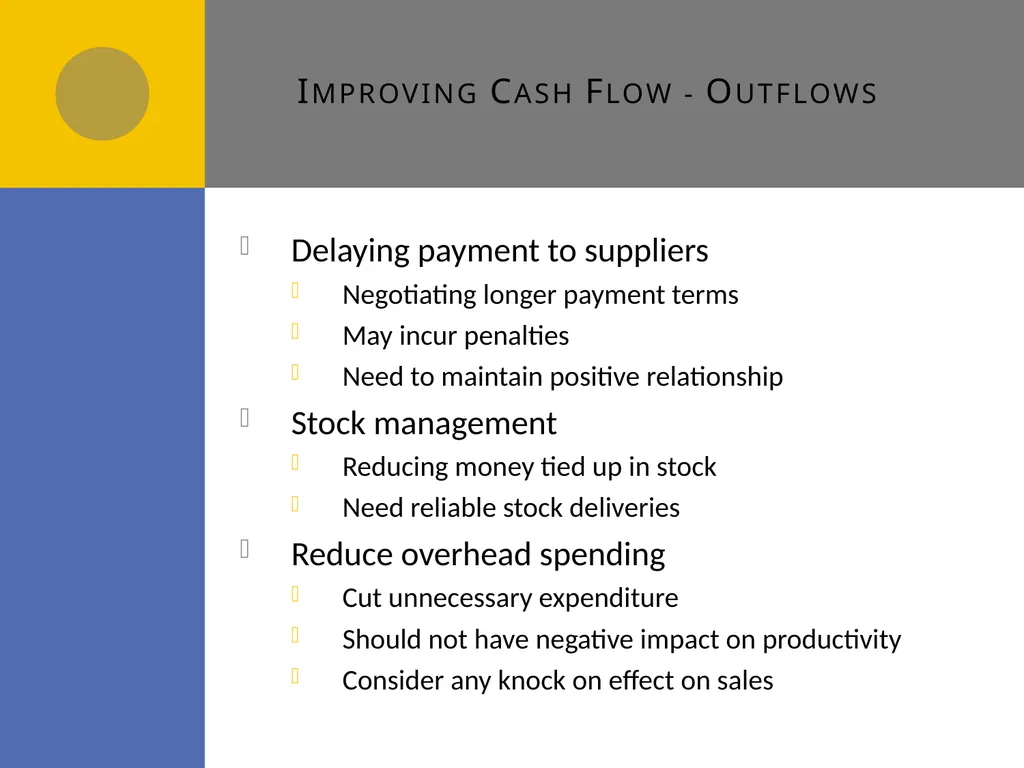
slide21. Improving Cash Flow - Outflows Delaying payment to suppliers
Negotiating longer payment terms
May incur penalties
Need to maintain positive relationship
Stock management
Reducing money tied up in stock
Need reliable stock deliveries
Reduce overhead spending
Cut unnecessary expenditure
Should not have negative impact on productivity
Consider any knock on effect on sales<br>
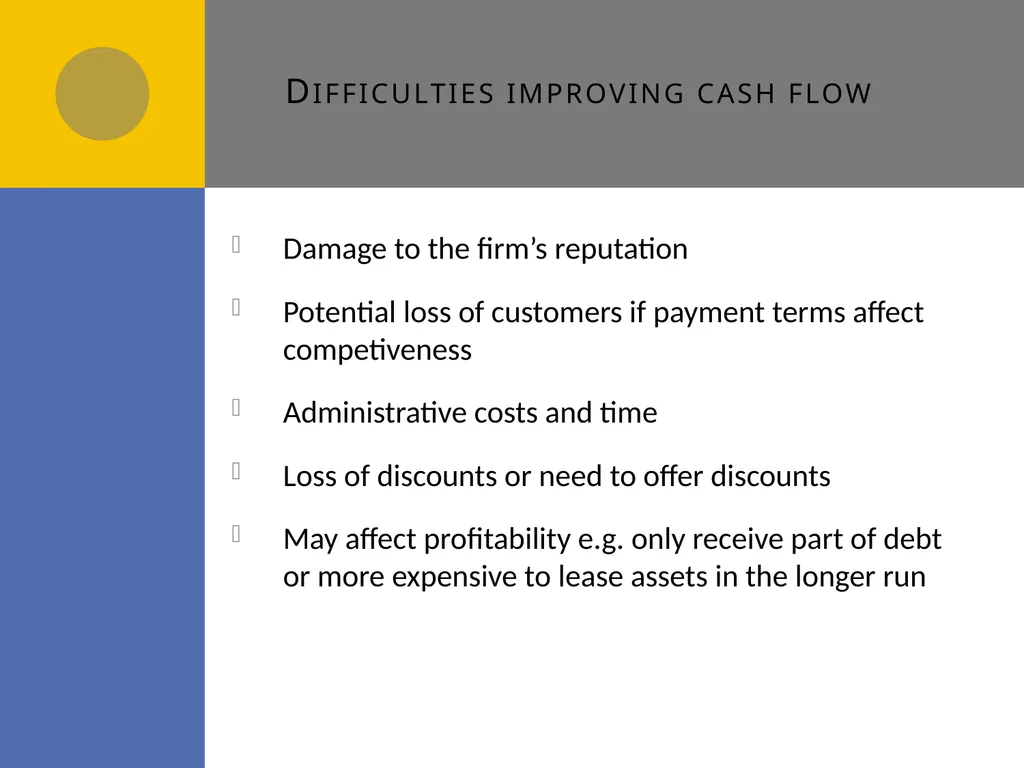
slide22. Difficulties improving cash flow Damage to the firm’s reputation
Potential loss of customers if payment terms affect competiveness
Administrative costs and time
Loss of discounts or need to offer discounts
May affect profitability e.g. only receive part of debt or more expensive to lease assets in the longer run<br>
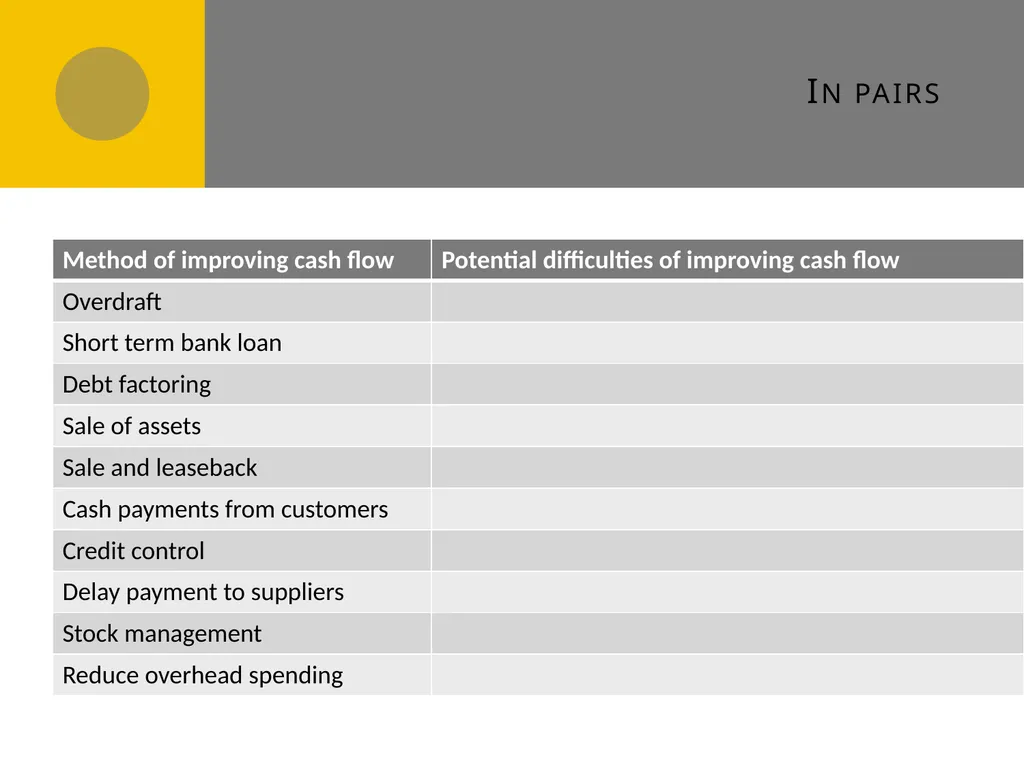
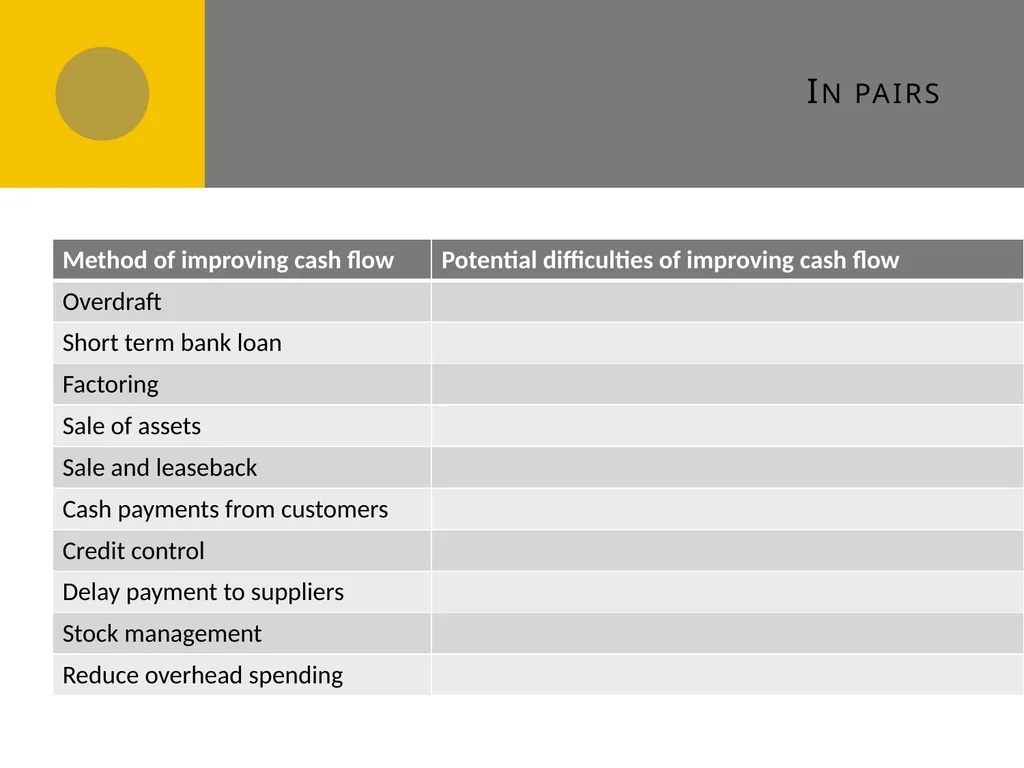
slide23. In pairs<br>
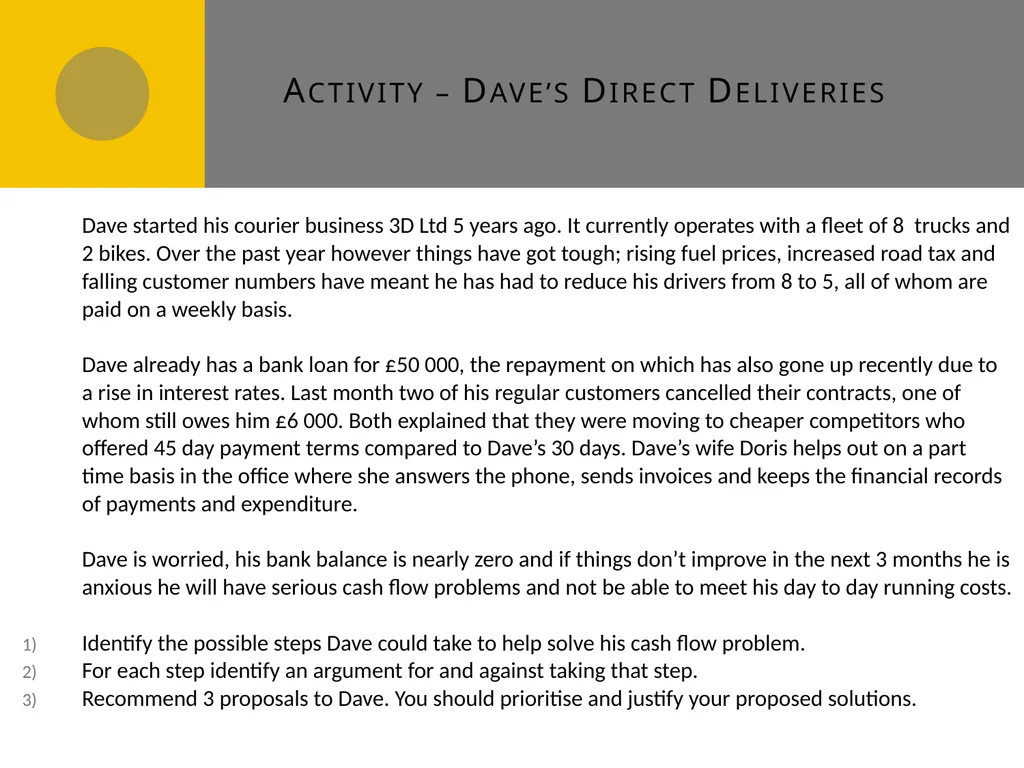
slide24. Activity – Dave’s Direct Deliveries Dave started his courier business 3D Ltd 5 years ago. It currently operates with a fleet of 8 trucks and 2 bikes. Over the past year however things have got tough; rising fuel prices, increased road tax and falling customer numbers have meant he has had to reduce his drivers from 8 to 5, all of whom are paid on a weekly basis.
Dave already has a bank loan for £50 000, the repayment on which has also gone up recently due to a rise in interest rates. Last month two of his regular customers cancelled their contracts, one of whom still owes him £6 000. Both explained that they were moving to cheaper competitors who offered 45 day payment terms compared to Dave’s 30 days. Dave’s wife Doris helps out on a part time basis in the office where she answers the phone, sends invoices and keeps the financial records of payments and expenditure.
Dave is worried, his bank balance is nearly zero and if things don’t improve in the next 3 months he is anxious he will have serious cash flow problems and not be able to meet his day to day running costs.
Identify the possible steps Dave could take to help solve his cash flow problem.
For each step identify an argument for and against taking that step.
Recommend 3 proposals to Dave. You should prioritise and justify your proposed solutions.<br>
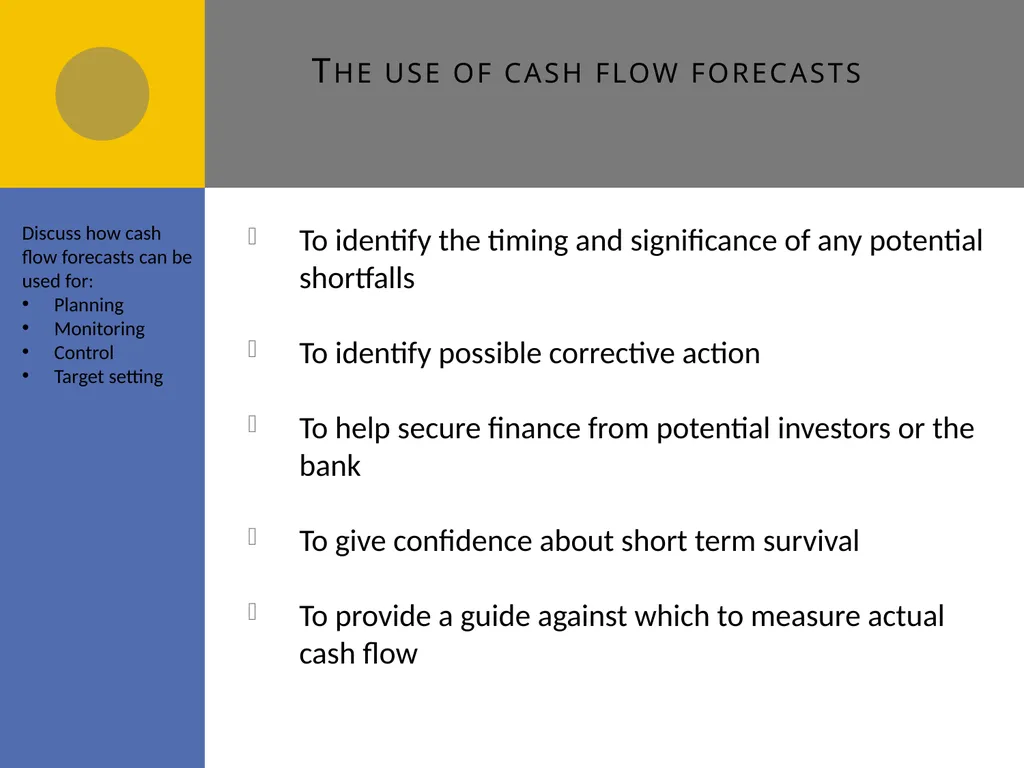
slide25. The use of cash flow forecasts To identify the timing and significance of any potential shortfalls
To identify possible corrective action
To help secure finance from potential investors or the bank
To give confidence about short term survival
To provide a guide against which to measure actual cash flow Discuss how cash flow forecasts can be used for:
Planning
Monitoring
Control
Target setting<br>
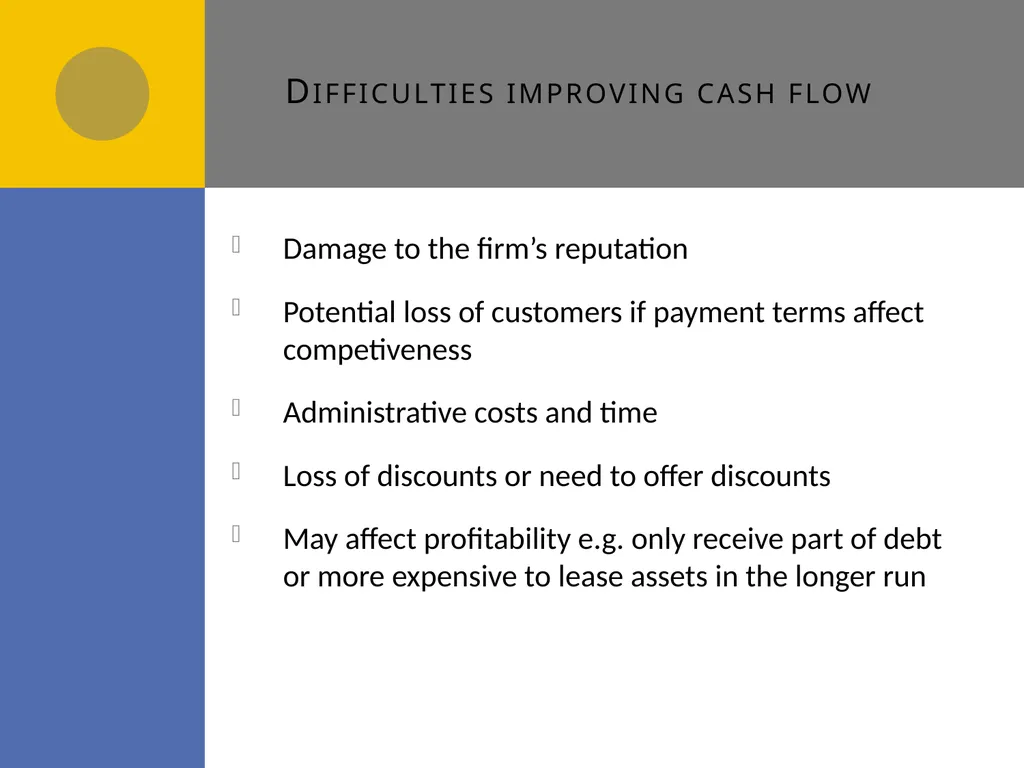
slide26. Difficulties improving cash flow Damage to the firm’s reputation
Potential loss of customers if payment terms affect competiveness
Administrative costs and time
Loss of discounts or need to offer discounts
May affect profitability e.g. only receive part of debt or more expensive to lease assets in the longer run<br>
slide27. In pairs<br>
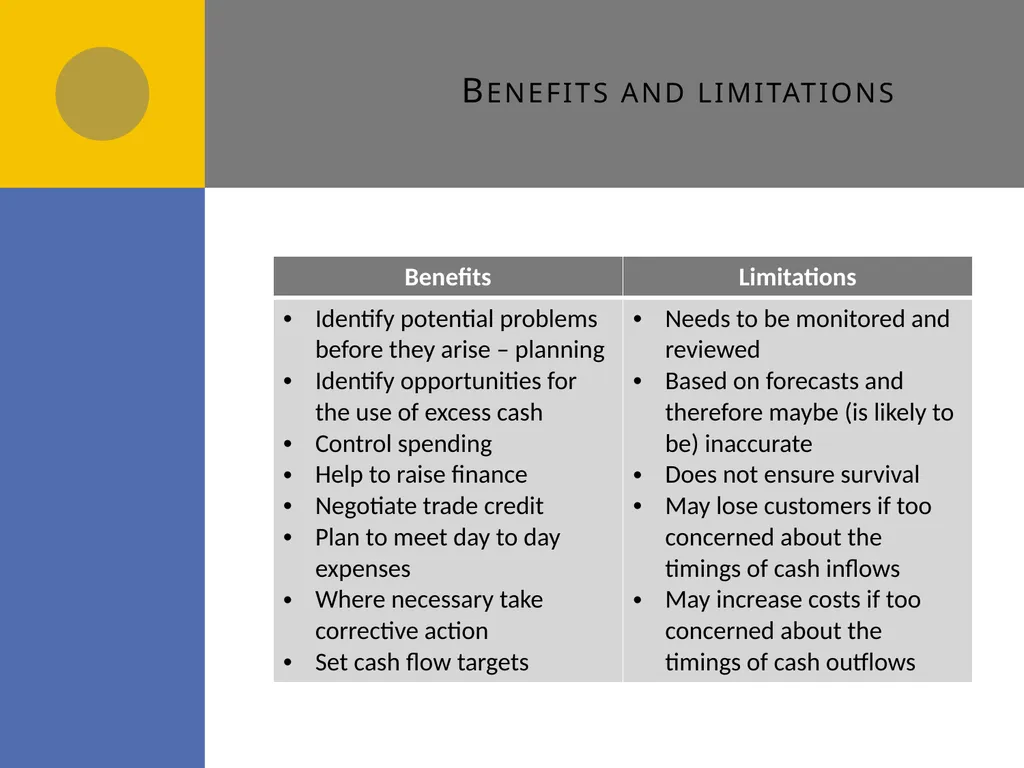
slide28. Benefits and limitations<br>
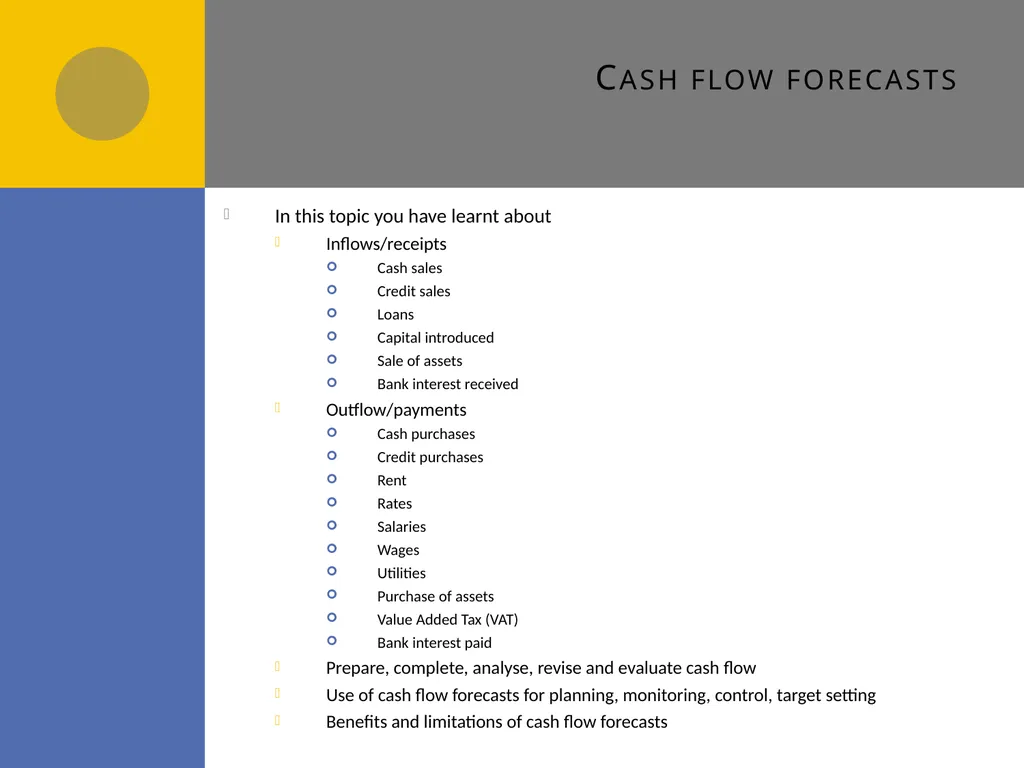
slide29. In this topic you have learnt about
Inflows/receipts
Cash sales
Credit sales
Loans
Capital introduced
Sale of assets
Bank interest received
Outflow/payments
Cash purchases
Credit purchases
Rent
Rates
Salaries
Wages
Utilities
Purchase of assets
Value Added Tax (VAT)
Bank interest paid
Prepare, complete, analyse, revise and evaluate cash flow
Use of cash flow forecasts for planning, monitoring, control, target setting
Benefits and limitations of cash flow forecasts Cash flow forecasts<br>
Cash flow forecasts Do you agree with these quotes?
“Sales for vanity, profit for sanity but cash is king”
“Profitable businesses can still go under if they run out of cash at a critical moment. Forecasting is the most focused method of avoiding that obstacle.”
Peter Jones<br>
slide2. Cash flow forecasts In this topic you will learn about
Inflows/receipts
Cash sales
Credit sales
Loans
Capital introduced
Sale of assets
Bank interest received
Outflow/payments
Cash purchases
Credit purchases
Rent
Rates
Salaries
Wages
Utilities
Purchase of assets
Value Added Tax (VAT)
Bank interest paid
Prepare, complete, analyse, revise and evaluate cash flow
Use of cash flow forecasts for planning, monitoring, control, target setting
Benefits and limitations of cash flow forecasts<br>
slide3. The nature of cash flow Cash flows into AND out of a business Cash sales
Payments from debtors
Owners’ capital invested
Sale of assets
Bank loan Purchasing stock
Paying wages
Paying debts – bank loans, creditors
Purchasing assets Cash flow is interested in the balance between these cash inflows and cash outflows in terms if their relative size and timings.<br>
slide4. cash flow forecasts Cash flow is important to a business as it needs to ensure a positive cash balance in order to be able to meet day to day expenses
A cash flow forecast is a forward looking statement that tries to predict cash inflows and outflows in the future
Cash flow forecasts are an important part of a business plan
A cash flow statement is a backward looking statement that shows what happened to cash inflows and outflows
Cash flow statements are normally presented as a part of a business’ accounts
A potentially profitable business may fail because it has cash flow problems Before looking at this link try to list up to 11 common reasons why small businesses fail. At which number are you going to put running out of cash?<br>
slide5. Cash flow forecasts Cash inflows/receipts
Money flowing into the business:
Cash sales
Credit sales
Loans
Capital introduced
Sale of assets
Bank interest received You have already covered all of these terms.
Write a sentence for each term explaining how it allows cash to flow into a business.<br>
slide6. Cash flow forecasts Cash outflows/payments
Money flowing out of the business:
Cash purchases
Credit purchases
Rent
Rates
Salaries
Wages
Utilities
Purchase of assets
Bank interest paid You have already covered all of these terms.
Write a sentence for each term explaining how it involves cash flowing out of a business.<br>
slide7. Cash flow forecasts Cash outflows/payments
One more cash outflow is value added tax (VAT)
Taxes are charges made by the government
VAT is charged on a large number of goods and services
The current rate (2016) is 20%
If a business has annual revenue in excess of £83 000 (2016) it must become VAT registered
It will then charge 20% VAT on all goods and services
It can however reclaim VAT paid on goods and services Numerical example:
Company A makes £36 000 in sales, in a 3 month period, of which £6 000 is VAT.
In the same 3 months it pays £2 000 in VAT on goods and services purchased.
Company A owes HMCR £4 000 (£6 000 - £2 000).<br>
slide8. Prepare a cash flow forecast Forecast cash inflows
Owner’s investment or other source of finance
Cash sales estimated from sales forecast
may be over or under estimated
to some extent depends upon the scale of research
More difficult for new businesses
What is expertise of entrepreneur?
How have estimates been calculated?
Is it a new product or service?
How might competitors react?
Debtor payments estimated from sales forecast
Determined by credit terms offered to customers
Will debts be paid on time?
How good is a firm’s credit control?<br>
slide9. Prepare a cash flow forecast Forecast cash outflows
Payment of fixed costs
These should be easy to estimate on a month by month basis
Time delay between estimates and signing contracts can cause inaccuracies
Payment of variable costs
If sales are difficult to forecast so are the costs associated with meeting demand
Made more difficult if suppliers are free to change the prices charged
Unforeseen expenses
One off payments that were not expected or expenses that have not been planned for
Payment terms
What if a supplier changes terms and wants payment sooner or a lender demands their money back? Unforeseen expenses can have a major impact on cash flow!<br>
slide10. Complete a cash flow forecast Cash inflows shows:
Cash in from sales
Cash sales appear in the month of sale
Credit sales (receivables)appear in month of cash receipt
Cash from other sources e.g. loan, investment
Cash outflows shows:
Cash out for purchases and payments
Cash payments appear in month of purchase
Credit payments (payables) appear in month of cash outflow
E.g. phone usage – line rental paid each month, call charges every 3 months Write a definition of receivables and payables.<br>
slide11. Complete a cash flow forecast Net cash flow
The net result of cash inflows and cash outflows each month
Net cash flow = cash inflows – cash outflows
Opening balance
How much the business has at the start of each month
For a new business in month 1 this will be 0
The closing balance for one month becomes the opening balance for the next
Closing balance
How much the business has at the end of each month
Calculated as:
Opening balance + net cash flow<br>
slide12. Complete a cash flow forecast<br>
slide13. Analyse cash flow forecasts Timings of cash inflows
If cash inflows are slow this may cause cash flow problems
A firm may try to speed up cash inflows
This may include offering a discount for early payment or penalties for late payments
Businesses may need to chase customers for payment i.e. credit control
When a business is owed money from customers these are referred to as receivables
The business is still to receive the payment Why might a business be willing to offer a customer long payment terms?<br>
slide14. Analyse cash flow forecasts Timings of cash outflows
If cash outflows are too quick this may cause cash flow problems
A firm may try to slow down cash outflows
This may include negotiating longer payment terms from suppliers
When a business owes money to suppliers these are referred to as payables
The business is still to make the payment What are the potential disadvantages to a business of asking for a longer period to pay? What are the costs and benefits to Tesco of delaying payments to suppliers?
What is the likely consequence of this to their suppliers??<br>
slide15. Analyse cash flow forecasts Cash flow problems
Businesses need to have sufficient cash to meet day to day finances
Buying inventory
Paying wages
Utility bills
Insufficient liquid cash funds may mean an inability to meet short term debts
Bank overdraft
Trade payables
Limited cash may result in missed opportunities
A key consideration should be whether the cash flow problem is short term or long term
A firm may be able to survive short term cash flow problems
Long term cash flow problems may be insurmountable<br>
slide16. Analyse cash flow forecasts Causes of cash flow problems:
Credit sales
Long payment terms
Poor credit control
Overtrading
Additional overhead and day to day expenses
Increased capital expenditure
Internal management
Stock control
Relationship with suppliers
Poor or inaccurate planning
Seasonality
Unexpected events What were the causes of the cash flow problems at Newport?
Could Newport have done anything to avoid these problems?<br>
slide17. Improving Cash Flow Increasing the volume of the inflow of cash
Speeding up the timing of the inflow of cash
Inflows
Capital invested
Loans
Cash sales
Debtor payments Reducing the volume of the outflow of cash
Slowing down the timing of the outflow of cash
Outflows
Loan repayments
Day to day running expenses
Interest payments<br>
slide18. Improving Cash Flow - Inflows Using financial institutions i.e. banks
Overdraft – an arrangement with the bank allowing the business to withdraw money above the amount available
Provides some financial peace of mind
Backed by a cash flow forecast to show ability to repay
Allows flexibility
Incurs interest and possible arrangement fee
Can be ordered to repay immediately
Short term loan – an arrangement with a bank to lend money for a set period of time
Pre agreed repayment terms
Incorporated into budget and cash flow
Interest rate may be lower than an overdraft
Interest is paid on the total value of the loan
May need to be backed by collateral<br>
slide19. Improving Cash Flow - Inflows Debt factoring
Debt factoring – the process of selling a business’ debts i.e. the money owed to it, to a factor house at a reduced amount in order to receive immediate payment
Immediate payment of debt
Reduced risk of non payment (bad debt)
Factor house takes a % as their profit
May alter customer’s image of business Read what RBS says about factoring.
You studied debt factoring in topic D1 as an external source of finance. How many other external sources of finance can you list?<br>
slide20. Improving Cash Flow - Inflows Cash payments from customers
Reducing credit terms – credit terms refers to the amount of time a customer is given to pay for their goods and services
Some businesses offer customers a discount for immediate or quick payment
Quick cash inflow
Reduced risk of bad debt
May need to offer a discount
May lose customers
Credit control – the process of chasing payments from debtors (people who have bought from you on credit)
Brings cash into the business
Full amount received
May alienate customers
Administratively demanding Should businesses enrol the help of experts in credit control?<br>
slide21. Improving Cash Flow - Outflows Delaying payment to suppliers
Negotiating longer payment terms
May incur penalties
Need to maintain positive relationship
Stock management
Reducing money tied up in stock
Need reliable stock deliveries
Reduce overhead spending
Cut unnecessary expenditure
Should not have negative impact on productivity
Consider any knock on effect on sales<br>
slide22. Difficulties improving cash flow Damage to the firm’s reputation
Potential loss of customers if payment terms affect competiveness
Administrative costs and time
Loss of discounts or need to offer discounts
May affect profitability e.g. only receive part of debt or more expensive to lease assets in the longer run<br>
slide23. In pairs<br>
slide24. Activity – Dave’s Direct Deliveries Dave started his courier business 3D Ltd 5 years ago. It currently operates with a fleet of 8 trucks and 2 bikes. Over the past year however things have got tough; rising fuel prices, increased road tax and falling customer numbers have meant he has had to reduce his drivers from 8 to 5, all of whom are paid on a weekly basis.
Dave already has a bank loan for £50 000, the repayment on which has also gone up recently due to a rise in interest rates. Last month two of his regular customers cancelled their contracts, one of whom still owes him £6 000. Both explained that they were moving to cheaper competitors who offered 45 day payment terms compared to Dave’s 30 days. Dave’s wife Doris helps out on a part time basis in the office where she answers the phone, sends invoices and keeps the financial records of payments and expenditure.
Dave is worried, his bank balance is nearly zero and if things don’t improve in the next 3 months he is anxious he will have serious cash flow problems and not be able to meet his day to day running costs.
Identify the possible steps Dave could take to help solve his cash flow problem.
For each step identify an argument for and against taking that step.
Recommend 3 proposals to Dave. You should prioritise and justify your proposed solutions.<br>
slide25. The use of cash flow forecasts To identify the timing and significance of any potential shortfalls
To identify possible corrective action
To help secure finance from potential investors or the bank
To give confidence about short term survival
To provide a guide against which to measure actual cash flow Discuss how cash flow forecasts can be used for:
Planning
Monitoring
Control
Target setting<br>
slide26. Difficulties improving cash flow Damage to the firm’s reputation
Potential loss of customers if payment terms affect competiveness
Administrative costs and time
Loss of discounts or need to offer discounts
May affect profitability e.g. only receive part of debt or more expensive to lease assets in the longer run<br>
slide27. In pairs<br>
slide28. Benefits and limitations<br>
slide29. In this topic you have learnt about
Inflows/receipts
Cash sales
Credit sales
Loans
Capital introduced
Sale of assets
Bank interest received
Outflow/payments
Cash purchases
Credit purchases
Rent
Rates
Salaries
Wages
Utilities
Purchase of assets
Value Added Tax (VAT)
Bank interest paid
Prepare, complete, analyse, revise and evaluate cash flow
Use of cash flow forecasts for planning, monitoring, control, target setting
Benefits and limitations of cash flow forecasts Cash flow forecasts<br>