Causation with a Human Face By Jim Woodward Presented by Clara Bueno Fall 2020 Philosophy of Science Outline Causation in physics vs. causation in the special sciences Remarks on causation Interventionist account of causation Distinctive
"Causation with a Human Face By Jim Woodward" is the property of its rightful owner. Permission is granted to
download and print the materials on this website for personal, non-commercial use only, and to display it
on your personal computer provided you do not modify the materials and that you retain all copyright
notices contained in the materials. By downloading content from our website, you accept the terms of this
agreement.
Presentation Transcript
01
Causation with a Human Face By Jim Woodward
Presented by Clara Bueno Fall 2020
Philosophy of Science<br>
02
Outline Causation in physics vs. causation in the special sciences
Remarks on causation
Interventionist account of causation
Distinctive features of causal generalizations in special sciences
Invariance and stability
Gems
Discussion questions<br>
03
Causation in physics Many philosophers of physics claim that causal notions play no role or are entirely absent of fundamental physics (e.g. Field, 2003)
Woodward: there’s no convincing argument for the conclusion that causation plays no role in physics, but there are good reasons to be skeptical about what this role might be Causation in the special sciences Causal claims play a central role in common sense reasoning — there are many studies showing the early emergence of causal judgment in children and even some animals
Causal claims also play a central role in special sciences — this is widely recognized by practitioners of medicine, biology, economics, neuroscience, etc.<br>
04
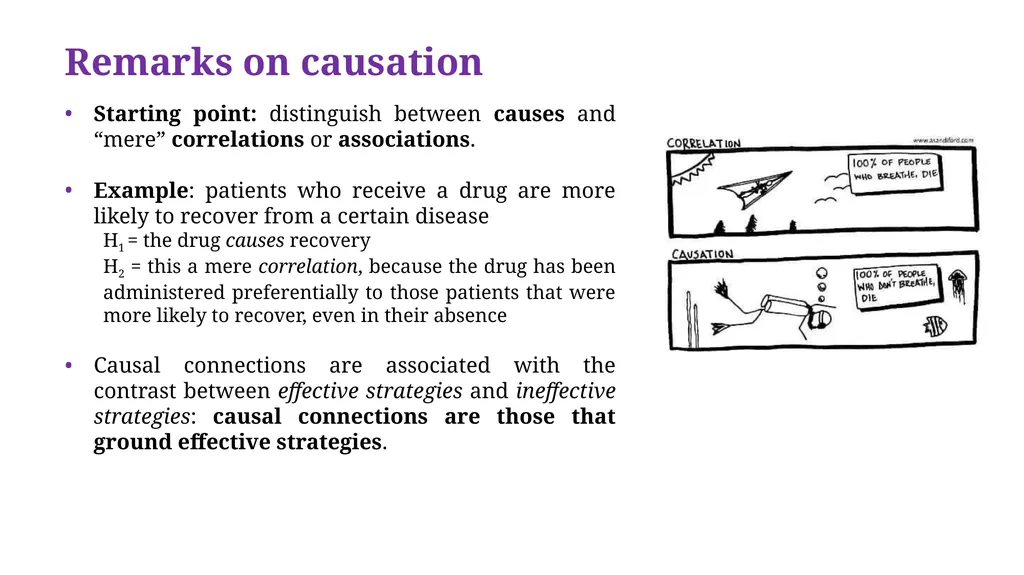
Remarks on causation Starting point: distinguish between causes and “mere” correlations or associations.
Example: patients who receive a drug are more likely to recover from a certain disease
H1 = the drug causes recovery
H2 = this a mere correlation, because the drug has been administered preferentially to those patients that were more likely to recover, even in their absence
Causal connections are associated with the contrast between effective strategies and ineffective strategies: causal connections are those that ground effective strategies.<br>
05
An interventionist account of causation Basic idea: causal claims are linked to counterfactual claims about what would happen under possible interventions.
Key issue: characterization of the notion of intervention
1. “Positive” way: type level notion of causal relevance
(C) X is a total cause of Y if an only if under an intervention that changes the value of X (with no other intervention occurring) there is an associated change in the value of Y.
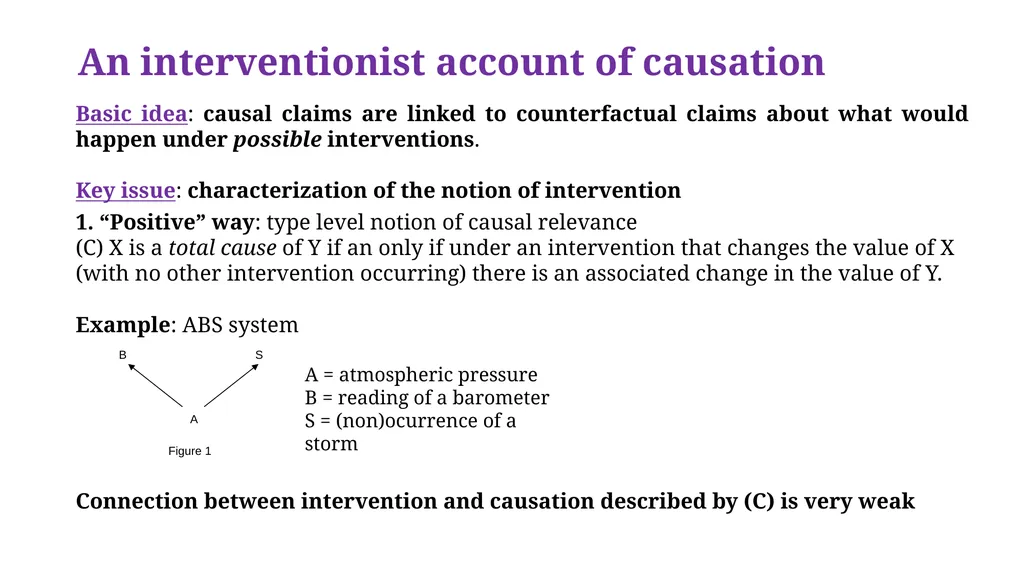
Example: ABS system
Connection between intervention and causation described by (C) is very weak A = atmospheric pressure
B = reading of a barometer
S = (non)ocurrence of a storm<br>
06
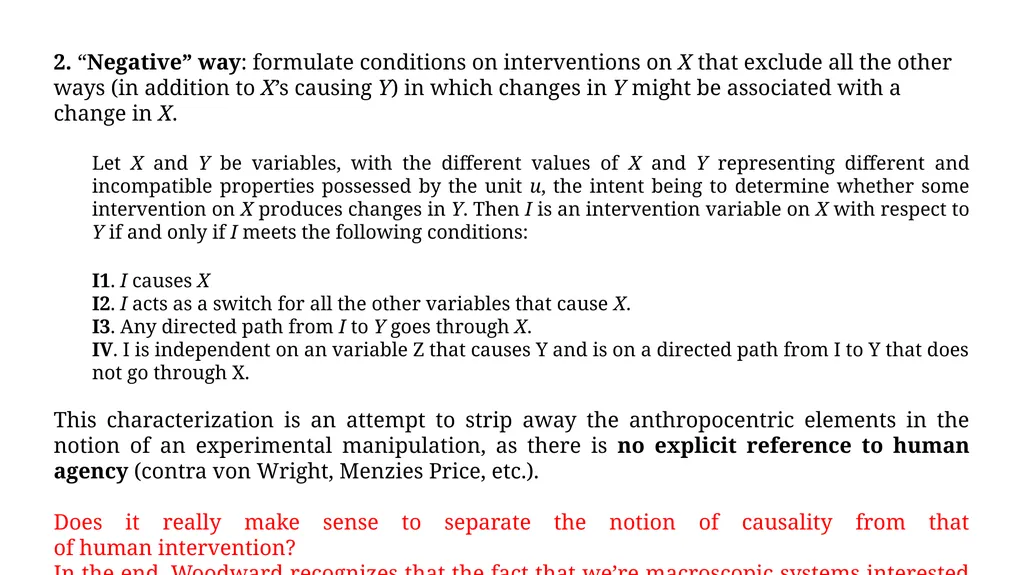
2. “Negative” way: formulate conditions on interventions on X that exclude all the other ways (in addition to X’s causing Y) in which changes in Y might be associated with a change in X.
Let X and Y be variables, with the different values of X and Y representing different and incompatible properties possessed by the unit u, the intent being to determine whether some intervention on X produces changes in Y. Then I is an intervention variable on X with respect to Y if and only if I meets the following conditions:
I1. I causes X
I2. I acts as a switch for all the other variables that cause X.
I3. Any directed path from I to Y goes through X.
IV. I is independent on an variable Z that causes Y and is on a directed path from I to Y that does not go through X.
This characterization is an attempt to strip away the anthropocentric elements in the notion of an experimental manipulation, as there is no explicit reference to human agency (contra von Wright, Menzies Price, etc.).
Does it really make sense to separate the notion of causality from that of human intervention?
In the end, Woodward recognizes that the fact that we’re macroscopic systems interested in other macroscopic systems has shaped our concept of causation<br>
07
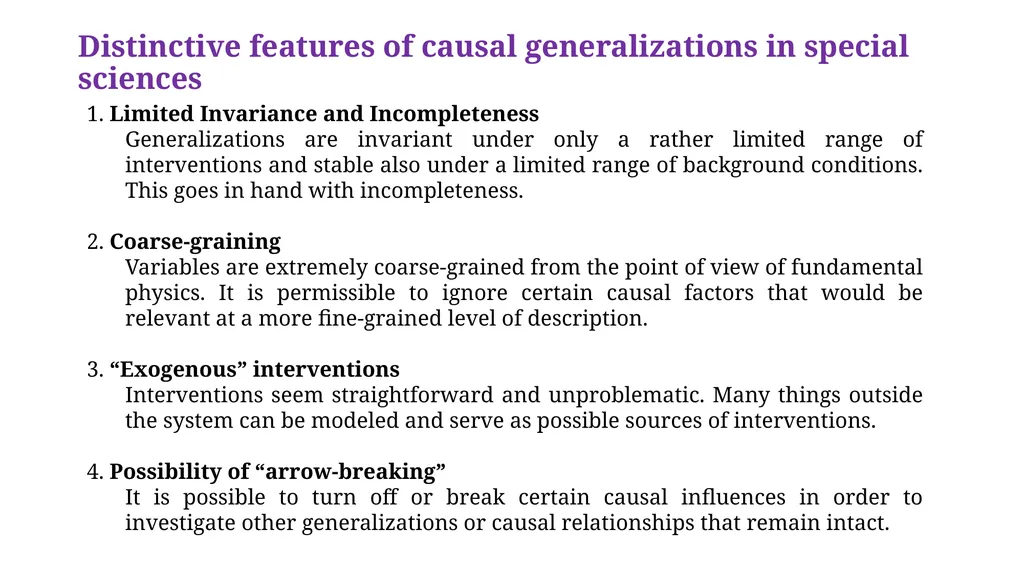
Distinctive features of causal generalizations in special sciences 1. Limited Invariance and Incompleteness
Generalizations are invariant under only a rather limited range of interventions and stable also under a limited range of background conditions. This goes in hand with incompleteness.
2. Coarse-graining
Variables are extremely coarse-grained from the point of view of fundamental physics. It is permissible to ignore certain causal factors that would be relevant at a more fine-grained level of description.
3. “Exogenous” interventions
Interventions seem straightforward and unproblematic. Many things outside the system can be modeled and serve as possible sources of interventions.
4. Possibility of “arrow-breaking”
It is possible to turn off or break certain causal influences in order to investigate other generalizations or causal relationships that remain intact.<br>
08
Invariance and Stability<br>
09
Second thesis: range of invariance/stability in special sciences is rather limited (in comparison to fundamental physics) — it’s local
Example: Schrödinger’s equation “holds under a large of extensive range of conditions […] and the conditions under which it breaks down can be given a relatively simple theoretical characterization” (p. 12)
Where do we draw the line between limited and (unlimited) invariance?
Can we be more precise about the basis for such comparisons?
Third thesis: limited invariance and stability go in hand with incompleteness
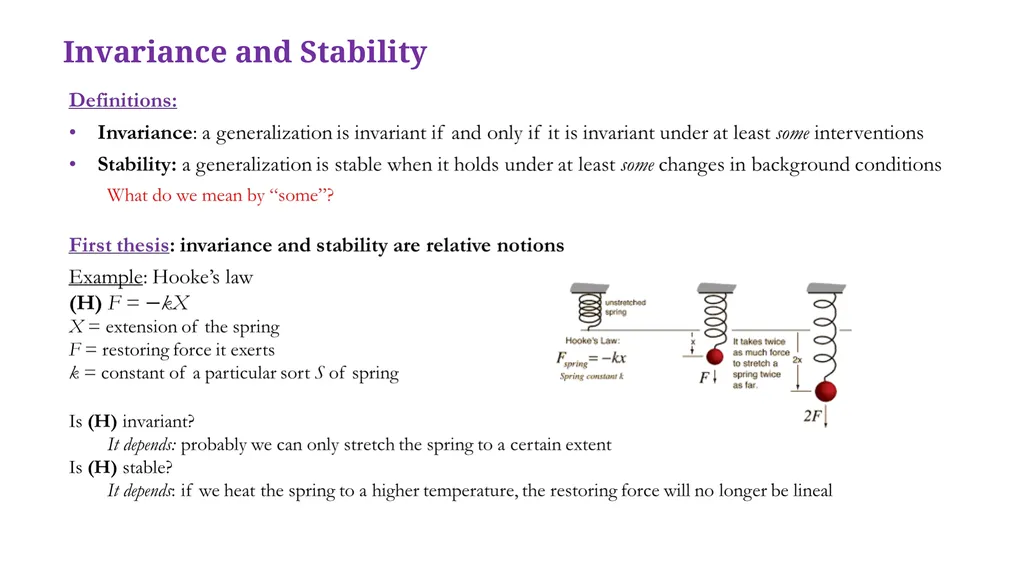
Example: in Hooke’s law (H), additional conditions include the internal structure of the spring, humidity of the surrounding air, changes in the spatio-temporal location of the spring, etc.
Fourth thesis: invariance allows us to distinguish between causal and merely correlational relationships in the special sciences
Example: B-S relationship isn’t invariant under any interventions (correlation), while (H) is invariant under some but not all interventions (causation)<br>
10
Gems Remarkable title: many have written about causality, but the originality of the title of this paper makes it really easy to remember it. (Nevertheless, it’s a bit paradoxical insofar as Woodward’s criterion for being an intervention has nothing to do with human causal capabilities).
Wide variety of examples : Woodward uses plenty of examples, both from ordinary life and across different sciences (e.g. physics, chemistry, medicine, behavioral sciences). This not only clarifies but also reinforces his argument.
Overall structure and organization: Woodward has the goal to examine the assumptions that guide the application of causal reasoning in common sense and the special sciences, and how these differ from some of the assumptions that characterize fundamental physics. He meets this goal point by point.<br>
11
Discussion questions What do we think of Woodward’s notion of intervention? Is it effectively applicable to uncover causal structures?
Is it appropriate to have a monolithic account of causation? Interventionism takes just one criteria (i.e. manipulability) and gives it a privileged place, allowing it to trump other criteria (e.g. spatio-temporal contiguity) when it comes to conflict with them. Wouldn’t it be more useful to have a pluralistic account?
Why there is so much independence among macroscopic variables, when at a microphysical level everything seems so interconnected?
Do you think that macroscopic causal relationships real/objective, or should we regard them as purely instrumental claims, as nothing but helpful fictions?<br>