
CELLULAR RESPIRATION MAKING LINKS FORMULA OF
LV
Published · 33 slides · 0 views
1 / 1




Description
CELLULAR RESPIRATION MAKING LINKS FORMULA OF PHOTOSYNTHESIS: EnergyCO2H2OEnzymes Glucose O2 FORMULA OF RESPIRATION GlucoseO2 Enzymes EnergyCO2H2O FORMULA OF COMBUSTION FuelO2 EnergyCO2 USES OF ENERGY Growth Movement Cell
Related Topics
Share
Embed code
Download this presentation From Below
"CELLULAR RESPIRATION MAKING LINKS FORMULA OF" is the property of its rightful owner. Permission is granted to download and print the materials on this website for personal, non-commercial use only, and to display it on your personal computer provided you do not modify the materials and that you retain all copyright notices contained in the materials. By downloading content from our website, you accept the terms of this agreement.
Presentation Transcript
01
CELLULAR RESPIRATION<br>
02
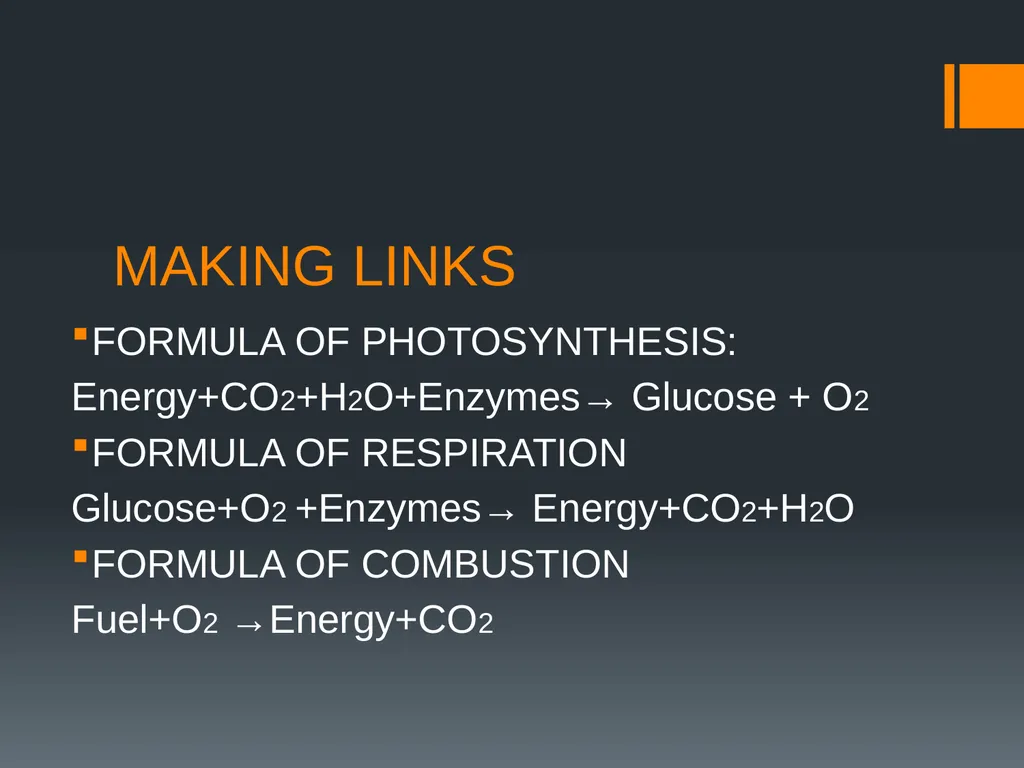
MAKING LINKS FORMULA OF PHOTOSYNTHESIS:
Energy+CO2+H2O+Enzymes→ Glucose + O2
FORMULA OF RESPIRATION
Glucose+O2 +Enzymes→ Energy+CO2+H2O
FORMULA OF COMBUSTION
Fuel+O2 →Energy+CO2<br>
Energy+CO2+H2O+Enzymes→ Glucose + O2
FORMULA OF RESPIRATION
Glucose+O2 +Enzymes→ Energy+CO2+H2O
FORMULA OF COMBUSTION
Fuel+O2 →Energy+CO2<br>
03
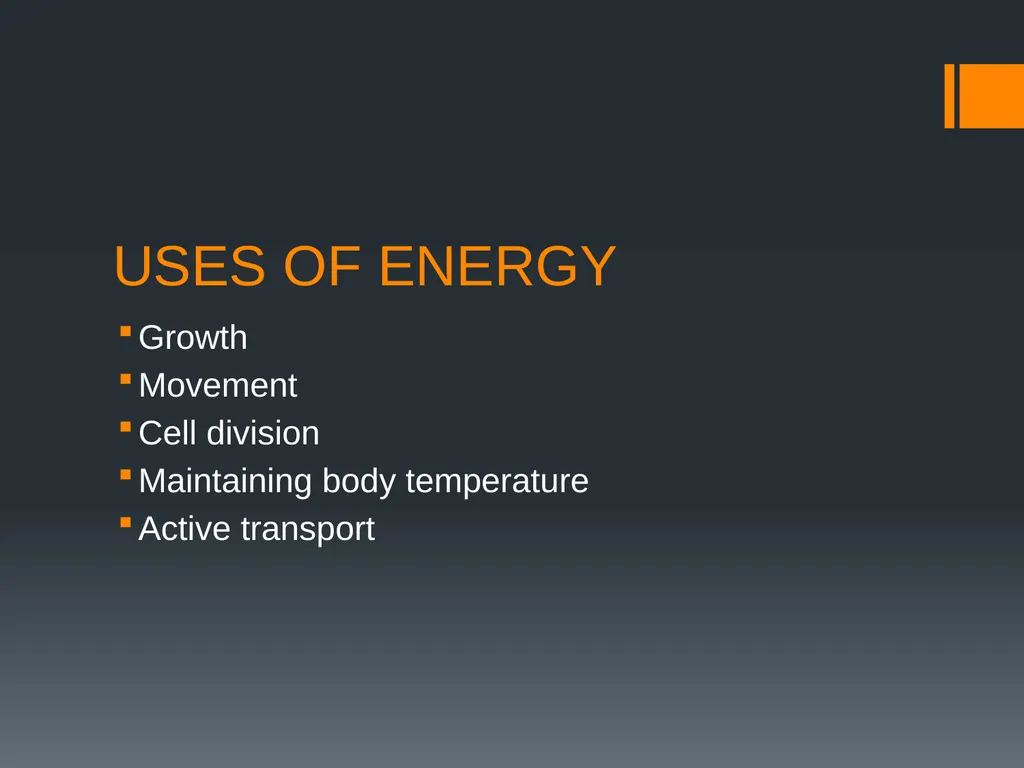
USES OF ENERGY Growth
Movement
Cell division
Maintaining body temperature
Active transport<br>
Movement
Cell division
Maintaining body temperature
Active transport<br>
04
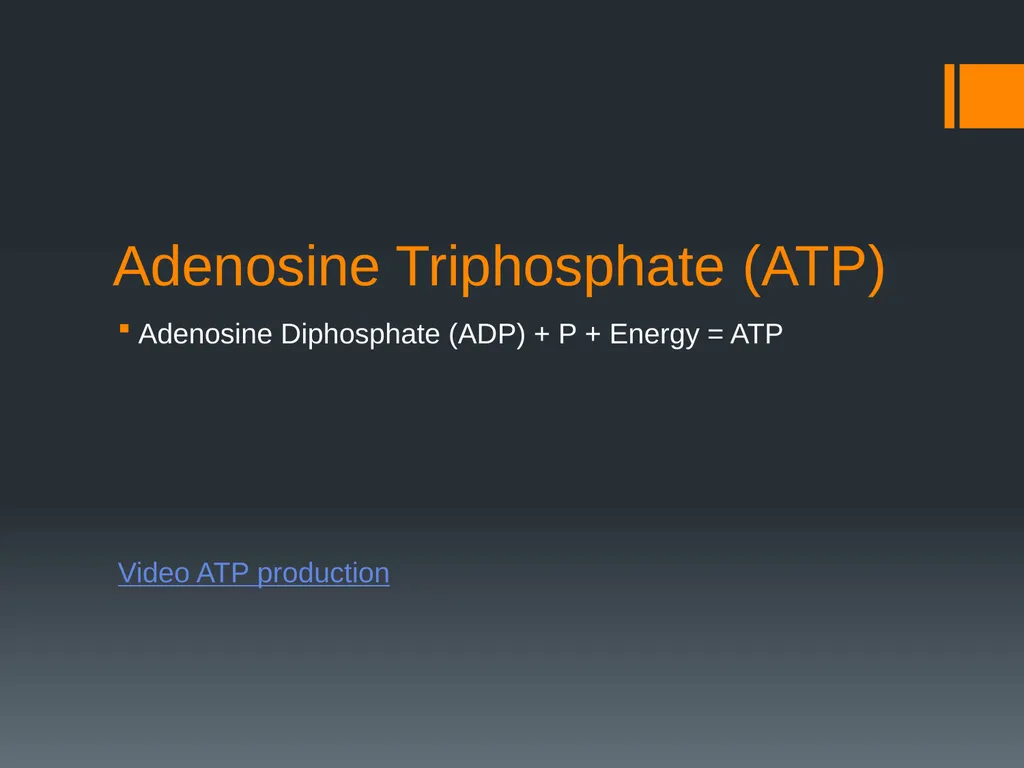
Adenosine Triphosphate (ATP) Adenosine Diphosphate (ADP) + P + Energy = ATP
Video ATP production<br>
Video ATP production<br>
05
Structure and function of a mitochondrion (The site of Aerobic respiration) Draw, label and annotate a diagram of a mitochondrion (pg 184)<br>
06
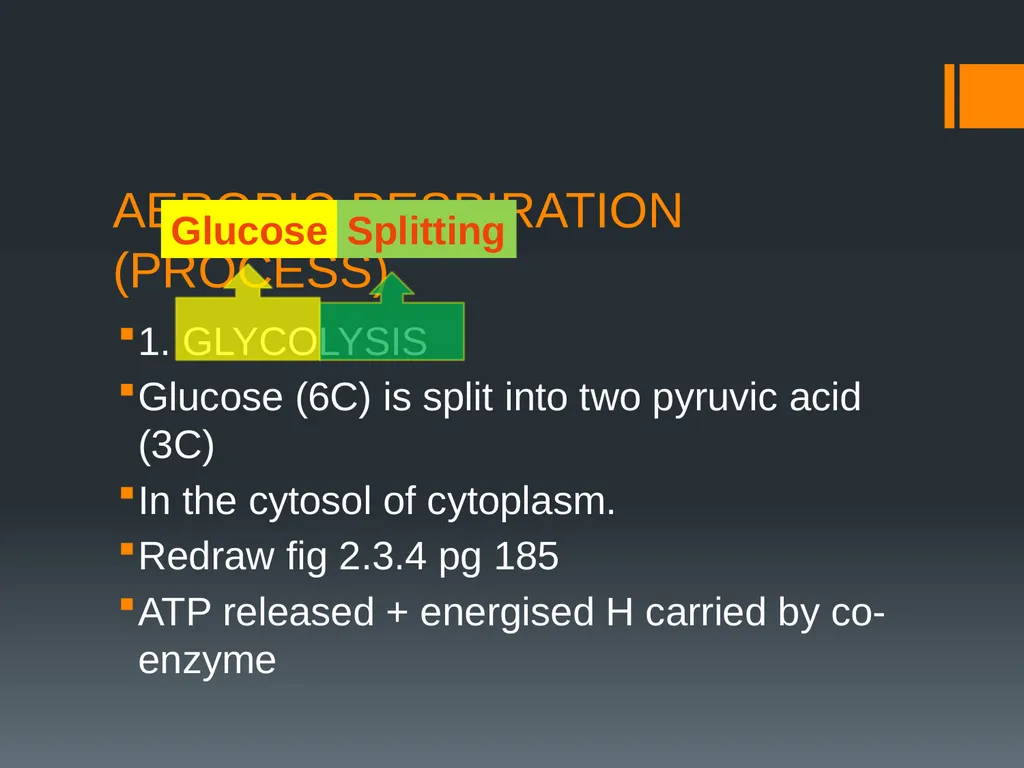
AEROBIC RESPIRATION (PROCESS) 1. GLYCOLYSIS
Glucose (6C) is split into two pyruvic acid (3C)
In the cytosol of cytoplasm.
Redraw fig 2.3.4 pg 185
ATP released + energised H carried by co-enzyme Glucose Splitting<br>
Glucose (6C) is split into two pyruvic acid (3C)
In the cytosol of cytoplasm.
Redraw fig 2.3.4 pg 185
ATP released + energised H carried by co-enzyme Glucose Splitting<br>
07
2. KREB’S CYCLE
In mitochondria
Energised H (carried by co-enzyme) and CO2 are released<br>
In mitochondria
Energised H (carried by co-enzyme) and CO2 are released<br>
08
3. OXIDATIVE PHOSPHORYLATION
In the mitochondria
Hydrogen is carried from co-enzyme to co-enzyme, releasing energy that is used to create ATP molecules.
The H eventually joins with O to form ________<br>
In the mitochondria
Hydrogen is carried from co-enzyme to co-enzyme, releasing energy that is used to create ATP molecules.
The H eventually joins with O to form ________<br>
09
ACTIVITY TIME Activity 2.3.1 pg 186 No 2 &3
Activity 2.3.4 pg 189<br>
Activity 2.3.4 pg 189<br>
10
ANAEROBIC RESPIRATION
(ABSENCE OF OXYGEN) Starts with glycolysis (same as in aerobic respiration)
IN PLANTS AND SOME MICRO-ORGANISMS:
The pyruvic acid is converted into ethanol and CO2.
IN ANIMALS:
Pyruvic acid is converted into lactic acid.<br>
IN PLANTS AND SOME MICRO-ORGANISMS:
The pyruvic acid is converted into ethanol and CO2.
IN ANIMALS:
Pyruvic acid is converted into lactic acid.<br>
11
ANAEROBIC RESPIRATION IN HUMANS Normally aerobic respiration
When too much energy needed and low supply of O2, anaerobic respiration occurs forming lactic acid.
Build up of lactic acid → Cramps
As you breathe O2 converts the lactic acid into CO2, water and glucose.<br>
When too much energy needed and low supply of O2, anaerobic respiration occurs forming lactic acid.
Build up of lactic acid → Cramps
As you breathe O2 converts the lactic acid into CO2, water and glucose.<br>
12
Anaerobic respiration in micro-organisms Yeast → bread and wine/beer
Bacteria → cheese and yoghurt Yeast (and plants):
Glucose→ pyruvic acid → ethanol and CO2
Some bacteria (and animals):
Glucose→ pyruvic acid → lactic acid<br>
Bacteria → cheese and yoghurt Yeast (and plants):
Glucose→ pyruvic acid → ethanol and CO2
Some bacteria (and animals):
Glucose→ pyruvic acid → lactic acid<br>
13
Anaerobic vs aerobic respiration SIMILARITIES:
Both need glucose and do glycolysis
CO2 released
ATP formed<br>
Both need glucose and do glycolysis
CO2 released
ATP formed<br>
14
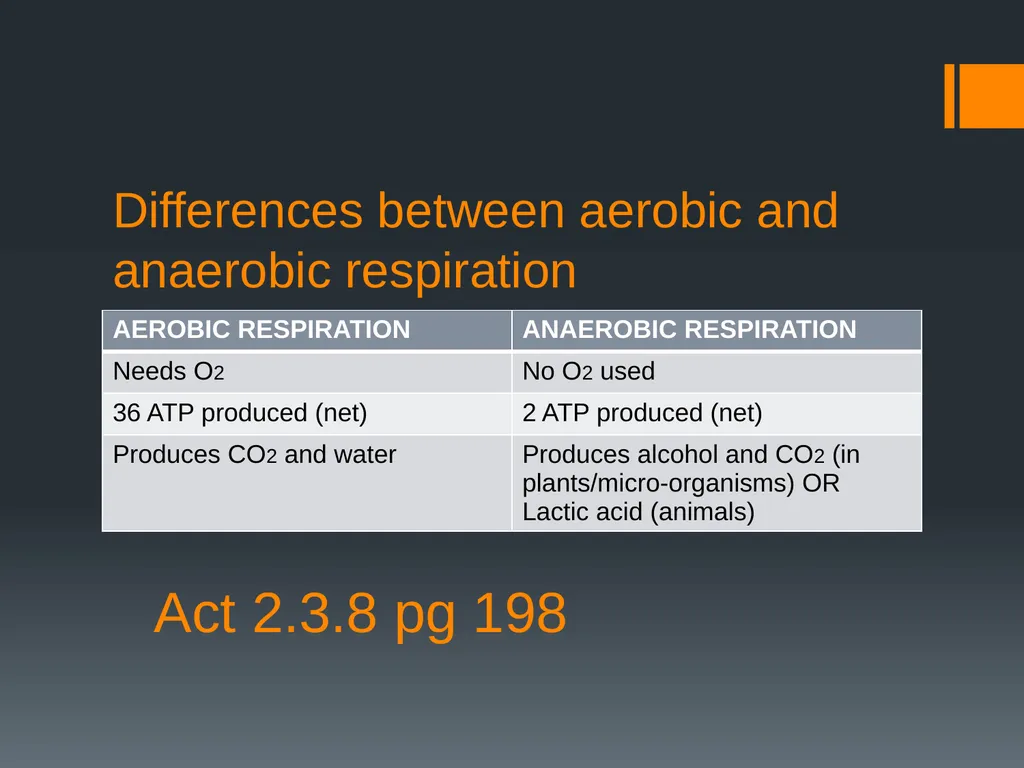
Differences between aerobic and anaerobic respiration Act 2.3.8 pg 198<br>
15
PRACTICAL WORK (Bring textbook)<br>
16
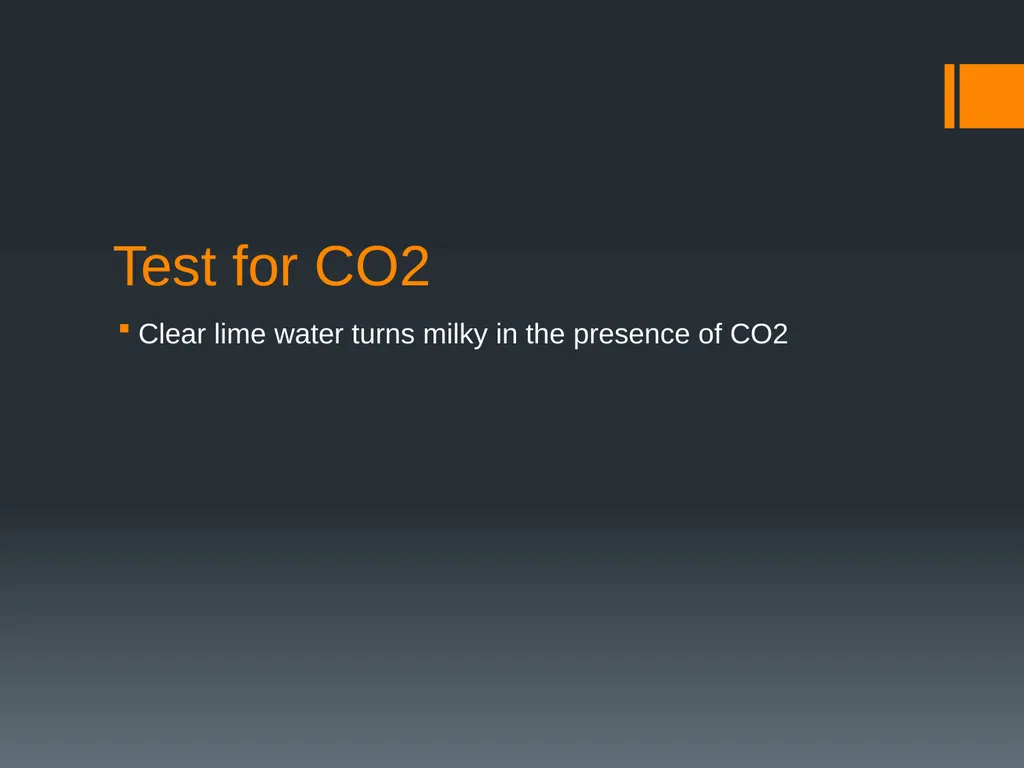
Test for CO2 Clear lime water turns milky in the presence of CO2<br>
17
ACT 2.3.3 pg 188.<br>
18
ACT 2.3.9 pg 199<br>
19
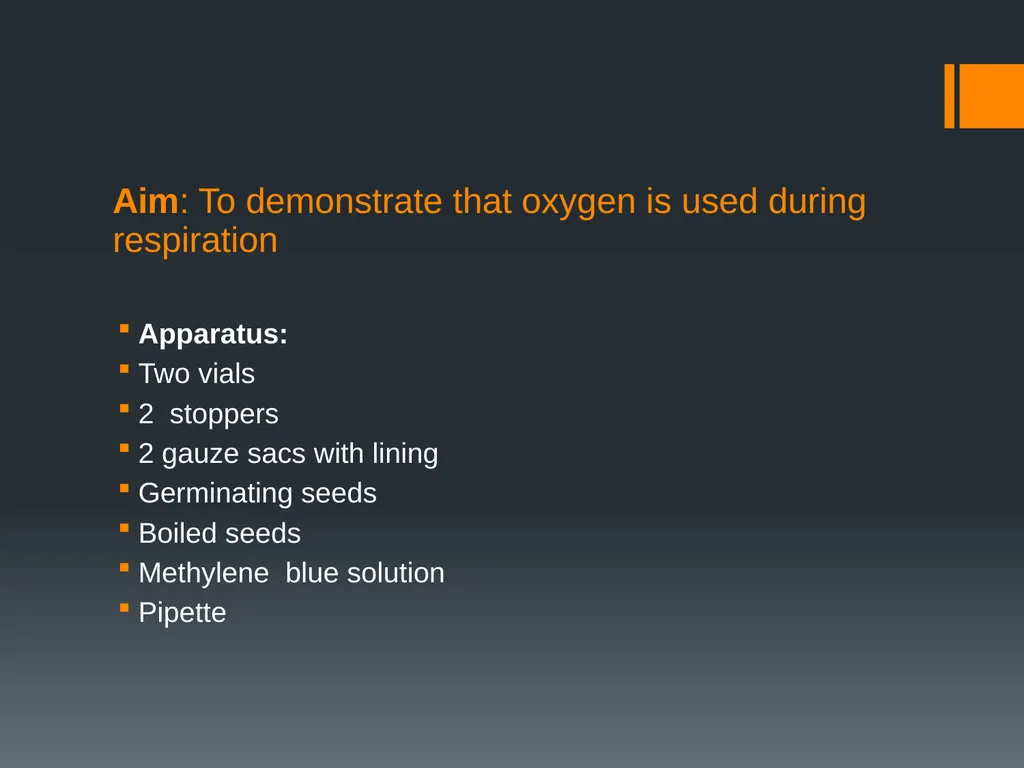
Aim: To demonstrate that oxygen is used during respiration Apparatus:
Two vials
2 stoppers
2 gauze sacs with lining
Germinating seeds
Boiled seeds
Methylene blue solution
Pipette<br>
Two vials
2 stoppers
2 gauze sacs with lining
Germinating seeds
Boiled seeds
Methylene blue solution
Pipette<br>
20
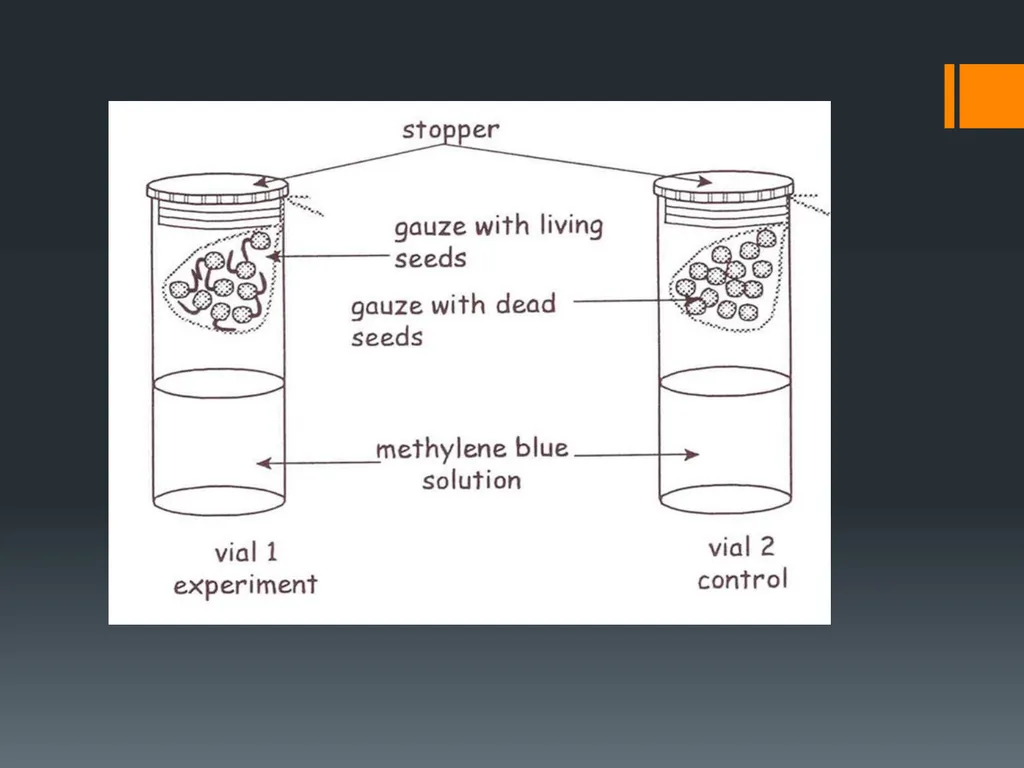
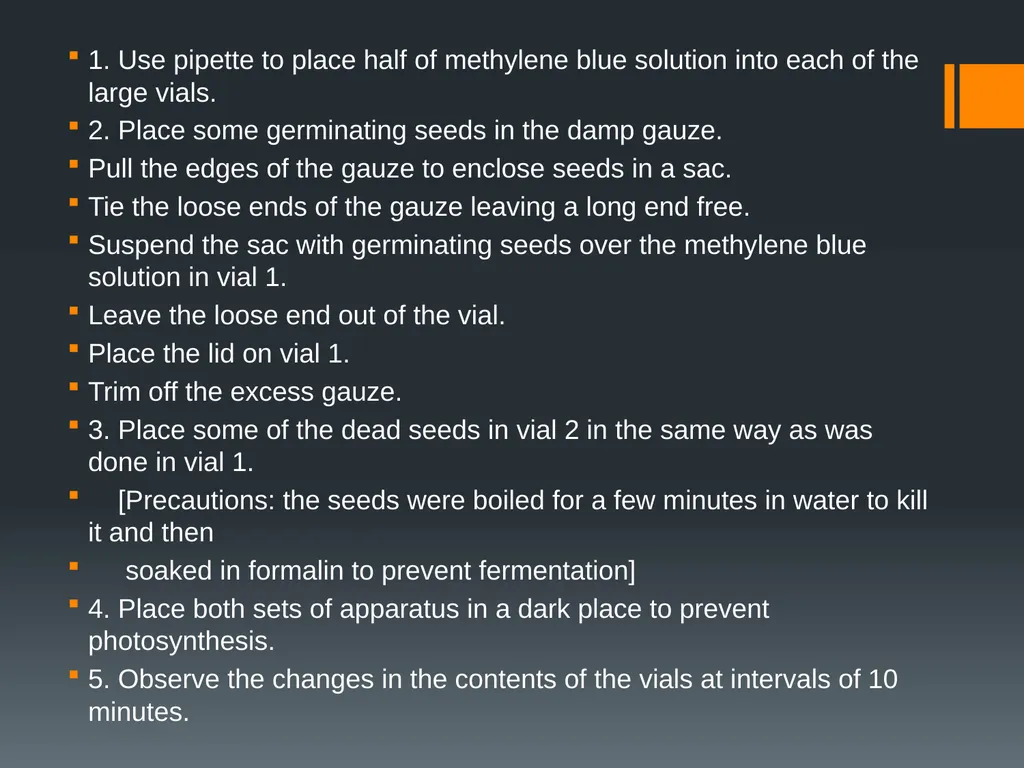
1. Use pipette to place half of methylene blue solution into each of the large vials.
2. Place some germinating seeds in the damp gauze.
Pull the edges of the gauze to enclose seeds in a sac.
Tie the loose ends of the gauze leaving a long end free.
Suspend the sac with germinating seeds over the methylene blue solution in vial 1.
Leave the loose end out of the vial.
Place the lid on vial 1.
Trim off the excess gauze.
3. Place some of the dead seeds in vial 2 in the same way as was done in vial 1.
[Precautions: the seeds were boiled for a few minutes in water to kill it and then
soaked in formalin to prevent fermentation]
4. Place both sets of apparatus in a dark place to prevent photosynthesis.
5. Observe the changes in the contents of the vials at intervals of 10 minutes.<br>
2. Place some germinating seeds in the damp gauze.
Pull the edges of the gauze to enclose seeds in a sac.
Tie the loose ends of the gauze leaving a long end free.
Suspend the sac with germinating seeds over the methylene blue solution in vial 1.
Leave the loose end out of the vial.
Place the lid on vial 1.
Trim off the excess gauze.
3. Place some of the dead seeds in vial 2 in the same way as was done in vial 1.
[Precautions: the seeds were boiled for a few minutes in water to kill it and then
soaked in formalin to prevent fermentation]
4. Place both sets of apparatus in a dark place to prevent photosynthesis.
5. Observe the changes in the contents of the vials at intervals of 10 minutes.<br>
21
NOTE:
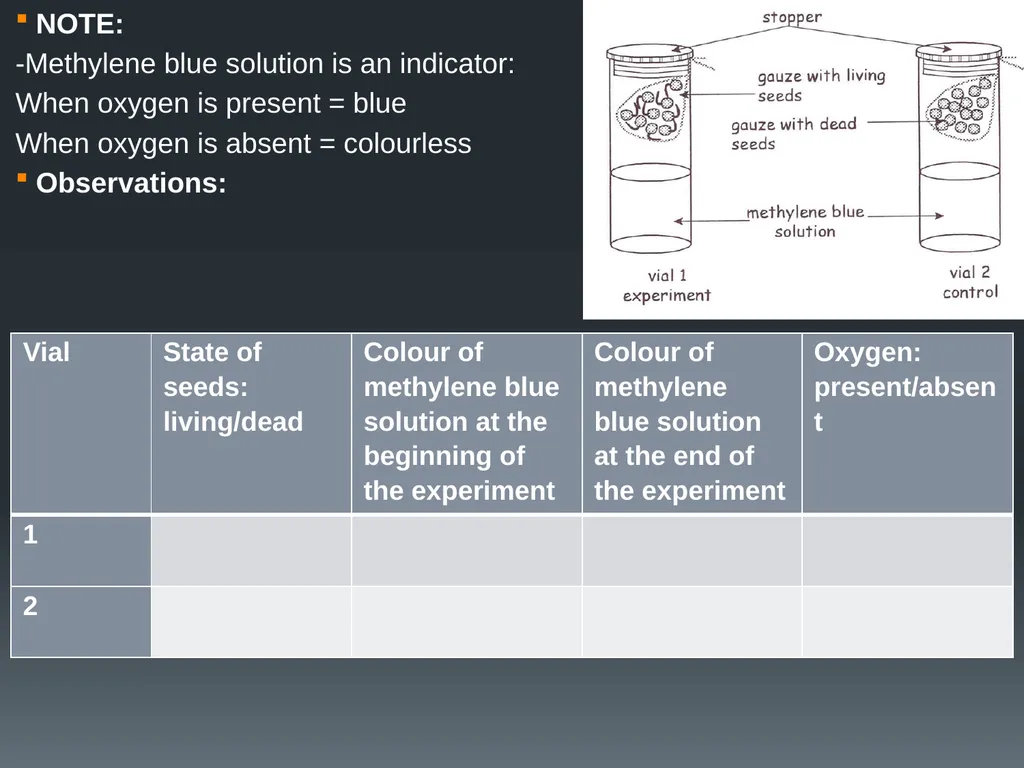
-Methylene blue solution is an indicator:
When oxygen is present = blue
When oxygen is absent = colourless
Observations:<br>
-Methylene blue solution is an indicator:
When oxygen is present = blue
When oxygen is absent = colourless
Observations:<br>
22
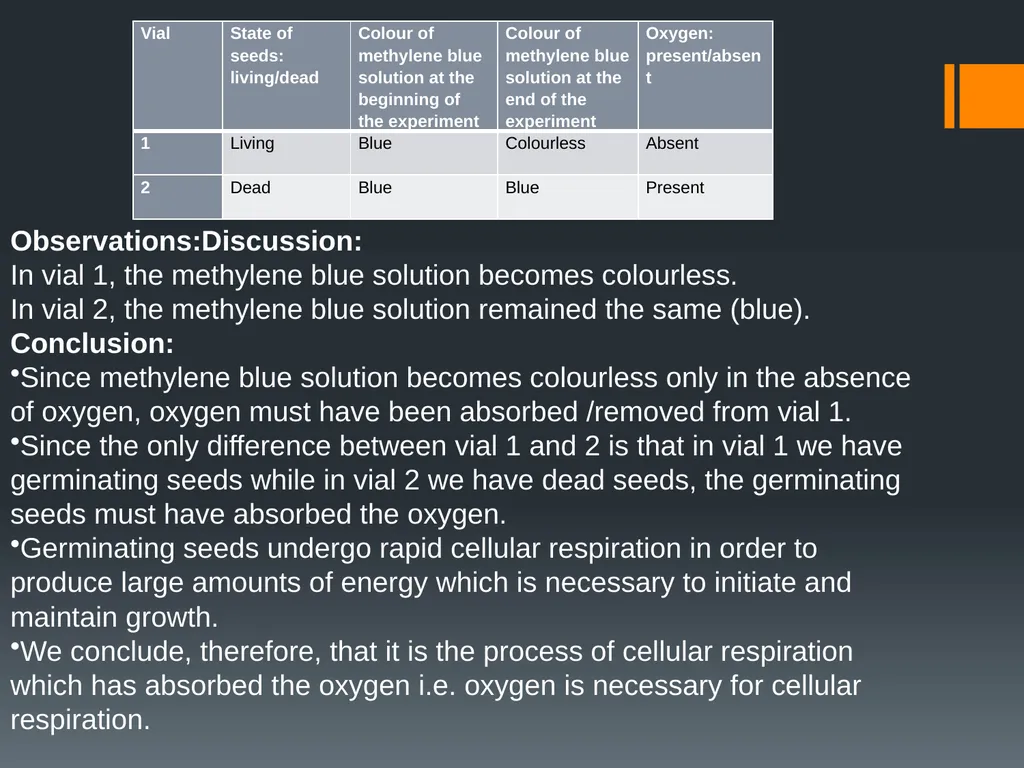
Observations:Discussion:
In vial 1, the methylene blue solution becomes colourless.
In vial 2, the methylene blue solution remained the same (blue).
Conclusion:
Since methylene blue solution becomes colourless only in the absence of oxygen, oxygen must have been absorbed /removed from vial 1.
Since the only difference between vial 1 and 2 is that in vial 1 we have germinating seeds while in vial 2 we have dead seeds, the germinating seeds must have absorbed the oxygen.
Germinating seeds undergo rapid cellular respiration in order to produce large amounts of energy which is necessary to initiate and maintain growth.
We conclude, therefore, that it is the process of cellular respiration which has absorbed the oxygen i.e. oxygen is necessary for cellular respiration.<br>
In vial 1, the methylene blue solution becomes colourless.
In vial 2, the methylene blue solution remained the same (blue).
Conclusion:
Since methylene blue solution becomes colourless only in the absence of oxygen, oxygen must have been absorbed /removed from vial 1.
Since the only difference between vial 1 and 2 is that in vial 1 we have germinating seeds while in vial 2 we have dead seeds, the germinating seeds must have absorbed the oxygen.
Germinating seeds undergo rapid cellular respiration in order to produce large amounts of energy which is necessary to initiate and maintain growth.
We conclude, therefore, that it is the process of cellular respiration which has absorbed the oxygen i.e. oxygen is necessary for cellular respiration.<br>
23
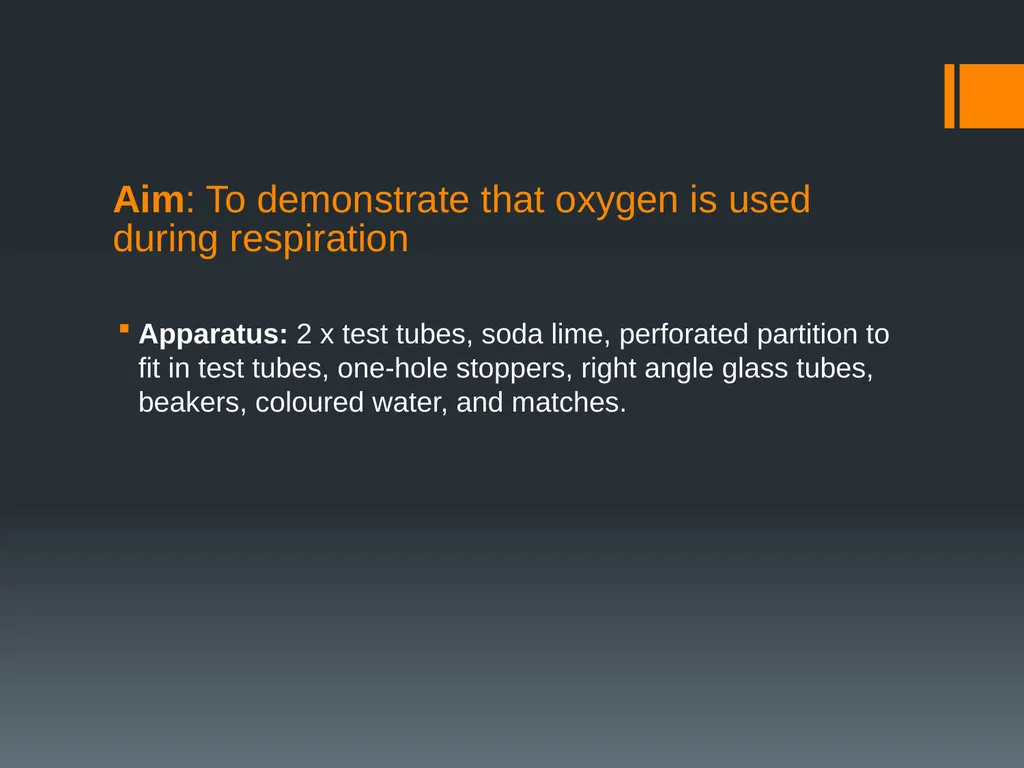
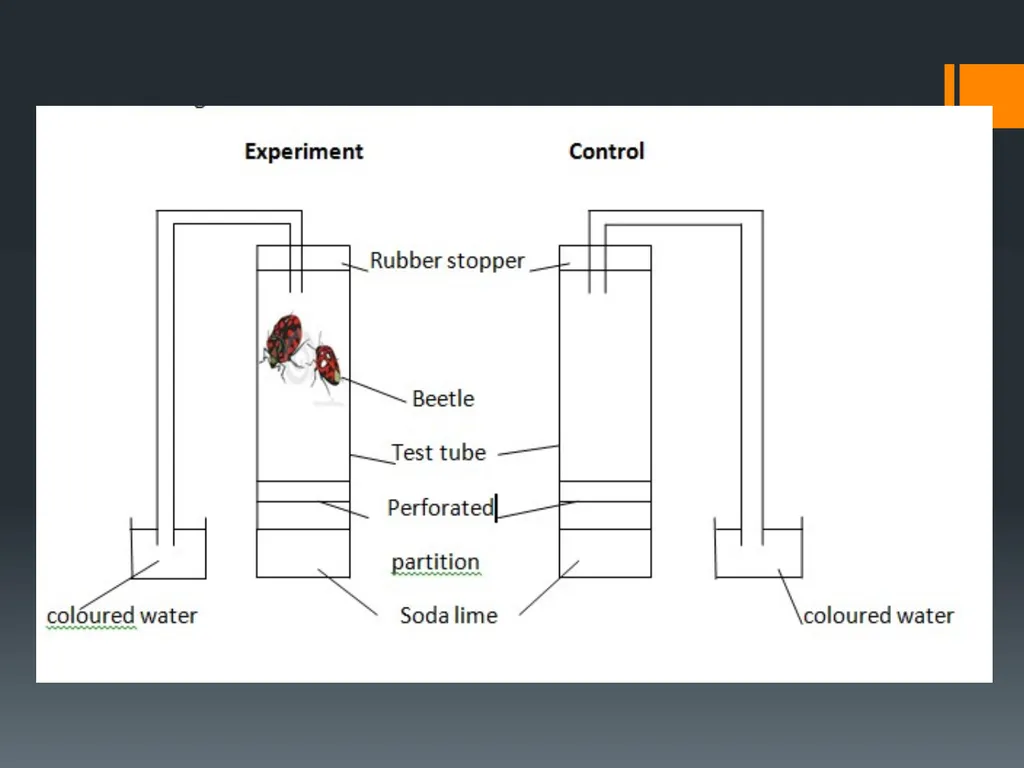
Aim: To demonstrate that oxygen is used during respiration Apparatus: 2 x test tubes, soda lime, perforated partition to fit in test tubes, one-hole stoppers, right angle glass tubes, beakers, coloured water, and matches.<br>
24
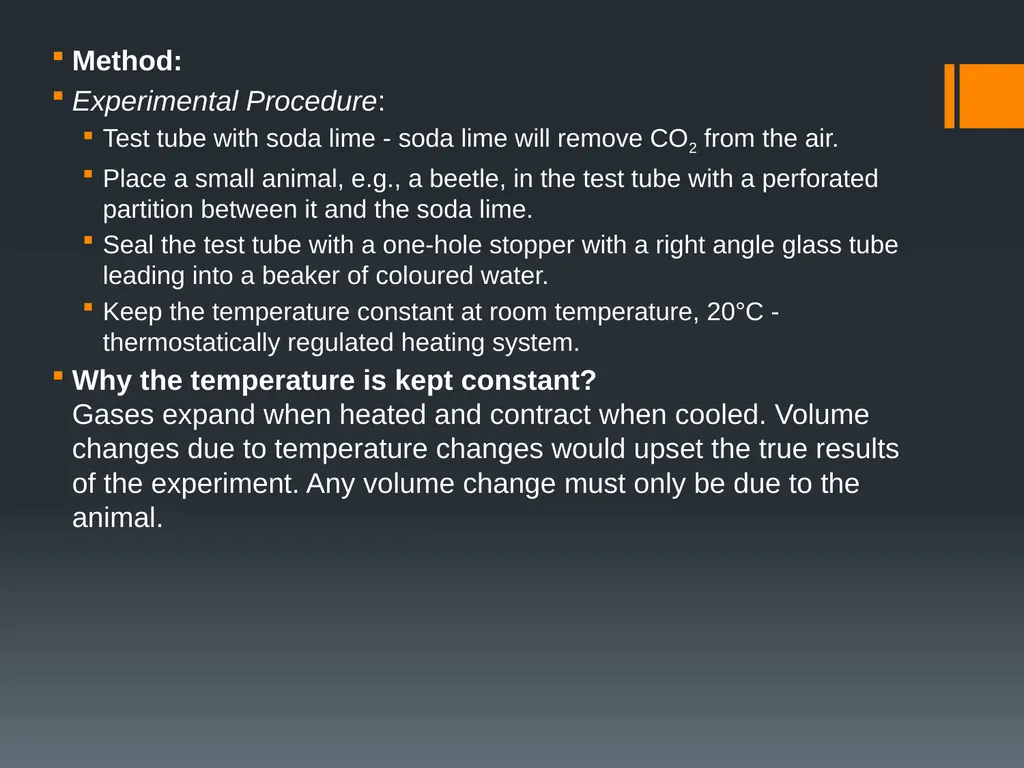
Method:
Experimental Procedure:
Test tube with soda lime - soda lime will remove CO2 from the air.
Place a small animal, e.g., a beetle, in the test tube with a perforated partition between it and the soda lime.
Seal the test tube with a one-hole stopper with a right angle glass tube leading into a beaker of coloured water.
Keep the temperature constant at room temperature, 20°C - thermostatically regulated heating system.
Why the temperature is kept constant? Gases expand when heated and contract when cooled. Volume changes due to temperature changes would upset the true results of the experiment. Any volume change must only be due to the animal.<br>
Experimental Procedure:
Test tube with soda lime - soda lime will remove CO2 from the air.
Place a small animal, e.g., a beetle, in the test tube with a perforated partition between it and the soda lime.
Seal the test tube with a one-hole stopper with a right angle glass tube leading into a beaker of coloured water.
Keep the temperature constant at room temperature, 20°C - thermostatically regulated heating system.
Why the temperature is kept constant? Gases expand when heated and contract when cooled. Volume changes due to temperature changes would upset the true results of the experiment. Any volume change must only be due to the animal.<br>
25
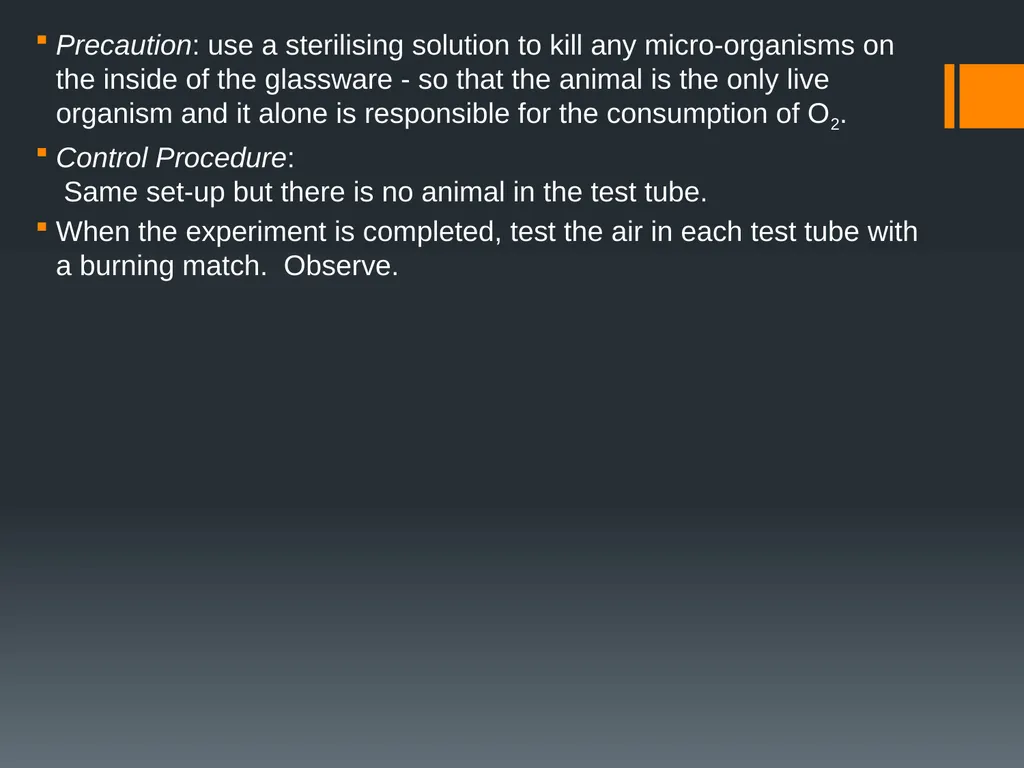
Precaution: use a sterilising solution to kill any micro-organisms on the inside of the glassware - so that the animal is the only live organism and it alone is responsible for the consumption of O2.
Control Procedure: Same set-up but there is no animal in the test tube.
When the experiment is completed, test the air in each test tube with a burning match. Observe.<br>
Control Procedure: Same set-up but there is no animal in the test tube.
When the experiment is completed, test the air in each test tube with a burning match. Observe.<br>
26
Observations:
___________________________________________________________________
___________________________________________________________________
___________________________________________________________________
Discussion:
___________________________________________________________________
___________________________________________________________________
Conclusion:
___________________________________________________________________
___________________________________________________________________
___________________________________________________________________
___________________________________________________________________<br>
___________________________________________________________________
___________________________________________________________________
___________________________________________________________________
Discussion:
___________________________________________________________________
___________________________________________________________________
Conclusion:
___________________________________________________________________
___________________________________________________________________
___________________________________________________________________
___________________________________________________________________<br>
27
Observations:
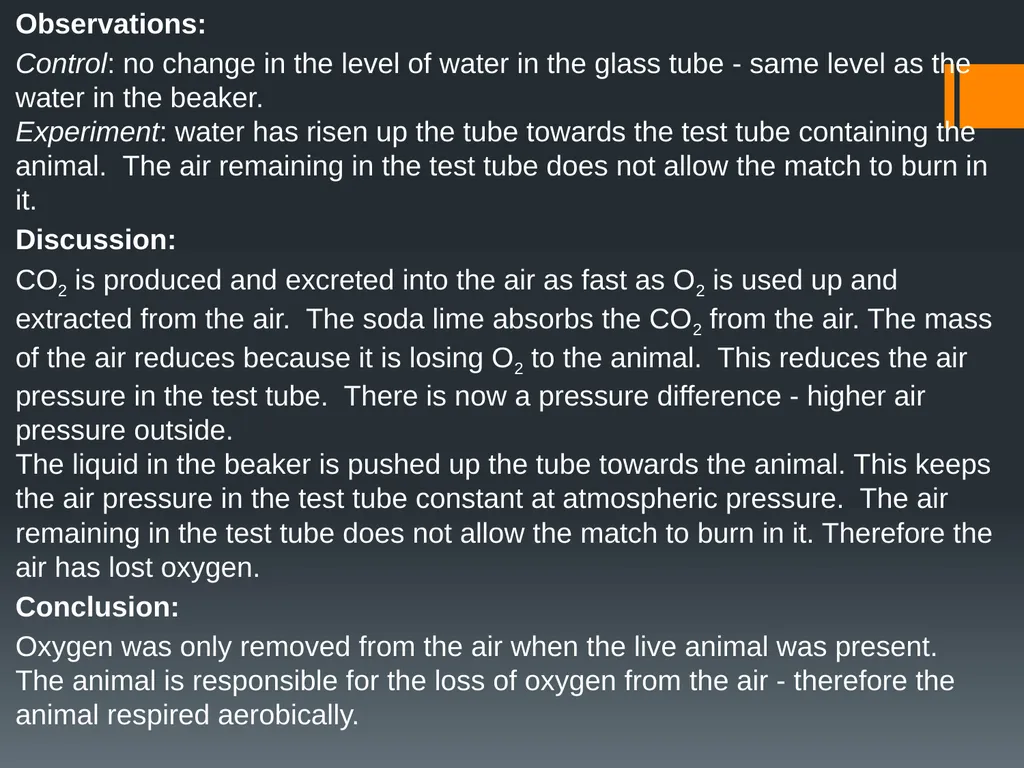
Control: no change in the level of water in the glass tube - same level as the water in the beaker. Experiment: water has risen up the tube towards the test tube containing the animal. The air remaining in the test tube does not allow the match to burn in it.
Discussion:
CO2 is produced and excreted into the air as fast as O2 is used up and extracted from the air. The soda lime absorbs the CO2 from the air. The mass of the air reduces because it is losing O2 to the animal. This reduces the air pressure in the test tube. There is now a pressure difference - higher air pressure outside. The liquid in the beaker is pushed up the tube towards the animal. This keeps the air pressure in the test tube constant at atmospheric pressure. The air remaining in the test tube does not allow the match to burn in it. Therefore the air has lost oxygen.
Conclusion:
Oxygen was only removed from the air when the live animal was present. The animal is responsible for the loss of oxygen from the air - therefore the animal respired aerobically.<br>
Control: no change in the level of water in the glass tube - same level as the water in the beaker. Experiment: water has risen up the tube towards the test tube containing the animal. The air remaining in the test tube does not allow the match to burn in it.
Discussion:
CO2 is produced and excreted into the air as fast as O2 is used up and extracted from the air. The soda lime absorbs the CO2 from the air. The mass of the air reduces because it is losing O2 to the animal. This reduces the air pressure in the test tube. There is now a pressure difference - higher air pressure outside. The liquid in the beaker is pushed up the tube towards the animal. This keeps the air pressure in the test tube constant at atmospheric pressure. The air remaining in the test tube does not allow the match to burn in it. Therefore the air has lost oxygen.
Conclusion:
Oxygen was only removed from the air when the live animal was present. The animal is responsible for the loss of oxygen from the air - therefore the animal respired aerobically.<br>
28
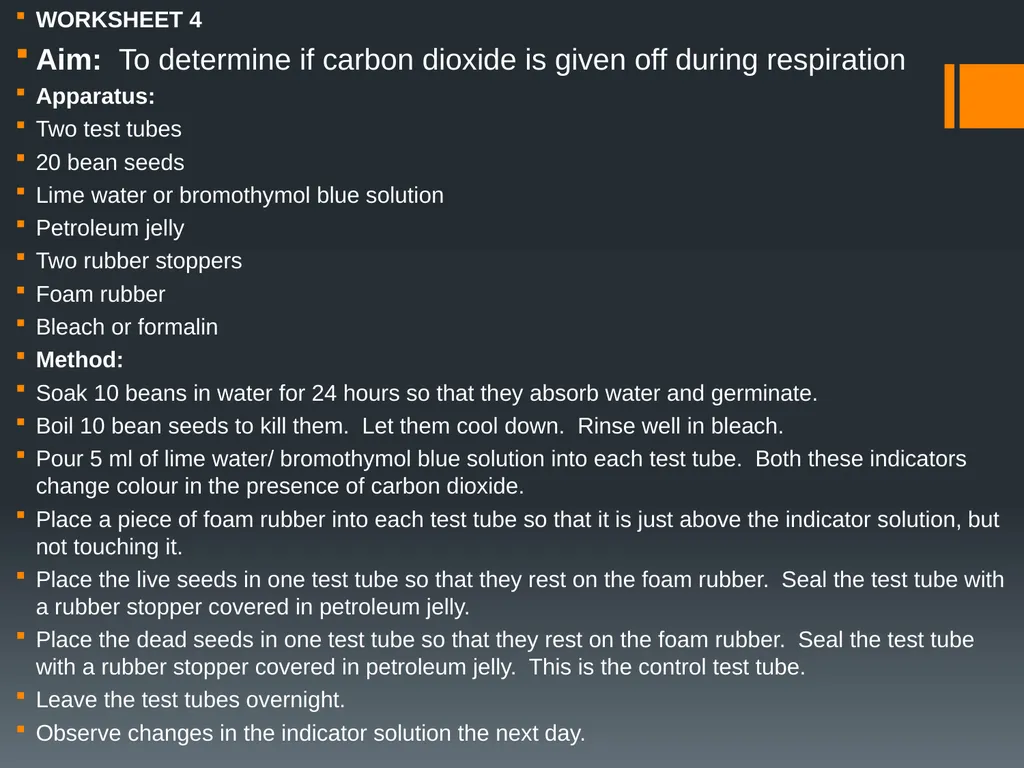
WORKSHEET 4
Aim: To determine if carbon dioxide is given off during respiration
Apparatus:
Two test tubes
20 bean seeds
Lime water or bromothymol blue solution
Petroleum jelly
Two rubber stoppers
Foam rubber
Bleach or formalin
Method:
Soak 10 beans in water for 24 hours so that they absorb water and germinate.
Boil 10 bean seeds to kill them. Let them cool down. Rinse well in bleach.
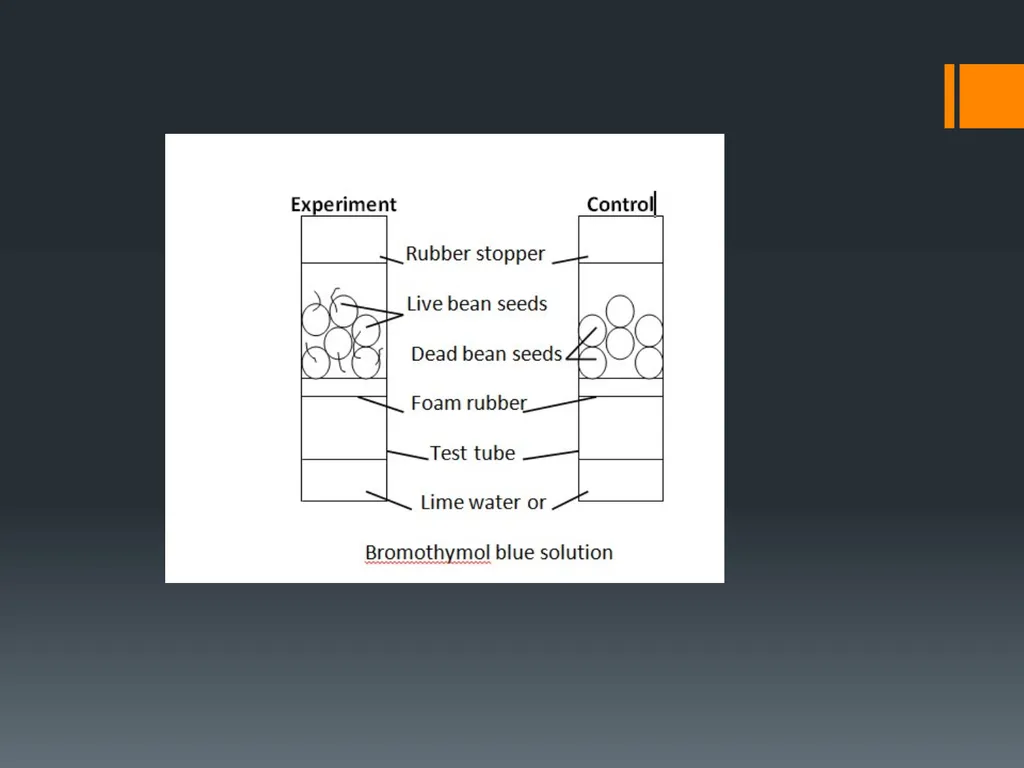
Pour 5 ml of lime water/ bromothymol blue solution into each test tube. Both these indicators change colour in the presence of carbon dioxide.
Place a piece of foam rubber into each test tube so that it is just above the indicator solution, but not touching it.
Place the live seeds in one test tube so that they rest on the foam rubber. Seal the test tube with a rubber stopper covered in petroleum jelly.
Place the dead seeds in one test tube so that they rest on the foam rubber. Seal the test tube with a rubber stopper covered in petroleum jelly. This is the control test tube.
Leave the test tubes overnight.
Observe changes in the indicator solution the next day.<br>
Aim: To determine if carbon dioxide is given off during respiration
Apparatus:
Two test tubes
20 bean seeds
Lime water or bromothymol blue solution
Petroleum jelly
Two rubber stoppers
Foam rubber
Bleach or formalin
Method:
Soak 10 beans in water for 24 hours so that they absorb water and germinate.
Boil 10 bean seeds to kill them. Let them cool down. Rinse well in bleach.
Pour 5 ml of lime water/ bromothymol blue solution into each test tube. Both these indicators change colour in the presence of carbon dioxide.
Place a piece of foam rubber into each test tube so that it is just above the indicator solution, but not touching it.
Place the live seeds in one test tube so that they rest on the foam rubber. Seal the test tube with a rubber stopper covered in petroleum jelly.
Place the dead seeds in one test tube so that they rest on the foam rubber. Seal the test tube with a rubber stopper covered in petroleum jelly. This is the control test tube.
Leave the test tubes overnight.
Observe changes in the indicator solution the next day.<br>
29
Observations
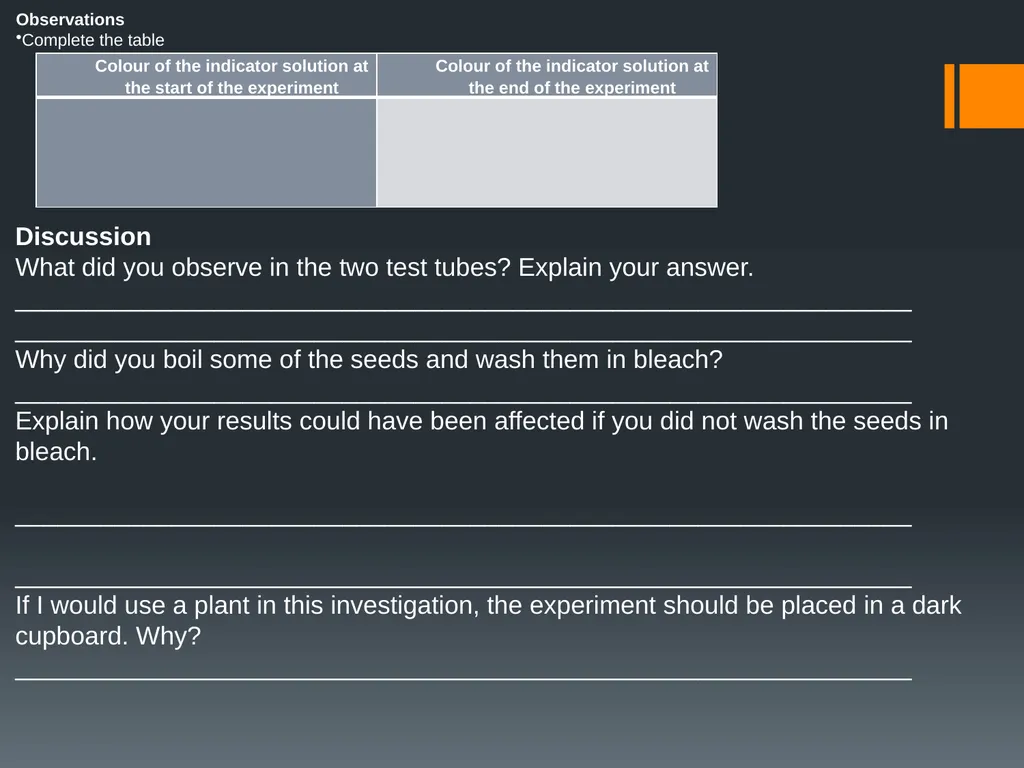
Complete the table Discussion
What did you observe in the two test tubes? Explain your answer.
_______________________________________________________________
_______________________________________________________________
Why did you boil some of the seeds and wash them in bleach?
_______________________________________________________________
Explain how your results could have been affected if you did not wash the seeds in bleach.
_______________________________________________________________
_______________________________________________________________
If I would use a plant in this investigation, the experiment should be placed in a dark cupboard. Why?
_______________________________________________________________<br>
Complete the table Discussion
What did you observe in the two test tubes? Explain your answer.
_______________________________________________________________
_______________________________________________________________
Why did you boil some of the seeds and wash them in bleach?
_______________________________________________________________
Explain how your results could have been affected if you did not wash the seeds in bleach.
_______________________________________________________________
_______________________________________________________________
If I would use a plant in this investigation, the experiment should be placed in a dark cupboard. Why?
_______________________________________________________________<br>
30
Discussion
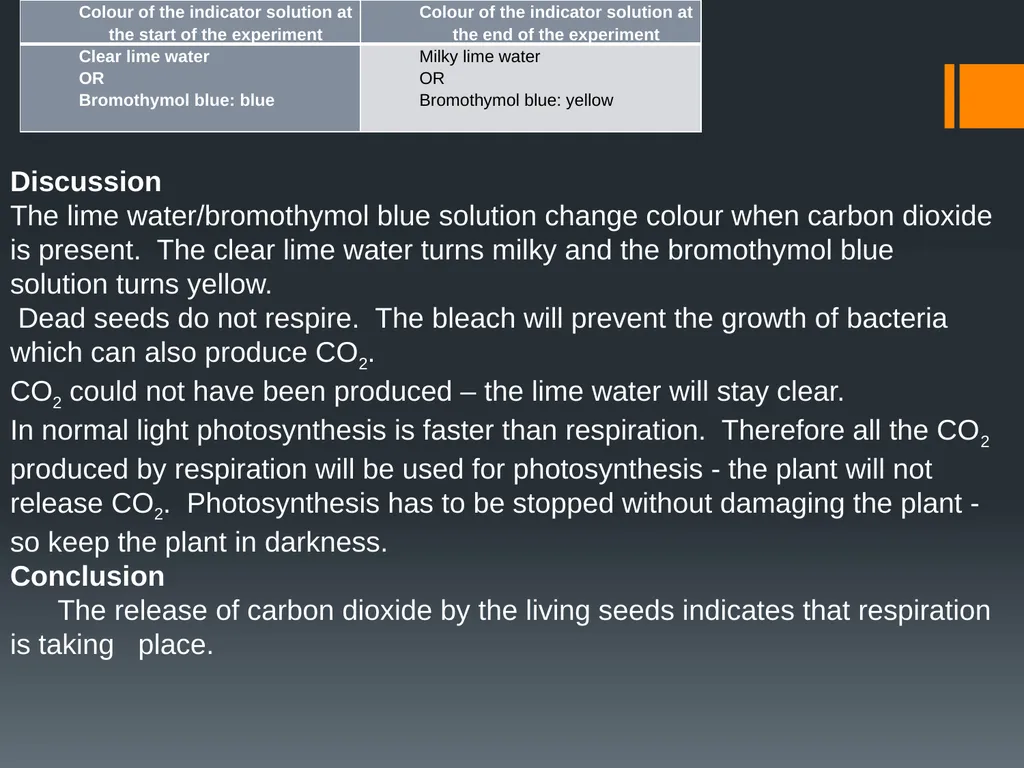
The lime water/bromothymol blue solution change colour when carbon dioxide is present. The clear lime water turns milky and the bromothymol blue solution turns yellow.
Dead seeds do not respire. The bleach will prevent the growth of bacteria which can also produce CO2.
CO2 could not have been produced – the lime water will stay clear.
In normal light photosynthesis is faster than respiration. Therefore all the CO2 produced by respiration will be used for photosynthesis - the plant will not release CO2. Photosynthesis has to be stopped without damaging the plant - so keep the plant in darkness.
Conclusion
The release of carbon dioxide by the living seeds indicates that respiration is taking place.<br>
The lime water/bromothymol blue solution change colour when carbon dioxide is present. The clear lime water turns milky and the bromothymol blue solution turns yellow.
Dead seeds do not respire. The bleach will prevent the growth of bacteria which can also produce CO2.
CO2 could not have been produced – the lime water will stay clear.
In normal light photosynthesis is faster than respiration. Therefore all the CO2 produced by respiration will be used for photosynthesis - the plant will not release CO2. Photosynthesis has to be stopped without damaging the plant - so keep the plant in darkness.
Conclusion
The release of carbon dioxide by the living seeds indicates that respiration is taking place.<br>