CENTRIFUGATION B.KRISHNAVENI DEPARTMENT OF MICROBIOLOGY DNR COLLEGE . The mechanical process of centrifugation separates particles from a solution based on the particles size, shape, density, medium viscosity, and rotor speed. While the
"CENTRIFUGATION B.KRISHNAVENI DEPARTMENT OF" is the property of its rightful owner. Permission is granted to
download and print the materials on this website for personal, non-commercial use only, and to display it
on your personal computer provided you do not modify the materials and that you retain all copyright
notices contained in the materials. By downloading content from our website, you accept the terms of this
agreement.
Presentation Transcript
01
CENTRIFUGATION B.KRISHNAVENI
DEPARTMENT OF MICROBIOLOGY
DNR COLLEGE
.<br>
02
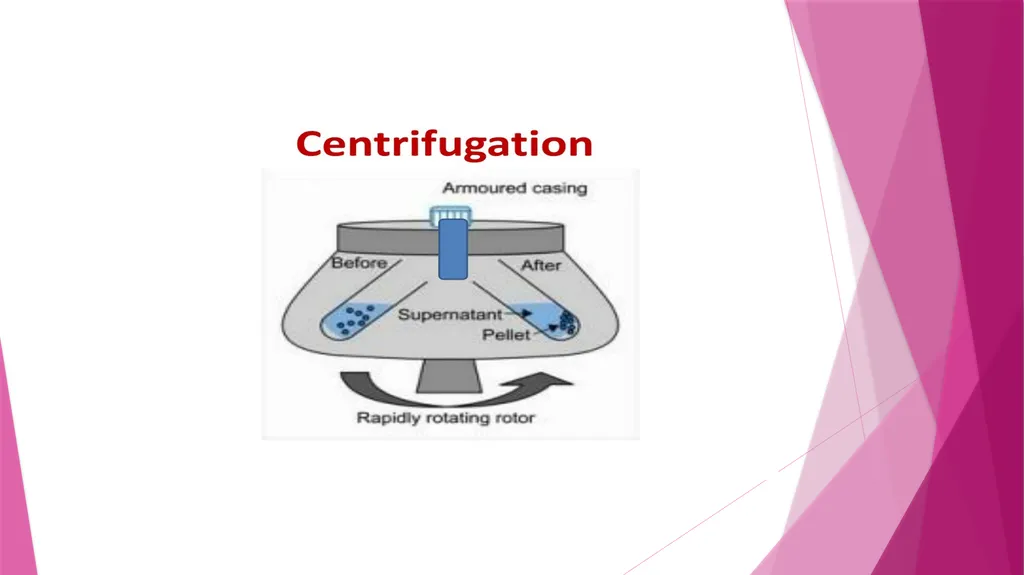
The mechanical process of centrifugation separates particles from a solution based on the particles’ size, shape, density, medium viscosity, and rotor speed. While the less dense components of the mixture move closer to the centrifuge’s axis, the denser components move farther away from it. Using centrifugal acceleration, centrifugation separates phases (liquid-liquid or solid-liquid) with different densities Centrifugation Definition<br>
03
Sedimentation is the centrifuge’s operating method. The centrifugation method operates under the premise that particles suspended in liquid media can be separated using a centrifugal field. These are put in the rotor of the centrifuge in tubes or bottles. Gravity causes suspended particles to settle out of fluids through sedimentation. Clay or powder particles could be suspended substances. Think of tea leaves settling to the bottom of a teacup as an illustration. Centrifugation Principle<br>
04
Smaller particles do not sediment under gravity; they are separated from bigger particles by a straightforward filtration procedure. Those particles can be separated using the central force.
The rate of particle sediment depends upon the:
RCFs in the centrifuge
size of particle
liquid viscosity
particle density and liquid density<br>
05
Density gradient centrifugation is the separation of molecules where the separation is based on the density of the molecules as they pass through a density gradient under a centrifugal force. Density gradient centrifugation Principle of Density gradient centrifugation Density gradient centrifugation is based on the principle that molecules settle down under a centrifugal force until they reach a medium with the density the same as theirs.
In this case, a medium with a density gradient is employed, which either has to decrease density or increasing density.
Molecules in a sample move through the medium as the sample is rotated creating a centrifugal force.<br>
06
The more dense molecules begin to move towards the bottom as they move through the density gradient.
The molecules then become suspended at a point in which the density of the particles equals the surrounding medium.
In this way, molecules with different densities are separated at different layers which can then be recovered by various processes.<br>
07
Steps of Density gradient centrifugation A density gradient of a medium is created by gently laying the lower concentration over the higher concentrations in a centrifuge tube.
The sample is then placed over the gradient, and the tubes are placed in an ultracentrifuge.
The particles travel through the gradient until they reach a point at which their density matches the density of the surrounding medium.
The fractions are removed and separated, obtaining the particles as isolated units<br>
08
Differential centrifugation Differential centrifugation is a type of centrifugation process in which components are separately settled down a centrifuge tube by applying a series of increasing centrifugal force Principle of Differential centrifugation Differential centrifugation is based upon the differences in the sedimentation rate of biological particles of different size and density.
As the increasing centrifugal force is applied, initial sedimentation of the larger molecules takes place.<br>
09
Further particles settle down depending upon the speed and time of individual centrifugation steps and the density and relative size of the particles.
The largest class of particles forms a pellet on the bottom of the centrifuge tube, leaving smaller-sized structures within the supernatant.
Thus, larger molecules sediment quickly and at lower centrifugal forces whereas the smaller molecules take longer time and higher forces.
In the case of particles that are less dense than the medium, the particles will float instead of settling<br>
10
Steps of Differential centrifugation The sample solution is homogenized in the medium containing buffer.
The sample is then placed in the centrifuge tube, which is operated at a particular centrifugal force for a specific time at a particular temperature.
By the end of this operation, a pellet will be formed at the bottom of the tube, which is separated from the supernatant.
The supernatant is added to a new centrifuge tube where it is centrifuged at another speed for a particular time and particular temperature.
Again, the supernatant is separated from the pellets formed.
These steps are continued until all particles are separated from each other.
The particles can then be identified by testing for indicators that are unique to the specific particle<br>
11
Applications of Centrifugation To separate two miscible substances
To analyze the hydrodynamic properties of macromolecules
Purification of mammalian cells
Fractionation of subcellular organelles (including membranes/membrane fractions) Fractionation of membrane vesicles
Separating chalk powder from water
Removing fat from milk to produce skimmed milk
Separating particles from an air-flow using cyclonic separation
The clarification and stabilization of wine
Separation of urine components and blood components in forensic and research laboratories<br>