
CEPS Task Force on Strengthening the EU Transition
TD
Published · 26 slides · 0 views
1 / 1


Description
CEPS Task Force on Strengthening the EU Transition to a Quantum Safe World Technology, Market, Governance and Policy Challenges 3 December 2025 Lorenzo Pupillo, Associate Senior Research Fellow and Head of the CybersecurityCEPS Initiative
Related Topics
Share
Embed code
Download this presentation From Below
"CEPS Task Force on Strengthening the EU Transition" is the property of its rightful owner. Permission is granted to download and print the materials on this website for personal, non-commercial use only, and to display it on your personal computer provided you do not modify the materials and that you retain all copyright notices contained in the materials. By downloading content from our website, you accept the terms of this agreement.
Presentation Transcript
01
CEPS Task Force on Strengthening the EU Transition to a Quantum Safe World
Technology, Market, Governance and Policy Challenges
3 December 2025
Lorenzo Pupillo, Associate Senior Research Fellow and Head of the Cybersecurity@CEPS Initiative
Centre for European Policy Studies (CEPS)<br>
Technology, Market, Governance and Policy Challenges
3 December 2025
Lorenzo Pupillo, Associate Senior Research Fellow and Head of the Cybersecurity@CEPS Initiative
Centre for European Policy Studies (CEPS)<br>
02
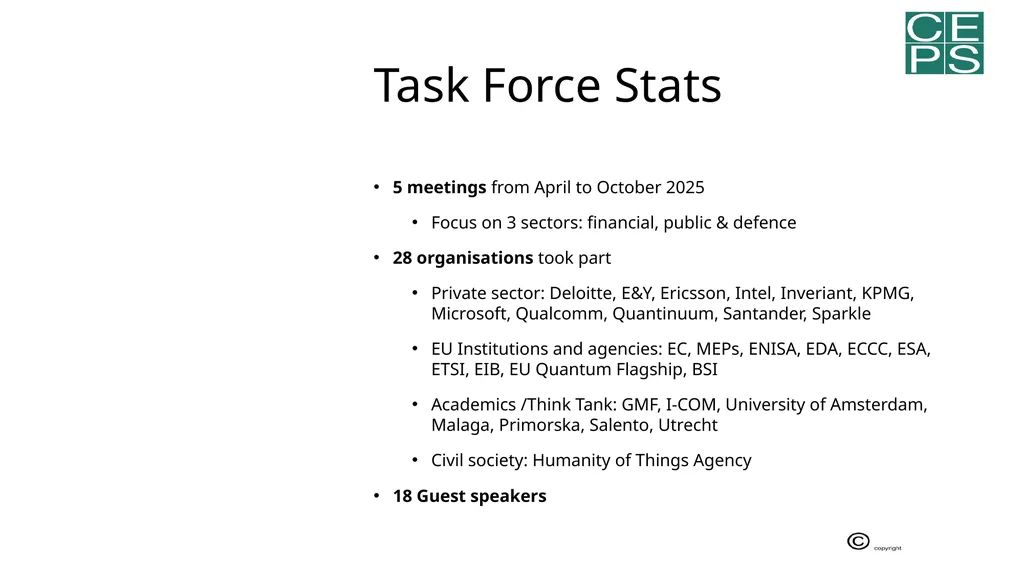
Task Force Stats 5 meetings from April to October 2025
Focus on 3 sectors: financial, public & defence
28 organisations took part
Private sector: Deloitte, E&Y, Ericsson, Intel, Inveriant, KPMG, Microsoft, Qualcomm, Quantinuum, Santander, Sparkle
EU Institutions and agencies: EC, MEPs, ENISA, EDA, ECCC, ESA, ETSI, EIB, EU Quantum Flagship, BSI
Academics /Think Tank: GMF, I-COM, University of Amsterdam, Malaga, Primorska, Salento, Utrecht
Civil society: Humanity of Things Agency
18 Guest speakers<br>
Focus on 3 sectors: financial, public & defence
28 organisations took part
Private sector: Deloitte, E&Y, Ericsson, Intel, Inveriant, KPMG, Microsoft, Qualcomm, Quantinuum, Santander, Sparkle
EU Institutions and agencies: EC, MEPs, ENISA, EDA, ECCC, ESA, ETSI, EIB, EU Quantum Flagship, BSI
Academics /Think Tank: GMF, I-COM, University of Amsterdam, Malaga, Primorska, Salento, Utrecht
Civil society: Humanity of Things Agency
18 Guest speakers<br>
03
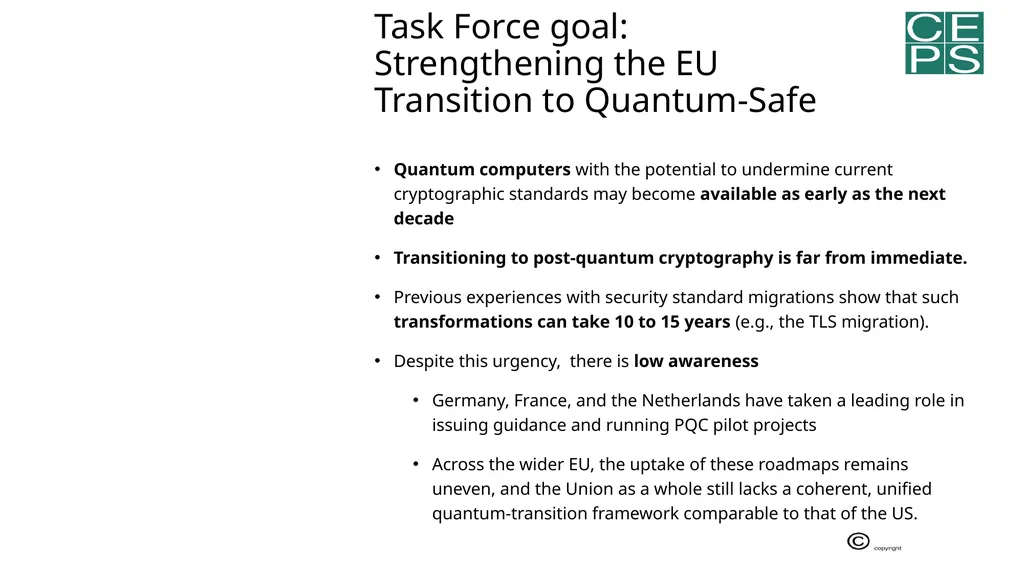
Task Force goal: Strengthening the EU Transition to Quantum-Safe Quantum computers with the potential to undermine current cryptographic standards may become available as early as the next decade
Transitioning to post-quantum cryptography is far from immediate.
Previous experiences with security standard migrations show that such transformations can take 10 to 15 years (e.g., the TLS migration).
Despite this urgency, there is low awareness
Germany, France, and the Netherlands have taken a leading role in issuing guidance and running PQC pilot projects
Across the wider EU, the uptake of these roadmaps remains uneven, and the Union as a whole still lacks a coherent, unified quantum-transition framework comparable to that of the US.<br>
Transitioning to post-quantum cryptography is far from immediate.
Previous experiences with security standard migrations show that such transformations can take 10 to 15 years (e.g., the TLS migration).
Despite this urgency, there is low awareness
Germany, France, and the Netherlands have taken a leading role in issuing guidance and running PQC pilot projects
Across the wider EU, the uptake of these roadmaps remains uneven, and the Union as a whole still lacks a coherent, unified quantum-transition framework comparable to that of the US.<br>
04
Strengthening by following these principles Quantum-Safe Transition as a Systemic Transformation
Moving Beyond the “Q-Day” Narrative
Post-Quantum Cryptography as the Core of the Transition
A Risk-Based Transition Model<br>
Moving Beyond the “Q-Day” Narrative
Post-Quantum Cryptography as the Core of the Transition
A Risk-Based Transition Model<br>
05
Transition to quantum-safe cryptography as a system-level transformation The shift to quantum-safe cryptography is increasingly understood not as a routine technical upgrade but as a comprehensive, systems-level transformation.
Transitioning PQC extends far beyond updating cryptographic libraries; it typically requires integrating new product versions, modifying APIs, adapting software development lifecycles, and, in some cases, redesigning core business processes. It also includes conscious management and transition of supplier, customer, and other ecosystem relations.
This process demands long-term planning, specialised workforce recruitment, and sustained organisational change over several years<br>
Transitioning PQC extends far beyond updating cryptographic libraries; it typically requires integrating new product versions, modifying APIs, adapting software development lifecycles, and, in some cases, redesigning core business processes. It also includes conscious management and transition of supplier, customer, and other ecosystem relations.
This process demands long-term planning, specialised workforce recruitment, and sustained organisational change over several years<br>
06
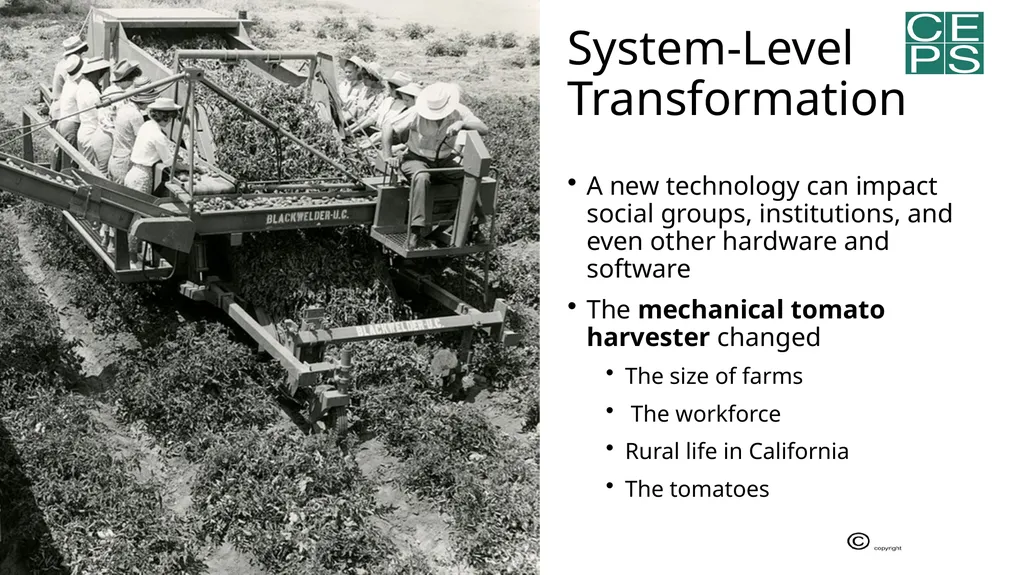
System-Level Transformation A new technology can impact social groups, institutions, and even other hardware and software
The mechanical tomato harvester changed
The size of farms
The workforce
Rural life in California
The tomatoes<br>
The mechanical tomato harvester changed
The size of farms
The workforce
Rural life in California
The tomatoes<br>
07
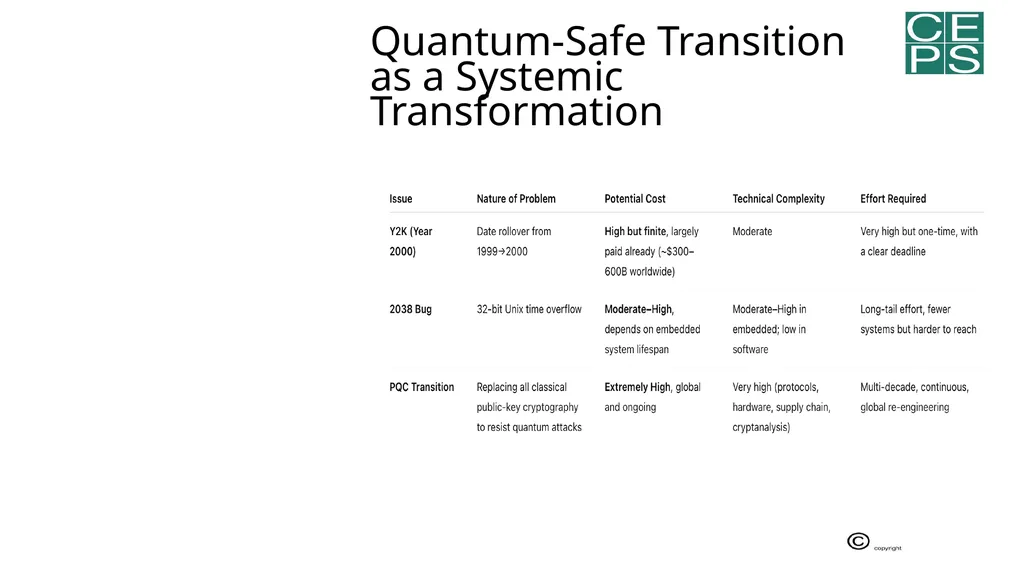
Quantum-Safe Transition as a Systemic Transformation<br>
08
Moving Beyond the “Q-Day” Narrative Discussions of PQC are frequently animated by the spectre of “Q-Day”, a sudden moment when a powerful quantum computer renders classical cryptography obsolete. While useful, this framing risks distorting the problem.
Quantum capability will not arrive as a tsunami but as a gradual, uneven process. A handful of machines will first be able to break selected keys, before scaling to broader applications.
Hype can be both enabling and distorting. On the one hand, alarmist framings help mobilise investment. On the other hand, over-reliance on the Q-Day metaphor risks premature or misaligned investments.
Treating the problem as a Q-period would support balanced migration strategies, paced with the actual evolution of quantum capability and standards readiness.<br>
Quantum capability will not arrive as a tsunami but as a gradual, uneven process. A handful of machines will first be able to break selected keys, before scaling to broader applications.
Hype can be both enabling and distorting. On the one hand, alarmist framings help mobilise investment. On the other hand, over-reliance on the Q-Day metaphor risks premature or misaligned investments.
Treating the problem as a Q-period would support balanced migration strategies, paced with the actual evolution of quantum capability and standards readiness.<br>
09
Post-Quantum Cryptography as the Core of the Transition Post-Quantum Cryptography forms the backbone of the transition to quantum safety. These algorithms are designed to withstand attacks from quantum computers and are widely recognised by regulators and standardisation bodies as the only viable short- to medium-term solution.
Other quantum technologies play more specialised roles
Quantum Key Distribution is not a direct substitute for public-key cryptography but but a complementary technology that can offer diverse layered protection for specific high-security environments
Quantum Random Number Generators provide certifiable entropy quality, ensuring that quantum-derived randomness can be embedded into cryptographic stacks and validated under recognised certification schemes.<br>
Other quantum technologies play more specialised roles
Quantum Key Distribution is not a direct substitute for public-key cryptography but but a complementary technology that can offer diverse layered protection for specific high-security environments
Quantum Random Number Generators provide certifiable entropy quality, ensuring that quantum-derived randomness can be embedded into cryptographic stacks and validated under recognised certification schemes.<br>
10
A Risk-Based Transition Model Crypto Agility
Design cryptographic systems in a modular way, allowing replacement of cryptographic components.
Awareness of Crypto Dependencies
Understanding and managing supply chain dependencies is crucial. Organisations must engage suppliers, request clear timelines for quantum-safe capabilities, and monitor supply chain readiness.
Crypto and Product Inventories
Comprehensive inventory of internal and external dependencies, including software, hardware, APIs, and services. Critical systems should be prioritised for early migration.
Hybrid Solutions
The coexistence of classical and quantum-resistant algorithms, known as hybrid cryptography, ensures interoperability and redundancy. The Task Force recommends broadening the definition of hybrid solutions to encompass “context-aware, technically inclusive approaches” that combine multiple cryptographic mechanisms for resilience, such as PQC/Traditional and PQC/QKD<br>
Design cryptographic systems in a modular way, allowing replacement of cryptographic components.
Awareness of Crypto Dependencies
Understanding and managing supply chain dependencies is crucial. Organisations must engage suppliers, request clear timelines for quantum-safe capabilities, and monitor supply chain readiness.
Crypto and Product Inventories
Comprehensive inventory of internal and external dependencies, including software, hardware, APIs, and services. Critical systems should be prioritised for early migration.
Hybrid Solutions
The coexistence of classical and quantum-resistant algorithms, known as hybrid cryptography, ensures interoperability and redundancy. The Task Force recommends broadening the definition of hybrid solutions to encompass “context-aware, technically inclusive approaches” that combine multiple cryptographic mechanisms for resilience, such as PQC/Traditional and PQC/QKD<br>
11
Crypto agility Cryptographic agility is the design of cryptographic protocols and systems in a modular way that enables replacing the cryptographic components. Rather than a one-off swap of algorithms, the crypto-agile approach entails building the capacity to change cryptographic algorithms and protocols rapidly with minimal disruption.
When an application uses cryptography (like encryption or hashing), it should be designed so that you can change the algorithm — for example, switch from AES to another method — just by updating a setting or configuration file, not by rewriting or changing the program’s code
It’s as much a software engineering challenge as a cryptographic one. Agility also implies maintaining interoperability during the migration, which is deemed a necessity.
Research on cryptographic agility will likely be useful in the future: it is unlikely that the transition to quantum-resistant cryptography will be the last time cryptographic agility will be needed.
.<br>
When an application uses cryptography (like encryption or hashing), it should be designed so that you can change the algorithm — for example, switch from AES to another method — just by updating a setting or configuration file, not by rewriting or changing the program’s code
It’s as much a software engineering challenge as a cryptographic one. Agility also implies maintaining interoperability during the migration, which is deemed a necessity.
Research on cryptographic agility will likely be useful in the future: it is unlikely that the transition to quantum-resistant cryptography will be the last time cryptographic agility will be needed.
.<br>
12
Crypto Dependencies Mapping<br>
13
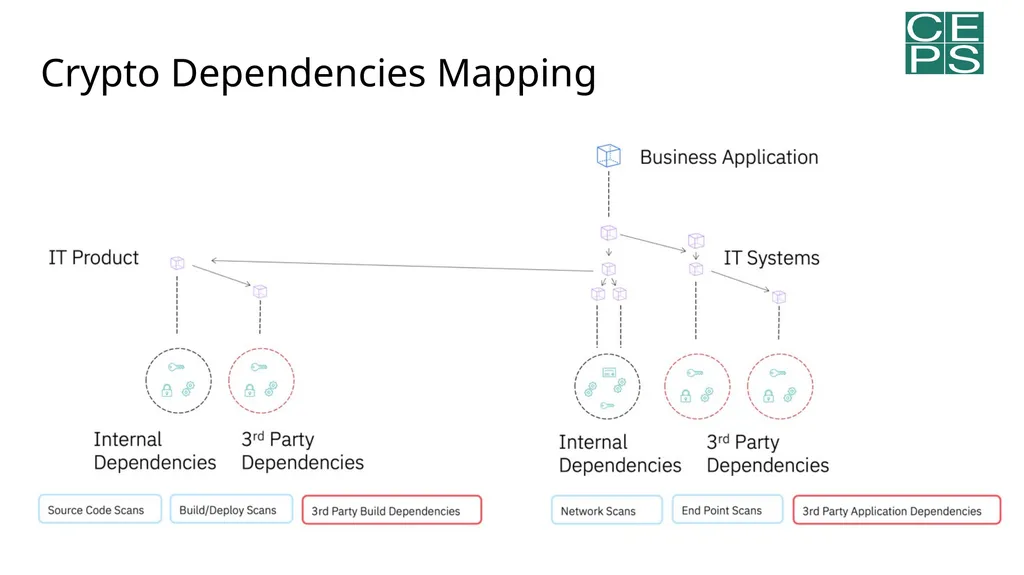
Engage with suppliers to take care of crypto dependencies Most organisations rely heavily on third-party products and services. Migration to PQC often stalls when critical products or dependencies are beyond the direct control of the organisation.
Software vendors and suppliers are on staggered upgrade schedules, and many cryptographic components are buried in complex, nested dependencies.
To address this, organisations need robust engagement with suppliers, clear requests for timelines on quantum-safe capabilities, and a mechanism for tracking supply chain readiness.
Actionable planning begins with an inventory of internal and external dependencies, software, hardware, APIs, and services so that organisations can engage suppliers, demand timelines for upgrades, and plan accordingly.<br>
Software vendors and suppliers are on staggered upgrade schedules, and many cryptographic components are buried in complex, nested dependencies.
To address this, organisations need robust engagement with suppliers, clear requests for timelines on quantum-safe capabilities, and a mechanism for tracking supply chain readiness.
Actionable planning begins with an inventory of internal and external dependencies, software, hardware, APIs, and services so that organisations can engage suppliers, demand timelines for upgrades, and plan accordingly.<br>
14
Building and maintaining crypto and product inventories In preparation for the shift to post-quantum cryptography, organisations are increasingly focusing on how cryptographic and product inventories are built and maintained.
Developing inventories should be prioritised, focusing on the most relevant use cases.
Cryptographic and product inventories are two different assessments.<br>
Developing inventories should be prioritised, focusing on the most relevant use cases.
Cryptographic and product inventories are two different assessments.<br>
15
Crypto Inventories Cryptographic inventories are a detailed mapping of where and how cryptography is used across an organisation’s systems. Its objectives are to identify the cryptographic algorithms in use (today, RSA, ECC, AES), their implementation context (code signing; TLS for communications), their quantum resistance status (legacy or PQC), and the dependencies of cryptographic modules and standards.
A key theme of cryptographic inventories is to adopt a risk-based approach to prioritise the critical systems that need PQC first. When cataloguing cryptographic assets, it is essential to be aware of the intertwined infrastructure of the systems mapped.<br>
A key theme of cryptographic inventories is to adopt a risk-based approach to prioritise the critical systems that need PQC first. When cataloguing cryptographic assets, it is essential to be aware of the intertwined infrastructure of the systems mapped.<br>
16
Product inventories Product inventories, focus on external products, services, and hardware that an organisation uses (i.e., third-party providers), mapping the cryptographic characteristics of these products. Organisations can use practical tools and processes for a cryptographic assessment of their product inventories. Updating the procurement guidelines to include cryptographic requirements and addressing inquiries could be an option
When purchasing new software, hardware, or cloud services, organisations would require vendors to disclose the cryptographic algorithms and protocols used in their products, potentially including a roadmap for post-quantum upgrades.<br>
When purchasing new software, hardware, or cloud services, organisations would require vendors to disclose the cryptographic algorithms and protocols used in their products, potentially including a roadmap for post-quantum upgrades.<br>
17
Quantum-Resistant Schemes in Hybrid Mode Together with Classical Schemes When the transition to quantum-resistant cryptography starts, there will be a period when both PQC and traditional public key cryptography will be used in a hybrid implementation. There are at least two good reasons for this.
First, different actors will transition at different speeds, and interoperability must be maintained.
Second, quantum-resistant cryptography is still comparatively recent. There has been a relatively short amount of time to carry out cryptanalysis, leading to uncertainty about security.
To build the same level of confidence in quantum-resistant schemes, more research and implementation experience are required. In order not to delay the migration to quantum-resistant cryptography, using hybrid schemes is a good option.
Meanwhile, many European cybersecurity agencies (e.g. ANSSI and BSI) recommend using quantum-resistant schemes in hybrid mode<br>
First, different actors will transition at different speeds, and interoperability must be maintained.
Second, quantum-resistant cryptography is still comparatively recent. There has been a relatively short amount of time to carry out cryptanalysis, leading to uncertainty about security.
To build the same level of confidence in quantum-resistant schemes, more research and implementation experience are required. In order not to delay the migration to quantum-resistant cryptography, using hybrid schemes is a good option.
Meanwhile, many European cybersecurity agencies (e.g. ANSSI and BSI) recommend using quantum-resistant schemes in hybrid mode<br>
18
NIS Cooperation Group Roadmap Phase 1: By December 31, 2026, Member States are expected to have laid the groundwork for PQC migration.
These “First Steps” involve identifying the essential stakeholders to guide early strategy and coordination within a supply chain that includes vendors and service providers promoting PQC products. Companies shall develop and maintain their cryptographic inventories. Thereon, both suppliers and adopters of cryptographic material should collaborate in mapping out dependencies of companies’ cryptographic inventories. Regulatory bodies will need to perform a quantum risk analysis
By the end of Phase 1, critical sectors with long data confidentiality needs or long-life systems are already experimenting with PQC solutions, ensuring a minimum level of readiness across the EU.
Phase 2: By December 31, 2030, all Member States should have implemented the following “Next Steps”. In this second phase, critical systems are quantum-safe, and software sold from this point onwards should support such encryption by default.
Phase 3: By December 31, 2035, the transition should be complete or nearly complete, with all medium- to high-use cases transitioned to PQC.<br>
These “First Steps” involve identifying the essential stakeholders to guide early strategy and coordination within a supply chain that includes vendors and service providers promoting PQC products. Companies shall develop and maintain their cryptographic inventories. Thereon, both suppliers and adopters of cryptographic material should collaborate in mapping out dependencies of companies’ cryptographic inventories. Regulatory bodies will need to perform a quantum risk analysis
By the end of Phase 1, critical sectors with long data confidentiality needs or long-life systems are already experimenting with PQC solutions, ensuring a minimum level of readiness across the EU.
Phase 2: By December 31, 2030, all Member States should have implemented the following “Next Steps”. In this second phase, critical systems are quantum-safe, and software sold from this point onwards should support such encryption by default.
Phase 3: By December 31, 2035, the transition should be complete or nearly complete, with all medium- to high-use cases transitioned to PQC.<br>
19
Design and Implement a Roadmap Integrate quantum safety into digital systems from the outset
The European Commission and Member States should ensure that digital systems (e.g., the European Digital Identity Wallet) are designed to be quantum-safe from the start.
Link the Roadmap to a Quantum Transition strategy and Existing Legislation
A roadmap defines milestones and timelines, but a supporting strategy must clarify how Member States, vendors, and institutions will meet them.
Ensure Alignment and Coherence Across Roadmaps
With multiple quantum-safety roadmaps emerging at EU and national levels, the European Commission, Member States, and standardisation bodies must coordinate efforts to ensure coherence in timelines, dependencies, and objectives. Coordination with the United States and other G7 partners is equally important.
Introducing Greater Parallelisation into the Roadmap
The Roadmap’s current structure implicitly relies on a staged or linear approach, which may unintentionally create bottlenecks. This Task Force recommends introducing greater parallelisation into the Roadmap to accelerate progress and reduce systemic risk.<br>
The European Commission and Member States should ensure that digital systems (e.g., the European Digital Identity Wallet) are designed to be quantum-safe from the start.
Link the Roadmap to a Quantum Transition strategy and Existing Legislation
A roadmap defines milestones and timelines, but a supporting strategy must clarify how Member States, vendors, and institutions will meet them.
Ensure Alignment and Coherence Across Roadmaps
With multiple quantum-safety roadmaps emerging at EU and national levels, the European Commission, Member States, and standardisation bodies must coordinate efforts to ensure coherence in timelines, dependencies, and objectives. Coordination with the United States and other G7 partners is equally important.
Introducing Greater Parallelisation into the Roadmap
The Roadmap’s current structure implicitly relies on a staged or linear approach, which may unintentionally create bottlenecks. This Task Force recommends introducing greater parallelisation into the Roadmap to accelerate progress and reduce systemic risk.<br>
20
Linking the Roadmap for the Transition to Post Quantum Cryptography to a quantum transition strategy and existing laws There are significant risks in pursuing an EU quantum-safe roadmap without a coordinated, risk-aware transition strategy. A roadmap must specify what milestones are required and by when, but only a supporting strategy can define how Member States, vendors, and institutions will meet them.
Without synchronised standards, certification schemes, interoperability frameworks, and testing infrastructures, regulation may outpace readiness.
The roadmap should therefore be embedded in a broader EU framework that aligns national plans, industry efforts, and regulatory tools, ensuring coordination across DORA, CRA, and NIS2, and guided by the institutional actors (ENISA, the Commission, ETSI, CEN/CENELEC) to deliver a coherent, actionable transition.<br>
Without synchronised standards, certification schemes, interoperability frameworks, and testing infrastructures, regulation may outpace readiness.
The roadmap should therefore be embedded in a broader EU framework that aligns national plans, industry efforts, and regulatory tools, ensuring coordination across DORA, CRA, and NIS2, and guided by the institutional actors (ENISA, the Commission, ETSI, CEN/CENELEC) to deliver a coherent, actionable transition.<br>
21
Promoting awareness , cooperation and better governance Awareness campaigns and training modules should not be generic or one-size-fits-all. Greater involvement of civil society.
The Roadmap should encourage joint pilot projects at the EU level to test interoperability of PQC in cross-border services before 2030.
We suggest establishing a public-private PQC migration observatory under ENISA to monitor advances and recommend acceleration of timelines if necessary.<br>
The Roadmap should encourage joint pilot projects at the EU level to test interoperability of PQC in cross-border services before 2030.
We suggest establishing a public-private PQC migration observatory under ENISA to monitor advances and recommend acceleration of timelines if necessary.<br>
22
Ensure Alignment and Coherence Across Roadmaps Multiple roadmaps for quantum-safe transition are currently being developed and discussed at the EU and national levels
While each roadmap sets valuable priorities and indicative milestones (e.g. 2026, 2030, 2035), their coexistence risks producing fragmented implementation if not properly aligned.
The European Commission, together with MS and standardisation bodies, should promote cross-roadmap coordination to ensure coherence in timelines, dependencies, and objectives.<br>
While each roadmap sets valuable priorities and indicative milestones (e.g. 2026, 2030, 2035), their coexistence risks producing fragmented implementation if not properly aligned.
The European Commission, together with MS and standardisation bodies, should promote cross-roadmap coordination to ensure coherence in timelines, dependencies, and objectives.<br>
23
Sector Specific Recommendations<br>
24
Additional Recommendation for the Financial Sector Create an ad hoc PQC governance structure
Enhancing collaboration with vendors and partners
Upgrade the financial sector underlying infrastructure
Prioritise actions based on risk assessment
Perform cost-benefit analysis of mitigation options
Overcome organisational and skills gaps<br>
Enhancing collaboration with vendors and partners
Upgrade the financial sector underlying infrastructure
Prioritise actions based on risk assessment
Perform cost-benefit analysis of mitigation options
Overcome organisational and skills gaps<br>
25
Additional Recommendation for the Public Sector Implement a sequenced migration plan across PKI and digital identity ecosystems
Synchronise authentication layers to prevent fragmentation and service disruption
Coordinate cross-border roadmaps and align national migration strategies
Manage the quantum transition as a coordinated sociotechnical programme<br>
Synchronise authentication layers to prevent fragmentation and service disruption
Coordinate cross-border roadmaps and align national migration strategies
Manage the quantum transition as a coordinated sociotechnical programme<br>
26
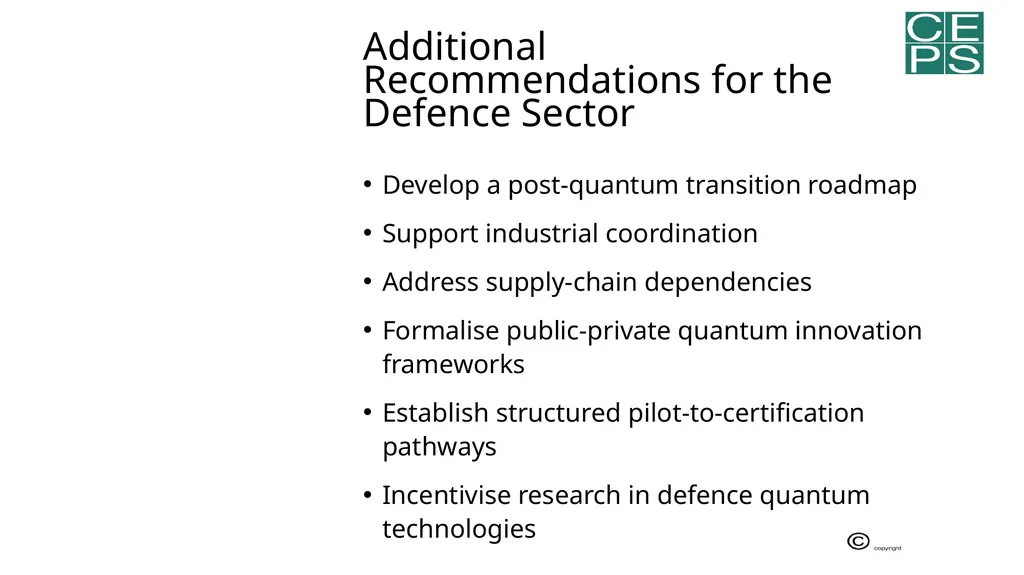
Additional Recommendations for the Defence Sector Develop a post-quantum transition roadmap
Support industrial coordination
Address supply-chain dependencies
Formalise public-private quantum innovation frameworks
Establish structured pilot-to-certification pathways
Incentivise research in defence quantum technologies<br>
Support industrial coordination
Address supply-chain dependencies
Formalise public-private quantum innovation frameworks
Establish structured pilot-to-certification pathways
Incentivise research in defence quantum technologies<br>