
CERTIFICATION EXAM PREPARATION COURSE SESSION 5:
MJ
Published · 62 slides · 0 views
1 / 1




Description
CERTIFICATION EXAM PREPARATION COURSE SESSION 5: Institutional Review Board and Institutional Ethics Committee What is an Institutional Review Board (IRB) or Institutional Ethics Committee (IEC)? An IRB is an appropriately constituted group
Related Topics
Share
Embed code
Download this presentation From Below
"CERTIFICATION EXAM PREPARATION COURSE SESSION 5:" is the property of its rightful owner. Permission is granted to download and print the materials on this website for personal, non-commercial use only, and to display it on your personal computer provided you do not modify the materials and that you retain all copyright notices contained in the materials. By downloading content from our website, you accept the terms of this agreement.
Presentation Transcript
01
CERTIFICATION EXAM PREPARATION COURSE SESSION 5:
Institutional Review Board and Institutional Ethics Committee<br>
Institutional Review Board and Institutional Ethics Committee<br>
02
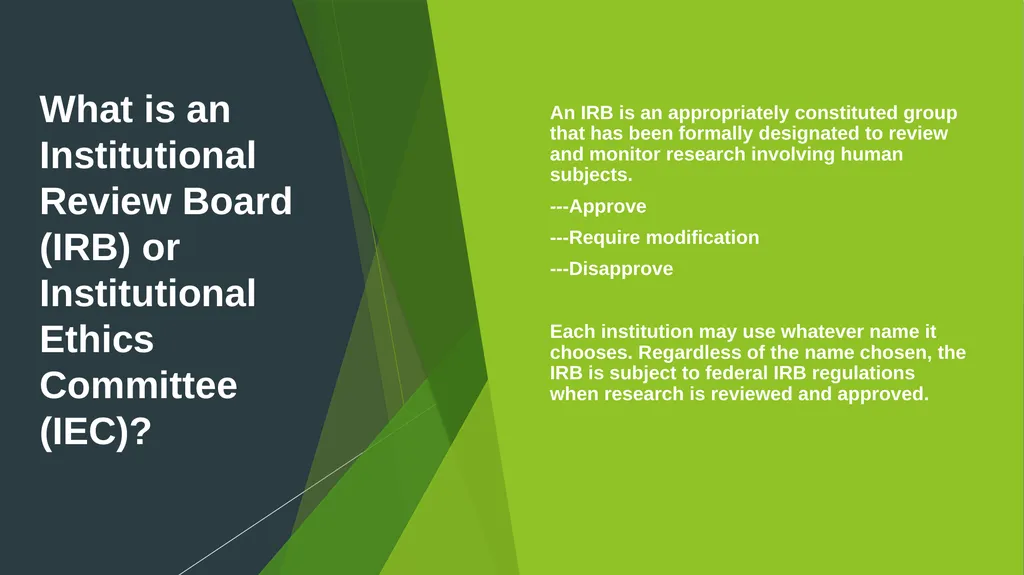
What is an Institutional Review Board (IRB) or Institutional Ethics Committee (IEC)? An IRB is an appropriately constituted group that has been formally designated to review and monitor research involving human subjects.
---Approve
---Require modification
---Disapprove
Each institution may use whatever name it chooses. Regardless of the name chosen, the IRB is subject to federal IRB regulations when research is reviewed and approved.<br>
---Approve
---Require modification
---Disapprove
Each institution may use whatever name it chooses. Regardless of the name chosen, the IRB is subject to federal IRB regulations when research is reviewed and approved.<br>
03
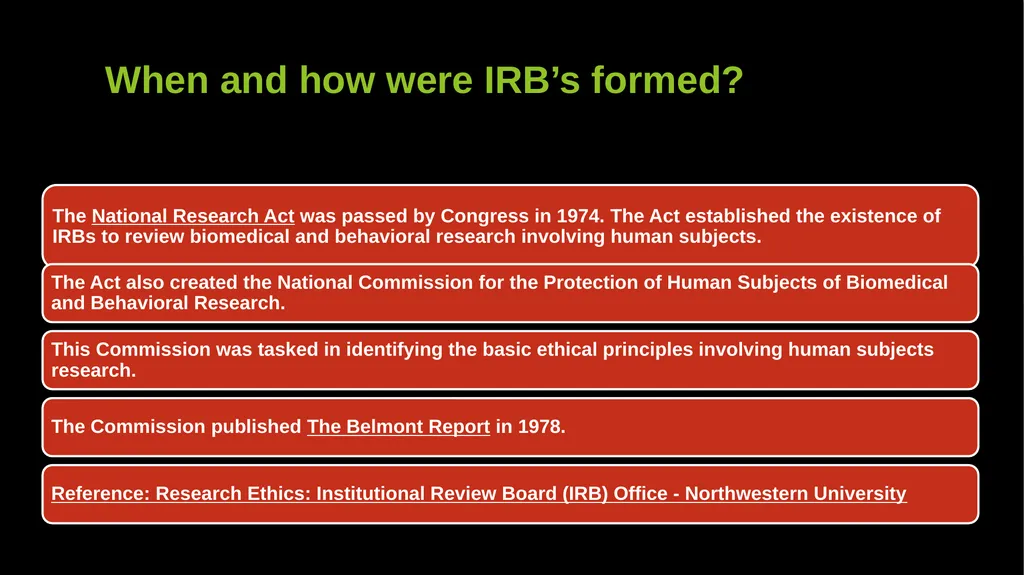
When and how were IRB’s formed?<br>
04
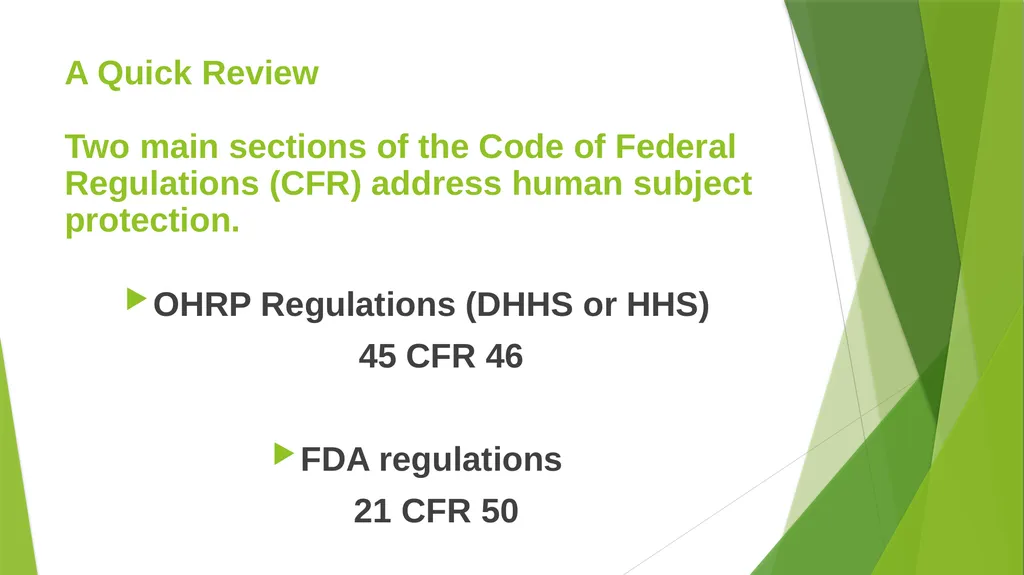
A Quick Review
Two main sections of the Code of Federal Regulations (CFR) address human subject protection. OHRP Regulations (DHHS or HHS)
45 CFR 46
FDA regulations
21 CFR 50<br>
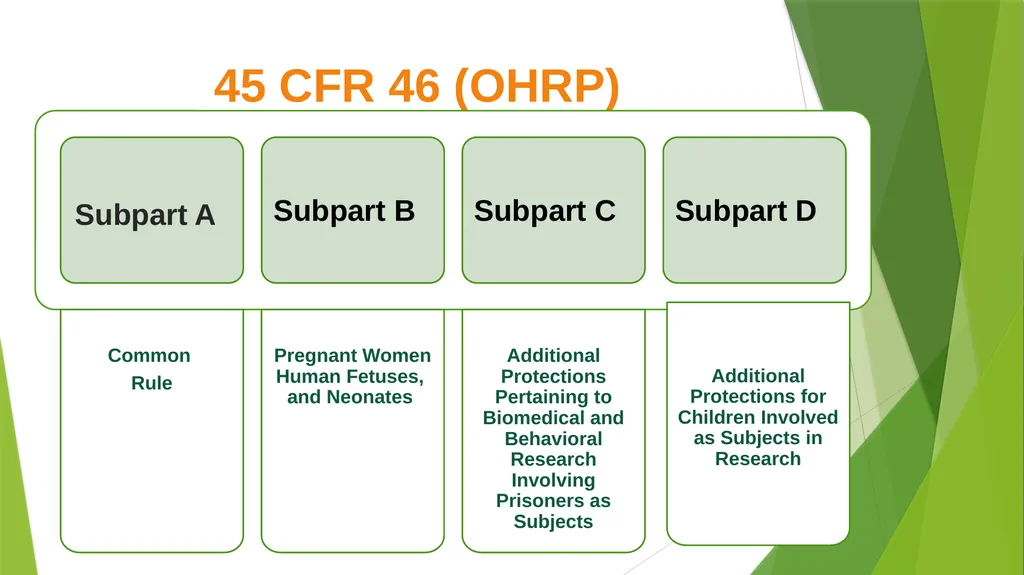
45 CFR 46
FDA regulations
21 CFR 50<br>
05
45 CFR 46 (OHRP)<br>
06
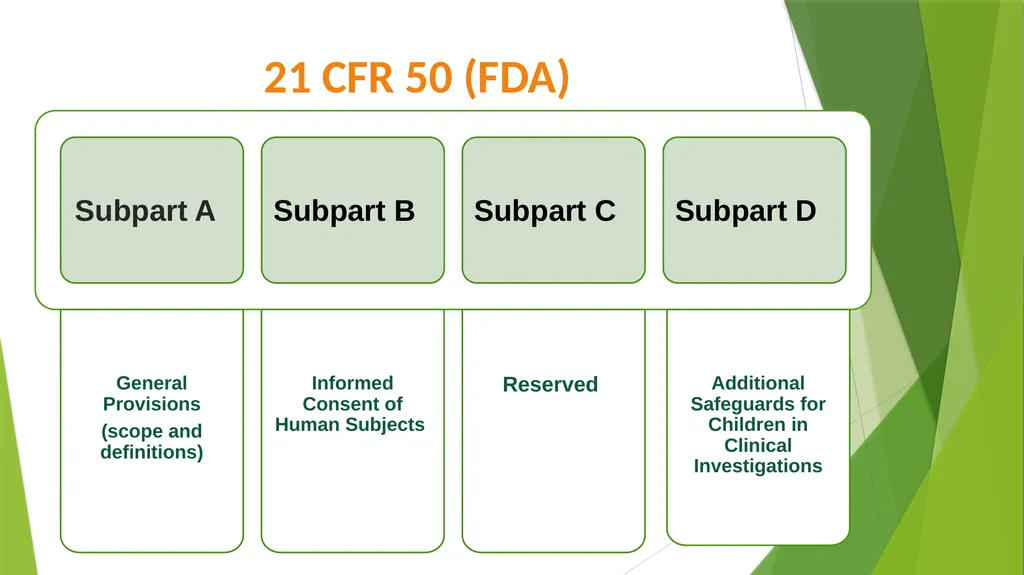
21 CFR 50 (FDA)<br>
07
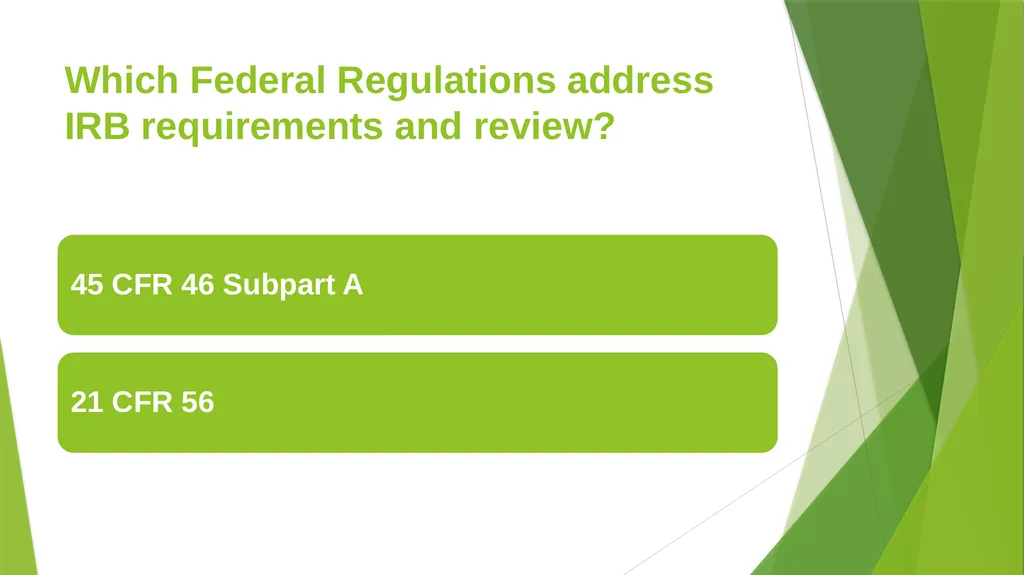
Which Federal Regulations address IRB requirements and review?<br>
08
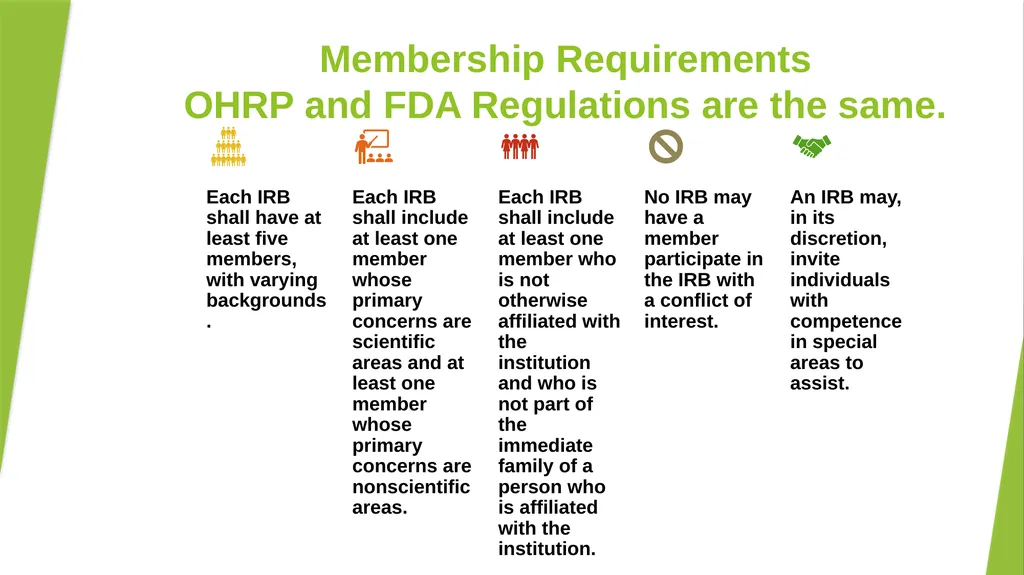
Membership Requirements
OHRP and FDA Regulations are the same.<br>
09
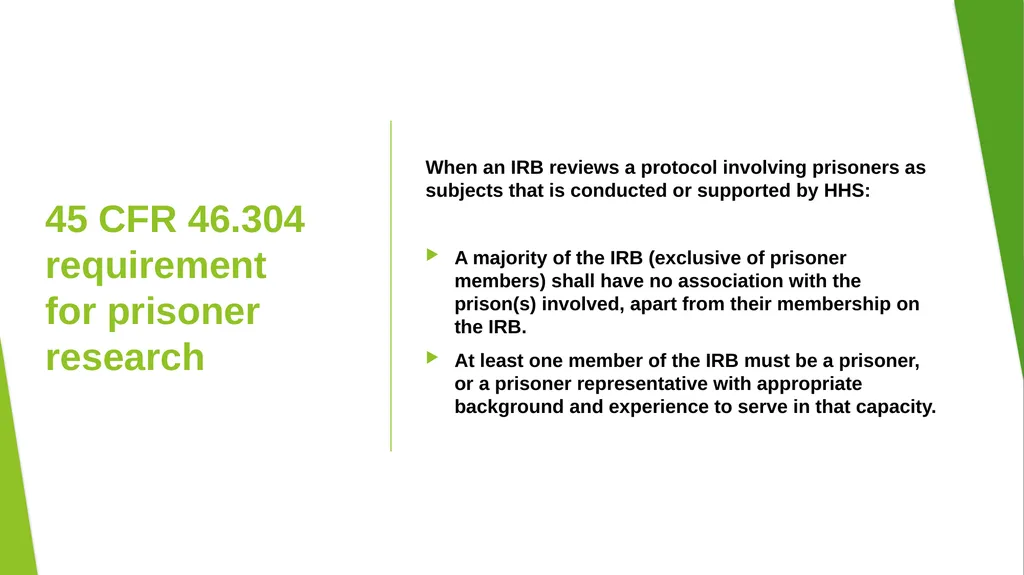
45 CFR 46.304 requirement
for prisoner research When an IRB reviews a protocol involving prisoners as subjects that is conducted or supported by HHS:
A majority of the IRB (exclusive of prisoner members) shall have no association with the prison(s) involved, apart from their membership on the IRB.
At least one member of the IRB must be a prisoner, or a prisoner representative with appropriate background and experience to serve in that capacity.<br>
A majority of the IRB (exclusive of prisoner members) shall have no association with the prison(s) involved, apart from their membership on the IRB.
At least one member of the IRB must be a prisoner, or a prisoner representative with appropriate background and experience to serve in that capacity.<br>
10
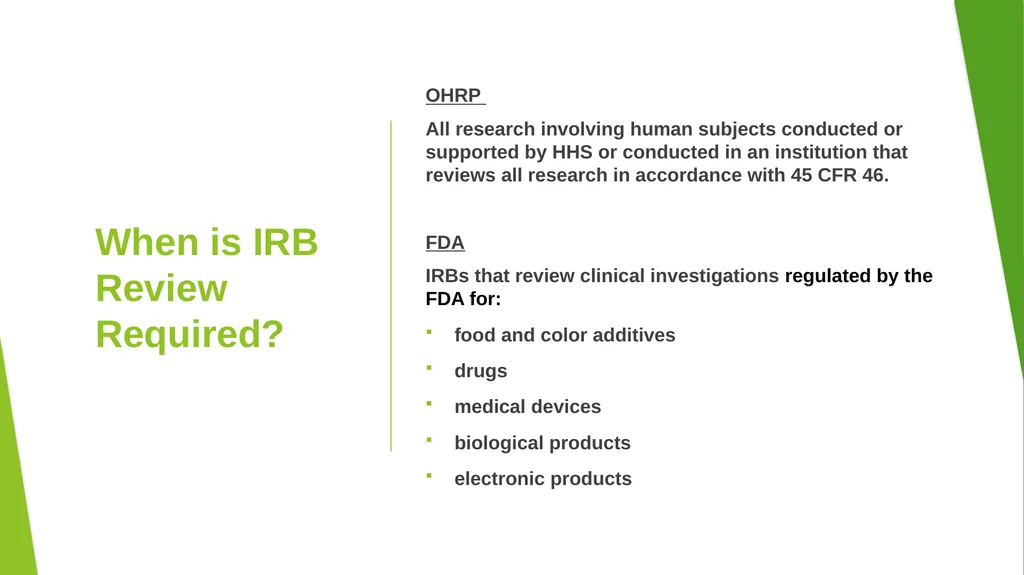
When is IRB Review Required? OHRP
All research involving human subjects conducted or supported by HHS or conducted in an institution that reviews all research in accordance with 45 CFR 46.
FDA
IRBs that review clinical investigations regulated by the FDA for:
food and color additives
drugs
medical devices
biological products
electronic products<br>
All research involving human subjects conducted or supported by HHS or conducted in an institution that reviews all research in accordance with 45 CFR 46.
FDA
IRBs that review clinical investigations regulated by the FDA for:
food and color additives
drugs
medical devices
biological products
electronic products<br>
11
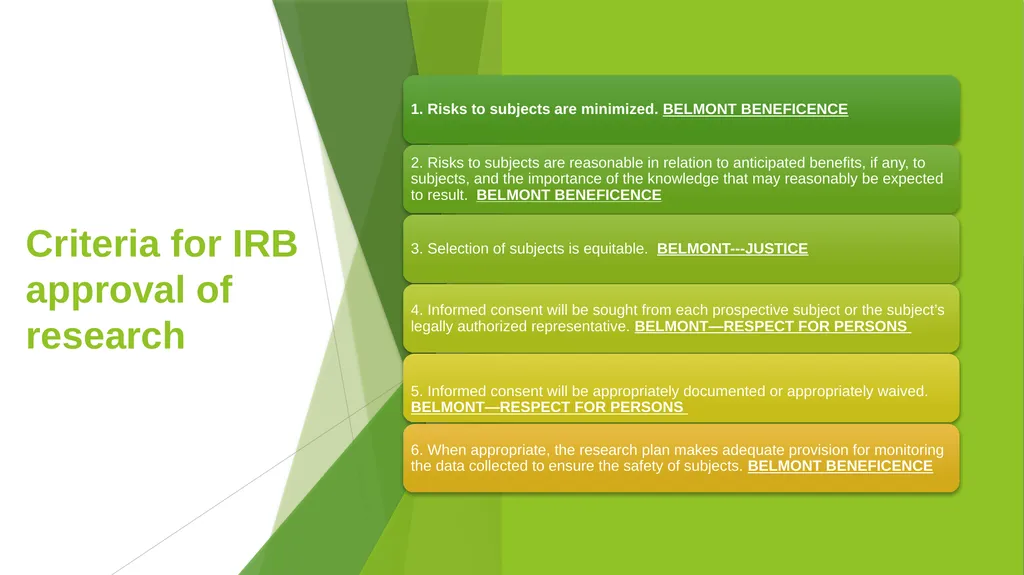
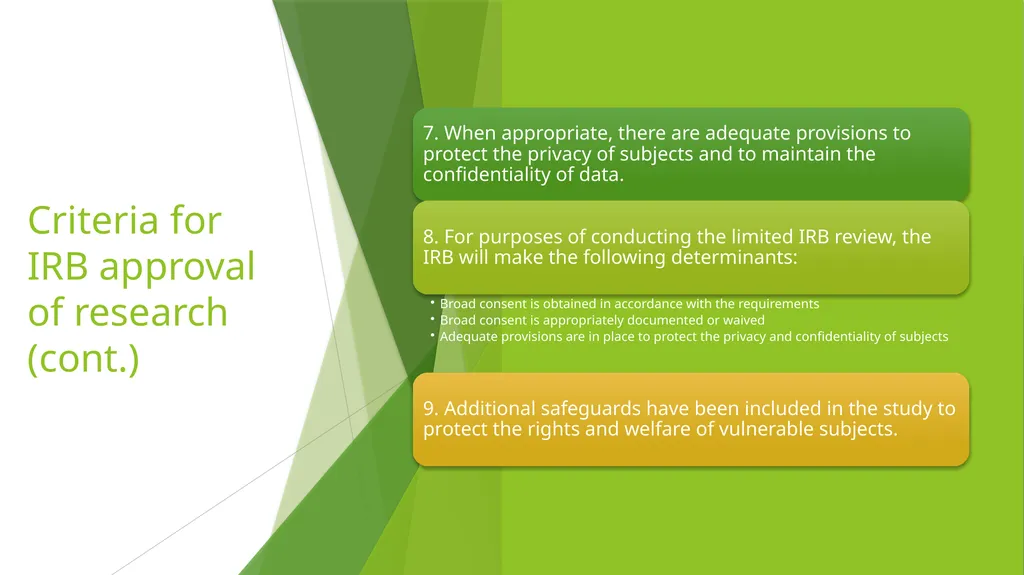
Criteria for IRB approval of research<br>
12
Criteria for IRB approval of research
(cont.)<br>
13
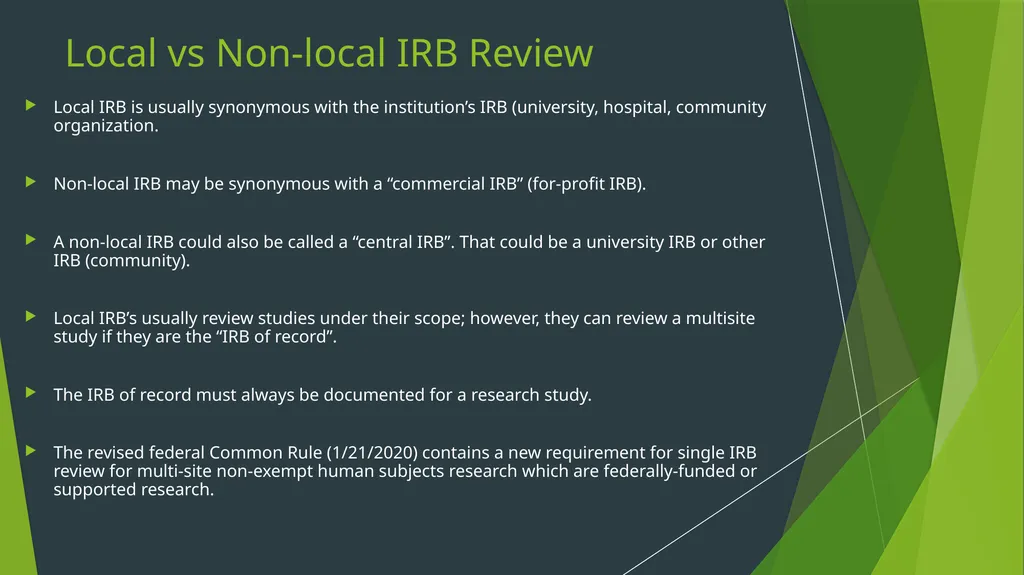
Local vs Non-local IRB Review Local IRB is usually synonymous with the institution’s IRB (university, hospital, community organization.
Non-local IRB may be synonymous with a “commercial IRB” (for-profit IRB).
A non-local IRB could also be called a “central IRB”. That could be a university IRB or other IRB (community).
Local IRB’s usually review studies under their scope; however, they can review a multisite study if they are the “IRB of record”.
The IRB of record must always be documented for a research study.
The revised federal Common Rule (1/21/2020) contains a new requirement for single IRB review for multi-site non-exempt human subjects research which are federally-funded or supported research.<br>
Non-local IRB may be synonymous with a “commercial IRB” (for-profit IRB).
A non-local IRB could also be called a “central IRB”. That could be a university IRB or other IRB (community).
Local IRB’s usually review studies under their scope; however, they can review a multisite study if they are the “IRB of record”.
The IRB of record must always be documented for a research study.
The revised federal Common Rule (1/21/2020) contains a new requirement for single IRB review for multi-site non-exempt human subjects research which are federally-funded or supported research.<br>
14
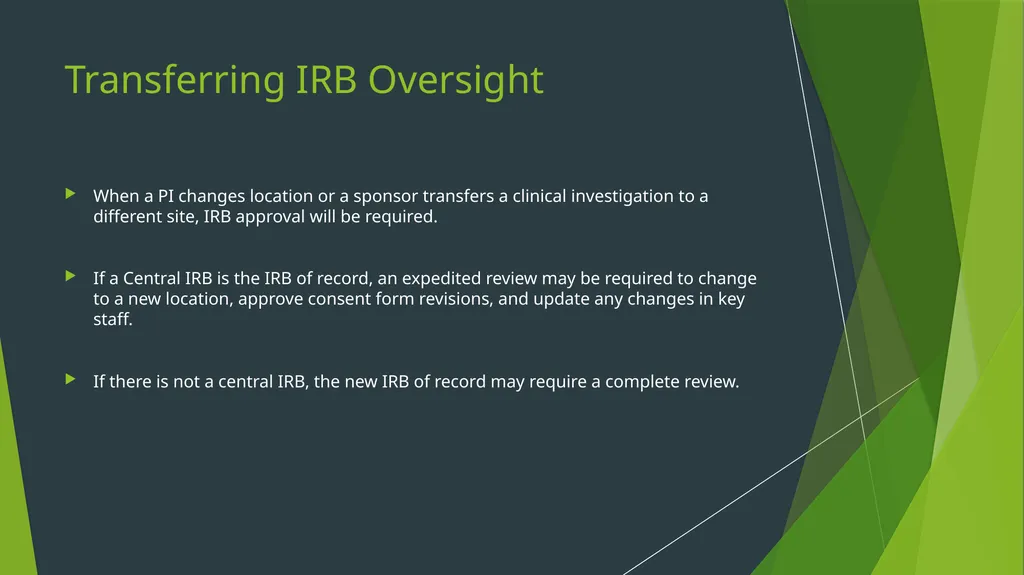
Transferring IRB Oversight When a PI changes location or a sponsor transfers a clinical investigation to a different site, IRB approval will be required.
If a Central IRB is the IRB of record, an expedited review may be required to change to a new location, approve consent form revisions, and update any changes in key staff.
If there is not a central IRB, the new IRB of record may require a complete review.<br>
If a Central IRB is the IRB of record, an expedited review may be required to change to a new location, approve consent form revisions, and update any changes in key staff.
If there is not a central IRB, the new IRB of record may require a complete review.<br>
15
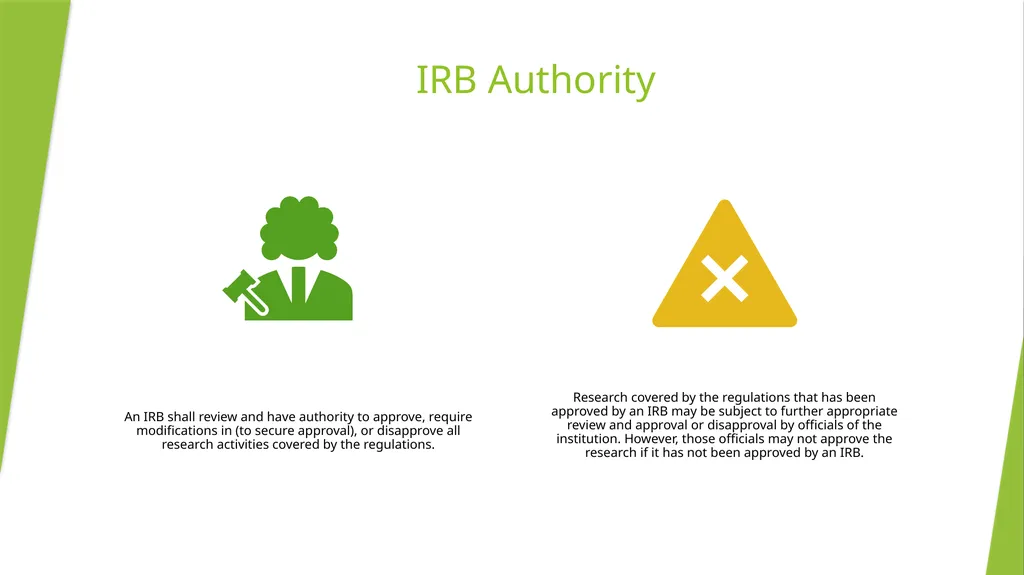
IRB Authority<br>
16
IRB Communication with PI, Sponsor, Study Team An IRB shall notify investigators and the institution in writing (outcome letters):
Approve
Require modification
Disapprove
If a study is disapproved:
The outcome letter shall give reasons
The investigator may respond in person or in writing<br>
Approve
Require modification
Disapprove
If a study is disapproved:
The outcome letter shall give reasons
The investigator may respond in person or in writing<br>
17
Suspension or Termination of IRB Approval of Research An IRB shall have authority to suspend or terminate approval of research.
Any suspension or termination of approval shall include a statement of the reasons.
The IRB shall report the suspension or termination promptly to the investigator, appropriate institutional officials, and the department or agency head.<br>
Any suspension or termination of approval shall include a statement of the reasons.
The IRB shall report the suspension or termination promptly to the investigator, appropriate institutional officials, and the department or agency head.<br>
18
IRB Record-keeping and Reports Copies of all research proposals reviewed, approved sample consent documents, progress reports submitted by investigators, and reports of injuries to subjects
Minutes of IRB meetings
Records of continuing review activities
Copies of all correspondence between the IRB and the investigators<br>
Minutes of IRB meetings
Records of continuing review activities
Copies of all correspondence between the IRB and the investigators<br>
19
IRB Record-keeping and Reports
(cont.) A list of IRB members with their characteristics, such as:
earned degrees
employment or other relationship between each member and the institution
Written procedures for the IRB
Statements of significant new findings provided to subjects<br>
earned degrees
employment or other relationship between each member and the institution
Written procedures for the IRB
Statements of significant new findings provided to subjects<br>
20
IRB Record-keeping and Reports
(cont.) The records shall be retained for at least 3 years after completion of the research
The records shall be accessible for inspection and copying by authorized representatives of the Food and Drug Administration at reasonable times and in a reasonable manner.
The Food and Drug Administration may refuse to consider a clinical investigation if the institution or the IRB refuses to allow an inspection<br>
The records shall be accessible for inspection and copying by authorized representatives of the Food and Drug Administration at reasonable times and in a reasonable manner.
The Food and Drug Administration may refuse to consider a clinical investigation if the institution or the IRB refuses to allow an inspection<br>
21
Exempt
Expedited
Full Committee Review or Full Board Review Types of Categorical Review for Human Subjects Research<br>
Expedited
Full Committee Review or Full Board Review Types of Categorical Review for Human Subjects Research<br>
22
The determination is usually made by:
Human Research Protection Program (HRPP) or IRB office.
The HRPP or IRB office also may ensure alignment with:
institutional policies
ethical guidelines
other relevant regulations and policies How the Review Category of Subjects Research is Determined<br>
Human Research Protection Program (HRPP) or IRB office.
The HRPP or IRB office also may ensure alignment with:
institutional policies
ethical guidelines
other relevant regulations and policies How the Review Category of Subjects Research is Determined<br>
23
To determine the review status of human subjects research, ask the following three questions, in this order:
Is the activity research according to the regulations?
Does the research involve human subjects based on the definition in the regulations?
Is the human subjects research exempt? How the Review Category of Subjects Research is Determined<br>
Is the activity research according to the regulations?
Does the research involve human subjects based on the definition in the regulations?
Is the human subjects research exempt? How the Review Category of Subjects Research is Determined<br>
24
Test your knowledge<br>
25
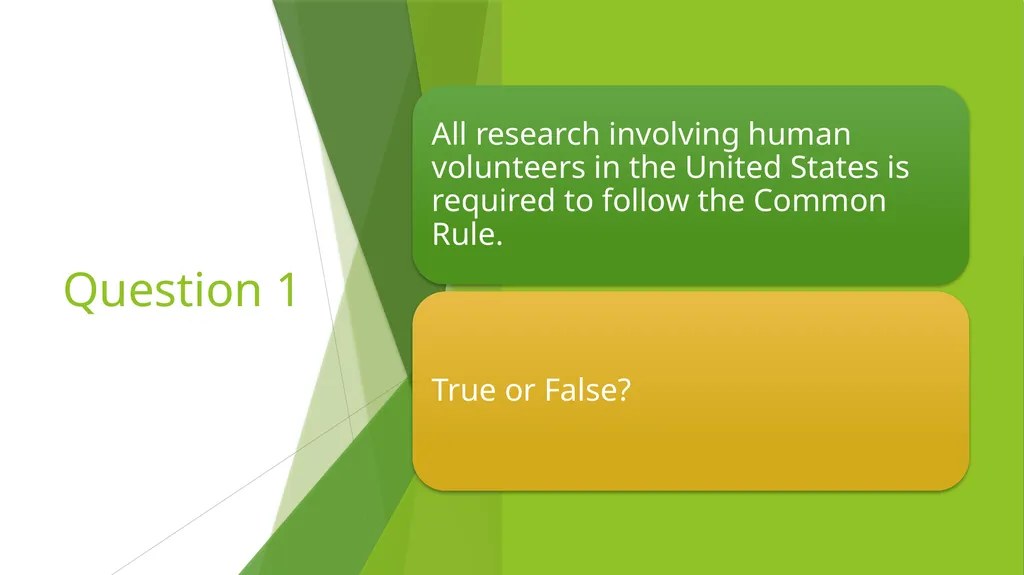
Question 1<br>
26
Question 1
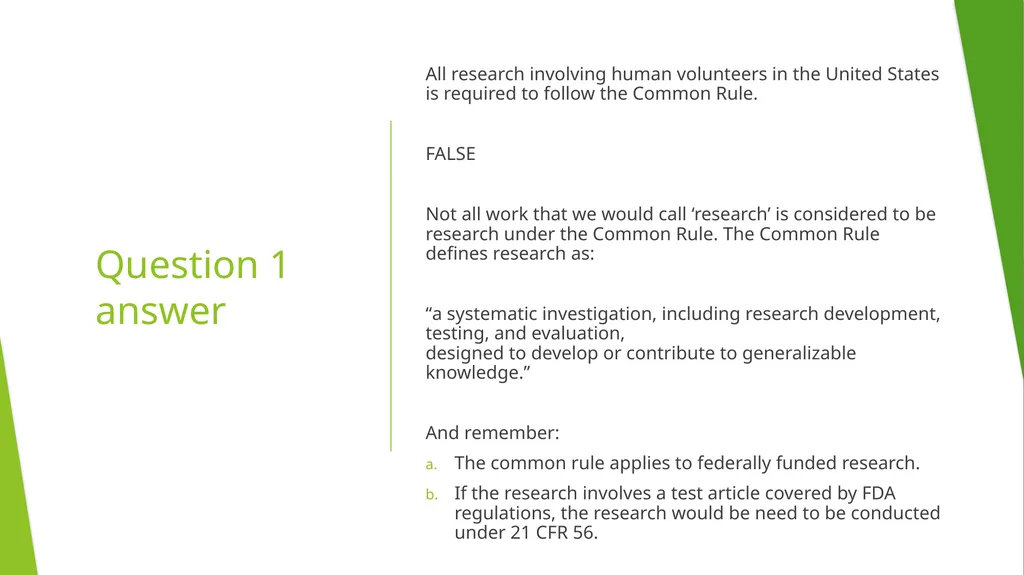
answer All research involving human volunteers in the United States is required to follow the Common Rule.
FALSE
Not all work that we would call ‘research’ is considered to be research under the Common Rule. The Common Rule defines research as:
“a systematic investigation, including research development, testing, and evaluation, designed to develop or contribute to generalizable knowledge.”
And remember:
The common rule applies to federally funded research.
If the research involves a test article covered by FDA regulations, the research would be need to be conducted under 21 CFR 56.<br>
FALSE
Not all work that we would call ‘research’ is considered to be research under the Common Rule. The Common Rule defines research as:
“a systematic investigation, including research development, testing, and evaluation, designed to develop or contribute to generalizable knowledge.”
And remember:
The common rule applies to federally funded research.
If the research involves a test article covered by FDA regulations, the research would be need to be conducted under 21 CFR 56.<br>
27
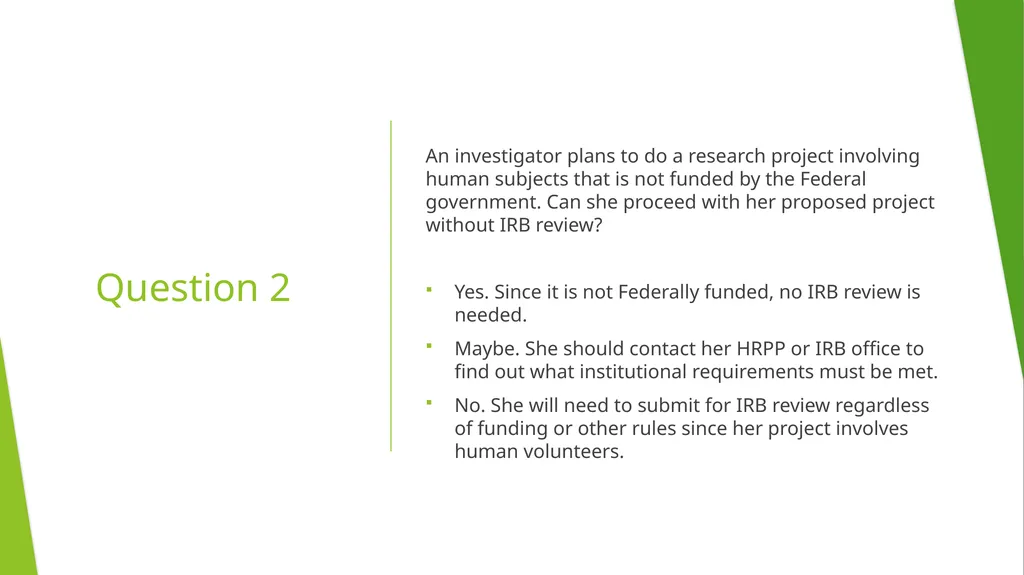
Question 2 An investigator plans to do a research project involving human subjects that is not funded by the Federal government. Can she proceed with her proposed project without IRB review?
Yes. Since it is not Federally funded, no IRB review is needed.
Maybe. She should contact her HRPP or IRB office to find out what institutional requirements must be met.
No. She will need to submit for IRB review regardless of funding or other rules since her project involves human volunteers.<br>
Yes. Since it is not Federally funded, no IRB review is needed.
Maybe. She should contact her HRPP or IRB office to find out what institutional requirements must be met.
No. She will need to submit for IRB review regardless of funding or other rules since her project involves human volunteers.<br>
28
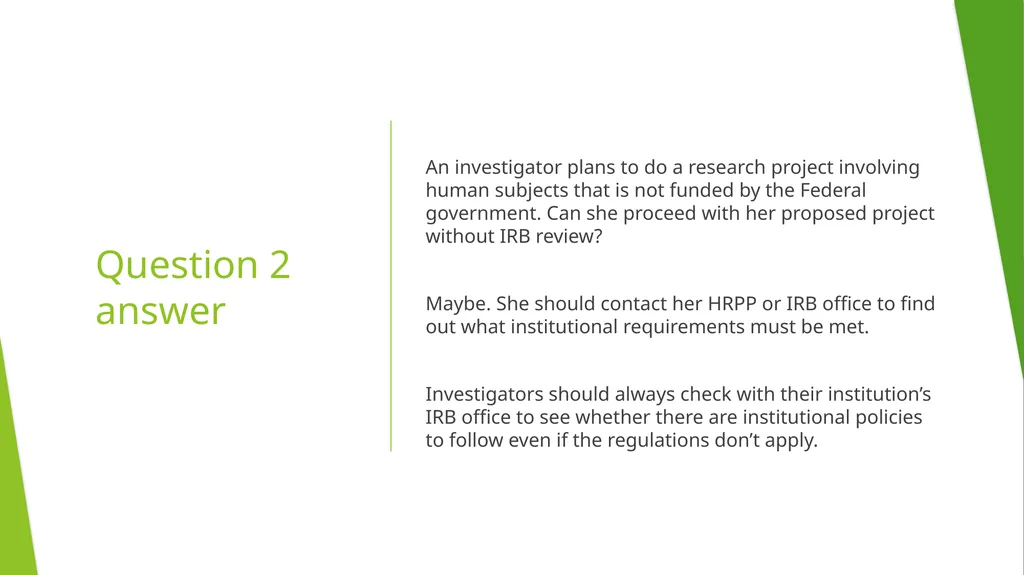
Question 2 answer An investigator plans to do a research project involving human subjects that is not funded by the Federal government. Can she proceed with her proposed project without IRB review?
Maybe. She should contact her HRPP or IRB office to find out what institutional requirements must be met.
Investigators should always check with their institution’s IRB office to see whether there are institutional policies to follow even if the regulations don’t apply.<br>
Maybe. She should contact her HRPP or IRB office to find out what institutional requirements must be met.
Investigators should always check with their institution’s IRB office to see whether there are institutional policies to follow even if the regulations don’t apply.<br>
29
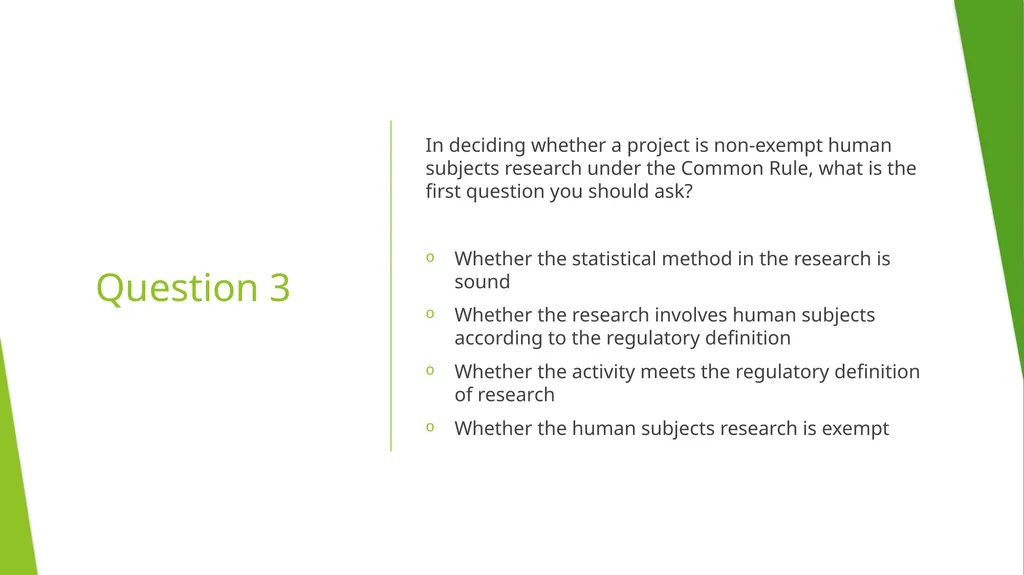
Question 3 In deciding whether a project is non-exempt human subjects research under the Common Rule, what is the first question you should ask?
Whether the statistical method in the research is sound
Whether the research involves human subjects according to the regulatory definition
Whether the activity meets the regulatory definition of research
Whether the human subjects research is exempt<br>
Whether the statistical method in the research is sound
Whether the research involves human subjects according to the regulatory definition
Whether the activity meets the regulatory definition of research
Whether the human subjects research is exempt<br>
30
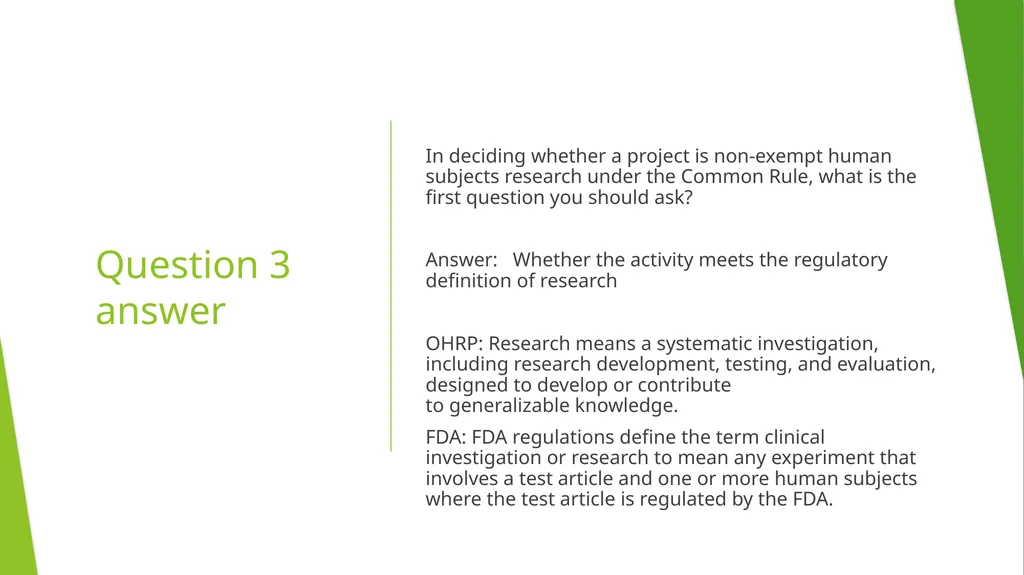
Question 3 answer In deciding whether a project is non-exempt human subjects research under the Common Rule, what is the first question you should ask?
Answer: Whether the activity meets the regulatory definition of research
OHRP: Research means a systematic investigation, including research development, testing, and evaluation, designed to develop or contribute to generalizable knowledge.
FDA: FDA regulations define the term clinical investigation or research to mean any experiment that involves a test article and one or more human subjects where the test article is regulated by the FDA.<br>
Answer: Whether the activity meets the regulatory definition of research
OHRP: Research means a systematic investigation, including research development, testing, and evaluation, designed to develop or contribute to generalizable knowledge.
FDA: FDA regulations define the term clinical investigation or research to mean any experiment that involves a test article and one or more human subjects where the test article is regulated by the FDA.<br>
31
Exempt:
Low risk, research activities in which the only involvement of human subjects will be in one or more of the categories defined as exempt research.
The determination of an exemption has to be made by someone other than the investigator. Types of IRB Review<br>
Low risk, research activities in which the only involvement of human subjects will be in one or more of the categories defined as exempt research.
The determination of an exemption has to be made by someone other than the investigator. Types of IRB Review<br>
32
When may a study be exempt from IRB oversight after the initial review? OHRP
Exempt research (8 exemptions)
FDA
Any investigation which commenced before 7/27/81 (before current regulations)
Emergency use of a test article, provided that such emergency use is reported to the IRB within 5 working days.<br>
Exempt research (8 exemptions)
FDA
Any investigation which commenced before 7/27/81 (before current regulations)
Emergency use of a test article, provided that such emergency use is reported to the IRB within 5 working days.<br>
33
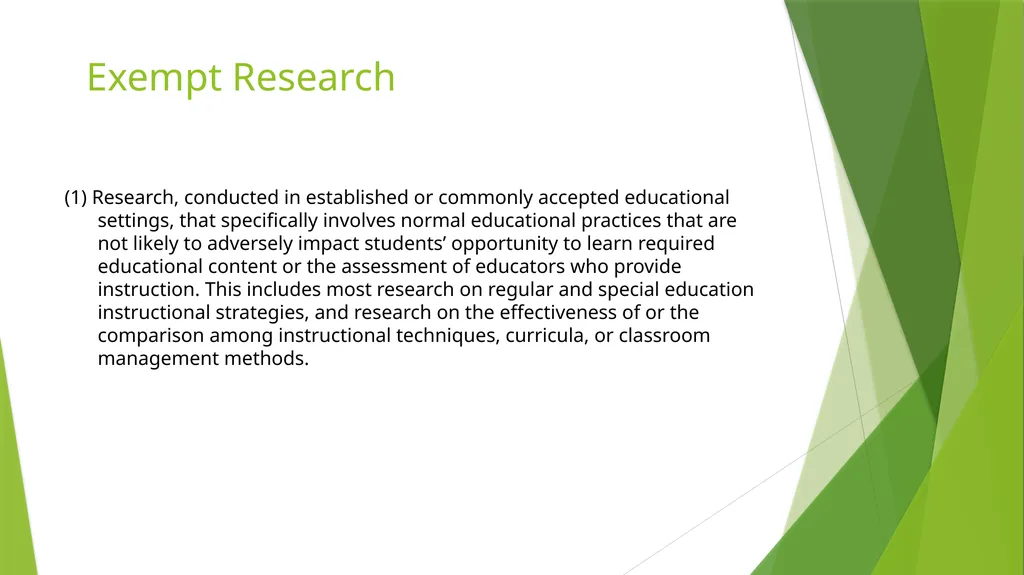
Exempt Research (1) Research, conducted in established or commonly accepted educational settings, that specifically involves normal educational practices that are not likely to adversely impact students’ opportunity to learn required educational content or the assessment of educators who provide instruction. This includes most research on regular and special education instructional strategies, and research on the effectiveness of or the comparison among instructional techniques, curricula, or classroom management methods.<br>
34
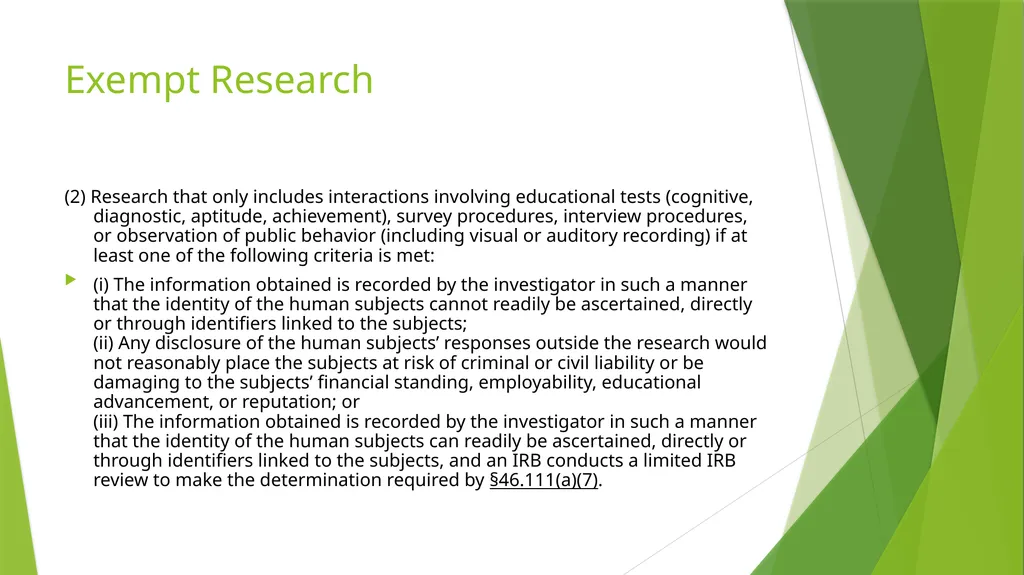
Exempt Research (2) Research that only includes interactions involving educational tests (cognitive, diagnostic, aptitude, achievement), survey procedures, interview procedures, or observation of public behavior (including visual or auditory recording) if at least one of the following criteria is met:
(i) The information obtained is recorded by the investigator in such a manner that the identity of the human subjects cannot readily be ascertained, directly or through identifiers linked to the subjects; (ii) Any disclosure of the human subjects’ responses outside the research would not reasonably place the subjects at risk of criminal or civil liability or be damaging to the subjects’ financial standing, employability, educational advancement, or reputation; or (iii) The information obtained is recorded by the investigator in such a manner that the identity of the human subjects can readily be ascertained, directly or through identifiers linked to the subjects, and an IRB conducts a limited IRB review to make the determination required by §46.111(a)(7).<br>
(i) The information obtained is recorded by the investigator in such a manner that the identity of the human subjects cannot readily be ascertained, directly or through identifiers linked to the subjects; (ii) Any disclosure of the human subjects’ responses outside the research would not reasonably place the subjects at risk of criminal or civil liability or be damaging to the subjects’ financial standing, employability, educational advancement, or reputation; or (iii) The information obtained is recorded by the investigator in such a manner that the identity of the human subjects can readily be ascertained, directly or through identifiers linked to the subjects, and an IRB conducts a limited IRB review to make the determination required by §46.111(a)(7).<br>
35
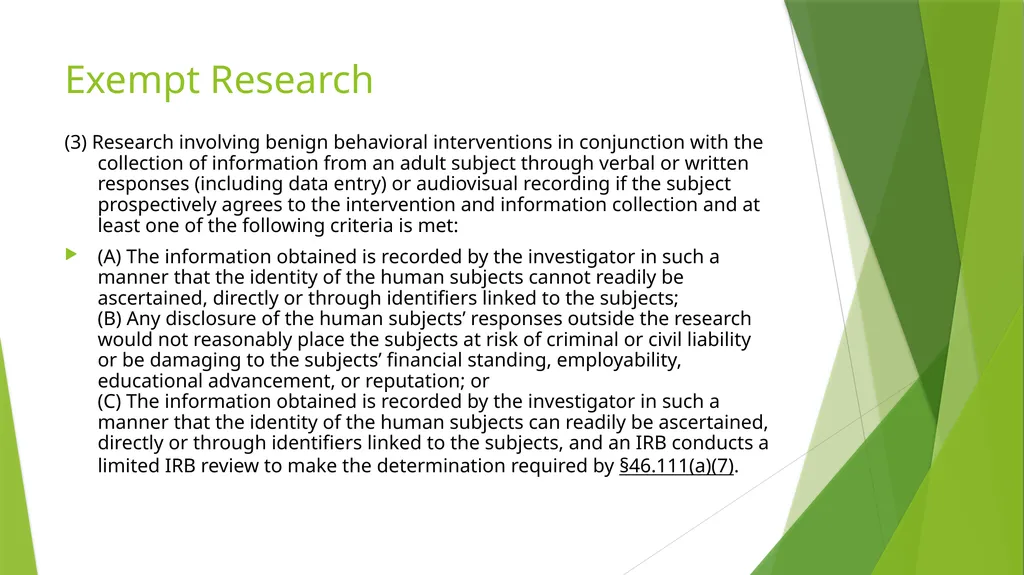
Exempt Research (3) Research involving benign behavioral interventions in conjunction with the collection of information from an adult subject through verbal or written responses (including data entry) or audiovisual recording if the subject prospectively agrees to the intervention and information collection and at least one of the following criteria is met:
(A) The information obtained is recorded by the investigator in such a manner that the identity of the human subjects cannot readily be ascertained, directly or through identifiers linked to the subjects; (B) Any disclosure of the human subjects’ responses outside the research would not reasonably place the subjects at risk of criminal or civil liability or be damaging to the subjects’ financial standing, employability, educational advancement, or reputation; or (C) The information obtained is recorded by the investigator in such a manner that the identity of the human subjects can readily be ascertained, directly or through identifiers linked to the subjects, and an IRB conducts a limited IRB review to make the determination required by §46.111(a)(7).<br>
(A) The information obtained is recorded by the investigator in such a manner that the identity of the human subjects cannot readily be ascertained, directly or through identifiers linked to the subjects; (B) Any disclosure of the human subjects’ responses outside the research would not reasonably place the subjects at risk of criminal or civil liability or be damaging to the subjects’ financial standing, employability, educational advancement, or reputation; or (C) The information obtained is recorded by the investigator in such a manner that the identity of the human subjects can readily be ascertained, directly or through identifiers linked to the subjects, and an IRB conducts a limited IRB review to make the determination required by §46.111(a)(7).<br>
36
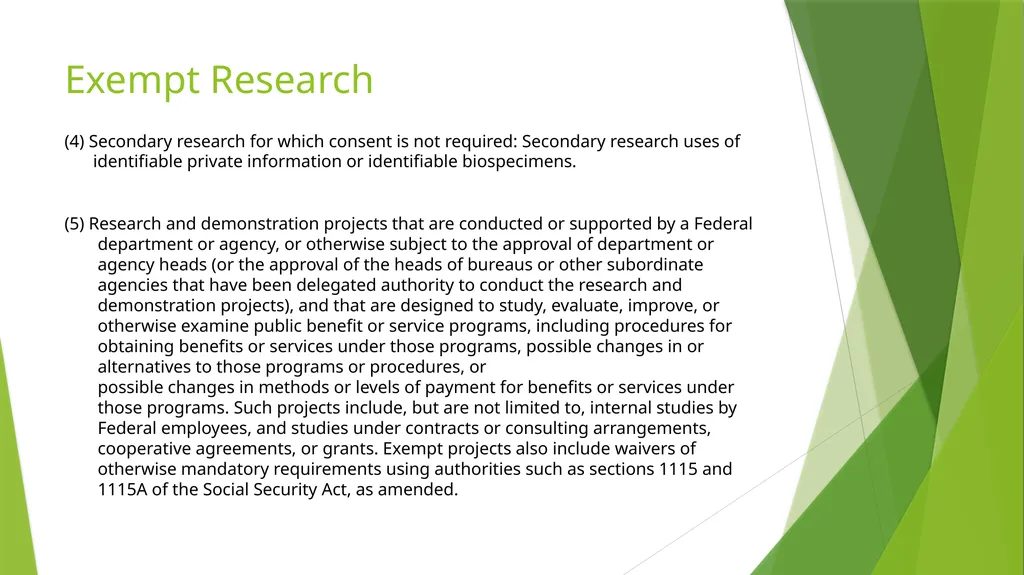
Exempt Research (4) Secondary research for which consent is not required: Secondary research uses of identifiable private information or identifiable biospecimens.
(5) Research and demonstration projects that are conducted or supported by a Federal department or agency, or otherwise subject to the approval of department or agency heads (or the approval of the heads of bureaus or other subordinate agencies that have been delegated authority to conduct the research and demonstration projects), and that are designed to study, evaluate, improve, or otherwise examine public benefit or service programs, including procedures for obtaining benefits or services under those programs, possible changes in or alternatives to those programs or procedures, or possible changes in methods or levels of payment for benefits or services under those programs. Such projects include, but are not limited to, internal studies by Federal employees, and studies under contracts or consulting arrangements, cooperative agreements, or grants. Exempt projects also include waivers of otherwise mandatory requirements using authorities such as sections 1115 and 1115A of the Social Security Act, as amended.<br>
(5) Research and demonstration projects that are conducted or supported by a Federal department or agency, or otherwise subject to the approval of department or agency heads (or the approval of the heads of bureaus or other subordinate agencies that have been delegated authority to conduct the research and demonstration projects), and that are designed to study, evaluate, improve, or otherwise examine public benefit or service programs, including procedures for obtaining benefits or services under those programs, possible changes in or alternatives to those programs or procedures, or possible changes in methods or levels of payment for benefits or services under those programs. Such projects include, but are not limited to, internal studies by Federal employees, and studies under contracts or consulting arrangements, cooperative agreements, or grants. Exempt projects also include waivers of otherwise mandatory requirements using authorities such as sections 1115 and 1115A of the Social Security Act, as amended.<br>
37
Exempt Research (6) Taste and food quality evaluation and consumer acceptance studies:
If wholesome foods without additives are consumed, or
If a food is consumed that contains a food ingredient at or below the level and for a use found to be safe, or agricultural chemical or environmental contaminant at or below the level found to be safe, by the Food and Drug Administration or approved by the Environmental Protection Agency or the Food Safety and Inspection Service of the U.S. Department of Agriculture.<br>
If wholesome foods without additives are consumed, or
If a food is consumed that contains a food ingredient at or below the level and for a use found to be safe, or agricultural chemical or environmental contaminant at or below the level found to be safe, by the Food and Drug Administration or approved by the Environmental Protection Agency or the Food Safety and Inspection Service of the U.S. Department of Agriculture.<br>
38
Exempt Research (7) Storage or maintenance for secondary research for which broad consent is required: Storage or maintenance of identifiable private information or identifiable biospecimens for potential secondary research use if an IRB conducts a limited IRB review and makes the determinations required by §46.111(a)(8).
(8) Secondary research for which broad consent is required: Research involving the use of identifiable private information or identifiable biospecimens for secondary research use.<br>
(8) Secondary research for which broad consent is required: Research involving the use of identifiable private information or identifiable biospecimens for secondary research use.<br>
39
Expedited:
Not greater than minimal risk
Involves only procedures listed in one or more of the expedited categories of the federal regulations
Needs IRB review and approval Types of IRB Review<br>
Not greater than minimal risk
Involves only procedures listed in one or more of the expedited categories of the federal regulations
Needs IRB review and approval Types of IRB Review<br>
40
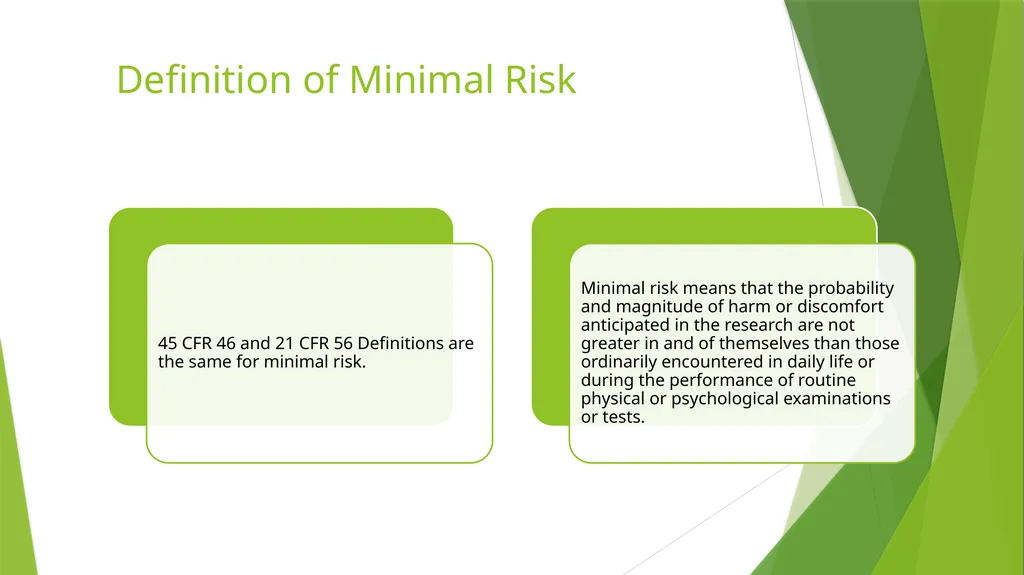
Definition of Minimal Risk<br>
41
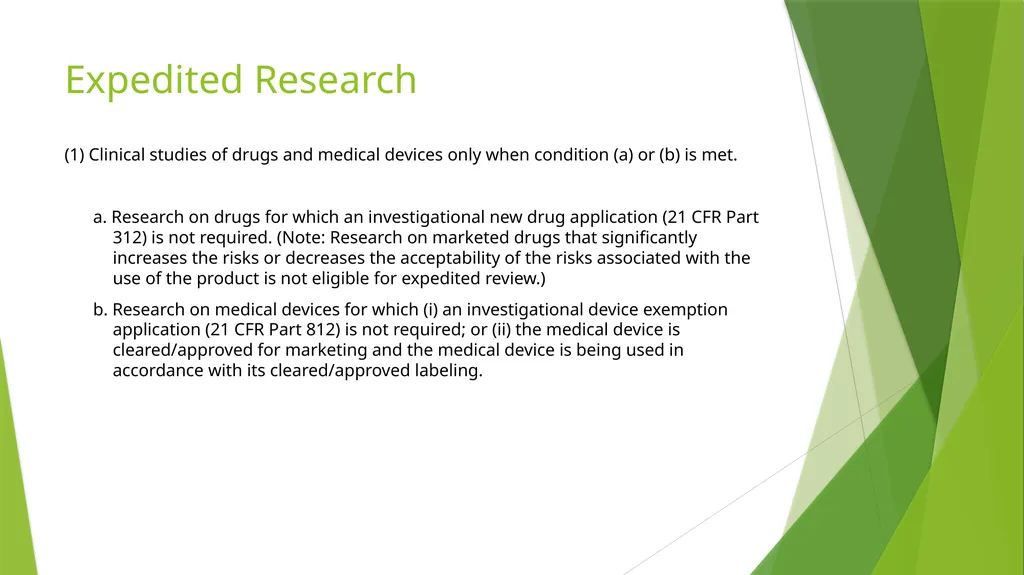
Expedited Research (1) Clinical studies of drugs and medical devices only when condition (a) or (b) is met.
a. Research on drugs for which an investigational new drug application (21 CFR Part 312) is not required. (Note: Research on marketed drugs that significantly increases the risks or decreases the acceptability of the risks associated with the use of the product is not eligible for expedited review.)
b. Research on medical devices for which (i) an investigational device exemption application (21 CFR Part 812) is not required; or (ii) the medical device is cleared/approved for marketing and the medical device is being used in accordance with its cleared/approved labeling.<br>
a. Research on drugs for which an investigational new drug application (21 CFR Part 312) is not required. (Note: Research on marketed drugs that significantly increases the risks or decreases the acceptability of the risks associated with the use of the product is not eligible for expedited review.)
b. Research on medical devices for which (i) an investigational device exemption application (21 CFR Part 812) is not required; or (ii) the medical device is cleared/approved for marketing and the medical device is being used in accordance with its cleared/approved labeling.<br>
42
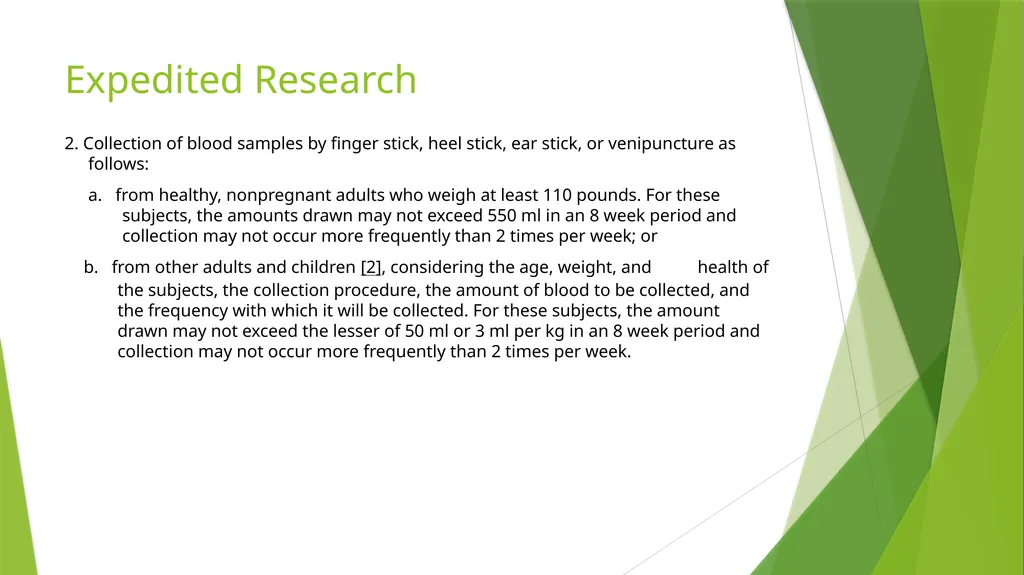
Expedited Research 2. Collection of blood samples by finger stick, heel stick, ear stick, or venipuncture as follows:
a. from healthy, nonpregnant adults who weigh at least 110 pounds. For these subjects, the amounts drawn may not exceed 550 ml in an 8 week period and collection may not occur more frequently than 2 times per week; or
b. from other adults and children [2], considering the age, weight, and health of the subjects, the collection procedure, the amount of blood to be collected, and the frequency with which it will be collected. For these subjects, the amount drawn may not exceed the lesser of 50 ml or 3 ml per kg in an 8 week period and collection may not occur more frequently than 2 times per week.<br>
a. from healthy, nonpregnant adults who weigh at least 110 pounds. For these subjects, the amounts drawn may not exceed 550 ml in an 8 week period and collection may not occur more frequently than 2 times per week; or
b. from other adults and children [2], considering the age, weight, and health of the subjects, the collection procedure, the amount of blood to be collected, and the frequency with which it will be collected. For these subjects, the amount drawn may not exceed the lesser of 50 ml or 3 ml per kg in an 8 week period and collection may not occur more frequently than 2 times per week.<br>
43
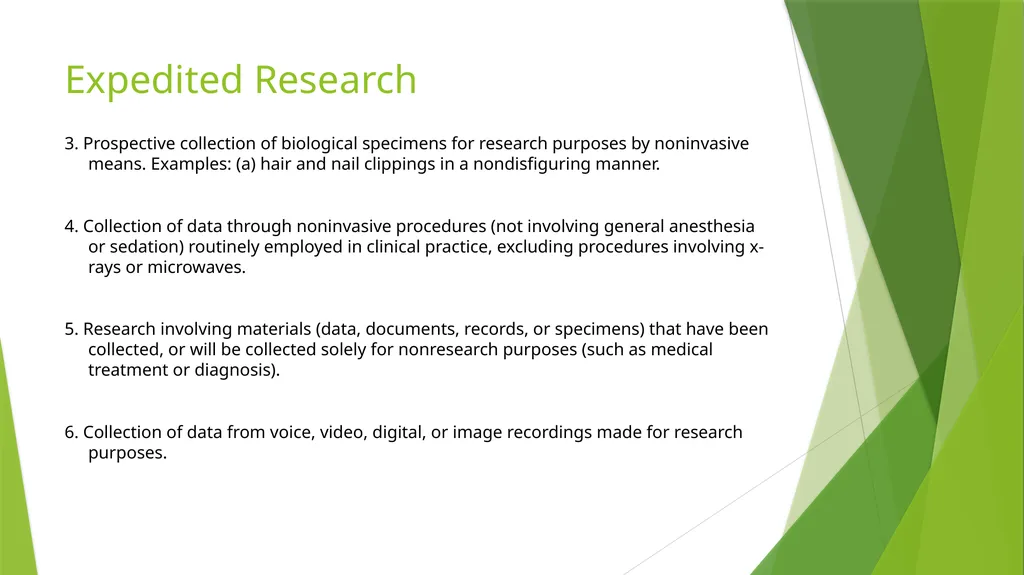
Expedited Research 3. Prospective collection of biological specimens for research purposes by noninvasive means. Examples: (a) hair and nail clippings in a nondisfiguring manner.
4. Collection of data through noninvasive procedures (not involving general anesthesia or sedation) routinely employed in clinical practice, excluding procedures involving x-rays or microwaves.
5. Research involving materials (data, documents, records, or specimens) that have been collected, or will be collected solely for nonresearch purposes (such as medical treatment or diagnosis).
6. Collection of data from voice, video, digital, or image recordings made for research purposes.<br>
4. Collection of data through noninvasive procedures (not involving general anesthesia or sedation) routinely employed in clinical practice, excluding procedures involving x-rays or microwaves.
5. Research involving materials (data, documents, records, or specimens) that have been collected, or will be collected solely for nonresearch purposes (such as medical treatment or diagnosis).
6. Collection of data from voice, video, digital, or image recordings made for research purposes.<br>
44
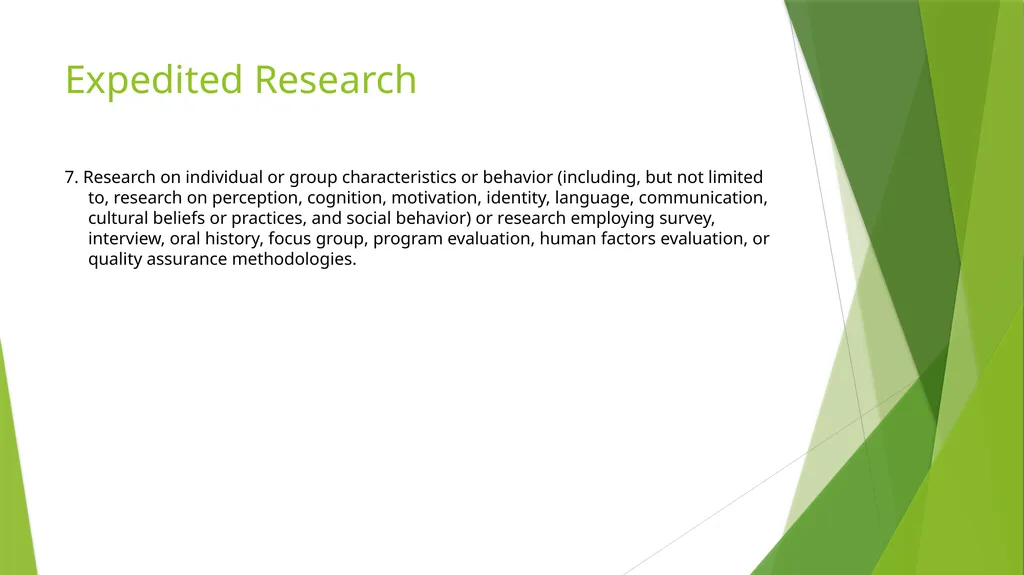
Expedited Research 7. Research on individual or group characteristics or behavior (including, but not limited to, research on perception, cognition, motivation, identity, language, communication, cultural beliefs or practices, and social behavior) or research employing survey, interview, oral history, focus group, program evaluation, human factors evaluation, or quality assurance methodologies.<br>
45
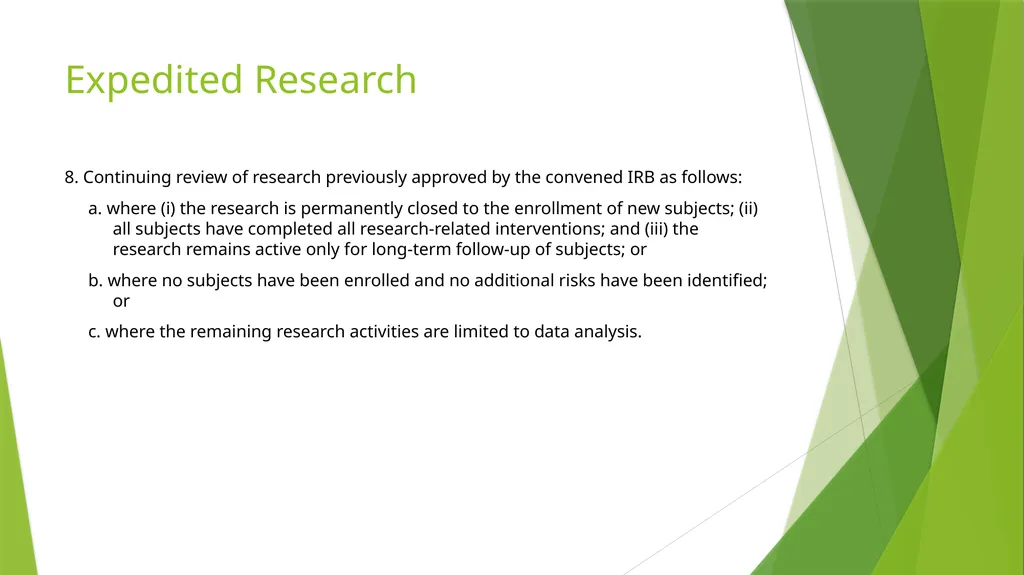
Expedited Research 8. Continuing review of research previously approved by the convened IRB as follows:
a. where (i) the research is permanently closed to the enrollment of new subjects; (ii) all subjects have completed all research-related interventions; and (iii) the research remains active only for long-term follow-up of subjects; or
b. where no subjects have been enrolled and no additional risks have been identified; or
c. where the remaining research activities are limited to data analysis.<br>
a. where (i) the research is permanently closed to the enrollment of new subjects; (ii) all subjects have completed all research-related interventions; and (iii) the research remains active only for long-term follow-up of subjects; or
b. where no subjects have been enrolled and no additional risks have been identified; or
c. where the remaining research activities are limited to data analysis.<br>
46
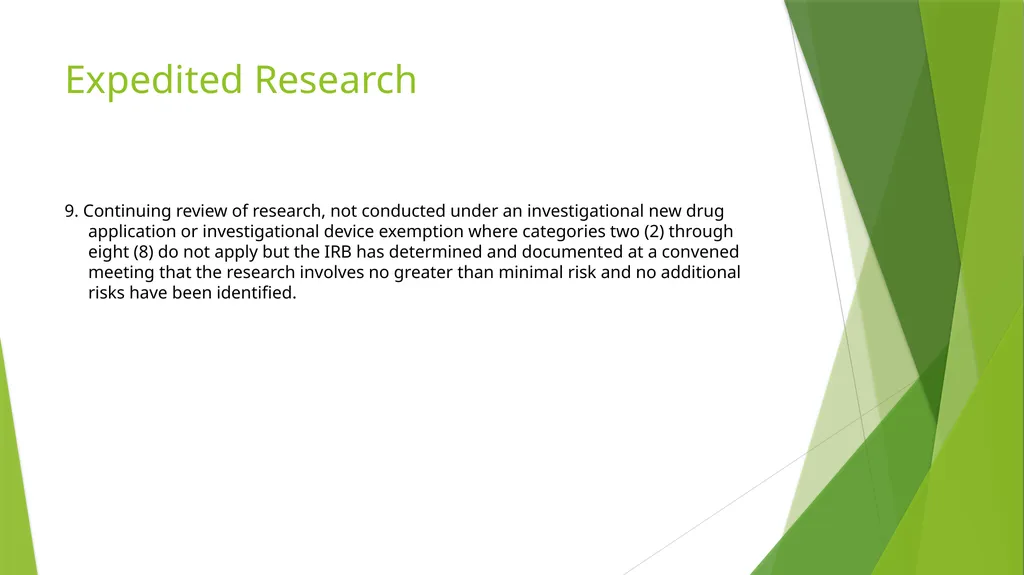
Expedited Research 9. Continuing review of research, not conducted under an investigational new drug application or investigational device exemption where categories two (2) through eight (8) do not apply but the IRB has determined and documented at a convened meeting that the research involves no greater than minimal risk and no additional risks have been identified.<br>
47
Full committee or full board review:
greater than minimal risk
does not meet the guidelines for exempt or expedited review.
requiring a convened committee, review and possible approval of changes
annual continuing review Types of IRB Review<br>
greater than minimal risk
does not meet the guidelines for exempt or expedited review.
requiring a convened committee, review and possible approval of changes
annual continuing review Types of IRB Review<br>
48
Definition of Minimal Risk<br>
49
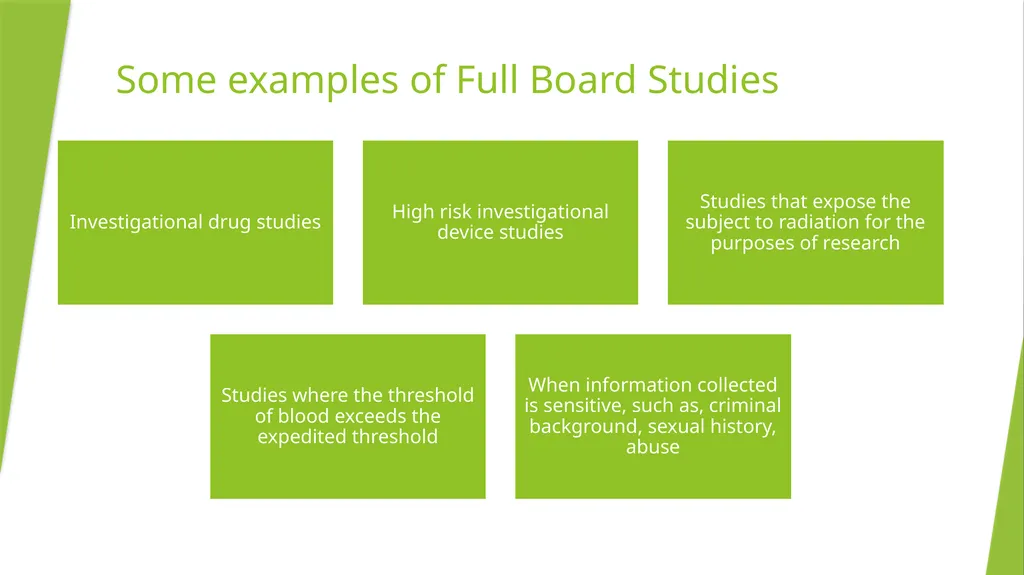
Some examples of Full Board Studies<br>
50
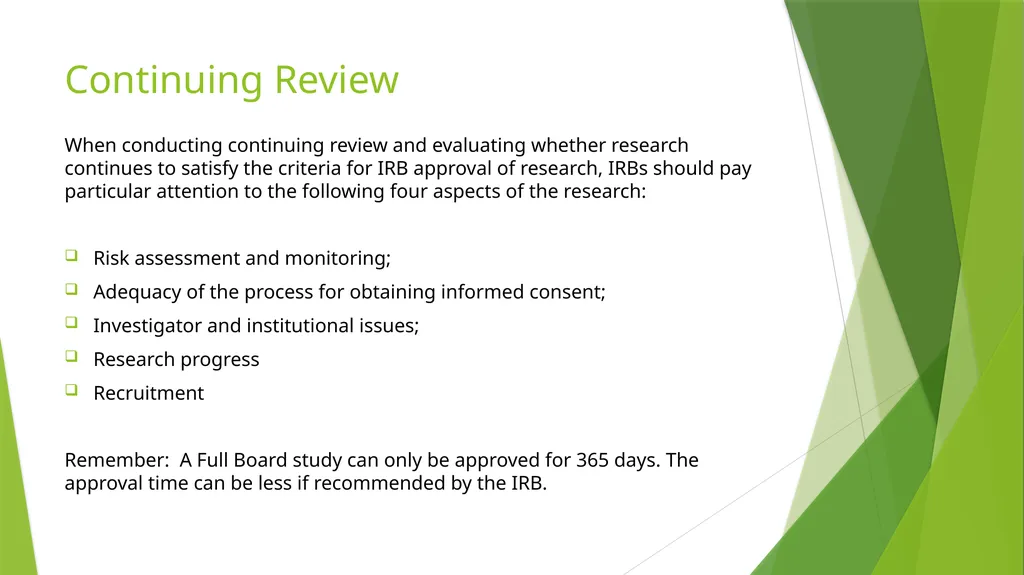
Continuing Review When conducting continuing review and evaluating whether research continues to satisfy the criteria for IRB approval of research, IRBs should pay particular attention to the following four aspects of the research:
Risk assessment and monitoring;
Adequacy of the process for obtaining informed consent;
Investigator and institutional issues;
Research progress
Recruitment
Remember: A Full Board study can only be approved for 365 days. The approval time can be less if recommended by the IRB.<br>
Risk assessment and monitoring;
Adequacy of the process for obtaining informed consent;
Investigator and institutional issues;
Research progress
Recruitment
Remember: A Full Board study can only be approved for 365 days. The approval time can be less if recommended by the IRB.<br>
51
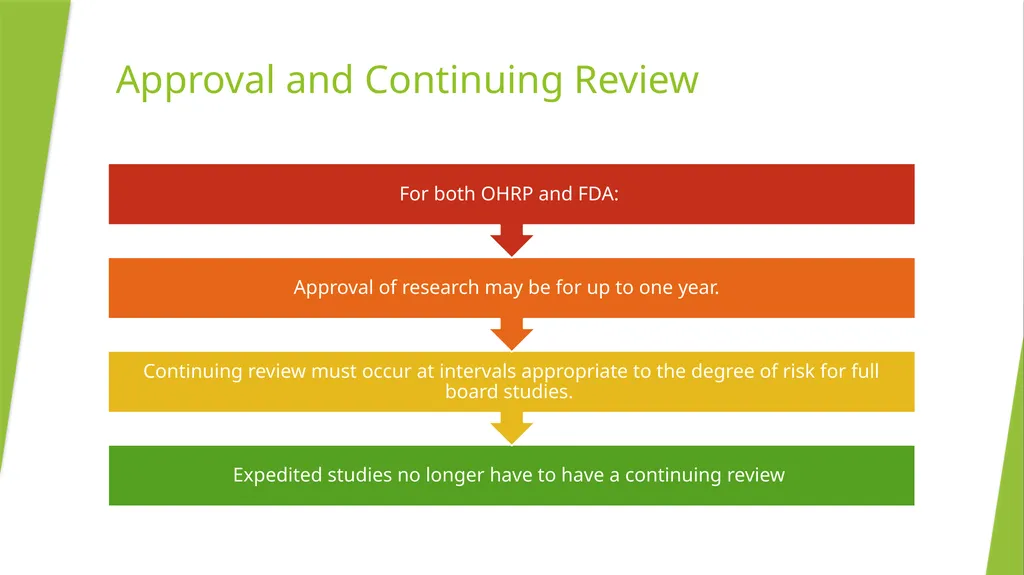
Approval and Continuing Review<br>
52
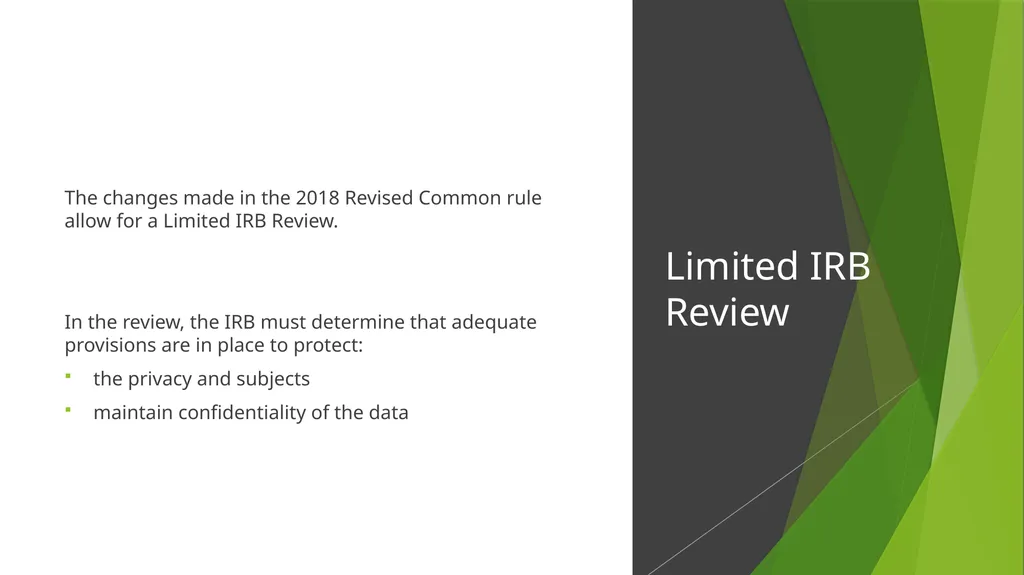
The changes made in the 2018 Revised Common rule allow for a Limited IRB Review.
In the review, the IRB must determine that adequate provisions are in place to protect:
the privacy and subjects
maintain confidentiality of the data Limited IRB Review<br>
In the review, the IRB must determine that adequate provisions are in place to protect:
the privacy and subjects
maintain confidentiality of the data Limited IRB Review<br>
53
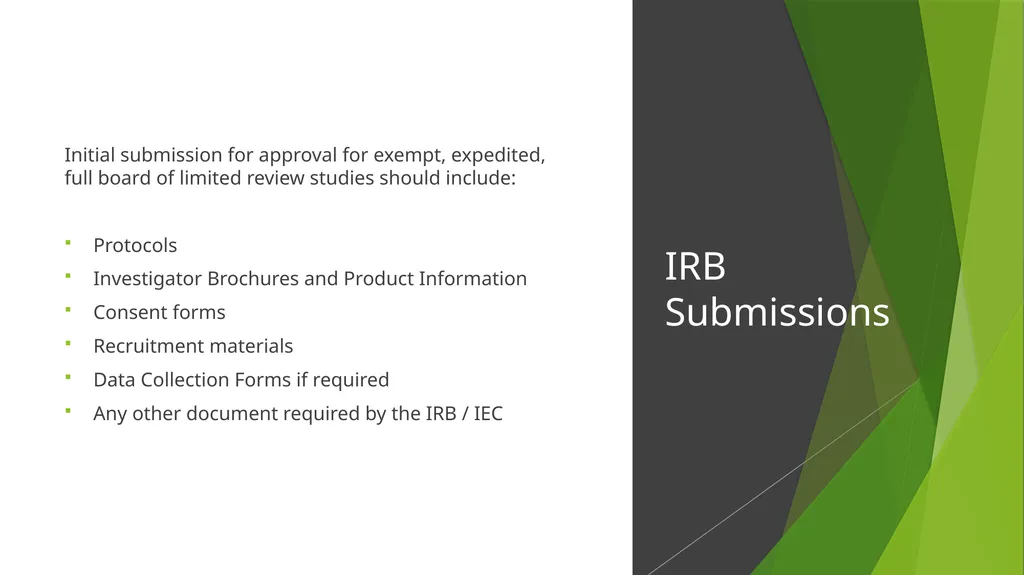
Initial submission for approval for exempt, expedited, full board of limited review studies should include:
Protocols
Investigator Brochures and Product Information
Consent forms
Recruitment materials
Data Collection Forms if required
Any other document required by the IRB / IEC IRB Submissions<br>
Protocols
Investigator Brochures and Product Information
Consent forms
Recruitment materials
Data Collection Forms if required
Any other document required by the IRB / IEC IRB Submissions<br>
54
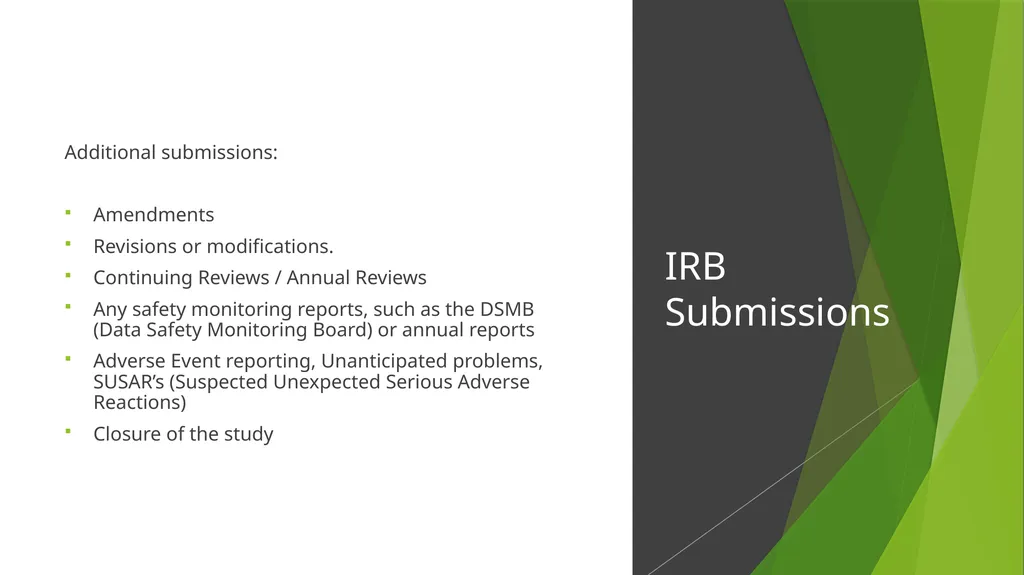
Additional submissions:
Amendments
Revisions or modifications.
Continuing Reviews / Annual Reviews
Any safety monitoring reports, such as the DSMB (Data Safety Monitoring Board) or annual reports
Adverse Event reporting, Unanticipated problems, SUSAR’s (Suspected Unexpected Serious Adverse Reactions)
Closure of the study IRB Submissions<br>
Amendments
Revisions or modifications.
Continuing Reviews / Annual Reviews
Any safety monitoring reports, such as the DSMB (Data Safety Monitoring Board) or annual reports
Adverse Event reporting, Unanticipated problems, SUSAR’s (Suspected Unexpected Serious Adverse Reactions)
Closure of the study IRB Submissions<br>
55
Test your knowledge<br>
56
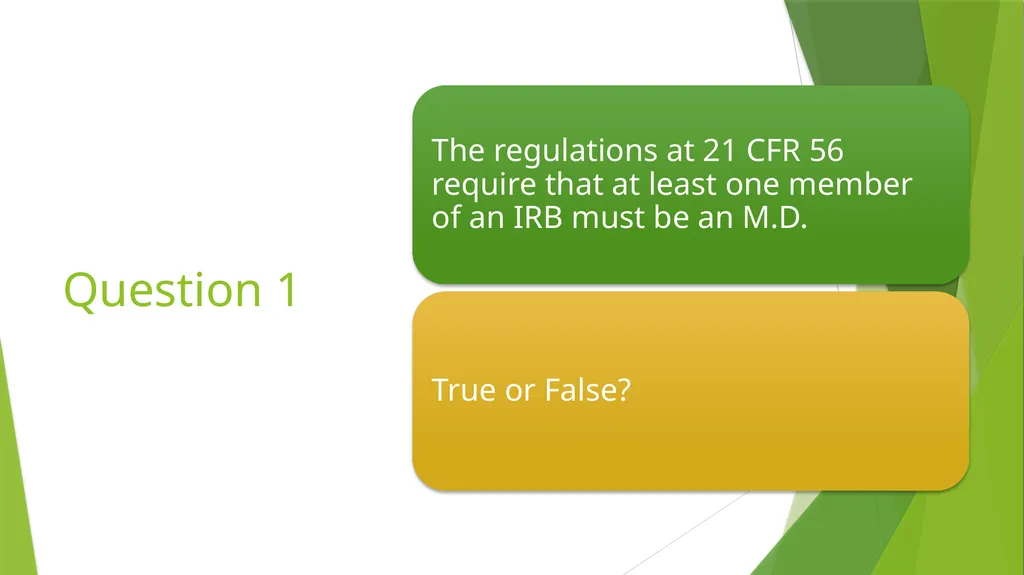
Question 1<br>
57
Question 1
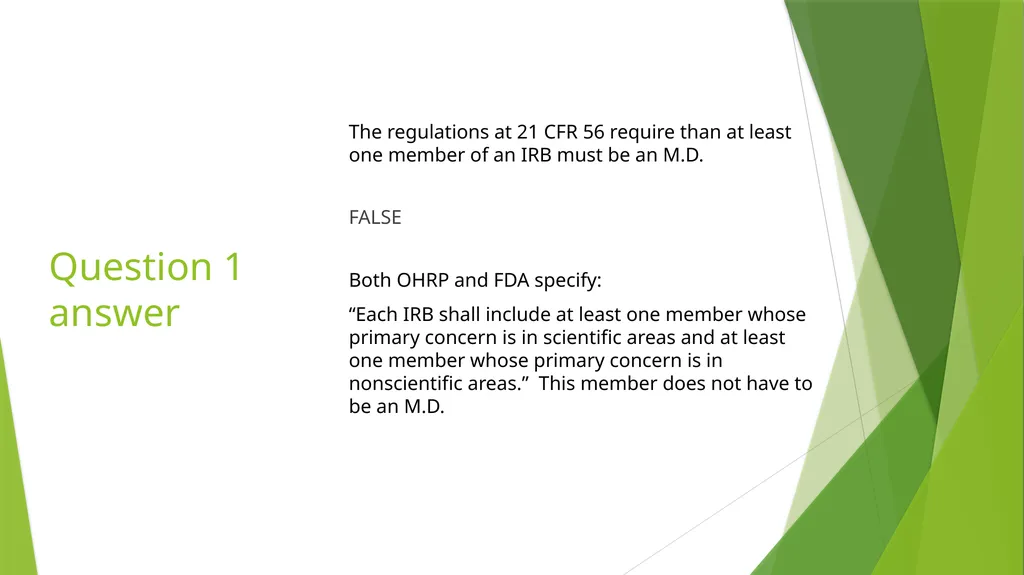
answer The regulations at 21 CFR 56 require than at least one member of an IRB must be an M.D.
FALSE
Both OHRP and FDA specify:
“Each IRB shall include at least one member whose primary concern is in scientific areas and at least one member whose primary concern is in nonscientific areas.” This member does not have to be an M.D.<br>
FALSE
Both OHRP and FDA specify:
“Each IRB shall include at least one member whose primary concern is in scientific areas and at least one member whose primary concern is in nonscientific areas.” This member does not have to be an M.D.<br>
58
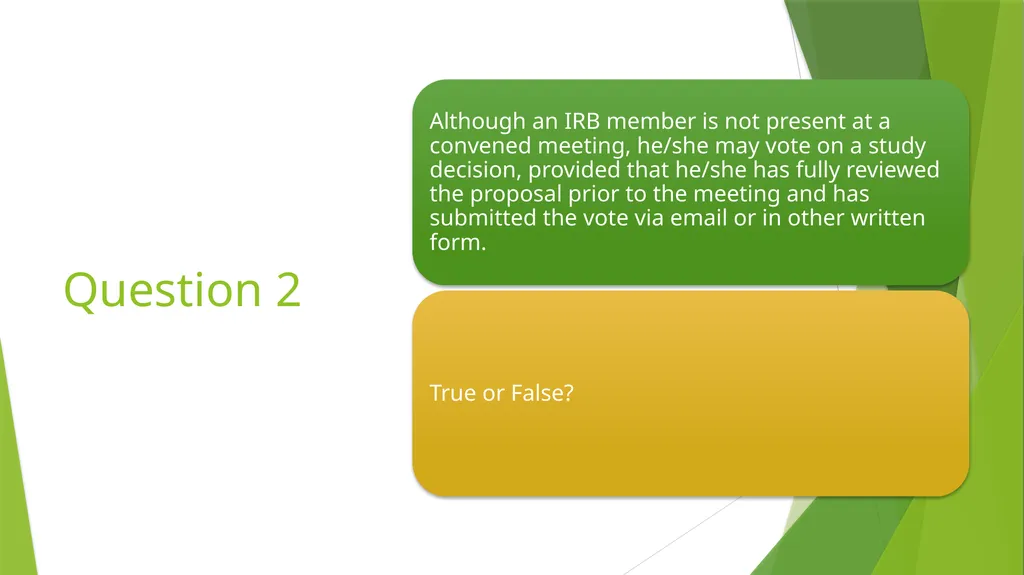
Question 2<br>
59
Question 2 answer Although an IRB member is not present at a convened meeting, he/she may vote on a study decision, provided that he/she has fully reviewed the proposal prior to the meeting and has submitted the vote via email or in other written form.
FALSE
Opinions of the absent members that are transmitted by mail, telephone, telefax or e-mail may be considered by the attending IRB members but may not be counted as votes or the quorum for convened meetings.<br>
FALSE
Opinions of the absent members that are transmitted by mail, telephone, telefax or e-mail may be considered by the attending IRB members but may not be counted as votes or the quorum for convened meetings.<br>
60
Question 3<br>
61
Question 2 answer An investigator has received notification that his protocol was disapproved by the IRB. The PI contacts the institutional official and appeals the IRB’s decision. According to the regulations, the institutional official may set aside the IRB’s decision and allow the PI to proceed with his research.
FALSE
An institutional official cannot allow research to proceed after IRB disapproval.<br>
FALSE
An institutional official cannot allow research to proceed after IRB disapproval.<br>
62
Questions?<br>