04
Marketing decisions requiring policies:
Whether to use exclusive dealerships – multiple channels of distribution
Whether to use heavy, light, or no TV advertising
Whether to limit (or not) the share of business done with a single customer Marketing Issues Ch 9 -10 Copyright © 2011 Pearson Education<br>
05
Whether to reward sales people
Whether to be a price leader or price follower
Whether to advertise online or not
Whether to offer complete or limited warranty Marketing Issues (cont’d) Ch 9 -11 Copyright © 2011 Pearson Education<br>
06
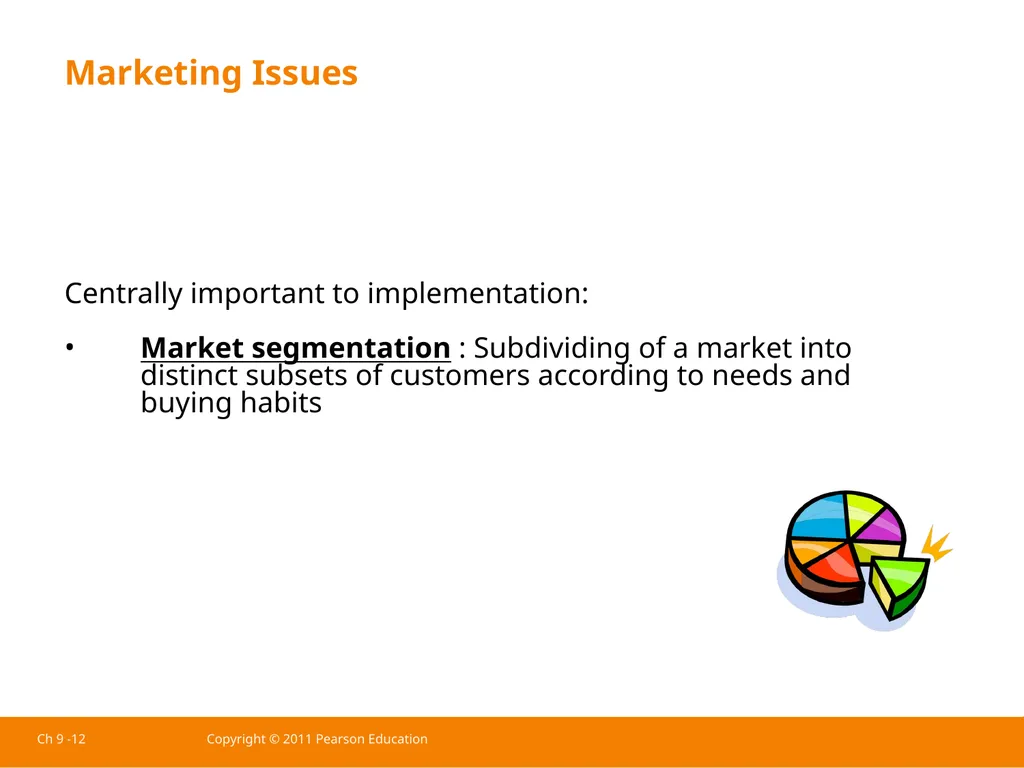
Centrally important to implementation:
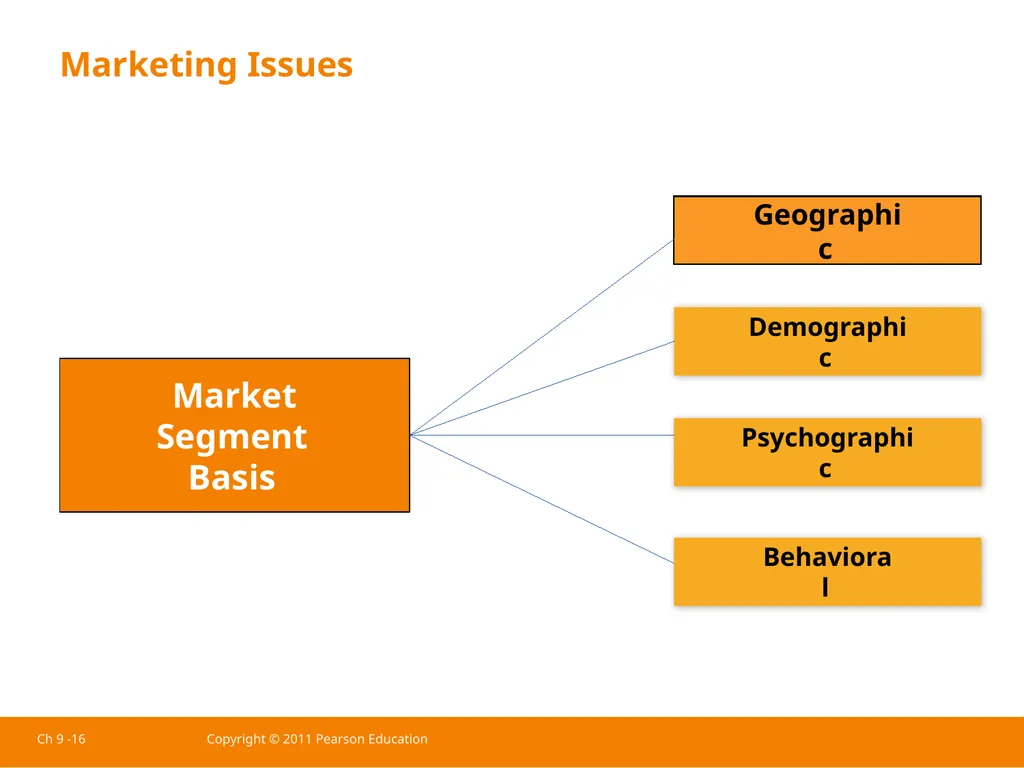
Market segmentation : Subdividing of a market into distinct subsets of customers according to needs and buying habits Marketing Issues Ch 9 -12 Copyright © 2011 Pearson Education<br>
07
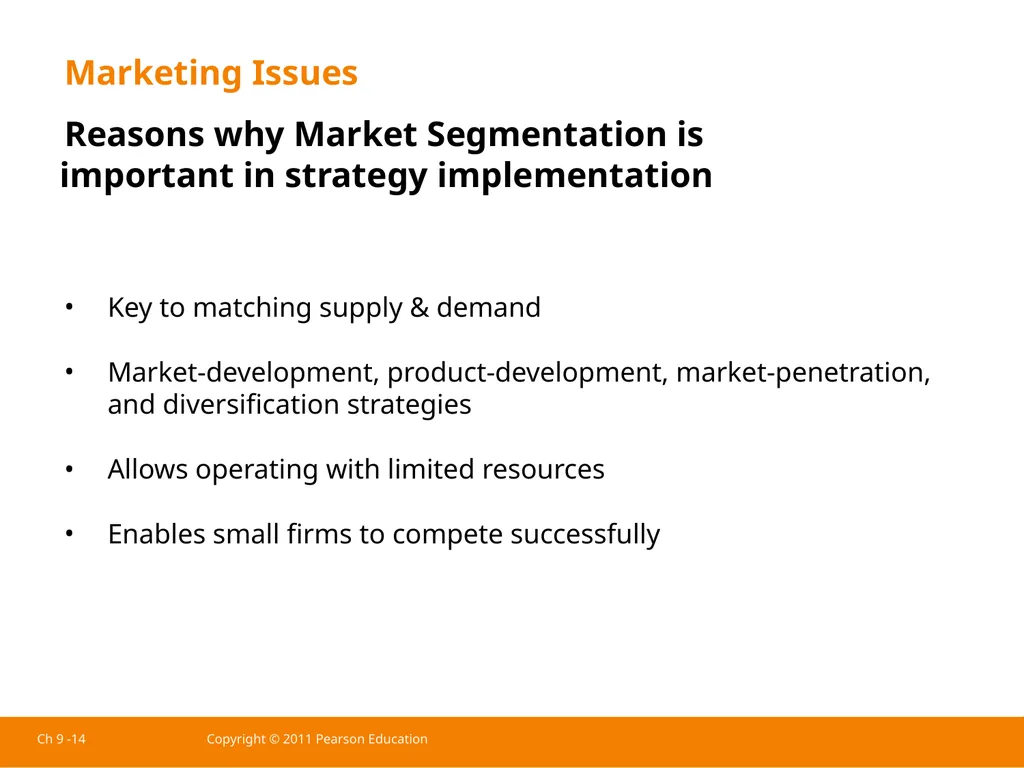
Key to matching supply & demand
Market-development, product-development, market-penetration, and diversification strategies
Allows operating with limited resources
Enables small firms to compete successfully Marketing Issues
Reasons why Market Segmentation is important in strategy implementation Ch 9 -14 Copyright © 2011 Pearson Education<br>
08
Marketing Issues Ch 9 -16 Copyright © 2011 Pearson Education<br>
09
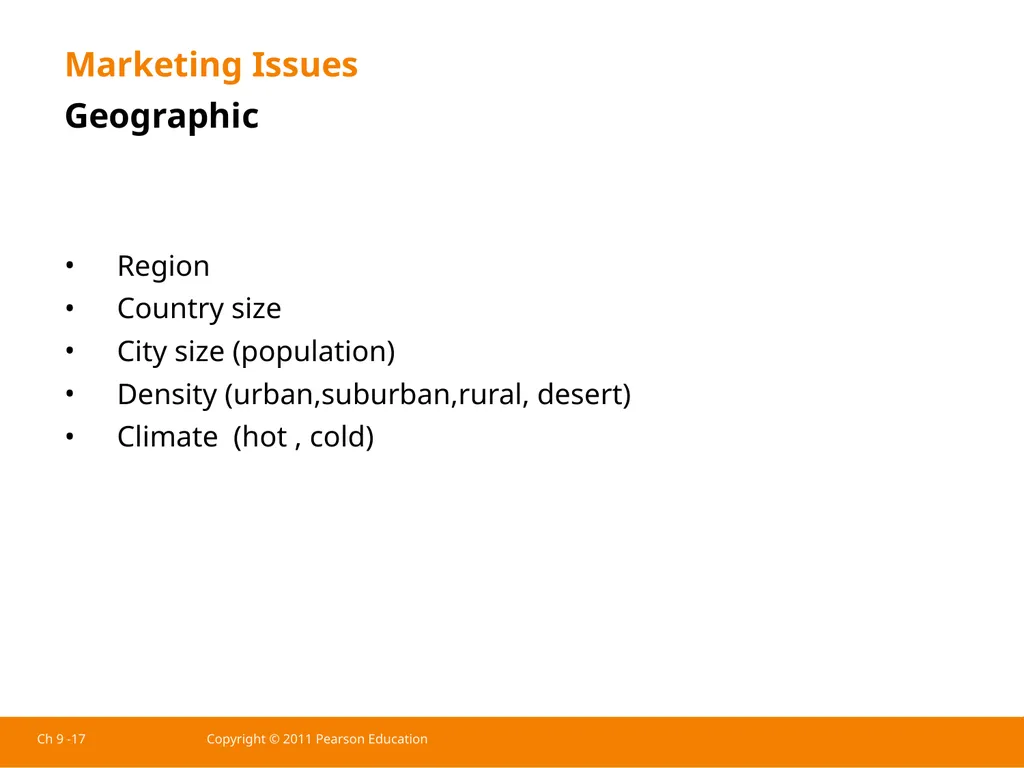
Region
Country size
City size (population)
Density (urban,suburban,rural, desert)
Climate (hot , cold) Marketing Issues Geographic Ch 9 -17 Copyright © 2011 Pearson Education<br>
10
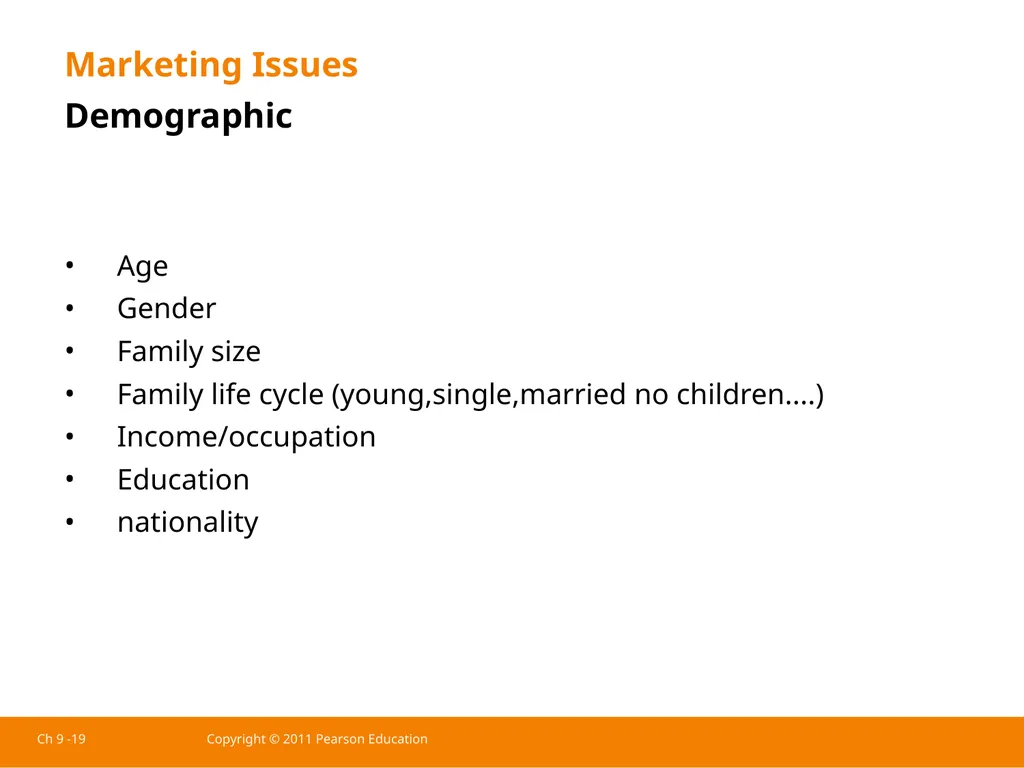
Age
Gender
Family size
Family life cycle (young,single,married no children....)
Income/occupation
Education
nationality Marketing Issues Demographic Ch 9 -19 Copyright © 2011 Pearson Education<br>
11
Social class
Personality Marketing Issues Psychographic Ch 9 -21 Copyright © 2011 Pearson Education<br>
12
Use occasion (regular occasion , special occasion)
User status (first time , ex-user...)
Usage rate(heavy user , light user...)
Loyalty status Marketing Issues Behavioral Ch 9 -23 Copyright © 2011 Pearson Education<br>
13
Acquiring needed capital(successful strategy implementation often requires additional capital)
Developing projected financial statements(allows an org to examine the expected results of various actions and approaches and the impact of strategy implementation)
Evaluating worth of a business. (its central to strategy implementation because integration , intensive and diversification strategies are often implemented by acquiring other firms.) Finance/Accounting Issues Essential for Implementation Ch 9 -31 Copyright © 2011 Pearson Education<br>
14
It is important to realize that evaluation is not an exact science. The evaluation of a firm’s worth is based on financial facts but common sense and intuitive judgement must enter into the process because its difficult to assign monetary value to some factors such as loyal customers ,dedicated employees)
**Evaluating the worth of a business truly requires both qualitative and quantitative skills.<br>
15
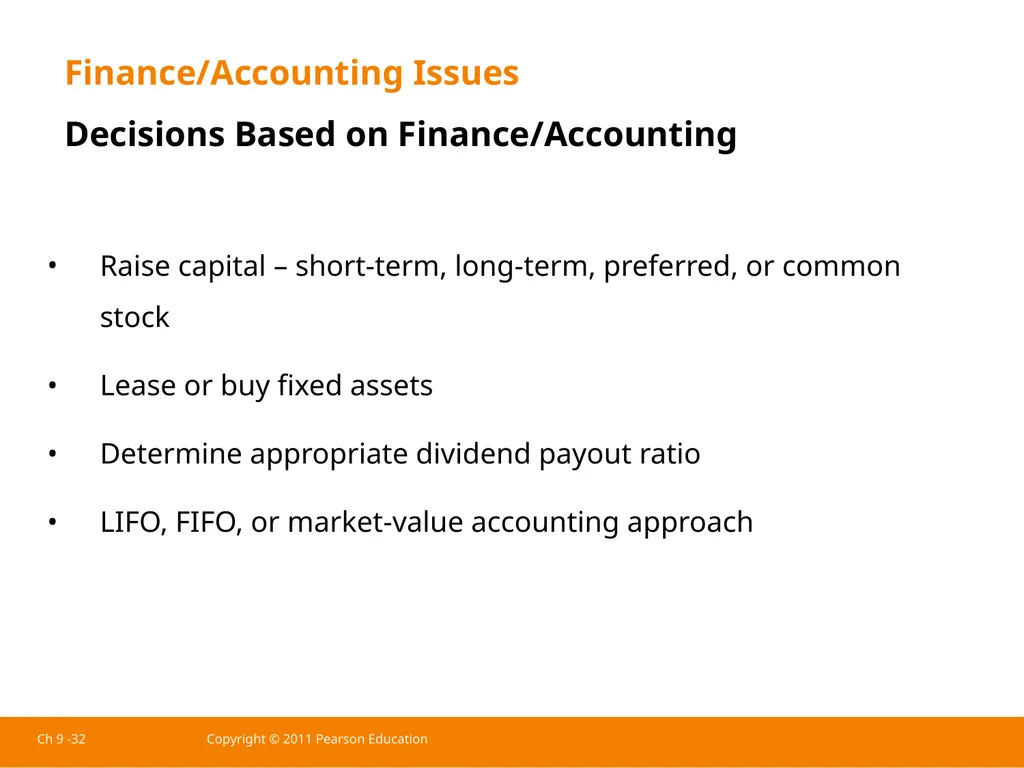
Raise capital – short-term, long-term, preferred, or common stock
Lease or buy fixed assets
Determine appropriate dividend payout ratio
LIFO, FIFO, or market-value accounting approach Finance/Accounting Issues
Decisions Based on Finance/Accounting Ch 9 -32 Copyright © 2011 Pearson Education<br>
16
Research & Development Issues Ch 9 -48 Copyright © 2011 Pearson Education New products and improvement of existing products that allow for effective strategy implementation.
what are the related strategies to R&D?<br>
17
Product development
Market Penetration
Innovation<br>
18
Level of management support constrained by resource availability Research & Development Issues
Constraints Ch 9 -49 Copyright © 2011 Pearson Education<br>
19
Technological improvements shorten product life cycles and this forces companies to be innovative and ahead of competitors.
Companies in every industry are relying on the development of new services and product to increase profitability and growth.<br>
20
R&D policies can enhance strategy implementation efforts to : Emphasise product or process improvement.
Stress basic or applied research
Be leaders or followers in R&D
Develop robotics or manual type processes
Spend high , average or low money in R&D.
Outsource R&D or within the firm<br>
21
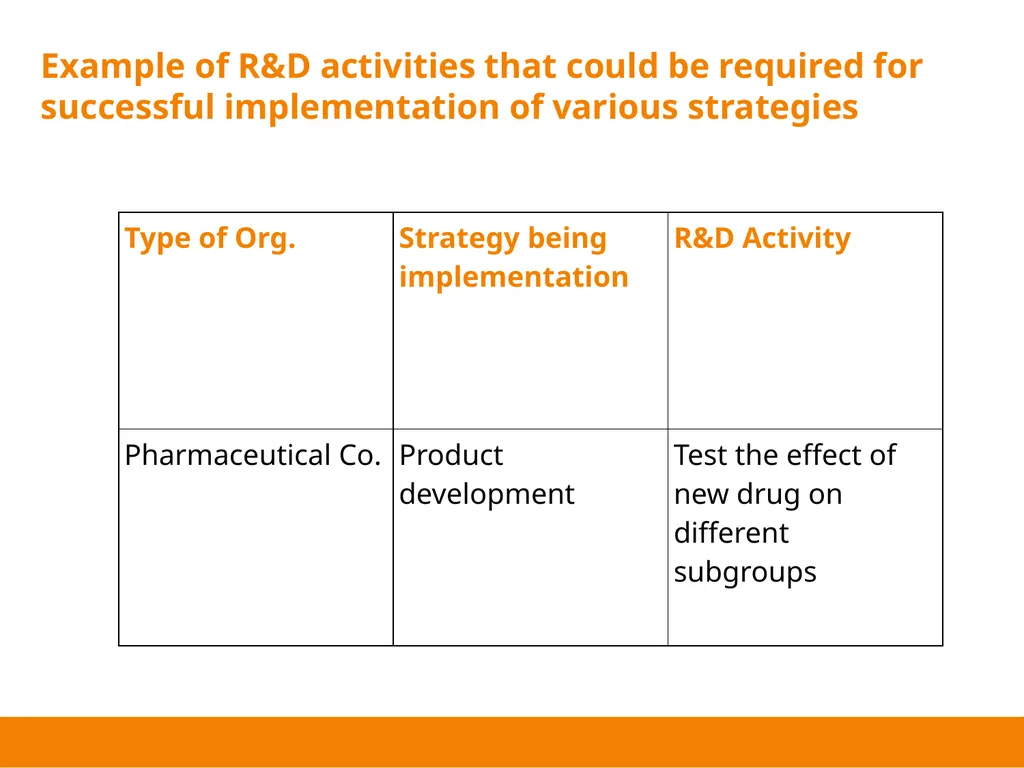
Example of R&D activities that could be required for successful implementation of various strategies<br>
22
1st firm to market new technological products (glamorous but dangerous !)
Innovative imitator of successful products(minimize the cost of start up, requires excellent R&D personnel as well as excellent marketing personnel)
Low-cost producer by mass producing of similar but less expensive products Research & Development Issues
Three Major R&D Approaches to Implementing Strategies Ch 9 -50 Copyright © 2011 Pearson Education<br>
23
Management Information Systems (MIS) Issues Ch 9 -51 Copyright © 2011 Pearson Education Information is the basis for understanding the firm. It’s one of the most important factors differentiating successful from unsuccessful firms.<br>
24
Information collection, retrieval, and storage
Keeping managers informed
Coordination of activities among divisions
Allow firm to reduce costs (e.g. online orders can reduce inventory cost) MIS Issues Functions of MIS Ch 9 -52 Copyright © 2011 Pearson Education<br>
25
The process of SM is facilitated better in the firms that have an effective information system
effective IS is the one blend the technical knowledge of the computer experts with the vision of senior managements.<br>
26
Conclusion successful strategy implementation depends on cooperation among all function and managers.<br>