Changes in Ships Center of Gravity Section 3.2 Center of MassGravity Center of MassGravity (G or CG) The weighted average over area or volume based on given distribution summed such that result is equivalent to the total force applied
"Changes in Ship’s Center of Gravity Section 3.2" is the property of its rightful owner. Permission is granted to
download and print the materials on this website for personal, non-commercial use only, and to display it
on your personal computer provided you do not modify the materials and that you retain all copyright
notices contained in the materials. By downloading content from our website, you accept the terms of this
agreement.
Presentation Transcript
01
Changes in Ship’s Center of Gravity Section 3.2<br>
02
Center of Mass/Gravity Center of Mass/Gravity (G or CG)
The weighted average over area or volume based on given distribution summed such that result is equivalent to the total force applied through a single point
Similar to Center of Buoyancy for defining
LCG – Longitudinal Center of Gravity, x axis
TCG – Transverse Center of Gravity, y axis
KG – Vertical Center of Gravity, distance from Keel to Center of Gravity, z axis
What can change the Center of Gravity?
Add weight
Subtract weight
Shift (move) weight/change distribution<br>
03
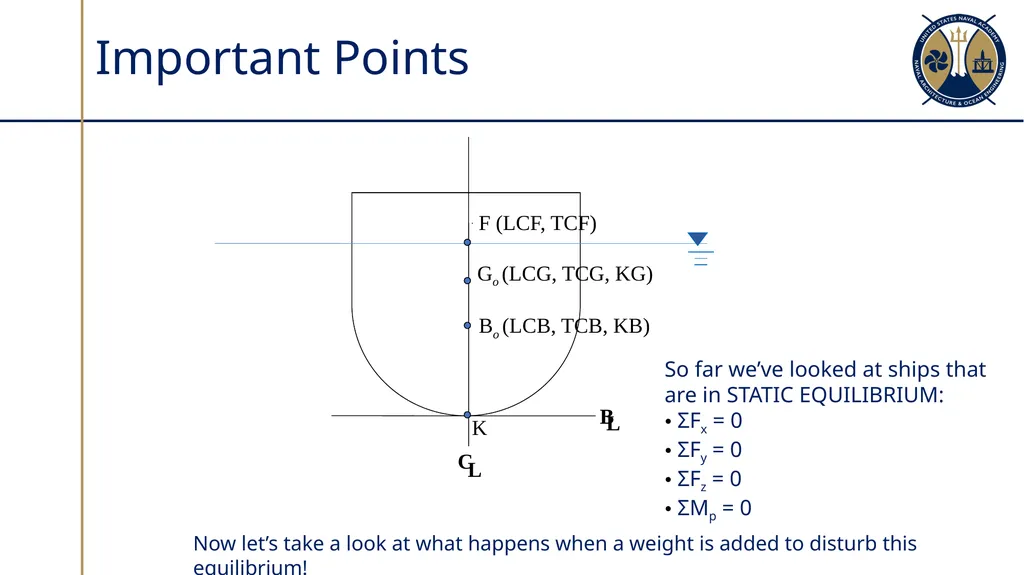
Important Points Go (LCG, TCG, KG) Bo (LCB, TCB, KB) K So far we’ve looked at ships that are in STATIC EQUILIBRIUM:
ΣFx = 0
ΣFy = 0
ΣFz = 0
ΣΜp = 0 Now let’s take a look at what happens when a weight is added to disturb this equilibrium!<br>
04
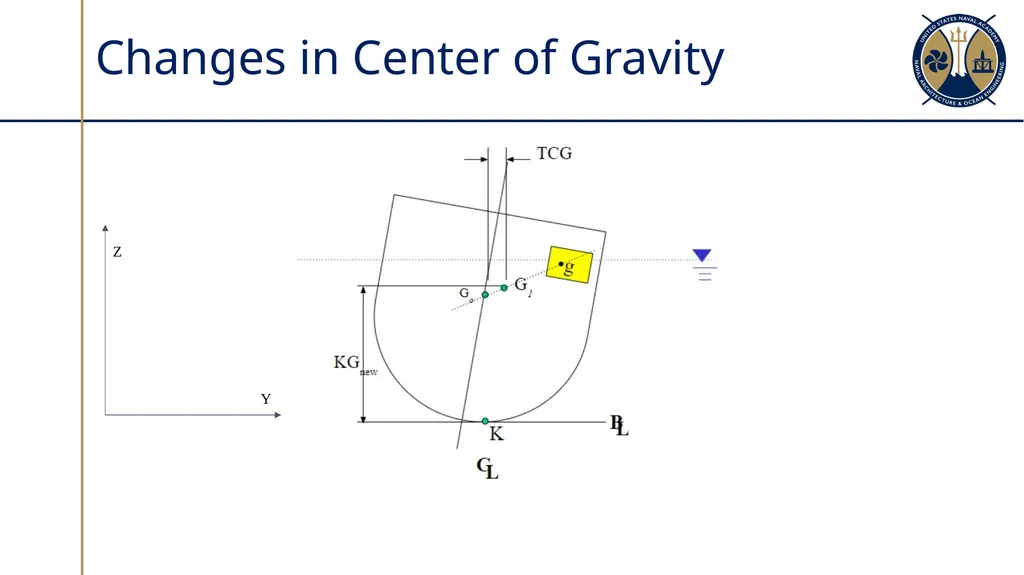
Terminology G = Location of Center of Gravity for whole ship
g = Location of Center of Gravity for singular object
Δs= Displacement of ship (LT)
w = weight of object placed/removed/shifted
G or CG = Center of Gravity
LCG = longitudinal Center of Gravity, x axis
TCG = transverse center of gravity (left / right), y axis
KG (aka VCG) = keel to center of gravity / vertical center of gravity, z axis<br>
05
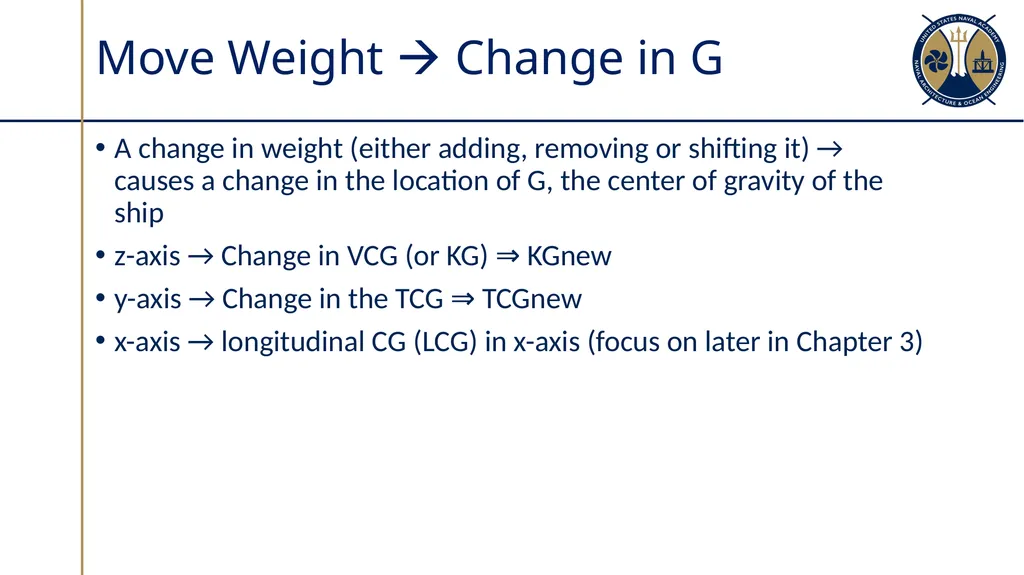
Move Weight Change in G A change in weight (either adding, removing or shifting it) → causes a change in the location of G, the center of gravity of the ship
z-axis → Change in VCG (or KG) ⇒ KGnew
y-axis → Change in the TCG ⇒ TCGnew
x-axis → longitudinal CG (LCG) in x-axis (focus on later in Chapter 3)<br>
06
Changes in Center of Gravity Z Y<br>
07
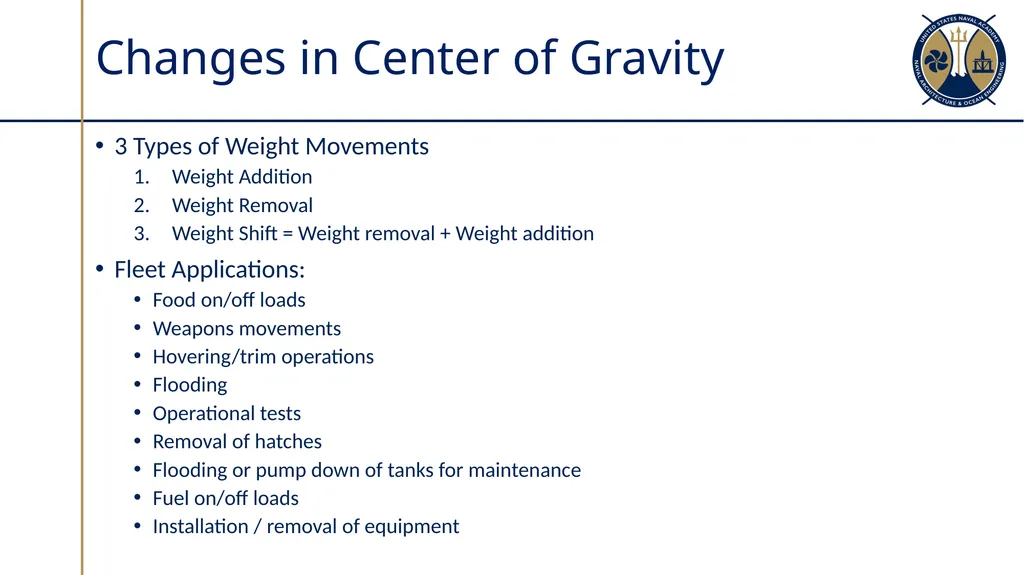
Changes in Center of Gravity 3 Types of Weight Movements
Weight Addition
Weight Removal
Weight Shift = Weight removal + Weight addition
Fleet Applications:
Food on/off loads
Weapons movements
Hovering/trim operations
Flooding
Operational tests
Removal of hatches
Flooding or pump down of tanks for maintenance
Fuel on/off loads
Installation / removal of equipment<br>
08
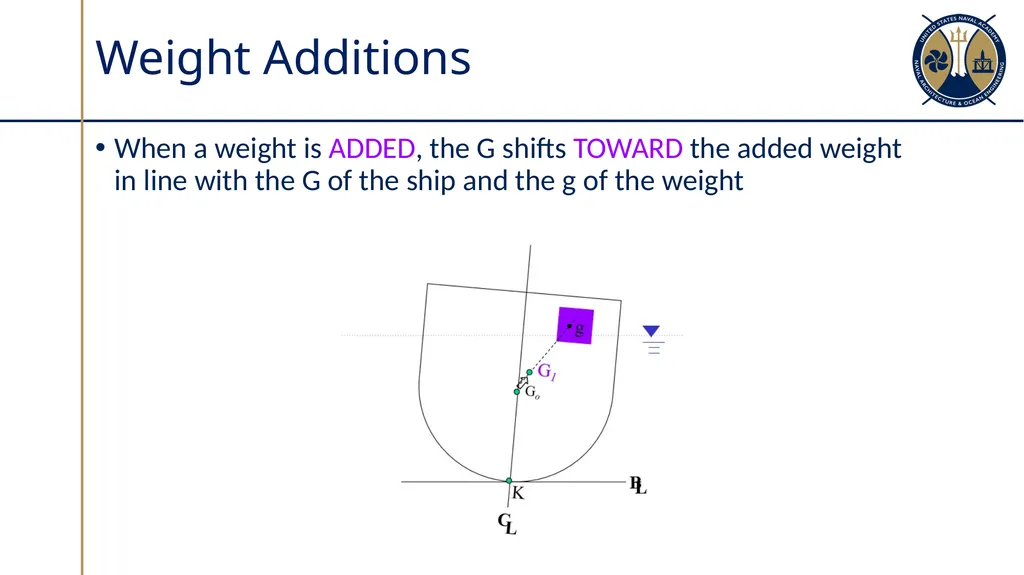
Weight Additions When a weight is ADDED, the G shifts TOWARD the added weight in line with the G of the ship and the g of the weight<br>
09
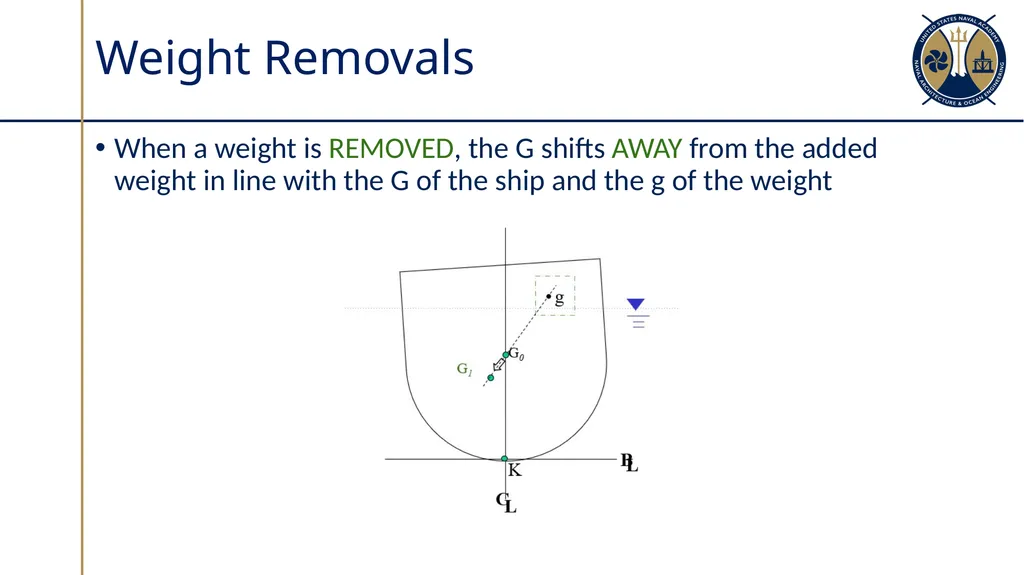
Weight Removals When a weight is REMOVED, the G shifts AWAY from the added weight in line with the G of the ship and the g of the weight<br>
10
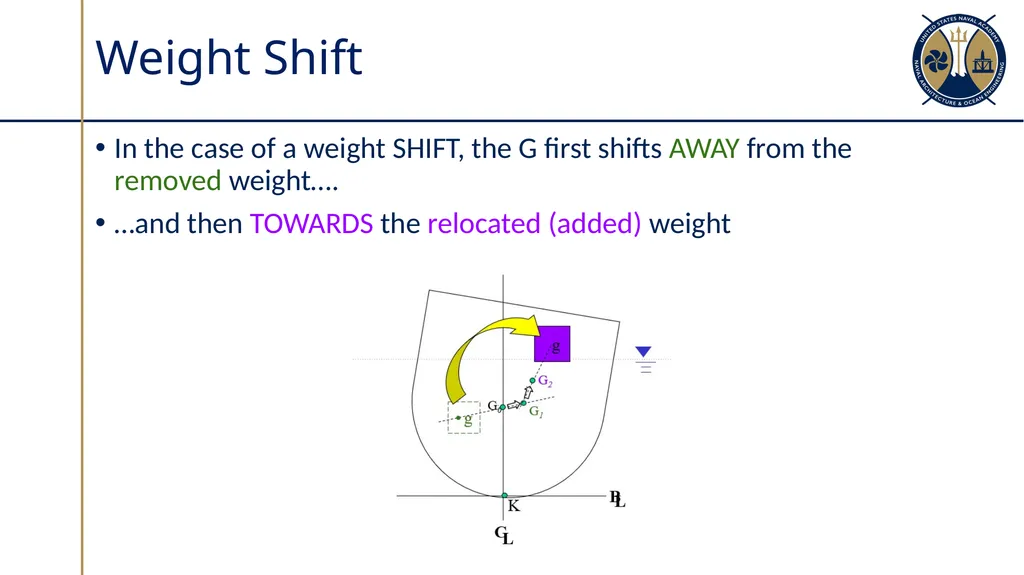
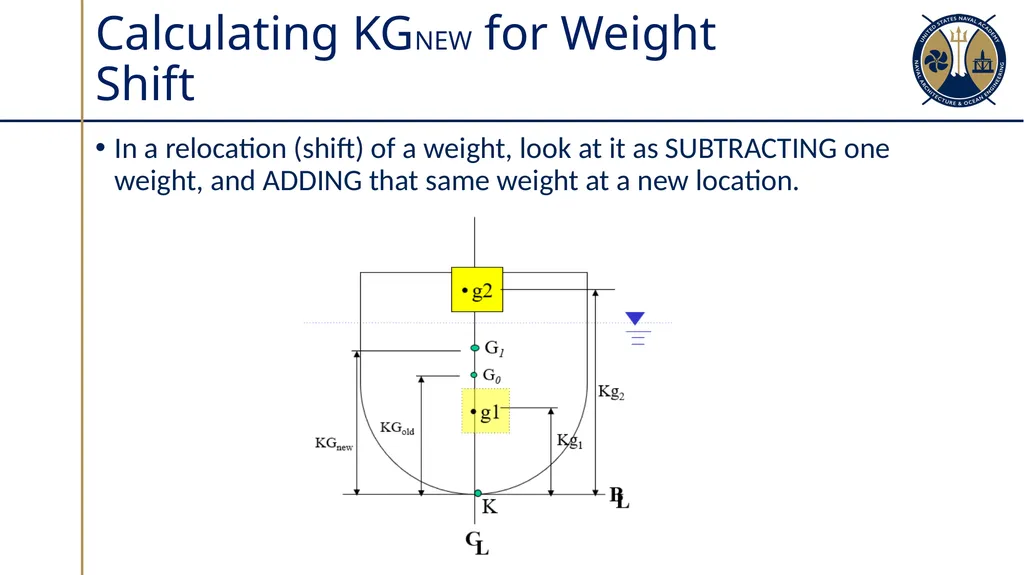
Weight Shift In the case of a weight SHIFT, the G first shifts AWAY from the removed weight….
…and then TOWARDS the relocated (added) weight<br>
11
Focus→ Z-axis Change in KG ⇒ KGnew<br>
12
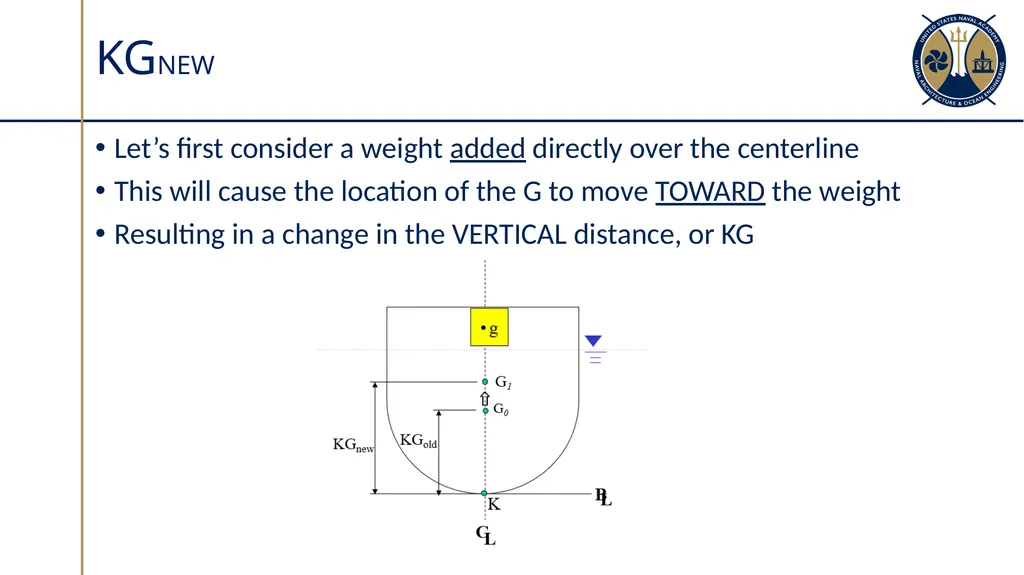
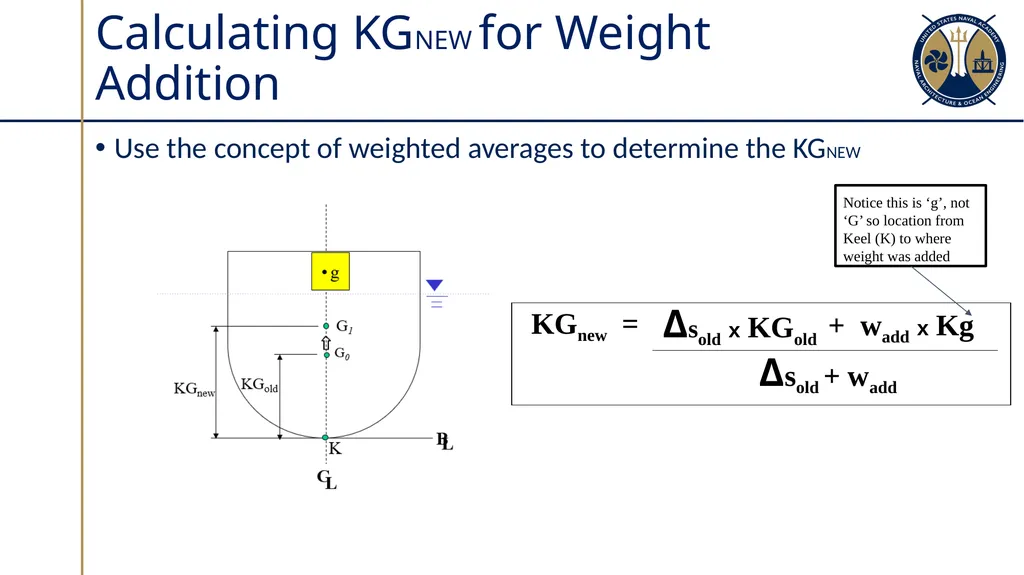
KGNEW Let’s first consider a weight added directly over the centerline
This will cause the location of the G to move TOWARD the weight
Resulting in a change in the VERTICAL distance, or KG<br>
13
Calculating KGNEW for Weight Addition Use the concept of weighted averages to determine the KGNEW Notice this is ‘g’, not ‘G’ so location from Keel (K) to where weight was added<br>
14
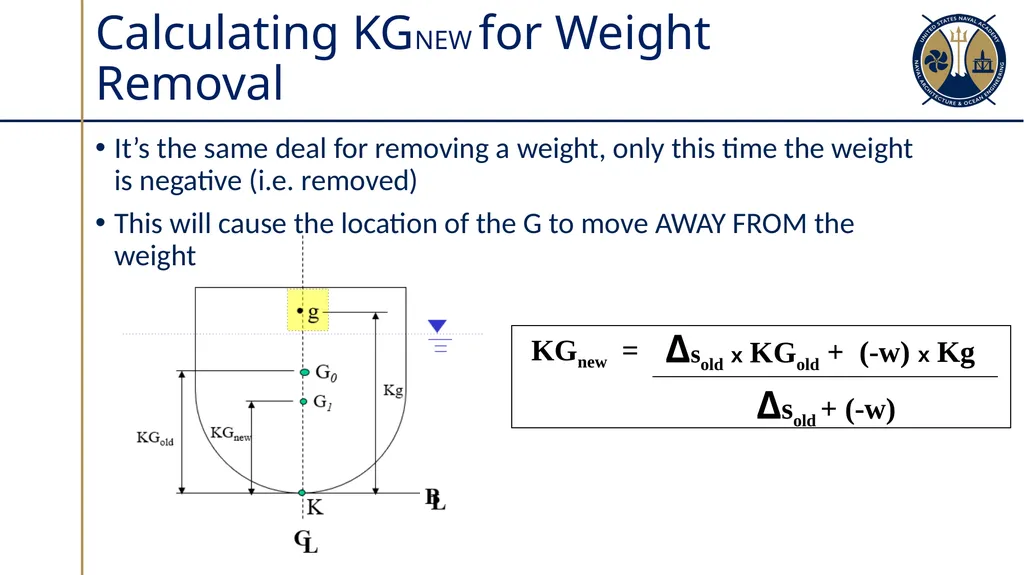
Calculating KGNEW for Weight Removal It’s the same deal for removing a weight, only this time the weight is negative (i.e. removed)
This will cause the location of the G to move AWAY FROM the weight<br>
15
Calculating KGNEW for Weight Shift In a relocation (shift) of a weight, look at it as SUBTRACTING one weight, and ADDING that same weight at a new location.<br>
16
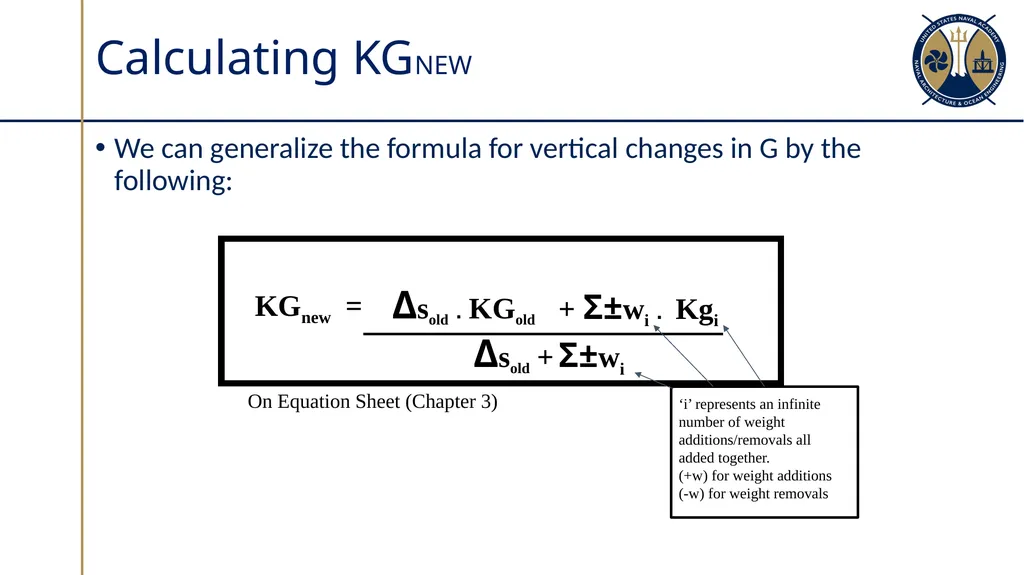
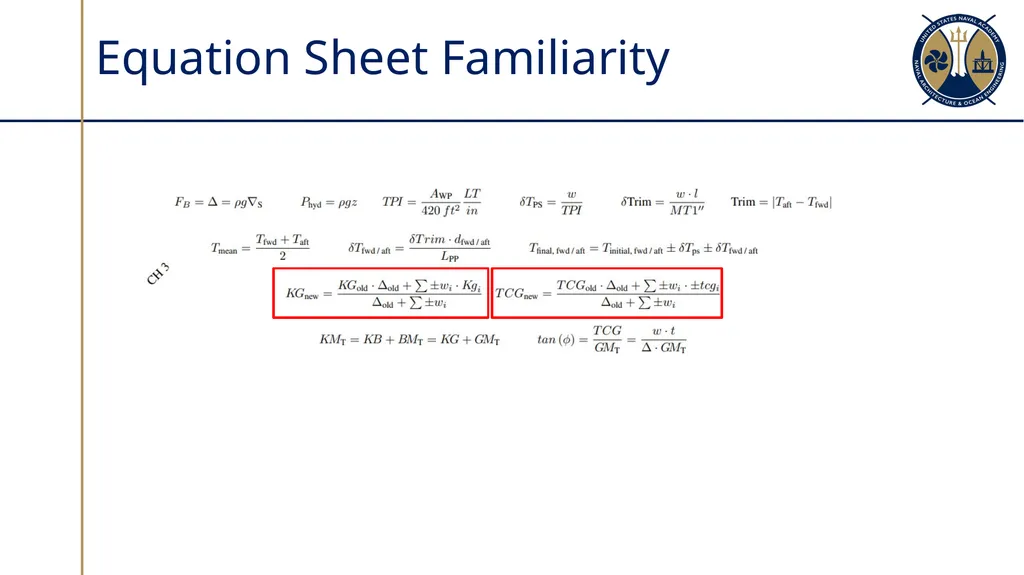
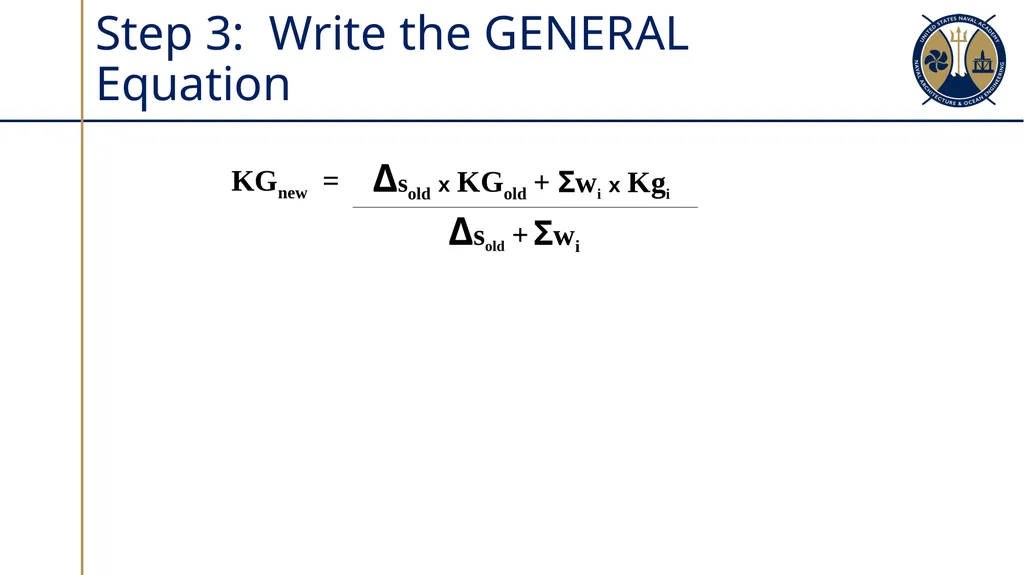
Calculating KGNEW We can generalize the formula for vertical changes in G by the following: ‘i’ represents an infinite number of weight additions/removals all added together.
(+w) for weight additions
(-w) for weight removals On Equation Sheet (Chapter 3)<br>
17
Focus→ Y-axis Change in the TCG ⇒ TCGnew<br>
18
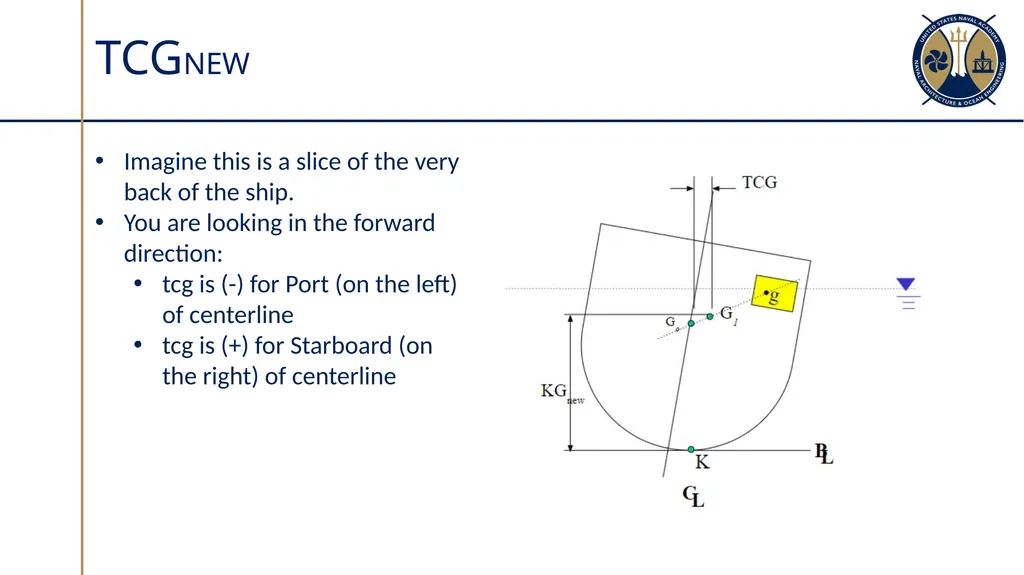
TCGNEW Imagine this is a slice of the very back of the ship.
You are looking in the forward direction:
tcg is (-) for Port (on the left) of centerline
tcg is (+) for Starboard (on the right) of centerline<br>
19
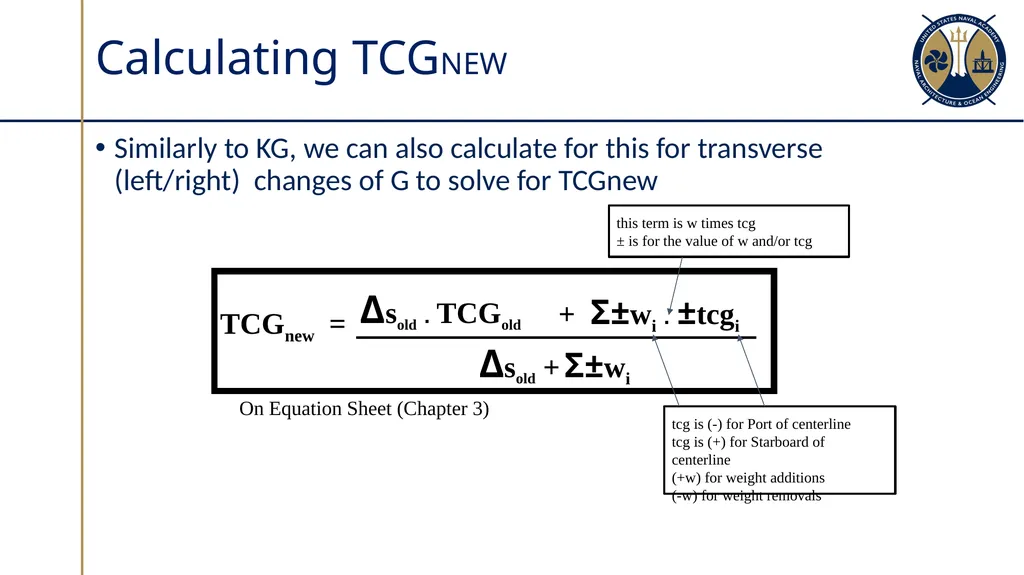
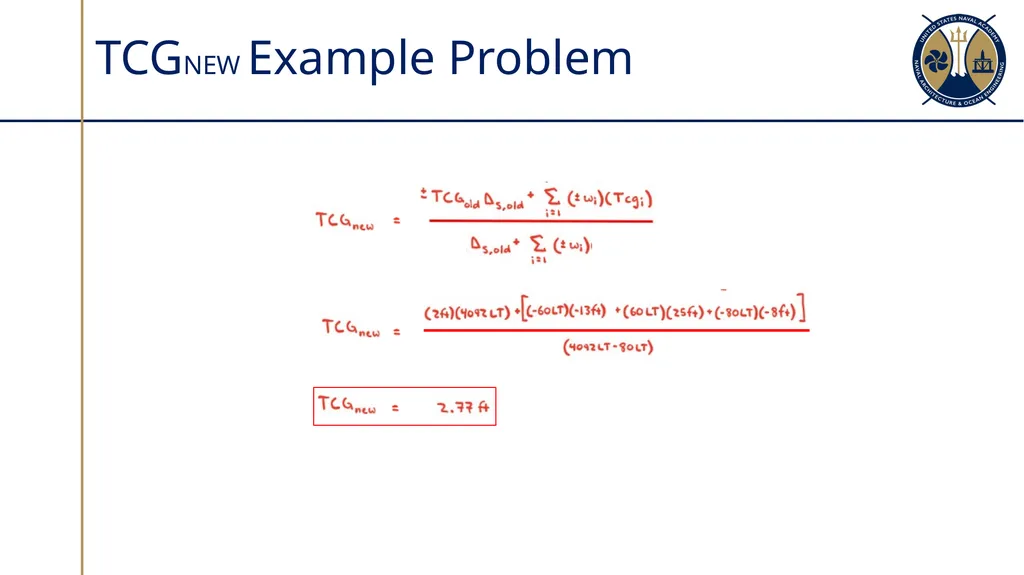
Calculating TCGNEW Similarly to KG, we can also calculate for this for transverse (left/right) changes of G to solve for TCGnew On Equation Sheet (Chapter 3) this term is w times tcg
± is for the value of w and/or tcg tcg is (-) for Port of centerline
tcg is (+) for Starboard of centerline
(+w) for weight additions
(-w) for weight removals<br>
20
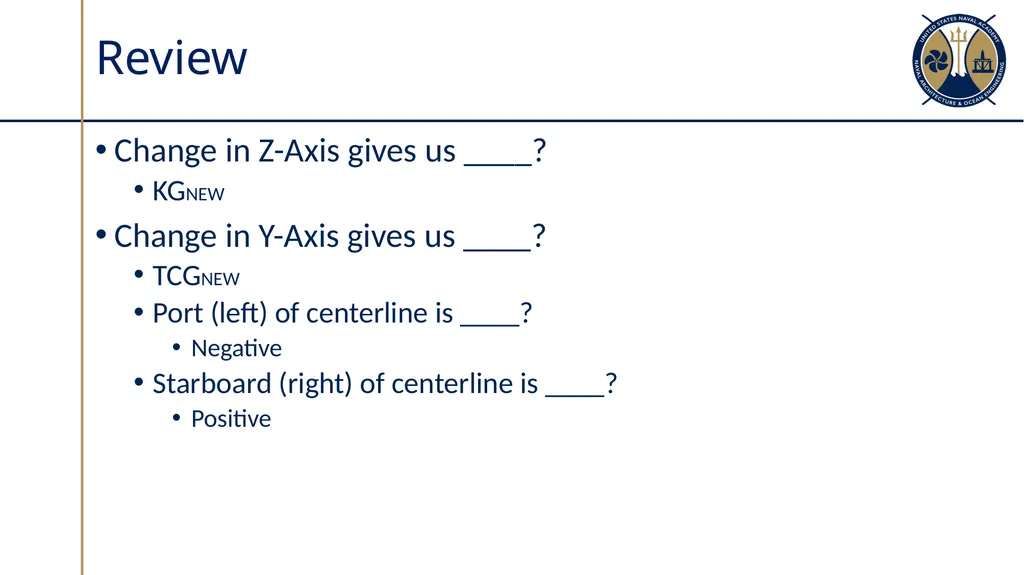
Review Change in Z-Axis gives us ____?
KGNEW
Change in Y-Axis gives us ____?
TCGNEW
Port (left) of centerline is ____?
Negative
Starboard (right) of centerline is ____?
Positive<br>
21
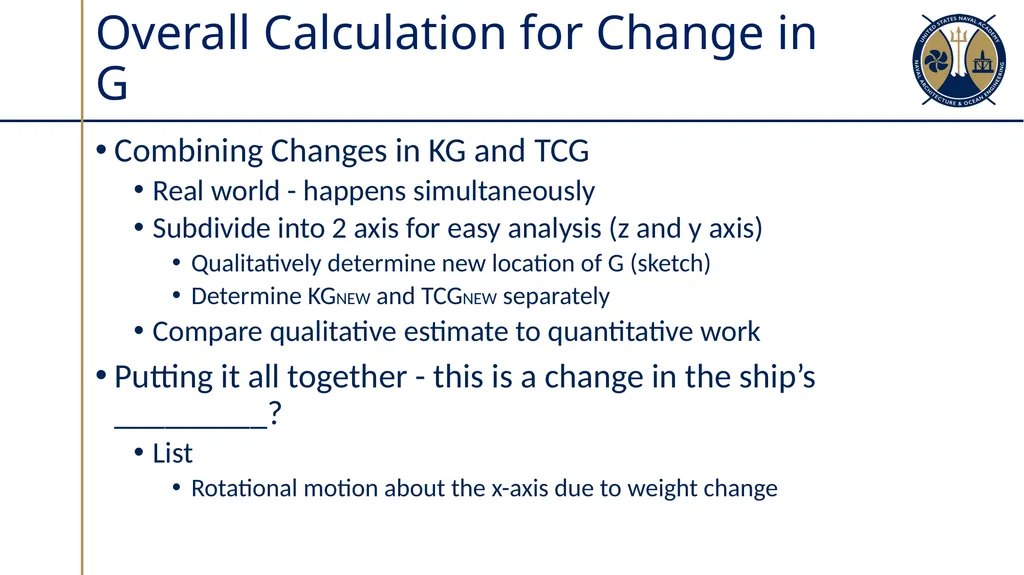
Overall Calculation for Change in G Combining Changes in KG and TCG
Real world - happens simultaneously
Subdivide into 2 axis for easy analysis (z and y axis)
Qualitatively determine new location of G (sketch)
Determine KGNEW and TCGNEW separately
Compare qualitative estimate to quantitative work
Putting it all together - this is a change in the ship’s _________?
List
Rotational motion about the x-axis due to weight change<br>
22
Equation Sheet Familiarity<br>
23
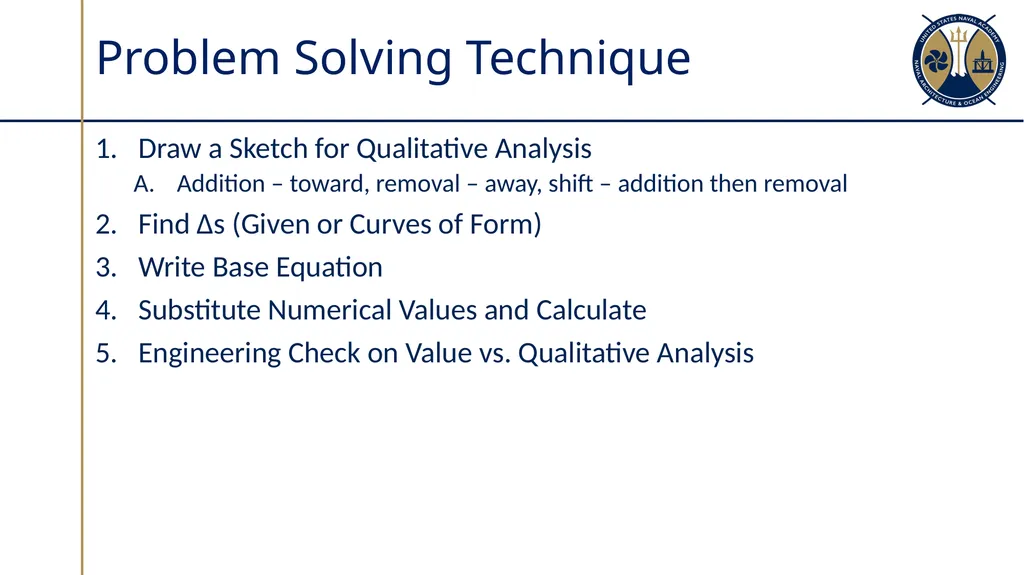
Problem Solving Technique Draw a Sketch for Qualitative Analysis
Addition – toward, removal – away, shift – addition then removal
Find Δs (Given or Curves of Form)
Write Base Equation
Substitute Numerical Values and Calculate
Engineering Check on Value vs. Qualitative Analysis<br>
24
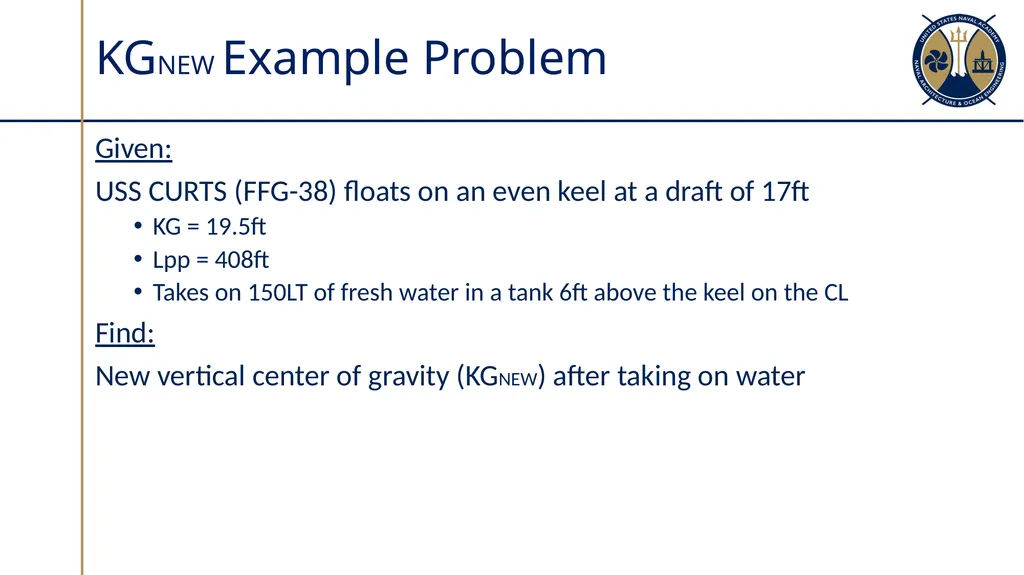
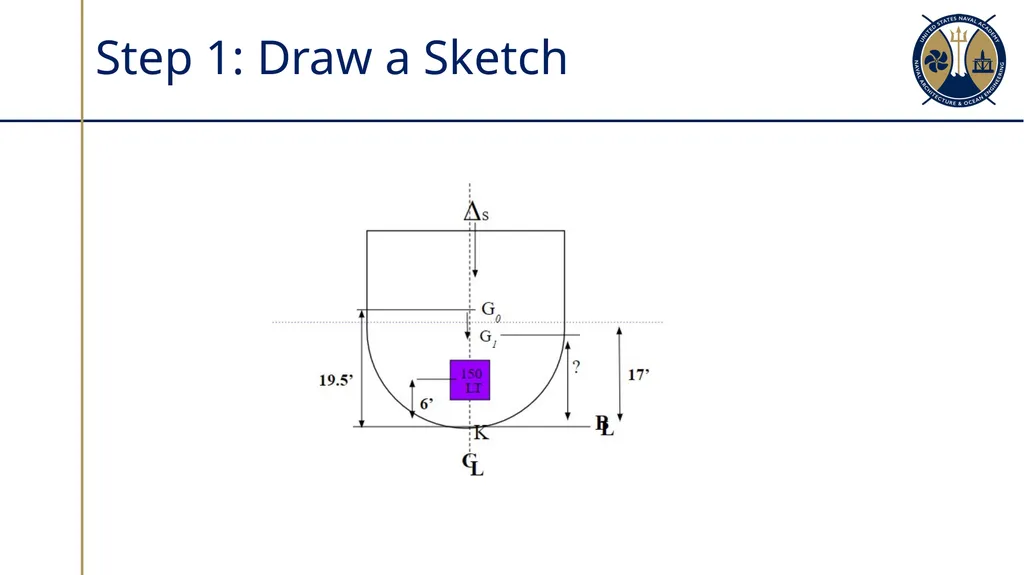
KGNEW Example Problem Given:
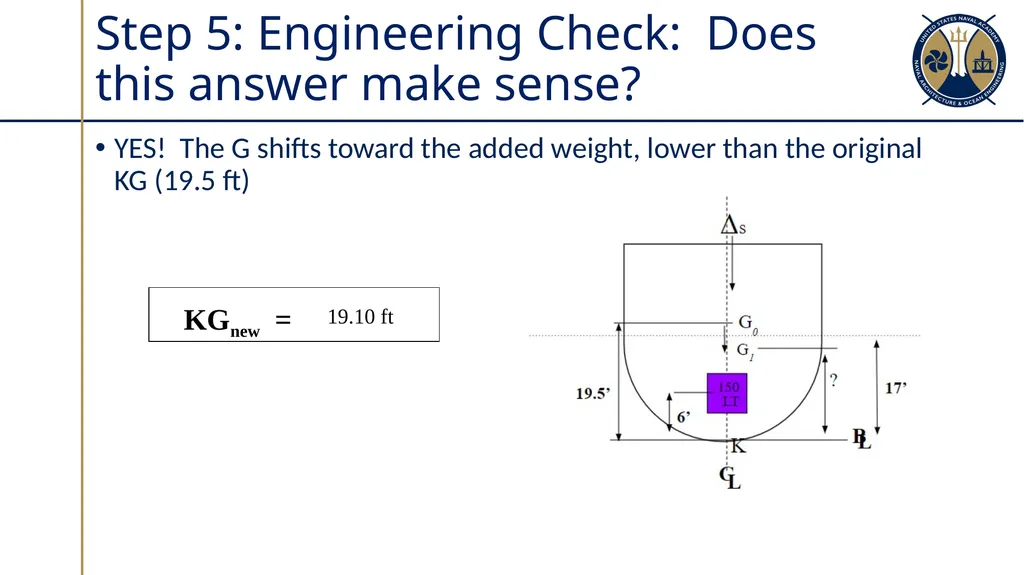
USS CURTS (FFG-38) floats on an even keel at a draft of 17ft
KG = 19.5ft
Lpp = 408ft
Takes on 150LT of fresh water in a tank 6ft above the keel on the CL
Find:
New vertical center of gravity (KGNEW) after taking on water<br>
25
Step 1: Draw a Sketch<br>
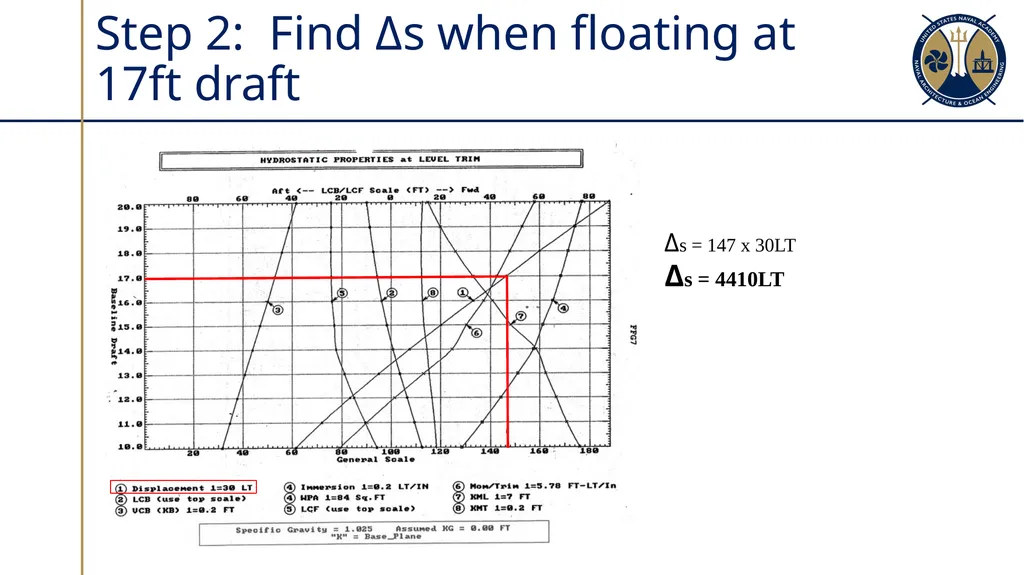
26
Step 2: Find Δs when floating at 17ft draft Need to utilize Curves of Form Δs = 147 x 30LT
Δs = 4410LT<br>
27
Step 3: Write the GENERAL Equation<br>
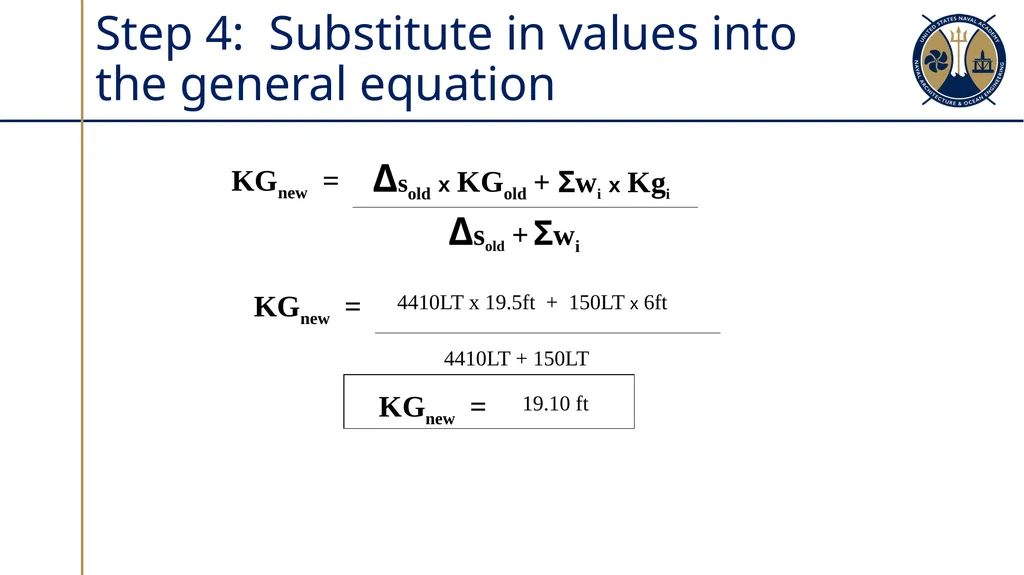
28
Step 4: Substitute in values into the general equation<br>
29
Step 5: Engineering Check: Does this answer make sense? YES! The G shifts toward the added weight, lower than the original KG (19.5 ft)<br>
30
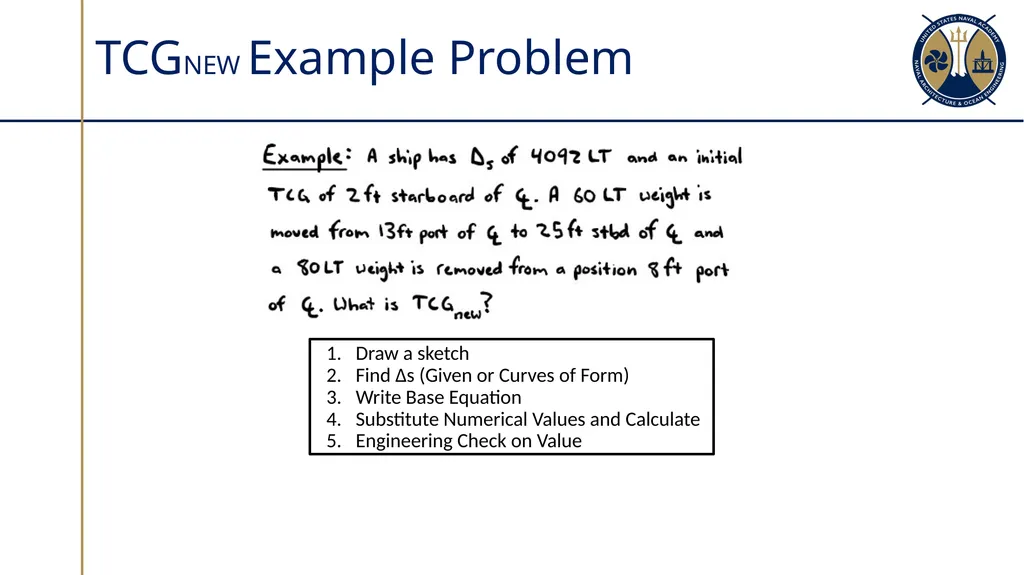
TCGNEW Example Problem Draw a sketch
Find Δs (Given or Curves of Form)
Write Base Equation
Substitute Numerical Values and Calculate
Engineering Check on Value<br>