
Chapter 1.2: Introduction to Toxicity and
Description: Chapter 1.2: Introduction to Toxicity and Toxicology It is not intended in this module to produce a detailed and comprehensive course in toxicology However, in order to discuss food chemical risk assessment we need as a starting point to
Related Topics
Download Presentation
"Chapter 1.2: Introduction to Toxicity and" is the property of its rightful owner. Permission is granted to download and print the materials on this website for personal, non-commercial use only, and to display it on your personal computer provided you do not modify the materials and that you retain all copyright notices contained in the materials. By downloading content from our website, you accept the terms of this agreement.
Presentation Transcript
slide1. Chapter 1.2: Introduction to Toxicity and Toxicology It is not intended in this module to produce a detailed and comprehensive course in toxicology
However, in order to discuss food chemical risk assessment we need as a starting point to introduce the concept of chemical toxicity, and the discipline of toxicology which is used to examine chemical toxicity in a structured way. 1<br>
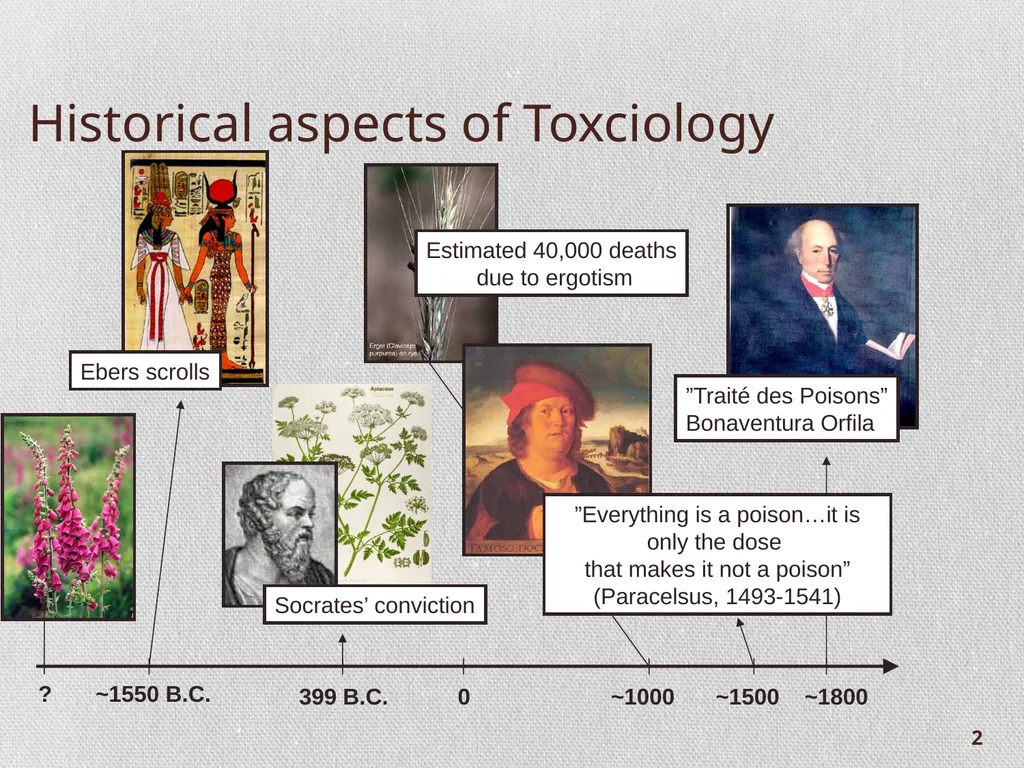
slide2. Historical aspects of Toxciology ”Everything is a poison…it is only the dose
that makes it not a poison” (Paracelsus, 1493-1541) ”Traité des Poisons”
Bonaventura Orfila ? ~1550 B.C. 399 B.C. ~1500 ~1800 0 Ebers scrolls Socrates’ conviction Estimated 40,000 deaths
due to ergotism ~1000 2<br>
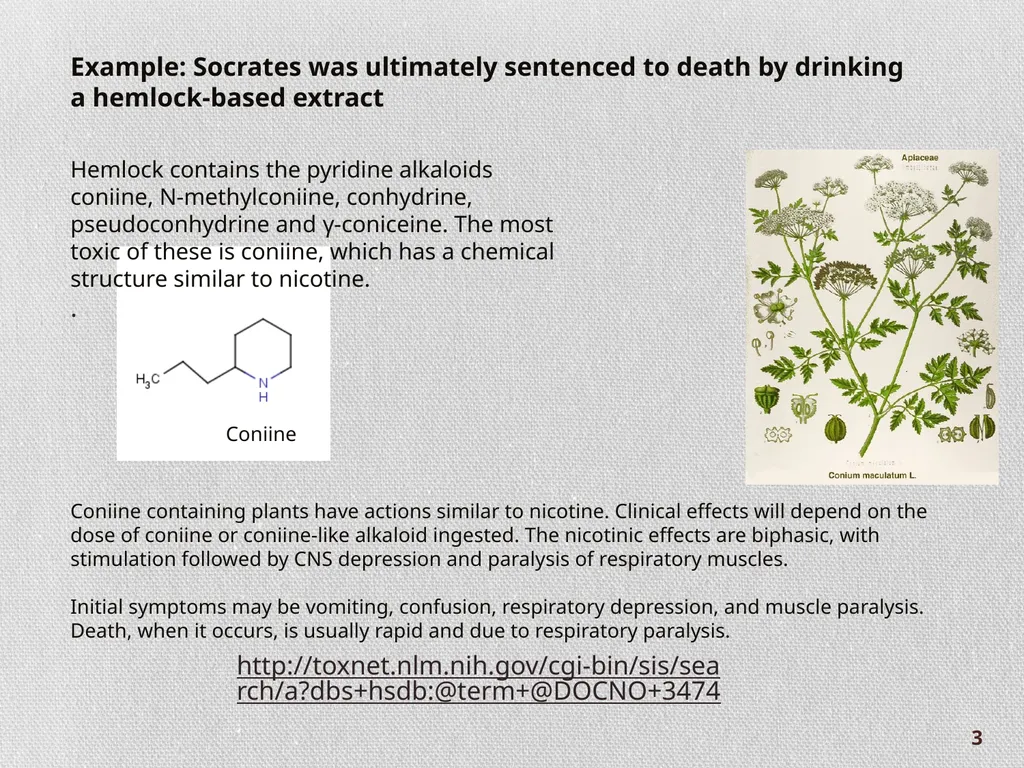
slide3. Example: Socrates was ultimately sentenced to death by drinking a hemlock-based extract Hemlock contains the pyridine alkaloids coniine, N-methylconiine, conhydrine, pseudoconhydrine and γ-coniceine. The most toxic of these is coniine, which has a chemical structure similar to nicotine.
. Coniine Coniine containing plants have actions similar to nicotine. Clinical effects will depend on the dose of coniine or coniine-like alkaloid ingested. The nicotinic effects are biphasic, with stimulation followed by CNS depression and paralysis of respiratory muscles.
Initial symptoms may be vomiting, confusion, respiratory depression, and muscle paralysis. Death, when it occurs, is usually rapid and due to respiratory paralysis. http://toxnet.nlm.nih.gov/cgi-bin/sis/search/a?dbs+hsdb:@term+@DOCNO+3474 3<br>
slide4. Role in Forensic Toxicology
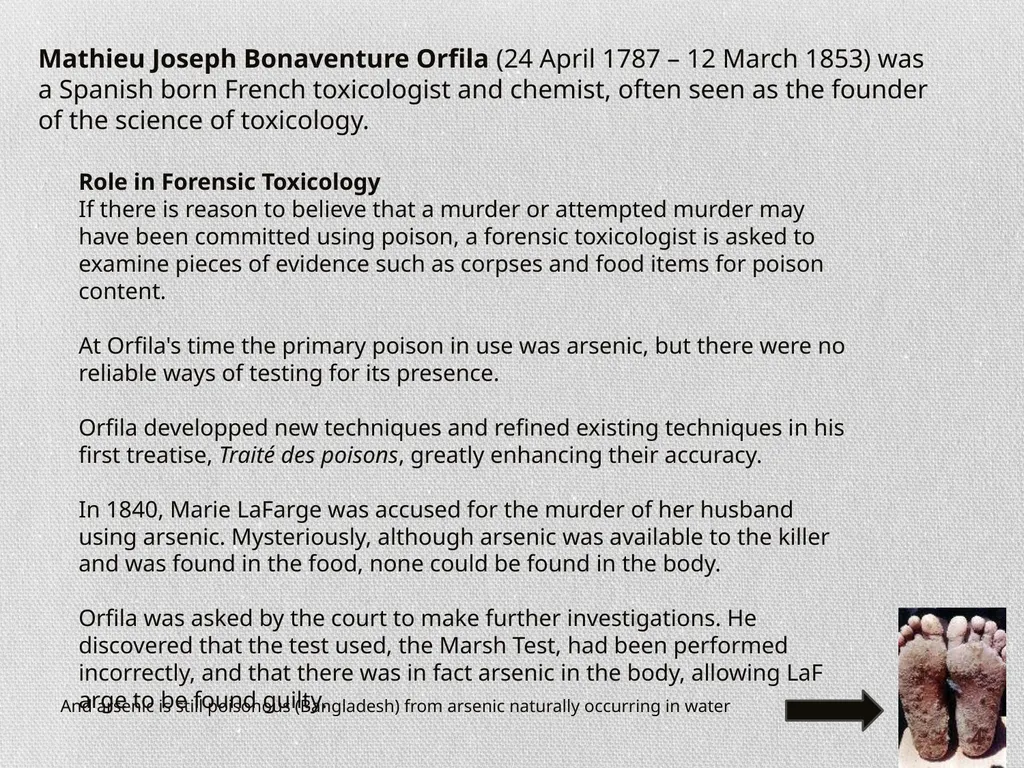
If there is reason to believe that a murder or attempted murder may have been committed using poison, a forensic toxicologist is asked to examine pieces of evidence such as corpses and food items for poison content.
At Orfila's time the primary poison in use was arsenic, but there were no reliable ways of testing for its presence.
Orfila developped new techniques and refined existing techniques in his first treatise, Traité des poisons, greatly enhancing their accuracy.
In 1840, Marie LaFarge was accused for the murder of her husband using arsenic. Mysteriously, although arsenic was available to the killer and was found in the food, none could be found in the body.
Orfila was asked by the court to make further investigations. He discovered that the test used, the Marsh Test, had been performed incorrectly, and that there was in fact arsenic in the body, allowing LaF arge to be found guilty. Mathieu Joseph Bonaventure Orfila (24 April 1787 – 12 March 1853) was a Spanish born French toxicologist and chemist, often seen as the founder of the science of toxicology. And arsenic is still poisonous (Bangladesh) from arsenic naturally occurring in water 4<br>
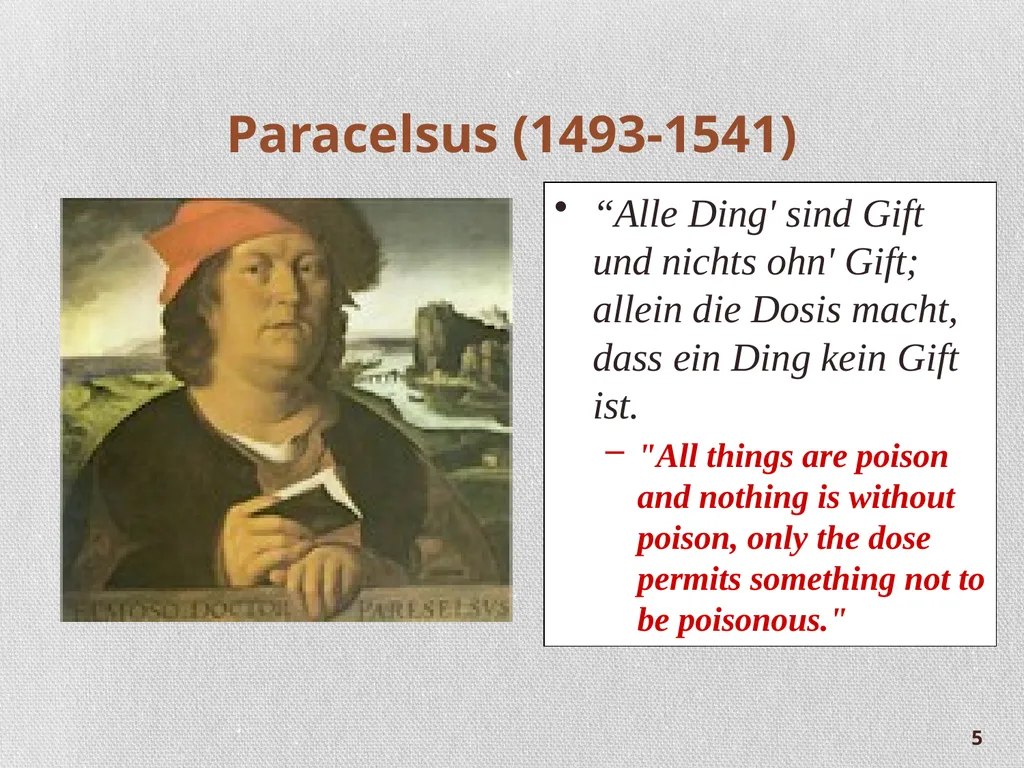
slide5. Paracelsus (1493-1541) “Alle Ding' sind Gift und nichts ohn' Gift; allein die Dosis macht, dass ein Ding kein Gift ist.
"All things are poison and nothing is without poison, only the dose permits something not to be poisonous." 5<br>
slide6. “The dose makes the poison” One of the most important concepts in toxicology LOW EXPOSURE = LOW RISK 6<br>
slide7. What does it mean that
something is Toxic?
Let us get some suggestions! 7<br>
slide8. Other words (expressions) for toxic?
Poisonous
Health impairing
or to some extent
Hazardious
Lets get an explanation on the last !
http://map.ais.ucla.edu/go/1002739 8<br>
slide9. What can be toxic?
An element (lets get examples)!
A chemical compound (examples)!
A ”product” (examples)!
Naturally occurring/”man made”
Any difference? 9<br>
slide10. Introduction to Toxicity What can be Toxic?
A solid, liquid or gas ”element” (examples)!
Lead (Pb) (metal found in some crops and seafoods).
Arsenic (As) (metalloid in grains such as rice)
Mercury (Hg) (converted to methylmercury in seafood, marine plants etc)
Calcium, copper, iron, sodium, magnesium, manganese, porassium (essential dietary minerals but can be toxic at high cncentratons) 10<br>
slide11. Introduction to Toxicity What can be Toxic (cont’d)....
A chemical compound (examples)!
Sodium Chloride (NaCl also known as salt!)
Carbon dioxide (CO2)
Ethanol (CH3CH2OH)
Cyanide (HCN) 11<br>
slide12. Introduction to Toxicity What can be Toxic (cont’d).....
A ”product” (examples)!
Agricultural and veterinary chemicals – pesticides, insecticides, fungicides
Pollutants – lubricants, cleaning agents, dioxins and PCBs
Food additives – preservatives, artificial colours, acidifiers etc 12<br>
slide13. Introduction to Toxicity What can be toxic (Cont’d)....
Naturally Inherent Plant Toxicants Examples
Macromolecular polyphenolic substances (hydrolysable and condensed tannins)
Toxic fatty acids/lipids
Non-protein amino acids
Alkaloids
Furanocoumarins
Polyacetylenes
Mono-, sesqui- and diterpenes; and
Toxic glycosides of various types (glucosinolates, cyanogenic glycosides, saponins) 13<br>
slide14. Introduction to Toxicity What can be toxic (Cont’d)....
Naturally Inherent Plant Toxicants Examples
Cyanogenic glycosides in casava and apricot kernels produce HCN.
Tannins in processed products such as tea, coffee and wine.
Proteinase inhibitors in legumes (e.g. Soybeans)
Alkaloids in foods and beverages (e.g. Caffeine)
Pyrrolizidine Alkaloids in grains, teas and herbal supplements
Gossypol in cotton seed oil 14<br>
slide15. A chemical compound (or a mixture) that is
toxic may e.g. be called:
A Poison
A Toxin
A Biotoxin
A toxicant
What are the differences?
http://en.wikipedia.org/wiki/Toxin
http://en.wikipedia.org/wiki/Toxicant 15<br>
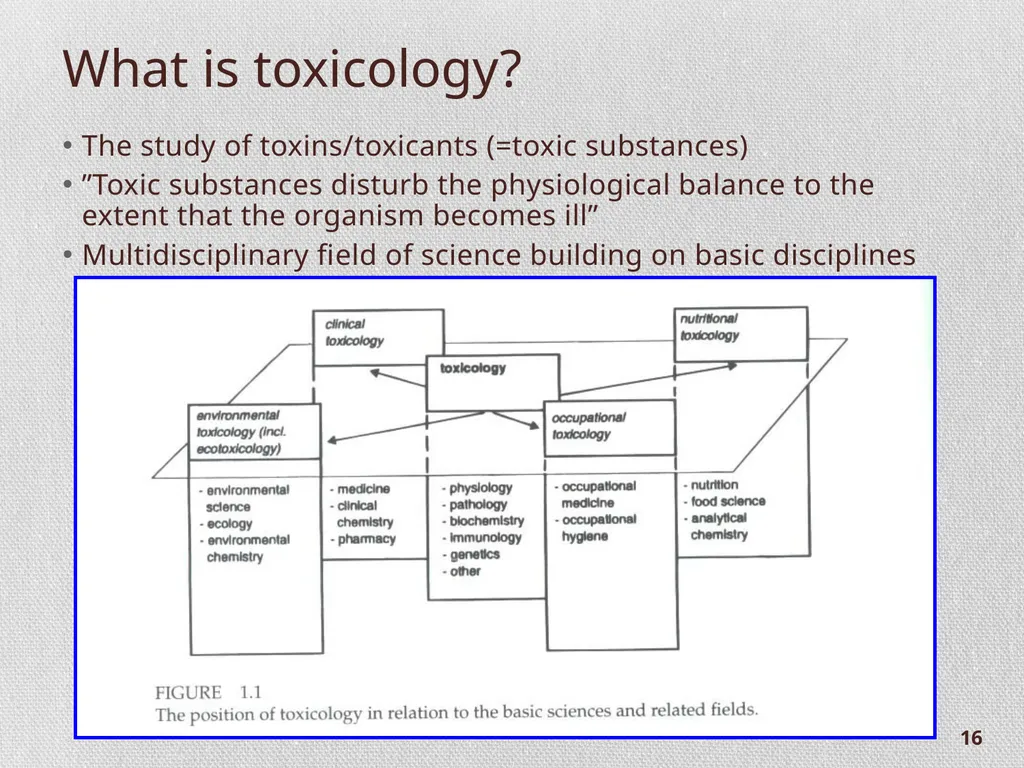
slide16. What is toxicology? The study of toxins/toxicants (=toxic substances)
”Toxic substances disturb the physiological balance to the extent that the organism becomes ill”
Multidisciplinary field of science building on basic disciplines 16<br>
slide17. What is Toxicology Some References to consider for further reading:
Analytical toxicology (A.Wallace Hayes, Principles and Methods of Toxicolog, 3rd Edition; Casarett and Doull’s Toxicology, 5th Editiin) ; http://www.who.int/ipcs/publications/training_poisons/analytical_toxicology/en/index.html
2. Clinical toxicology (Ellenhorn’s Medical Toxicology, 5th Edition).
3. Occupational toxicology (A.Wallace Hayes, Principles and Methods of Toxicolog, 3rd Edition; Casarett and Doull’s Toxicology, 5th Edition)
4. Environmental toxicology (A.Wallace Hayes, Principles and Methods of Toxicolog, 3rd Edition; Casarett and Doull’s Toxicology, 5th Edition)
5. Regulatory toxicology (A.Wallace Hayes, Principles and Methods of Toxicolog, 3rd Edition; Casarett and Doull’s Toxicology, 5th Editiin); http://www.ncbi.nlm.nih/gov/pubmed/11814699 17<br>
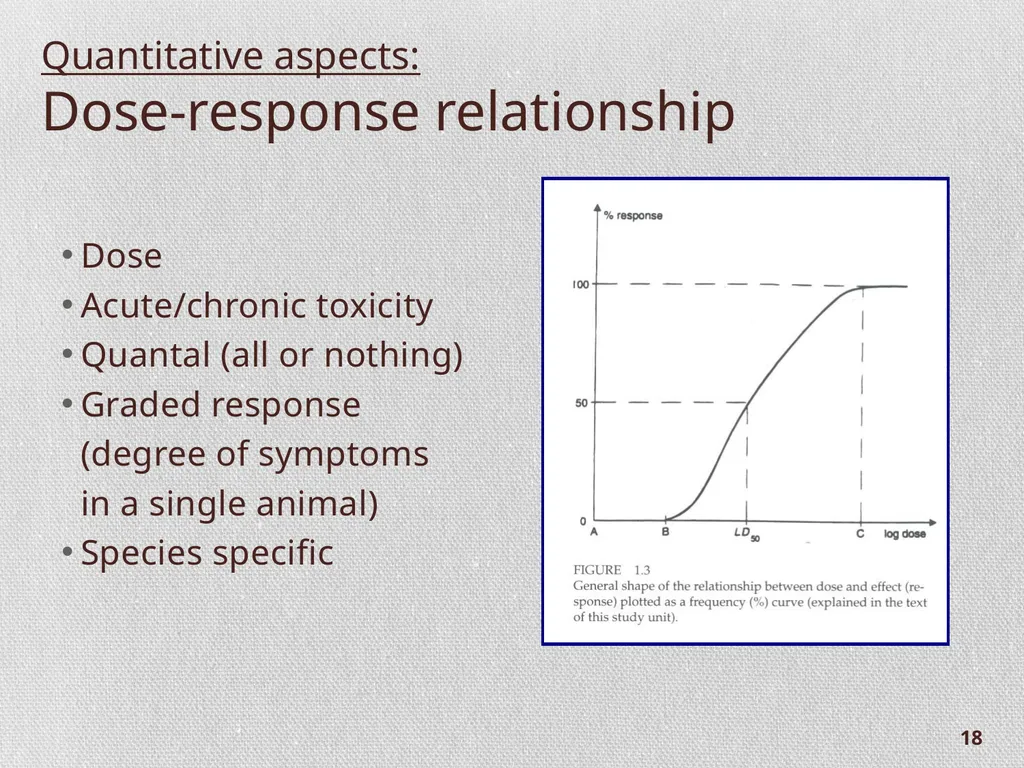
slide18. Quantitative aspects: Dose-response relationship Dose
Acute/chronic toxicity
Quantal (all or nothing)
Graded response
(degree of symptoms
in a single animal)
Species specific 18<br>
However, in order to discuss food chemical risk assessment we need as a starting point to introduce the concept of chemical toxicity, and the discipline of toxicology which is used to examine chemical toxicity in a structured way. 1<br>
slide2. Historical aspects of Toxciology ”Everything is a poison…it is only the dose
that makes it not a poison” (Paracelsus, 1493-1541) ”Traité des Poisons”
Bonaventura Orfila ? ~1550 B.C. 399 B.C. ~1500 ~1800 0 Ebers scrolls Socrates’ conviction Estimated 40,000 deaths
due to ergotism ~1000 2<br>
slide3. Example: Socrates was ultimately sentenced to death by drinking a hemlock-based extract Hemlock contains the pyridine alkaloids coniine, N-methylconiine, conhydrine, pseudoconhydrine and γ-coniceine. The most toxic of these is coniine, which has a chemical structure similar to nicotine.
. Coniine Coniine containing plants have actions similar to nicotine. Clinical effects will depend on the dose of coniine or coniine-like alkaloid ingested. The nicotinic effects are biphasic, with stimulation followed by CNS depression and paralysis of respiratory muscles.
Initial symptoms may be vomiting, confusion, respiratory depression, and muscle paralysis. Death, when it occurs, is usually rapid and due to respiratory paralysis. http://toxnet.nlm.nih.gov/cgi-bin/sis/search/a?dbs+hsdb:@term+@DOCNO+3474 3<br>
slide4. Role in Forensic Toxicology
If there is reason to believe that a murder or attempted murder may have been committed using poison, a forensic toxicologist is asked to examine pieces of evidence such as corpses and food items for poison content.
At Orfila's time the primary poison in use was arsenic, but there were no reliable ways of testing for its presence.
Orfila developped new techniques and refined existing techniques in his first treatise, Traité des poisons, greatly enhancing their accuracy.
In 1840, Marie LaFarge was accused for the murder of her husband using arsenic. Mysteriously, although arsenic was available to the killer and was found in the food, none could be found in the body.
Orfila was asked by the court to make further investigations. He discovered that the test used, the Marsh Test, had been performed incorrectly, and that there was in fact arsenic in the body, allowing LaF arge to be found guilty. Mathieu Joseph Bonaventure Orfila (24 April 1787 – 12 March 1853) was a Spanish born French toxicologist and chemist, often seen as the founder of the science of toxicology. And arsenic is still poisonous (Bangladesh) from arsenic naturally occurring in water 4<br>
slide5. Paracelsus (1493-1541) “Alle Ding' sind Gift und nichts ohn' Gift; allein die Dosis macht, dass ein Ding kein Gift ist.
"All things are poison and nothing is without poison, only the dose permits something not to be poisonous." 5<br>
slide6. “The dose makes the poison” One of the most important concepts in toxicology LOW EXPOSURE = LOW RISK 6<br>
slide7. What does it mean that
something is Toxic?
Let us get some suggestions! 7<br>
slide8. Other words (expressions) for toxic?
Poisonous
Health impairing
or to some extent
Hazardious
Lets get an explanation on the last !
http://map.ais.ucla.edu/go/1002739 8<br>
slide9. What can be toxic?
An element (lets get examples)!
A chemical compound (examples)!
A ”product” (examples)!
Naturally occurring/”man made”
Any difference? 9<br>
slide10. Introduction to Toxicity What can be Toxic?
A solid, liquid or gas ”element” (examples)!
Lead (Pb) (metal found in some crops and seafoods).
Arsenic (As) (metalloid in grains such as rice)
Mercury (Hg) (converted to methylmercury in seafood, marine plants etc)
Calcium, copper, iron, sodium, magnesium, manganese, porassium (essential dietary minerals but can be toxic at high cncentratons) 10<br>
slide11. Introduction to Toxicity What can be Toxic (cont’d)....
A chemical compound (examples)!
Sodium Chloride (NaCl also known as salt!)
Carbon dioxide (CO2)
Ethanol (CH3CH2OH)
Cyanide (HCN) 11<br>
slide12. Introduction to Toxicity What can be Toxic (cont’d).....
A ”product” (examples)!
Agricultural and veterinary chemicals – pesticides, insecticides, fungicides
Pollutants – lubricants, cleaning agents, dioxins and PCBs
Food additives – preservatives, artificial colours, acidifiers etc 12<br>
slide13. Introduction to Toxicity What can be toxic (Cont’d)....
Naturally Inherent Plant Toxicants Examples
Macromolecular polyphenolic substances (hydrolysable and condensed tannins)
Toxic fatty acids/lipids
Non-protein amino acids
Alkaloids
Furanocoumarins
Polyacetylenes
Mono-, sesqui- and diterpenes; and
Toxic glycosides of various types (glucosinolates, cyanogenic glycosides, saponins) 13<br>
slide14. Introduction to Toxicity What can be toxic (Cont’d)....
Naturally Inherent Plant Toxicants Examples
Cyanogenic glycosides in casava and apricot kernels produce HCN.
Tannins in processed products such as tea, coffee and wine.
Proteinase inhibitors in legumes (e.g. Soybeans)
Alkaloids in foods and beverages (e.g. Caffeine)
Pyrrolizidine Alkaloids in grains, teas and herbal supplements
Gossypol in cotton seed oil 14<br>
slide15. A chemical compound (or a mixture) that is
toxic may e.g. be called:
A Poison
A Toxin
A Biotoxin
A toxicant
What are the differences?
http://en.wikipedia.org/wiki/Toxin
http://en.wikipedia.org/wiki/Toxicant 15<br>
slide16. What is toxicology? The study of toxins/toxicants (=toxic substances)
”Toxic substances disturb the physiological balance to the extent that the organism becomes ill”
Multidisciplinary field of science building on basic disciplines 16<br>
slide17. What is Toxicology Some References to consider for further reading:
Analytical toxicology (A.Wallace Hayes, Principles and Methods of Toxicolog, 3rd Edition; Casarett and Doull’s Toxicology, 5th Editiin) ; http://www.who.int/ipcs/publications/training_poisons/analytical_toxicology/en/index.html
2. Clinical toxicology (Ellenhorn’s Medical Toxicology, 5th Edition).
3. Occupational toxicology (A.Wallace Hayes, Principles and Methods of Toxicolog, 3rd Edition; Casarett and Doull’s Toxicology, 5th Edition)
4. Environmental toxicology (A.Wallace Hayes, Principles and Methods of Toxicolog, 3rd Edition; Casarett and Doull’s Toxicology, 5th Edition)
5. Regulatory toxicology (A.Wallace Hayes, Principles and Methods of Toxicolog, 3rd Edition; Casarett and Doull’s Toxicology, 5th Editiin); http://www.ncbi.nlm.nih/gov/pubmed/11814699 17<br>
slide18. Quantitative aspects: Dose-response relationship Dose
Acute/chronic toxicity
Quantal (all or nothing)
Graded response
(degree of symptoms
in a single animal)
Species specific 18<br>