
CHAPTER 1 Investments - Background and Issues This








Description: CHAPTER 1 Investments - Background and Issues This chapter takes an overview of what we will learn in the text book Defining an investment (投資) Investment targets: financial or real assets (金融資產或實質資產) Different classes of financial assets
Related Topics
Download Presentation
"CHAPTER 1 Investments - Background and Issues This" is the property of its rightful owner. Permission is granted to download and print the materials on this website for personal, non-commercial use only, and to display it on your personal computer provided you do not modify the materials and that you retain all copyright notices contained in the materials. By downloading content from our website, you accept the terms of this agreement.
Presentation Transcript
slide1. CHAPTER 1 Investments - Background and Issues<br>
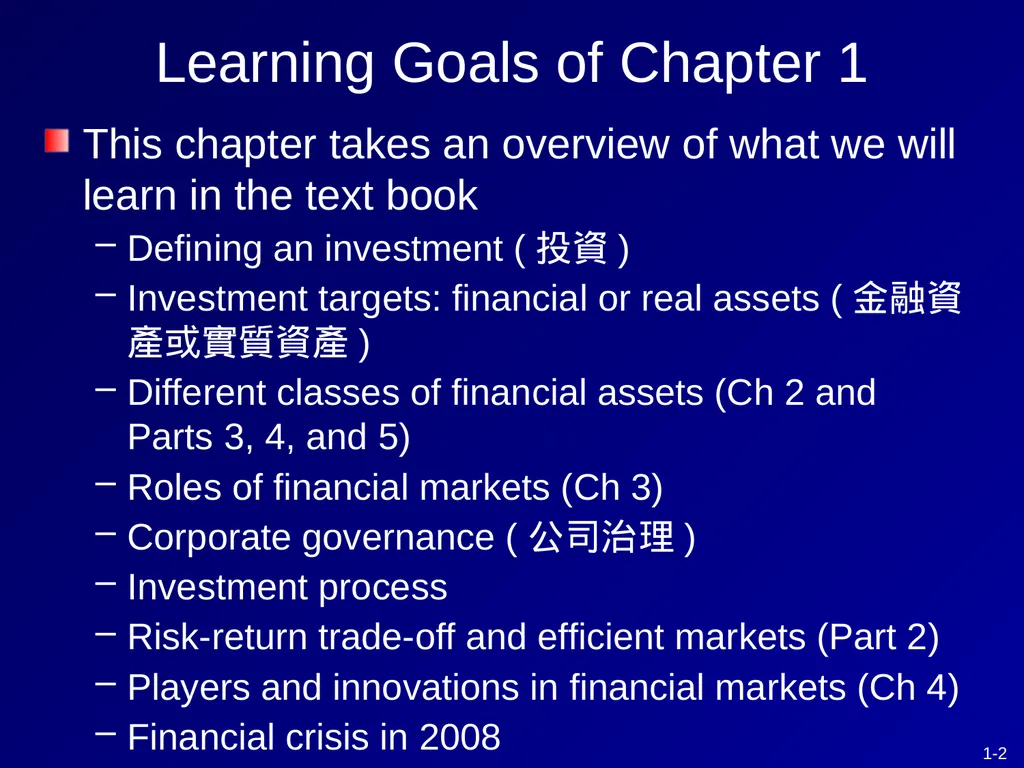
slide2. This chapter takes an overview of what we will learn in the text book
Defining an investment (投資)
Investment targets: financial or real assets (金融資產或實質資產)
Different classes of financial assets (Ch 2 and Parts 3, 4, and 5)
Roles of financial markets (Ch 3)
Corporate governance (公司治理)
Investment process
Risk-return trade-off and efficient markets (Part 2)
Players and innovations in financial markets (Ch 4)
Financial crisis in 2008 Learning Goals of Chapter 1<br>
slide3. 1.1 REAL ASSETS VERSUS FINANCIAL ASSETS<br>
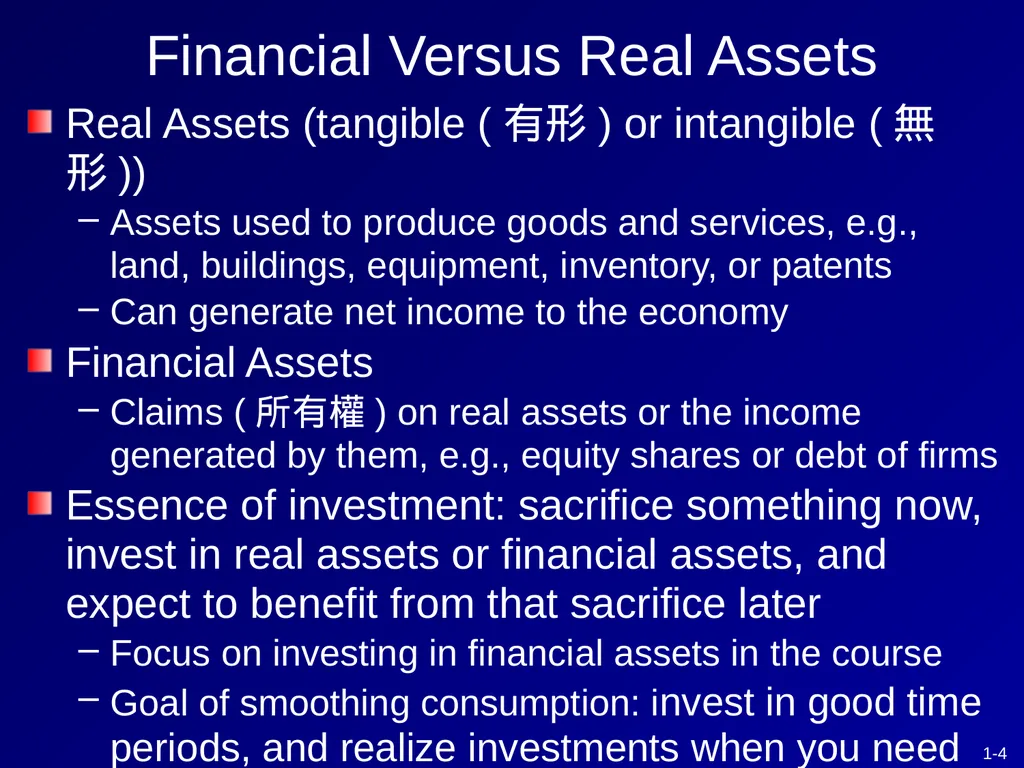
slide4. Real Assets (tangible (有形) or intangible (無形))
Assets used to produce goods and services, e.g., land, buildings, equipment, inventory, or patents
Can generate net income to the economy
Financial Assets
Claims (所有權) on real assets or the income generated by them, e.g., equity shares or debt of firms
Essence of investment: sacrifice something now, invest in real assets or financial assets, and expect to benefit from that sacrifice later
Focus on investing in financial assets in the course
Goal of smoothing consumption: invest in good time periods, and realize investments when you need more consumption Financial Versus Real Assets<br>
slide5. Balance Sheet (資產負債表) of U.S. Households 2022 ※ The largest parts of assets and liabilities both come from the house owned
※ The position of deposits is usually maintained for liquidity of consumption
※ Pension reserves (退休準備) is the money or assets invested for future retired life
※ Equity in noncorporate business may come from the investment in sole proprietorship (獨資) or partnership companies (合夥)<br>
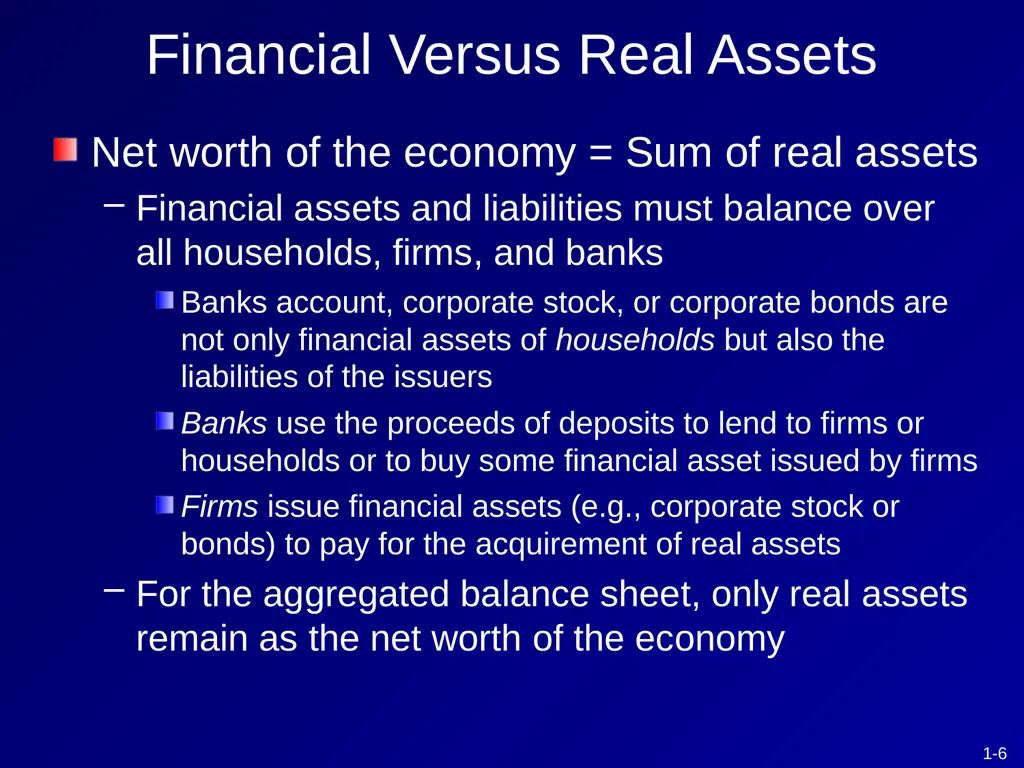
slide6. Net worth of the economy = Sum of real assets
Financial assets and liabilities must balance over all households, firms, and banks
Banks account, corporate stock, or corporate bonds are not only financial assets of households but also the liabilities of the issuers
Banks use the proceeds of deposits to lend to firms or households or to buy some financial asset issued by firms
Firms issue financial assets (e.g., corporate stock or bonds) to pay for the acquirement of real assets
For the aggregated balance sheet, only real assets remain as the net worth of the economy Financial Versus Real Assets<br>
slide7. Domestic Net Worth in the U.S. 2022<br>
slide8. 1.2 A CLASSIFICATION OF FINANCIAL ASSETS<br>
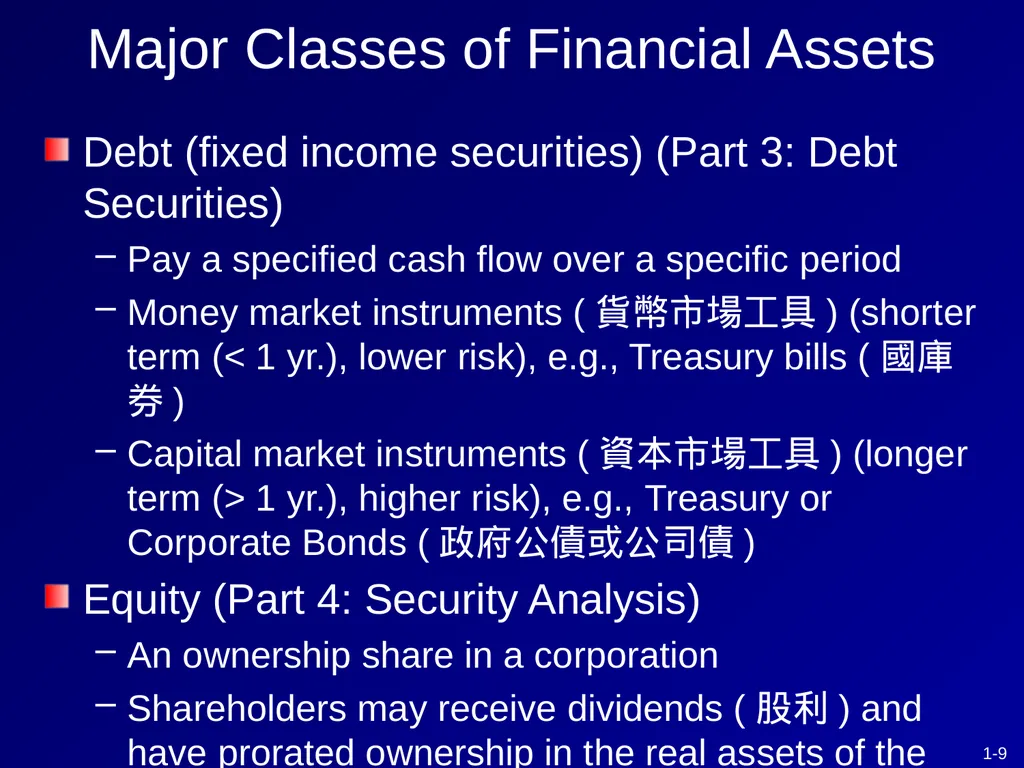
slide9. Major Classes of Financial Assets Debt (fixed income securities) (Part 3: Debt Securities)
Pay a specified cash flow over a specific period
Money market instruments (貨幣市場工具) (shorter term (< 1 yr.), lower risk), e.g., Treasury bills (國庫券)
Capital market instruments (資本市場工具) (longer term (> 1 yr.), higher risk), e.g., Treasury or Corporate Bonds (政府公債或公司債)
Equity (Part 4: Security Analysis)
An ownership share in a corporation
Shareholders may receive dividends (股利) and have prorated ownership in the real assets of the firm<br>
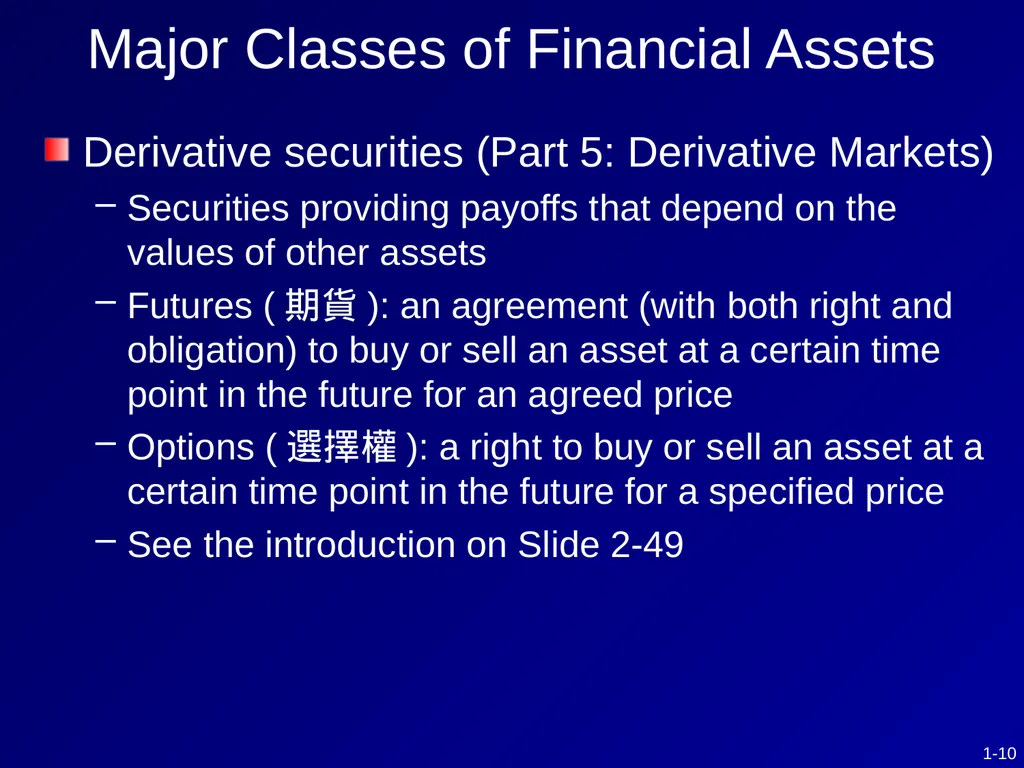
slide10. Major Classes of Financial Assets Derivative securities (Part 5: Derivative Markets)
Securities providing payoffs that depend on the values of other assets
Futures (期貨): an agreement (with both right and obligation) to buy or sell an asset at a certain time point in the future for an agreed price
Options (選擇權): a right to buy or sell an asset at a certain time point in the future for a specified price
See the introduction on Slide 2-49<br>
slide11. 1.3 FINANCIAL MARKETS AND THE ECONOMY<br>
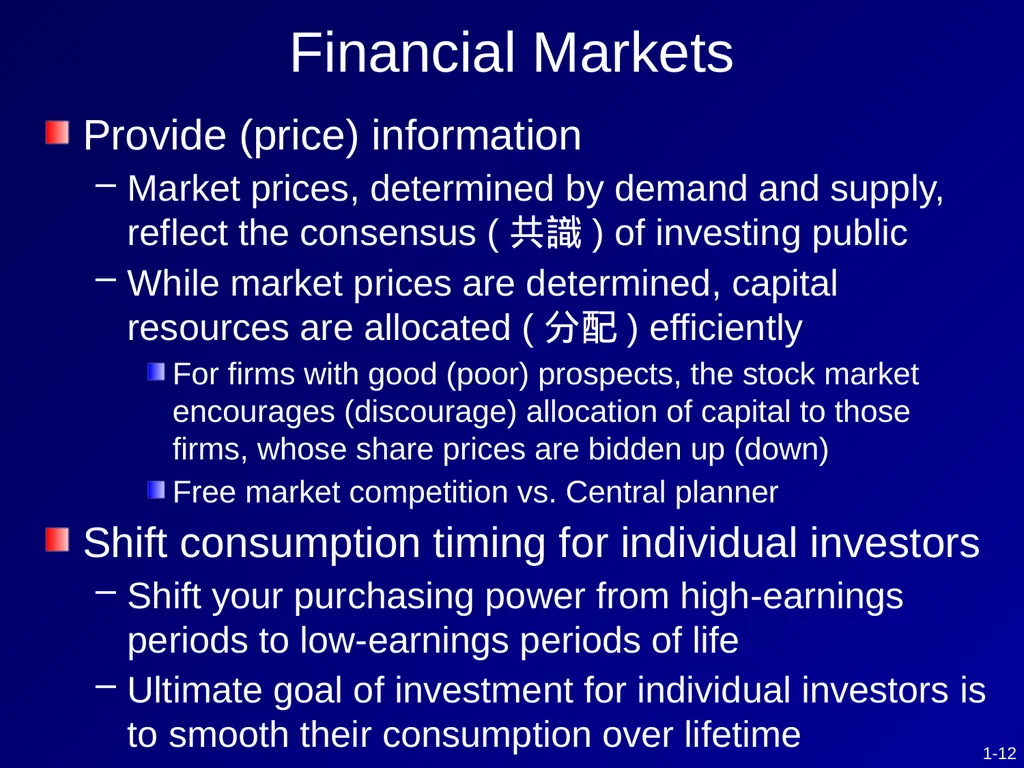
slide12. Financial Markets Provide (price) information
Market prices, determined by demand and supply, reflect the consensus (共識) of investing public
While market prices are determined, capital resources are allocated (分配) efficiently
For firms with good (poor) prospects, the stock market encourages (discourage) allocation of capital to those firms, whose share prices are bidden up (down)
Free market competition vs. Central planner
Shift consumption timing for individual investors
Shift your purchasing power from high-earnings periods to low-earnings periods of life
Ultimate goal of investment for individual investors is to smooth their consumption over lifetime<br>
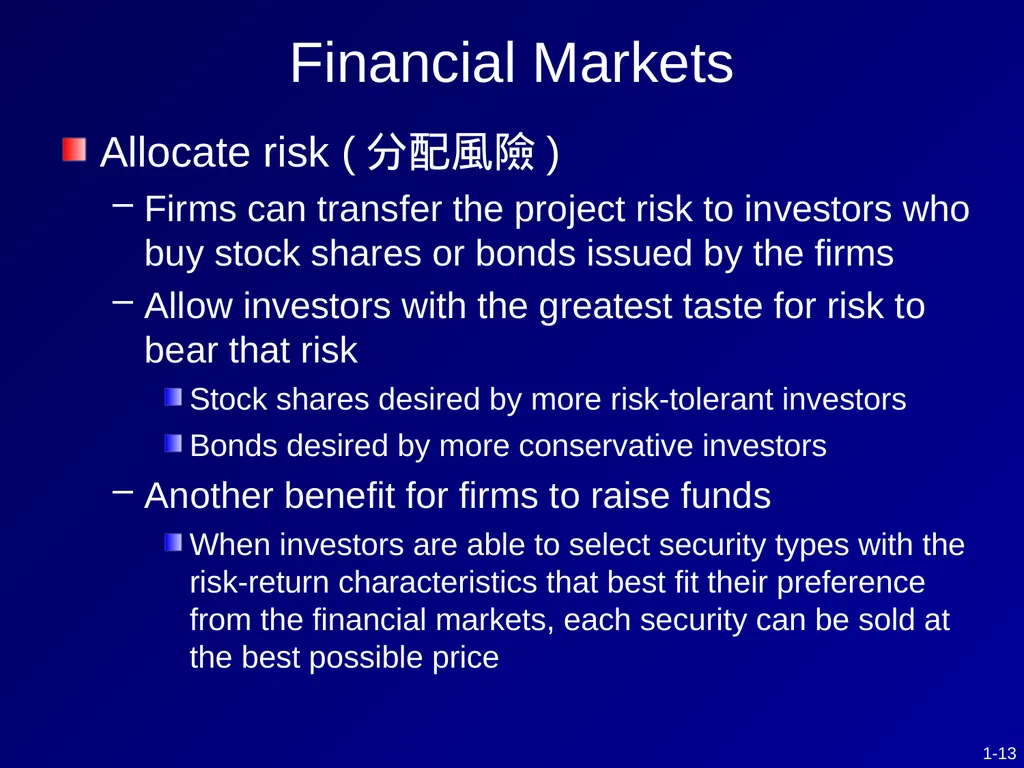
slide13. Financial Markets Allocate risk (分配風險)
Firms can transfer the project risk to investors who buy stock shares or bonds issued by the firms
Allow investors with the greatest taste for risk to bear that risk
Stock shares desired by more risk-tolerant investors
Bonds desired by more conservative investors
Another benefit for firms to raise funds
When investors are able to select security types with the risk-return characteristics that best fit their preference from the financial markets, each security can be sold at the best possible price<br>
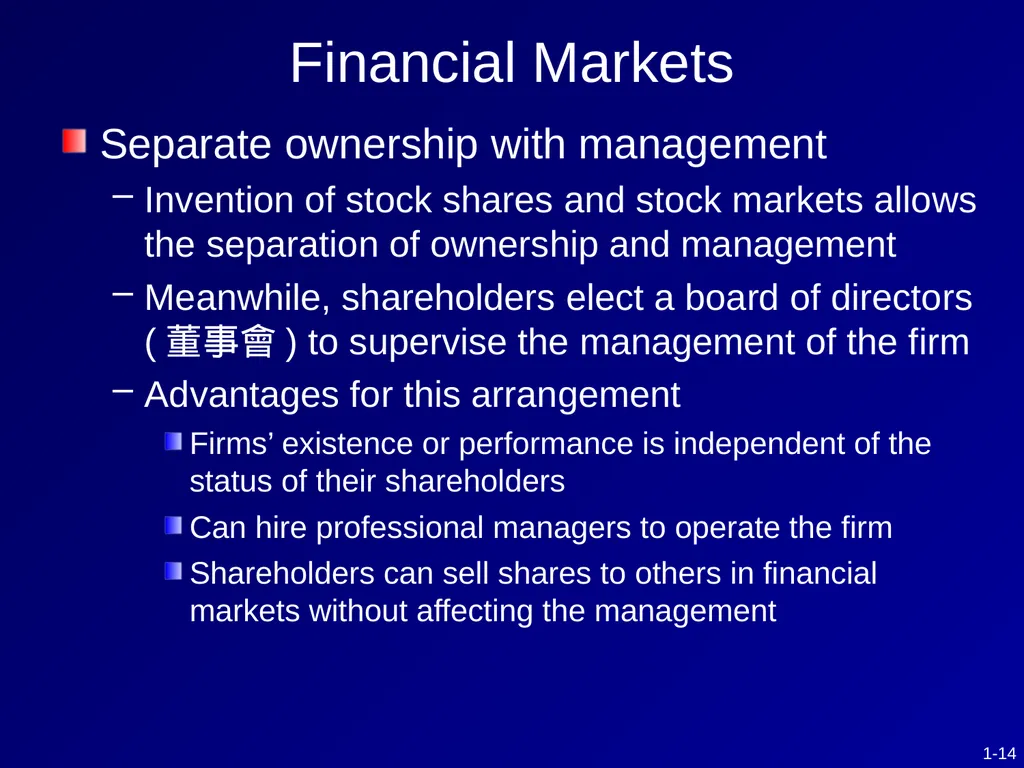
slide14. Financial Markets Separate ownership with management
Invention of stock shares and stock markets allows the separation of ownership and management
Meanwhile, shareholders elect a board of directors (董事會) to supervise the management of the firm
Advantages for this arrangement
Firms’ existence or performance is independent of the status of their shareholders
Can hire professional managers to operate the firm
Shareholders can sell shares to others in financial markets without affecting the management<br>
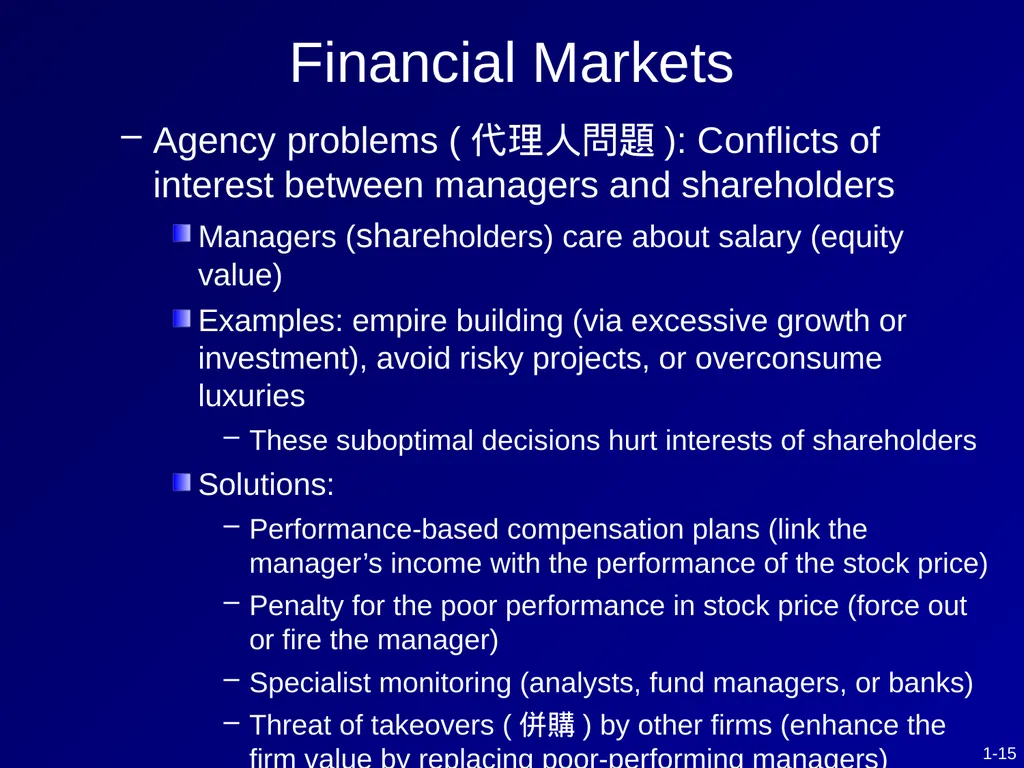
slide15. Financial Markets Agency problems (代理人問題): Conflicts of interest between managers and shareholders
Managers (shareholders) care about salary (equity value)
Examples: empire building (via excessive growth or investment), avoid risky projects, or overconsume luxuries
These suboptimal decisions hurt interests of shareholders
Solutions:
Performance-based compensation plans (link the manager’s income with the performance of the stock price)
Penalty for the poor performance in stock price (force out or fire the manager)
Specialist monitoring (analysts, fund managers, or banks)
Threat of takeovers (併購) by other firms (enhance the firm value by replacing poor-performing managers)<br>
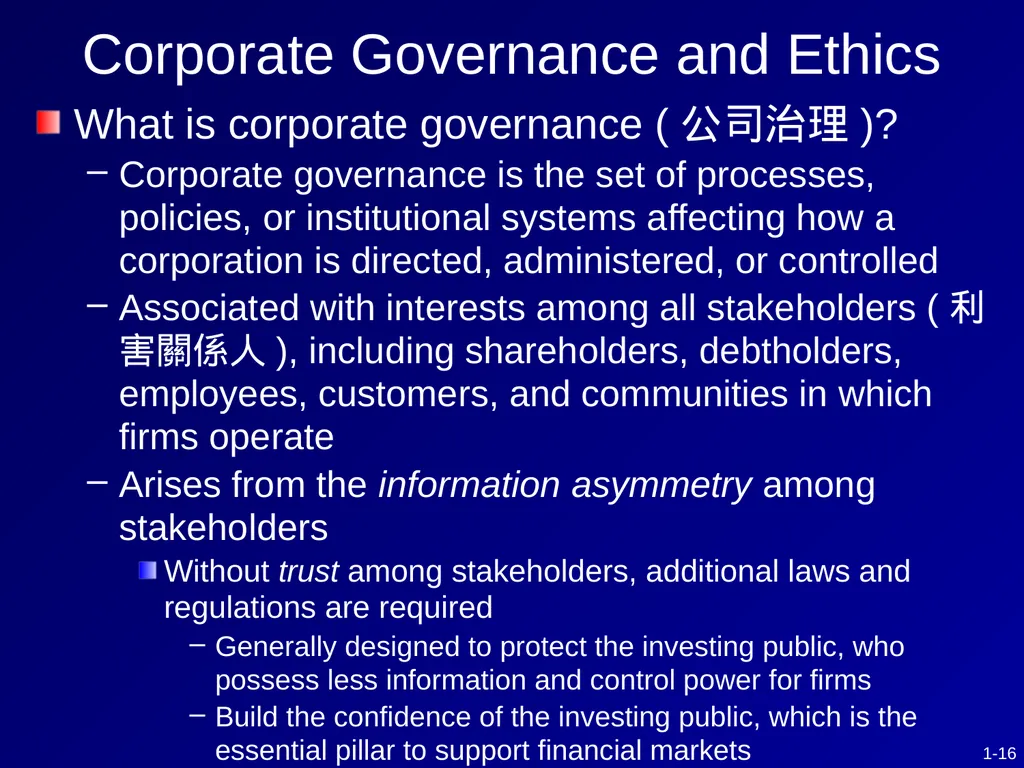
slide16. Corporate Governance and Ethics What is corporate governance (公司治理)?
Corporate governance is the set of processes, policies, or institutional systems affecting how a corporation is directed, administered, or controlled
Associated with interests among all stakeholders (利害關係人), including shareholders, debtholders, employees, customers, and communities in which firms operate
Arises from the information asymmetry among stakeholders
Without trust among stakeholders, additional laws and regulations are required
Generally designed to protect the investing public, who possess less information and control power for firms
Build the confidence of the investing public, which is the essential pillar to support financial markets<br>
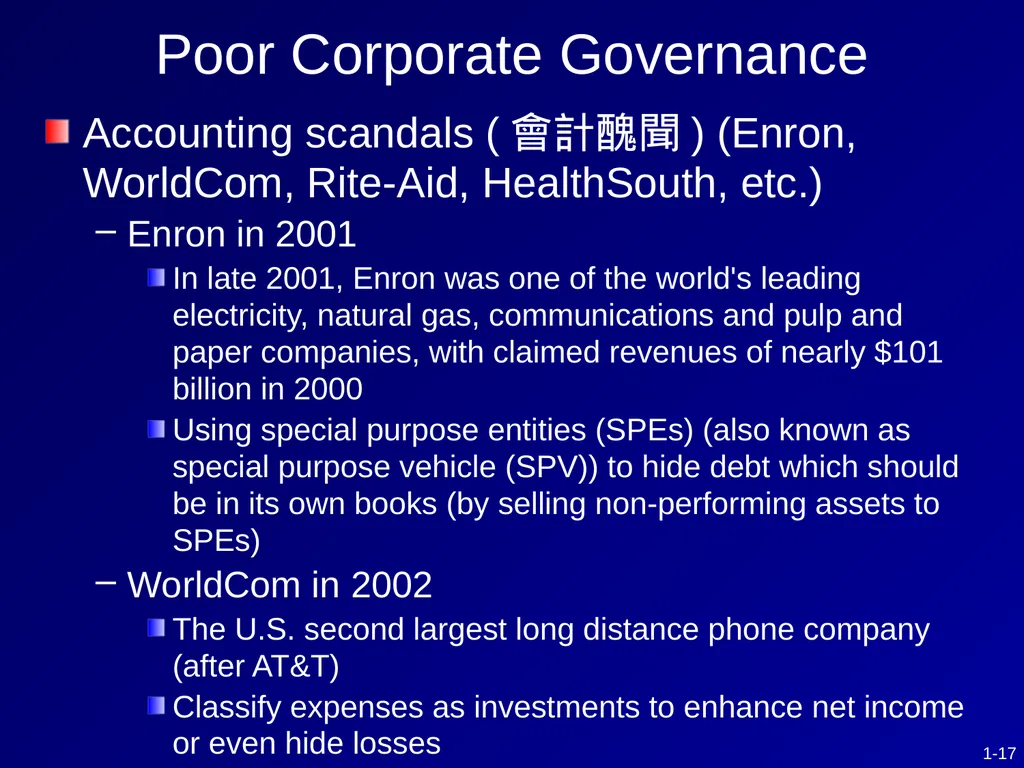
slide17. Poor Corporate Governance Accounting scandals (會計醜聞) (Enron, WorldCom, Rite-Aid, HealthSouth, etc.)
Enron in 2001
In late 2001, Enron was one of the world's leading electricity, natural gas, communications and pulp and paper companies, with claimed revenues of nearly $101 billion in 2000
Using special purpose entities (SPEs) (also known as special purpose vehicle (SPV)) to hide debt which should be in its own books (by selling non-performing assets to SPEs)
WorldCom in 2002
The U.S. second largest long distance phone company (after AT&T)
Classify expenses as investments to enhance net income or even hide losses<br>
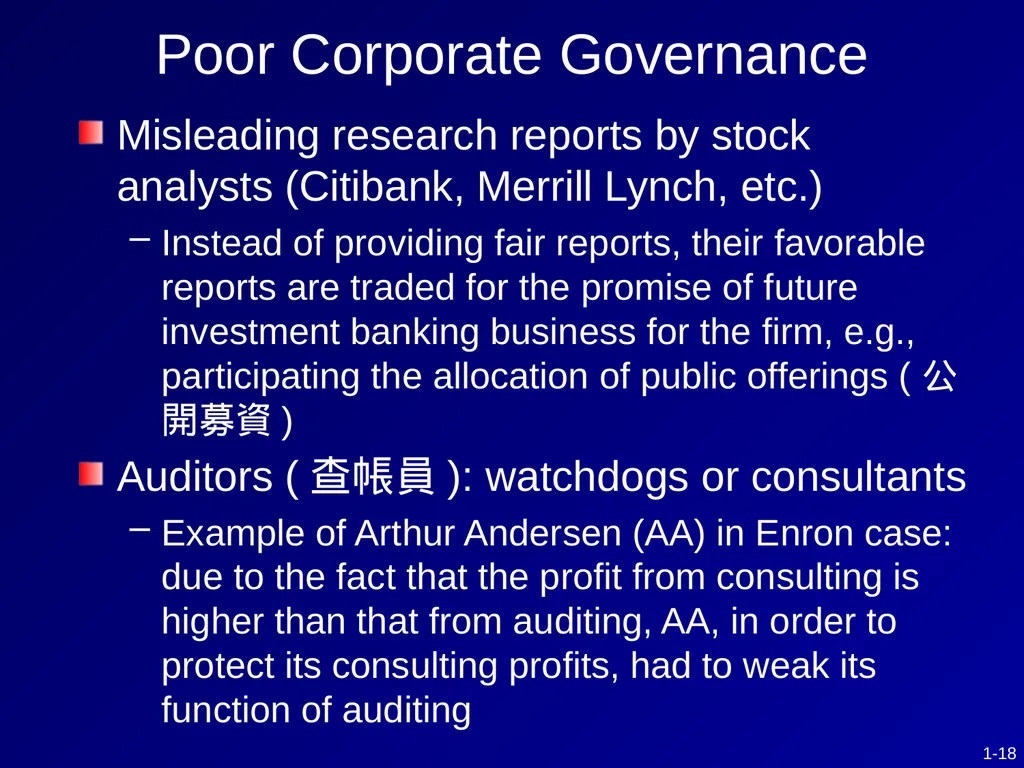
slide18. Poor Corporate Governance Misleading research reports by stock analysts (Citibank, Merrill Lynch, etc.)
Instead of providing fair reports, their favorable reports are traded for the promise of future investment banking business for the firm, e.g., participating the allocation of public offerings (公開募資)
Auditors (查帳員): watchdogs or consultants
Example of Arthur Andersen (AA) in Enron case: due to the fact that the profit from consulting is higher than that from auditing, AA, in order to protect its consulting profits, had to weak its function of auditing<br>
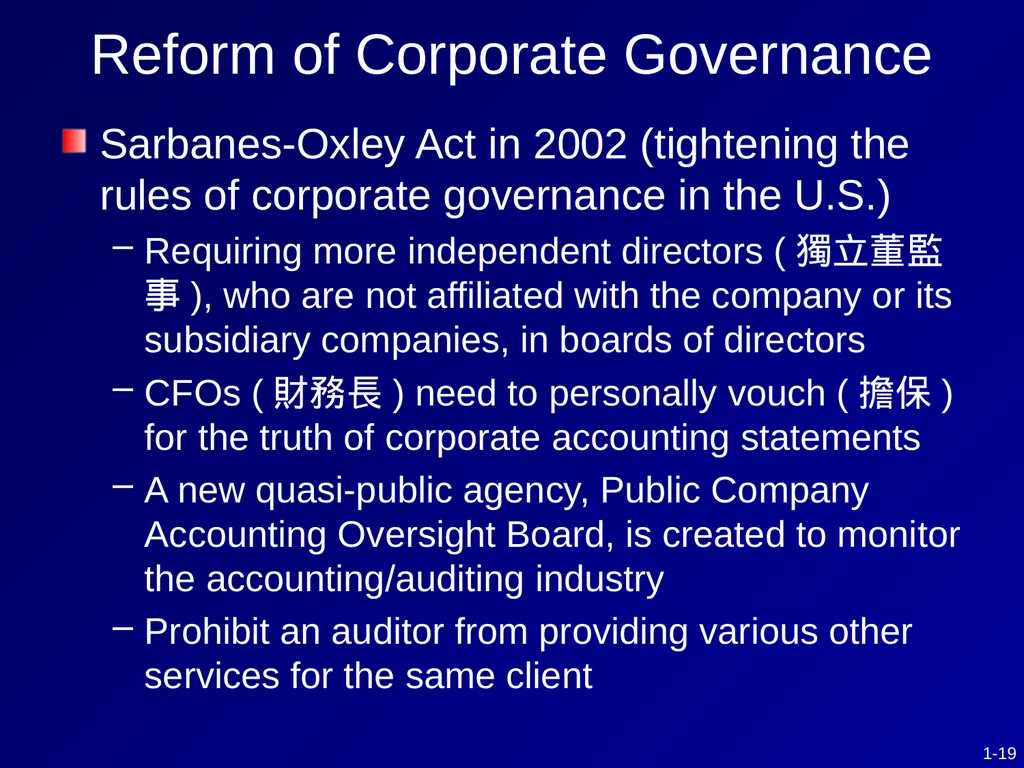
slide19. Reform of Corporate Governance Sarbanes-Oxley Act in 2002 (tightening the rules of corporate governance in the U.S.)
Requiring more independent directors (獨立董監事), who are not affiliated with the company or its subsidiary companies, in boards of directors
CFOs (財務長) need to personally vouch (擔保) for the truth of corporate accounting statements
A new quasi-public agency, Public Company Accounting Oversight Board, is created to monitor the accounting/auditing industry
Prohibit an auditor from providing various other services for the same client<br>
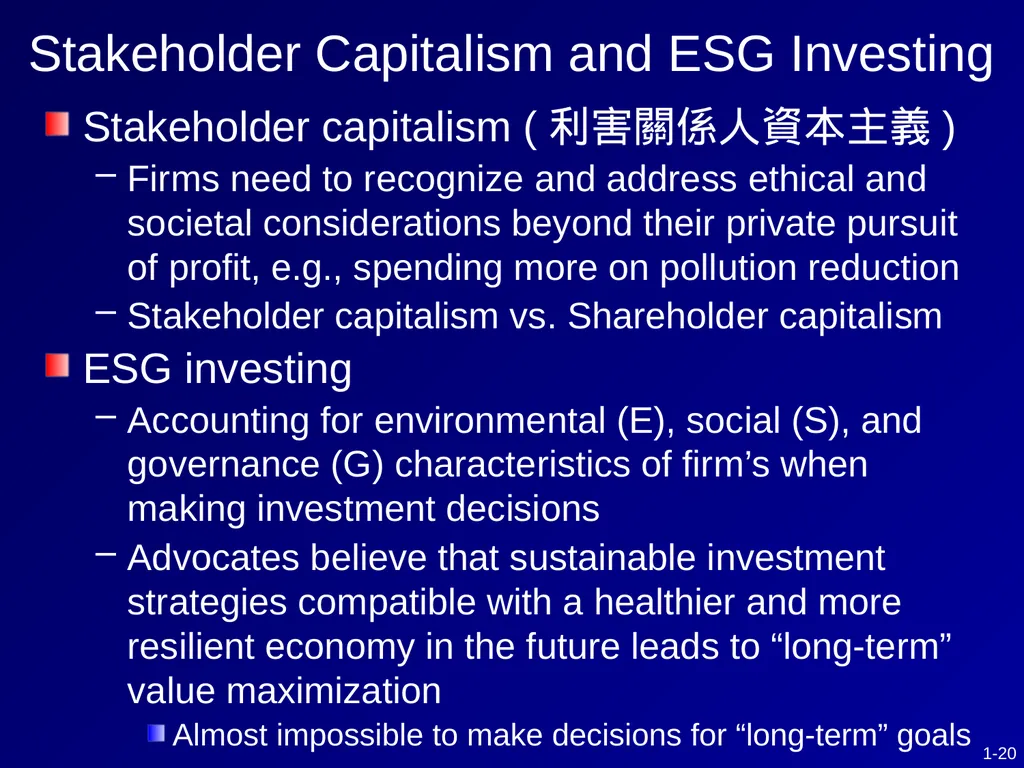
slide20. Stakeholder Capitalism and ESG Investing Stakeholder capitalism (利害關係人資本主義)
Firms need to recognize and address ethical and societal considerations beyond their private pursuit of profit, e.g., spending more on pollution reduction
Stakeholder capitalism vs. Shareholder capitalism
ESG investing
Accounting for environmental (E), social (S), and governance (G) characteristics of firm’s when making investment decisions
Advocates believe that sustainable investment strategies compatible with a healthier and more resilient economy in the future leads to “long-term” value maximization
Almost impossible to make decisions for “long-term” goals<br>
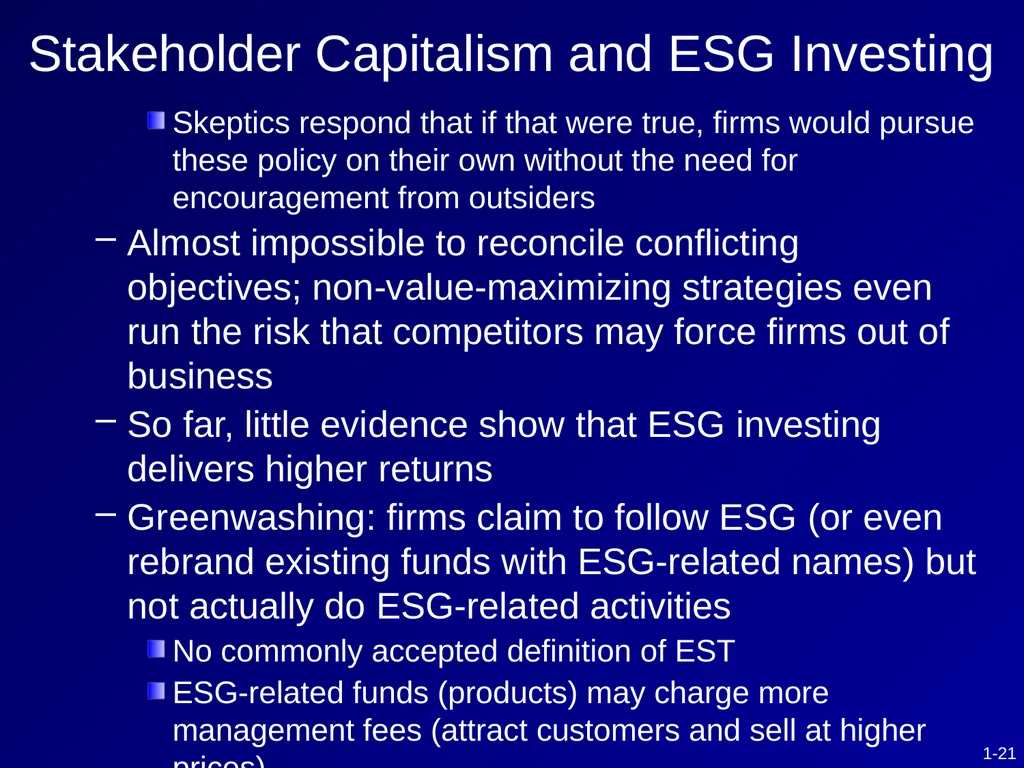
slide21. Stakeholder Capitalism and ESG Investing Skeptics respond that if that were true, firms would pursue these policy on their own without the need for encouragement from outsiders
Almost impossible to reconcile conflicting objectives; non-value-maximizing strategies even run the risk that competitors may force firms out of business
So far, little evidence show that ESG investing delivers higher returns
Greenwashing: firms claim to follow ESG (or even rebrand existing funds with ESG-related names) but not actually do ESG-related activities
No commonly accepted definition of EST
ESG-related funds (products) may charge more management fees (attract customers and sell at higher prices)<br>
slide22. 1.4 THE INVESTMENT PROCESS<br>
slide23. Investment Philosophies and Strategies Asset allocation (資產配置)
Choice among a broad classes of assets
Decide weights of various classes of assets
1. According to your return-risk preference (報酬風險偏好)
2. According to the portfolio theory: constructing a well-diversified (充分分散) portfolio to generate the desired “expected” return but bear lower degree of risk
※ Correlations between assets affect the portfolio risk
Top down strategy (由上而下策略)
The investment portfolio is constructed starting with asset allocation
For example, deposits vs. securities, stocks vs. bonds, automobile industry vs. electronic industry, Treasury bills vs. Treasury bonds, and so on<br>
slide24. Investment Philosophies and Strategies Security selection (證券選擇)
Perform the security analysis to evaluate securities and find over- or under-valued ones
Bottom up strategy (由下而上策略)
Find securities with over- or under-estimated prices but ignore the resulting asset allocation
In an efficient market (效率市場)
Price distortions exist for a very short time period because many investors try to benefit from selling overvalued and buying undervalued securities
Theoretically, there are almost no distorted-price securities and the bottom up strategy is difficult to make profit<br>
slide25. 1.5 MARKETS ARE COMPETITIVE AND RISK-RETURN TRADE-OFF<br>
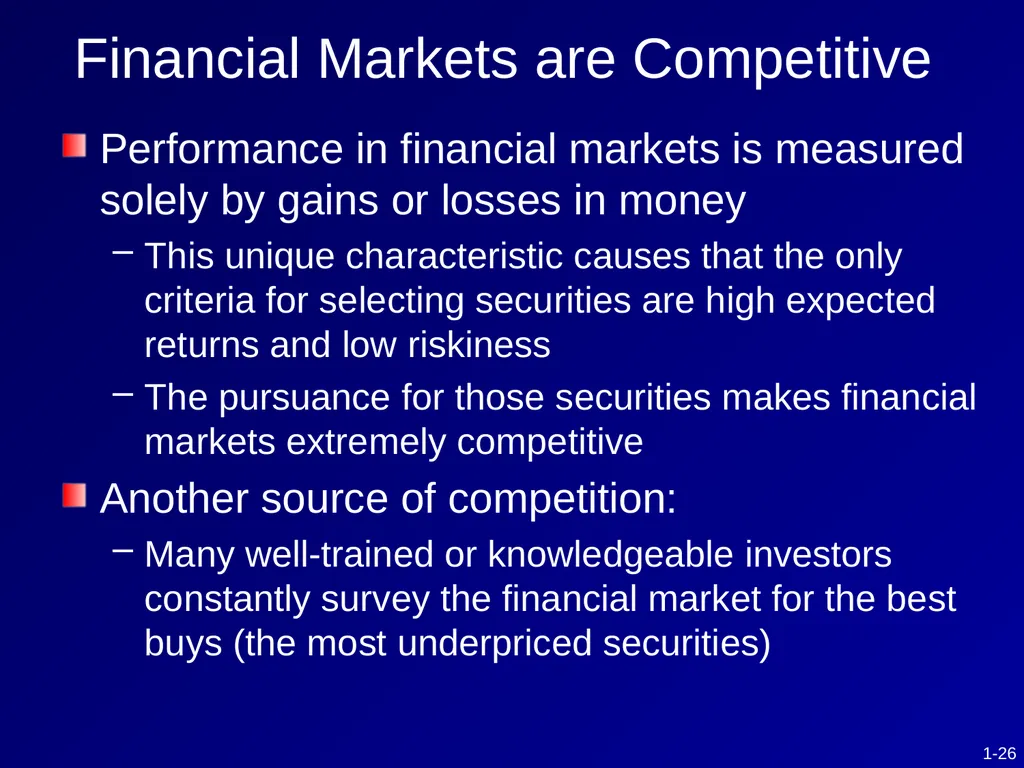
slide26. Financial Markets are Competitive Performance in financial markets is measured solely by gains or losses in money
This unique characteristic causes that the only criteria for selecting securities are high expected returns and low riskiness
The pursuance for those securities makes financial markets extremely competitive
Another source of competition:
Many well-trained or knowledgeable investors constantly survey the financial market for the best buys (the most underpriced securities)<br>
slide27. Risk-Return Trade-Off (風險報酬抉擇)<br>
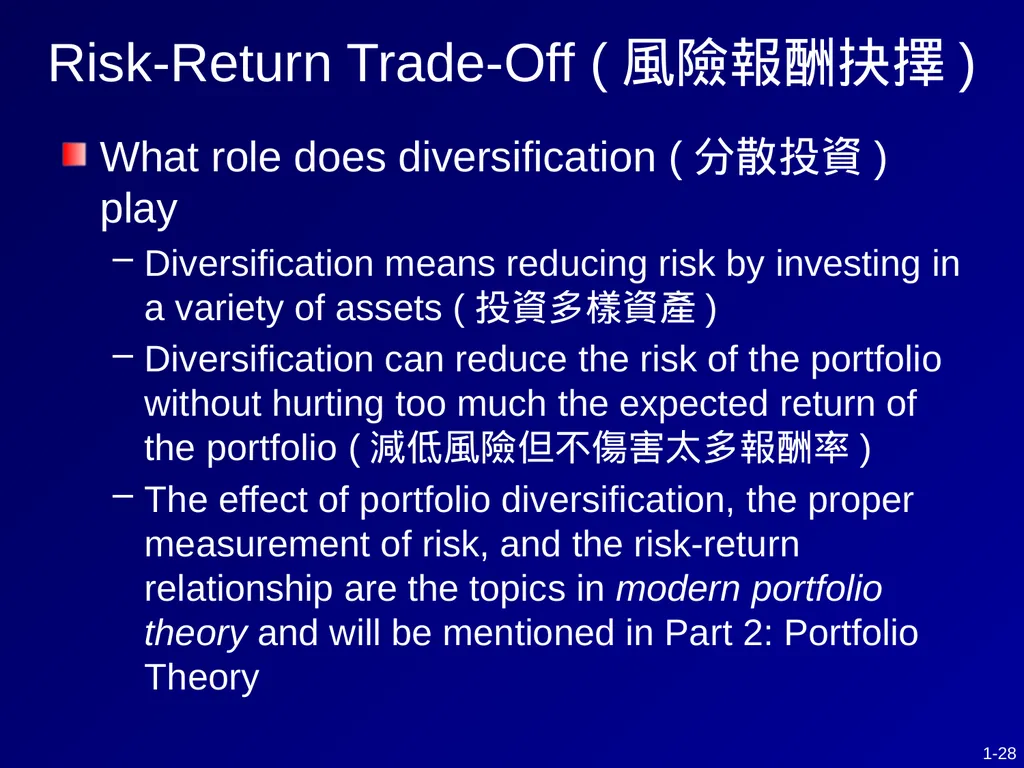
slide28. What role does diversification (分散投資) play
Diversification means reducing risk by investing in a variety of assets (投資多樣資產)
Diversification can reduce the risk of the portfolio without hurting too much the expected return of the portfolio (減低風險但不傷害太多報酬率)
The effect of portfolio diversification, the proper measurement of risk, and the risk-return relationship are the topics in modern portfolio theory and will be mentioned in Part 2: Portfolio Theory Risk-Return Trade-Off (風險報酬抉擇)<br>
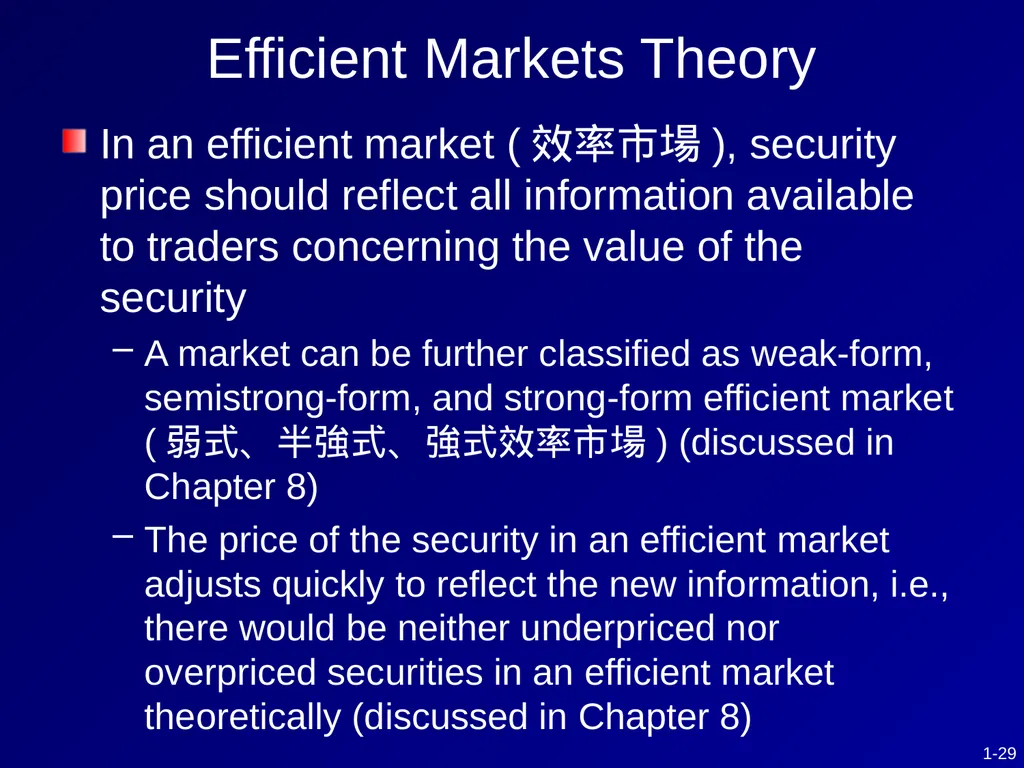
slide29. Efficient Markets Theory In an efficient market (效率市場), security price should reflect all information available to traders concerning the value of the security
A market can be further classified as weak-form, semistrong-form, and strong-form efficient market (弱式、半強式、強式效率市場) (discussed in Chapter 8)
The price of the security in an efficient market adjusts quickly to reflect the new information, i.e., there would be neither underpriced nor overpriced securities in an efficient market theoretically (discussed in Chapter 8)<br>
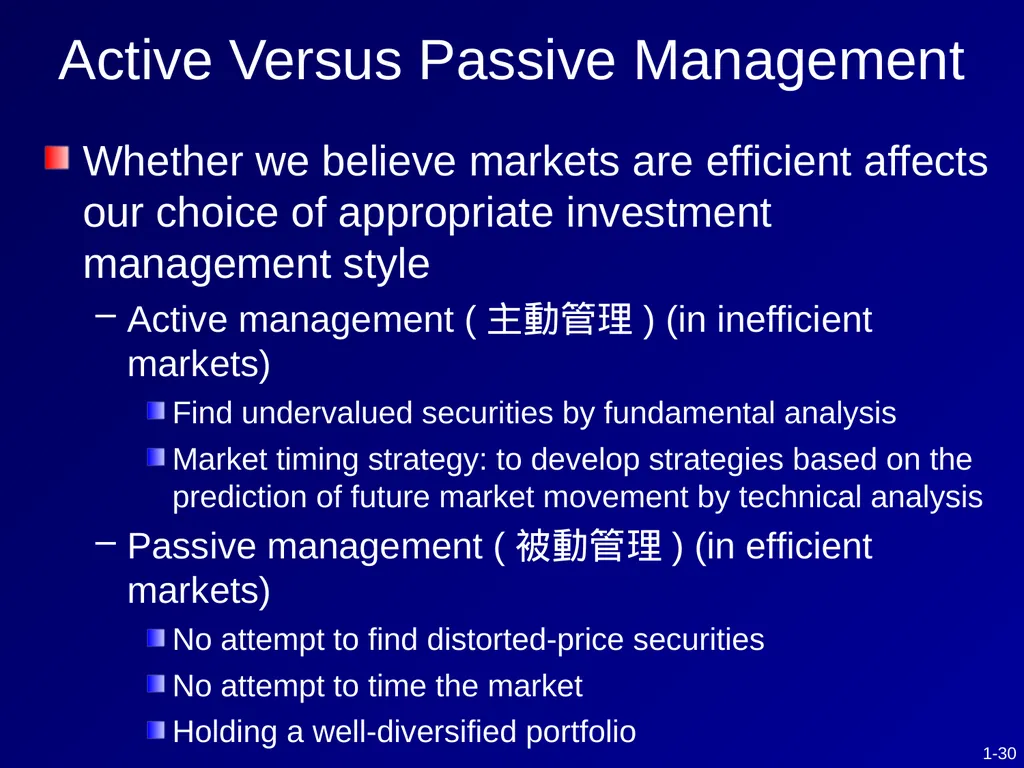
slide30. Active Versus Passive Management Whether we believe markets are efficient affects our choice of appropriate investment management style
Active management (主動管理) (in inefficient markets)
Find undervalued securities by fundamental analysis
Market timing strategy: to develop strategies based on the prediction of future market movement by technical analysis
Passive management (被動管理) (in efficient markets)
No attempt to find distorted-price securities
No attempt to time the market
Holding a well-diversified portfolio<br>
slide31. 1.6 THE PLAYERS<br>
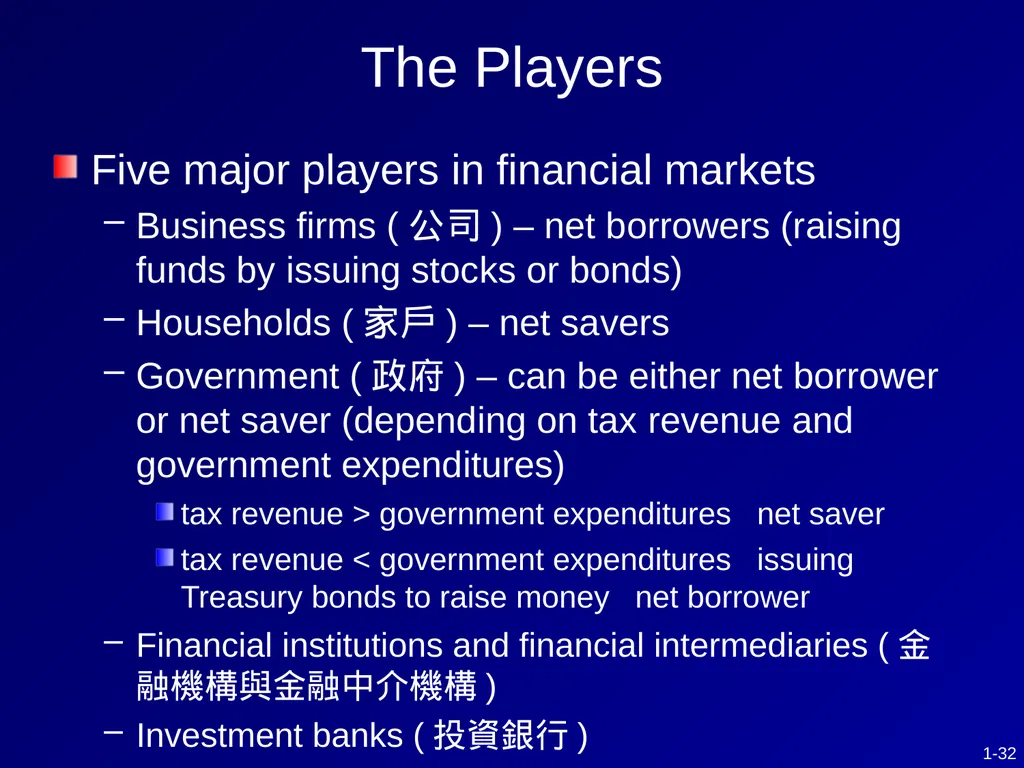
slide32. The Players Five major players in financial markets
Business firms (公司) – net borrowers (raising funds by issuing stocks or bonds)
Households (家戶) – net savers
Government (政府) – can be either net borrower or net saver (depending on tax revenue and government expenditures)
tax revenue > government expenditures net saver
tax revenue < government expenditures issuing Treasury bonds to raise money net borrower
Financial institutions and financial intermediaries (金融機構與金融中介機構)
Investment banks (投資銀行)<br>
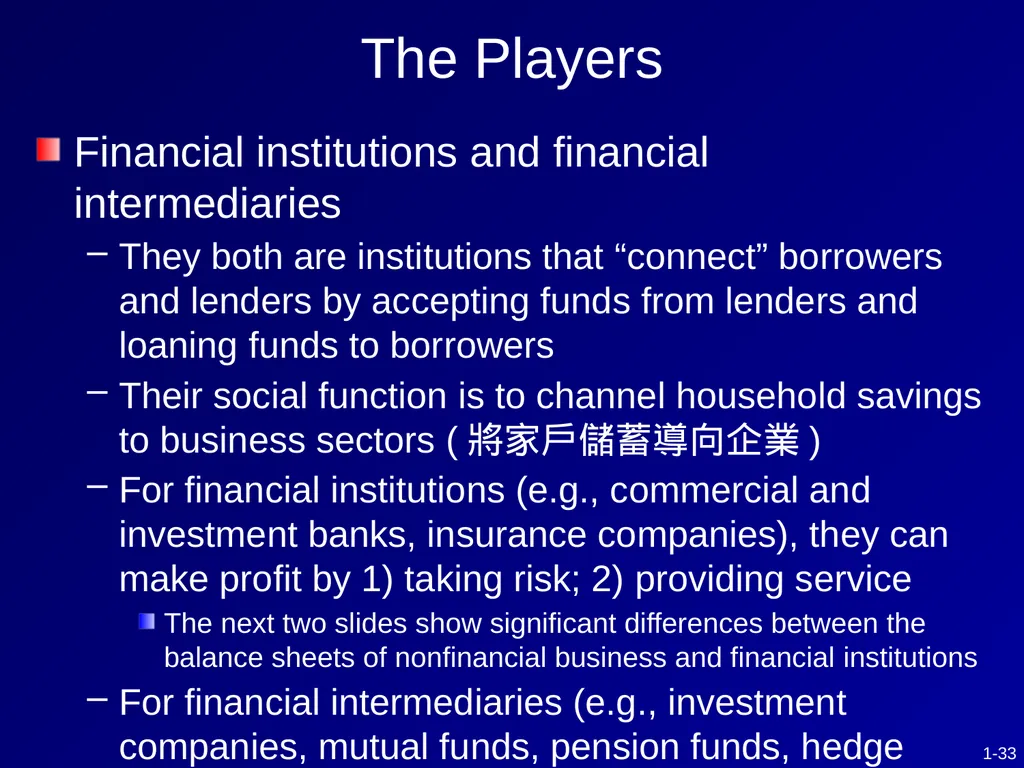
slide33. The Players Financial institutions and financial intermediaries
They both are institutions that “connect” borrowers and lenders by accepting funds from lenders and loaning funds to borrowers
Their social function is to channel household savings to business sectors (將家戶儲蓄導向企業)
For financial institutions (e.g., commercial and investment banks, insurance companies), they can make profit by 1) taking risk; 2) providing service
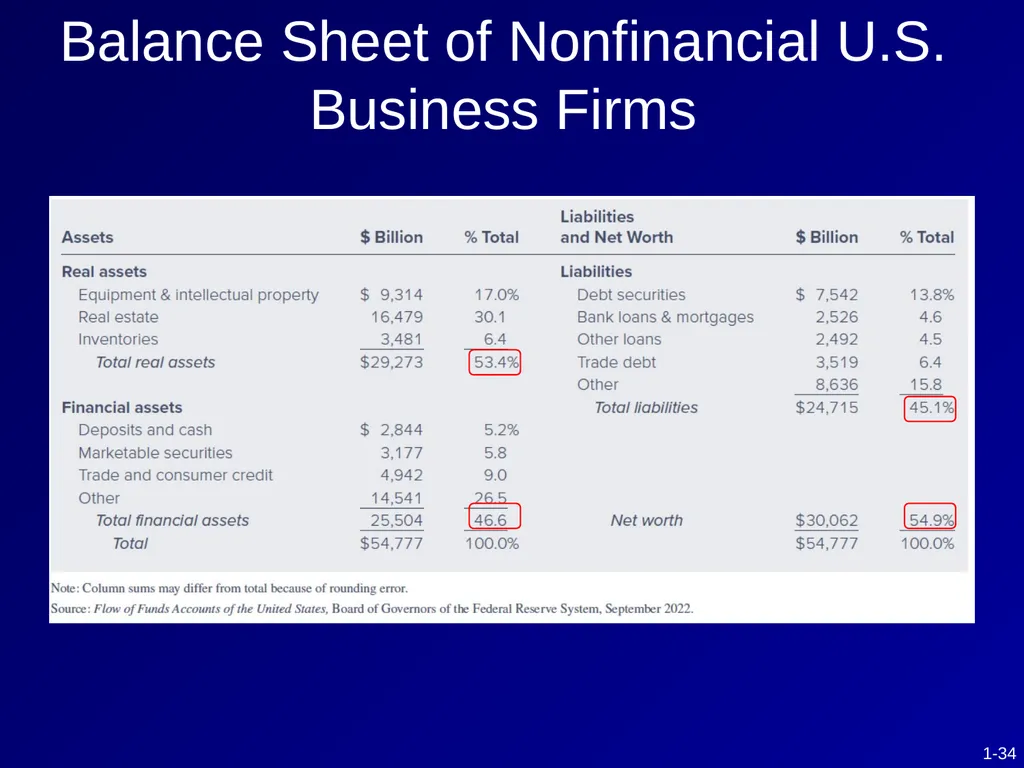
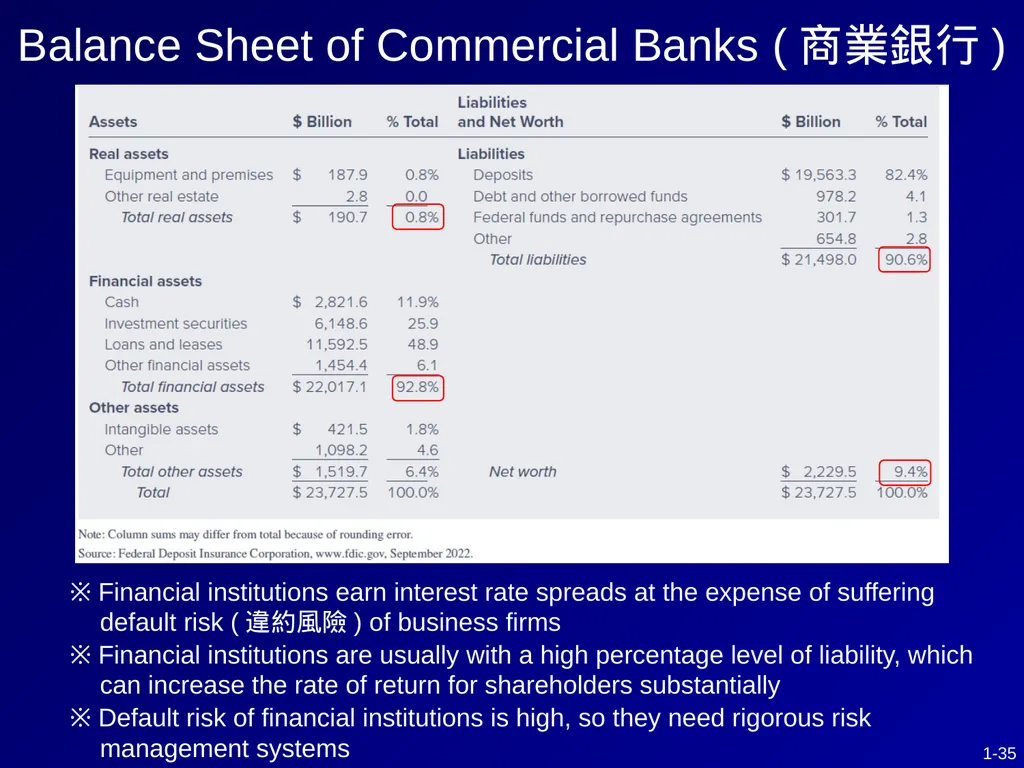
The next two slides show significant differences between the balance sheets of nonfinancial business and financial institutions
For financial intermediaries (e.g., investment companies, mutual funds, pension funds, hedge funds), they only provide service and thus earn fees<br>
slide34. Balance Sheet of Nonfinancial U.S. Business Firms<br>
slide35. Balance Sheet of Commercial Banks (商業銀行) ※ Financial institutions earn interest rate spreads at the expense of suffering default risk (違約風險) of business firms
※ Financial institutions are usually with a high percentage level of liability, which can increase the rate of return for shareholders substantially
※ Default risk of financial institutions is high, so they need rigorous risk management systems<br>
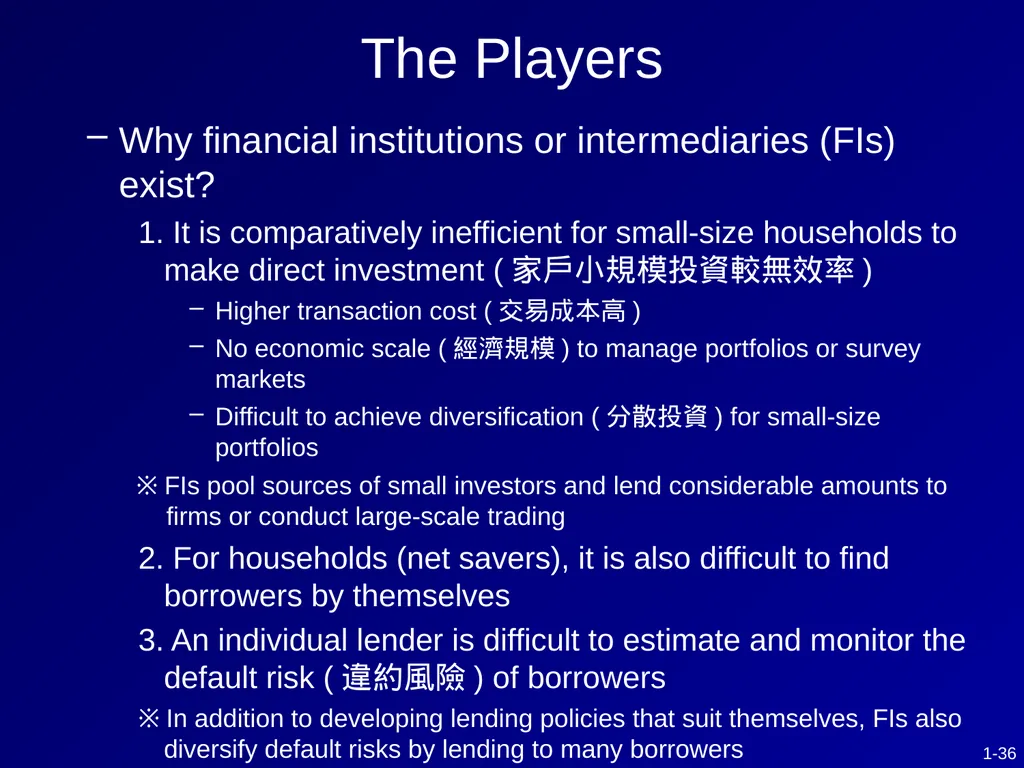
slide36. The Players Why financial institutions or intermediaries (FIs) exist?
1. It is comparatively inefficient for small-size households to make direct investment (家戶小規模投資較無效率)
Higher transaction cost (交易成本高)
No economic scale (經濟規模) to manage portfolios or survey markets
Difficult to achieve diversification (分散投資) for small-size portfolios
※ FIs pool sources of small investors and lend considerable amounts to firms or conduct large-scale trading
2. For households (net savers), it is also difficult to find borrowers by themselves
3. An individual lender is difficult to estimate and monitor the default risk (違約風險) of borrowers
※ In addition to developing lending policies that suit themselves, FIs also diversify default risks by lending to many borrowers
※ Due to economies of scale, FIs can build expertise to manage portfolios and various types of risks (建立管理投資組合與管理各類風險之專業)<br>
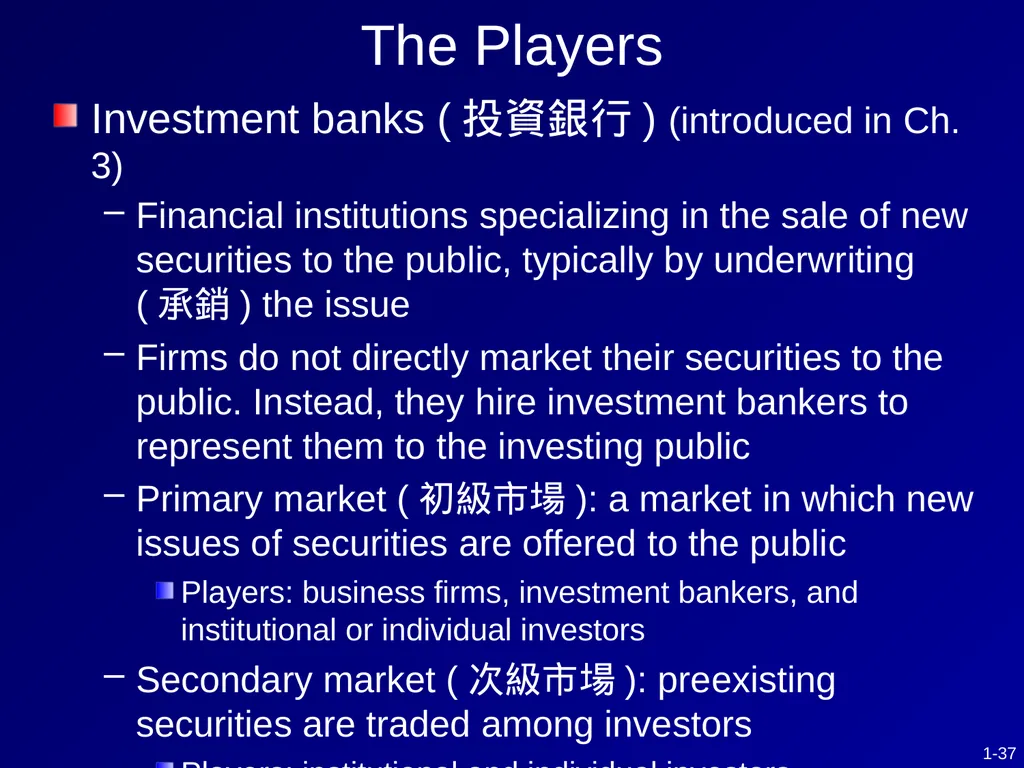
slide37. The Players Investment banks (投資銀行) (introduced in Ch. 3)
Financial institutions specializing in the sale of new securities to the public, typically by underwriting (承銷) the issue
Firms do not directly market their securities to the public. Instead, they hire investment bankers to represent them to the investing public
Primary market (初級市場): a market in which new issues of securities are offered to the public
Players: business firms, investment bankers, and institutional or individual investors
Secondary market (次級市場): preexisting securities are traded among investors
Players: institutional and individual investors<br>
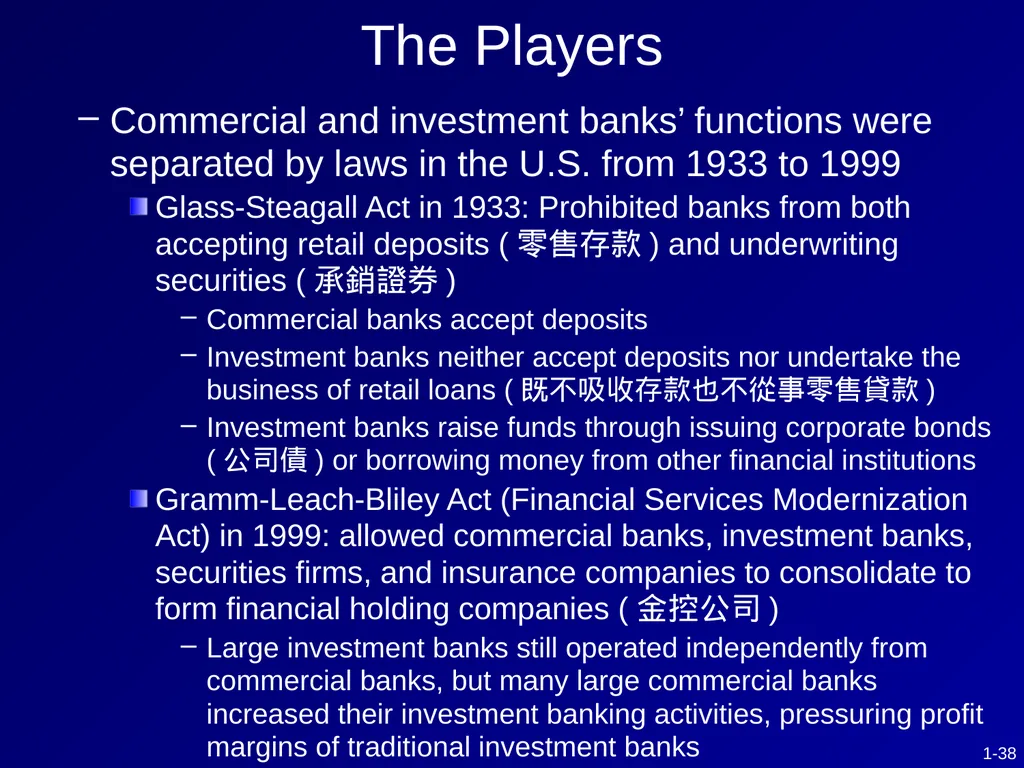
slide38. The Players Commercial and investment banks’ functions were separated by laws in the U.S. from 1933 to 1999
Glass-Steagall Act in 1933: Prohibited banks from both accepting retail deposits (零售存款) and underwriting securities (承銷證券)
Commercial banks accept deposits
Investment banks neither accept deposits nor undertake the business of retail loans (既不吸收存款也不從事零售貸款)
Investment banks raise funds through issuing corporate bonds (公司債) or borrowing money from other financial institutions
Gramm-Leach-Bliley Act (Financial Services Modernization Act) in 1999: allowed commercial banks, investment banks, securities firms, and insurance companies to consolidate to form financial holding companies (金控公司)
Large investment banks still operated independently from commercial banks, but many large commercial banks increased their investment banking activities, pressuring profit margins of traditional investment banks<br>
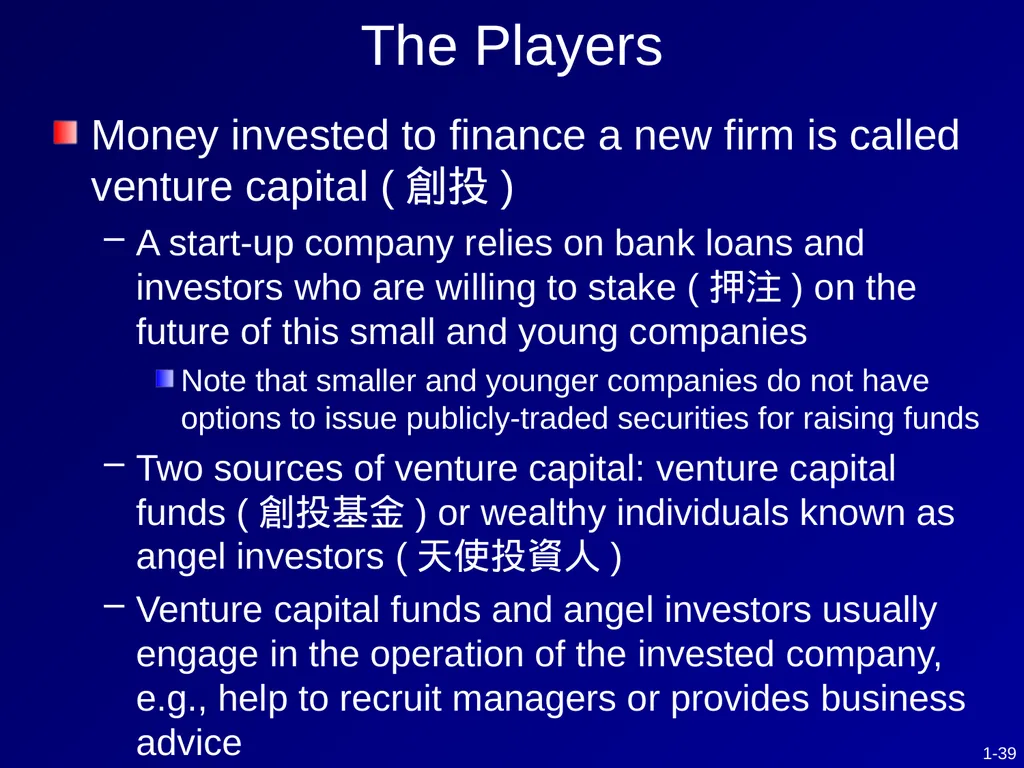
slide39. The Players Money invested to finance a new firm is called venture capital (創投)
A start-up company relies on bank loans and investors who are willing to stake (押注) on the future of this small and young companies
Note that smaller and younger companies do not have options to issue publicly-traded securities for raising funds
Two sources of venture capital: venture capital funds (創投基金) or wealthy individuals known as angel investors (天使投資人)
Venture capital funds and angel investors usually engage in the operation of the invested company, e.g., help to recruit managers or provides business advice<br>
slide40. The Players In practice, there are a lot of fails for venture capital investments, but a successful case can bring million profits
These investments in firms that do not trade on public stock exchanges are known as private equity investment (私募股權投資)<br>
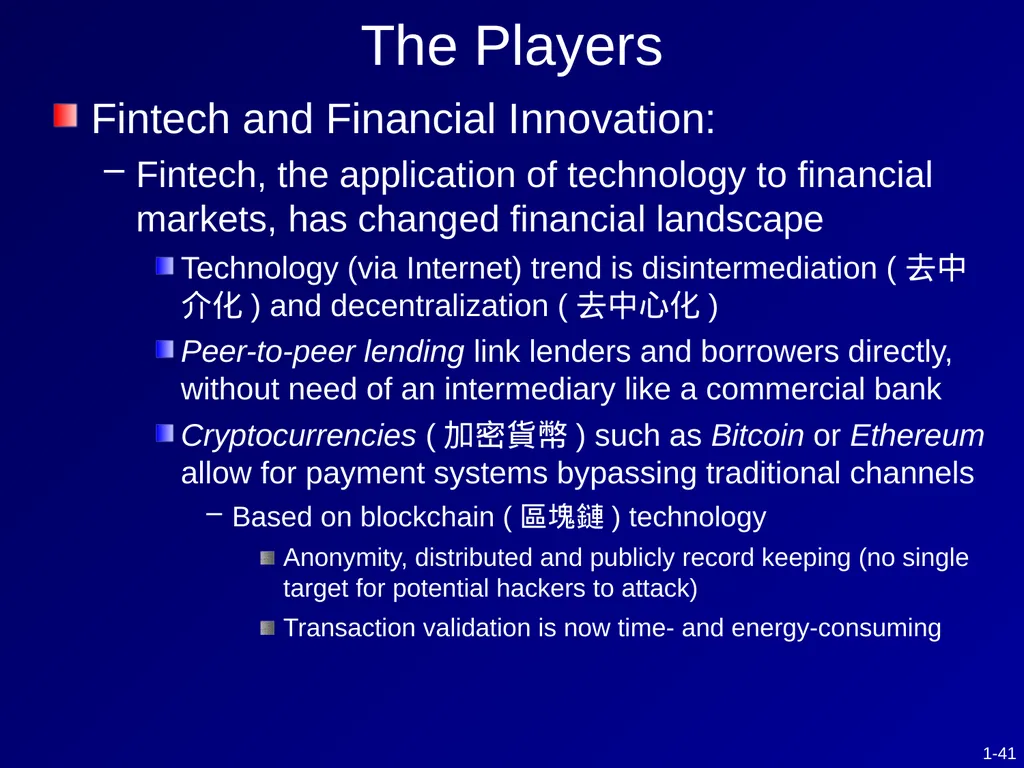
slide41. The Players Fintech and Financial Innovation:
Fintech, the application of technology to financial markets, has changed financial landscape
Technology (via Internet) trend is disintermediation (去中介化) and decentralization (去中心化)
Peer-to-peer lending link lenders and borrowers directly, without need of an intermediary like a commercial bank
Cryptocurrencies (加密貨幣) such as Bitcoin or Ethereum allow for payment systems bypassing traditional channels
Based on blockchain (區塊鏈) technology
Anonymity, distributed and publicly record keeping (no single target for potential hackers to attack)
Transaction validation is now time- and energy-consuming<br>
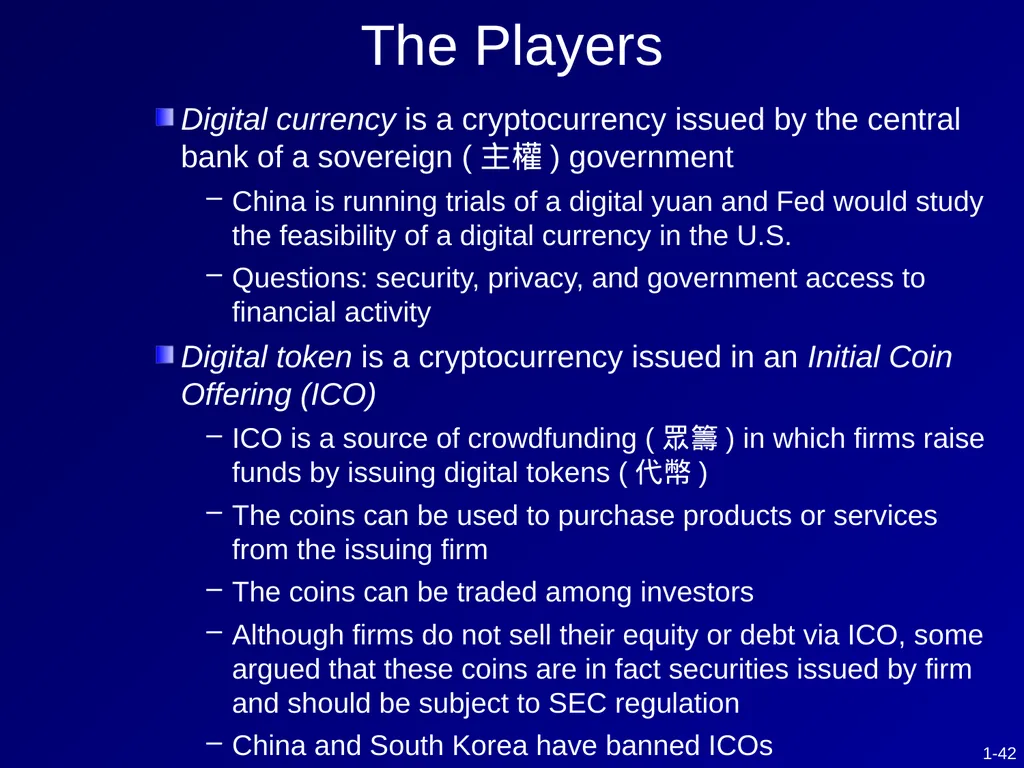
slide42. The Players Digital currency is a cryptocurrency issued by the central bank of a sovereign (主權) government
China is running trials of a digital yuan and Fed would study the feasibility of a digital currency in the U.S.
Questions: security, privacy, and government access to financial activity
Digital token is a cryptocurrency issued in an Initial Coin Offering (ICO)
ICO is a source of crowdfunding (眾籌) in which firms raise funds by issuing digital tokens (代幣)
The coins can be used to purchase products or services from the issuing firm
The coins can be traded among investors
Although firms do not sell their equity or debt via ICO, some argued that these coins are in fact securities issued by firm and should be subject to SEC regulation
China and South Korea have banned ICOs<br>
slide43. 1.7 Financial Crisis in 2008<br>
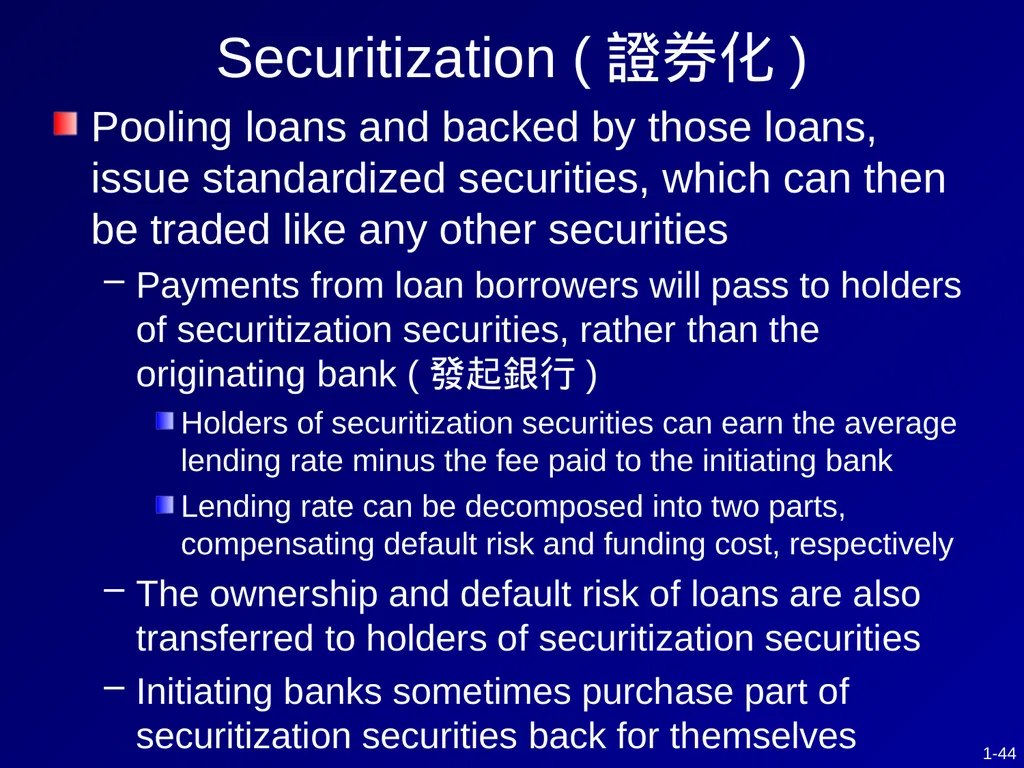
slide44. Securitization (證券化) Pooling loans and backed by those loans, issue standardized securities, which can then be traded like any other securities
Payments from loan borrowers will pass to holders of securitization securities, rather than the originating bank (發起銀行)
Holders of securitization securities can earn the average lending rate minus the fee paid to the initiating bank
Lending rate can be decomposed into two parts, compensating default risk and funding cost, respectively
The ownership and default risk of loans are also transferred to holders of securitization securities
Initiating banks sometimes purchase part of securitization securities back for themselves<br>
slide45. Increase the asset liquidity (流動性) by replacing the illiquid loan assets with liquid securitization securities
※ Securitization securities vs. original loans Securitization (證券化)<br>
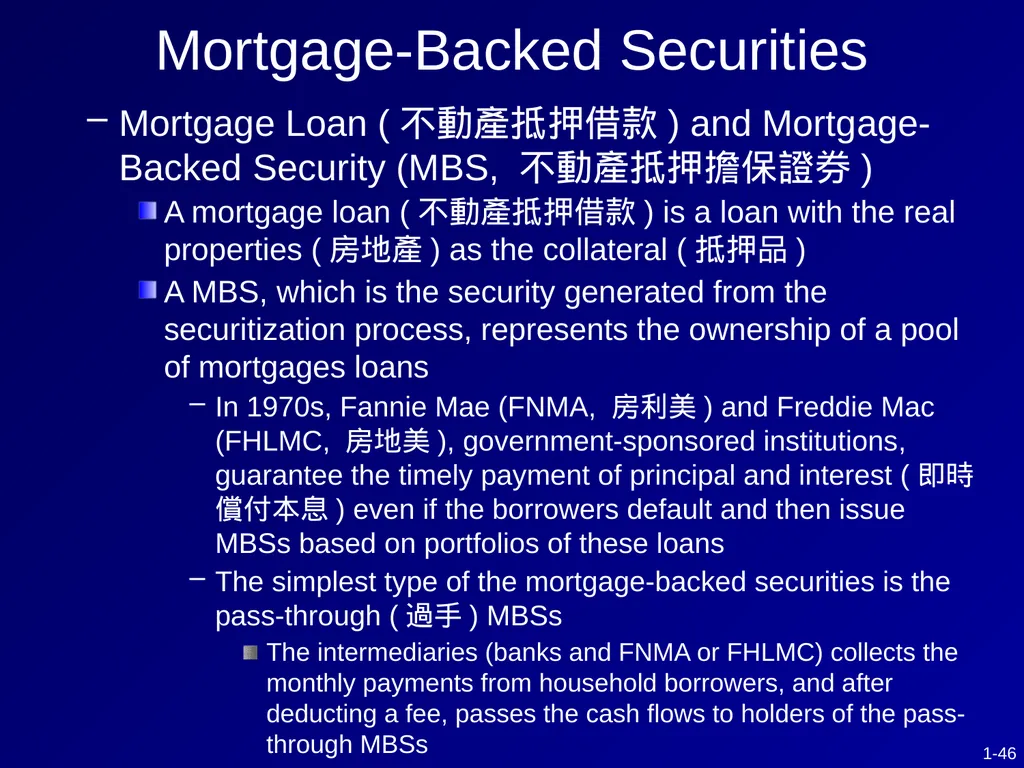
slide46. Mortgage-Backed Securities Mortgage Loan (不動產抵押借款) and Mortgage-Backed Security (MBS, 不動產抵押擔保證券)
A mortgage loan (不動產抵押借款) is a loan with the real properties (房地產) as the collateral (抵押品)
A MBS, which is the security generated from the securitization process, represents the ownership of a pool of mortgages loans
In 1970s, Fannie Mae (FNMA, 房利美) and Freddie Mac (FHLMC, 房地美), government-sponsored institutions, guarantee the timely payment of principal and interest (即時償付本息) even if the borrowers default and then issue MBSs based on portfolios of these loans
The simplest type of the mortgage-backed securities is the pass-through (過手) MBSs
The intermediaries (banks and FNMA or FHLMC) collects the monthly payments from household borrowers, and after deducting a fee, passes the cash flows to holders of the pass-through MBSs<br>
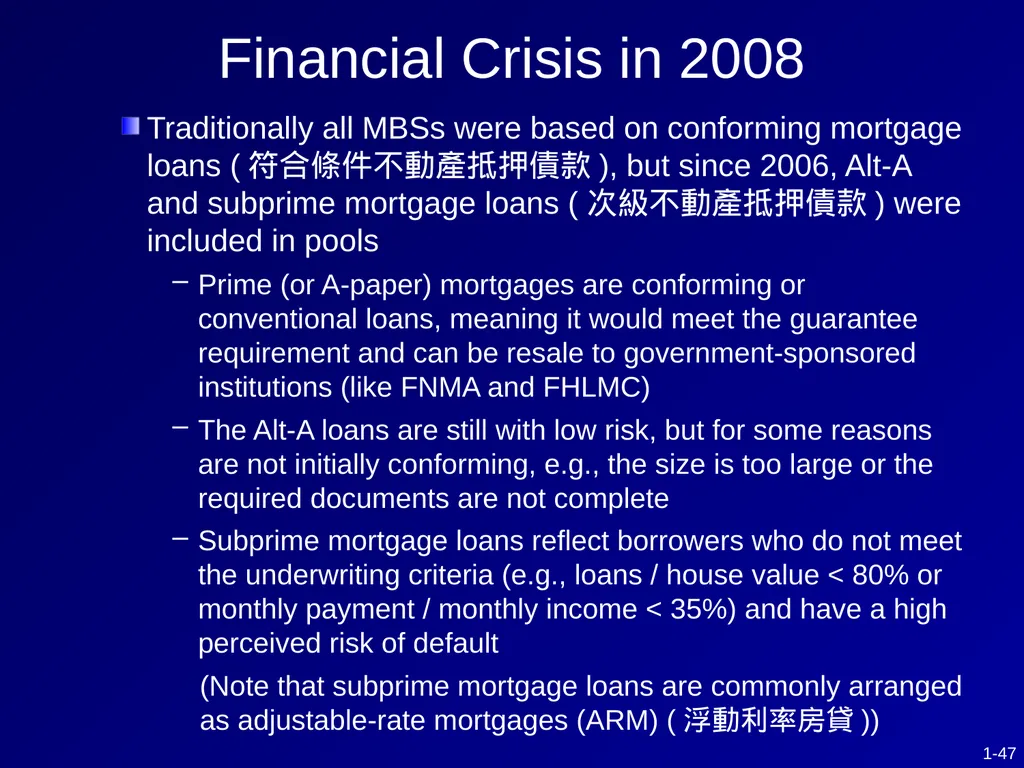
slide47. Financial Crisis in 2008 Traditionally all MBSs were based on conforming mortgage loans (符合條件不動產抵押債款), but since 2006, Alt-A and subprime mortgage loans (次級不動產抵押債款) were included in pools
Prime (or A-paper) mortgages are conforming or conventional loans, meaning it would meet the guarantee requirement and can be resale to government-sponsored institutions (like FNMA and FHLMC)
The Alt-A loans are still with low risk, but for some reasons are not initially conforming, e.g., the size is too large or the required documents are not complete
Subprime mortgage loans reflect borrowers who do not meet the underwriting criteria (e.g., loans / house value < 80% or monthly payment / monthly income < 35%) and have a high perceived risk of default
(Note that subprime mortgage loans are commonly arranged as adjustable-rate mortgages (ARM) (浮動利率房貸))<br>
slide48. The reasons for the growth of the subprime mortgage loans
The growing house prices
The low interest rate to aid the U.S. economy in its recovery from the 2000-2001 recession reduces the overall interest rate paid by the subprime borrowers
Political encouragement to spur affordable housing led to increase in subprime lending Financial Crisis in 2008<br>
slide49. Financial Crisis in 2008 Subprime crisis (次貸危機):
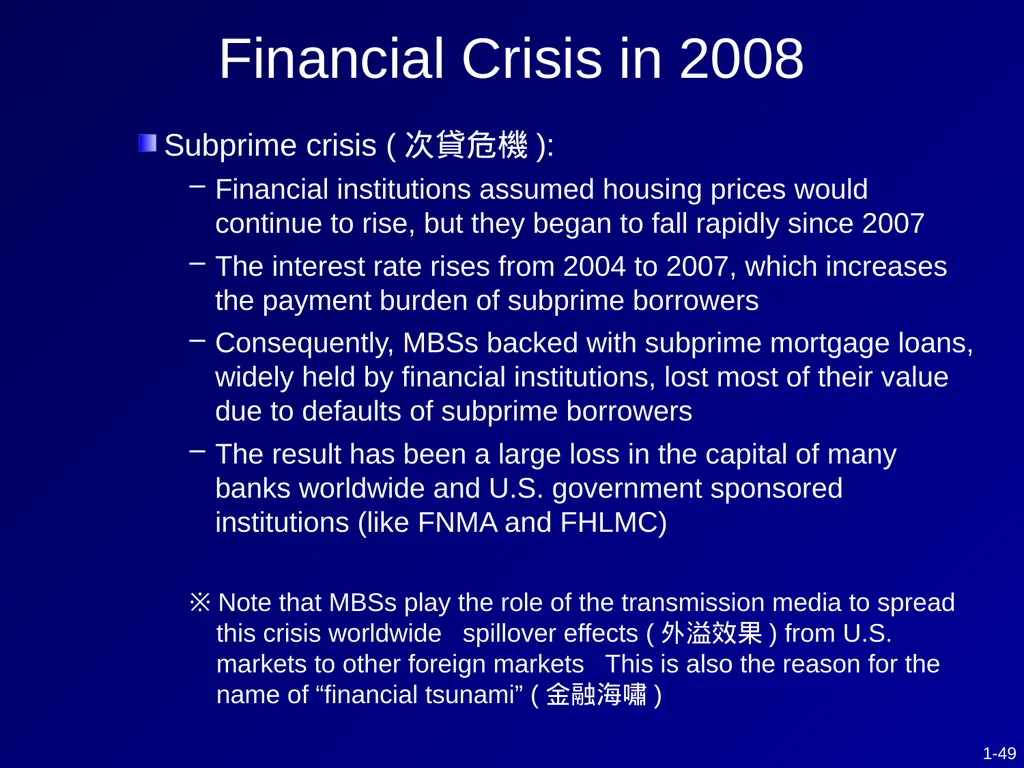
Financial institutions assumed housing prices would continue to rise, but they began to fall rapidly since 2007
The interest rate rises from 2004 to 2007, which increases the payment burden of subprime borrowers
Consequently, MBSs backed with subprime mortgage loans, widely held by financial institutions, lost most of their value due to defaults of subprime borrowers
The result has been a large loss in the capital of many banks worldwide and U.S. government sponsored institutions (like FNMA and FHLMC)
※ Note that MBSs play the role of the transmission media to spread this crisis worldwide spillover effects (外溢效果) from U.S. markets to other foreign markets This is also the reason for the name of “financial tsunami” (金融海嘯)<br>
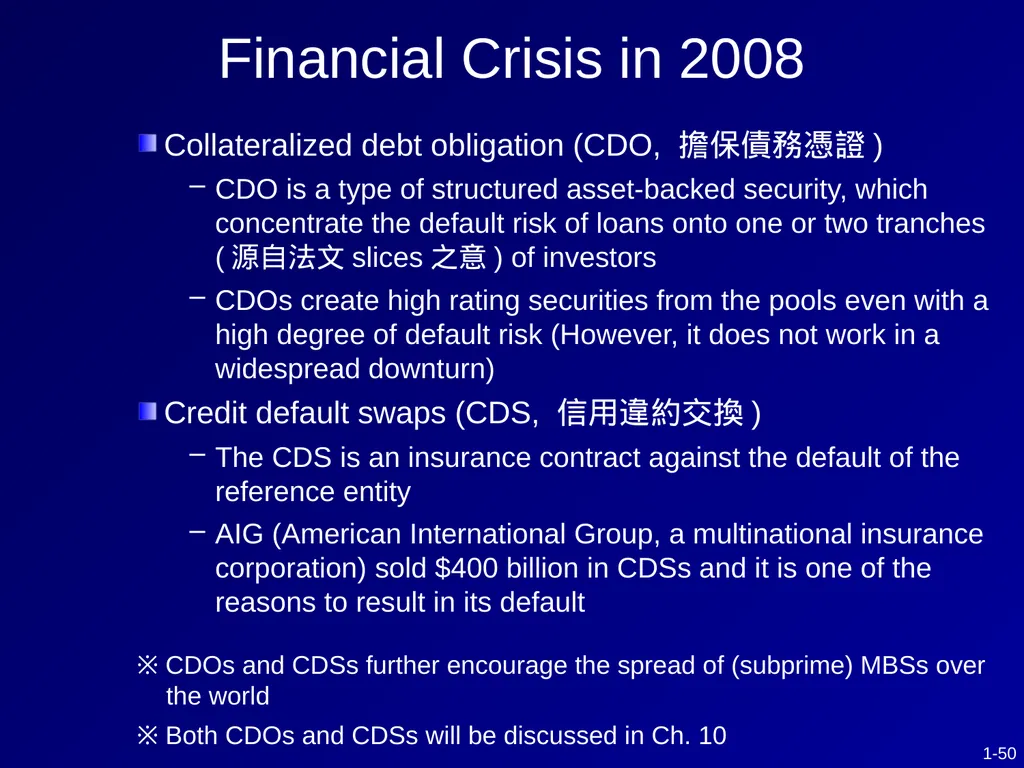
slide50. Financial Crisis in 2008 Collateralized debt obligation (CDO, 擔保債務憑證)
CDO is a type of structured asset-backed security, which concentrate the default risk of loans onto one or two tranches (源自法文slices之意) of investors
CDOs create high rating securities from the pools even with a high degree of default risk (However, it does not work in a widespread downturn)
Credit default swaps (CDS, 信用違約交換)
The CDS is an insurance contract against the default of the reference entity
AIG (American International Group, a multinational insurance corporation) sold $400 billion in CDSs and it is one of the reasons to result in its default
※ CDOs and CDSs further encourage the spread of (subprime) MBSs over the world
※ Both CDOs and CDSs will be discussed in Ch. 10<br>
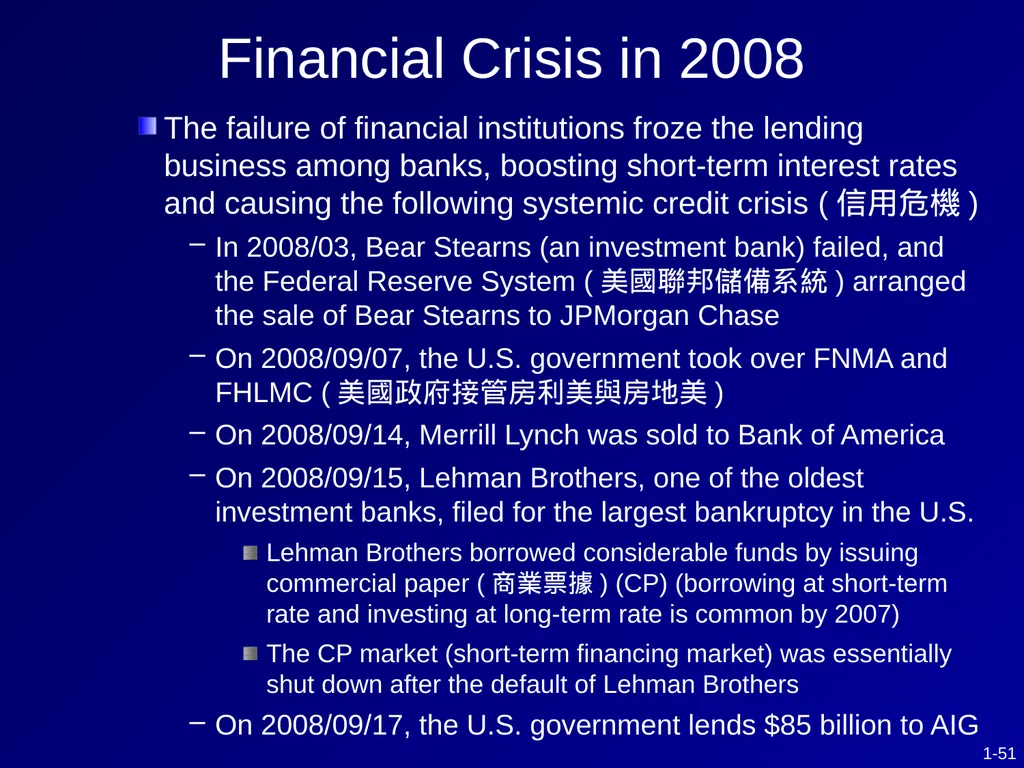
slide51. Financial Crisis in 2008 The failure of financial institutions froze the lending business among banks, boosting short-term interest rates and causing the following systemic credit crisis (信用危機)
In 2008/03, Bear Stearns (an investment bank) failed, and the Federal Reserve System (美國聯邦儲備系統) arranged the sale of Bear Stearns to JPMorgan Chase
On 2008/09/07, the U.S. government took over FNMA and FHLMC (美國政府接管房利美與房地美)
On 2008/09/14, Merrill Lynch was sold to Bank of America
On 2008/09/15, Lehman Brothers, one of the oldest investment banks, filed for the largest bankruptcy in the U.S.
Lehman Brothers borrowed considerable funds by issuing commercial paper (商業票據) (CP) (borrowing at short-term rate and investing at long-term rate is common by 2007)
The CP market (short-term financing market) was essentially shut down after the default of Lehman Brothers
On 2008/09/17, the U.S. government lends $85 billion to AIG<br>
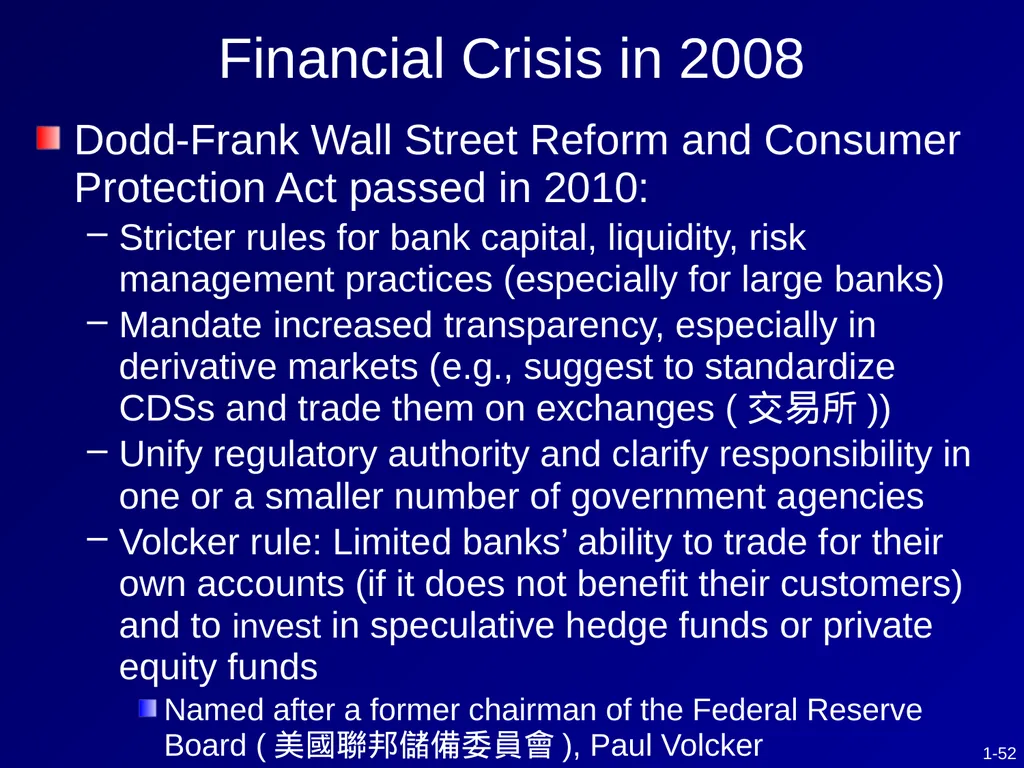
slide52. Financial Crisis in 2008 Dodd-Frank Wall Street Reform and Consumer Protection Act passed in 2010:
Stricter rules for bank capital, liquidity, risk management practices (especially for large banks)
Mandate increased transparency, especially in derivative markets (e.g., suggest to standardize CDSs and trade them on exchanges (交易所))
Unify regulatory authority and clarify responsibility in one or a smaller number of government agencies
Volcker rule: Limited banks’ ability to trade for their own accounts (if it does not benefit their customers) and to invest in speculative hedge funds or private equity funds
Named after a former chairman of the Federal Reserve Board (美國聯邦儲備委員會), Paul Volcker<br>
slide2. This chapter takes an overview of what we will learn in the text book
Defining an investment (投資)
Investment targets: financial or real assets (金融資產或實質資產)
Different classes of financial assets (Ch 2 and Parts 3, 4, and 5)
Roles of financial markets (Ch 3)
Corporate governance (公司治理)
Investment process
Risk-return trade-off and efficient markets (Part 2)
Players and innovations in financial markets (Ch 4)
Financial crisis in 2008 Learning Goals of Chapter 1<br>
slide3. 1.1 REAL ASSETS VERSUS FINANCIAL ASSETS<br>
slide4. Real Assets (tangible (有形) or intangible (無形))
Assets used to produce goods and services, e.g., land, buildings, equipment, inventory, or patents
Can generate net income to the economy
Financial Assets
Claims (所有權) on real assets or the income generated by them, e.g., equity shares or debt of firms
Essence of investment: sacrifice something now, invest in real assets or financial assets, and expect to benefit from that sacrifice later
Focus on investing in financial assets in the course
Goal of smoothing consumption: invest in good time periods, and realize investments when you need more consumption Financial Versus Real Assets<br>
slide5. Balance Sheet (資產負債表) of U.S. Households 2022 ※ The largest parts of assets and liabilities both come from the house owned
※ The position of deposits is usually maintained for liquidity of consumption
※ Pension reserves (退休準備) is the money or assets invested for future retired life
※ Equity in noncorporate business may come from the investment in sole proprietorship (獨資) or partnership companies (合夥)<br>
slide6. Net worth of the economy = Sum of real assets
Financial assets and liabilities must balance over all households, firms, and banks
Banks account, corporate stock, or corporate bonds are not only financial assets of households but also the liabilities of the issuers
Banks use the proceeds of deposits to lend to firms or households or to buy some financial asset issued by firms
Firms issue financial assets (e.g., corporate stock or bonds) to pay for the acquirement of real assets
For the aggregated balance sheet, only real assets remain as the net worth of the economy Financial Versus Real Assets<br>
slide7. Domestic Net Worth in the U.S. 2022<br>
slide8. 1.2 A CLASSIFICATION OF FINANCIAL ASSETS<br>
slide9. Major Classes of Financial Assets Debt (fixed income securities) (Part 3: Debt Securities)
Pay a specified cash flow over a specific period
Money market instruments (貨幣市場工具) (shorter term (< 1 yr.), lower risk), e.g., Treasury bills (國庫券)
Capital market instruments (資本市場工具) (longer term (> 1 yr.), higher risk), e.g., Treasury or Corporate Bonds (政府公債或公司債)
Equity (Part 4: Security Analysis)
An ownership share in a corporation
Shareholders may receive dividends (股利) and have prorated ownership in the real assets of the firm<br>
slide10. Major Classes of Financial Assets Derivative securities (Part 5: Derivative Markets)
Securities providing payoffs that depend on the values of other assets
Futures (期貨): an agreement (with both right and obligation) to buy or sell an asset at a certain time point in the future for an agreed price
Options (選擇權): a right to buy or sell an asset at a certain time point in the future for a specified price
See the introduction on Slide 2-49<br>
slide11. 1.3 FINANCIAL MARKETS AND THE ECONOMY<br>
slide12. Financial Markets Provide (price) information
Market prices, determined by demand and supply, reflect the consensus (共識) of investing public
While market prices are determined, capital resources are allocated (分配) efficiently
For firms with good (poor) prospects, the stock market encourages (discourage) allocation of capital to those firms, whose share prices are bidden up (down)
Free market competition vs. Central planner
Shift consumption timing for individual investors
Shift your purchasing power from high-earnings periods to low-earnings periods of life
Ultimate goal of investment for individual investors is to smooth their consumption over lifetime<br>
slide13. Financial Markets Allocate risk (分配風險)
Firms can transfer the project risk to investors who buy stock shares or bonds issued by the firms
Allow investors with the greatest taste for risk to bear that risk
Stock shares desired by more risk-tolerant investors
Bonds desired by more conservative investors
Another benefit for firms to raise funds
When investors are able to select security types with the risk-return characteristics that best fit their preference from the financial markets, each security can be sold at the best possible price<br>
slide14. Financial Markets Separate ownership with management
Invention of stock shares and stock markets allows the separation of ownership and management
Meanwhile, shareholders elect a board of directors (董事會) to supervise the management of the firm
Advantages for this arrangement
Firms’ existence or performance is independent of the status of their shareholders
Can hire professional managers to operate the firm
Shareholders can sell shares to others in financial markets without affecting the management<br>
slide15. Financial Markets Agency problems (代理人問題): Conflicts of interest between managers and shareholders
Managers (shareholders) care about salary (equity value)
Examples: empire building (via excessive growth or investment), avoid risky projects, or overconsume luxuries
These suboptimal decisions hurt interests of shareholders
Solutions:
Performance-based compensation plans (link the manager’s income with the performance of the stock price)
Penalty for the poor performance in stock price (force out or fire the manager)
Specialist monitoring (analysts, fund managers, or banks)
Threat of takeovers (併購) by other firms (enhance the firm value by replacing poor-performing managers)<br>
slide16. Corporate Governance and Ethics What is corporate governance (公司治理)?
Corporate governance is the set of processes, policies, or institutional systems affecting how a corporation is directed, administered, or controlled
Associated with interests among all stakeholders (利害關係人), including shareholders, debtholders, employees, customers, and communities in which firms operate
Arises from the information asymmetry among stakeholders
Without trust among stakeholders, additional laws and regulations are required
Generally designed to protect the investing public, who possess less information and control power for firms
Build the confidence of the investing public, which is the essential pillar to support financial markets<br>
slide17. Poor Corporate Governance Accounting scandals (會計醜聞) (Enron, WorldCom, Rite-Aid, HealthSouth, etc.)
Enron in 2001
In late 2001, Enron was one of the world's leading electricity, natural gas, communications and pulp and paper companies, with claimed revenues of nearly $101 billion in 2000
Using special purpose entities (SPEs) (also known as special purpose vehicle (SPV)) to hide debt which should be in its own books (by selling non-performing assets to SPEs)
WorldCom in 2002
The U.S. second largest long distance phone company (after AT&T)
Classify expenses as investments to enhance net income or even hide losses<br>
slide18. Poor Corporate Governance Misleading research reports by stock analysts (Citibank, Merrill Lynch, etc.)
Instead of providing fair reports, their favorable reports are traded for the promise of future investment banking business for the firm, e.g., participating the allocation of public offerings (公開募資)
Auditors (查帳員): watchdogs or consultants
Example of Arthur Andersen (AA) in Enron case: due to the fact that the profit from consulting is higher than that from auditing, AA, in order to protect its consulting profits, had to weak its function of auditing<br>
slide19. Reform of Corporate Governance Sarbanes-Oxley Act in 2002 (tightening the rules of corporate governance in the U.S.)
Requiring more independent directors (獨立董監事), who are not affiliated with the company or its subsidiary companies, in boards of directors
CFOs (財務長) need to personally vouch (擔保) for the truth of corporate accounting statements
A new quasi-public agency, Public Company Accounting Oversight Board, is created to monitor the accounting/auditing industry
Prohibit an auditor from providing various other services for the same client<br>
slide20. Stakeholder Capitalism and ESG Investing Stakeholder capitalism (利害關係人資本主義)
Firms need to recognize and address ethical and societal considerations beyond their private pursuit of profit, e.g., spending more on pollution reduction
Stakeholder capitalism vs. Shareholder capitalism
ESG investing
Accounting for environmental (E), social (S), and governance (G) characteristics of firm’s when making investment decisions
Advocates believe that sustainable investment strategies compatible with a healthier and more resilient economy in the future leads to “long-term” value maximization
Almost impossible to make decisions for “long-term” goals<br>
slide21. Stakeholder Capitalism and ESG Investing Skeptics respond that if that were true, firms would pursue these policy on their own without the need for encouragement from outsiders
Almost impossible to reconcile conflicting objectives; non-value-maximizing strategies even run the risk that competitors may force firms out of business
So far, little evidence show that ESG investing delivers higher returns
Greenwashing: firms claim to follow ESG (or even rebrand existing funds with ESG-related names) but not actually do ESG-related activities
No commonly accepted definition of EST
ESG-related funds (products) may charge more management fees (attract customers and sell at higher prices)<br>
slide22. 1.4 THE INVESTMENT PROCESS<br>
slide23. Investment Philosophies and Strategies Asset allocation (資產配置)
Choice among a broad classes of assets
Decide weights of various classes of assets
1. According to your return-risk preference (報酬風險偏好)
2. According to the portfolio theory: constructing a well-diversified (充分分散) portfolio to generate the desired “expected” return but bear lower degree of risk
※ Correlations between assets affect the portfolio risk
Top down strategy (由上而下策略)
The investment portfolio is constructed starting with asset allocation
For example, deposits vs. securities, stocks vs. bonds, automobile industry vs. electronic industry, Treasury bills vs. Treasury bonds, and so on<br>
slide24. Investment Philosophies and Strategies Security selection (證券選擇)
Perform the security analysis to evaluate securities and find over- or under-valued ones
Bottom up strategy (由下而上策略)
Find securities with over- or under-estimated prices but ignore the resulting asset allocation
In an efficient market (效率市場)
Price distortions exist for a very short time period because many investors try to benefit from selling overvalued and buying undervalued securities
Theoretically, there are almost no distorted-price securities and the bottom up strategy is difficult to make profit<br>
slide25. 1.5 MARKETS ARE COMPETITIVE AND RISK-RETURN TRADE-OFF<br>
slide26. Financial Markets are Competitive Performance in financial markets is measured solely by gains or losses in money
This unique characteristic causes that the only criteria for selecting securities are high expected returns and low riskiness
The pursuance for those securities makes financial markets extremely competitive
Another source of competition:
Many well-trained or knowledgeable investors constantly survey the financial market for the best buys (the most underpriced securities)<br>
slide27. Risk-Return Trade-Off (風險報酬抉擇)<br>
slide28. What role does diversification (分散投資) play
Diversification means reducing risk by investing in a variety of assets (投資多樣資產)
Diversification can reduce the risk of the portfolio without hurting too much the expected return of the portfolio (減低風險但不傷害太多報酬率)
The effect of portfolio diversification, the proper measurement of risk, and the risk-return relationship are the topics in modern portfolio theory and will be mentioned in Part 2: Portfolio Theory Risk-Return Trade-Off (風險報酬抉擇)<br>
slide29. Efficient Markets Theory In an efficient market (效率市場), security price should reflect all information available to traders concerning the value of the security
A market can be further classified as weak-form, semistrong-form, and strong-form efficient market (弱式、半強式、強式效率市場) (discussed in Chapter 8)
The price of the security in an efficient market adjusts quickly to reflect the new information, i.e., there would be neither underpriced nor overpriced securities in an efficient market theoretically (discussed in Chapter 8)<br>
slide30. Active Versus Passive Management Whether we believe markets are efficient affects our choice of appropriate investment management style
Active management (主動管理) (in inefficient markets)
Find undervalued securities by fundamental analysis
Market timing strategy: to develop strategies based on the prediction of future market movement by technical analysis
Passive management (被動管理) (in efficient markets)
No attempt to find distorted-price securities
No attempt to time the market
Holding a well-diversified portfolio<br>
slide31. 1.6 THE PLAYERS<br>
slide32. The Players Five major players in financial markets
Business firms (公司) – net borrowers (raising funds by issuing stocks or bonds)
Households (家戶) – net savers
Government (政府) – can be either net borrower or net saver (depending on tax revenue and government expenditures)
tax revenue > government expenditures net saver
tax revenue < government expenditures issuing Treasury bonds to raise money net borrower
Financial institutions and financial intermediaries (金融機構與金融中介機構)
Investment banks (投資銀行)<br>
slide33. The Players Financial institutions and financial intermediaries
They both are institutions that “connect” borrowers and lenders by accepting funds from lenders and loaning funds to borrowers
Their social function is to channel household savings to business sectors (將家戶儲蓄導向企業)
For financial institutions (e.g., commercial and investment banks, insurance companies), they can make profit by 1) taking risk; 2) providing service
The next two slides show significant differences between the balance sheets of nonfinancial business and financial institutions
For financial intermediaries (e.g., investment companies, mutual funds, pension funds, hedge funds), they only provide service and thus earn fees<br>
slide34. Balance Sheet of Nonfinancial U.S. Business Firms<br>
slide35. Balance Sheet of Commercial Banks (商業銀行) ※ Financial institutions earn interest rate spreads at the expense of suffering default risk (違約風險) of business firms
※ Financial institutions are usually with a high percentage level of liability, which can increase the rate of return for shareholders substantially
※ Default risk of financial institutions is high, so they need rigorous risk management systems<br>
slide36. The Players Why financial institutions or intermediaries (FIs) exist?
1. It is comparatively inefficient for small-size households to make direct investment (家戶小規模投資較無效率)
Higher transaction cost (交易成本高)
No economic scale (經濟規模) to manage portfolios or survey markets
Difficult to achieve diversification (分散投資) for small-size portfolios
※ FIs pool sources of small investors and lend considerable amounts to firms or conduct large-scale trading
2. For households (net savers), it is also difficult to find borrowers by themselves
3. An individual lender is difficult to estimate and monitor the default risk (違約風險) of borrowers
※ In addition to developing lending policies that suit themselves, FIs also diversify default risks by lending to many borrowers
※ Due to economies of scale, FIs can build expertise to manage portfolios and various types of risks (建立管理投資組合與管理各類風險之專業)<br>
slide37. The Players Investment banks (投資銀行) (introduced in Ch. 3)
Financial institutions specializing in the sale of new securities to the public, typically by underwriting (承銷) the issue
Firms do not directly market their securities to the public. Instead, they hire investment bankers to represent them to the investing public
Primary market (初級市場): a market in which new issues of securities are offered to the public
Players: business firms, investment bankers, and institutional or individual investors
Secondary market (次級市場): preexisting securities are traded among investors
Players: institutional and individual investors<br>
slide38. The Players Commercial and investment banks’ functions were separated by laws in the U.S. from 1933 to 1999
Glass-Steagall Act in 1933: Prohibited banks from both accepting retail deposits (零售存款) and underwriting securities (承銷證券)
Commercial banks accept deposits
Investment banks neither accept deposits nor undertake the business of retail loans (既不吸收存款也不從事零售貸款)
Investment banks raise funds through issuing corporate bonds (公司債) or borrowing money from other financial institutions
Gramm-Leach-Bliley Act (Financial Services Modernization Act) in 1999: allowed commercial banks, investment banks, securities firms, and insurance companies to consolidate to form financial holding companies (金控公司)
Large investment banks still operated independently from commercial banks, but many large commercial banks increased their investment banking activities, pressuring profit margins of traditional investment banks<br>
slide39. The Players Money invested to finance a new firm is called venture capital (創投)
A start-up company relies on bank loans and investors who are willing to stake (押注) on the future of this small and young companies
Note that smaller and younger companies do not have options to issue publicly-traded securities for raising funds
Two sources of venture capital: venture capital funds (創投基金) or wealthy individuals known as angel investors (天使投資人)
Venture capital funds and angel investors usually engage in the operation of the invested company, e.g., help to recruit managers or provides business advice<br>
slide40. The Players In practice, there are a lot of fails for venture capital investments, but a successful case can bring million profits
These investments in firms that do not trade on public stock exchanges are known as private equity investment (私募股權投資)<br>
slide41. The Players Fintech and Financial Innovation:
Fintech, the application of technology to financial markets, has changed financial landscape
Technology (via Internet) trend is disintermediation (去中介化) and decentralization (去中心化)
Peer-to-peer lending link lenders and borrowers directly, without need of an intermediary like a commercial bank
Cryptocurrencies (加密貨幣) such as Bitcoin or Ethereum allow for payment systems bypassing traditional channels
Based on blockchain (區塊鏈) technology
Anonymity, distributed and publicly record keeping (no single target for potential hackers to attack)
Transaction validation is now time- and energy-consuming<br>
slide42. The Players Digital currency is a cryptocurrency issued by the central bank of a sovereign (主權) government
China is running trials of a digital yuan and Fed would study the feasibility of a digital currency in the U.S.
Questions: security, privacy, and government access to financial activity
Digital token is a cryptocurrency issued in an Initial Coin Offering (ICO)
ICO is a source of crowdfunding (眾籌) in which firms raise funds by issuing digital tokens (代幣)
The coins can be used to purchase products or services from the issuing firm
The coins can be traded among investors
Although firms do not sell their equity or debt via ICO, some argued that these coins are in fact securities issued by firm and should be subject to SEC regulation
China and South Korea have banned ICOs<br>
slide43. 1.7 Financial Crisis in 2008<br>
slide44. Securitization (證券化) Pooling loans and backed by those loans, issue standardized securities, which can then be traded like any other securities
Payments from loan borrowers will pass to holders of securitization securities, rather than the originating bank (發起銀行)
Holders of securitization securities can earn the average lending rate minus the fee paid to the initiating bank
Lending rate can be decomposed into two parts, compensating default risk and funding cost, respectively
The ownership and default risk of loans are also transferred to holders of securitization securities
Initiating banks sometimes purchase part of securitization securities back for themselves<br>
slide45. Increase the asset liquidity (流動性) by replacing the illiquid loan assets with liquid securitization securities
※ Securitization securities vs. original loans Securitization (證券化)<br>
slide46. Mortgage-Backed Securities Mortgage Loan (不動產抵押借款) and Mortgage-Backed Security (MBS, 不動產抵押擔保證券)
A mortgage loan (不動產抵押借款) is a loan with the real properties (房地產) as the collateral (抵押品)
A MBS, which is the security generated from the securitization process, represents the ownership of a pool of mortgages loans
In 1970s, Fannie Mae (FNMA, 房利美) and Freddie Mac (FHLMC, 房地美), government-sponsored institutions, guarantee the timely payment of principal and interest (即時償付本息) even if the borrowers default and then issue MBSs based on portfolios of these loans
The simplest type of the mortgage-backed securities is the pass-through (過手) MBSs
The intermediaries (banks and FNMA or FHLMC) collects the monthly payments from household borrowers, and after deducting a fee, passes the cash flows to holders of the pass-through MBSs<br>
slide47. Financial Crisis in 2008 Traditionally all MBSs were based on conforming mortgage loans (符合條件不動產抵押債款), but since 2006, Alt-A and subprime mortgage loans (次級不動產抵押債款) were included in pools
Prime (or A-paper) mortgages are conforming or conventional loans, meaning it would meet the guarantee requirement and can be resale to government-sponsored institutions (like FNMA and FHLMC)
The Alt-A loans are still with low risk, but for some reasons are not initially conforming, e.g., the size is too large or the required documents are not complete
Subprime mortgage loans reflect borrowers who do not meet the underwriting criteria (e.g., loans / house value < 80% or monthly payment / monthly income < 35%) and have a high perceived risk of default
(Note that subprime mortgage loans are commonly arranged as adjustable-rate mortgages (ARM) (浮動利率房貸))<br>
slide48. The reasons for the growth of the subprime mortgage loans
The growing house prices
The low interest rate to aid the U.S. economy in its recovery from the 2000-2001 recession reduces the overall interest rate paid by the subprime borrowers
Political encouragement to spur affordable housing led to increase in subprime lending Financial Crisis in 2008<br>
slide49. Financial Crisis in 2008 Subprime crisis (次貸危機):
Financial institutions assumed housing prices would continue to rise, but they began to fall rapidly since 2007
The interest rate rises from 2004 to 2007, which increases the payment burden of subprime borrowers
Consequently, MBSs backed with subprime mortgage loans, widely held by financial institutions, lost most of their value due to defaults of subprime borrowers
The result has been a large loss in the capital of many banks worldwide and U.S. government sponsored institutions (like FNMA and FHLMC)
※ Note that MBSs play the role of the transmission media to spread this crisis worldwide spillover effects (外溢效果) from U.S. markets to other foreign markets This is also the reason for the name of “financial tsunami” (金融海嘯)<br>
slide50. Financial Crisis in 2008 Collateralized debt obligation (CDO, 擔保債務憑證)
CDO is a type of structured asset-backed security, which concentrate the default risk of loans onto one or two tranches (源自法文slices之意) of investors
CDOs create high rating securities from the pools even with a high degree of default risk (However, it does not work in a widespread downturn)
Credit default swaps (CDS, 信用違約交換)
The CDS is an insurance contract against the default of the reference entity
AIG (American International Group, a multinational insurance corporation) sold $400 billion in CDSs and it is one of the reasons to result in its default
※ CDOs and CDSs further encourage the spread of (subprime) MBSs over the world
※ Both CDOs and CDSs will be discussed in Ch. 10<br>
slide51. Financial Crisis in 2008 The failure of financial institutions froze the lending business among banks, boosting short-term interest rates and causing the following systemic credit crisis (信用危機)
In 2008/03, Bear Stearns (an investment bank) failed, and the Federal Reserve System (美國聯邦儲備系統) arranged the sale of Bear Stearns to JPMorgan Chase
On 2008/09/07, the U.S. government took over FNMA and FHLMC (美國政府接管房利美與房地美)
On 2008/09/14, Merrill Lynch was sold to Bank of America
On 2008/09/15, Lehman Brothers, one of the oldest investment banks, filed for the largest bankruptcy in the U.S.
Lehman Brothers borrowed considerable funds by issuing commercial paper (商業票據) (CP) (borrowing at short-term rate and investing at long-term rate is common by 2007)
The CP market (short-term financing market) was essentially shut down after the default of Lehman Brothers
On 2008/09/17, the U.S. government lends $85 billion to AIG<br>
slide52. Financial Crisis in 2008 Dodd-Frank Wall Street Reform and Consumer Protection Act passed in 2010:
Stricter rules for bank capital, liquidity, risk management practices (especially for large banks)
Mandate increased transparency, especially in derivative markets (e.g., suggest to standardize CDSs and trade them on exchanges (交易所))
Unify regulatory authority and clarify responsibility in one or a smaller number of government agencies
Volcker rule: Limited banks’ ability to trade for their own accounts (if it does not benefit their customers) and to invest in speculative hedge funds or private equity funds
Named after a former chairman of the Federal Reserve Board (美國聯邦儲備委員會), Paul Volcker<br>