
Chapter 1 – Stakeholders 1.1 Introduction to
TG
Published · 73 slides · 0 views
1 / 1
Description
Chapter 1 Stakeholders 1.1 Introduction to Stakeholders Who Are Stakeholders? A stakeholder is an individual or a group that has an interest in an organisation and can either affect or be affected by that organisation. Every organisation,
Related Topics
Share
Embed code
Download this presentation From Below
"Chapter 1 – Stakeholders 1.1 Introduction to" is the property of its rightful owner. Permission is granted to download and print the materials on this website for personal, non-commercial use only, and to display it on your personal computer provided you do not modify the materials and that you retain all copyright notices contained in the materials. By downloading content from our website, you accept the terms of this agreement.
Presentation Transcript
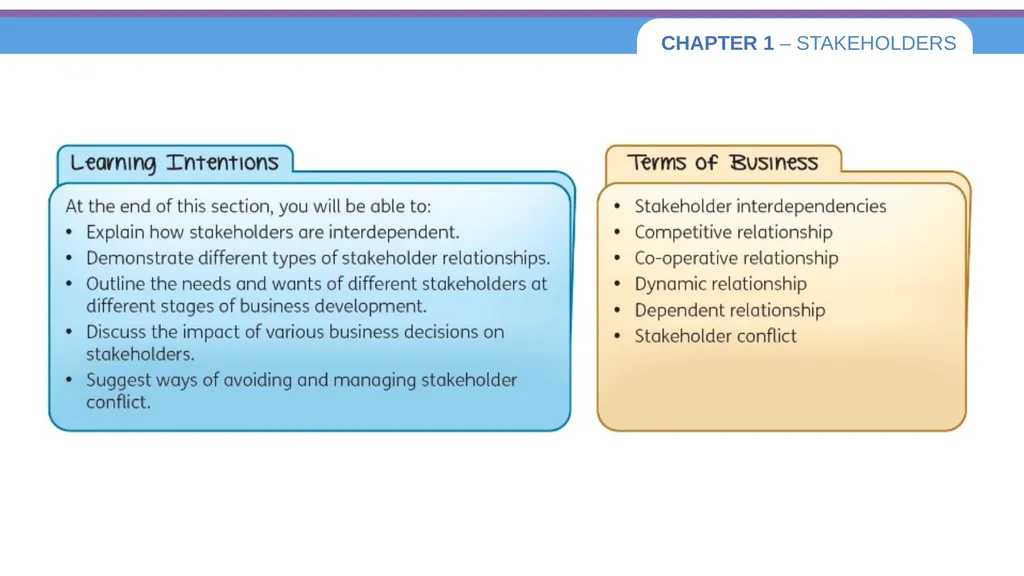
01
Chapter 1 – Stakeholders<br>
02
1.1 Introduction to Stakeholders<br>
03
Who Are Stakeholders? A stakeholder is an individual or a group that has an interest in an organisation and can either affect or be affected by that organisation.
Every organisation, irrespective of its size, nature, structure and purpose, has stakeholders.
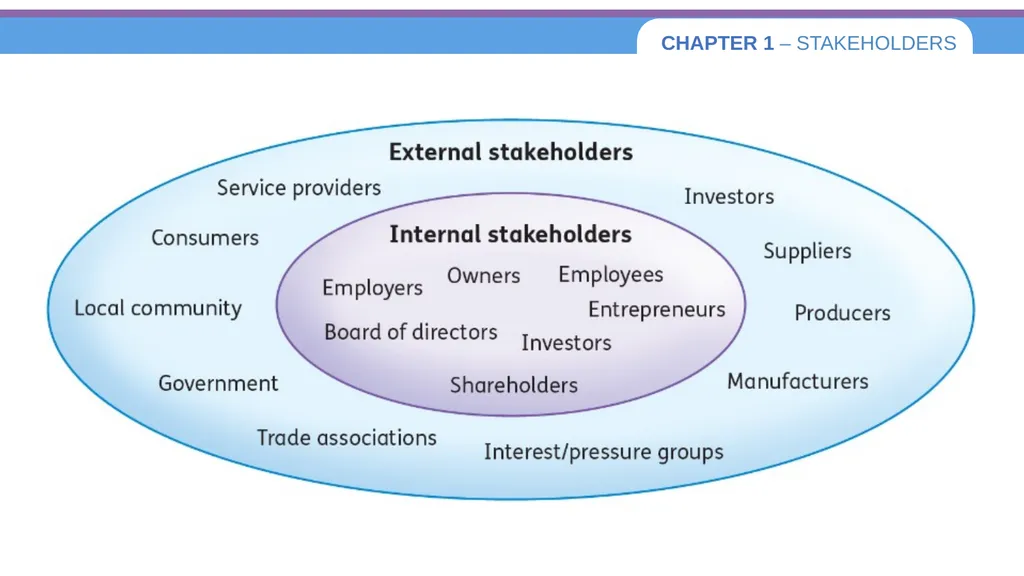
Stakeholders can be either internal or external.
Internal stakeholders: individuals and parties within the organisation.
External stakeholders: do not work within a business, but are affected by its activities.<br>
Every organisation, irrespective of its size, nature, structure and purpose, has stakeholders.
Stakeholders can be either internal or external.
Internal stakeholders: individuals and parties within the organisation.
External stakeholders: do not work within a business, but are affected by its activities.<br>
04
Who Are Stakeholders? All decisions made by a business will impact on one or more of its stakeholders. Ignoring this impact may result in negative consequences for the organisation.
For example, employees may be unhappy about a change in work practices that are being considered to reduce costs in a business. In that case, it may be detrimental to enforce these changes without considering staff views if it will result in:
a demotivated workforce, which affects production levels and quality of work
high staff turnover.<br>
For example, employees may be unhappy about a change in work practices that are being considered to reduce costs in a business. In that case, it may be detrimental to enforce these changes without considering staff views if it will result in:
a demotivated workforce, which affects production levels and quality of work
high staff turnover.<br>
05
Key Stakeholders in Business Entrepreneurs use their initiative to spot a gap in the market and take the personal and financial risk of setting up a business with the aim of making a profit.
Owners are individuals or entities that hold legal ownership of a business.
Owners can be entrepreneurs or shareholders, depending on the organisation.
Employers hire employees to complete work in return for a wage or salary.
When entrepreneurs recruit employees to work in the business, they become employers.<br>
Owners are individuals or entities that hold legal ownership of a business.
Owners can be entrepreneurs or shareholders, depending on the organisation.
Employers hire employees to complete work in return for a wage or salary.
When entrepreneurs recruit employees to work in the business, they become employers.<br>
06
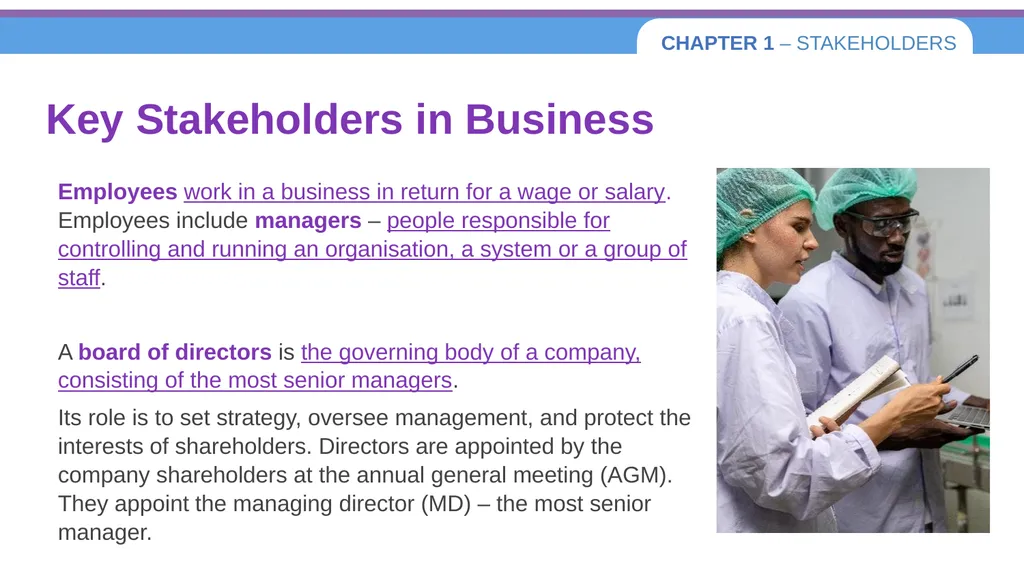
Key Stakeholders in Business Employees work in a business in return for a wage or salary. Employees include managers – people responsible for controlling and running an organisation, a system or a group of staff.
A board of directors is the governing body of a company, consisting of the most senior managers.
Its role is to set strategy, oversee management, and protect the interests of shareholders. Directors are appointed by the company shareholders at the annual general meeting (AGM). They appoint the managing director (MD) – the most senior manager.<br>
A board of directors is the governing body of a company, consisting of the most senior managers.
Its role is to set strategy, oversee management, and protect the interests of shareholders. Directors are appointed by the company shareholders at the annual general meeting (AGM). They appoint the managing director (MD) – the most senior manager.<br>
07
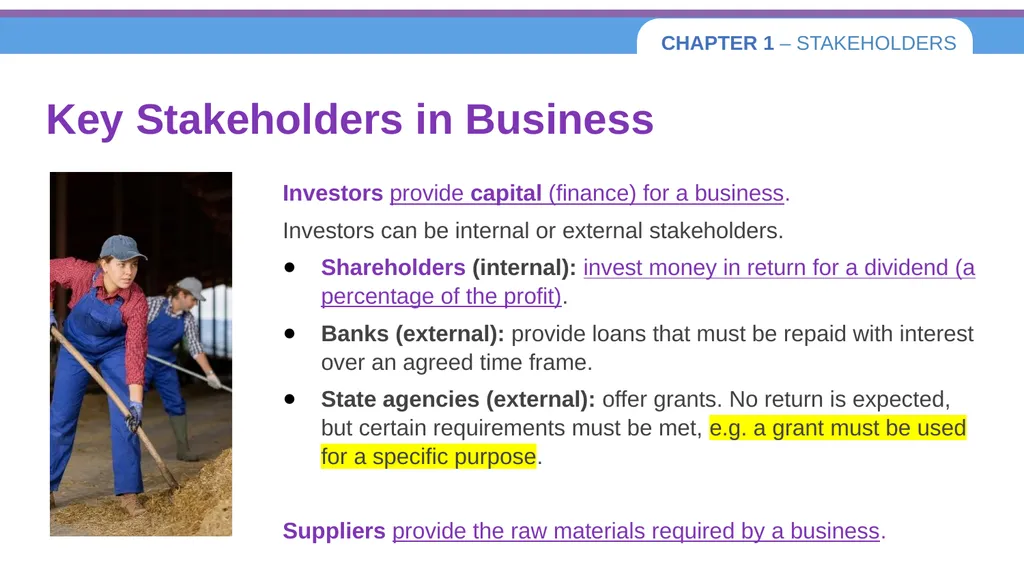
Key Stakeholders in Business Investors provide capital (finance) for a business.
Investors can be internal or external stakeholders.
Shareholders (internal): invest money in return for a dividend (a percentage of the profit).
Banks (external): provide loans that must be repaid with interest over an agreed time frame.
State agencies (external): offer grants. No return is expected, but certain requirements must be met, e.g. a grant must be used for a specific purpose.
Suppliers provide the raw materials required by a business.<br>
Investors can be internal or external stakeholders.
Shareholders (internal): invest money in return for a dividend (a percentage of the profit).
Banks (external): provide loans that must be repaid with interest over an agreed time frame.
State agencies (external): offer grants. No return is expected, but certain requirements must be met, e.g. a grant must be used for a specific purpose.
Suppliers provide the raw materials required by a business.<br>
08
Key Stakeholders in Business Producers/manufacturers turn raw materials into finished products to sell to consumers.
Service providers are businesses that supply services (banking, insurance, accountancy, etc.) required by the business.
Consumers are people who buy or use goods and services for personal use, rather than for business purposes.<br>
Service providers are businesses that supply services (banking, insurance, accountancy, etc.) required by the business.
Consumers are people who buy or use goods and services for personal use, rather than for business purposes.<br>
09
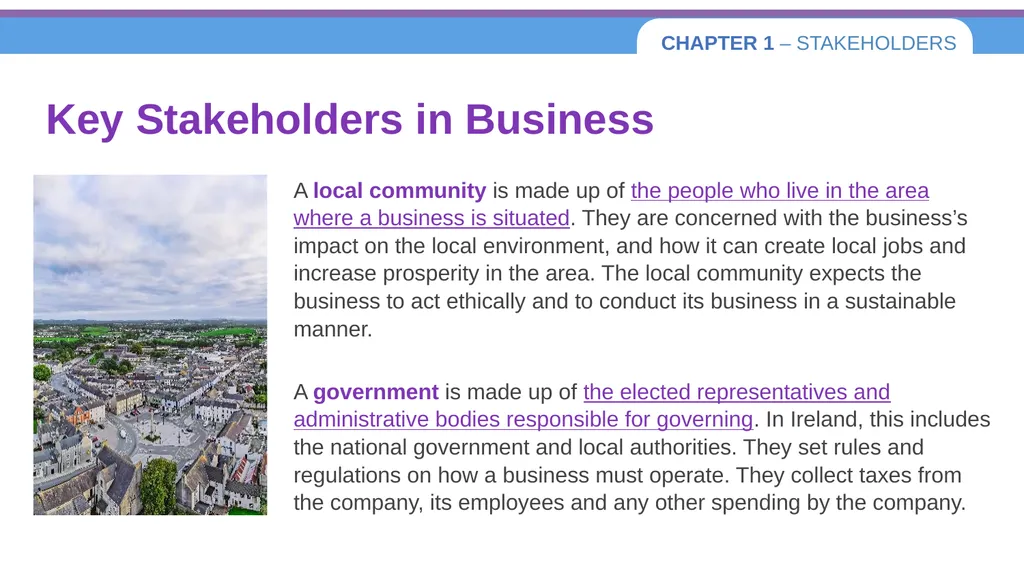
Key Stakeholders in Business A local community is made up of the people who live in the area where a business is situated. They are concerned with the business’s impact on the local environment, and how it can create local jobs and increase prosperity in the area. The local community expects the business to act ethically and to conduct its business in a sustainable manner.
A government is made up of the elected representatives and administrative bodies responsible for governing. In Ireland, this includes the national government and local authorities. They set rules and regulations on how a business must operate. They collect taxes from the company, its employees and any other spending by the company.<br>
A government is made up of the elected representatives and administrative bodies responsible for governing. In Ireland, this includes the national government and local authorities. They set rules and regulations on how a business must operate. They collect taxes from the company, its employees and any other spending by the company.<br>
10
Key Stakeholders in Business Trade associations represent businesses involved in similar types of activities.
Interest/pressure groups are organisations that represent people with a common interest.
Lobbying is the practice of influencing government decisions by communicating with decision makers or gaining media attention for a certain viewpoint.<br>
Interest/pressure groups are organisations that represent people with a common interest.
Lobbying is the practice of influencing government decisions by communicating with decision makers or gaining media attention for a certain viewpoint.<br>
11
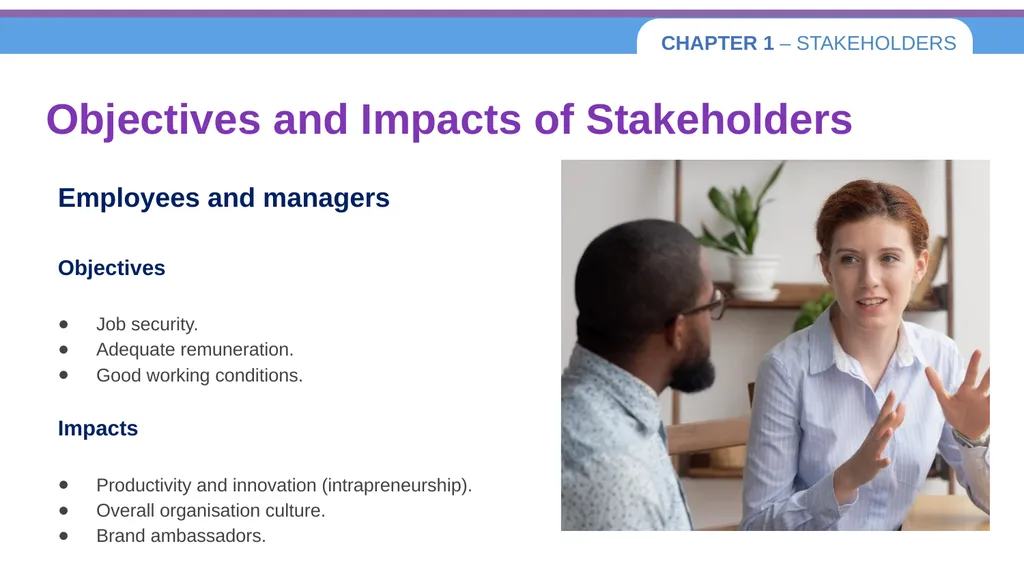
Objectives and Impacts of Stakeholders Employees and managers
Objectives
Job security.
Adequate remuneration.
Good working conditions.
Impacts
Productivity and innovation (intrapreneurship).
Overall organisation culture.
Brand ambassadors.<br>
Objectives
Job security.
Adequate remuneration.
Good working conditions.
Impacts
Productivity and innovation (intrapreneurship).
Overall organisation culture.
Brand ambassadors.<br>
12
Objectives and Impacts of Stakeholders Suppliers, producers, manufacturers and service providers
Objectives
Fair procurement processes and negotiations.
To be paid in full within credit terms.
For all contracts to be honoured.
Long-term partnership and loyalty.
Impacts
Steady supply of raw materials or services essential for production.
Product quality, cost and delivery timelines.
Strong supplier relationships.<br>
Objectives
Fair procurement processes and negotiations.
To be paid in full within credit terms.
For all contracts to be honoured.
Long-term partnership and loyalty.
Impacts
Steady supply of raw materials or services essential for production.
Product quality, cost and delivery timelines.
Strong supplier relationships.<br>
13
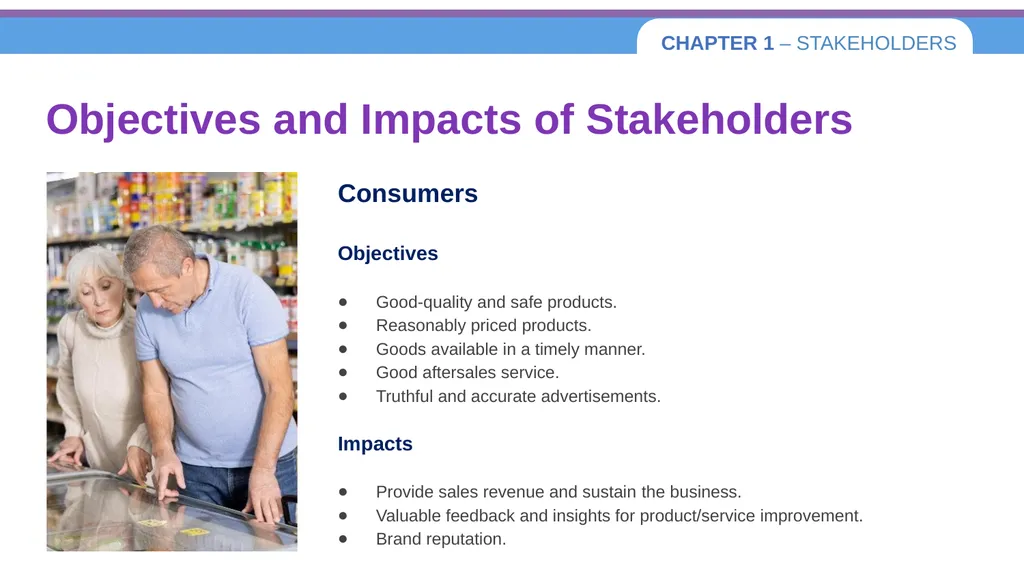
Objectives and Impacts of Stakeholders Consumers
Objectives
Good-quality and safe products.
Reasonably priced products.
Goods available in a timely manner.
Good aftersales service.
Truthful and accurate advertisements.
Impacts
Provide sales revenue and sustain the business.
Valuable feedback and insights for product/service improvement.
Brand reputation.<br>
Objectives
Good-quality and safe products.
Reasonably priced products.
Goods available in a timely manner.
Good aftersales service.
Truthful and accurate advertisements.
Impacts
Provide sales revenue and sustain the business.
Valuable feedback and insights for product/service improvement.
Brand reputation.<br>
14
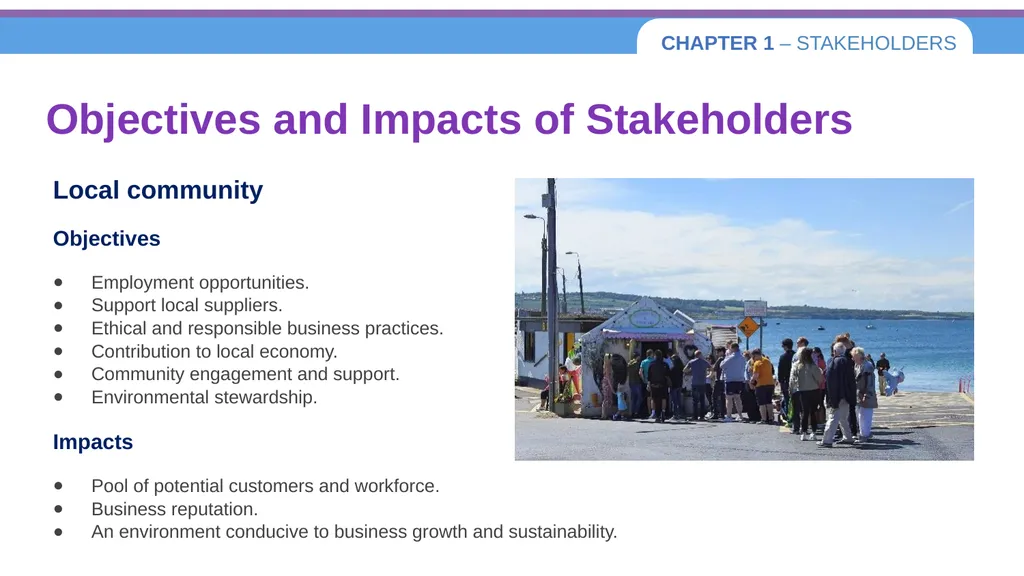
Objectives and Impacts of Stakeholders Local community
Objectives
Employment opportunities.
Support local suppliers.
Ethical and responsible business practices.
Contribution to local economy.
Community engagement and support.
Environmental stewardship.
Impacts
Pool of potential customers and workforce.
Business reputation.
An environment conducive to business growth and sustainability.<br>
Objectives
Employment opportunities.
Support local suppliers.
Ethical and responsible business practices.
Contribution to local economy.
Community engagement and support.
Environmental stewardship.
Impacts
Pool of potential customers and workforce.
Business reputation.
An environment conducive to business growth and sustainability.<br>
15
Objectives and Impacts of Stakeholders Government
Objectives
Direct and indirect employment.
Adhere to local, national and EU legislation.
Taxes to be paid on time and in full.
Co-operation with government offices.
Community engagement and support.
For grant conditions to be met.
Impacts
Regulations and laws that business must comply with.
Provide infrastructure and service that support business operations.
Economic conditions, trade policies and market stability.<br>
Objectives
Direct and indirect employment.
Adhere to local, national and EU legislation.
Taxes to be paid on time and in full.
Co-operation with government offices.
Community engagement and support.
For grant conditions to be met.
Impacts
Regulations and laws that business must comply with.
Provide infrastructure and service that support business operations.
Economic conditions, trade policies and market stability.<br>
16
Objectives and Impacts of Stakeholders Trade associations/Interest groups
Objectives
Influence decisions/policies in favour of its members.
Impacts
Lobbying, negotiations, legal action or boycotting.<br>
Objectives
Influence decisions/policies in favour of its members.
Impacts
Lobbying, negotiations, legal action or boycotting.<br>
17
1.2 Stakeholder Interdependencies
and Relationships<br>
18
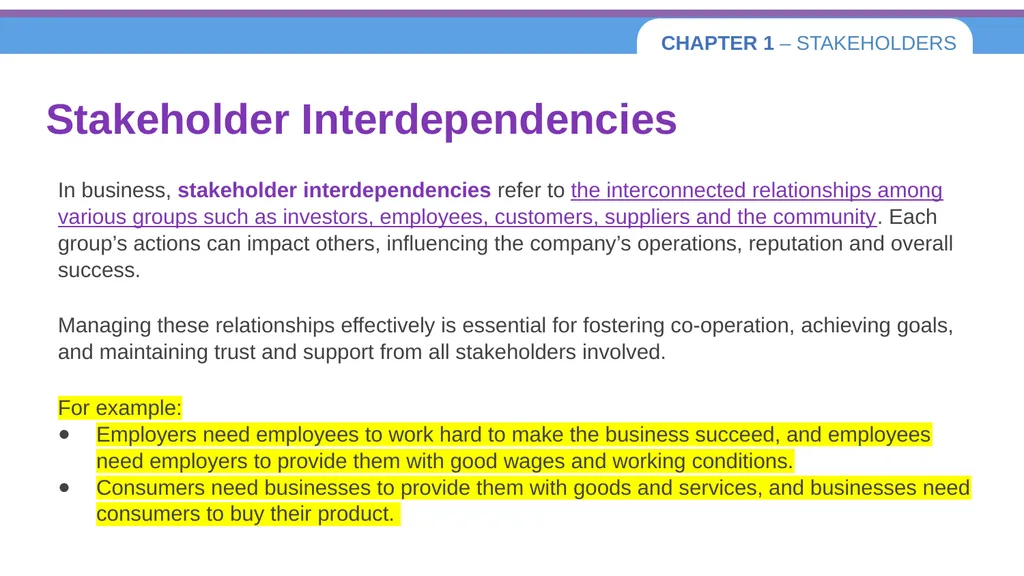
Stakeholder Interdependencies In business, stakeholder interdependencies refer to the interconnected relationships among various groups such as investors, employees, customers, suppliers and the community. Each group’s actions can impact others, influencing the company’s operations, reputation and overall success.
Managing these relationships effectively is essential for fostering co-operation, achieving goals, and maintaining trust and support from all stakeholders involved.
For example:
Employers need employees to work hard to make the business succeed, and employees need employers to provide them with good wages and working conditions.
Consumers need businesses to provide them with goods and services, and businesses need consumers to buy their product.<br>
Managing these relationships effectively is essential for fostering co-operation, achieving goals, and maintaining trust and support from all stakeholders involved.
For example:
Employers need employees to work hard to make the business succeed, and employees need employers to provide them with good wages and working conditions.
Consumers need businesses to provide them with goods and services, and businesses need consumers to buy their product.<br>
19
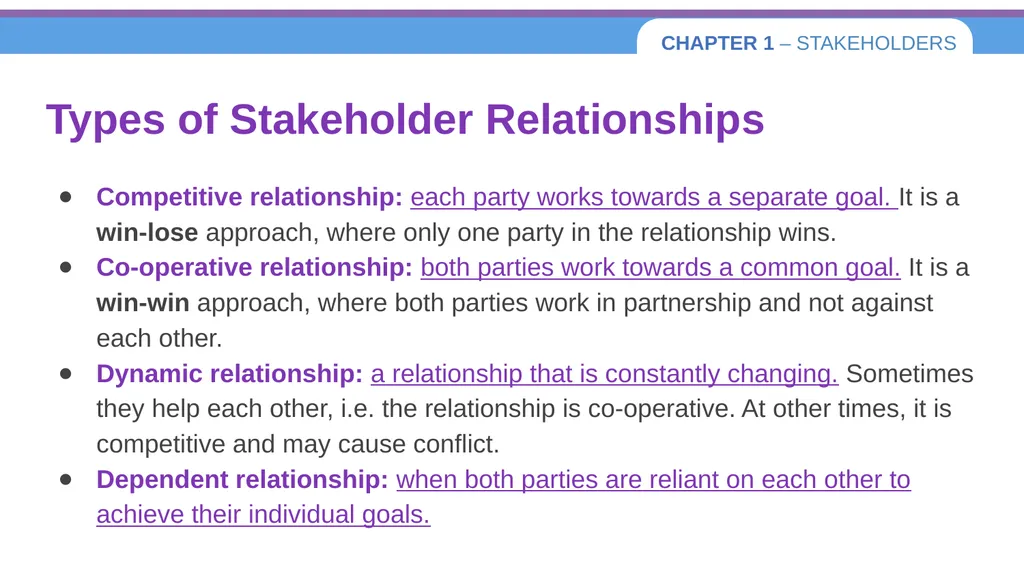
Types of Stakeholder Relationships Competitive relationship: each party works towards a separate goal. It is a win-lose approach, where only one party in the relationship wins.
Co-operative relationship: both parties work towards a common goal. It is a win-win approach, where both parties work in partnership and not against each other.
Dynamic relationship: a relationship that is constantly changing. Sometimes they help each other, i.e. the relationship is co-operative. At other times, it is competitive and may cause conflict.
Dependent relationship: when both parties are reliant on each other to achieve their individual goals.<br>
Co-operative relationship: both parties work towards a common goal. It is a win-win approach, where both parties work in partnership and not against each other.
Dynamic relationship: a relationship that is constantly changing. Sometimes they help each other, i.e. the relationship is co-operative. At other times, it is competitive and may cause conflict.
Dependent relationship: when both parties are reliant on each other to achieve their individual goals.<br>
20
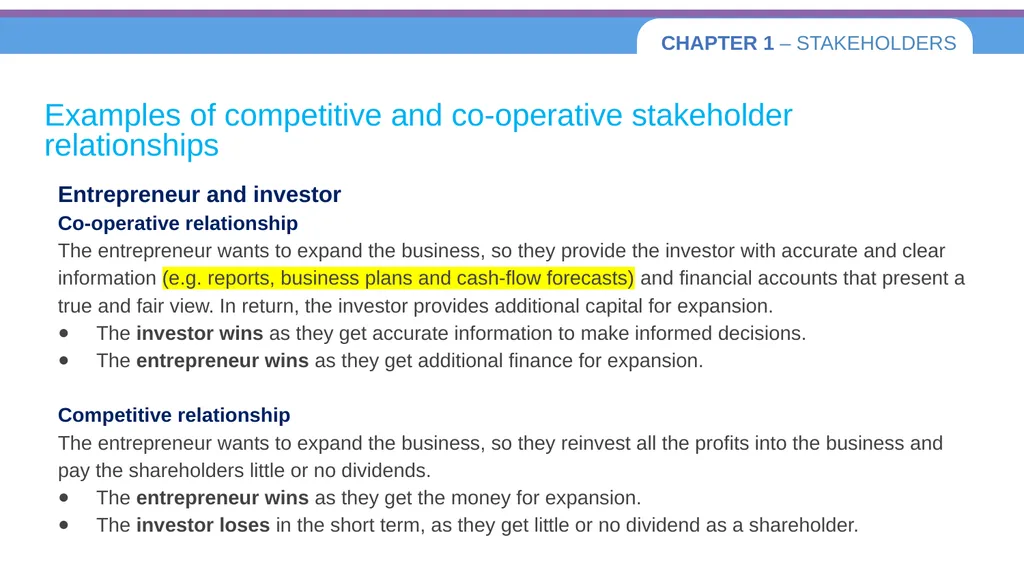
Examples of competitive and co-operative stakeholder relationships Entrepreneur and investor
Co-operative relationship
The entrepreneur wants to expand the business, so they provide the investor with accurate and clear information (e.g. reports, business plans and cash-flow forecasts) and financial accounts that present a true and fair view. In return, the investor provides additional capital for expansion.
The investor wins as they get accurate information to make informed decisions.
The entrepreneur wins as they get additional finance for expansion.
Competitive relationship
The entrepreneur wants to expand the business, so they reinvest all the profits into the business and pay the shareholders little or no dividends.
The entrepreneur wins as they get the money for expansion.
The investor loses in the short term, as they get little or no dividend as a shareholder.<br>
Co-operative relationship
The entrepreneur wants to expand the business, so they provide the investor with accurate and clear information (e.g. reports, business plans and cash-flow forecasts) and financial accounts that present a true and fair view. In return, the investor provides additional capital for expansion.
The investor wins as they get accurate information to make informed decisions.
The entrepreneur wins as they get additional finance for expansion.
Competitive relationship
The entrepreneur wants to expand the business, so they reinvest all the profits into the business and pay the shareholders little or no dividends.
The entrepreneur wins as they get the money for expansion.
The investor loses in the short term, as they get little or no dividend as a shareholder.<br>
21
Examples of competitive and co-operative stakeholder relationships Consumer and producer
Co-operative relationship
The consumer provides detailed feedback as part of the producer’s market research queries.
The producer wins as they get good-quality information on their target market.
The consumer wins as the products are developed based on their needs and wants.
Competitive relationship
The producer changes the raw materials used in order to save money. This results in an inferior product.
The producer wins (in the short term) as they reduce the cost and increase profit margin.
The consumer loses as they receive a product of inferior quality.
However, the producer could lose in the long term if the unhappy consumer decides to buy from a competitor.<br>
Co-operative relationship
The consumer provides detailed feedback as part of the producer’s market research queries.
The producer wins as they get good-quality information on their target market.
The consumer wins as the products are developed based on their needs and wants.
Competitive relationship
The producer changes the raw materials used in order to save money. This results in an inferior product.
The producer wins (in the short term) as they reduce the cost and increase profit margin.
The consumer loses as they receive a product of inferior quality.
However, the producer could lose in the long term if the unhappy consumer decides to buy from a competitor.<br>
22
Examples of competitive and co-operative stakeholder relationships Employer and employees
Co-operative relationship
The employer offers flexitime to the employees.
The employees win as they have an improved work-life balance.
The employer wins as employees have good morale and are more productive.
Competitive relationship
The business wants to increase production, but employees engage in an official strike to protest pay.
The employees win when they get a pay rise.
The employer loses due to negative publicity and loss of sales.<br>
Co-operative relationship
The employer offers flexitime to the employees.
The employees win as they have an improved work-life balance.
The employer wins as employees have good morale and are more productive.
Competitive relationship
The business wants to increase production, but employees engage in an official strike to protest pay.
The employees win when they get a pay rise.
The employer loses due to negative publicity and loss of sales.<br>
23
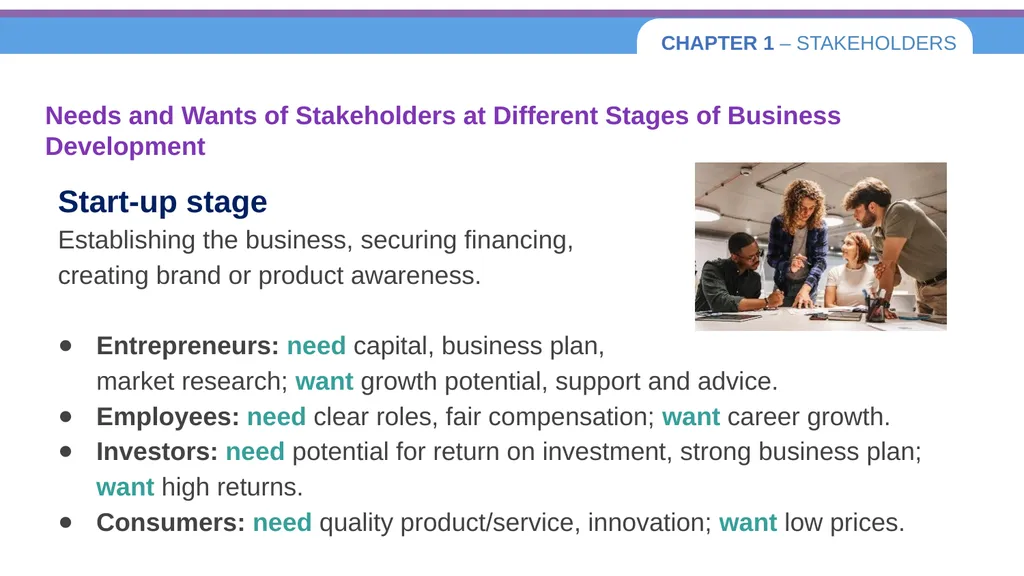
Needs and Wants of Stakeholders at Different Stages of Business Development Start-up stage
Establishing the business, securing financing,
creating brand or product awareness.
Entrepreneurs: need capital, business plan, market research; want growth potential, support and advice.
Employees: need clear roles, fair compensation; want career growth.
Investors: need potential for return on investment, strong business plan; want high returns.
Consumers: need quality product/service, innovation; want low prices.<br>
Establishing the business, securing financing,
creating brand or product awareness.
Entrepreneurs: need capital, business plan, market research; want growth potential, support and advice.
Employees: need clear roles, fair compensation; want career growth.
Investors: need potential for return on investment, strong business plan; want high returns.
Consumers: need quality product/service, innovation; want low prices.<br>
24
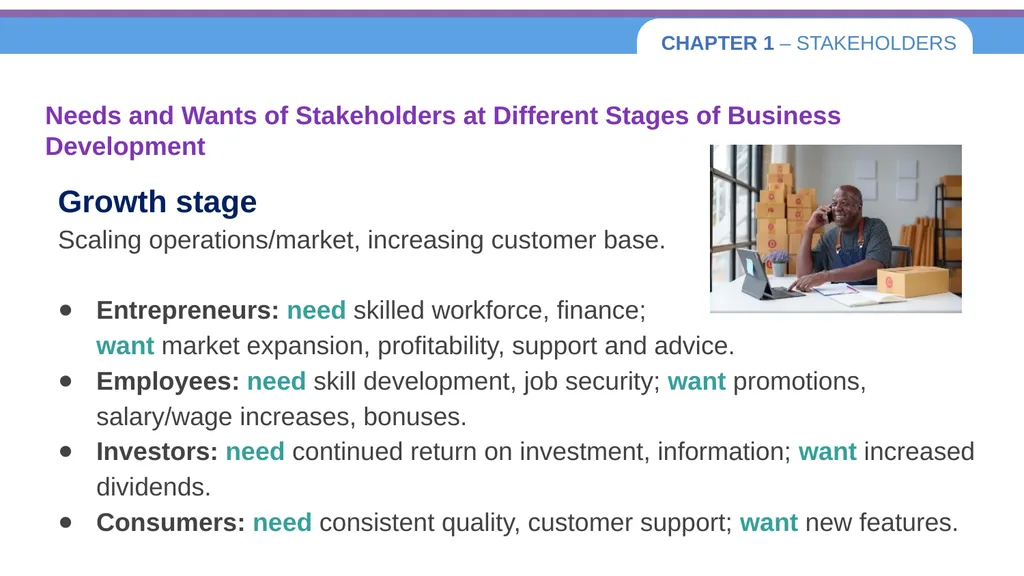
Needs and Wants of Stakeholders at Different Stages of Business Development Growth stage
Scaling operations/market, increasing customer base.
Entrepreneurs: need skilled workforce, finance; want market expansion, profitability, support and advice.
Employees: need skill development, job security; want promotions, salary/wage increases, bonuses.
Investors: need continued return on investment, information; want increased dividends.
Consumers: need consistent quality, customer support; want new features.<br>
Scaling operations/market, increasing customer base.
Entrepreneurs: need skilled workforce, finance; want market expansion, profitability, support and advice.
Employees: need skill development, job security; want promotions, salary/wage increases, bonuses.
Investors: need continued return on investment, information; want increased dividends.
Consumers: need consistent quality, customer support; want new features.<br>
25
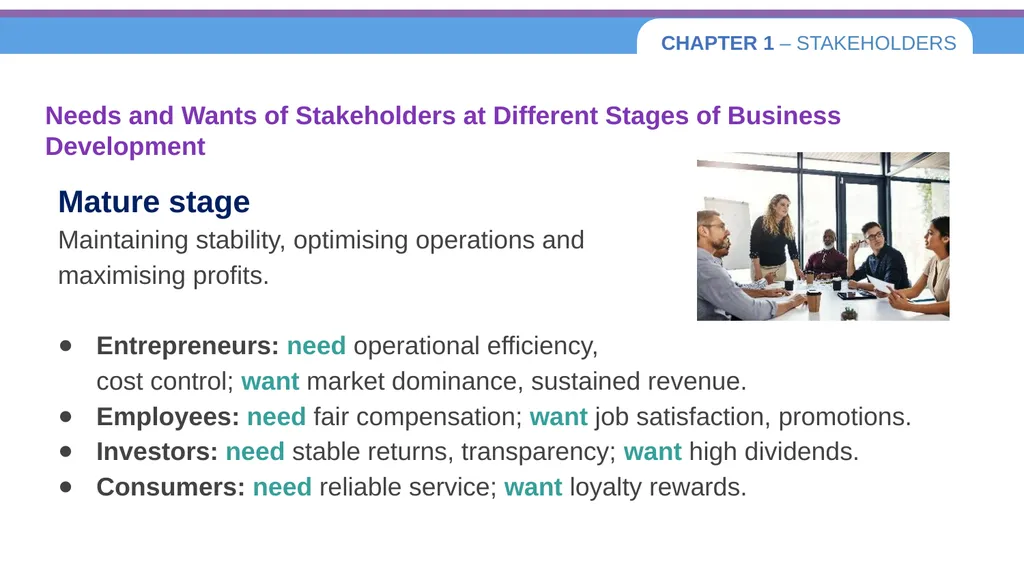
Needs and Wants of Stakeholders at Different Stages of Business Development Mature stage
Maintaining stability, optimising operations and maximising profits.
Entrepreneurs: need operational efficiency, cost control; want market dominance, sustained revenue.
Employees: need fair compensation; want job satisfaction, promotions.
Investors: need stable returns, transparency; want high dividends.
Consumers: need reliable service; want loyalty rewards.<br>
Maintaining stability, optimising operations and maximising profits.
Entrepreneurs: need operational efficiency, cost control; want market dominance, sustained revenue.
Employees: need fair compensation; want job satisfaction, promotions.
Investors: need stable returns, transparency; want high dividends.
Consumers: need reliable service; want loyalty rewards.<br>
26
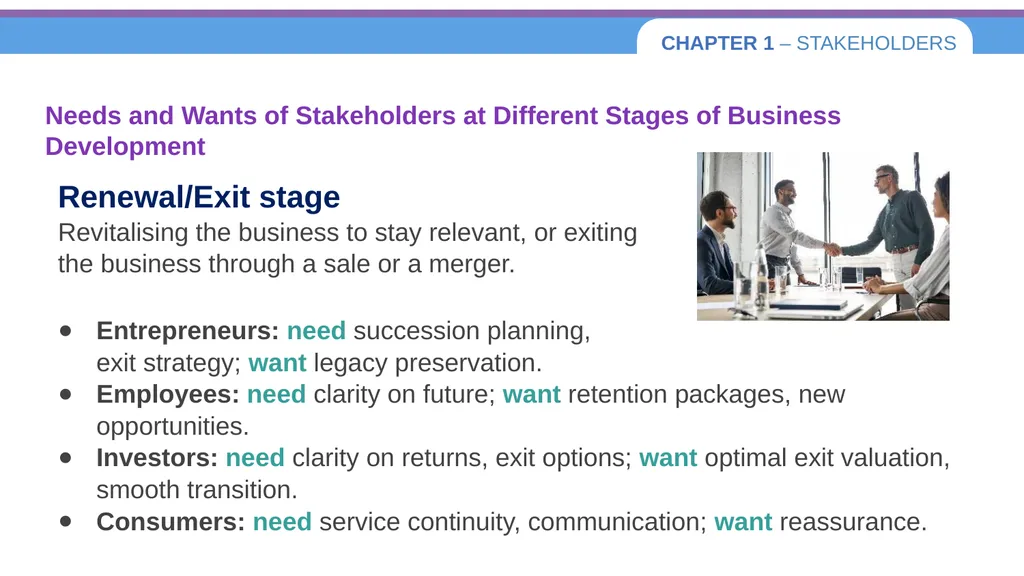
Needs and Wants of Stakeholders at Different Stages of Business Development Renewal/Exit stage
Revitalising the business to stay relevant, or exiting
the business through a sale or a merger.
Entrepreneurs: need succession planning, exit strategy; want legacy preservation.
Employees: need clarity on future; want retention packages, new opportunities.
Investors: need clarity on returns, exit options; want optimal exit valuation, smooth transition.
Consumers: need service continuity, communication; want reassurance.<br>
Revitalising the business to stay relevant, or exiting
the business through a sale or a merger.
Entrepreneurs: need succession planning, exit strategy; want legacy preservation.
Employees: need clarity on future; want retention packages, new opportunities.
Investors: need clarity on returns, exit options; want optimal exit valuation, smooth transition.
Consumers: need service continuity, communication; want reassurance.<br>
27
How Changing Objectives Affect Stakeholders Changing business objectives can have significant implications for stakeholders.
For example, it is essential for companies to consider the potential impacts and risks associated with expansion and to implement strategies to mitigate negative consequences. This may involve detailed planning, effective communication and a commitment to responsible business practices throughout the expansion process.<br>
For example, it is essential for companies to consider the potential impacts and risks associated with expansion and to implement strategies to mitigate negative consequences. This may involve detailed planning, effective communication and a commitment to responsible business practices throughout the expansion process.<br>
28
How Changing Objectives Affect Stakeholders The decision to expand operations can have positive and negative impacts on different stakeholders in a business.
Stakeholders
Increased sales revenue can lead to increased profits for the business.
Share value increases.
Potential for higher dividend payouts in the future.
Increased financial risks, as expansion costs money.<br>
Stakeholders
Increased sales revenue can lead to increased profits for the business.
Share value increases.
Potential for higher dividend payouts in the future.
Increased financial risks, as expansion costs money.<br>
29
How Changing Objectives Affect Stakeholders Employees
Career advancement opportunities.
Improved job security.
Increased opportunities for training.
If the expansion includes rationalisation, it could lead to:
redundancies
decreased staff morale
change in job roles.<br>
Career advancement opportunities.
Improved job security.
Increased opportunities for training.
If the expansion includes rationalisation, it could lead to:
redundancies
decreased staff morale
change in job roles.<br>
30
How Changing Objectives Affect Stakeholders Consumers
Increased availability of goods/services.
Increased product portfolio and choice.
Reduction in price due to the business benefitting from economies of scale.
Issues with quality control.
Local community
Improves the local economy due to job creation.
Environmental concerns of the expansion.<br>
Increased availability of goods/services.
Increased product portfolio and choice.
Reduction in price due to the business benefitting from economies of scale.
Issues with quality control.
Local community
Improves the local economy due to job creation.
Environmental concerns of the expansion.<br>
31
Stakeholder Conflict Stakeholder conflict refers to a situation in which the interests or goals of different stakeholders in an organisation conflict with one another.
For example, when a business moves production overseas, it may reduce wage bills, lower costs and increase profits, benefitting owners. However, this move may lead to conflicts with existing employees, as some may lose their jobs or have to relocate.<br>
For example, when a business moves production overseas, it may reduce wage bills, lower costs and increase profits, benefitting owners. However, this move may lead to conflicts with existing employees, as some may lose their jobs or have to relocate.<br>
32
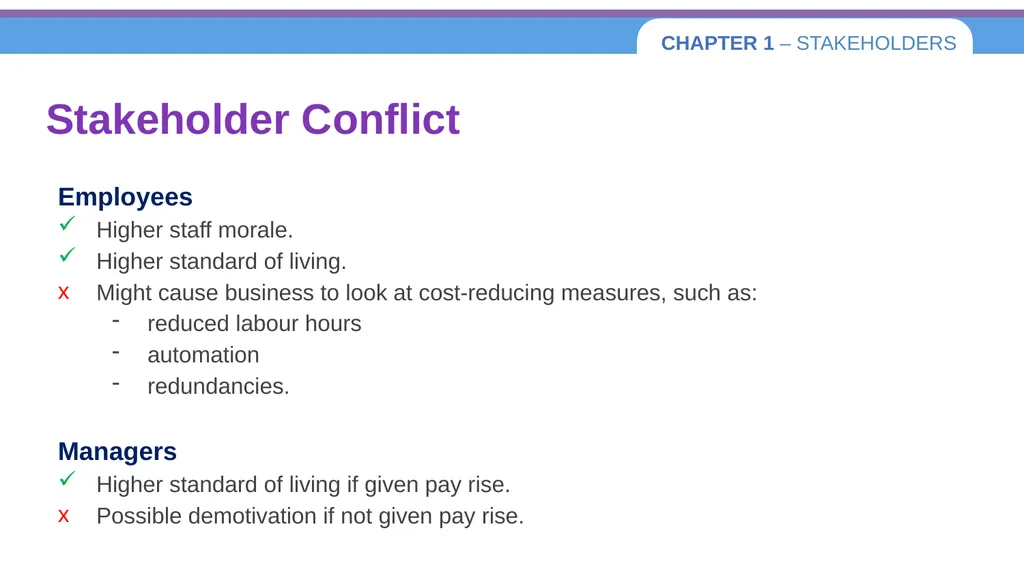
Stakeholder Conflict The decision to grant a 10% pay rise to employees will have different consequences on different stakeholders in a business.
Shareholders
Increased costs.
Reduced profits.
Possible reduction in dividends.<br>
Shareholders
Increased costs.
Reduced profits.
Possible reduction in dividends.<br>
33
Stakeholder Conflict Employees
Higher staff morale.
Higher standard of living.
Might cause business to look at cost-reducing measures, such as:
reduced labour hours
automation
redundancies.
Managers
Higher standard of living if given pay rise.
Possible demotivation if not given pay rise.<br>
Higher staff morale.
Higher standard of living.
Might cause business to look at cost-reducing measures, such as:
reduced labour hours
automation
redundancies.
Managers
Higher standard of living if given pay rise.
Possible demotivation if not given pay rise.<br>
34
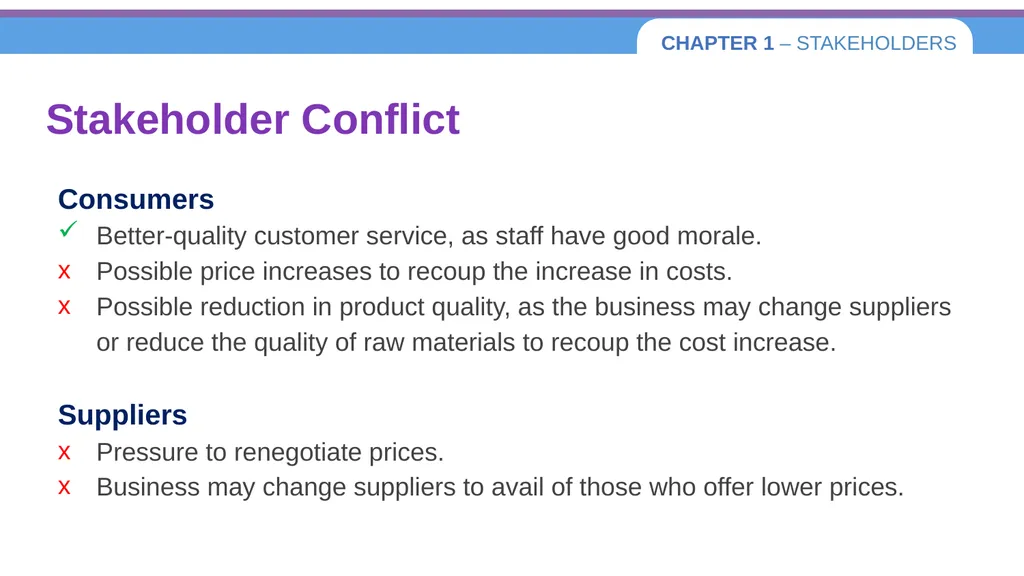
Stakeholder Conflict Consumers
Better-quality customer service, as staff have good morale.
Possible price increases to recoup the increase in costs.
Possible reduction in product quality, as the business may change suppliers or reduce the quality of raw materials to recoup the cost increase.
Suppliers
Pressure to renegotiate prices.
Business may change suppliers to avail of those who offer lower prices.<br>
Better-quality customer service, as staff have good morale.
Possible price increases to recoup the increase in costs.
Possible reduction in product quality, as the business may change suppliers or reduce the quality of raw materials to recoup the cost increase.
Suppliers
Pressure to renegotiate prices.
Business may change suppliers to avail of those who offer lower prices.<br>
35
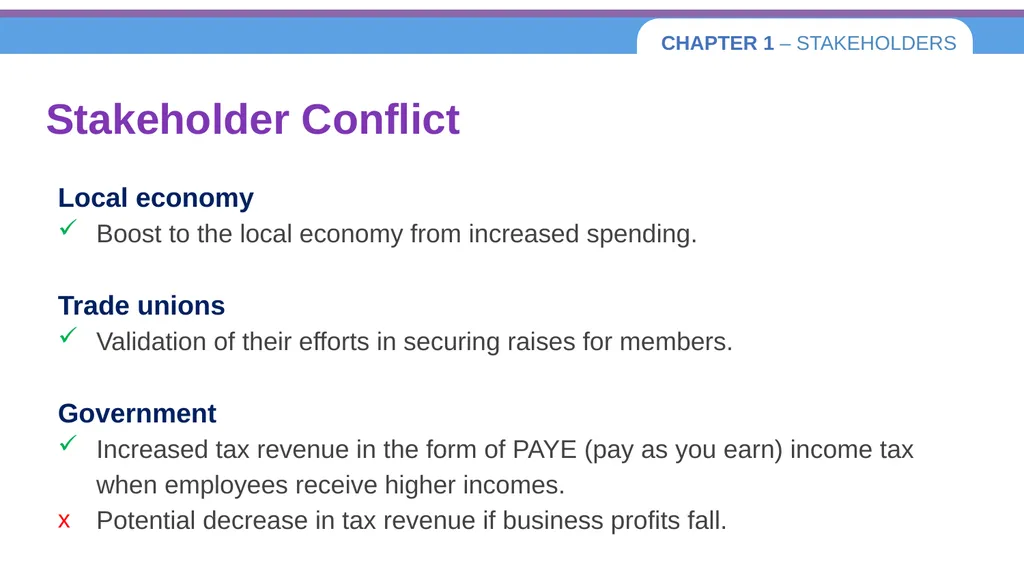
Stakeholder Conflict Local economy
Boost to the local economy from increased spending.
Trade unions
Validation of their efforts in securing raises for members.
Government
Increased tax revenue in the form of PAYE (pay as you earn) income tax when employees receive higher incomes.
Potential decrease in tax revenue if business profits fall.<br>
Boost to the local economy from increased spending.
Trade unions
Validation of their efforts in securing raises for members.
Government
Increased tax revenue in the form of PAYE (pay as you earn) income tax when employees receive higher incomes.
Potential decrease in tax revenue if business profits fall.<br>
36
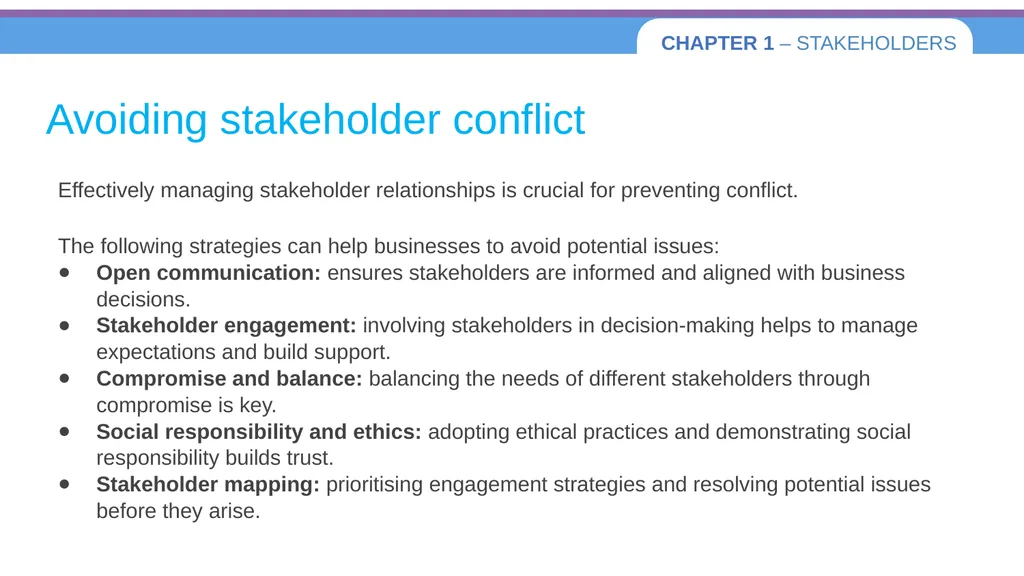
Avoiding stakeholder conflict Effectively managing stakeholder relationships is crucial for preventing conflict.
The following strategies can help businesses to avoid potential issues:
Open communication: ensures stakeholders are informed and aligned with business decisions.
Stakeholder engagement: involving stakeholders in decision-making helps to manage expectations and build support.
Compromise and balance: balancing the needs of different stakeholders through compromise is key.
Social responsibility and ethics: adopting ethical practices and demonstrating social responsibility builds trust.
Stakeholder mapping: prioritising engagement strategies and resolving potential issues before they arise.<br>
The following strategies can help businesses to avoid potential issues:
Open communication: ensures stakeholders are informed and aligned with business decisions.
Stakeholder engagement: involving stakeholders in decision-making helps to manage expectations and build support.
Compromise and balance: balancing the needs of different stakeholders through compromise is key.
Social responsibility and ethics: adopting ethical practices and demonstrating social responsibility builds trust.
Stakeholder mapping: prioritising engagement strategies and resolving potential issues before they arise.<br>
37
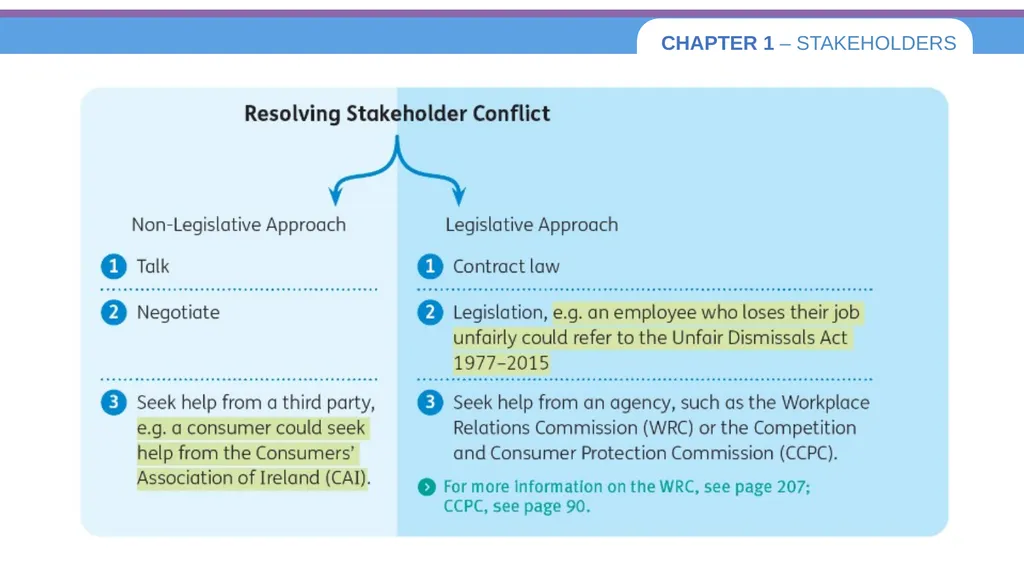
Resolving stakeholder conflict It is best to minimise conflict between stakeholders. When conflict does occur, it is important to manage it effectively to avoid negatively impacting the business’s reputation.
There are two approaches to resolving conflict.
Non-legislative approach: stakeholders try to solve the conflict by themselves or with the help of others, without the use of legislation or legal agencies.
Legislative approach: stakeholders use legislation or legal agencies to resolve the conflict.<br>
There are two approaches to resolving conflict.
Non-legislative approach: stakeholders try to solve the conflict by themselves or with the help of others, without the use of legislation or legal agencies.
Legislative approach: stakeholders use legislation or legal agencies to resolve the conflict.<br>
38
1.3 Contract Law<br>
39
Stakeholders use contracts to legally establish deals with each other.
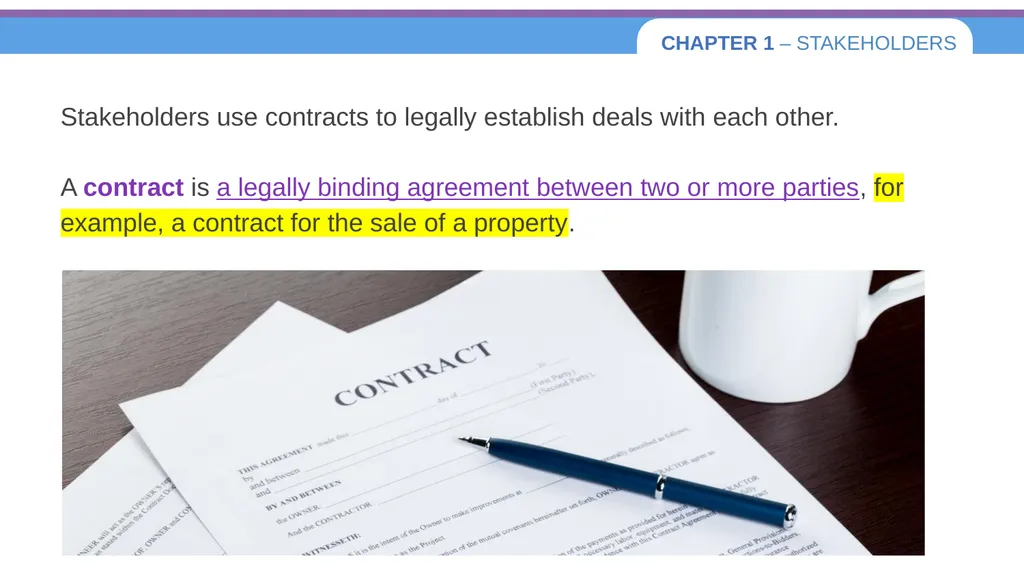
A contract is a legally binding agreement between two or more parties, for example, a contract for the sale of a property.<br>
A contract is a legally binding agreement between two or more parties, for example, a contract for the sale of a property.<br>
40
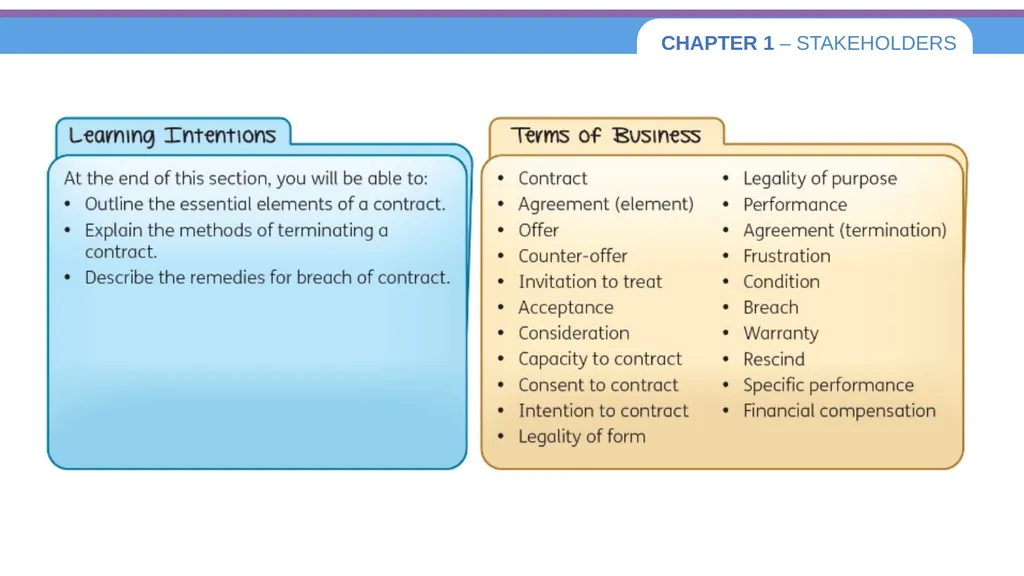
Elements of a Contract For a contract to be valid, all of the important elements must be fulfilled.
Agreement
Agreement (as an element of a contract) is when two or more parties agree to the terms of a contract.
There are two parts to agreement.
Offer
Acceptance<br>
Agreement
Agreement (as an element of a contract) is when two or more parties agree to the terms of a contract.
There are two parts to agreement.
Offer
Acceptance<br>
41
Elements of a Contract 1. Offer
An offer is a voluntary promise with conditions made by one party (offeror) to another (offeree).
An offer can be made verbally, in writing, or can be implied by conduct. An offer can be terminated by:
being revoked before the offeree has accepted
being rejected by the offeree
the death of one of the parties
not being accepted within a certain time frame.<br>
An offer is a voluntary promise with conditions made by one party (offeror) to another (offeree).
An offer can be made verbally, in writing, or can be implied by conduct. An offer can be terminated by:
being revoked before the offeree has accepted
being rejected by the offeree
the death of one of the parties
not being accepted within a certain time frame.<br>
42
Elements of a Contract A counter-offer is when someone responds to an initial offer with different terms. A counter-offer is considered an automatic rejection of the first offer.
When a retailer advertises a product or service for sale, the consumer is given an invitation to treat. This means the consumer is invited to make an offer to buy the product, and the offer can either be accepted or rejected. This is to protect the retailer if a price is incorrectly displayed or quoted.
2. Acceptance
Acceptance is when the offeree agrees to all the terms of the offer without any changes or conditions. Acceptance can be oral, written or implied by conduct.<br>
When a retailer advertises a product or service for sale, the consumer is given an invitation to treat. This means the consumer is invited to make an offer to buy the product, and the offer can either be accepted or rejected. This is to protect the retailer if a price is incorrectly displayed or quoted.
2. Acceptance
Acceptance is when the offeree agrees to all the terms of the offer without any changes or conditions. Acceptance can be oral, written or implied by conduct.<br>
43
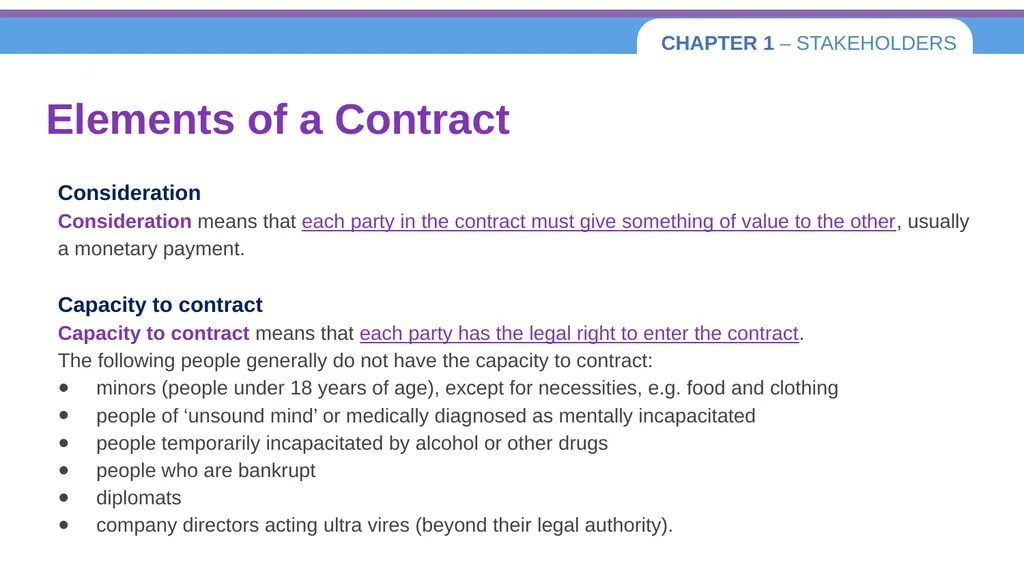
Elements of a Contract Consideration
Consideration means that each party in the contract must give something of value to the other, usually a monetary payment.
Capacity to contract
Capacity to contract means that each party has the legal right to enter the contract.
The following people generally do not have the capacity to contract:
minors (people under 18 years of age), except for necessities, e.g. food and clothing
people of ‘unsound mind’ or medically diagnosed as mentally incapacitated
people temporarily incapacitated by alcohol or other drugs
people who are bankrupt
diplomats
company directors acting ultra vires (beyond their legal authority).<br>
Consideration means that each party in the contract must give something of value to the other, usually a monetary payment.
Capacity to contract
Capacity to contract means that each party has the legal right to enter the contract.
The following people generally do not have the capacity to contract:
minors (people under 18 years of age), except for necessities, e.g. food and clothing
people of ‘unsound mind’ or medically diagnosed as mentally incapacitated
people temporarily incapacitated by alcohol or other drugs
people who are bankrupt
diplomats
company directors acting ultra vires (beyond their legal authority).<br>
44
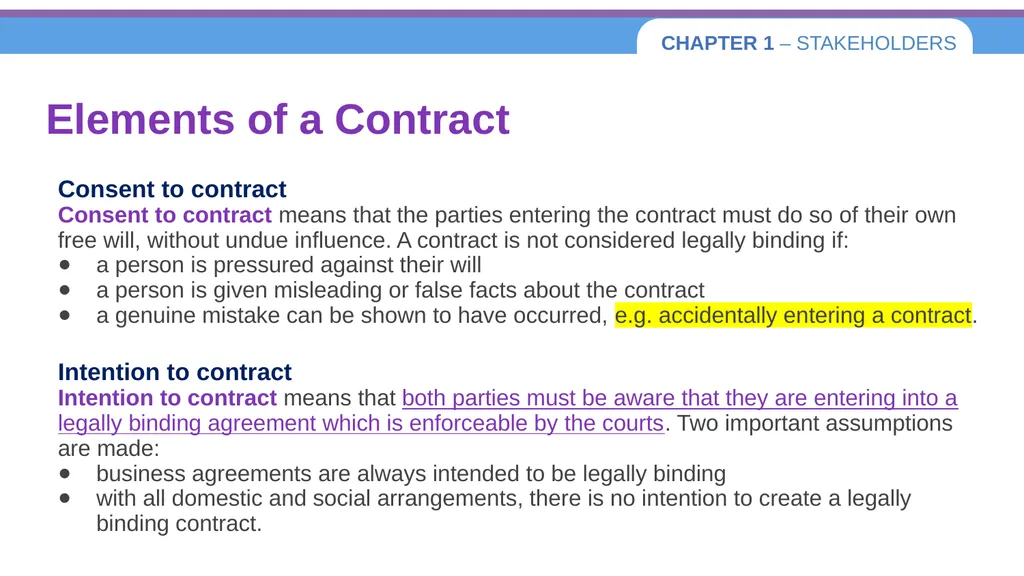
Elements of a Contract Consent to contract
Consent to contract means that the parties entering the contract must do so of their own free will, without undue influence. A contract is not considered legally binding if:
a person is pressured against their will
a person is given misleading or false facts about the contract
a genuine mistake can be shown to have occurred, e.g. accidentally entering a contract.
Intention to contract
Intention to contract means that both parties must be aware that they are entering into a legally binding agreement which is enforceable by the courts. Two important assumptions are made:
business agreements are always intended to be legally binding
with all domestic and social arrangements, there is no intention to create a legally binding contract.<br>
Consent to contract means that the parties entering the contract must do so of their own free will, without undue influence. A contract is not considered legally binding if:
a person is pressured against their will
a person is given misleading or false facts about the contract
a genuine mistake can be shown to have occurred, e.g. accidentally entering a contract.
Intention to contract
Intention to contract means that both parties must be aware that they are entering into a legally binding agreement which is enforceable by the courts. Two important assumptions are made:
business agreements are always intended to be legally binding
with all domestic and social arrangements, there is no intention to create a legally binding contract.<br>
45
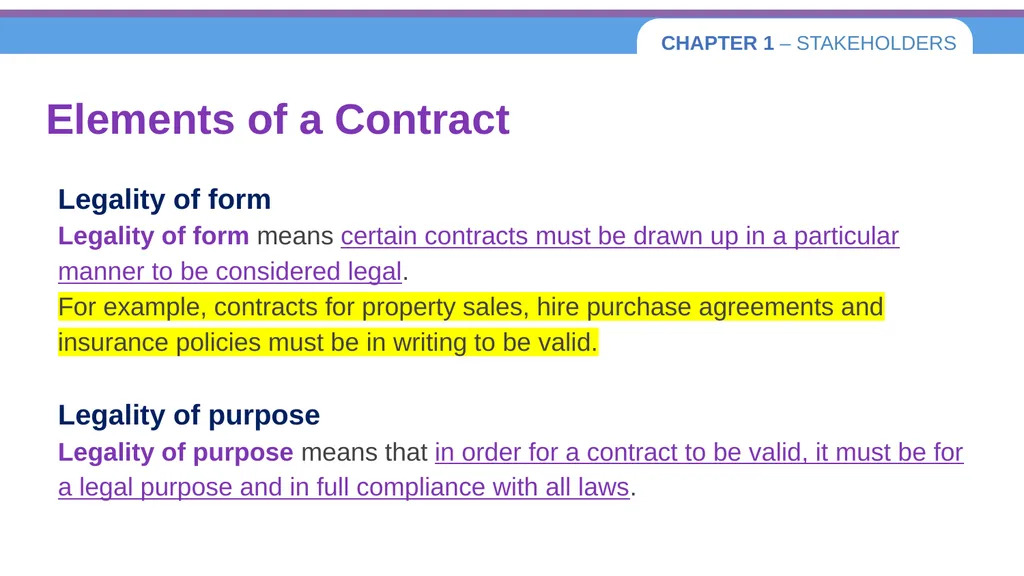
Elements of a Contract Legality of form
Legality of form means certain contracts must be drawn up in a particular manner to be considered legal.
For example, contracts for property sales, hire purchase agreements and insurance policies must be in writing to be valid.
Legality of purpose
Legality of purpose means that in order for a contract to be valid, it must be for a legal purpose and in full compliance with all laws.<br>
Legality of form means certain contracts must be drawn up in a particular manner to be considered legal.
For example, contracts for property sales, hire purchase agreements and insurance policies must be in writing to be valid.
Legality of purpose
Legality of purpose means that in order for a contract to be valid, it must be for a legal purpose and in full compliance with all laws.<br>
46
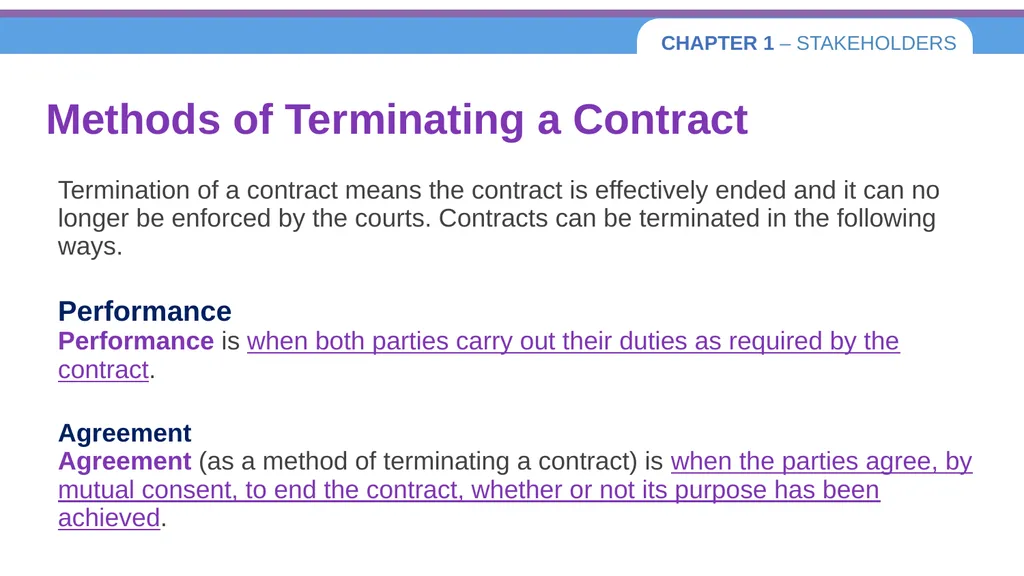
Methods of Terminating a Contract Termination of a contract means the contract is effectively ended and it can no longer be enforced by the courts. Contracts can be terminated in the following ways.
Performance
Performance is when both parties carry out their duties as required by the contract.
Agreement
Agreement (as a method of terminating a contract) is when the parties agree, by mutual consent, to end the contract, whether or not its purpose has been achieved.<br>
Performance
Performance is when both parties carry out their duties as required by the contract.
Agreement
Agreement (as a method of terminating a contract) is when the parties agree, by mutual consent, to end the contract, whether or not its purpose has been achieved.<br>
47
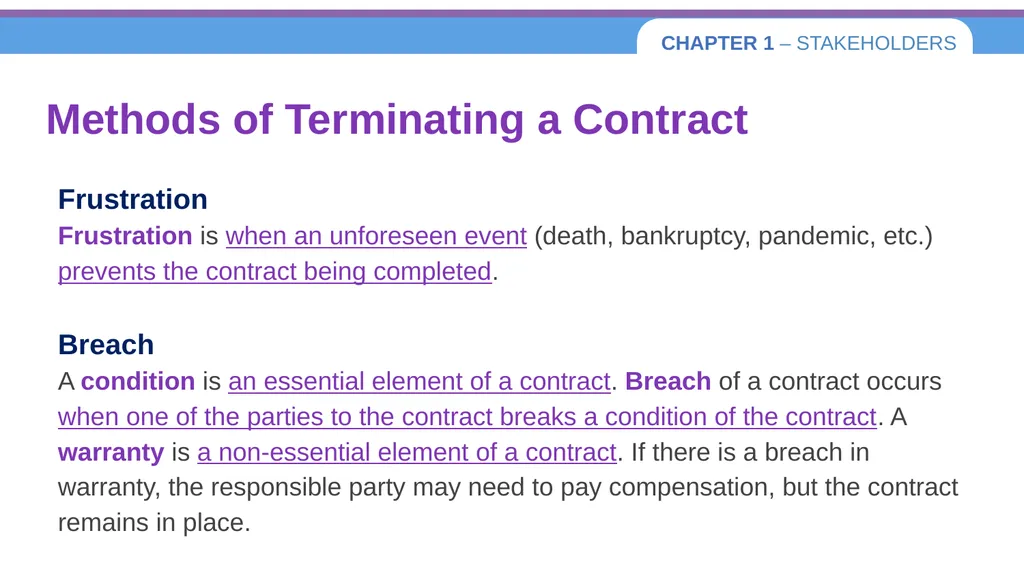
Methods of Terminating a Contract Frustration
Frustration is when an unforeseen event (death, bankruptcy, pandemic, etc.) prevents the contract being completed.
Breach
A condition is an essential element of a contract. Breach of a contract occurs when one of the parties to the contract breaks a condition of the contract. A warranty is a non-essential element of a contract. If there is a breach in warranty, the responsible party may need to pay compensation, but the contract remains in place.<br>
Frustration is when an unforeseen event (death, bankruptcy, pandemic, etc.) prevents the contract being completed.
Breach
A condition is an essential element of a contract. Breach of a contract occurs when one of the parties to the contract breaks a condition of the contract. A warranty is a non-essential element of a contract. If there is a breach in warranty, the responsible party may need to pay compensation, but the contract remains in place.<br>
48
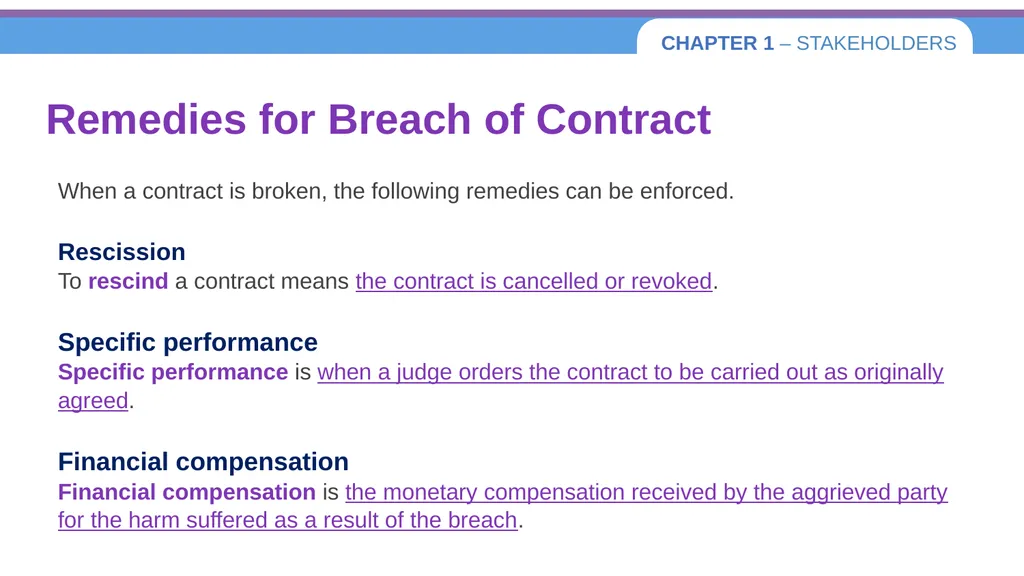
Remedies for Breach of Contract When a contract is broken, the following remedies can be enforced.
Rescission
To rescind a contract means the contract is cancelled or revoked.
Specific performance
Specific performance is when a judge orders the contract to be carried out as originally agreed.
Financial compensation
Financial compensation is the monetary compensation received by the aggrieved party for the harm suffered as a result of the breach.<br>
Rescission
To rescind a contract means the contract is cancelled or revoked.
Specific performance
Specific performance is when a judge orders the contract to be carried out as originally agreed.
Financial compensation
Financial compensation is the monetary compensation received by the aggrieved party for the harm suffered as a result of the breach.<br>
49
1.4 Stakeholder Mapping and Prioritisation<br>
50
What Is Stakeholder Mapping? Stakeholder mapping involves identifying important stakeholders, understanding their power and interest, and considering different viewpoints.
Power refers to a stakeholder’s ability to influence business decisions.
Interest indicates how much a stakeholder cares about a particular decision.<br>
Power refers to a stakeholder’s ability to influence business decisions.
Interest indicates how much a stakeholder cares about a particular decision.<br>
51
Benefits of Stakeholder Mapping Carrying out stakeholder mapping is important as it helps managers
to see:
which stakeholder group cares most about an issue
which group(s) have the greatest power to sway decisions or impact the outcome.
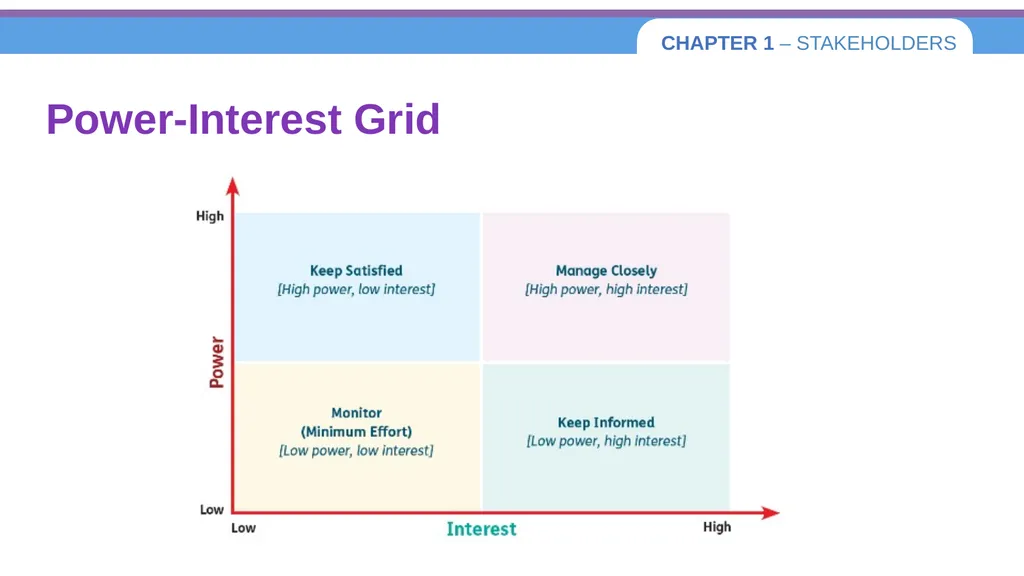
A power-interest grid is a form of stakeholder mapping that considers the stakeholder’s motivations and their ability to exert influence (either positive or negative).<br>
which stakeholder group cares most about an issue
which group(s) have the greatest power to sway decisions or impact the outcome.
A power-interest grid is a form of stakeholder mapping that considers the stakeholder’s motivations and their ability to exert influence (either positive or negative).<br>
52
Power-Interest Grid<br>
53
Conducting Stakeholder Mapping Using a
Power-Interest Grid Identify the internal and external stakeholders.
Determine the power and interest of each stakeholder.
Create the grid.
Plot stakeholders on the grid based on their power and interest.
Identify the stakeholders to prioritise based on the grid.
Develop stakeholder engagement strategies.
Regularly monitor and review the grid.<br>
Determine the power and interest of each stakeholder.
Create the grid.
Plot stakeholders on the grid based on their power and interest.
Identify the stakeholders to prioritise based on the grid.
Develop stakeholder engagement strategies.
Regularly monitor and review the grid.<br>
54
Conducting Stakeholder Mapping Using a
Power-Interest Grid Stakeholder engagement strategies
High power, low interest (satisfy)
These stakeholders need to be kept satisfied even though they aren’t interested because they hold high power.
Consult and engage with this group.
High power, high interest (prioritise)
Stakeholders to prioritise.
Involve in projects and key decisions.
Engage on a regular basis.
Work to maintain a co-operative relationship.<br>
High power, low interest (satisfy)
These stakeholders need to be kept satisfied even though they aren’t interested because they hold high power.
Consult and engage with this group.
High power, high interest (prioritise)
Stakeholders to prioritise.
Involve in projects and key decisions.
Engage on a regular basis.
Work to maintain a co-operative relationship.<br>
55
Conducting Stakeholder Mapping Using a
Power-Interest Grid Stakeholder engagement strategies
Low power, low interest (monitor)
Monitor, but do not bore with excessive communication.
Low power, high interest (inform)
Keep adequately informed.
Engage to ensure no major issues are arising.
Stakeholder engagement is the process by which an organisation involves stakeholders
(individuals and groups) and communicates with them.<br>
Low power, low interest (monitor)
Monitor, but do not bore with excessive communication.
Low power, high interest (inform)
Keep adequately informed.
Engage to ensure no major issues are arising.
Stakeholder engagement is the process by which an organisation involves stakeholders
(individuals and groups) and communicates with them.<br>
56
Importance of Prioritising Stakeholder Interests Ensures that stakeholders with the most interest are involved in the decisions of the business.
Identifies possible areas of conflict that might arise so appropriate actions can be taken in advance.
Provides the opportunity to negotiate with groups who might disagree with a strategy.
Communication strategies can be tailored for different stakeholder groups.
Improves strategic (long-term) planning.<br>
Identifies possible areas of conflict that might arise so appropriate actions can be taken in advance.
Provides the opportunity to negotiate with groups who might disagree with a strategy.
Communication strategies can be tailored for different stakeholder groups.
Improves strategic (long-term) planning.<br>
57
Limitations of Power-Interest Grids Subjective: establishing the power and interest levels of stakeholders can be open to interpretation.
Overly simplistic: classifies stakeholders into only four quadrants, based solely on power and interest.<br>
Overly simplistic: classifies stakeholders into only four quadrants, based solely on power and interest.<br>
58
1.5 Social Responsibility Towards Stakeholders<br>
59
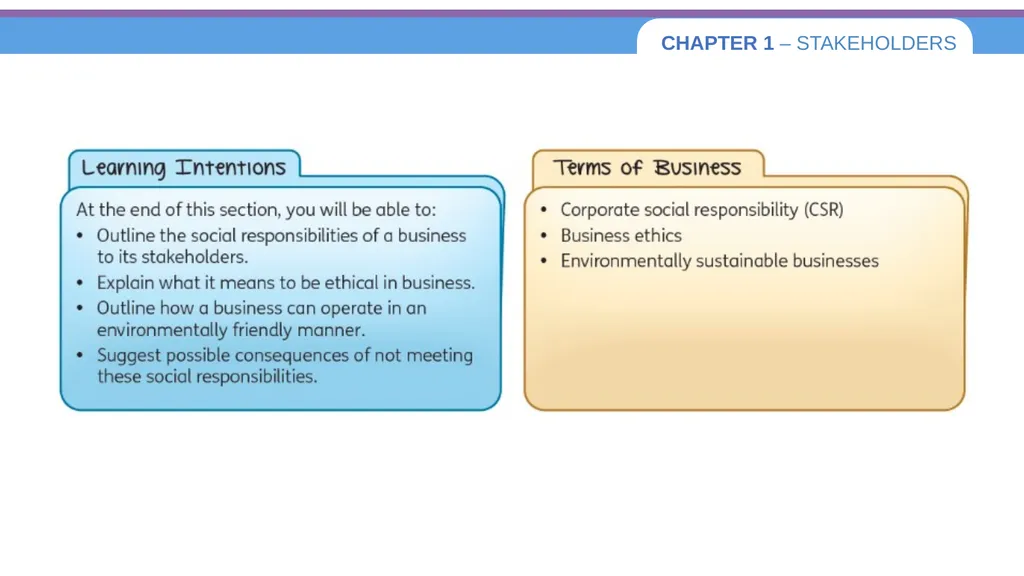
Corporate Social Responsibility (CSR) Corporate social responsibility (CSR) refers to how businesses interact with stakeholders in terms of social accountability. A business that is socially responsible looks at the overall behaviour of the organisation towards its stakeholders and seeks to exceed basic legal requirements by considering its impact on society.
CSR is traditionally broken into four categories:
ethical responsibility
environmental responsibility
philanthropic (giving to help others) responsibility
economic responsibility.
Many companies are also considering different forms of CSR, such as inclusion and diversity, governance, wellbeing and employee engagement.<br>
CSR is traditionally broken into four categories:
ethical responsibility
environmental responsibility
philanthropic (giving to help others) responsibility
economic responsibility.
Many companies are also considering different forms of CSR, such as inclusion and diversity, governance, wellbeing and employee engagement.<br>
60
Business ethics Business ethics are a set of principles, moral rules and standards that guide decision-making and how a business interacts with stakeholders. An ethical business is more concerned with right and wrong, honesty, fairness and respect than profit.<br>
61
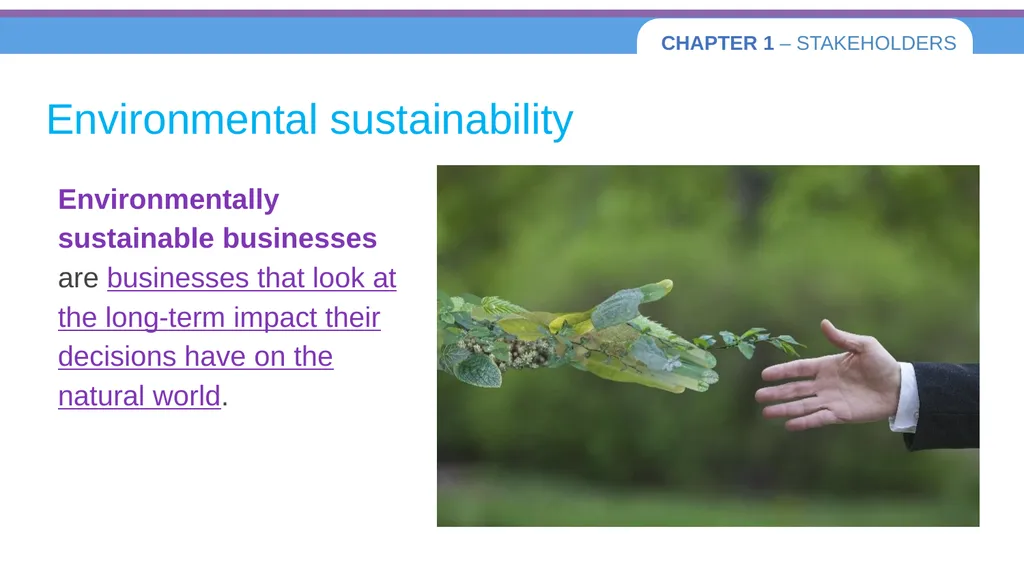
Environmental sustainability Environmentally sustainable businesses are businesses that look at the long-term impact their decisions have on the natural world.<br>
62
Environmental sustainability When a business acts in an environmentally friendly manner, it:
operates in a sustainable manner, and uses renewable resources where possible
works with environmentally responsible suppliers
sources materials locally to reduce its carbon footprint
limits unnecessary packaging and uses recyclable packaging when required
manages stock production to reduce waste
adopts the 4Rs (reduce, reuse, recycle and recover)
focuses on pollution prevention
engages in regular environmental audits.<br>
operates in a sustainable manner, and uses renewable resources where possible
works with environmentally responsible suppliers
sources materials locally to reduce its carbon footprint
limits unnecessary packaging and uses recyclable packaging when required
manages stock production to reduce waste
adopts the 4Rs (reduce, reuse, recycle and recover)
focuses on pollution prevention
engages in regular environmental audits.<br>
63
Benefits of CSR Increased consumer loyalty: consumers are more likely to supports businesses that meet their social responsibilities.
Access to new markets: sustainable and environmentally friendly businesses can access emerging markets (rapidly growing economies), as there is a growing consumer demand for sustainable and eco-friendly products.
Improved reputation: businesses with a strong commitment to their social responsibilities gain a positive reputation, attracting stakeholders who share their values.<br>
Access to new markets: sustainable and environmentally friendly businesses can access emerging markets (rapidly growing economies), as there is a growing consumer demand for sustainable and eco-friendly products.
Improved reputation: businesses with a strong commitment to their social responsibilities gain a positive reputation, attracting stakeholders who share their values.<br>
64
Consequences of Not Being Socially Responsible By not fulfilling social responsibility obligations, businesses risk a variety of negative consequences for stakeholders, including the following.
Legal and regulatory action
When it comes to employment legislation and environmental regulations, not being socially responsible could negatively impact employees and/or local community, and could lead to fines or lawsuits.<br>
Legal and regulatory action
When it comes to employment legislation and environmental regulations, not being socially responsible could negatively impact employees and/or local community, and could lead to fines or lawsuits.<br>
65
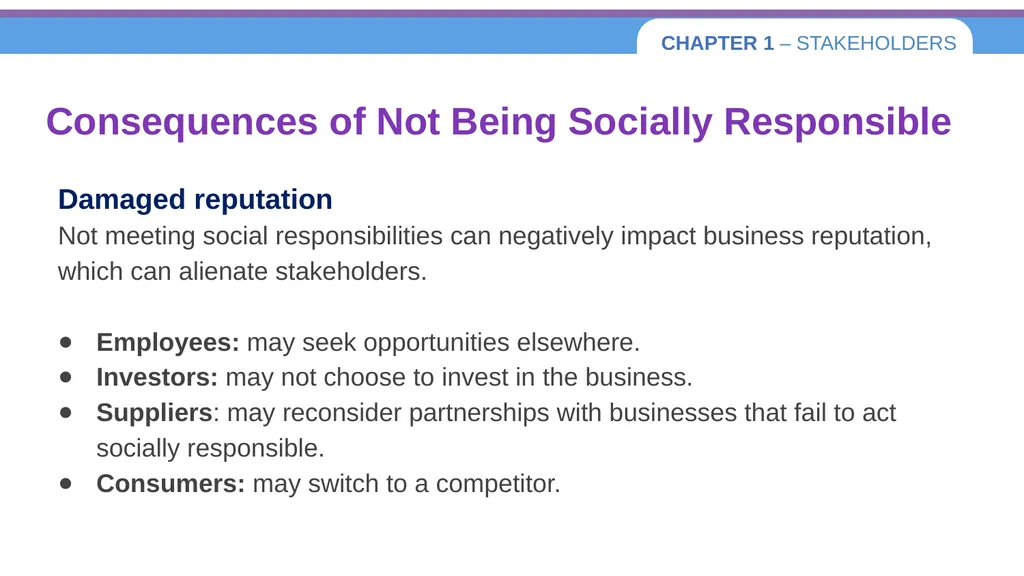
Consequences of Not Being Socially Responsible Damaged reputation
Not meeting social responsibilities can negatively impact business reputation, which can alienate stakeholders.
Employees: may seek opportunities elsewhere.
Investors: may not choose to invest in the business.
Suppliers: may reconsider partnerships with businesses that fail to act socially responsible.
Consumers: may switch to a competitor.<br>
Not meeting social responsibilities can negatively impact business reputation, which can alienate stakeholders.
Employees: may seek opportunities elsewhere.
Investors: may not choose to invest in the business.
Suppliers: may reconsider partnerships with businesses that fail to act socially responsible.
Consumers: may switch to a competitor.<br>
66
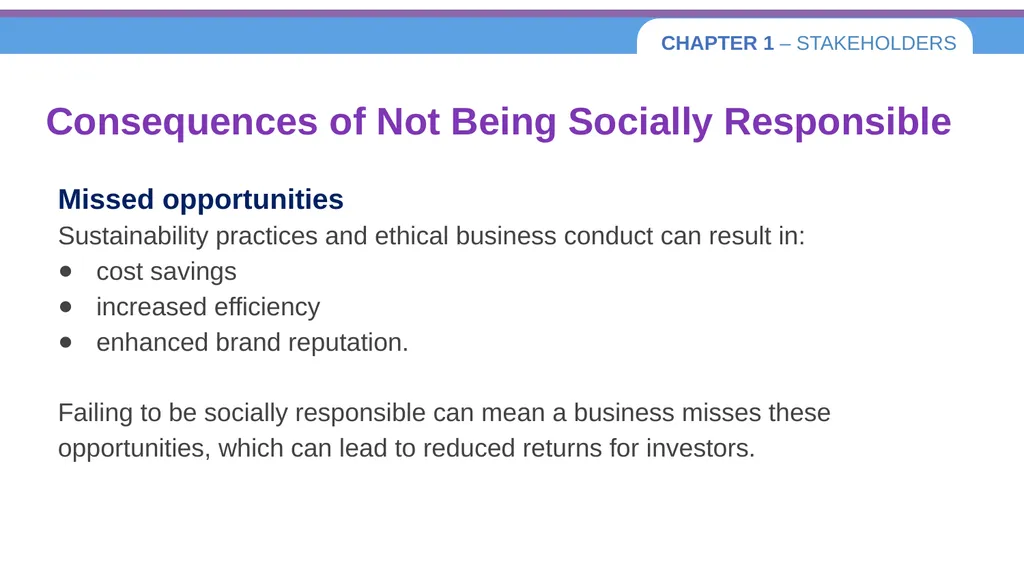
Consequences of Not Being Socially Responsible Missed opportunities
Sustainability practices and ethical business conduct can result in:
cost savings
increased efficiency
enhanced brand reputation.
Failing to be socially responsible can mean a business misses these opportunities, which can lead to reduced returns for investors.<br>
Sustainability practices and ethical business conduct can result in:
cost savings
increased efficiency
enhanced brand reputation.
Failing to be socially responsible can mean a business misses these opportunities, which can lead to reduced returns for investors.<br>