01
Chapter 1: Understanding Teams<br>
02
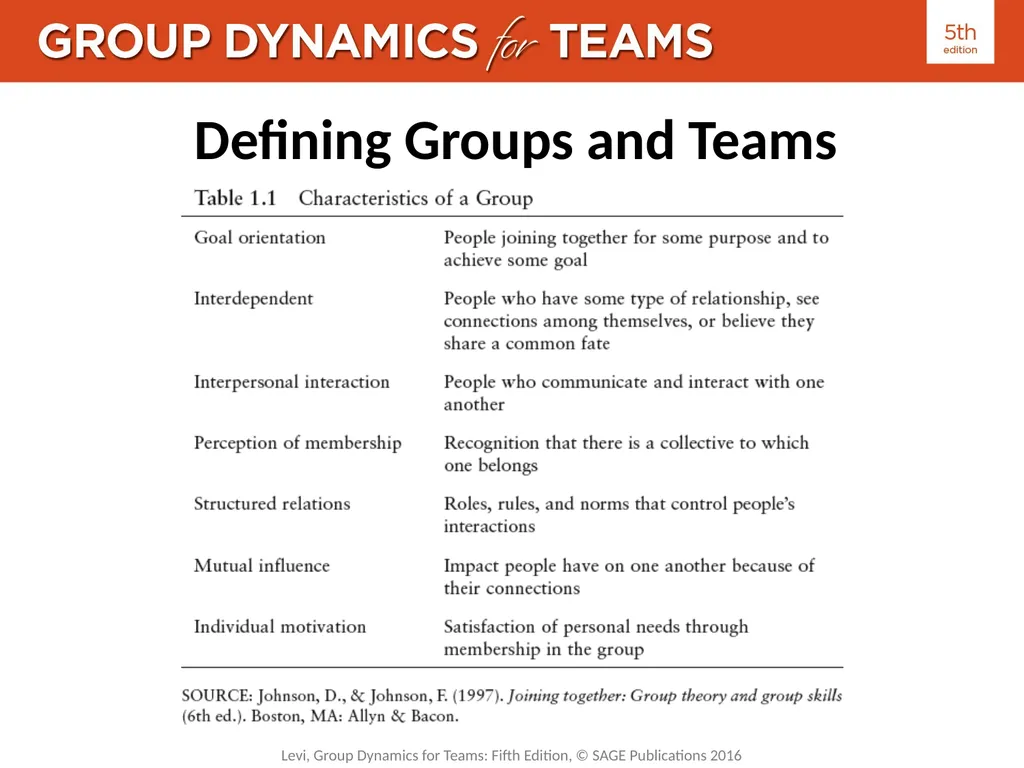
Defining Groups and Teams Levi, Group Dynamics for Teams: Fifth Edition, © SAGE Publications 2016<br>
03
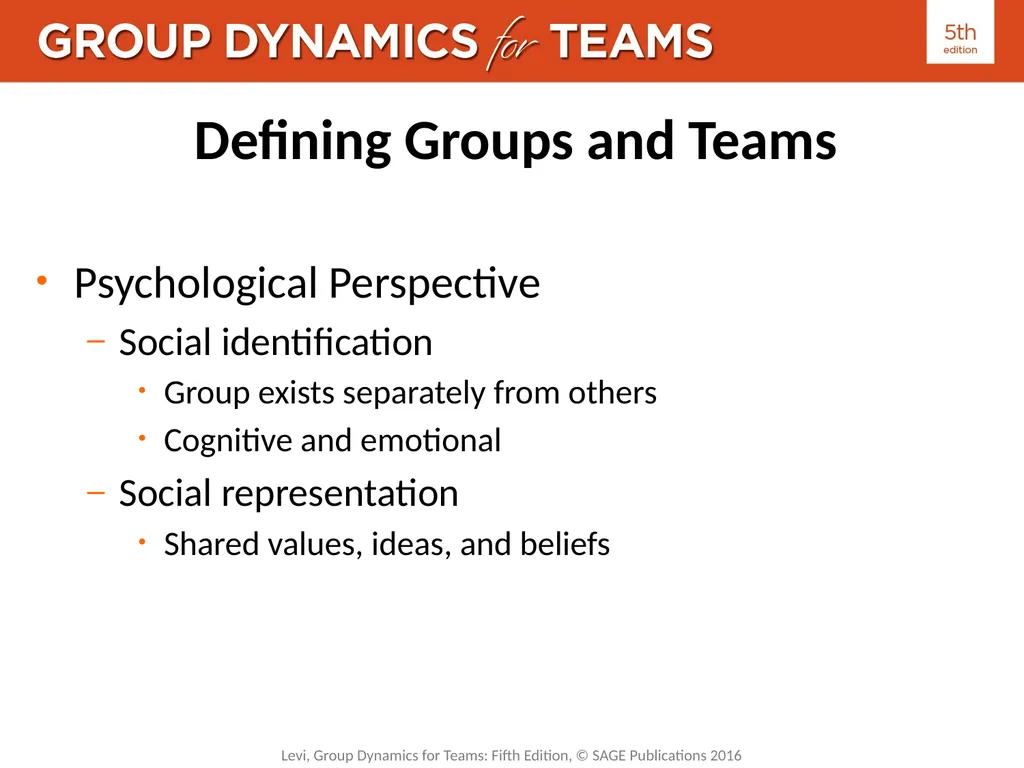
Psychological Perspective
Social identification
Group exists separately from others
Cognitive and emotional
Social representation
Shared values, ideas, and beliefs Levi, Group Dynamics for Teams: Fifth Edition, © SAGE Publications 2016 Defining Groups and Teams<br>
04
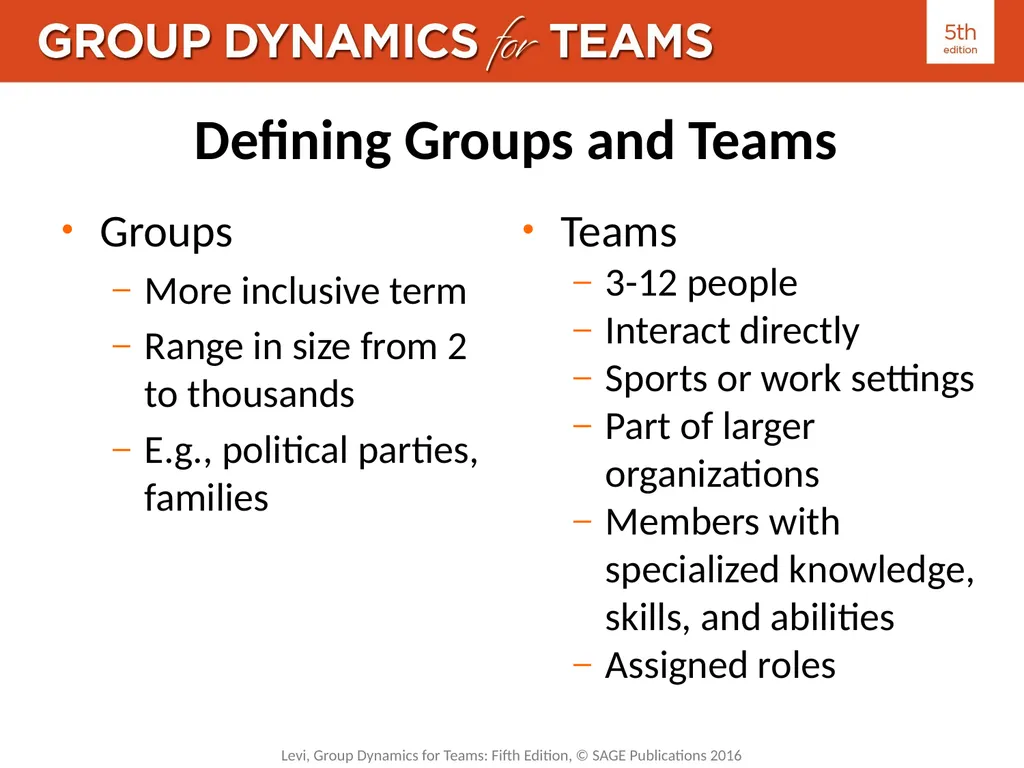
Groups
More inclusive term
Range in size from 2 to thousands
E.g., political parties, families Teams
3-12 people
Interact directly
Sports or work settings
Part of larger organizations
Members with specialized knowledge, skills, and abilities
Assigned roles Levi, Group Dynamics for Teams: Fifth Edition, © SAGE Publications 2016 Defining Groups and Teams<br>
05
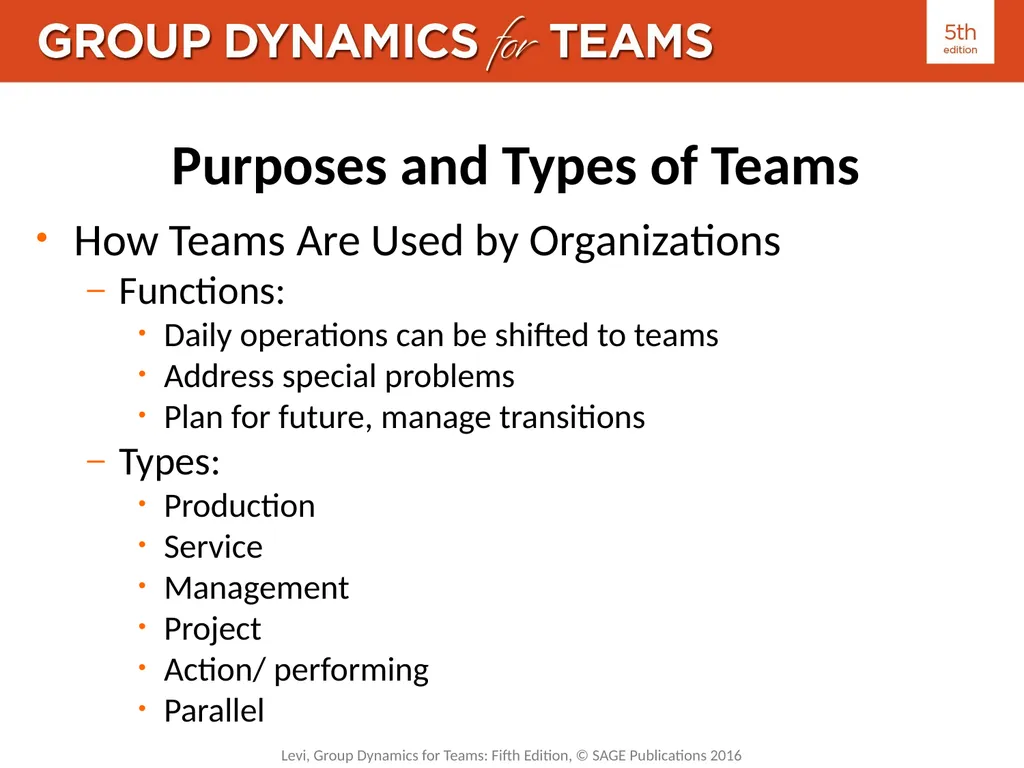
Purposes and Types of Teams How Teams Are Used by Organizations
Functions:
Daily operations can be shifted to teams
Address special problems
Plan for future, manage transitions
Types:
Production
Service
Management
Project
Action/ performing
Parallel Levi, Group Dynamics for Teams: Fifth Edition, © SAGE Publications 2016<br>
06
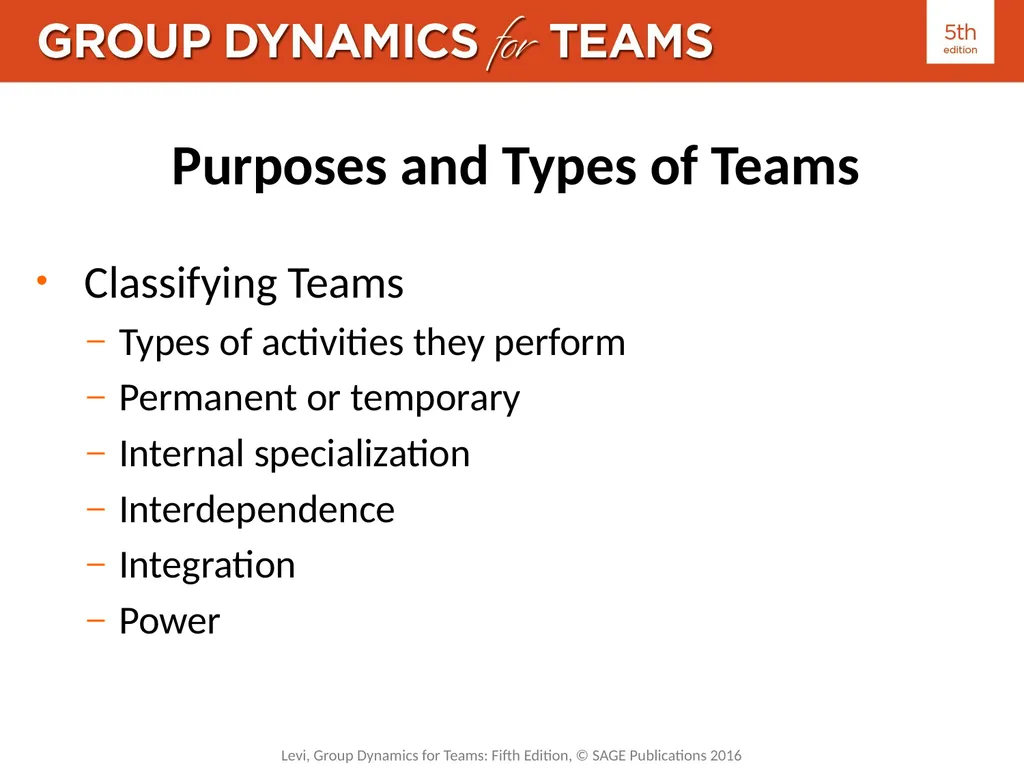
Purposes and Types of Teams Classifying Teams
Types of activities they perform
Permanent or temporary
Internal specialization
Interdependence
Integration
Power Levi, Group Dynamics for Teams: Fifth Edition, © SAGE Publications 2016<br>
07
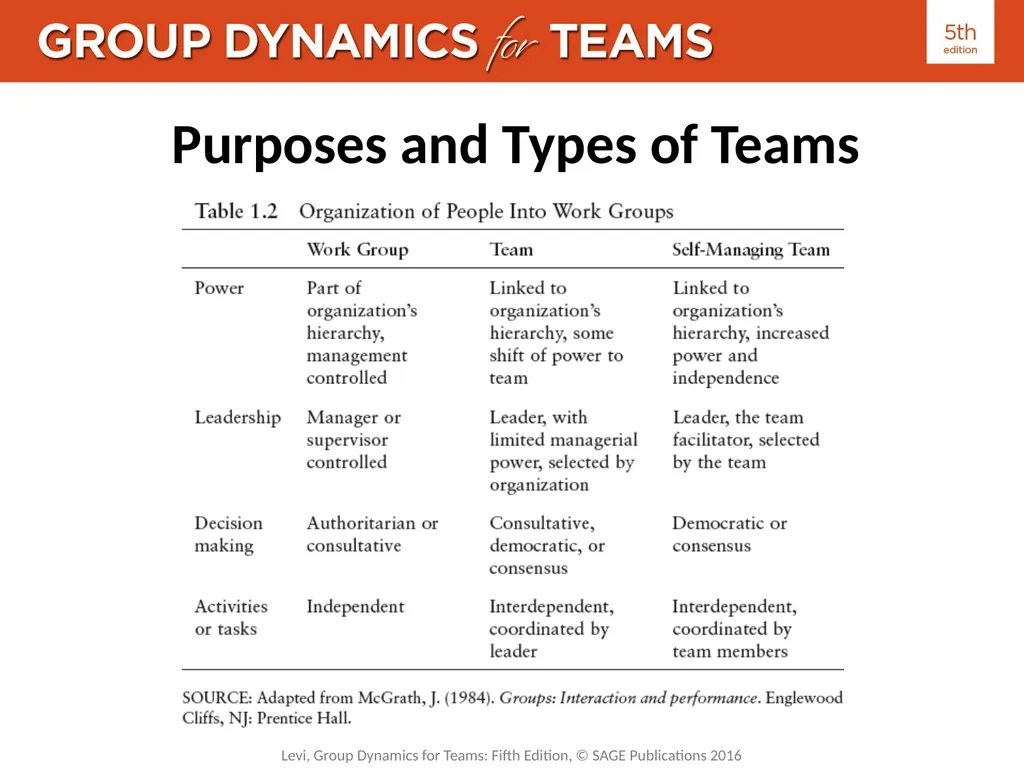
Purposes and Types of Teams Levi, Group Dynamics for Teams: Fifth Edition, © SAGE Publications 2016<br>
08
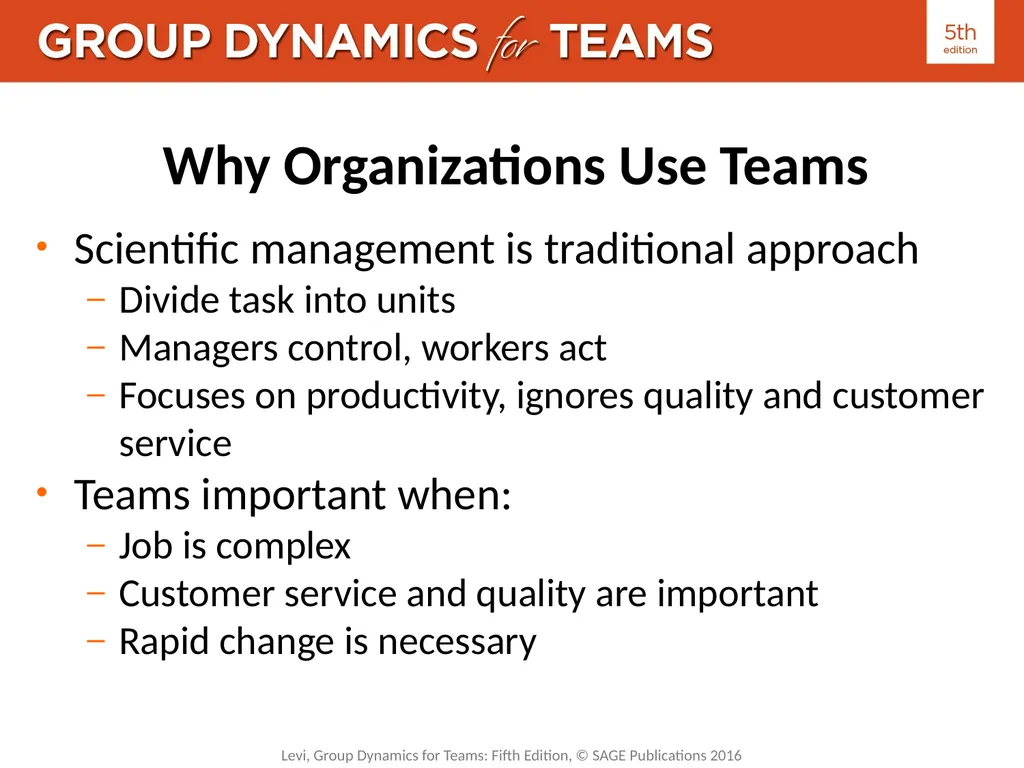
Why Organizations Use Teams Scientific management is traditional approach
Divide task into units
Managers control, workers act
Focuses on productivity, ignores quality and customer service
Teams important when:
Job is complex
Customer service and quality are important
Rapid change is necessary Levi, Group Dynamics for Teams: Fifth Edition, © SAGE Publications 2016<br>
09
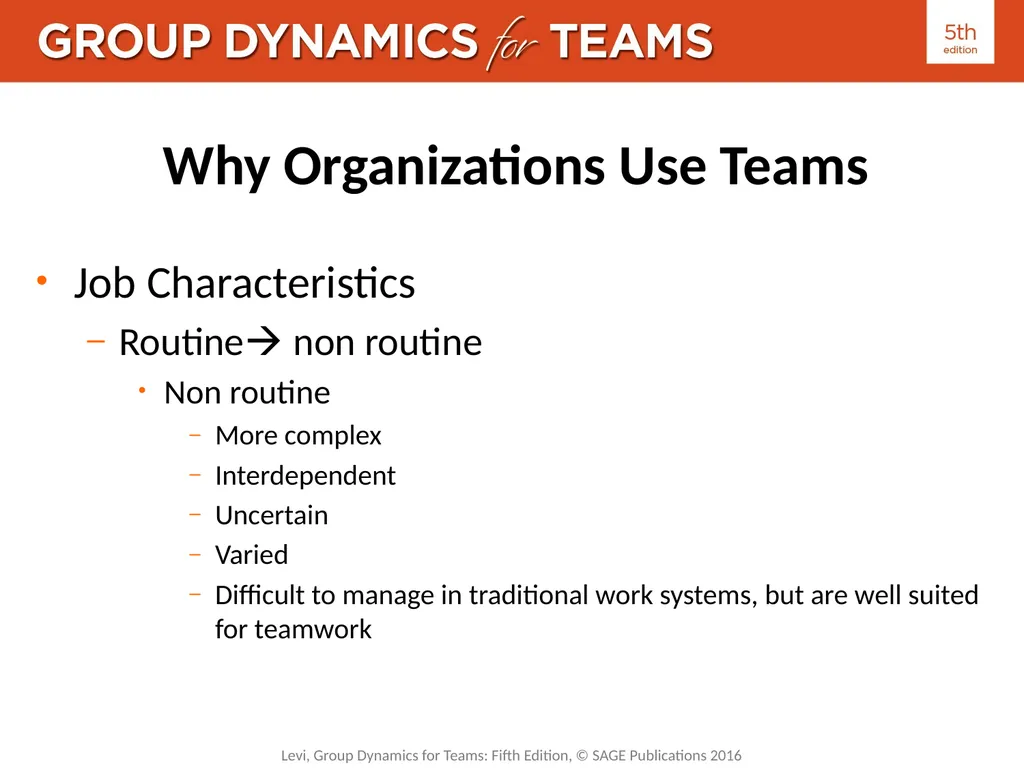
Why Organizations Use Teams Job Characteristics
Routine non routine
Non routine
More complex
Interdependent
Uncertain
Varied
Difficult to manage in traditional work systems, but are well suited for teamwork Levi, Group Dynamics for Teams: Fifth Edition, © SAGE Publications 2016<br>
10
Why Organizations Use Teams Organizational Characteristics
Global markets
Increasing use in technology
Contemporary demands
Reduce cost, improve quality, improve customer service, increase adaptability Levi, Group Dynamics for Teams: Fifth Edition, © SAGE Publications 2016<br>
11
History of Teams and Group Dynamics Foundations of Teamwork
Industrial revolution
Scientific management
Hawthorne Studies
Social factors impact performance
Sociotechnical systems theory
Quality circle teams (mixed success)
Focus on quality launched current interest Levi, Group Dynamics for Teams: Fifth Edition, © SAGE Publications 2016<br>
12
History of Teams and Group Dynamics Currently teams are often temporary
Because teams change, these issues are important:
Dynamic Composition
Technology and Distance
Empowerment and Delayering
Power shift from management to teams
Current movements in psychology affecting
the study of teamwork:
Diversity and Multiculturalism
Positive Psychology Levi, Group Dynamics for Teams: Fifth Edition, © SAGE Publications 2016<br>
13
History of Teams and Group Dynamics Foundations of Group Dynamics
Triplett
Social facilitation
Kurt Lewin
Group dynamics
Action research
Social change
Interdisciplinary; Equifinality Levi, Group Dynamics for Teams: Fifth Edition, © SAGE Publications 2016<br>
14
Levi, Group Dynamics for Teams: Fifth Edition, © SAGE Publications 2016<br>
Show all 14 slides