Chapter 10 (10.4) The Catholic Counter-Reformation LO: 3.8 The Catholic Counter-Reformation Learning Intention(s) Understand the main elements of the Counter-Reformation The Catholic Church was alarmed at the spread of Protestantism and
"Chapter 10 (10.4) The Catholic Counter-Reformation" is the property of its rightful owner. Permission is granted to
download and print the materials on this website for personal, non-commercial use only, and to display it
on your personal computer provided you do not modify the materials and that you retain all copyright
notices contained in the materials. By downloading content from our website, you accept the terms of this
agreement.
Presentation Transcript
01
Chapter 10 (10.4)
The Catholic Counter-Reformation LO: 3.8<br>
02
The Catholic Counter-Reformation
Learning Intention(s) Understand the main elements of the Counter-Reformation<br>
03
The Catholic Church was alarmed at the spread of Protestantism and realised that if it did not act to limit the damage, the Church could collapse.
It adopted a ‘carrot and stick’ approach – it would use both force and persuasion to keep people inside the Church. THE CATHOLIC COUNTER-REFORMATION<br>
04
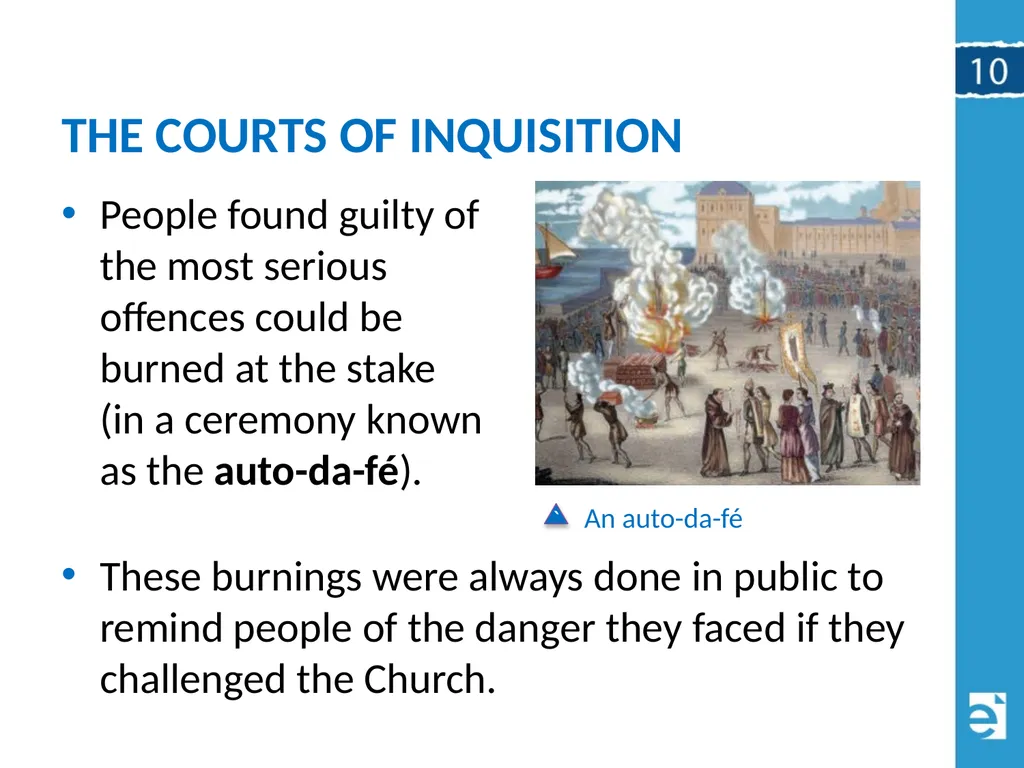
The Church set up the COURTS OF INQUISITION to arrest, try and punish anyone who they thought was a threat to Church teachings.
The Inquisition used imprisonment and torture to get people accused of heresy to recant their views. 1. THE COURTS OF INQUISITION<br>
05
THE COURTS OF INQUISITION People found guilty of the most serious offences could be burned at the stake (in a ceremony known as the auto-da-fé). These burnings were always done in public to remind people of the danger they faced if they challenged the Church. ` An auto-da-fé<br>
06
Other punishments included imprisonment, fines, confiscation of property, expulsion or the wearing of a yellow cloak (sanbenito).
The Inquisition was quite successful in limiting the spread of the Reformation, especially in Italy and Spain. THE COURTS OF INQUISITION<br>
07
The Courts of Inquisition were Catholic courts set up during the Counter-Reformation to try heretics.<br>
08
The Church saw that it needed to reconnect with the faithful, and several new religious orders were founded to do this.
Some, like the Ursuline nuns and Capuchin monks, worked in communities helping people and preaching the gospel.
They set up schools and hospitals around Europe to help the poor. 2. NEW RELIGIOUS ORDERS<br>
09
The most important was the Society of Jesus, or the Jesuits, founded by Ignatius Loyola in 1534.
His order was like an army, with a general at the top and priest ‘soldiers’ who were expected to follow orders without question.
They quickly gained a reputation as being highly educated and very successful in their two main tasks: (next slide) NEW RELIGIOUS ORDERS – JESUITS<br>
10
Travelling the world, especially the newly discovered lands in the Americas and Asia, as missionaries. They were responsible for the conversion of the peoples of South America and for introducing Catholicism to Asia, particularly China and Japan.
Setting up schools to educate the sons of the nobility or of wealthy families. They deliberately targeted these boys because they would have power and social influence when they grew up. NEW RELIGIOUS ORDERS – JESUITS<br>
11
The Council of Trent was the Church’s response to the attack on its teachings by the Reformers.
Senior bishops and cardinals from various countries met between 1545 and 1563 in Trento, Italy.
The Council attempted to deal with the Church’s existing problems and to impose discipline. 3. THE COUNCIL OF TRENT<br>
12
Simony, pluralism, nepotism, absenteeism and the sale of indulgences were banned.
Seminaries were set up in every diocese to train priests.
Priests were to be celibate and could not marry.
Strict rules and punishments were introduced for priests who broke these rules.
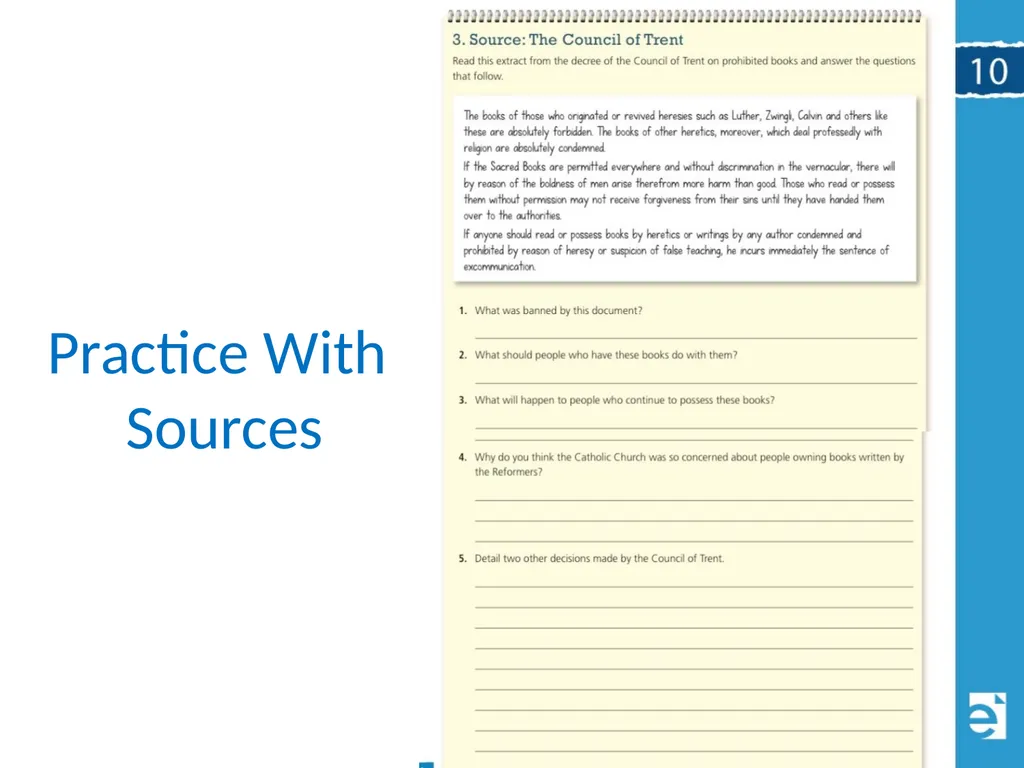
It published a list of books that Catholics were forbidden to read (The Index of Prohibited Books). THE COUNCIL OF TRENT<br>
13
It also clarified Catholic teachings and defended them against the arguments of Reformers:
Faith and good works were required to get into heaven.
There were seven sacraments.
Mass and the Bible must be in Latin. THE COUNCIL OF TRENT<br>
14
They drew up a single ‘rulebook’ for Catholicism, the Catechism. This was designed toprovide people with clear, simple answers to questions about their faith, and also to ensure there was consistency in how Catholicism was taught across Europe. THE COUNCIL OF TRENT<br>
15
The Counter-Reformation was largely successful in preventing the further spread of Protestantism – but was unable to reverse it in any of the countries where it had taken hold. IMPACT OF THE COUNTER-REFORMATION<br>
16
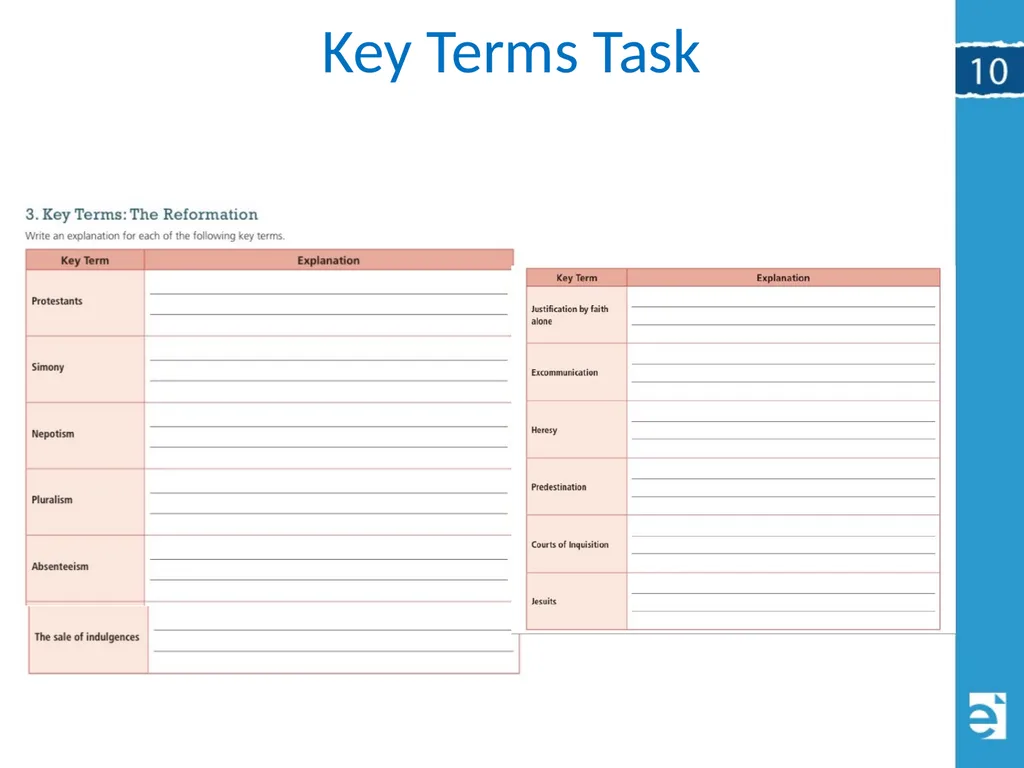
Key Terms Task<br>
17
Practice With Sources<br>
18
REVIEW QUESTIONS What was the Inquisition and how was it used against the Reformation? The Inquisition was a Church court used to try those accused of heresy. Suspected Protestants were tortured and tried until they recanted their beliefs.<br>
19
REVIEW QUESTIONS How did the Jesuits try to combat the Reformation? They travelled the world to convert new people to Catholicism and set up schools for the sons of the elite to ensure they remained Catholic.<br>
20
REVIEW QUESTIONS What was the Council of Trent? A regular meeting of bishops between 1545 and 1563. It was the Church’s response to the Protestant attack on its teachings.<br>
21
REVIEW QUESTIONS How did it respond to problems and abuses in the Church? It banned the sale of indulgences, simony, nepotism, pluralism and absenteeism. Seminaries were set up to train priests. A list of books was created that Catholics were forbidden to read.<br>
22
REVIEW QUESTIONS What was the Catechism and why was it important? It was a single ‘rule book’ for Catholicism, designed to provide people with clear, simple answers to questions about their faith, and also to ensure there was consistency in how Catholicism was taught across Europe.<br>