
CHAPTER 10: Logistic Regression Binary

CHAPTER 10: Logistic Regression Binary
1 / 1
CHAPTER 10: Logistic Regression Binary - slide 1 of 5 CHAPTER 10: Logistic Regression Binary - slide 2 of 5 CHAPTER 10: Logistic Regression Binary - slide 3 of 5 CHAPTER 10: Logistic Regression Binary - slide 4 of 5 CHAPTER 10: Logistic Regression Binary - slide 5 of 5
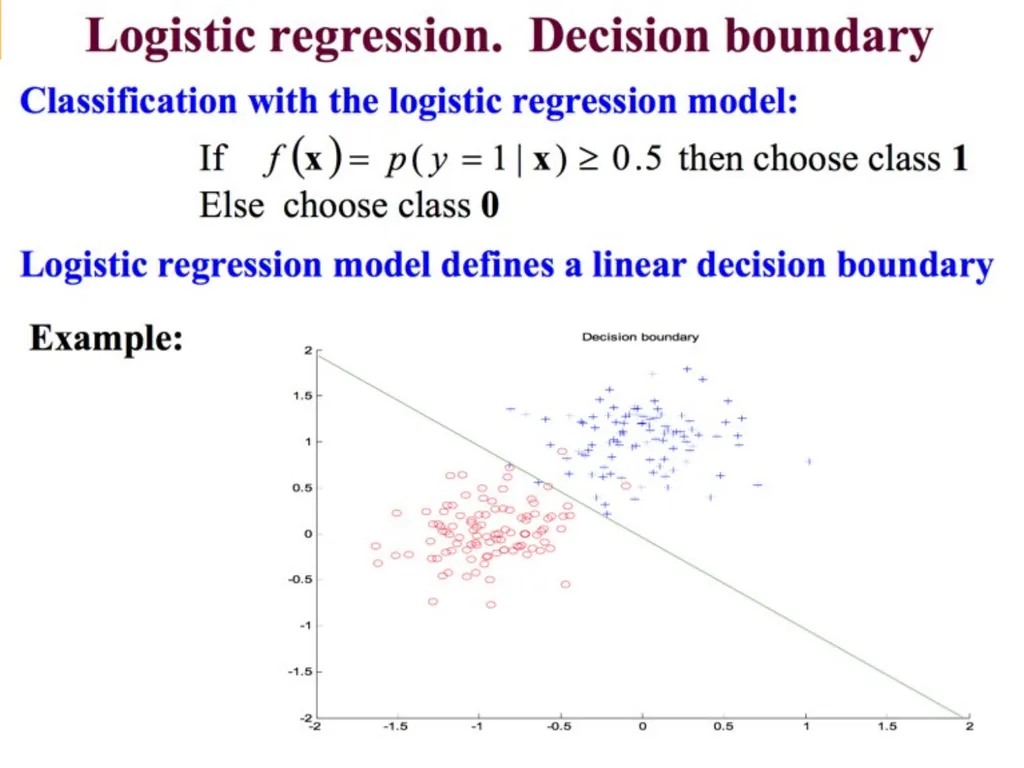
CHAPTER 10: Logistic Regression Binary classification Two classes Y 0,1 Goal is to learn how to correctly classify the input into one of these two classes Class 0 labeled as 0 Class 1 labeled as 1 We would like to learn f : X

Related Topics

Download this presentation From Below

"CHAPTER 10: Logistic Regression Binary" is the property of its rightful owner. Permission is granted to download and print the materials on this website for personal, non-commercial use only, and to display it on your personal computer provided you do not modify the materials and that you retain all copyright notices contained in the materials. By downloading content from our website, you accept the terms of this agreement.

Presentation Transcript

01
CHAPTER 10: Logistic Regression<br>
02
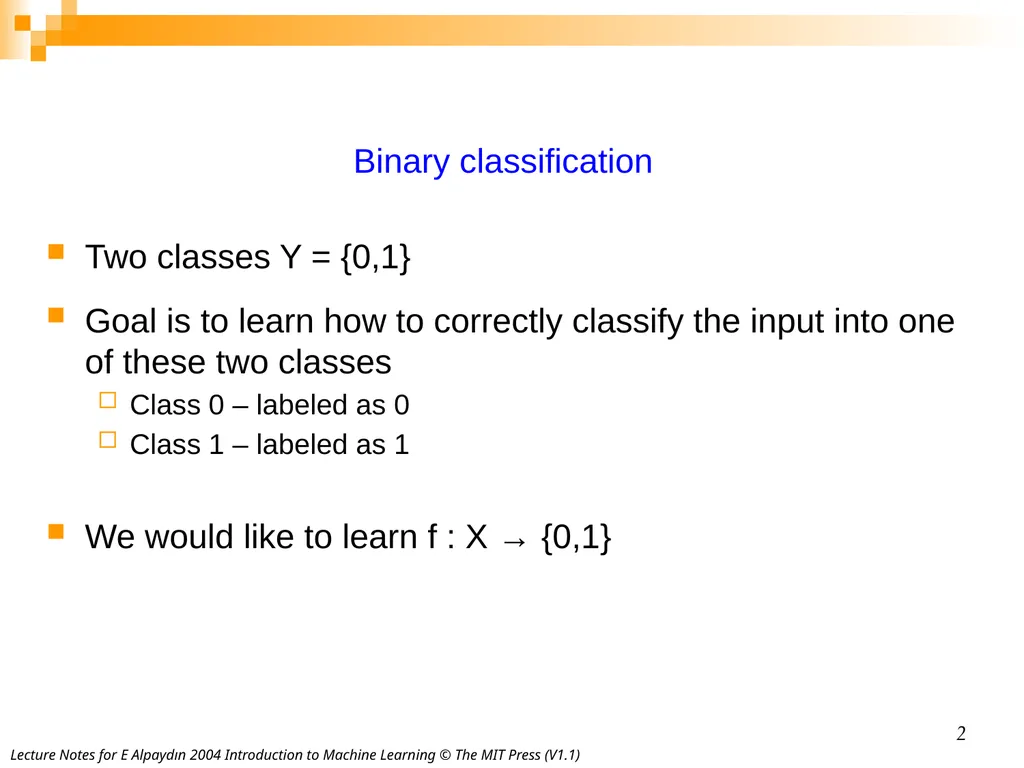
Binary classification

Two classes Y = {0,1}

Goal is to learn how to correctly classify the input into one of these two classes
Class 0 – labeled as 0
Class 1 – labeled as 1

We would like to learn f : X → {0,1} Lecture Notes for E Alpaydın 2004 Introduction to Machine Learning © The MIT Press (V1.1) 2<br>
03
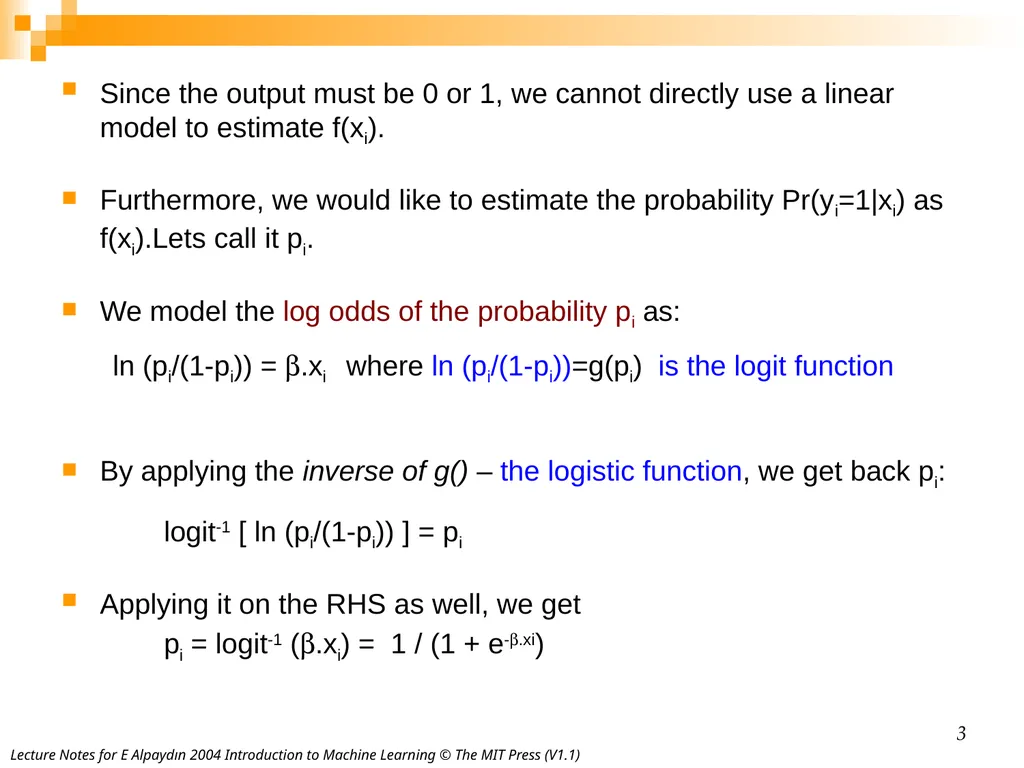
Since the output must be 0 or 1, we cannot directly use a linear model to estimate f(xi).

Furthermore, we would like to estimate the probability Pr(yi=1|xi) as f(xi).Lets call it pi.

We model the log odds of the probability pi as:

ln (pi/(1-pi)) = b.xi where ln (pi/(1-pi))=g(pi) is the logit function


By applying the inverse of g() – the logistic function, we get back pi:

logit-1 [ ln (pi/(1-pi)) ] = pi

Applying it on the RHS as well, we get
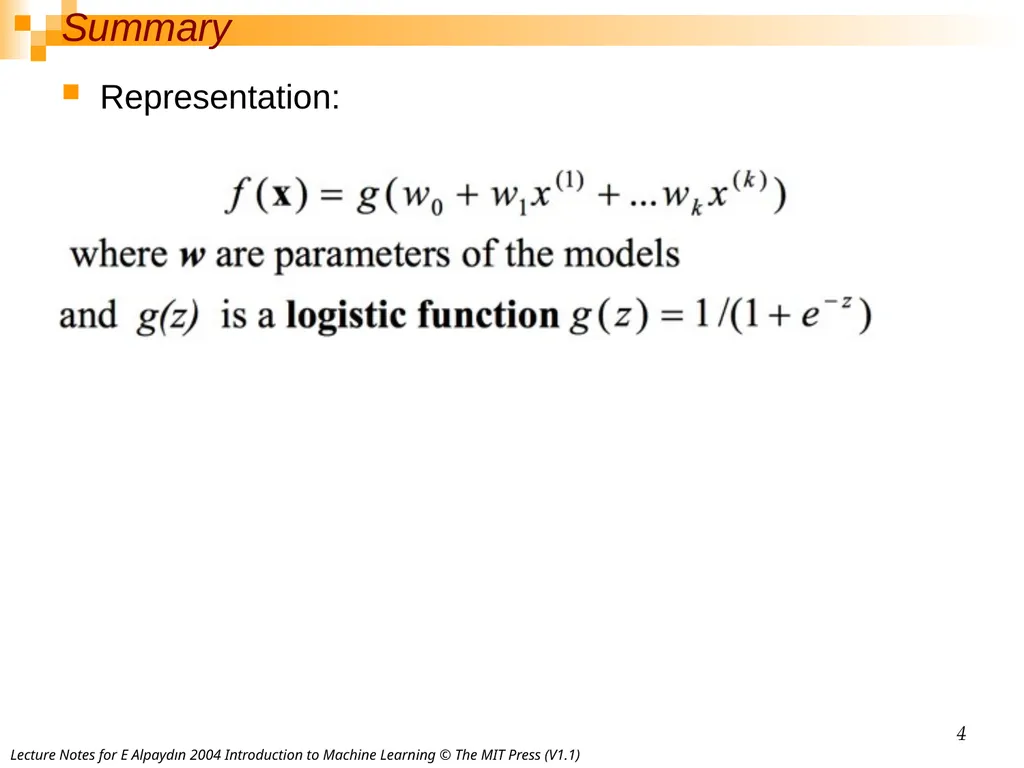
pi = logit-1 (b.xi) = 1 / (1 + e-b.xi) Lecture Notes for E Alpaydın 2004 Introduction to Machine Learning © The MIT Press (V1.1) 3<br>