
Chapter 10 Microbes in Human Welfare USEFUL
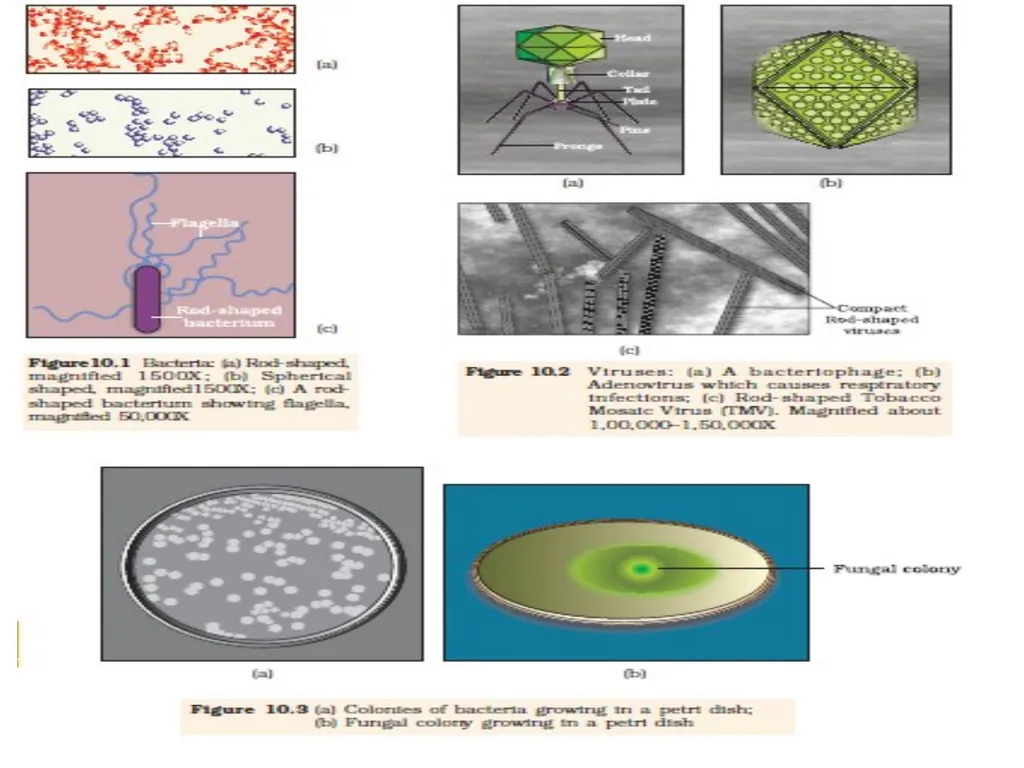




Description: Chapter 10 Microbes in Human Welfare USEFUL ASPECTS OF MICROBES MICROBES Microbes are diverse 1.Protozoa, 2.Bacteria, 3. Fungi 4. Viruses, 5. Viroids and 6. Prions that are Proteinacious infectious agents. Some of the microbes are shown in
Related Topics
Download Presentation
"Chapter 10 Microbes in Human Welfare USEFUL" is the property of its rightful owner. Permission is granted to download and print the materials on this website for personal, non-commercial use only, and to display it on your personal computer provided you do not modify the materials and that you retain all copyright notices contained in the materials. By downloading content from our website, you accept the terms of this agreement.
Presentation Transcript
slide1. Chapter 10
Microbes in Human Welfare<br>
slide2. USEFUL ASPECTS OF MICROBES<br>
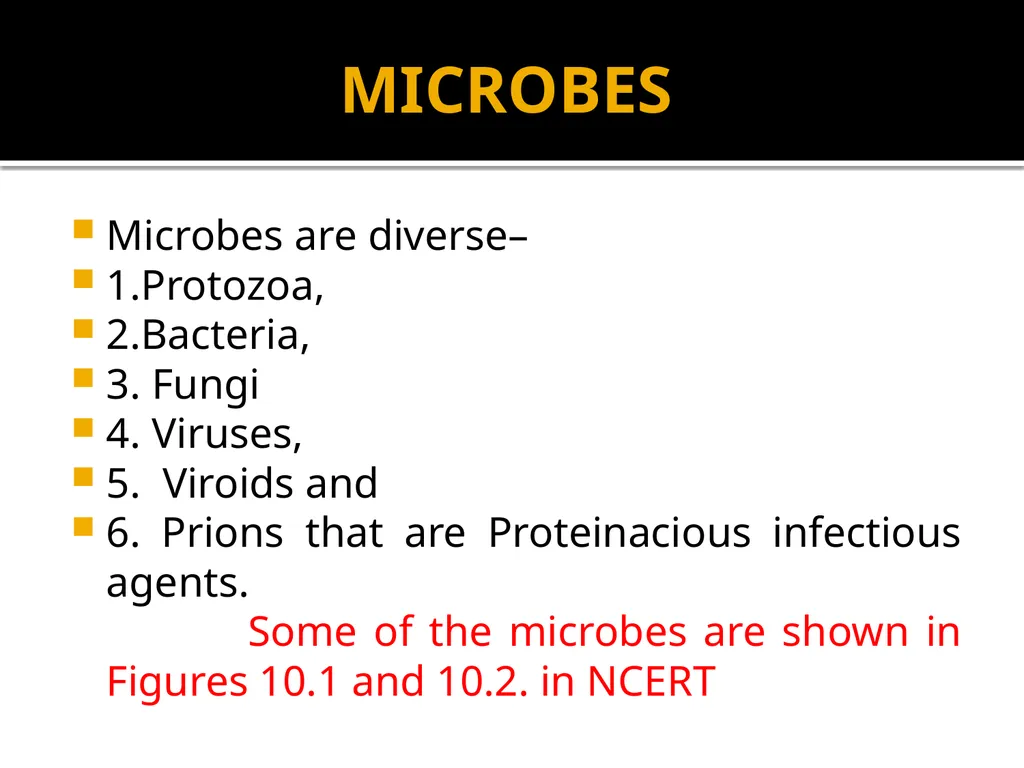
slide3. MICROBES Microbes are diverse–
1.Protozoa,
2.Bacteria,
3. Fungi
4. Viruses,
5. Viroids and
6. Prions that are Proteinacious infectious agents.
Some of the microbes are shown in Figures 10.1 and 10.2. in NCERT<br>
slide5. MICROBES IN HOUSEHOLD PRODUCTS<br>
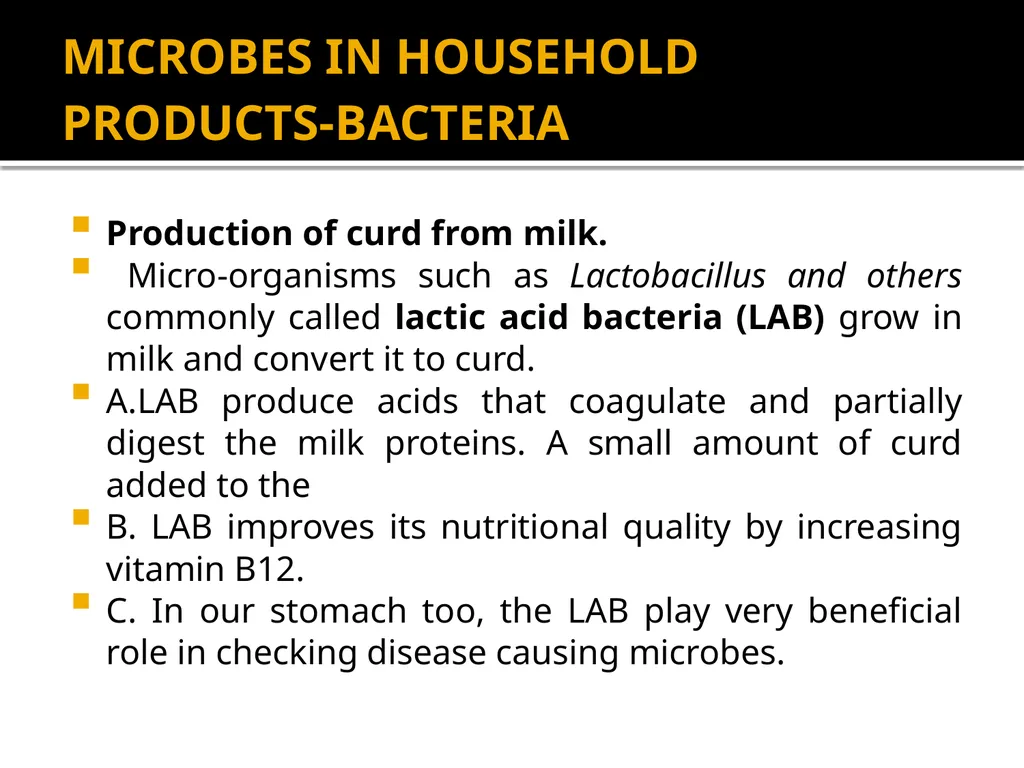
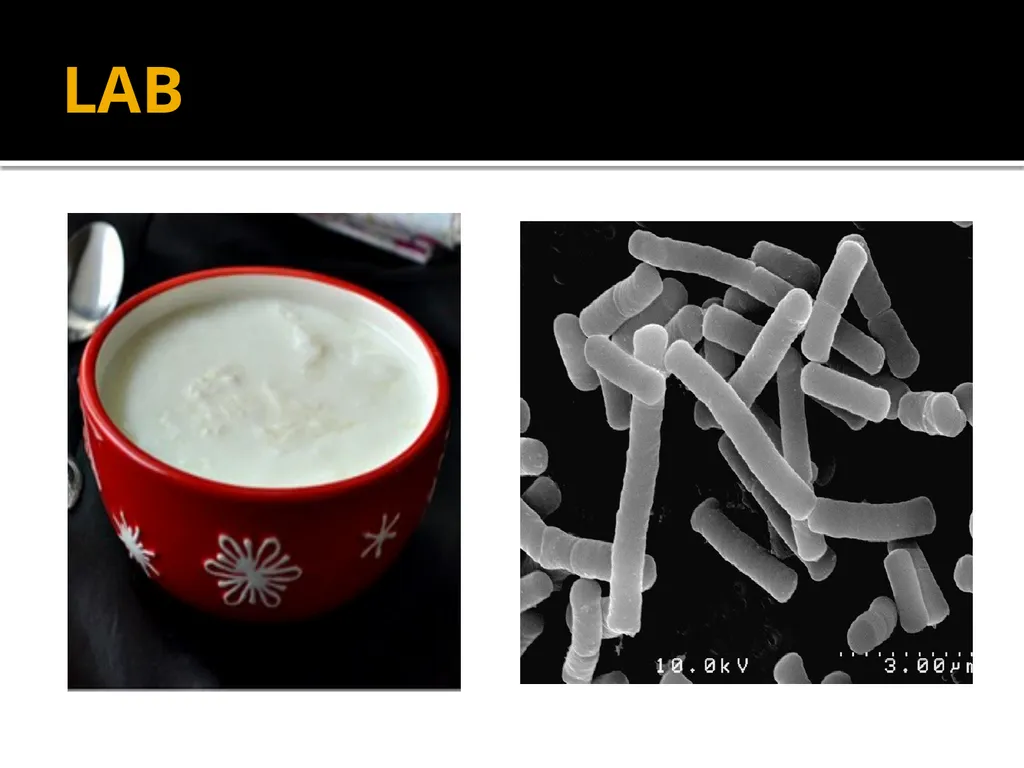
slide7. MICROBES IN HOUSEHOLD PRODUCTS-BACTERIA Production of curd from milk.
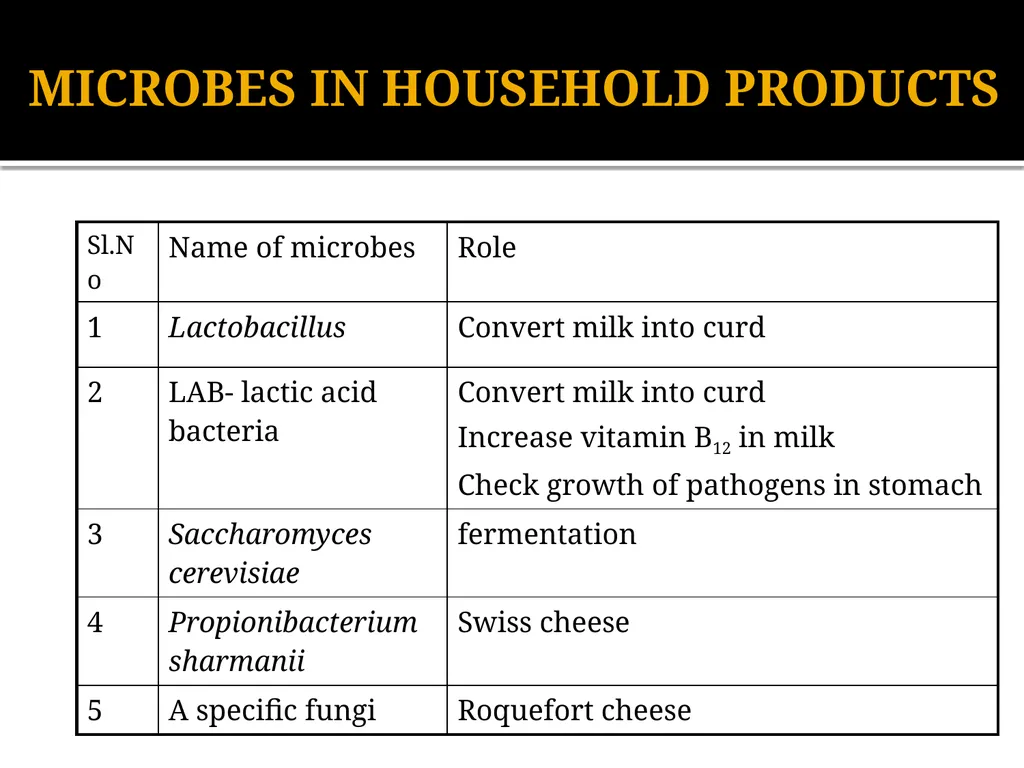
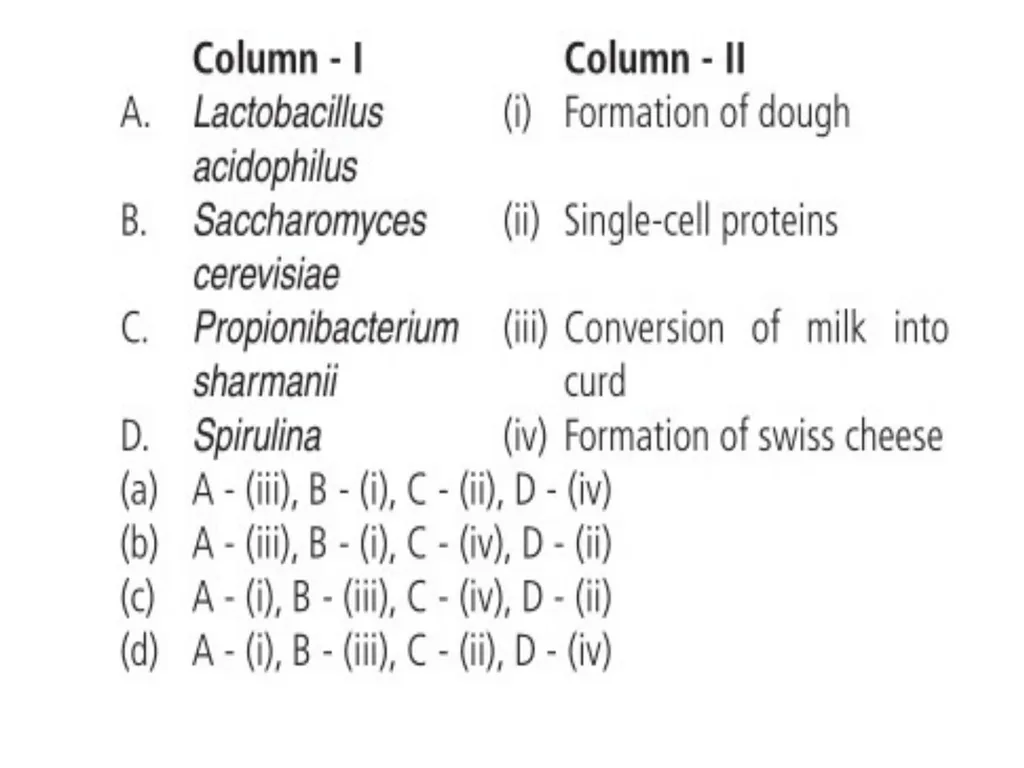
Micro-organisms such as Lactobacillus and others commonly called lactic acid bacteria (LAB) grow in milk and convert it to curd.
A.LAB produce acids that coagulate and partially digest the milk proteins. A small amount of curd added to the
B. LAB improves its nutritional quality by increasing vitamin B12.
C. In our stomach too, the LAB play very beneficial role in checking disease causing microbes.<br>
slide8. LAB<br>
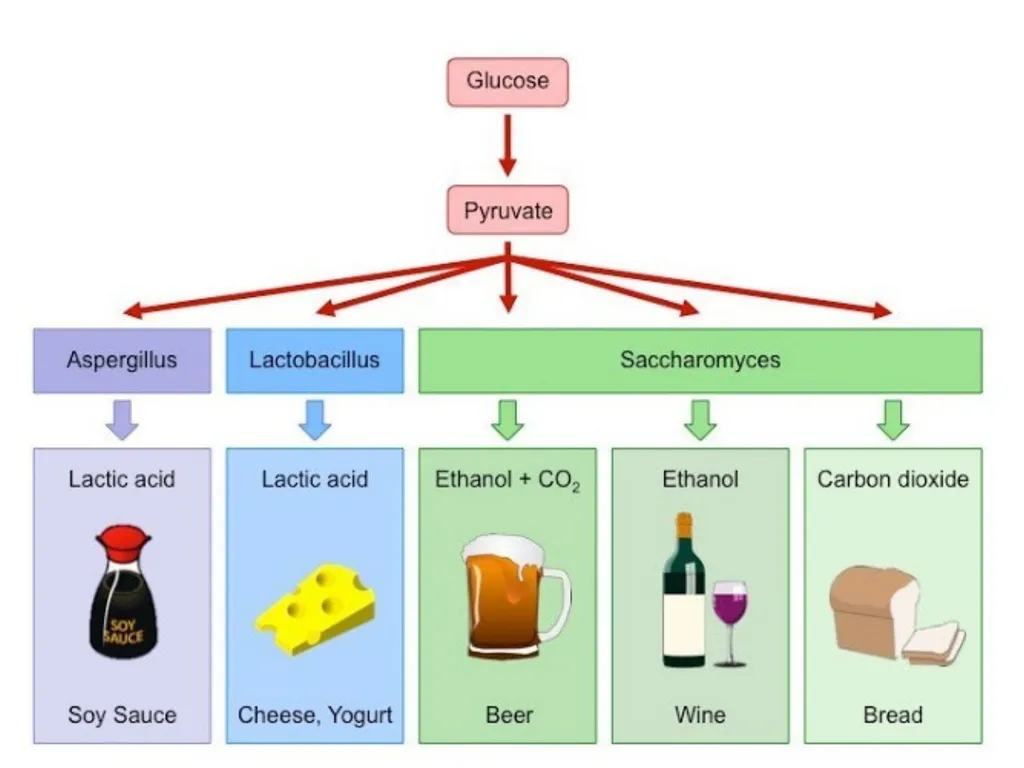
slide9. FUNGI The dough, which is used for making foods such as dosa and idli is also fermented by bacteria ,Saccharomyces cerevisae commonly called yeast.
The puffed-up appearance of dough is due to the production of CO2 gas.
Similarly the dough, which is used for making bread, is fermented using baker’s yeast (Saccharomyces cerevisiae).<br>
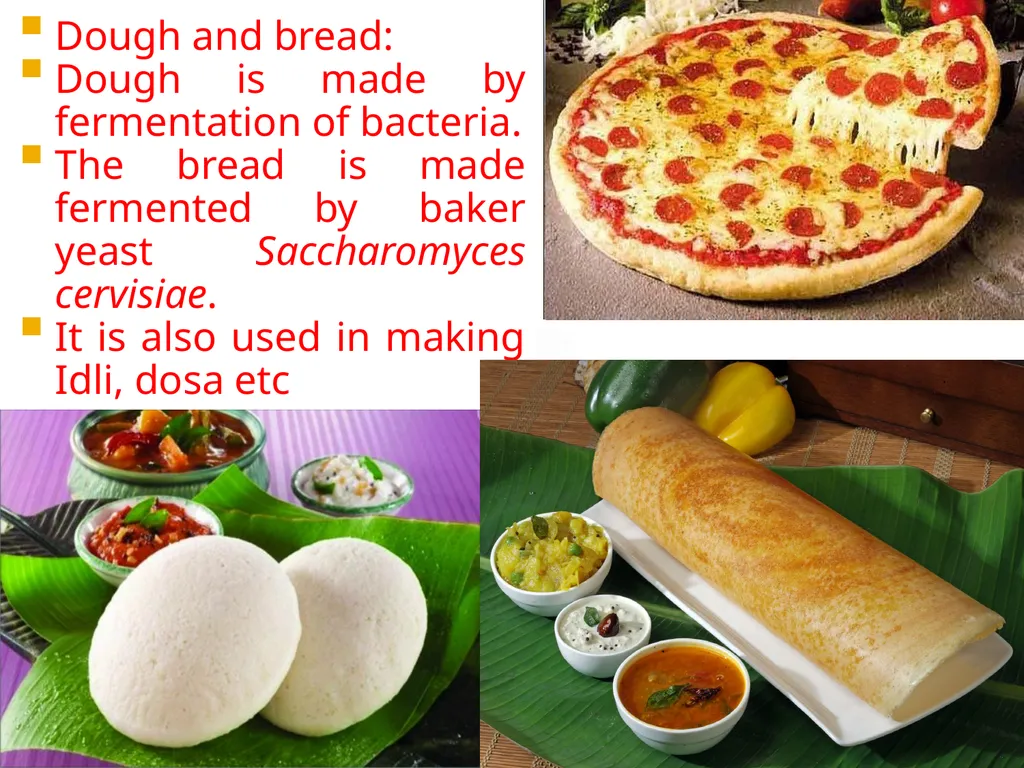
slide10. Dough and bread:
Dough is made by fermentation of bacteria.
The bread is made fermented by baker yeast Saccharomyces cervisiae.
It is also used in making Idli, dosa etc<br>
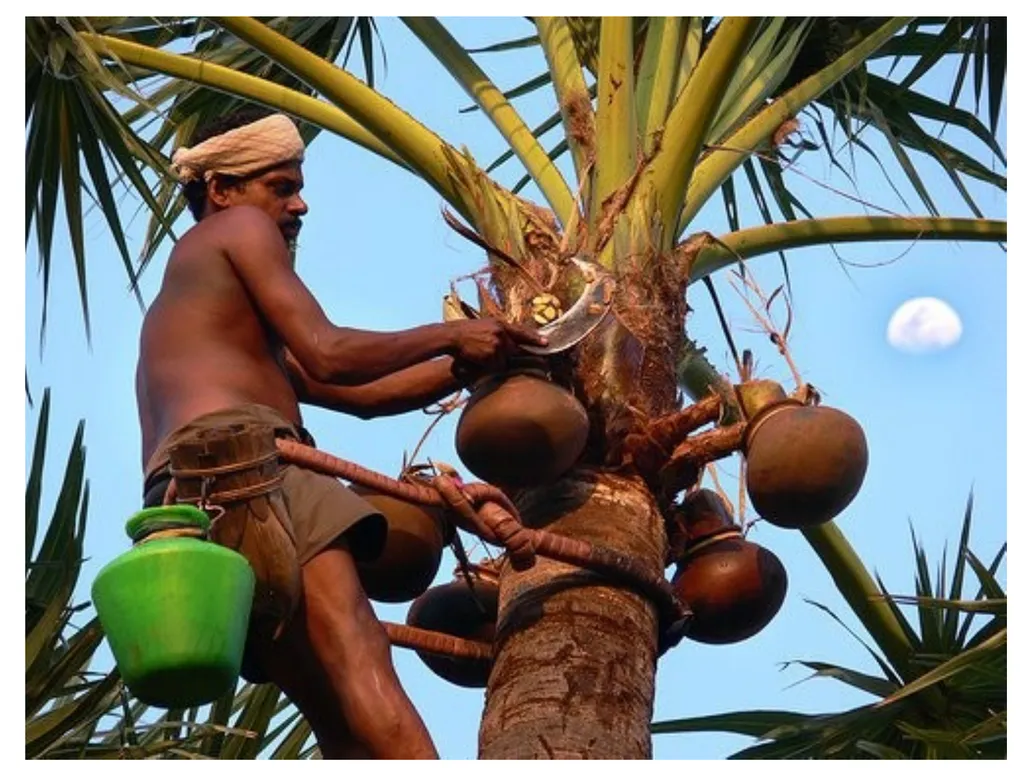
slide11. TODDY ‘Toddy’, a traditional drink of some parts of southern India is made by fermenting sap from palms by natural yeasts.
Microbes are also used to ferment fish, soya bean and bamboo shoots to make foods.
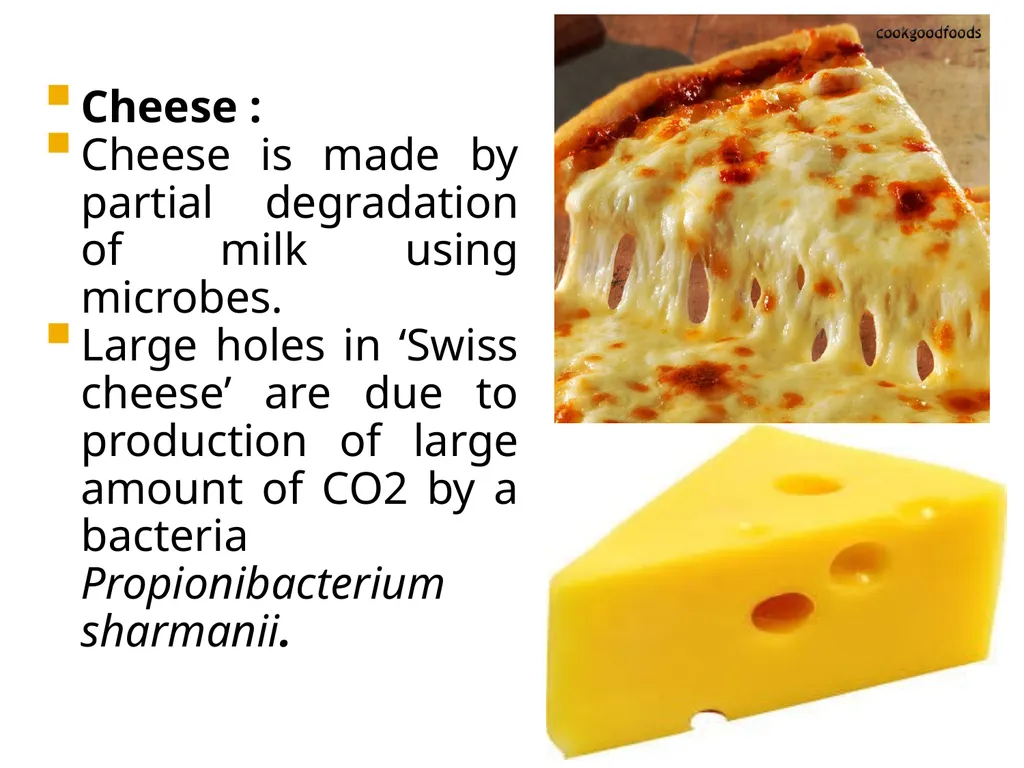
Cheese, is one of the oldest food items in which microbes were used. Different varieties of cheese are known by their characteristic texture, flavor and taste, the specificity coming from the microbes used.
For example, the large holes in ‘Swiss cheese’ are due to production of a large amount of CO2 by a bacterium named Propionibacterium sharmanii.
The ‘Roquefort cheese’ are ripened by growing a specific fungi on them, which gives them a particular flavor.<br>
slide13. Cheese :
Cheese is made by partial degradation of milk using microbes.
Large holes in ‘Swiss cheese’ are due to production of large amount of CO2 by a bacteria Propionibacterium sharmanii.<br>
slide15. MICROBES IN INDUSTRIAL PRODUCTS Fermented beverages
Antibiotics
Chemicals
Enzymes
Bioactive molecules<br>
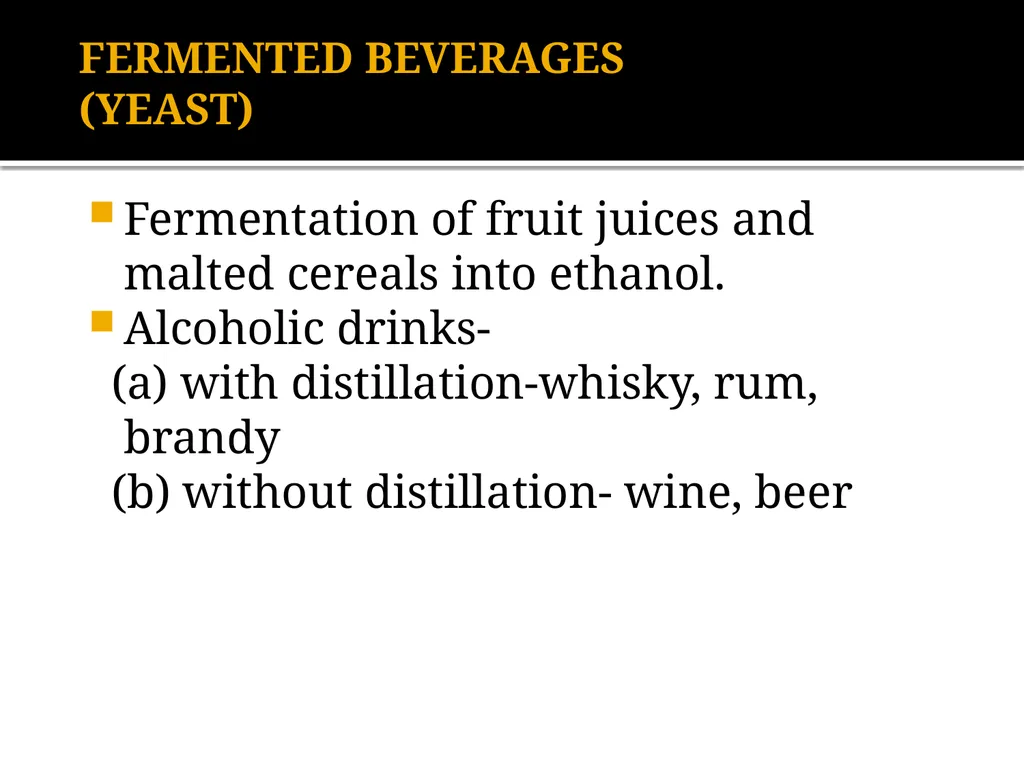
slide17. FERMENTED BEVERAGES (YEAST) Fermentation of fruit juices and malted cereals into ethanol.
Alcoholic drinks-
(a) with distillation-whisky, rum, brandy
(b) without distillation- wine, beer<br>
slide18. MICROBES IN INDUSTRIAL PRODUCTS Beverages and antibiotics are some examples.
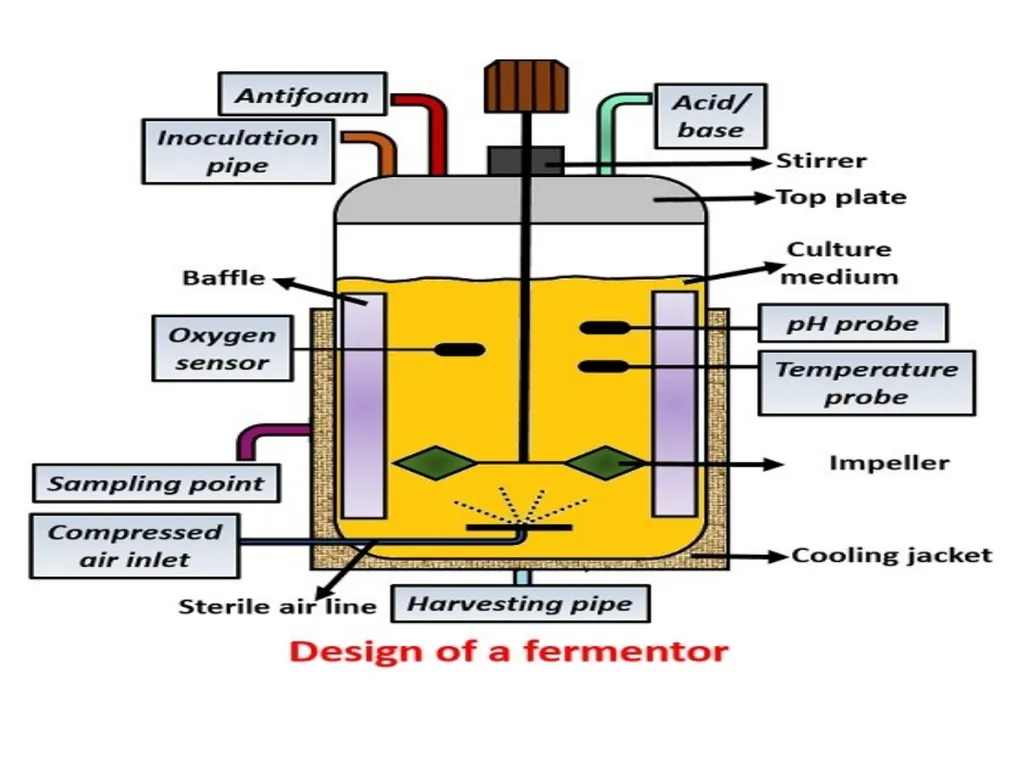
Production on an industrial scale, requires growing microbes in very large vessels called fermentors (Figure 10.4).<br>
slide19. Fermented Beverages Microbes especially yeasts have been used from time immemorial for the production of beverages like wine, beer, whisky, brandy or rum.
For this purpose the same yeast Saccharomyces
cerevisiae used for bread-making and
commonly called brewer’s yeast, is used for
fermenting malted cereals and fruit juices, to
produce ethanol.<br>
slide20. BEVERAGES Wine and beer are produced without distillation.
Whereas whisky, brandy and rum are produced by distillation of the fermented broth.
The photograph of a fermentation plant is shown in Figure 10.5.<br>
slide21. Microbes in industrial products:
Fermented beverages:
Alcoholic beverages are formed by fermenting malt and fruit juice by brewer’s yeast Saccharomyces cervisiae.
Wine and beer are produced with out distilation.
Wisky, brandy and rum are formed by distilation.<br>
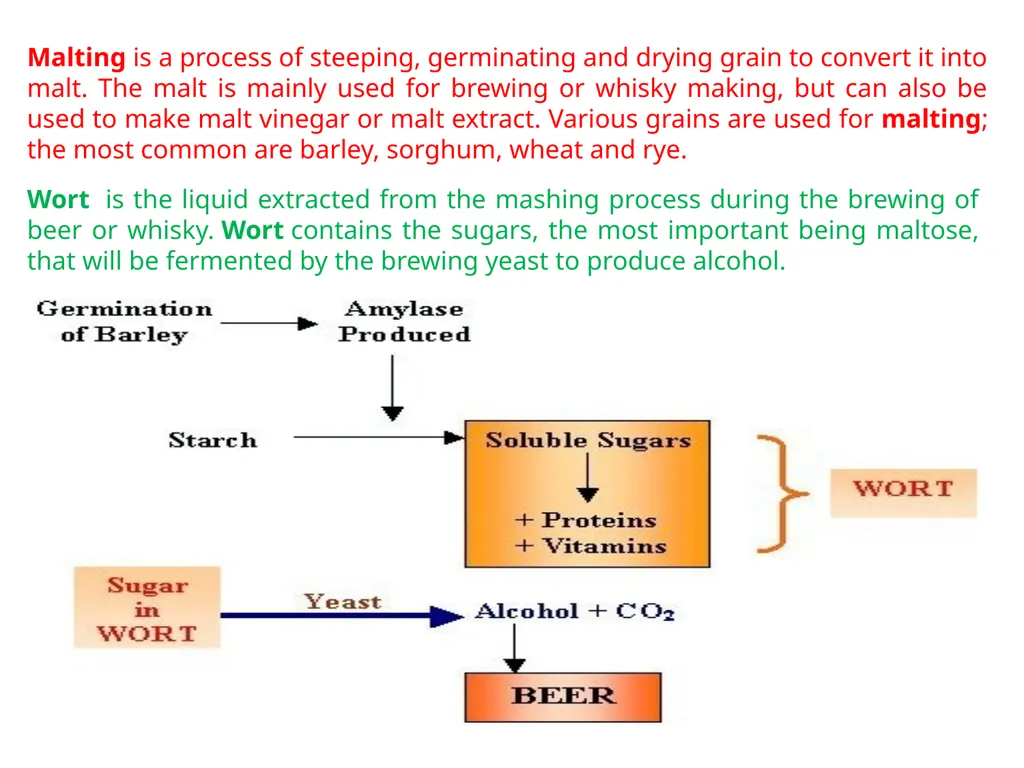
slide22. Wort is the liquid extracted from the mashing process during the brewing of beer or whisky. Wort contains the sugars, the most important being maltose, that will be fermented by the brewing yeast to produce alcohol. Malting is a process of steeping, germinating and drying grain to convert it into malt. The malt is mainly used for brewing or whisky making, but can also be used to make malt vinegar or malt extract. Various grains are used for malting; the most common are barley, sorghum, wheat and rye.<br>
slide23. ANTIBIOTICS Anti is a Greek word that means ‘against’, and bio means ‘life’, together they mean ‘against life’ (in the context of disease causing organisms); whereas with reference to human beings, they are ‘pro life’ and not against.
The term antibiotic was given by Selman Waksman in 1942.
Antibiotics are chemical substances, which are produced by some microbes and can kill or retard the growth of other (disease-causing) microbes.
Alexander Fleming while working on Staphylococci bacteria, once observed a mould growing in one of his unwashed culture plates around which Staphylococci could not grow.
He found out that it was due to a chemical produced by the mould and he named it Penicillin after the mould Penicillium notatum.<br>
slide24. Antibiotics cont. Full potential as an effective antibiotic was established much later by Ernest Chain and Howard Florey.
This antibiotic was extensively used to treat American soldiers wounded in World War II.
Fleming, Chain and Florey were awarded the Nobel Prize in 1945, for this discovery.<br>
slide25. ANTIBIOTICS Chemical substances, produced by some microbes and can kill or retard the growth of other disease causing microbes.
E.g. Penicillin obtained from fungus Penicillum notatum.<br>
slide26. Antibiotics
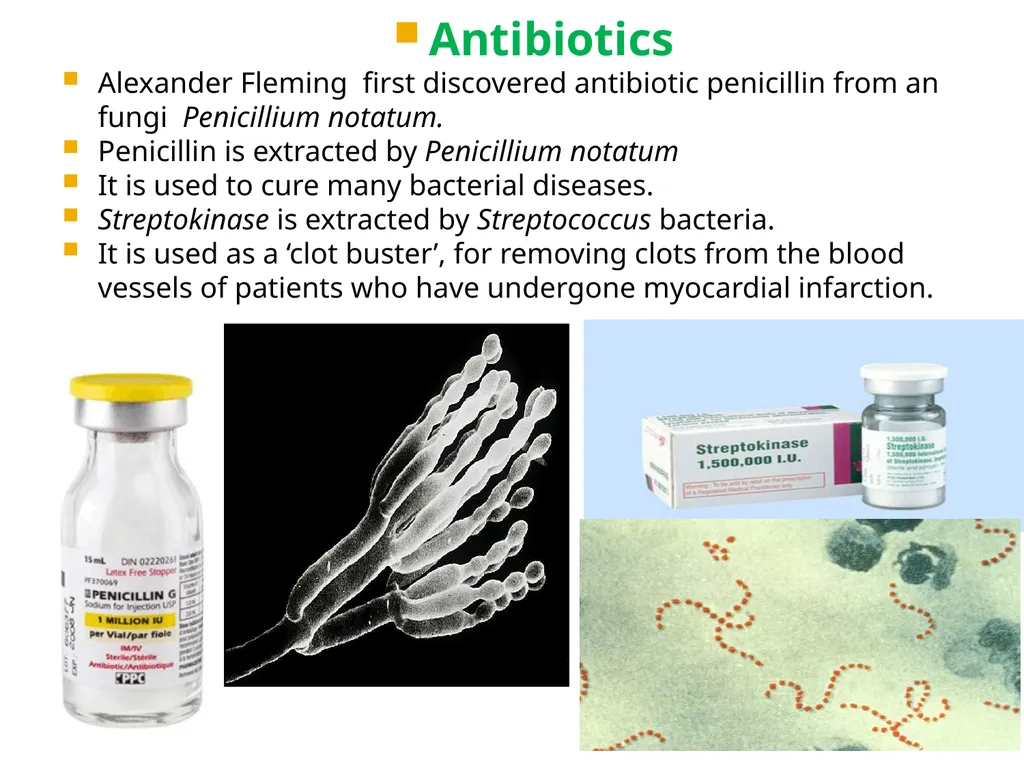
Alexander Fleming first discovered antibiotic penicillin from an fungi Penicillium notatum.
Penicillin is extracted by Penicillium notatum
It is used to cure many bacterial diseases.
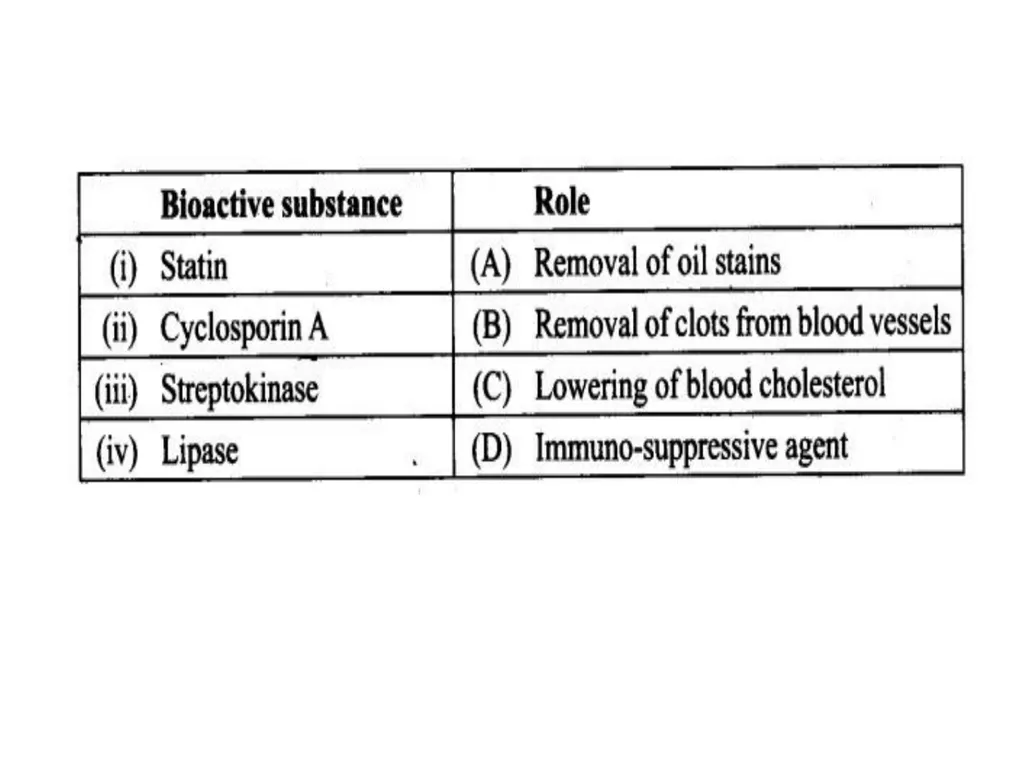
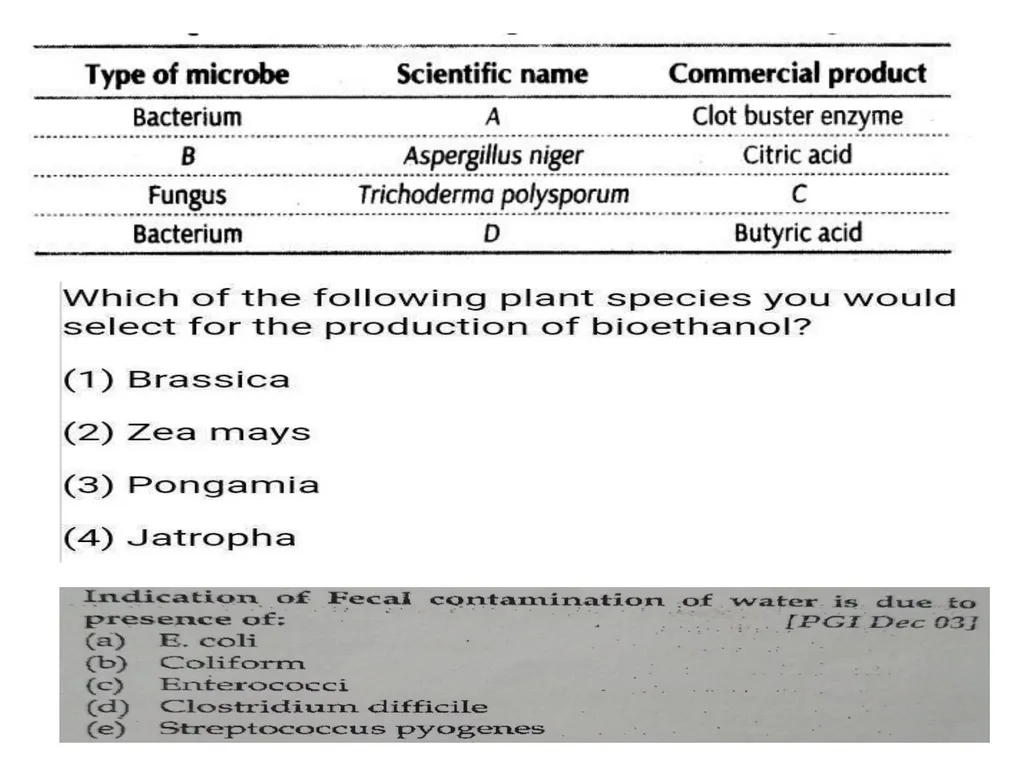
Streptokinase is extracted by Streptococcus bacteria.
It is used as a ‘clot buster’, for removing clots from the blood vessels of patients who have undergone myocardial infarction.<br>
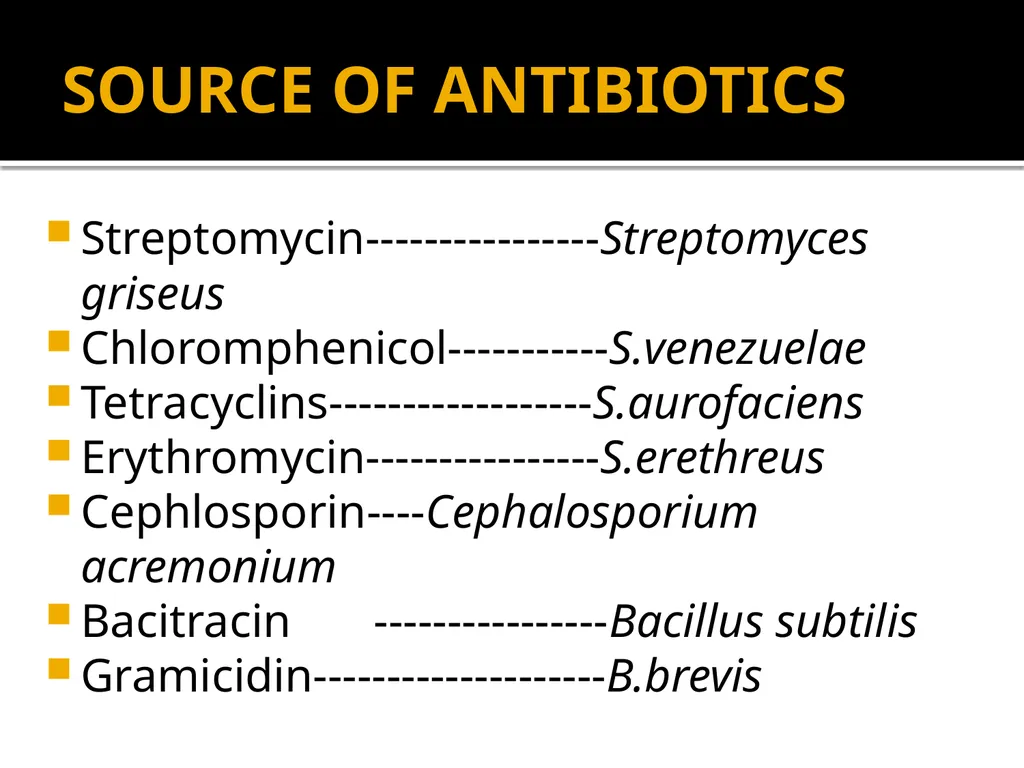
slide27. SOURCE OF ANTIBIOTICS Streptomycin----------------Streptomyces griseus
Chloromphenicol-----------S.venezuelae
Tetracyclins------------------S.aurofaciens
Erythromycin----------------S.erethreus
Cephlosporin----Cephalosporium acremonium
Bacitracin ----------------Bacillus subtilis
Gramicidin--------------------B.brevis<br>
slide28. Antibiotics Antibiotics have greatly improved our capacity to treat deadly diseases such as plague, whooping cough (kali khansi ), diphtheria (gal ghotu) and leprosy (kusht rog), which used to kill millions all over the globe.
Today, we cannot imagine a world without antibiotics.<br>
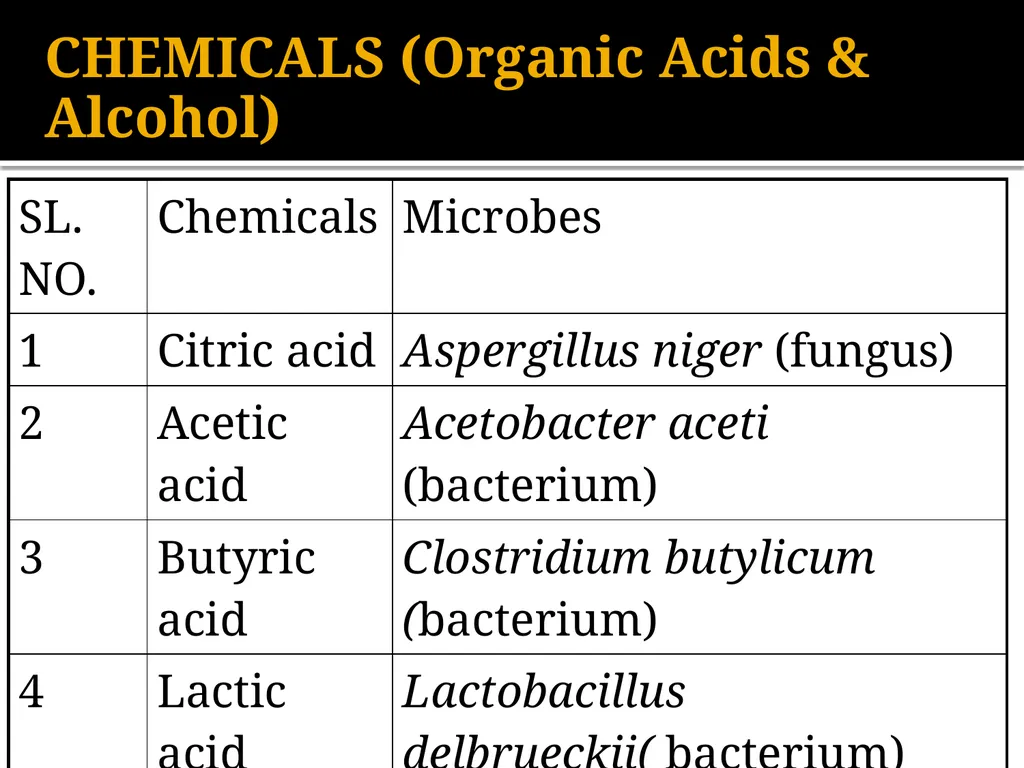
slide29. CHEMICALS (Organic Acids & Alcohol)<br>
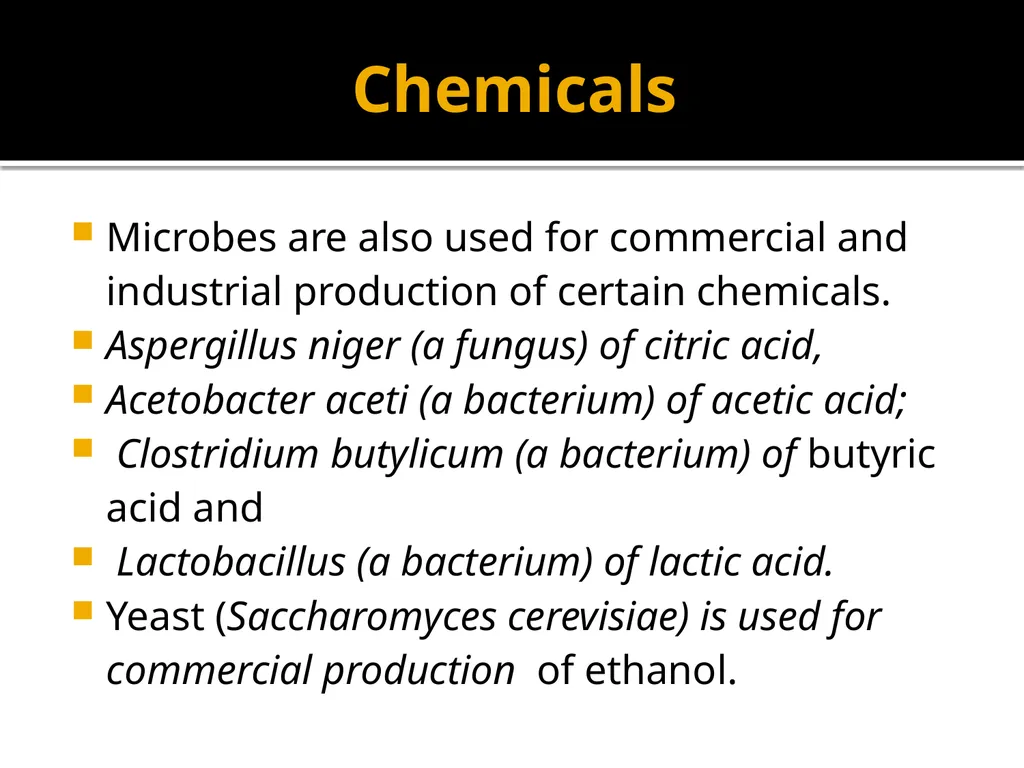
slide30. Chemicals Microbes are also used for commercial and industrial production of certain chemicals.
Aspergillus niger (a fungus) of citric acid,
Acetobacter aceti (a bacterium) of acetic acid;
Clostridium butylicum (a bacterium) of butyric acid and
Lactobacillus (a bacterium) of lactic acid.
Yeast (Saccharomyces cerevisiae) is used for commercial production of ethanol.<br>
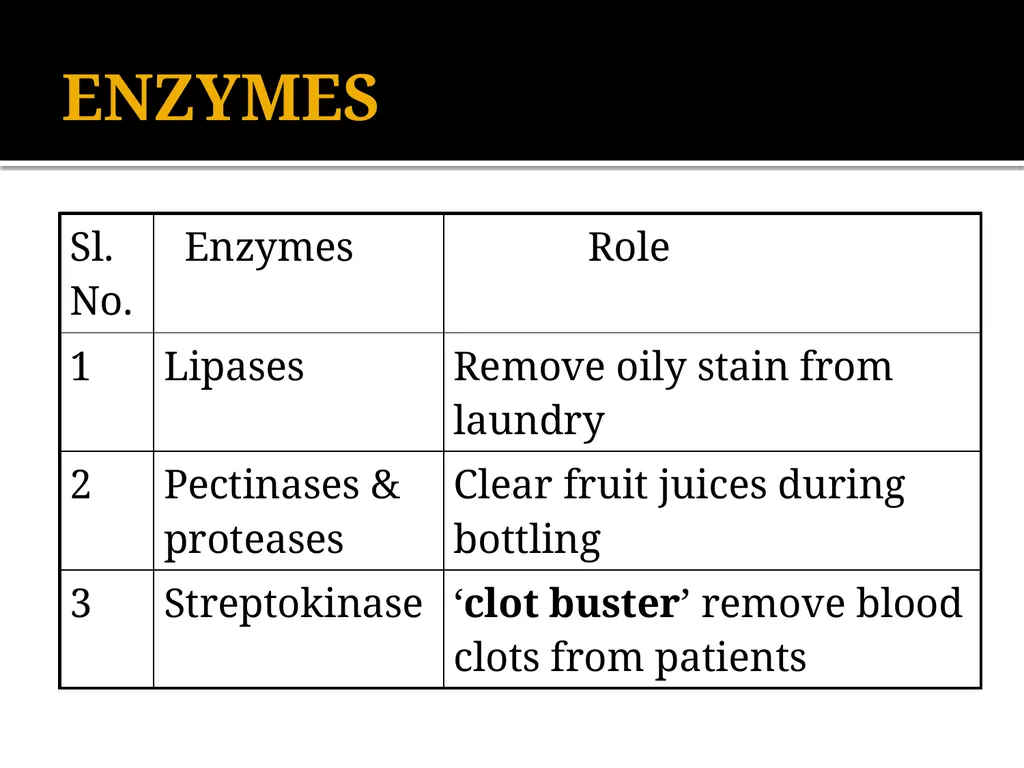
slide31. ENZYMES<br>
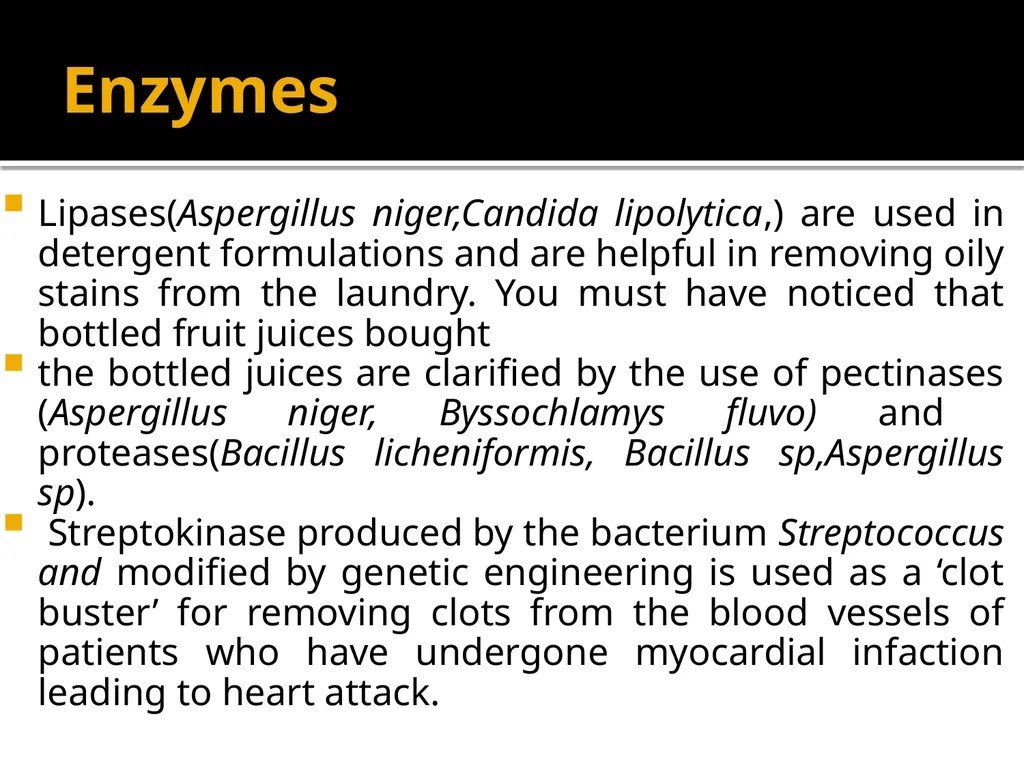
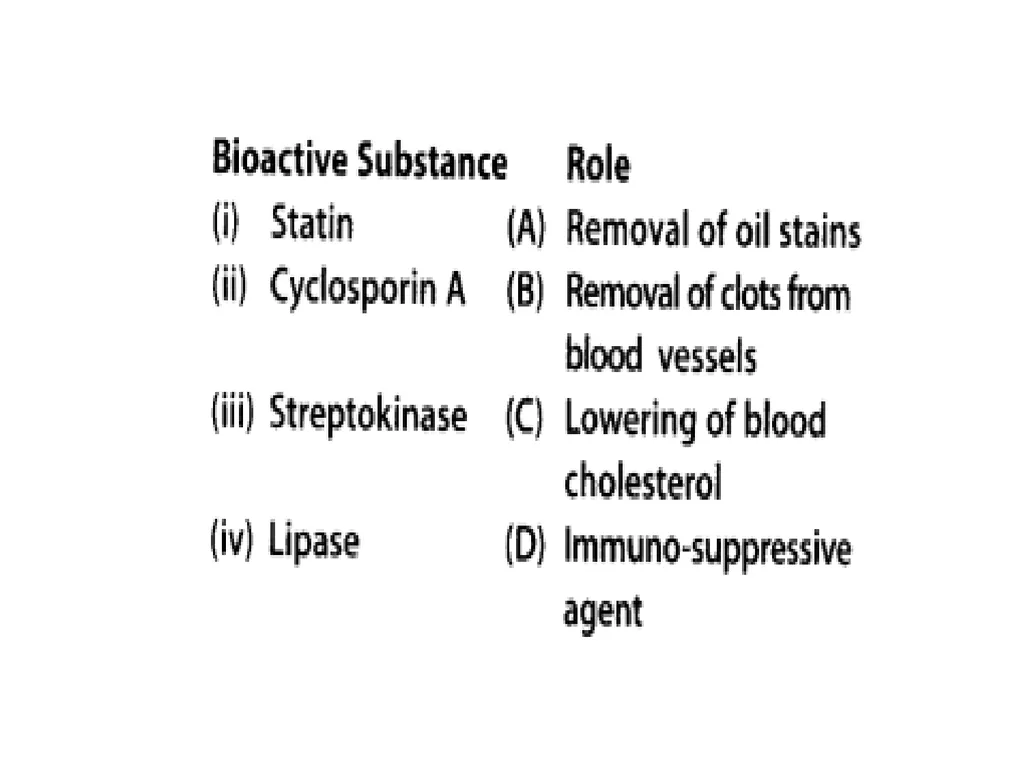
slide32. Enzymes Lipases(Aspergillus niger,Candida lipolytica,) are used in detergent formulations and are helpful in removing oily stains from the laundry. You must have noticed that bottled fruit juices bought
the bottled juices are clarified by the use of pectinases (Aspergillus niger, Byssochlamys fluvo) and proteases(Bacillus licheniformis, Bacillus sp,Aspergillus sp).
Streptokinase produced by the bacterium Streptococcus and modified by genetic engineering is used as a ‘clot buster’ for removing clots from the blood vessels of patients who have undergone myocardial infaction leading to heart attack.<br>
slide33. BIOACTIVE MOLECULES<br>
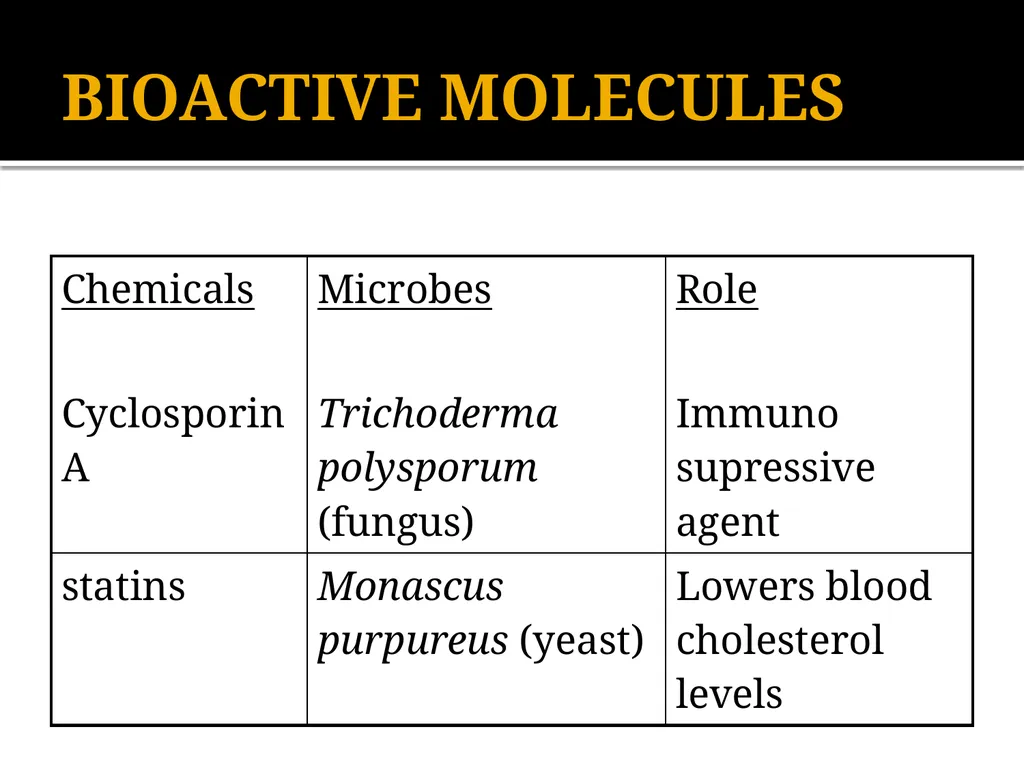
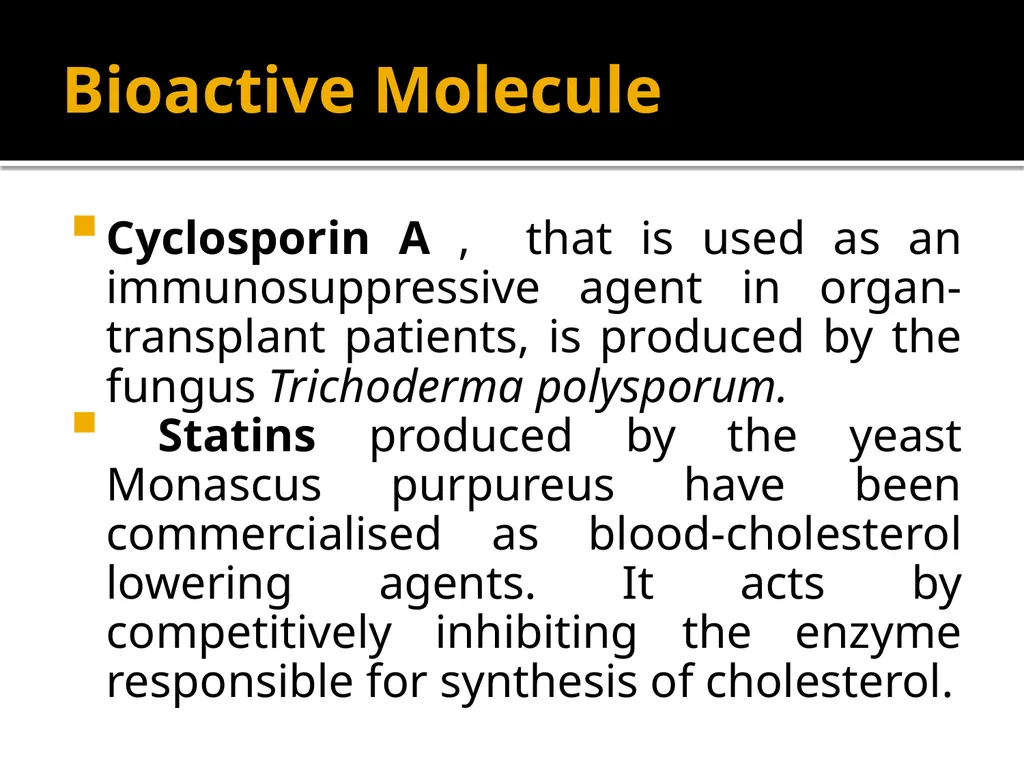
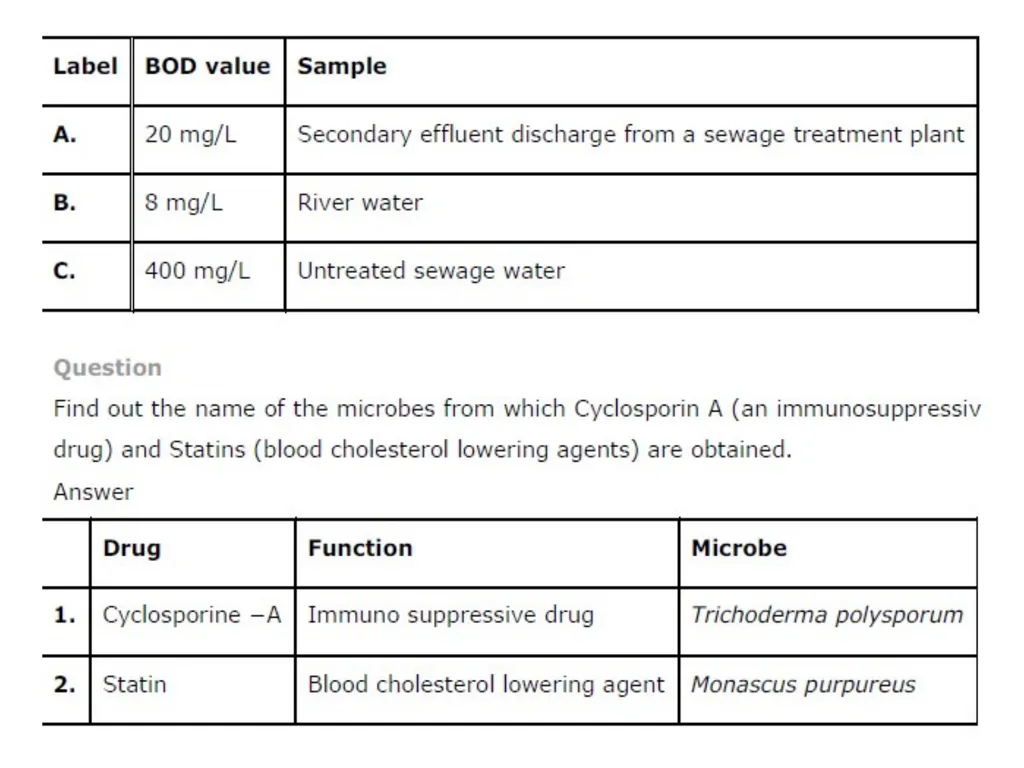
slide35. Bioactive Molecule Cyclosporin A , that is used as an immunosuppressive agent in organ-transplant patients, is produced by the fungus Trichoderma polysporum.
Statins produced by the yeast Monascus purpureus have been commercialised as blood-cholesterol lowering agents. It acts by competitively inhibiting the enzyme responsible for synthesis of cholesterol.<br>
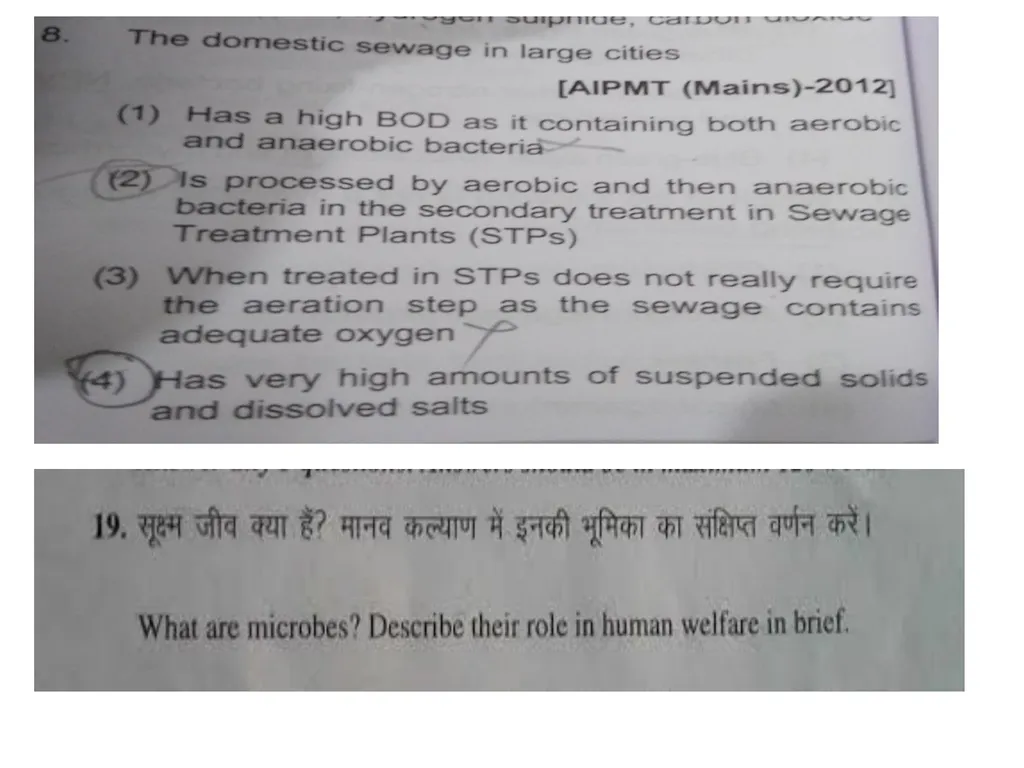
slide36. Microbes in sewage treatment:
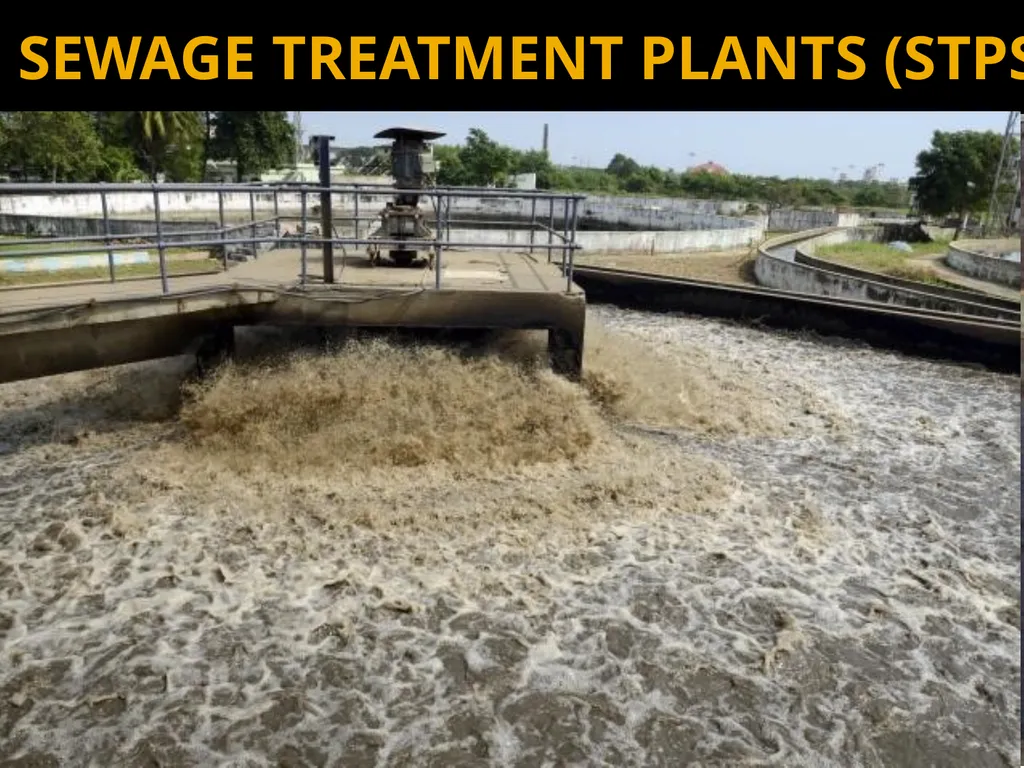
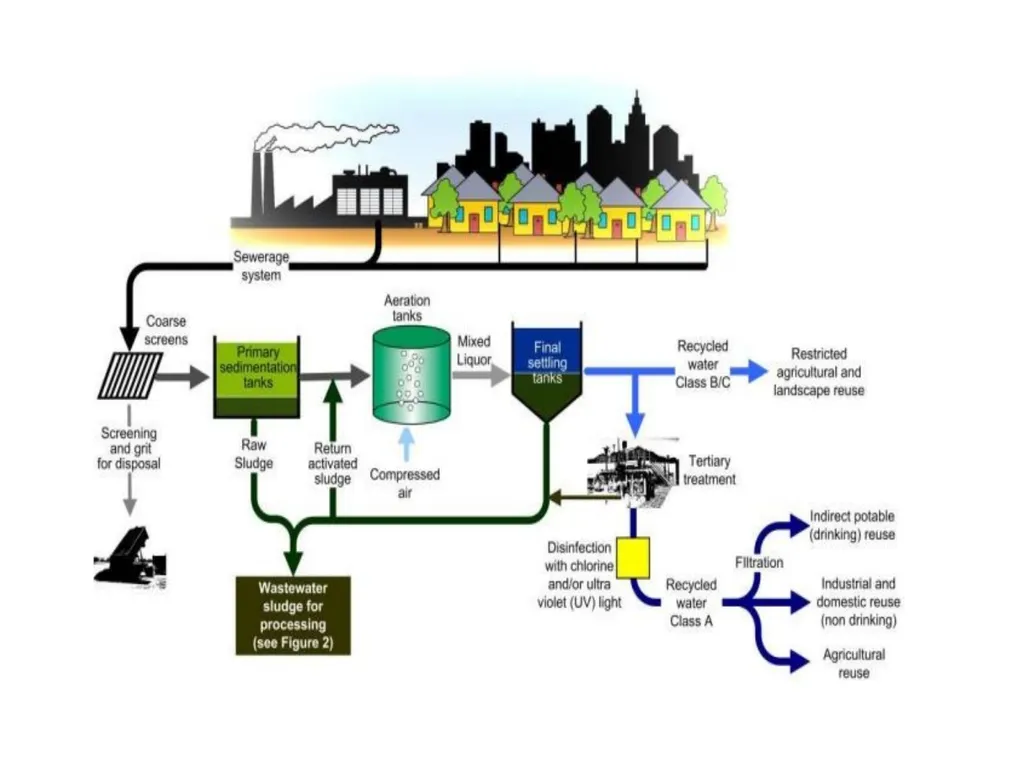
Sewage is the municipal waste water containing large human excreta. It contains organic waste and pathogens.
Before discharging into natural water bodies sewage water is made less polluted by treating in sewage treatment plants (STPs).<br>
slide37. SEWAGE TREATMENT PLANTS (STPS)<br>
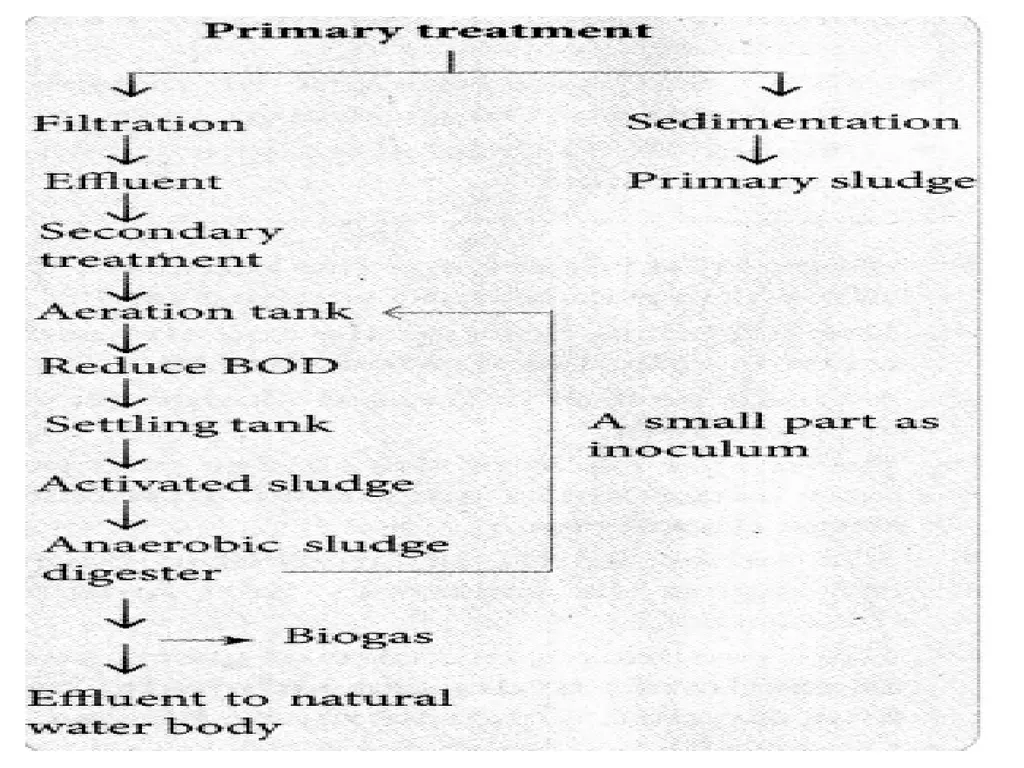
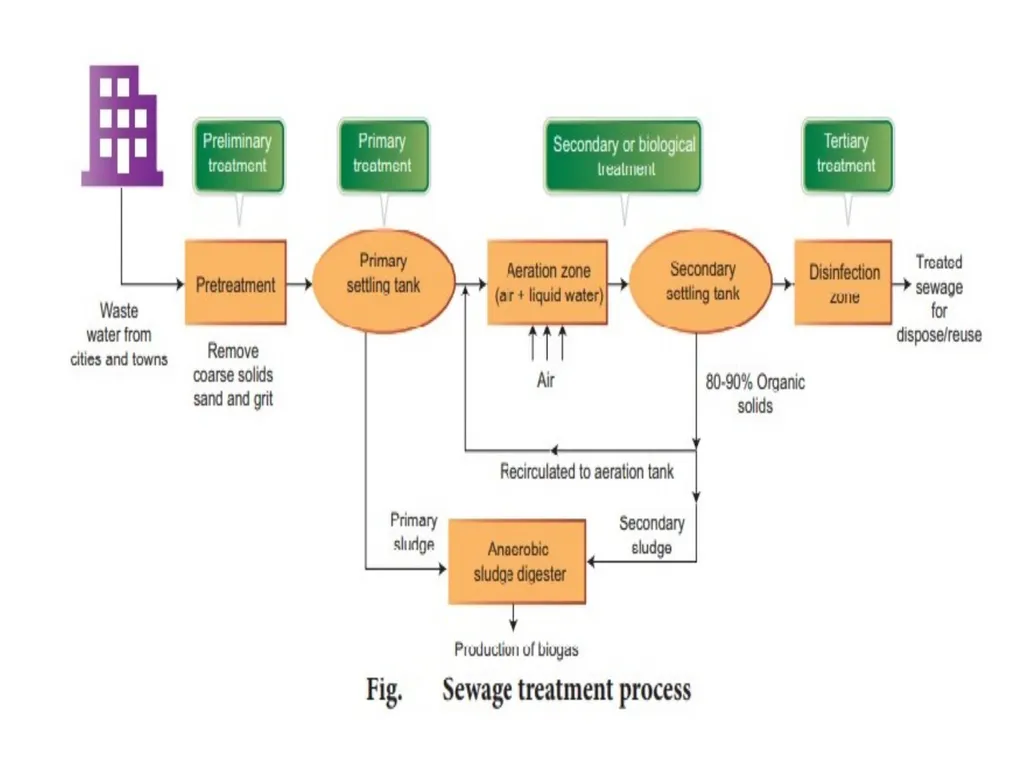
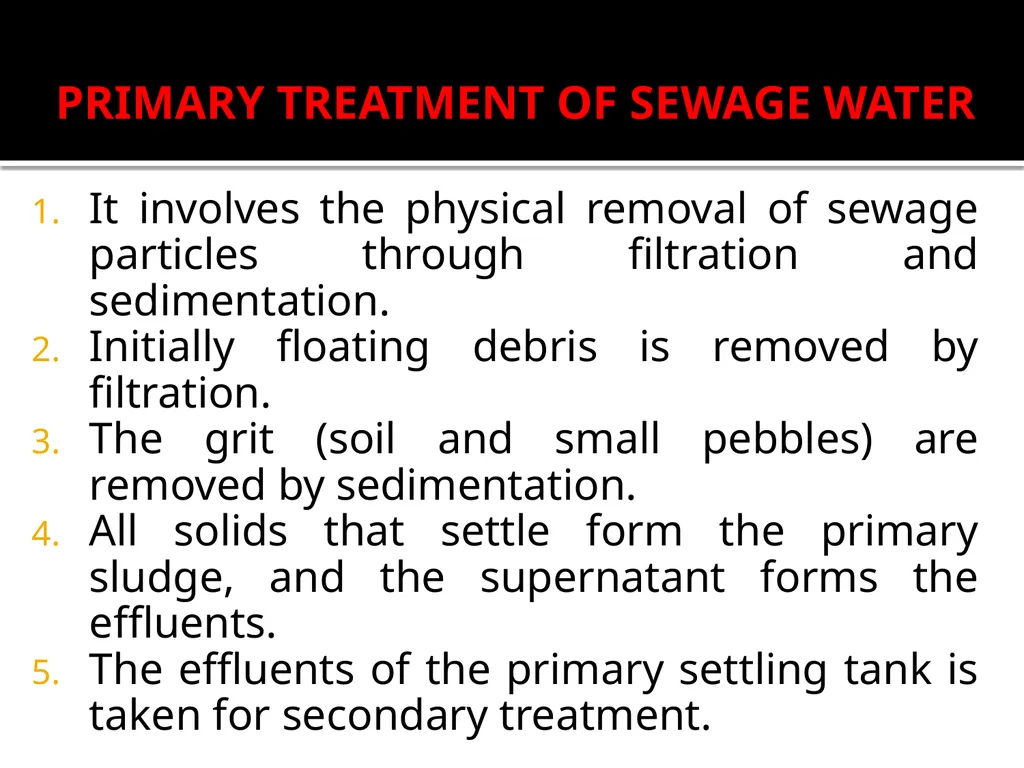
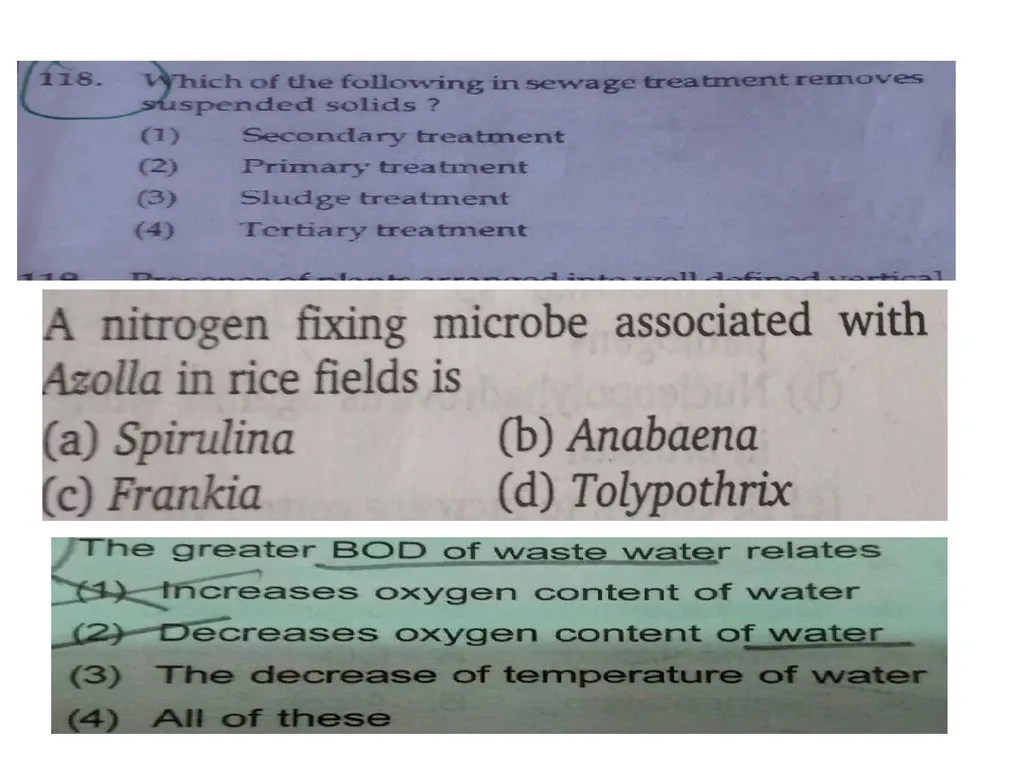
slide41. It involves the physical removal of sewage particles through filtration and sedimentation.
Initially floating debris is removed by filtration.
The grit (soil and small pebbles) are removed by sedimentation.
All solids that settle form the primary sludge, and the supernatant forms the effluents.
The effluents of the primary settling tank is taken for secondary treatment. PRIMARY TREATMENT OF SEWAGE WATER<br>
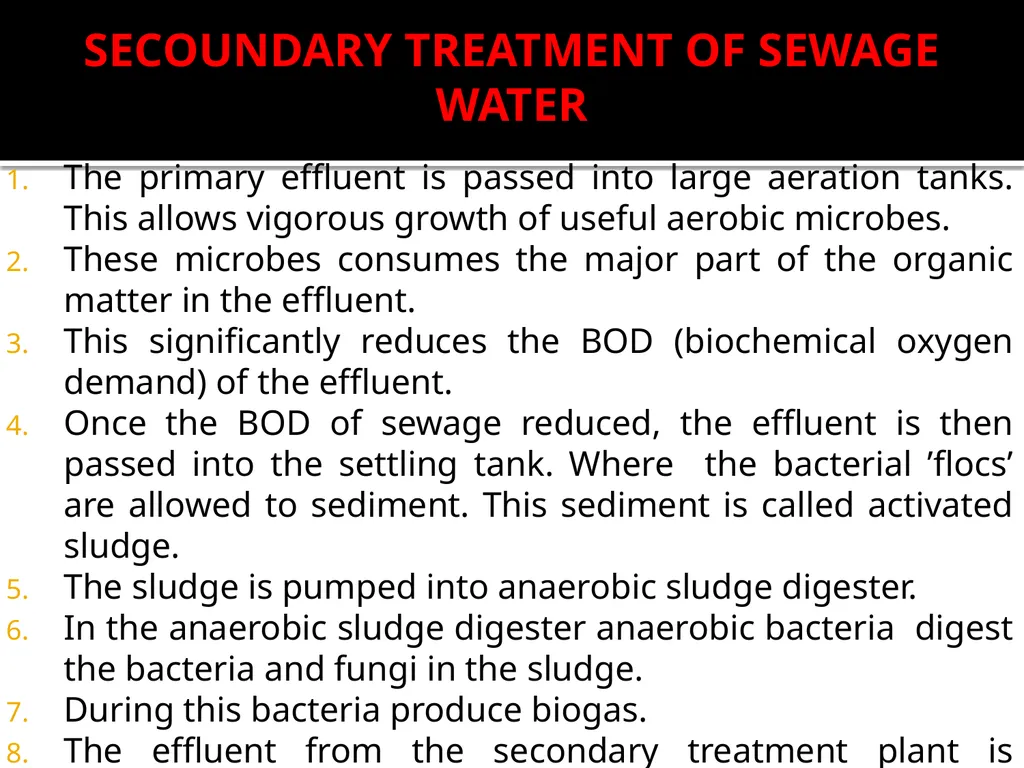
slide42. The primary effluent is passed into large aeration tanks. This allows vigorous growth of useful aerobic microbes.
These microbes consumes the major part of the organic matter in the effluent.
This significantly reduces the BOD (biochemical oxygen demand) of the effluent.
Once the BOD of sewage reduced, the effluent is then passed into the settling tank. Where the bacterial ’flocs’ are allowed to sediment. This sediment is called activated sludge.
The sludge is pumped into anaerobic sludge digester.
In the anaerobic sludge digester anaerobic bacteria digest the bacteria and fungi in the sludge.
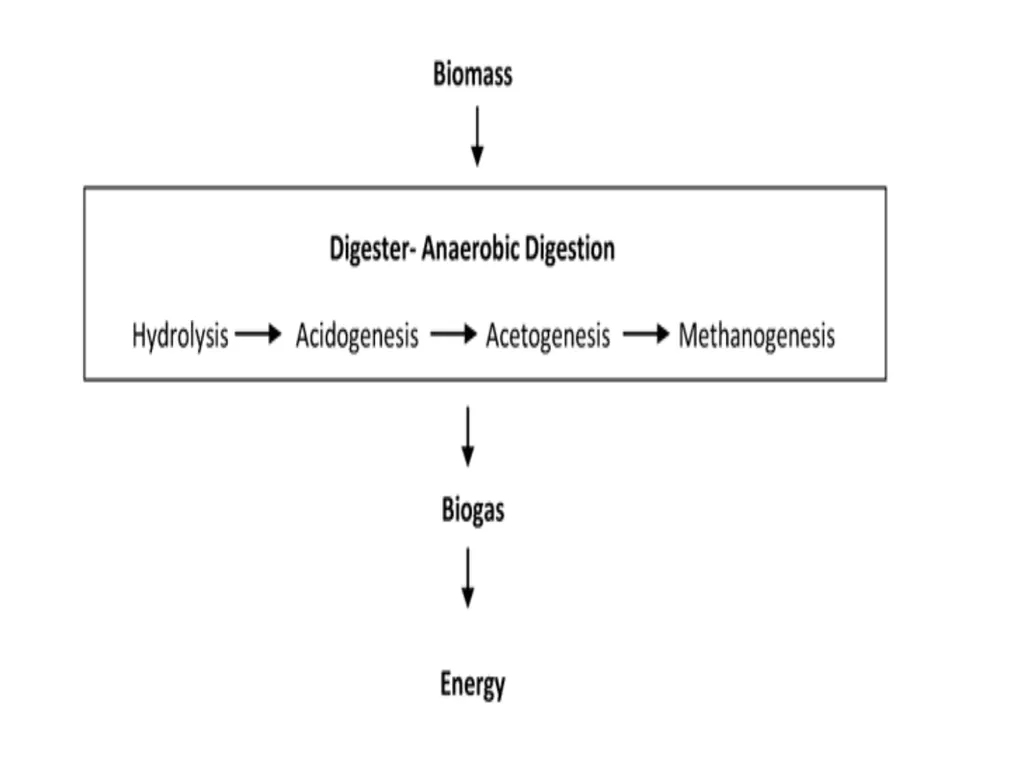
During this bacteria produce biogas.
The effluent from the secondary treatment plant is released into natural water body like rivers and streams. SECOUNDARY TREATMENT OF SEWAGE WATER<br>
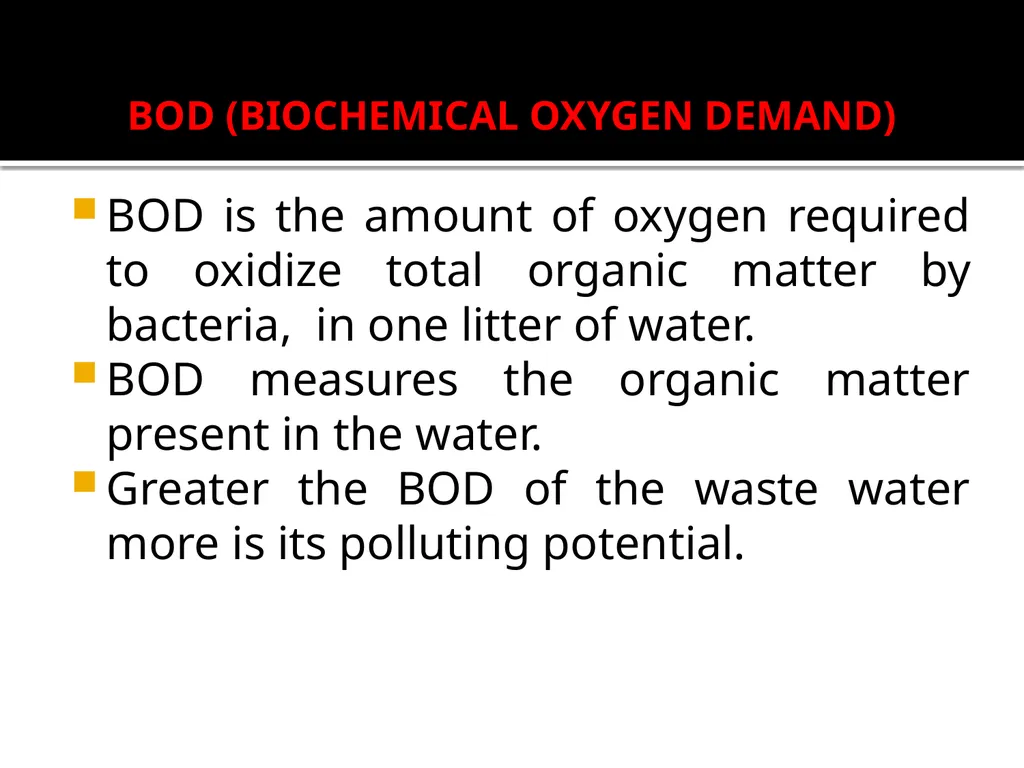
slide43. BOD is the amount of oxygen required to oxidize total organic matter by bacteria, in one litter of water.
BOD measures the organic matter present in the water.
Greater the BOD of the waste water more is its polluting potential. BOD (BIOCHEMICAL OXYGEN DEMAND)<br>
slide45. Biogas plant:
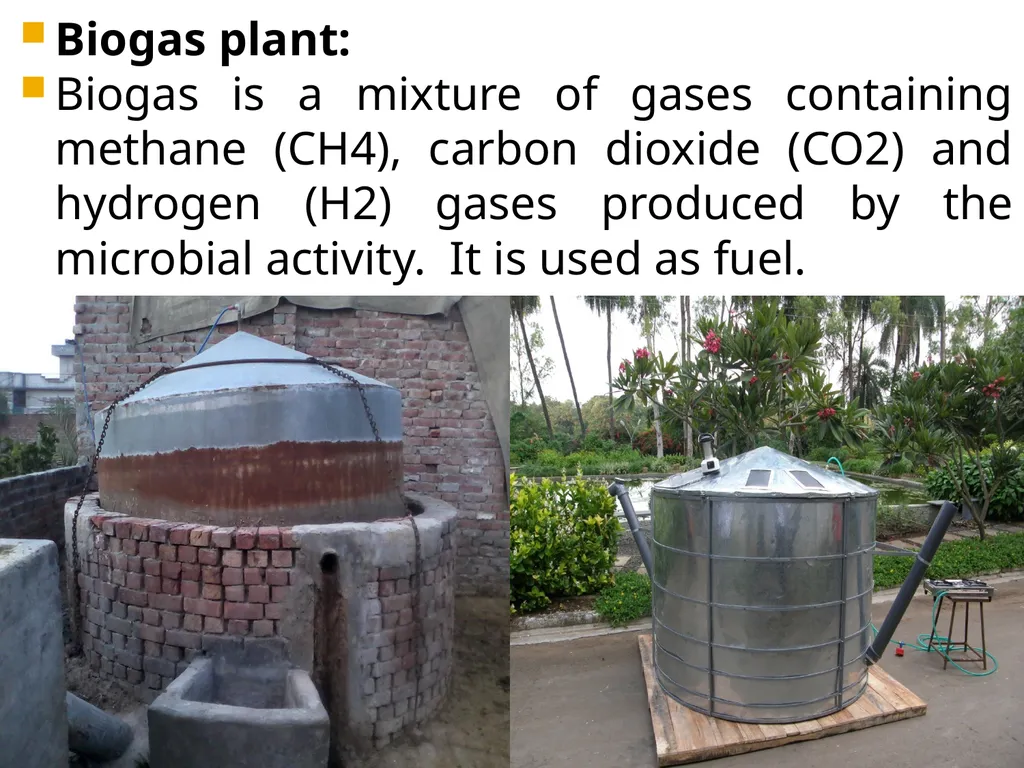
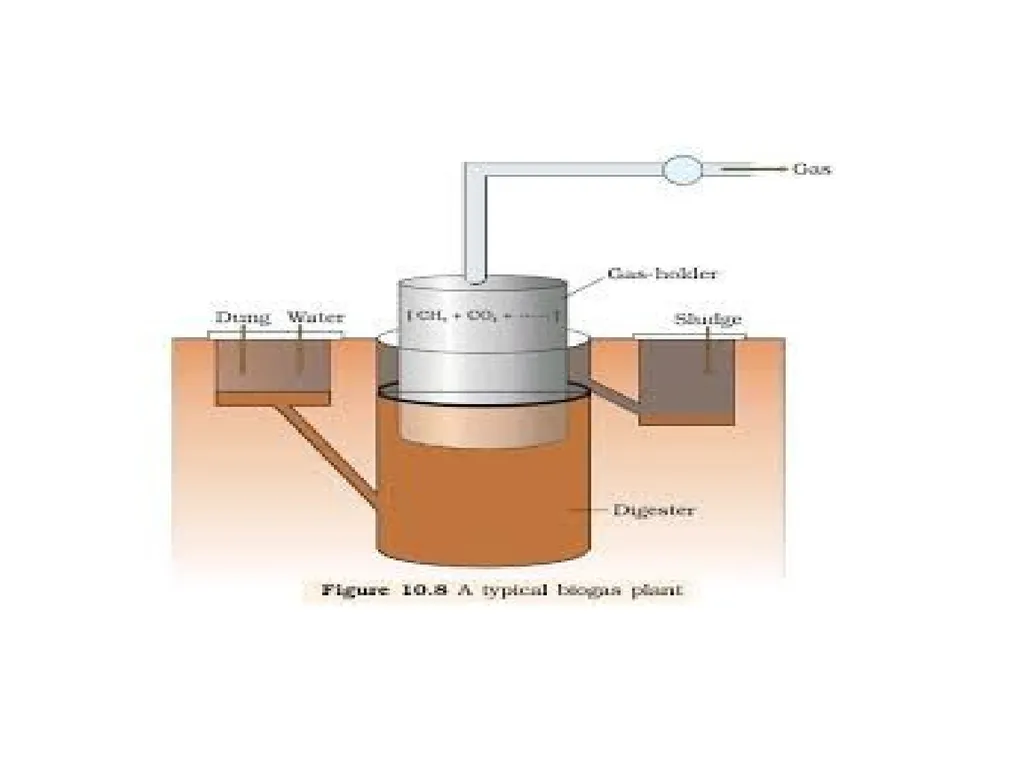
Biogas is a mixture of gases containing methane (CH4), carbon dioxide (CO2) and hydrogen (H2) gases produced by the microbial activity. It is used as fuel.<br>
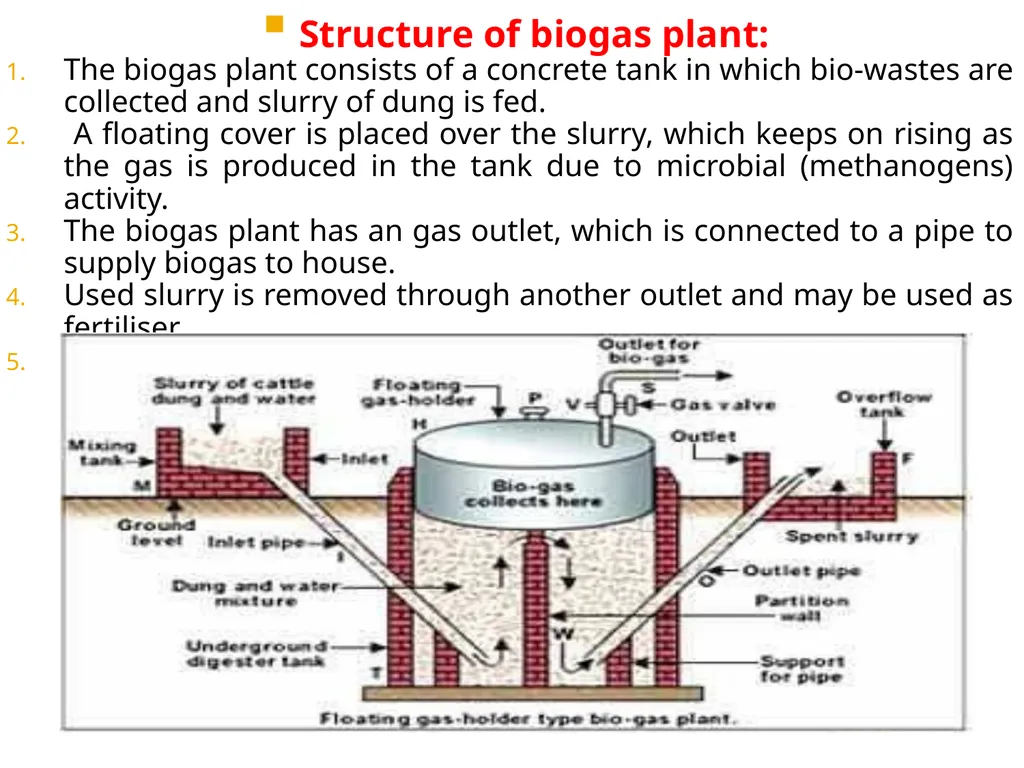
slide50. Structure of biogas plant:
The biogas plant consists of a concrete tank in which bio-wastes are collected and slurry of dung is fed.
A floating cover is placed over the slurry, which keeps on rising as the gas is produced in the tank due to microbial (methanogens) activity.
The biogas plant has an gas outlet, which is connected to a pipe to supply biogas to house.
Used slurry is removed through another outlet and may be used as fertiliser.
The biogas thus produced is used for cooking and lighting.<br>
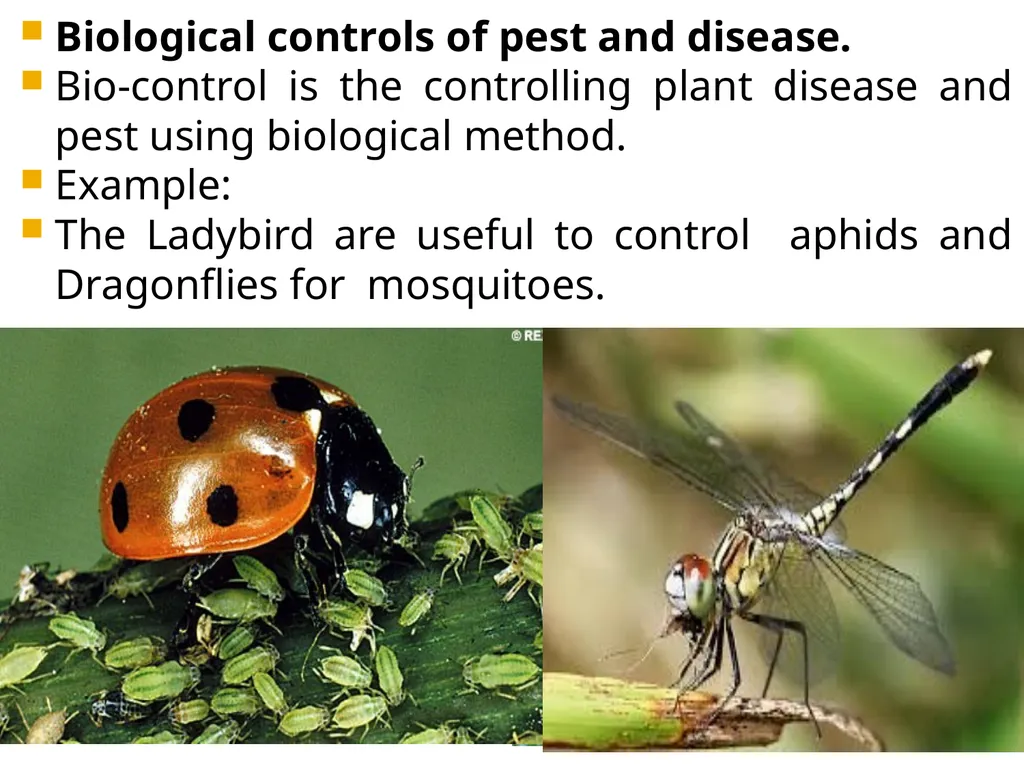
slide51. Biological controls of pest and disease.
Bio-control is the controlling plant disease and pest using biological method.
Example:
The Ladybird are useful to control aphids and Dragonflies for mosquitoes.<br>
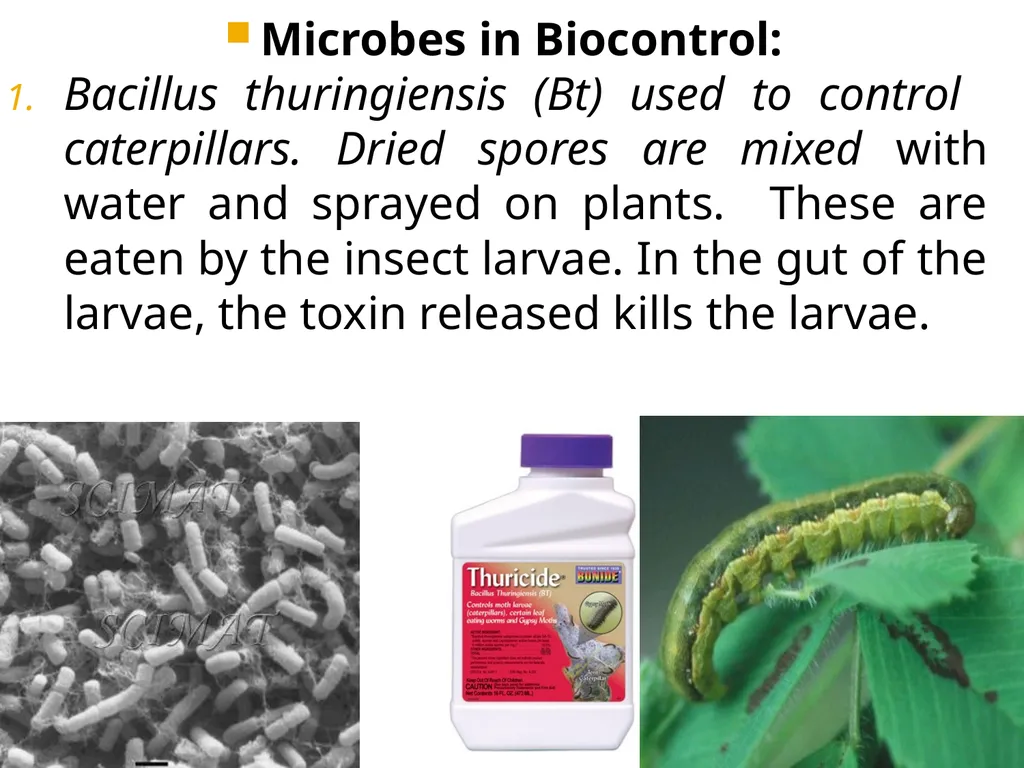
slide52. Microbes in Biocontrol:
Bacillus thuringiensis (Bt) used to control caterpillars. Dried spores are mixed with water and sprayed on plants. These are eaten by the insect larvae. In the gut of the larvae, the toxin released kills the larvae.<br>
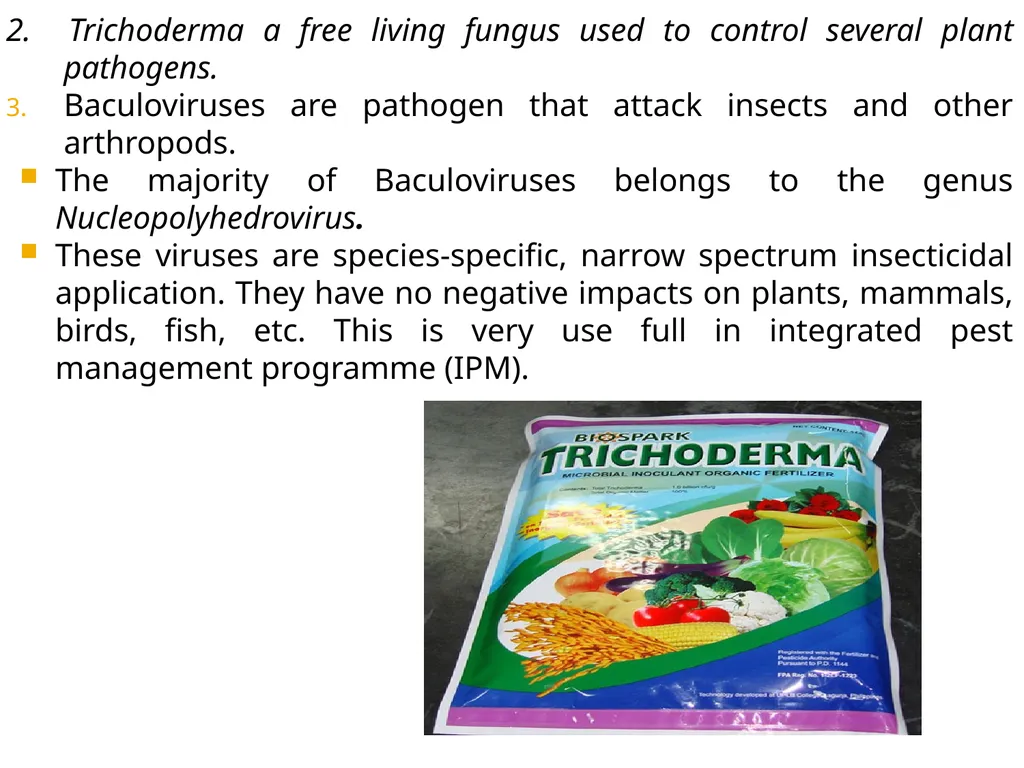
slide53. 2. Trichoderma a free living fungus used to control several plant pathogens.
Baculoviruses are pathogen that attack insects and other arthropods.
The majority of Baculoviruses belongs to the genus Nucleopolyhedrovirus.
These viruses are species-specific, narrow spectrum insecticidal application. They have no negative impacts on plants, mammals, birds, fish, etc. This is very use full in integrated pest management programme (IPM).<br>
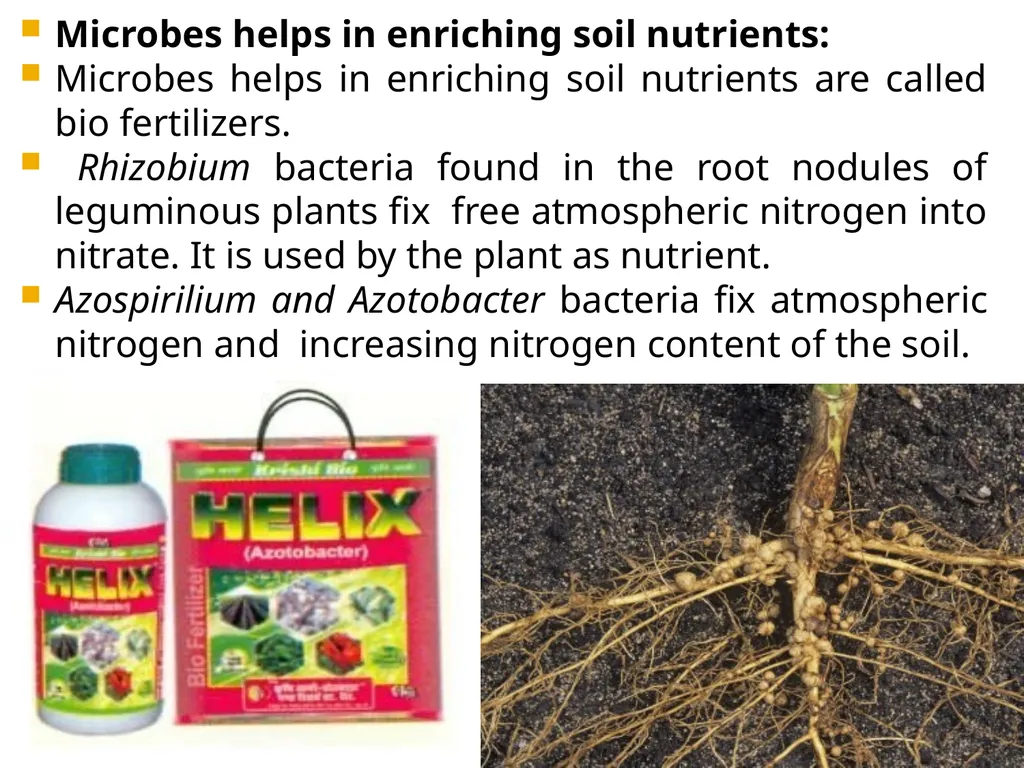
slide54. Microbes helps in enriching soil nutrients:
Microbes helps in enriching soil nutrients are called bio fertilizers.
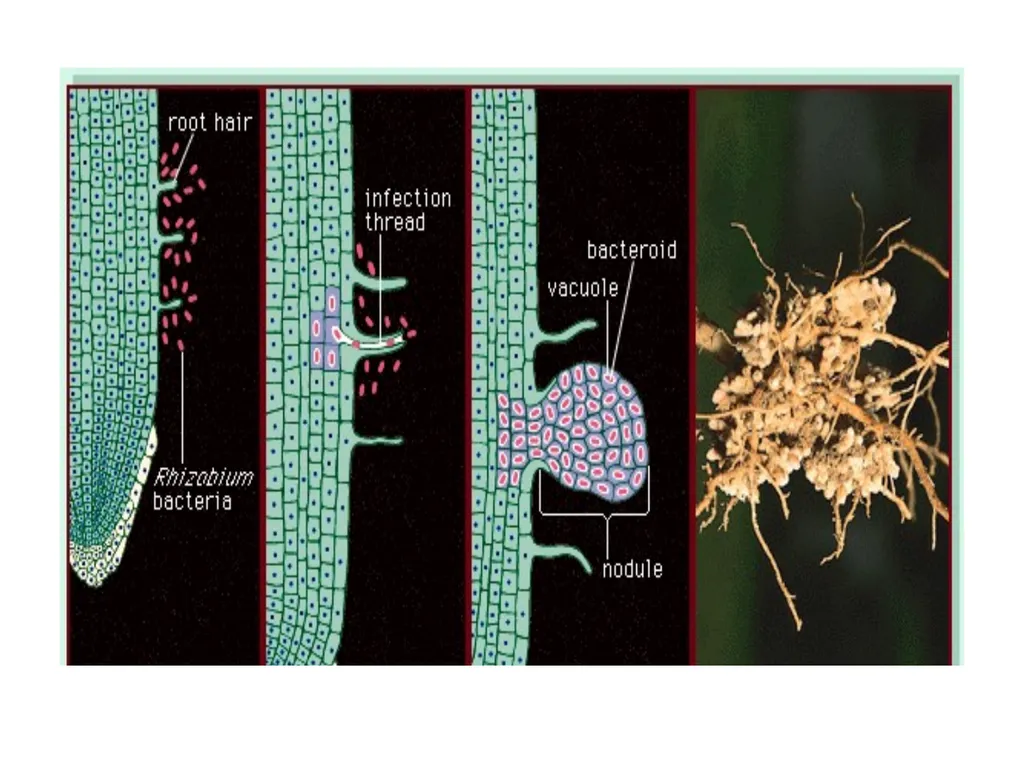
Rhizobium bacteria found in the root nodules of leguminous plants fix free atmospheric nitrogen into nitrate. It is used by the plant as nutrient.
Azospirilium and Azotobacter bacteria fix atmospheric nitrogen and increasing nitrogen content of the soil.<br>
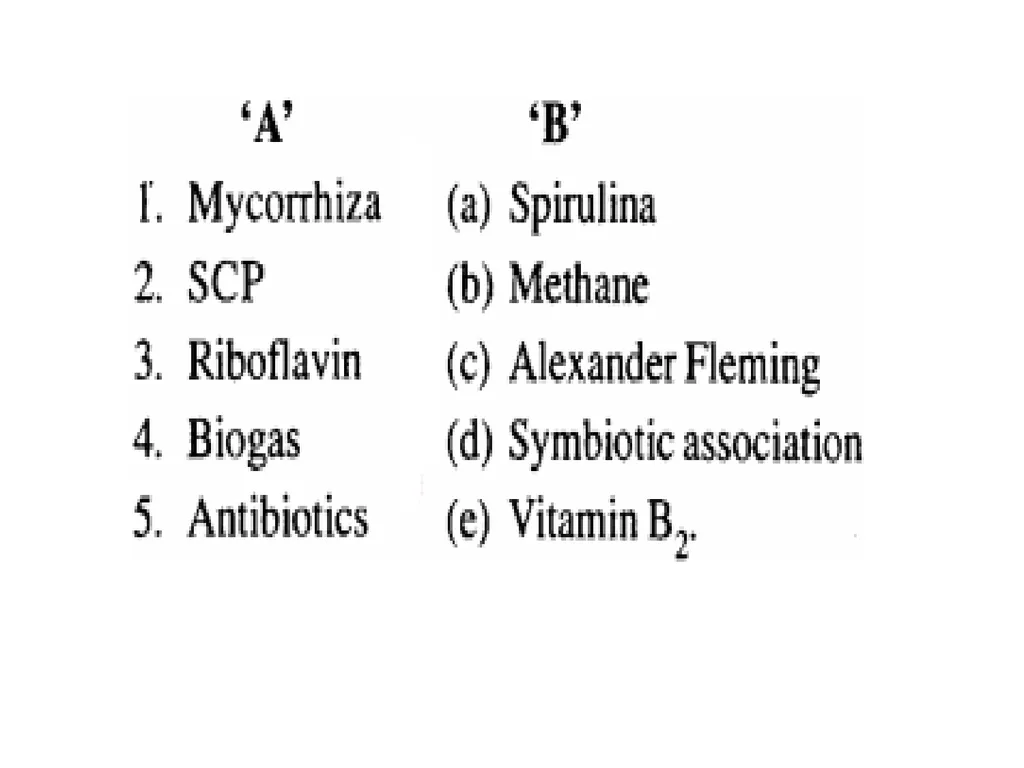
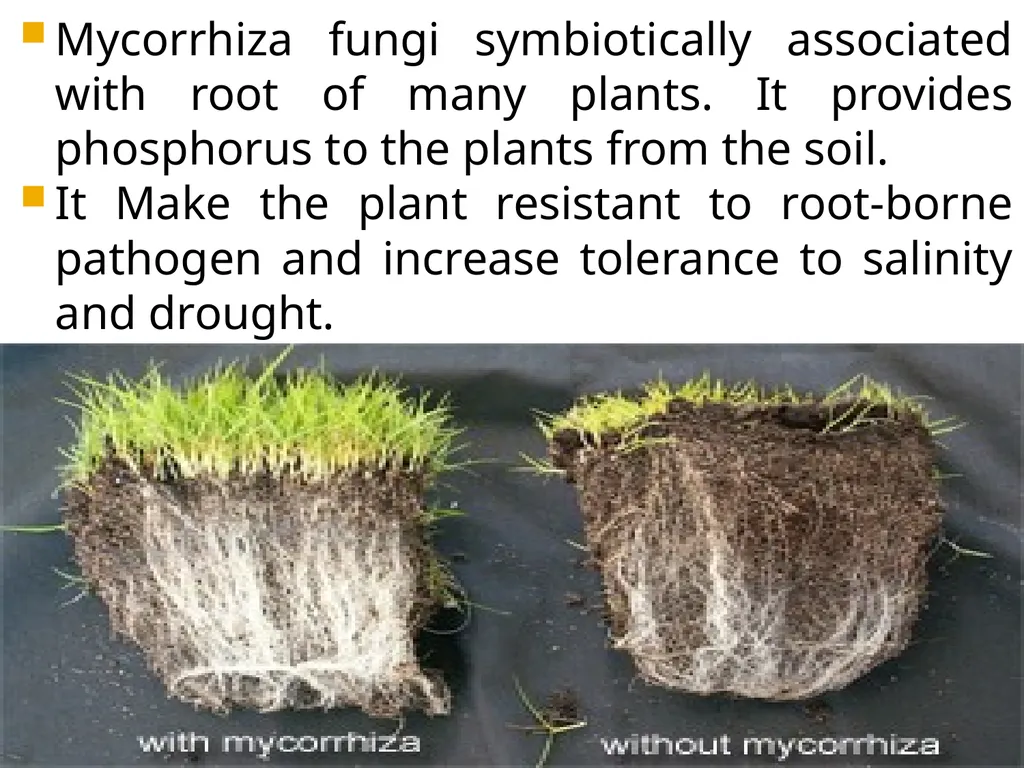
slide55. Mycorrhiza fungi symbiotically associated with root of many plants. It provides phosphorus to the plants from the soil.
It Make the plant resistant to root-borne pathogen and increase tolerance to salinity and drought.<br>
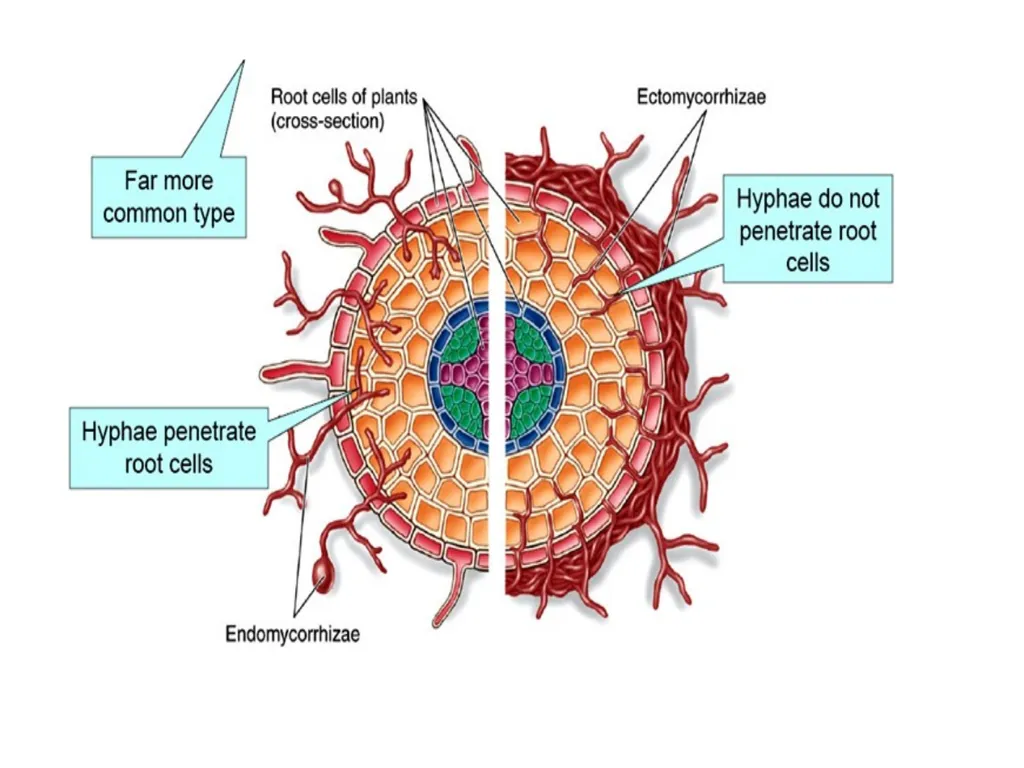
slide56. MYCORRHIZA ECTOMYCORRHIZA- In Pinus,Eucalyptus.
ENDOMYCORRHIZA-The fungal hyphae along with their growth in the inter-cellular space may also invade the inner cellular region forming VESICULAR structure called ARBUSCLE.This type of close association is called VAM(Vesicular Arbuscular Mycorriza). Eg. Orchids,Woody plants<br>
slide59. Cyanobacteria are autotrophic microbes widely distributed in aquatic and terrestrial habitats. Many of which fix atmospheric nitrogen and increase soil fertility.
Ex. Anabaena, Nostoc, and Oscillatoria etc.<br>
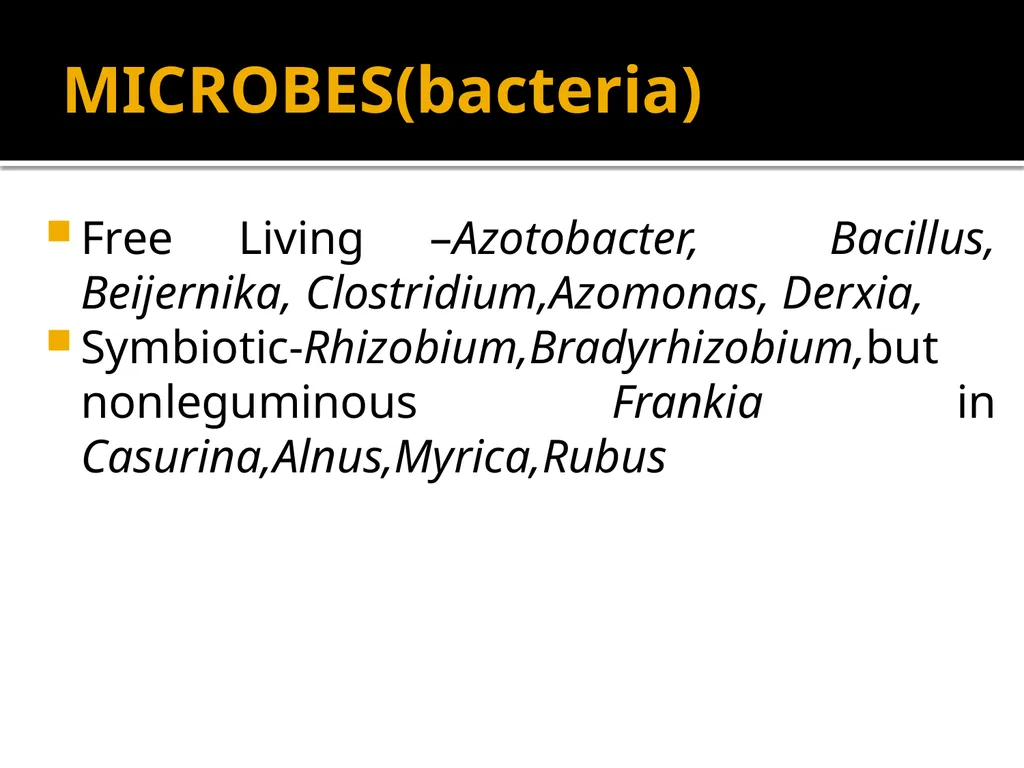
slide60. MICROBES(bacteria) Free Living –Azotobacter, Bacillus, Beijernika, Clostridium,Azomonas, Derxia,
Symbiotic-Rhizobium,Bradyrhizobium,but nonleguminous Frankia in Casurina,Alnus,Myrica,Rubus<br>
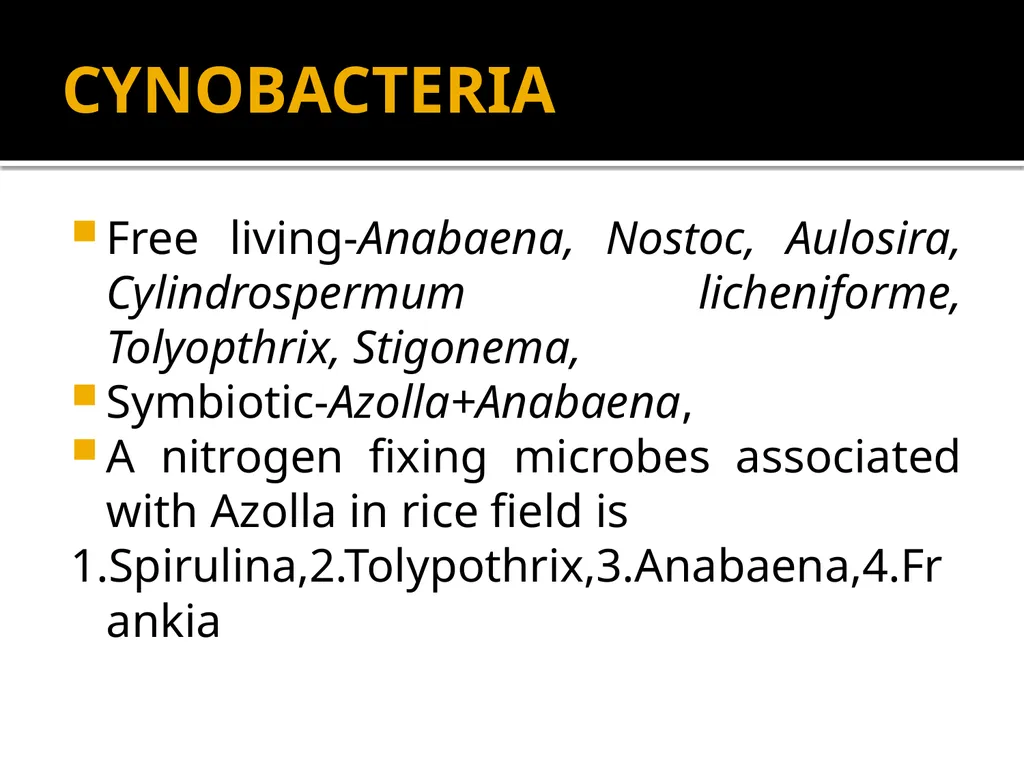
slide61. CYNOBACTERIA Free living-Anabaena, Nostoc, Aulosira, Cylindrospermum licheniforme, Tolyopthrix, Stigonema,
Symbiotic-Azolla+Anabaena,
A nitrogen fixing microbes associated with Azolla in rice field is
1.Spirulina,2.Tolypothrix,3.Anabaena,4.Frankia<br>
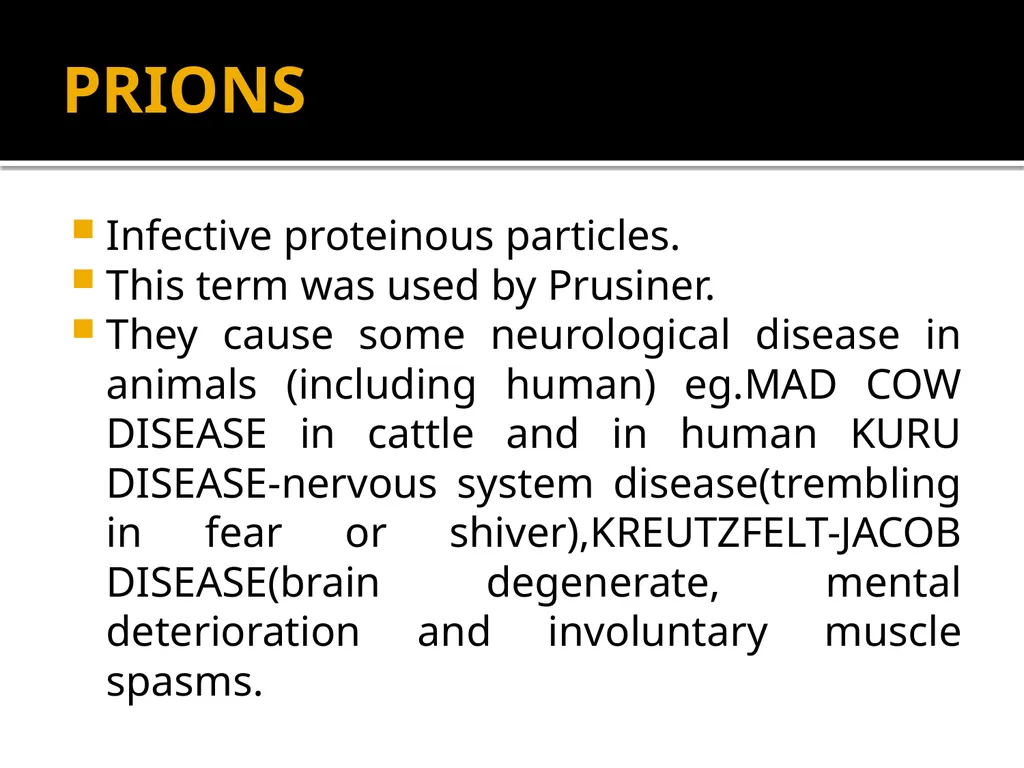
slide62. PRIONS Infective proteinous particles.
This term was used by Prusiner.
They cause some neurological disease in animals (including human) eg.MAD COW DISEASE in cattle and in human KURU DISEASE-nervous system disease(trembling in fear or shiver),KREUTZFELT-JACOB DISEASE(brain degenerate, mental deterioration and involuntary muscle spasms.<br>
Microbes in Human Welfare<br>
slide2. USEFUL ASPECTS OF MICROBES<br>
slide3. MICROBES Microbes are diverse–
1.Protozoa,
2.Bacteria,
3. Fungi
4. Viruses,
5. Viroids and
6. Prions that are Proteinacious infectious agents.
Some of the microbes are shown in Figures 10.1 and 10.2. in NCERT<br>
slide5. MICROBES IN HOUSEHOLD PRODUCTS<br>
slide7. MICROBES IN HOUSEHOLD PRODUCTS-BACTERIA Production of curd from milk.
Micro-organisms such as Lactobacillus and others commonly called lactic acid bacteria (LAB) grow in milk and convert it to curd.
A.LAB produce acids that coagulate and partially digest the milk proteins. A small amount of curd added to the
B. LAB improves its nutritional quality by increasing vitamin B12.
C. In our stomach too, the LAB play very beneficial role in checking disease causing microbes.<br>
slide8. LAB<br>
slide9. FUNGI The dough, which is used for making foods such as dosa and idli is also fermented by bacteria ,Saccharomyces cerevisae commonly called yeast.
The puffed-up appearance of dough is due to the production of CO2 gas.
Similarly the dough, which is used for making bread, is fermented using baker’s yeast (Saccharomyces cerevisiae).<br>
slide10. Dough and bread:
Dough is made by fermentation of bacteria.
The bread is made fermented by baker yeast Saccharomyces cervisiae.
It is also used in making Idli, dosa etc<br>
slide11. TODDY ‘Toddy’, a traditional drink of some parts of southern India is made by fermenting sap from palms by natural yeasts.
Microbes are also used to ferment fish, soya bean and bamboo shoots to make foods.
Cheese, is one of the oldest food items in which microbes were used. Different varieties of cheese are known by their characteristic texture, flavor and taste, the specificity coming from the microbes used.
For example, the large holes in ‘Swiss cheese’ are due to production of a large amount of CO2 by a bacterium named Propionibacterium sharmanii.
The ‘Roquefort cheese’ are ripened by growing a specific fungi on them, which gives them a particular flavor.<br>
slide13. Cheese :
Cheese is made by partial degradation of milk using microbes.
Large holes in ‘Swiss cheese’ are due to production of large amount of CO2 by a bacteria Propionibacterium sharmanii.<br>
slide15. MICROBES IN INDUSTRIAL PRODUCTS Fermented beverages
Antibiotics
Chemicals
Enzymes
Bioactive molecules<br>
slide17. FERMENTED BEVERAGES (YEAST) Fermentation of fruit juices and malted cereals into ethanol.
Alcoholic drinks-
(a) with distillation-whisky, rum, brandy
(b) without distillation- wine, beer<br>
slide18. MICROBES IN INDUSTRIAL PRODUCTS Beverages and antibiotics are some examples.
Production on an industrial scale, requires growing microbes in very large vessels called fermentors (Figure 10.4).<br>
slide19. Fermented Beverages Microbes especially yeasts have been used from time immemorial for the production of beverages like wine, beer, whisky, brandy or rum.
For this purpose the same yeast Saccharomyces
cerevisiae used for bread-making and
commonly called brewer’s yeast, is used for
fermenting malted cereals and fruit juices, to
produce ethanol.<br>
slide20. BEVERAGES Wine and beer are produced without distillation.
Whereas whisky, brandy and rum are produced by distillation of the fermented broth.
The photograph of a fermentation plant is shown in Figure 10.5.<br>
slide21. Microbes in industrial products:
Fermented beverages:
Alcoholic beverages are formed by fermenting malt and fruit juice by brewer’s yeast Saccharomyces cervisiae.
Wine and beer are produced with out distilation.
Wisky, brandy and rum are formed by distilation.<br>
slide22. Wort is the liquid extracted from the mashing process during the brewing of beer or whisky. Wort contains the sugars, the most important being maltose, that will be fermented by the brewing yeast to produce alcohol. Malting is a process of steeping, germinating and drying grain to convert it into malt. The malt is mainly used for brewing or whisky making, but can also be used to make malt vinegar or malt extract. Various grains are used for malting; the most common are barley, sorghum, wheat and rye.<br>
slide23. ANTIBIOTICS Anti is a Greek word that means ‘against’, and bio means ‘life’, together they mean ‘against life’ (in the context of disease causing organisms); whereas with reference to human beings, they are ‘pro life’ and not against.
The term antibiotic was given by Selman Waksman in 1942.
Antibiotics are chemical substances, which are produced by some microbes and can kill or retard the growth of other (disease-causing) microbes.
Alexander Fleming while working on Staphylococci bacteria, once observed a mould growing in one of his unwashed culture plates around which Staphylococci could not grow.
He found out that it was due to a chemical produced by the mould and he named it Penicillin after the mould Penicillium notatum.<br>
slide24. Antibiotics cont. Full potential as an effective antibiotic was established much later by Ernest Chain and Howard Florey.
This antibiotic was extensively used to treat American soldiers wounded in World War II.
Fleming, Chain and Florey were awarded the Nobel Prize in 1945, for this discovery.<br>
slide25. ANTIBIOTICS Chemical substances, produced by some microbes and can kill or retard the growth of other disease causing microbes.
E.g. Penicillin obtained from fungus Penicillum notatum.<br>
slide26. Antibiotics
Alexander Fleming first discovered antibiotic penicillin from an fungi Penicillium notatum.
Penicillin is extracted by Penicillium notatum
It is used to cure many bacterial diseases.
Streptokinase is extracted by Streptococcus bacteria.
It is used as a ‘clot buster’, for removing clots from the blood vessels of patients who have undergone myocardial infarction.<br>
slide27. SOURCE OF ANTIBIOTICS Streptomycin----------------Streptomyces griseus
Chloromphenicol-----------S.venezuelae
Tetracyclins------------------S.aurofaciens
Erythromycin----------------S.erethreus
Cephlosporin----Cephalosporium acremonium
Bacitracin ----------------Bacillus subtilis
Gramicidin--------------------B.brevis<br>
slide28. Antibiotics Antibiotics have greatly improved our capacity to treat deadly diseases such as plague, whooping cough (kali khansi ), diphtheria (gal ghotu) and leprosy (kusht rog), which used to kill millions all over the globe.
Today, we cannot imagine a world without antibiotics.<br>
slide29. CHEMICALS (Organic Acids & Alcohol)<br>
slide30. Chemicals Microbes are also used for commercial and industrial production of certain chemicals.
Aspergillus niger (a fungus) of citric acid,
Acetobacter aceti (a bacterium) of acetic acid;
Clostridium butylicum (a bacterium) of butyric acid and
Lactobacillus (a bacterium) of lactic acid.
Yeast (Saccharomyces cerevisiae) is used for commercial production of ethanol.<br>
slide31. ENZYMES<br>
slide32. Enzymes Lipases(Aspergillus niger,Candida lipolytica,) are used in detergent formulations and are helpful in removing oily stains from the laundry. You must have noticed that bottled fruit juices bought
the bottled juices are clarified by the use of pectinases (Aspergillus niger, Byssochlamys fluvo) and proteases(Bacillus licheniformis, Bacillus sp,Aspergillus sp).
Streptokinase produced by the bacterium Streptococcus and modified by genetic engineering is used as a ‘clot buster’ for removing clots from the blood vessels of patients who have undergone myocardial infaction leading to heart attack.<br>
slide33. BIOACTIVE MOLECULES<br>
slide35. Bioactive Molecule Cyclosporin A , that is used as an immunosuppressive agent in organ-transplant patients, is produced by the fungus Trichoderma polysporum.
Statins produced by the yeast Monascus purpureus have been commercialised as blood-cholesterol lowering agents. It acts by competitively inhibiting the enzyme responsible for synthesis of cholesterol.<br>
slide36. Microbes in sewage treatment:
Sewage is the municipal waste water containing large human excreta. It contains organic waste and pathogens.
Before discharging into natural water bodies sewage water is made less polluted by treating in sewage treatment plants (STPs).<br>
slide37. SEWAGE TREATMENT PLANTS (STPS)<br>
slide41. It involves the physical removal of sewage particles through filtration and sedimentation.
Initially floating debris is removed by filtration.
The grit (soil and small pebbles) are removed by sedimentation.
All solids that settle form the primary sludge, and the supernatant forms the effluents.
The effluents of the primary settling tank is taken for secondary treatment. PRIMARY TREATMENT OF SEWAGE WATER<br>
slide42. The primary effluent is passed into large aeration tanks. This allows vigorous growth of useful aerobic microbes.
These microbes consumes the major part of the organic matter in the effluent.
This significantly reduces the BOD (biochemical oxygen demand) of the effluent.
Once the BOD of sewage reduced, the effluent is then passed into the settling tank. Where the bacterial ’flocs’ are allowed to sediment. This sediment is called activated sludge.
The sludge is pumped into anaerobic sludge digester.
In the anaerobic sludge digester anaerobic bacteria digest the bacteria and fungi in the sludge.
During this bacteria produce biogas.
The effluent from the secondary treatment plant is released into natural water body like rivers and streams. SECOUNDARY TREATMENT OF SEWAGE WATER<br>
slide43. BOD is the amount of oxygen required to oxidize total organic matter by bacteria, in one litter of water.
BOD measures the organic matter present in the water.
Greater the BOD of the waste water more is its polluting potential. BOD (BIOCHEMICAL OXYGEN DEMAND)<br>
slide45. Biogas plant:
Biogas is a mixture of gases containing methane (CH4), carbon dioxide (CO2) and hydrogen (H2) gases produced by the microbial activity. It is used as fuel.<br>
slide50. Structure of biogas plant:
The biogas plant consists of a concrete tank in which bio-wastes are collected and slurry of dung is fed.
A floating cover is placed over the slurry, which keeps on rising as the gas is produced in the tank due to microbial (methanogens) activity.
The biogas plant has an gas outlet, which is connected to a pipe to supply biogas to house.
Used slurry is removed through another outlet and may be used as fertiliser.
The biogas thus produced is used for cooking and lighting.<br>
slide51. Biological controls of pest and disease.
Bio-control is the controlling plant disease and pest using biological method.
Example:
The Ladybird are useful to control aphids and Dragonflies for mosquitoes.<br>
slide52. Microbes in Biocontrol:
Bacillus thuringiensis (Bt) used to control caterpillars. Dried spores are mixed with water and sprayed on plants. These are eaten by the insect larvae. In the gut of the larvae, the toxin released kills the larvae.<br>
slide53. 2. Trichoderma a free living fungus used to control several plant pathogens.
Baculoviruses are pathogen that attack insects and other arthropods.
The majority of Baculoviruses belongs to the genus Nucleopolyhedrovirus.
These viruses are species-specific, narrow spectrum insecticidal application. They have no negative impacts on plants, mammals, birds, fish, etc. This is very use full in integrated pest management programme (IPM).<br>
slide54. Microbes helps in enriching soil nutrients:
Microbes helps in enriching soil nutrients are called bio fertilizers.
Rhizobium bacteria found in the root nodules of leguminous plants fix free atmospheric nitrogen into nitrate. It is used by the plant as nutrient.
Azospirilium and Azotobacter bacteria fix atmospheric nitrogen and increasing nitrogen content of the soil.<br>
slide55. Mycorrhiza fungi symbiotically associated with root of many plants. It provides phosphorus to the plants from the soil.
It Make the plant resistant to root-borne pathogen and increase tolerance to salinity and drought.<br>
slide56. MYCORRHIZA ECTOMYCORRHIZA- In Pinus,Eucalyptus.
ENDOMYCORRHIZA-The fungal hyphae along with their growth in the inter-cellular space may also invade the inner cellular region forming VESICULAR structure called ARBUSCLE.This type of close association is called VAM(Vesicular Arbuscular Mycorriza). Eg. Orchids,Woody plants<br>
slide59. Cyanobacteria are autotrophic microbes widely distributed in aquatic and terrestrial habitats. Many of which fix atmospheric nitrogen and increase soil fertility.
Ex. Anabaena, Nostoc, and Oscillatoria etc.<br>
slide60. MICROBES(bacteria) Free Living –Azotobacter, Bacillus, Beijernika, Clostridium,Azomonas, Derxia,
Symbiotic-Rhizobium,Bradyrhizobium,but nonleguminous Frankia in Casurina,Alnus,Myrica,Rubus<br>
slide61. CYNOBACTERIA Free living-Anabaena, Nostoc, Aulosira, Cylindrospermum licheniforme, Tolyopthrix, Stigonema,
Symbiotic-Azolla+Anabaena,
A nitrogen fixing microbes associated with Azolla in rice field is
1.Spirulina,2.Tolypothrix,3.Anabaena,4.Frankia<br>
slide62. PRIONS Infective proteinous particles.
This term was used by Prusiner.
They cause some neurological disease in animals (including human) eg.MAD COW DISEASE in cattle and in human KURU DISEASE-nervous system disease(trembling in fear or shiver),KREUTZFELT-JACOB DISEASE(brain degenerate, mental deterioration and involuntary muscle spasms.<br>