
Chapter 10: Servant Leadership Overview Servant
CB
Published · 21 slides · 0 views
1 / 1


Description
Chapter 10: Servant Leadership Overview Servant Leadership Description Servant Leadership Defined Historical Basis of Servant Leadership Ten Characteristics of Servant Leadership Building a Theory about Servant Leadership Peter G.
Related Topics
Share
Embed code
Download this presentation From Below
"Chapter 10: Servant Leadership Overview Servant" is the property of its rightful owner. Permission is granted to download and print the materials on this website for personal, non-commercial use only, and to display it on your personal computer provided you do not modify the materials and that you retain all copyright notices contained in the materials. By downloading content from our website, you accept the terms of this agreement.
Presentation Transcript
01
Chapter 10: Servant Leadership<br>
02
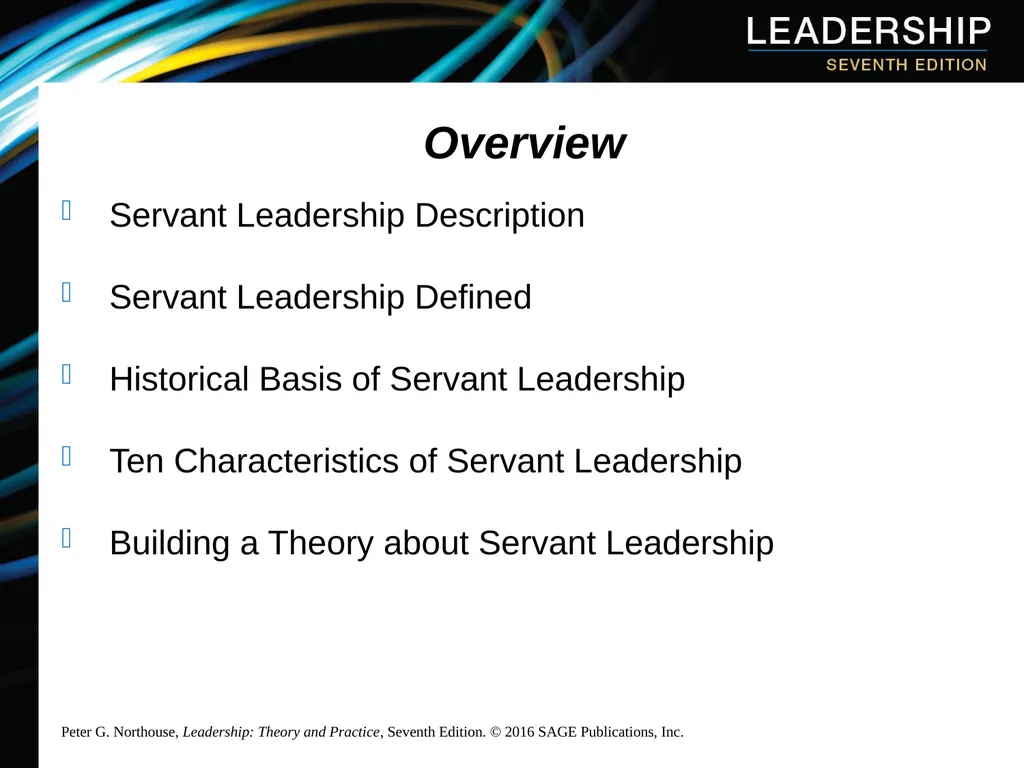
Overview Servant Leadership Description
Servant Leadership Defined
Historical Basis of Servant Leadership
Ten Characteristics of Servant Leadership
Building a Theory about Servant Leadership Peter G. Northouse, Leadership: Theory and Practice, Seventh Edition. © 2016 SAGE Publications, Inc.<br>
Servant Leadership Defined
Historical Basis of Servant Leadership
Ten Characteristics of Servant Leadership
Building a Theory about Servant Leadership Peter G. Northouse, Leadership: Theory and Practice, Seventh Edition. © 2016 SAGE Publications, Inc.<br>
03
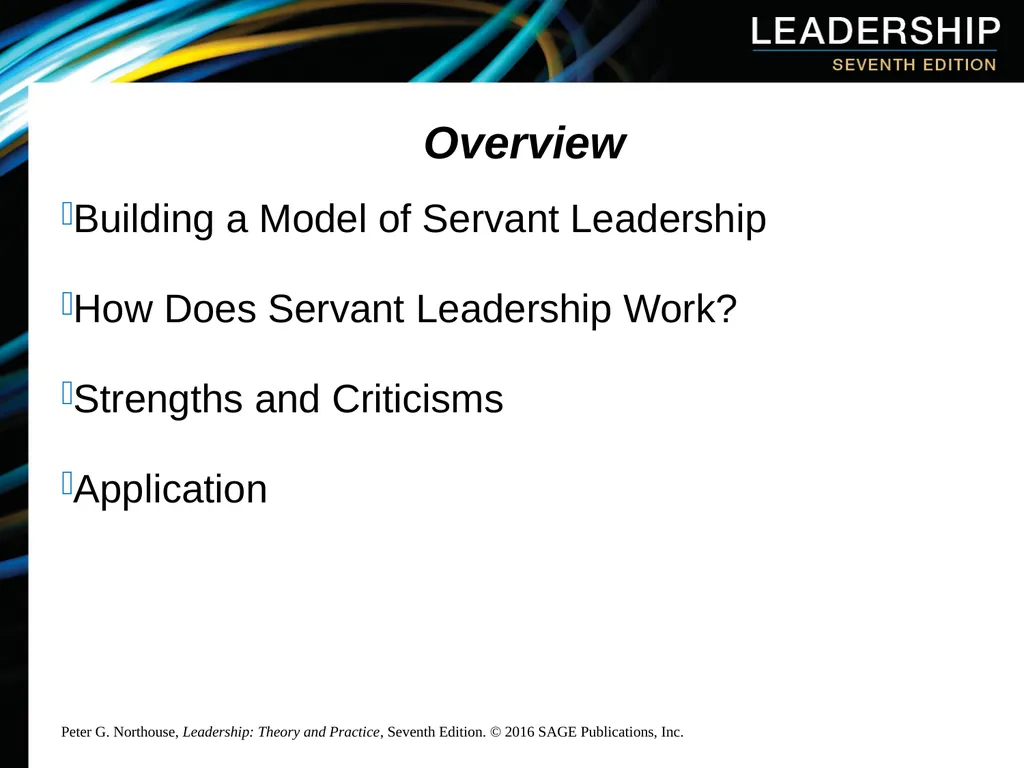
Overview Building a Model of Servant Leadership
How Does Servant Leadership Work?
Strengths and Criticisms
Application Peter G. Northouse, Leadership: Theory and Practice, Seventh Edition. © 2016 SAGE Publications, Inc.<br>
How Does Servant Leadership Work?
Strengths and Criticisms
Application Peter G. Northouse, Leadership: Theory and Practice, Seventh Edition. © 2016 SAGE Publications, Inc.<br>
04
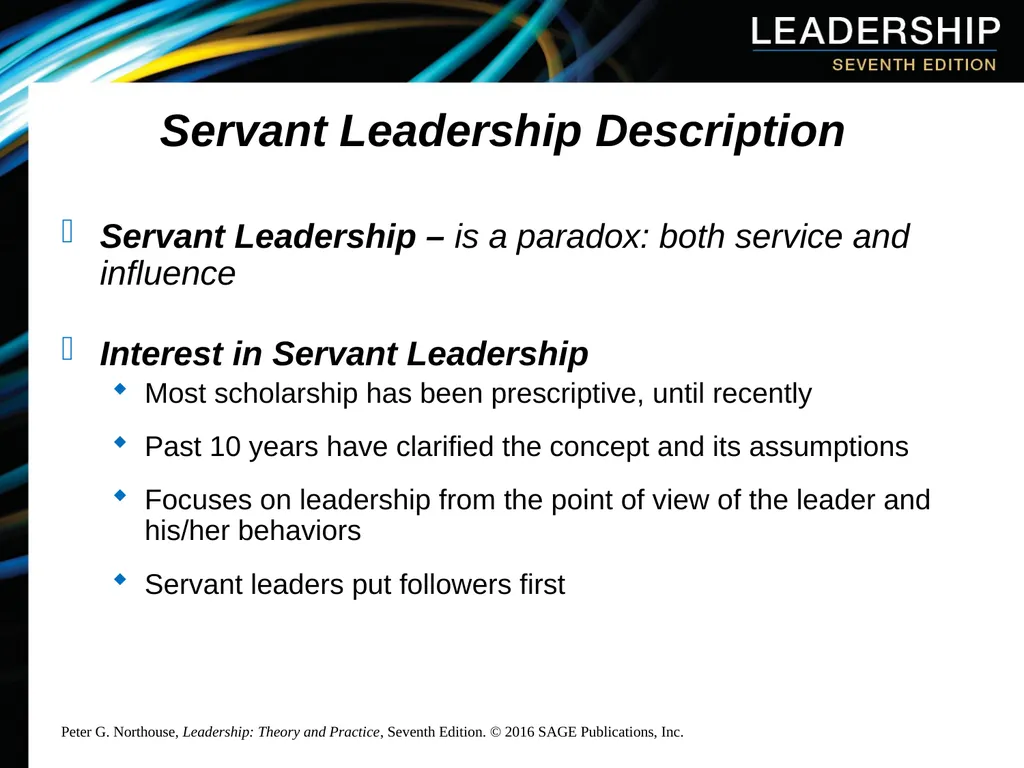
Servant Leadership Description Servant Leadership – is a paradox: both service and influence
Interest in Servant Leadership
Most scholarship has been prescriptive, until recently
Past 10 years have clarified the concept and its assumptions
Focuses on leadership from the point of view of the leader and his/her behaviors
Servant leaders put followers first Peter G. Northouse, Leadership: Theory and Practice, Seventh Edition. © 2016 SAGE Publications, Inc.<br>
Interest in Servant Leadership
Most scholarship has been prescriptive, until recently
Past 10 years have clarified the concept and its assumptions
Focuses on leadership from the point of view of the leader and his/her behaviors
Servant leaders put followers first Peter G. Northouse, Leadership: Theory and Practice, Seventh Edition. © 2016 SAGE Publications, Inc.<br>
05
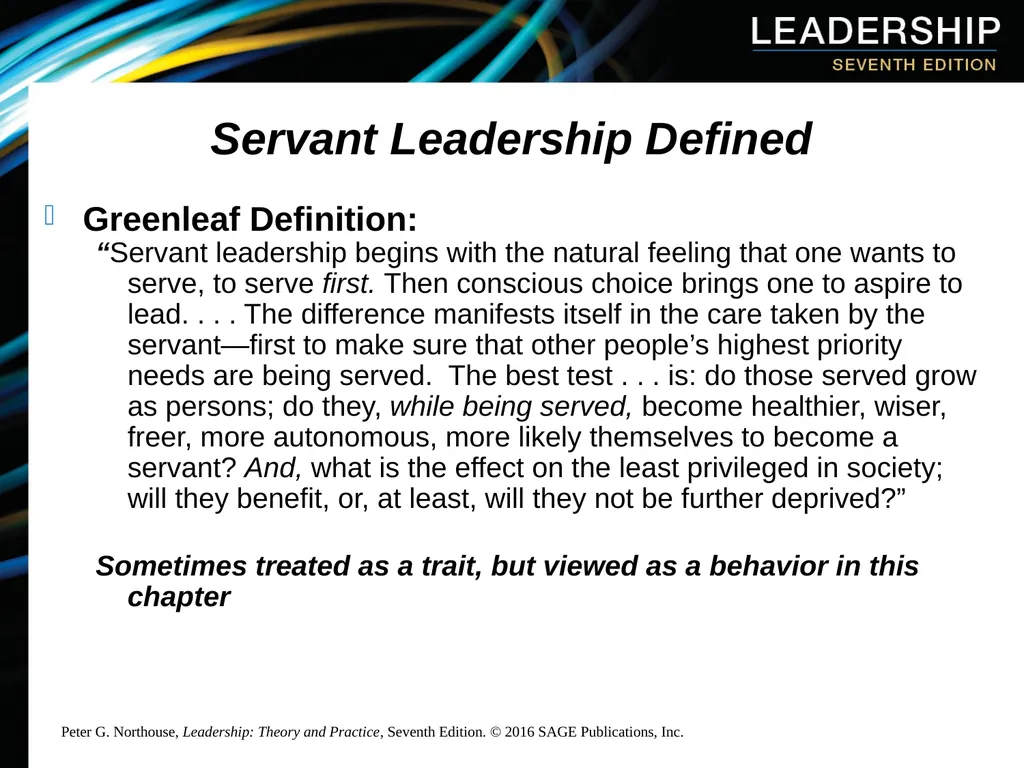
Servant Leadership Defined Greenleaf Definition:
“Servant leadership begins with the natural feeling that one wants to serve, to serve first. Then conscious choice brings one to aspire to lead. . . . The difference manifests itself in the care taken by the servant—first to make sure that other people’s highest priority needs are being served. The best test . . . is: do those served grow as persons; do they, while being served, become healthier, wiser, freer, more autonomous, more likely themselves to become a servant? And, what is the effect on the least privileged in society; will they benefit, or, at least, will they not be further deprived?”
Sometimes treated as a trait, but viewed as a behavior in this chapter Peter G. Northouse, Leadership: Theory and Practice, Seventh Edition. © 2016 SAGE Publications, Inc.<br>
“Servant leadership begins with the natural feeling that one wants to serve, to serve first. Then conscious choice brings one to aspire to lead. . . . The difference manifests itself in the care taken by the servant—first to make sure that other people’s highest priority needs are being served. The best test . . . is: do those served grow as persons; do they, while being served, become healthier, wiser, freer, more autonomous, more likely themselves to become a servant? And, what is the effect on the least privileged in society; will they benefit, or, at least, will they not be further deprived?”
Sometimes treated as a trait, but viewed as a behavior in this chapter Peter G. Northouse, Leadership: Theory and Practice, Seventh Edition. © 2016 SAGE Publications, Inc.<br>
06
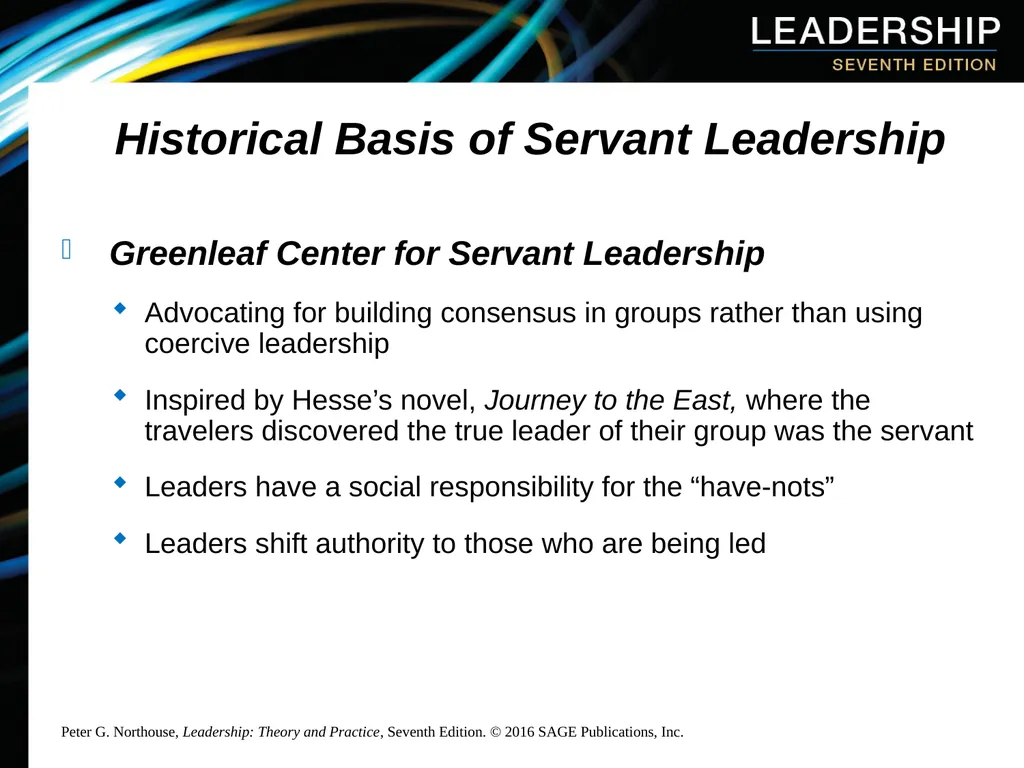
Historical Basis of Servant Leadership Greenleaf Center for Servant Leadership
Advocating for building consensus in groups rather than using coercive leadership
Inspired by Hesse’s novel, Journey to the East, where the travelers discovered the true leader of their group was the servant
Leaders have a social responsibility for the “have-nots”
Leaders shift authority to those who are being led Peter G. Northouse, Leadership: Theory and Practice, Seventh Edition. © 2016 SAGE Publications, Inc.<br>
Advocating for building consensus in groups rather than using coercive leadership
Inspired by Hesse’s novel, Journey to the East, where the travelers discovered the true leader of their group was the servant
Leaders have a social responsibility for the “have-nots”
Leaders shift authority to those who are being led Peter G. Northouse, Leadership: Theory and Practice, Seventh Edition. © 2016 SAGE Publications, Inc.<br>
07
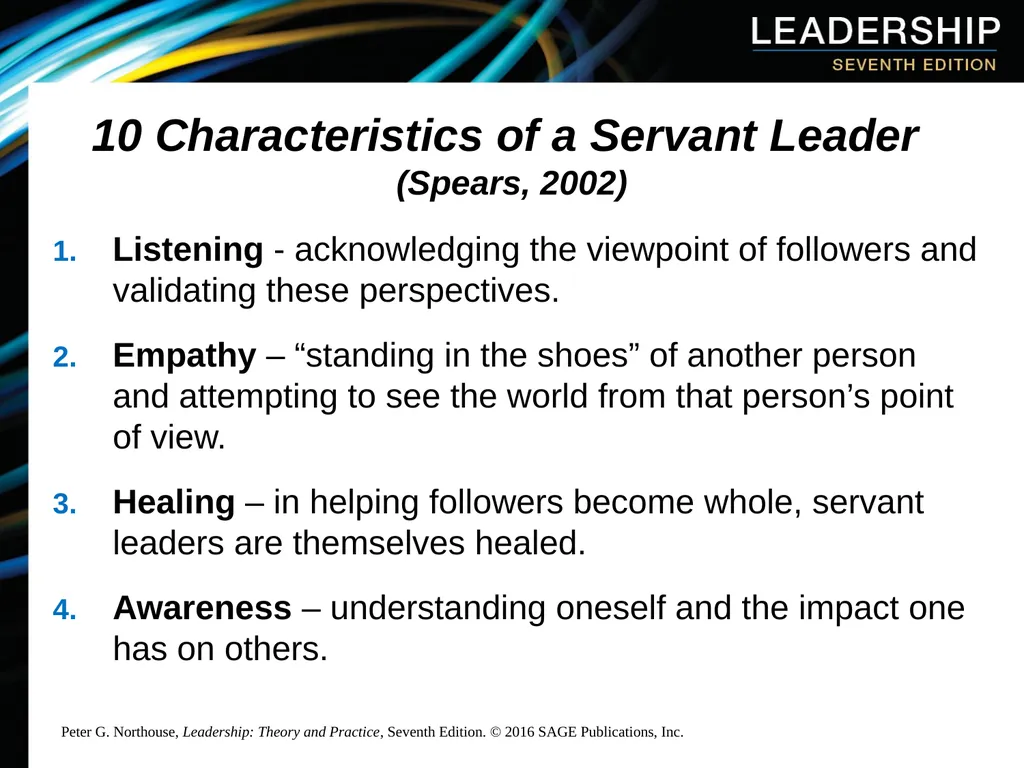
10 Characteristics of a Servant Leader (Spears, 2002) Listening - acknowledging the viewpoint of followers and validating these perspectives.
Empathy – “standing in the shoes” of another person and attempting to see the world from that person’s point of view.
Healing – in helping followers become whole, servant leaders are themselves healed.
Awareness – understanding oneself and the impact one has on others. Peter G. Northouse, Leadership: Theory and Practice, Seventh Edition. © 2016 SAGE Publications, Inc.<br>
Empathy – “standing in the shoes” of another person and attempting to see the world from that person’s point of view.
Healing – in helping followers become whole, servant leaders are themselves healed.
Awareness – understanding oneself and the impact one has on others. Peter G. Northouse, Leadership: Theory and Practice, Seventh Edition. © 2016 SAGE Publications, Inc.<br>
08
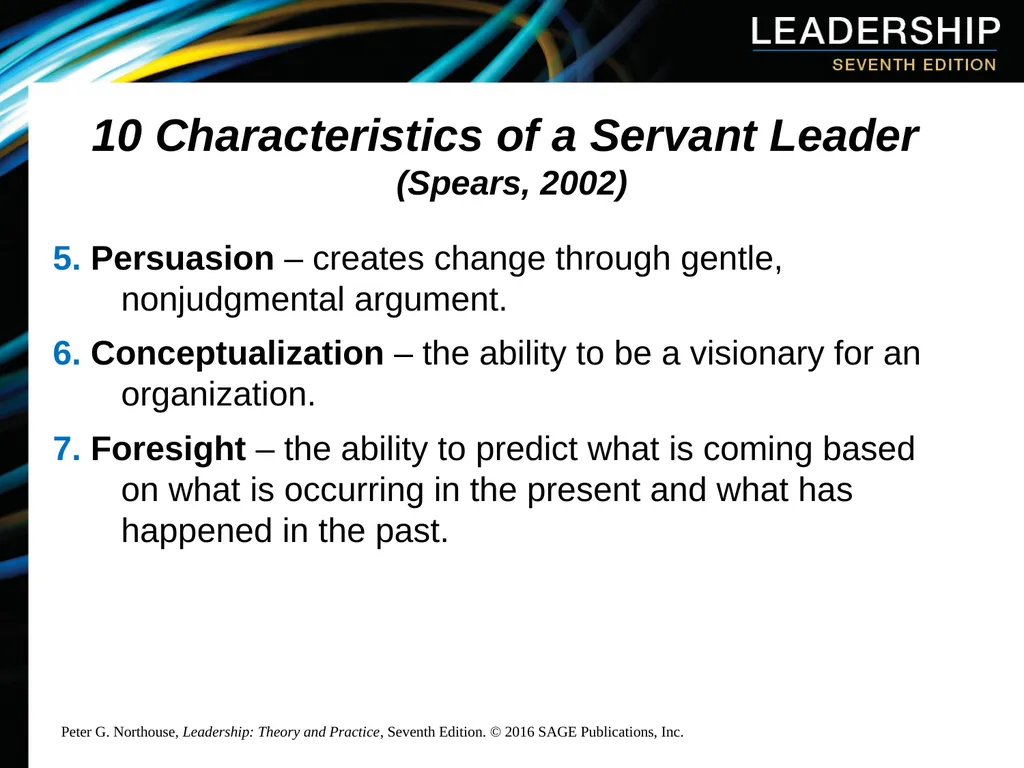
5. Persuasion – creates change through gentle, nonjudgmental argument.
6. Conceptualization – the ability to be a visionary for an organization.
7. Foresight – the ability to predict what is coming based on what is occurring in the present and what has happened in the past. 10 Characteristics of a Servant Leader (Spears, 2002) Peter G. Northouse, Leadership: Theory and Practice, Seventh Edition. © 2016 SAGE Publications, Inc.<br>
6. Conceptualization – the ability to be a visionary for an organization.
7. Foresight – the ability to predict what is coming based on what is occurring in the present and what has happened in the past. 10 Characteristics of a Servant Leader (Spears, 2002) Peter G. Northouse, Leadership: Theory and Practice, Seventh Edition. © 2016 SAGE Publications, Inc.<br>
09
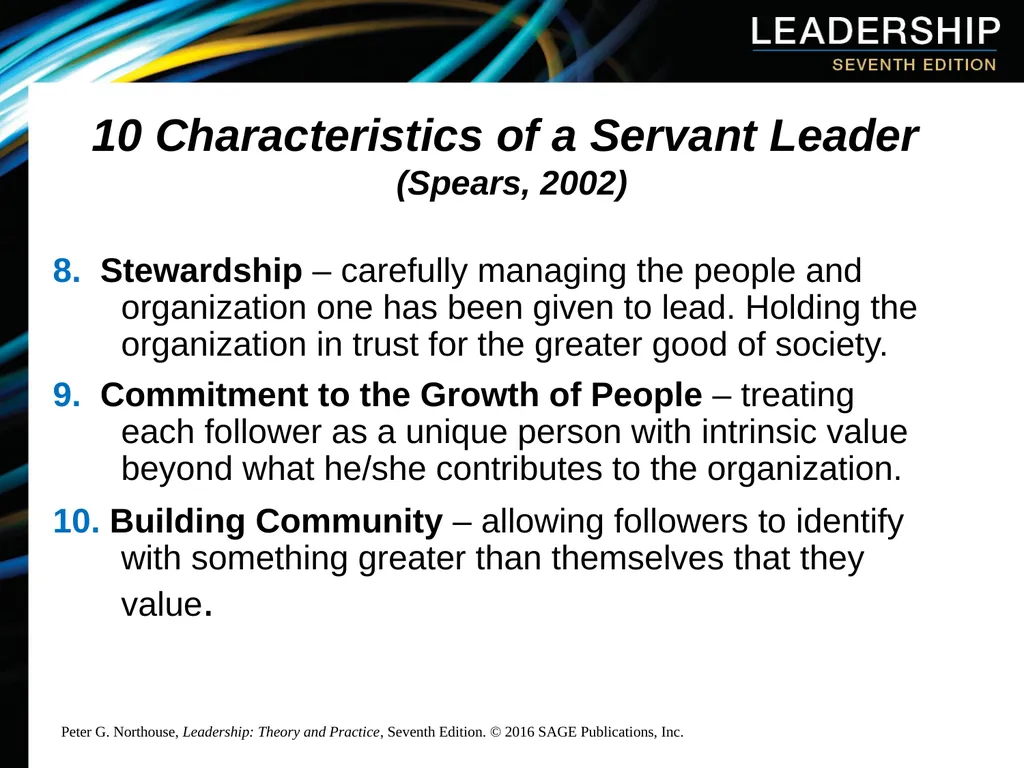
8. Stewardship – carefully managing the people and organization one has been given to lead. Holding the organization in trust for the greater good of society.
9. Commitment to the Growth of People – treating each follower as a unique person with intrinsic value beyond what he/she contributes to the organization.
10. Building Community – allowing followers to identify with something greater than themselves that they value. 10 Characteristics of a Servant Leader (Spears, 2002) Peter G. Northouse, Leadership: Theory and Practice, Seventh Edition. © 2016 SAGE Publications, Inc.<br>
9. Commitment to the Growth of People – treating each follower as a unique person with intrinsic value beyond what he/she contributes to the organization.
10. Building Community – allowing followers to identify with something greater than themselves that they value. 10 Characteristics of a Servant Leader (Spears, 2002) Peter G. Northouse, Leadership: Theory and Practice, Seventh Edition. © 2016 SAGE Publications, Inc.<br>
10
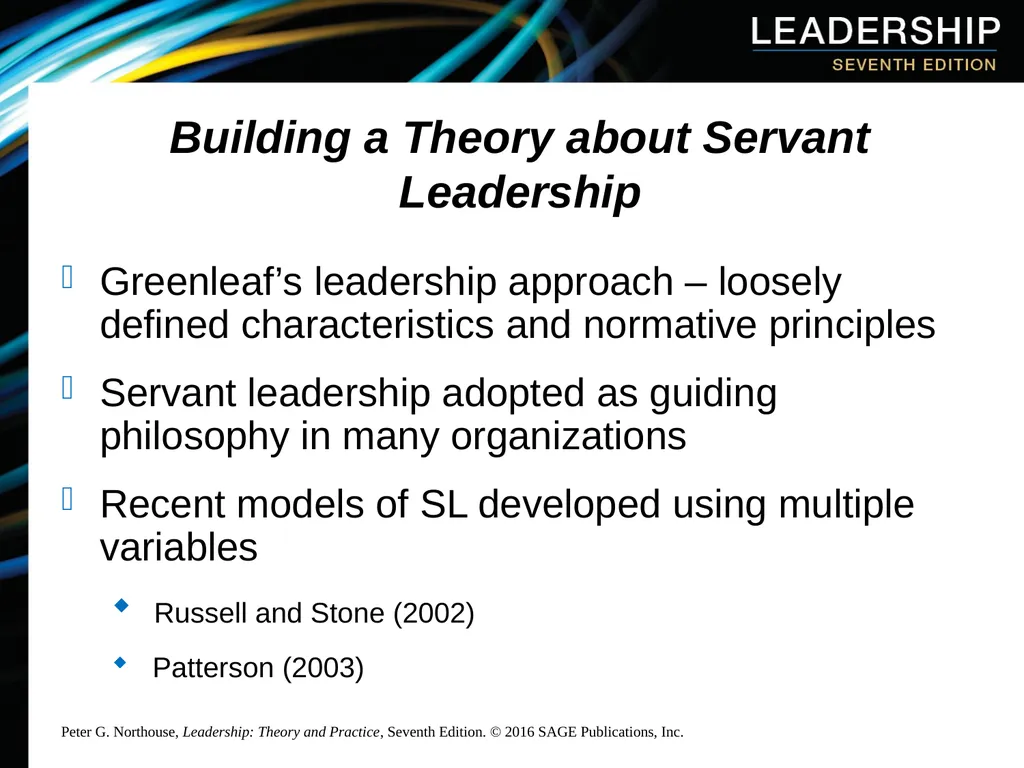
Building a Theory about Servant Leadership Greenleaf’s leadership approach – loosely defined characteristics and normative principles
Servant leadership adopted as guiding philosophy in many organizations
Recent models of SL developed using multiple variables
Russell and Stone (2002)
Patterson (2003) Peter G. Northouse, Leadership: Theory and Practice, Seventh Edition. © 2016 SAGE Publications, Inc.<br>
Servant leadership adopted as guiding philosophy in many organizations
Recent models of SL developed using multiple variables
Russell and Stone (2002)
Patterson (2003) Peter G. Northouse, Leadership: Theory and Practice, Seventh Edition. © 2016 SAGE Publications, Inc.<br>
11
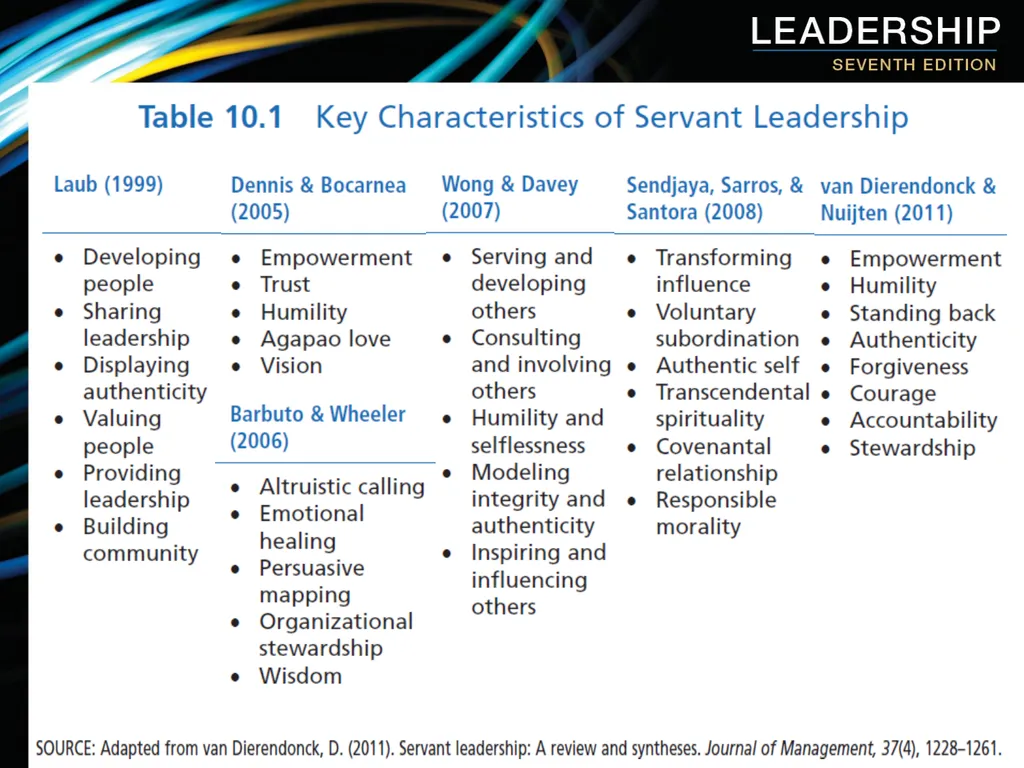
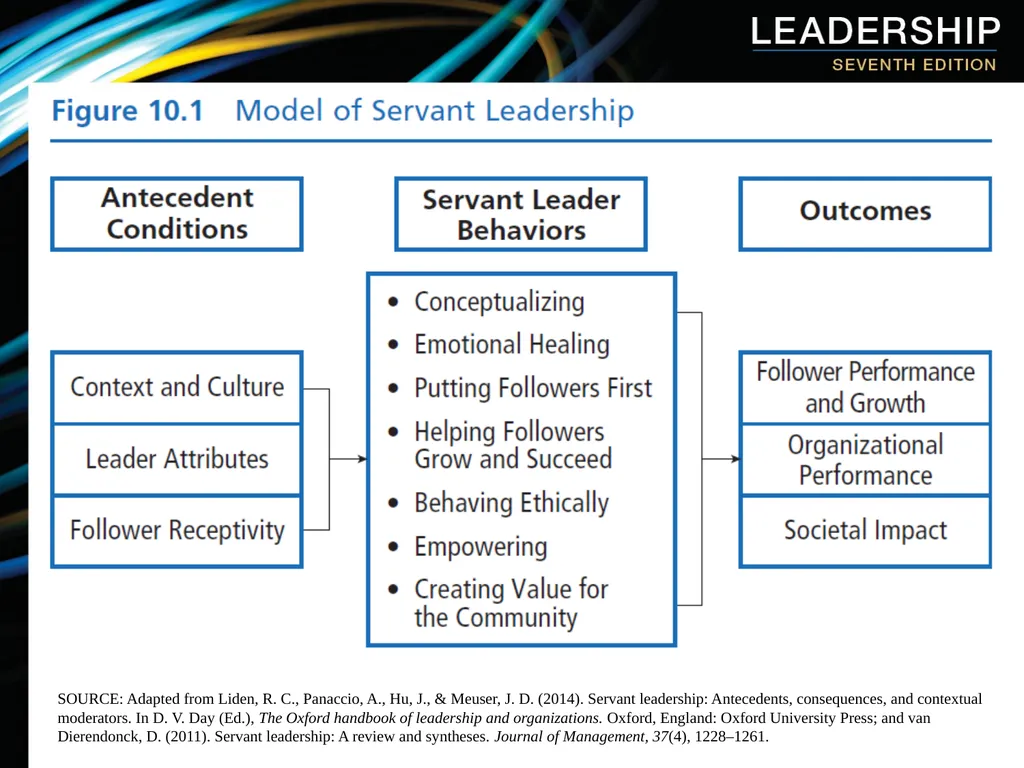
SOURCE: Adapted from Liden, R. C., Panaccio, A., Hu, J., & Meuser, J. D. (2014). Servant leadership: Antecedents, consequences, and contextual moderators. In D. V. Day (Ed.), The Oxford handbook of leadership and organizations. Oxford, England: Oxford University Press; and van Dierendonck, D. (2011). Servant leadership: A review and syntheses. Journal of Management, 37(4), 1228–1261.<br>
12
Model of Servant Leadership
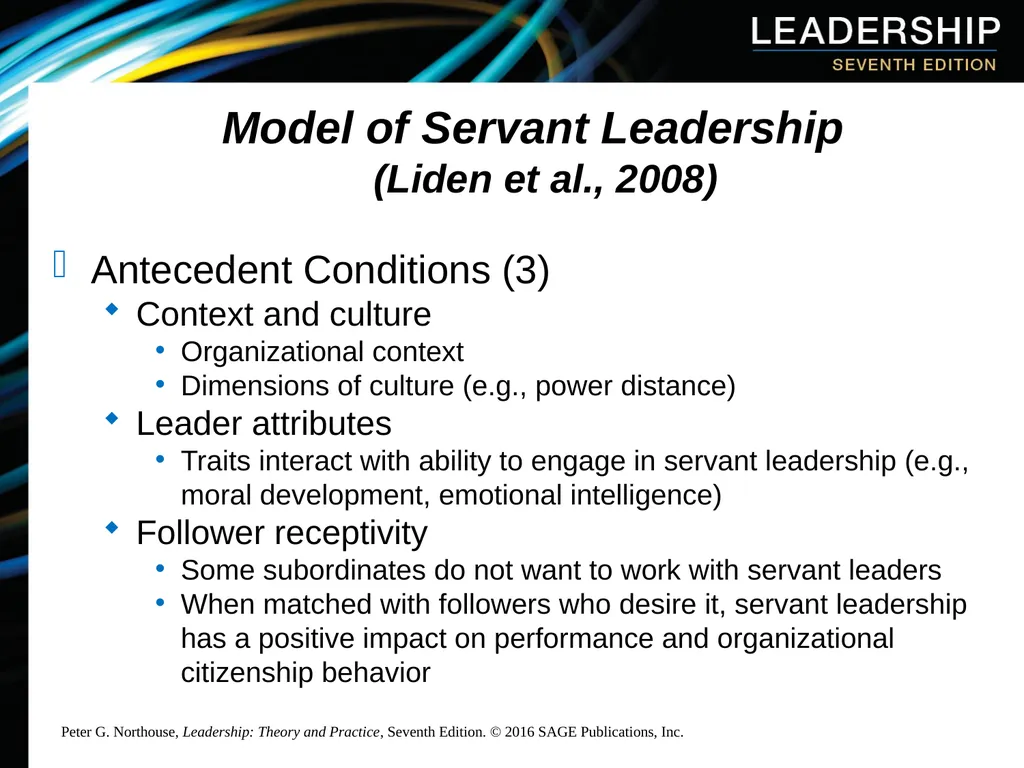
(Liden et al., 2008) Antecedent Conditions (3)
Context and culture
Organizational context
Dimensions of culture (e.g., power distance)
Leader attributes
Traits interact with ability to engage in servant leadership (e.g., moral development, emotional intelligence)
Follower receptivity
Some subordinates do not want to work with servant leaders
When matched with followers who desire it, servant leadership has a positive impact on performance and organizational citizenship behavior Peter G. Northouse, Leadership: Theory and Practice, Seventh Edition. © 2016 SAGE Publications, Inc.<br>
Context and culture
Organizational context
Dimensions of culture (e.g., power distance)
Leader attributes
Traits interact with ability to engage in servant leadership (e.g., moral development, emotional intelligence)
Follower receptivity
Some subordinates do not want to work with servant leaders
When matched with followers who desire it, servant leadership has a positive impact on performance and organizational citizenship behavior Peter G. Northouse, Leadership: Theory and Practice, Seventh Edition. © 2016 SAGE Publications, Inc.<br>
13
Servant Leader Behaviors (7)
Conceptualizing
Thorough understanding of the organization
Ex. Senior nursing supervisor in emergency room
Emotional healing
Recognizing others’ problems and taking the time to address them
Ex. Hospice priest on Chicago’s south side
Putting followers first
Ex. Widely published health education professor Model of Servant Leadership (Liden et al., 2008) Peter G. Northouse, Leadership: Theory and Practice, Seventh Edition. © 2016 SAGE Publications, Inc.<br>
Conceptualizing
Thorough understanding of the organization
Ex. Senior nursing supervisor in emergency room
Emotional healing
Recognizing others’ problems and taking the time to address them
Ex. Hospice priest on Chicago’s south side
Putting followers first
Ex. Widely published health education professor Model of Servant Leadership (Liden et al., 2008) Peter G. Northouse, Leadership: Theory and Practice, Seventh Edition. © 2016 SAGE Publications, Inc.<br>
14
Helping followers grow and succeed
Knowing followers’ professional or personal goals
Ex. High school music teacher
Behaving ethically
Doing the right thing in the right way
Ex. CEO and leaked document from rival company
Empowering
Allowing followers the freedom to be independent, make decisions on their own, and be self-sufficient
Ex. College professor with TAs Model of Servant Leadership (Liden et al., 2008) Peter G. Northouse, Leadership: Theory and Practice, Seventh Edition. © 2016 SAGE Publications, Inc.<br>
Knowing followers’ professional or personal goals
Ex. High school music teacher
Behaving ethically
Doing the right thing in the right way
Ex. CEO and leaked document from rival company
Empowering
Allowing followers the freedom to be independent, make decisions on their own, and be self-sufficient
Ex. College professor with TAs Model of Servant Leadership (Liden et al., 2008) Peter G. Northouse, Leadership: Theory and Practice, Seventh Edition. © 2016 SAGE Publications, Inc.<br>
15
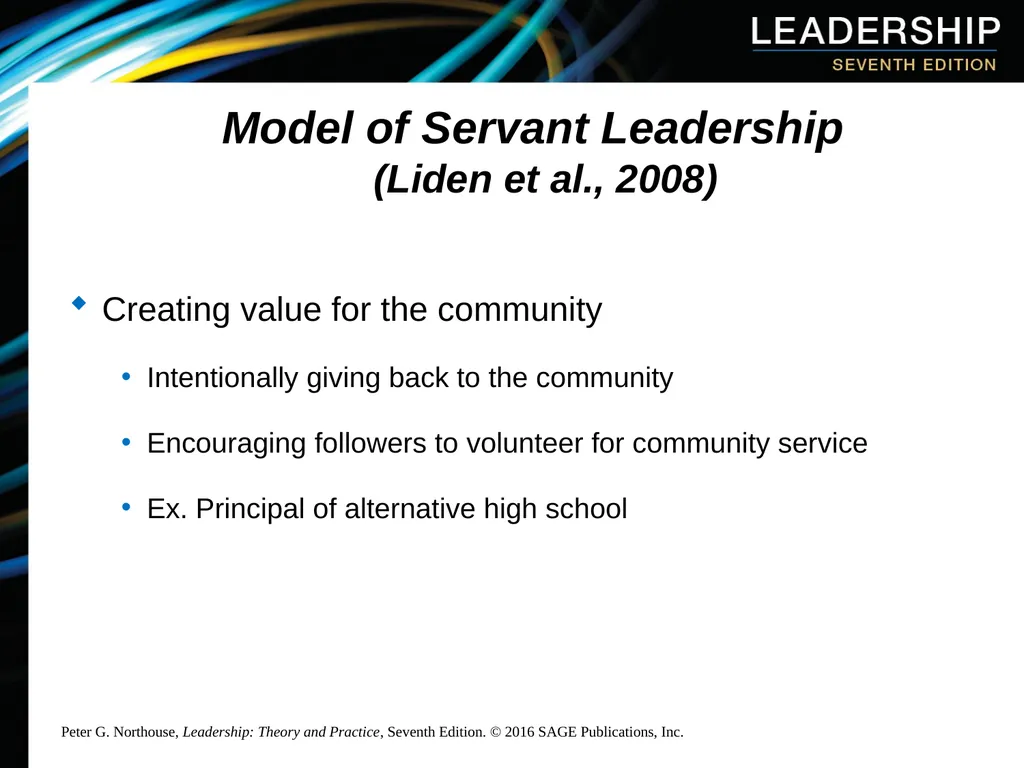
Creating value for the community
Intentionally giving back to the community
Encouraging followers to volunteer for community service
Ex. Principal of alternative high school Model of Servant Leadership (Liden et al., 2008) Peter G. Northouse, Leadership: Theory and Practice, Seventh Edition. © 2016 SAGE Publications, Inc.<br>
Intentionally giving back to the community
Encouraging followers to volunteer for community service
Ex. Principal of alternative high school Model of Servant Leadership (Liden et al., 2008) Peter G. Northouse, Leadership: Theory and Practice, Seventh Edition. © 2016 SAGE Publications, Inc.<br>
16
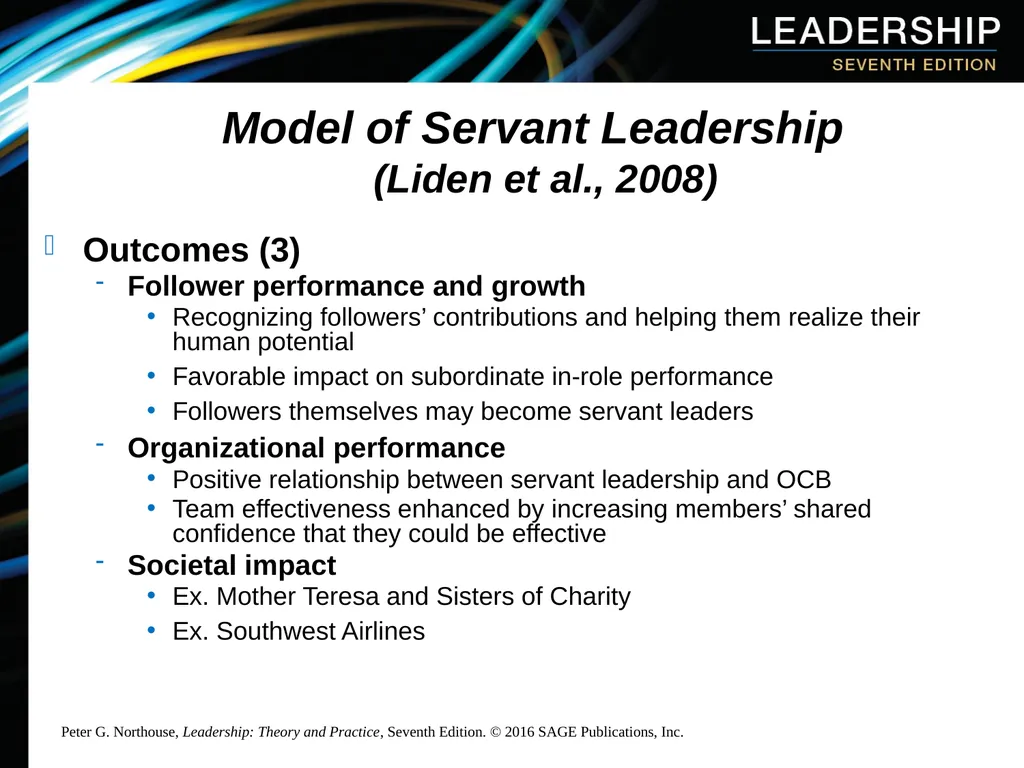
Outcomes (3)
Follower performance and growth
Recognizing followers’ contributions and helping them realize their human potential
Favorable impact on subordinate in-role performance
Followers themselves may become servant leaders
Organizational performance
Positive relationship between servant leadership and OCB
Team effectiveness enhanced by increasing members’ shared confidence that they could be effective
Societal impact
Ex. Mother Teresa and Sisters of Charity
Ex. Southwest Airlines Model of Servant Leadership (Liden et al., 2008) Peter G. Northouse, Leadership: Theory and Practice, Seventh Edition. © 2016 SAGE Publications, Inc.<br>
Follower performance and growth
Recognizing followers’ contributions and helping them realize their human potential
Favorable impact on subordinate in-role performance
Followers themselves may become servant leaders
Organizational performance
Positive relationship between servant leadership and OCB
Team effectiveness enhanced by increasing members’ shared confidence that they could be effective
Societal impact
Ex. Mother Teresa and Sisters of Charity
Ex. Southwest Airlines Model of Servant Leadership (Liden et al., 2008) Peter G. Northouse, Leadership: Theory and Practice, Seventh Edition. © 2016 SAGE Publications, Inc.<br>
17
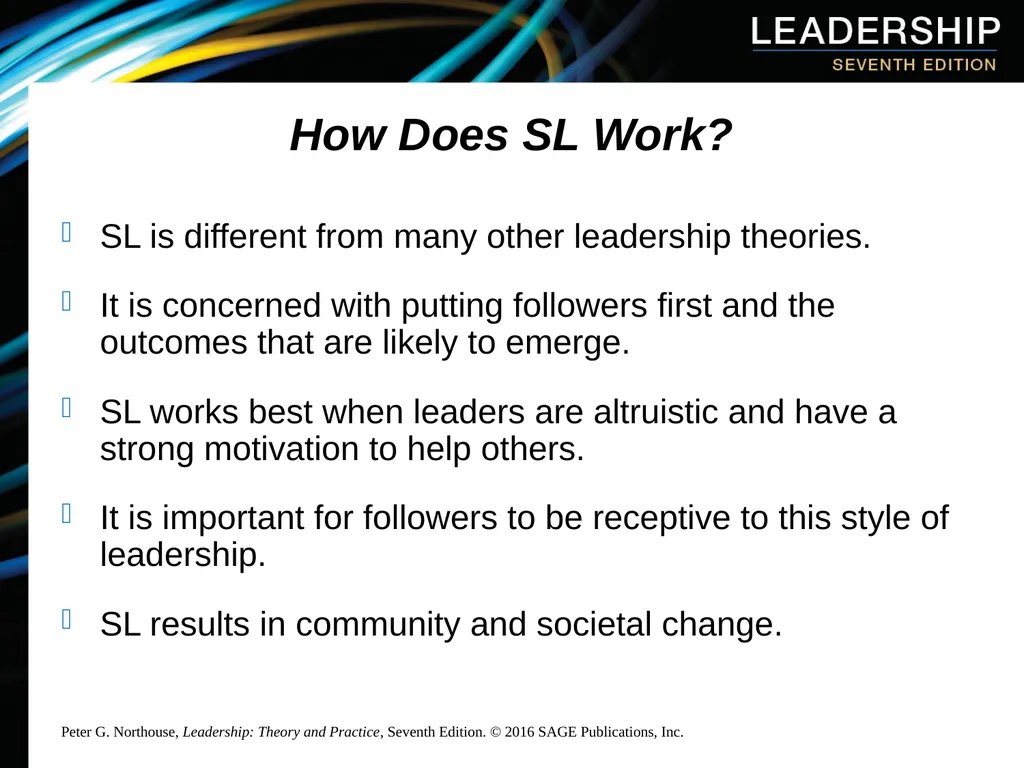
How Does SL Work? SL is different from many other leadership theories.
It is concerned with putting followers first and the outcomes that are likely to emerge.
SL works best when leaders are altruistic and have a strong motivation to help others.
It is important for followers to be receptive to this style of leadership.
SL results in community and societal change. Peter G. Northouse, Leadership: Theory and Practice, Seventh Edition. © 2016 SAGE Publications, Inc.<br>
It is concerned with putting followers first and the outcomes that are likely to emerge.
SL works best when leaders are altruistic and have a strong motivation to help others.
It is important for followers to be receptive to this style of leadership.
SL results in community and societal change. Peter G. Northouse, Leadership: Theory and Practice, Seventh Edition. © 2016 SAGE Publications, Inc.<br>
18
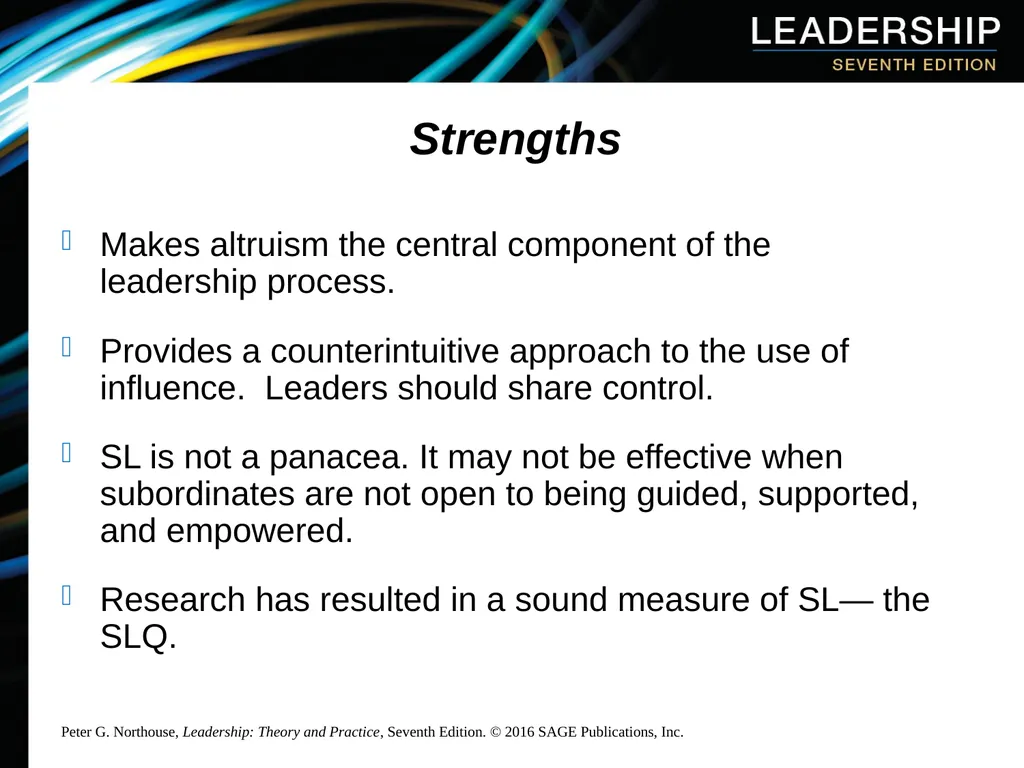
Strengths Makes altruism the central component of the leadership process.
Provides a counterintuitive approach to the use of influence. Leaders should share control.
SL is not a panacea. It may not be effective when subordinates are not open to being guided, supported, and empowered.
Research has resulted in a sound measure of SL— the SLQ. Peter G. Northouse, Leadership: Theory and Practice, Seventh Edition. © 2016 SAGE Publications, Inc.<br>
Provides a counterintuitive approach to the use of influence. Leaders should share control.
SL is not a panacea. It may not be effective when subordinates are not open to being guided, supported, and empowered.
Research has resulted in a sound measure of SL— the SLQ. Peter G. Northouse, Leadership: Theory and Practice, Seventh Edition. © 2016 SAGE Publications, Inc.<br>
19
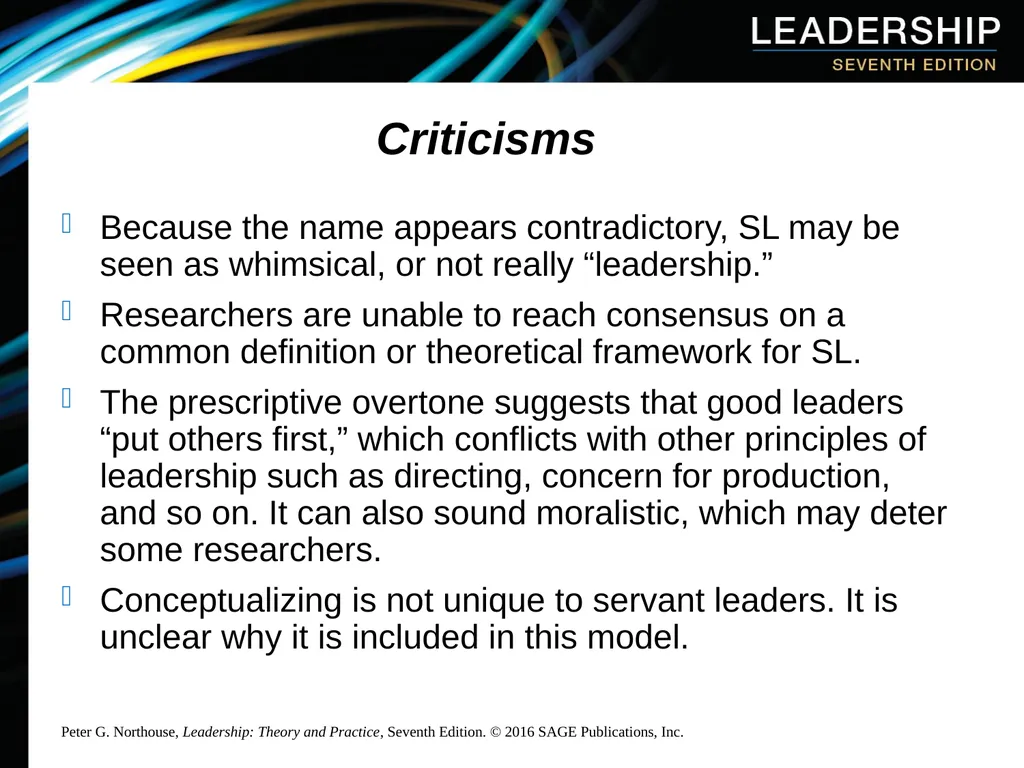
Criticisms Because the name appears contradictory, SL may be seen as whimsical, or not really “leadership.”
Researchers are unable to reach consensus on a common definition or theoretical framework for SL.
The prescriptive overtone suggests that good leaders “put others first,” which conflicts with other principles of leadership such as directing, concern for production, and so on. It can also sound moralistic, which may deter some researchers.
Conceptualizing is not unique to servant leaders. It is unclear why it is included in this model. Peter G. Northouse, Leadership: Theory and Practice, Seventh Edition. © 2016 SAGE Publications, Inc.<br>
Researchers are unable to reach consensus on a common definition or theoretical framework for SL.
The prescriptive overtone suggests that good leaders “put others first,” which conflicts with other principles of leadership such as directing, concern for production, and so on. It can also sound moralistic, which may deter some researchers.
Conceptualizing is not unique to servant leaders. It is unclear why it is included in this model. Peter G. Northouse, Leadership: Theory and Practice, Seventh Edition. © 2016 SAGE Publications, Inc.<br>
20
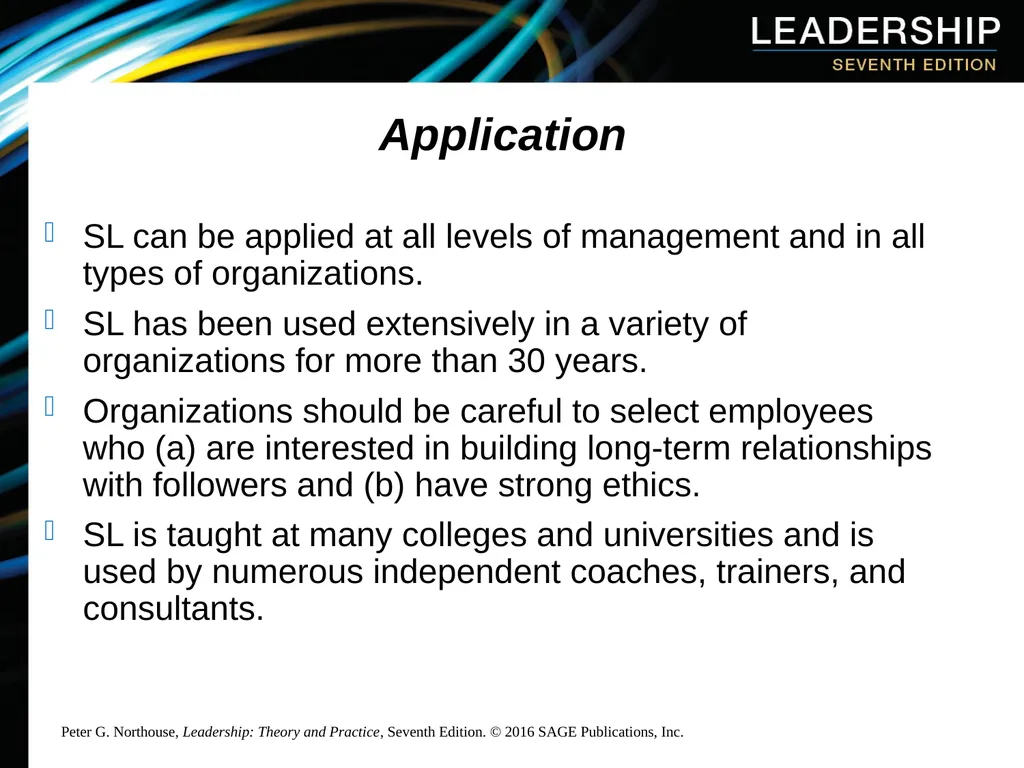
Application SL can be applied at all levels of management and in all types of organizations.
SL has been used extensively in a variety of organizations for more than 30 years.
Organizations should be careful to select employees who (a) are interested in building long-term relationships with followers and (b) have strong ethics.
SL is taught at many colleges and universities and is used by numerous independent coaches, trainers, and consultants. Peter G. Northouse, Leadership: Theory and Practice, Seventh Edition. © 2016 SAGE Publications, Inc.<br>
SL has been used extensively in a variety of organizations for more than 30 years.
Organizations should be careful to select employees who (a) are interested in building long-term relationships with followers and (b) have strong ethics.
SL is taught at many colleges and universities and is used by numerous independent coaches, trainers, and consultants. Peter G. Northouse, Leadership: Theory and Practice, Seventh Edition. © 2016 SAGE Publications, Inc.<br>